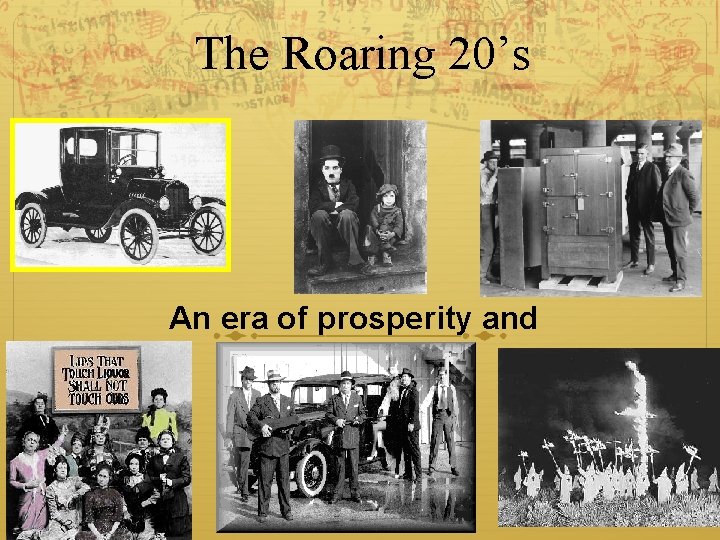
The Roaring 20s An era of prosperity and



- Slides: 90
The Roaring 20’s An era of prosperity and conflict
Essential Question: To what extent did Republican dominance in the 1920 s represent a change from Gilded Age & Progressive politics?
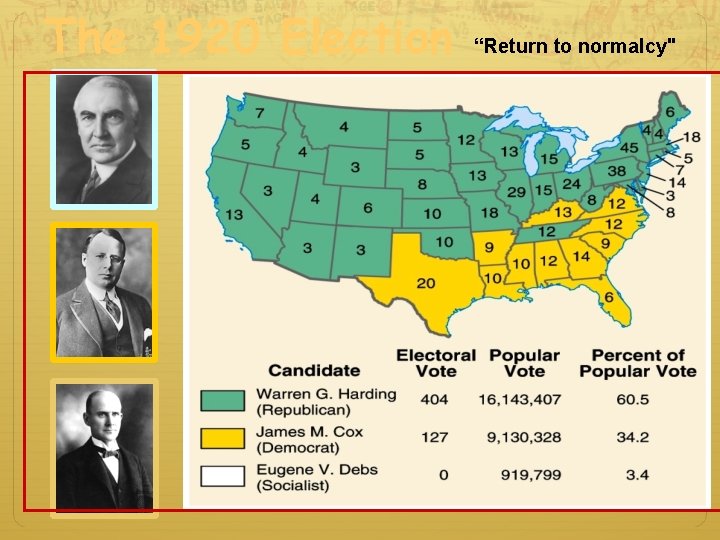
The 1920 Election “Return to normalcy"
Politics of the 1920 s The 1920 s were dominated by Republicans in the White House & in both houses of Congress: Wilson’s idealism and Treaty of Versailles led many Americans to vote for the Republican, Warren Harding… Limited Progressive reforms Developed a close relationship between the gov’t & business that promoted private enterprise Advocated a foreign policy based on economic investment of U. S. business in the world
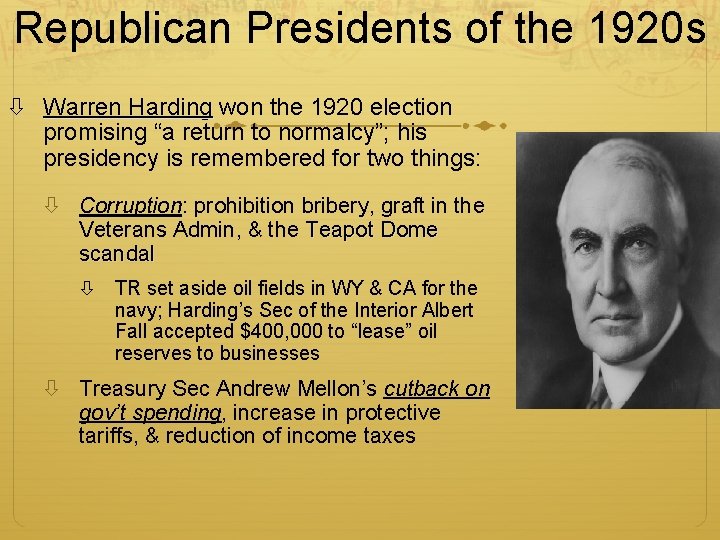
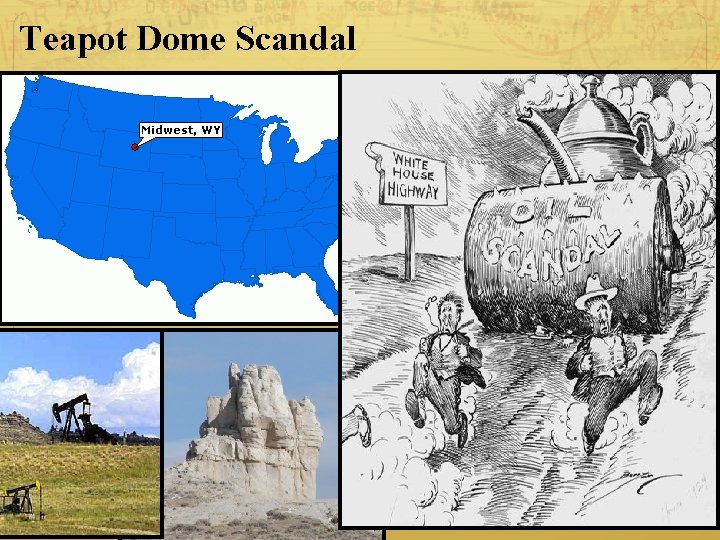
Republican Presidents of the 1920 s Warren Harding won the 1920 election promising “a return to normalcy”; his presidency is remembered for two things: Corruption: prohibition bribery, graft in the Veterans Admin, & the Teapot Dome scandal TR set aside oil fields in WY & CA for the navy; Harding’s Sec of the Interior Albert Fall accepted $400, 000 to “lease” oil reserves to businesses Treasury Sec Andrew Mellon’s cutback on gov’t spending, increase in protective tariffs, & reduction of income taxes
Teapot Dome Scandal
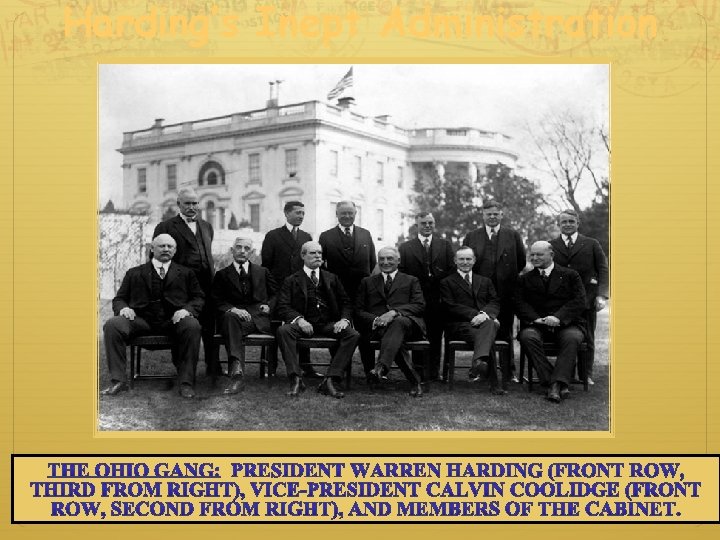
Harding’s Inept Administration
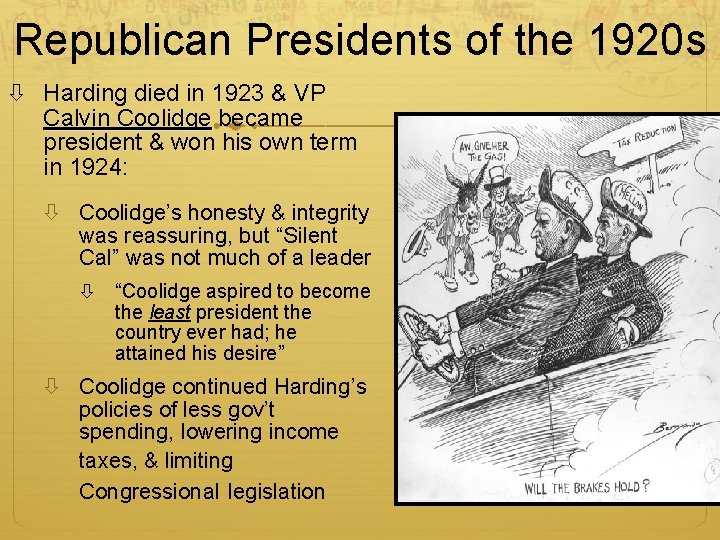
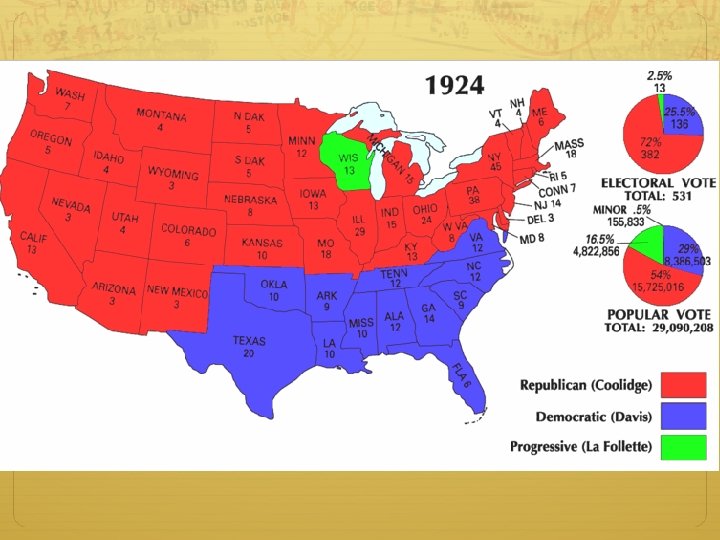
Republican Presidents of the 1920 s Harding died in 1923 & VP Calvin Coolidge became president & won his own term in 1924: Coolidge’s honesty & integrity was reassuring, but “Silent Cal” was not much of a leader “Coolidge aspired to become the least president the country ever had; he attained his desire” Coolidge continued Harding’s policies of less gov’t spending, lowering income taxes, & limiting Congressional legislation
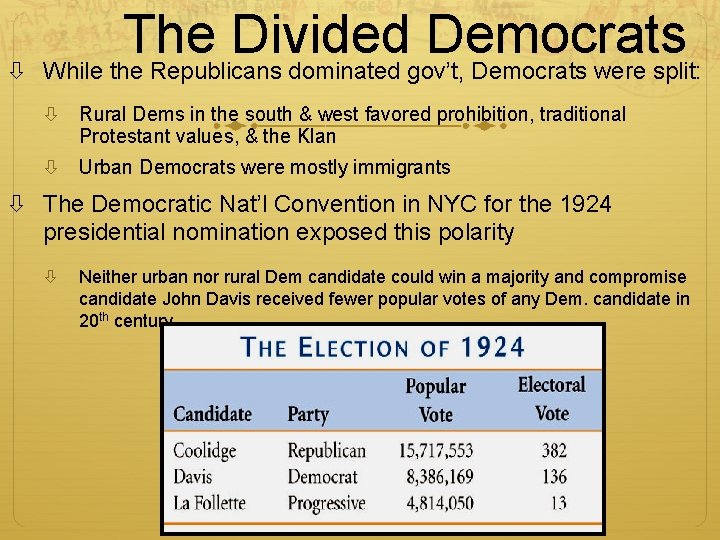
The Divided Democrats While the Republicans dominated gov’t, Democrats were split: Rural Dems in the south & west favored prohibition, traditional Protestant values, & the Klan Urban Democrats were mostly immigrants The Democratic Nat’l Convention in NYC for the 1924 presidential nomination exposed this polarity Neither urban nor rural Dem candidate could win a majority and compromise candidate John Davis received fewer popular votes of any Dem. candidate in 20 th century
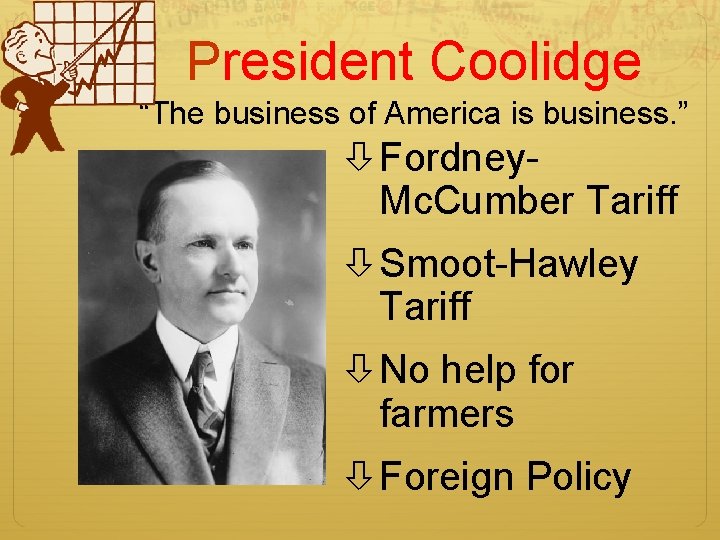
President Coolidge “The business of America is business. ” Fordney. Mc. Cumber Tariff Smoot-Hawley Tariff No help for farmers Foreign Policy
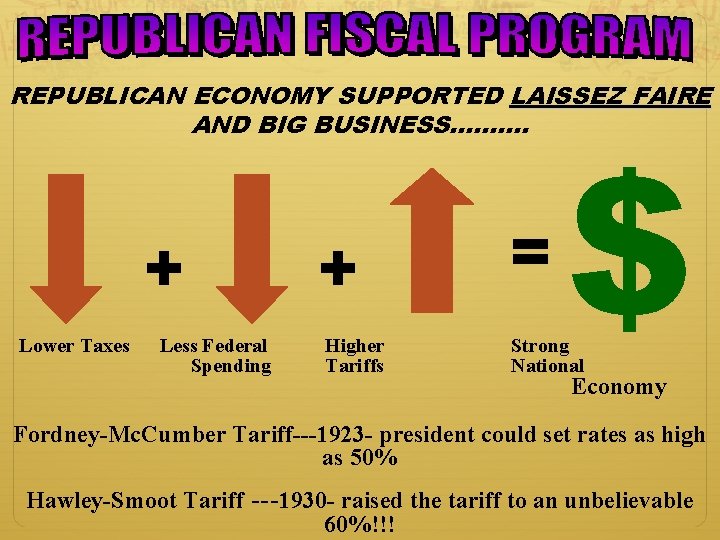
REPUBLICAN ECONOMY SUPPORTED LAISSEZ FAIRE AND BIG BUSINESS………. + Lower Taxes Less Federal Spending + Higher Tariffs = $ Strong National Economy Fordney-Mc. Cumber Tariff---1923 - president could set rates as high as 50% Hawley-Smoot Tariff ---1930 - raised the tariff to an unbelievable 60%!!!
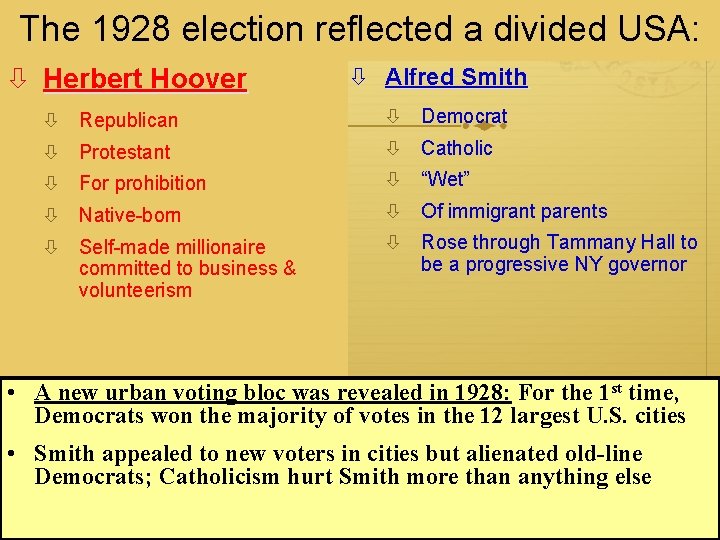
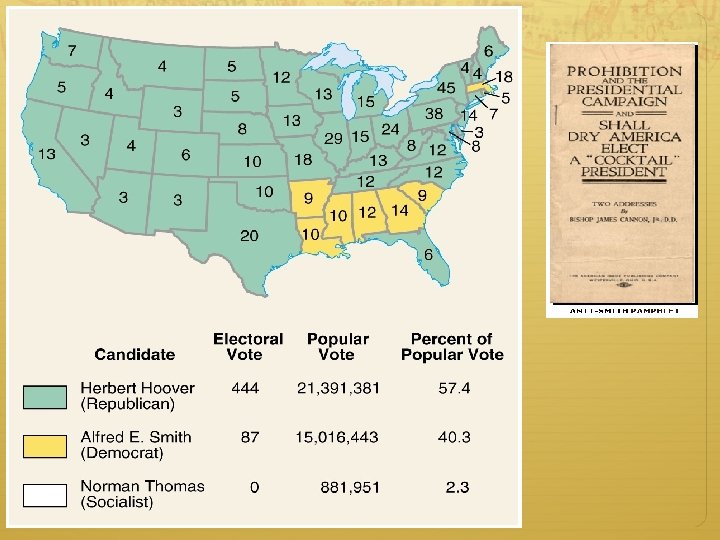
The 1928 election reflected a divided USA: Herbert Hoover Alfred Smith Republican Democrat Protestant Catholic For prohibition “Wet” Native-born Of immigrant parents Self-made millionaire committed to business & volunteerism Rose through Tammany Hall to be a progressive NY governor • A new urban voting bloc was revealed in 1928: For the 1 st time, Democrats won the majority of votes in the 12 largest U. S. cities • Smith appealed to new voters in cities but alienated old-line Democrats; Catholicism hurt Smith more than anything else
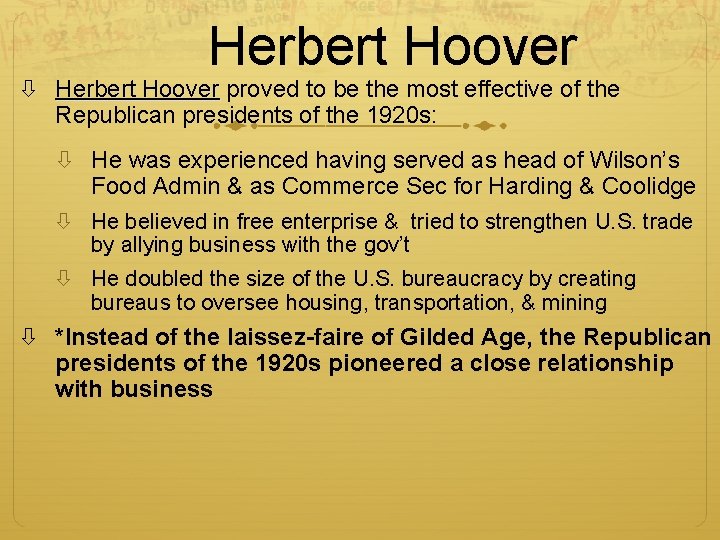
Herbert Hoover proved to be the most effective of the Republican presidents of the 1920 s: He was experienced having served as head of Wilson’s Food Admin & as Commerce Sec for Harding & Coolidge He believed in free enterprise & tried to strengthen U. S. trade by allying business with the gov’t He doubled the size of the U. S. bureaucracy by creating bureaus to oversee housing, transportation, & mining *Instead of the laissez-faire of Gilded Age, the Republican presidents of the 1920 s pioneered a close relationship with business
1920’s Economic and Cultural Changes
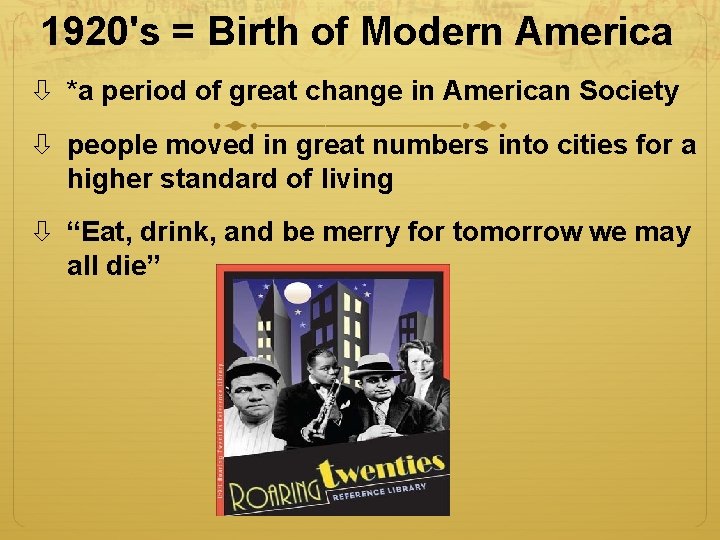
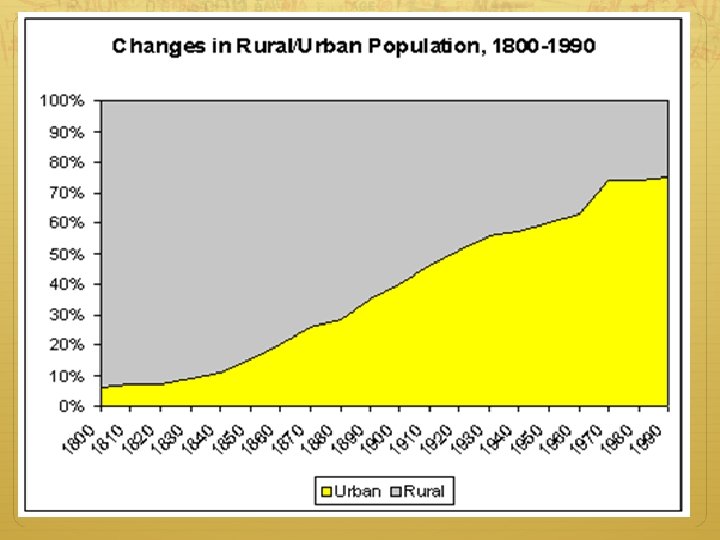
1920's = Birth of Modern America *a period of great change in American Society people moved in great numbers into cities for a higher standard of living “Eat, drink, and be merry for tomorrow we may all die”
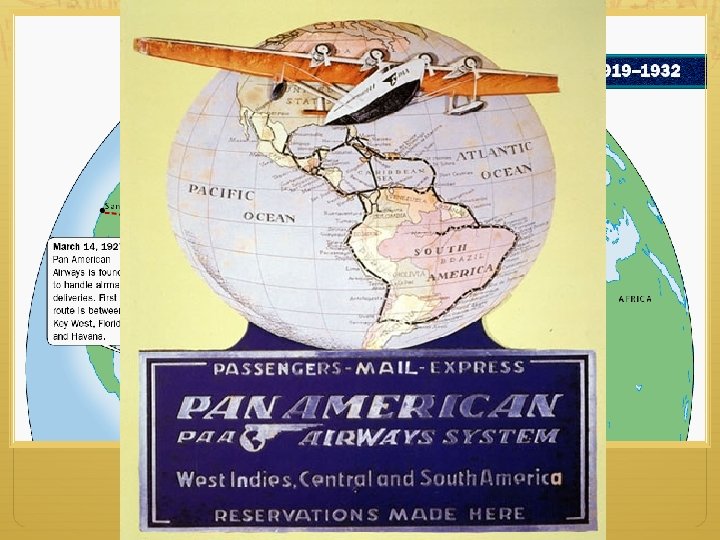
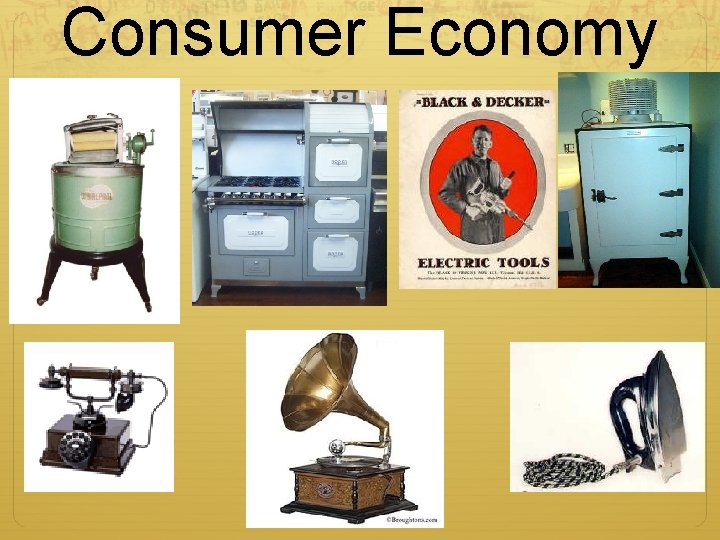
The New Industrial Revolution *U. S. develops the highest standard of living in the world *new technological revolution Mostly in consumer durable goods like appliances, cars, radios, furniture, & clothing Electricity replaced steam power Corporations used salaried executives, plant managers, & engineers to increase efficiency Henry Ford’s assembly line introduced *Rise of the airline industry (Pan-Am) *Modern appliances begin to change American society
The New Industrial Revolution To stop the growth of labor unions companies used welfare capitalism Offered employees stock, house-purchase, & insurance options Used an “open shop” shop & offered non-union workers the same rights that unions gained After WWI, the federal gov’t & Supreme Court reverted back to a pro-business stance
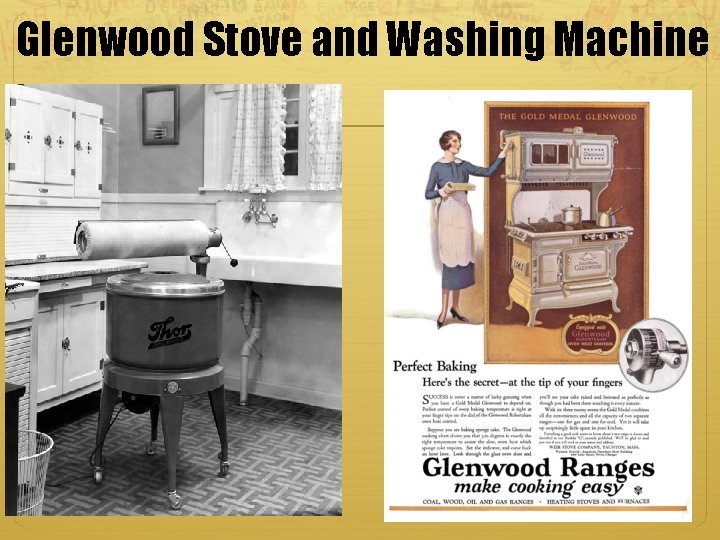
Glenwood Stove and Washing Machine
Consumer Economy
The Roaring 20 s Video Analysis Draw A T-Chart Label One side “Progress” Label the Other Side “Conflict” Gather evidence from the Film to help you determine if the 1920 s was an age of PROGRESS or CONFLICT. Be ready to discuss with your partner and the class
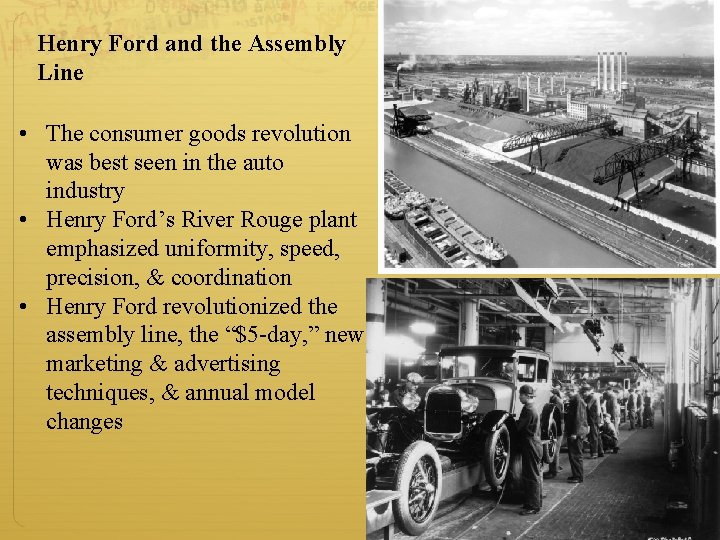
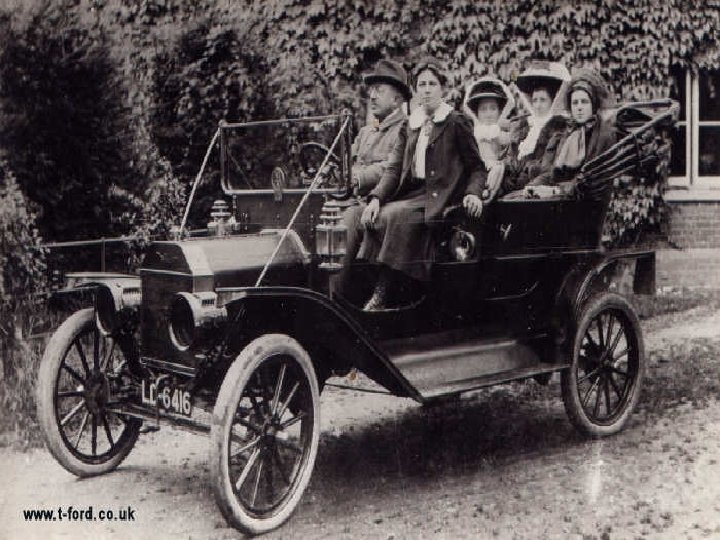
Henry Ford and the Assembly Line • The consumer goods revolution was best seen in the auto industry • Henry Ford’s River Rouge plant emphasized uniformity, speed, precision, & coordination • Henry Ford revolutionized the assembly line, the “$5 -day, ” new marketing & advertising techniques, & annual model changes
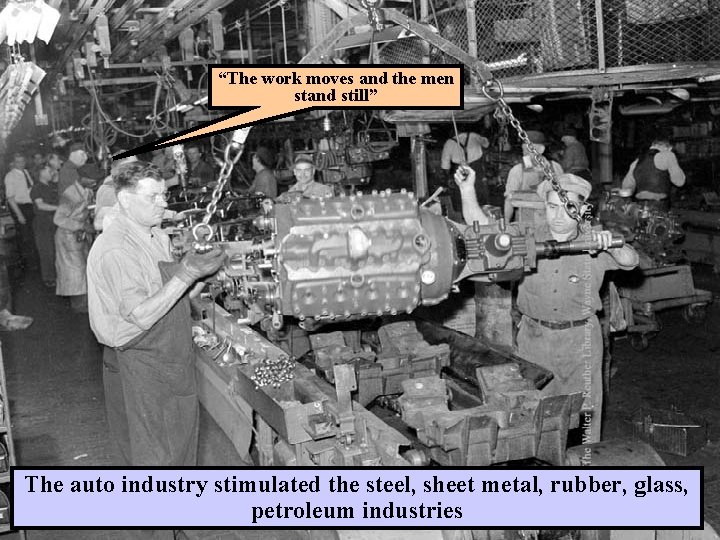
Henry Ford revolutionized the assembly The consumer goods revolution line, the “$5 -day, ” new marketing & “The work moves and the men was best seen in the auto stand still” advertising techniques, industry& annual model changes Henry Ford’s River Rouge plant The auto industry stimulated the steel, sheet metal, rubber, glass, emphasized uniformity, speed, precision, petroleum industries
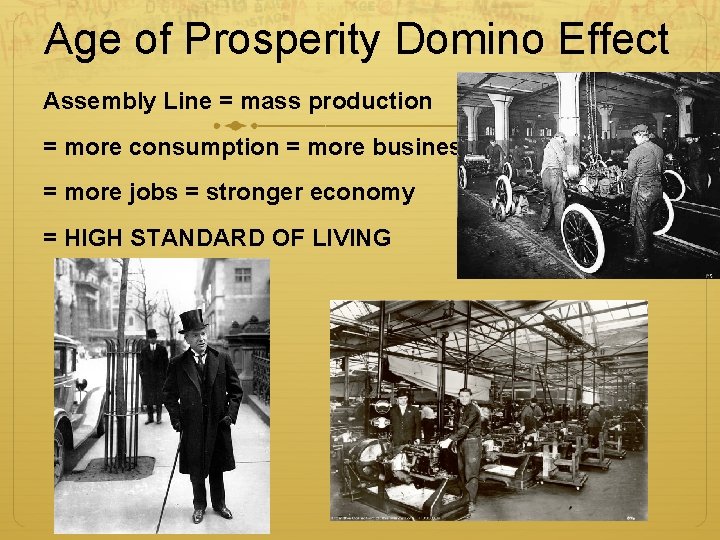
Age of Prosperity Domino Effect Assembly Line = mass production = more consumption = more business = more jobs = stronger economy = HIGH STANDARD OF LIVING
The auto industry led to the construction of roads & new filling stations…
Economic Weaknesses The “Roaring 20 s” was not as prosperous as it appeared: RR, cotton textile, coal industries suffered due to new competition Farmers boomed during WWI but a decline in demand after the war deflated farm prices Farm per capita income was $273 per year vs. the U. S. average of $681 per year
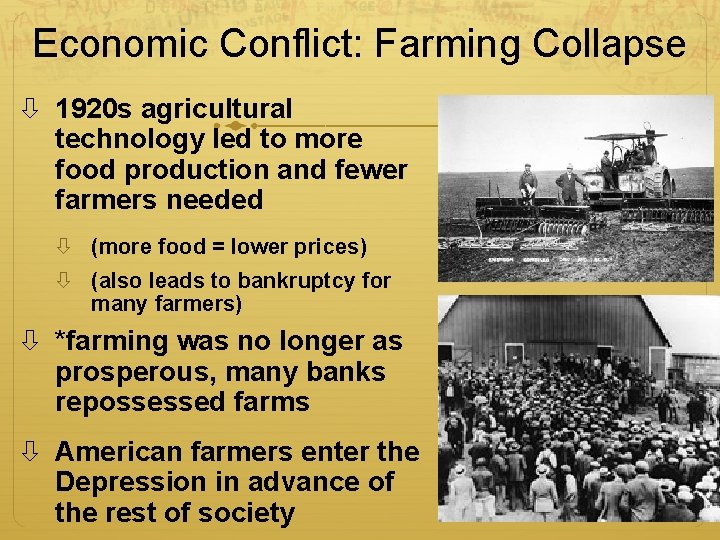
Economic Conflict: Farming Collapse 1920 s agricultural technology led to more food production and fewer farmers needed (more food = lower prices) (also leads to bankruptcy for many farmers) *farming was no longer as prosperous, many banks repossessed farms American farmers enter the Depression in advance of the rest of society
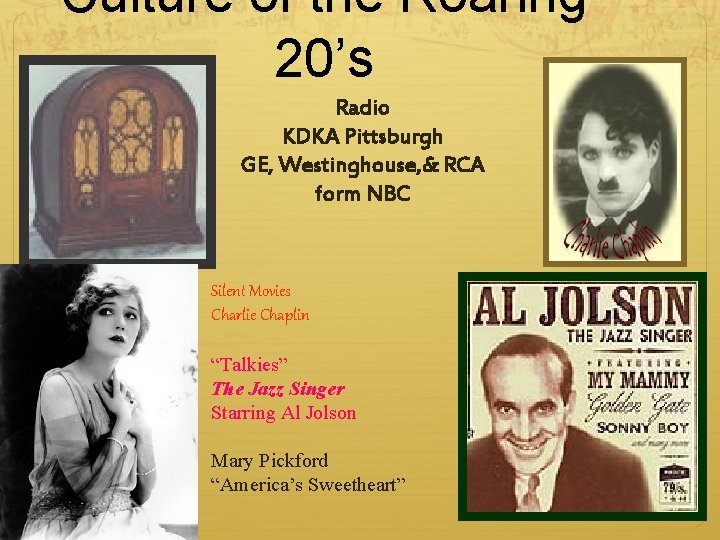
Culture of the Roaring 20’s Radio KDKA Pittsburgh GE, Westinghouse, & RCA form NBC Silent Movies Charlie Chaplin “Talkies” The Jazz Singer Starring Al Jolson Mary Pickford “America’s Sweetheart”
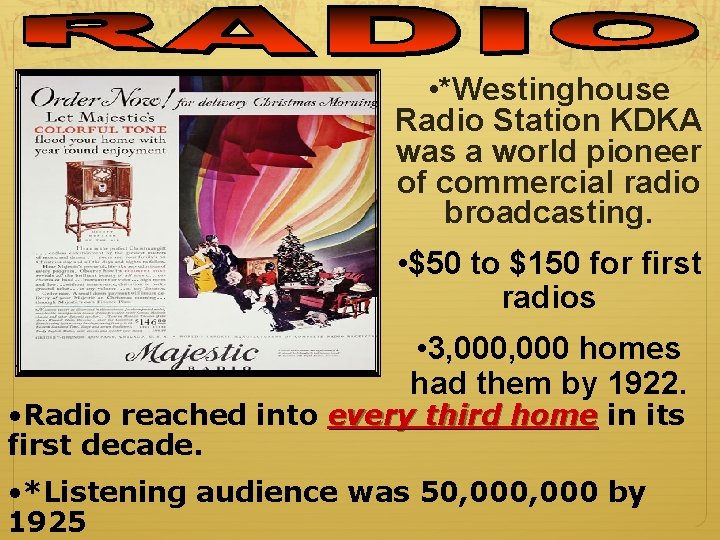
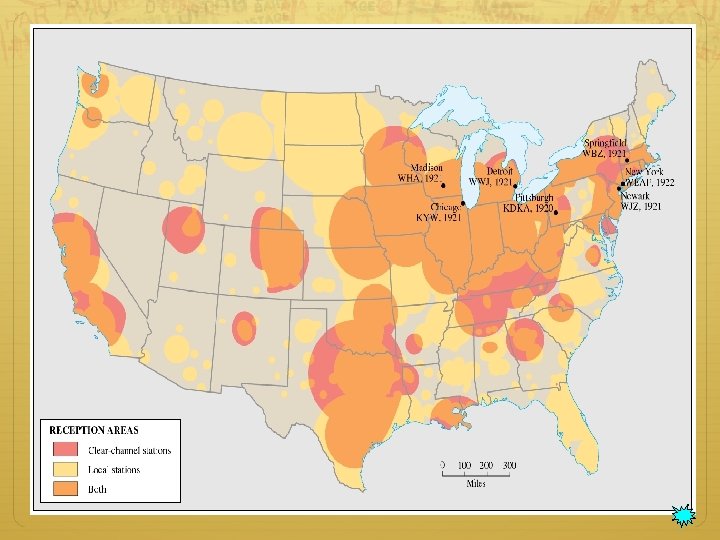
• *Westinghouse Radio Station KDKA was a world pioneer of commercial radio broadcasting. • $50 to $150 for first radios • 3, 000 homes had them by 1922. • Radio reached into every third home in its first decade. • *Listening audience was 50, 000 by 1925
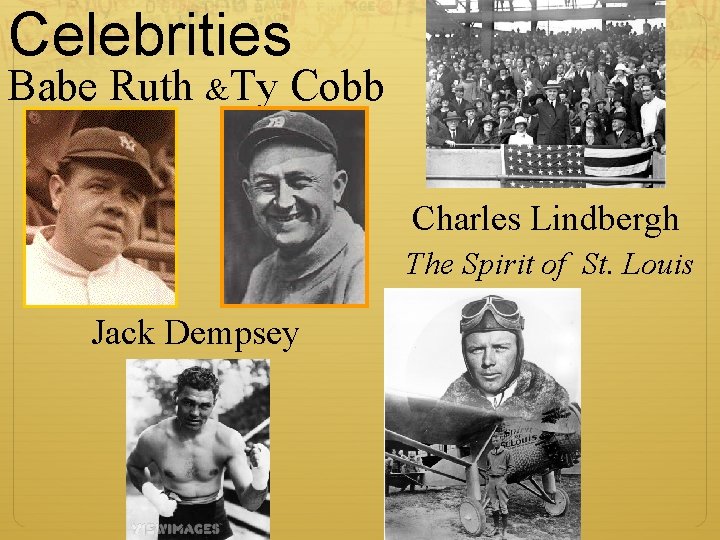
Celebrities Babe Ruth &Ty Cobb Charles Lindbergh The Spirit of St. Louis Jack Dempsey
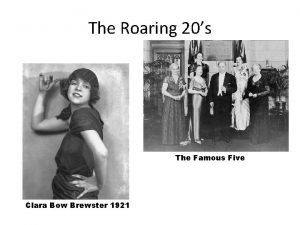
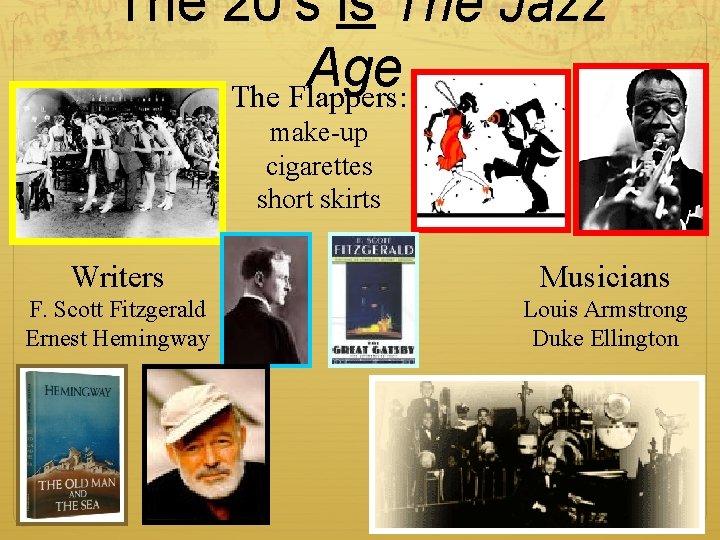
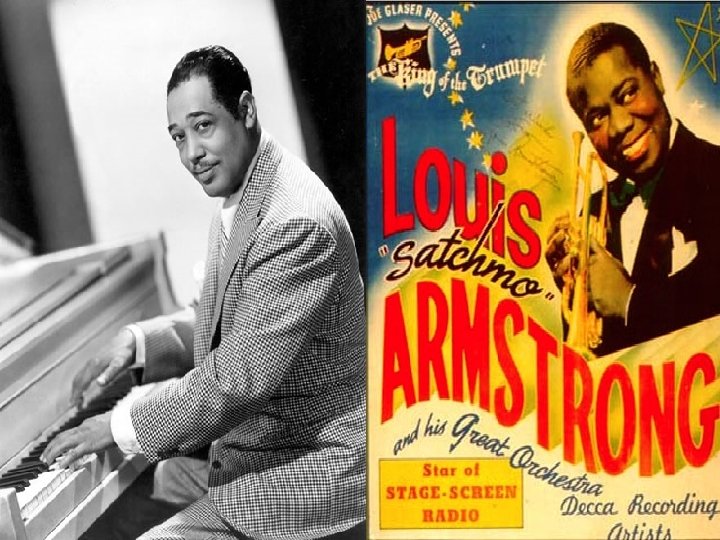
The 20’s is The Jazz Age The Flappers: make-up cigarettes short skirts Writers Musicians F. Scott Fitzgerald Ernest Hemingway Louis Armstrong Duke Ellington
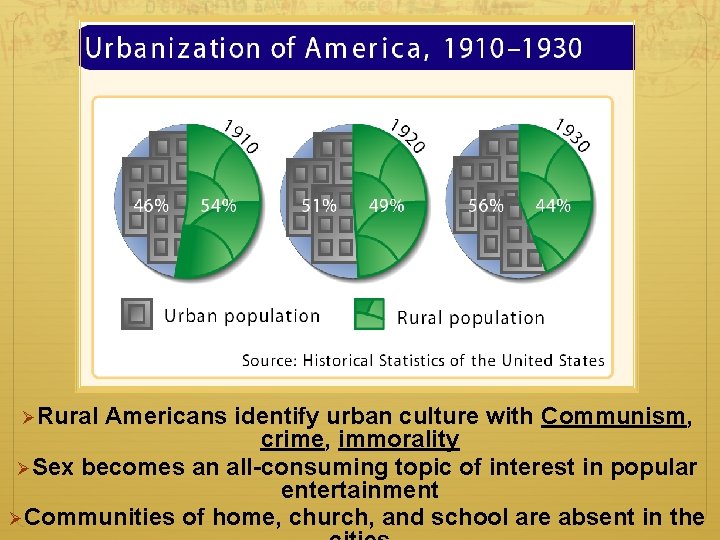
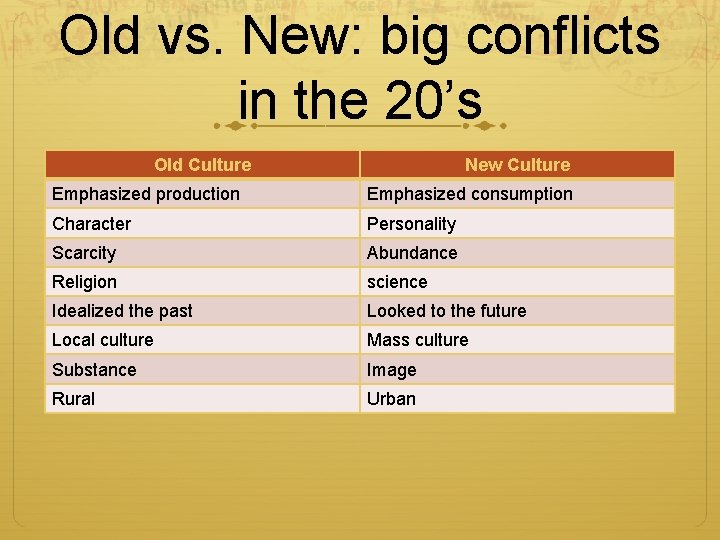
The Old and the New Urban culture & industrial production dominated the 1920 s: Mass-produced consumer goods, mass media, advertising spread a new American culture Much to the dismay of a rural America trying to cling to traditional values Progressive reforms were no match for technology & prosperity
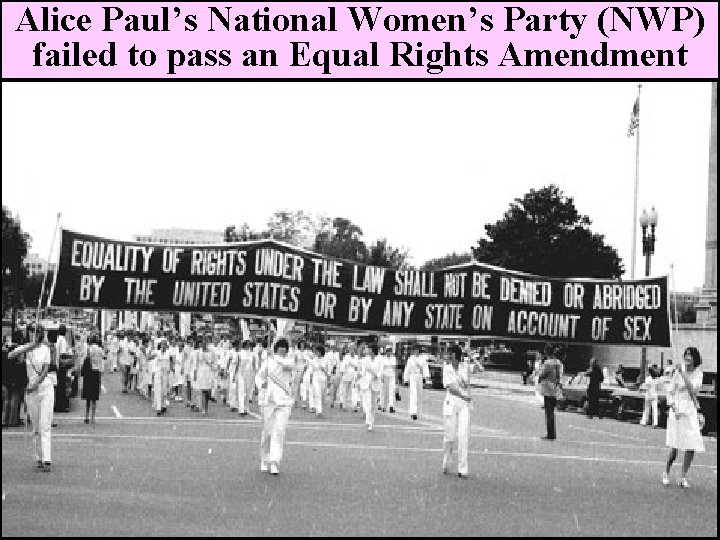
Alice Paul’s National Women’s Party (NWP) failed to pass an Equal Rights Amendment
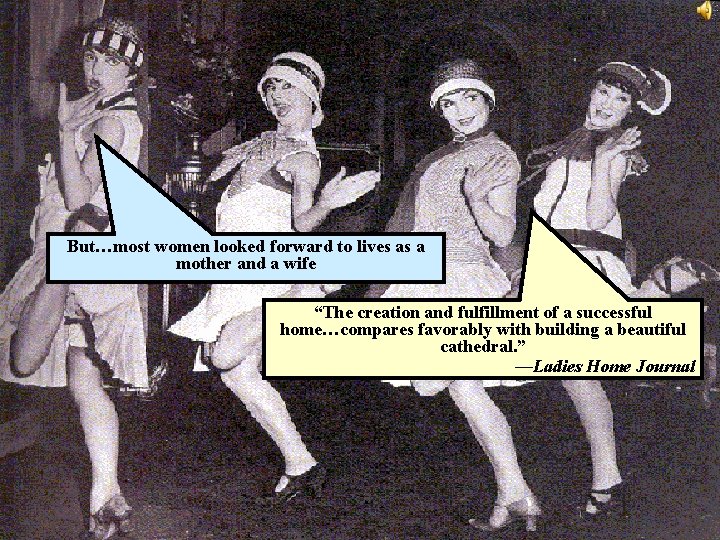
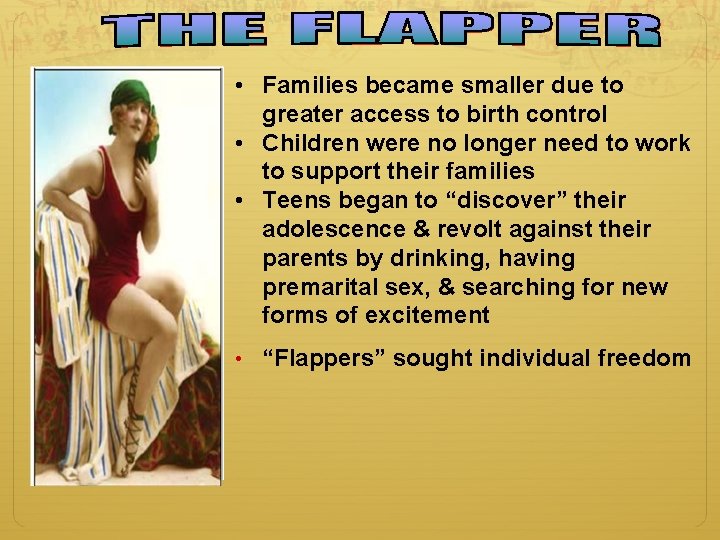
Women andagainst the Family “Flappers” rebelled Victorian customs Divorce rates doubled But…most women looked forward to lives as a mother and a wife “The creation and fulfillment of a successful home…compares favorably with building a beautiful cathedral. ” —Ladies Home Journal
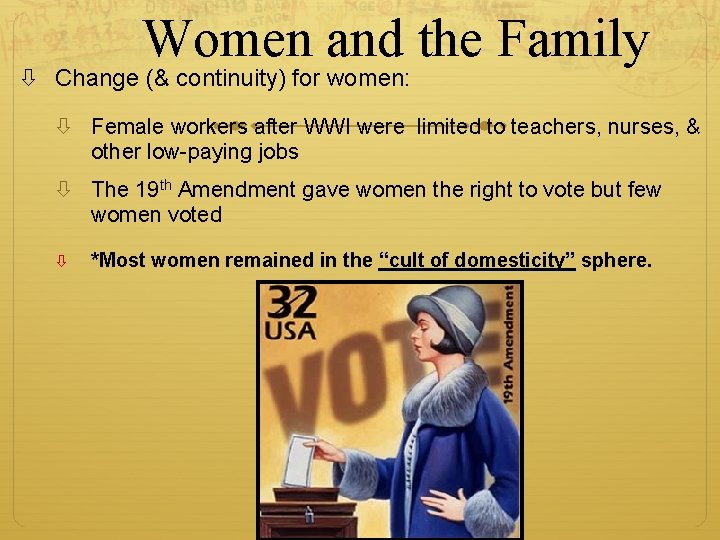
Women and the Family Change (& continuity) for women: Female workers after WWI were limited to teachers, nurses, & other low-paying jobs The 19 th Amendment gave women the right to vote but few women voted *Most women remained in the “cult of domesticity” sphere.
• Families became smaller due to greater access to birth control • Children were no longer need to work to support their families • Teens began to “discover” their adolescence & revolt against their parents by drinking, having premarital sex, & searching for new forms of excitement • “Flappers” sought individual freedom
Closure Activity: The Long Road to Women’s Suffrage What was a typical woman’s role in each era in American history? Colonial life Revolutionary era Antebellum South 19 th century “sphere” & reform Progressive era
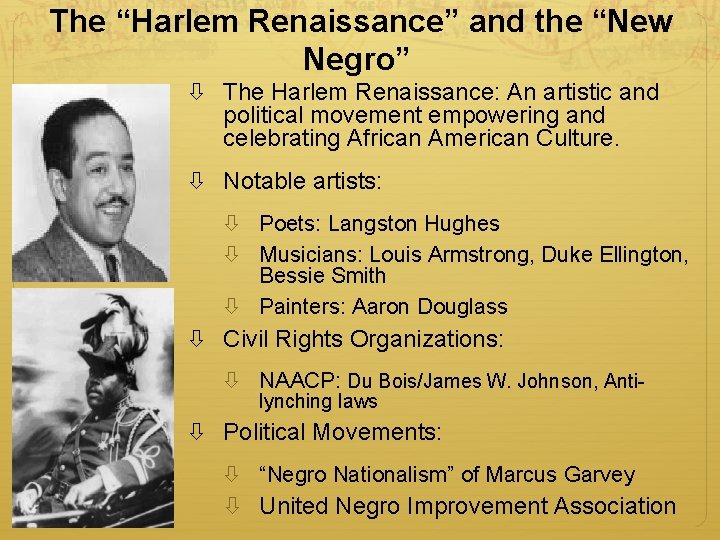
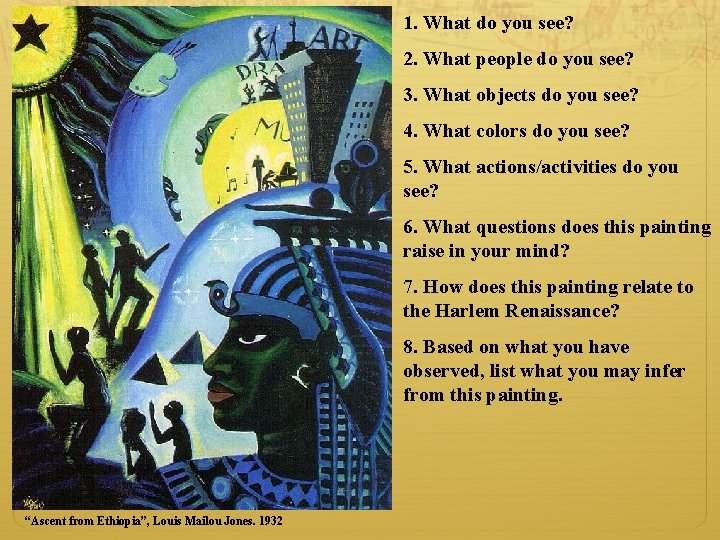
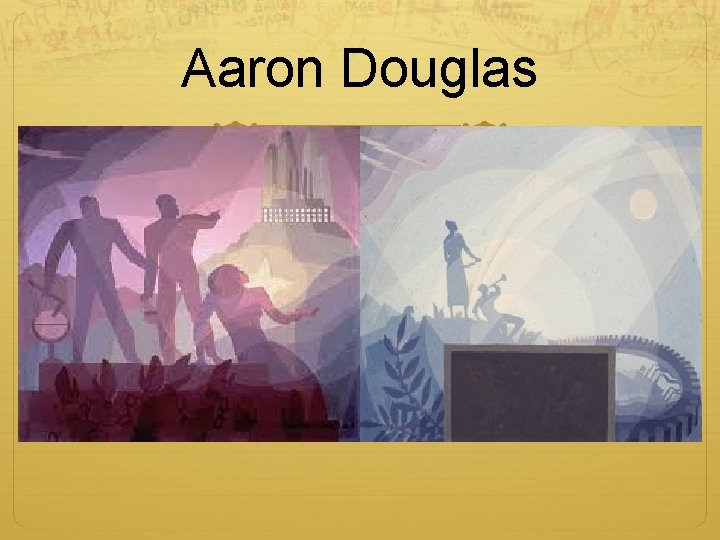
The “Harlem Renaissance” and the “New Negro” The Harlem Renaissance: An artistic and political movement empowering and celebrating African American Culture. Notable artists: Poets: Langston Hughes Musicians: Louis Armstrong, Duke Ellington, Bessie Smith Painters: Aaron Douglass Civil Rights Organizations: NAACP: Du Bois/James W. Johnson, Antilynching laws Political Movements: “Negro Nationalism” of Marcus Garvey United Negro Improvement Association
• Beginning of the Jazz Age in New York City • Acceptance of African American culture • African American literature and music
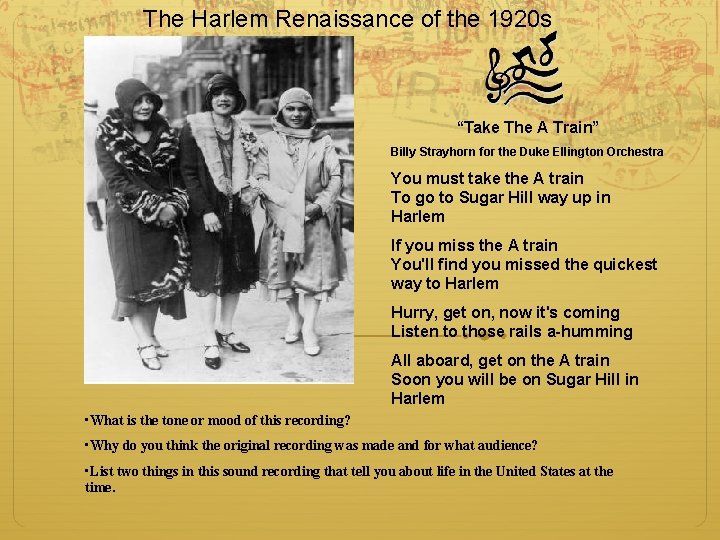
The Harlem Renaissance of the 1920 s “Take The A Train” Billy Strayhorn for the Duke Ellington Orchestra You must take the A train To go to Sugar Hill way up in Harlem If you miss the A train You'll find you missed the quickest way to Harlem Hurry, get on, now it's coming Listen to those rails a-humming All aboard, get on the A train Soon you will be on Sugar Hill in Harlem • What is the tone or mood of this recording? • Why do you think the original recording was made and for what audience? • List two things in this sound recording that tell you about life in the United States at the time.
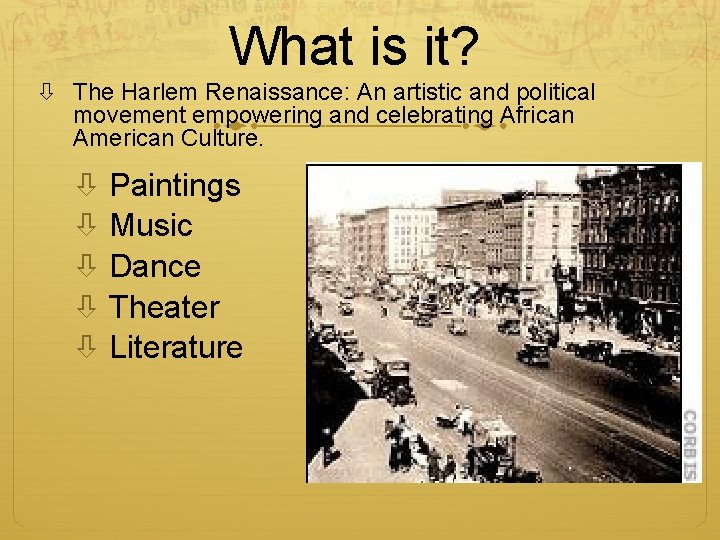
What is it? The Harlem Renaissance: An artistic and political movement empowering and celebrating African American Culture. Paintings Music Dance Theater Literature
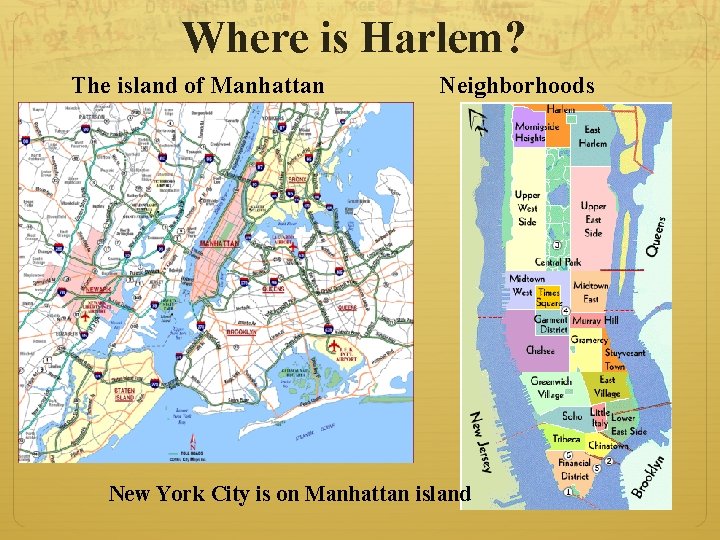
Where is Harlem? The island of Manhattan Neighborhoods New York City is on Manhattan island
Harlem Renaissance, Great Migration, and Significance The economic opportunities triggered a widespread “Great Migration” of African. Americans from the rural south to the industrial north. The HR helped to redefine how Americans and the world understood African American culture. It integrated black and white cultures, and marked the beginning of a black urban society. The Harlem Renaissance set the stage for the Civil Rights Movement of the 1950 s and 60 s.
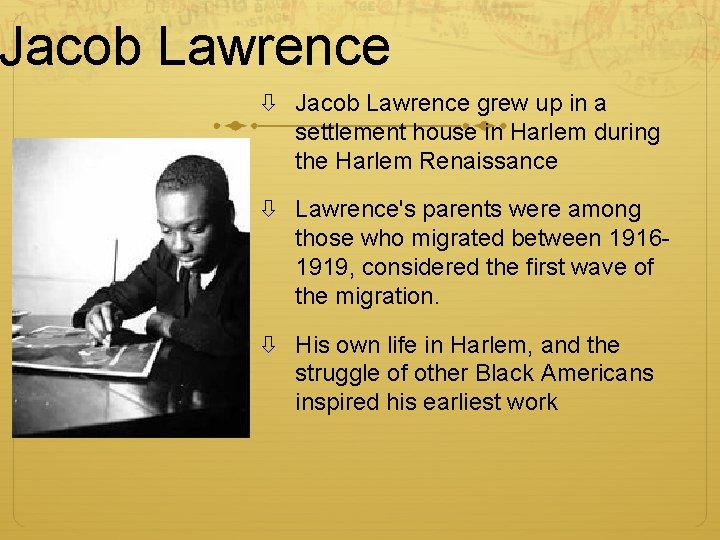
Jacob Lawrence grew up in a settlement house in Harlem during the Harlem Renaissance Lawrence's parents were among those who migrated between 19161919, considered the first wave of the migration. His own life in Harlem, and the struggle of other Black Americans inspired his earliest work
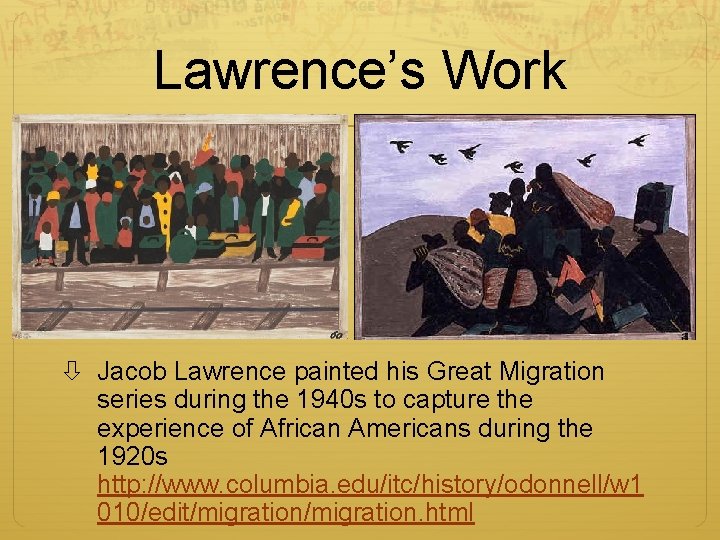
Lawrence’s Work Jacob Lawrence painted his Great Migration series during the 1940 s to capture the experience of African Americans during the 1920 s http: //www. columbia. edu/itc/history/odonnell/w 1 010/edit/migration. html
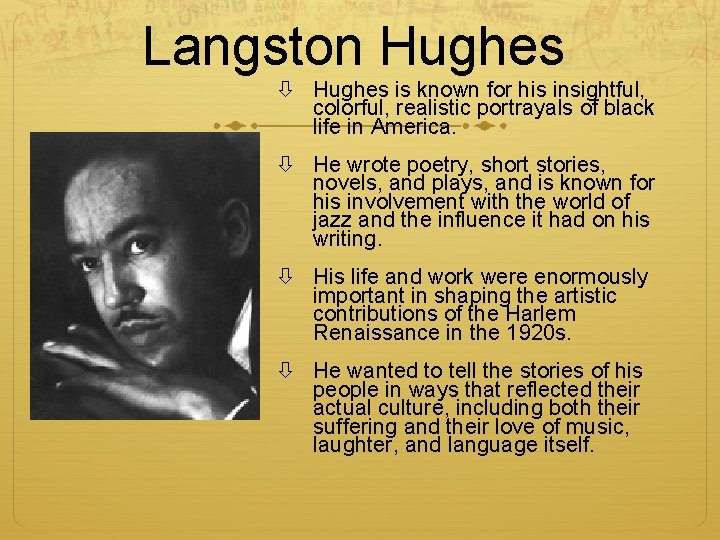
Langston Hughes is known for his insightful, colorful, realistic portrayals of black life in America. He wrote poetry, short stories, novels, and plays, and is known for his involvement with the world of jazz and the influence it had on his writing. His life and work were enormously important in shaping the artistic contributions of the Harlem Renaissance in the 1920 s. He wanted to tell the stories of his people in ways that reflected their actual culture, including both their suffering and their love of music, laughter, and language itself.
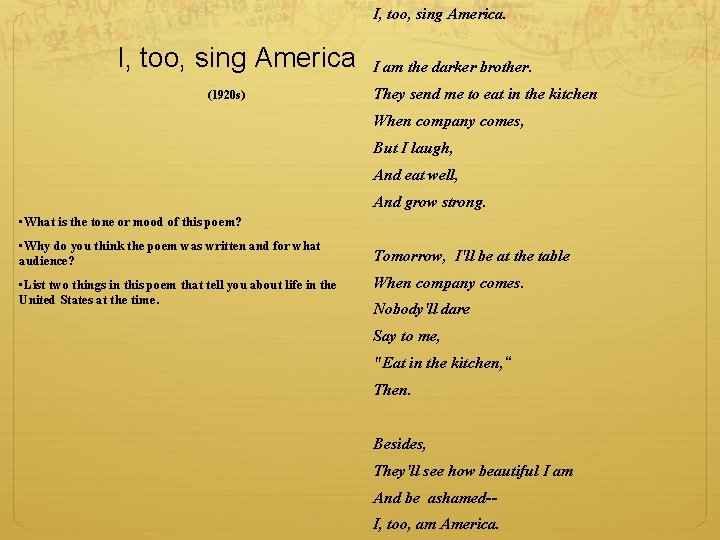
I, too, sing America. I, too, sing America (1920 s) I am the darker brother. They send me to eat in the kitchen When company comes, But I laugh, And eat well, And grow strong. • What is the tone or mood of this poem? • Why do you think the poem was written and for what audience? • List two things in this poem that tell you about life in the United States at the time. Tomorrow, I'll be at the table When company comes. Nobody'll dare Say to me, "Eat in the kitchen, “ Then. Besides, They'll see how beautiful I am And be ashamed-- I, too, am America.
Duke Ellington was a jazz composer, conductor, and performer during the Harlem Renaissance. Ellington would be among the first to focus on musical form and composition in jazz. Ellington wrote over 2000 pieces in his lifetime.
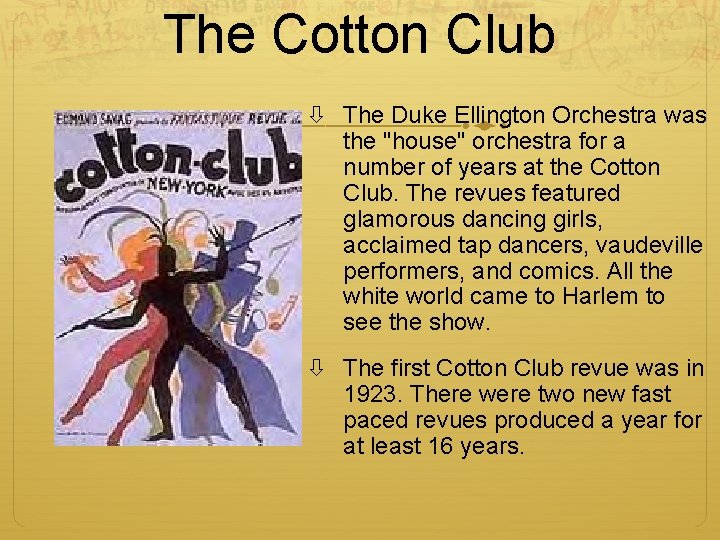
The Cotton Club The Duke Ellington Orchestra was the "house" orchestra for a number of years at the Cotton Club. The revues featured glamorous dancing girls, acclaimed tap dancers, vaudeville performers, and comics. All the white world came to Harlem to see the show. The first Cotton Club revue was in 1923. There were two new fast paced revues produced a year for at least 16 years.
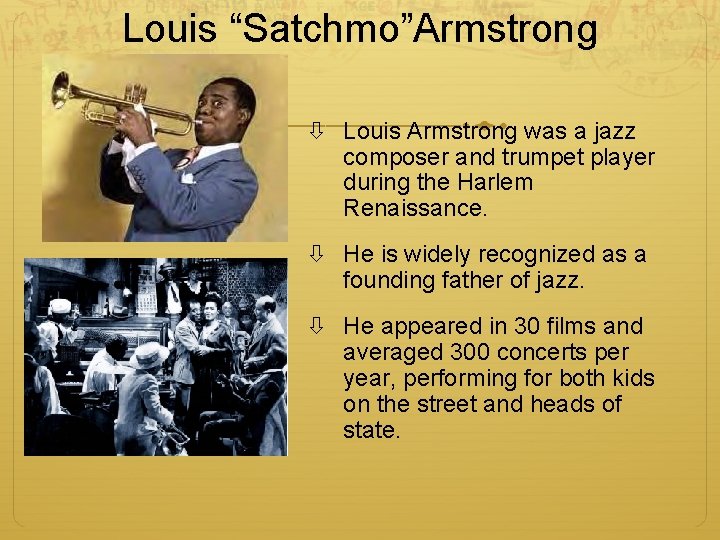
Louis “Satchmo”Armstrong Louis Armstrong was a jazz composer and trumpet player during the Harlem Renaissance. He is widely recognized as a founding father of jazz. He appeared in 30 films and averaged 300 concerts per year, performing for both kids on the street and heads of state.
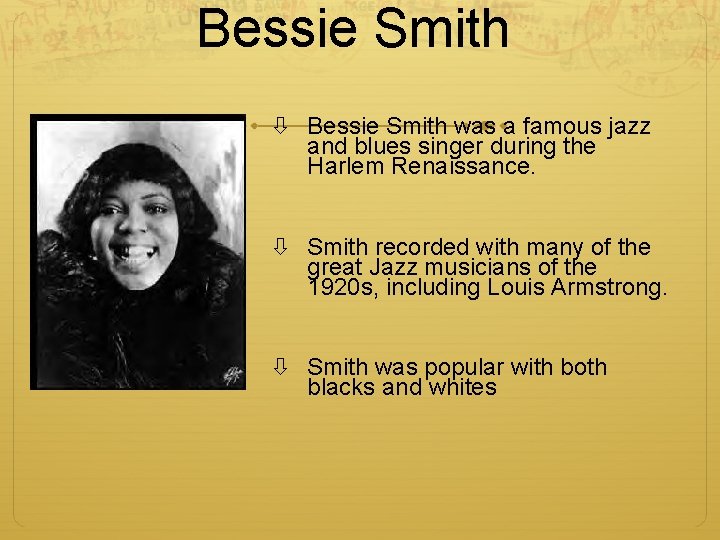
Bessie Smith was a famous jazz and blues singer during the Harlem Renaissance. Smith recorded with many of the great Jazz musicians of the 1920 s, including Louis Armstrong. Smith was popular with both blacks and whites
1. What do you see? 2. What people do you see? 3. What objects do you see? 4. What colors do you see? 5. What actions/activities do you see? 6. What questions does this painting raise in your mind? 7. How does this painting relate to the Harlem Renaissance? 8. Based on what you have observed, list what you may infer from this painting. “Ascent from Ethiopia”, Louis Mailou Jones. 1932
Aaron Douglas
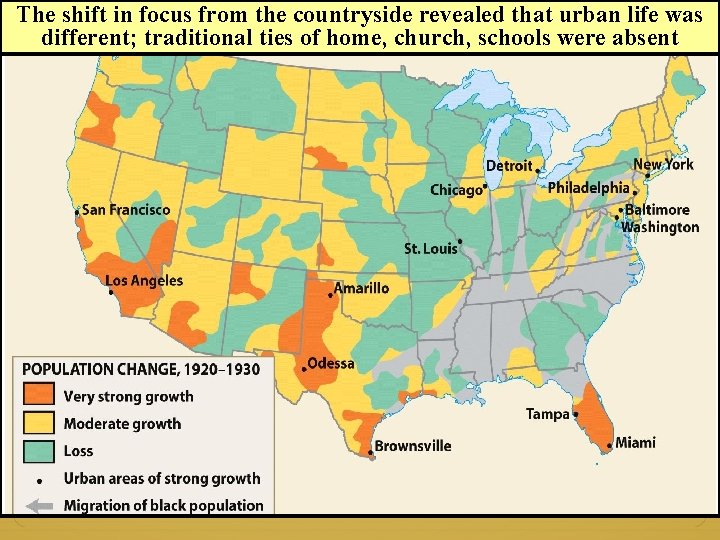
ØRural Americans identify urban culture with Communism, crime, immorality ØSex becomes an all-consuming topic of interest in popular entertainment ØCommunities of home, church, and school are absent in the
Old vs. New: big conflicts in the 20’s Old Culture New Culture Emphasized production Emphasized consumption Character Personality Scarcity Abundance Religion science Idealized the past Looked to the future Local culture Mass culture Substance Image Rural Urban
1920 s Social Conflicts Counter-Reactions
The shift in focus from the countryside revealed that urban life was different; traditional ties of home, church, schools were absent City Life in the Jazz Age
The Rural Counterattack Rural Americans identified cities with saloons, whorehouses, communist cells, & immorality The 1920 s saw an attempt to restore a “Protestant” culture in America & an attack on any “un-American” behavior like drinking, illiteracy, & immigration
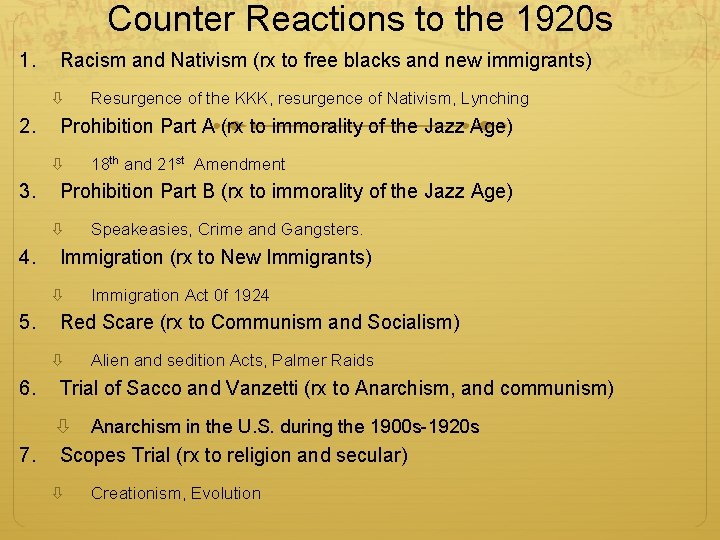
Counter Reactions to the 1920 s 1. Racism and Nativism (rx to free blacks and new immigrants) 2. Prohibition Part A (rx to immorality of the Jazz Age) 3. Immigration Act 0 f 1924 Red Scare (rx to Communism and Socialism) 6. Speakeasies, Crime and Gangsters. Immigration (rx to New Immigrants) 5. 18 th and 21 st Amendment Prohibition Part B (rx to immorality of the Jazz Age) 4. Resurgence of the KKK, resurgence of Nativism, Lynching Alien and sedition Acts, Palmer Raids Trial of Sacco and Vanzetti (rx to Anarchism, and communism) Anarchism in the U. S. during the 1900 s-1920 s 7. Scopes Trial (rx to religion and secular) Creationism, Evolution
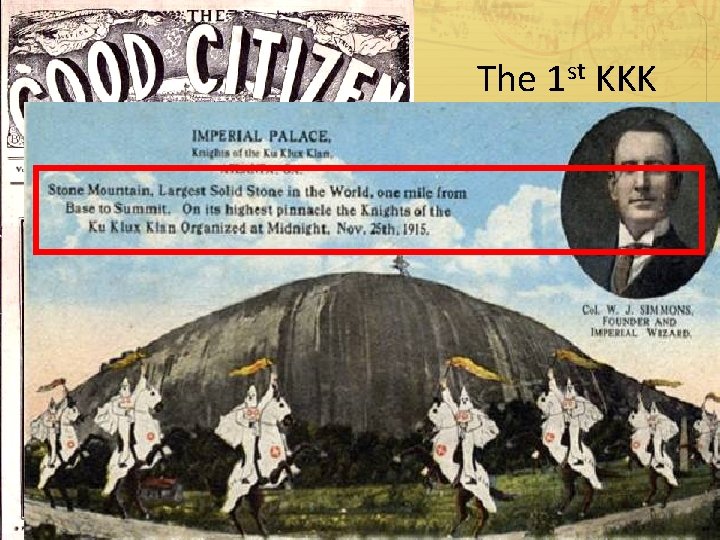
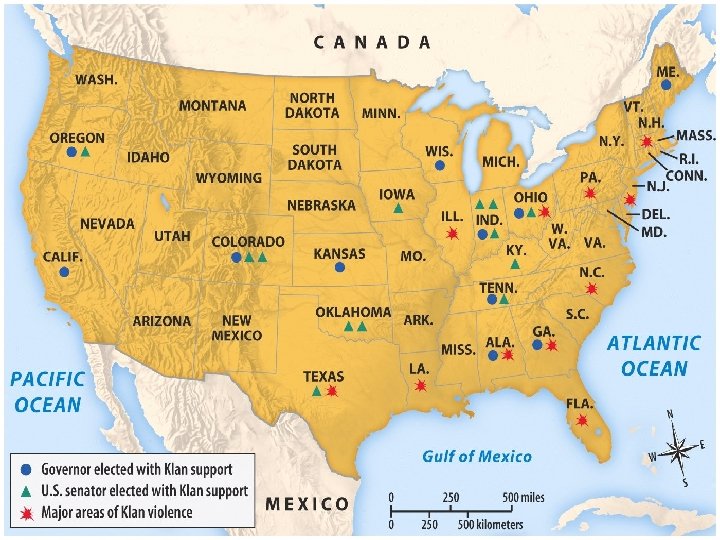
The 1 st KKK disbanded when Reconstruction ended in the 1870 s, but the 2 nd KKK formed in 1915 to protect rural, Christian values
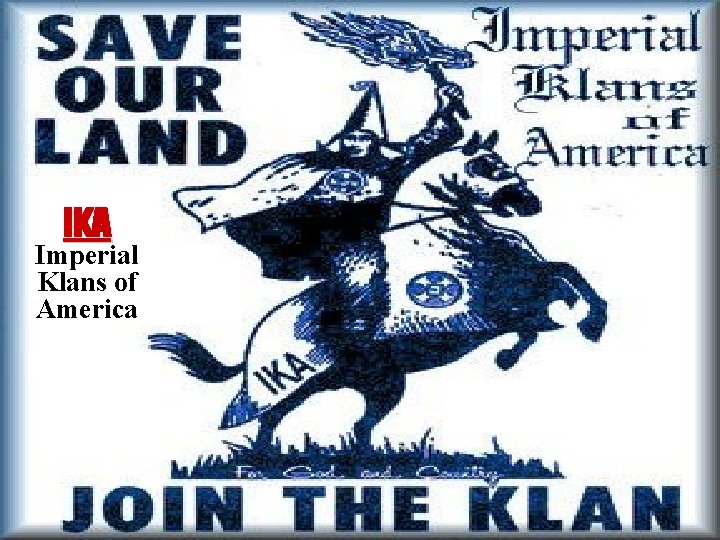
IKA Imperial Klans of America
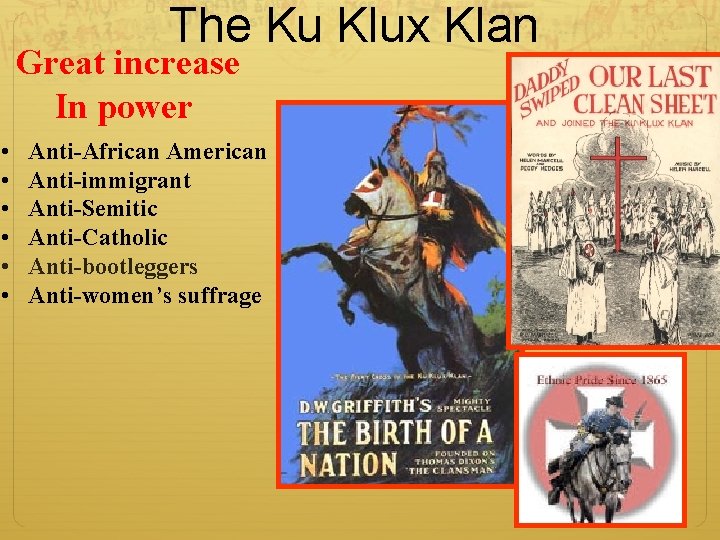
The Ku Klux Klan Great increase In power • • • Anti-African American Anti-immigrant Anti-Semitic Anti-Catholic Anti-bootleggers Anti-women’s suffrage
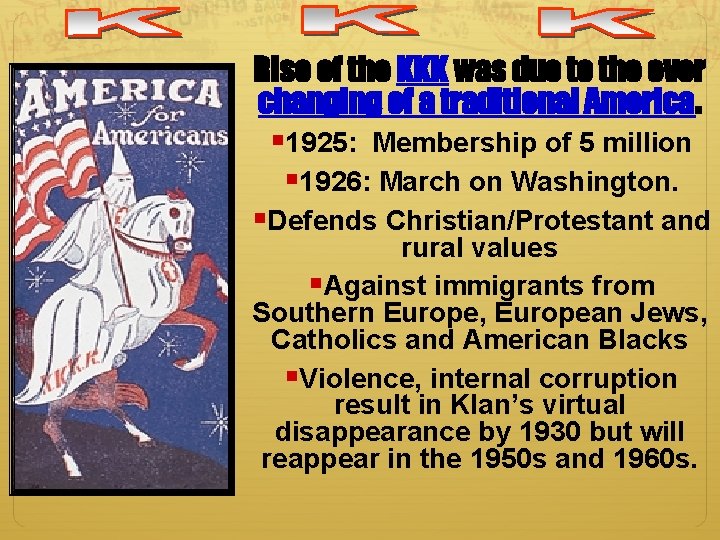
Rise of the KKK was due to the ever changing of a traditional America. § 1925: Membership of 5 million § 1926: March on Washington. §Defends Christian/Protestant and rural values §Against immigrants from Southern Europe, European Jews, Catholics and American Blacks §Violence, internal corruption result in Klan’s virtual disappearance by 1930 but will reappear in the 1950 s and 1960 s.
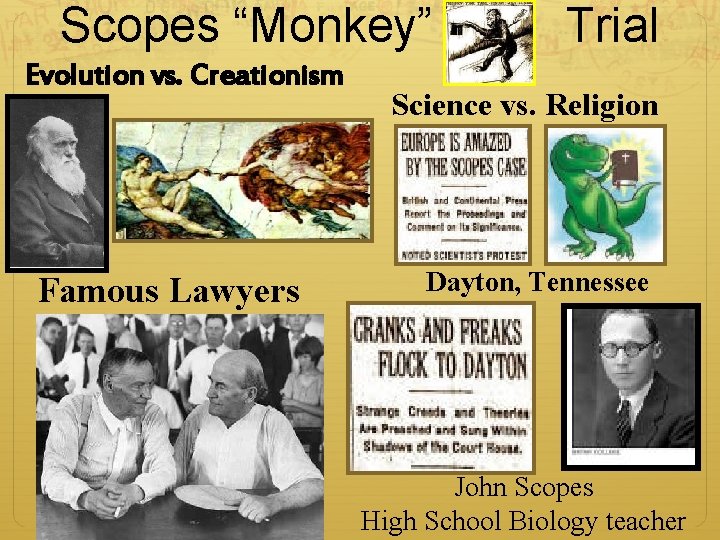
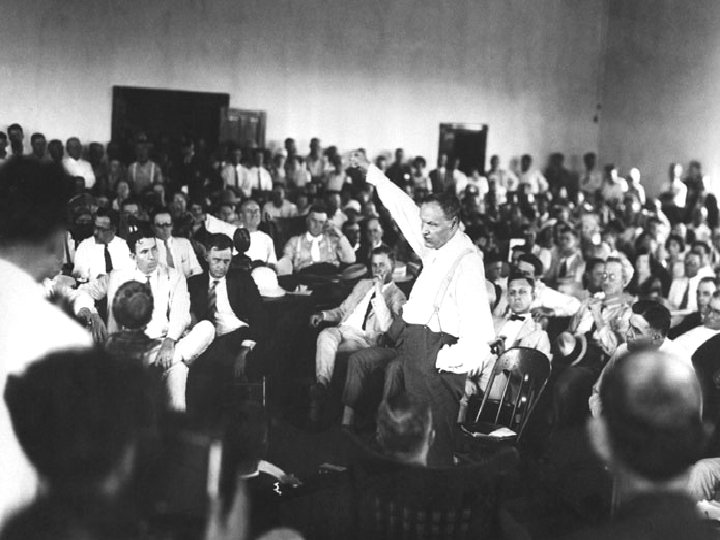
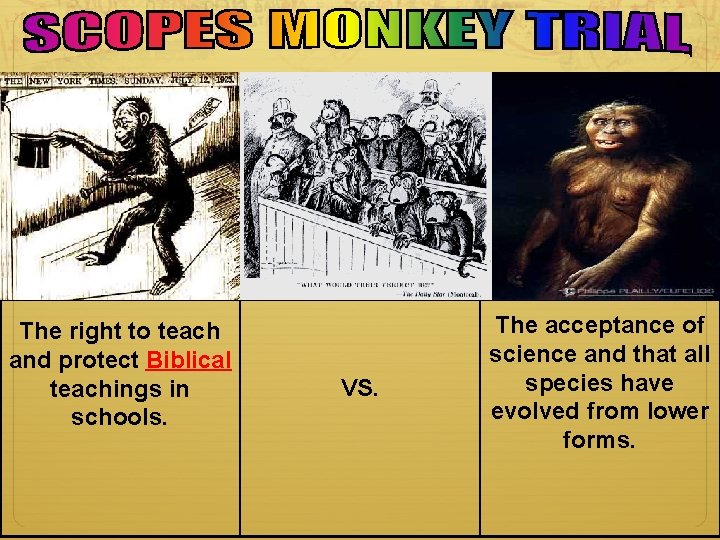
Scopes “Monkey” Evolution vs. Creationism Famous Lawyers Trial Science vs. Religion Dayton, Tennessee John Scopes High School Biology teacher
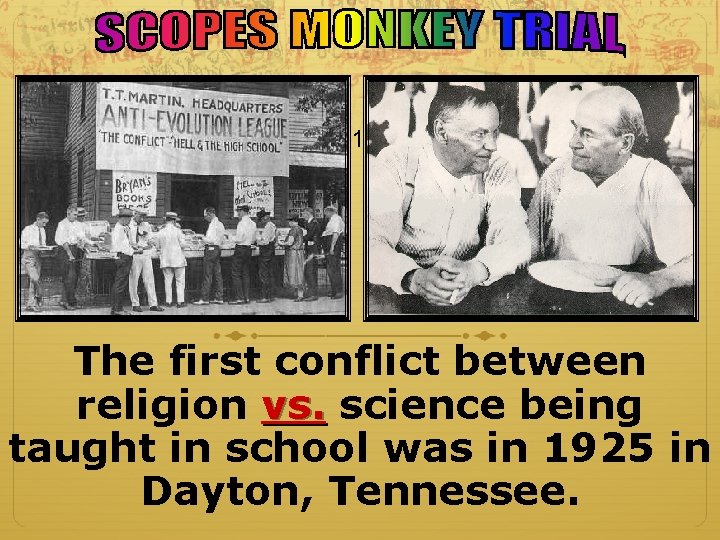
1925 The first conflict between religion vs. science being taught in school was in 1925 in Dayton, Tennessee.
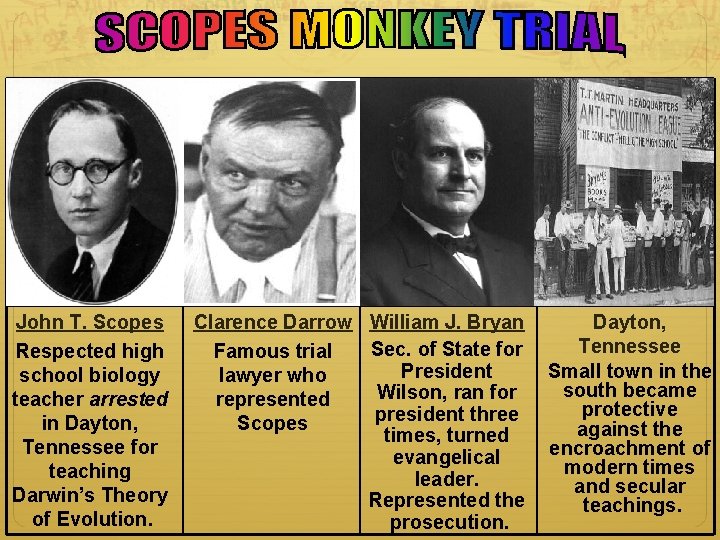
John T. Scopes Respected high school biology teacher arrested in Dayton, Tennessee for teaching Darwin’s Theory of Evolution. Clarence Darrow William J. Bryan Sec. of State for Famous trial President lawyer who Wilson, ran for represented president three Scopes times, turned evangelical leader. Represented the prosecution. Dayton, Tennessee Small town in the south became protective against the encroachment of modern times and secular teachings.
The right to teach and protect Biblical teachings in schools. VS. The acceptance of science and that all species have evolved from lower forms.
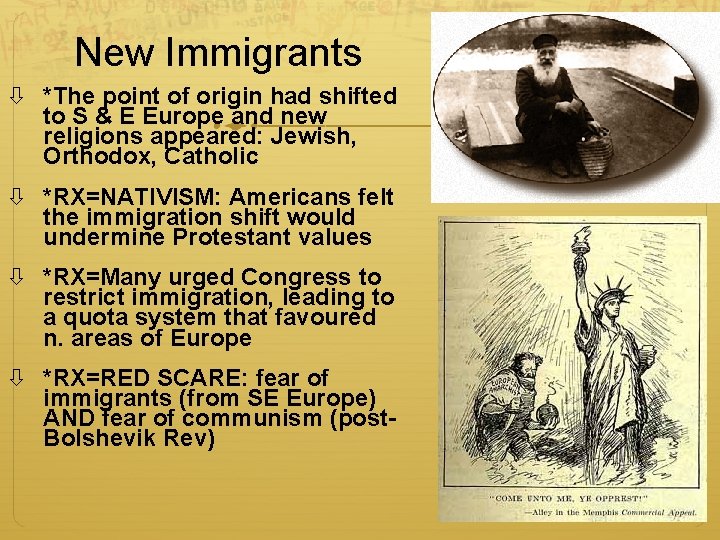
• Congress passed the Emergency Quota Act of 1921, in which newcomers from Europe were restricted at 3% of the people of their nationality who lived in the U. S. in 1910. • Immigration Act of 1924, Congress passed a 2% quota based on the existing population in the 1890 census when few southeastern Europeans lived in America. • First time in US history immigration was limited for all groups. • Ex. 2% out of 100 vs. 2% out of 10, 000
New Immigrants *The point of origin had shifted to S & E Europe and new religions appeared: Jewish, Orthodox, Catholic *RX=NATIVISM: Americans felt the immigration shift would undermine Protestant values *RX=Many urged Congress to restrict immigration, leading to a quota system that favoured n. areas of Europe *RX=RED SCARE: fear of immigrants (from SE Europe) AND fear of communism (post. Bolshevik Rev)
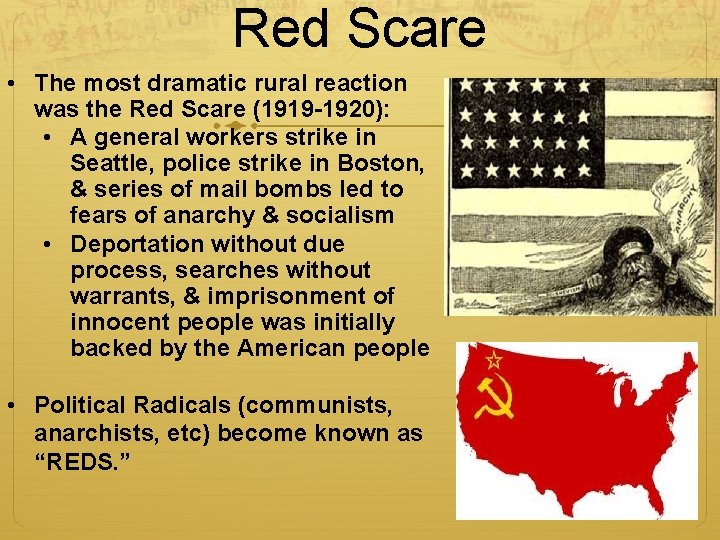
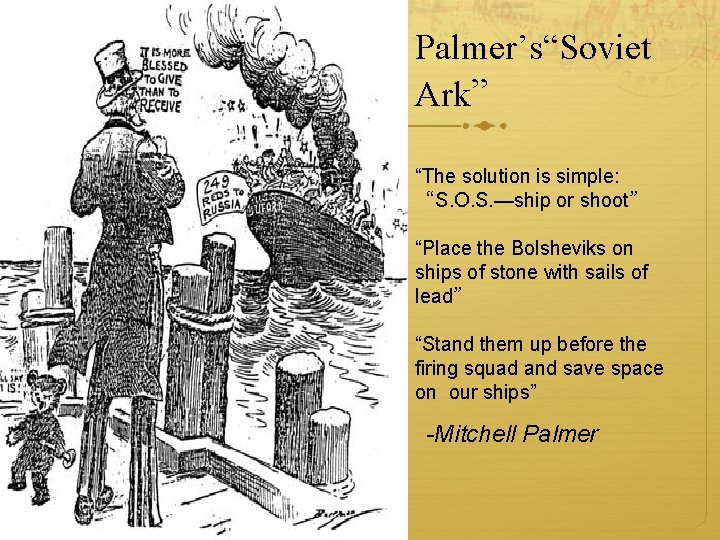
Red Scare • The most dramatic rural reaction was the Red Scare (1919 -1920): • A general workers strike in Seattle, police strike in Boston, & series of mail bombs led to fears of anarchy & socialism • Deportation without due process, searches without warrants, & imprisonment of innocent people was initially backed by the American people • Political Radicals (communists, anarchists, etc) become known as “REDS. ”
Palmer’s“Soviet Ark” “The solution is simple: “S. O. S. —ship or shoot” “Place the Bolsheviks on ships of stone with sails of lead” “Stand them up before the firing squad and save space on our ships” -Mitchell Palmer
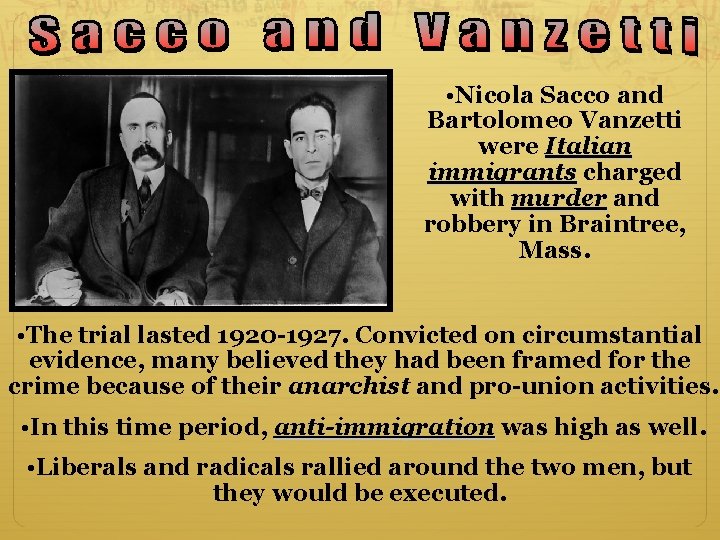
• Nicola Sacco and Bartolomeo Vanzetti were Italian immigrants charged with murder and robbery in Braintree, Mass. • The trial lasted 1920 -1927. Convicted on circumstantial evidence, many believed they had been framed for the crime because of their anarchist and pro-union activities. • In this time period, anti-immigration was high as well. • Liberals and radicals rallied around the two men, but they would be executed.
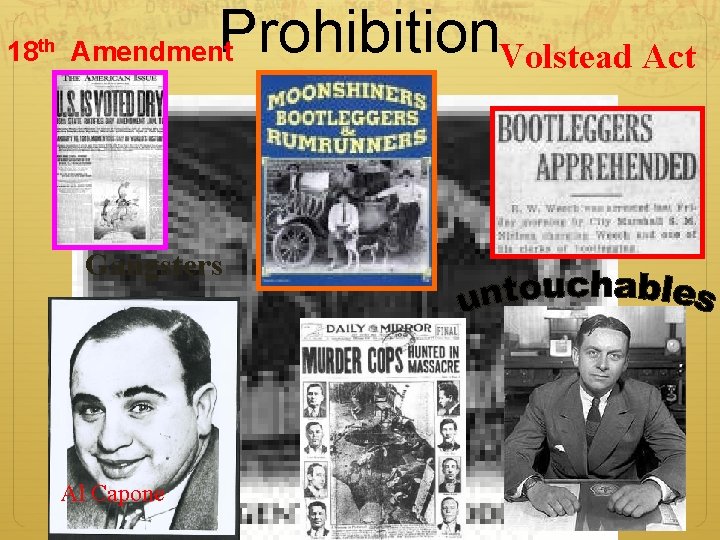
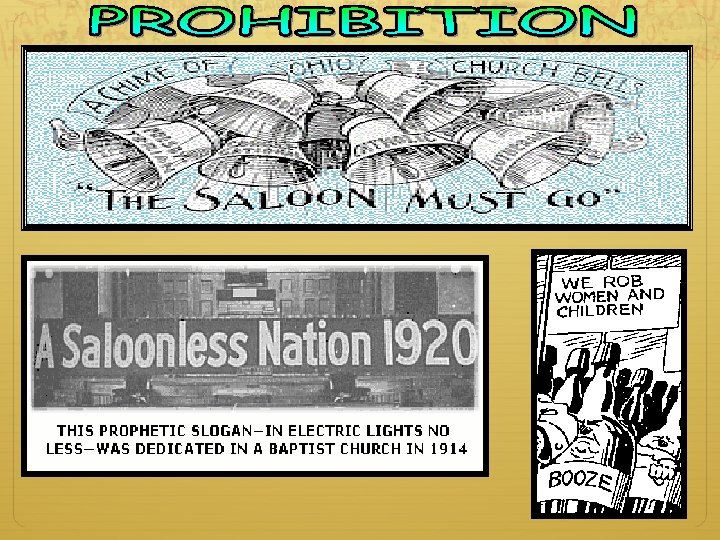
Prohibition. Volstead Act 18 th Amendment Gangsters Al Capone
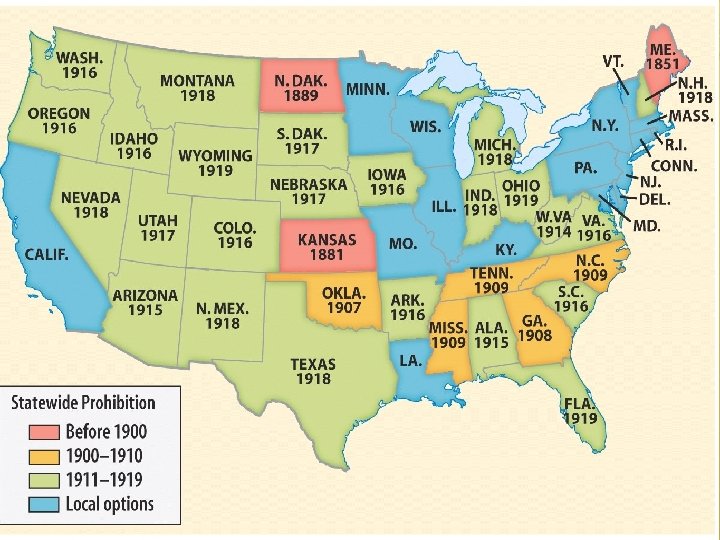
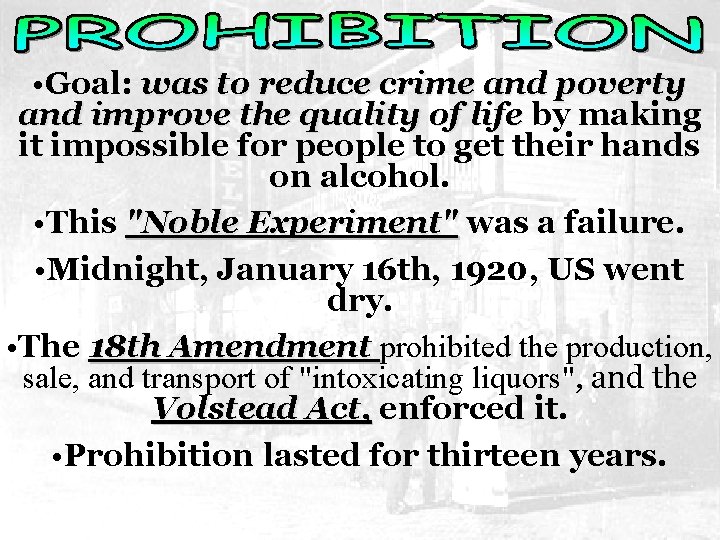
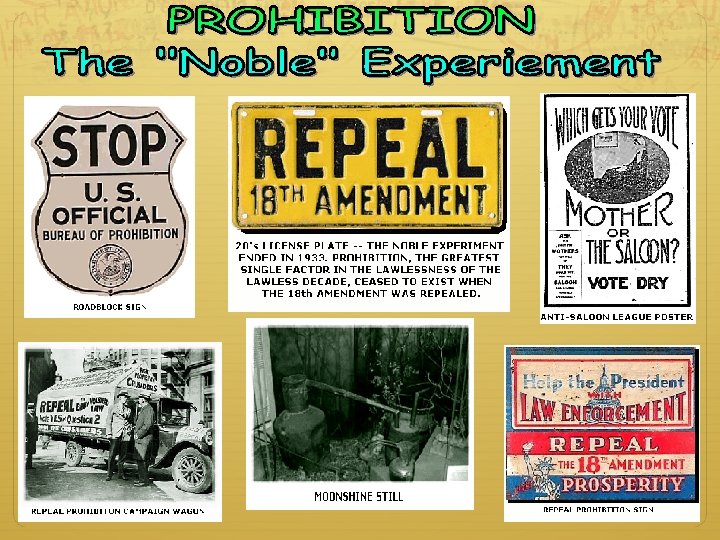
• Goal: was to reduce crime and poverty and improve the quality of life by making it impossible for people to get their hands on alcohol. • This "Noble Experiment" was a failure. • Midnight, January 16 th, 1920, US went dry. • The 18 th Amendment prohibited the production, sale, and transport of "intoxicating liquors", and the Volstead Act, enforced it. • Prohibition lasted for thirteen years.
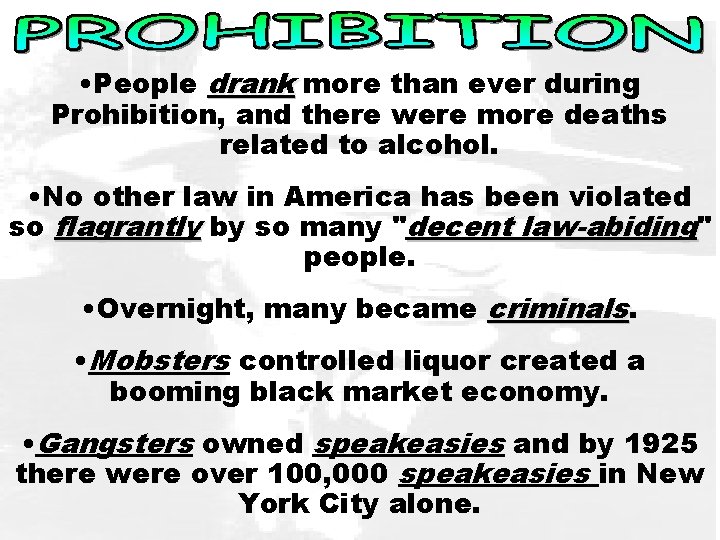
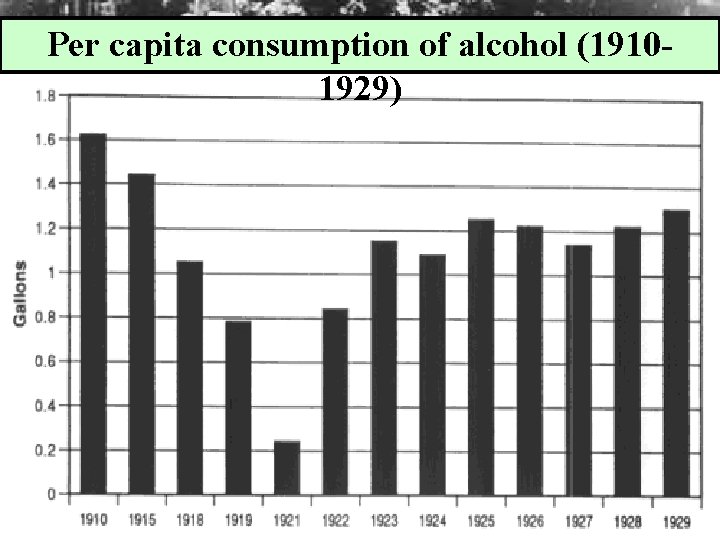
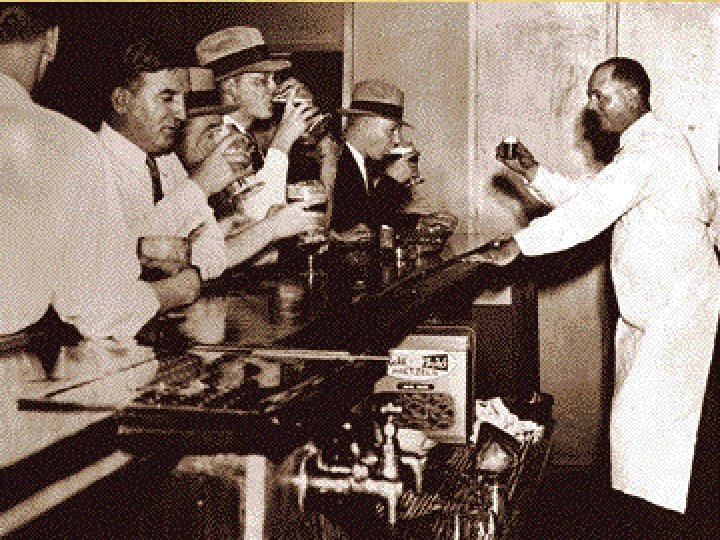
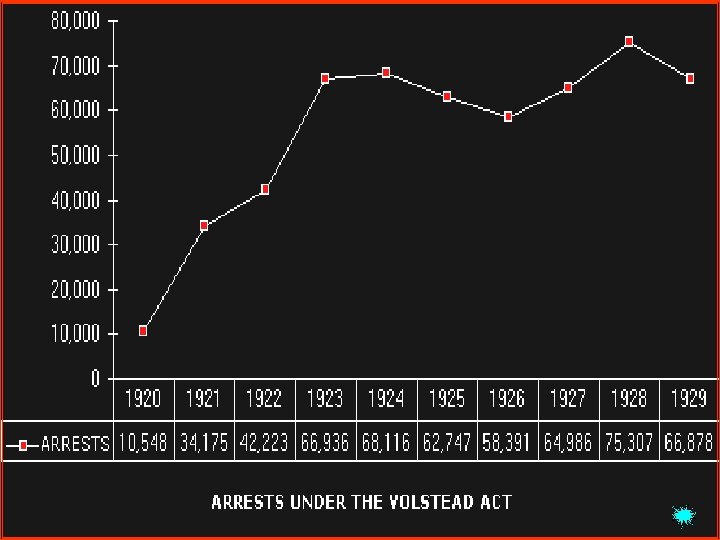
• People drank more than ever during Prohibition, and there were more deaths related to alcohol. • No other law in America has been violated so flagrantly by so many "decent law-abiding" people. • Overnight, many became criminals. • Mobsters controlled liquor created a booming black market economy. • Gangsters owned speakeasies and by 1925 there were over 100, 000 speakeasies in New York City alone.
Per capita consumption of alcohol (19101929)
Al Capone Detroit police inspecting equipment found in a hidden underground brewery during Chicago gangster during Prohibition who controlled the “bootlegging” industry. Elliot Ness, part of the Untouchables Agent with the U. S. Treasury Department's Prohibition Bureau during a time when bootlegging was rampant throughout
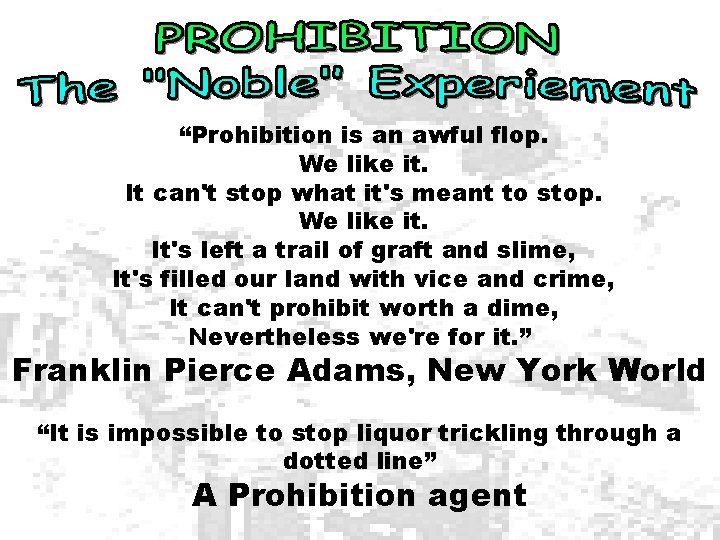
“Prohibition is an awful flop. We like it. It can't stop what it's meant to stop. We like it. It's left a trail of graft and slime, It's filled our land with vice and crime, It can't prohibit worth a dime, Nevertheless we're for it. ” Franklin Pierce Adams, New York World “It is impossible to stop liquor trickling through a dotted line” A Prohibition agent
Conclusions Urban America came to define all of the United States in the 1920 s: Radio, movies, advertising reflected urban culture Consumer goods were made in American cities Small-town whites, blacks, & immigrants moved to cities But, conservative rural Americans (religious fundamentalists & KKK) attacked these new, urban ideas