
American History The Roaring Twenties The United States










- Slides: 41
American History The Roaring Twenties The United States seeks postwar normality and isolation. The standard of living soars amid labor unrest, immigration quotas, and the scandals of the Harding administration. 1 Copyright © by Houghton Mifflin Harcourt Publishing Company
American History The Roaring Twenties ESSENTIAL QUESTION Why did political, economic, and social tensions characterize the 1920 s? LESSON 1 The Business of America LESSON 2 Postwar Issues LESSON 3 Changing Ways of Life LESSON 4 The Twenties Woman LESSON 5 Education and Popular Culture LESSON 6 The Harlem Renaissance 2 Copyright © by Houghton Mifflin Harcourt Publishing Company
American History LESSON 1 The Business of America Consumer goods fuel the business boom of the 1920 s as America’s standard of living soars. 3 Copyright © by Houghton Mifflin Harcourt Publishing Company
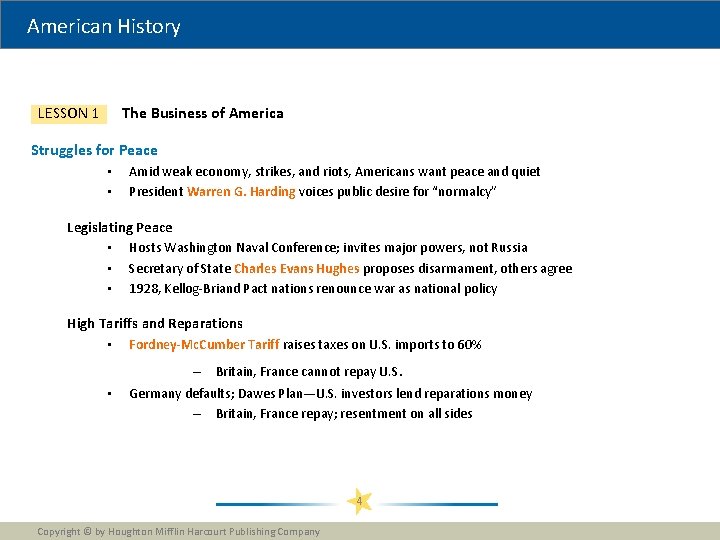
American History The Business of America LESSON 1 Struggles for Peace • • Amid weak economy, strikes, and riots, Americans want peace and quiet President Warren G. Harding voices public desire for “normalcy” Legislating Peace • Hosts Washington Naval Conference; invites major powers, not Russia • Secretary of State Charles Evans Hughes proposes disarmament, others agree • 1928, Kellog-Briand Pact nations renounce war as national policy High Tariffs and Reparations • Fordney-Mc. Cumber Tariff raises taxes on U. S. imports to 60% • – Britain, France cannot repay U. S. Germany defaults; Dawes Plan—U. S. investors lend reparations money – Britain, France repay; resentment on all sides 4 Copyright © by Houghton Mifflin Harcourt Publishing Company
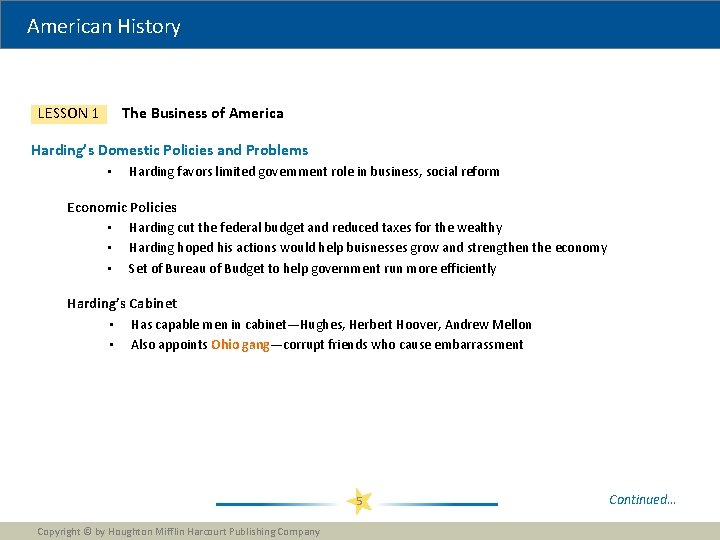
American History The Business of America LESSON 1 Harding’s Domestic Policies and Problems • Harding favors limited government role in business, social reform Economic Policies • Harding cut the federal budget and reduced taxes for the wealthy • Harding hoped his actions would help buisnesses grow and strengthen the economy • Set of Bureau of Budget to help government run more efficiently Harding’s Cabinet • Has capable men in cabinet—Hughes, Herbert Hoover, Andrew Mellon • Also appoints Ohio gang—corrupt friends who cause embarrassment 5 Copyright © by Houghton Mifflin Harcourt Publishing Company Continued…
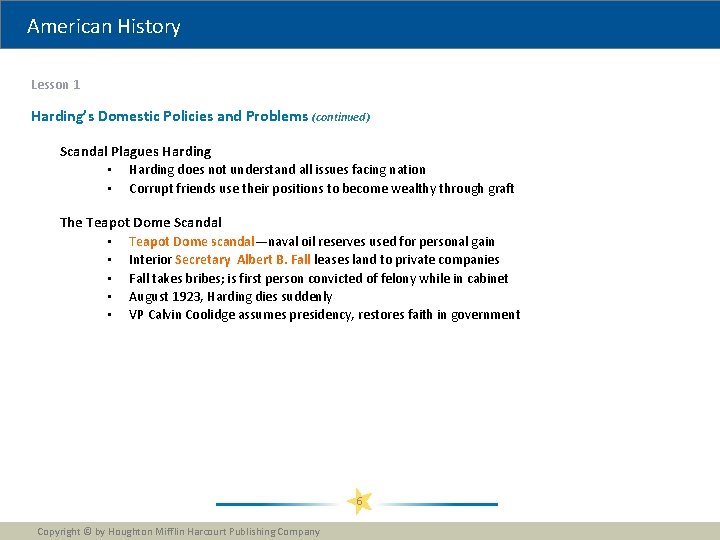
American History Lesson 1 Harding’s Domestic Policies and Problems (continued) Scandal Plagues Harding • Harding does not understand all issues facing nation • Corrupt friends use their positions to become wealthy through graft The Teapot Dome Scandal • Teapot Dome scandal—naval oil reserves used for personal gain • Interior Secretary Albert B. Fall leases land to private companies • Fall takes bribes; is first person convicted of felony while in cabinet • August 1923, Harding dies suddenly • VP Calvin Coolidge assumes presidency, restores faith in government 6 Copyright © by Houghton Mifflin Harcourt Publishing Company
American History The Business of America LESSON 1 American Industries Flourish • Calvin Coolidge favors minimal government interference in business – low taxes and available credit for businesses – high tariffs on foreign goods – reduced income tax, more money for consumers The Auto Industry and Increased Productivity • Henry Ford makes production efficient and effective; assembly-line, increased pay, and simple • car design 1920, productivity rises by 45%; workers producing more in less time 7 Copyright © by Houghton Mifflin Harcourt Publishing Company Continued…
American History Lesson 1 American Industries Flourish (continued) The Impact of the Automobile • Cars change life—paved roads, gas stations, motels, shopping centers • Give mobility to rural families, women, young people • Workers live far from jobs, leads to urban sprawl (spread of cities) • Auto industry economic base for some cities, boosts oil industry • By late 1920 s, 1 car for every 5 Americans The Young Airplane Industry • Airplane industry starts as mail service for U. S. Post Office • Weather forecasting begins; planes carry radios, navigation tools • Lockheed Company produces popular transport plane of late 1920 s • 1927, Pan American Airways inaugurates transatlantic flights 8 Copyright © by Houghton Mifflin Harcourt Publishing Company
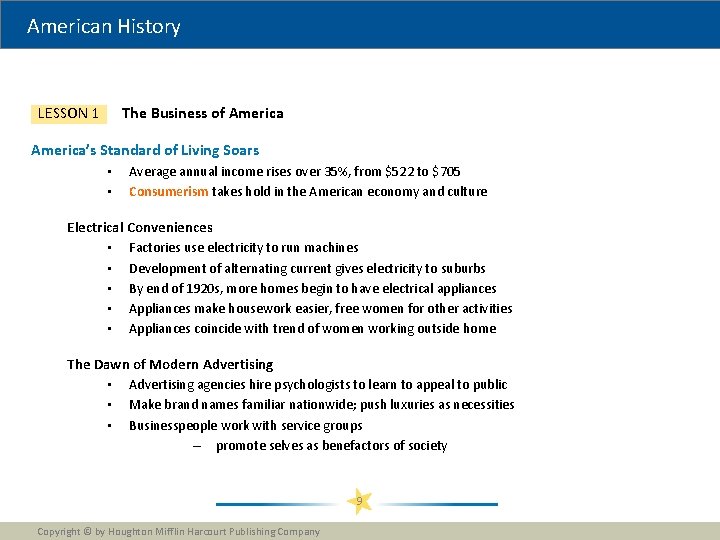
American History The Business of America LESSON 1 America’s Standard of Living Soars • • Average annual income rises over 35%, from $522 to $705 Consumerism takes hold in the American economy and culture Electrical Conveniences • Factories use electricity to run machines • Development of alternating current gives electricity to suburbs • By end of 1920 s, more homes begin to have electrical appliances • Appliances make housework easier, free women for other activities • Appliances coincide with trend of women working outside home The Dawn of Modern Advertising • Advertising agencies hire psychologists to learn to appeal to public • Make brand names familiar nationwide; push luxuries as necessities • Businesspeople work with service groups – promote selves as benefactors of society 9 Copyright © by Houghton Mifflin Harcourt Publishing Company
American History The Business of America LESSON 1 A Superficial Prosperity • Most Americans believe prosperity will last forever Producing Great Quantities of Goods • Productivity increasing, businesses expanding • Mergers in auto industry, steel, electrical equipment, utilities • Chain stores develop; national banks allowed to create branches • Income gap between workers, managers grows • Iron, railroad industries not prosperous; farms suffer losses Buying Goods on Credit • Installment plan—pay for goods over extended period with interest • Banks provide money at low interest rates • Some economists, business owners think installment buying excessive • Think is sign of fundamental weakness behind superficial prosperity 10 Copyright © by Houghton Mifflin Harcourt Publishing Company
American History LESSON 2 Postwar Issues A desire for normality after the war and a fear of communism and “foreigners” lead to postwar isolationism. 11 Copyright © by Houghton Mifflin Harcourt Publishing Company
American History Postwar Issues LESSON 2 Postwar Trends • • War leaves Americans exhausted; debate over League divides them Economy adjusting: cost of living doubles; farm, factory orders down – soldiers take jobs from women, minorities – farmers, factory workers suffer Postwar Fears • Americans become fearful of outsiders, leads to xenophobia • Wave of nativism—prejudice against foreign-born people—sweeps nation • Isolationism—pulling away from world affairs—becomes popular A Global economy • U. S. economy becoming more international – loans to European countries – factories export manufactured goods • New farming techniques increase output – Later, U. S. farmers suffer from overproduction 12 Copyright © by Houghton Mifflin Harcourt Publishing Company
American History Postwar Issues LESSON 2 Fear of Communism • Communism—economic, political system, single-party government – ruled by dictator – no private property The Red Scare • 1919 Vladimir I. Lenin, Bolsheviks, set up Communist state in Russia • U. S. Communist Party forms; 70, 000, including some IWW members • Bombs mailed to government, businesses; people fear Red conspiracy • Attorney General A. Mitchell Palmer takes action The Palmer Raids • Palmer, J. Edgar Hoover hunt down Communists, socialists, anarchists • Anarchists oppose any form of government • Raids trample civil rights, foreign-born radicals deported without trial • fail to find evidence of conspiracy 13 Copyright © by Houghton Mifflin Harcourt Publishing Company Continued…
American History Lesson 2 Fear of Communism (continued) Sacco and Vanzetti • Red Scare feeds fear of foreigners, ruins reputations, wrecks lives • 1920, Sacco and Vanzetti, Italian immigrants, anarchists, arrested – charged with robbery, murder – trial does not prove guilt • Jury finds them guilty; widespread protests in U. S. , abroad – Sacco, Vanzetti executed 1927 14 Copyright © by Houghton Mifflin Harcourt Publishing Company
American History Postwar Issues LESSON 2 Immigration and Citizenship Issues • • Nativists: fewer unskilled jobs available, fewer immigrants needed Think immigrant anarchists and socialists are Communist The Klan Rises Again • Bigots use anti-communism to harass groups unlike themselves • KKK opposes blacks, Catholics, Jews, immigrants, unions, saloons – 1924, 4. 5 million members • Klan controls many states’ politics; violence leads to less power 15 Copyright © by Houghton Mifflin Harcourt Publishing Company Continued…
American History Lesson 2 Immigration and Citizenship Issues (continued) The Quota System • 1919– 1921, number of immigrants grows almost 600% • Quota system sets maximum number can enter U. S. from each country – sharply reduces European immigration • 1924, European arrivals cut to 2% of number of residents in 1890 • Discriminates against southern, eastern Europeans • Prohibits Japanese immigration; causes ill will between U. S. , Japan • Does not apply to Western Hemisphere; many Canadians, Mexicans enter Changes for Native Americans • Despite not being citizens, Native Americans register for military and serve in WWI • 1924, President Coolidge signs Indian Citizenship Act – 125, 000 Native Americans become citizens – did not ensure voting rights 16 Copyright © by Houghton Mifflin Harcourt Publishing Company
American History Postwar Issues LESSON 2 A Time of Labor Unrest • • Government doesn’t allow strikes in wartime; 1919 over 3, 000 strikes Employers against raises, unions; label strikers as Communists The Boston Police Strike • Boston police strike over raises, right to unionize • Governor Calvin Coolidge ends strike, replaces strikers with new policemen The Steel Mill Strike • 1919, steel workers strike; companies use force, later negotiate • Talks deadlock; Wilson appeals; strike ends – 1923 report on conditions leads to 8 -hour day – steelworkers remain without a union 17 Copyright © by Houghton Mifflin Harcourt Publishing Company Continued…
American History Lesson 2 A Time of Labor Unrest (continued) The Coal Miners’ Strike • 1919, John L. Lewis becomes head of United Mine Workers of America • Leads strike; defies court order to work; accepts arbitration • Miners receive 27% wage increase; Lewis becomes national hero Labor Movement Loses Appeal • In 1920 s, union membership drops from over 5 million to 3. 5 million • Less than 1% of African Americans, just over 3% whites in unions 18 Copyright © by Houghton Mifflin Harcourt Publishing Company
American History LESSON 3 Changing Ways of Life Americans experience cultural conflicts as customs and values change in the 1920 s. 19 Copyright © by Houghton Mifflin Harcourt Publishing Company
American History Changing Ways of Life LESSON 3 Rural and Urban Differences • • 1920 census: 51. 2% of Americans in communities of 2, 500 or more 1922– 1929, nearly 2 million people leave farms, towns each year The New Urban Scene • Largest cities are New York, Chicago, Philadelphia – 65 other cities with 100, 000 people or more • In 1920 s, people caught between rural, urban cultures – close ties, hard work, strict morals of small towns The Prohibition Experiment • 18 th Amendment launches Prohibition era – supported by religious groups, rural South, West • Prohibition—production, sale, transportation of alcohol illegal • Government does not budget enough money to enforce the law 20 Copyright © by Houghton Mifflin Harcourt Publishing Company Continued…
American History Lesson 3 Rural and Urban Differences (continued) Speakeasies and Bootleggers • Speakeasies (hidden saloons, nightclubs) become fashionable • People distill liquor, buy prescription alcohol, sacramental wine • Bootleggers smuggle alcohol from surrounding countries Organized Crime • Prohibition contributes to organized crime in major cities • Al Capone controls Chicago liquor business by killing competitors • By mid-1920 s, only 19% support Prohibition • 18 th Amendment in force until 1933; repealed by 21 st Amendment 21 Copyright © by Houghton Mifflin Harcourt Publishing Company
American History Changing Ways of Life LESSON 3 Science and Religion Clash • Secular thinkers and fundamentalists battle over scientific discoveries American Fundamentalism • Fundamentalism—movement based on literal interpretation of Bible • Fundamentalists skeptical of some scientific discoveries, theories – reject theory of evolution • Believe all important knowledge can be found in Bible • Fundamentalist preachers lead religious revivals in South, West • — Billy Sunday holds emotional meetings • — Aimee Semple Mc. Pherson uses showmanship while preaching on radio 22 Copyright © by Houghton Mifflin Harcourt Publishing Company Continued…
American History Lesson 3 Science and Religion Clash (continued) The Scopes Trial • 1925, Tennessee passes law making it a crime to teach evolution • American Civil Liberties Union backs John T. Scopes challenge of law • Clarence Darrow, most famous trial lawyer of day, defends Scopes • Fundamentalist William Jennings Bryan is special prosecutor • Scopes trial—debates evolution, role of science, religion in school – national sensation; thousands attend • Bryan admits Bible open to interpretation; Scopes found guilty 23 Copyright © by Houghton Mifflin Harcourt Publishing Company
American History LESSON 4 The Twenties Woman American women pursue new lifestyles and assume new jobs and different roles in society during the 1920 s. 24 Copyright © by Houghton Mifflin Harcourt Publishing Company
American History The Twenties Woman LESSON 4 Young Women Change the Rules • Women begin to assert their independence, reject 19 th Century values, and demand same freedoms as men. The Flapper • Flapper—emancipated young woman, adopts new fashions, urban attitudes • Many young women want equal status with men, become assertive • Middle-class men, women begin to see marriage as equal partnership – housework, child-rearing still woman’s job The Double Standard • Elders disapprove new behavior and its promotion by periodicals, ads • Casual dating begins to replace formal courtship • Women subject to double standard (less sexual freedom than men) – must observe stricter standards of behavior 25 Copyright © by Houghton Mifflin Harcourt Publishing Company Continued…
American History The Twenties Woman LESSON 4 Women Shed Old Roles at Home and at Work • • New roles for women outside the home; work in offices, factories stores New trends in family life New Opportunities • After war, employers replace female workers with men • Female college graduates become teachers, nurses, librarians – more option for higher education • Many women become clerical workers as demand rises • Some become sales clerks, factory workers • Few become managers; always paid less than men 26 Copyright © by Houghton Mifflin Harcourt Publishing Company Continued…
American History Lesson 4 Women Shed Old Roles at Home and at Work (continued) The Changing Family • Birthrate drops partly due to more birth-control information • Manufactured products, public services give homemakers freedom • Housewives can focus more on families, pastimes, not housework • Marriages increasingly based on romantic love, companionship • Children spend most of day at school, organized activities – adolescents resist parental control; reflected in popular culture • Working-class, college-educated women juggle family, work 27 Copyright © by Houghton Mifflin Harcourt Publishing Company
American History LESSON 5 Education and Popular Culture The mass media, movies, and spectator sports play important roles in creating the popular culture of the 1920 s—a culture that many artists and writers criticize. 28 Copyright © by Houghton Mifflin Harcourt Publishing Company
American History Education and Popular Culture LESSON 5 Schools and the Mass Media Shape Culture • Mass media and education have a powerful influence on Americans School Enrollments • High school population increases dramatically in 1920 s due to: – prosperity – higher standards for industry jobs • Pre-1920 s, high school for college-bound students • In 1920 s, high schools also offer vocational training • Public schools prepare immigrant children who speak no English • Taxes increase as school costs rise sharply 29 Copyright © by Houghton Mifflin Harcourt Publishing Company Continued…
American History Lesson 5 Schools and the Mass Media Shape Culture (continued) Expanding News Coverage • Mass media shapes mass culture; takes advantage of greater literacy • By 1914, hundreds of local newspapers replaced by national chains • 1920 s, mass-market magazines thrive; Reader’s Digest, Time Radio Comes of Age • Radio is most powerful communications medium of 1920 s • Networks provide shared national experience – can hear news as it happens 30 Copyright © by Houghton Mifflin Harcourt Publishing Company
American History Education and Popular Culture LESSON 5 America Chases New Heroes and Old Dreams • • In 1920 s, many people have extra money, leisure time to enjoy it Crowds attend sports events; athletes glorified by mass media Lindbergh’s Flight • Charles A. Lindbergh makes first solo nonstop flight across Atlantic • Small-town Minnesotan symbolizes honesty, bravery in age of excess • Lindbergh paves the way for other pilots 31 Copyright © by Houghton Mifflin Harcourt Publishing Company
American History Education and Popular Culture LESSON 5 Popular Culture Reflects New Attitudes • • 1920 s, Americans sought fun and entertainment Youth culture sets the tine; Charleston, fads, new styles of clothing Movies, Drama, Music and Art • Silent movies already a national pastime • Introduction of sound leads millions to attend every week • Playwrights, composers break away from European traditions – George Gershwin uses jazz to create American music – Painters portray American realities, dreams – Modernism rejects traditional art as outdated in an industrialized, urban world 32 Copyright © by Houghton Mifflin Harcourt Publishing Company Continued…
American History Lesson 5 Popular Culture Reflects New Attitudes (continued) Writers of the 1920 s • Sinclair Lewis is first American to win Nobel Prize for literature – criticizes conformity, materialism • F. Scott Fitzgerald reveals negative side of era’s gaiety, freedom • Edna St. Vincent Millay celebrates youth, independence in her poems • Expatriate Ernest Hemingway introduces simple, tough, American style • Writers soured by American culture, war settle in Europe – called Lost Generation 33 Copyright © by Houghton Mifflin Harcourt Publishing Company
American History LESSON 6 The Harlem Renaissance African-American ideas, politics, art, literature, and music flourish in Harlem and elsewhere in the United States. 34 Copyright © by Houghton Mifflin Harcourt Publishing Company
American History Module 17 The Harlem Renaissance LESSON 6 African American Voices in the 1920 s • • Black Americans look north for security, freedom, opportunities Begin to move to northern cities The Move North • 1910– 1920, Great Migration of thousands of African Americans – move from South to Northern cities • By 1920, over 40% of African Americans live in cities • Racial tensions escalate in North; about 25 urban race riots in 1919 African-American Goals • National Association for the Advancement of Colored People (NAACP) – protests racial violence • NAACP leader James Weldon Johnson fights for civil rights legislation • NAACP antilynching campaign leads to drop in number of lynchings 35 Copyright © by Houghton Mifflin Harcourt Publishing Company Continued…
American History Lesson 6 African American Voices in the 1920 s (continued) Marcus Garvey and the UNIA • Marcus Garvey founds Universal Negro Improvement Association (UNIA) – believes African Americans should build separate society • Garvey promotes black pride, black businesses, return to Africa – Forms the basis of Black Nationalism 36 Copyright © by Houghton Mifflin Harcourt Publishing Company
American History The Harlem Renaissance LESSON 6 The Harlem Renaissance Flowers in New York • • Many African American migrants settle in Harlem in New York City Harlem world’s largest black urban area; people from U. S. , Caribbean African American Writers • Harlem Renaissance—African-American literary, artistic movement – express pride in African-American experience • Poems of Claude Mc. Kay urge blacks to resist prejudice, discrimination • Poems of Langston Hughes describe difficult lives of working class – many written in jazz, blues tempo • Zora Neale Hurston shows folkways, values of poor, uneducated blacks 37 Copyright © by Houghton Mifflin Harcourt Publishing Company Continued…
American History Lesson 6 The Harlem Renaissance Flowers in New York (continued) African-American Performers • Influence, popularity of Harlem Renaissance go beyond black audience • Musical comedy Shuffle Along launches movement – is popular with white audiences • African-American performers win large followings • Paul Robeson—major dramatic actor in London, New York African Americans and Jazz • Jazz born in early 20 th century New Orleans, spreads across U. S. • Trumpeter Louis Armstrong makes personal expression key part of jazz – most influential musician in jazz history • Edward Kennedy “Duke” Ellington—jazz pianist, orchestra leader – one of America’s greatest composers • Cab Calloway, Armstrong popularize scat (improvised jazz singing) • Bessie Smith—blues singer, perhaps best vocalist of decade 38 Copyright © by Houghton Mifflin Harcourt Publishing Company Continued…
American History Lesson 6 The Harlem Renaissance Flowers in New York (continued) African American Artists • African American artists also contributed to Harlem Renaissance • Sculptor Richmond Barhé, painter Aaron Douglas, and photographer James Van Der Zee are among the prominent artists of the era Enduring Influence • Harlem Renaissance puts important cultural contributions of African Americans on display • New pride in cultural achievements and importance • Economic prosperity of 1920 s was short-lived, cultural achievements were lasting 39 Copyright © by Houghton Mifflin Harcourt Publishing Company
American History This is the end of the chapter presentation of lecture notes. Click the HOME or EXIT button. 40 Copyright © by Houghton Mifflin Harcourt Publishing Company
American History Print Slide Show 1. On the File menu, select Print 2. In the pop-up menu, select Microsoft Power. Point If the dialog box does not include this pop-up, continue to step 4 3. In the Print what box, choose the presentation format you want to print: slides, notes, handouts, or outline 4. Click the Print button to print the Power. Point presentation 41 Copyright © by Houghton Mifflin Harcourt Publishing Company