
F Scott Fitzgerald In search of the Great


- Slides: 9
F. Scott Fitzgerald In search of the Great American Novel Many American authors have attempted to write the “Great American Novel, ” one that captures the American spirit and speaks to generation after generation in a familiar voice with a meaningful message to be embraced for decades to come. Many say that F. Scott Fitzgerald did just that.
Fitzgerald’s Roots • Named after a famous relative… Hint: “Star…” • Born in St. Paul, Minnesota • Father: family was socially prominent (but a business failure) • Mother: family had money but no social standing • Result: Fitzgerald becomes obsessed with wealth and high society.
Relevant Quote: Says F. Scott Fitzgerald Biographer Jeffrey Meyers: “Fitzgerald inherited his elegance and propensity to failure from his father, his social insecurity and absurd behavior from his mother. ”
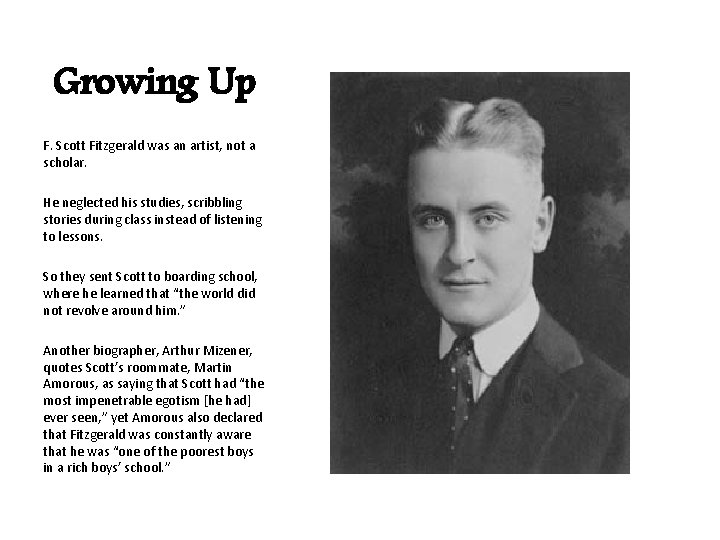
Growing Up F. Scott Fitzgerald was an artist, not a scholar. He neglected his studies, scribbling stories during class instead of listening to lessons. So they sent Scott to boarding school, where he learned that “the world did not revolve around him. ” Another biographer, Arthur Mizener, quotes Scott’s roommate, Martin Amorous, as saying that Scott had “the most impenetrable egotism [he had] ever seen, ” yet Amorous also declared that Fitzgerald was constantly aware that he was “one of the poorest boys in a rich boys’ school. ”
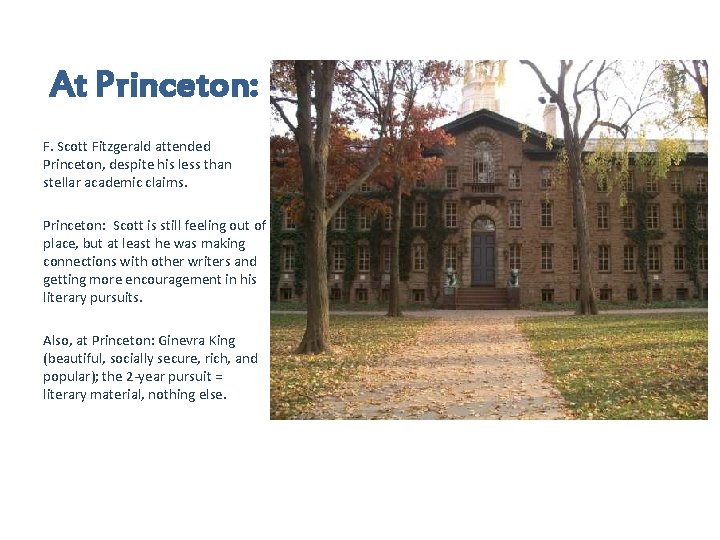
At Princeton: F. Scott Fitzgerald attended Princeton, despite his less than stellar academic claims. Princeton: Scott is still feeling out of place, but at least he was making connections with other writers and getting more encouragement in his literary pursuits. Also, at Princeton: Ginevra King (beautiful, socially secure, rich, and popular); the 2 -year pursuit = literary material, nothing else.
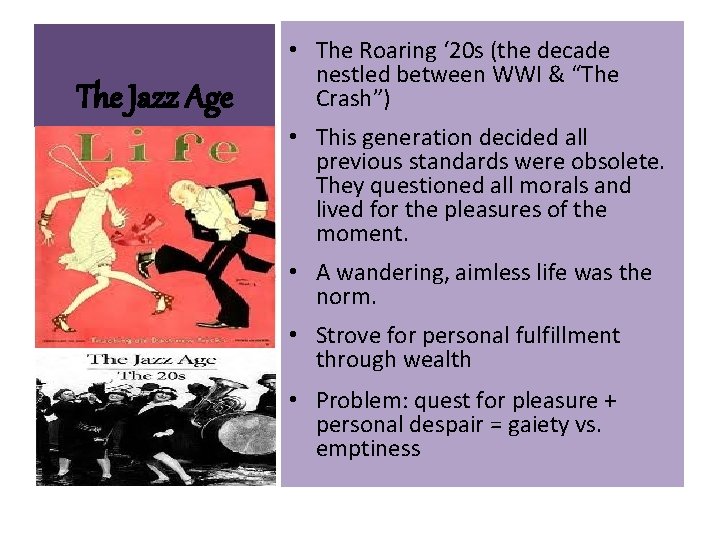
The Jazz Age • The Roaring ‘ 20 s (the decade nestled between WWI & “The Crash”) • This generation decided all previous standards were obsolete. They questioned all morals and lived for the pleasures of the moment. • A wandering, aimless life was the norm. • Strove for personal fulfillment through wealth • Problem: quest for pleasure + personal despair = gaiety vs. emptiness
In the Army Now • Started at Ft. Leavenworth, KS: Captain Dwight Eisenhower leading him in calisthenics & drills. • Worked on his next novel on weekends and sometimes during training classes! • War ended on November 11, 1918, just as his regiment was boarding ship to leave for France. • Stationed in Montgomery, AL after war ended. Here he met Zelda, a Southern Belle.
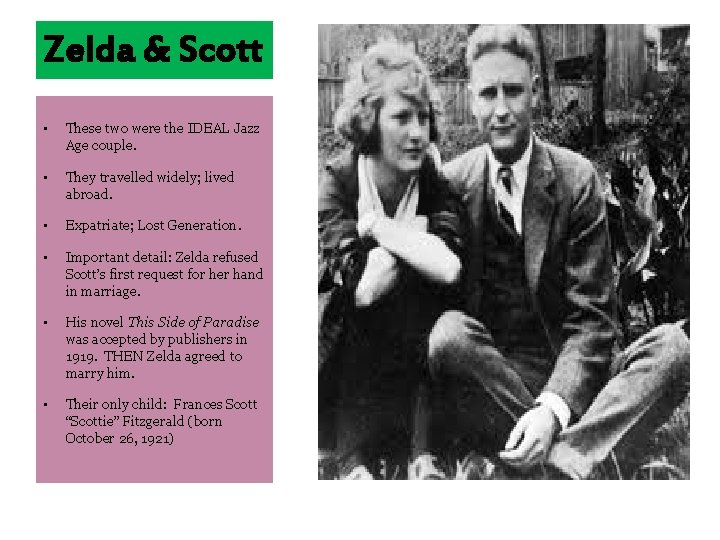
Zelda & Scott • These two were the IDEAL Jazz Age couple. • They travelled widely; lived abroad. • Expatriate; Lost Generation. • Important detail: Zelda refused Scott’s first request for her hand in marriage. • His novel This Side of Paradise was accepted by publishers in 1919. THEN Zelda agreed to marry him. • Their only child: Frances Scott “Scottie” Fitzgerald (born October 26, 1921)
Final Fitzgerald Tidbits WHAT HE CLAIMED: WHAT OTHERS SAY: Short stories fill the void (in a life like Fitzgerald’s): • Irony: the majority of the very American Gatsby was written during the 2+ years Fitzgerald lived in Europe Novel: This Side of Paradise Short Story Collection: Flappers and Philosophers • Successful stage adaptation of Gatsby helped it achieve its initial success • Matthew Bruccoli on Fitzgerald: “[A] major theme in Fitzgerald’s fiction: the gifted man ruined by a selfish woman. The hero is [often] a scandalous middle-aged novelist who lost his Ginevra as a young man and never got over it… The girl is the writer’s inspiration, but only when she is unattained. The satisfied artist is unproductive. ” Novel: Beautiful and Damned Short Story Collection: Tales of the Jazz Age _________________________ • Fitzgerald on writing: “An author ought to write for the youth of his own generation, the critics of the next, and the schoolmaster of ever afterwards. ” • Fitzgerald met Ernest Hemingway right after The Great Gatsby was published • • Fitzgerald once said that Hemingway spoke with the authority of success, while he (Fitzgerald) spoke with the authority of failure. “There never was a good biography of a novelist. There couldn’t be. He is too many people, if he’s any good. ” –F. Scott Fitzgerald HIS DEATH Fitzgerald was working on The Last Tycoon in 1940 and suffering from ill health, mainly cardiac problems (and at least one heart attack). On December 21, 1940, while he was relaxing and eating a chocolate bar, waiting for his physician to come by, he suddenly stood, reached for the chimney, and then slid to the floor. He had another heart attack, and he died quickly. He was buried six days later in Rockville, Maryland.