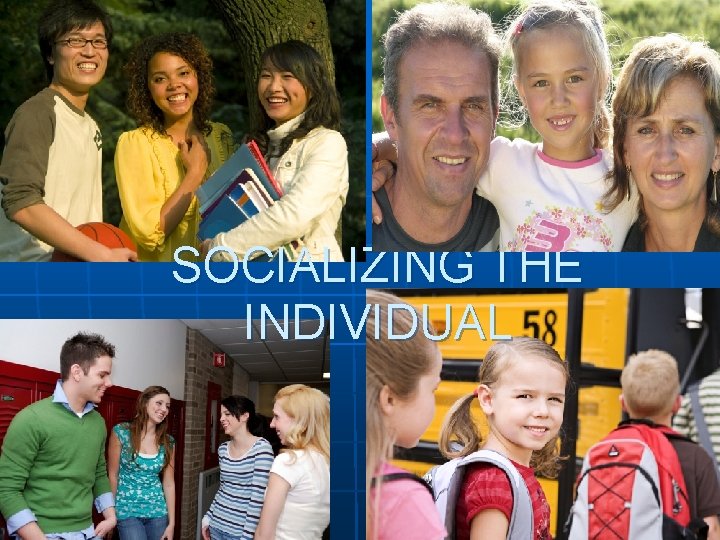
SOCIALIZING THE INDIVIDUAL Social experience is the foundation
- Slides: 64
SOCIALIZING THE INDIVIDUAL
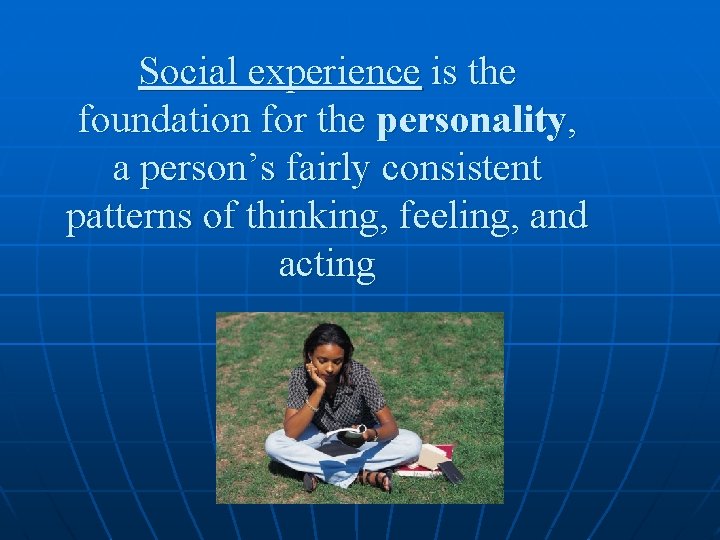
Social experience is the foundation for the personality, a person’s fairly consistent patterns of thinking, feeling, and acting
Personality n n The sum total of behaviors, attitudes, beliefs, and values that are characteristic of an individual Determines how we adjust/react Unique Develops over time
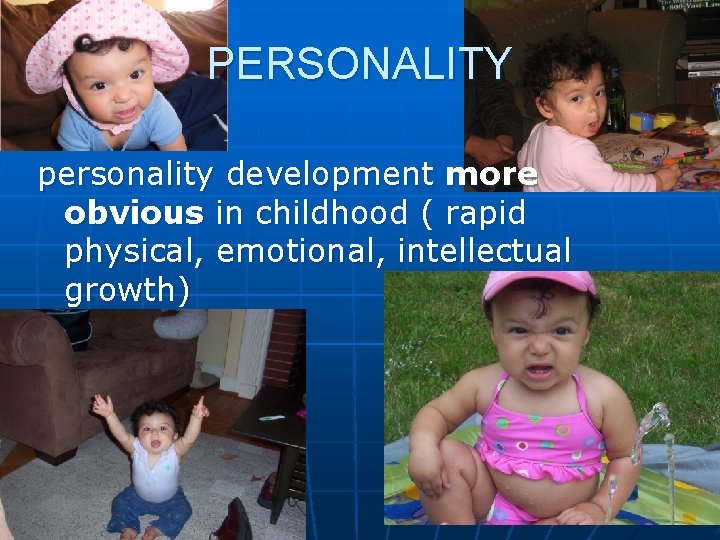
PERSONALITY personality development more obvious in childhood ( rapid physical, emotional, intellectual growth)
PERSONALITY What are the 4 main factors that affect development of personality?
PERSONALITY n n HEREDITY BIRTH ORDER PARENTAL CHARACTERISTICS CULTURAL ENVIRONMENT
NATURE VS NURTURE n n 19 th century an intense debate regarding the relative importance of nature (biology) and nurture (socialization) in the shaping of human behavior. Modern sociologists view nurture as much more important than nature in shaping human behavior.
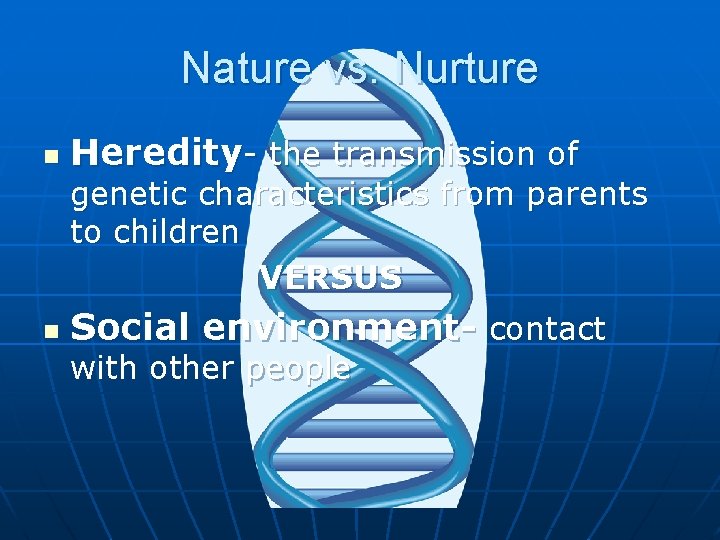
Nature vs. Nurture n Heredity- the transmission of genetic characteristics from parents to children VERSUS n Social environment- contact with other people
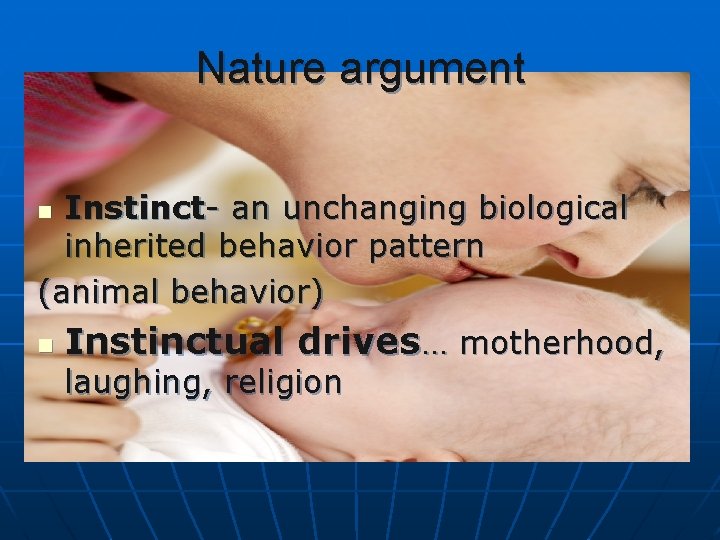
Nature argument Instinct- an unchanging biological inherited behavior pattern (animal behavior) n n Instinctual drives… motherhood, laughing, religion
Nurture argument Ivan Pavlov’s work w/dogs n Russian scientist that showed instinctual behavior could be taught http: //www. youtube. com/watch? v=hhqu mfpxuz. I&feature=related n American psychologist John B. Watson: apply principle to humans. . dozen healthy infants and turn them into dr. ’s, lawyers, beggars, thieves, etc n
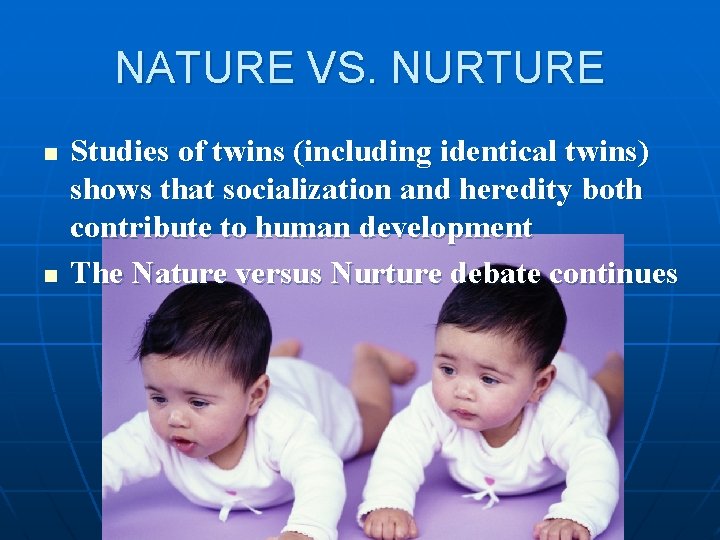
NATURE VS. NURTURE n n Studies of twins (including identical twins) shows that socialization and heredity both contribute to human development The Nature versus Nurture debate continues
Nature argument n n n Sociobiology- systematic study of biological basis of all social behavior Certain cultural characteristics and behavioral traits are “rooted” in genetic makeup of humans Human social life is determined by biological factors
Reflection n n Describe the nature versus nurture viewpoints of personality developments. Which argument do you support? Explain
HEREDITY n n Characteristics present at birth: body build, hair, eye color, skin pigmentation Aptitude- capacity to learn a particular skill or acquire knowledge (natural talent) EXAMPLE-music or art = aptitude Social scientists believe that “inherited aptitude”- can be influenced by environmental factors – parents can encourage/discourage.
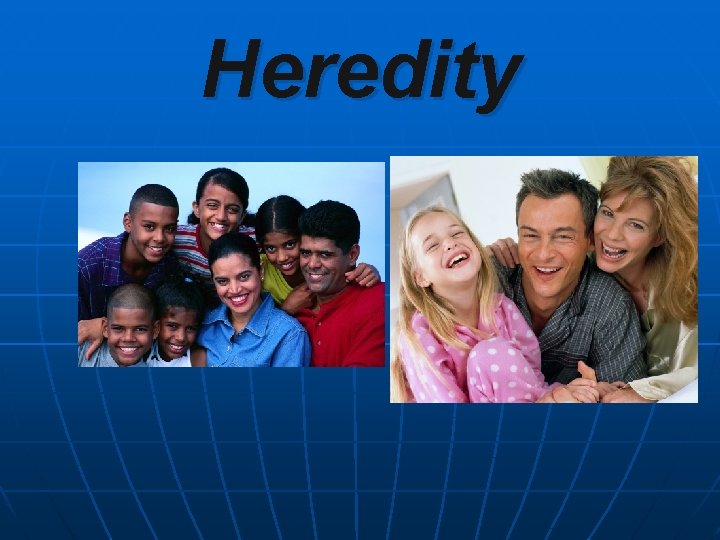
Heredity
HEREDITY and CULTURE Heredity provides you with biological needs n Culture determines how you meet these needs n Shapes human personalities by setting limits on the individuals http: //www. youtube. com/watch? v=eg XIk_4 -q. MY n
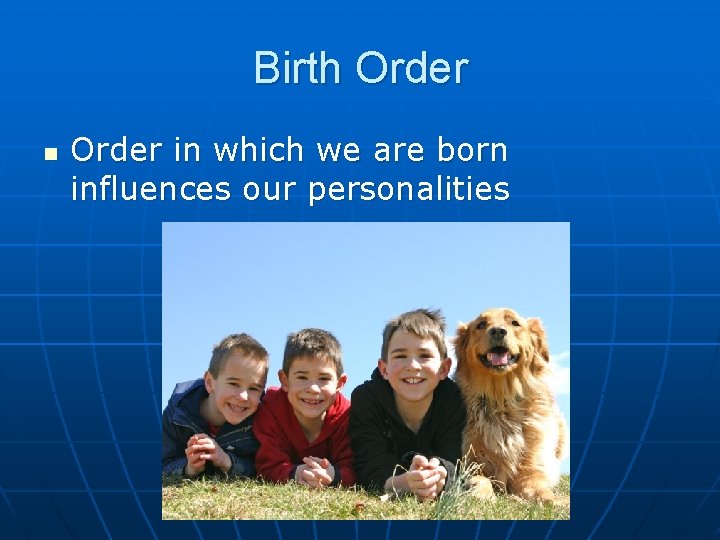
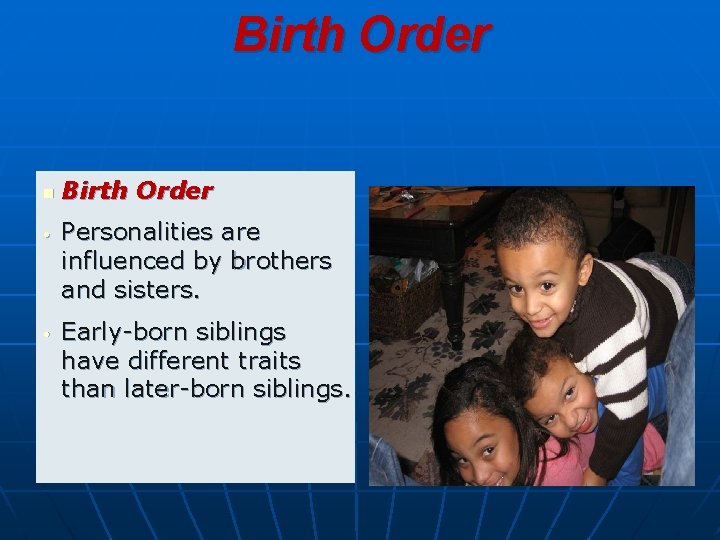
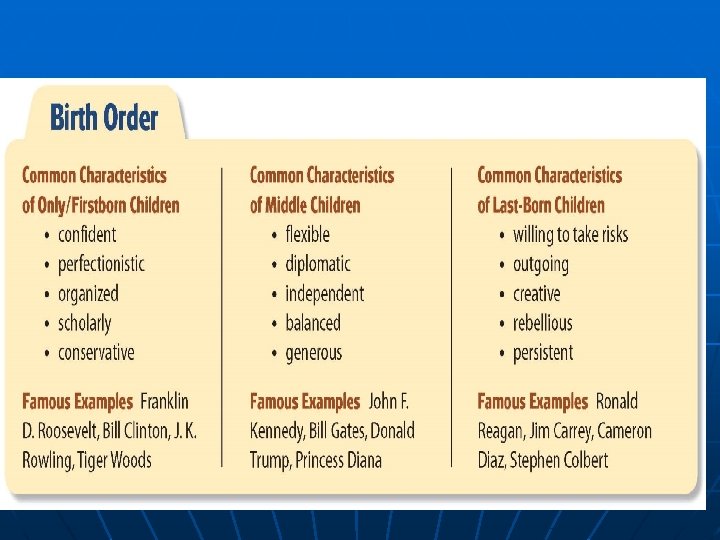
Birth Order n Order in which we are born influences our personalities
Birth Order n n First Born…. achievement oriented Last Born…social Middle child… Only child… What is your birth order?
Birth Order n • • Birth Order Personalities are influenced by brothers and sisters. Early-born siblings have different traits than later-born siblings.
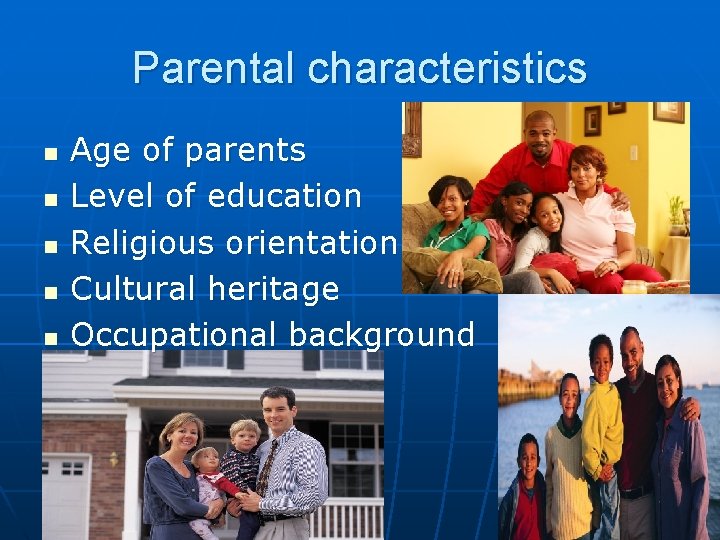
Parental characteristics n n n Age of parents Level of education Religious orientation Cultural heritage Occupational background
Parental characteristics Three parenting styles: n Permissive n Authoritative n Authoritarian Children reared with authoritative style integrate into society with the most ease (balance). Permissive and authoritarian styles represent opposite extremes. Permissive parenting styles causes children to not understand their boundaries. Authoritarian raised children will often rebel.
The Cultural Environment n n Culture influences personality Determines basic types of personalities found in society U. S. -competitive, assertiveness, competitive = personality traits. Ik (“eek”) culture • Prior to WW II the Ik were huntergatherers in mountainous region of Uganda. Children viewed all adults and other children as parents and brothers/sisters.
Ik socialization culture change continued n n POST-WWII the government turned Ik land to national park, and the land went barren, and their social structure COLLAPSED. Today Ik children are thrown out by the age of 3. As a result they form bands for survival. Parents do not help children survive. Only the strongest and most clever survive. The culture influences the Ik children.
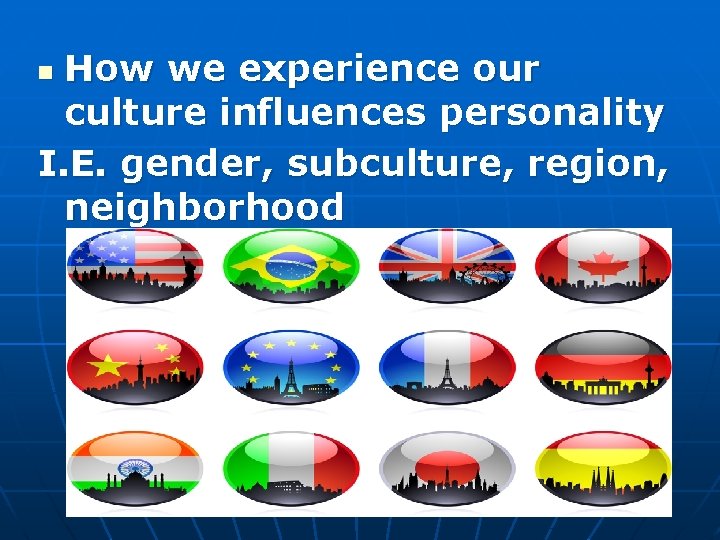
How we experience our culture influences personality I. E. gender, subculture, region, neighborhood n
SUMMARIZE/process INFO n n n What are the 4 main factors that affect personality development? Which factor has more influence on personality development and which less? Complete the graphic organizer to investigate how culture and socialization influences YOUR personality.
POINTS TO PONDER n n How does isolation in childhood affect development? Make a list of characteristics a child might exhibit if he or she were raised isolated from their families….
Isolation in Childhood n Feral children- wild or untamed – found living in isolation in homes Case studies of isolation have led Sociologists to conclude that our personality comes from our cultural environment!
ISOLATION IN CHILDHOOD n n Anna-was confined to attic space, given no social attention. When found (at age 6) she had no interest in people. She could not walk, talk or feed herself. Died at 10 from malnourishment. Isabelle-was restricted to a dark room, but did have her mother (who was deaf). When found at age 6, she could not speak, but eventually did learn to communicate (shows that social deprivation can be overcome!)
n n Genie was raised in near isolation for the first twelve years of her life. Lived in almost complete silence, and was beaten if she made noise. She did not learn how to talk. After she was found, she had the skills of a 1 year old. After 8 years of training, she never progressed past the 3 rd grade level. Never able to function as a social being, but could conform to basic social norms. http: //www. youtube. com/watch? v=th. IDCL 3 NCl. Q&feat ure=related
ISOLATION IN CHILDHOOD n n Lack social skills human characteristics Lack reasoning, manners, ability to control bodily functions or move like humans lack the ability to speak
ISOLATION IN CHILDHOOD Research on the effects of social isolation demonstrates the importance of socialization. n All the evidence points to the crucial role in social development in forming personality. n
Summarize n What is the significance of the cultural environment in the socialization /personality development?
INSTITUTIONALIZATION Orphanages and hospitals can often create the same characteristics of isolated children Spitz’s research on institutionalization on infants in orphanage: n Human interaction is important n Lack of caring environment: develop much slower, mentally, physically, emotionally. n
THE SOCIAL SELF n How does a person’s sense of self emerge?
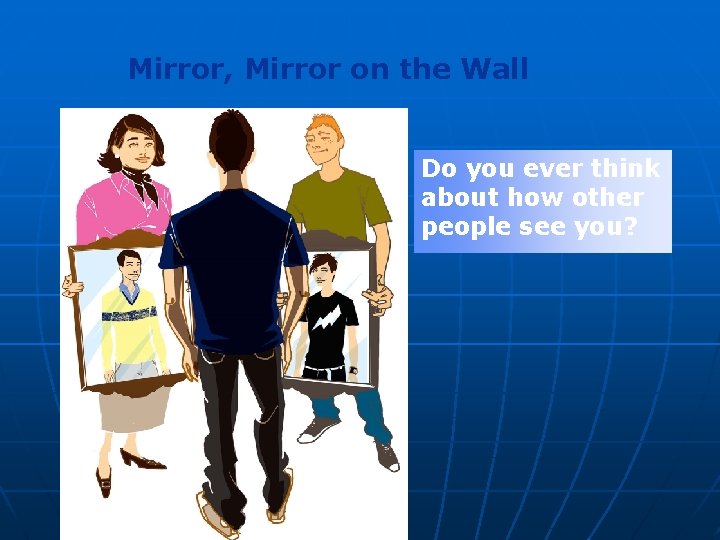
Mirror, Mirror on the Wall Do you ever think about how other people see you?
SOCIALIZATION n n Socialization is the lifelong social experience by which individuals develop their human potential and learn culture. interactive process
SELF n distinct identity that separates you from other members of society.
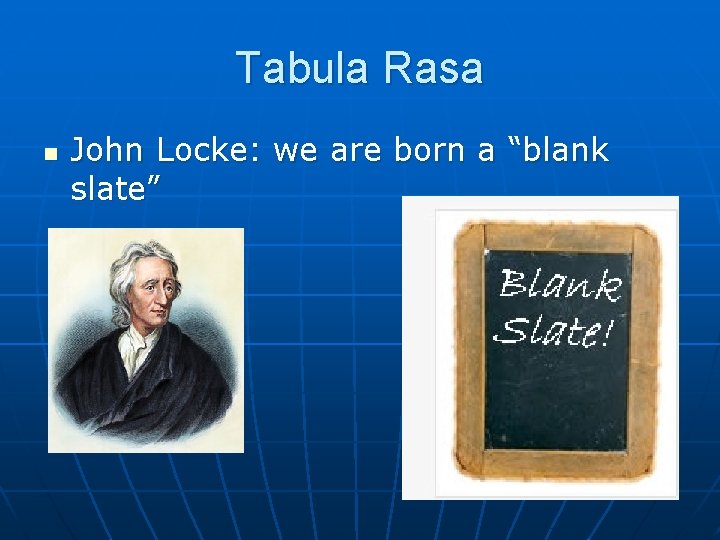
Tabula Rasa n John Locke: we are born a “blank slate”
Locke n n n A “clean slate” onto which anything can be written Believed adults could shape newborns’ personality Absorb the aspects of the culture they are in contact with
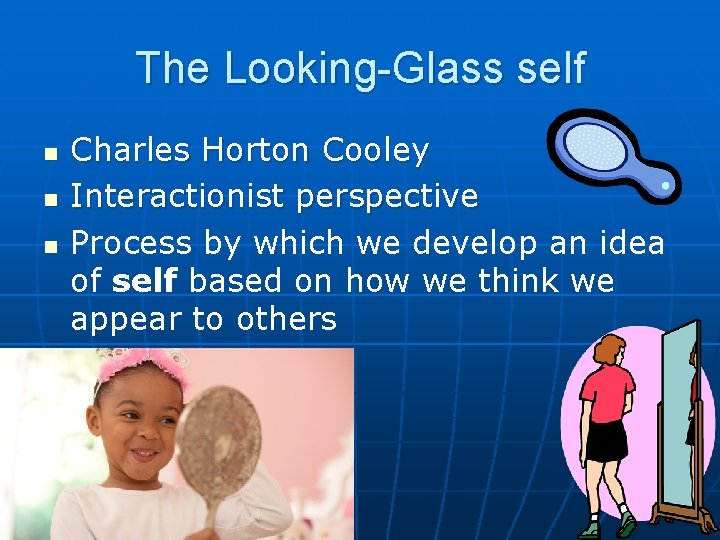
The Looking-Glass self n n n Charles Horton Cooley Interactionist perspective Process by which we develop an idea of self based on how we think we appear to others
Three-step process 1. 2. 3. n We imagine how we appear to others Based on their reaction to us, we attempt to determine if others view us as we view ourselves We use perceptions of how others judge us to develop feelings about ourselves Begins in infancy but continues throughout life
Example n Mattie is a new sociology professor at the local college. During her first lecture, she noticed that some students were yawning. Based on her interpretation of the students yawning, Mattie has decided she is a boring teacher.
Cooley n n The formation of the self – the set of concepts we use in defining who we are – is a central part of the socialization process. The self emerges in the course of interaction with other people
George Herbert Mead n n n Interactionist perspective Idea similar to Cooley Role taking: we see ourselves as others see us but take on or pretend to take the roles of others imagining the situation from that person’s point of view, a process called taking the role of the other. Internalize the expectations of the people closest to us (significant others)
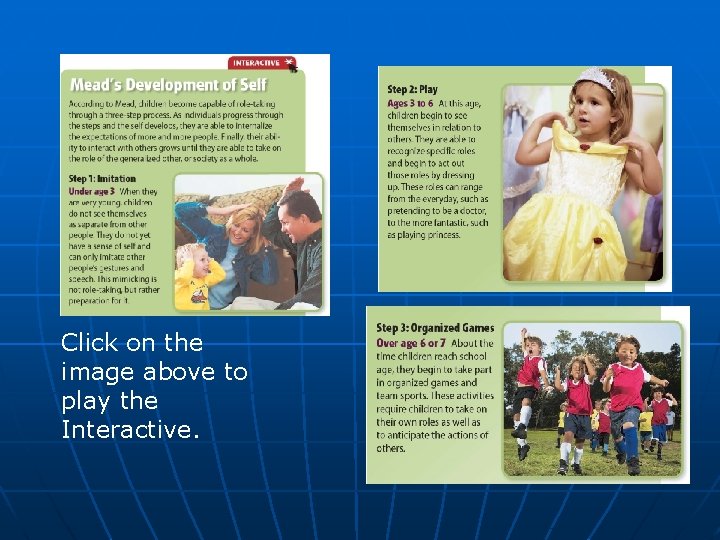
Mead The self develops through several stages: n Imitation. n Play, in which children take the roles of significant others. n Games, in which they take the roles of several other people at the same time. n Internalized attitudes, expectations, and viewpoints =the generalized other n
Click on the image above to play the Interactive.
Mead n n I= unsocialized, spontaneous selfinterested component of personality and self identity Me= aware of expectations and attitudes of society- the socialized self
n n Seeing ourselves as others see us is first step Eventually take on, or pretend to take on, the roles of others (roletaking)
n n Significant others are the people who are closest to us: parents, siblings, and others who directly influence our socialization As an individual ages, significant others grow less important Generalized other is the internalized attitudes, expectations and viewpoints of society Children under three can only imitate the actions of others
Creating a sense of self : Mead • Criticized for ignoring the role of biology in the development of the self. • Self-esteem is governed by appraisals, social comparisons, and self-attribution • Conclusion: Mead showed that symbolic interaction is the foundation of both self and society
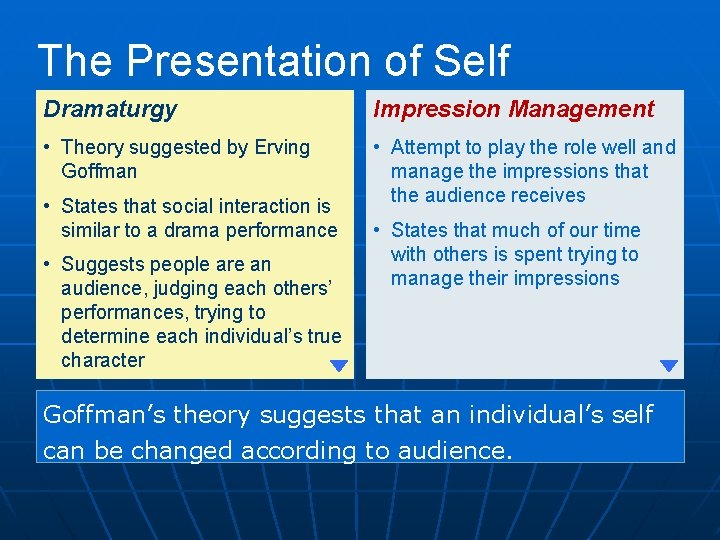
The Presentation of Self Dramaturgy Impression Management • Theory suggested by Erving Goffman • Attempt to play the role well and manage the impressions that the audience receives • States that social interaction is similar to a drama performance • Suggests people are an audience, judging each others’ performances, trying to determine each individual’s true character • States that much of our time with others is spent trying to manage their impressions Goffman’s theory suggests that an individual’s self can be changed according to audience.
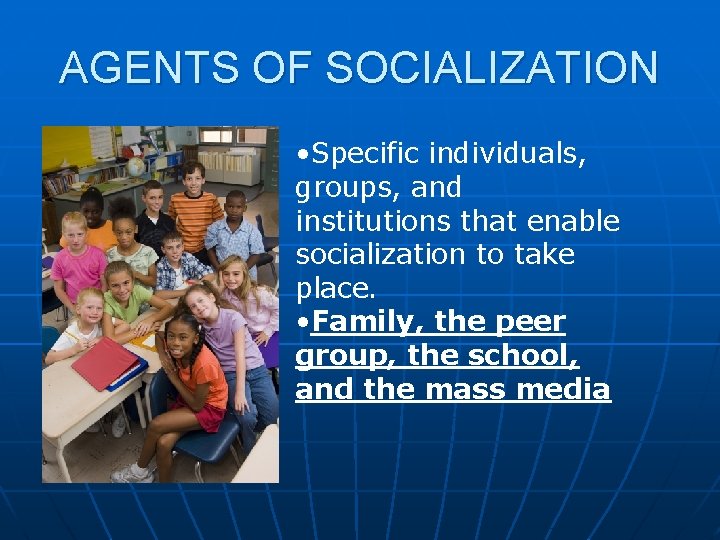
AGENTS OF SOCIALIZATION • Specific individuals, groups, and institutions that enable socialization to take place. • Family, the peer group, the school, and the mass media
Family n n most important of the agents of socialization Primary socializer of young children determining one's attitudes toward religion and establishing career goals. Unintended or deliberate socialization
Peer Group n n n Peers refer to people who are roughly the same age and/or who share other social characteristics Influential during the pre-teen/early teenage years w/out peer acceptance…misfits, outsiders,
School n n Major role in “deliberate” socialization Class activities deliberate teaching Extracurricular activities prepare students for life in larger society Transmit cultural values: patriotism, responsibility, citizenship
School n n Teachers become role models (manners, speech, style) Peer groups and cliques
Mass Media n n Instruments of mass communication reaching large audiences No personal contact Books, film, internet, magazines, newspapers, radio, television Which form has the most influence?
Mass Media n n n 98% of homes in US have TV’s Average more than 2 tv’s per home Children watch avg. of 28 hrs a week Ongoing debate over TV violence What are negative and positive aspects of the effects of mass media on socialization?
Resocialization Setting in which people are isolated from the rest of society for a set period n Break with past experiences n Learning of new values and norms n Voluntary (college)and involuntary I. E. prisons, (military)boot camp, n
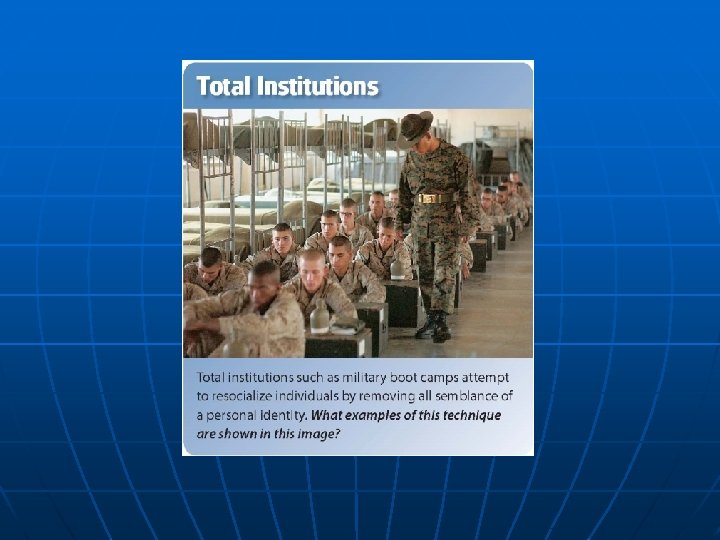
Resocialization Total institutions concerned w/ resocializing members n Isolated n Subject to tight control Changing personality/social behavior n How is this done? n
Resocialization n Strip away individual identity Replace inst. Identity Uniforms, deny freedom http: //www. youtube. com/watch? v=PA S 4 u. SDJe 9 k&feature=channel http: //www. youtube. com/watch? v=Qd 7_yp 0 Hkwc