Smart Starter What is the last chemical reaction





- Slides: 66
Smart Starter • What is the last chemical reaction you observed? • What things were mixed? What was made?
Chemical Reactions Chapter 7 Are you into them?
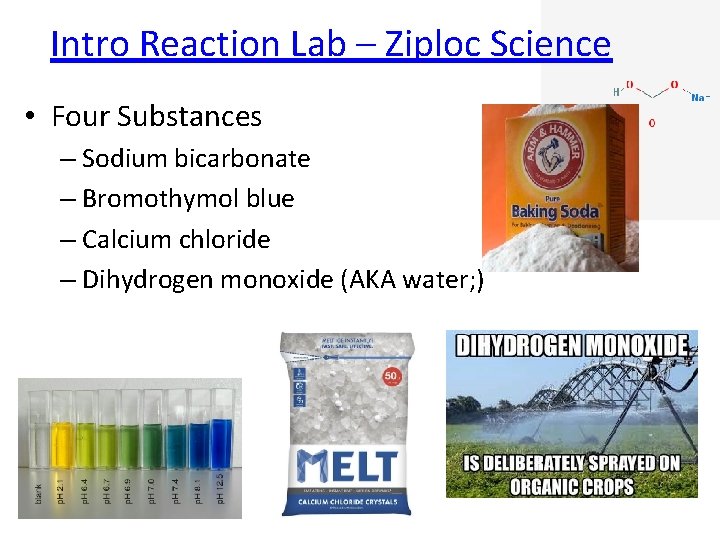
Intro Reaction Lab – Ziploc Science • Four Substances – Sodium bicarbonate – Bromothymol blue – Calcium chloride – Dihydrogen monoxide (AKA water; )
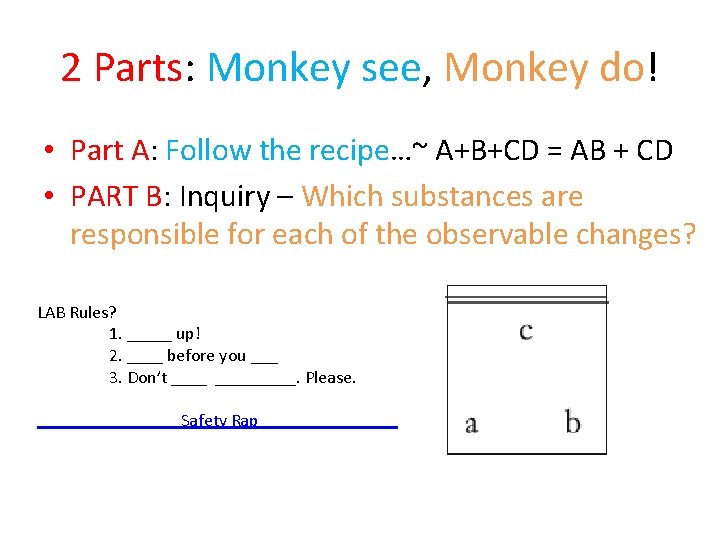
2 Parts: Monkey see, Monkey do! • Part A: Follow the recipe…~ A+B+CD = AB + CD • PART B: Inquiry – Which substances are responsible for each of the observable changes? LAB Rules? 1. _____ up! 2. ____ before you ___ 3. Don’t _________. Please. Safety Rap
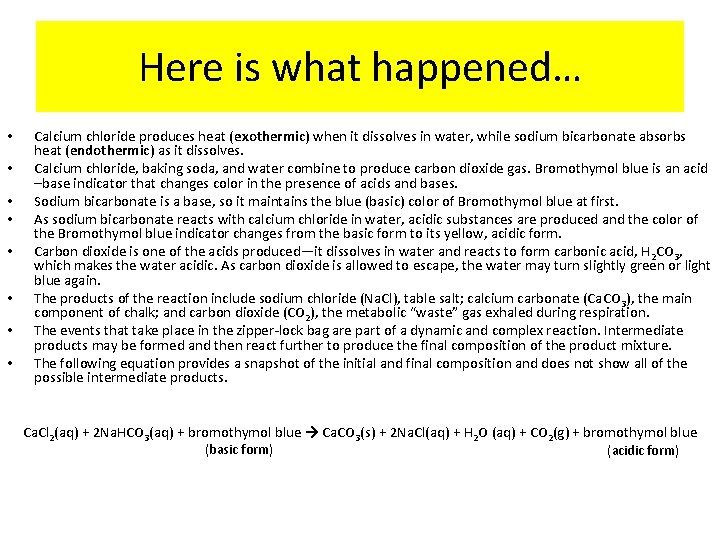
Here is what happened… • • Calcium chloride produces heat (exothermic) when it dissolves in water, while sodium bicarbonate absorbs heat (endothermic) as it dissolves. Calcium chloride, baking soda, and water combine to produce carbon dioxide gas. Bromothymol blue is an acid –base indicator that changes color in the presence of acids and bases. Sodium bicarbonate is a base, so it maintains the blue (basic) color of Bromothymol blue at first. As sodium bicarbonate reacts with calcium chloride in water, acidic substances are produced and the color of the Bromothymol blue indicator changes from the basic form to its yellow, acidic form. Carbon dioxide is one of the acids produced—it dissolves in water and reacts to form carbonic acid, H 2 CO 3, which makes the water acidic. As carbon dioxide is allowed to escape, the water may turn slightly green or light blue again. The products of the reaction include sodium chloride (Na. Cl), table salt; calcium carbonate (Ca. CO 3), the main component of chalk; and carbon dioxide (CO 2), the metabolic “waste” gas exhaled during respiration. The events that take place in the zipper lock bag are part of a dynamic and complex reaction. Intermediate products may be formed and then react further to produce the final composition of the product mixture. The following equation provides a snapshot of the initial and final composition and does not show all of the possible intermediate products. Ca. Cl 2(aq) + 2 Na. HCO 3(aq) + bromothymol blue → Ca. CO 3(s) + 2 Na. Cl(aq) + H 2 O (aq) + CO 2(g) + bromothymol blue (basic form) (acidic form)
7. 1 Describing Reactions • Intro Assignment: – Flash Cards Pictionary • Term on one side • Definitions & Drawings on the other side Ch 7 Quizlet
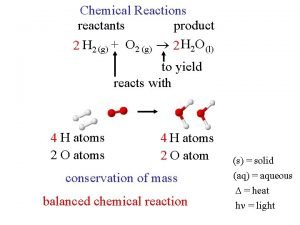
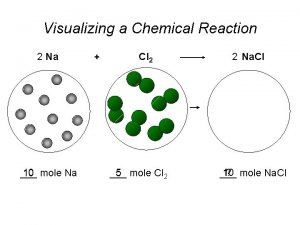
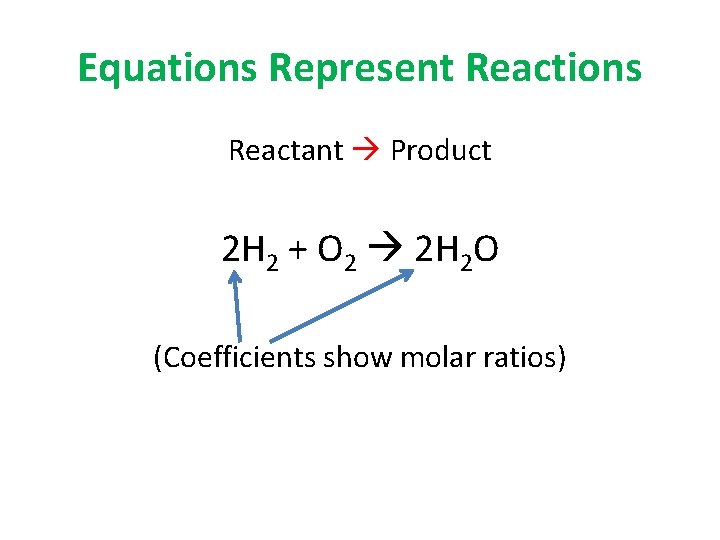
Equations Represent Reactions Reactant Product 2 H 2 + O 2 2 H 2 O (Coefficients show molar ratios)
Smart. Starter What is the law of conservation of mass? • Don’t know? Do the best you can to write down what you thing it might be and then See page 193 in your textbook
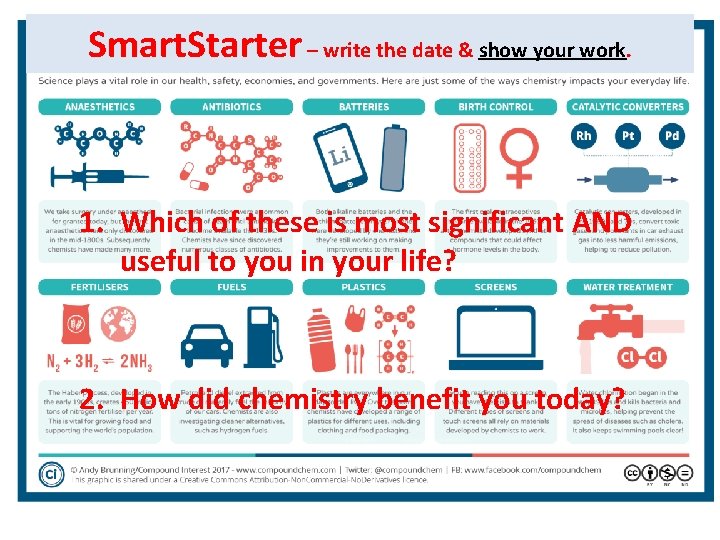
Smart. Starter – write the date & show your work. 1. Which of these is most significant AND useful to you in your life? 2. How did chemistry benefit you today?
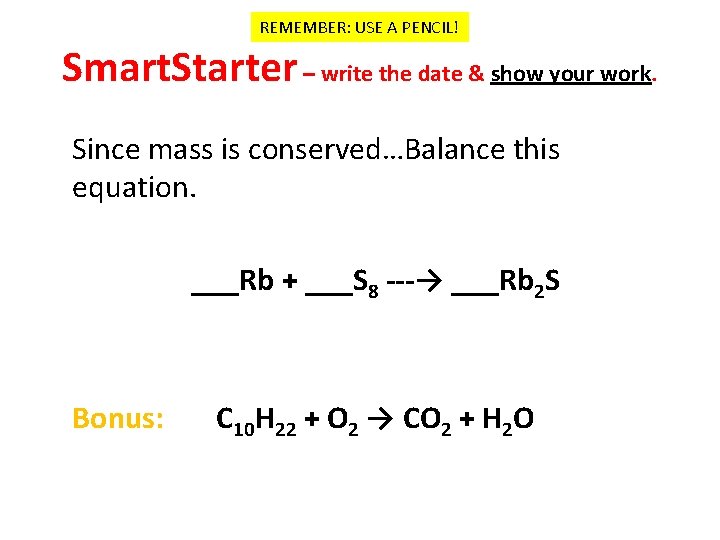
REMEMBER: USE A PENCIL! Smart. Starter – write the date & show your work. Since mass is conserved…Balance this equation. ___Rb + ___S 8 ---→ ___Rb 2 S Bonus: C 10 H 22 + O 2 → CO 2 + H 2 O
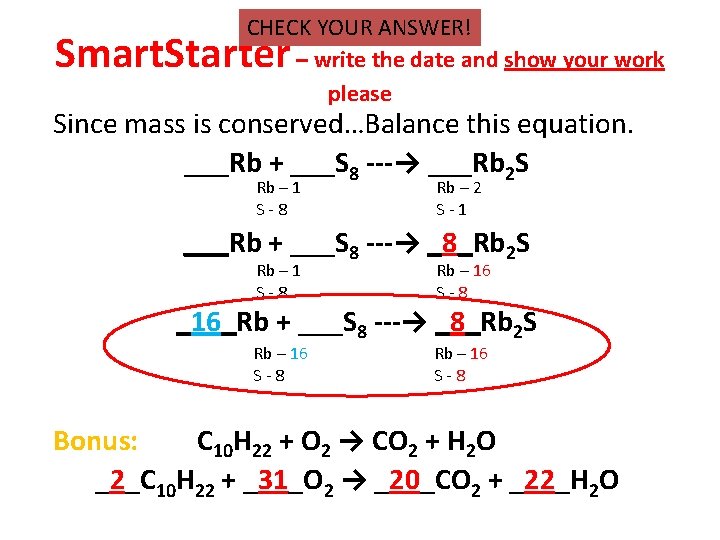
CHECK YOUR ANSWER! – write the date and show your work please Smart. Starter Since mass is conserved…Balance this equation. ___Rb + ___S 8 ---→ ___Rb 2 S Rb – 1 S 8 Rb – 2 S 1 ___Rb + ___S 8 ---→ _8_Rb 2 S Rb – 1 S 8 Rb – 16 S 8 _16_Rb + ___S 8 ---→ _8_Rb 2 S Bonus: C 10 H 22 + O 2 → CO 2 + H 2 O _2_C 10 H 22 + _31_O 2 → _20_CO 2 + _22_H 2 O
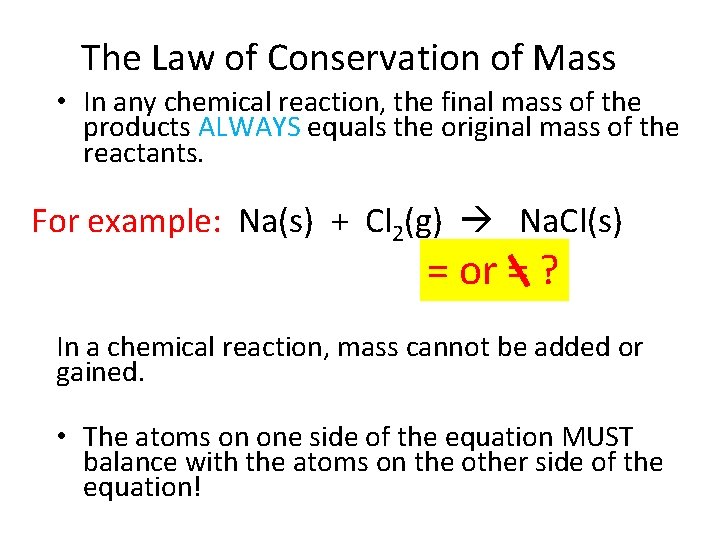
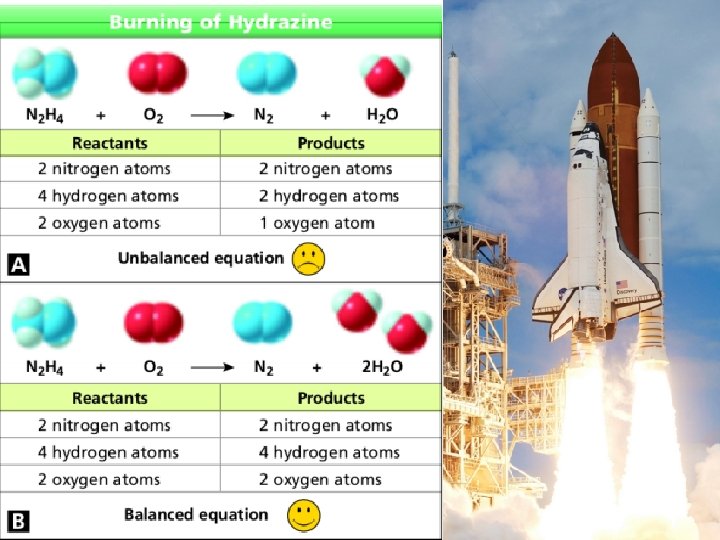
The Law of Conservation of Mass • In any chemical reaction, the final mass of the products ALWAYS equals the original mass of the reactants. For example: Na(s) + Cl 2(g) Na. Cl(s) = or = ? In a chemical reaction, mass cannot be added or gained. • The atoms on one side of the equation MUST balance with the atoms on the other side of the equation!
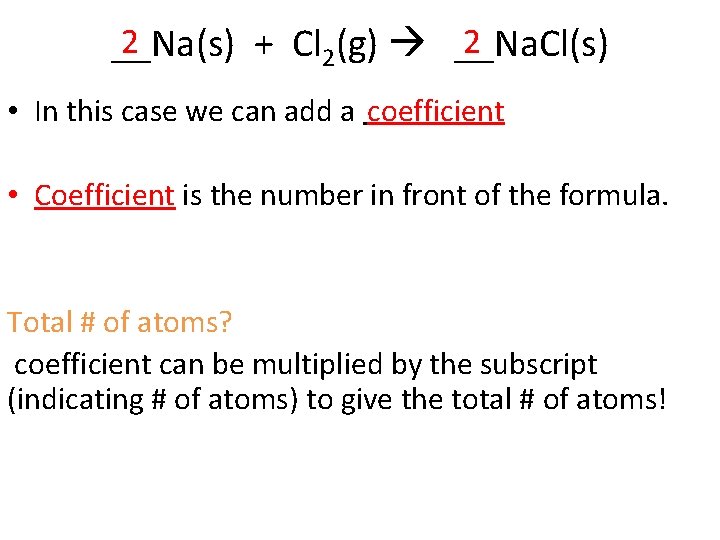
2 2 __Na(s) + Cl 2(g) __Na. Cl(s) • In this case we can add a coefficient • Coefficient is the number in front of the formula. Total # of atoms? coefficient can be multiplied by the subscript (indicating # of atoms) to give the total # of atoms!
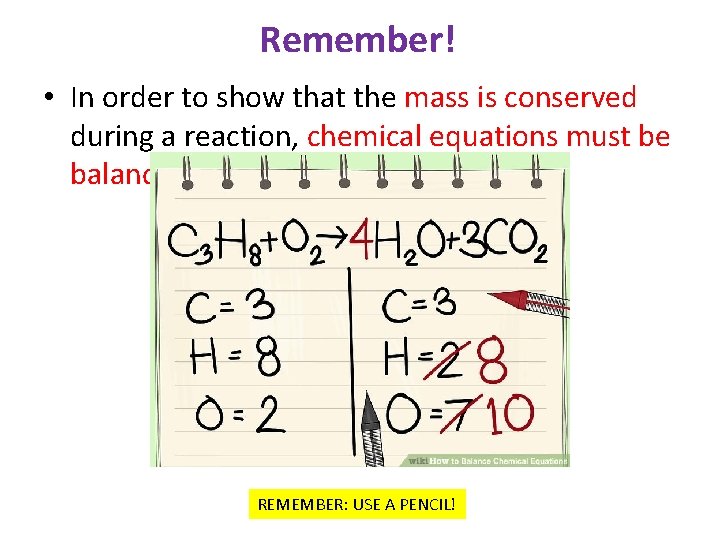
Remember! • In order to show that the mass is conserved during a reaction, chemical equations must be balanced! REMEMBER: USE A PENCIL!
Video: Guided Practice – 5 min. Write the 5 Helps in your NOTES! 5 Steps Practice to Learn how to balance!
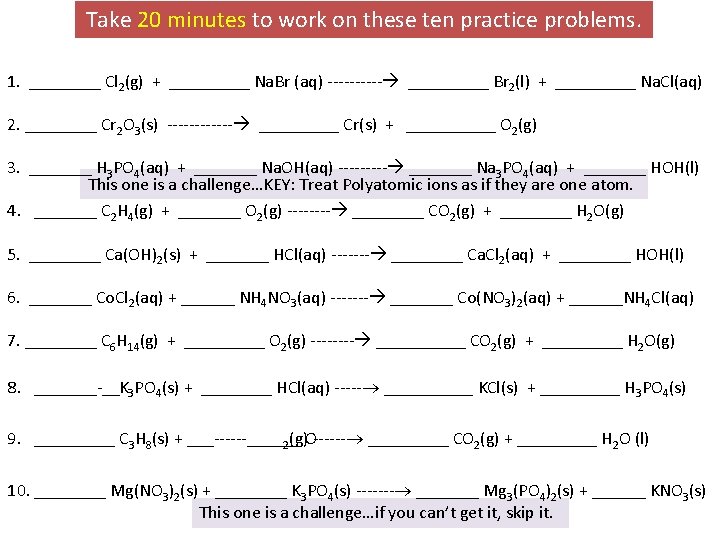
Take 20 minutes to work on these ten practice problems. 1. ____ Cl 2(g) + _____ Na. Br (aq) _____ Br 2(l) + _____ Na. Cl(aq) 2. ____ Cr 2 O 3(s) _____ Cr(s) + _____ O 2(g) 3. _______ H 3 PO 4(aq) + _______ Na. OH(aq) _______ Na 3 PO 4(aq) + _______ HOH(l) This one is a challenge…KEY: Treat Polyatomic ions as if they are one atom. 4. _______ C 2 H 4(g) + _______ O 2(g) ____ CO 2(g) + ____ H 2 O(g) 5. ____ Ca(OH)2(s) + _______ HCl(aq) ____ Ca. Cl 2(aq) + ____ HOH(l) 6. _______ Co. Cl 2(aq) + ______ NH 4 NO 3(aq) _______ Co(NO 3)2(aq) + ______NH 4 Cl(aq) 7. ____ C 6 H 14(g) + _____ O 2(g) _____ CO 2(g) + _____ H 2 O(g) 8. _______ __ K 3 PO 4(s) + ____ HCl(aq) _____ KCl(s) + _____ H 3 PO 4(s) 9. _____ C 3 H 8(s) + ______ O 2(g) _____ CO 2(g) + _____ H 2 O (l) 10. ____ Mg(NO 3)2(s) + ____ K 3 PO 4(s) _______ Mg 3(PO 4)2(s) + ______ KNO 3(s) This one is a challenge…if you can’t get it, skip it.
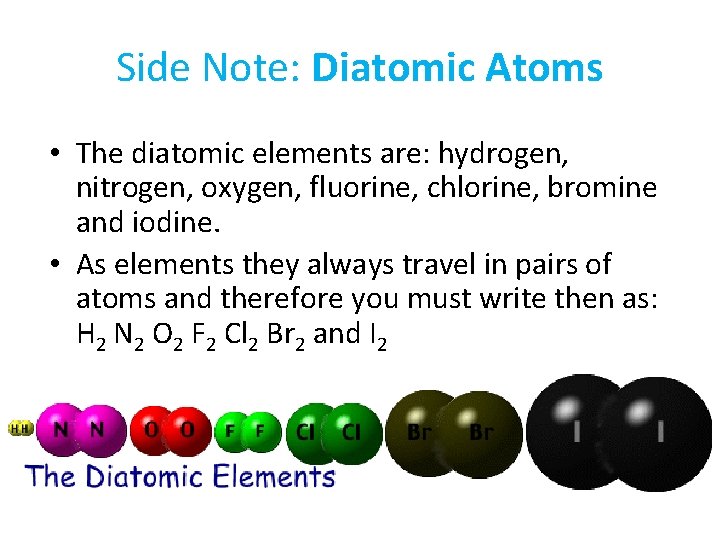
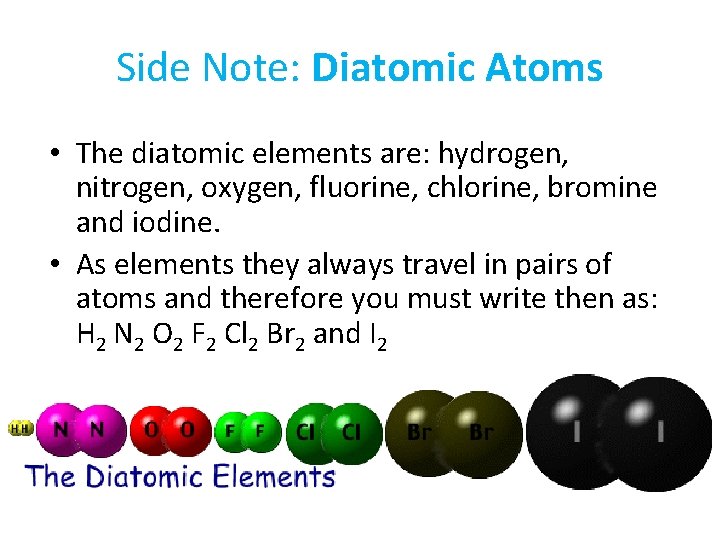
Side Note: Diatomic Atoms • The diatomic elements are: hydrogen, nitrogen, oxygen, fluorine, chlorine, bromine and iodine. • As elements they always travel in pairs of atoms and therefore you must write then as: H 2 N 2 O 2 F 2 Cl 2 Br 2 and I 2
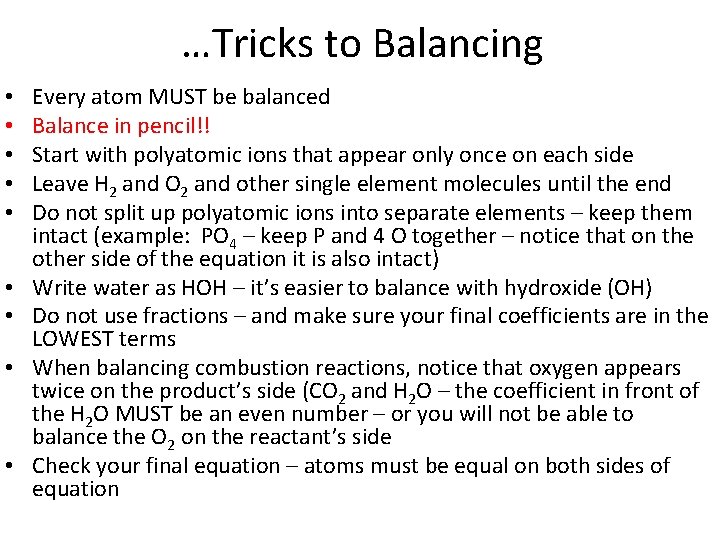
…Tricks to Balancing • • • Every atom MUST be balanced Balance in pencil!! Start with polyatomic ions that appear only once on each side Leave H 2 and O 2 and other single element molecules until the end Do not split up polyatomic ions into separate elements – keep them intact (example: PO 4 – keep P and 4 O together – notice that on the other side of the equation it is also intact) Write water as HOH – it’s easier to balance with hydroxide (OH) Do not use fractions – and make sure your final coefficients are in the LOWEST terms When balancing combustion reactions, notice that oxygen appears twice on the product’s side (CO 2 and H 2 O – the coefficient in front of the H 2 O MUST be an even number – or you will not be able to balance the O 2 on the reactant’s side Check your final equation – atoms must be equal on both sides of equation
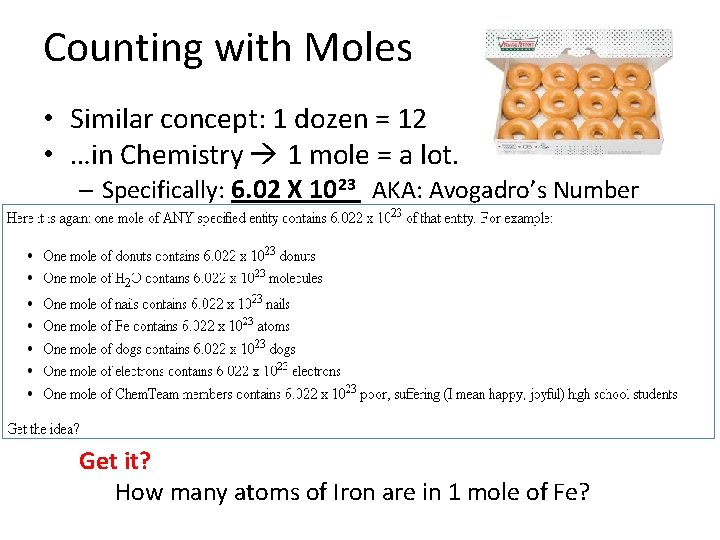
Counting with Moles • Similar concept: 1 dozen = 12 • …in Chemistry 1 mole = a lot. – Specifically: 6. 02 X 1023 AKA: Avogadro’s Number Get it? How many atoms of Iron are in 1 mole of Fe?
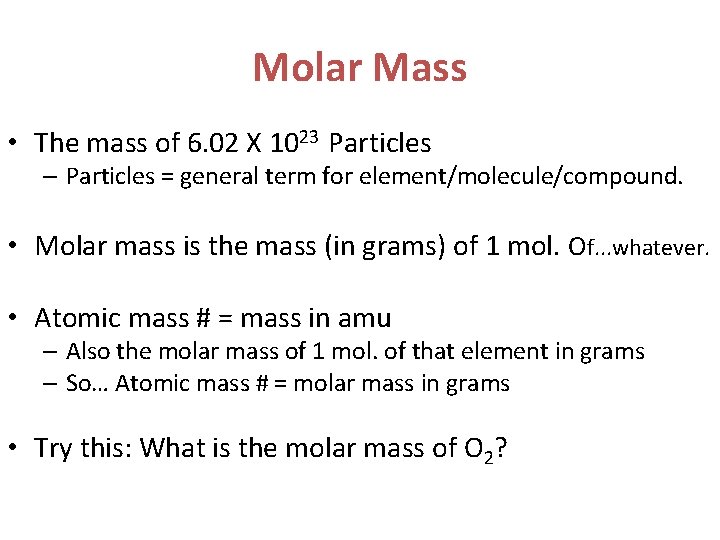
Molar Mass • The mass of 6. 02 X 1023 Particles – Particles = general term for element/molecule/compound. • Molar mass is the mass (in grams) of 1 mol. Of. . . whatever. • Atomic mass # = mass in amu – Also the molar mass of 1 mol. of that element in grams – So… Atomic mass # = molar mass in grams • Try this: What is the molar mass of O 2?
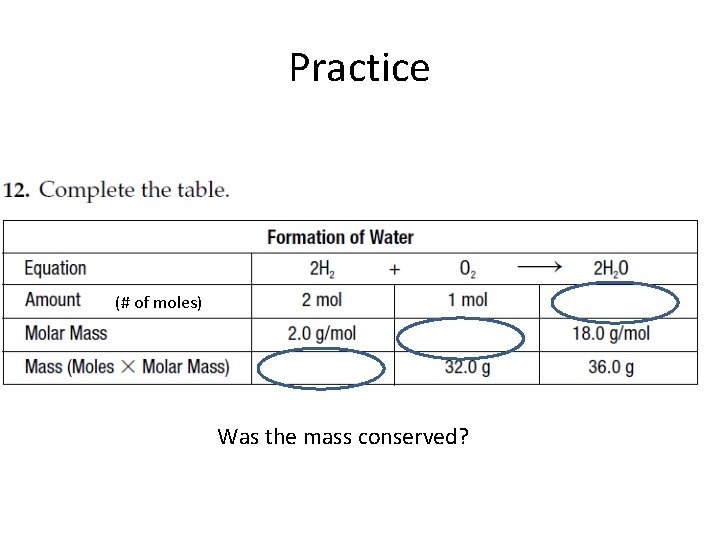
Practice (# of moles) Was the mass conserved?
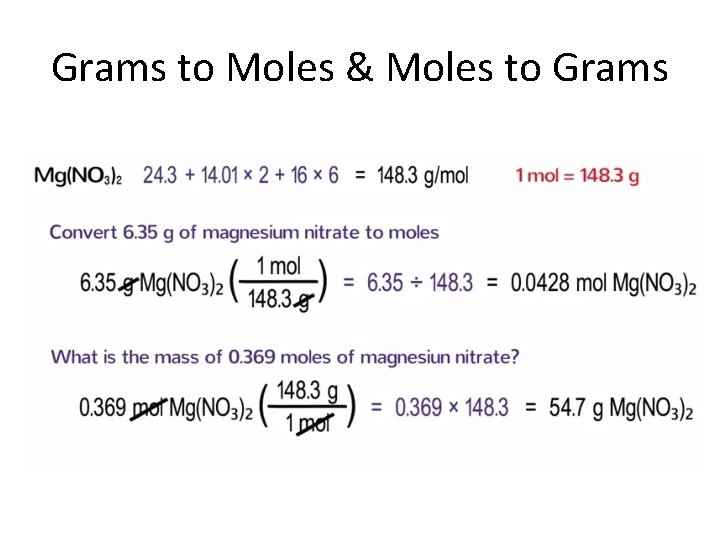
Resources/Help Videos Manipulating Moles Practice • Formula to Molar Mass (g) – Calculate the molar mass of Al(NO 3)3 • How many moles of Al(NO 3)3 is that? • Grams to Moles – If I have 639 g of Al(NO 3)3, how many moles do I have? • Moles to Grams – What is the mass (g) of 5 moles of Al(NO 3)3?
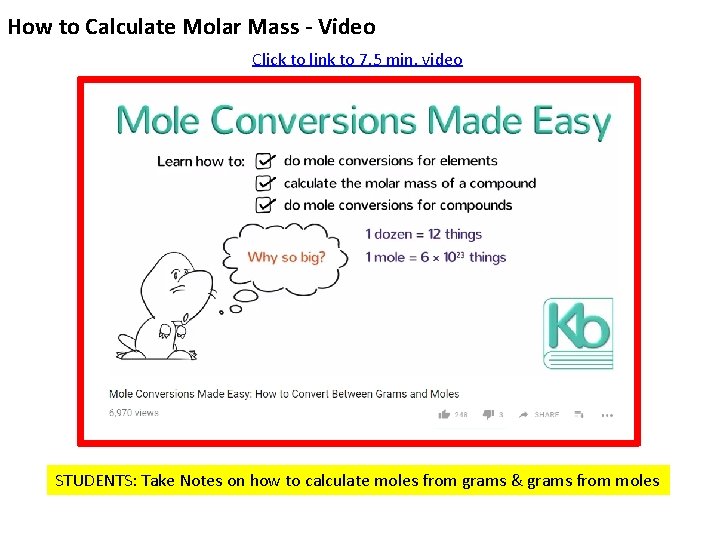
How to Calculate Molar Mass - Video Click to link to 7. 5 min. video STUDENTS: Take Notes on how to calculate moles from grams & grams from moles Take Notes so you will be ready to succeed in the next practice set of questions!
Grams to Moles & Moles to Grams
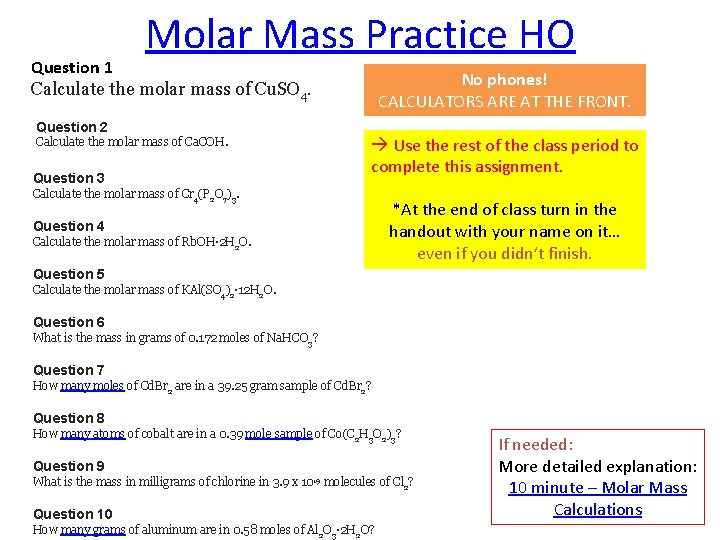
Molar Mass Practice HO Question 1 Calculate the molar mass of Cu. SO 4. No phones! CALCULATORS ARE AT THE FRONT. Question 2 Calculate the molar mass of Ca. COH. Question 3 Use the rest of the class period to complete this assignment. Calculate the molar mass of Cr 4(P 2 O 7)3. Question 4 Calculate the molar mass of Rb. OH· 2 H 2 O. *At the end of class turn in the handout with your name on it… even if you didn’t finish. Question 5 Calculate the molar mass of KAl(SO 4)2· 12 H 2 O. Question 6 What is the mass in grams of 0. 172 moles of Na. HCO 3? Question 7 How many moles of Cd. Br 2 are in a 39. 25 gram sample of Cd. Br 2? Question 8 How many atoms of cobalt are in a 0. 39 mole sample of Co(C 2 H 3 O 2)3? Question 9 What is the mass in milligrams of chlorine in 3. 9 x 10¹⁹ molecules of Cl 2? Question 10 How many grams of aluminum are in 0. 58 moles of Al 2 O 3· 2 H 2 O? If needed: More detailed explanation: 10 minute – Molar Mass Calculations
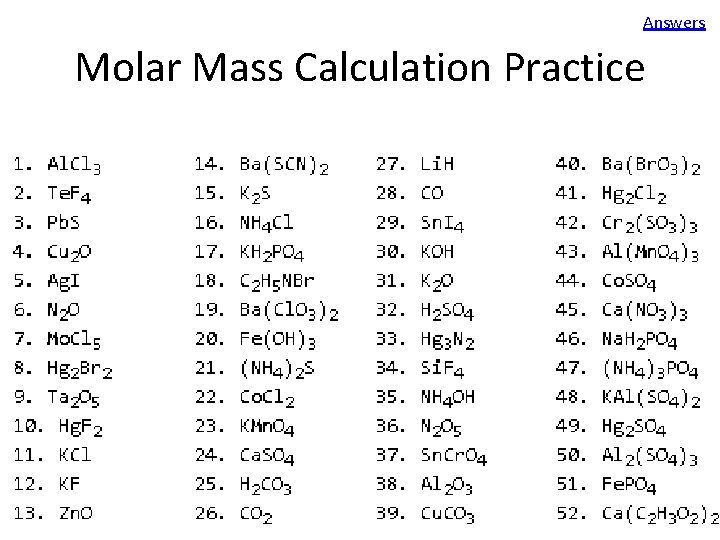
Answers Molar Mass Calculation Practice
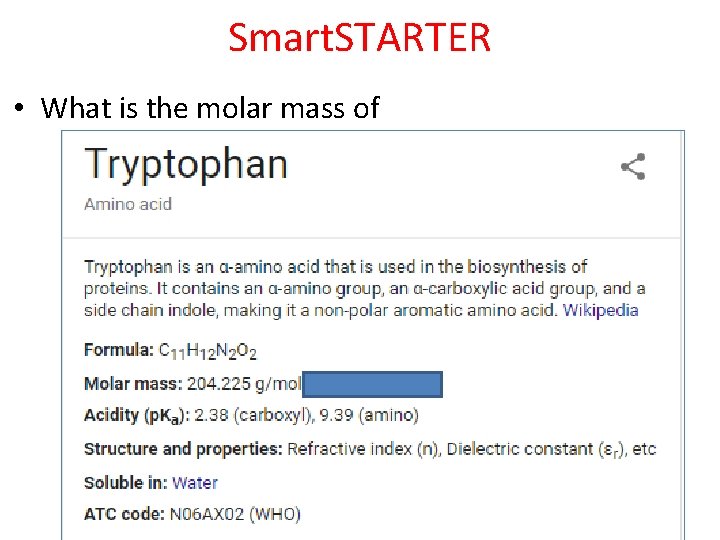
Smart. STARTER • What is the molar mass of
7. 2 Types of Reactions
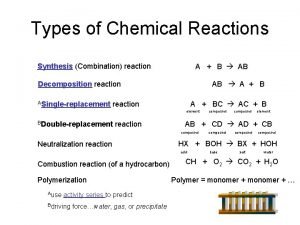
4 Types Of Reactions • In chemistry there are millions of chemical reactions. But most reactions can be classified as one of 4 types: • Synthesis: A + B -> AB • Decomposition: AB -> A + B • Single Replacement: A + BC -> AC + B • Double Replacement: AB + CD -> AD + CB Here is a short explanation and examples of each type of reaction.
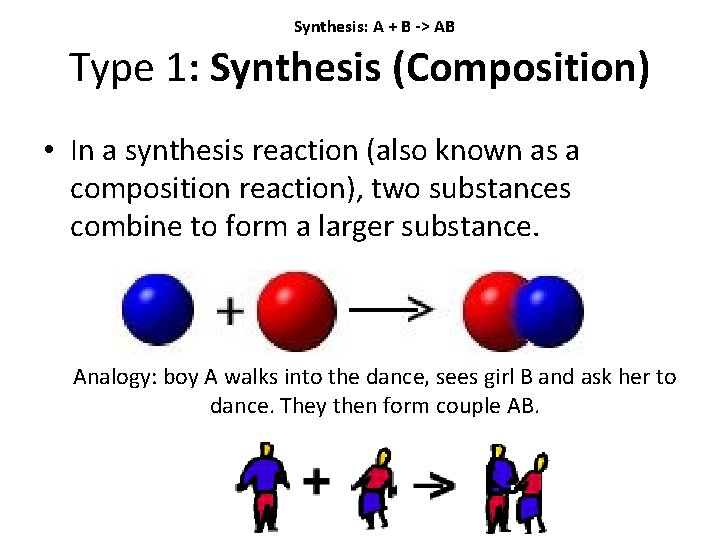
Synthesis: A + B -> AB Type 1: Synthesis (Composition) • In a synthesis reaction (also known as a composition reaction), two substances combine to form a larger substance. Analogy: boy A walks into the dance, sees girl B and ask her to dance. They then form couple AB.
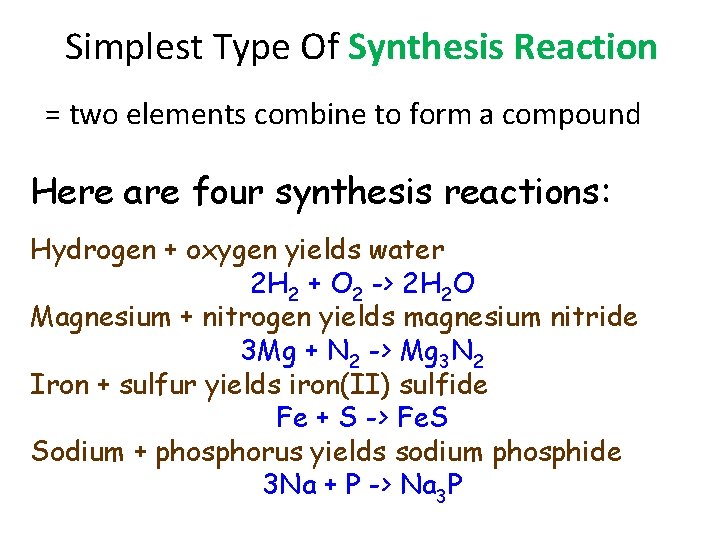
Simplest Type Of Synthesis Reaction = two elements combine to form a compound Here are four synthesis reactions: Hydrogen + oxygen yields water 2 H 2 + O 2 -> 2 H 2 O Magnesium + nitrogen yields magnesium nitride 3 Mg + N 2 -> Mg 3 N 2 Iron + sulfur yields iron(II) sulfide Fe + S -> Fe. S Sodium + phosphorus yields sodium phosphide 3 Na + P -> Na 3 P
Side Note: Diatomic Atoms • The diatomic elements are: hydrogen, nitrogen, oxygen, fluorine, chlorine, bromine and iodine. • As elements they always travel in pairs of atoms and therefore you must write then as: H 2 N 2 O 2 F 2 Cl 2 Br 2 and I 2
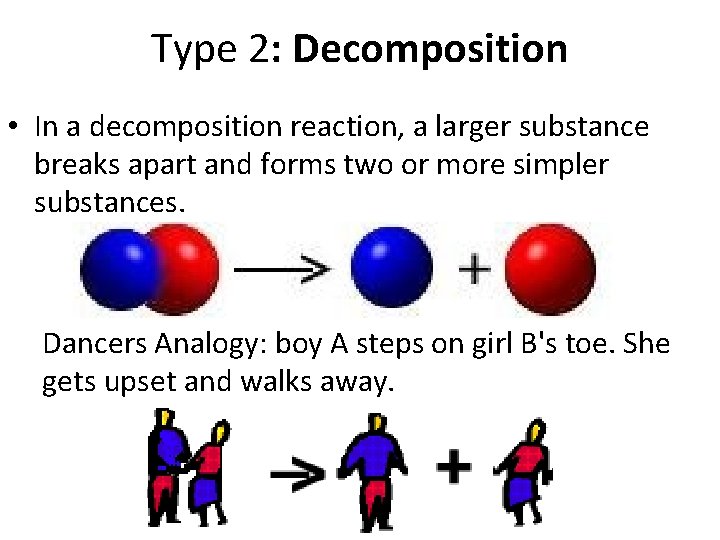
Type 2: Decomposition • In a decomposition reaction, a larger substance breaks apart and forms two or more simpler substances. Dancers Analogy: boy A steps on girl B's toe. She gets upset and walks away.
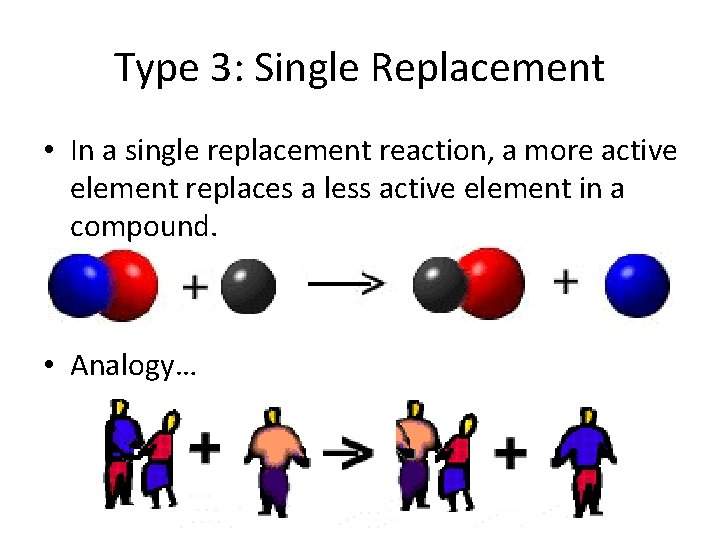
Type 3: Single Replacement • In a single replacement reaction, a more active element replaces a less active element in a compound. • Analogy…
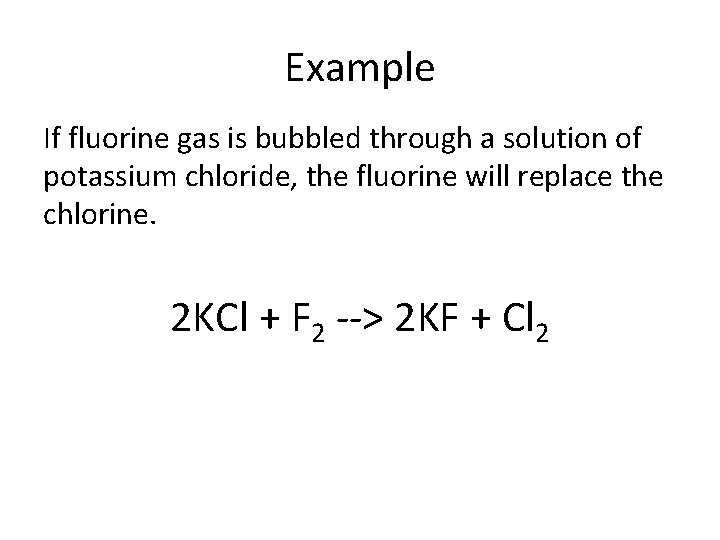
Example If fluorine gas is bubbled through a solution of potassium chloride, the fluorine will replace the chlorine. 2 KCl + F 2 > 2 KF + Cl 2
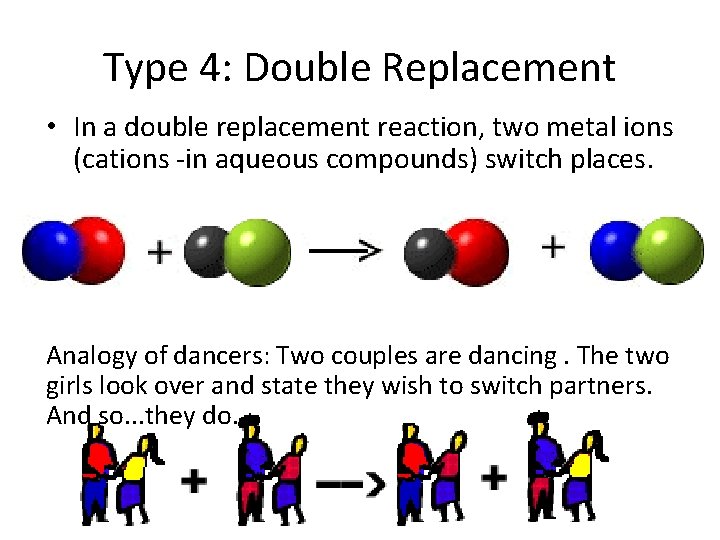
Type 4: Double Replacement • In a double replacement reaction, two metal ions (cations in aqueous compounds) switch places. Analogy of dancers: Two couples are dancing. The two girls look over and state they wish to switch partners. And so. . . they do.
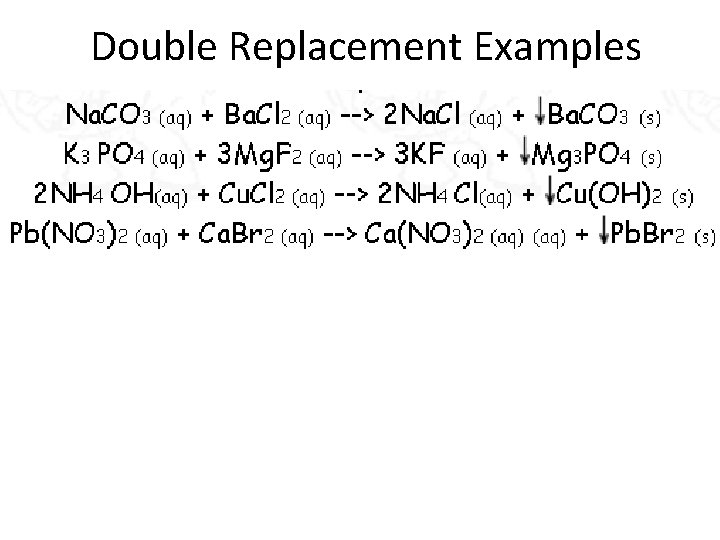
Double Replacement Examples
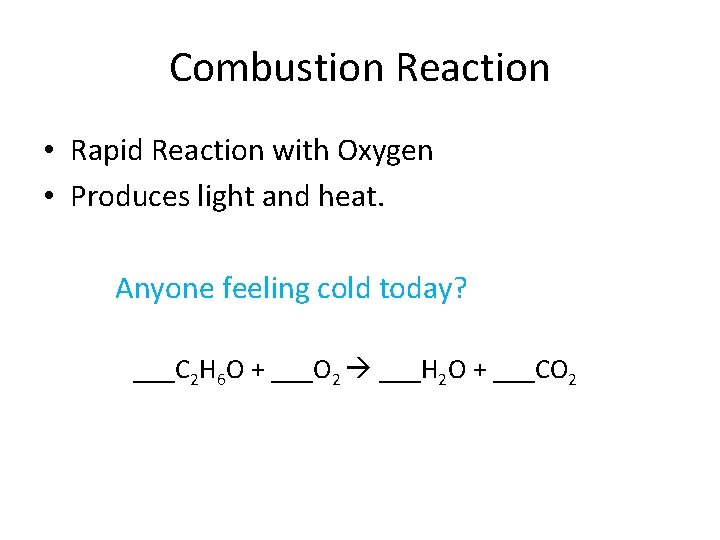
Combustion Reaction • Rapid Reaction with Oxygen • Produces light and heat. Anyone feeling cold today? ___C 2 H 6 O + ___O 2 ___H 2 O + ___CO 2
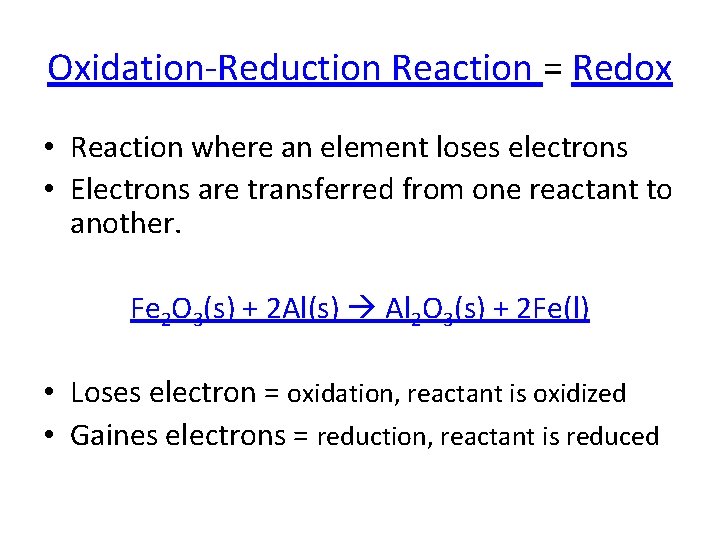
Oxidation Reduction Reaction = Redox • Reaction where an element loses electrons • Electrons are transferred from one reactant to another. Fe 2 O 3(s) + 2 Al(s) Al 2 O 3(s) + 2 Fe(l) • Loses electron = oxidation, reactant is oxidized • Gaines electrons = reduction, reactant is reduced
7. 3 Energy Changes in Reaction • Energy is either released or absorbed in reactions • Chemical Bonds are either broken or formed
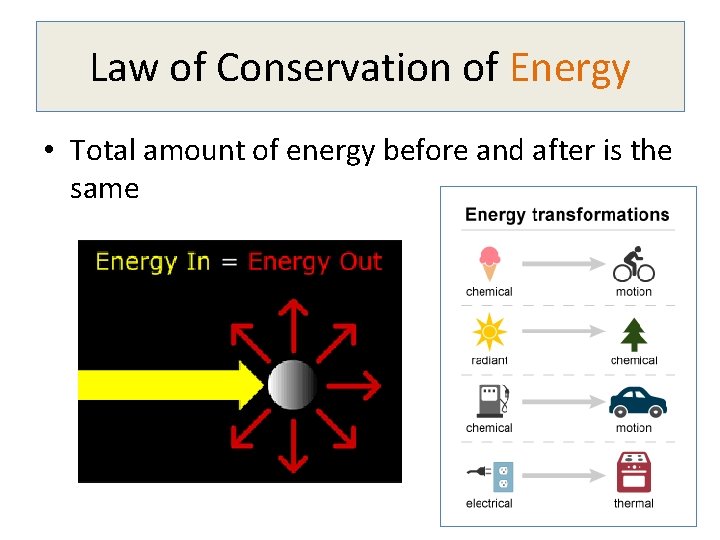
Law of Conservation of Energy • Total amount of energy before and after is the same
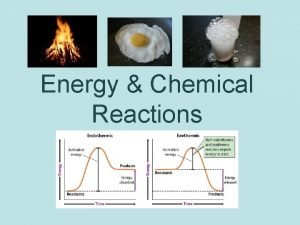
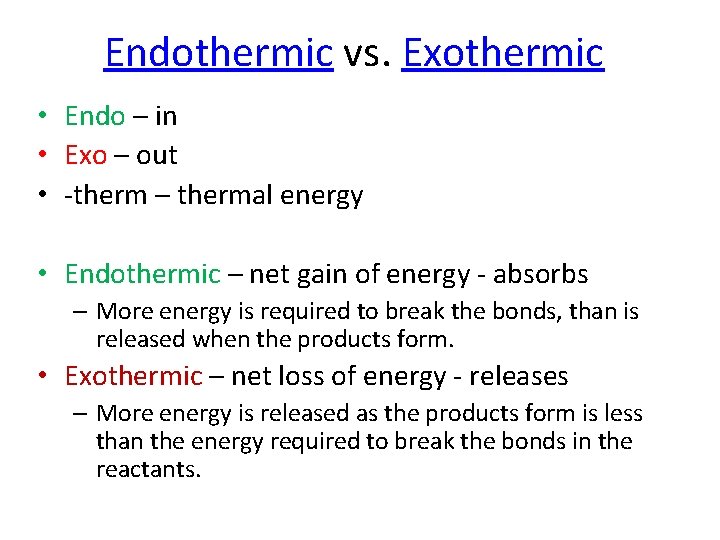
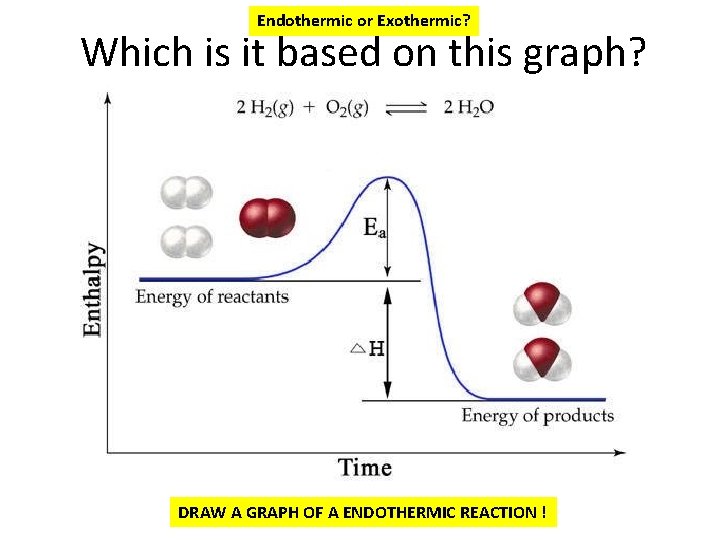
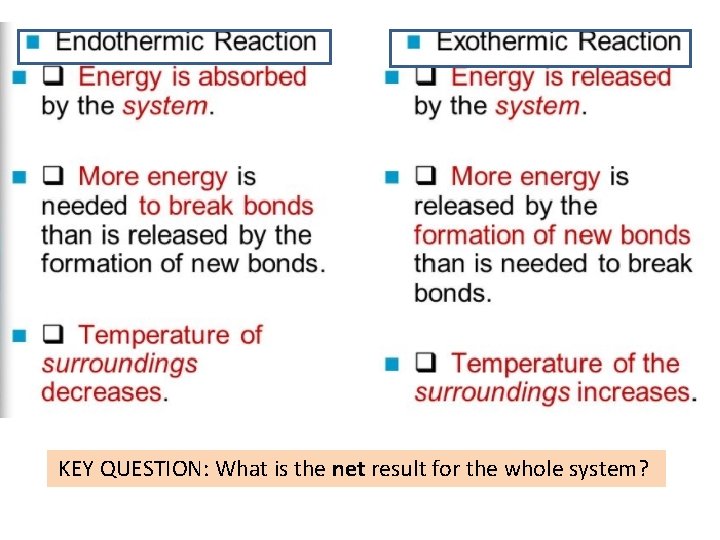
Endothermic vs. Exothermic • Endo – in • Exo – out • therm – thermal energy • Endothermic – net gain of energy absorbs – More energy is required to break the bonds, than is released when the products form. • Exothermic – net loss of energy releases – More energy is released as the products form is less than the energy required to break the bonds in the reactants.
Endothermic or Exothermic? Which is it based on this graph? DRAW A GRAPH OF A ENDOTHERMIC REACTION !
KEY QUESTION: What is the net result for the whole system?
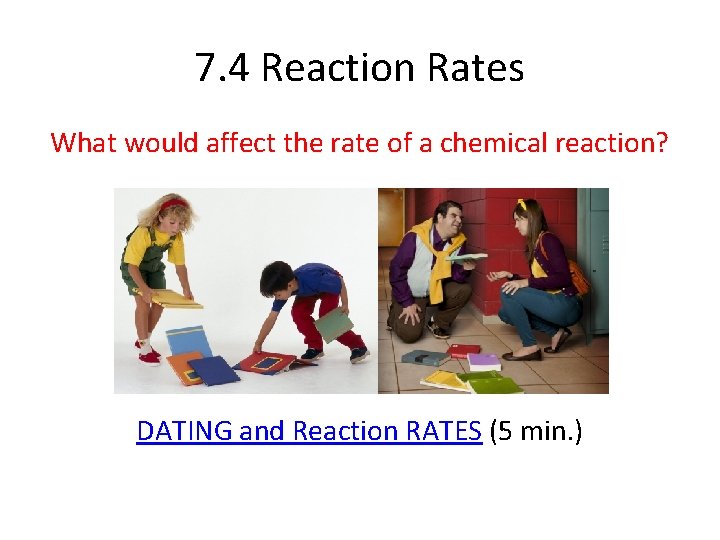
7. 4 Reaction Rates What would affect the rate of a chemical reaction? DATING and Reaction RATES (5 min. )
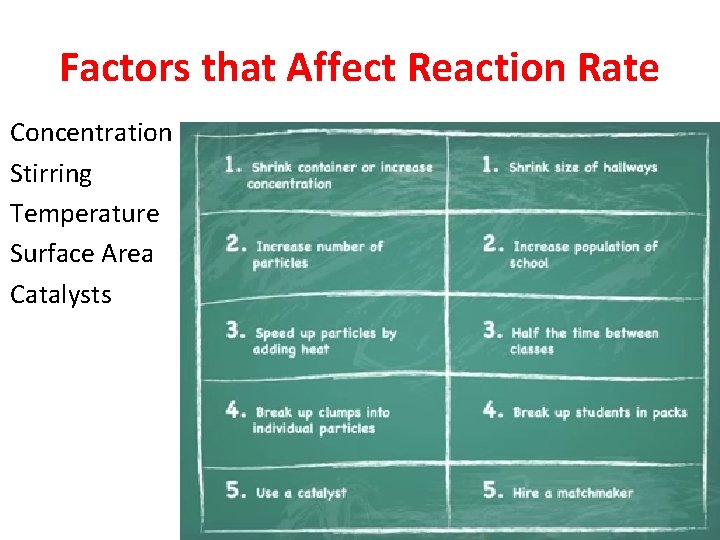
Factors that Affect Reaction Rate Concentration Stirring Temperature Surface Area Catalysts
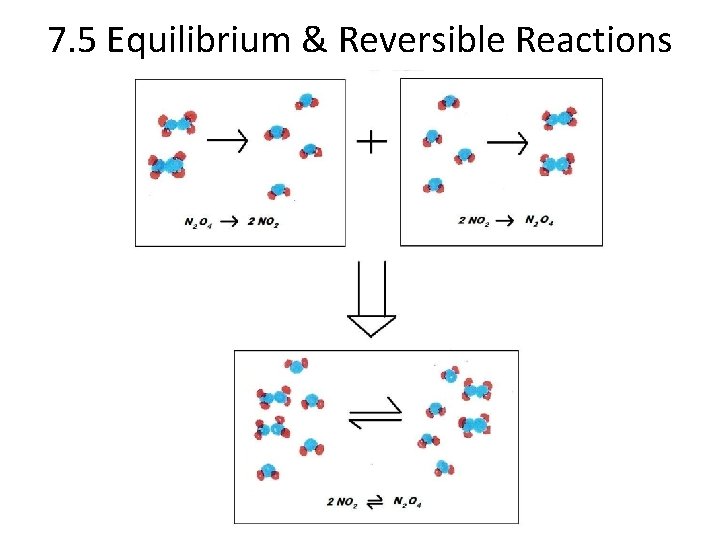
7. 5 Equilibrium & Reversible Reactions
REVIEW CHEM. RCN. • Kahoot: Exam III Easy Review • Quizlet Live: Ch 7 Quizlet
LAUNCH Home Work: Enjoy family time!
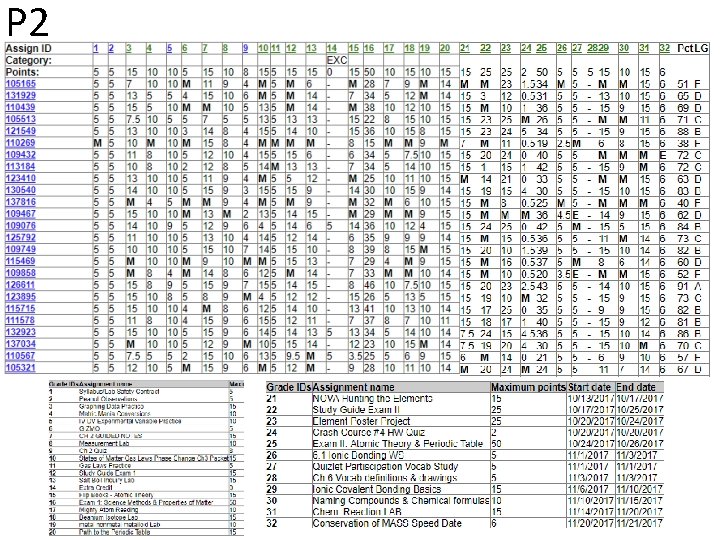
P 2
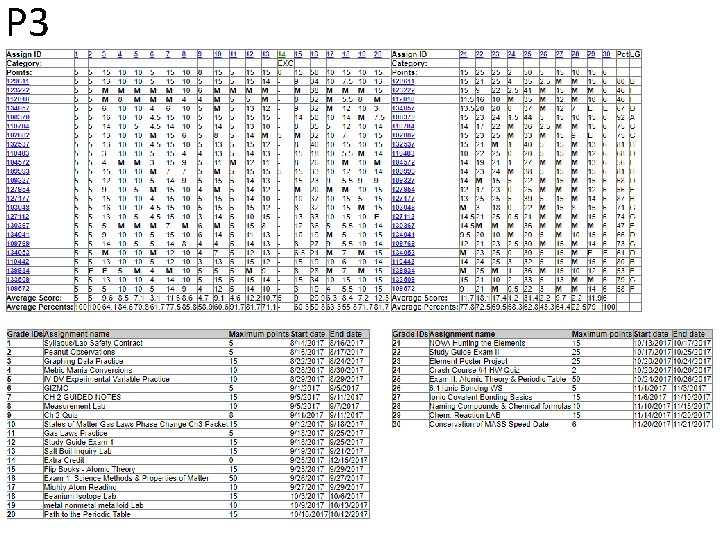
P 3
P 4
P 5
P 7
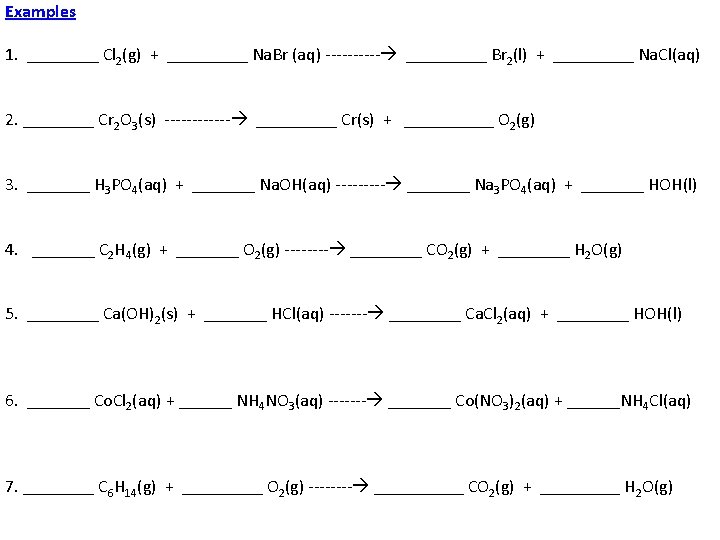
Examples 1. ____ Cl 2(g) + _____ Na. Br (aq) _____ Br 2(l) + _____ Na. Cl(aq) 2. ____ Cr 2 O 3(s) _____ Cr(s) + _____ O 2(g) 3. _______ H 3 PO 4(aq) + _______ Na. OH(aq) _______ Na 3 PO 4(aq) + _______ HOH(l) 4. _______ C 2 H 4(g) + _______ O 2(g) ____ CO 2(g) + ____ H 2 O(g) 5. ____ Ca(OH)2(s) + _______ HCl(aq) ____ Ca. Cl 2(aq) + ____ HOH(l) 6. _______ Co. Cl 2(aq) + ______ NH 4 NO 3(aq) _______ Co(NO 3)2(aq) + ______NH 4 Cl(aq) 7. ____ C 6 H 14(g) + _____ O 2(g) _____ CO 2(g) + _____ H 2 O(g)
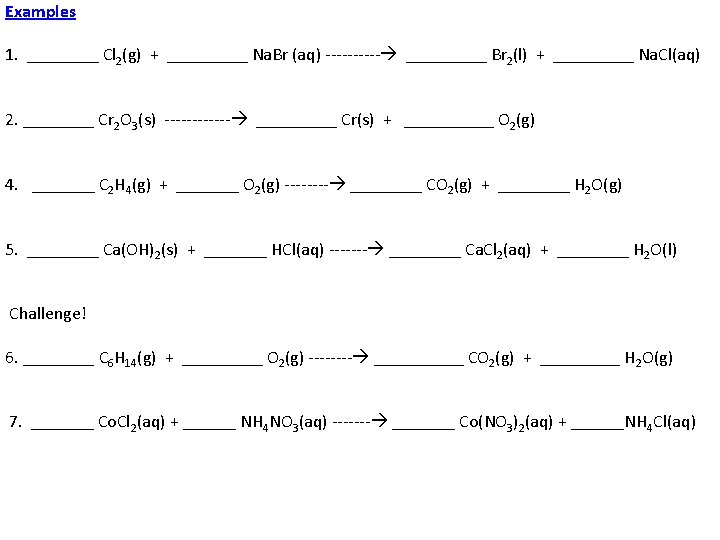
Examples 1. ____ Cl 2(g) + _____ Na. Br (aq) _____ Br 2(l) + _____ Na. Cl(aq) 2. ____ Cr 2 O 3(s) _____ Cr(s) + _____ O 2(g) 4. _______ C 2 H 4(g) + _______ O 2(g) ____ CO 2(g) + ____ H 2 O(g) 5. ____ Ca(OH)2(s) + _______ HCl(aq) ____ Ca. Cl 2(aq) + ____ H 2 O(l) Challenge! 6. ____ C 6 H 14(g) + _____ O 2(g) _____ CO 2(g) + _____ H 2 O(g) 7. _______ Co. Cl 2(aq) + ______ NH 4 NO 3(aq) _______ Co(NO 3)2(aq) + ______NH 4 Cl(aq)
Speed Dating!
Date 1 Hello, my name is _________. 1 st person – give answer 2 nd person – explain why it is the right answer Write it down.
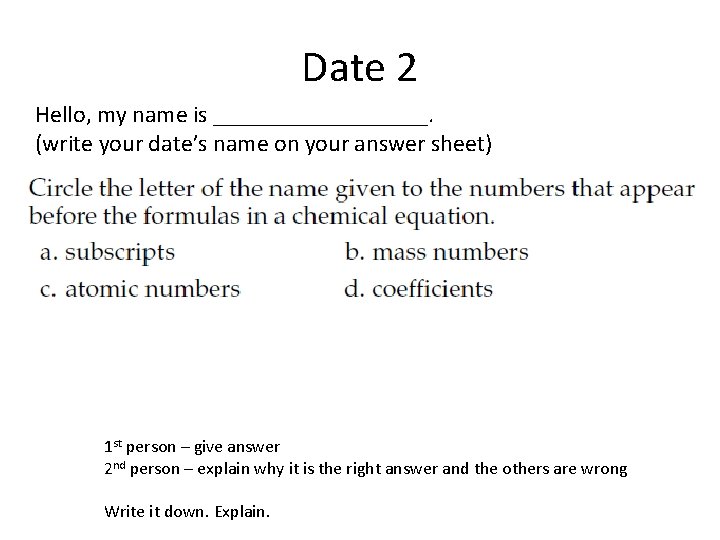
Date 2 Hello, my name is _________. (write your date’s name on your answer sheet) 1 st person – give answer 2 nd person – explain why it is the right answer and the others are wrong Write it down. Explain.
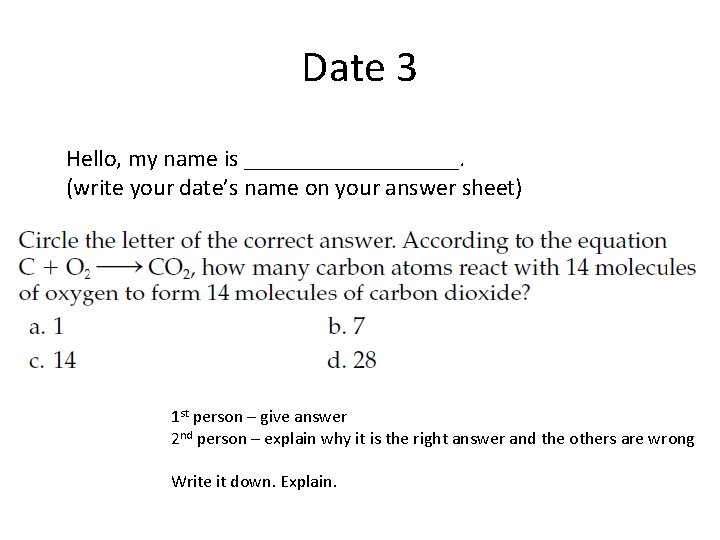
Date 3 Hello, my name is _________. (write your date’s name on your answer sheet) 1 st person – give answer 2 nd person – explain why it is the right answer and the others are wrong Write it down. Explain.
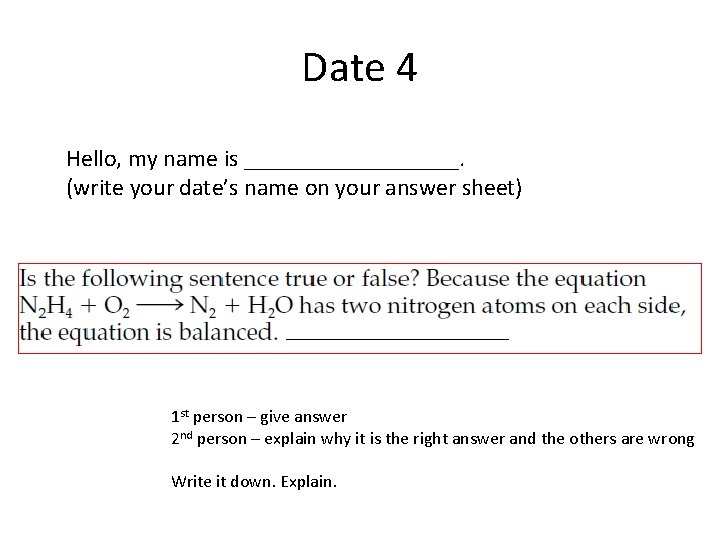
Date 4 Hello, my name is _________. (write your date’s name on your answer sheet) 1 st person – give answer 2 nd person – explain why it is the right answer and the others are wrong Write it down. Explain.
Date 5 Hello, my name is _________. (write your date’s name on your answer sheet) 1. 1 st person – give answer 2 nd person – explain why it is the right answer Write it down. Explain.
Date 6: Feedback No Names! 1. Hello, my name is _________. (write your date’s name on your answer sheet) 2. What made your best date good? 3. What was something you thought could be done better in some of your “dates”?