Chemical Reaction Engineering Chapter 4 Part 2 1


- Slides: 29
Chemical Reaction Engineering Chapter 4, Part 2: 1. Applying the Algorithm to a Batch Reactor, CSTR, and PFR 2. Calculating the Equilibrium Conversion
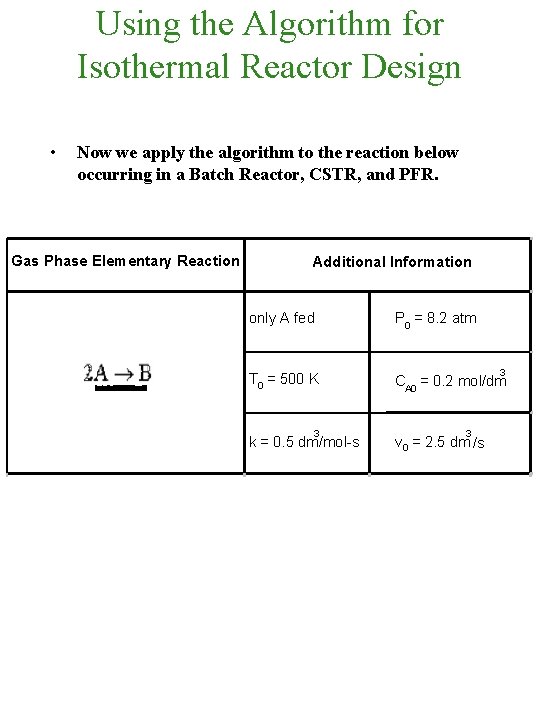
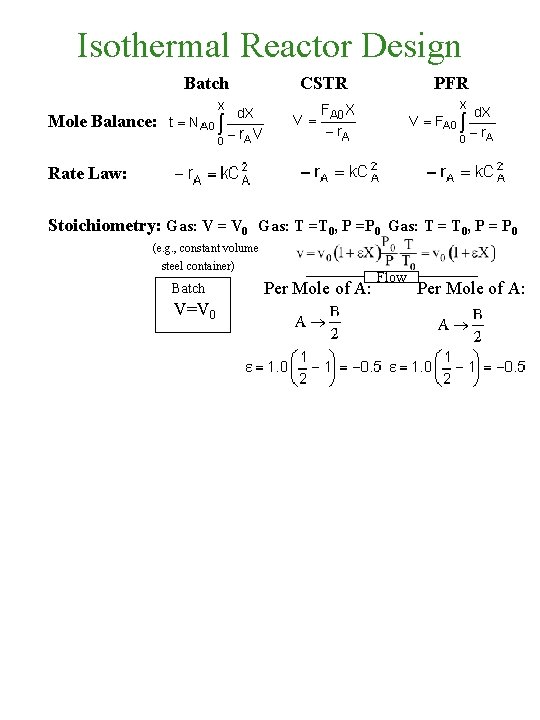
Using the Algorithm for Isothermal Reactor Design • Now we apply the algorithm to the reaction below occurring in a Batch Reactor, CSTR, and PFR. Gas Phase Elementary Reaction Additional Information only A fed P 0 = 8. 2 atm T 0 = 500 K CA 0 = 0. 2 mol/dm 3 k = 0. 5 dm/mol-s 3 3 v 0 = 2. 5 dm /s
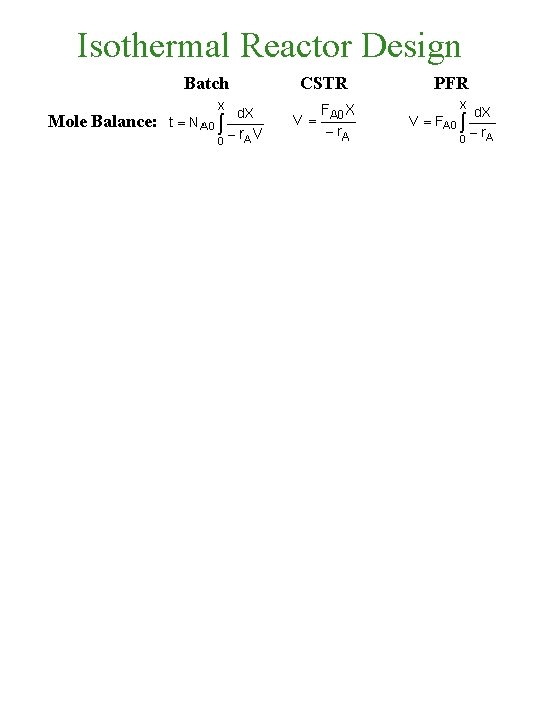
Isothermal Reactor Design Batch Mole Balance: CSTR PFR
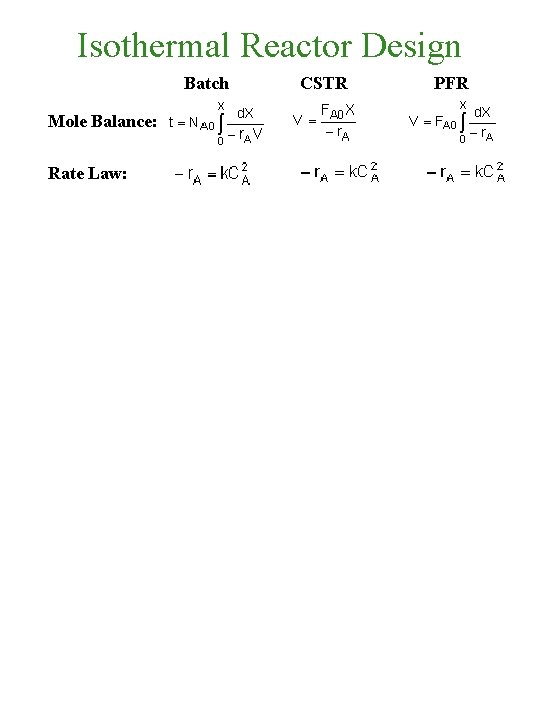
Isothermal Reactor Design Batch Mole Balance: Rate Law: CSTR PFR
Isothermal Reactor Design Batch CSTR PFR Mole Balance: Rate Law: Stoichiometry: Gas: V = V 0 Gas: T =T 0, P =P 0 Gas: T = T 0, P = P 0 (e. g. , constant volume steel container) Batch V=V 0 Flow Per Mole of A:
Isothermal Reactor Design Batch CSTR PFR Mole Balance: Rate Law: Stoichiometry: Gas: V = V 0 Gas: T =T 0, P =P 0 Gas: T = T 0, P = P 0 (e. g. , constant volume steel container) Batch V=V 0 Flow Per Mole of A:
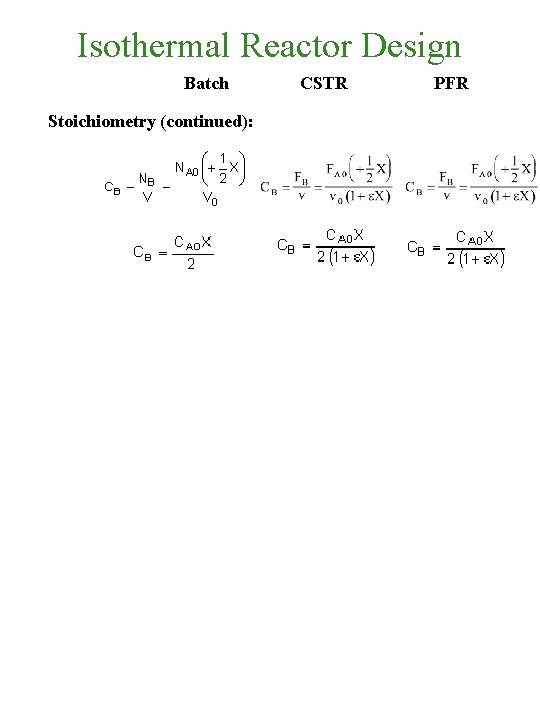
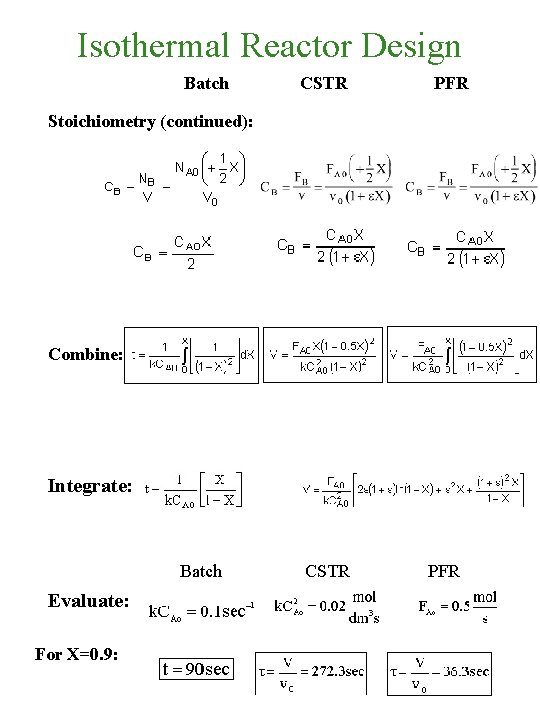
Isothermal Reactor Design Batch Stoichiometry (continued): CSTR PFR
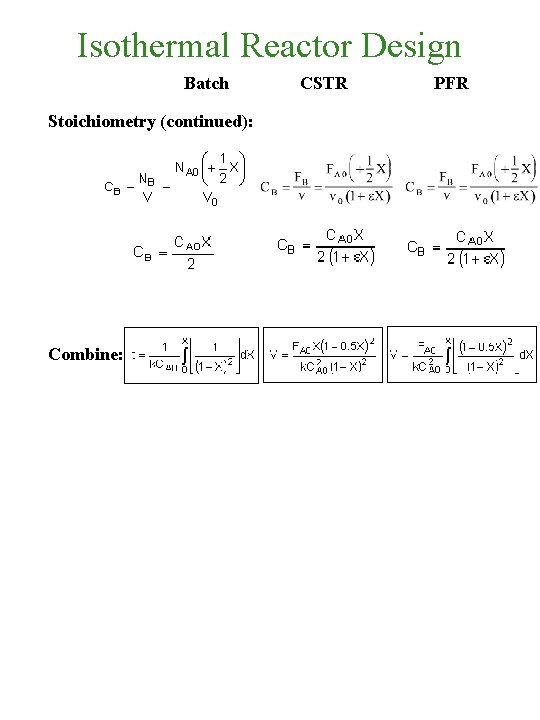
Isothermal Reactor Design Batch Stoichiometry (continued): Combine: CSTR PFR
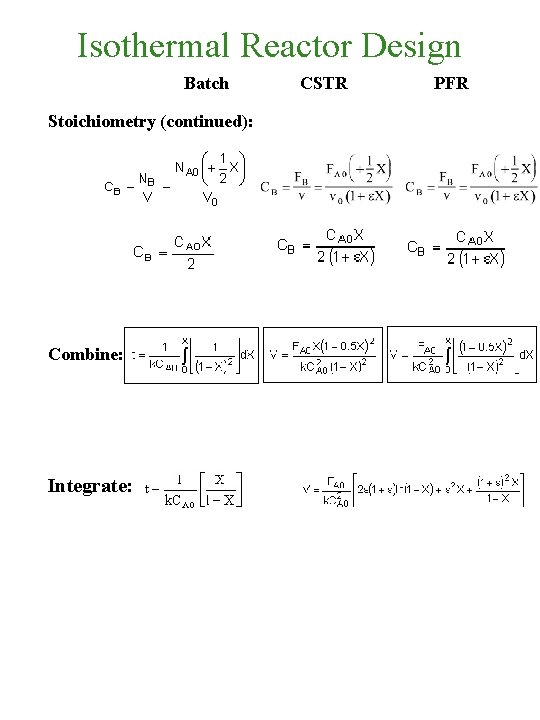
Isothermal Reactor Design Batch Stoichiometry (continued): Combine: Integrate: CSTR PFR
Isothermal Reactor Design Batch CSTR PFR Stoichiometry (continued): Combine: Integrate: Batch Evaluate: For X=0. 9: CSTR PFR
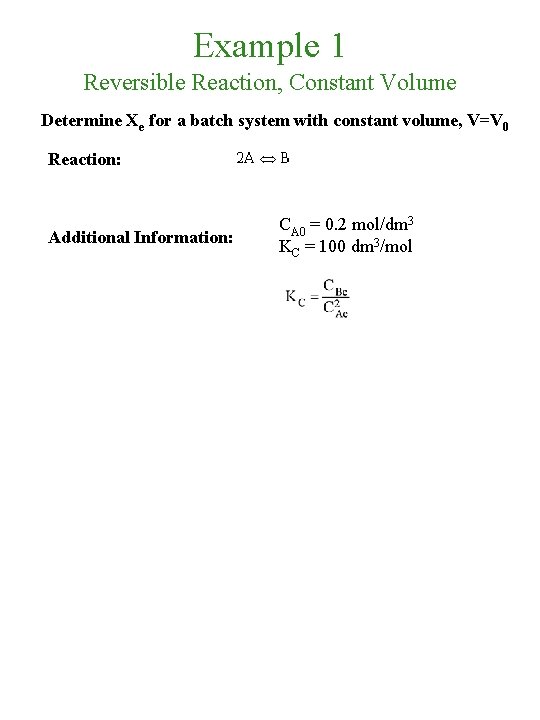
Example 1 Reversible Reaction, Constant Volume Determine Xe for a batch system with constant volume, V=V 0 Reaction: Additional Information: CA 0 = 0. 2 mol/dm 3 KC = 100 dm 3/mol
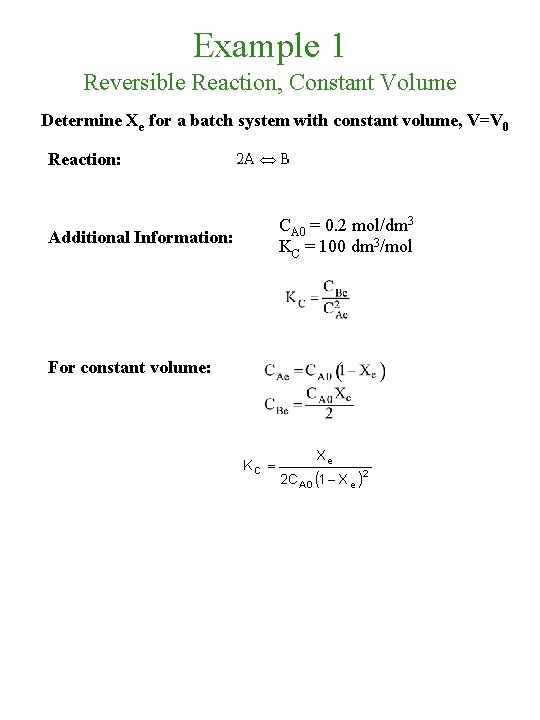
Example 1 Reversible Reaction, Constant Volume Determine Xe for a batch system with constant volume, V=V 0 Reaction: Additional Information: For constant volume: CA 0 = 0. 2 mol/dm 3 KC = 100 dm 3/mol
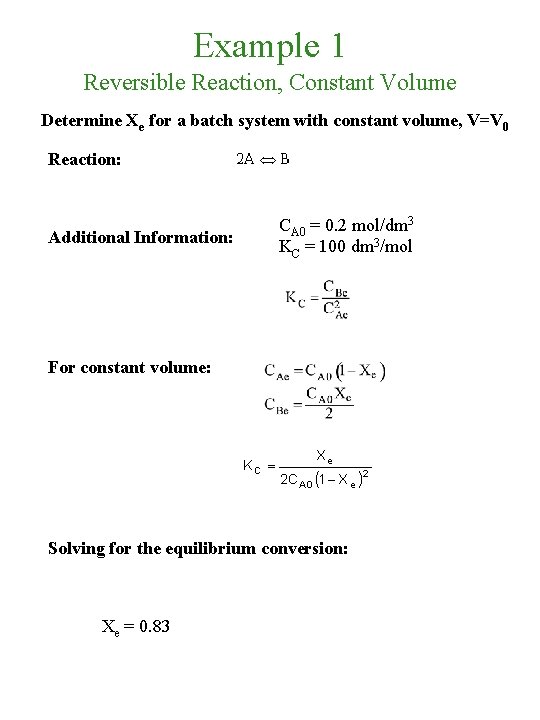
Example 1 Reversible Reaction, Constant Volume Determine Xe for a batch system with constant volume, V=V 0 Reaction: Additional Information: CA 0 = 0. 2 mol/dm 3 KC = 100 dm 3/mol For constant volume: Solving for the equilibrium conversion: Xe = 0. 83
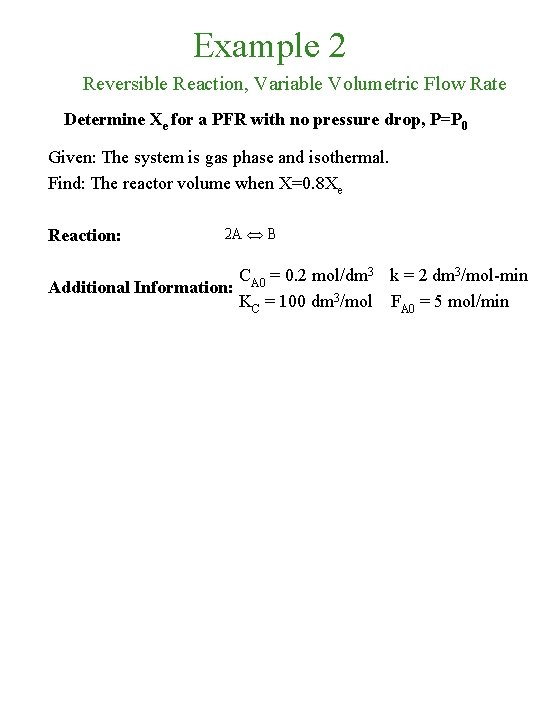
Example 2 Reversible Reaction, Variable Volumetric Flow Rate Determine Xe for a PFR with no pressure drop, P=P 0 Given: The system is gas phase and isothermal. Find: The reactor volume when X=0. 8 Xe Reaction: CA 0 = 0. 2 mol/dm 3 k = 2 dm 3/mol-min Additional Information: KC = 100 dm 3/mol FA 0 = 5 mol/min
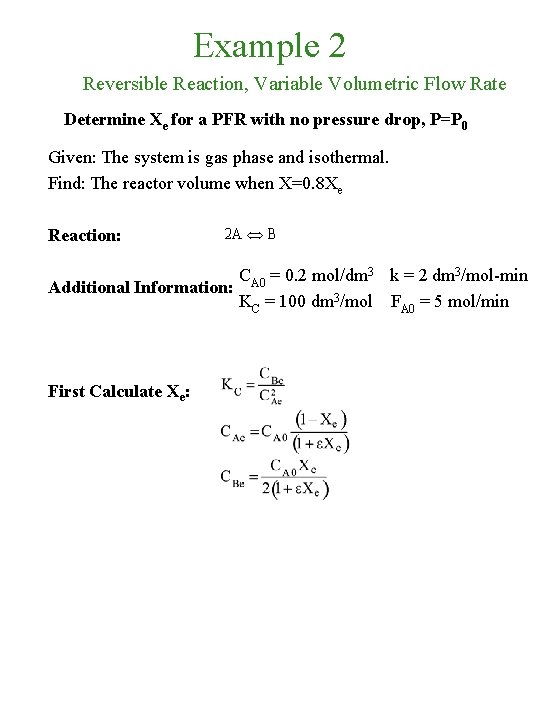
Example 2 Reversible Reaction, Variable Volumetric Flow Rate Determine Xe for a PFR with no pressure drop, P=P 0 Given: The system is gas phase and isothermal. Find: The reactor volume when X=0. 8 Xe Reaction: CA 0 = 0. 2 mol/dm 3 k = 2 dm 3/mol-min Additional Information: KC = 100 dm 3/mol FA 0 = 5 mol/min First Calculate Xe:
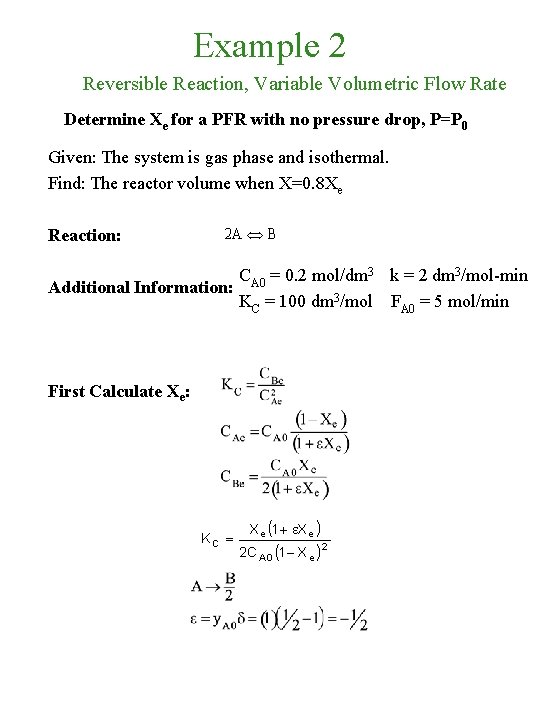
Example 2 Reversible Reaction, Variable Volumetric Flow Rate Determine Xe for a PFR with no pressure drop, P=P 0 Given: The system is gas phase and isothermal. Find: The reactor volume when X=0. 8 Xe Reaction: CA 0 = 0. 2 mol/dm 3 k = 2 dm 3/mol-min Additional Information: KC = 100 dm 3/mol FA 0 = 5 mol/min First Calculate Xe:
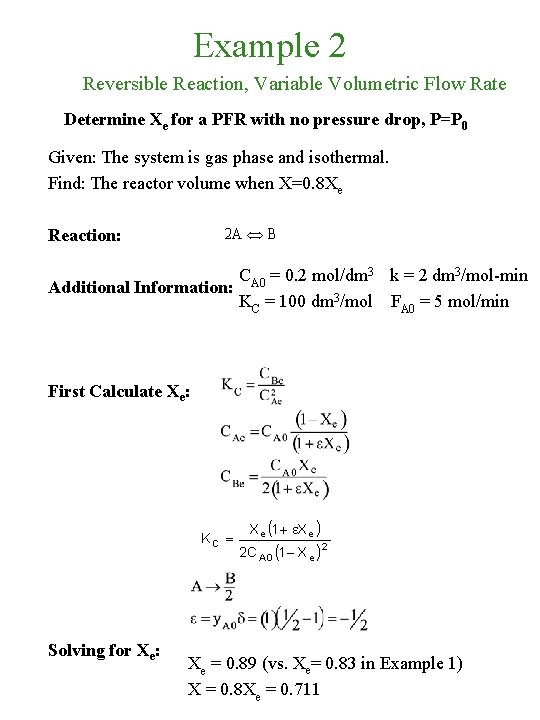
Example 2 Reversible Reaction, Variable Volumetric Flow Rate Determine Xe for a PFR with no pressure drop, P=P 0 Given: The system is gas phase and isothermal. Find: The reactor volume when X=0. 8 Xe Reaction: CA 0 = 0. 2 mol/dm 3 k = 2 dm 3/mol-min Additional Information: KC = 100 dm 3/mol FA 0 = 5 mol/min First Calculate Xe: Solving for Xe: Xe = 0. 89 (vs. Xe= 0. 83 in Example 1) X = 0. 8 Xe = 0. 711
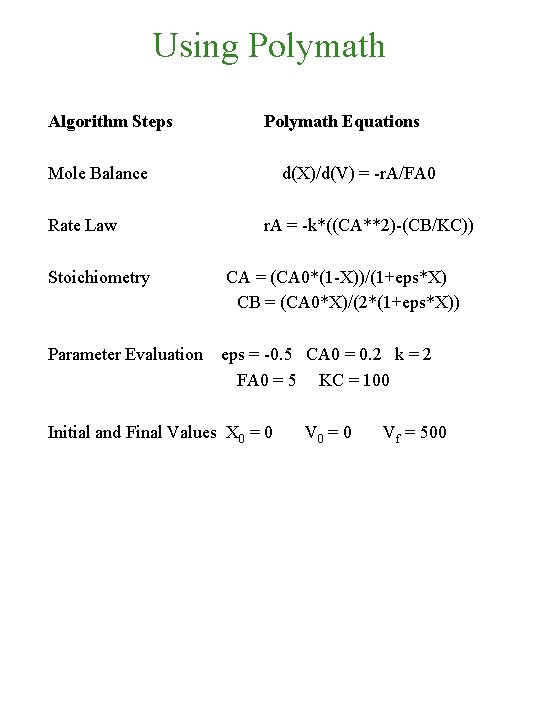
Using Polymath Algorithm Steps Polymath Equations
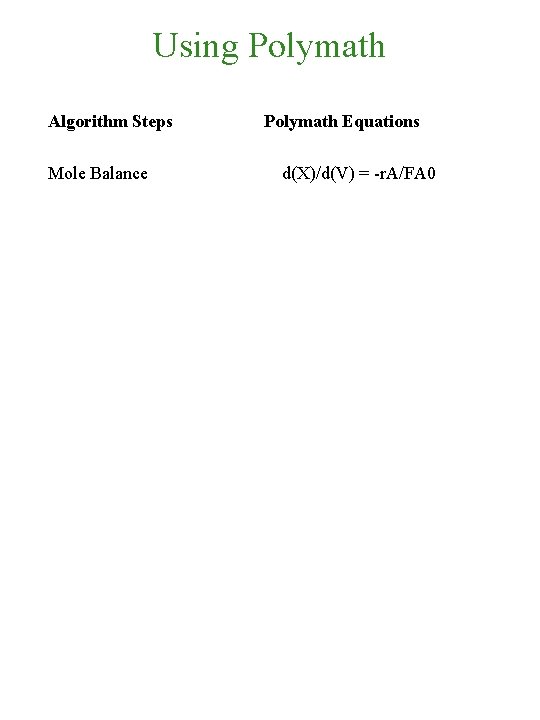
Using Polymath Algorithm Steps Polymath Equations Mole Balance d(X)/d(V) = -r. A/FA 0
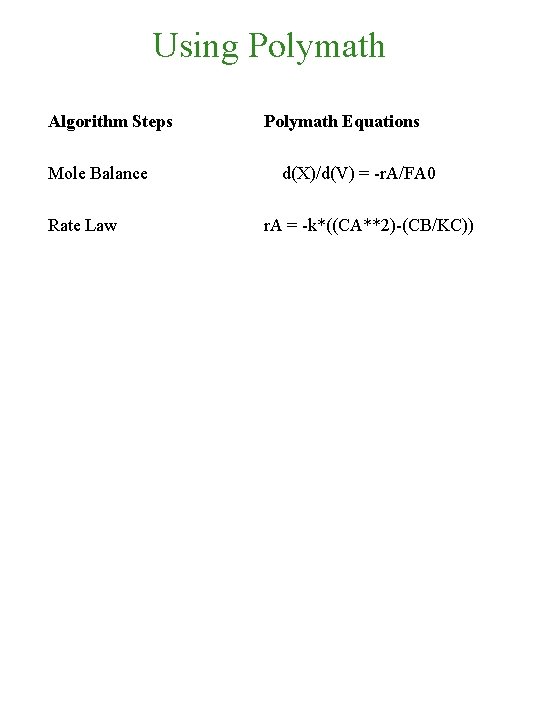
Using Polymath Algorithm Steps Polymath Equations Mole Balance d(X)/d(V) = -r. A/FA 0 Rate Law r. A = -k*((CA**2)-(CB/KC))
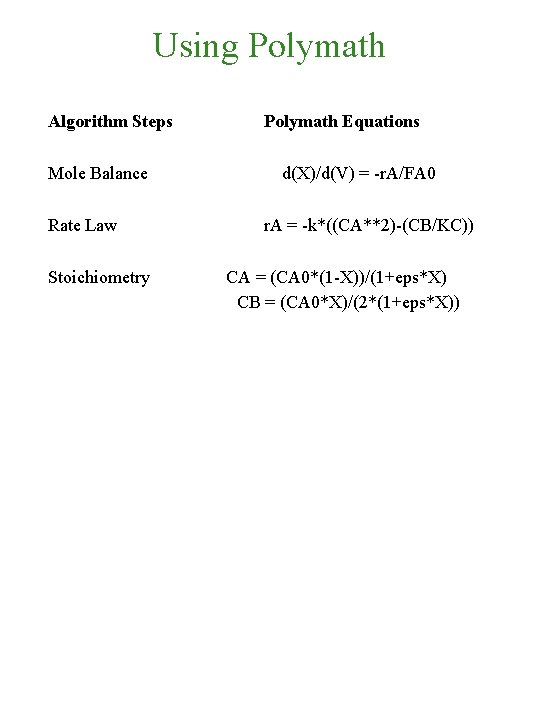
Using Polymath Algorithm Steps Polymath Equations Mole Balance d(X)/d(V) = -r. A/FA 0 Rate Law r. A = -k*((CA**2)-(CB/KC)) Stoichiometry CA = (CA 0*(1 -X))/(1+eps*X) CB = (CA 0*X)/(2*(1+eps*X))
Using Polymath Algorithm Steps Polymath Equations Mole Balance d(X)/d(V) = -r. A/FA 0 Rate Law r. A = -k*((CA**2)-(CB/KC)) Stoichiometry CA = (CA 0*(1 -X))/(1+eps*X) CB = (CA 0*X)/(2*(1+eps*X)) Parameter Evaluation eps = -0. 5 CA 0 = 0. 2 k = 2 FA 0 = 5 KC = 100
Using Polymath Algorithm Steps Polymath Equations Mole Balance d(X)/d(V) = -r. A/FA 0 Rate Law r. A = -k*((CA**2)-(CB/KC)) Stoichiometry CA = (CA 0*(1 -X))/(1+eps*X) CB = (CA 0*X)/(2*(1+eps*X)) Parameter Evaluation eps = -0. 5 CA 0 = 0. 2 k = 2 FA 0 = 5 KC = 100 Initial and Final Values X 0 = 0 Vf = 500
General Guidelines for California Problems
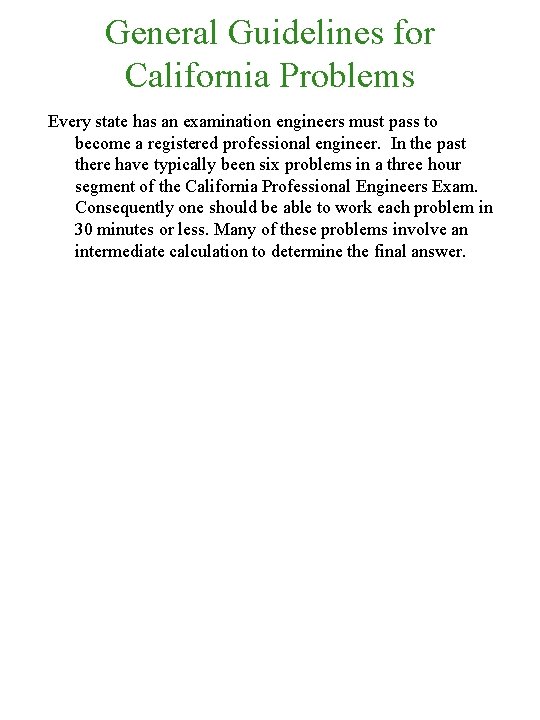
General Guidelines for California Problems Every state has an examination engineers must pass to become a registered professional engineer. In the past there have typically been six problems in a three hour segment of the California Professional Engineers Exam. Consequently one should be able to work each problem in 30 minutes or less. Many of these problems involve an intermediate calculation to determine the final answer.
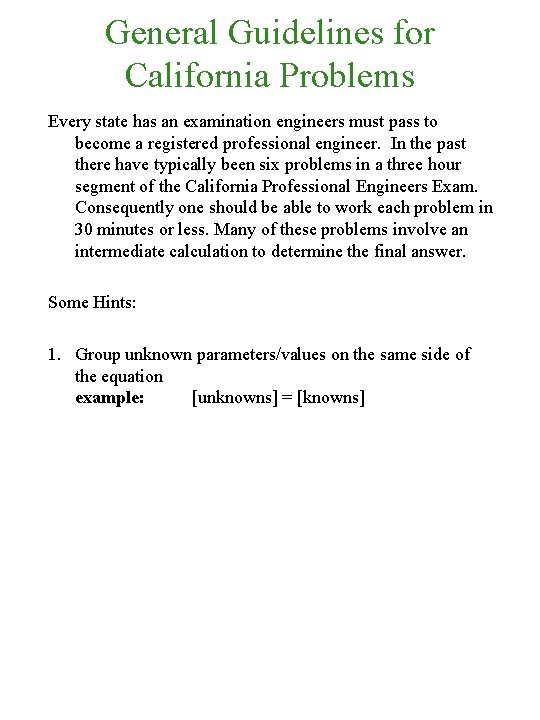
General Guidelines for California Problems Every state has an examination engineers must pass to become a registered professional engineer. In the past there have typically been six problems in a three hour segment of the California Professional Engineers Exam. Consequently one should be able to work each problem in 30 minutes or less. Many of these problems involve an intermediate calculation to determine the final answer. Some Hints: 1. Group unknown parameters/values on the same side of the equation example: [unknowns] = [knowns]
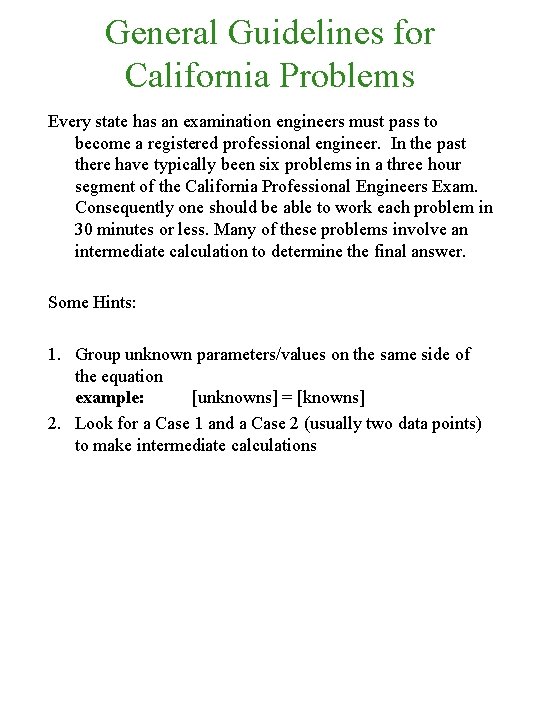
General Guidelines for California Problems Every state has an examination engineers must pass to become a registered professional engineer. In the past there have typically been six problems in a three hour segment of the California Professional Engineers Exam. Consequently one should be able to work each problem in 30 minutes or less. Many of these problems involve an intermediate calculation to determine the final answer. Some Hints: 1. Group unknown parameters/values on the same side of the equation example: [unknowns] = [knowns] 2. Look for a Case 1 and a Case 2 (usually two data points) to make intermediate calculations
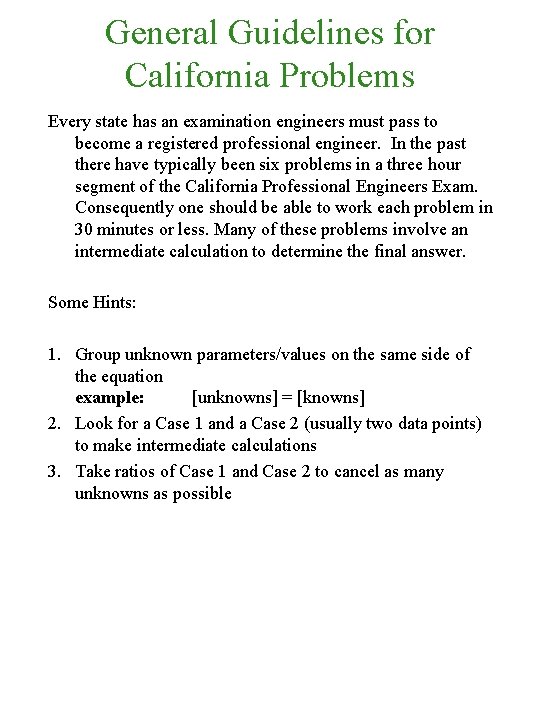
General Guidelines for California Problems Every state has an examination engineers must pass to become a registered professional engineer. In the past there have typically been six problems in a three hour segment of the California Professional Engineers Exam. Consequently one should be able to work each problem in 30 minutes or less. Many of these problems involve an intermediate calculation to determine the final answer. Some Hints: 1. Group unknown parameters/values on the same side of the equation example: [unknowns] = [knowns] 2. Look for a Case 1 and a Case 2 (usually two data points) to make intermediate calculations 3. Take ratios of Case 1 and Case 2 to cancel as many unknowns as possible
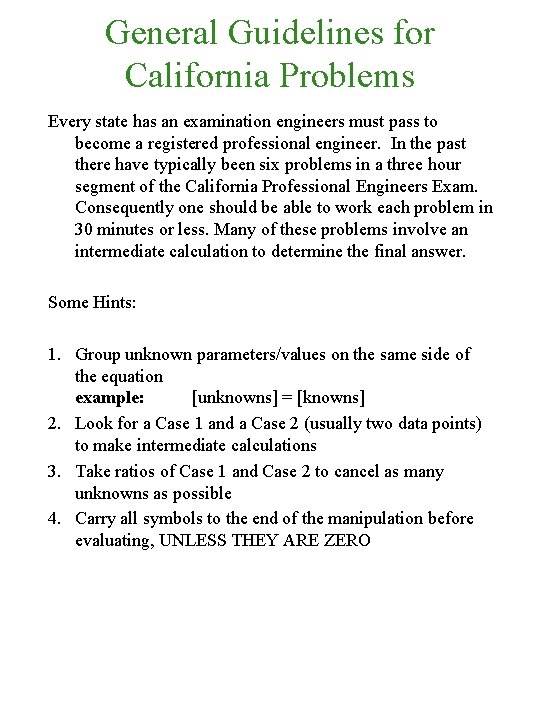
General Guidelines for California Problems Every state has an examination engineers must pass to become a registered professional engineer. In the past there have typically been six problems in a three hour segment of the California Professional Engineers Exam. Consequently one should be able to work each problem in 30 minutes or less. Many of these problems involve an intermediate calculation to determine the final answer. Some Hints: 1. Group unknown parameters/values on the same side of the equation example: [unknowns] = [knowns] 2. Look for a Case 1 and a Case 2 (usually two data points) to make intermediate calculations 3. Take ratios of Case 1 and Case 2 to cancel as many unknowns as possible 4. Carry all symbols to the end of the manipulation before evaluating, UNLESS THEY ARE ZERO