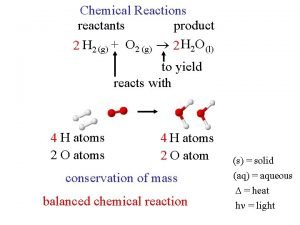
Chemical Reactions reactants product 2 H 2 g




- Slides: 10
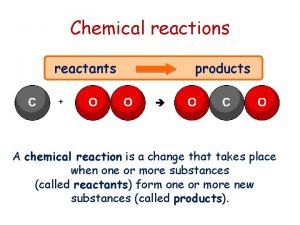
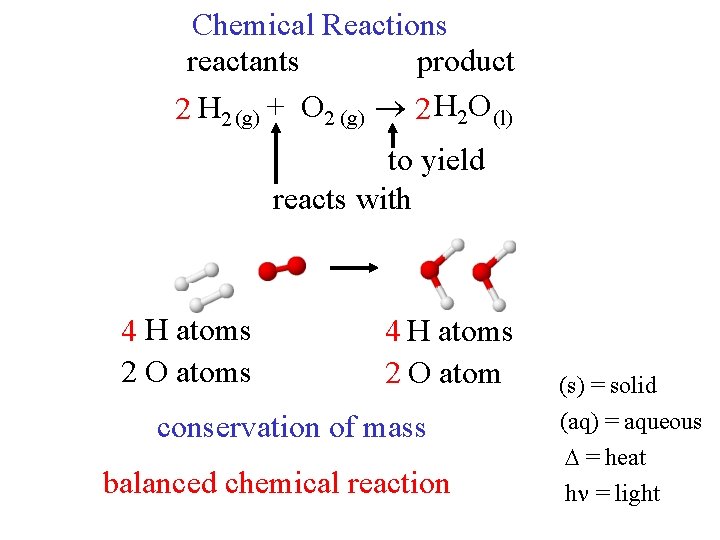
Chemical Reactions reactants product 2 H 2 (g) + O 2 (g) 2 H 2 O (l) to yield reacts with 2 4 H atoms 2 O atoms 24 H atoms 12 O atom conservation of mass balanced chemical reaction (s) = solid (aq) = aqueous = heat h = light
coefficients 2 H 2 (g) + O 2 (g) 2 H 2 O (l) 1 O 2 4 H atoms 2 O atoms 2 H 2 O 1 mol O 2 2 mol H 2 O atomic 4 H atoms 2 O atoms molecular 2 H 2 molar 2 mol H 2 mass 2 x 2. 016 g H 2 32. 00 g O 2 2 x 18. 02 g H 2 O 36. 04 g reactants 36. 04 g products stoichiometry described by balanced reaction
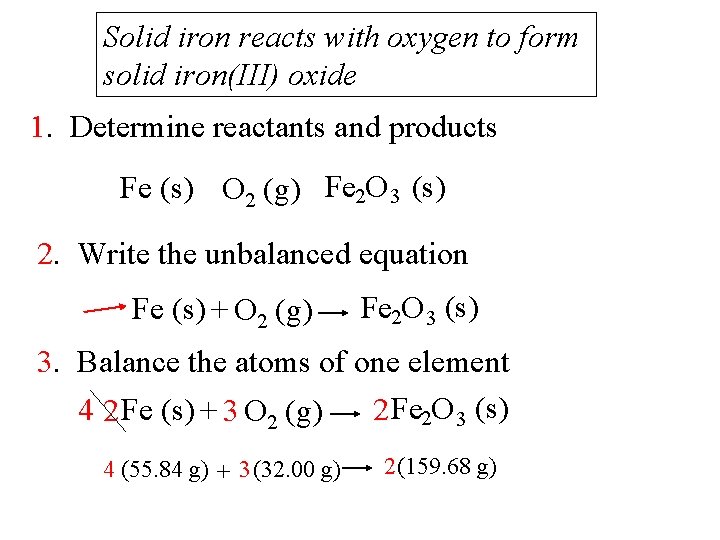
Solid iron reacts with oxygen to form solid iron(III) oxide 1. Determine reactants and products Fe (s) O 2 (g) Fe 2 O 3 (s) 2. Write the unbalanced equation Fe (s) + O 2 (g) Fe 2 O 3 (s) 3. Balance the atoms of one element 4 2 Fe (s) + 3 O 2 (g) 2 Fe 2 O 3 (s) 4 (55. 84 g) + 3(32. 00 g) 2(159. 68 g)
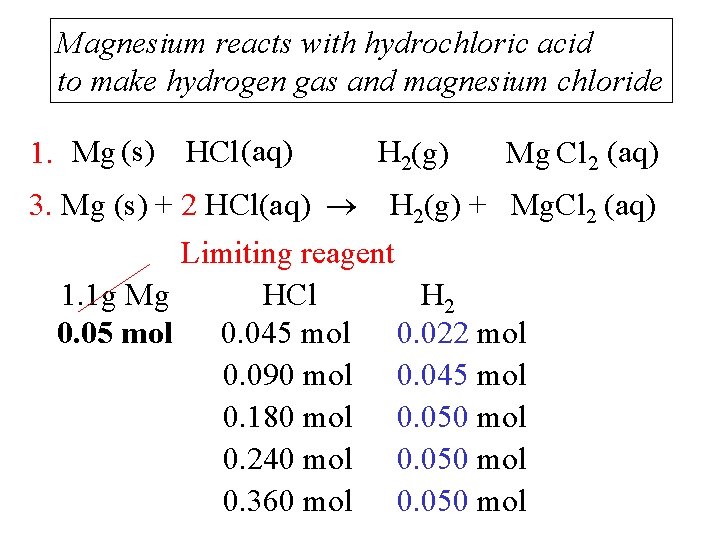
Magnesium reacts with hydrochloric acid to make hydrogen gas and magnesium chloride 1. Mg (s) HCl (aq) H 2(g) Mg Cl 2 (aq) 3. 2. Mg (s) + 2 HCl(aq) H 2(g) + Mg. Cl 2 (aq) Limiting reagent 1. 1 g Mg HCl H 2 0. 05 mol 0. 045 mol 0. 022 mol 0. 090 mol 0. 045 mol 0. 180 mol 0. 050 mol 0. 240 mol 0. 050 mol 0. 360 mol 0. 050 mol
2 H 2 (g) + O 2 (g) 2 H 2 O (l)
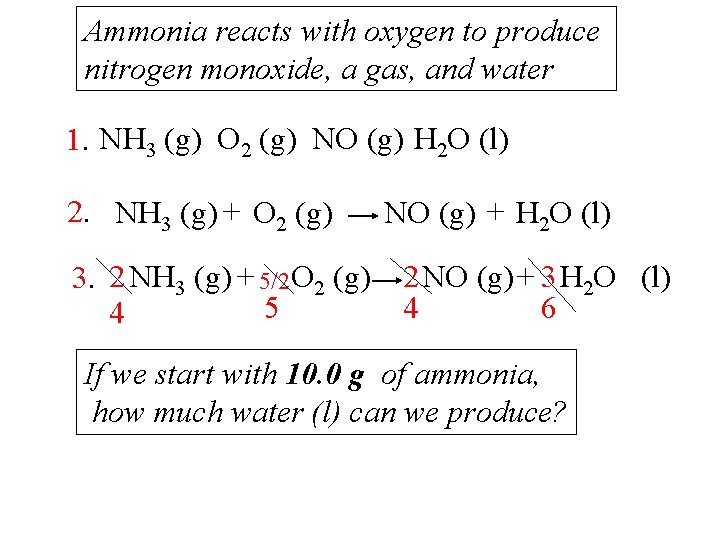
Ammonia reacts with oxygen to produce nitrogen monoxide, a gas, and water 1. NH 3 (g) O 2 (g) NO (g) H 2 O (l) 2. NH 3 (g) + O 2 (g) 3. 2 NH 3 (g) + 5/2 O 2 (g) 5 4 NO (g) + H 2 O (l) 2 NO (g) + 3 H 2 O (l) 4 6 If we start with 10. 0 g of ammonia, how much water (l) can we produce?
If we start with 10. 0 g of ammonia, how much water (l) can we produce? 4 NH 3 (g) + 5 O 2 (g) 4 NO (g) + 6 H 2 O (l) 10. 0 g NH 3 1 mol NH 3 = 0. 587 mol NH 3 17. 03 g 0. 587 mol NH 3 6 mol H 2 O 18. 02 g H 2 O = 15. 9 g H O 2 4 mol NH 3 1 mol H 2 O If we start with 10. 0 g of ammonia and 10. 0 g O 2 how much water (l) can we produce?
If we start with 10. 0 g of ammonia and 10. 0 g O 2 how much water (l) can we produce? 4 NH 3 (g) + 5 O 2 (g) 4 NO (g) + 6 H 2 O (l) 10. 0 g NH 3 1 mol NH 3 = 0. 587 mol NH 3 17. 0 g 10. 0 g O 2 1 mol O 2 32. 0 g = 0. 313 mol O 2 limiting reagent 0. 587 mol NH 3 5 mol O 2 = 0. 734 mol O 2 4 mol NH 3 0. 313 mol O 2 6 mol H 2 O 18. 0 g 5 mol O 2 1 mol H 2 O = 6. 76 g H 2 O theoretical yield
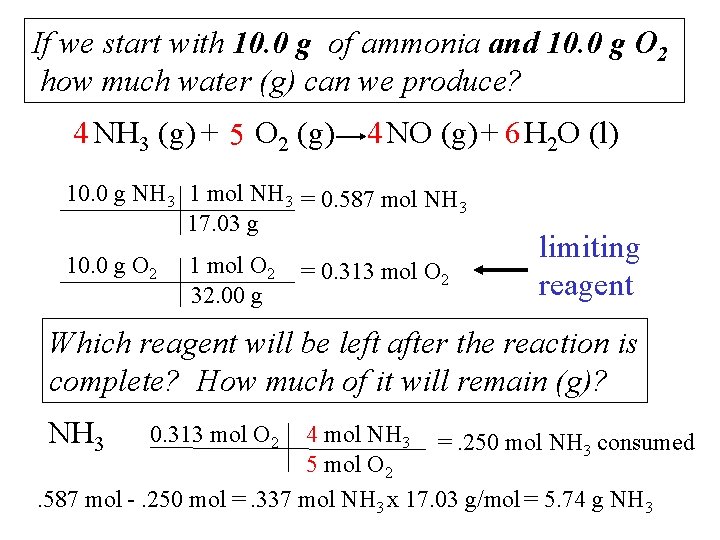
If we start with 10. 0 g of ammonia and 10. 0 g O 2 how much water (g) can we produce? 4 NH 3 (g) + 5 O 2 (g) 4 NO (g) + 6 H 2 O (l) 10. 0 g NH 3 1 mol NH 3 = 0. 587 mol NH 3 17. 03 g 10. 0 g O 2 1 mol O 2 32. 00 g = 0. 313 mol O 2 limiting reagent Which reagent will be left after the reaction is complete? How much of it will remain (g)? NH 3 0. 313 mol O 2 4 mol NH 3 =. 250 mol NH consumed 3 5 mol O 2. 587 mol -. 250 mol =. 337 mol NH 3 x 17. 03 g/mol = 5. 74 g NH 3
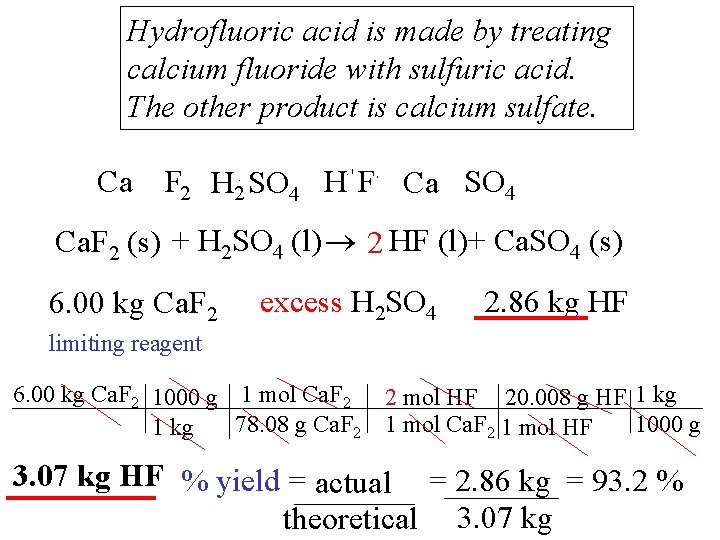
Hydrofluoric acid is made by treating calcium fluoride with sulfuric acid. The other product is calcium sulfate. Ca 2 + F 2 - H 2+ SO 42 - H+F- Ca 2+ SO 42 Ca. F 2 (s) + H 2 SO 4 (l) 2 HF (l)+ Ca. SO 4 (s) 6. 00 kg Ca. F 2 excess H 2 SO 4 2. 86 kg HF limiting reagent 6. 00 kg Ca. F 2 1000 g 1 mol Ca. F 2 78. 08 g Ca. F 2 1 kg 2 mol HF 20. 008 g HF 1 kg 1 mol Ca. F 2 1 mol HF 1000 g 3. 07 kg HF % yield = actual = 2. 86 kg = 93. 2 % theoretical 3. 07 kg