SAGENAP Review of the XENON Project March 12


- Slides: 61
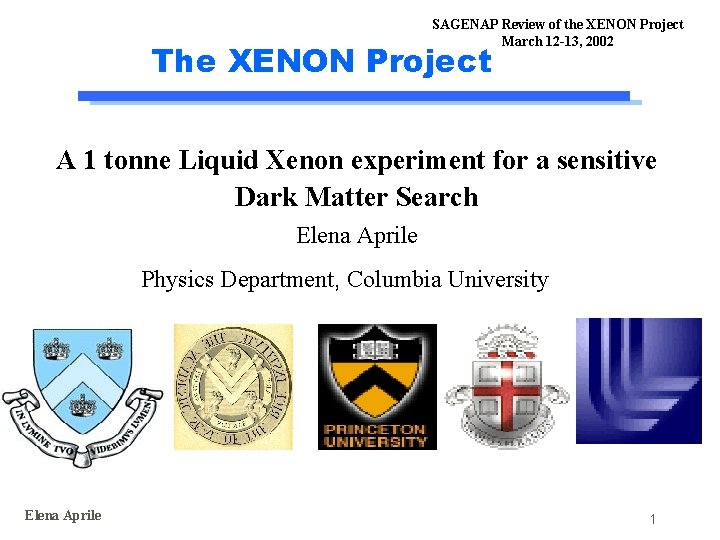
SAGENAP Review of the XENON Project March 12 -13, 2002 The XENON Project A 1 tonne Liquid Xenon experiment for a sensitive Dark Matter Search Elena Aprile Physics Department, Columbia University Elena Aprile 1
SAGENAP Review of the XENON Project March 12 -13, 2002 The XENON Project Overview Outline q Science Motivation and Goals Overview q Dark Matter Direct Searches Worldwide q LXe Properties relevant to WIMP Detection q XENON Instrument Design Overview q Comparison with other LXe Projects q XENON Team Presentations q XENON Organization and Management Elena Aprile 2
The XENON Collaboration Columbia University: E. Aprile (Principal Investigator) T. Baltz, A. Curioni, K-L. Giboni, C. Hailey, L. Hui, M. Kobayashi and K. Ni Brown University: R. Gaitskell Princeton University: T. Shutt Rice University: U. Oberlack LLNL: W. Craig Elena Aprile 3
Why should NSF support XENON • Because a WIMP experiment with discovery potential will have enormous scientific impact in particle physics and astrophysics. Need to validate discovery with different targets and technology. • Because the timing is right and the proposed XENON concept is based on a relatively simple technology with unique suitability for the 1 -tonne scale required by the science. • Because the proposing team combines extensive experience with large scale LXe detectors with complementary experience in other key areas required for a successful realization of the XENON dark matter project! Elena Aprile 4
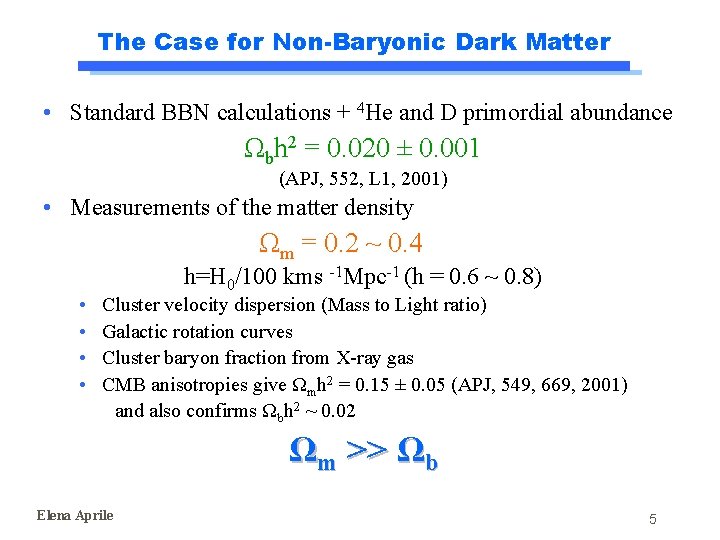
The Case for Non-Baryonic Dark Matter • Standard BBN calculations + 4 He and D primordial abundance Ωbh 2 = 0. 020 ± 0. 001 (APJ, 552, L 1, 2001) • Measurements of the matter density Ωm = 0. 2 ~ 0. 4 • • h=H 0/100 kms -1 Mpc-1 (h = 0. 6 ~ 0. 8) Cluster velocity dispersion (Mass to Light ratio) Galactic rotation curves Cluster baryon fraction from X-ray gas CMB anisotropies give Ωmh 2 = 0. 15 ± 0. 05 (APJ, 549, 669, 2001) and also confirms Ωbh 2 ~ 0. 02 Ωm >> Ωb Elena Aprile 5
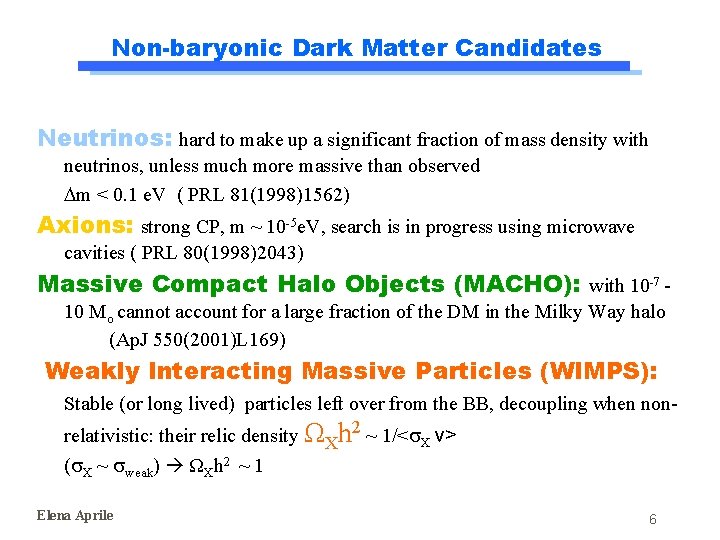
Non-baryonic Dark Matter Candidates Neutrinos: hard to make up a significant fraction of mass density with neutrinos, unless much more massive than observed m < 0. 1 e. V ( PRL 81(1998)1562) Axions: strong CP, m ~ 10 -5 e. V, search is in progress using microwave cavities ( PRL 80(1998)2043) Massive Compact Halo Objects (MACHO): with 10 -7 10 Mo cannot account for a large fraction of the DM in the Milky Way halo (Ap. J 550(2001)L 169) Weakly Interacting Massive Particles (WIMPS): Stable (or long lived) particles left over from the BB, decoupling when nonrelativistic: their relic density ΩXh 2 ~ 1/< X v> ( X ~ weak) ΩXh 2 ~ 1 Elena Aprile 6
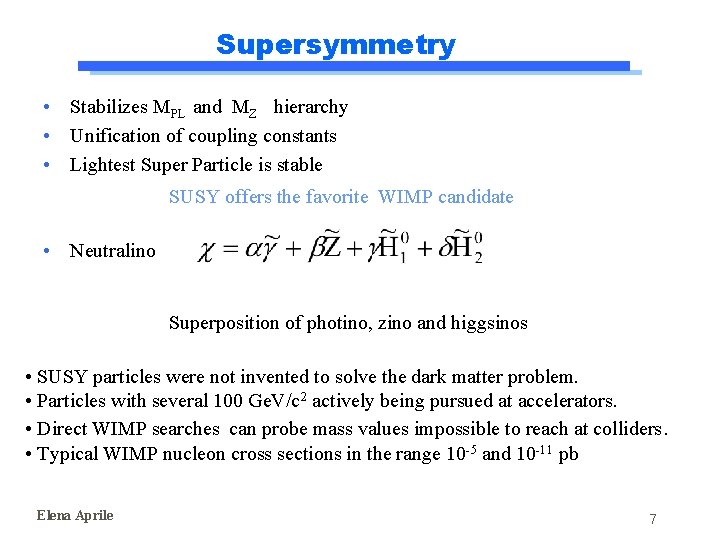
Supersymmetry • Stabilizes MPL and MZ hierarchy • Unification of coupling constants • Lightest Super Particle is stable SUSY offers the favorite WIMP candidate • Neutralino Superposition of photino, zino and higgsinos • SUSY particles were not invented to solve the dark matter problem. • Particles with several 100 Ge. V/c 2 actively being pursued at accelerators. • Direct WIMP searches can probe mass values impossible to reach at colliders. • Typical WIMP nucleon cross sections in the range 10 -5 and 10 -11 pb Elena Aprile 7
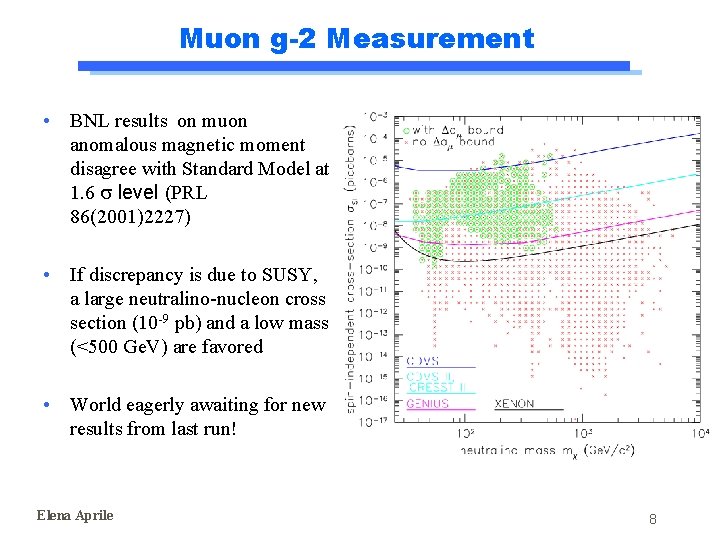
Muon g-2 Measurement • BNL results on muon anomalous magnetic moment disagree with Standard Model at 1. 6 level (PRL 86(2001)2227) • If discrepancy is due to SUSY, a large neutralino-nucleon cross section (10 -9 pb) and a low mass (<500 Ge. V) are favored • World eagerly awaiting for new results from last run! Elena Aprile 8
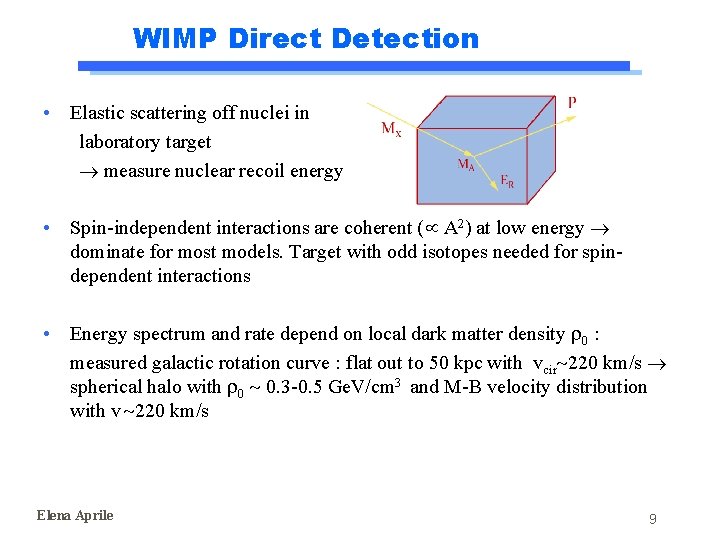
WIMP Direct Detection • Elastic scattering off nuclei in laboratory target measure nuclear recoil energy • Spin-independent interactions are coherent ( A 2) at low energy dominate for most models. Target with odd isotopes needed for spindependent interactions • Energy spectrum and rate depend on local dark matter density 0 : measured galactic rotation curve : flat out to 50 kpc with vcir 220 km/s spherical halo with 0 0. 3 -0. 5 Ge. V/cm 3 and M-B velocity distribution with v 220 km/s Elena Aprile 9
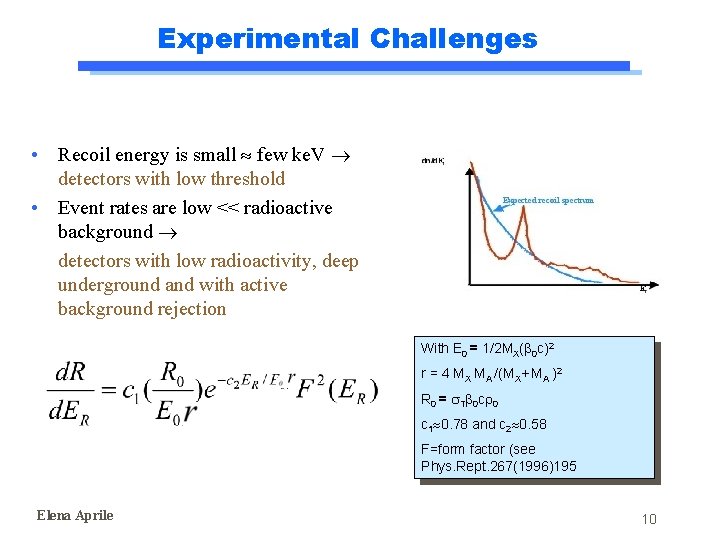
Experimental Challenges • Recoil energy is small few ke. V detectors with low threshold • Event rates are low << radioactive background detectors with low radioactivity, deep underground and with active background rejection With E 0 = 1/2 MX( 0 c)2 r = 4 MX MA /(MX+ MA )2 R 0 = T 0 c 0 c 1 0. 78 and c 2 0. 58 F=form factor (see Phys. Rept. 267(1996)195 Elena Aprile 10
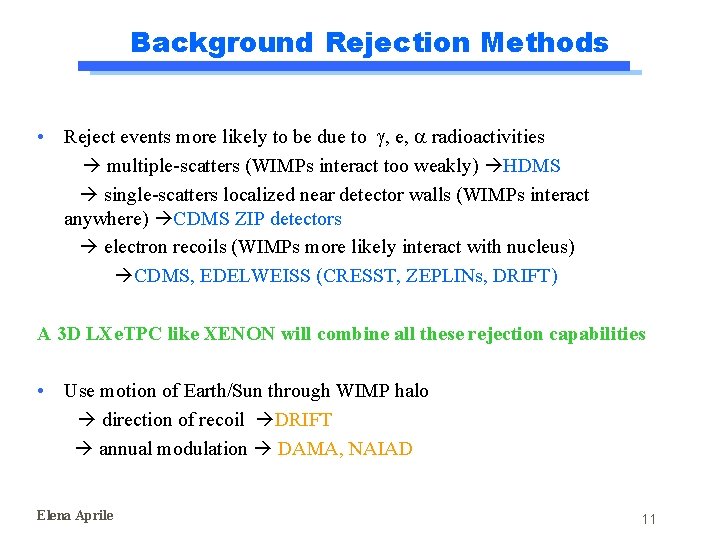
Background Rejection Methods • Reject events more likely to be due to g, e, radioactivities multiple-scatters (WIMPs interact too weakly) HDMS single-scatters localized near detector walls (WIMPs interact anywhere) CDMS ZIP detectors electron recoils (WIMPs more likely interact with nucleus) CDMS, EDELWEISS (CRESST, ZEPLINs, DRIFT) A 3 D LXe. TPC like XENON will combine all these rejection capabilities • Use motion of Earth/Sun through WIMP halo direction of recoil DRIFT annual modulation DAMA, NAIAD Elena Aprile 11
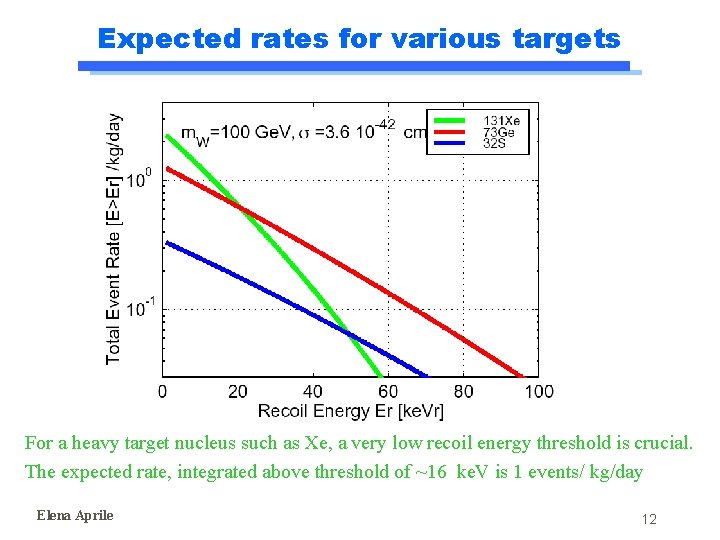
Expected rates for various targets For a heavy target nucleus such as Xe, a very low recoil energy threshold is crucial. The expected rate, integrated above threshold of ~16 ke. V is 1 events/ kg/day Elena Aprile 12
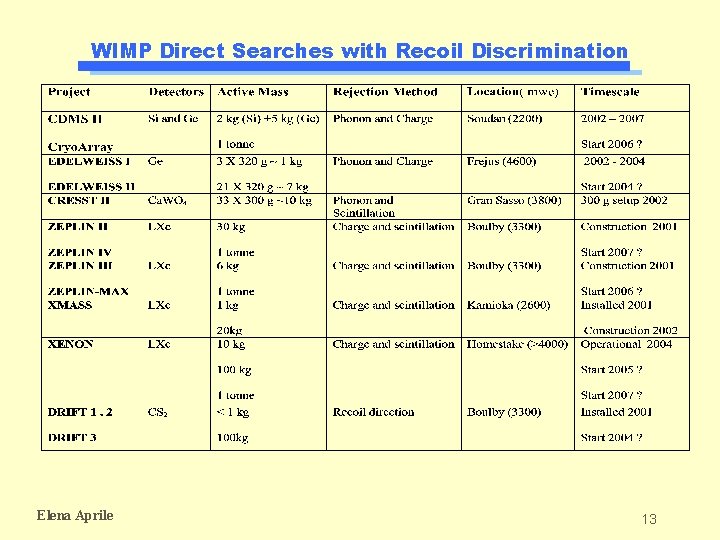
WIMP Direct Searches with Recoil Discrimination Elena Aprile 13
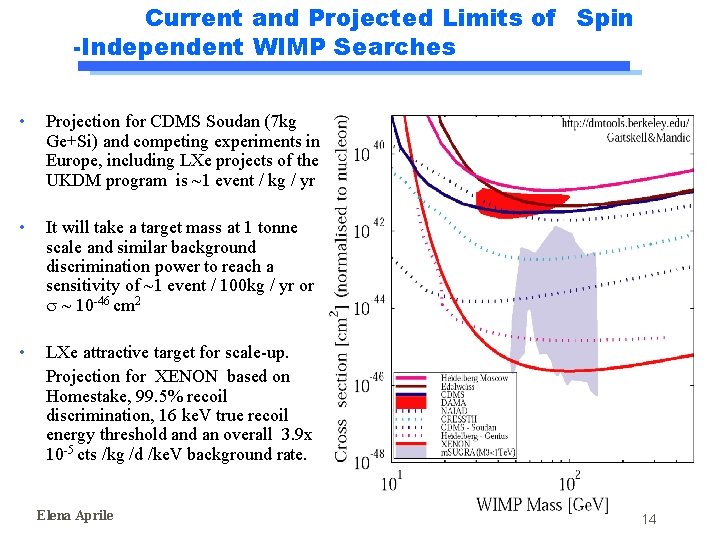
Current and Projected Limits of Spin -Independent WIMP Searches • Projection for CDMS Soudan (7 kg Ge+Si) and competing experiments in Europe, including LXe projects of the UKDM program is ~1 event / kg / yr • It will take a target mass at 1 tonne scale and similar background discrimination power to reach a sensitivity of ~1 event / 100 kg / yr or ~ 10 -46 cm 2 • LXe attractive target for scale-up. Projection for XENON based on Homestake, 99. 5% recoil discrimination, 16 ke. V true recoil energy threshold an overall 3. 9 x 10 -5 cts /kg /d /ke. V background rate. Elena Aprile 14
Why is Liquid Xenon Attractive for Dark Matter q q o ¨ q q q High mass Xe nucleus good for scalar interaction of WIMPs High atomic number (Z=54) and density (r=3 g/cc) good for compact and flexible detector geometry. “Easy” cryogenics at – 100 C High ionization (W=15. 6 e. V) yield and small Fano factor for good DE/E High electron drift velocity (v=2 mm/ms) and low diffusion for excellent spatial resolution. Calorimetry and 3 D event localization powerful for background rejection based on fiducial volume cuts and event multiplicity High scintillation (W~13 e. V) yield with fast response and strong dependence on ionizing particle for event trigger and background discrimination with PSD Distinct charge/light ratio for electron/nuclear energy deposits for high background discrimination Available in large quantity and “easy” to purify with a variety of methods. Demonstrated electron lifetime before trapping of order 1 millisecond for long drift. No long-lived radioactive isotopes. 85 Kr contamination reducible to ppb level Elena Aprile 15
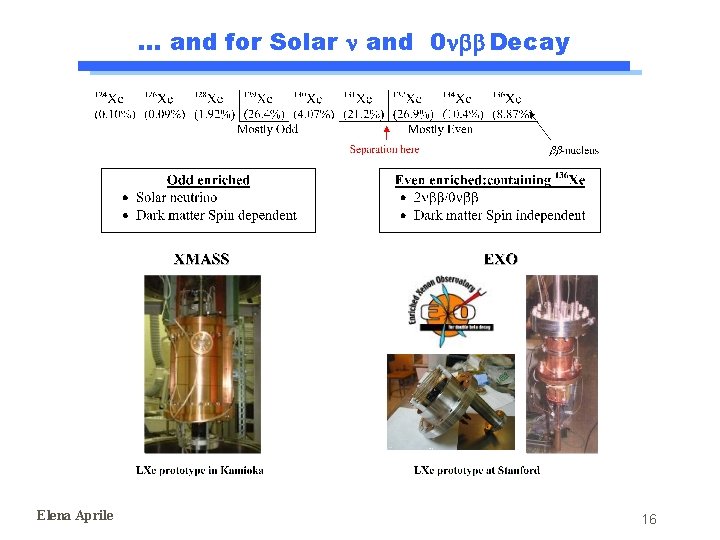
… and for Solar and 0 Decay Elena Aprile 16
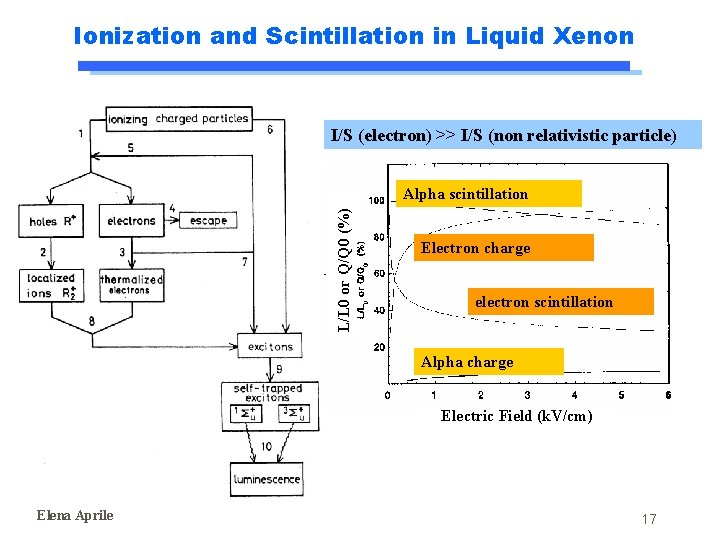
Ionization and Scintillation in Liquid Xenon I/S (electron) >> I/S (non relativistic particle) L/L 0 or Q/Q 0 (%) Alpha scintillation Electron charge electron scintillation Alpha charge Electric Field (k. V/cm) Elena Aprile 17
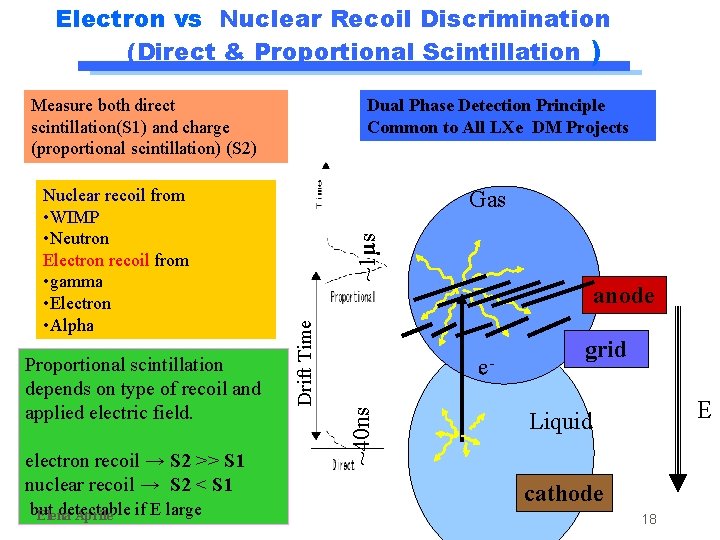
Electron vs Nuclear Recoil Discrimination (Direct & Proportional Scintillation ) Measure both direct scintillation(S 1) and charge (proportional scintillation) (S 2) electron recoil → S 2 >> S 1 nuclear recoil → S 2 < S 1 but detectable if E large Elena Aprile ~1μs anode - e ~40 ns Proportional scintillation depends on type of recoil and applied electric field. Gas Drift Time Nuclear recoil from • WIMP • Neutron Electron recoil from • gamma • Electron • Alpha Dual Phase Detection Principle Common to All LXe DM Projects grid E Liquid cathode 18
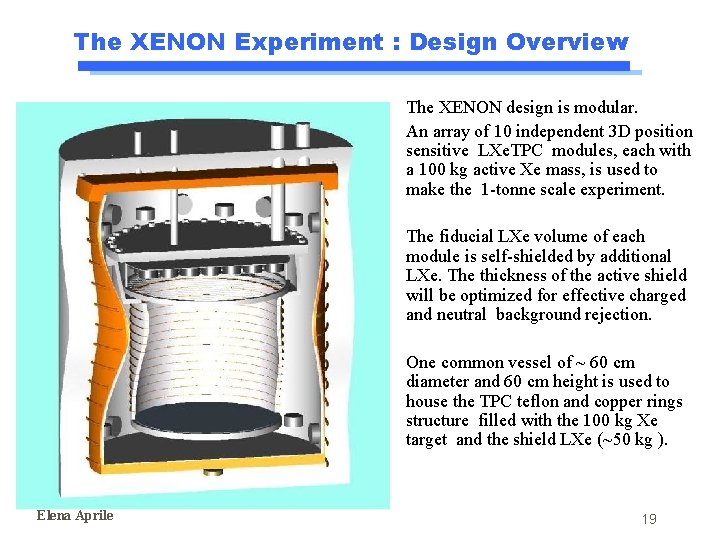
The XENON Experiment : Design Overview Elena Aprile • The XENON design is modular. An array of 10 independent 3 D position sensitive LXe. TPC modules, each with a 100 kg active Xe mass, is used to make the 1 -tonne scale experiment. • The fiducial LXe volume of each module is self-shielded by additional LXe. The thickness of the active shield will be optimized for effective charged and neutral background rejection. • One common vessel of ~ 60 cm diameter and 60 cm height is used to house the TPC teflon and copper rings structure filled with the 100 kg Xe target and the shield LXe (~50 kg ). 19
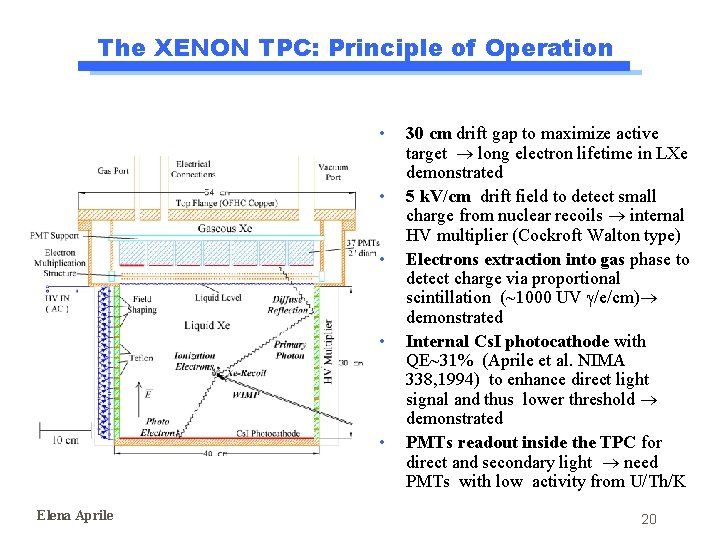
The XENON TPC: Principle of Operation • • • Elena Aprile 30 cm drift gap to maximize active target long electron lifetime in LXe demonstrated 5 k. V/cm drift field to detect small charge from nuclear recoils internal HV multiplier (Cockroft Walton type) Electrons extraction into gas phase to detect charge via proportional scintillation (~1000 UV g/e/cm) demonstrated Internal Cs. I photocathode with QE~31% (Aprile et al. NIMA 338, 1994) to enhance direct light signal and thus lower threshold demonstrated PMTs readout inside the TPC for direct and secondary light need PMTs with low activity from U/Th/K 20
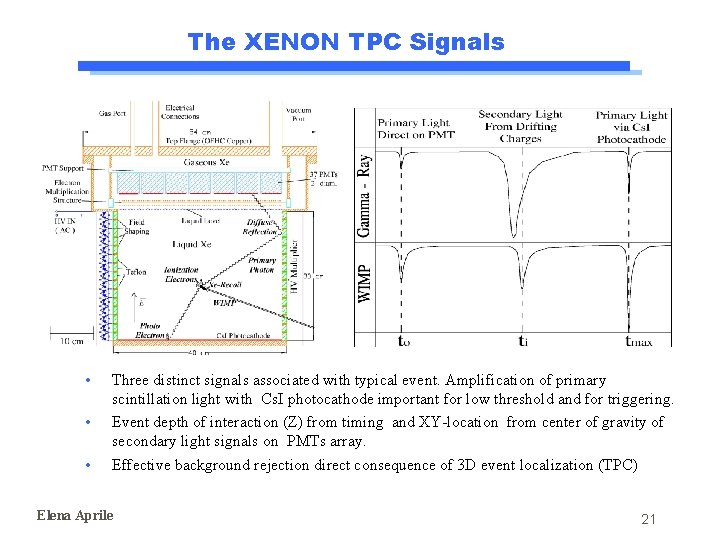
The XENON TPC Signals • • • Three distinct signals associated with typical event. Amplification of primary scintillation light with Cs. I photocathode important for low threshold and for triggering. Event depth of interaction (Z) from timing and XY-location from center of gravity of secondary light signals on PMTs array. Effective background rejection direct consequence of 3 D event localization (TPC) Elena Aprile 21
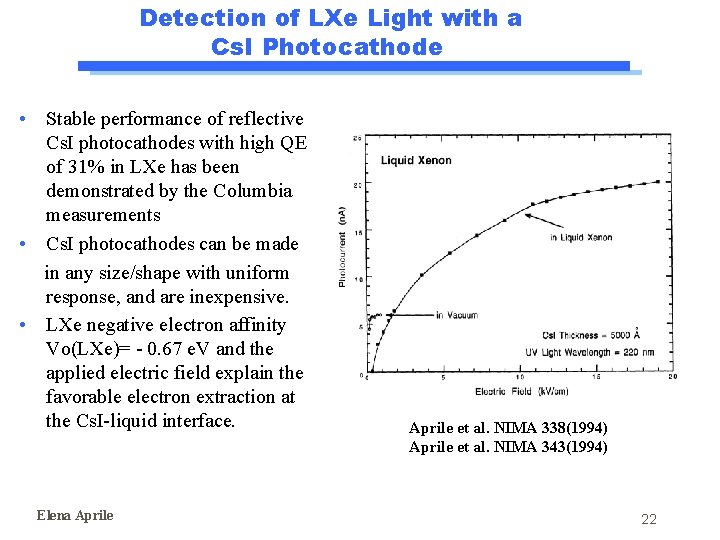
Detection of LXe Light with a Cs. I Photocathode • Stable performance of reflective Cs. I photocathodes with high QE of 31% in LXe has been demonstrated by the Columbia measurements • Cs. I photocathodes can be made in any size/shape with uniform response, and are inexpensive. • LXe negative electron affinity Vo(LXe)= - 0. 67 e. V and the applied electric field explain the favorable electron extraction at the Cs. I-liquid interface. Elena Aprile et al. NIMA 338(1994) Aprile et al. NIMA 343(1994) 22
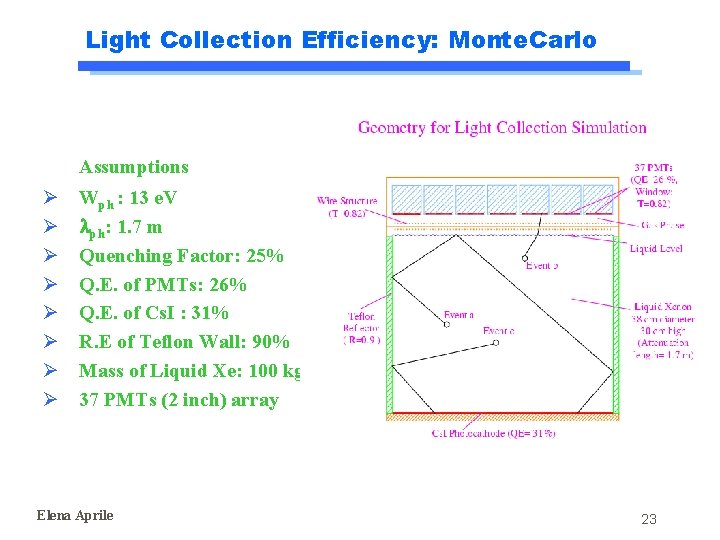
Light Collection Efficiency: Monte. Carlo Assumptions Ø Ø Ø Ø Wph : 13 e. V lph: 1. 7 m Quenching Factor: 25% Q. E. of PMTs: 26% Q. E. of Cs. I : 31% R. E of Teflon Wall: 90% Mass of Liquid Xe: 100 kg 37 PMTs (2 inch) array Elena Aprile 23
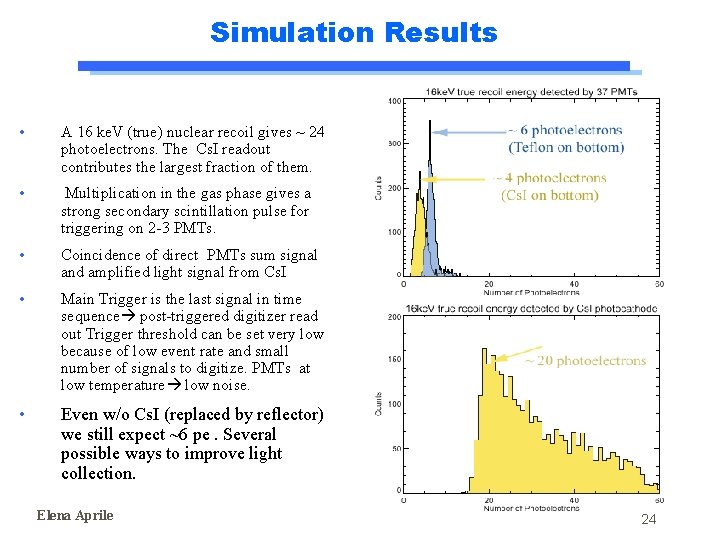
Simulation Results • A 16 ke. V (true) nuclear recoil gives ~ 24 photoelectrons. The Cs. I readout contributes the largest fraction of them. • Multiplication in the gas phase gives a strong secondary scintillation pulse for triggering on 2 -3 PMTs. • Coincidence of direct PMTs sum signal and amplified light signal from Cs. I • Main Trigger is the last signal in time sequence post-triggered digitizer read out Trigger threshold can be set very low because of low event rate and small number of signals to digitize. PMTs at low temperature low noise. • Even w/o Cs. I (replaced by reflector) we still expect ~6 pe. Several possible ways to improve light collection. Elena Aprile 24
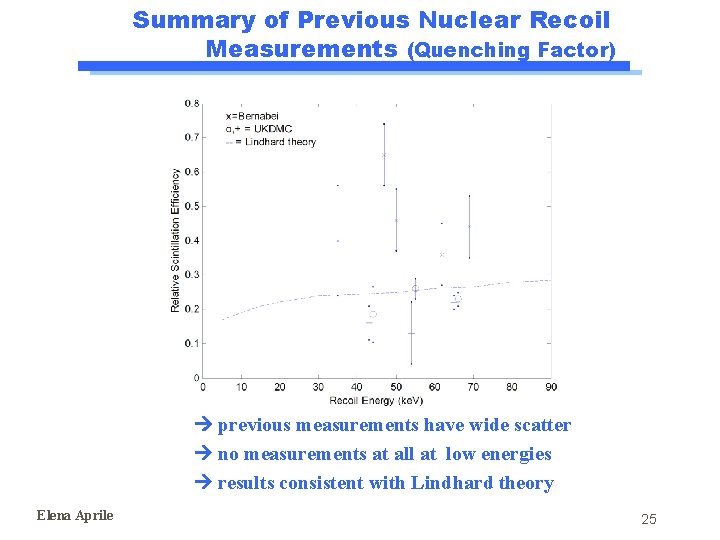
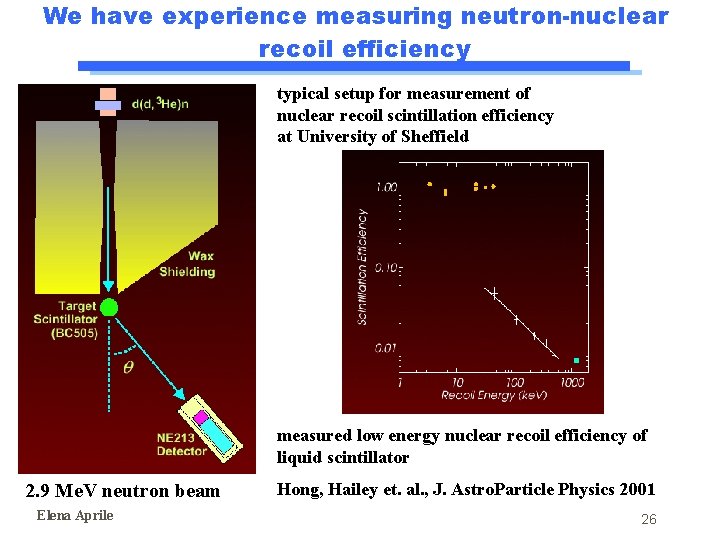
Summary of Previous Nuclear Recoil Measurements (Quenching Factor) previous measurements have wide scatter no measurements at all at low energies results consistent with Lindhard theory Elena Aprile 25
We have experience measuring neutron-nuclear recoil efficiency typical setup for measurement of nuclear recoil scintillation efficiency at University of Sheffield measured low energy nuclear recoil efficiency of liquid scintillator 2. 9 Me. V neutron beam Elena Aprile Hong, Hailey et. al. , J. Astro. Particle Physics 2001 26
Why Do Nuclear Recoil Scintillation Efficiency Measurements? • Confirm that measured efficiency at higher energies extends down to lowest energies of interest to a WIMP search • Confirm result in our particular experimental configuration. Results can vary with Xe purity, light collection efficiency etc. • Measure true nuclear recoil scintillation pulse shapes Elena Aprile 27
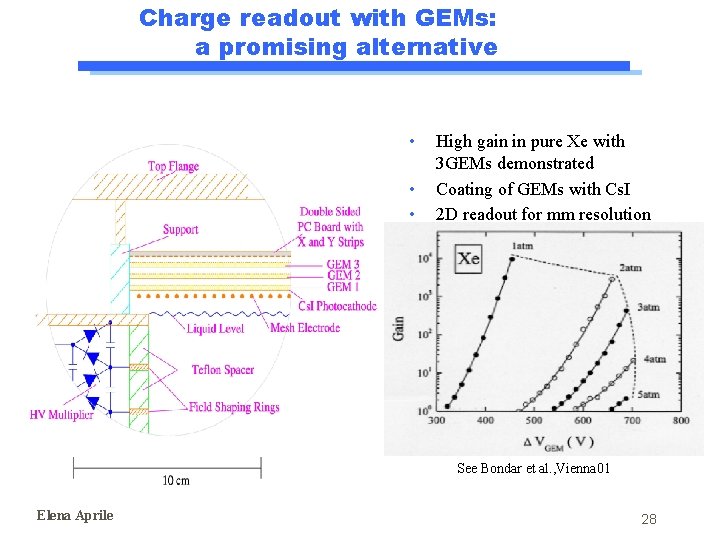
Charge readout with GEMs: a promising alternative • • • High gain in pure Xe with 3 GEMs demonstrated Coating of GEMs with Cs. I 2 D readout for mm resolution See Bondar et al. , Vienna 01 Elena Aprile 28
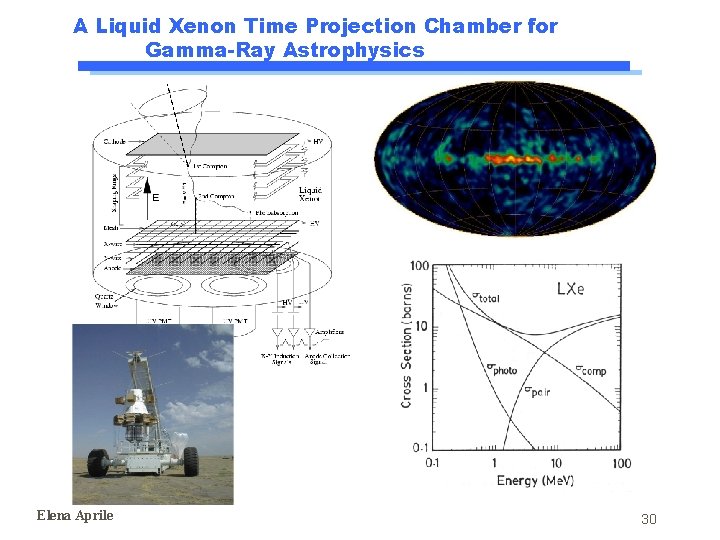
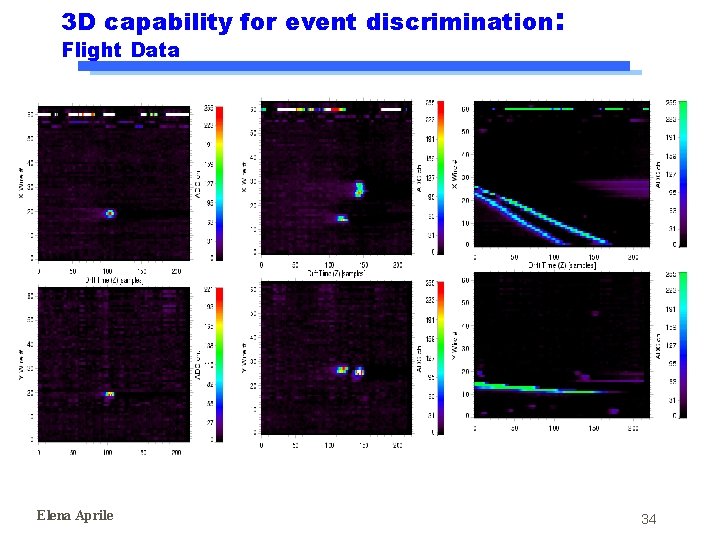
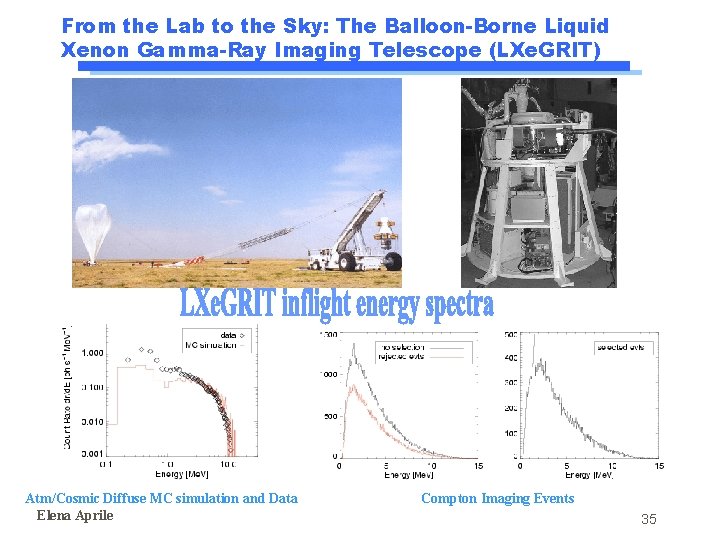
XENON Technical Heritage: LXe. GRIT A 30 kg Liquid Xenon Time Projection Chamber developed with NASA support. 3 D imaging detector with good spectroscopy is the basis of the balloon-borne LXe. GRIT, a novel Compton Telescope for Me. V Gamma- Ray Astrophysics. q The LXe. TPC operation and response to gamma-rays successfully tested in the lab and in the harsh conditions of a near space environment. q Road to LXe. GRIT: extensive R&D to study LXe ionization and scintillation properties, purification techniques to achieve long electron drift for large volume application, energy resolution and 3 D imaging resolution studies, electron mobility etc. q Elena Aprile 29
A Liquid Xenon Time Projection Chamber for Gamma-Ray Astrophysics Elena Aprile 30
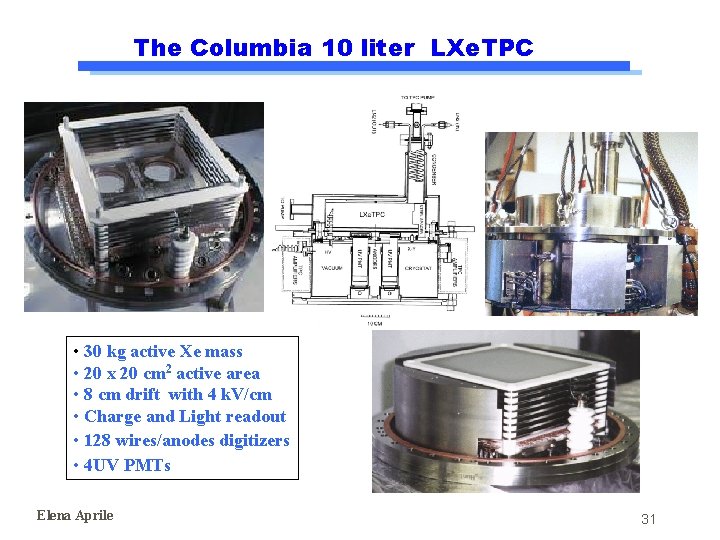
The Columbia 10 liter LXe. TPC • 30 kg active Xe mass • 20 x 20 cm 2 active area • 8 cm drift with 4 k. V/cm • Charge and Light readout • 128 wires/anodes digitizers • 4 UV PMTs Elena Aprile 31
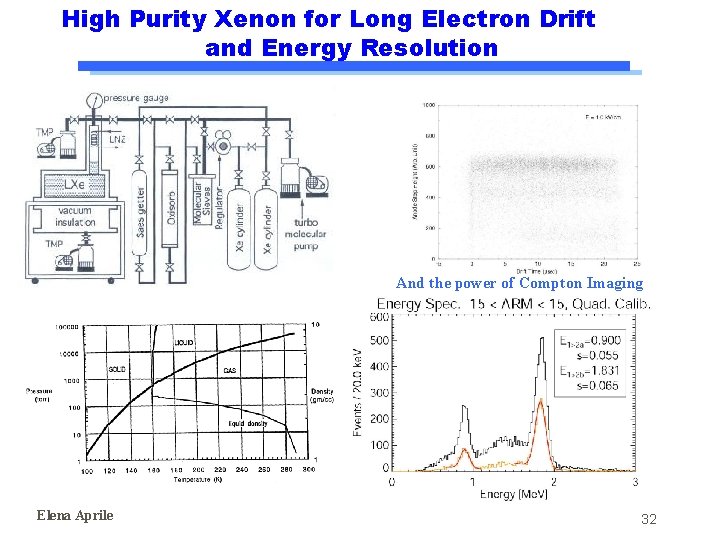
High Purity Xenon for Long Electron Drift and Energy Resolution And the power of Compton Imaging Elena Aprile 32
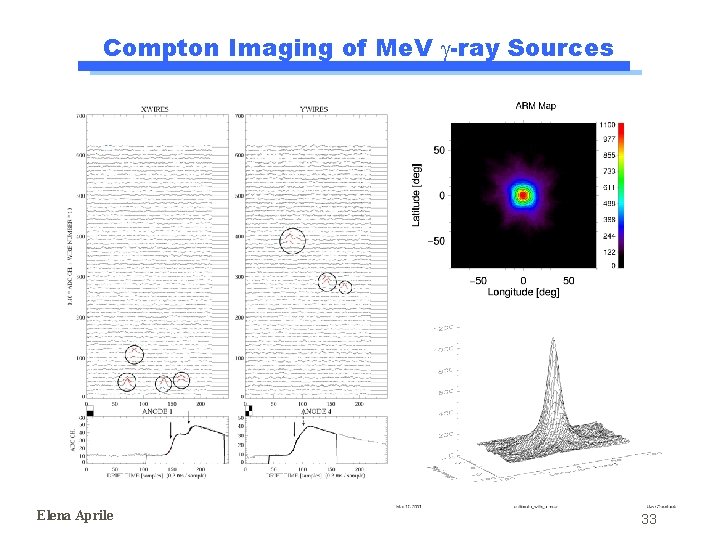
Compton Imaging of Me. V g-ray Sources Elena Aprile 33
3 D capability for event discrimination: Flight Data Elena Aprile 34
From the Lab to the Sky: The Balloon-Borne Liquid Xenon Gamma-Ray Imaging Telescope (LXe. GRIT) Atm/Cosmic Diffuse MC simulation and Data Elena Aprile Compton Imaging Events 35
Background Considerations for XENON • and induced background ( 1/2=10. 7 y): 85 Kr/Kr 2 x 10 -11 in air giving ~1 Bq/m 3 Standard Xe gas contains ~ 10 ppm of Kr 10 Hz from 85 Kr decays in 1 liter of LXe. Allowing <1 85 Kr decay/day i n XENON energy band <1 ppb level of Kr in Xe 85 Kr 136 Xe 2 decay ( 1/2=8 x 1021 y): with Q= 2. 48 Me. V expected rate in XENON is 1 x 10 -6 cts/kg/d/ke. V before any rejection • Neutron induced background Muon induced neutrons: spallation of 136 Xe and 134 Xe take 10 mb and Homestake 4. 4 kmwe estimate 6 x 10 -5 cts/kg/d before any rejection reduce by muon veto with 99% efficiency ( , n) neutrons from rock: 1000/n/m 2/d from ( , n) reactions from U/Th of rock appropriate shield reduces this background to 1 x 10 -6 cts/kg/d/ke. V Neutrons from U/Th of detector materials: within shield, neutrons from U/Th of detector components and vessel give 5 x 10 -5 cts/kg/d/ke. V lower it by x 10 with materials selection Elena Aprile 36
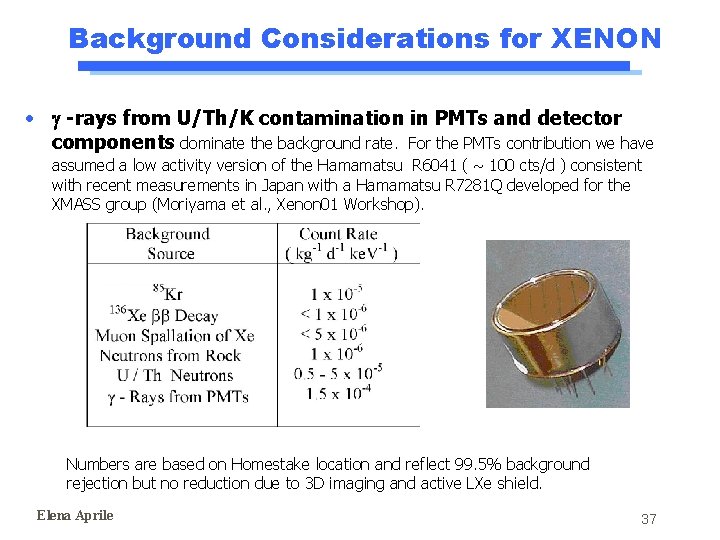
Background Considerations for XENON • -rays from U/Th/K contamination in PMTs and detector components dominate the background rate. For the PMTs contribution we have assumed a low activity version of the Hamamatsu R 6041 ( 100 cts/d ) consistent with recent measurements in Japan with a Hamamatsu R 7281 Q developed for the XMASS group (Moriyama et al. , Xenon 01 Workshop). Numbers are based on Homestake location and reflect 99. 5% background rejection but no reduction due to 3 D imaging and active LXe shield. Elena Aprile 37
How is XENON different from other Liquid Xe Projects? Elena Aprile 38
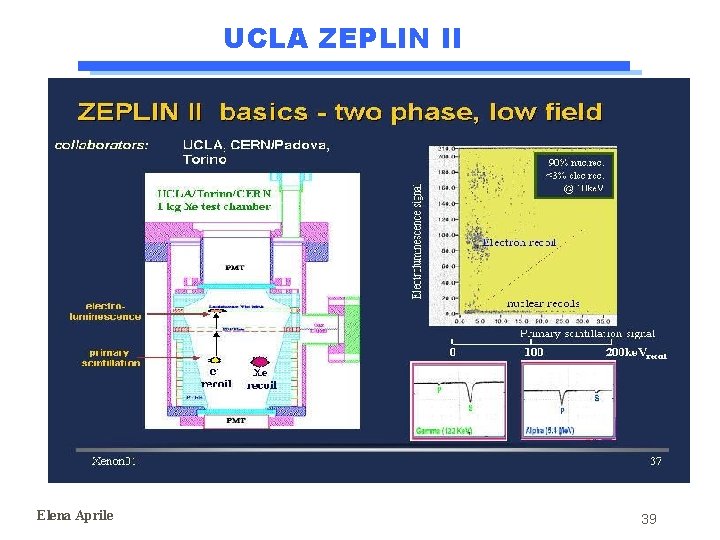
UCLA ZEPLIN II Elena Aprile 39
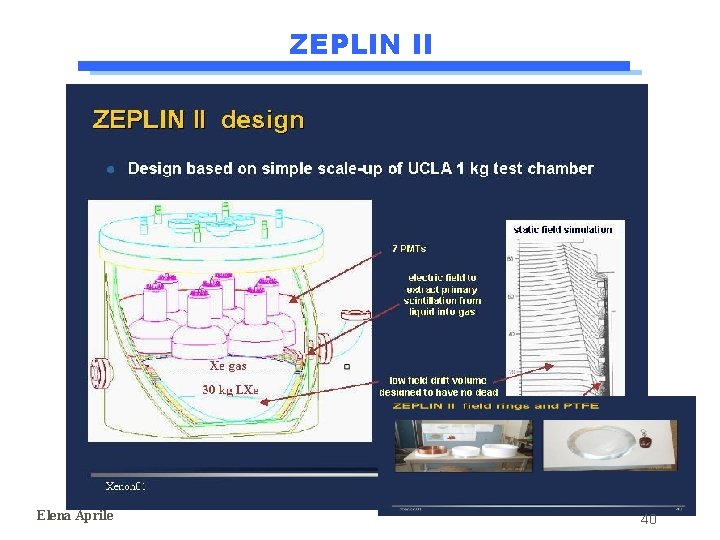
ZEPLIN II Elena Aprile 40
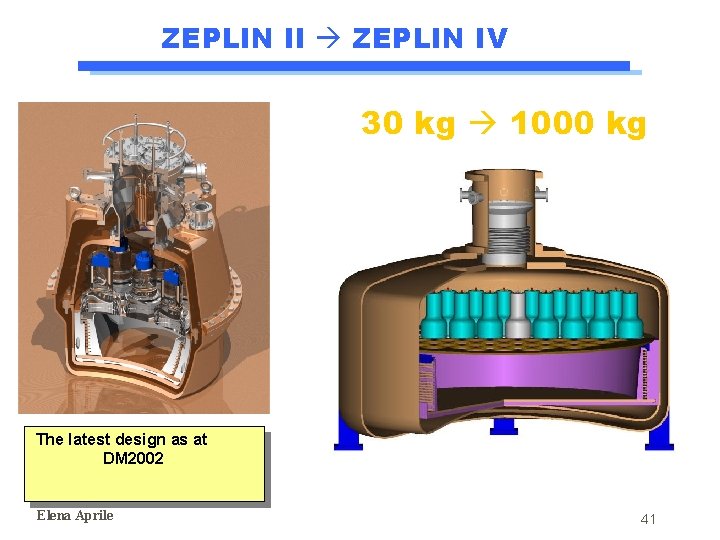
ZEPLIN II ZEPLIN IV 30 kg 1000 kg The latest design as at DM 2002 Elena Aprile 41
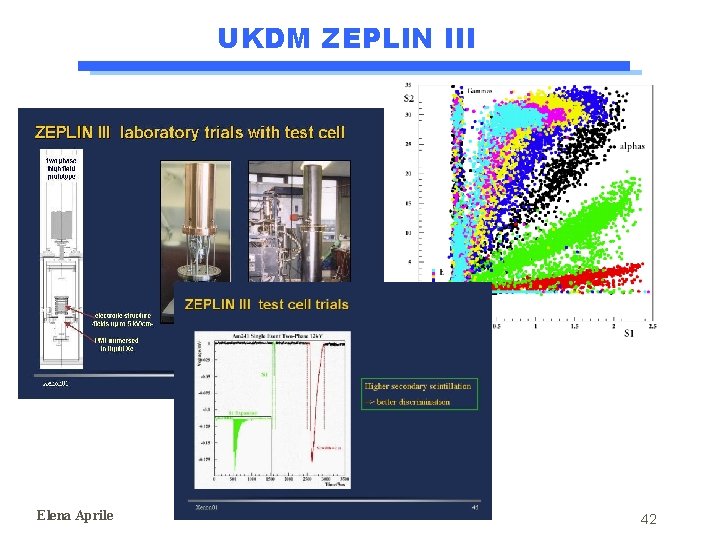
UKDM ZEPLIN III Elena Aprile 42
ZEPLIN III Elena Aprile 43
The LXe Program at Boulby Elena Aprile 44
The LXe Program at Kamioka XMASS Cold finger present with new PMTs no rejec. gas filling line Wire set (Grid 1, Anode Grid 2) with 99% rejection PTFE Teflon (Reflector) Gas Xe Mg. F 2 Window with Ni mesh (cathode) OFHC vessel (5 cm) Elena Aprile Liq. Xe(1 kg) 9. 5 cm Drift PMT 45
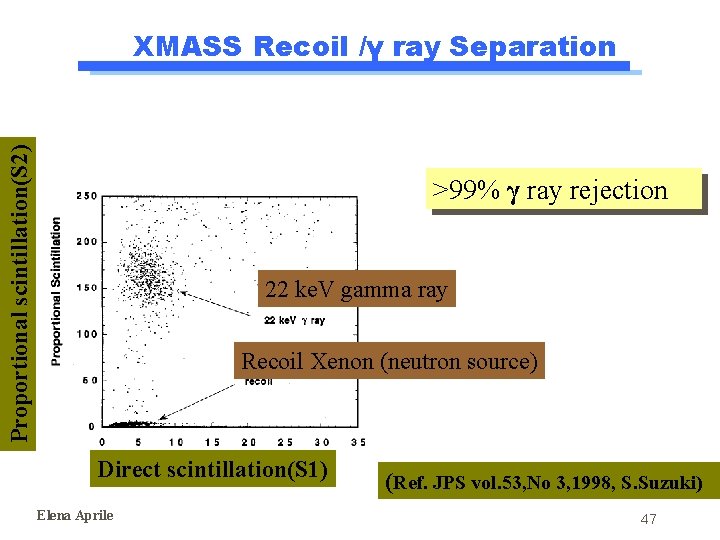
Signals from 1 kg XMASS Prototype 42000 photon/Me. V Decay time 45 nsec direct drift time Elena Aprile proportional drift time 46
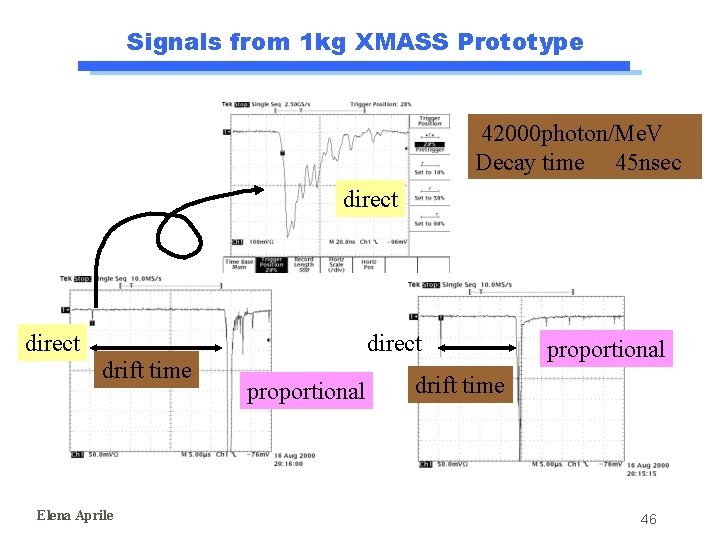
Proportional scintillation(S 2) XMASS Recoil /γ ray Separation >99% γ ray rejection 22 ke. V gamma ray Recoil Xenon (neutron source) Direct scintillation(S 1) Elena Aprile (Ref. JPS vol. 53, No 3, 1998, S. Suzuki) 47
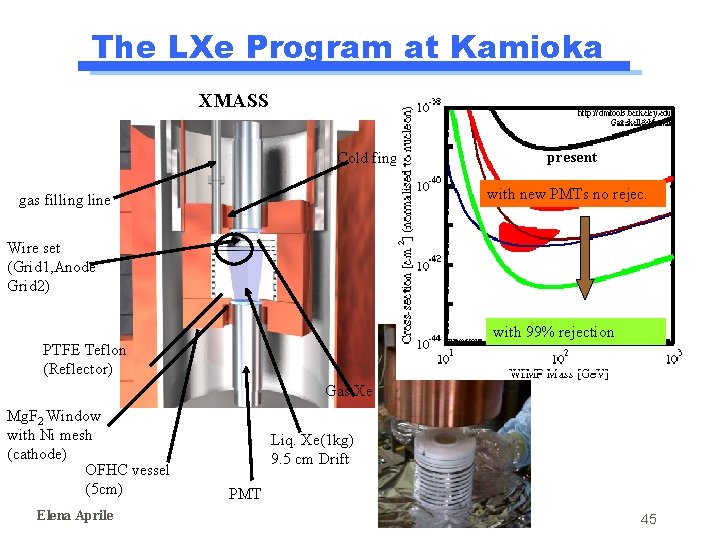
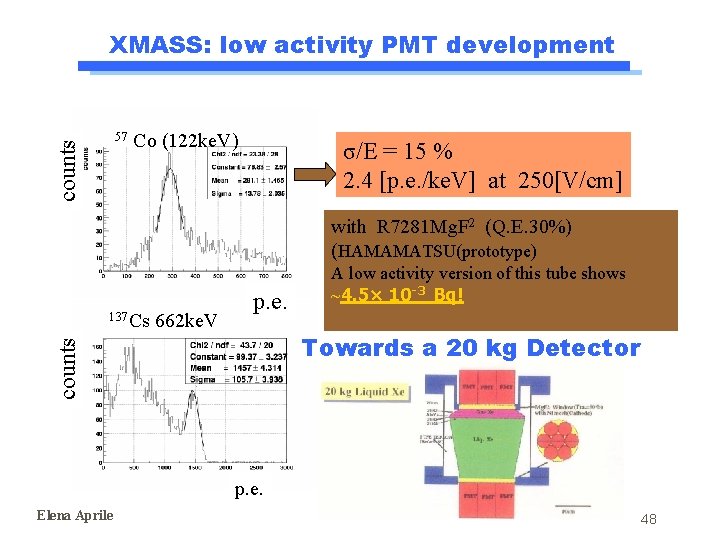
XMASS: low activity PMT development counts 57 Co (122 ke. V) σ/E = 15 % 2. 4 [p. e. /ke. V] at 250[V/cm] with R 7281 Mg. F 2 (Q. E. 30%) (HAMAMATSU(prototype) 662 ke. V p. e. Towards a 20 kg Detector counts 137 Cs A low activity version of this tube shows ~4. 5× 10 -3 Bq! p. e. Elena Aprile 48
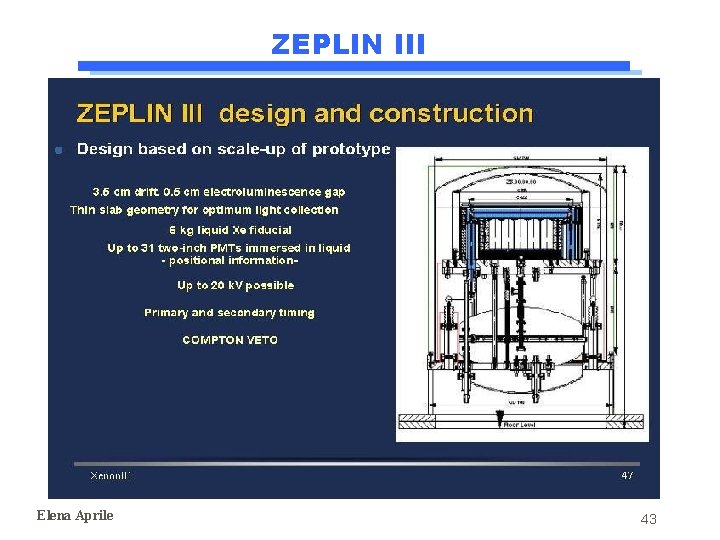
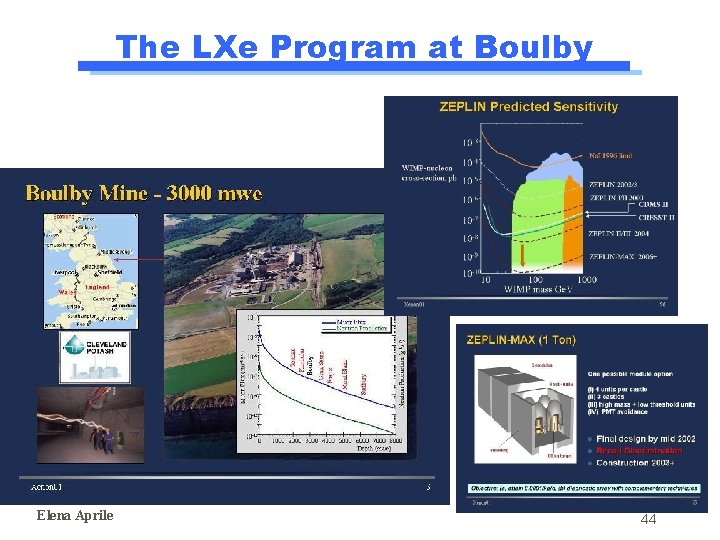
Answer to Question • LXe long recognized as promising WIMP target for a large scale experiment with relatively simple technology. So far however development effort has been subcritical. • Low energy threshold and background rejection capability yet to be fully demonstrated. • Recent move to an underground lab - 1 kg XMASS detector in Kamioka- an important milestone. Scale up to a 20 kg detector of same design (7 PMTs vs 1) started. • UCLA ZEPLIN II is similar in size and design to XMASS: drift in LXe over ~ 10 cm with low electric. Secondary light pulse from low energy nuclear recoils hard to detect. Scale up to 1 tonne with a monolithic detector (ZEPLIN IV) too risky and unpractical. • UKDM ZEPLIN III better discrimination power and lower threshold due to high electric field. Design does not present an easy scale up from 6 kg to sizable modules of order 100 kg. • XENON combines the best of the techniques with a design which can be easily scaled. Strength of experience with a 30 kg LXe. TPC for gamma ray astrophysics + critical mass at Columbia with collaborators key experiences in DM searches. Elena Aprile 49
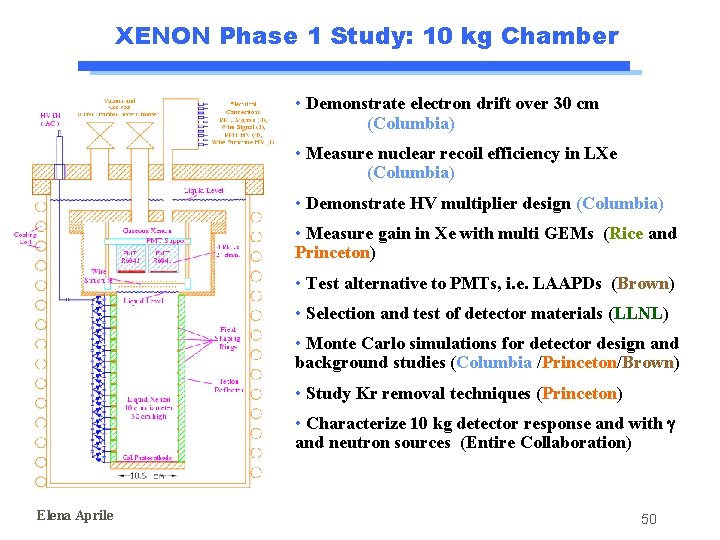
XENON Phase 1 Study: 10 kg Chamber • Demonstrate electron drift over 30 cm (Columbia) • Measure nuclear recoil efficiency in LXe (Columbia) • Demonstrate HV multiplier design (Columbia) • Measure gain in Xe with multi GEMs (Rice and Princeton) • Test alternative to PMTs, i. e. LAAPDs (Brown) • Selection and test of detector materials (LLNL) • Monte Carlo simulations for detector design and background studies (Columbia /Princeton/Brown) • Study Kr removal techniques (Princeton) • Characterize 10 kg detector response and with and neutron sources (Entire Collaboration) Elena Aprile 50
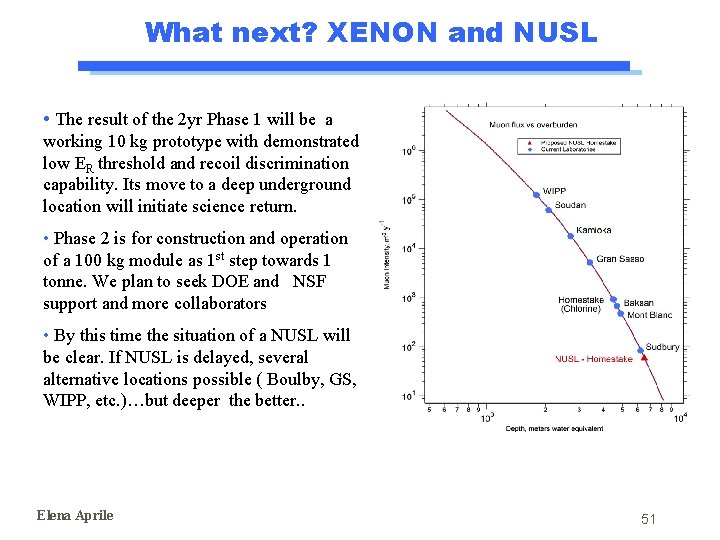
What next? XENON and NUSL • The result of the 2 yr Phase 1 will be a working 10 kg prototype with demonstrated low ER threshold and recoil discrimination capability. Its move to a deep underground location will initiate science return. • Phase 2 is for construction and operation of a 100 kg module as 1 st step towards 1 tonne. We plan to seek DOE and NSF support and more collaborators • By this time the situation of a NUSL will be clear. If NUSL is delayed, several alternative locations possible ( Boulby, GS, WIPP, etc. )…but deeper the better. . Elena Aprile 51
Summary • Liquid Xenon is an excellent detector material well suited for the large target mass required for a sensitive Dark Matter experiment. • The XENON experiment is proposed as an array of ten independent, self shielded, 3 D position sensitive LXe. TPCs each with 100 kg active mass. • The detector design, largely based on established technology and >10 yrs experience with LXe detectors development at Columbia, maximizes the fiducial volume and the signal information useful to distinguish the rare WIMP events from the large background. • With a total mass of 1 -tonne, a nuclear recoil discrimination > 99. 5% and a threshold of ~ 16 ke. V, XENON expected sensitivity of 0. 0001 events/kg/day in 3 yrs operation, will cover most SUSY predictions. Elena Aprile 52
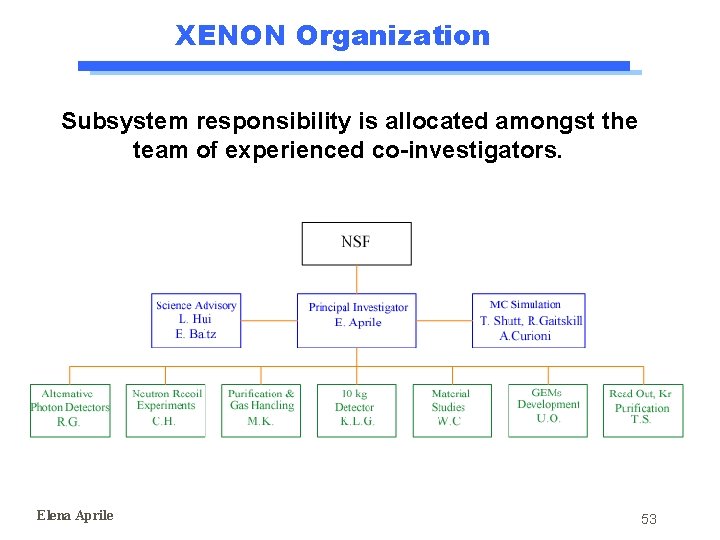
XENON Organization Subsystem responsibility is allocated amongst the team of experienced co-investigators. Elena Aprile 53
XENON Management Approach • Phase I of the XENON project spans a 2 year period from the funding start date. This instrument development effort has the focused goal of a clear demonstration of the capabilities of a 10 kg LXe detector for a sensitive Dark Matter search. • The 10 kg prototype defines the roadmap to the Phase II development of a 100 kg detector as one unit of a 1 tonne scale XENON experiment. • In complexity, the XENON Phase I development does not exceed the NASA funded LXe. GRIT experiment and we adopt the successful practices developed during this project. • We have the required critical mass with extensive expertise in LXe detector technology and other areas relevant to a Dark Matter experiment. This, plus sensible management practices will insure meeting the milestones promised by the end of the 2 nd year of Phase I. Elena Aprile 54
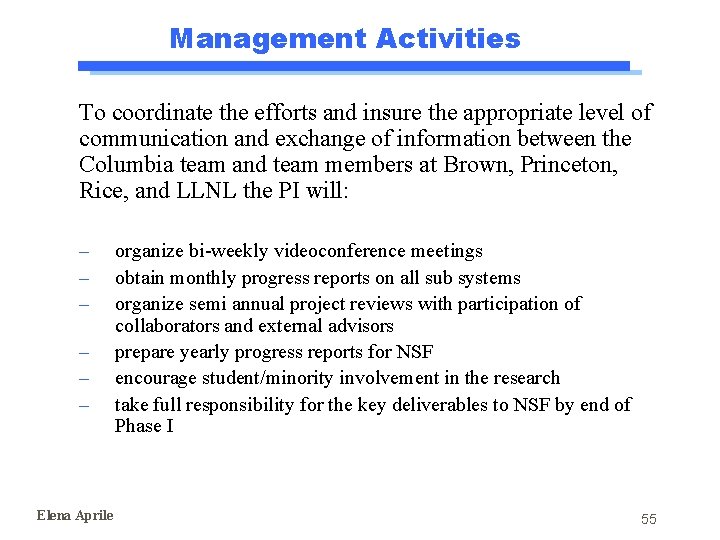
Management Activities To coordinate the efforts and insure the appropriate level of communication and exchange of information between the Columbia team and team members at Brown, Princeton, Rice, and LLNL the PI will: – – – Elena Aprile organize bi-weekly videoconference meetings obtain monthly progress reports on all sub systems organize semi annual project reviews with participation of collaborators and external advisors prepare yearly progress reports for NSF encourage student/minority involvement in the research take full responsibility for the key deliverables to NSF by end of Phase I 55
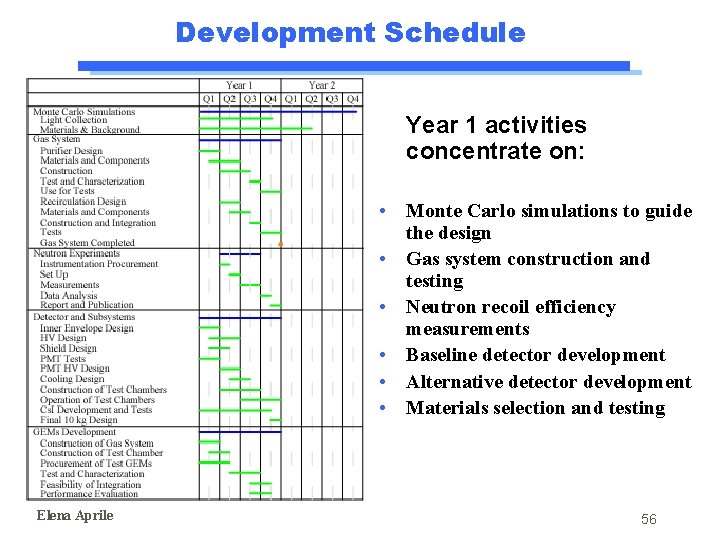
Development Schedule Year 1 activities concentrate on: • Monte Carlo simulations to guide the design • Gas system construction and testing • Neutron recoil efficiency measurements • Baseline detector development • Alternative detector development • Materials selection and testing Elena Aprile 56
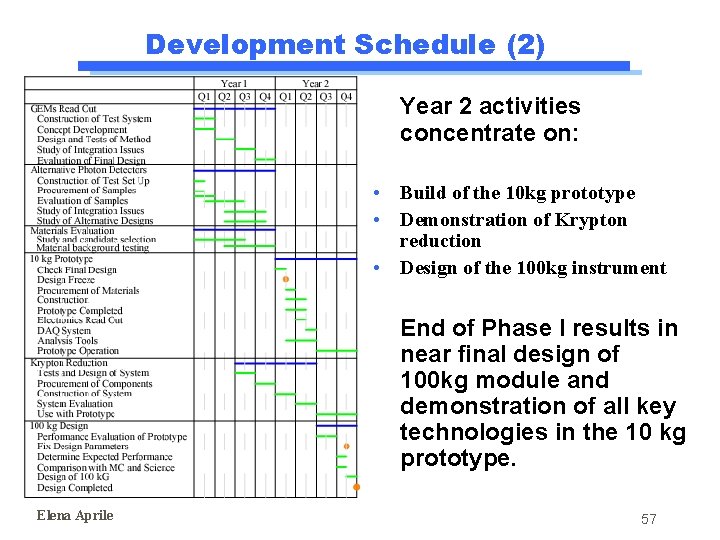
Development Schedule (2) Year 2 activities concentrate on: • Build of the 10 kg prototype • Demonstration of Krypton reduction • Design of the 100 kg instrument End of Phase I results in near final design of 100 kg module and demonstration of all key technologies in the 10 kg prototype. Elena Aprile 57
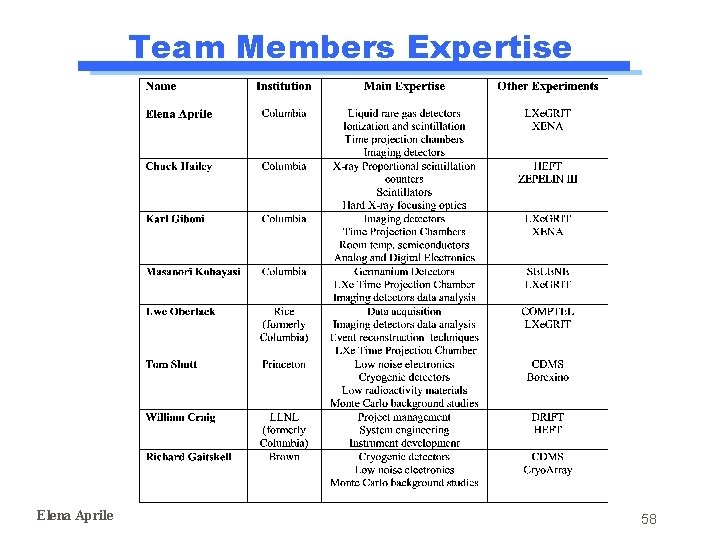
Team Members Expertise Elena Aprile 58
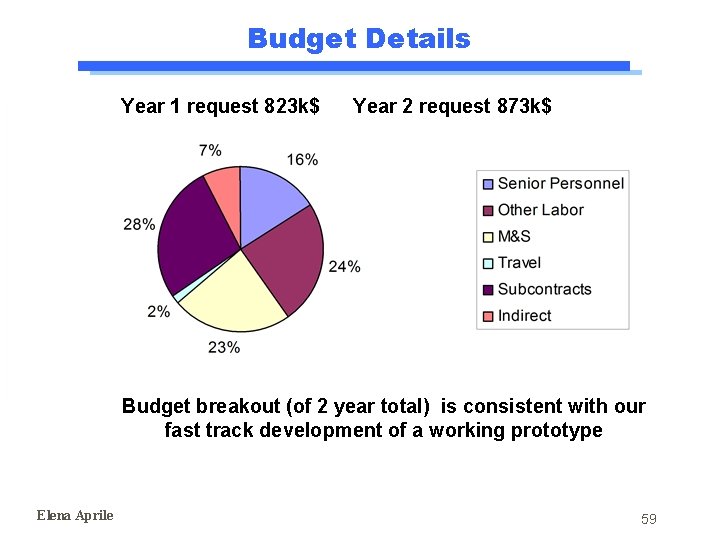
Budget Details Year 1 request 823 k$ Year 2 request 873 k$ Budget breakout (of 2 year total) is consistent with our fast track development of a working prototype Elena Aprile 59
Team Members Presentations Elena Aprile 60
Materials Selection and Testing Bill Craig (LLNL) • Candidate material selection will begin with study of existing databases assembled for other projects. • LLNL personnel (Craig, Ziock) are associated with ongoing projects requiring low background and will use this existing infrastructure to do testing of candidate materials. • Close coupling between this effort and the XENON 10/100 kg design team to ensure optimal material choices are incorporated as quickly as possible. Elena Aprile 61