
The EXO200 Detector Razvan Gornea for the EXO

- Slides: 21
The EXO-200 Detector Razvan Gornea for the EXO Collaboration LHEP, Center for Research and Education in Fundamental Physics, Bern University Frontier Detectors for Frontier Physics 11 th Pisa meeting on advanced detectors 24 -30 May 2009
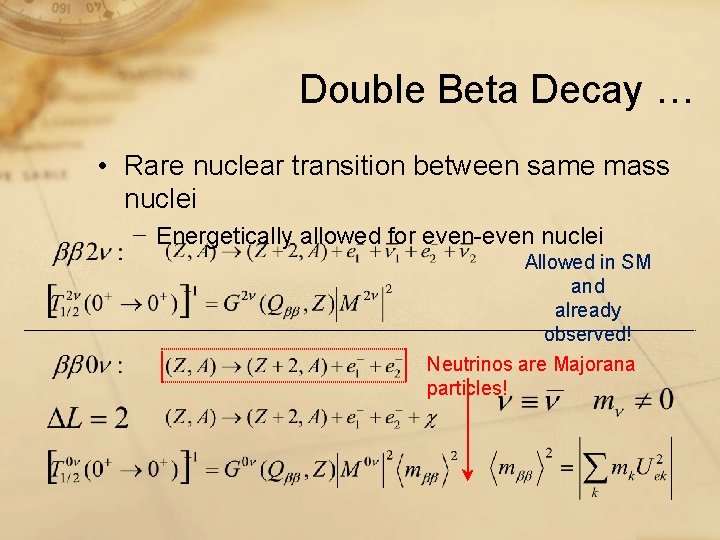
Double Beta Decay … • Rare nuclear transition between same mass nuclei − Energetically allowed for even-even nuclei Allowed in SM and already observed! Neutrinos are Majorana particles!
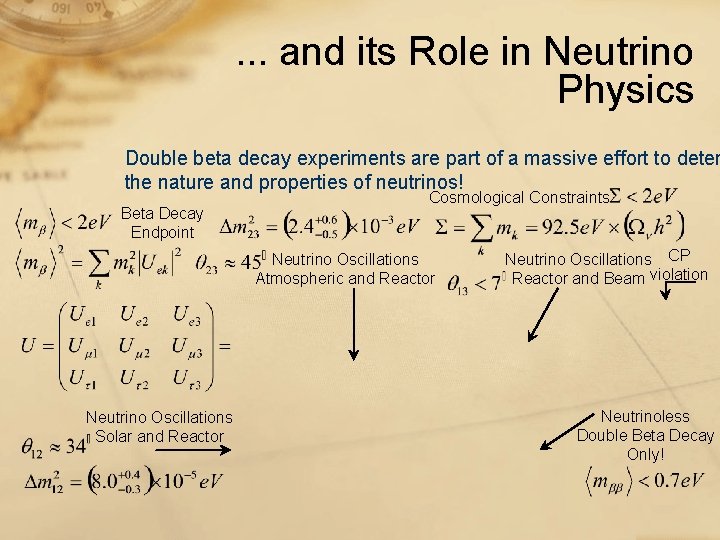
. . . and its Role in Neutrino Physics Double beta decay experiments are part of a massive effort to deter the nature and properties of neutrinos! Beta Decay Endpoint Cosmological Constraints Neutrino Oscillations Atmospheric and Reactor Neutrino Oscillations Solar and Reactor Neutrino Oscillations CP Reactor and Beam violation Neutrinoless Double Beta Decay Only!
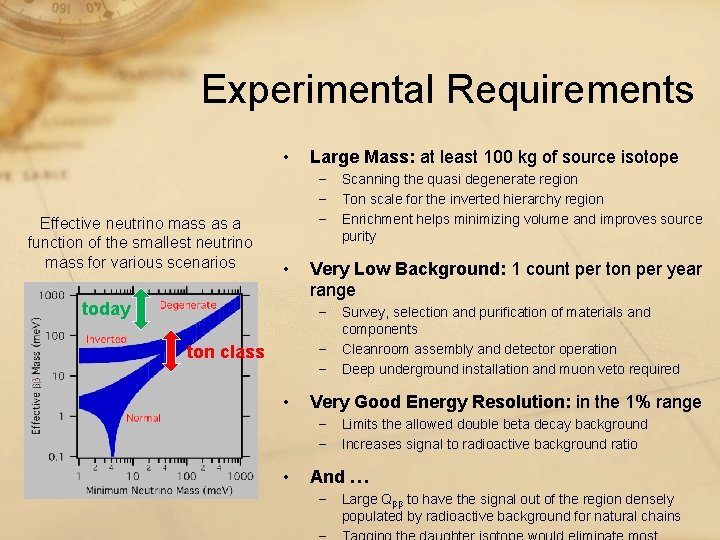
Experimental Requirements • Effective neutrino mass as a function of the smallest neutrino mass for various scenarios Large Mass: at least 100 kg of source isotope − Scanning the quasi degenerate region − Ton scale for the inverted hierarchy region − Enrichment helps minimizing volume and improves source purity • today Very Low Background: 1 count per ton per year range − Survey, selection and purification of materials and components − Cleanroom assembly and detector operation − Deep underground installation and muon veto required ton class • Very Good Energy Resolution: in the 1% range − Limits the allowed double beta decay background − Increases signal to radioactive background ratio • And … − Large Qββ to have the signal out of the region densely populated by radioactive background for natural chains
EXO Project & EXO-200 Phase • EXO project searches for double beta decay using 136 Xe − Ton scale implementation either as liquid or gas phase TPC − Relatively large Q value and straight forward enrichment technique − 136 Ba daughter tagging either No Background! in-situ or in external RF cage • EXO-200 is the first phase using 200 kg of 80% enriched Xe − Major R&D effort precursory to the ton-scale experiment − Exploration of the quasi-degenerate region with 136 Xe − Allowed double beta decay never observed in xenon!
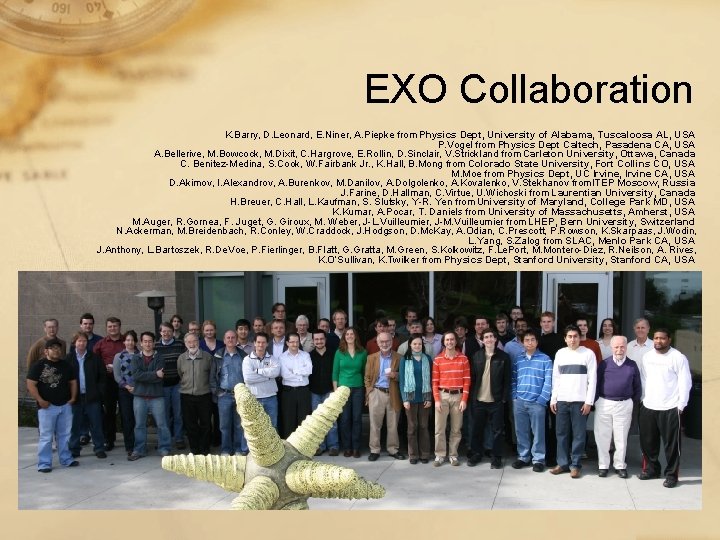
EXO Collaboration K. Barry, D. Leonard, E. Niner, A. Piepke from Physics Dept, University of Alabama, Tuscaloosa AL, USA P. Vogel from Physics Dept Caltech, Pasadena CA, USA A. Bellerive, M. Bowcock, M. Dixit, C. Hargrove, E. Rollin, D. Sinclair, V. Strickland from Carleton University, Ottawa, Canada C. Benitez-Medina, S. Cook, W. Fairbank Jr. , K. Hall, B. Mong from Colorado State University, Fort Collins CO, USA M. Moe from Physics Dept, UC Irvine, Irvine CA, USA D. Akimov, I. Alexandrov, A. Burenkov, M. Danilov, A. Dolgolenko, A. Kovalenko, V. Stekhanov from ITEP Moscow, Russia J. Farine, D. Hallman, C. Virtue, U. Wichoski from Laurentian University, Canada H. Breuer, C. Hall, L. Kaufman, S. Slutsky, Y-R. Yen from University of Maryland, College Park MD, USA K. Kumar, A. Pocar, T. Daniels from University of Massachusetts, Amherst, USA M. Auger, R. Gornea, F. Juget, G. Giroux, M. Weber, J-L. Vuilleumier, J-M. Vuilleumier from LHEP, Bern University, Switzerland N. Ackerman, M. Breidenbach, R. Conley, W. Craddock, J. Hodgson, D. Mc. Kay, A. Odian, C. Prescott, P. Rowson, K. Skarpaas, J. Wodin, L. Yang, S. Zalog from SLAC, Menlo Park CA, USA J. Anthony, L. Bartoszek, R. De. Voe, P. Fierlinger, B. Flatt, G. Gratta, M. Green, S. Kolkowitz, F. Le. Port, M. Montero-Diez, R. Neilson, A. Rives, K. O’Sullivan, K. Twilker from Physics Dept, Stanford University, Stanford CA, USA
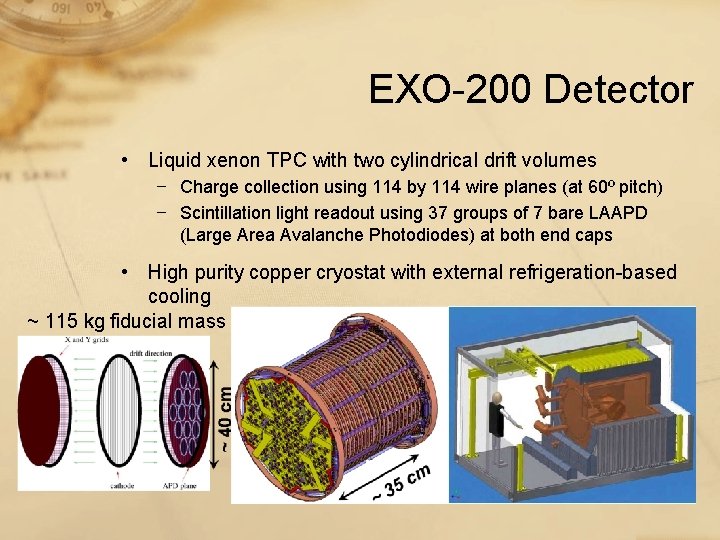
EXO-200 Detector • Liquid xenon TPC with two cylindrical drift volumes − Charge collection using 114 by 114 wire planes (at 60º pitch) − Scintillation light readout using 37 groups of 7 bare LAAPD (Large Area Avalanche Photodiodes) at both end caps • High purity copper cryostat with external refrigeration-based cooling ~ 115 kg fiducial mass
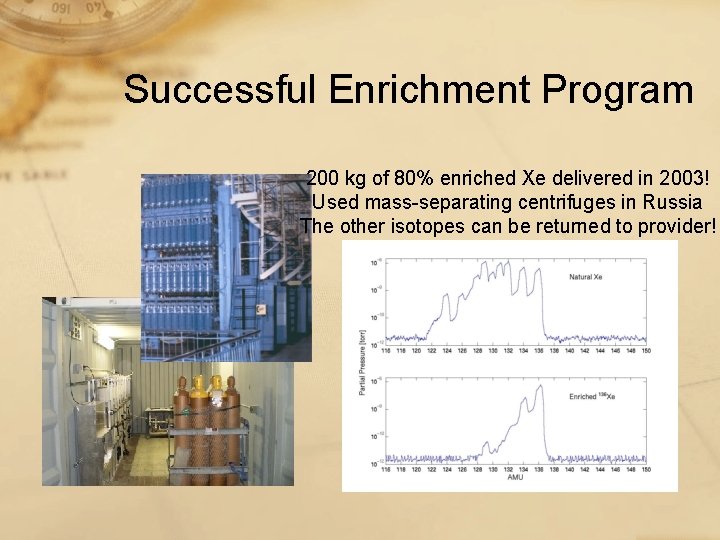
Successful Enrichment Program 200 kg of 80% enriched Xe delivered in 2003! Used mass-separating centrifuges in Russia The other isotopes can be returned to provider!
Radio-Purity Survey • Large effort to determine the residual radioactive contamination of the materials employed for the construction of EXO-200 detector − Mass spectrometry (MS) − Neutron activation analysis (NAA) • Very sensitive but expensive, potential background from main elements − Alpha counting (evaluation of the 210 Pb concentration in the shield lead) − Glow discharge MS (GD-MS), inductively coupled plasma MS (ICP-MS) • ICP-MS has better sensitivity when pre-concentration procedures are employed but the samples have to be soluble in acids (preferably HNO 3) − Direct gamma counting • Large mass samples and long duration exposures are necessary • Published database of characterized materials − Nucl. Instr. Meth. A 591, 490 -509, 2008 • Detailed Monte Carlo simulation of expected background
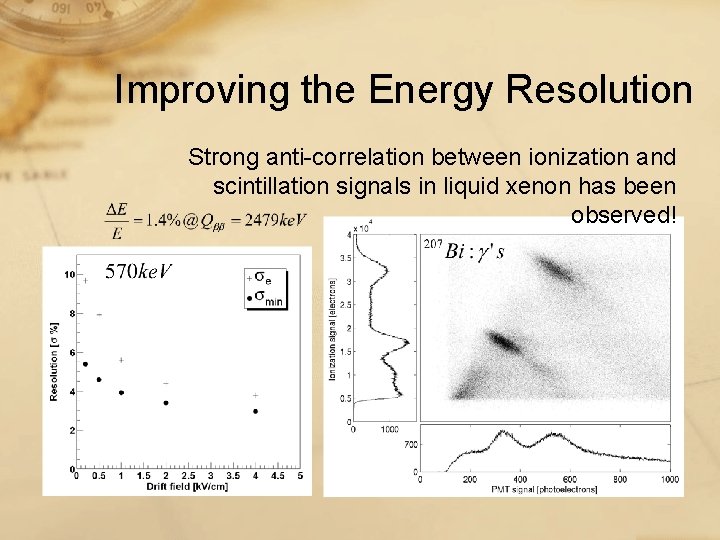
Improving the Energy Resolution Strong anti-correlation between ionization and scintillation signals in liquid xenon has been observed!
EXO-200 Detector
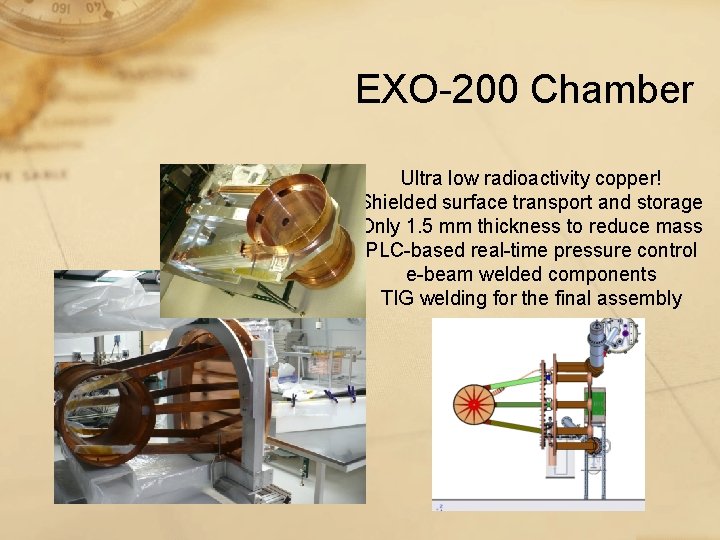
EXO-200 Chamber Ultra low radioactivity copper! Shielded surface transport and storage Only 1. 5 mm thickness to reduce mass PLC-based real-time pressure control e-beam welded components TIG welding for the final assembly
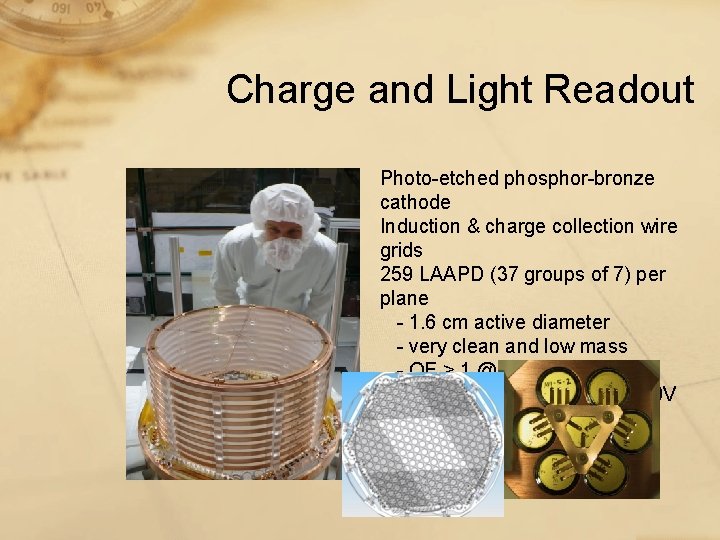
Charge and Light Readout Photo-etched phosphor-bronze cathode Induction & charge collection wire grids 259 LAAPD (37 groups of 7) per plane - 1. 6 cm active diameter - very clean and low mass - QE > 1 @ 174 nm - gain 100× to 150× @ ~ 1500 V Radial Teflon UV light reflectors
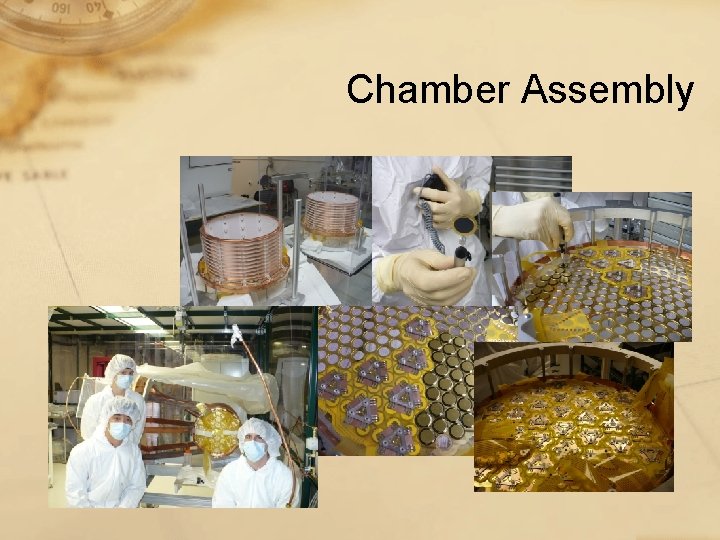
Chamber Assembly
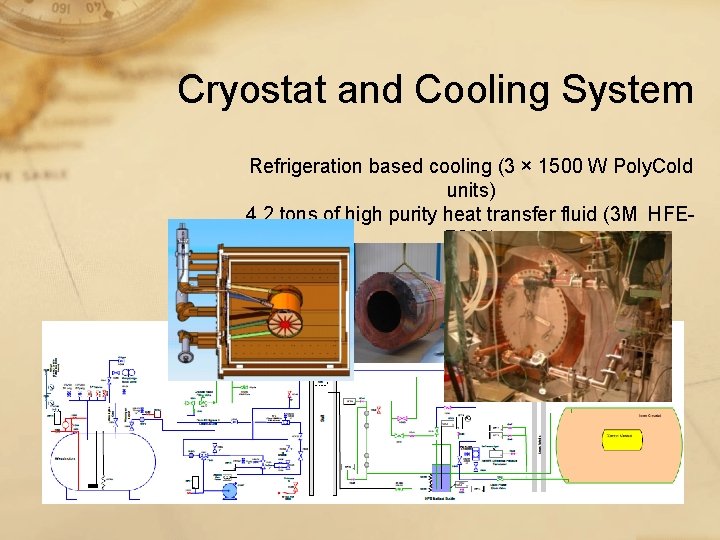
Cryostat and Cooling System Refrigeration based cooling (3 × 1500 W Poly. Cold units) 4. 2 tons of high purity heat transfer fluid (3 M HFE 7000) Serves also as inner shield!
WIPP Installation
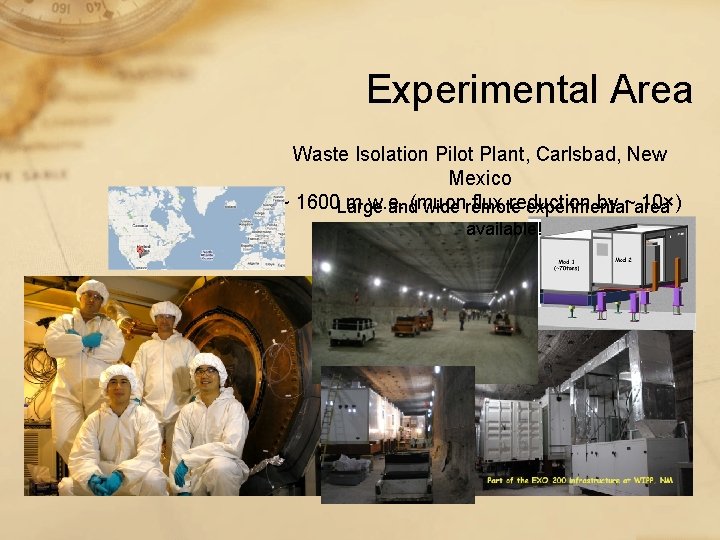
Experimental Area Waste Isolation Pilot Plant, Carlsbad, New Mexico ~ 1600 Large m. w. e. flux reduction by ~area 10×) and(muon wide remote experimental available!
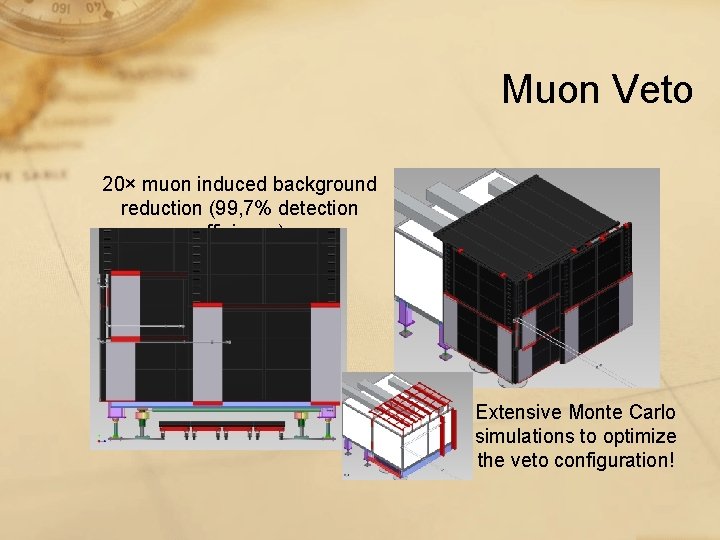
Muon Veto 20× muon induced background reduction (99, 7% detection efficiency) Extensive Monte Carlo simulations to optimize the veto configuration!
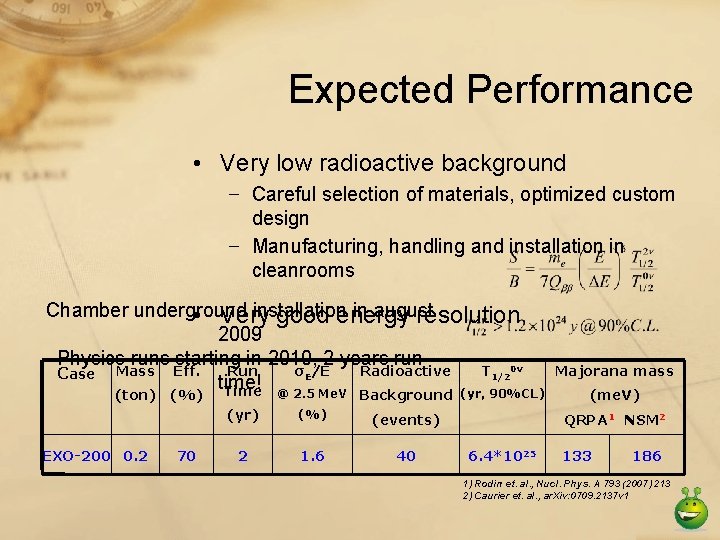
Expected Performance • Very low radioactive background − Careful selection of materials, optimized custom design − Manufacturing, handling and installation in cleanrooms Chamber underground installation in august • Very good energy resolution 2009 Physics runs starting in 2010, 2 years run Run σE/E Radioactive T 1/20ν Case Mass Eff. time! Time @ 2. 5 Me. V (yr, 90%CL) (ton) EXO-200 0. 2 (%) 70 Majorana mass Background (me. V) QRPA 1 NSM 2 (yr) (%) (events) 2 1. 6 40 6. 4*1025 133 186 1) Rodin et. al. , Nucl. Phys. A 793 (2007) 213 2) Caurier et. al. , ar. Xiv: 0709. 2137 v 1
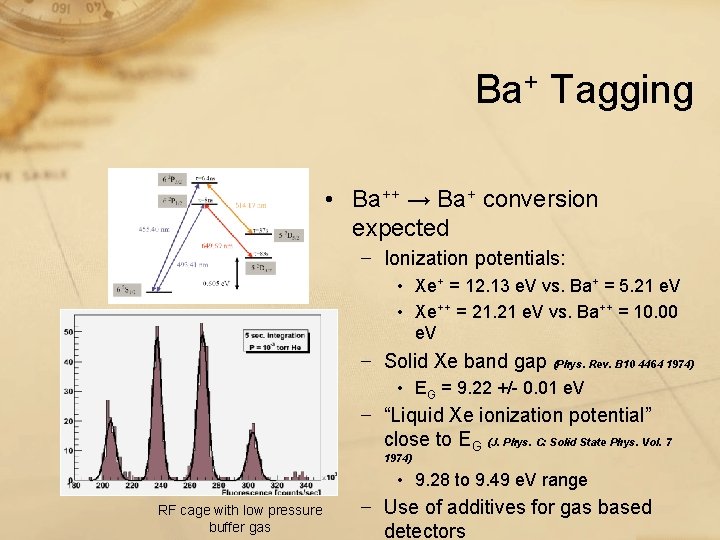
Ba+ Tagging • Ba++ → Ba+ conversion expected − Ionization potentials: • Xe+ = 12. 13 e. V vs. Ba+ = 5. 21 e. V • Xe++ = 21. 21 e. V vs. Ba++ = 10. 00 e. V − Solid Xe band gap (Phys. Rev. B 10 4464 1974) • EG = 9. 22 +/- 0. 01 e. V − “Liquid Xe ionization potential” close to EG (J. Phys. C: Solid State Phys. Vol. 7 1974) • 9. 28 to 9. 49 e. V range RF cage with low pressure buffer gas − Use of additives for gas based detectors
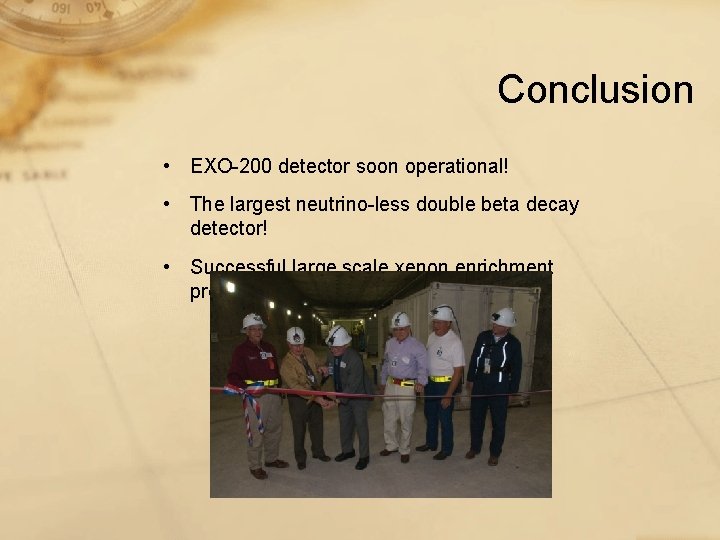
Conclusion • EXO-200 detector soon operational! • The largest neutrino-less double beta decay detector! • Successful large scale xenon enrichment proven!