
Compounds of p block elements Semester 6 B
Compounds of p- block elements �Semester 6 �B. Sc Chemistry �Jofrin J �Assistant Professor of Chemistry �T. M. Jacob Memorial Government College, Manimalakunnu
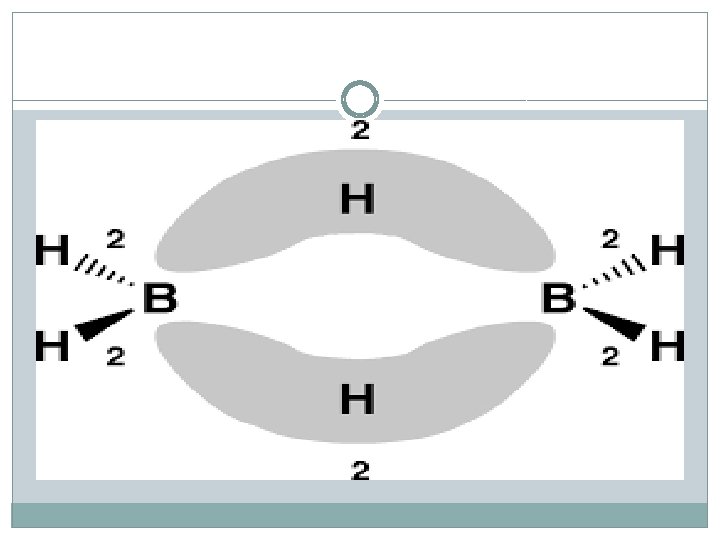
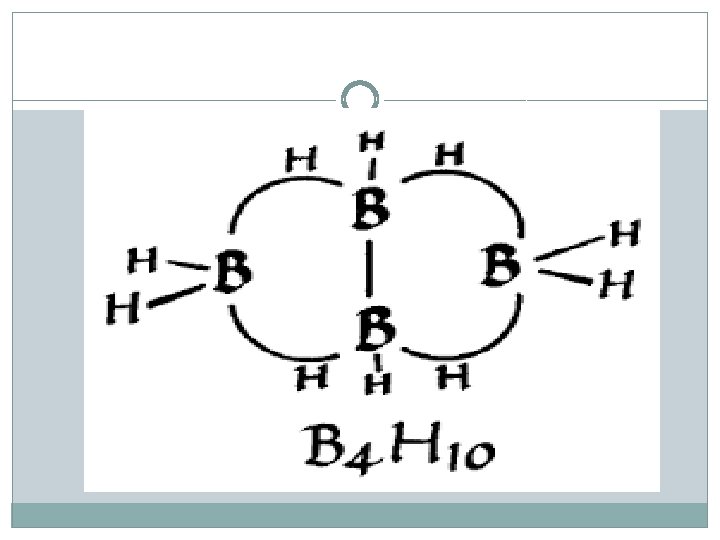
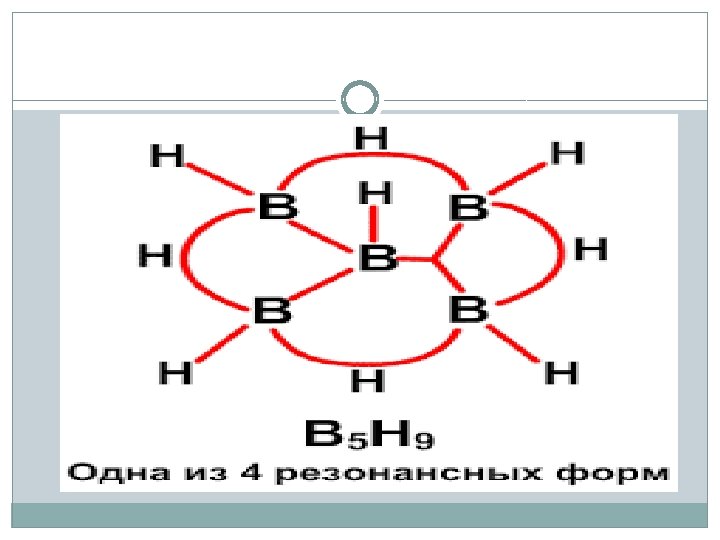
Bonding in diborane �Diborane is an electron deficient compound ie, enough number of electrons are not available to form the expected number of covalent bonds. �Electron diffraction studies reveals that B 2 H 6 contains 2 Boron atoms and four hydrogen atoms (ie, two BH 2 groups) lying in the same plane. Out of the two remaining hydrogen atoms , one lie above and the other below this plane and links the two BH 2 groups.
�Each B atom in Diborane is sp 3 hybridized. Three of the hybrid orbital contains 1 electron each and one hybrid in each Boron atom is empty. Two hybrid orbital on each B atom bonds with 1 s orbital of two hydrogen atoms to form BH 2 group. The third hybrid orbital which contain the electron, overlap with 1 s orbital of one hydrogen atom and also with the empty hybrid orbital of the second B atom. Thus one pair of electrons covers 3 atoms and so form a 3 centre-2 electron B-H-B bond. In the same manner a second B-H-B bond is formed. Such a 3 centr-2 -electron bond has a banana shape. So in diborane there are two such banana bonds. One B-H-B banana bond is lying above the plane and the other lying below the plane in which the two BH 2 group lies.
Borazine or Borazole �Borazine is frequently referred to as inorganic benzene. (The systematic name of Borazine is triborine triamine). It is isoelectronic with benzene and furthermore some of its physical properties show similarity with benzene. That is why it is called inorganic benzene
Preparation �By treatment of ammonia with diborane at low temperature yield an addition product which on heating at 200 degree Celsius gives borazine �B 2 H 6+2 NH 3 ----------- B 2 H 6. 2 NH 3 --------- B 3 N 3 H 6 �Borazole can be prepared in the laboratory by heating a mixture of lithium boro hydride and ammonium chloride at 2300 C. � 3 NH 4 Cl+ 3 Li. BH 4 ------- B 3 N 3 H 6+9 H 2+3 Li. HCl
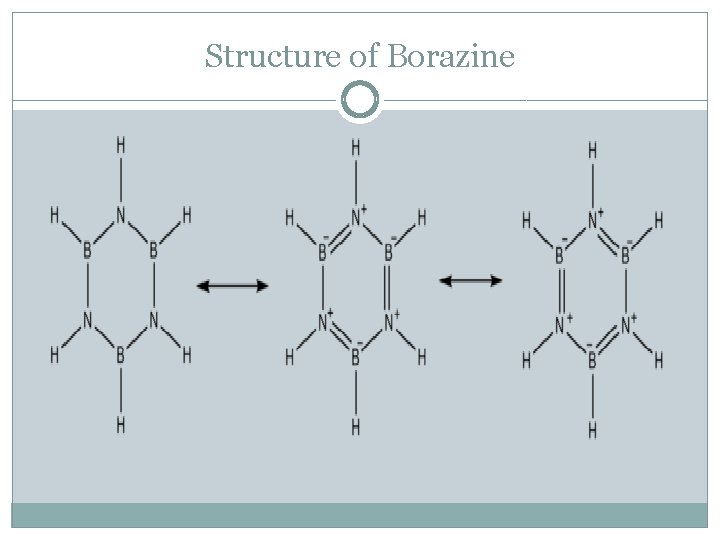
Structure of Borazine
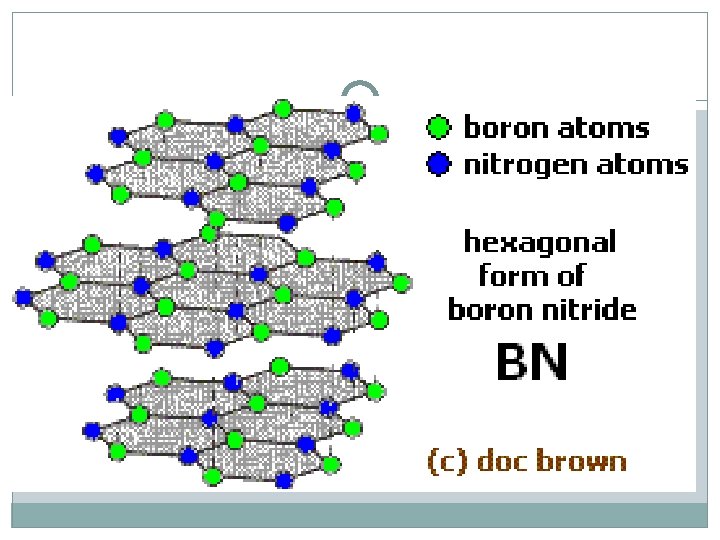
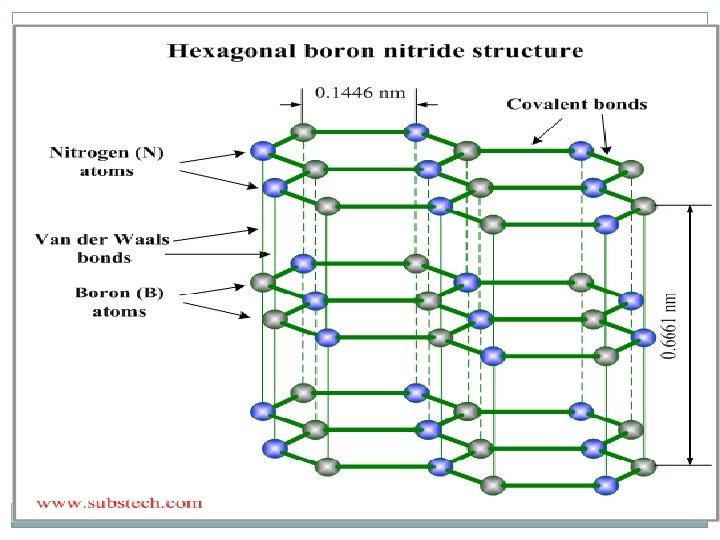
Boron Nitride �It is also called inorganic graphite. Preparation �From Boron: - it is formed by the combination of boron with nitrogen at white heat. 2 B+N 2 ------------ 2 BN �From Boron Oxide: - Boron oxide is heated with KCN, Hg(CN)2, or NH 4 Cl to get BN �From Boron amide or boron imide: - Boron amide or imide on heating gives boron nitride � 2 B(NH 2)3 ------------ 2 BN+4 NH 3, �B 2(NH)3 --------- 2 BN+NH 3
Properties �It is a white powder. It is as hard as diamond. It decomposes on heating in steam giving ammonia BN+3 H 2 O-------------- H 3 BO 3+NH 3 �When BN is heated above 15000 C at very high pressure gives borazone. Borazone is a hard variety of boron nitride.
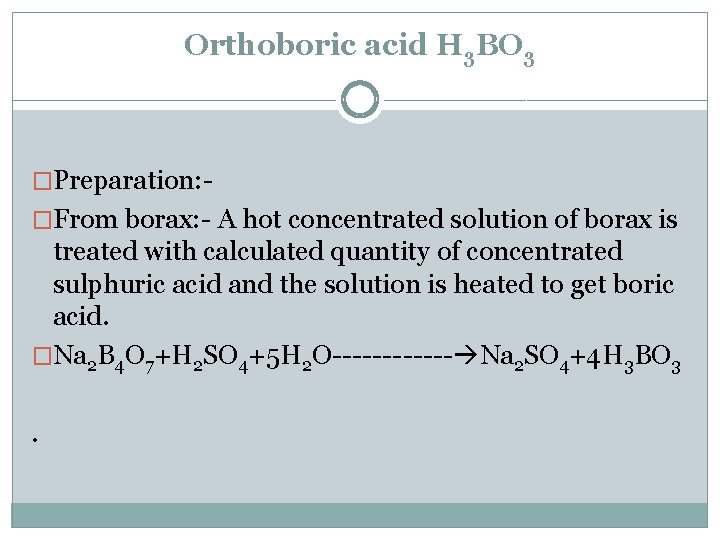
Orthoboric acid H 3 BO 3 �Preparation: �From borax: - A hot concentrated solution of borax is treated with calculated quantity of concentrated sulphuric acid and the solution is heated to get boric acid. �Na 2 B 4 O 7+H 2 SO 4+5 H 2 O------ Na 2 SO 4+4 H 3 BO 3.
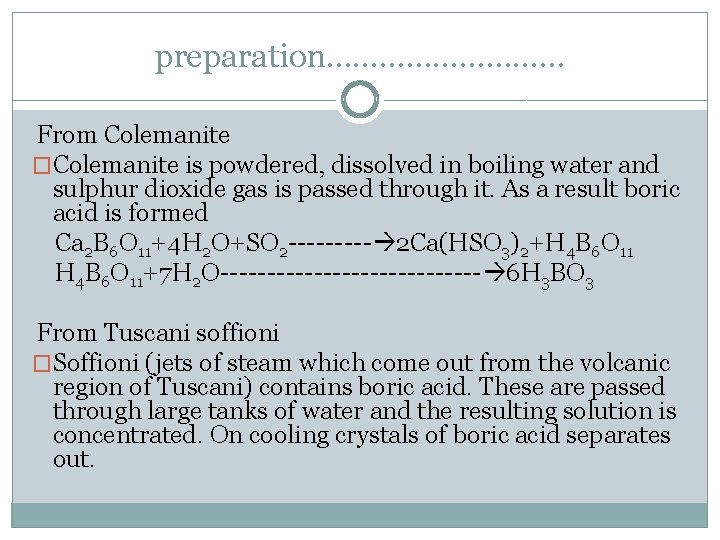
preparation…………… From Colemanite �Colemanite is powdered, dissolved in boiling water and sulphur dioxide gas is passed through it. As a result boric acid is formed Ca 2 B 6 O 11+4 H 2 O+SO 2 ----- 2 Ca(HSO 3)2+H 4 B 6 O 11+7 H 2 O-------------- 6 H 3 BO 3 From Tuscani soffioni �Soffioni (jets of steam which come out from the volcanic region of Tuscani) contains boric acid. These are passed through large tanks of water and the resulting solution is concentrated. On cooling crystals of boric acid separates out.
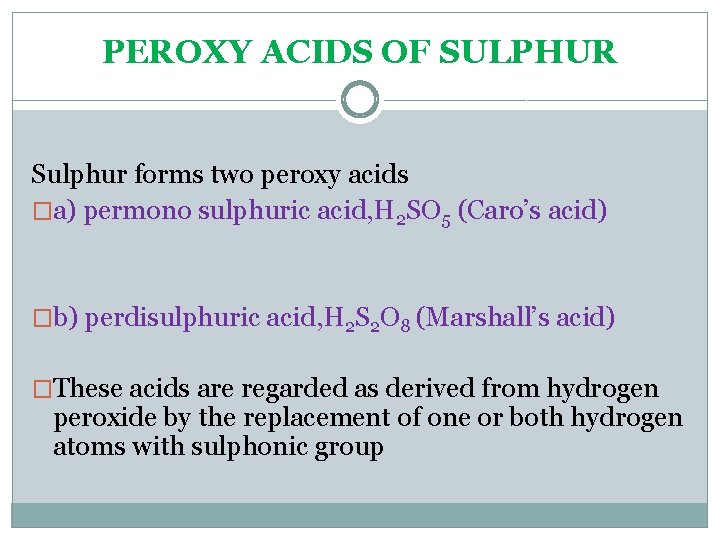
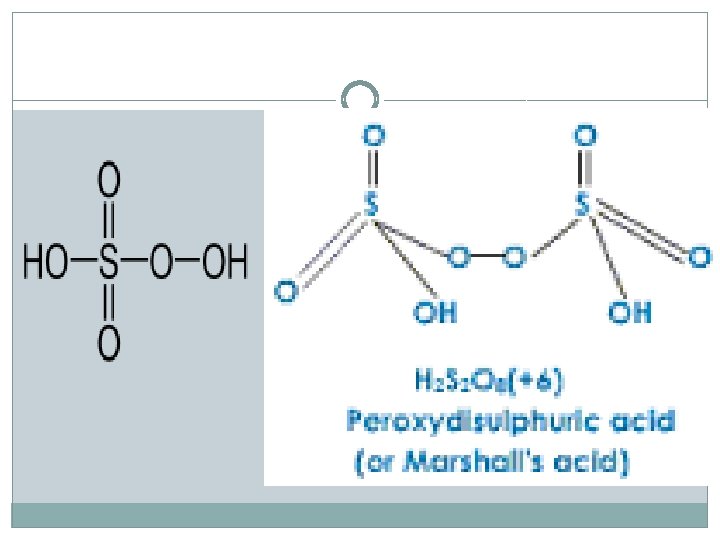
PEROXY ACIDS OF SULPHUR Sulphur forms two peroxy acids �a) permono sulphuric acid, H 2 SO 5 (Caro’s acid) �b) perdisulphuric acid, H 2 S 2 O 8 (Marshall’s acid) �These acids are regarded as derived from hydrogen peroxide by the replacement of one or both hydrogen atoms with sulphonic group
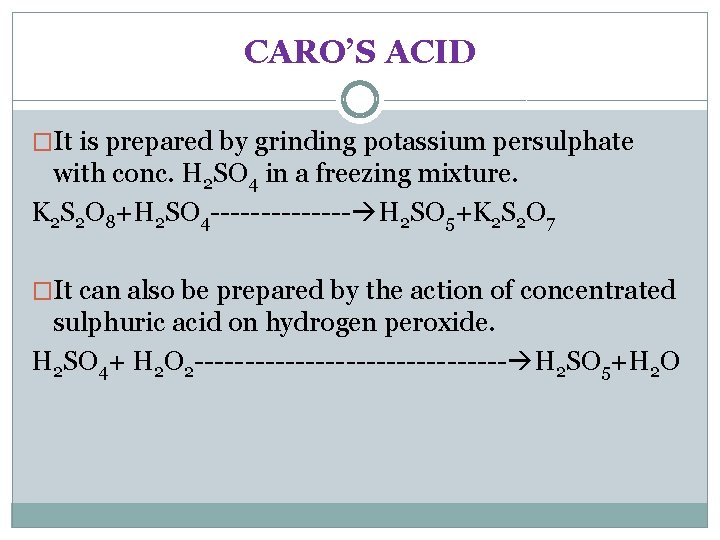
CARO’S ACID �It is prepared by grinding potassium persulphate with conc. H 2 SO 4 in a freezing mixture. K 2 S 2 O 8+H 2 SO 4 ------- H 2 SO 5+K 2 S 2 O 7 �It can also be prepared by the action of concentrated sulphuric acid on hydrogen peroxide. H 2 SO 4+ H 2 O 2 ---------------- H 2 SO 5+H 2 O
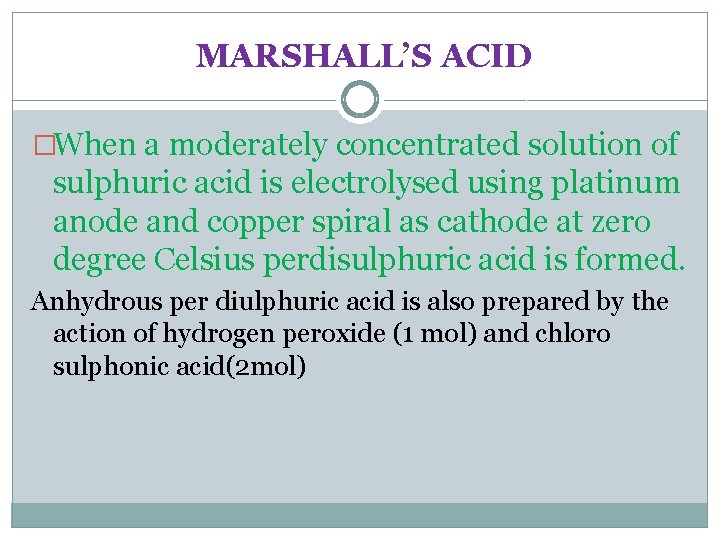
MARSHALL’S ACID �When a moderately concentrated solution of sulphuric acid is electrolysed using platinum anode and copper spiral as cathode at zero degree Celsius perdisulphuric acid is formed. Anhydrous per diulphuric acid is also prepared by the action of hydrogen peroxide (1 mol) and chloro sulphonic acid(2 mol)
Oxides of Halogens �Binary compounds of Oxygen and halogens are well known. �Fluorine forms two oxides, (OF 2 and O 2 F 2) but actually they are fluorides since the electronegativity of fluorine is greater than that of oxygen.
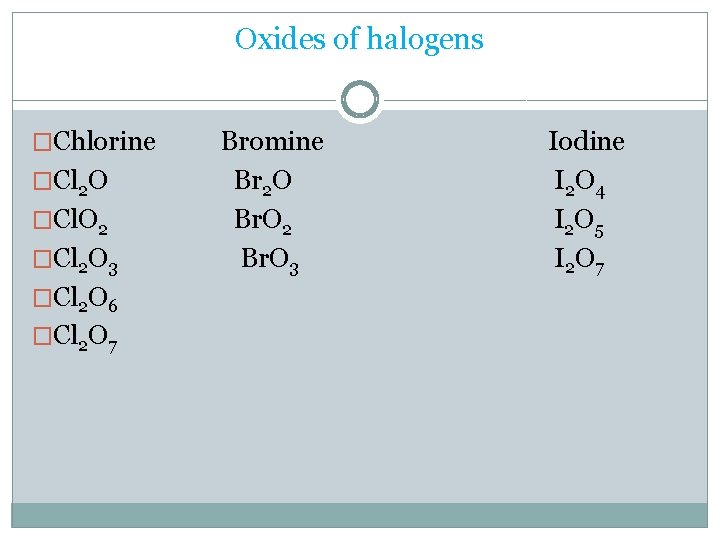
Oxides of halogens �Chlorine �Cl 2 O �Cl. O 2 �Cl 2 O 3 �Cl 2 O 6 �Cl 2 O 7 Bromine Br 2 O Br. O 2 Br. O 3 Iodine I 2 O 4 I 2 O 5 I 2 O 7
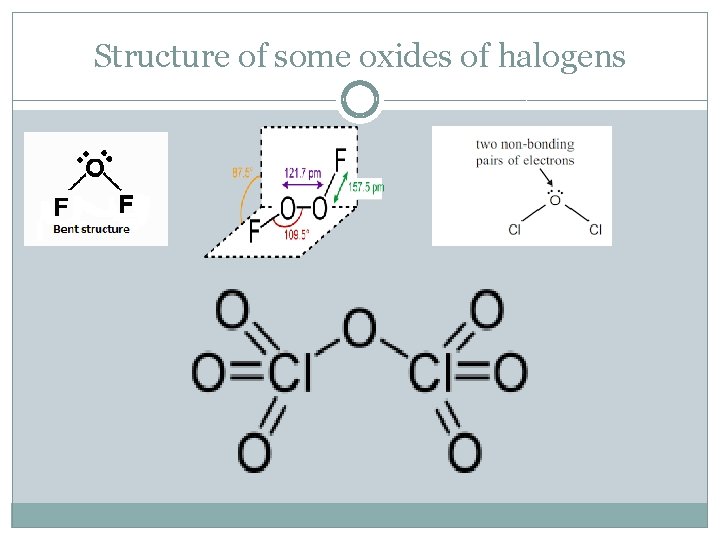
Structure of some oxides of halogens
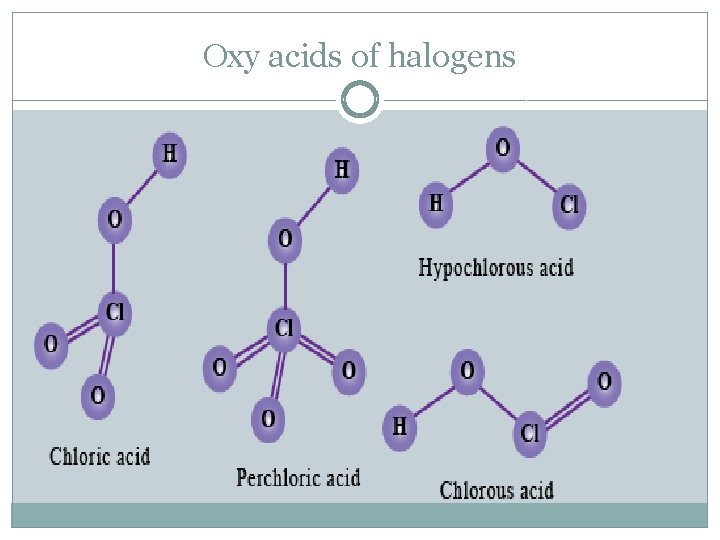
Oxy acids of halogens
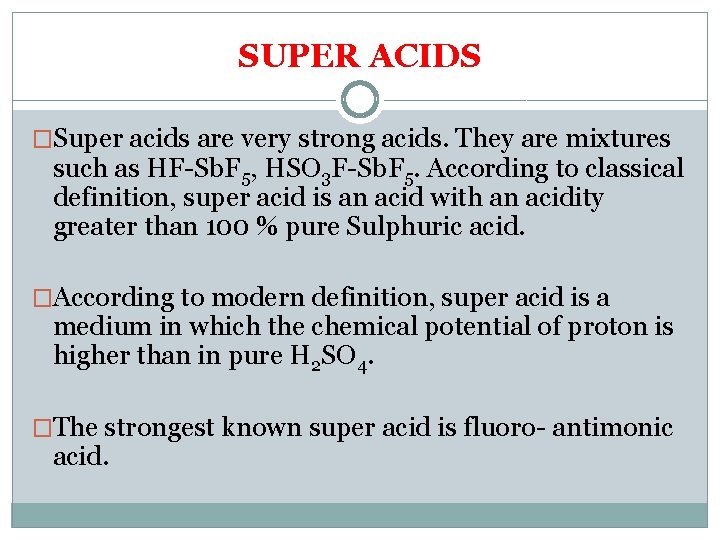
SUPER ACIDS �Super acids are very strong acids. They are mixtures such as HF-Sb. F 5, HSO 3 F-Sb. F 5. According to classical definition, super acid is an acid with an acidity greater than 100 % pure Sulphuric acid. �According to modern definition, super acid is a medium in which the chemical potential of proton is higher than in pure H 2 SO 4. �The strongest known super acid is fluoro- antimonic acid.

Interhalogen compounds �The binary compounds made by direct combination of halogens themselves under suitable conditions of temperature and pressure are called inter halogen compounds. �I. AX type Eg: Cl. F, Br. F, IF, Br. Cl, IBr �II. AX 3 type Eg: Cl. F 3, Br. F 3, ICl 3 �III. AX 5 type Eg: Cl. F 5, Br. F 5, IF 5 �IV. AX 7 type Eg: IF 7 �Among these IF, IF 3 and Cl. F 5 are unstable. So there are eleven inter-halogen compounds
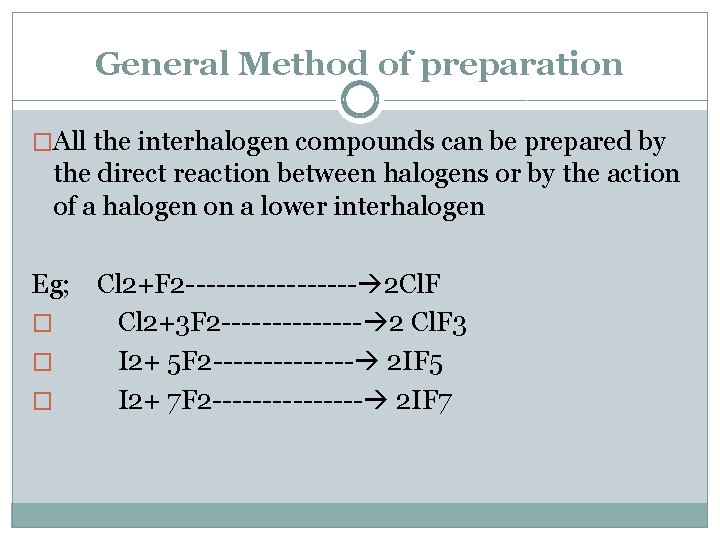
General Method of preparation �All the interhalogen compounds can be prepared by the direct reaction between halogens or by the action of a halogen on a lower interhalogen Eg; Cl 2+F 2 --------- 2 Cl. F � Cl 2+3 F 2 ------- 2 Cl. F 3 � I 2+ 5 F 2 ------- 2 IF 5 � I 2+ 7 F 2 -------- 2 IF 7
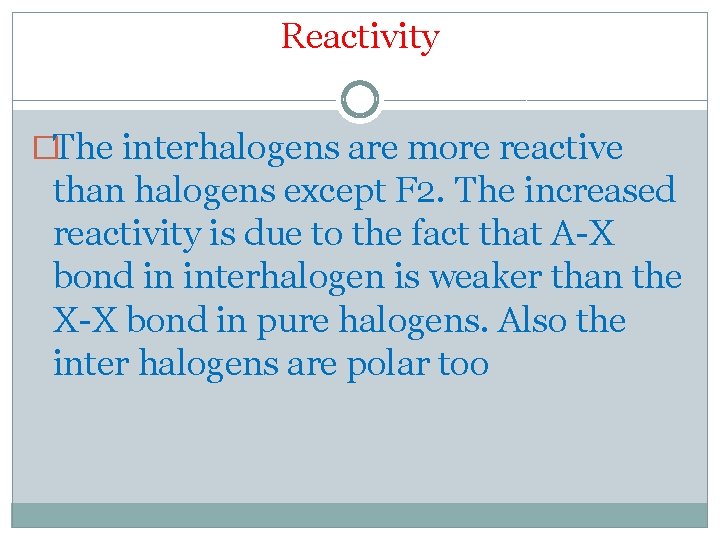
Reactivity �The interhalogens are more reactive than halogens except F 2. The increased reactivity is due to the fact that A-X bond in interhalogen is weaker than the X-X bond in pure halogens. Also the inter halogens are polar too
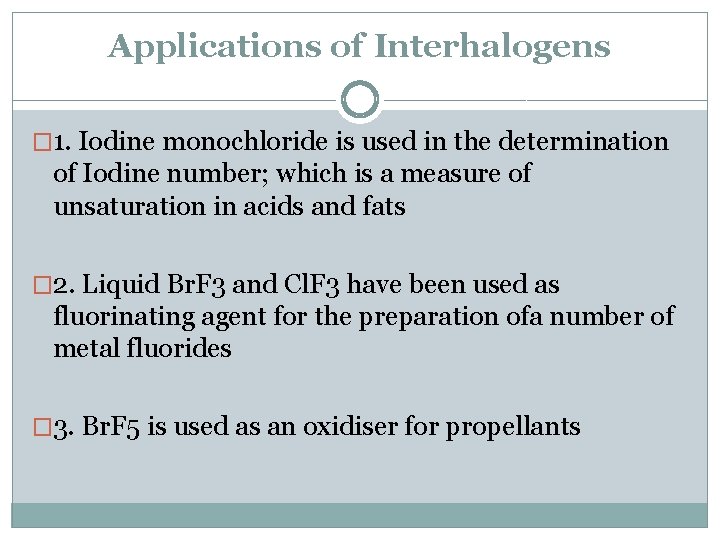
Applications of Interhalogens � 1. Iodine monochloride is used in the determination of Iodine number; which is a measure of unsaturation in acids and fats � 2. Liquid Br. F 3 and Cl. F 3 have been used as fluorinating agent for the preparation ofa number of metal fluorides � 3. Br. F 5 is used as an oxidiser for propellants
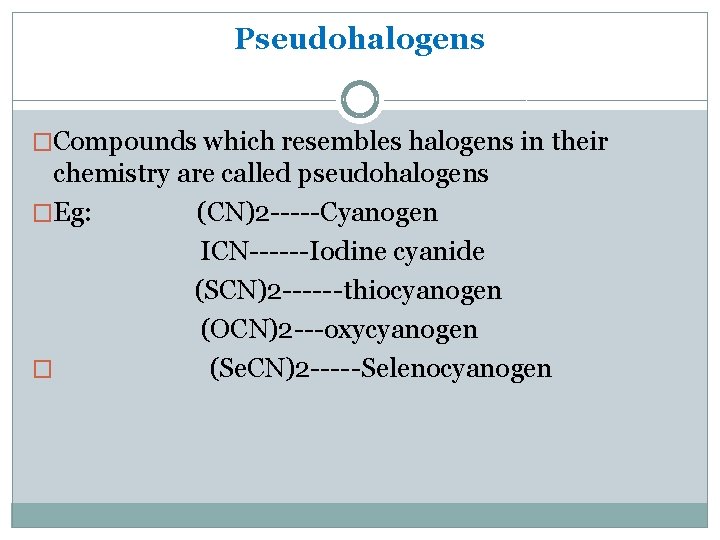
Pseudohalogens �Compounds which resembles halogens in their chemistry are called pseudohalogens �Eg: (CN)2 -----Cyanogen ICN------Iodine cyanide (SCN)2 ------thiocyanogen (OCN)2 ---oxycyanogen � (Se. CN)2 -----Selenocyanogen
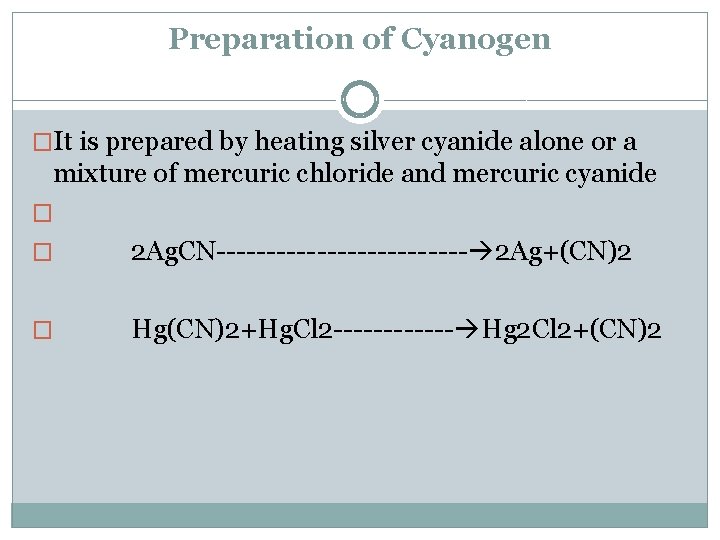
Preparation of Cyanogen �It is prepared by heating silver cyanide alone or a mixture of mercuric chloride and mercuric cyanide � � 2 Ag. CN------------- 2 Ag+(CN)2 � Hg(CN)2+Hg. Cl 2 ------ Hg 2 Cl 2+(CN)2
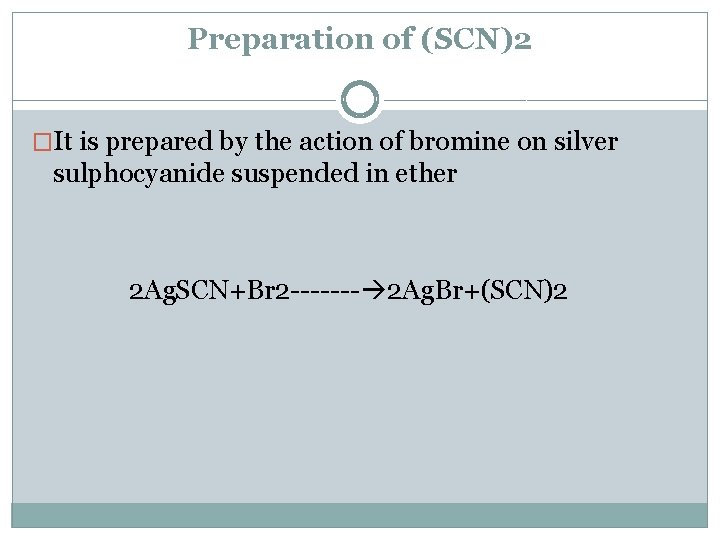
Preparation of (SCN)2 �It is prepared by the action of bromine on silver sulphocyanide suspended in ether 2 Ag. SCN+Br 2 ------- 2 Ag. Br+(SCN)2
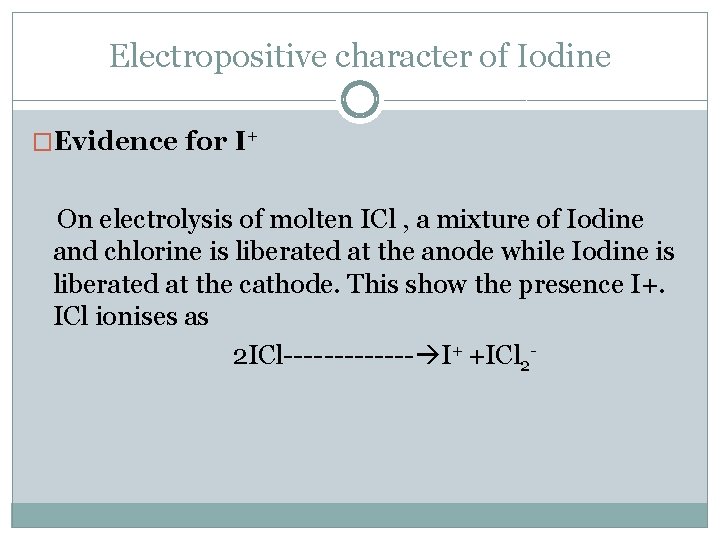
Electropositive character of Iodine �Evidence for I+ On electrolysis of molten ICl , a mixture of Iodine and chlorine is liberated at the anode while Iodine is liberated at the cathode. This show the presence I+. ICl ionises as 2 ICl------- I+ +ICl 2 -

Electropositive character of Iodine �Evidence for I 3+ �Molten ICl 3 conducts electricity. On electrolysis it gives a mixture of Iodine and chlorine at both the electrodes. This suggests the ionisation of ICl 3 as following. 2 ICl 3 ------- ICl 2++ICl 4 Evidently both ICl 2+ ICl 4 - contain I 3+.
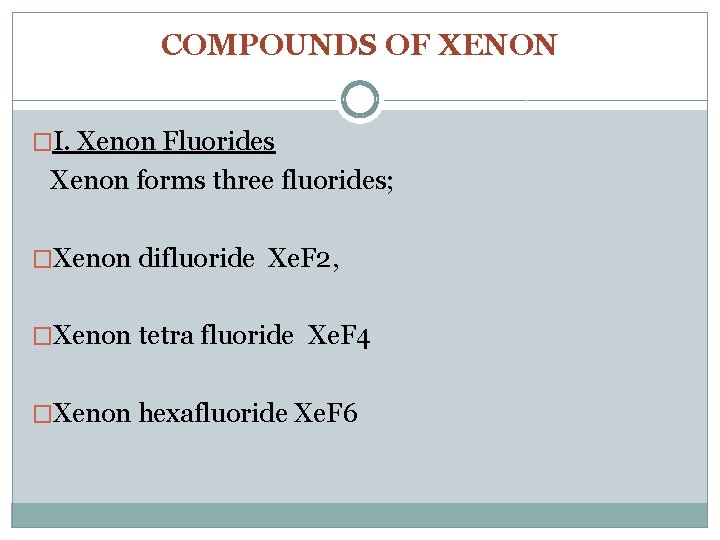
COMPOUNDS OF XENON �I. Xenon Fluorides Xenon forms three fluorides; �Xenon difluoride Xe. F 2, �Xenon tetra fluoride Xe. F 4 �Xenon hexafluoride Xe. F 6
Xenon difluoride, Xe. F 2 It is best prepared by heating Xenon and fluorine in the molar ratio 2: 1 Xe+F 2 -------- Xe. F 2 �Photochemical combination of Xe and F 2 in a pyrex glass vessel gives Xe. F 2.
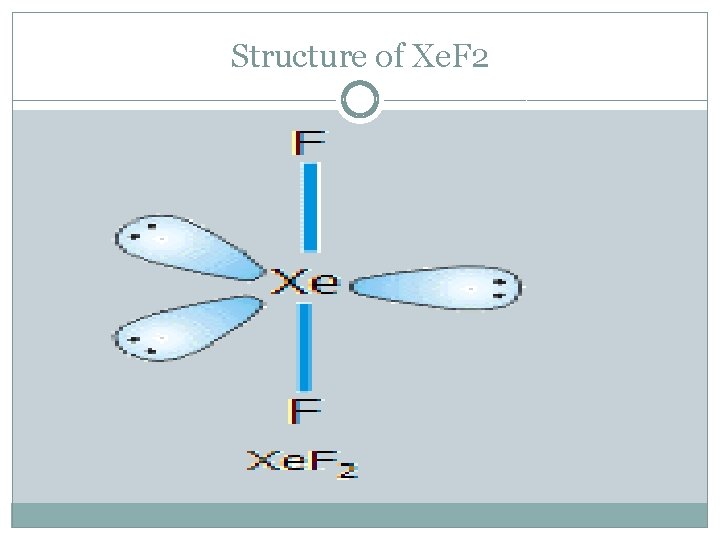
Structure of Xe. F 2 �The 5 sp 3 d hybrid orbitals are arranged in trigonal bipyramid with the three equatorial positions are occupied by lone pair of electrons. The F-Xe-F bond angle is 1800 and so the shape of the molecule is linear.
Structure of Xe. F 2
Xenon tetrafluoride, Xe. F 4 �It is prepared by heating a mixture of Xenon and fluorine in the molar ratio 1: 5 at 400 degree Celsius and 5 -6 atm. pressure in an enclosed nickel vessel. � Xe+2 F 2 ---------- Xe. F 4 In this reaction Xenon acts as a reducing agent because the oxidation number of Xe increases from 0 to 4
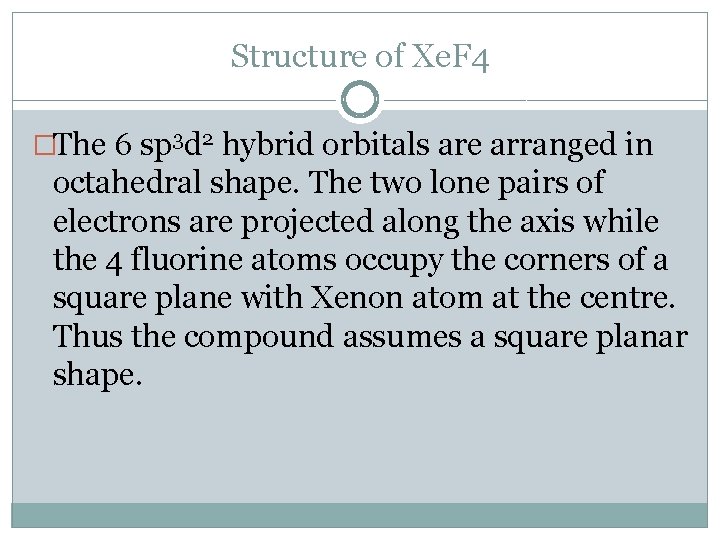
Structure of Xe. F 4 �The 6 sp 3 d 2 hybrid orbitals are arranged in octahedral shape. The two lone pairs of electrons are projected along the axis while the 4 fluorine atoms occupy the corners of a square plane with Xenon atom at the centre. Thus the compound assumes a square planar shape.
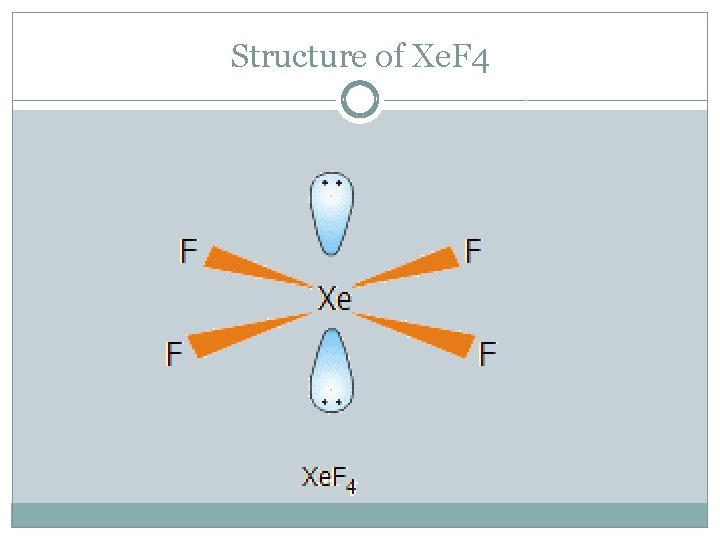
Structure of Xe. F 4
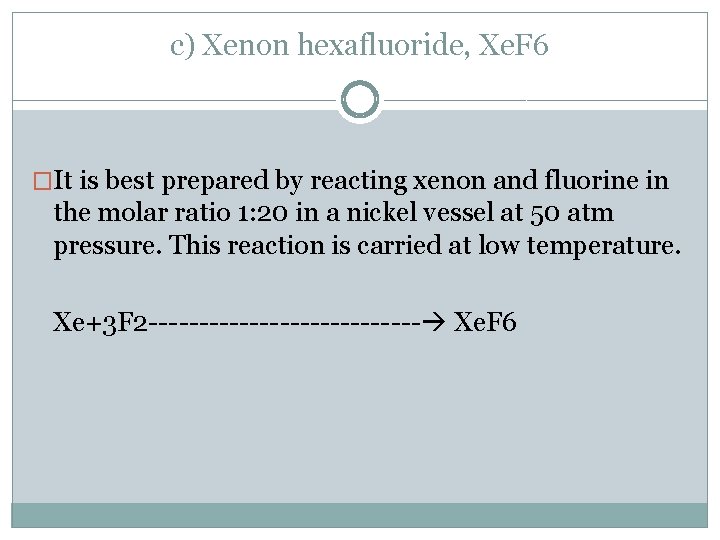
c) Xenon hexafluoride, Xe. F 6 �It is best prepared by reacting xenon and fluorine in the molar ratio 1: 20 in a nickel vessel at 50 atm pressure. This reaction is carried at low temperature. Xe+3 F 2 -------------- Xe. F 6
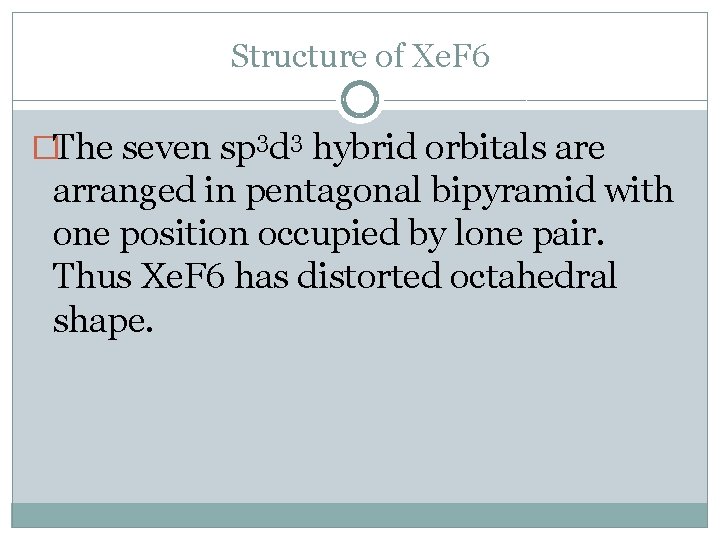
Structure of Xe. F 6 �The seven sp 3 d 3 hybrid orbitals are arranged in pentagonal bipyramid with one position occupied by lone pair. Thus Xe. F 6 has distorted octahedral shape.
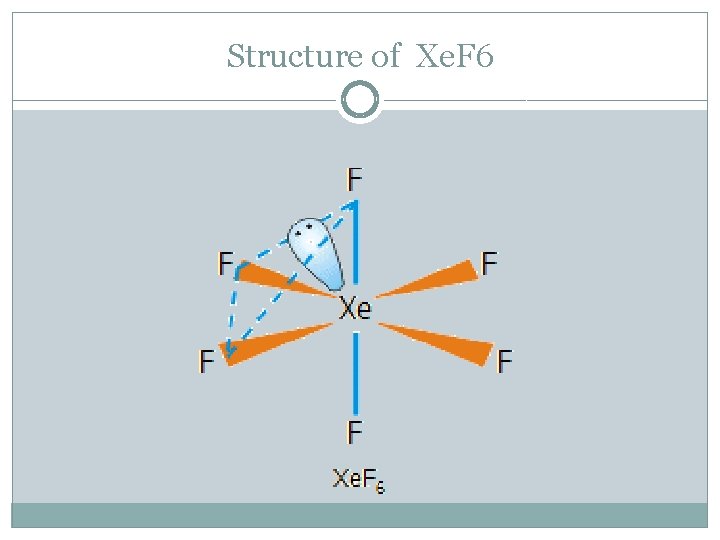
Structure of Xe. F 6
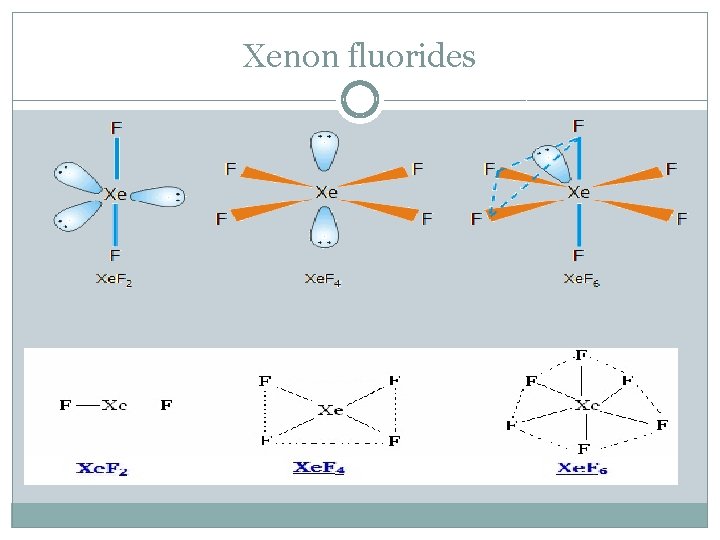
Xenon fluorides
II. Oxide of Xenon �a) Xenon trioxide, Xe. O 3 �It is prepared by the hydrolysis of Xe. F 6 or Xe. F 4. Great care should be taken as the preparation reaction is explosive. �Xe. F 6+3 H 2 O------------ Xe. O 3+6 HF
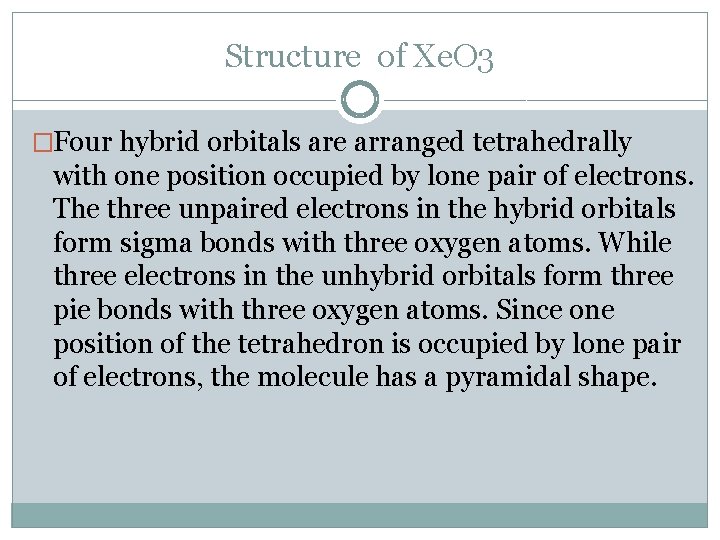
Structure of Xe. O 3 �Four hybrid orbitals are arranged tetrahedrally with one position occupied by lone pair of electrons. The three unpaired electrons in the hybrid orbitals form sigma bonds with three oxygen atoms. While three electrons in the unhybrid orbitals form three pie bonds with three oxygen atoms. Since one position of the tetrahedron is occupied by lone pair of electrons, the molecule has a pyramidal shape.
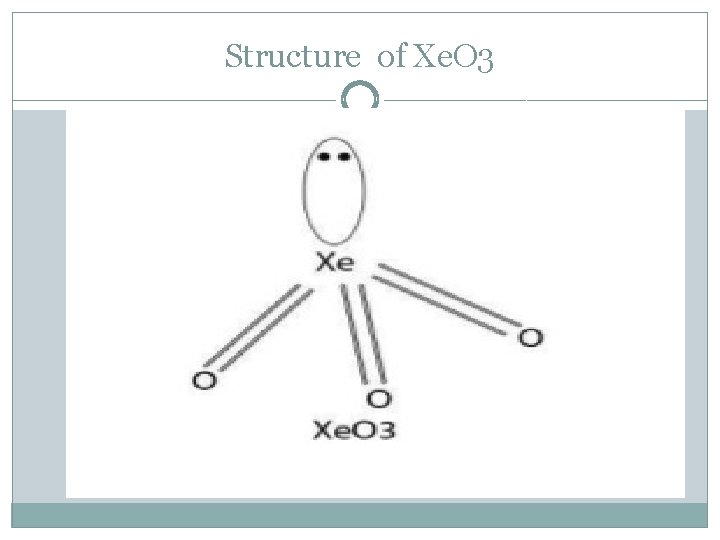
Structure of Xe. O 3

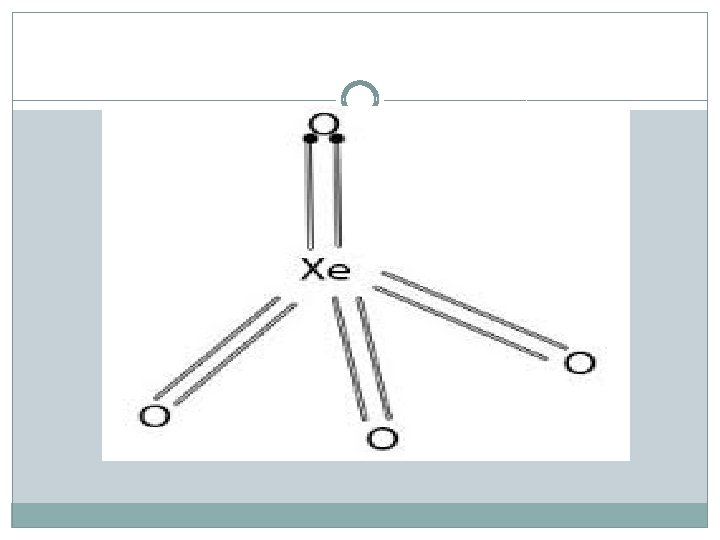
Structure of Xe. O 4 �Xenon atom is in sp 3 hybridization. Four hybrid orbitals are arranged tetrahedrally. Four unpaired electrons in the four hybrid orbitals form four sigma bonds with four oxygen atoms. While the electrons in the four unhybrid orbitals form four pi bonds with the four oxygen atoms. The shape of the molecule is tetrahedral.
III Xenon oxyfluorides �a) Xenon oxytetrafluoride, Xe. OF 4 �It is prepared by the controlled hydrolysis of Xe. F 6+H 2 O---------------- Xe. OF 4+2 HF
Structure of Xe. OF 4 �Xe atom undergoes sp 3 d 2 hybridization. Six hybrid orbitals are arranged in octahedral shape. The unpaired electrons in the unhybrid orbital are used to form pi bond with oxygen atom. The four unpaired electrons are used to form sigma bonds with fluorine atoms, while the fifth electron in the hybrid orbital used to form sigma bond with oxygen atom. The shape of the molecule is square pyramidal
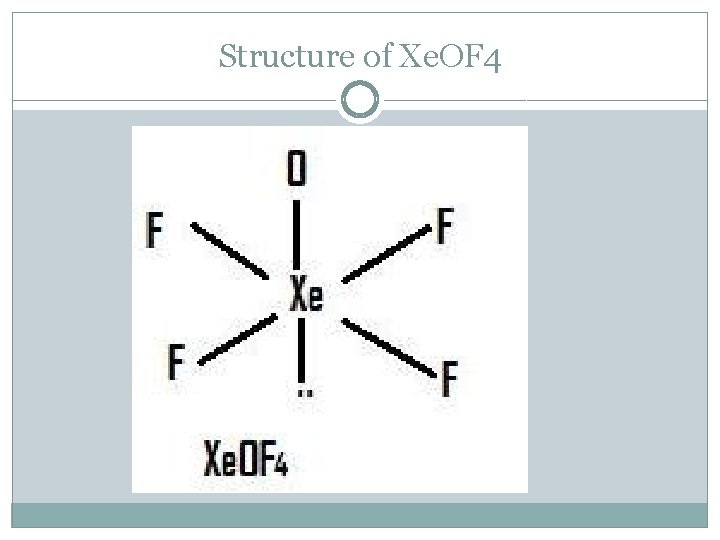
Structure of Xe. OF 4
b) Xenon dioxide difuoride, Xe. O 2 F 2 �It is prepared by mixing Xe. O 3 with Xe. OF 4 at -78 degree Celsius
Structure of Xe. O 2 F 2 �Xe atom undergo sp 3 d hybridization. Four electrons in the hybrid orbitals are used to form sigma bonds with oxygen and fluorine atoms. The two unpaired electrons in the unhybrid orbitals are used to form 2 pi bonds with two oxygen atoms. The molecule is having a see-saw shape.
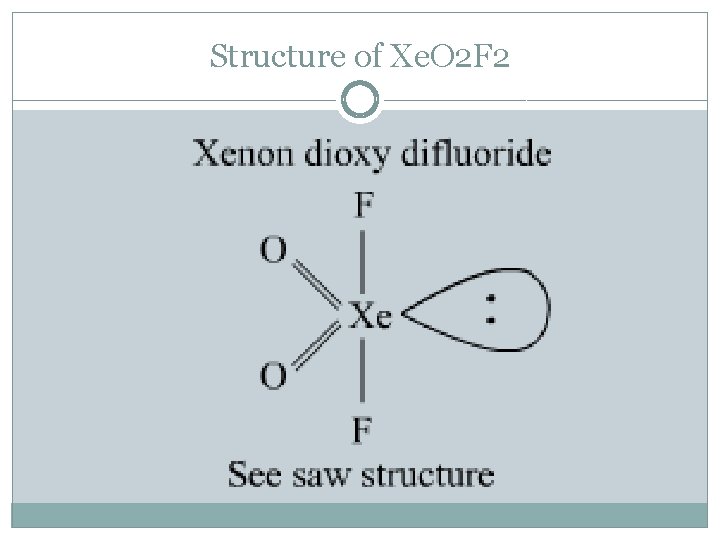
Structure of Xe. O 2 F 2
- Slides: 55