Quarks for Dummies TM Modeling e N Cross
















- Slides: 73
Quarks for Dummies TM * Modeling (e/ / �-N Cross Sections from Low to High Energies: from DIS to Resonance, to Quasielastic Scattering Modified LO PDFs, w scaling, Quarks and Duality Femilab Wine/Cheese Talk August 16, 2002 Arie Bodek, Univ. of Rochester Un-Ki Yang, University of Chicago * TM- (present company excepted) Arie Bodek, Univ. of Rochester 1
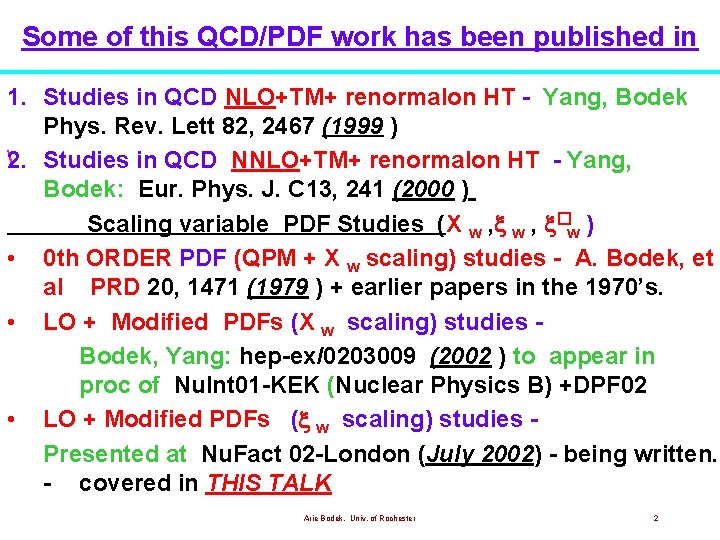
Some of this QCD/PDF work has been published in 1. Studies in QCD NLO+TM+ renormalon HT - Yang, Bodek Phys. Rev. Lett 82, 2467 (1999 ) 2. Studies in QCD NNLO+TM+ renormalon HT - Yang, Bodek: Eur. Phys. J. C 13, 241 (2000 ) Scaling variable PDF Studies (X w , � w ) • 0 th ORDER PDF (QPM + X w scaling) studies - A. Bodek, et al PRD 20, 1471 (1979 ) + earlier papers in the 1970’s. • LO + Modified PDFs (X w scaling) studies Bodek, Yang: hep-ex/0203009 (2002 ) to appear in proc of Nu. Int 01 -KEK (Nuclear Physics B) +DPF 02 • LO + Modified PDFs ( w scaling) studies Presented at Nu. Fact 02 -London (July 2002) - being written. - covered in THIS TALK Arie Bodek, Univ. of Rochester 2
Neutrino cross sections at low energy • • • Neutrino oscillation experiments (K 2 K, MINOS, CNGS, Mini. Boo. NE, and future experiments with Superbeams at JHF, NUMI, CERN) are in the few Ge. V region Important to correctly model neutrino-nucleon and neutrino-nucleus reactions at 0. 5 to 4 Ge. V (essential for precise next generation neutrino oscillation experiments with super neutrino beams ) as well as at the 15 -30 Ge. V (for future factories) - Nu. Int, Nufac The very high energy region in neutrino-nucleon scatterings (50 -300 Ge. V) is well understood at the few percent level in terms QCD and Parton Distributions Functions (PDFs) within the framework of the quark-parton model (data from a series of e/ / DIS experiments) However, neutrino differential cross sections and final states in the few Ge. V region are poorly understood. ( especially, resonance and low Q 2 DIS contributions). In contrast, there is enormous amount of e-N data from SLAC and Jlab in this region. Intellectually - Understanding Low Energy neutrino and electron scattering Processes is also a very way to understand quarks and QCD. - common ground between the QCD community and the weak interaction community, and between medium and HEP physicists. Arie Bodek, Univ. of Rochester 3
The Importance of Precision Measurement of the Oscillation Probability P( -> e) with Neutrino Superbeams • Conventional “superbeams” (e. g. NUMI) will be our only windows into this suppressed transition – Analogous to |Vub| in quark sector – ( Next steps: sources or “b beams” too far away) • Studying P( -> e) in neutrinos and antineutrinos gives us magnitude and phase information on |Ue 3| Arie Bodek, Univ. of Rochester Sign of dm 23 d |Ue 3| 4
Examples of Current Low Energy Neutrino Data: Quasi-elastic cross section tot/E Arie Bodek, Univ. of Rochester 5
Examples of Low Energy Neutrino Data: Total (inelastic and quasielastic) cross section E Ge. V Arie Bodek, Univ. of Rochester 6
Examples of Current Low Energy Neutrino Data: Single charged and neutral pion production Old bubble chamber language Arie Bodek, Univ. of Rochester 7
Bubble lang. - Exclusive final states Resonance lang. - Excit. Form factors DIS lang. - PDFs and fragmentation Arie Bodek, Univ. of Rochester 8
Note: 2 nd conf. Nu. Int 02 to Be held at UC Irvine Dec 12 -15, 2002 Needed even for the Low statistics at K 2 K Bring people of All languages And nuclear and Particle physicists Together. Arie Bodek, Univ. of Rochester 9
What do we want to know about low energy neutrino reactions and why- 1 Reasons • Intellectual Reasons: • Understand how QCD works in both neutrino and electron scattering at low energies different spectator quark effects. (There are fascinating issues here as we will show) • How is fragmentation into final state hadrons affected by nuclear effects in electron versus neutrino reactions. • Of interest to : Nuclear Physics/Medium Energy, QCD/ Jlab communities • Practical Reasons: • Determining the neutrino sector mass and mixing matrix precisely • --> requires knowledge of both Neutral Current (NC) and Charged Current(CC) differential Cross Sections and Final States • -->These are needed for the NUCLEAR TARGET from which the Neutrino Detector is constructed (e. g Water, Carbon, Iron). • Particle Physics/ HEP/ FNAL /KEK/ Neutrino communities Arie Bodek, Univ. of Rochester 10
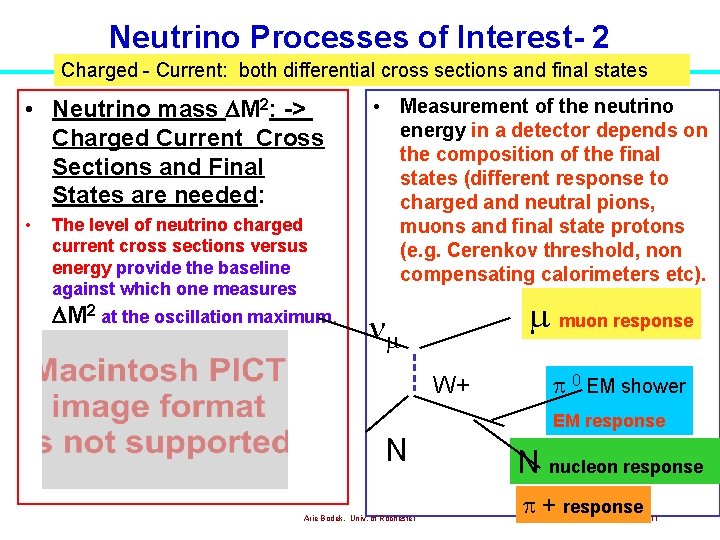
Neutrino Processes of Interest- 2 Charged - Current: both differential cross sections and final states • Neutrino mass M 2: -> Charged Current Cross Sections and Final States are needed: • The level of neutrino charged current cross sections versus energy provide the baseline against which one measures M 2 at the oscillation maximum. • Measurement of the neutrino energy in a detector depends on the composition of the final states (different response to charged and neutral pions, muons and final state protons (e. g. Cerenkov threshold, non compensating calorimeters etc). muon response W+ 0 EM shower EM response N Arie Bodek, Univ. of Rochester N nucleon response + response 11
Neutrino Processes of Interest- 3 Neutral - Current both differential cross sections and final states • SIGNAL e transition • ~ 0. 1% oscillations probability of e. e- e W+ P N • Electrons from Misidentified in NC events without a muon from higher energy neutrinos are a background Z 0 Z N N SIGNAL • N EM shower • Backgrounds: Neutral Current Cross Sections and Final State Composition are needed: + N 0 EM shower FAKE electron background Arie Bodek, Univ. of Rochester 12
How are PDFs Extracted from global fits to High Q 2 Note: additional information on Antiquarks Deep Inelastic e/ / Data from Drell-Yan and on MRSR 2 PDFs Gluons from p-pbar jets also used. At high x, deuteron binding effects introduce an uncertainty in the d distribution extracted from F 2 d data (but not from the W asymmetry data). Arie Bodek, Univ. of Rochester 13
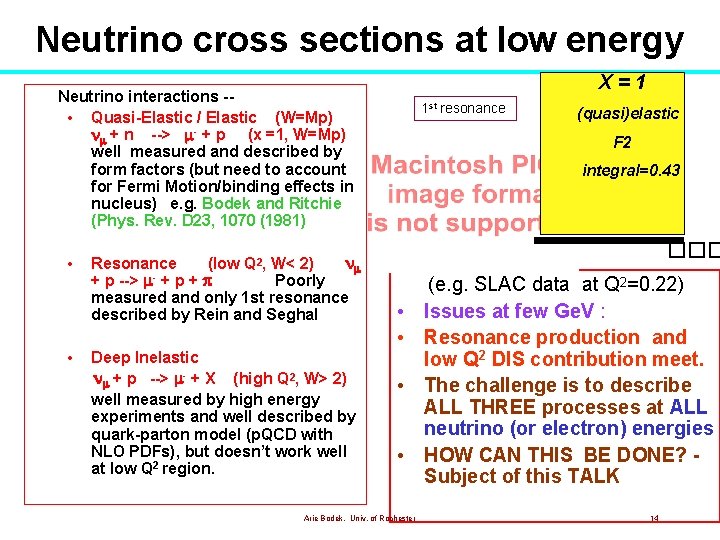
Neutrino cross sections at low energy Neutrino interactions - • Quasi-Elastic / Elastic (W=Mp) + n --> - + p (x =1, W=Mp) well measured and described by form factors (but need to account for Fermi Motion/binding effects in nucleus) e. g. Bodek and Ritchie (Phys. Rev. D 23, 1070 (1981) • • Resonance (low Q 2, W< 2) + p --> + p + Poorly measured and only 1 st resonance described by Rein and Seghal Deep Inelastic + p --> - + X (high Q 2, W> 2) well measured by high energy experiments and well described by quark-parton model (p. QCD with NLO PDFs), but doesn’t work well at low Q 2 region. X=1 1 st resonance GRV 94 LO (quasi)elastic F 2 integral=0. 43 ��� • • Arie Bodek, Univ. of Rochester (e. g. SLAC data at Q 2=0. 22) Issues at few Ge. V : Resonance production and low Q 2 DIS contribution meet. The challenge is to describe ALL THREE processes at ALL neutrino (or electron) energies HOW CAN THIS BE DONE? Subject of this TALK 14
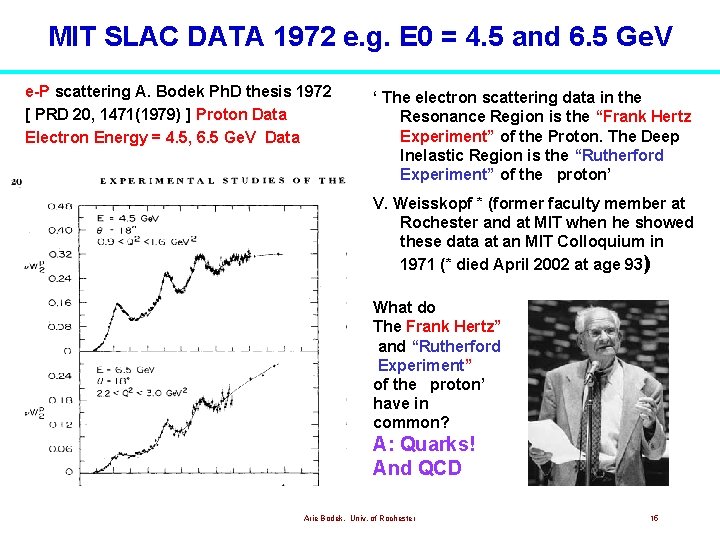
MIT SLAC DATA 1972 e. g. E 0 = 4. 5 and 6. 5 Ge. V e-P scattering A. Bodek Ph. D thesis 1972 [ PRD 20, 1471(1979) ] Proton Data Electron Energy = 4. 5, 6. 5 Ge. V Data ‘ The electron scattering data in the Resonance Region is the “Frank Hertz Experiment” of the Proton. The Deep Inelastic Region is the “Rutherford Experiment” of the proton’ V. Weisskopf * (former faculty member at Rochester and at MIT when he showed these data at an MIT Colloquium in 1971 (* died April 2002 at age 93) What do The Frank Hertz” and “Rutherford Experiment” of the proton’ have in common? A: Quarks! And QCD Arie Bodek, Univ. of Rochester 15
Building up a model for all Q 2. • Can we build up a model to describe all Q 2 region from high down to very low energies ? [resonance, DIS, even photo production] • Advantage if we describe it in terms of the quark-parton model. o then it is straightforward to convert charged-lepton scattering cross sections into neutrino cross section. (just matter of different couplings) o o Final state hadrons implemented in terms of fragmentation functions. Nuclear dependence of PDFs and fragmentation functions can be included. Challenges • Understanding of high x PDFs at very low Q 2? • There is a of wealth SLAC, JLAB data, but it requires understanding of non-perturbative QCD effects. • Need better understanding of resonance scattering in terms of the quark-parton model? (duality works, many studies by JLAB) • • Need to satisfy photoproduction limits at Q 2=0. At high Q 2 should agree with QCD PDFs and sum rules Should have theoretical basis If one knows where the road begins (high Q 2 PDFs) and ends (Q 2=0 photoproduction), it is easier to build it. Arie Bodek, Univ. of Rochester 16
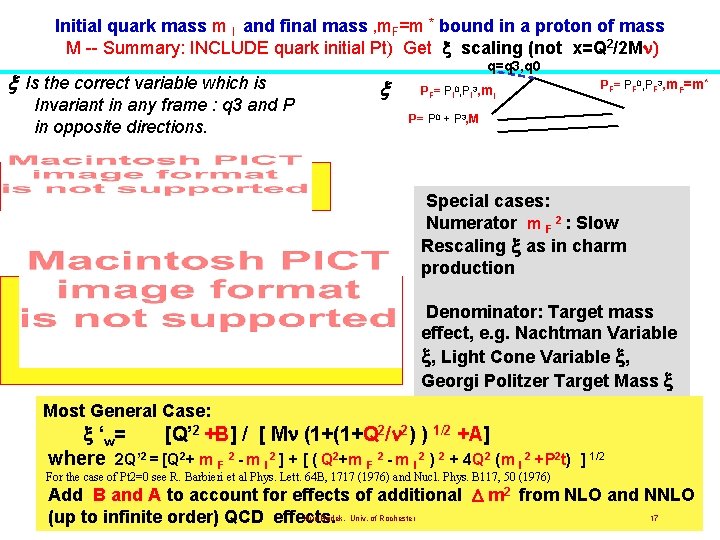
Initial quark mass m I and final mass , m. F=m * bound in a proton of mass M -- Summary: INCLUDE quark initial Pt) Get scaling (not x=Q 2/2 M x Is the correct variable which is Invariant in any frame : q 3 and P in opposite directions. q=q 3, q 0 x PF= PF 0, PF 3, m. F=m* PF= PI 0, PI 3, m. I P= P 0 + P 3, M Special cases: Numerator m F 2 : Slow Rescaling as in charm production Denominator: Target mass effect, e. g. Nachtman Variable , Light Cone Variable , Georgi Politzer Target Mass Most General Case: ‘w= [Q’ 2 +B] / [ M (1+(1+Q 2/ 2) ) 1/2 +A] where 2 Q’ 2 = [Q 2+ m F 2 - m I 2 ] + [ ( Q 2+m F 2 - m I 2 ) 2 + 4 Q 2 (m I 2 +P 2 t) For the case of Pt 2=0 see R. Barbieri et al Phys. Lett. 64 B, 1717 (1976) and Nucl. Phys. B 117, 50 (1976) Add B and A to account for effects of additional m 2 from Arie Bodek, Univ. of Rochester (up to infinite order) QCD effects. ] 1/2 NLO and NNLO 17
Initial quark mass m I and final mass , m. F=m * bound in a proton of mass M -- Page 1 INCLUDE quark initial Pt) Get scaling (not x=Q 2/2 M DETAILS x Is the correct variable which is Invariant in any frame : q 3 and P in opposite directions. q=q 3, q 0 x PF= PI 0, PI 3, m. I PF= PF 0, PF 3, m. F=m* P= P 0 + P 3, M Arie Bodek, Univ. of Rochester 18
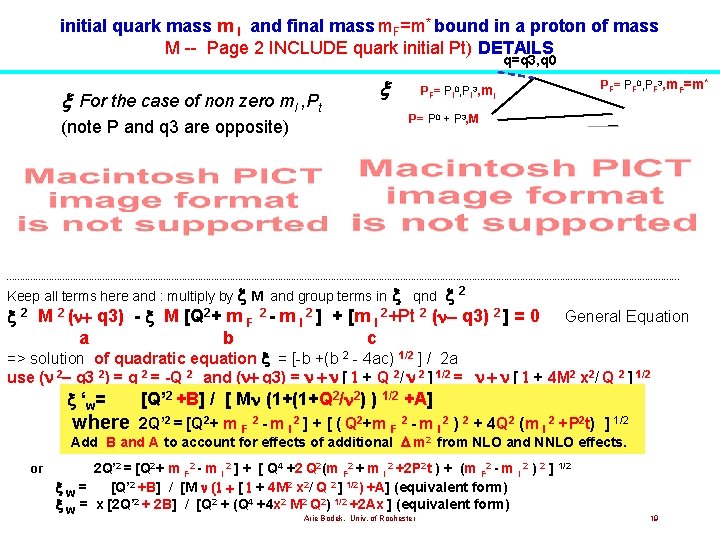
initial quark mass m I and final mass m. F=m* bound in a proton of mass M -- Page 2 INCLUDE quark initial Pt) DETAILS q=q 3, q 0 x For the case of non zero m. I , Pt x (note P and q 3 are opposite) PF= PF 0, PF 3, m. F=m* PF= PI 0, PI 3, m. I P= P 0 + P 3, M ------------------------------------------------------------------------------------------------------------------------------- Keep all terms here and : multiply by M and group terms in 2 qnd 2 M 2 ( + q 3) - M [Q 2+ m F 2 - m I 2 ] + [m I 2+Pt 2 ( q 3) 2 ] = 0 a b c General Equation => solution of quadratic equation = [-b +(b 2 - 4 ac) 1/2 ] / 2 a use ( 2 q 3 2) = q 2 = -Q 2 and ( + q 3) = + [ 1 + Q 2/ 2 ] 1/2 = + [ 1 + 4 M 2 x 2/ Q 2 ] 1/2 ‘ w= where [Q’ 2 +B] / [ M (1+(1+Q 2/ 2) ) 1/2 +A] 2 Q’ 2 = [Q 2+ m F 2 - m I 2 ] + [ ( Q 2+m F 2 - m I 2 ) 2 + 4 Q 2 (m I 2 +P 2 t) ] 1/2 Add B and A to account for effects of additional m 2 from NLO and NNLO effects. 2 Q’ 2 = [Q 2+ m F 2 - m I 2 ] + [ Q 4 +2 Q 2(m F 2 + m I 2 +2 P 2 t ) + (m F 2 - m I 2 ) 2 ] 1/2 w = [Q’ 2 +B] / [M 1 + [ 1 + 4 M 2 x 2/ Q 2 ] 1/2) +A] (equivalent form) w = x [2 Q’ 2 + 2 B] / [Q 2 + (Q 4 +4 x 2 M 2 Q 2) 1/2 +2 Ax ] (equivalent form) or Arie Bodek, Univ. of Rochester 19
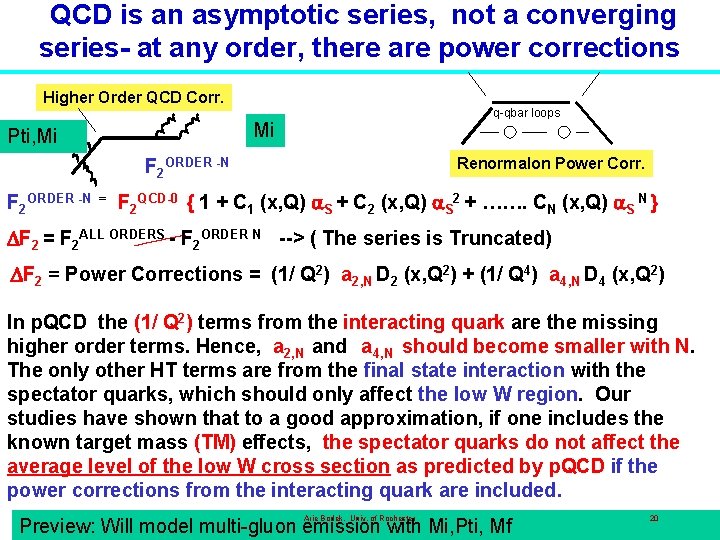
QCD is an asymptotic series, not a converging series- at any order, there are power corrections Higher Order QCD Corr. q-qbar loops Mi Pti, Mi Renormalon Power Corr. F 2 ORDER -N = F 2 QCD-0 { 1 + C 1 (x, Q) S + C 2 (x, Q) S 2 + ……. CN (x, Q) S N } F 2 = F 2 ALL ORDERS - F 2 ORDER N --> ( The series is Truncated) F 2 = Power Corrections = (1/ Q 2) a 2, N D 2 (x, Q 2) + (1/ Q 4) a 4, N D 4 (x, Q 2) In p. QCD the (1/ Q 2) terms from the interacting quark are the missing higher order terms. Hence, a 2, N and a 4, N should become smaller with N. The only other HT terms are from the final state interaction with the spectator quarks, which should only affect the low W region. Our studies have shown that to a good approximation, if one includes the known target mass (TM) effects, the spectator quarks do not affect the average level of the low W cross section as predicted by p. QCD if the power corrections from the interacting quark are included. Arie Bodek, Univ. of Rochester Preview: Will model multi-gluon emission with Mi, Pti, Mf 20
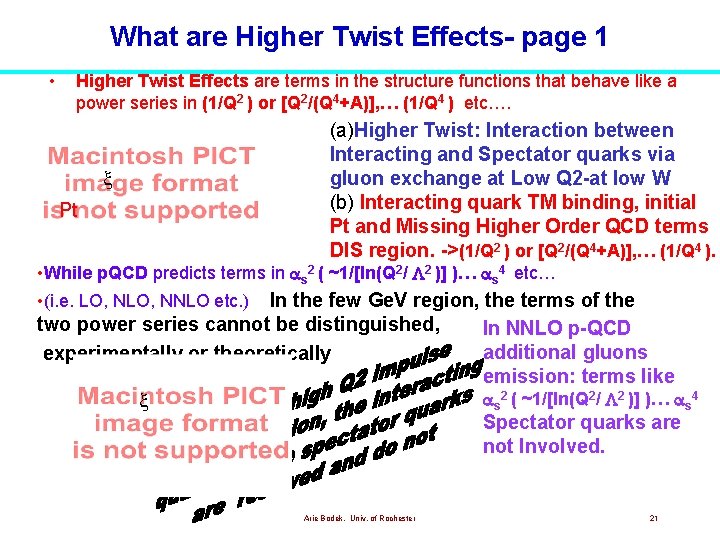
What are Higher Twist Effects- page 1 • Higher Twist Effects are terms in the structure functions that behave like a power series in (1/Q 2 ) or [Q 2/(Q 4+A)], … (1/Q 4 ) etc…. Pt (a)Higher Twist: Interaction between Interacting and Spectator quarks via gluon exchange at Low Q 2 -at low W (b) Interacting quark TM binding, initial Pt and Missing Higher Order QCD terms DIS region. ->(1/Q 2 ) or [Q 2/(Q 4+A)], … (1/Q 4 ). • While p. QCD predicts terms in s 2 ( ~1/[ln(Q 2/ L 2 )] )… s 4 etc… In the few Ge. V region, the terms of the two power series cannot be distinguished, In NNLO p-QCD additional gluons experimentally or theoretically emission: terms like s 2 ( ~1/[ln(Q 2/ L 2 )] )… s 4 Spectator quarks are not Involved. • (i. e. LO, NNLO etc. ) Arie Bodek, Univ. of Rochester 21
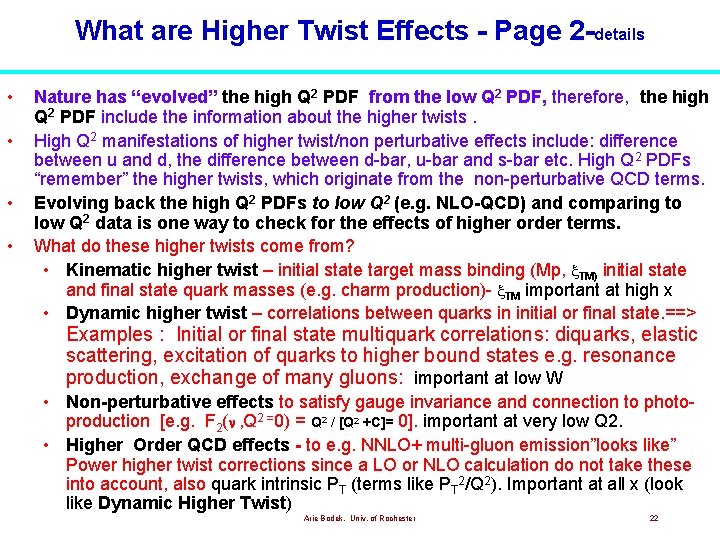
What are Higher Twist Effects - Page 2 -details • • Nature has “evolved” the high Q 2 PDF from the low Q 2 PDF, therefore, the high Q 2 PDF include the information about the higher twists. High Q 2 manifestations of higher twist/non perturbative effects include: difference between u and d, the difference between d-bar, u-bar and s-bar etc. High Q 2 PDFs “remember” the higher twists, which originate from the non-perturbative QCD terms. Evolving back the high Q 2 PDFs to low Q 2 (e. g. NLO-QCD) and comparing to low Q 2 data is one way to check for the effects of higher order terms. What do these higher twists come from? • Kinematic higher twist – initial state target mass binding (Mp, TM) initial state and final state quark masses (e. g. charm production)- TM important at high x • Dynamic higher twist – correlations between quarks in initial or final state. ==> Examples : Initial or final state multiquark correlations: diquarks, elastic scattering, excitation of quarks to higher bound states e. g. resonance production, exchange of many gluons: important at low W • Non-perturbative effects to satisfy gauge invariance and connection to photoproduction [e. g. F 2( , Q 2 =0) = Q 2 / [Q 2 +C]= 0]. important at very low Q 2. • Higher Order QCD effects - to e. g. NNLO+ multi-gluon emission”looks like” Power higher twist corrections since a LO or NLO calculation do not take these into account, also quark intrinsic PT (terms like PT 2/Q 2). Important at all x (look like Dynamic Higher Twist) Arie Bodek, Univ. of Rochester 22
Old Picture of fixed W scattering - form factors (the Frank Hertz Picture) e +i k 2. r e +i k 1. r r. Mp • OLD Picture fixed W: Elastic Scattering, Resonance Production. Electric and Magnetic Form Factors (GE and GM) versus Q 2 measure size of object (the electric charge and magnetization distributions). • Elastic scattering W = Mp = M, single final state nucleon: Form factor measures size of nucleon. Matrix element squared | <p f | V(r) | p i > |2 between initial and final state lepton plane waves. Which becomes: | < e -i k 2. r | V(r) | e +i k 1. r > | 2 q = k 1 - k 2 = momentum transfer GE (q) = {e i q. r r (r) d 3 r } = Electric form factor is the Fourier transform of the charge distribution. Similarly for the magnetization distribution for GM Form factors are relates to structure function by: 2 x. F 1(x , Q 2)elastic = x 2 GM 2 elastic (Q 2) d x-1) Mp • • e +i k 2. r • e +i k 1. r q Mp MR • • • Resonance Production, W=MR, Measure transition form factor between a quark in the ground state and a quark in the first excited state. For the Delta 1. 238 Ge. V first resonance, we have a Breit-Wigner instead of d x-1). 2 x. F 1(x , Q 2) resonance ~ x 2 GM 2 Res. transition (Q 2) BW W-1. 238) Arie Bodek, Univ. of Rochester 23
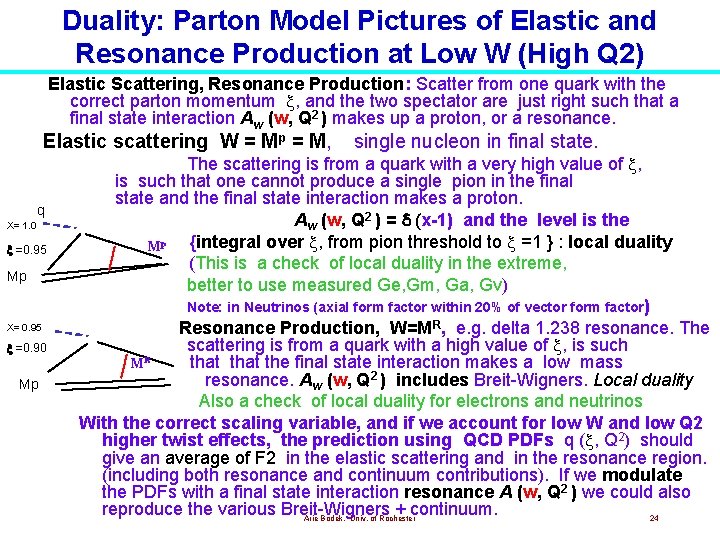
Duality: Parton Model Pictures of Elastic and Resonance Production at Low W (High Q 2) Elastic Scattering, Resonance Production: Scatter from one quark with the correct parton momentum , and the two spectator are just right such that a final state interaction Aw (w, Q 2 ) makes up a proton, or a resonance. Elastic scattering W = Mp = M, q X= 1. 0 =0. 95 Mp X= 0. 95 =0. 90 Mp single nucleon in final state. The scattering is from a quark with a very high value of , is such that one cannot produce a single pion in the final state and the final state interaction makes a proton. A w (w, Q 2 ) = d x-1) and the level is the {integral over , from pion threshold to =1 } : local duality Mp (This is a check of local duality in the extreme, better to use measured Ge, Gm, Ga, Gv) Note: in Neutrinos (axial form factor within 20% of vector form factor) Resonance Production, W=M R, e. g. delta 1. 238 resonance. The scattering is from a quark with a high value of , is such R M that the final state interaction makes a low mass resonance. Aw (w, Q 2 ) includes Breit-Wigners. Local duality Also a check of local duality for electrons and neutrinos With the correct scaling variable, and if we account for low W and low Q 2 higher twist effects, the prediction using QCD PDFs q ( , Q 2) should give an average of F 2 in the elastic scattering and in the resonance region. (including both resonance and continuum contributions). If we modulate the PDFs with a final state interaction resonance A (w, Q 2 ) we could also reproduce the various Breit-Wigners + continuum. Arie Bodek, Univ. of Rochester 24
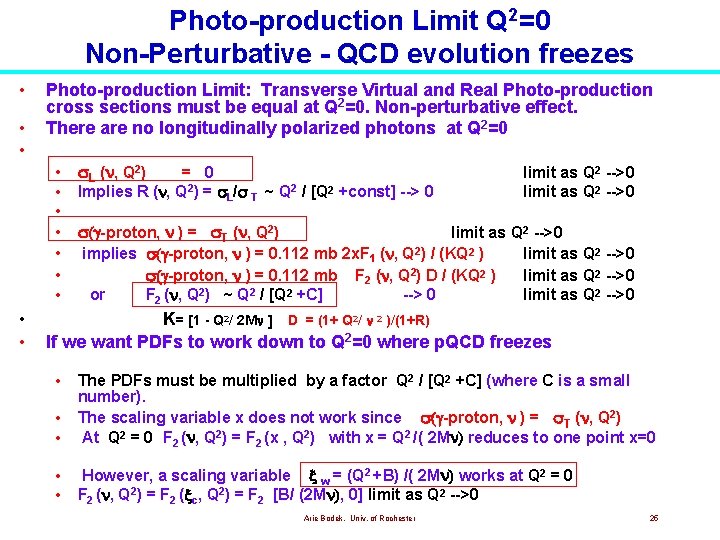
Photo-production Limit Q 2=0 Non-Perturbative - QCD evolution freezes • • • Photo-production Limit: Transverse Virtual and Real Photo-production cross sections must be equal at Q 2=0. Non-perturbative effect. There are no longitudinally polarized photons at Q 2=0 • L ( , Q 2) • • = 0 Implies R ( , Q 2) = L/ T ~ Q 2 / [Q 2 +const] --> 0 limit as Q 2 -->0 • g-proton, ) = T ( , Q 2) limit as Q 2 -->0 • implies g-proton, ) = 0. 112 mb 2 x. F 1 ( , Q 2) / (KQ 2 ) limit as Q 2 -->0 • g-proton, ) = 0. 112 mb F 2 ( , Q 2) D / (KQ 2 ) limit as Q 2 -->0 • • • or F 2 ( , Q 2) ~ Q 2 / [Q 2 +C] --> 0 limit as Q 2 -->0 K= [1 - Q 2/ 2 M D = (1+ Q 2/ 2 )/(1+R) If we want PDFs to work down to Q 2=0 where p. QCD freezes • • • The PDFs must be multiplied by a factor Q 2 / [Q 2 +C] (where C is a small number). The scaling variable x does not work since g-proton, ) = T ( , Q 2) At Q 2 = 0 F 2 ( , Q 2) = F 2 (x , Q 2) with x = Q 2 /( 2 M reduces to one point x=0 • • However, a scaling variable w = (Q 2 +B) /( 2 M works at Q 2 = 0 F 2 ( , Q 2) = F 2 ( c, Q 2) = F 2 [B/ (2 M , 0] limit as Q 2 -->0 Arie Bodek, Univ. of Rochester 25
How do we “measure” higher twist (HT) • • Take a set of QCD PDF which were fit to high Q 2 (e/ / data (in Leading Order-LO, or NNLO) Evolve to low Q 2 (NNLO, NLO to Q 2=1 Ge. V 2) (LO to Q 2=0. 24) Include the “known” kinematic higher twist from initial target mass (proton mass) and final heavy quark masses (e. g. charm production). Compare to low Q 2 data in the DIS region (e. g. SLAC) The difference between data and QCD+target mass predictions is the extracted “effective” dynamic higher twists. Describe the extracted “effective” dynamic higher twist within a specific HT model (e. g. QCD renormalons, or a purely empirical model). Obviously - results will depend on the QCD order LO, NNLO (since in the 1 Ge. V region 1/Q 2 and 1/Ln. Q 2 are similar). In lower orders, the “effective higher twist” will also account for missing QCD higher order terms. The question is the relative size of the terms. o Studies in NLO - Yang and Bodek: Phys. Rev. Lett 82, 2467 (1999) ; ibid 84, 3456 (2000) o Studies in NNLO - Yang and Bodek: Eur. Phys. J. C 13, 241 (2000) o Studies in LO - Bodek and Yang: hep-ex/0203009 (2002) o Studies in QPM 0 th order - Bodek, el al PRD 20, 1471 (1979) Arie Bodek, Univ. of Rochester 26
Lessons from Two 99, 00 QCD studies • Our NLO study comparing NLO PDFs to DIS SLAC, NMC, and BCDMS e/ scattering data on H and D targets shows (for Q 2 > 1 Ge. V 2) [ref: Yang and Bodek: Phys. Rev. Lett 82, 2467 (1999) ] o Kinematic Higher Twist (target mass ) effects are large and important at large x, and must be included in the form of Georgi & Politzer TM scaling. o Dynamic Higher Twist effects are smaller, but need to be included. (A second NNLO study established their origin) o The ratio of d/u at high x must be increased if nuclear binding effects in the deuteron are taken into account. o The Very high x (=0. 9) region - is described by NLO QCD (if target mass and renormalon higher twist effects are included) to better than 10%. SPECTATOR QUARKS modulate A(W, Q 2) ONLY. o Resonance region: NLO p. QCD + Target mass + Higher Twist describes average F 2 in the resonance region (duality works). Include Aw (w, Q 2 ) resonance modulating function from spectator quarks later. • A similar NNLO study using NNLO QCD we find that the “empirically measured “effective” Dynamic Higher Twist Effects in the NLO study come from the missing NNLO higher order QCD terms. [ref: Yang and Bodek Eur. Phys. J. C 13, 241 (2000) ] Arie Bodek, Univ. of Rochester 27
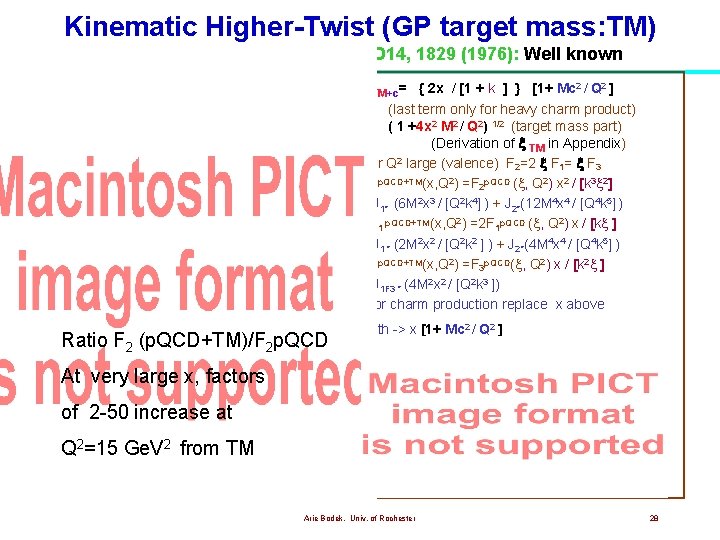
Kinematic Higher-Twist (GP target mass: TM) Georgi and Politzer Phys. Rev. D 14, 1829 (1976): Well known TM+c= { 2 x / [1 + k ] } [1+ Mc 2 / Q 2 ] (last term only for heavy charm product) k= ( 1 +4 x 2 M 2 / Q 2) 1/2 (target mass part) (Derivation of TM in Appendix) For Q 2 large (valence) F 2=2 F 1= F 3 F 2 p. QCD+TM(x, Q 2) =F 2 p. QCD ( , Q 2) x 2 / [k 3 2] +J 1* (6 M 2 x 3 / [Q 2 k 4] ) + J 2*(12 M 4 x 4 / [Q 4 k 5] ) 2 F 1 p. QCD+TM(x, Q 2) =2 F 1 p. QCD ( , Q 2) x / [k ] +J 1 * (2 M 2 x 2 / [Q 2 k 2 ] ) + J 2*(4 M 4 x 4 / [Q 4 k 5] ) F 3 p. QCD+TM(x, Q 2) =F 3 p. QCD( , Q 2) x / [k 2 ] +J 1 F 3 * (4 M 2 x 2 / [Q 2 k 3 ]) For charm production replace x above Ratio F 2 (p. QCD+TM)/F 2 p. QCD With -> x [1+ Mc 2 / Q 2 ] At very large x, factors of 2 -50 increase at Q 2=15 Ge. V 2 from TM Arie Bodek, Univ. of Rochester 28
Kinematic Higher-Twist (target mass: TM) TM = Q 2/ [M (1+Q 2/ 2 ) 1/2 ) ] Compare complete Target-Mass calculation to simple rescaling in TM Ratio F 2 (p. QCD+TM)/F 2 p. QCD Q 2=15 Ge. V 2 • The Target Mass Kinematic Higher Twist effects comes from the fact that the quarks are bound in the nucleon. They are important at low Q 2 and high x. They involve change in the scaling variable from x to TM and various kinematic factors and convolution integrals in terms of the PDFs for x. F 1, F 2 and x. F 3 • Above x=0. 9, this effect is mostly explained by a simple rescaling in TM F 2 p. QCD+TM(x, Q 2) =F 2 p. QCD( TM Q 2 Arie Bodek, Univ. of Rochester 29
Dynamic Higher Twist- Renormalon Model • Use: Renormalon QCD model of Webber&Dasgupta- Phys. Lett. B 382, 272 (1996), Two parameters a 2 and a 4. This model includes the (1/ Q 2) and (1/ Q 4) terms from gluon radiation turning into virtual quark antiquark fermion loops (from the interacting quark only, the spectator quarks are not involved). • F 2 theory (x, Q 2) = F 2 PQC�D+TM [1+ D 2 (x, Q 2) + D 4 (x, Q 2) ] D 2 (x, Q 2) = (1/ Q 2) [ a 2 / q (x, Q 2) ] ∫ (dz/z) c 2(z) q(x/z, Q 2) D 4 (x, Q 2) = (1/ Q 4) [ a 4 times function of x) ] q-qbar loops In this model, the higher twist effects are different for 2 x. F 1, x. F 3 , F 2. With complicated x dependences which are defined by only two parameters a 2 and a 4. (the D 2 (x, Q 2) term is the same for 2 x. F 1 and , x. F 3 ) Fit a 2 and a 4 to experimental data for F 2 and R=FL/2 x. F 1. F 2 data (x, Q 2) = [ F 2 measured + l d F 2 syst ] ( 1+ N ) : 2 weighted by errors where N is the fitted normalization (within errors) and d F 2 syst is the fitted correlated systematic error BCDMS (within errors). Arie Bodek, Univ. of Rochester 30
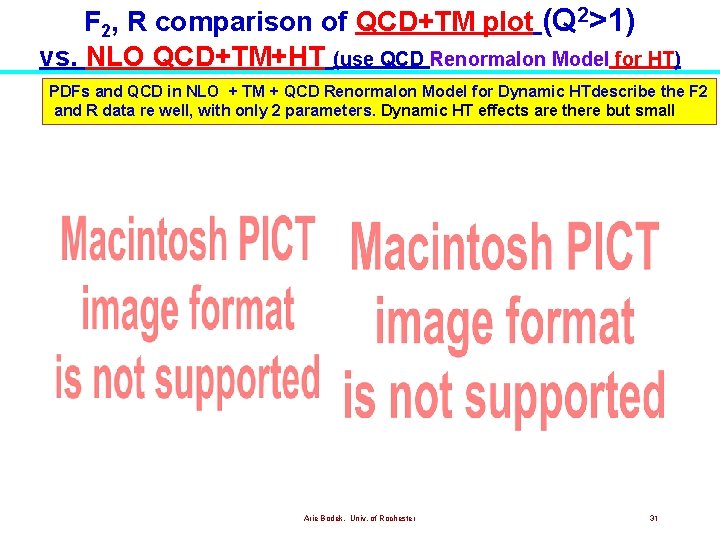
F 2, R comparison of QCD+TM plot (Q 2>1) vs. NLO QCD+TM+HT (use QCD Renormalon Model for HT) PDFs and QCD in NLO + TM + QCD Renormalon Model for Dynamic HTdescribe the F 2 and R data re well, with only 2 parameters. Dynamic HT effects are there but small Arie Bodek, Univ. of Rochester 31
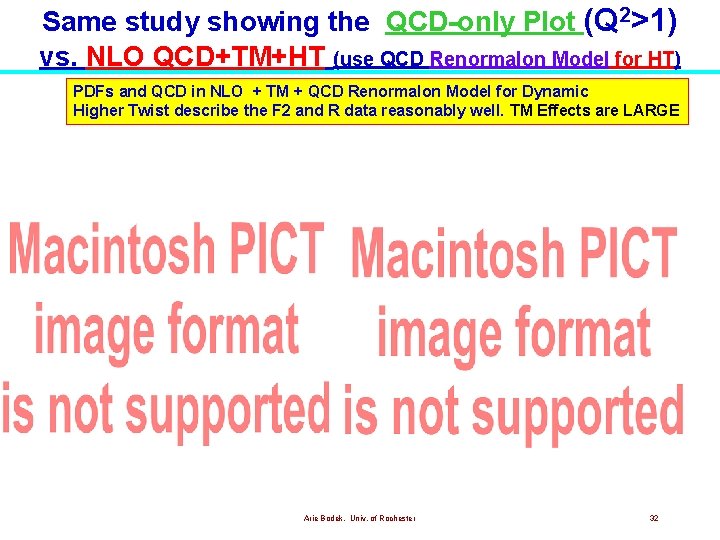
Same study showing the QCD-only Plot (Q 2>1) vs. NLO QCD+TM+HT (use QCD Renormalon Model for HT) PDFs and QCD in NLO + TM + QCD Renormalon Model for Dynamic Higher Twist describe the F 2 and R data reasonably well. TM Effects are LARGE Arie Bodek, Univ. of Rochester 32
Very high x F 2 proton data (DIS + resonance) (not included in the original fits Q 2=1. 5 to 25 Ge. V 2) Q 2= 25 Ge. V 2 Ratio F 2 data/F 2 p. QCD F 2 resonance Data versus F 2 p. QCD+TM+HT Q 2= 1. 5 Ge. V 2 p. QCD ONLY Q 2= 3 Ge. V 2 Q 2= 25 Ge. V 2 Ratio F 2 data/ F 2 p. QCD+TM Q 2= 9 Ge. V 2 Q 2= 15 Ge. V 2 Q 2= 25 Ge. V 2 Ratio F 2 data/F 2 p. QCD+TM+HT Q 2= 25 Ge. V 2 x x NLO p. QCD + TM + higher twist describes very high x DIS F 2 and resonance F 2 data well. (duality works) Q 2=1. 5 to 25 Ge. V 2 Arie Bodek, Univ. of Rochester p. QCD+TM+HT Aw (w, Q 2 ) will account for interactions with spectator quarks 33
Look at Q 2= 8, 15, 25 Ge. V 2 very high x data-backup slide* Ratio F 2 data/F 2 p. QCD+TM+HT Q 2= 9 Ge. V 2 • Pion production threshold • Now Look at lower Q 2 (8, 15 vs 25) DIS and resonance data for the ratio of F 2 data/( NLO p. QCD +TM +HT} High x ratio of F 2 data to NLO p. QCD +TM +HT parameters extracted from lower x data. These high x data were not included in the fit. o The Very high x(=0. 9) region: It is described by NLO p. QCD (if target mass and higher twist effects are included) to better than 10% • Q 2= 15 Ge. V 2 Aw (w, Q 2 ) Q 2= 25 Ge. V 2 Arie Bodek, Univ. of Rochester 34
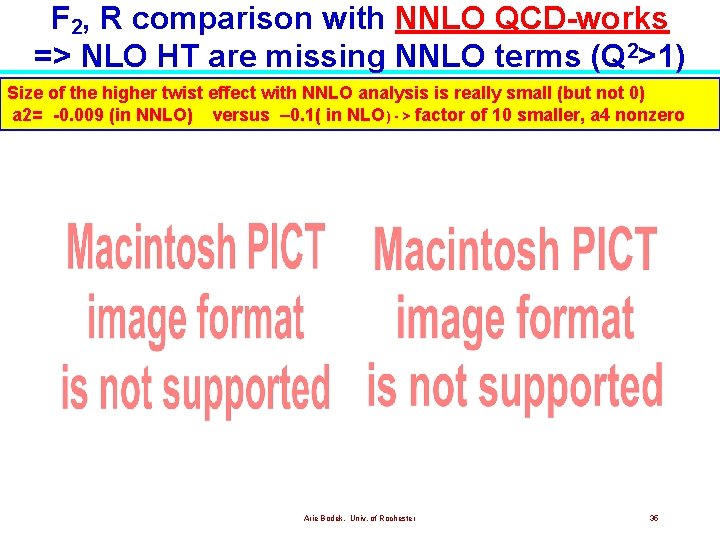
F 2, R comparison with NNLO QCD-works => NLO HT are missing NNLO terms (Q 2>1) Size of the higher twist effect with NNLO analysis is really small (but not 0) a 2= -0. 009 (in NNLO) versus – 0. 1( in NLO) - > factor of 10 smaller, a 4 nonzero Arie Bodek, Univ. of Rochester 35
At LOW x, Q 2 “NNLO terms” look similar to “kinematic final state mass higher twist” or “effective final state quark mass -> “enhanced” QCD Charm production s to c quarks in neutrino scattering-slow rescaling c s Þ Þ At low Q 2, the final state u and d quark effective mass is not zero u u Mc (final state quark mass (Pi + q)2 = Pi 2 + 2 q. Pi + q 2 = Pf 2 = Mc 2 2 C q. P = Q 2 + Mc 2 (Q 2 = -q 2 ) 2 C M = Q 2 + Mc 2 Þ C = mass C slow re-scaling [Q 2+Mc 2 ] / [ 2 M ] (final state charm F 2 At Low x, low Q 2 C > x (slow rescaling C (and the PDF is smaller at high x, so the low Q 2 cross Final state mass effect section is suppressed threshold effect. Lambda QCD M* Production of pions etc gluon emission from the Interacting quark (Pi + q)2 = Pi 2 + 2 q. Pi + q 2 = Pf 2 = M*2 Þ C = [Q 2+M*2 ] / [ 2 M ] (final state M* mass)) Þ versus for mass-less quarks 2 x q. P= Q 2 Þ x = [Q 2] / [2 M ] (compared to x] Low x QCD evolution C slow rescaling looks like faster evolving QCD Since QCD and slow rescaling are both present at the same Q 2 Arie Bodek, Univ. of Rochester Ln Q 2 36
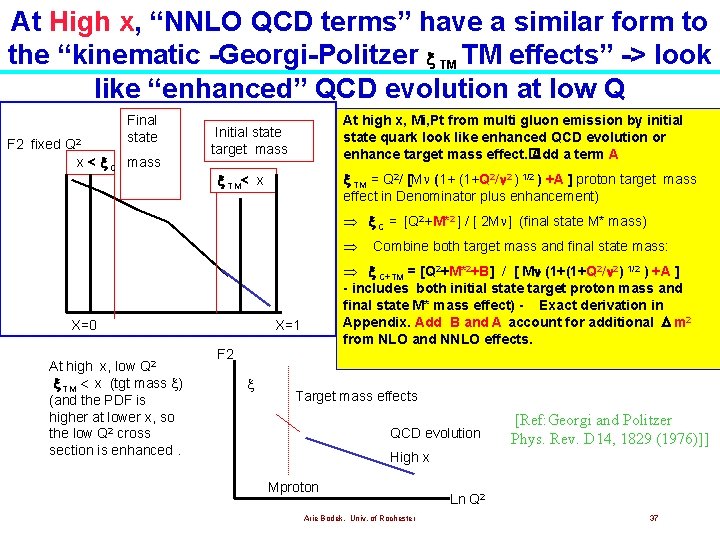
At High x, “NNLO QCD terms” have a similar form to the “kinematic -Georgi-Politzer TM TM effects” -> look like “enhanced” QCD evolution at low Q Final state F 2 fixed Q 2 x < C mass At high x, Mi, Pt from multi gluon emission by initial Target tgtevolution mass or state quark Mass look like(G-P): enhanced QCD enhance target mass effect. � Add a term A Initial state target mass TM = Q 2/ [M (1+Q 2/ 2 ) 1/2 ) +A ] proton target mass effect in Denominator plus enhancement) TM< x Þ C = [Q 2+M*2 ] / [ 2 M ] (final state M* mass) Þ X=0 At high x, low Q 2 TM < x (tgt mass (and the PDF is higher at lower x, so the low Q 2 cross section is enhanced. Þ C+TM = [Q 2+M*2+B] / [ M (1+(1+Q 2/ 2) 1/2 ) +A ] - includes both initial state target proton mass and final state M* mass effect) - Exact derivation in Appendix. Add B and A account for additional m 2 from NLO and NNLO effects. X=1 F 2 Combine both target mass and final state mass: Target mass effects QCD evolution [Ref: Georgi and Politzer Phys. Rev. D 14, 1829 (1976)]] High x Mproton Arie Bodek, Univ. of Rochester Ln Q 2 37
Modified LO PDFs for all Q 2 region? Philosophy 1. We find that NNLO QCD+tgt mass works very well for Q 2 > 1 Ge. V 2. That target mass and missing NNLO terms “explain” what we extract as higher twists in a NLO analysis. i. e. SPECTATOR QUARKS ONLY MODULATE THE CROSS SECTION AT LOW W. THEY DO NOT CONTRIBUTE TO DIS HT. 2. However, we want to go down all the way to Q 2=0. All NNLO and NLO terms blow up. However, higher twist formalism in terms of initial state target mass binding and Pt, and final state mass are valid below Q 2=1, and mimic the higher order QCD terms for Q 2>1 (in terms of effective masses, Pt due to gluon emission). 3. While the original approach was to explain the “empirical higher twists” in terms of NNLO QCD at low Q 2 (and extract NNLO PDFs), we can reverse the approach and have “higher twist” model non-perturbative QCD, down to Q 2=0, by using LO PDFs and “effective target mass and final state masses” to account for initial target mass, final target mass, and missing NLO and NNLO terms. I. e. Do a fit with: 4. F 2(x, Q 2 ) = Q 2/ [Q 2+C] F 2 QCD( w, Q 2) A (w, Q 2 ) (set Aw (w, Q 2 ) =1 for now - spectator quarks) C is the photo-production limit Non-perturbative term. 5. w= [Q 2+B ] / [ M (1+(1+Q 2/ 2) 1/2 ) + A] or Xw = [Q 2+B] /[2 M + A] 6. B=effective final state quark mass. A=enhanced TM term, [Ref: Bodek and Yang hep-ex/0203009] Arie Bodek, Univ. of Rochester 38
Modified LO PDFs for all Q 2 (including 0) Construction Results 1. Start with GRV 94 LO (Q 2 min=0. 23 Ge. V 2 ) • - describe F 2 data at high Q 2 2 A. Replace X with a new scaling, Xw § x= [Q 2] / [2 M • § Xw= [Q 2+B] / [2 M +A] § A: initial binding/target mass effect plus NLO +NNLO terms ) ª B: final state mass effect (but also photo production limit) 2 B. Or Replace X with a new scaling, w w= [Q 2+B ] / [ M (1+(1+Q 2/ 2) 1/2 ) + A] • Modified LO GRV 94 PDFs with three parameters (a new scaling variable, Xw, w) describe DIS F 2 H, D data (SLAC/BCDMS/NMC) well. A=1. 735, B=0. 624, and C=0. 188 Xw (note for Xw, A includes the Proton M) A=0. 700, B=0. 327, and C=0. 197 w works better as expected MEASURE PROTON MASS FROM HIGHER TWIST FITTING • 3. Multiply all PDFs by a factor of Q 2/[Q 2+c] for photo prod. Limit+non-perturbative Keep final state interaction resonance modulating function A (w, Q 2 )=1 for now (will be included in the future). Fit DIS Only • 4. Freeze the evolution at Q 2 = 0. 24 Ge. V 2 • Compare with SLAC/Jlab resonance data (not used in our fit) ->A (w, Q 2 ) Compare with photo production data (not used in our fit)-> check on C Compare with medium energy neutrino data (not used in our fit)- except to the extent that GRV 94 originally included very high energy data on x. F 3 F 2(x, Q 2 ) = Q 2/[Q 2+C] F 2 QCD( w, Q 2) A (w, Q 2 ) -F 2(x, Q 2 < 0. 24) = Q 2/[Q 2+C] F 2(Xw, Q 2=0. 24) A. Do a fit to SLAC/NMC/BCDMS H, D data. - Allow the normalization of the experiments and the BCDMS major systematic error to float within errors. B. HERE INCLUDE DATA WITH Q 2<1 if it is not in the resonance region • [Ref: Bodek and Yang hep-ex/0203009] Arie Bodek, Univ. of Rochester 39
LO+HT Xw fit Comparison with DIS F 2 (H, D) data [These SLAC/BCDMS/NMC are used in this Xw fit Proton 2 = 1555 /958 DOF (Q 2>0. 5) ] Deuteron Arie Bodek, Univ. of Rochester 40
LO+HT fit Comparison with DIS F 2 (H, D) data SLAC/BCDMS/NMC w works better than Xw Proton 2 = 1351 /958 DOF Deuteron Arie Bodek, Univ. of Rochester 41
Comparison with F 2 resonance data [ SLAC/ Jlab] (These data were not included in this w fit) Q 2= 0. 07 Ge. V 2 Q 2= 0. 8 5 Ge. V 2 Q 2= 0. 22 Ge. V 2 Q 2= 1. 4 Ge. V 2 • • • Q 2= 3 Ge. V 2 Q 2= 9 Ge. V 2 • • Q 2= 1 5 Ge. V 2 Q 2= 2 5 Ge. V 2 The modified LO GRV 94 PDFs with a new scaling variable, w describe the SLAC/Jlab resonance data very well (on average). • Even down to Q 2 = 0. 07 Ge. V 2 • Duality works: The DIS curve describes the average over resonance region <--- w fit. For now, lets compare to neutrino data and photoproduction Later. repeat with other PDFs and f(x) Note QCD evolution between Q 2=0. 85 qnd Q 2=0. 25 small. Later: add the Aw (w, Q 2 ) modulating function. (to account for interaction with spectator quarks at low W) Later: check the x=1 Elasic Scattering Limit for electrons, neutrino, and 1 st resonance. Arie Bodek, Univ. of Rochester 42
Comparison of LO+HT to neutrino data on Iron [CCFR] (not used in this Xw fit) Construction • • Apply nuclear corrections using e/ scattering data. Calculate F 2 and x. F 3 from the modified PDFs with Xw Use R=Rworld fit to get 2 x. F 1 from F 2 Implement charm mass effect through a slow rescaling algorithm, for F 2 2 x. F 1, and XF 3 Xw fit The modified GRV 94 LO PDFs with a new scaling variable, Xw describe the CCFR diff. cross section data (E =30– 300 Ge. V) well. Will repeat with w Arie Bodek, Univ. of Rochester 43
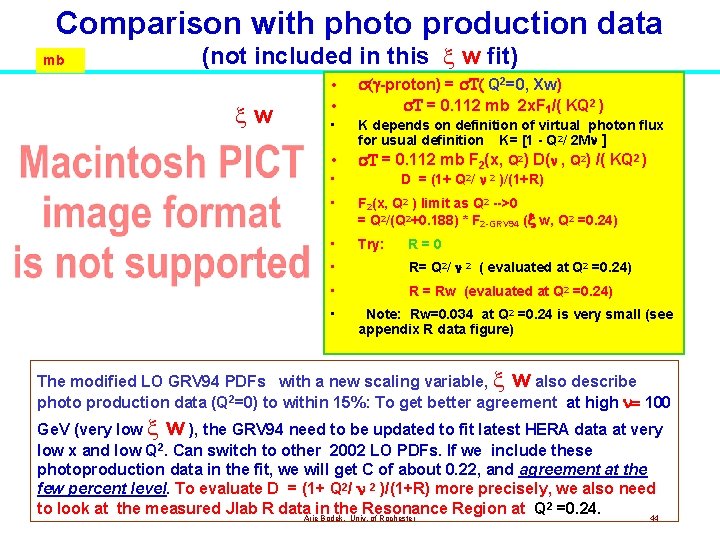
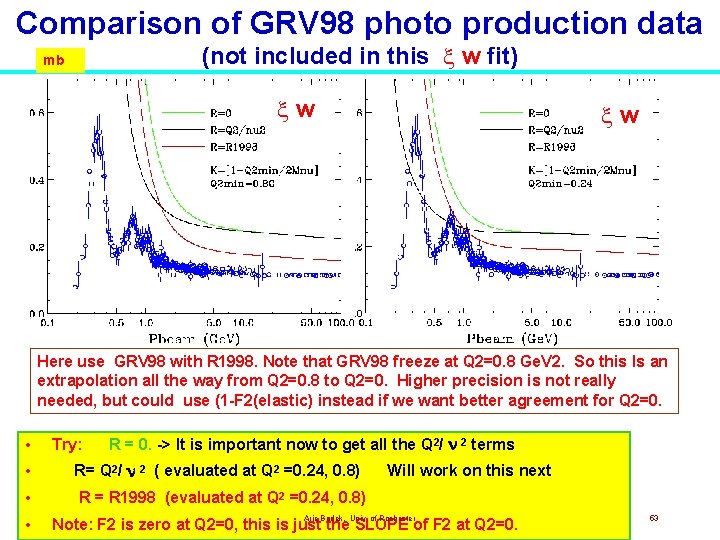
Comparison with photo production data mb (not included in this w fit) w • • g-proton) = Q 2=0, Xw) = 0. 112 mb 2 x. F 1/( KQ 2 ) • K depends on definition of virtual photon flux for usual definition K= [1 - Q 2/ 2 M = 0. 112 mb F 2(x, Q 2) D( , Q 2) /( KQ 2 ) D = (1+ Q 2/ 2 )/(1+R) • • • F 2(x, Q 2 ) limit as Q 2 -->0 = Q 2/(Q 2+0. 188) * F 2 -GRV 94 ( w, Q 2 =0. 24) • Try: R=0 • R= Q 2/ 2 ( evaluated at Q 2 =0. 24) • R = Rw (evaluated at Q 2 =0. 24) • Note: Rw=0. 034 at Q 2 =0. 24 is very small (see appendix R data figure) The modified LO GRV 94 PDFs with a new scaling variable, w also describe photo production data (Q 2=0) to within 15%: To get better agreement at high 100 Ge. V (very low w ), the GRV 94 need to be updated to fit latest HERA data at very low x and low Q 2. Can switch to other 2002 LO PDFs. If we include these photoproduction data in the fit, we will get C of about 0. 22, and agreement at the few percent level. To evaluate D = (1+ Q 2/ 2 )/(1+R) more precisely, we also need to look at the measured Jlab R data. Ariein the Resonance Region at Q 2 =0. 24. Bodek, Univ. of Rochester 44
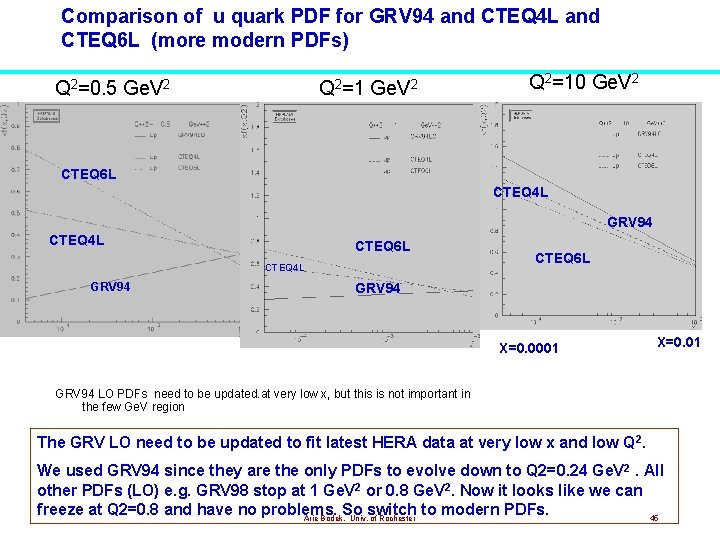
Comparison of u quark PDF for GRV 94 and CTEQ 4 L and CTEQ 6 L (more modern PDFs) Q 2=0. 5 Ge. V 2 Q 2=10 Ge. V 2 CTEQ 6 L CTEQ 4 L GRV 94 CTEQ 4 L CTEQ 6 L CTEQ 4 L GRV 94 CTEQ 6 L GRV 94 X=0. 0001 X=0. 01 GRV 94 LO PDFs need to be updated. at very low x, but this is not important in the few Ge. V region The GRV LO need to be updated to fit latest HERA data at very low x and low Q 2. We used GRV 94 since they are the only PDFs to evolve down to Q 2=0. 24 Ge. V 2. All other PDFs (LO) e. g. GRV 98 stop at 1 Ge. V 2 or 0. 8 Ge. V 2. Now it looks like we can freeze at Q 2=0. 8 and have no problems. So switch to modern PDFs. Arie Bodek, Univ. of Rochester 45
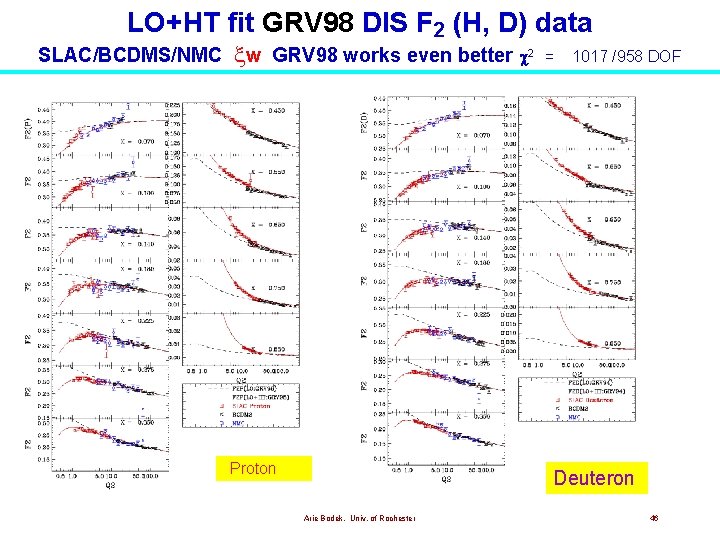
LO+HT fit GRV 98 DIS F 2 (H, D) data SLAC/BCDMS/NMC w GRV 98 works even better 2 Proton = 1017 /958 DOF Deuteron Arie Bodek, Univ. of Rochester 46
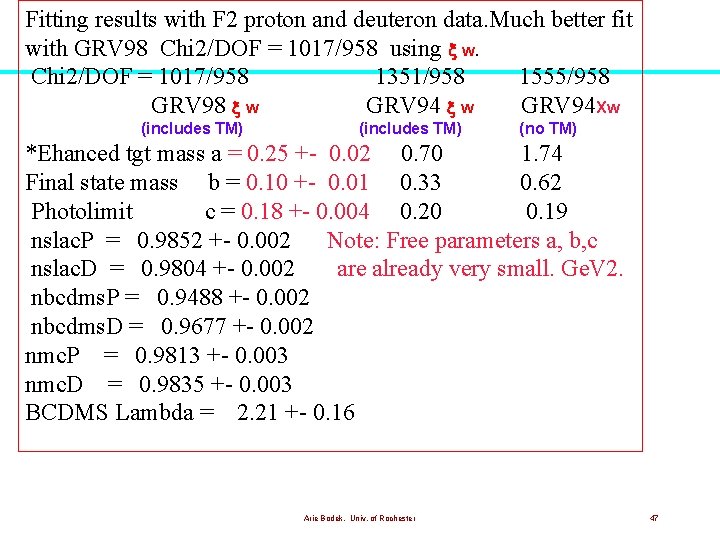
Fitting results with F 2 proton and deuteron data. Much better fit with GRV 98 Chi 2/DOF = 1017/958 using w. Chi 2/DOF = 1017/958 1351/958 1555/958 GRV 98 w GRV 94 Xw (includes TM) (no TM) *Ehanced tgt mass a = 0. 25 +- 0. 02 0. 70 1. 74 Final state mass b = 0. 10 +- 0. 01 0. 33 0. 62 Photolimit c = 0. 18 +- 0. 004 0. 20 0. 19 nslac. P = 0. 9852 +- 0. 002 Note: Free parameters a, b, c nslac. D = 0. 9804 +- 0. 002 are already very small. Ge. V 2. nbcdms. P = 0. 9488 +- 0. 002 nbcdms. D = 0. 9677 +- 0. 002 nmc. P = 0. 9813 +- 0. 003 nmc. D = 0. 9835 +- 0. 003 BCDMS Lambda = 2. 21 +- 0. 16 Arie Bodek, Univ. of Rochester 47
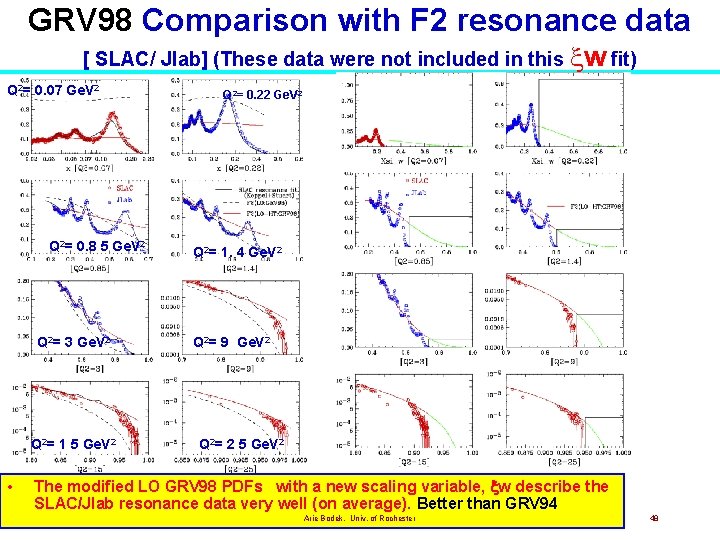
GRV 98 Comparison with F 2 resonance data [ SLAC/ Jlab] (These data were not included in this w fit) Q 2= 0. 07 Ge. V 2 Q 2= 0. 8 5 Ge. V 2 Q 2= 3 Ge. V 2 Q 2= 1 5 Ge. V 2 • Q 2= 0. 22 Ge. V 2 Q 2= 1. 4 Ge. V 2 Q 2= 9 Ge. V 2 Q 2= 2 5 Ge. V 2 The modified LO GRV 98 PDFs with a new scaling variable, w describe the SLAC/Jlab resonance data very well (on average). Better than GRV 94 Arie Bodek, Univ. of Rochester 48
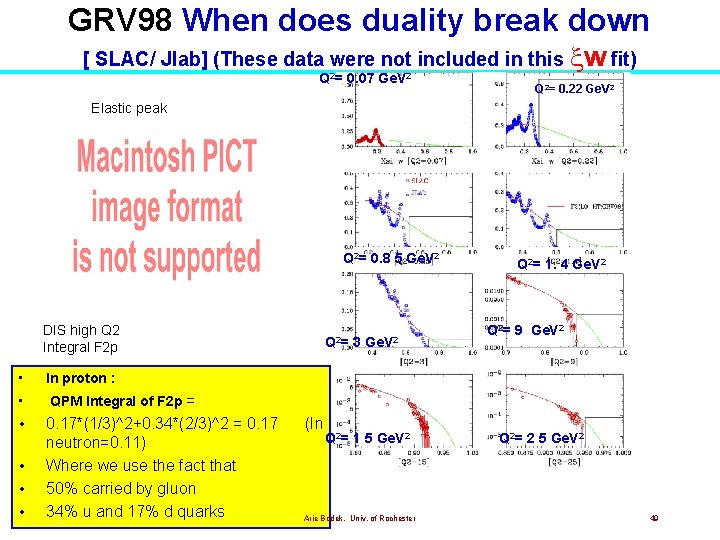
GRV 98 When does duality break down [ SLAC/ Jlab] (These data were not included in this w fit) Q 2= 0. 07 Ge. V 2 Q 2= 0. 22 Ge. V 2 Elastic peak Q 2= 0. 8 5 Ge. V 2 DIS high Q 2 Integral F 2 p • In proton : • QPM Integral of F 2 p = • 0. 17*(1/3)^2+0. 34*(2/3)^2 = 0. 17 neutron=0. 11) Where we use the fact that 50% carried by gluon 34% u and 17% d quarks • • • Q 2= (In 3 Ge. V 2 Q 2= 1 5 Ge. V 2 Arie Bodek, Univ. of Rochester Q 2= 1. 4 Ge. V 2 Q 2= 9 Ge. V 2 Q 2= 2 5 Ge. V 2 49
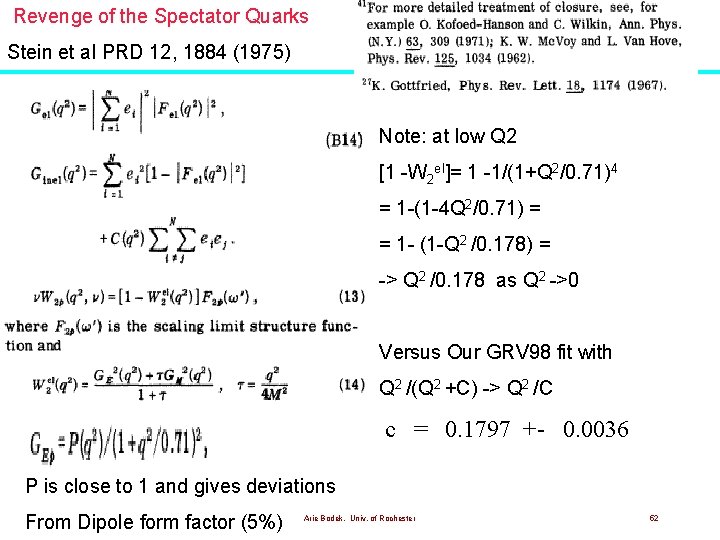
Very low Q 2: Revenge of the Spectator Quarks F 2(elastic) versus Q 2 (Ge. V 2) Just like in p-p scattering there is a strong connection between elastic and inelastic scattering (Optical Theorem). F 2(elastic) proton Quantum Mechanics (Closure) requires a strong connection between elastic and inelastic scattering. Although spectator quarks were ignored in p. QCD - they rebel at low. Q 2 and will not be ignored. F 2(elastic) Neutron Q 2 Arie Bodek, Univ. of Rochester 50
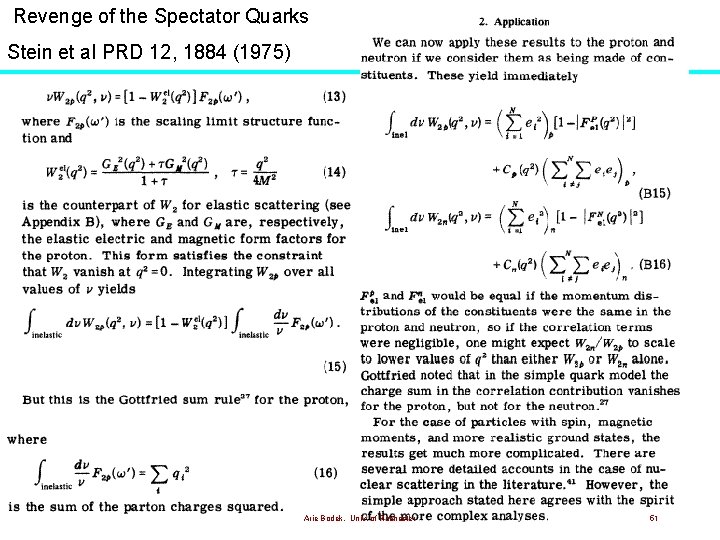
Revenge of the Spectator Quarks Stein et al PRD 12, 1884 (1975) Arie Bodek, Univ. of Rochester 51
Revenge of the Spectator Quarks Stein et al PRD 12, 1884 (1975) Note: at low Q 2 [1 -W 2 el]= 1 -1/(1+Q 2/0. 71)4 = 1 -(1 -4 Q 2/0. 71) = = 1 - (1 -Q 2 /0. 178) = -> Q 2 /0. 178 as Q 2 ->0 Versus Our GRV 98 fit with Q 2 /(Q 2 +C) -> Q 2 /C c = 0. 1797 +- 0. 0036 P is close to 1 and gives deviations From Dipole form factor (5%) Arie Bodek, Univ. of Rochester 52
Comparison of GRV 98 photo production data (not included in this w fit) mb w w Here use GRV 98 with R 1998. Note that GRV 98 freeze at Q 2=0. 8 Ge. V 2. So this Is an extrapolation all the way from Q 2=0. 8 to Q 2=0. Higher precision is not really needed, but could use (1 -F 2(elastic) instead if we want better agreement for Q 2=0. • Try: R = 0. -> It is important now to get all the Q 2/ 2 terms • R= Q 2/ 2 ( evaluated at Q 2 =0. 24, 0. 8) • R = R 1998 (evaluated at Q 2 =0. 24, 0. 8) • Will work on this next Arie Bodek, Univ. of Rochester Note: F 2 is zero at Q 2=0, this is just the SLOPE of F 2 at Q 2=0. 53
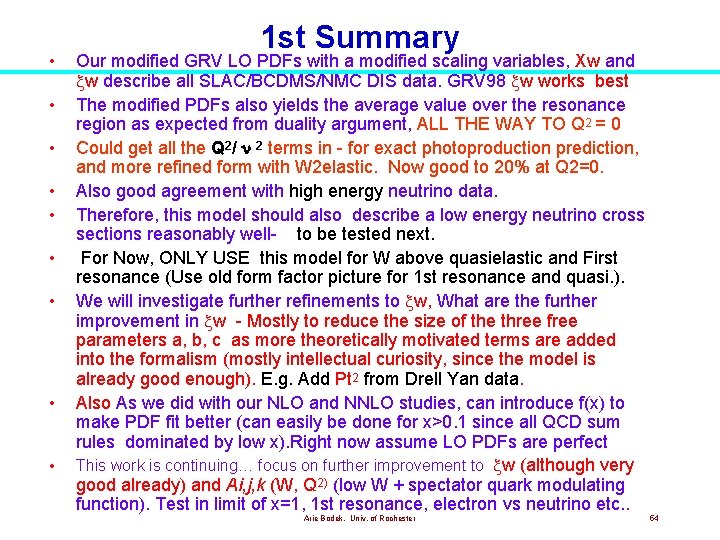
• • • 1 st Summary Our modified GRV LO PDFs with a modified scaling variables, Xw and w describe all SLAC/BCDMS/NMC DIS data. GRV 98 w works best The modified PDFs also yields the average value over the resonance region as expected from duality argument, ALL THE WAY TO Q 2 = 0 Could get all the Q 2/ 2 terms in - for exact photoproduction prediction, and more refined form with W 2 elastic. Now good to 20% at Q 2=0. Also good agreement with high energy neutrino data. Therefore, this model should also describe a low energy neutrino cross sections reasonably well- to be tested next. For Now, ONLY USE this model for W above quasielastic and First resonance (Use old form factor picture for 1 st resonance and quasi. ). We will investigate further refinements to w, What are the further improvement in w - Mostly to reduce the size of the three free parameters a, b, c as more theoretically motivated terms are added into the formalism (mostly intellectual curiosity, since the model is already good enough). E. g. Add Pt 2 from Drell Yan data. Also As we did with our NLO and NNLO studies, can introduce f(x) to make PDF fit better (can easily be done for x>0. 1 since all QCD sum rules dominated by low x). Right now assume LO PDFs are perfect This work is continuing… focus on further improvement to w (although very good already) and Ai, j, k (W, Q 2) (low W + spectator quark modulating function). Test in limit of x=1, 1 st resonance, electron vs neutrino etc. . Arie Bodek, Univ. of Rochester 54
Summary continued • • Do some more work on the Q 2=0 limit (terms in Q 2/Nu 2, PT 2 need to be included) Future studies involving both neutrino and electron scattering including new experiments are of interest. • As x gets close to 1, local Duality is very dependent on the spectator quarks (e. g. different for Gep. Gen, Gmp, Gmn, Gaxial, Gvector neutrinos and antineutrinos • In DIS language it is a function of Q 2 and is different for W 1, W 2 , W 3 (or transverse (--left and right, and longitudinal cross sections for neutrinos and antineutrinos on neutrons and protons. • This is why the present model is probably good in the 2 nd resonance region and above, and needs to be further studied in the region of the first resonance and quasielastic scattering region. • Nuclear Fermi motion studies are of interest, best done at Jla with electrons. • Nuclear dependence of hadronic final state of interest. • Nuclei of interest, C 12, P 16, Fe 56. (common materials for neutrino detectors). Arie Bodek, Univ. of Rochester 55
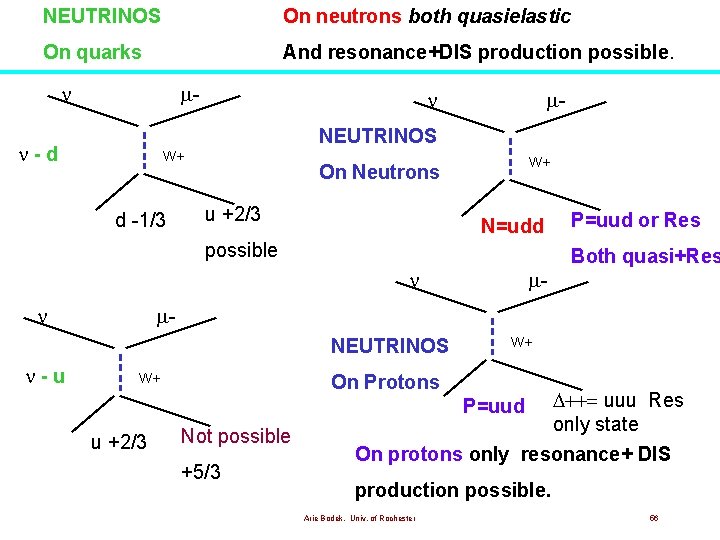
NEUTRINOS On neutrons both quasielastic On quarks And resonance+DIS production possible. - - NEUTRINOS -d W+ d -1/3 W+ On Neutrons u +2/3 N=udd possible - Both quasi+Res - NEUTRINOS -u P=uud or Res W+ W+ On Protons uuu Res only state On protons only resonance+ DIS P=uud u +2/3 Not possible +5/3 production possible. Arie Bodek, Univ. of Rochester 56
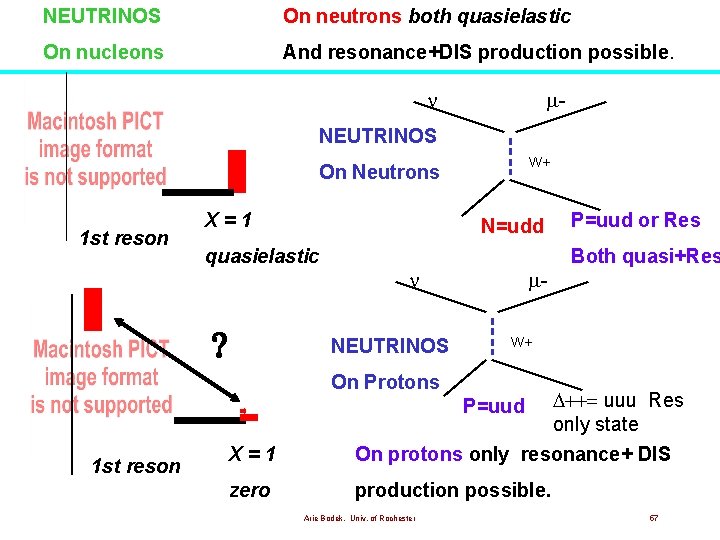
NEUTRINOS On neutrons both quasielastic On nucleons And resonance+DIS production possible. - NEUTRINOS W+ On Neutrons 1 st reson X=1 N=udd quasielastic - NEUTRINOS P=uud or Res Both quasi+Res W+ On Protons X=1 uuu Res only state On protons only resonance+ DIS zero production possible. P=uud 1 st reson Arie Bodek, Univ. of Rochester 57
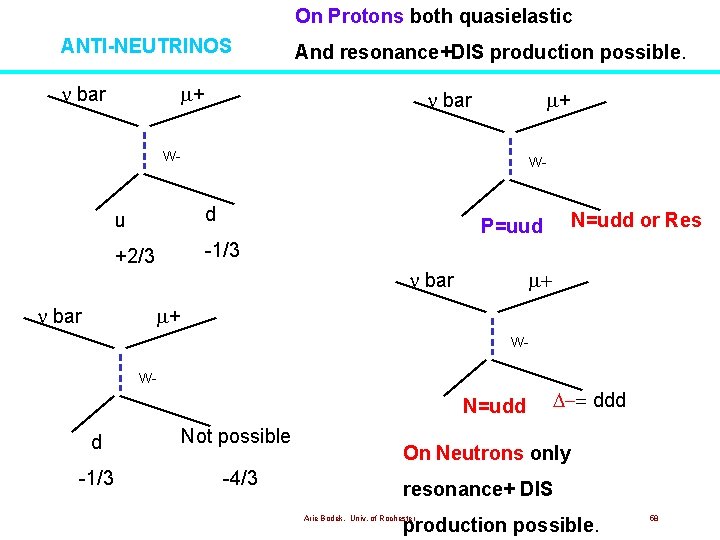
On Protons both quasielastic ANTI-NEUTRINOS bar And resonance+DIS production possible. + bar + W- W- u d +2/3 -1/3 bar N=udd or Res P=uud bar + WW- N=udd d Not possible -1/3 -4/3 ddd On Neutrons only resonance+ DIS production possible. Arie Bodek, Univ. of Rochester 58
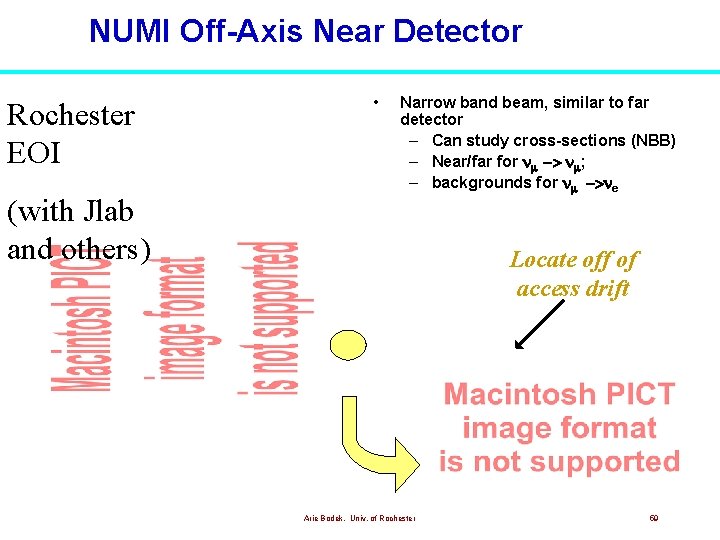
NUMI Off-Axis Near Detector Rochester EOI (with Jlab and others) • Narrow band beam, similar to far detector – Can study cross-sections (NBB) – Near/far for ; – backgrounds for e Locate off of access drift Arie Bodek, Univ. of Rochester 59
Event Spectra in Near Off-Axis, Near On-Axis and Far Detectors Far 0. 7 o OA OA Near 0. 7 o OA (LE) Near 0. 7 o OA (ME) Near On-Axis (LE) Near On-Axis (ME) Arie Bodek, Univ. of Rochester 60
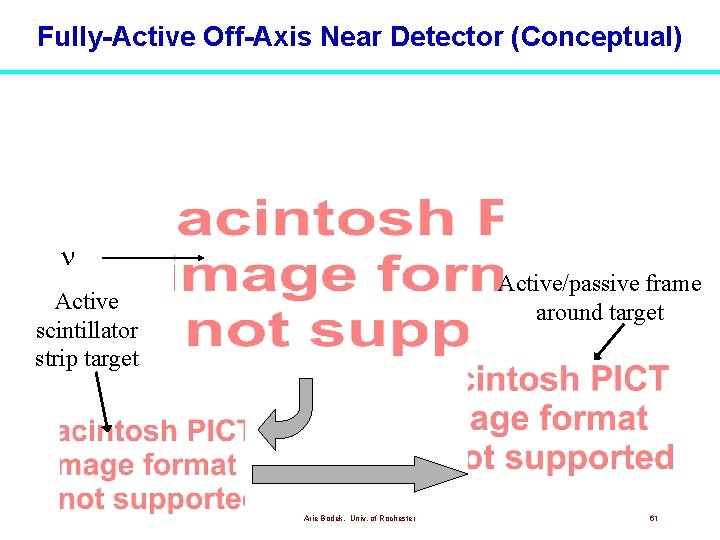
Fully-Active Off-Axis Near Detector (Conceptual) Active/passive frame around target Active scintillator strip target Arie Bodek, Univ. of Rochester 61
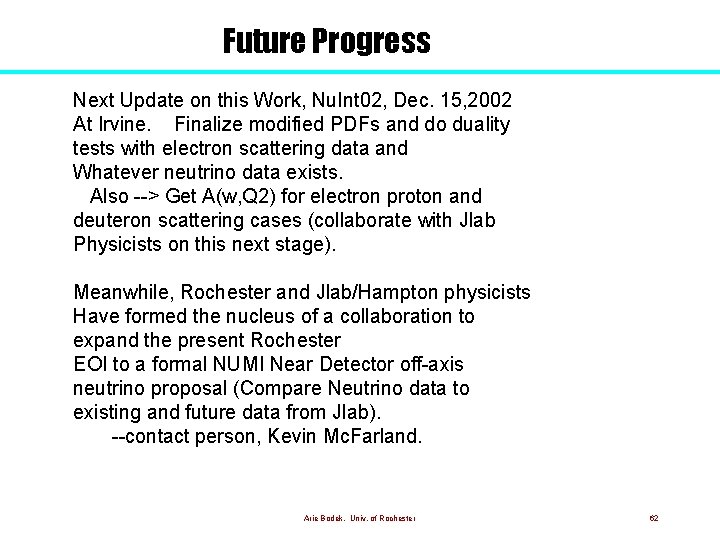
Future Progress Next Update on this Work, Nu. Int 02, Dec. 15, 2002 At Irvine. Finalize modified PDFs and do duality tests with electron scattering data and Whatever neutrino data exists. Also --> Get A(w, Q 2) for electron proton and deuteron scattering cases (collaborate with Jlab Physicists on this next stage). Meanwhile, Rochester and Jlab/Hampton physicists Have formed the nucleus of a collaboration to expand the present Rochester EOI to a formal NUMI Near Detector off-axis neutrino proposal (Compare Neutrino data to existing and future data from Jlab). --contact person, Kevin Mc. Farland. Arie Bodek, Univ. of Rochester 62
Tests of Local Duality at high x, How local Electron Scattering Case • • • INELASTIC High Q 2 x-->1. QCD at High Q 2 Note d refers to d quark in the proton, which is the same as u in the neutron. d/u=0. 2; x=1. F 2 (e-P) = (4/9)u+(1/9)d = (4/9+1/45) u = (21/45) u F 2(e-N) = (4/9)d+(1/9)u = (4/45+5/45) u = (9/45) u F 2(e-N) /F 2 (e-P) = 9/21=0. 43 • Elastic/quasielastic +resonance at high Q 2 dominated by magnetic form factors which have a dipole form factor times the magnetic moment • F 2 (e-P) = A G 2 m. P(el) +BG 2 m. N(res c=+1) • F 2 (e-N) = AG 2 m. N(el) +BG 2 m. N(res c=0) • TAKE ELASTIC TERM ONLY • F 2(e-N) /F 2 (e-P) (elastic) = 2 N 2 P 2 =0. 47 Close if we just take the elastic/quasielastic x=1 term. Different at low Q 2, where Gep, Gen dominate. Since Gep=0. Arie Bodek, Univ. of Rochester 63
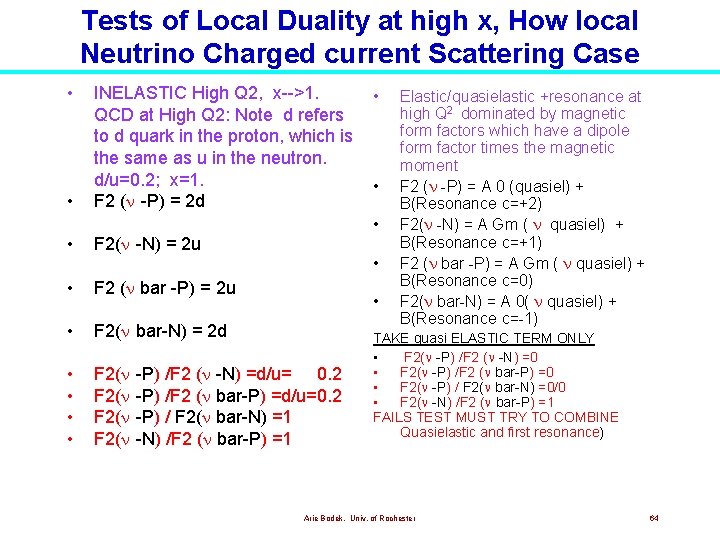
Tests of Local Duality at high x, How local Neutrino Charged current Scattering Case • • INELASTIC High Q 2, x-->1. QCD at High Q 2: Note d refers to d quark in the proton, which is the same as u in the neutron. d/u=0. 2; x=1. F 2 ( -P) = 2 d • • F 2( -N) = 2 u • F 2 ( bar -P) = 2 u • F 2( bar-N) = 2 d • • F 2( -P) /F 2 ( -N) =d/u= 0. 2 F 2( -P) /F 2 ( bar-P) =d/u=0. 2 F 2( -P) / F 2( bar-N) =1 F 2( -N) /F 2 ( bar-P) =1 • • Elastic/quasielastic +resonance at high Q 2 dominated by magnetic form factors which have a dipole form factor times the magnetic moment F 2 ( -P) = A 0 (quasiel) + B(Resonance c=+2) F 2( -N) = A Gm ( quasiel) + B(Resonance c=+1) F 2 ( bar -P) = A Gm ( quasiel) + B(Resonance c=0) F 2( bar-N) = A 0( quasiel) + B(Resonance c=-1) TAKE quasi ELASTIC TERM ONLY • F 2( -P) /F 2 ( -N) =0 • F 2( -P) /F 2 ( bar-P) =0 • F 2( -P) / F 2( bar-N) =0/0 • F 2( -N) /F 2 ( bar-P) =1 FAILS TEST MUST TRY TO COMBINE Quasielastic and first resonance) Arie Bodek, Univ. of Rochester 64
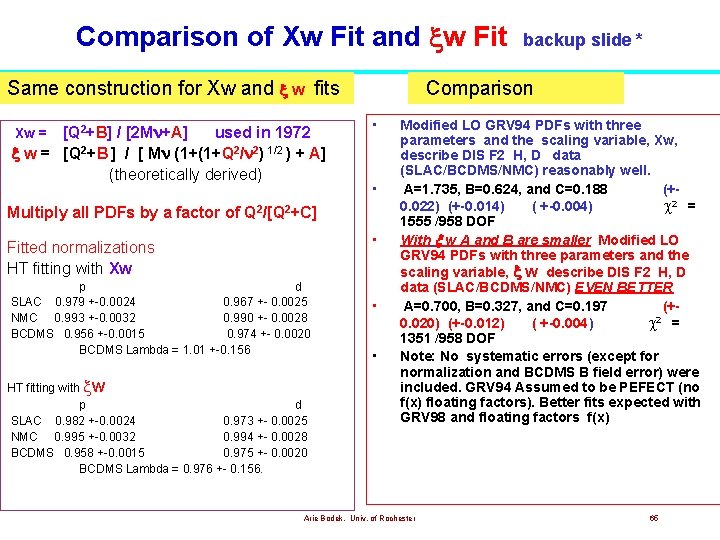
Comparison of Xw Fit and w Fit Same construction for Xw and w fits [Q 2+B] / [2 M +A] used in 1972 w = [Q 2+B ] / [ M (1+(1+Q 2/ 2) 1/2 ) + A] (theoretically derived) Xw = Comparison • • Multiply all PDFs by a factor of Q 2/[Q 2+C] • Fitted normalizations HT fitting with Xw p d SLAC 0. 979 +-0. 0024 0. 967 +- 0. 0025 NMC 0. 993 +-0. 0032 0. 990 +- 0. 0028 BCDMS 0. 956 +-0. 0015 0. 974 +- 0. 0020 BCDMS Lambda = 1. 01 +-0. 156 HT fitting with w p d SLAC 0. 982 +-0. 0024 0. 973 +- 0. 0025 NMC 0. 995 +-0. 0032 0. 994 +- 0. 0028 BCDMS 0. 958 +-0. 0015 0. 975 +- 0. 0020 BCDMS Lambda = 0. 976 +- 0. 156. backup slide * • • Modified LO GRV 94 PDFs with three parameters and the scaling variable, Xw, describe DIS F 2 H, D data (SLAC/BCDMS/NMC) reasonably well. A=1. 735, B=0. 624, and C=0. 188 (+0. 022) (+-0. 014) ( +-0. 004) 2 = 1555 /958 DOF With x w A and B are smaller Modified LO GRV 94 PDFs with three parameters and the scaling variable, w describe DIS F 2 H, D data (SLAC/BCDMS/NMC) EVEN BETTER A=0. 700, B=0. 327, and C=0. 197 (+2 0. 020) (+-0. 012) ( +-0. 004) = 1351 /958 DOF Note: No systematic errors (except for normalization and BCDMS B field error) were included. GRV 94 Assumed to be PEFECT (no f(x) floating factors). Better fits expected with GRV 98 and floating factors f(x) Arie Bodek, Univ. of Rochester 65
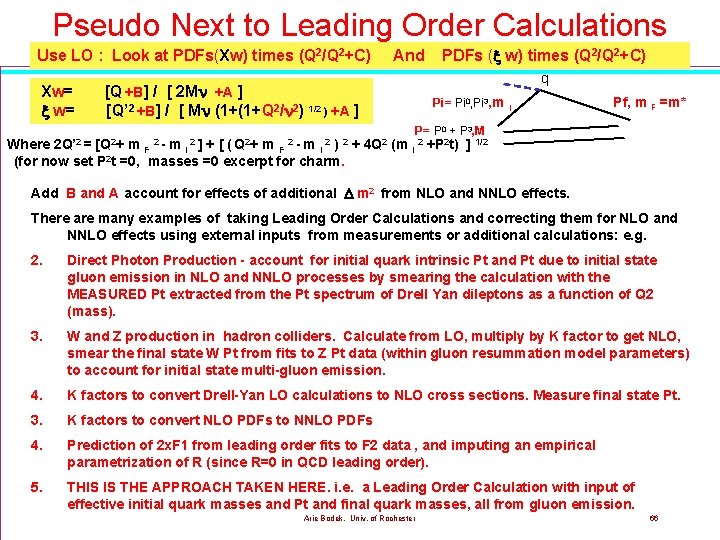
Pseudo Next to Leading Order Calculations Use LO : Look at PDFs(Xw) times (Q 2/Q 2+C) Xw= [Q +B] / [ 2 M +A ] w= [Q’ 2 +B] / [ M (1+(1+Q 2/ 2) And PDFs ( w) times (Q 2/Q 2+C) q 1/2 ) Pi= Pi 0, Pi 3, m +A ] I Pf, m F =m* P= P 0 + P 3, M Where 2 Q’ 2 = [Q 2+ m F 2 - m I 2 ] + [ ( Q 2+ m F 2 - m I 2 ) 2 + 4 Q 2 (m I 2 +P 2 t) ] 1/2 (for now set P 2 t =0, masses =0 excerpt for charm. Add B and A account for effects of additional m 2 from NLO and NNLO effects. There are many examples of taking Leading Order Calculations and correcting them for NLO and NNLO effects using external inputs from measurements or additional calculations: e. g. 2. Direct Photon Production - account for initial quark intrinsic Pt and Pt due to initial state gluon emission in NLO and NNLO processes by smearing the calculation with the MEASURED Pt extracted from the Pt spectrum of Drell Yan dileptons as a function of Q 2 (mass). 3. W and Z production in hadron colliders. Calculate from LO, multiply by K factor to get NLO, smear the final state W Pt from fits to Z Pt data (within gluon resummation model parameters) to account for initial state multi-gluon emission. 4. K factors to convert Drell-Yan LO calculations to NLO cross sections. Measure final state Pt. 3. K factors to convert NLO PDFs to NNLO PDFs 4. Prediction of 2 x. F 1 from leading order fits to F 2 data , and imputing an empirical parametrization of R (since R=0 in QCD leading order). 5. THIS IS THE APPROACH TAKEN HERE. i. e. a Leading Order Calculation with input of effective initial quark masses and Pt and final quark masses, all from gluon emission. Arie Bodek, Univ. of Rochester 66
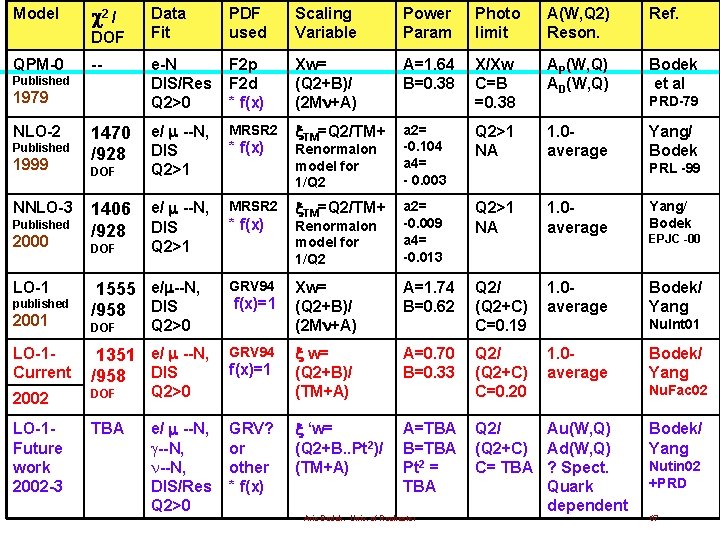
Model 2 / DOF QPM-0 -- Published 1979 NLO-2 Published 1999 NNLO-3 Published 2000 LO-1 published 2001 1470 /928 DOF 1406 /928 DOF Data Fit PDF used Scaling Variable Power Param Photo limit A(W, Q 2) Reson. Ref. e-N DIS/Res Q 2>0 F 2 p F 2 d * f(x) Xw= (Q 2+B)/ (2 M +A) A=1. 64 B=0. 38 X/Xw C=B =0. 38 AP(W, Q) AD(W, Q) Bodek et al e/ --N, DIS Q 2>1 MRSR 2 TM=Q 2/TM+ a 2= -0. 104 a 4= - 0. 003 Q 2>1 NA 1. 0 average Yang/ Bodek e/ --N, DIS Q 2>1 MRSR 2 a 2= -0. 009 a 4= -0. 013 Q 2>1 NA 1. 0 average Yang/ Bodek Xw= (Q 2+B)/ (2 M +A) A=1. 74 B=0. 62 Q 2/ (Q 2+C) C=0. 19 1. 0 average Bodek/ Yang w= (Q 2+B)/ (TM+A) A=0. 70 B=0. 33 Q 2/ (Q 2+C) C=0. 20 1. 0 average ‘w= (Q 2+B. . Pt 2)/ (TM+A) A=TBA B=TBA Pt 2 = TBA 1555 e/ --N, /958 DIS DOF * f(x) GRV 94 f(x)=1 Q 2>0 LO-1 Current 1351 e/ --N, /958 DIS 2002 DOF Q 2>0 LO-1 Future work 2002 -3 TBA e/ --N, g--N, DIS/Res Q 2>0 GRV 94 f(x)=1 GRV? or other * f(x) Renormalon model for 1/Q 2 TM=Q 2/TM+ Renormalon model for 1/Q 2 Arie Bodek, Univ. of Rochester PRD-79 PRL -99 EPJC -00 Nu. Int 01 Q 2/ Au(W, Q) (Q 2+C) Ad(W, Q) C= TBA ? Spect. Quark dependent Bodek/ Yang Nu. Fac 02 Bodek/ Yang Nutin 02 +PRD 67
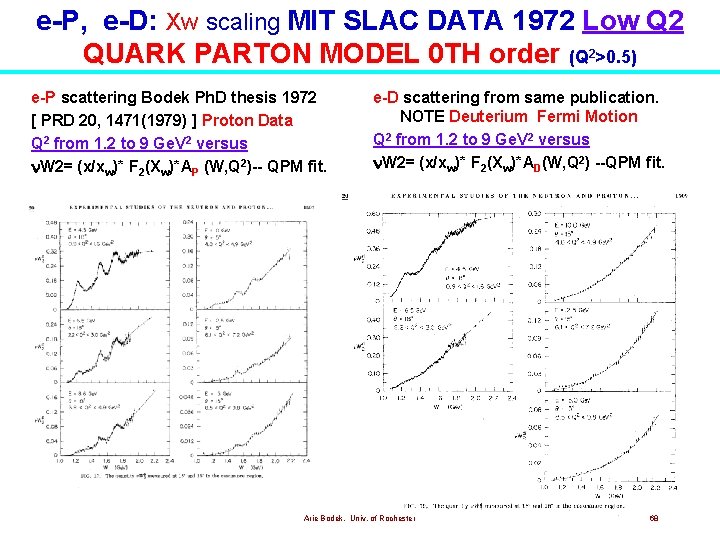
e-P, e-D: Xw scaling MIT SLAC DATA 1972 Low Q 2 QUARK PARTON MODEL 0 TH order (Q 2>0. 5) e-P scattering Bodek Ph. D thesis 1972 [ PRD 20, 1471(1979) ] Proton Data Q 2 from 1. 2 to 9 Ge. V 2 versus W 2= (x/xw)* F 2(Xw)*AP (W, Q 2)-- QPM fit. e-D scattering from same publication. NOTE Deuterium Fermi Motion Q 2 from 1. 2 to 9 Ge. V 2 versus W 2= (x/xw)* F 2(Xw)*AD(W, Q 2) --QPM fit. Arie Bodek, Univ. of Rochester 68
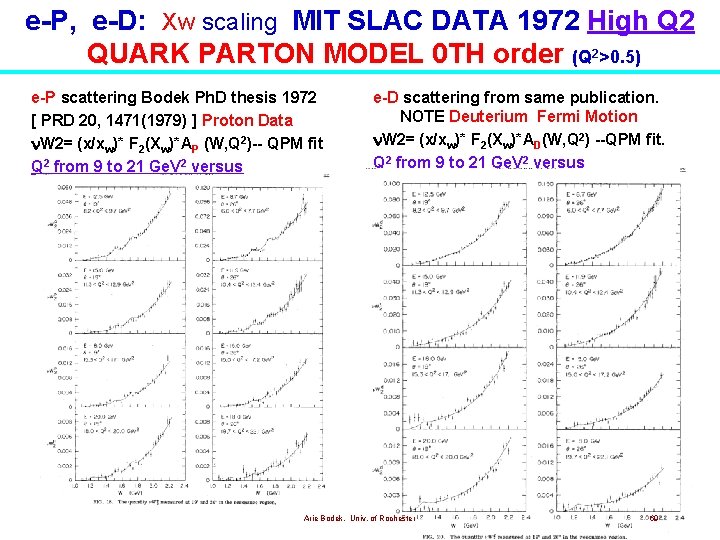
e-P, e-D: Xw scaling MIT SLAC DATA 1972 High Q 2 QUARK PARTON MODEL 0 TH order (Q 2>0. 5) e-P scattering Bodek Ph. D thesis 1972 [ PRD 20, 1471(1979) ] Proton Data W 2= (x/xw)* F 2(Xw)*AP (W, Q 2)-- QPM fit Q 2 from 9 to 21 Ge. V 2 versus e-D scattering from same publication. NOTE Deuterium Fermi Motion W 2= (x/xw)* F 2(Xw)*AD(W, Q 2) --QPM fit. Q 2 from 9 to 21 Ge. V 2 versus Arie Bodek, Univ. of Rochester 69
LO+HT w fit Comparison with DIS F 2 (H, D) data SLAC/BCDMS/NMC w works better Proton 2 = 1351 /958 DOF (Q 2>0. 5) Deuteron Arie Bodek, Univ. of Rochester 70
F 2, R comparison with NNLO QCD-works => NLO HT are missing NNLO terms (Q 2>1) Size of the higher twist effect with NNLO analysis is really small (but not 0) a 2= -0. 009 (in NNLO) versus – 0. 1( in NLO) - > factor of 10 smaller, a 4 nonzero Arie Bodek, Univ. of Rochester 71
Future Work - part 1 • • • Implement A e/ (W, Q 2) resonances into the model for F 2 with w scaling. For this need to fit all DIS and SLAC and JLAB resonance date and Photo-production H and D data and CCFR neutrino data. Check for local duality between w scaling curve and elastic form factors Ge, Gm in electron scattering. - Check method where its applicability will break down. Check for local duality of w scaling curve and quasielastic form factors Gm. Ge, GA, GV in quasielastic electron and neutrino and antineutrino scattering. - Good check on the applicability of the method in predicting exclusive production of strange and charm hyperons Compare our model prediction with the Rein and Seghal model for the 1 st resonance (in neutrino scattering). Implement differences between and e/ final state resonance masses in terms of A ( i, j, k) (W, Q 2) ( i is the interacting quark, and j, k are spectator quarks). Look at Jlab and SLAC heavy target data for possible Q 2 dependence of nuclear dependence on Iron. Implementation for R (and 2 x. F 1) is done exactly - use empirical fits to R (agrees with NNLO+GP tgt mass for Q 2>1); Need to update Rw Q 2<1 to include Jlab R data in resonance region. Compare to low-energy neutrino data (only low statistics data, thus new measurements of neutrino differential cross sections at low energy are important). Check other forms of scaling e. g. F 2=(1+ Q 2/ W 2 (for low energies) Arie Bodek, Univ. of Rochester 72
Future Work - part 2 • • Investigate different scaling variable parameters for different flavor quark masses (u, d, s, uv, dv, usea, dsea in initial and final state) for F 2. , Note: w = [Q 2+B ] / [ M (1+Q 2/ 2) 1/2 ) +A ] assumes m F = m i =0, P 2 t=0 More sophisticated General expression (see derivation in Appendix): w’ =[ Q’ 2+B ] / [M (1+Q 2/ 2) 1/2 ) +A] with 2 Q’ 2 = [Q 2+ m F 2 - m I 2 ] + [ ( Q 2+ m F 2 - m I 2 ) 2 + 4 Q 2 (m I 2 +P 2 t) ] 1/2 or 2 Q’ 2 = [Q 2+ m F 2 - m I 2 ] + [ Q 4 +2 Q 2(m F 2 + m I 2 +2 P 2 t ) + (m F 2 - m I 2 ) 2 ] 1/2 Here B and A account for effects of additional m 2 from NLO and NNLO effects. However, one can include P 2 t, as well as m F , m i as the current quark masses (e. g. Charm, production in neutrino scattering, strange particle production etc. ). In w, B and A account for effective masses+initial Pt. When including Pt in the fits, we can constrain Pt to agree with the measured mean Pt of Drell Yan data. . Include a floating factor f(x) to change the x dependence of the GRV 94 PDFs such that they provide a good fit to all high energy DIS, HERA, Drell-Yan, Wasymmetry, CDF Jets etc, for a global PDF QCD LO fit to include Pt, quark masses A, B for w scaling and the Q 2/(Q 2+C) factor, and A e/ (W, Q 2) as a first step towards modern PDFs. (but need to conserve sum rules). Put in fragmentation functions versus W, Q 2, quark type and nuclear target Arie Bodek, Univ. of Rochester 73