Particles Waves Cf E Higher Physics Unit 2
- Slides: 21
Particles & Waves Cf. E Higher Physics - Unit 2
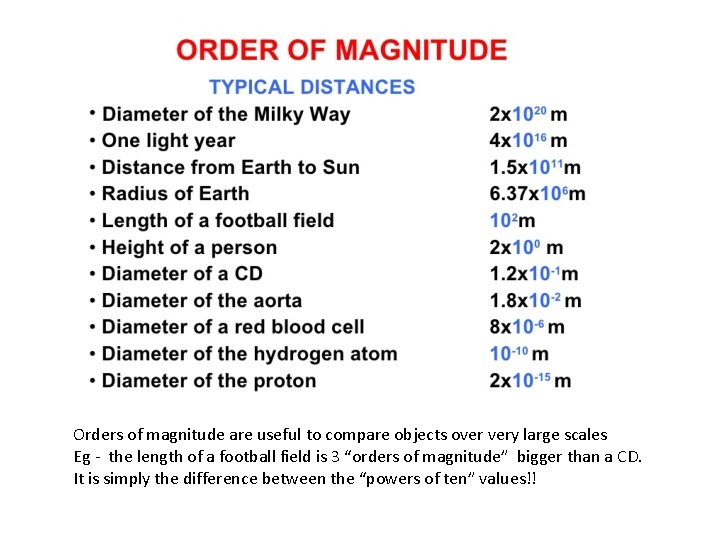
The scale of things…. The Universe is a very big place. In Our Dynamic Universe we were looking at the Universe on a very big scale. What happens is we go the other way and look at the Universe on its smallest scale. How small does the Universe get? What are the fundamental building blocks in the Universe? • the scale of the universe
Orders of magnitude are useful to compare objects over very large scales Eg - the length of a football field is 3 “orders of magnitude” bigger than a CD. It is simply the difference between the “powers of ten” values!!
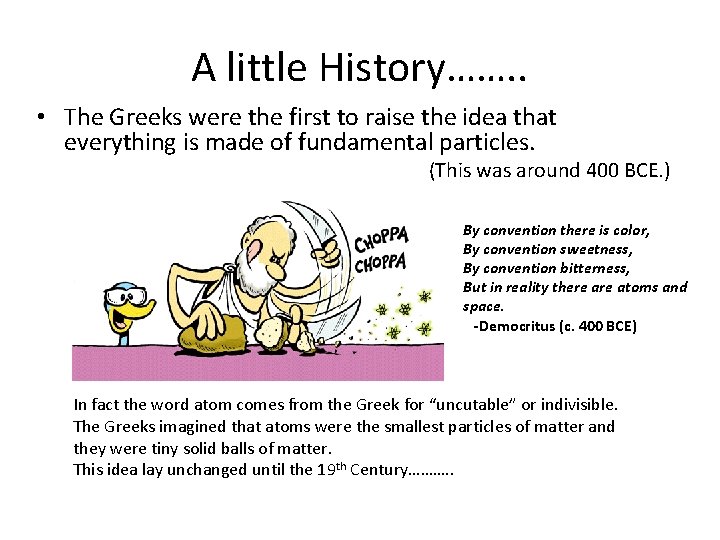
A little History……. . • The Greeks were the first to raise the idea that everything is made of fundamental particles. (This was around 400 BCE. ) By convention there is color, By convention sweetness, By convention bitterness, But in reality there atoms and space. -Democritus (c. 400 BCE) In fact the word atom comes from the Greek for “uncutable” or indivisible. The Greeks imagined that atoms were the smallest particles of matter and they were tiny solid balls of matter. This idea lay unchanged until the 19 th Century………. .
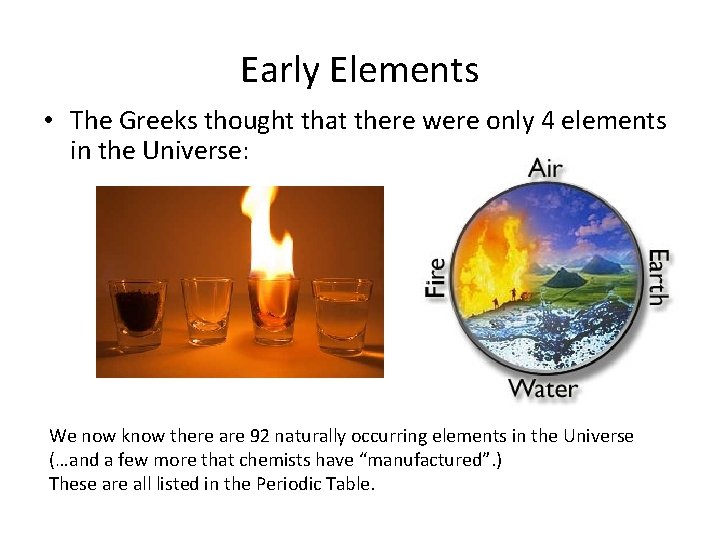
Early Elements • The Greeks thought that there were only 4 elements in the Universe: We now know there are 92 naturally occurring elements in the Universe (…and a few more that chemists have “manufactured”. ) These are all listed in the Periodic Table.
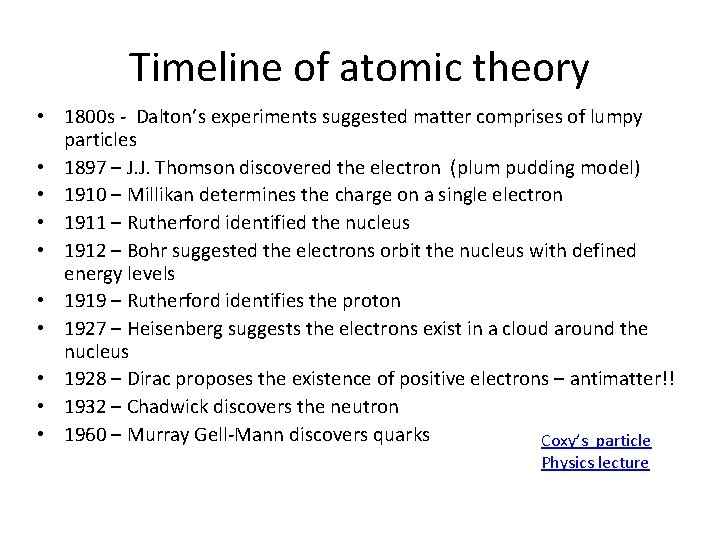
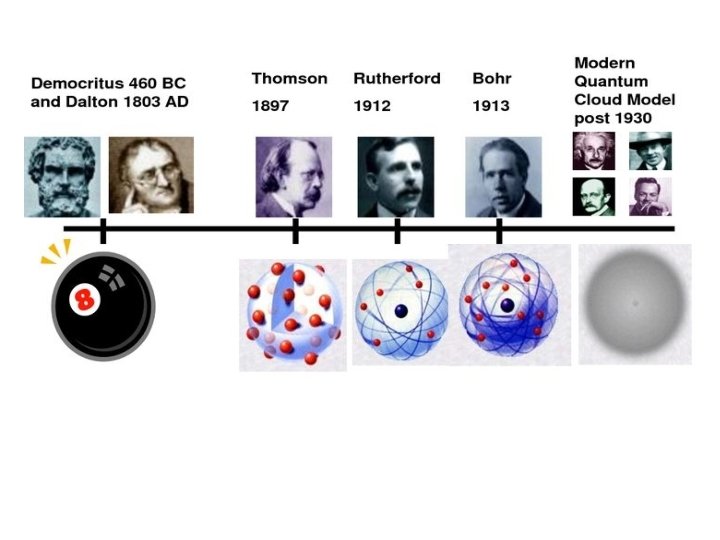
Timeline of atomic theory • 1800 s - Dalton’s experiments suggested matter comprises of lumpy particles • 1897 – J. J. Thomson discovered the electron (plum pudding model) • 1910 – Millikan determines the charge on a single electron • 1911 – Rutherford identified the nucleus • 1912 – Bohr suggested the electrons orbit the nucleus with defined energy levels • 1919 – Rutherford identifies the proton • 1927 – Heisenberg suggests the electrons exist in a cloud around the nucleus • 1928 – Dirac proposes the existence of positive electrons – antimatter!! • 1932 – Chadwick discovers the neutron • 1960 – Murray Gell-Mann discovers quarks Coxy’s particle Physics lecture
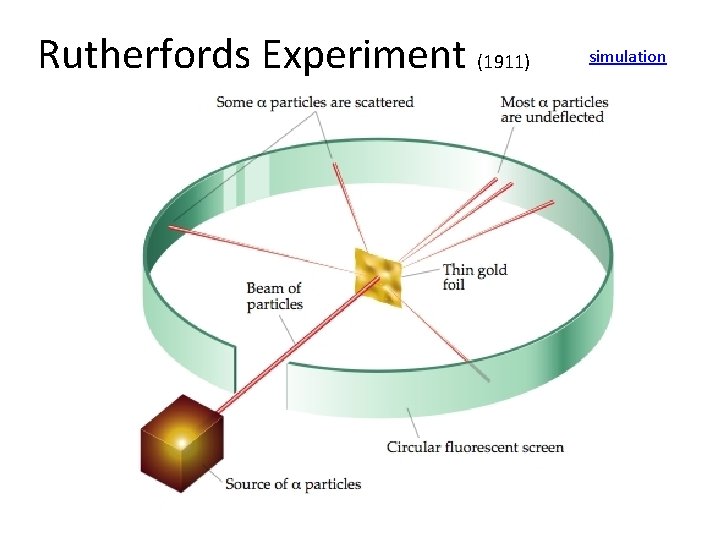
Rutherfords Experiment (1911) simulation
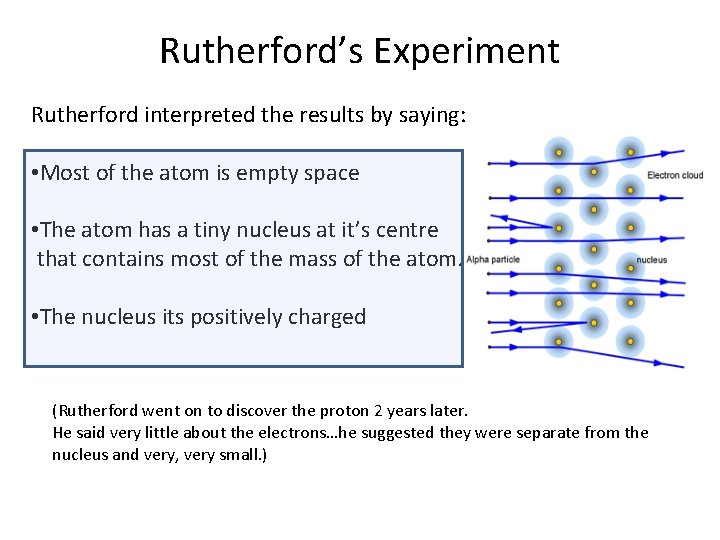
Rutherford’s Experiment Rutherford interpreted the results by saying: • Most of the atom is empty space • The atom has a tiny nucleus at it’s centre that contains most of the mass of the atom. • The nucleus its positively charged (Rutherford went on to discover the proton 2 years later. He said very little about the electrons…he suggested they were separate from the nucleus and very, very small. )
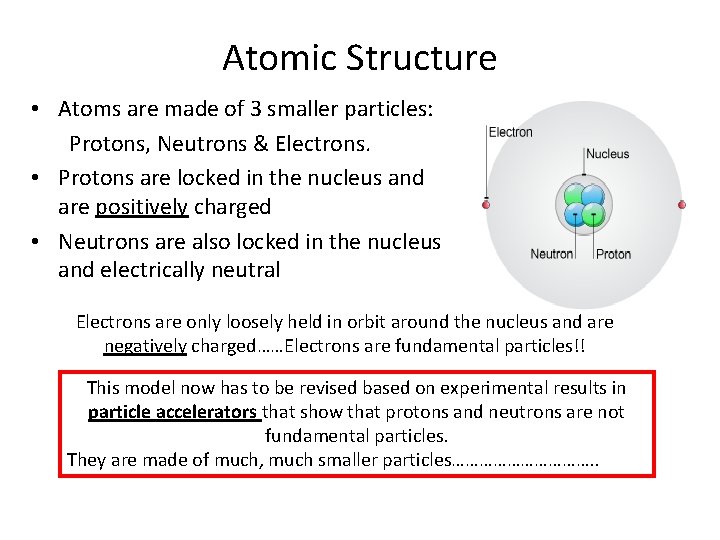
Atomic Structure • Atoms are made of 3 smaller particles: Protons, Neutrons & Electrons. • Protons are locked in the nucleus and are positively charged • Neutrons are also locked in the nucleus and electrically neutral Electrons are only loosely held in orbit around the nucleus and are negatively charged……Electrons are fundamental particles!! This model now has to be revised based on experimental results in particle accelerators that show that protons and neutrons are not fundamental particles. They are made of much, much smaller particles……………. .
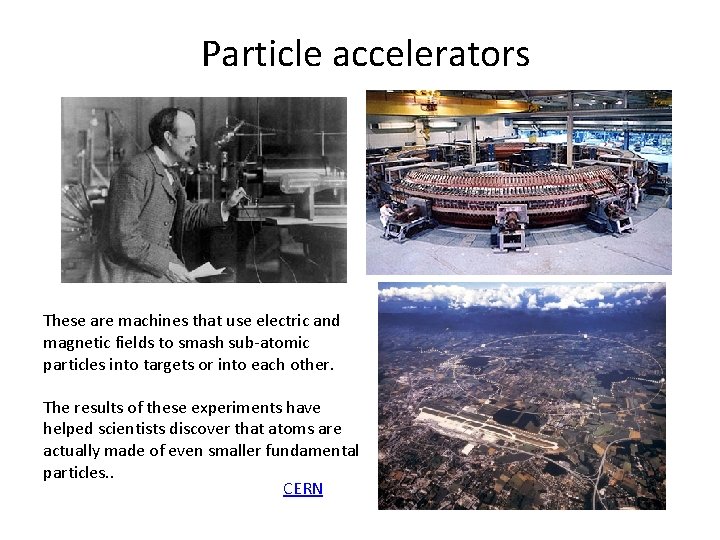
Particle accelerators These are machines that use electric and magnetic fields to smash sub-atomic particles into targets or into each other. The results of these experiments have helped scientists discover that atoms are actually made of even smaller fundamental particles. . CERN
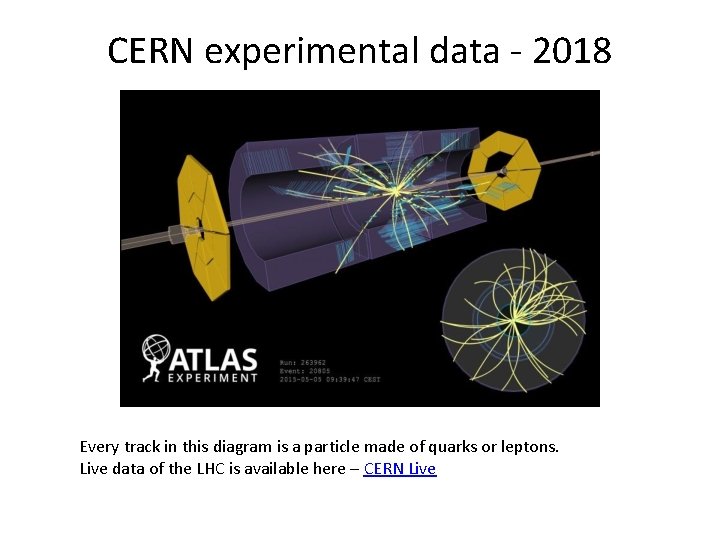
CERN experimental data - 2018 Every track in this diagram is a particle made of quarks or leptons. Live data of the LHC is available here – CERN Live
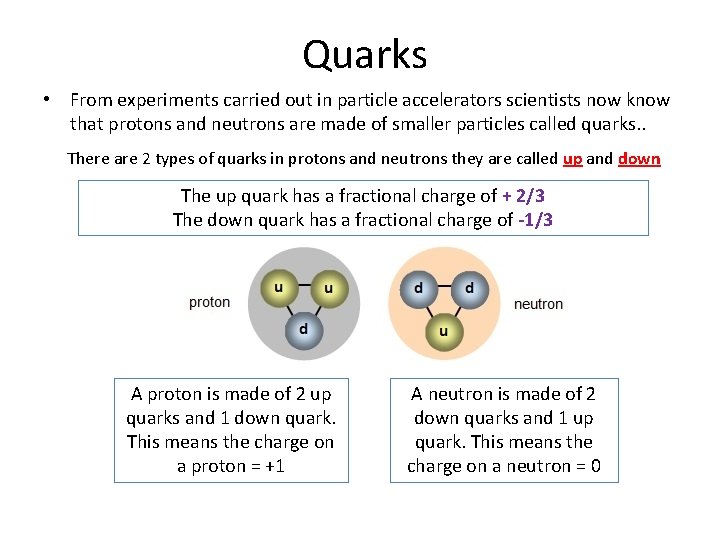
Quarks • From experiments carried out in particle accelerators scientists now know that protons and neutrons are made of smaller particles called quarks. . There are 2 types of quarks in protons and neutrons they are called up and down The up quark has a fractional charge of + 2/3 The down quark has a fractional charge of -1/3 A proton is made of 2 up quarks and 1 down quark. This means the charge on a proton = +1 A neutron is made of 2 down quarks and 1 up quark. This means the charge on a neutron = 0
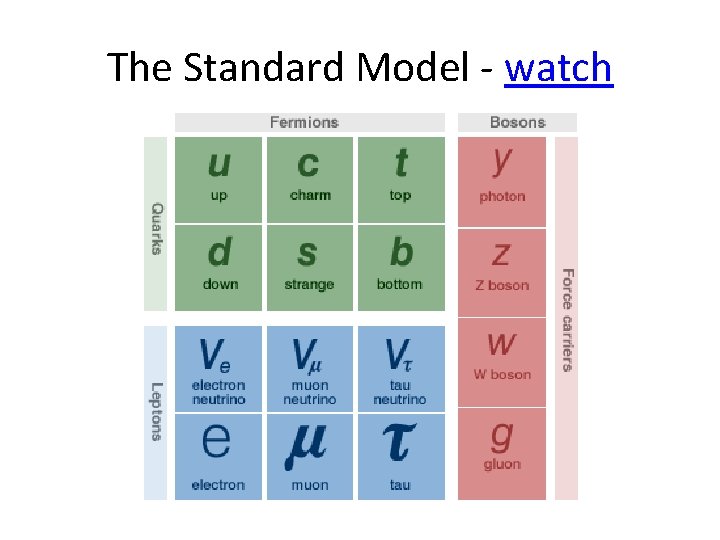
More quarks ? • Further experiments have shown that there are more quarks than just the up and down variety……and more massive versions of the electron……. . and other tiny neutral particles called neutrinos…………. and………well. . • Have a look for yourself – get to a computer and google: The particle adventure…. Work your way through: “The Standard Model”
The Standard Model - watch
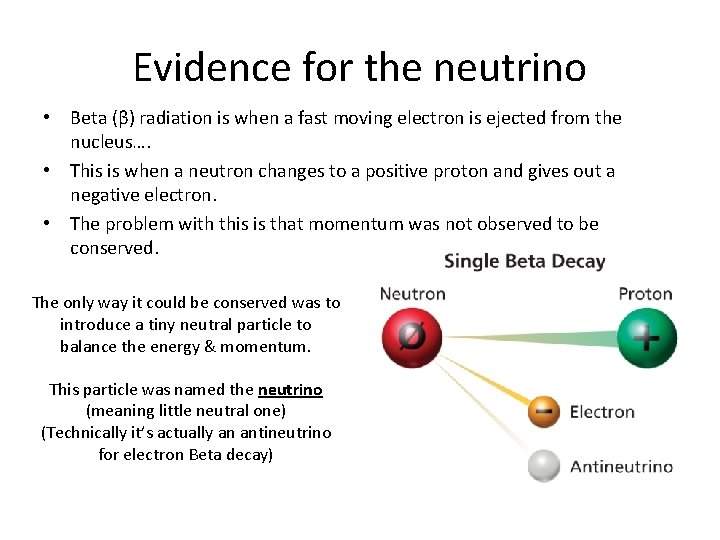
Evidence for the neutrino • Beta (β) radiation is when a fast moving electron is ejected from the nucleus…. • This is when a neutron changes to a positive proton and gives out a negative electron. • The problem with this is that momentum was not observed to be conserved. The only way it could be conserved was to introduce a tiny neutral particle to balance the energy & momentum. This particle was named the neutrino (meaning little neutral one) (Technically it’s actually an antineutrino for electron Beta decay)
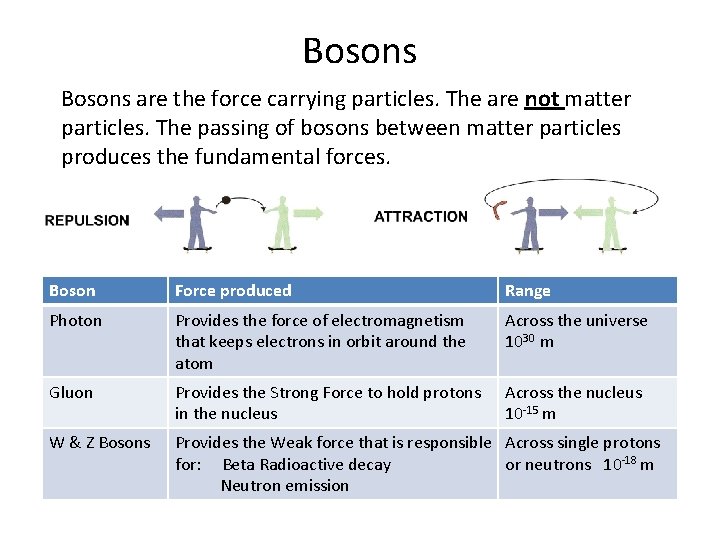
Bosons are the force carrying particles. The are not matter particles. The passing of bosons between matter particles produces the fundamental forces. Boson Force produced Range Photon Provides the force of electromagnetism that keeps electrons in orbit around the atom Across the universe 1030 m Gluon Provides the Strong Force to hold protons in the nucleus Across the nucleus 10 -15 m W & Z Bosons Provides the Weak force that is responsible Across single protons for: Beta Radioactive decay or neutrons 10 -18 m Neutron emission
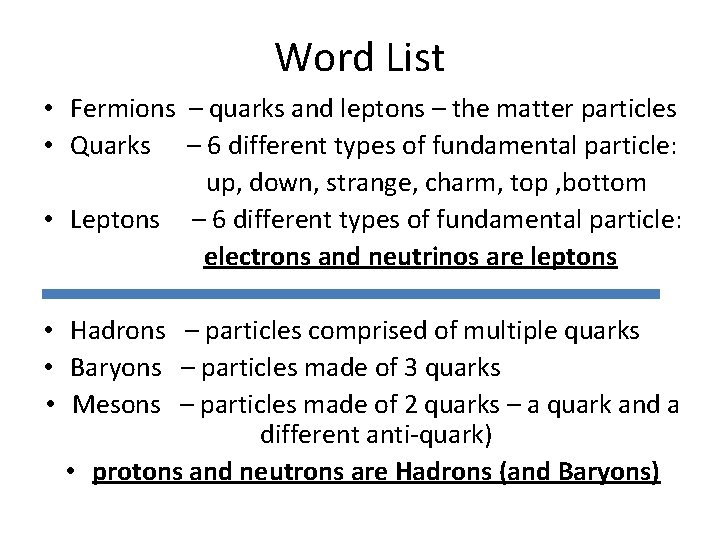
Word List • Fermions – quarks and leptons – the matter particles • Quarks – 6 different types of fundamental particle: up, down, strange, charm, top , bottom • Leptons – 6 different types of fundamental particle: electrons and neutrinos are leptons • Hadrons – particles comprised of multiple quarks • Baryons – particles made of 3 quarks • Mesons – particles made of 2 quarks – a quark and a different anti-quark) • protons and neutrons are Hadrons (and Baryons)
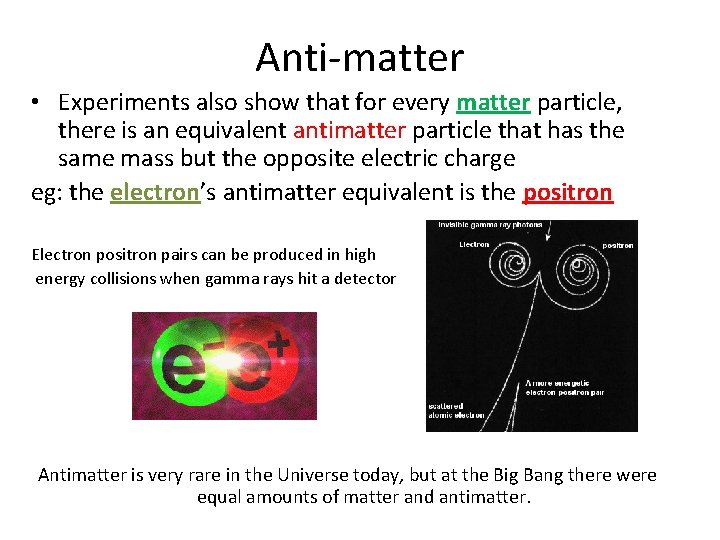
Anti-matter • Experiments also show that for every matter particle, there is an equivalent antimatter particle that has the same mass but the opposite electric charge eg: the electron’s antimatter equivalent is the positron Electron positron pairs can be produced in high energy collisions when gamma rays hit a detector Antimatter is very rare in the Universe today, but at the Big Bang there were equal amounts of matter and antimatter.
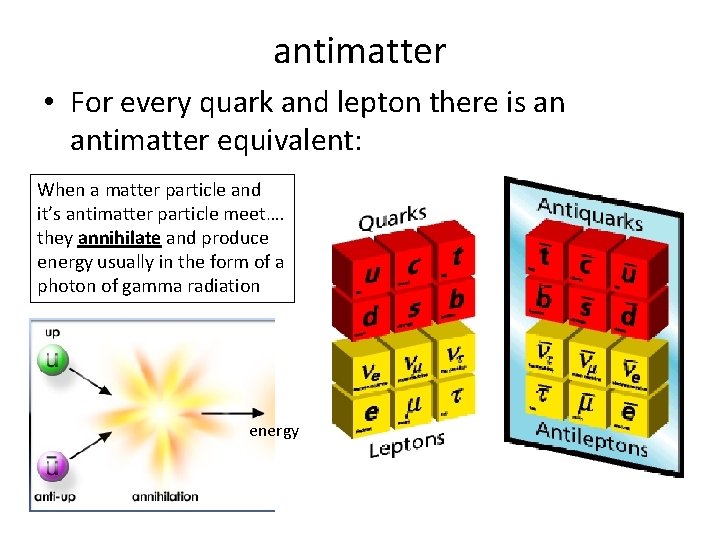
antimatter • For every quark and lepton there is an antimatter equivalent: When a matter particle and it’s antimatter particle meet…. they annihilate and produce energy usually in the form of a photon of gamma radiation energy
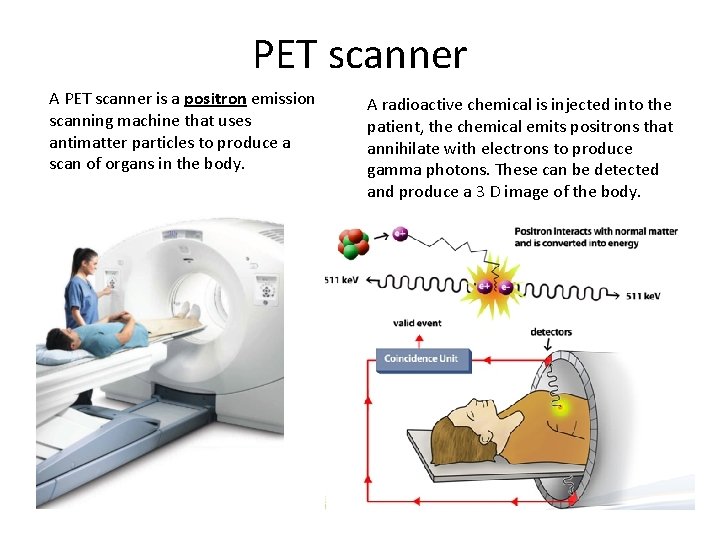
PET scanner A PET scanner is a positron emission scanning machine that uses antimatter particles to produce a scan of organs in the body. A radioactive chemical is injected into the patient, the chemical emits positrons that annihilate with electrons to produce gamma photons. These can be detected and produce a 3 D image of the body.