Experimental aspects of top quark physics Lecture 1




- Slides: 26
Experimental aspects of top quark physics Lecture #1 Regina Demina University of Rochester Topical Seminar on Frontier of Particle Physics Beijing, China 08/14/05 Regina Demina, Lecture #1
Regina Demina, University of Rochester Novosibirsk Rochester 08/14/05 Regina Demina, Lecture #1 2
Rochester, Ny www. pas. rochester. edu 08/14/05 Regina Demina, Lecture #1 3
Outline • • Introduction Colliders Parton density functions Top quark production – Meaning of luminosity • • Top quark decay Particle identification Top pair production cross section measurement Control questions 08/14/05 Regina Demina, Lecture #1 4
Energy and matter • Einstein taught us that matter and energy are equivalent E=mc 2 • We can use energy to create matter: – Protons and antiprotons are accelerated to high energies – They are then collided producing new more massive particles (matter), e. g. top quarks 08/14/05 Regina Demina, Lecture #1 That is why a convenient unit for mass is e. V/c 2 5
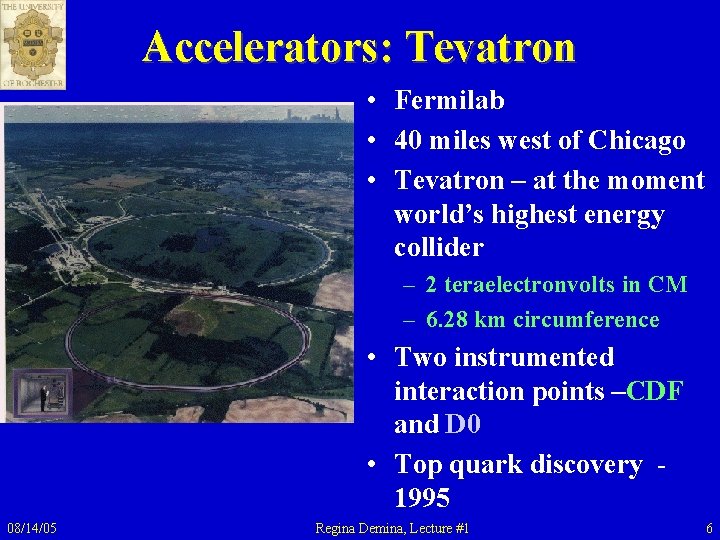
Accelerators: Tevatron • Fermilab • 40 miles west of Chicago • Tevatron – at the moment world’s highest energy collider – 2 teraelectronvolts in CM – 6. 28 km circumference • Two instrumented interaction points –CDF and D 0 • Top quark discovery 1995 08/14/05 Regina Demina, Lecture #1 6
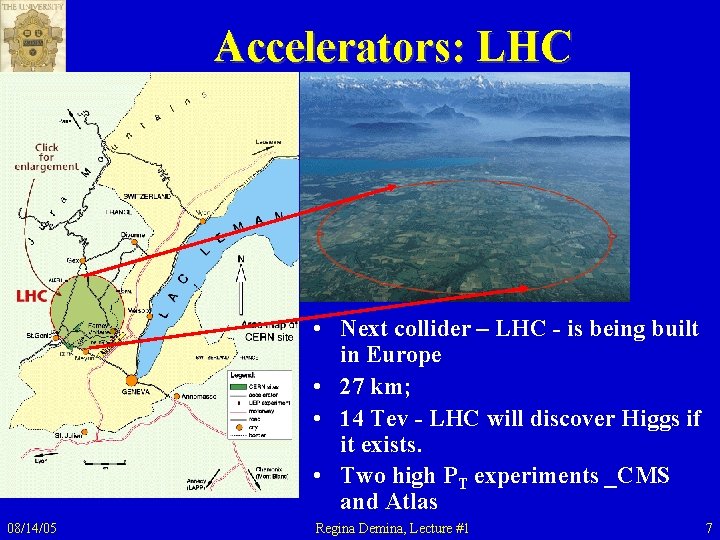
Accelerators: LHC • Next collider – LHC - is being built in Europe • 27 km; • 14 Tev - LHC will discover Higgs if it exists. • Two high PT experiments _CMS and Atlas 08/14/05 Regina Demina, Lecture #1 7
Parton density functions • • Proton (q=+1 e) is not an elementary particle It consists of three valence quarks uud (q=+2/3 e -1/3 e) Valence quarks interact with each other via gluons Gluons can split into a pair of virtual quarks Thus, in addition to valence quarks we have a Sea of quarks and gluons Same is true for antiprotons Quarks and gluons inside proton are called partons Probability for a parton to carry a certain fraction of momentum of proton x=p(parton)/p(proton) is called parton density function (pdf) • When proton and antiproton interact with each other only one parton from each participate in high p. T interaction d u u 08/14/05 Regina Demina, Lecture #1 8
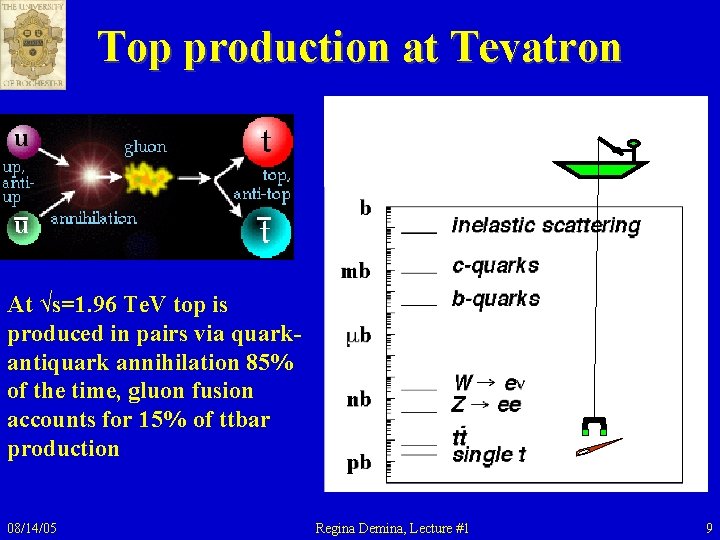
Top production at Tevatron At √s=1. 96 Te. V top is produced in pairs via quarkantiquark annihilation 85% of the time, gluon fusion accounts for 15% of ttbar production 08/14/05 Regina Demina, Lecture #1 9
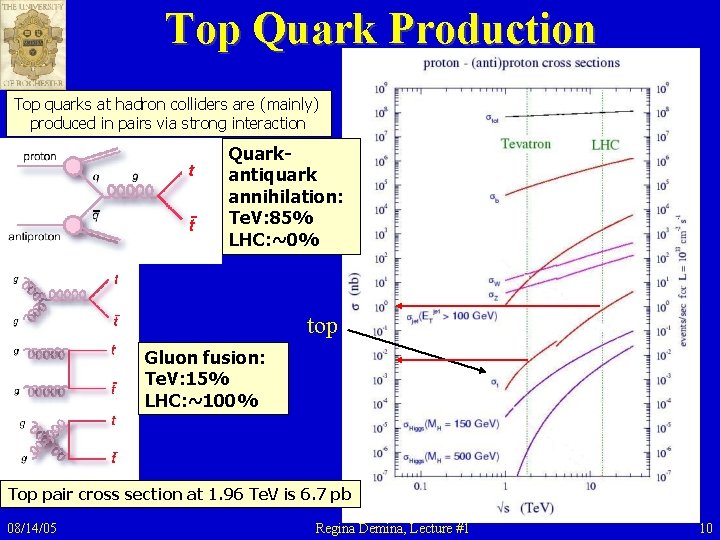
Top Quark Production Top quarks at hadron colliders are (mainly) produced in pairs via strong interaction Quarkantiquark annihilation: Te. V: 85% LHC: ~0% top Gluon fusion: Te. V: 15% LHC: ~100% Top pair cross section at 1. 96 Te. V is 6. 7 pb 08/14/05 Regina Demina, Lecture #1 10
Luminosity integrated luminosity 0. 75 fb-1 This is delivered luminosity instantaneous luminosity 1. 1032 cm-2 sec-1 Recorded or good for physics is lower 1/3 used in the analyses presented here 08/14/05 Regina Demina, Lecture #1 11
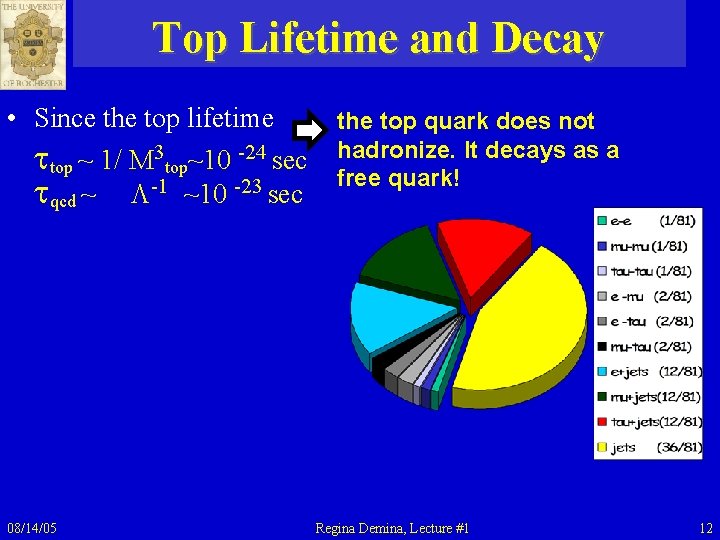
Top Lifetime and Decay • Since the top lifetime top ~ 1/ M 3 top~10 -24 sec qcd ~ -1 ~10 -23 sec 08/14/05 the top quark does not hadronize. It decays as a free quark! Regina Demina, Lecture #1 12
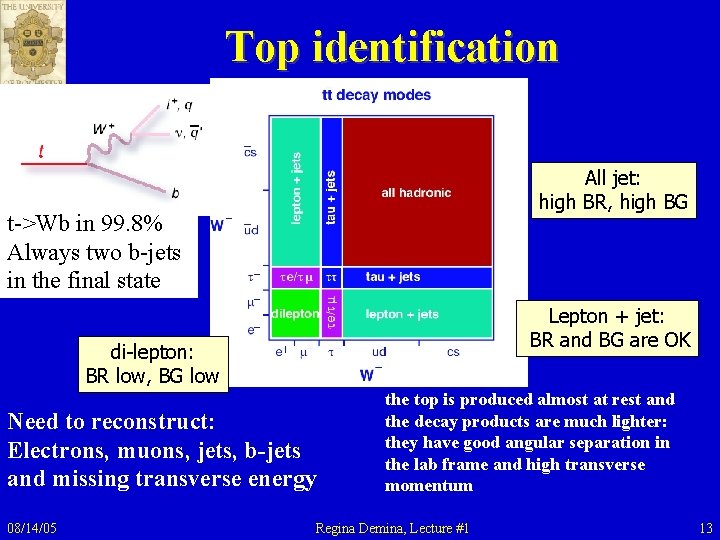
Top identification All jet: high BR, high BG t->Wb in 99. 8% Always two b-jets in the final state Lepton + jet: BR and BG are OK di-lepton: BR low, BG low Need to reconstruct: Electrons, muons, jets, b-jets and missing transverse energy 08/14/05 the top is produced almost at rest and the decay products are much lighter: they have good angular separation in the lab frame and high transverse momentum Regina Demina, Lecture #1 13
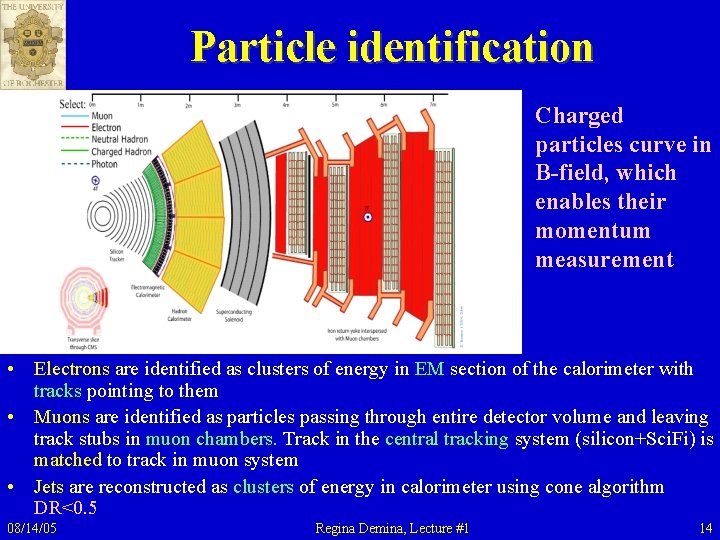
Particle identification Charged particles curve in B-field, which enables their momentum measurement • Electrons are identified as clusters of energy in EM section of the calorimeter with tracks pointing to them • Muons are identified as particles passing through entire detector volume and leaving track stubs in muon chambers. Track in the central tracking system (silicon+Sci. Fi) is matched to track in muon system • Jets are reconstructed as clusters of energy in calorimeter using cone algorithm DR<0. 5 08/14/05 Regina Demina, Lecture #1 14
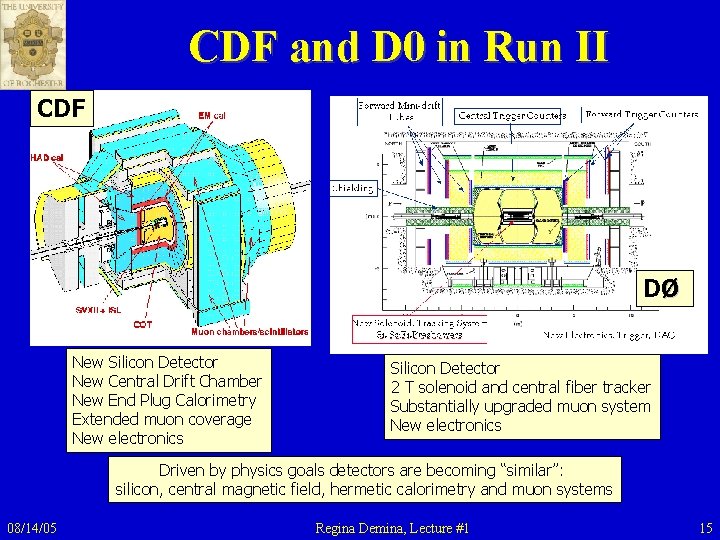
CDF and D 0 in Run II CDF DØ New Silicon Detector New Central Drift Chamber New End Plug Calorimetry Extended muon coverage New electronics Silicon Detector 2 T solenoid and central fiber tracker Substantially upgraded muon system New electronics Driven by physics goals detectors are becoming “similar”: silicon, central magnetic field, hermetic calorimetry and muon systems 08/14/05 Regina Demina, Lecture #1 15
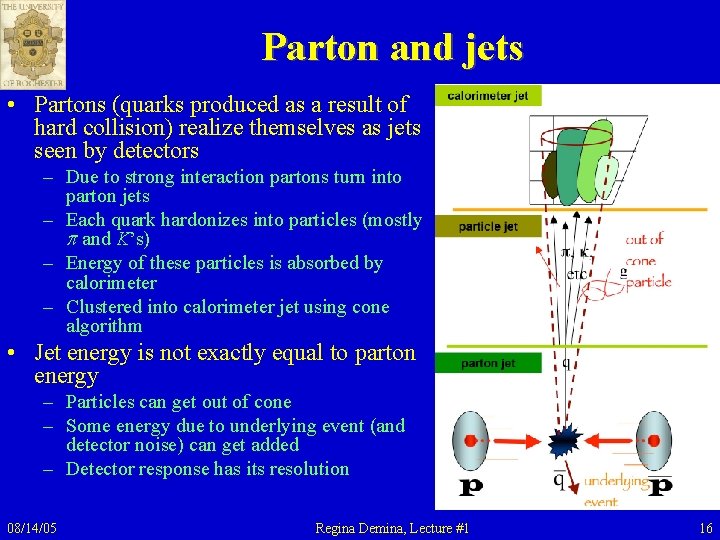
Parton and jets • Partons (quarks produced as a result of hard collision) realize themselves as jets seen by detectors – Due to strong interaction partons turn into parton jets – Each quark hardonizes into particles (mostly p and K’s) – Energy of these particles is absorbed by calorimeter – Clustered into calorimeter jet using cone algorithm • Jet energy is not exactly equal to parton energy – Particles can get out of cone – Some energy due to underlying event (and detector noise) can get added – Detector response has its resolution 08/14/05 Regina Demina, Lecture #1 16
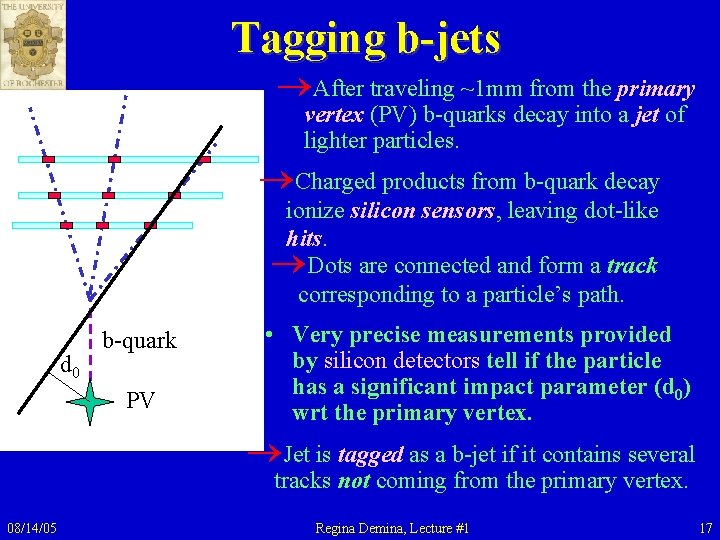
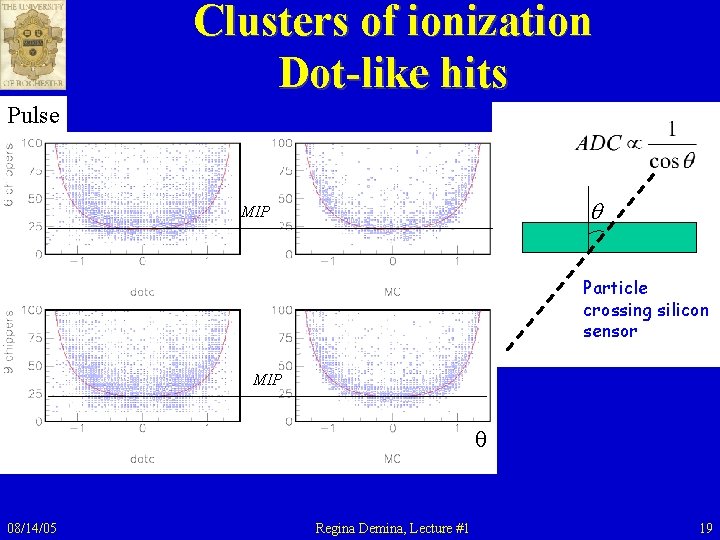
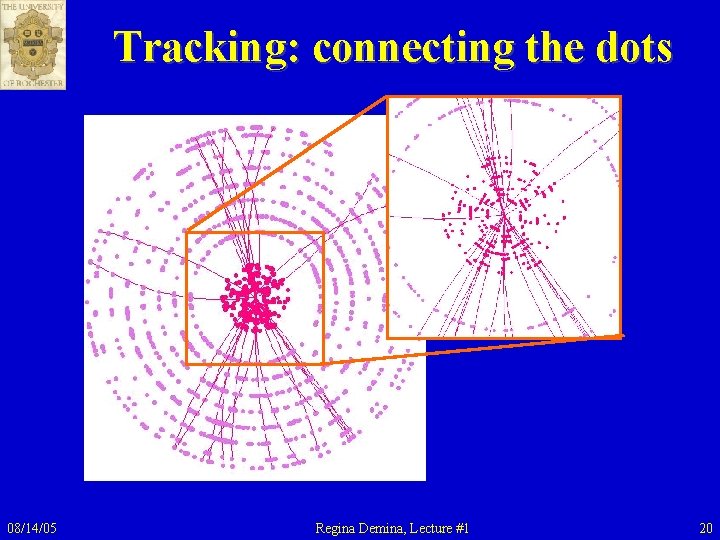
Tagging b-jets ®After traveling ~1 mm from the primary vertex (PV) b-quarks decay into a jet of lighter particles. ®Charged products from b-quark decay ionize silicon sensors, leaving dot-like hits. ®Dots are connected and form a track corresponding to a particle’s path. d 0 b-quark PV • Very precise measurements provided by silicon detectors tell if the particle has a significant impact parameter (d 0) wrt the primary vertex. ®Jet is tagged as a b-jet if it contains several tracks not coming from the primary vertex. 08/14/05 Regina Demina, Lecture #1 17
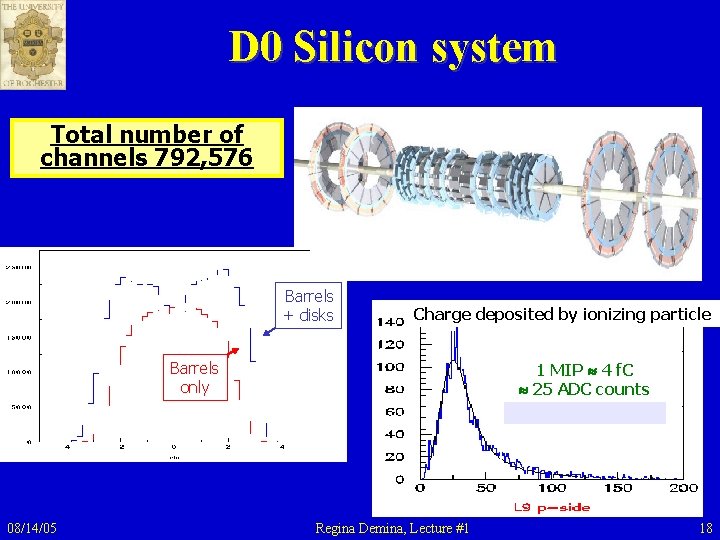
D 0 Silicon system Total number of channels 792, 576 Barrels + disks Charge deposited by ionizing particle Barrels only 08/14/05 1 MIP 4 f. C 25 ADC counts Regina Demina, Lecture #1 18
Clusters of ionization Dot-like hits Pulse q MIP Particle crossing silicon sensor MIP q 08/14/05 Regina Demina, Lecture #1 19
Tracking: connecting the dots 08/14/05 Regina Demina, Lecture #1 20
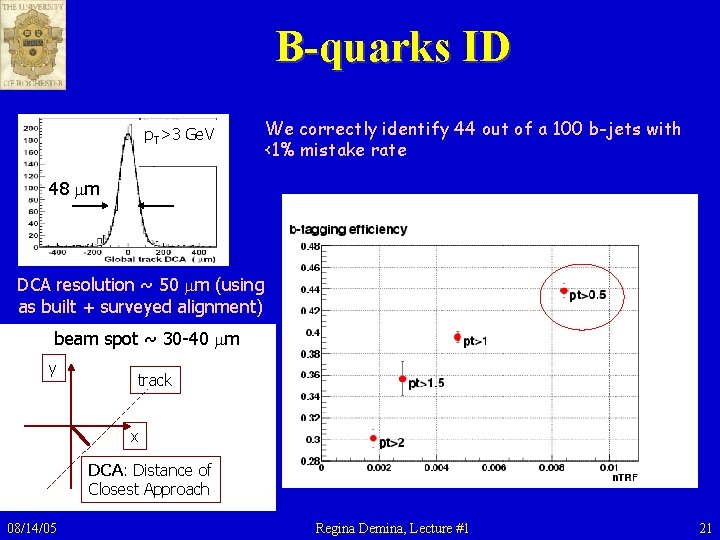
B-quarks ID p. T>3 Ge. V We correctly identify 44 out of a 100 b-jets with <1% mistake rate 48 m DCA resolution ~ 50 m (using as built + surveyed alignment) beam spot ~ 30 -40 m y track x DCA: Distance of Closest Approach 08/14/05 Regina Demina, Lecture #1 21
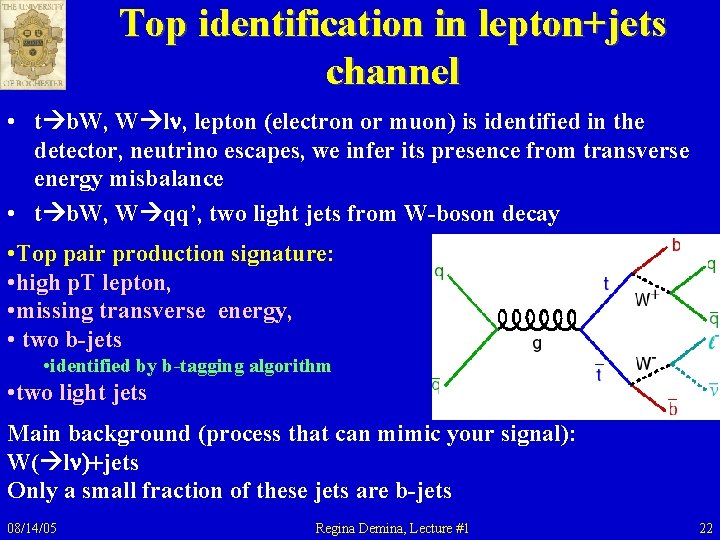
Top identification in lepton+jets channel • t b. W, W ln, lepton (electron or muon) is identified in the detector, neutrino escapes, we infer its presence from transverse energy misbalance • t b. W, W qq’, two light jets from W-boson decay • Top pair production signature: • high p. T lepton, • missing transverse energy, • two b-jets • identified by b-tagging algorithm • two light jets Main background (process that can mimic your signal): W( ln)+jets Only a small fraction of these jets are b-jets 08/14/05 Regina Demina, Lecture #1 22
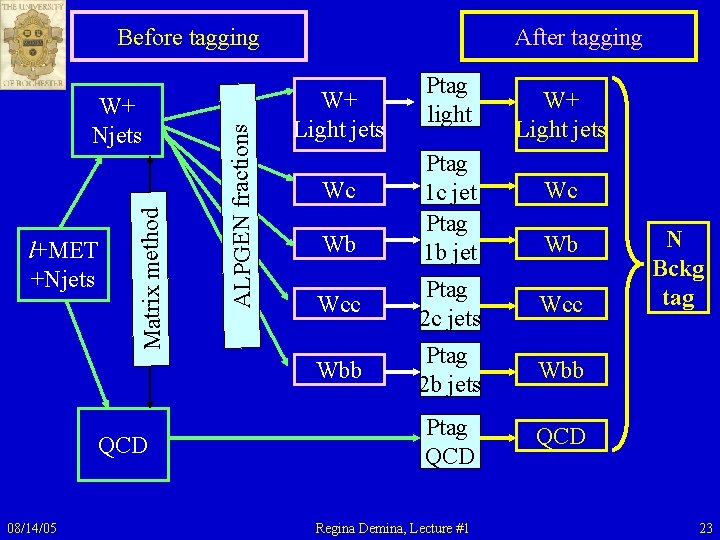
l+MET +Njets Matrix method W+ Njets QCD 08/14/05 ALPGEN fractions Before tagging After tagging W+ Light jets Wc Wb Ptag light Ptag 1 c jet Ptag 1 b jet W+ Light jets Wc Wb Wcc Ptag 2 c jets Wcc Wbb Ptag 2 b jets Wbb Ptag QCD Regina Demina, Lecture #1 N Bckg tag 23
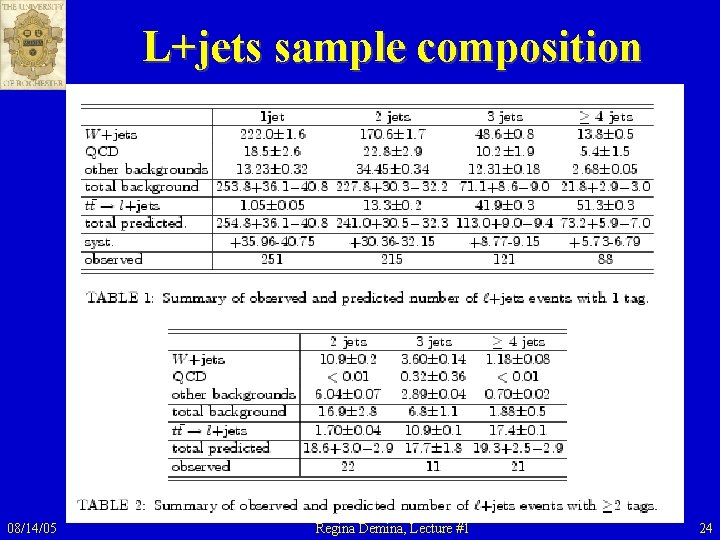
L+jets sample composition 08/14/05 Regina Demina, Lecture #1 24
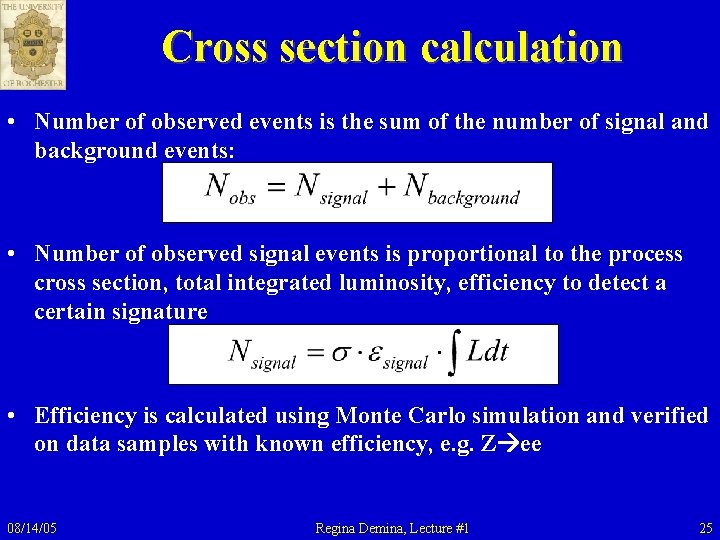
Cross section calculation • Number of observed events is the sum of the number of signal and background events: • Number of observed signal events is proportional to the process cross section, total integrated luminosity, efficiency to detect a certain signature • Efficiency is calculated using Monte Carlo simulation and verified on data samples with known efficiency, e. g. Z ee 08/14/05 Regina Demina, Lecture #1 25
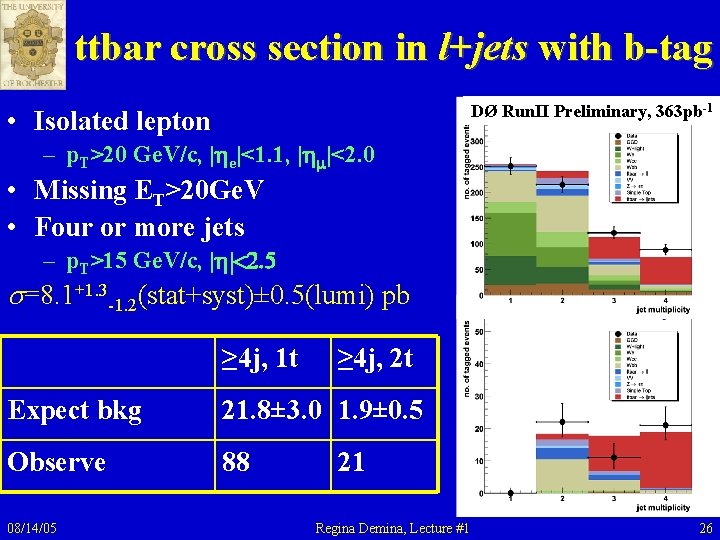
ttbar cross section in l+jets with b-tag DØ Run. II Preliminary, 363 pb-1 • Isolated lepton – p. T>20 Ge. V/c, |he|<1. 1, |hm|<2. 0 • Missing ET>20 Ge. V • Four or more jets – p. T>15 Ge. V/c, |h|<2. 5 s=8. 1+1. 3 -1. 2(stat+syst)± 0. 5(lumi) pb ≥ 4 j, 1 t ≥ 4 j, 2 t Expect bkg 21. 8± 3. 0 1. 9± 0. 5 Observe 88 08/14/05 21 Regina Demina, Lecture #1 26