
Towards a constituent quark model description of baryon
Towards a constituent quark model description of baryon spectroscopy. J. Vijande, University of Valencia (Spain) A. Valcarce, University of Salamanca (Spain) H. Garcilazo, Instituto Politecnico Nacional (Mexico) P. Gonzalez, University of Valencia (Spain) 11/23/2020 1
Outline • QCD: Hadron physics & constituent quark model • Modeling QCD. A constituent quark model. • Light baryons. • Heavy baryons. • The missing states. • Summary 11/23/2020 2
QCD. Hadron physics & quark model QCD is the correct theory of the strong interaction. It has been tested to very high accuracy in the perturbative regime. The low energy sector (“strong QCD”), i. e. hadron physics, remains challenging “I am convinced that the keys to a qualitative understanding of “Strong QCD” are the same as in most other areas of physics: identifying the appropriate degrees of freedom and the effective forces between them. ” N. Isgur, Overview talk at N*2000, nucl-th/0007008 All roads lead to valence “constituent quarks” and effective forces inspired in the properties of QCD: asymptotic freedom, confinement and chiral symmetry Constituent quark models Constituent quarks (appropriate degrees of freedom) behave in a remarkably simple fashion Effective forces: confining mechanism, a spin-spin force ( - , - ) and a long-range force The limitations of the quark model are as obvious as its successes. Nevertheless almost all hadrons can be classified as relatively simple configurations of a few confined quarks. Although quark models differ in their details, the qualitative aspects of their spectra are determined by features that they share in common, these ingredients can be used to project expectations for new sectors. 11/23/2020 3
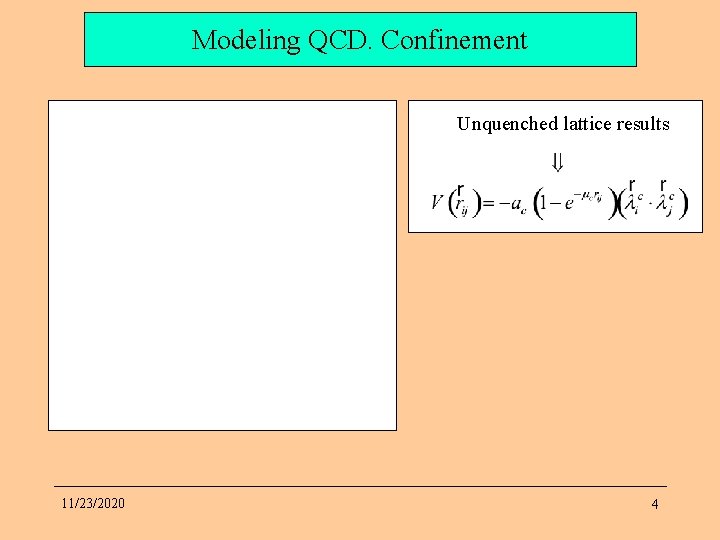
Modeling QCD. Confinement Quenched lattice results 11/23/2020 Unquenched lattice results 4
Modeling QCD. Goldstone boson exchange Chiral symmetry is spontaneously broken in the light quark sector. Exchange of Goldstone bosons between light (qq) quarks But! Chiral symmetry is explicitely broken in the heavy quark sector due to the large current quark masses. Exchange of Goldstone bosons DO NOT contribute between heavy (QQ) and heavy-light (Qq) quarks 11/23/2020 5
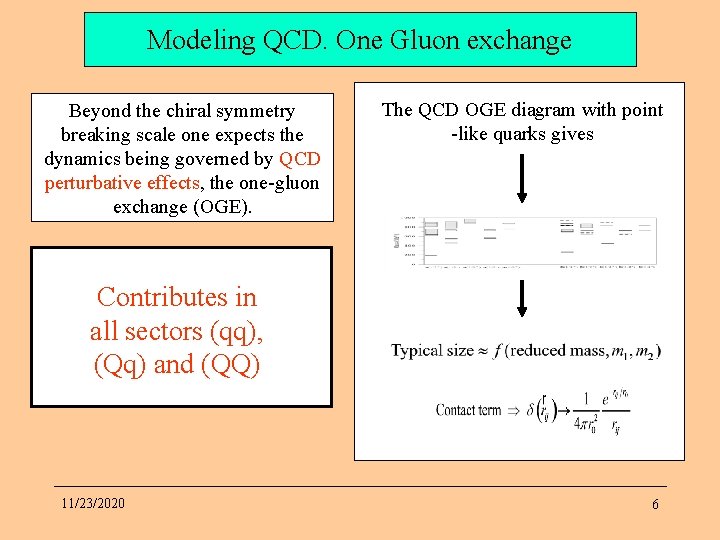
Modeling QCD. One Gluon exchange Beyond the chiral symmetry breaking scale one expects the dynamics being governed by QCD perturbative effects, the one-gluon exchange (OGE). Contributes in all sectors (qq), (Qq) and (QQ) 11/23/2020 The QCD OGE diagram with point S=1 -like quarks gives S=0 mq 6
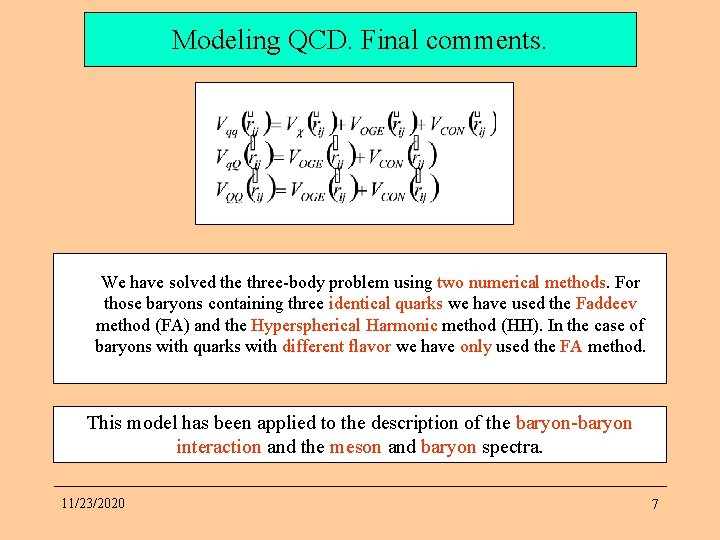
Modeling QCD. Final comments. We have solved the three-body problem using two numerical methods. For those baryons containing three identical quarks we have used the Faddeev method (FA) and the Hyperspherical Harmonic method (HH). In the case of baryons with quarks with different flavor we have only used the FA method. This model has been applied to the description of the baryon-baryon interaction and the meson and baryon spectra. 11/23/2020 7
CQM results. Light sector PRC 72, 025206 (2005) 11/23/2020 8
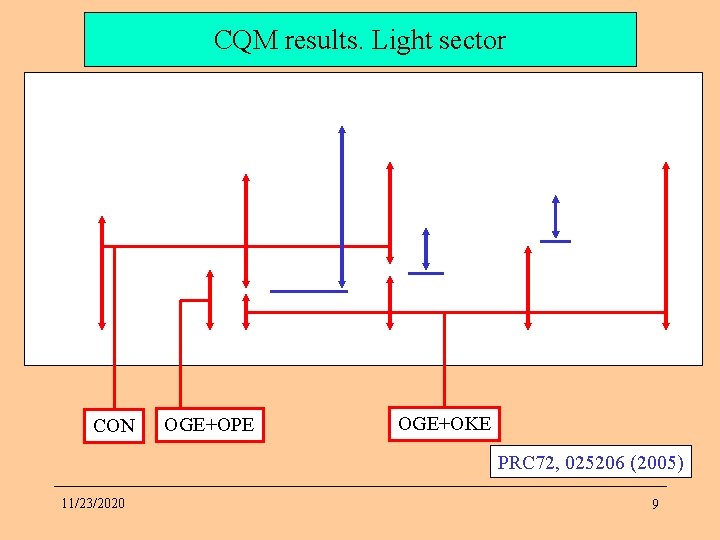
CQM results. Light sector CON OGE+OPE OGE+OKE PRC 72, 025206 (2005) 11/23/2020 9
Heavy baryons 1985 Bjorken: “ We should strive to study triply charmed baryons because their excitation spectrum should be close to the perturbative QCD regime. For their size scales the quark-gluon coupling constant is small and therefore the leading term in the perturbative expansion may be enough” nn. QQ QQQ • The larger the number of heavy quarks the simpler the system • n. QQ and QQQ one-gluon exchange and confinement • nn. Q there is still some residual interaction between light quarks • nn. Q and n. QQ, the presence of light and heavy quarks may allow to learn about the flavor dependence of the one-gluon exchange potential • Ideal systems to study the assumed flavor independence of confinement 11/23/2020 10
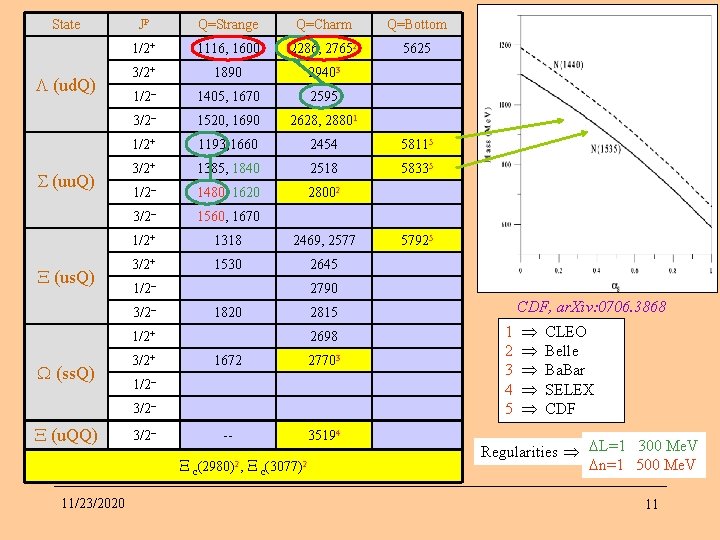
State (ud. Q) S (uu. Q) (us. Q) JP Q=Strange Q=Charm Q=Bottom 1/2+ 1116, 1600 2286, 27652 5625 3/2+ 1890 29403 1/2– 1405, 1670 2595 3/2– 1520, 1690 2628, 28801 1/2+ 1193, 1660 2454 58115 3/2+ 1385, 1840 2518 58335 1/2– 1480, 1620 28002 3/2– 1560, 1670 1/2+ 1318 2469, 2577 3/2+ 1530 2645 1/2– 3/2– 2790 1820 1/2+ (ss. Q) 3/2+ 2698 1672 27703 -- 35194 1/2– 3/2– c(2980)2, c(3077)2 11/23/2020 CDF, ar. Xiv: 0706. 3868 2815 3/2– (u. QQ) 57925 1 2 3 4 5 CLEO Belle Ba. Bar SELEX CDF Regularities L=1 300 Me. V n=1 500 Me. V 11
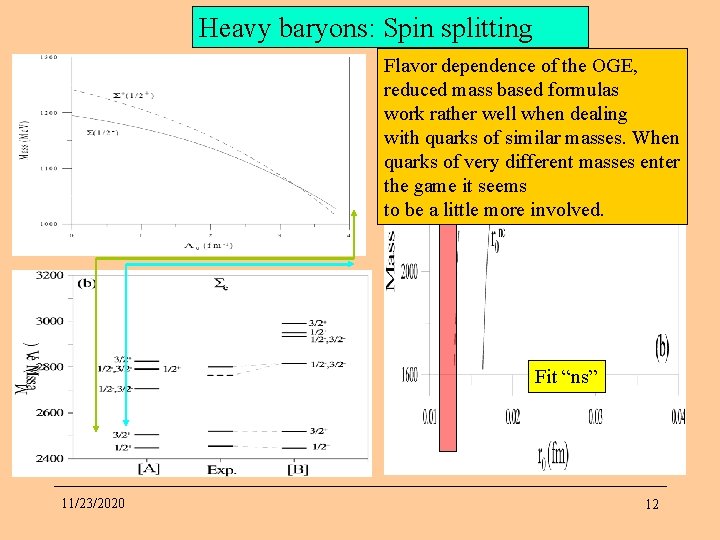
Heavy baryons: Spin splitting Flavor dependence of the OGE, reduced mass based formulas work rather well when dealing with quarks of similar masses. When quarks of very different masses enter the game it seems to be a little more involved. Fit “ns” 11/23/2020 12
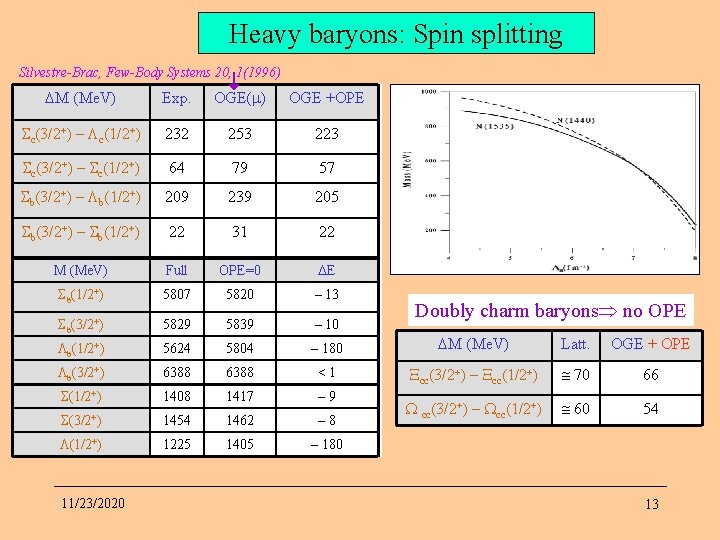
Heavy baryons: Spin splitting Silvestre-Brac, Few-Body Systems 20, 1(1996) M (Me. V) Exp. OGE( ) OGE +OPE Sc(3/2+) – c(1/2+) 232 253 223 Sc(3/2+) – Sc(1/2+) 64 79 57 Sb(3/2+) – b(1/2+) 209 239 205 Sb(3/2+) – Sb(1/2+) 22 31 22 M (Me. V) Full OPE=0 E Sb(1/2+) 5807 5820 – 13 Sb(3/2+) 5829 5839 – 10 b(1/2+) 5624 5804 – 180 M (Me. V) Latt. OGE + OPE b(3/2+) 6388 <1 cc(3/2+) – cc(1/2+) 70 66 S(1/2+) 1408 1417 – 9 S(3/2+) 1454 1462 – 8 cc(3/2+) – cc(1/2+) 60 54 (1/2+) 1225 1405 – 180 11/23/2020 Doubly charm baryons no OPE 13
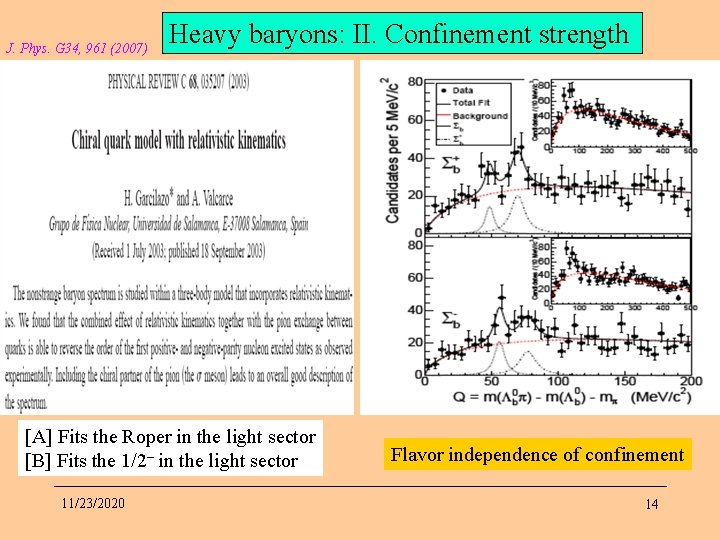
J. Phys. G 34, 961 (2007) Heavy baryons: II. Confinement strength [A] Fits the Roper in the light sector [B] Fits the 1/2– in the light sector 11/23/2020 Flavor independence of confinement 14
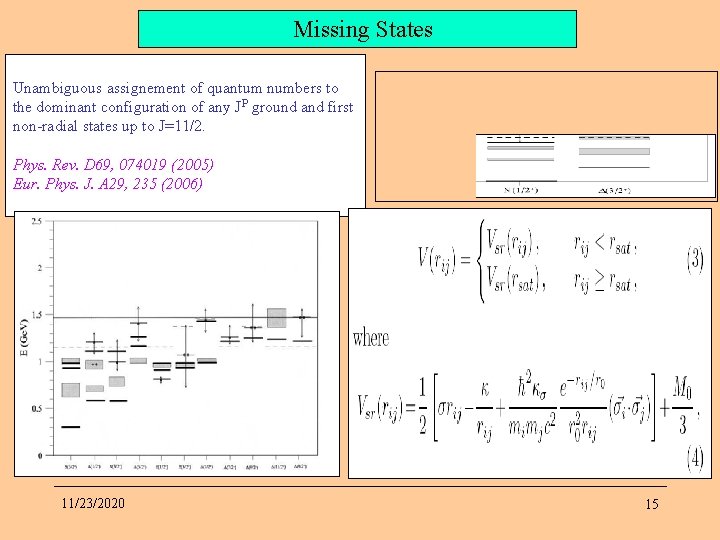
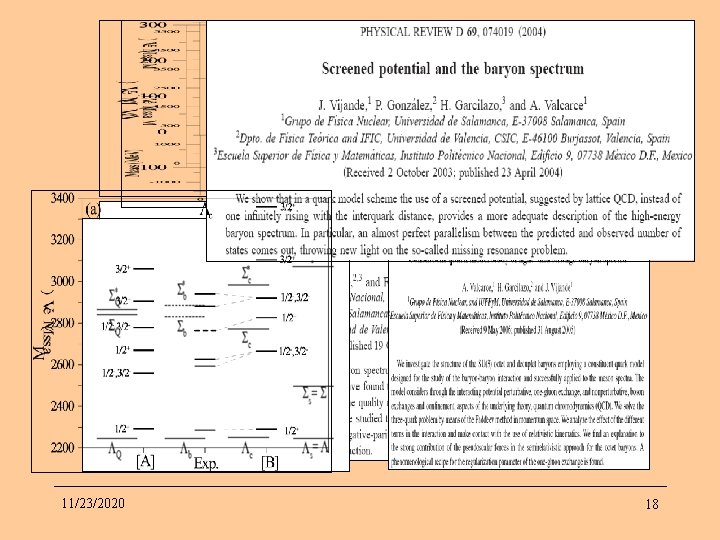
Missing States Lattice QCD shows that theof QQ potential saturates Unambiguous assignement quantum numbers to sharply for a breaking distance of 1. 25 fm P the dominant configuration of any J ground and first corresponding to up a saturation non-radial states to J=11/2. energy about twice the B-meson mass, indicating that the formation of two heavy-light subsystems Phys. Rev. D 69, 074019(B, B) (2005)is energetically favored Bali et al. , Phys. Rev. D 71, 074019 (2005) Eur. Phys. J. A 29, 235 (2006) 11/23/2020 15
Summary • There is an increasing interest in hadron spectroscopy due to the advent of a large number of experimental data in several cases of difficult explanation. • These data provide with the best laboratory for studying the predictions of QCD in what has been called the strong limit. We have the methods, so we can learn about the dynamics. • Although we do not believe that explanations based on constituent quark models may rule out or contradict other alternative ones, one should, at the very least, acknowledge the capability of constituent quark models for a coherent understanding of the low-energy phenomena of the hadron spectroscopy and the baryon-baryon interaction in a simple framework based on the contribution of pseudoscalar, scalar and one-gluon-exchange forces between quarks. J. Phys. G 34 (2007) 961 Eur. Phys. J. A 29 (2006) 235 Phys. Rev. C 72 (2005) 025206 11/23/2020 J. Phys. G 31 (2005) 481 Phys. Rev. D 70 (2004) 054022 Phys. Rev. D 69 (2004) 074019 16
11/23/2020 17
11/23/2020 18
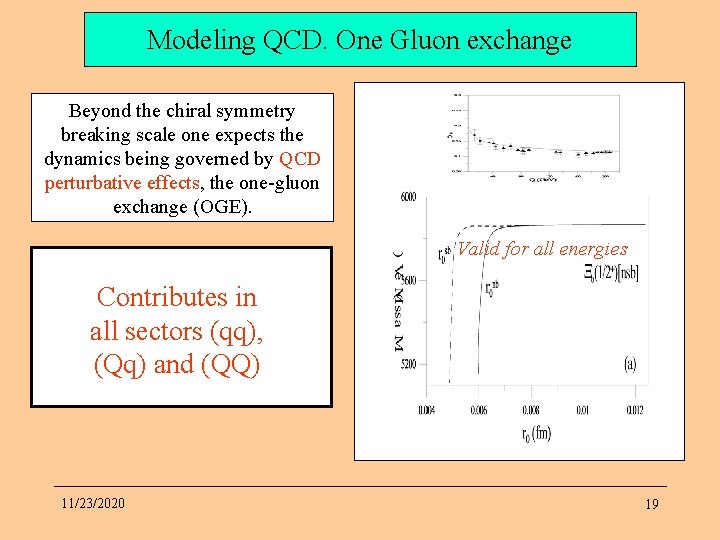
Modeling QCD. One Gluon exchange Beyond the chiral symmetry breaking scale one expects the dynamics being governed by QCD perturbative effects, the one-gluon exchange (OGE). The QCD OGE diagram with point S=1 -like quarks gives Valid for all energies Contributes in all sectors (qq), (Qq) and (QQ) 11/23/2020 S=0 mq 19
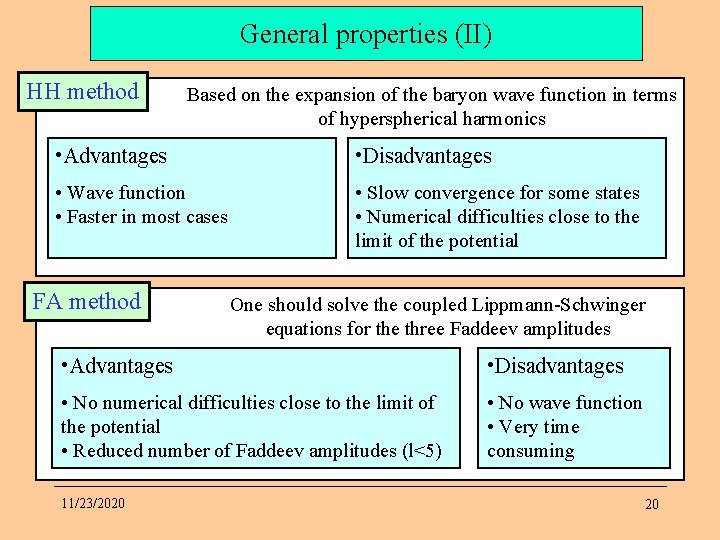
General properties (II) HH method Based on the expansion of the baryon wave function in terms of hyperspherical harmonics • Advantages • Disadvantages • Wave function • Faster in most cases • Slow convergence for some states • Numerical difficulties close to the limit of the potential FA method One should solve the coupled Lippmann-Schwinger equations for the three Faddeev amplitudes • Advantages • Disadvantages • No numerical difficulties close to the limit of the potential • Reduced number of Faddeev amplitudes (l<5) • No wave function • Very time consuming 11/23/2020 20
- Slides: 20