
Two topics on dense quark matter http www
- Slides: 38
Two topics on dense quark matter http: //www. pbase. com/daveb/image
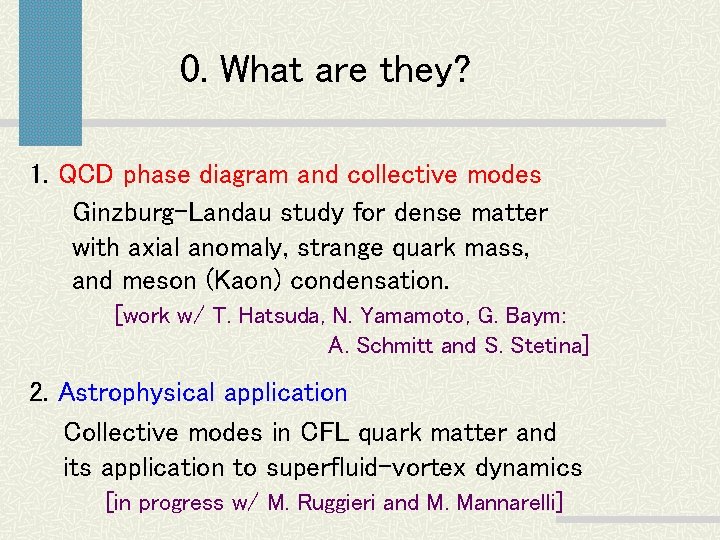
0. What are they? 1. QCD phase diagram and collective modes Ginzburg-Landau study for dense matter with axial anomaly, strange quark mass, and meson (Kaon) condensation. [work w/ T. Hatsuda, N. Yamamoto, G. Baym: A. Schmitt and S. Stetina] 2. Astrophysical application Collective modes in CFL quark matter and its application to superfluid-vortex dynamics [in progress w/ M. Ruggieri and M. Mannarelli]
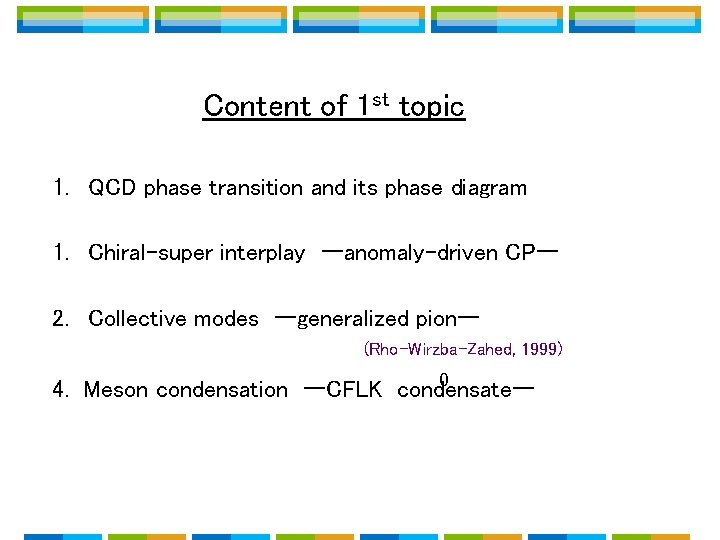
Content of 1 st topic 1. QCD phase transition and its phase diagram 1. Chiral-super interplay ーanomaly-driven CPー 2. Collective modes ーgeneralized pionー (Rho-Wirzba-Zahed, 1999) 0 4. Meson condensation ーCFLK condensateー
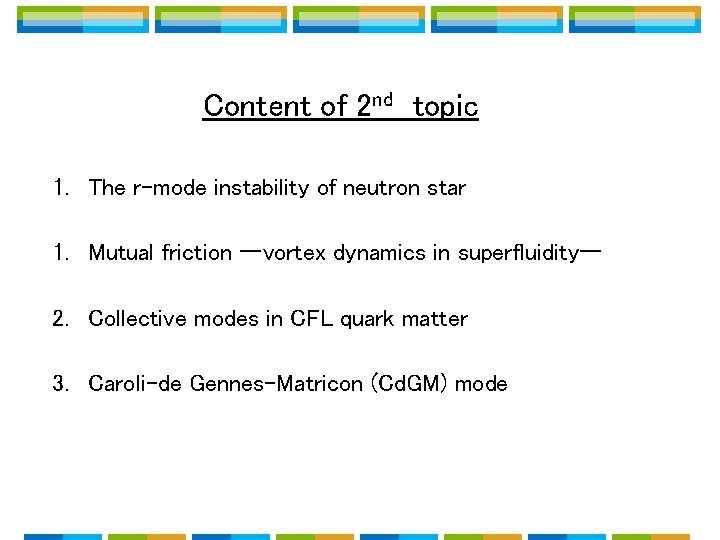
Content of 2 nd topic 1. The r-mode instability of neutron star 1. Mutual friction ーvortex dynamics in superfluidityー 2. Collective modes in CFL quark matter 3. Caroli-de Gennes-Matricon (Cd. GM) mode
3 recent topics of NS observations
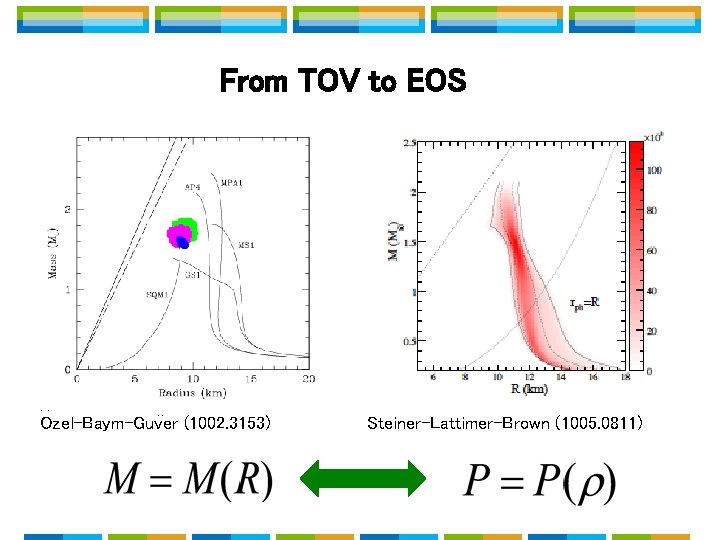
From TOV to EOS . . Ozel-Baym-Guver (1002. 3153) Steiner-Lattimer-Brown (1005. 0811)
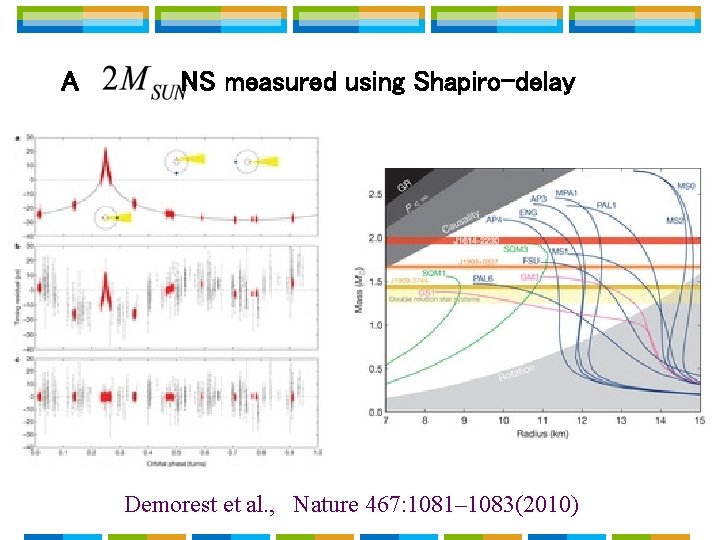
A NS measured using Shapiro-delay Demorest et al. , Nature 467: 1081– 1083(2010)
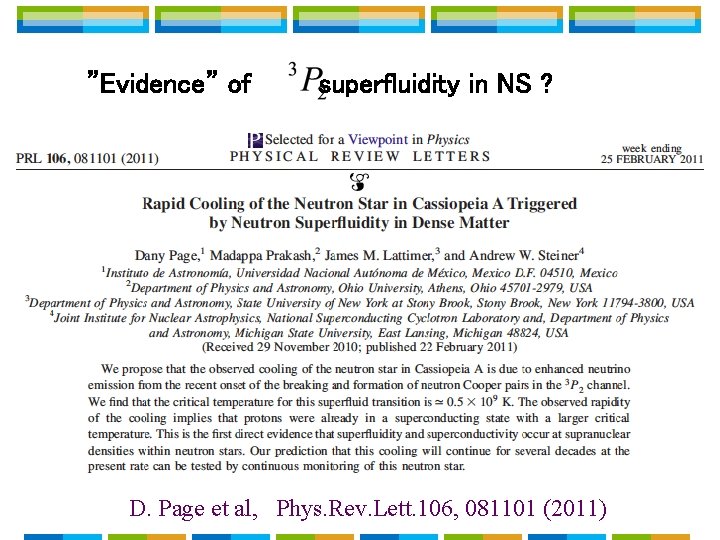
”Evidence” of superfluidity in NS ? D. Page et al, Phys. Rev. Lett. 106, 081101 (2011)
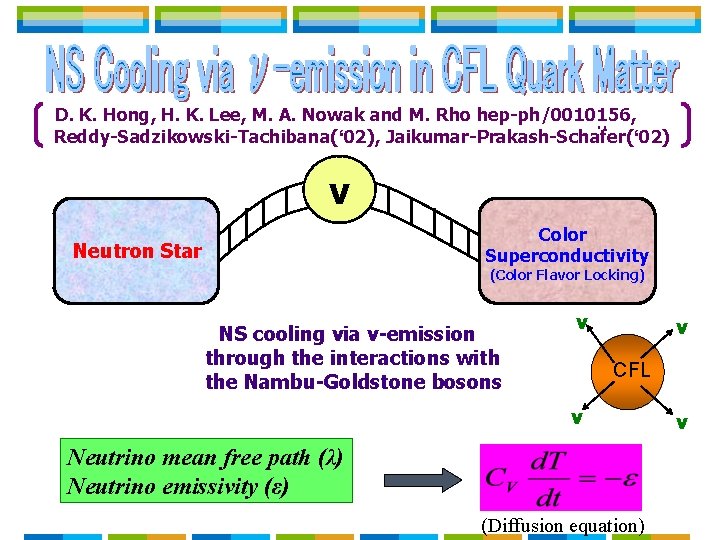
D. K. Hong, H. K. Lee, M. A. Nowak and M. Rho hep-ph/0010156, . . Reddy-Sadzikowski-Tachibana(‘ 02), Jaikumar-Prakash-Schafer(‘ 02) ν Color Superconductivity Neutron Star (Color Flavor Locking) NS cooling via ν-emission through the interactions with the Nambu-Goldstone bosons ν ν CFL ν Neutrino mean free path (λ) Neutrino emissivity (ε) (Diffusion equation) ν
1. Ginzburg-Landau study in dense QCD: chiral-super interplay, axial anomaly, and meson condensation(s) Quark matter (KOSHI-AN) Hadrons (AZUKI) Hadronic matter (TSUBU-AN)
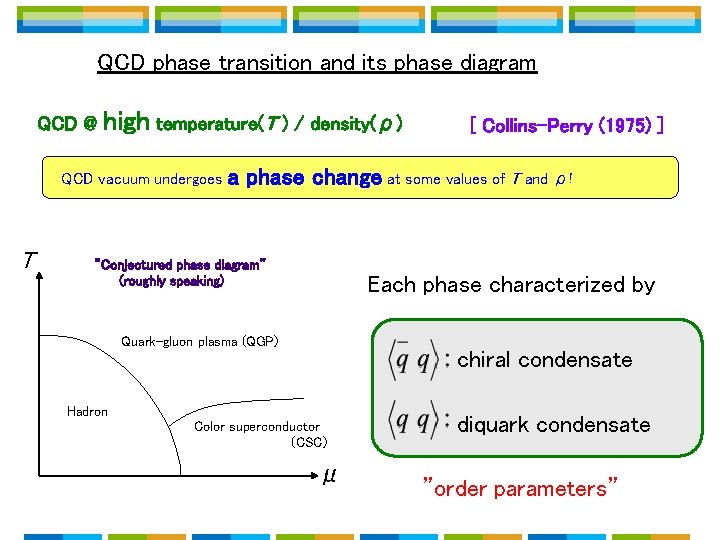
QCD phase transition and its phase diagram QCD @ high temperature(T ) / density(ρ) QCD vacuum undergoes T [ Collins-Perry (1975) ] a phase change at some values of T and ρ! “Conjectured phase diagram” (roughly speaking) Each phase characterized by Quark-gluon plasma (QGP) chiral condensate Hadron Color superconductor (CSC) μ diquark condensate ”order parameters”
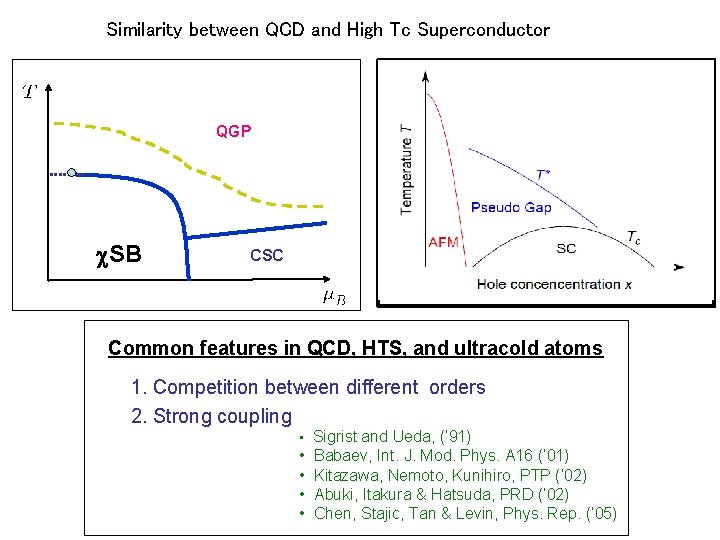
Similarity between QCD and High Tc Superconductor QGP c. SB CSC Common features in QCD, HTS, and ultracold atoms 1. Competition between different orders 2. Strong coupling • Sigrist and Ueda, (‘ 91) • • Babaev, Int. J. Mod. Phys. A 16 (‘ 01) Kitazawa, Nemoto, Kunihiro, PTP (‘ 02) Abuki, Itakura & Hatsuda, PRD (’ 02) Chen, Stajic, Tan & Levin, Phys. Rep. (’ 05)
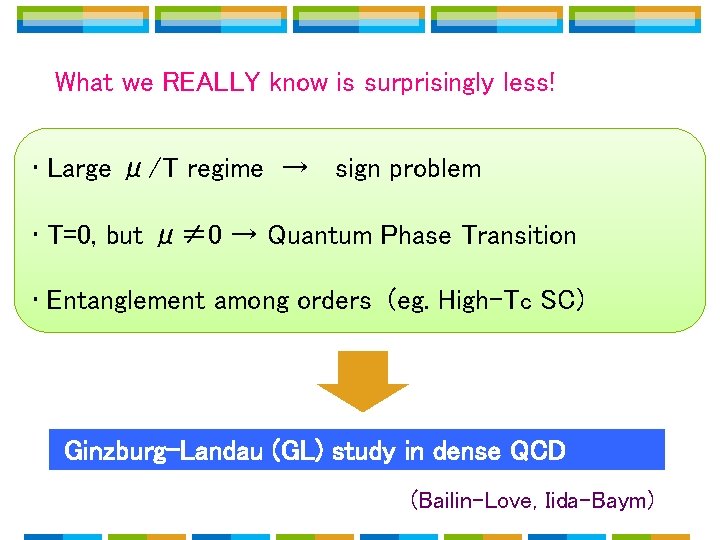
What we REALLY know is surprisingly less! • Large μ/T regime → sign problem • T=0, but μ≠ 0 → Quantum Phase Transition • Entanglement among orders (eg. High-Tc SC) Ginzburg-Landau (GL) study in dense QCD (Bailin-Love, Iida-Baym)
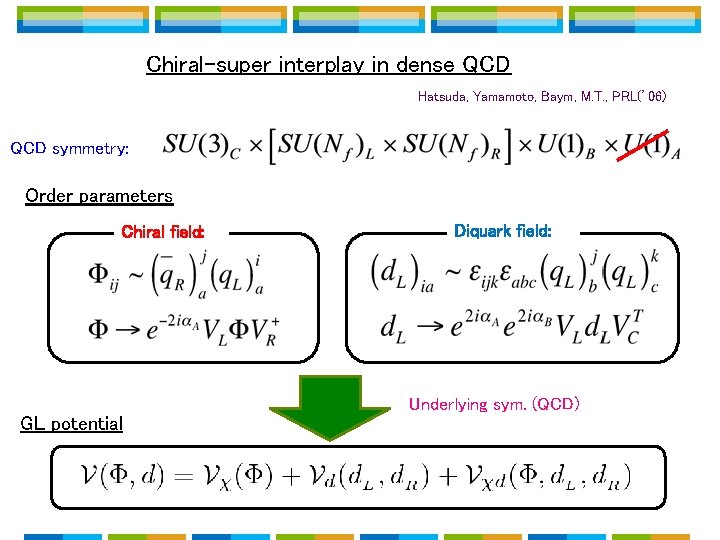
Chiral-super interplay in dense QCD Hatsuda, Yamamoto, Baym, M. T. , PRL(’ 06) QCD symmetry: Order parameters Chiral field: GL potential Diquark field: Underlying sym. (QCD)
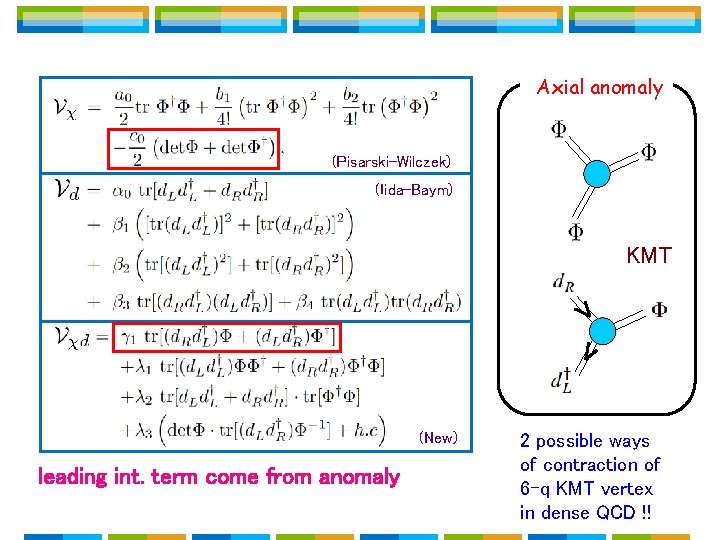
Axial anomaly (Pisarski-Wilczek) (Iida-Baym) KMT (New) leading int. term come from anomaly 2 possible ways of contraction of 6 -q KMT vertex in dense QCD !!
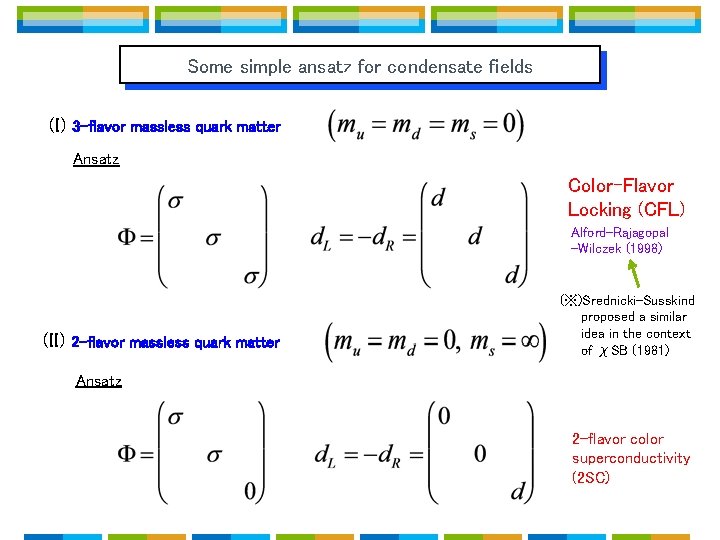
Some simple ansatz for condensate fields (I) 3 -flavor massless quark matter Ansatz Color-Flavor Locking (CFL) Alford-Rajagopal -Wilczek (1998) (II) 2 -flavor massless quark matter (※)Srednicki-Susskind proposed a similar idea in the context of χSB (1981) Ansatz 2 -flavor color superconductivity (2 SC)
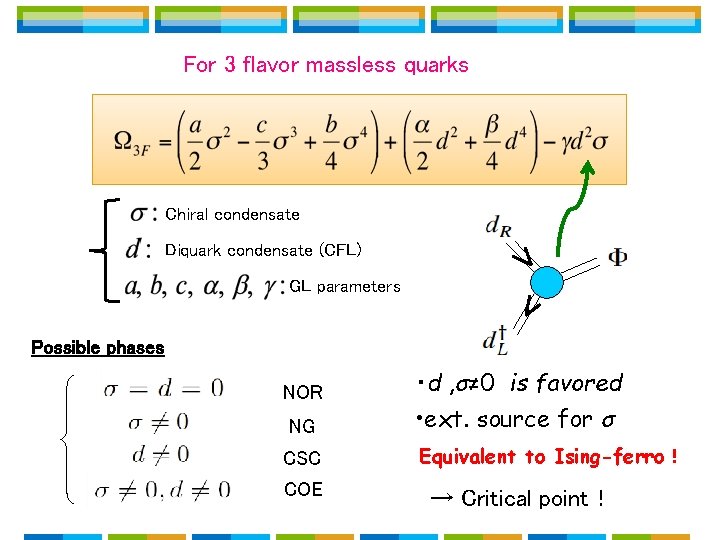
For 3 flavor massless quarks Chiral condensate Diquark condensate (CFL) GL parameters Possible phases NOR ・d , σ≠ 0 is favored NG • ext. source for σ CSC Equivalent to Ising-ferro! COE → Critical point!
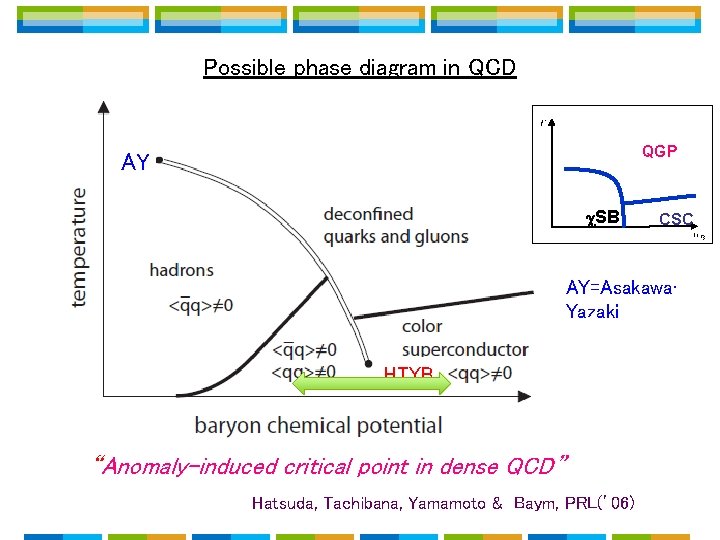
Possible phase diagram in QCD QGP AY c. SB CSC AY=Asakawa • Yazaki HTYB “Anomaly-induced critical point in dense QCD” Hatsuda, Tachibana, Yamamoto & Baym, PRL(’ 06)
Collective modes ----pions at intermediate density--A concrete realization of quark-hadron continuity?
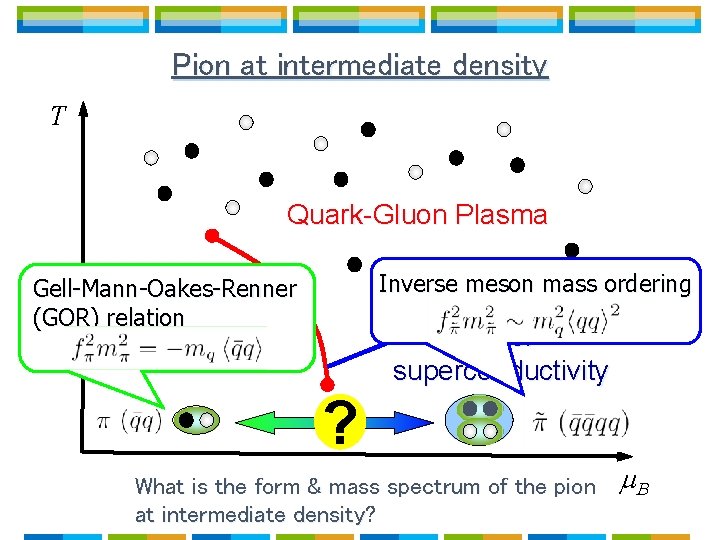
Pion at intermediate density T Quark-Gluon Plasma Inverse meson mass ordering Gell-Mann-Oakes-Renner (GOR) relation Hadrons Color superconductivity ? What is the form & mass spectrum of the pion at intermediate density? density m. B
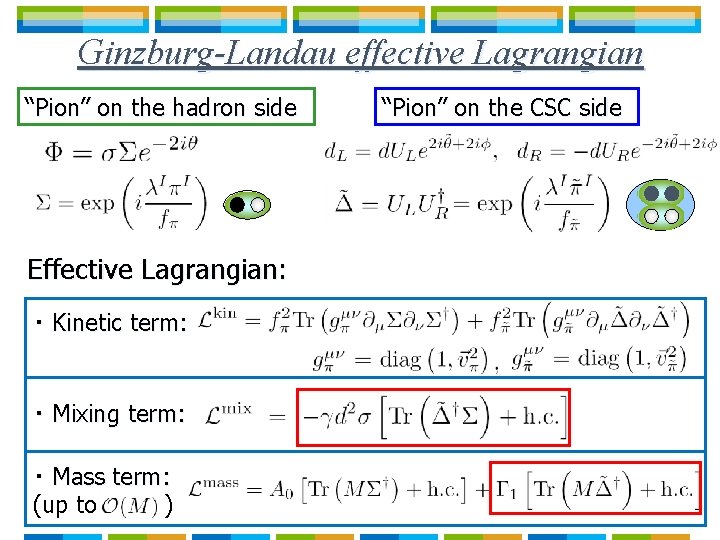
Ginzburg-Landau effective Lagrangian “Pion” on the hadron side Effective Lagrangian: ・ Kinetic term: ・ Mixing term: ・ Mass term: (up to ) “Pion” on the CSC side
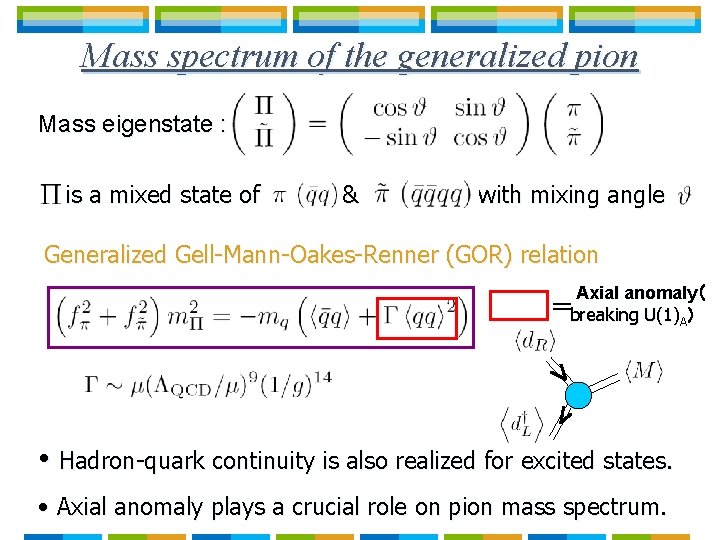
Mass spectrum of the generalized pion Mass eigenstate : Iis a mixed state of & with mixing angle. Generalized Gell-Mann-Oakes-Renner (GOR) relation Axial anomaly( =breaking U(1)A) • Hadron-quark continuity is also realized for excited states. • Axial anomaly plays a crucial role on pion mass spectrum.
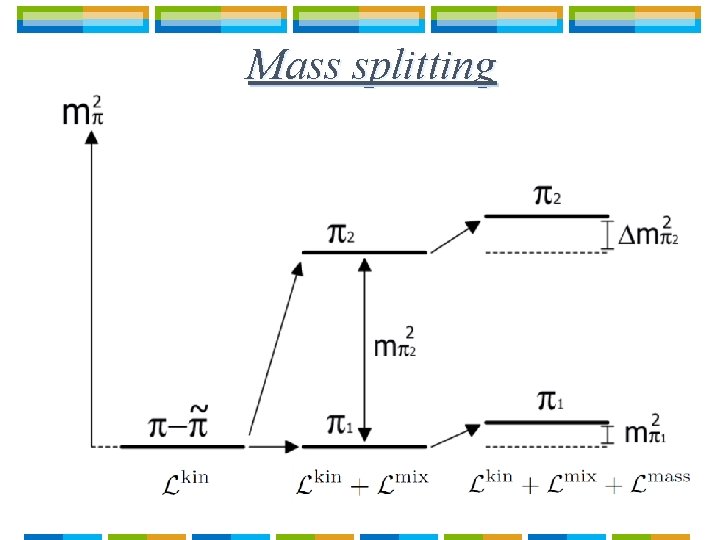
Mass splitting
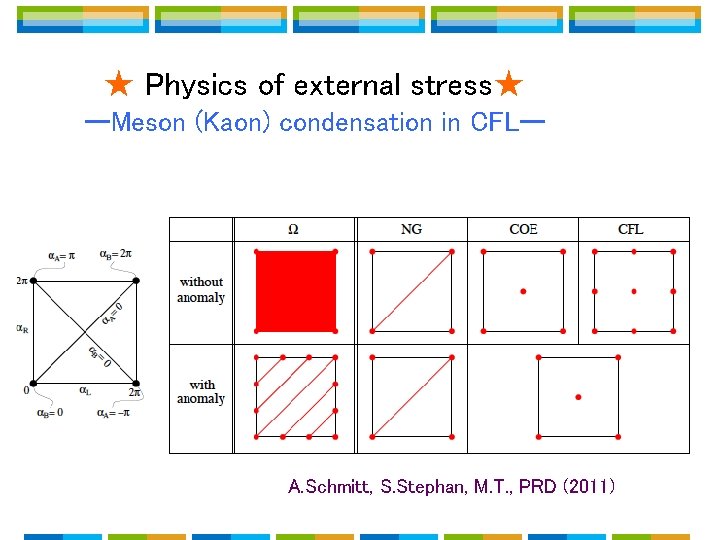
★ Physics of external stress★ ーMeson (Kaon) condensation in CFLー A. Schmitt, S. Stephan, M. T. , PRD (2011)
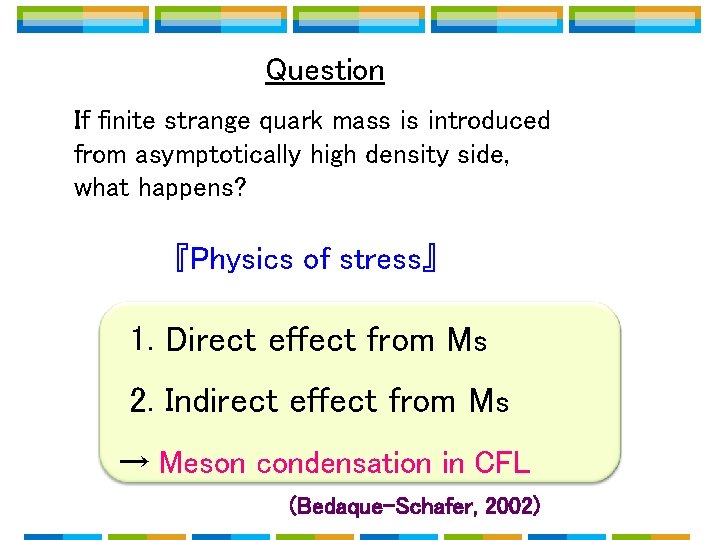
Question If finite strange quark mass is introduced from asymptotically high density side, what happens? 『Physics of stress』 1. Direct effect from Ms 2. Indirect effect from Ms → Meson condensation in CFL (Bedaque-Schafer, 2002)
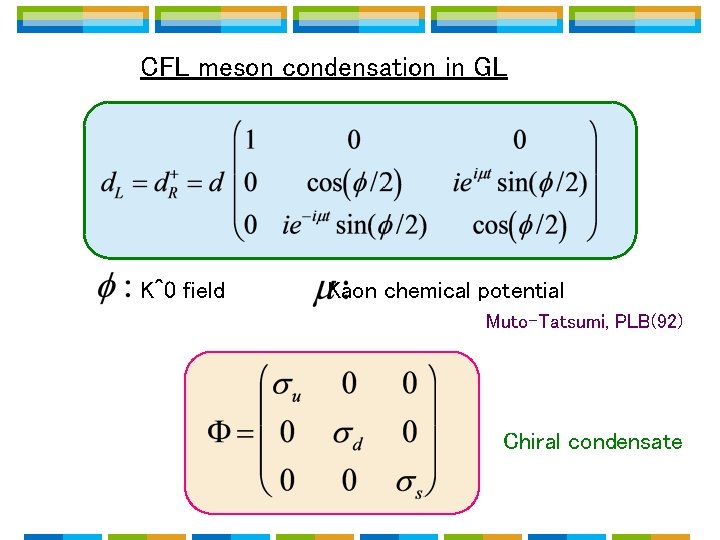
CFL meson condensation in GL K^0 field Kaon chemical potential Muto-Tatsumi, PLB(92) Chiral condensate
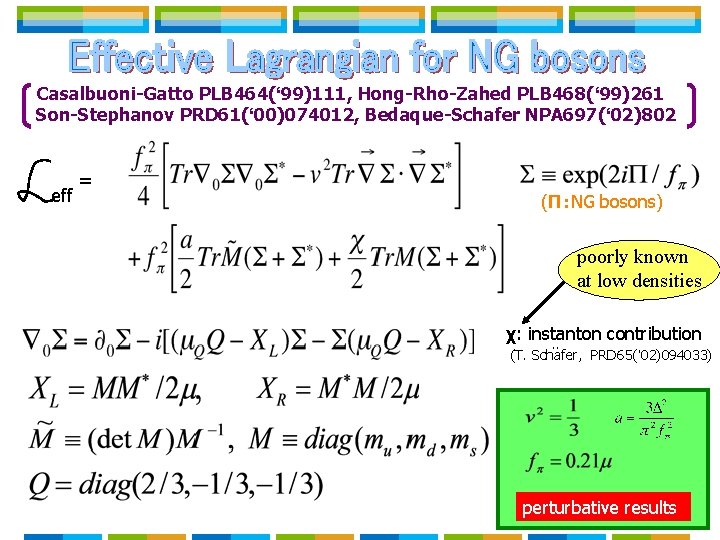
Casalbuoni-Gatto PLB 464(‘ 99)111, Hong-Rho-Zahed PLB 468(‘ 99)261 Son-Stephanov PRD 61(‘ 00)074012, Bedaque-Schafer NPA 697(‘ 02)802 eff = (Π:NG bosons) poorly known at low densities χ: instanton contribution . . (T. Schafer, PRD 65(‘ 02)094033) perturbative results
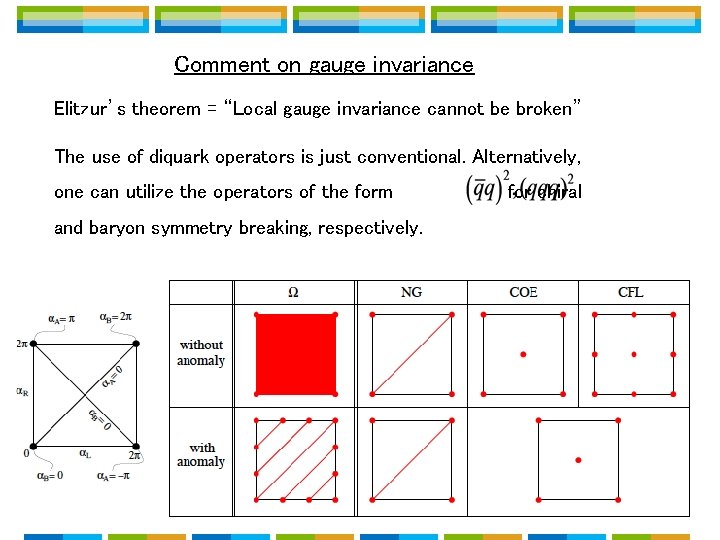
Comment on gauge invariance Elitzur’s theorem = “Local gauge invariance cannot be broken” The use of diquark operators is just conventional. Alternatively, one can utilize the operators of the form and baryon symmetry breaking, respectively. for chiral
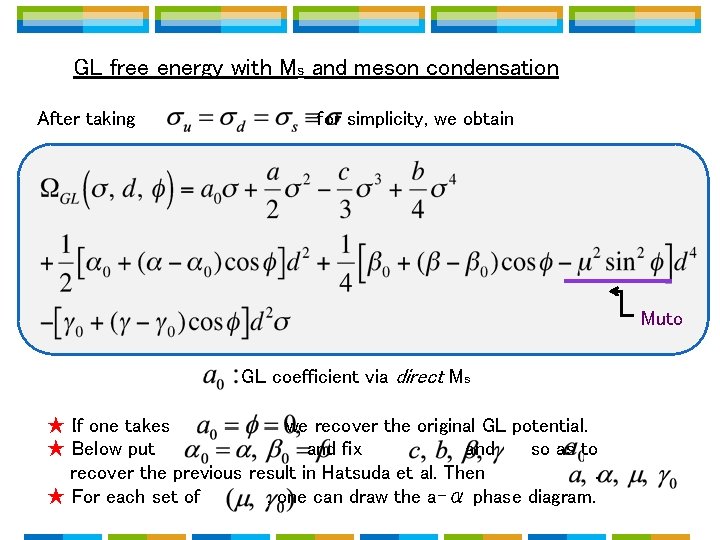
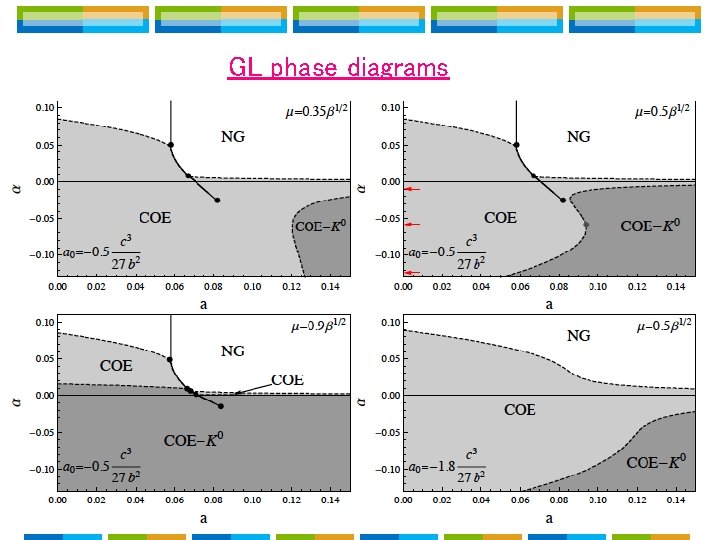
GL free energy with Ms and meson condensation After taking for simplicity, we obtain Muto GL coefficient via direct Ms ★ If one takes we recover the original GL potential. ★ Below put and fix and so as to recover the previous result in Hatsuda et al. Then. ★ For each set of , one can draw the a-α phase diagram.
GL phase diagrams
Collective modes in CFL quark matter and its application to vortex dynamics in superfluidity Key ingredients • The r(otational)-mode instability of NS • Mutual friction in superfluid vortex system • Collective modes in CFL quark matter - A chance to pin-down NS matter content Work in progress w/ M. Ruggieri & M. Mannarelli
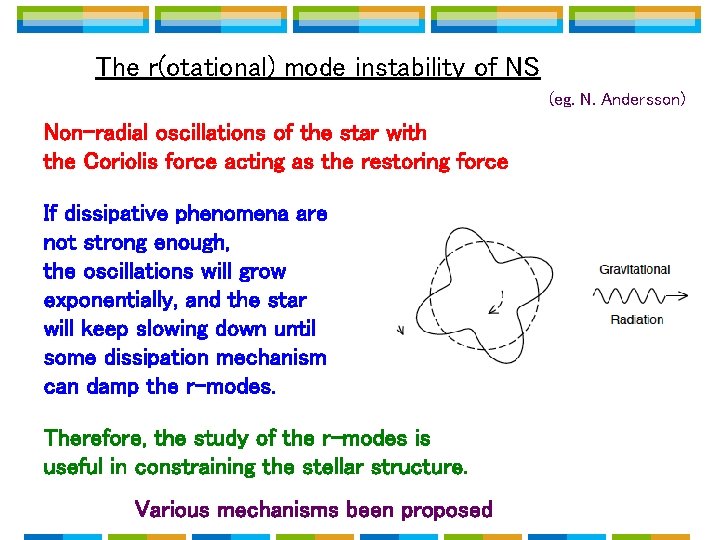
The r(otational) mode instability of NS (eg. N. Andersson) Non-radial oscillations of the star with the Coriolis force acting as the restoring force If dissipative phenomena are not strong enough, the oscillations will grow exponentially, and the star will keep slowing down until some dissipation mechanism can damp the r-modes. Therefore, the study of the r-modes is useful in constraining the stellar structure. Various mechanisms been proposed
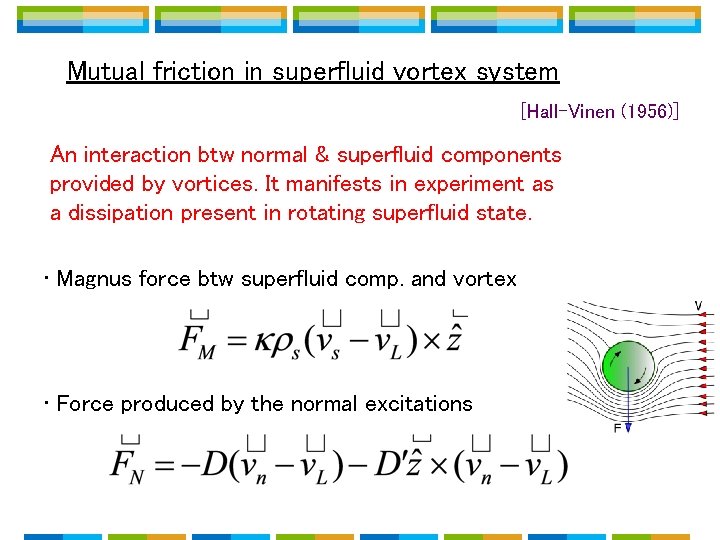
Mutual friction in superfluid vortex system [Hall-Vinen (1956)] An interaction btw normal & superfluid components provided by vortices. It manifests in experiment as a dissipation present in rotating superfluid state. • Magnus force btw superfluid comp. and vortex • Force produced by the normal excitations
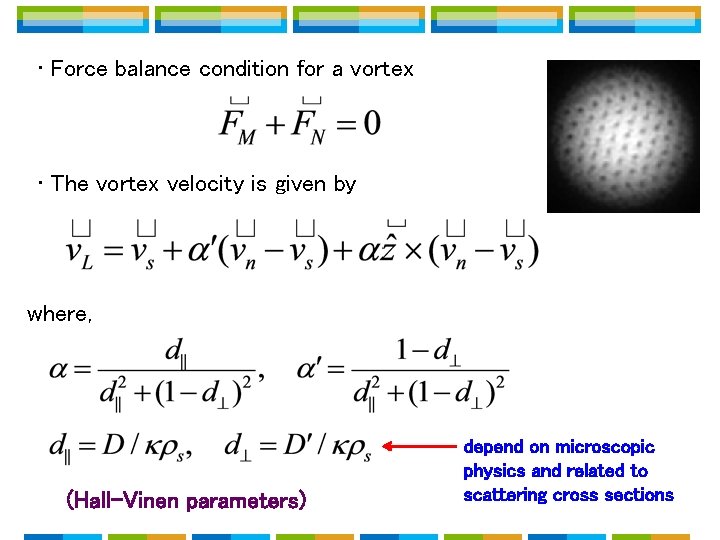
• Force balance condition for a vortex • The vortex velocity is given by where, (Hall-Vinen parameters) depend on microscopic physics and related to scattering cross sections
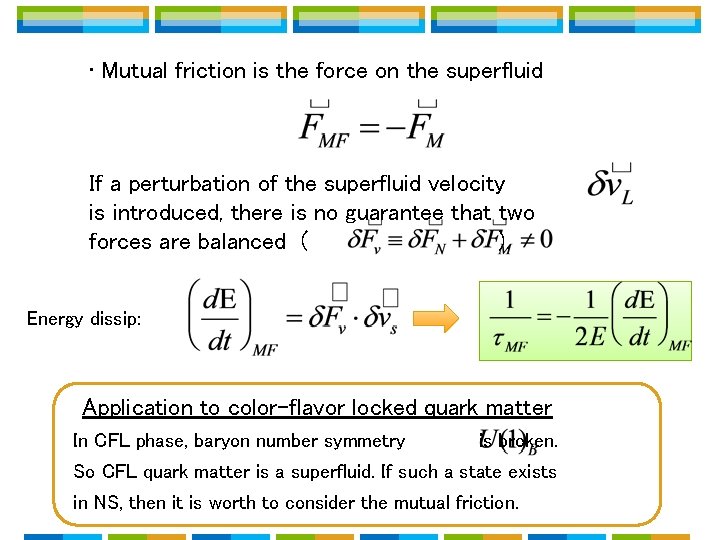
• Mutual friction is the force on the superfluid If a perturbation of the superfluid velocity is introduced, there is no guarantee that two forces are balanced ( ). Energy dissip: Application to color-flavor locked quark matter In CFL phase, baryon number symmetry is broken. So CFL quark matter is a superfluid. If such a state exists in NS, then it is worth to consider the mutual friction.
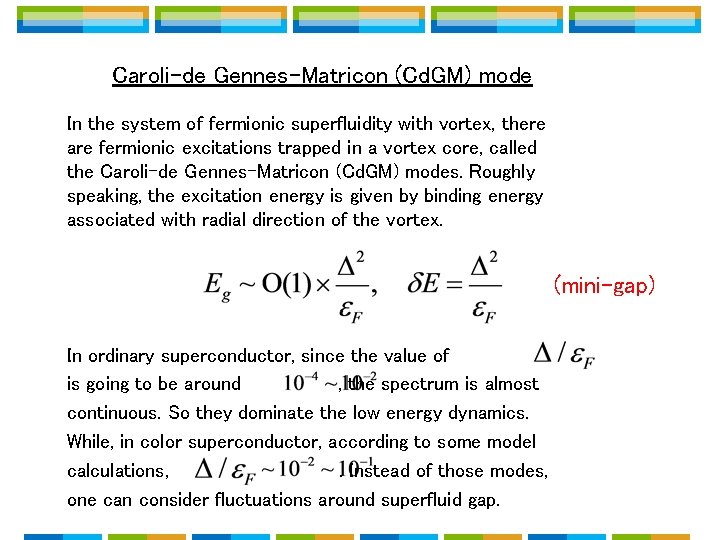
Caroli-de Gennes-Matricon (Cd. GM) mode In the system of fermionic superfluidity with vortex, there are fermionic excitations trapped in a vortex core, called the Caroli-de Gennes-Matricon (Cd. GM) modes. Roughly speaking, the excitation energy is given by binding energy associated with radial direction of the vortex. (mini-gap) In ordinary superconductor, since the value of is going to be around , the spectrum is almost continuous. So they dominate the low energy dynamics. While, in color superconductor, according to some model calculations, . Instead of those modes, one can consider fluctuations around superfluid gap.
We are on the way of the calculations. . .
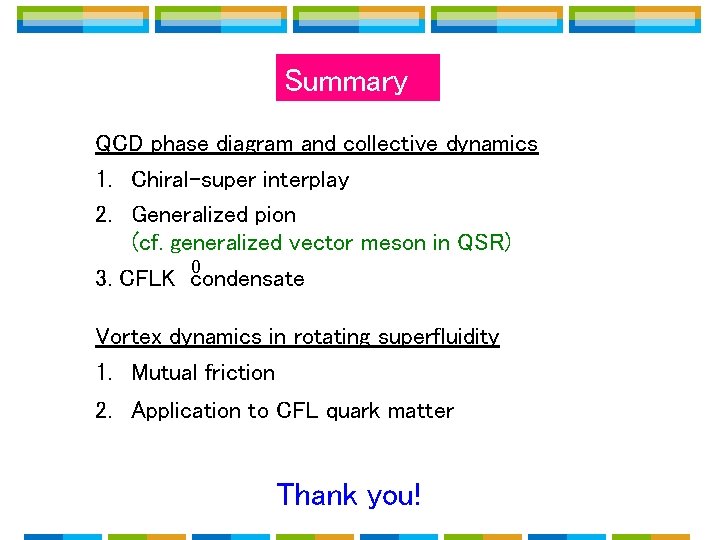
Summary QCD phase diagram and collective dynamics 1. Chiral-super interplay 2. Generalized pion (cf. generalized vector meson in QSR) 0 3. CFLK condensate Vortex dynamics in rotating superfluidity 1. Mutual friction 2. Application to CFL quark matter Thank you!