
What are things made of What are little
- Slides: 33
What are things made of? What are little boys made of? Frogs and snails and puppy-dogs' tails, And that are little boys made of. What are little girls made of? Sugar and spice and all things nice, And that are little girls made of. What are young men made of? Sighs and leers, and crocodile tears, And that are young men made of. What are young women made of? Ribbons and laces, and sweet pretty faces, And that are young women made of.
What is the world made of? n n We Want to know the basic particles We want to know the forces that hold them together.
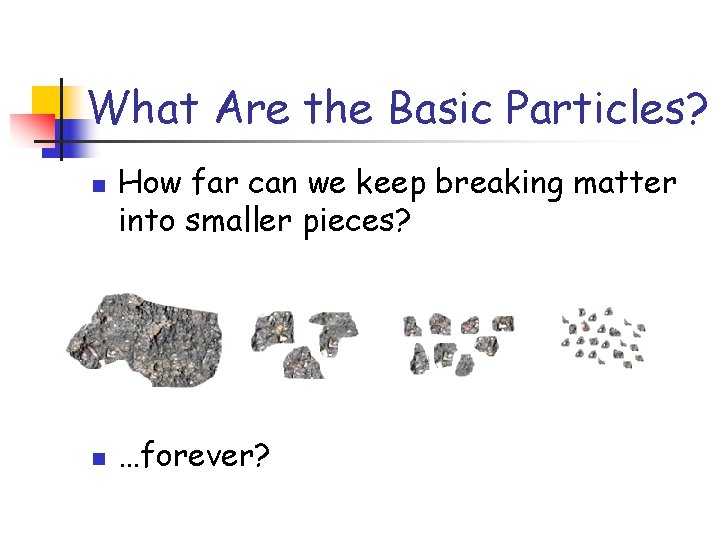
What Are the Basic Particles? n n How far can we keep breaking matter into smaller pieces? …forever?
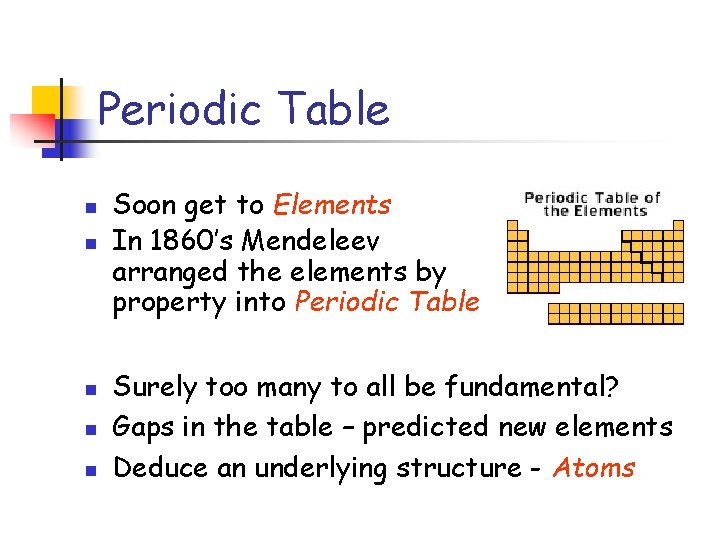
Periodic Table n n n Soon get to Elements In 1860’s Mendeleev arranged the elements by property into Periodic Table Surely too many to all be fundamental? Gaps in the table – predicted new elements Deduce an underlying structure - Atoms
Are Atoms Fundamental? n n Around 100 years ago atoms thought to be “indivisible balls” Rutherford took large gold atoms and fired radioactive particles at them He found that most of the particles went straight through BUT occasionally some did bounce back…
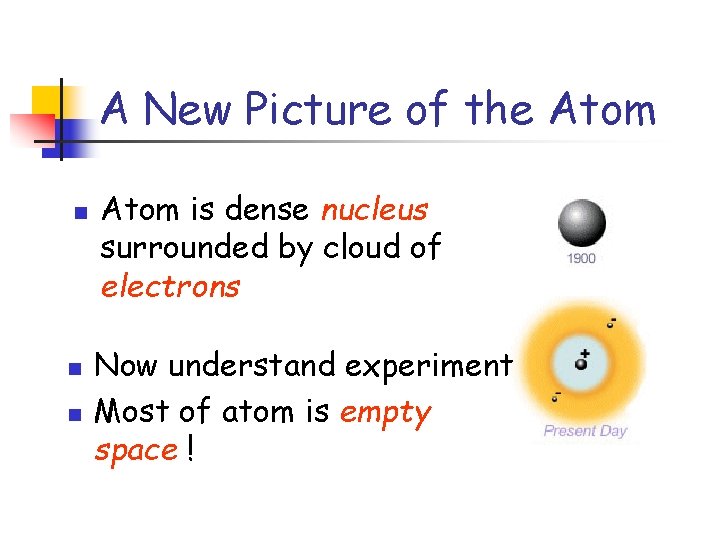
A New Picture of the Atom n n n Atom is dense nucleus surrounded by cloud of electrons Now understand experiment Most of atom is empty space !
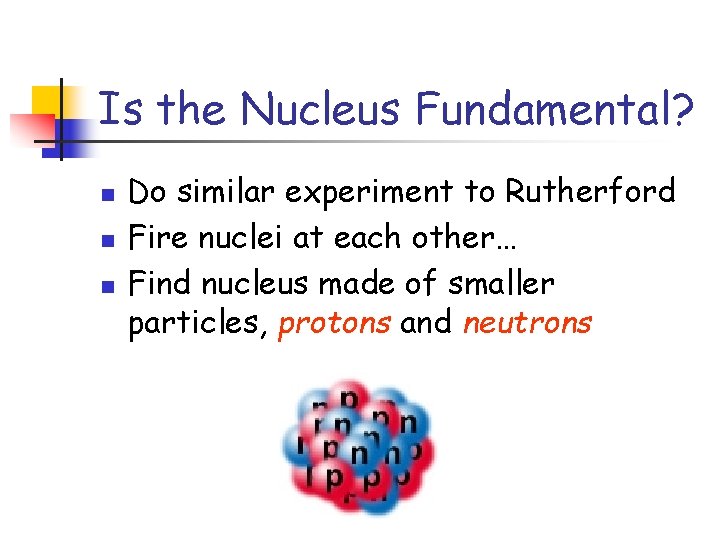
Is the Nucleus Fundamental? n n n Do similar experiment to Rutherford Fire nuclei at each other… Find nucleus made of smaller particles, protons and neutrons
Is the Proton Fundamental? n n In the 1960 s physicists began to collide protons together To their horror, found LOTS of particles – S, L, X , … Is there a pattern? Can we deduce some underlying structure?
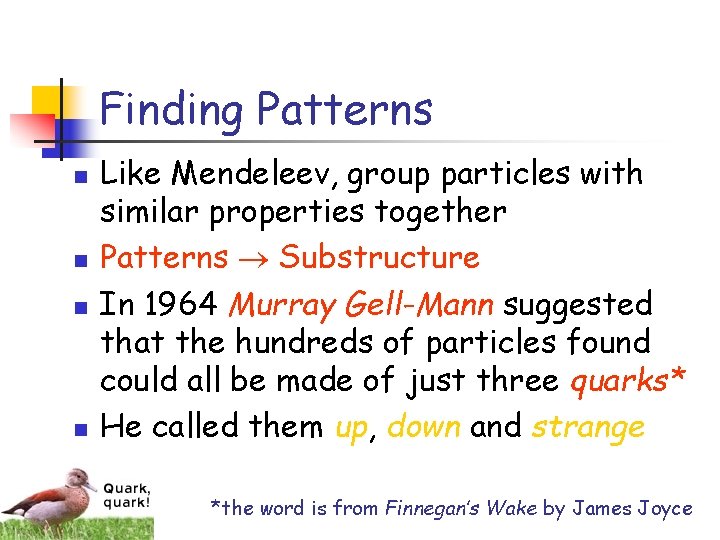
Finding Patterns n n Like Mendeleev, group particles with similar properties together Patterns Substructure In 1964 Murray Gell-Mann suggested that the hundreds of particles found could all be made of just three quarks* He called them up, down and strange *the word is from Finnegan’s Wake by James Joyce
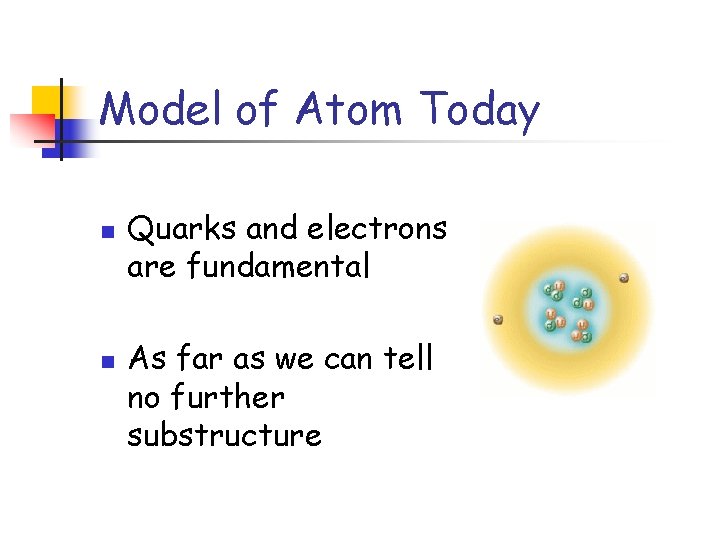
Model of Atom Today n n Quarks and electrons are fundamental As far as we can tell no further substructure
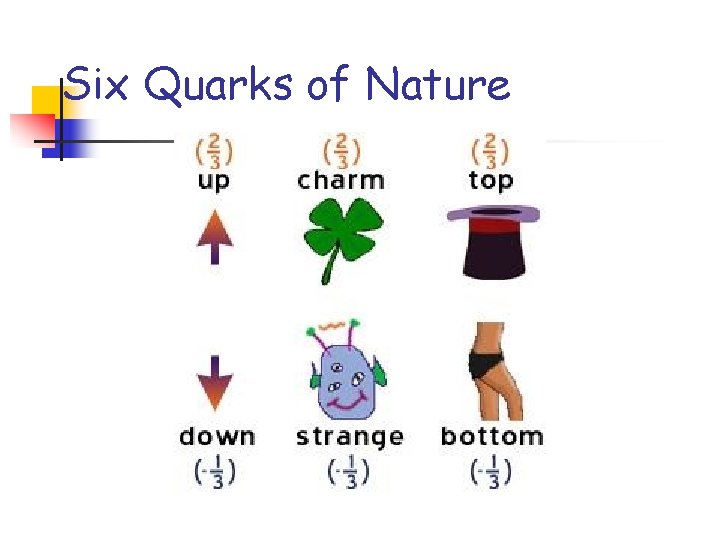
Six Quarks of Nature
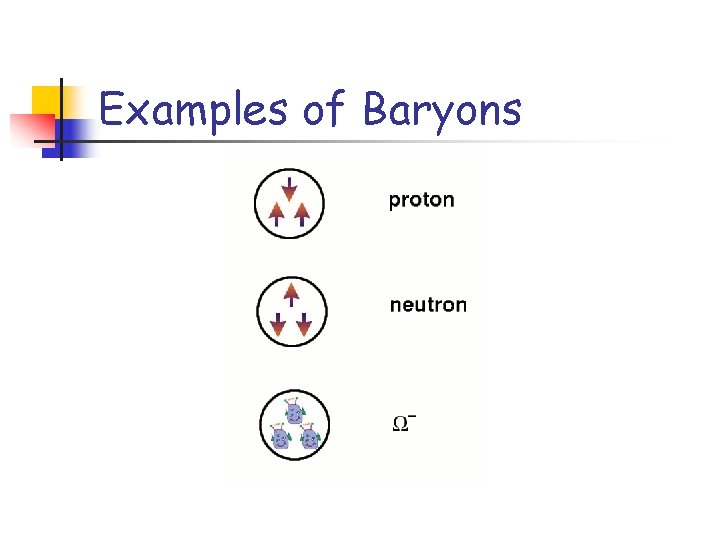
Examples of Baryons
Powers of Ten n n For very large or very small numbers it is easier to use powers of ten, e. g. 100, 000 = 108 0. 00000001 = 10 -15 Note: 1 = 100
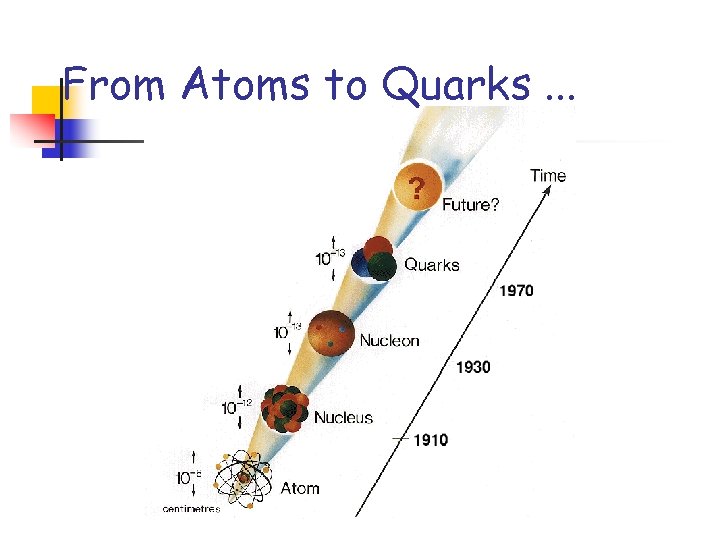
From Atoms to Quarks. . .
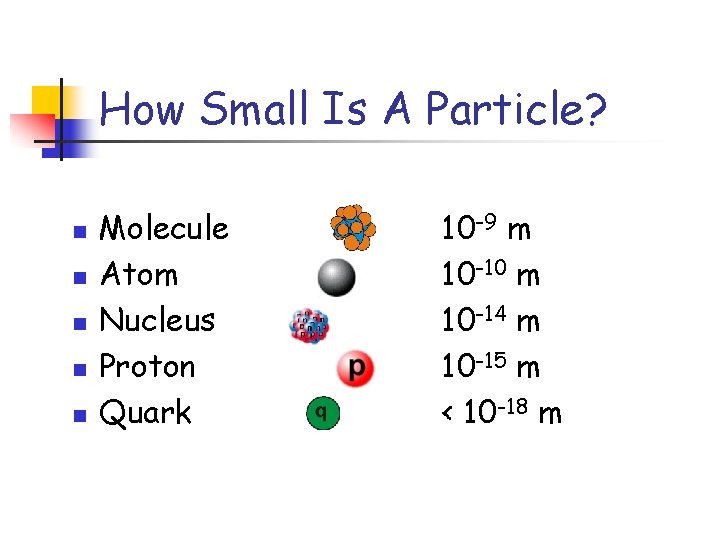
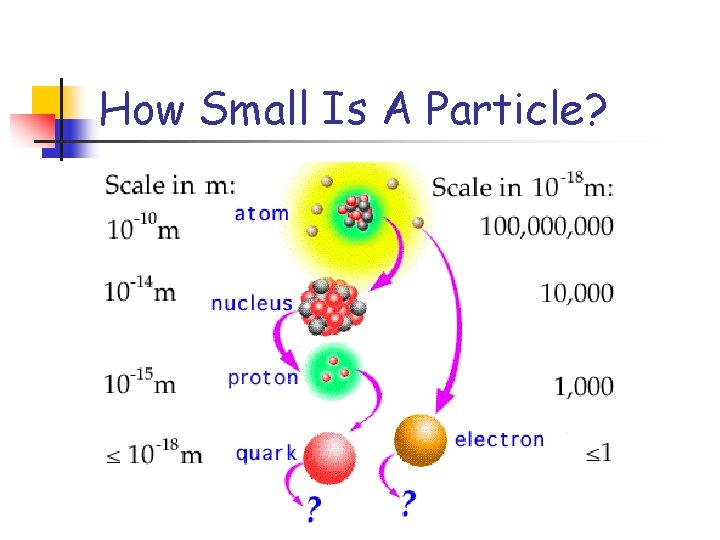
How Small Is A Particle? n n n Molecule Atom Nucleus Proton Quark 10 -9 m 10 -10 m 10 -14 m 10 -15 m < 10 -18 m
How Small Is A Particle?
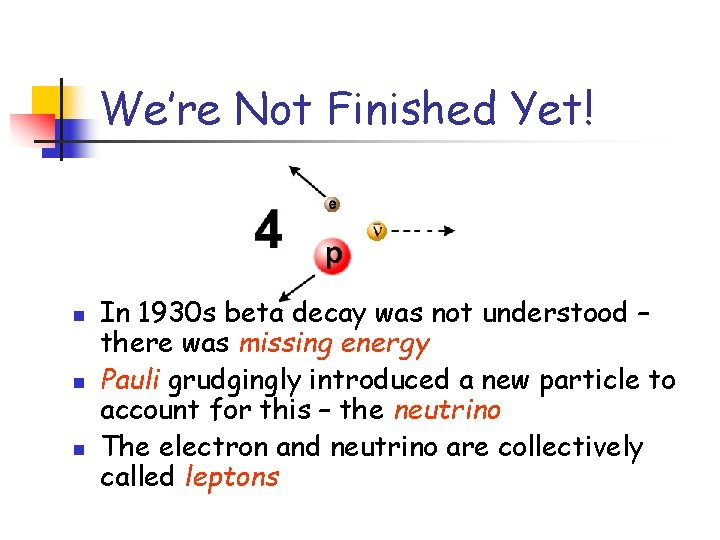
We’re Not Finished Yet! n n n In 1930 s beta decay was not understood – there was missing energy Pauli grudgingly introduced a new particle to account for this – the neutrino The electron and neutrino are collectively called leptons
Antimatter Too! n n In 1932 Anderson discovered the positron For every particle there is also an antiparticle Antimatter just like ordinary matter but with opposite charge electron negative, positron positive!
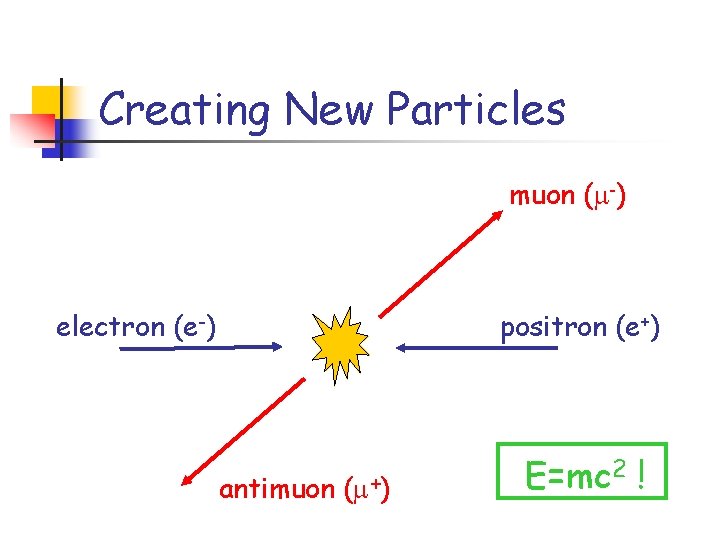
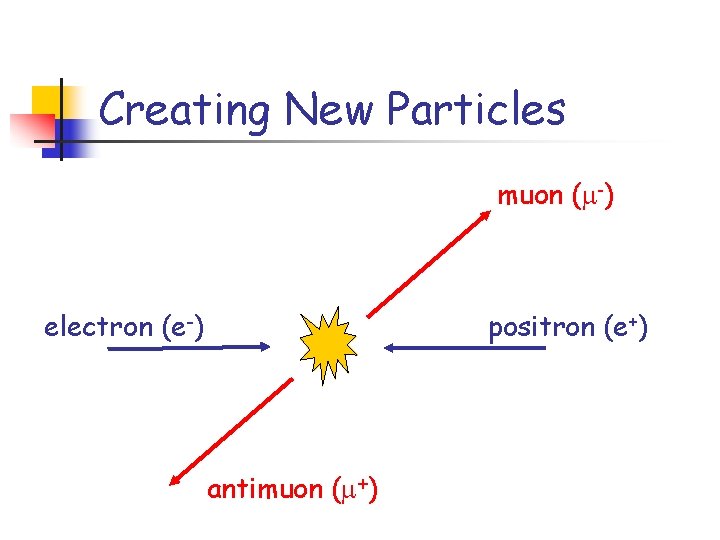
Creating New Particles muon ( -) electron (e-) positron (e+) antimuon ( +) E=mc 2 !
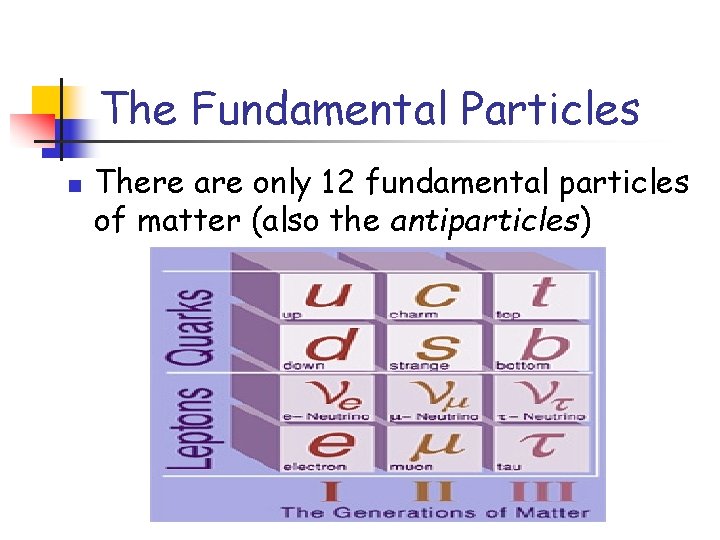
The Fundamental Particles n There are only 12 fundamental particles of matter (also the antiparticles)
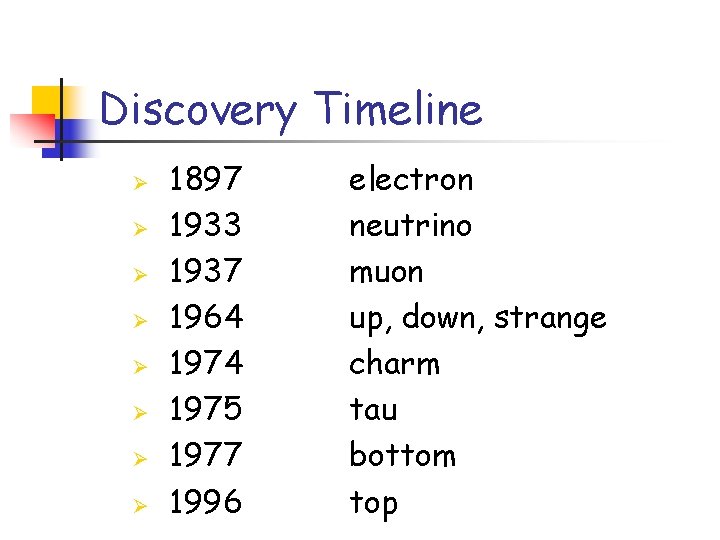
Discovery Timeline Ø Ø Ø Ø 1897 1933 1937 1964 1975 1977 1996 electron neutrino muon up, down, strange charm tau bottom top
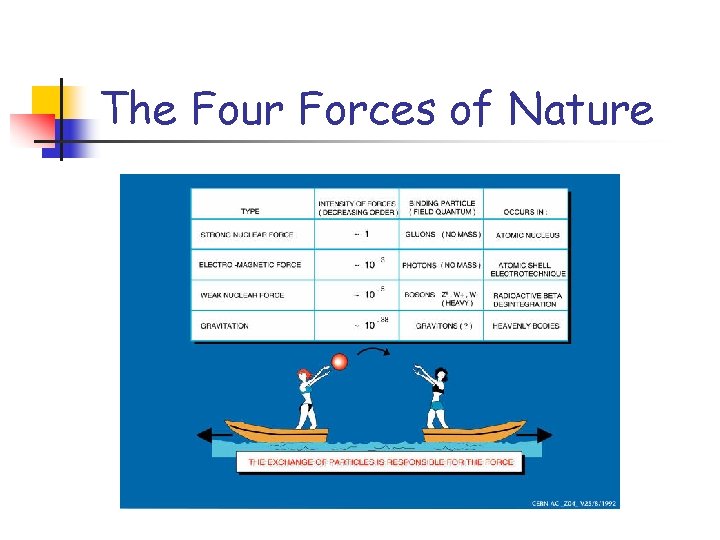
What About Forces? n n n Particles interact with each other via forces There are four types – gravity, electromagnetism and the strong and weak nuclear forces Each is described by the exchange of a force-carrying particle between the matter particles
The Four Forces of Nature
How Do We Know All This? n n All our experiments involve colliding particles Matter and antimatter are accelerated to near light-speed by an accelerator They are brought together inside a detector and collide They annihilate and their energy is released to create new particles according to E=mc 2
Creating New Particles muon ( -) electron (e-) positron (e+) antimuon ( +)
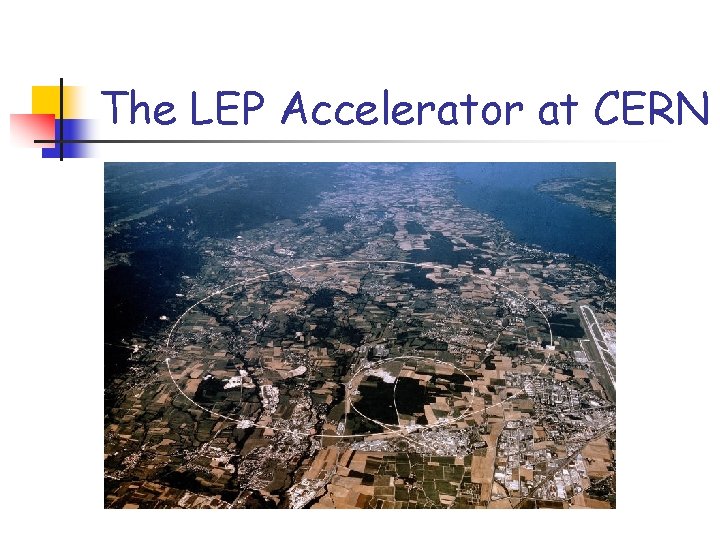
The LEP Accelerator at CERN
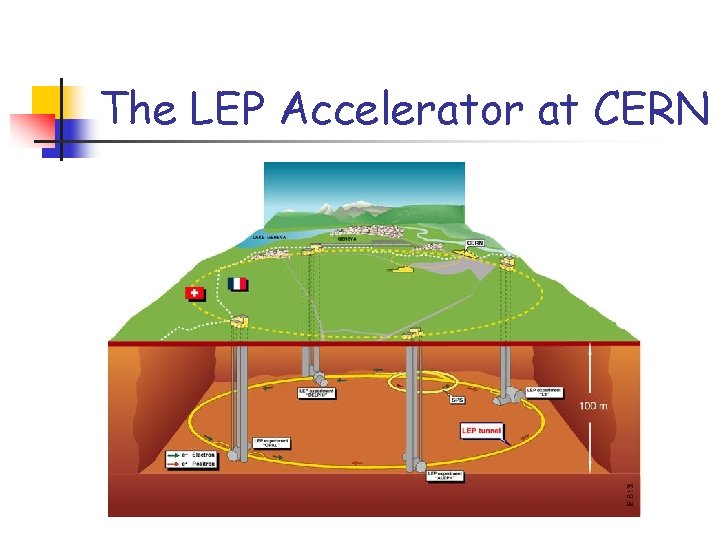
The LEP Accelerator at CERN
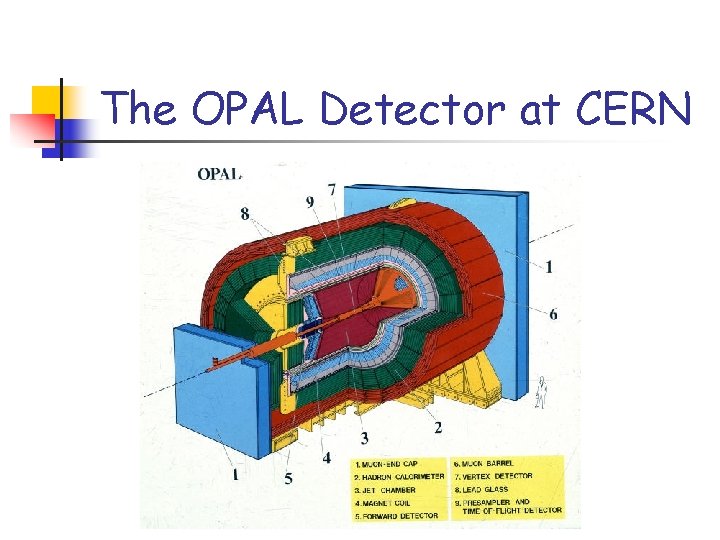
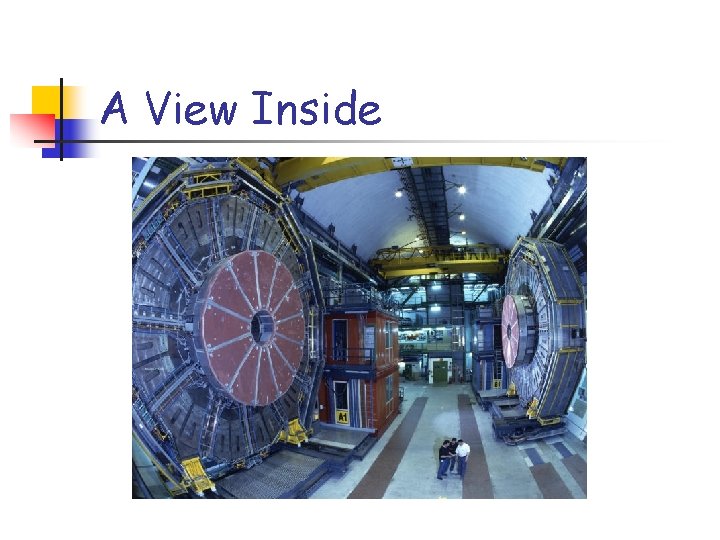
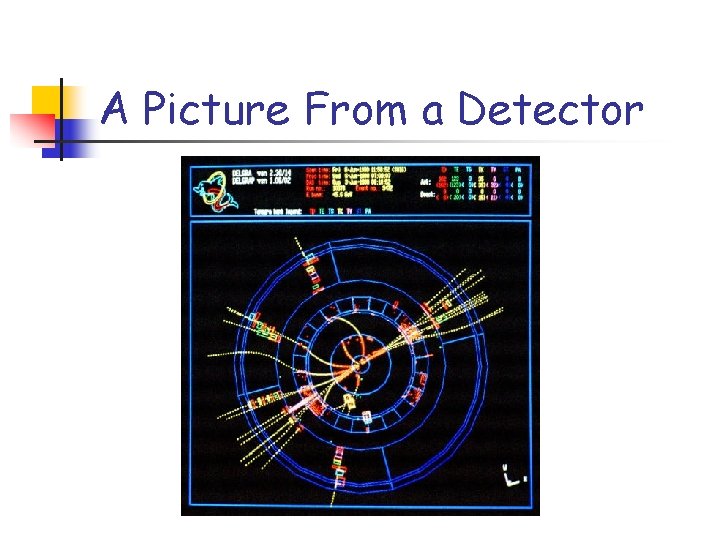
How Detectors Work A detector does various jobs… n n Track the positions of particles Measure energy of particles Detector layered like an onion Each layer measures different things
The OPAL Detector at CERN
A View Inside
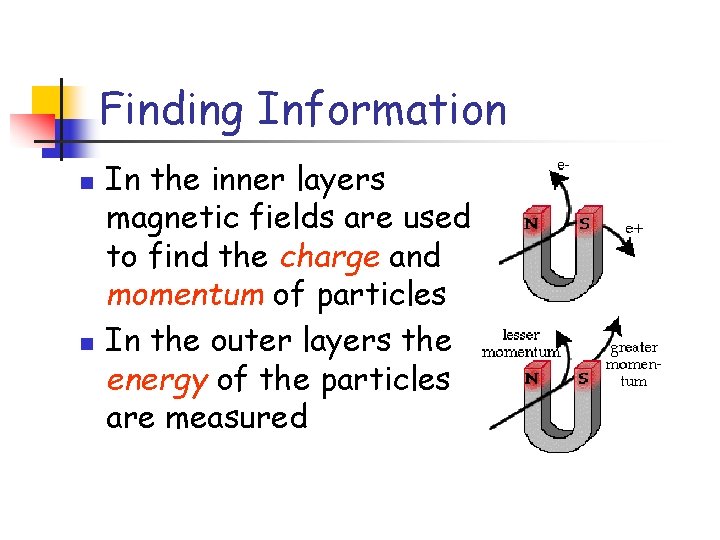
Finding Information n n In the inner layers magnetic fields are used to find the charge and momentum of particles In the outer layers the energy of the particles are measured
A Picture From a Detector
Summary n n n There are 12 fundamental matter particles, the Quarks and Leptons There are 4 forces transmitted by particles Accelerators are used to collide and study particles