
Short Introduction to QCD Renormalisation Quark Parton Model
- Slides: 36
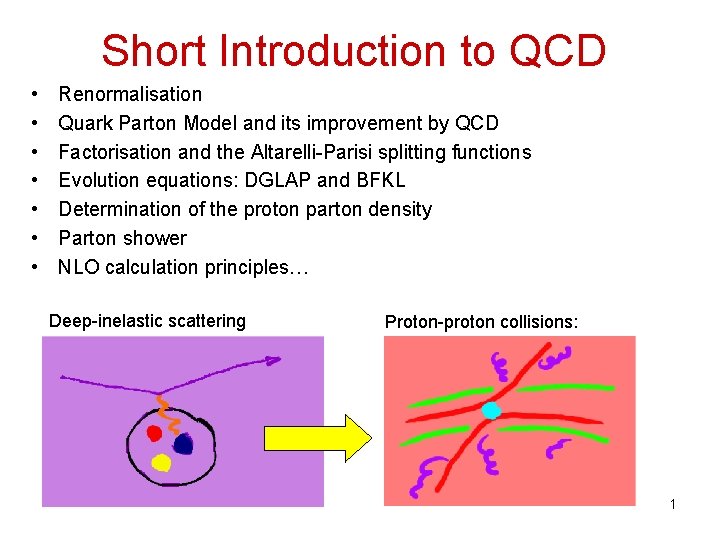
Short Introduction to QCD • • Renormalisation Quark Parton Model and its improvement by QCD Factorisation and the Altarelli-Parisi splitting functions Evolution equations: DGLAP and BFKL Determination of the proton parton density Parton shower NLO calculation principles… Deep-inelastic scattering Proton-proton collisions: 1
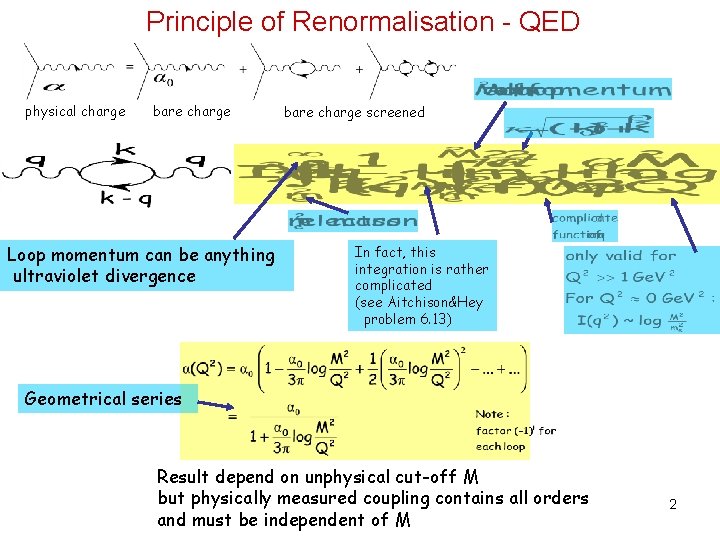
Principle of Renormalisation - QED physical charge bare charge Loop momentum can be anything ultraviolet divergence bare charge screened In fact, this integration is rather complicated (see Aitchison&Hey problem 6. 13) Geometrical series Result depend on unphysical cut-off M but physically measured coupling contains all orders and must be independent of M 2
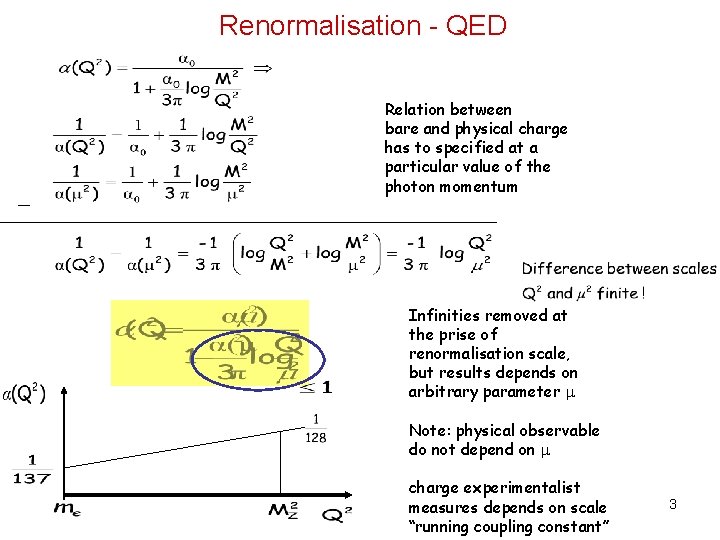
Renormalisation - QED _ Relation between bare and physical charge has to specified at a particular value of the photon momentum Infinities removed at the prise of renormalisation scale, but results depends on arbitrary parameter m Note: physical observable do not depend on m charge experimentalist measures depends on scale “running coupling constant” 3
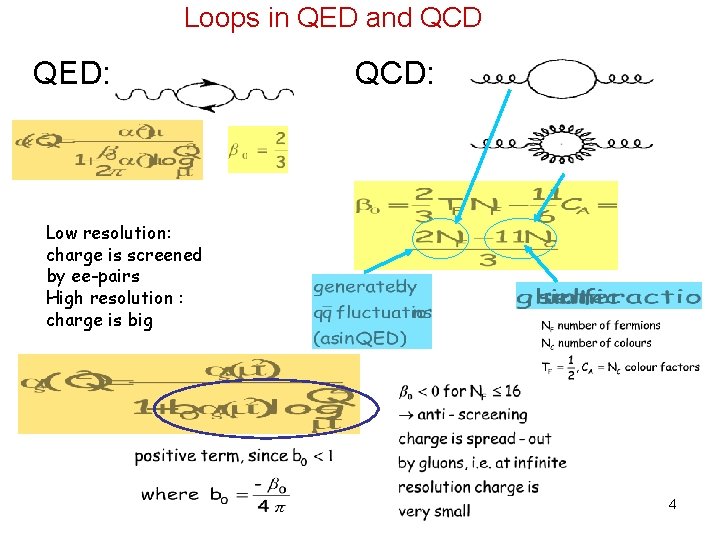
Loops in QED and QCD QED: QCD: Low resolution: charge is screened by ee-pairs High resolution : charge is big 4
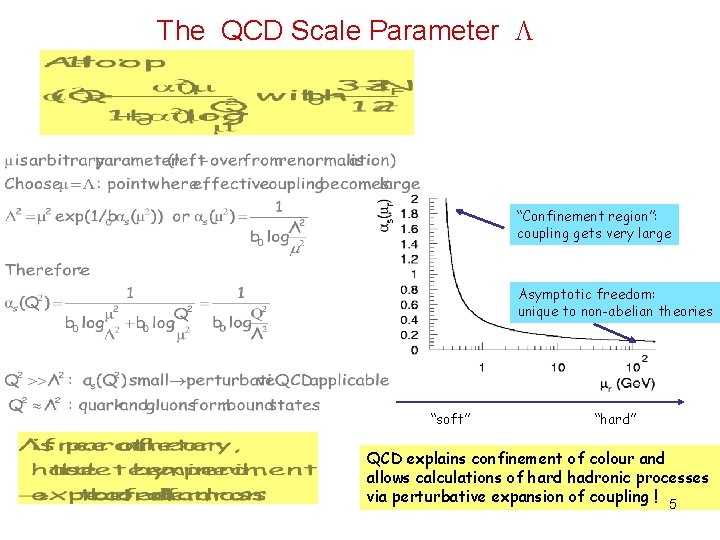
The QCD Scale Parameter L “Confinement region”: coupling gets very large Asymptotic freedom: unique to non-abelian theories “soft” “hard” QCD explains confinement of colour and allows calculations of hard hadronic processes via perturbative expansion of coupling ! 5
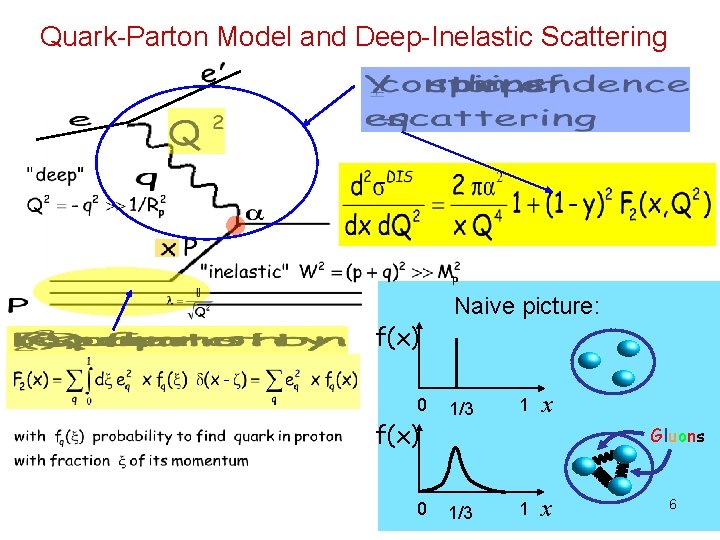
Quark-Parton Model and Deep-Inelastic Scattering Naive picture: f(x) 0 1/3 1 x Gluons 1/3 1 x 6
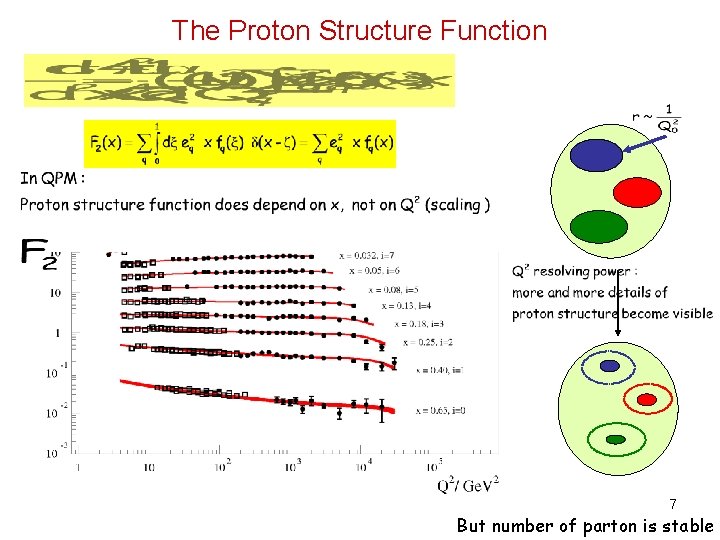
The Proton Structure Function 7 But number of parton is stable
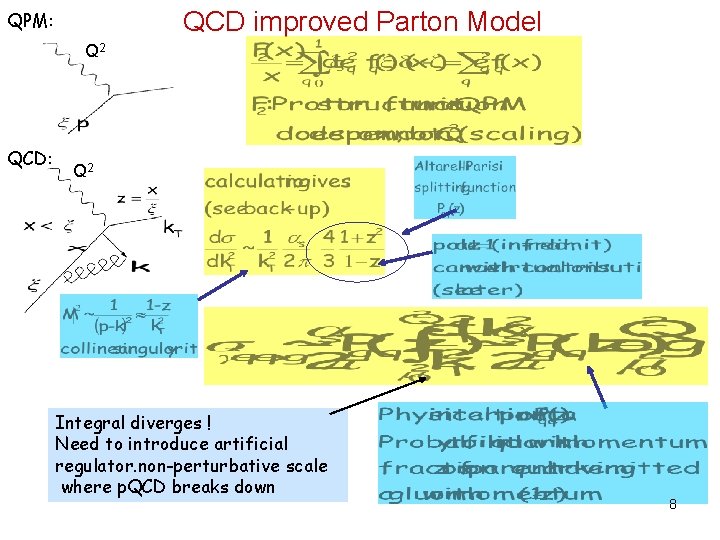
QCD improved Parton Model QPM: Q 2 QCD: Q 2 Integral diverges ! Need to introduce artificial regulator. non-perturbative scale where p. QCD breaks down 8
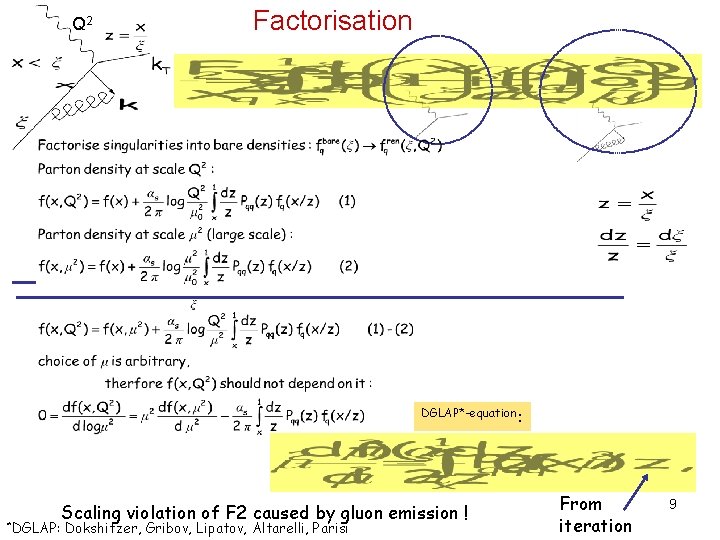
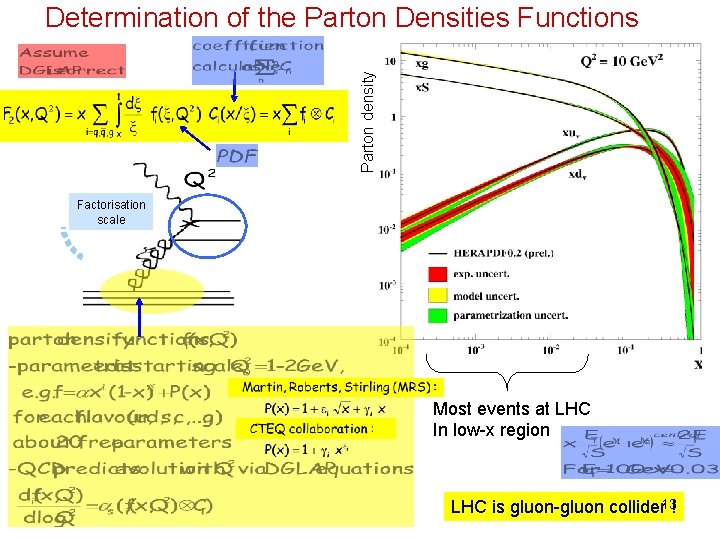
Q 2 Factorisation DGLAP*-equation: *DGLAP: Scaling violation of F 2 caused by gluon emission ! Dokshitzer, Gribov, Lipatov, Altarelli, Parisi From iteration 9
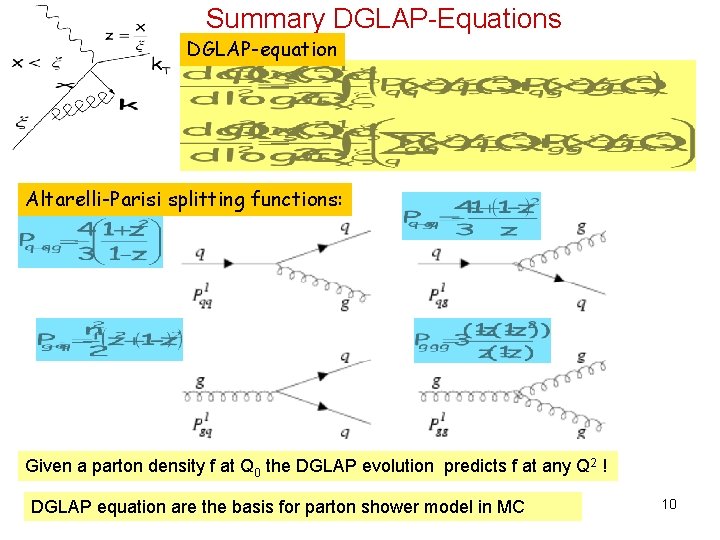
Summary DGLAP-Equations DGLAP-equation Altarelli-Parisi splitting functions: Given a parton density f at Q 0 the DGLAP evolution predicts f at any Q 2 ! DGLAP equation are the basis for parton shower model in MC 10
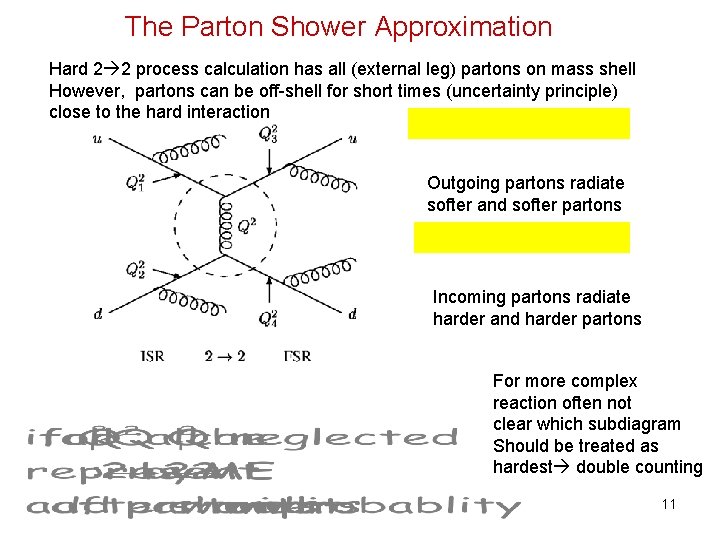
The Parton Shower Approximation Hard 2 2 process calculation has all (external leg) partons on mass shell However, partons can be off-shell for short times (uncertainty principle) close to the hard interaction Outgoing partons radiate softer and softer partons Incoming partons radiate harder and harder partons For more complex reaction often not clear which subdiagram Should be treated as hardest double counting 11
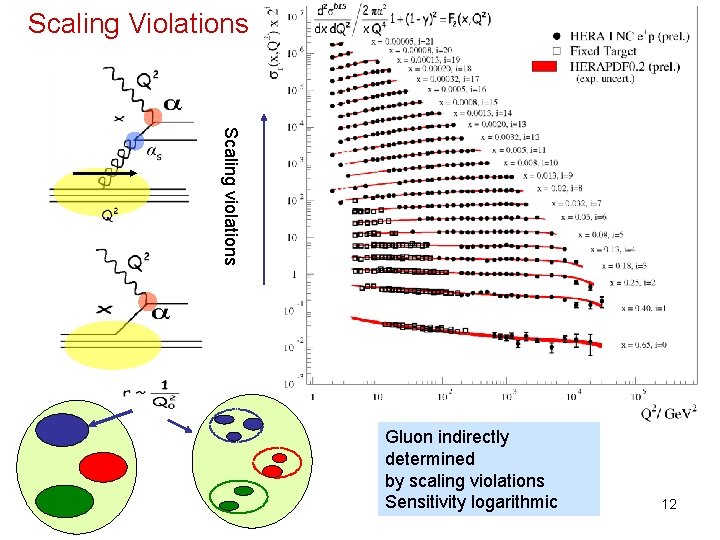
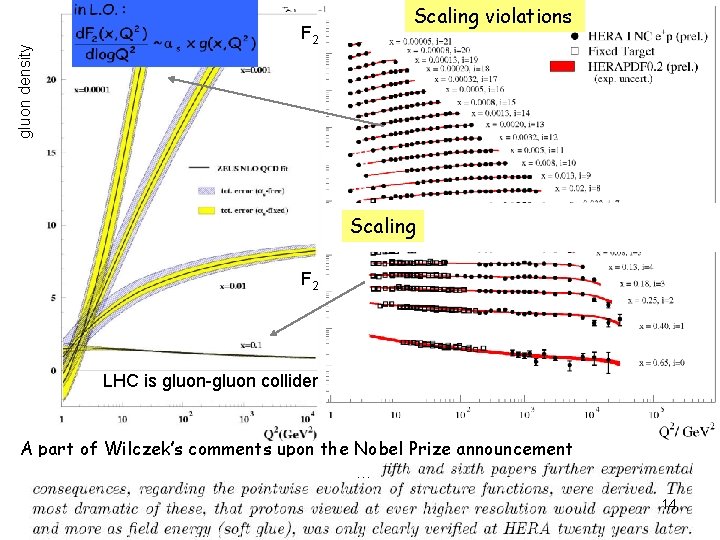
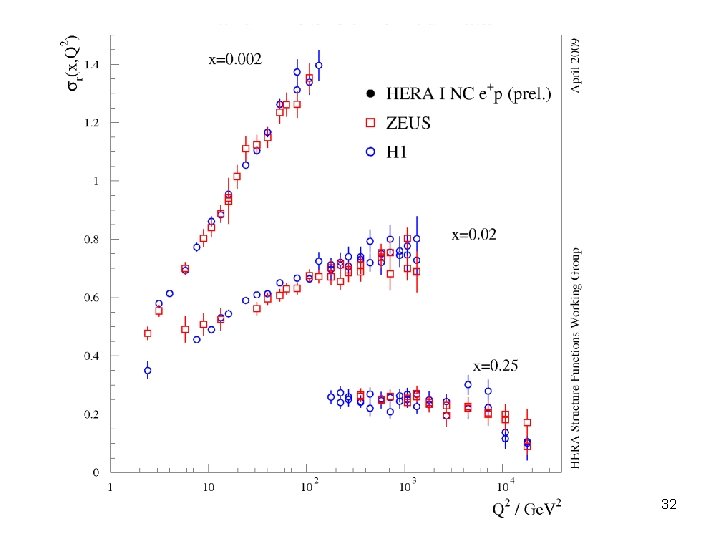
Scaling Violations Scaling violations Gluon indirectly determined by scaling violations Sensitivity logarithmic 12
Parton density Determination of the Parton Densities Functions Factorisation scale Most events at LHC In low-x region LHC is gluon-gluon collider 13!
gluon density Scaling violations F 2 Scaling F 2 LHC is gluon-gluon collider A part of Wilczek’s comments upon the Nobel Prize announcement … 14
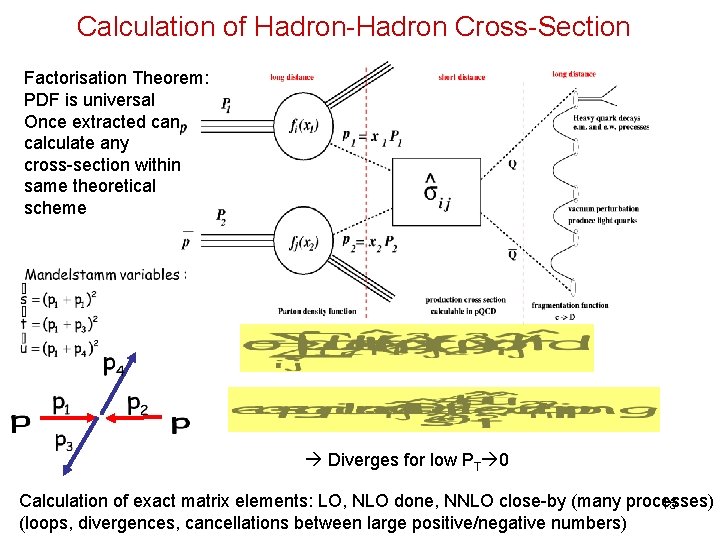
Calculation of Hadron-Hadron Cross-Section Factorisation Theorem: PDF is universal Once extracted can calculate any cross-section within same theoretical scheme Diverges for low PT 0 Calculation of exact matrix elements: LO, NLO done, NNLO close-by (many processes) 15 (loops, divergences, cancellations between large positive/negative numbers)
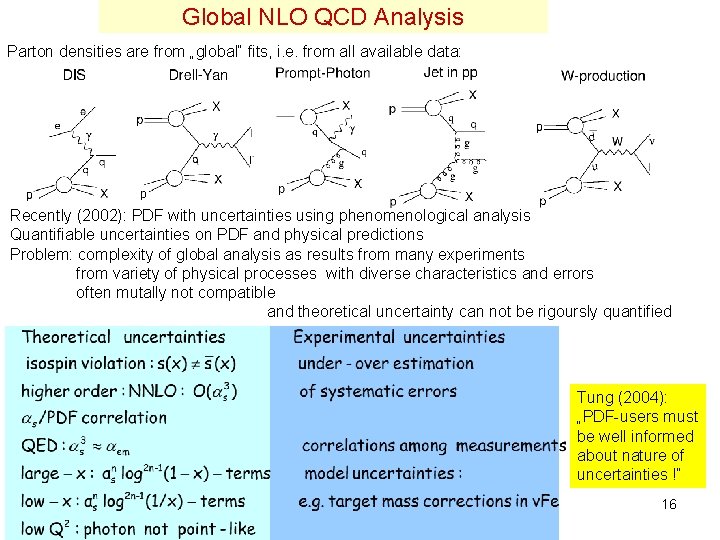
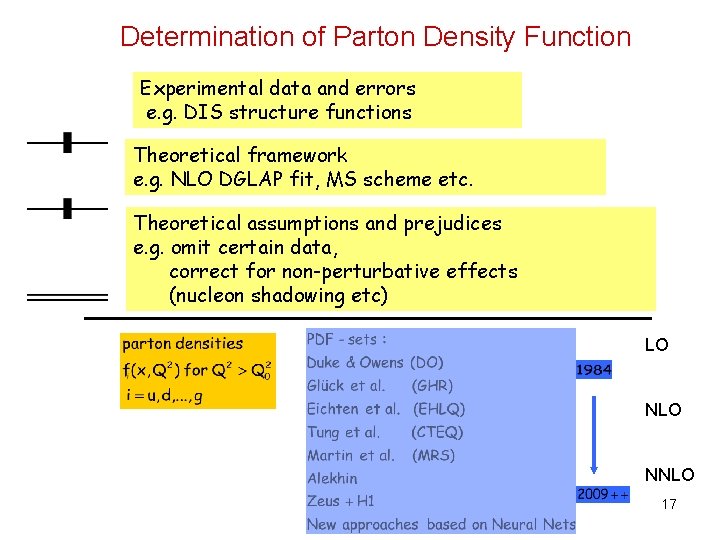
Global NLO QCD Analysis Parton densities are from „global“ fits, i. e. from all available data: Recently (2002): PDF with uncertainties using phenomenological analysis Quantifiable uncertainties on PDF and physical predictions Problem: complexity of global analysis as results from many experiments from variety of physical processes with diverse characteristics and errors often mutally not compatible and theoretical uncertainty can not be rigoursly quantified Tung (2004): „PDF-users must be well informed about nature of uncertainties !“ 16
Determination of Parton Density Function Experimental data and errors e. g. DIS structure functions Theoretical framework e. g. NLO DGLAP fit, MS scheme etc. Theoretical assumptions and prejudices e. g. omit certain data, correct for non-perturbative effects (nucleon shadowing etc) LO NNLO 17
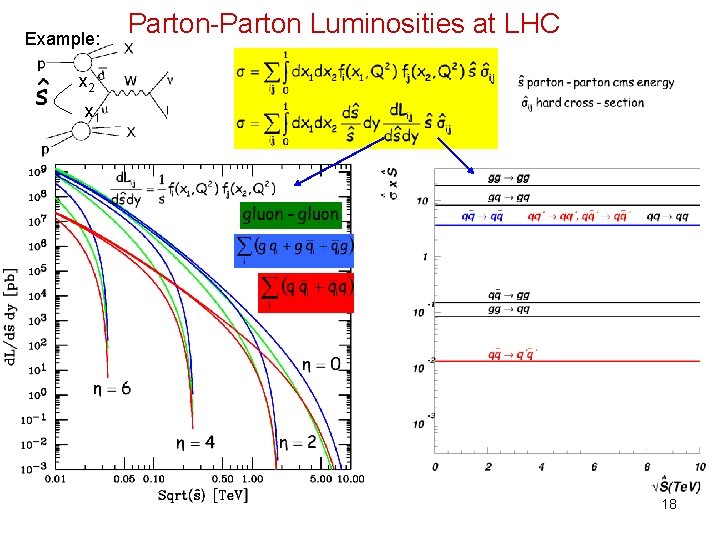
Example: Parton-Parton Luminosities at LHC x 2 x 1 18
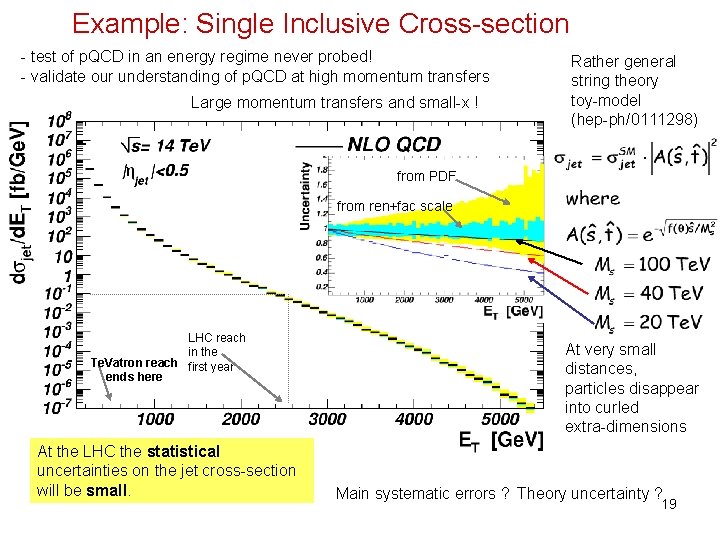
Example: Single Inclusive Cross-section - test of p. QCD in an energy regime never probed! - validate our understanding of p. QCD at high momentum transfers Large momentum transfers and small-x ! Rather general string theory toy-model (hep-ph/0111298) from PDF from ren+fac scale LHC reach in the Te. Vatron reach first year ends here At the LHC the statistical uncertainties on the jet cross-section will be small. At very small distances, particles disappear into curled extra-dimensions Main systematic errors ? Theory uncertainty ? 19
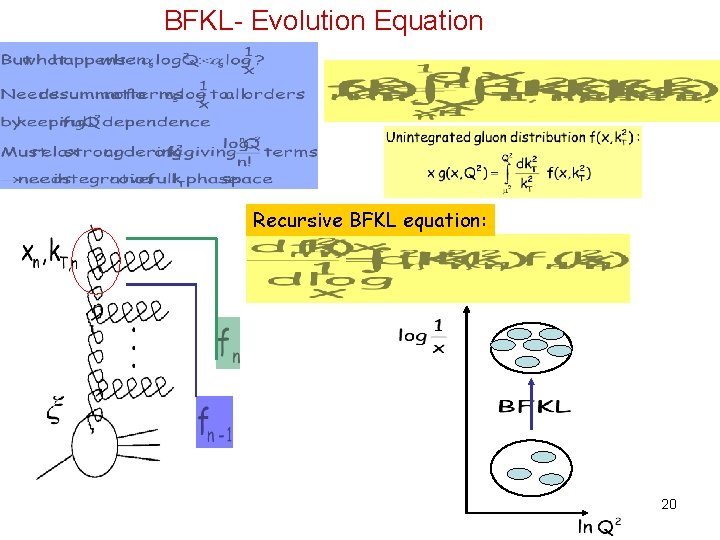
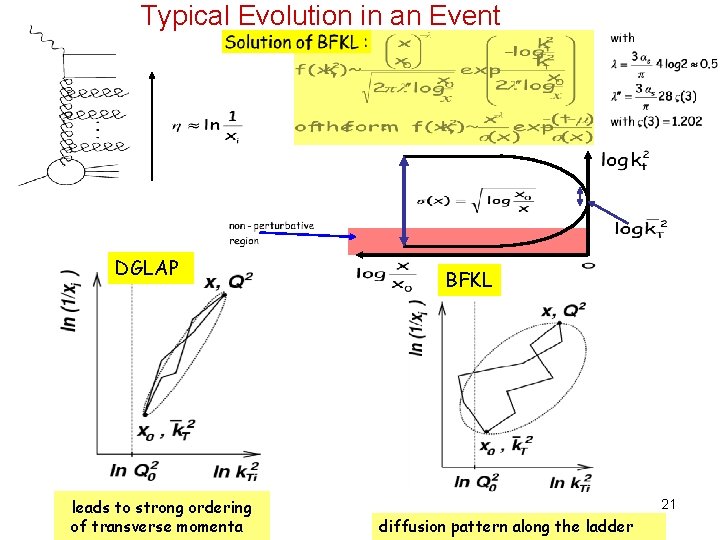
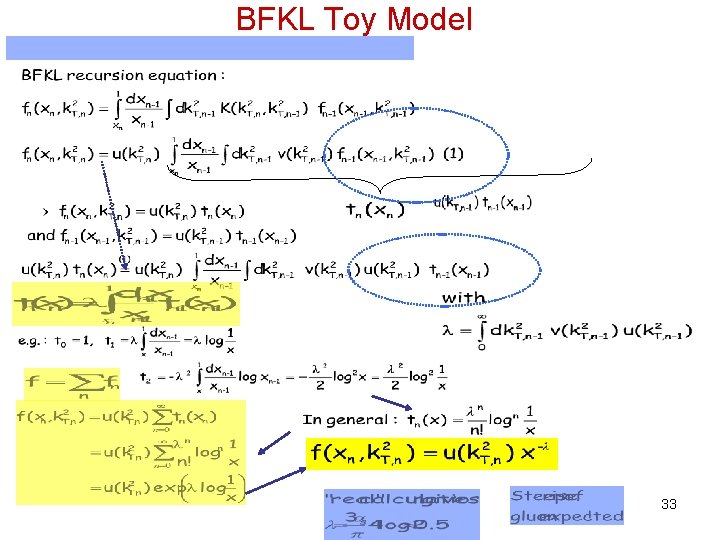
BFKL- Evolution Equation Recursive BFKL equation: 20
Typical Evolution in an Event DGLAP leads to strong ordering of transverse momenta BFKL 21 diffusion pattern along the ladder
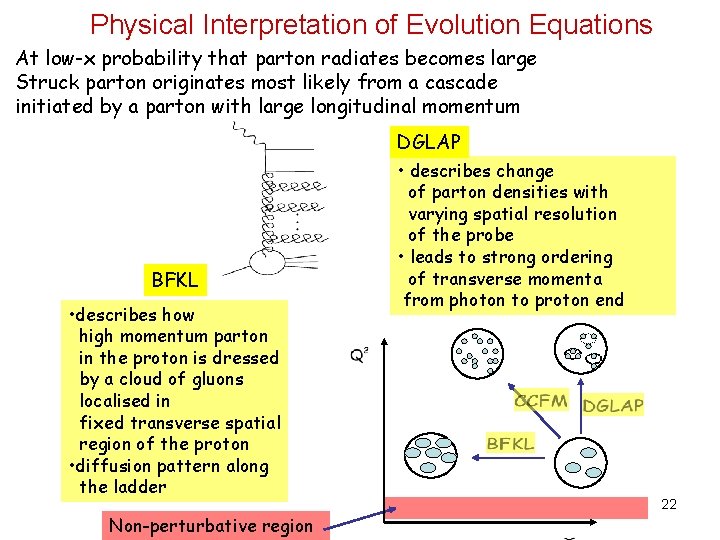
Physical Interpretation of Evolution Equations At low-x probability that parton radiates becomes large Struck parton originates most likely from a cascade initiated by a parton with large longitudinal momentum DGLAP BFKL • describes how high momentum parton in the proton is dressed by a cloud of gluons localised in fixed transverse spatial region of the proton • diffusion pattern along the ladder Non-perturbative region • describes change of parton densities with varying spatial resolution of the probe • leads to strong ordering of transverse momenta from photon to proton end 22
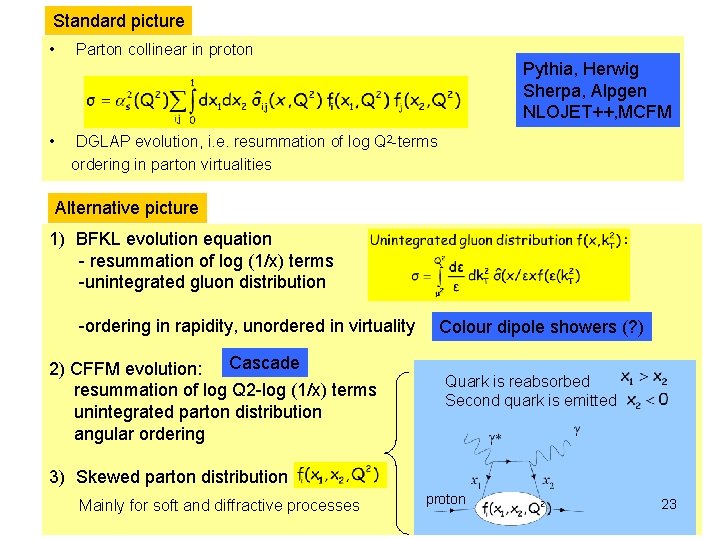
Standard picture • Parton collinear in proton Pythia, Herwig Sherpa, Alpgen NLOJET++, MCFM • DGLAP evolution, i. e. resummation of log Q 2 -terms ordering in parton virtualities Alternative picture 1) BFKL evolution equation - resummation of log (1/x) terms -unintegrated gluon distribution -ordering in rapidity, unordered in virtuality Cascade 2) CFFM evolution: resummation of log Q 2 -log (1/x) terms unintegrated parton distribution angular ordering Colour dipole showers (? ) Quark is reabsorbed Second quark is emitted 3) Skewed parton distribution Mainly for soft and diffractive processes proton 23
Back-up 24
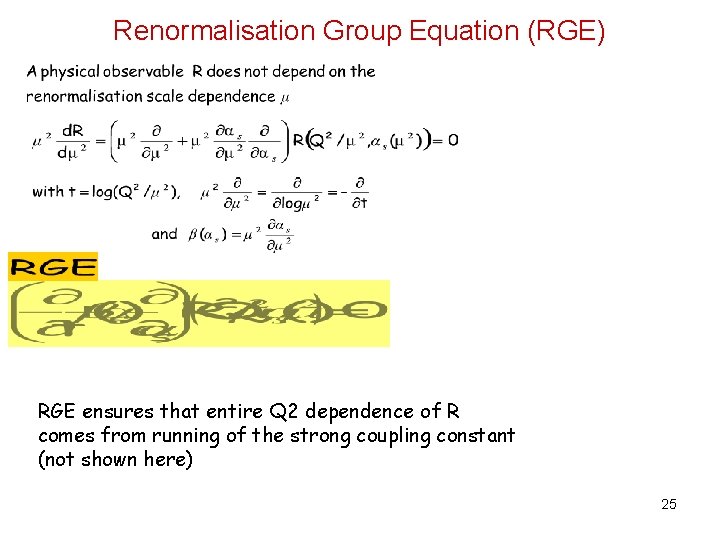
Renormalisation Group Equation (RGE) RGE ensures that entire Q 2 dependence of R comes from running of the strong coupling constant (not shown here) 25
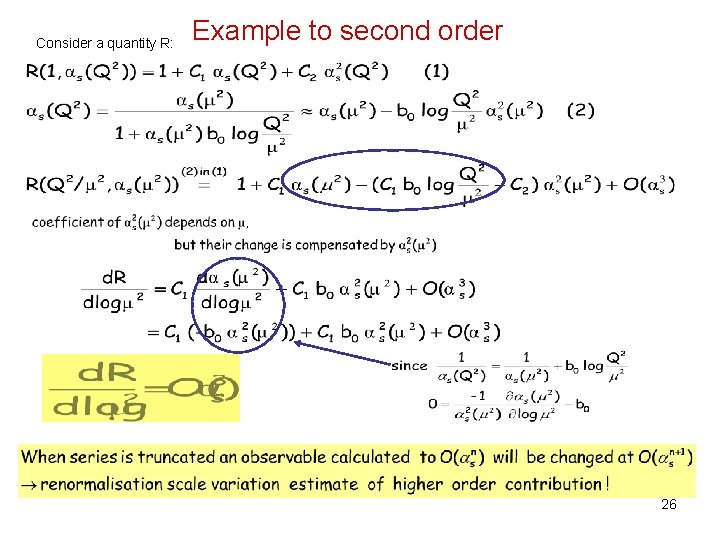
Consider a quantity R: Example to second order 26
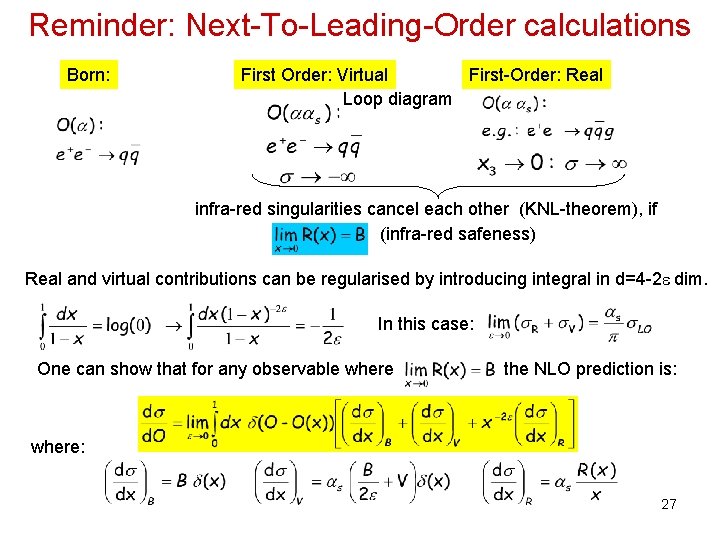
Reminder: Next-To-Leading-Order calculations Born: First Order: Virtual First-Order: Real Loop diagram infra-red singularities cancel each other (KNL-theorem), if (infra-red safeness) Real and virtual contributions can be regularised by introducing integral in d=4 -2 e dim. In this case: One can show that for any observable where the NLO prediction is: where: 27
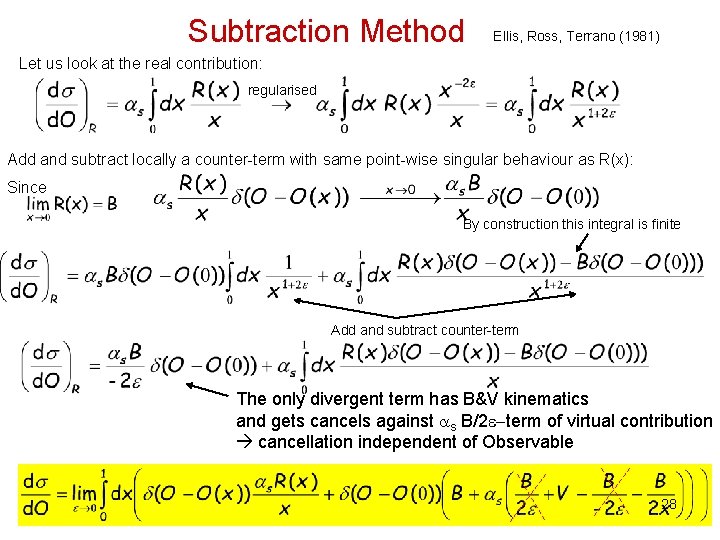
Subtraction Method Ellis, Ross, Terrano (1981) Let us look at the real contribution: regularised Add and subtract locally a counter-term with same point-wise singular behaviour as R(x): Since By construction this integral is finite Add and subtract counter-term The only divergent term has B&V kinematics and gets cancels against as B/2 e-term of virtual contribution cancellation independent of Observable 28
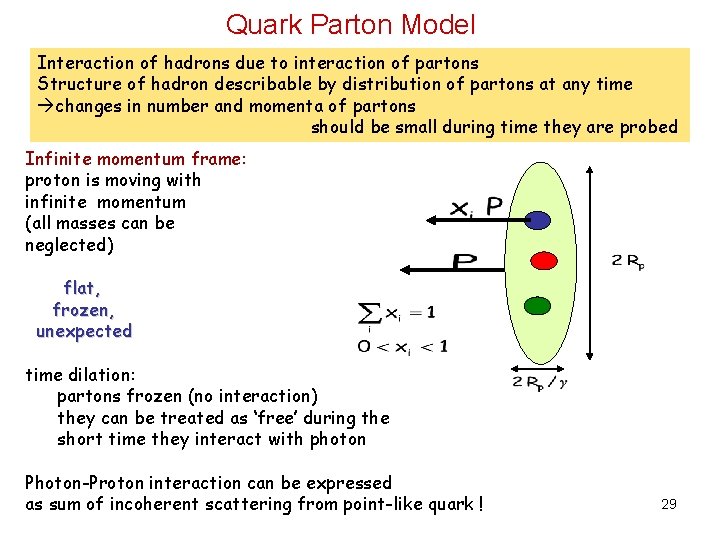
Quark Parton Model Interaction of hadrons due to interaction of partons Structure of hadron describable by distribution of partons at any time changes in number and momenta of partons should be small during time they are probed Infinite momentum frame: proton is moving with infinite momentum (all masses can be neglected) flat, frozen, unexpected time dilation: partons frozen (no interaction) they can be treated as ‘free’ during the short time they interact with photon Photon-Proton interaction can be expressed as sum of incoherent scattering from point-like quark ! 29
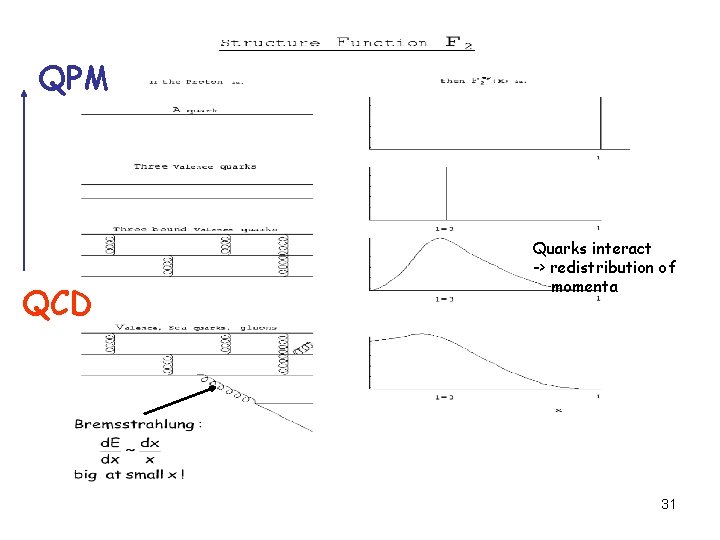
QPM QCD Quarks interact -> redistribution of momenta 31
32
BFKL Toy Model 33
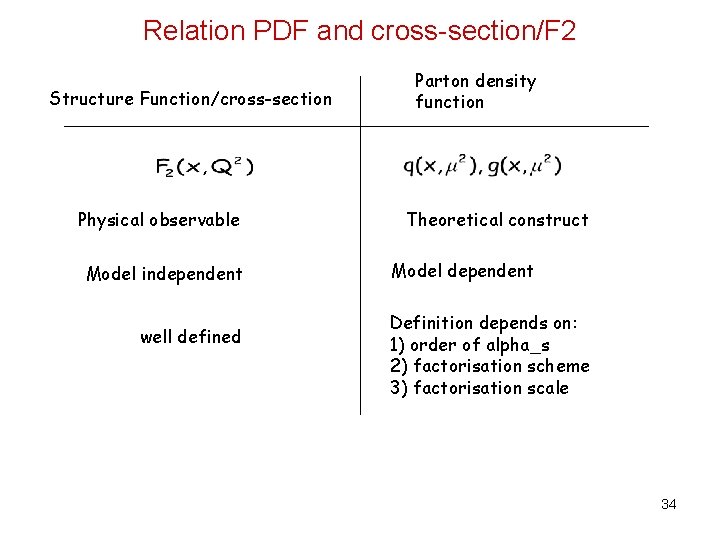
Relation PDF and cross-section/F 2 Structure Function/cross-section Physical observable Model independent well defined Parton density function Theoretical construct Model dependent Definition depends on: 1) order of alpha_s 2) factorisation scheme 3) factorisation scale 34
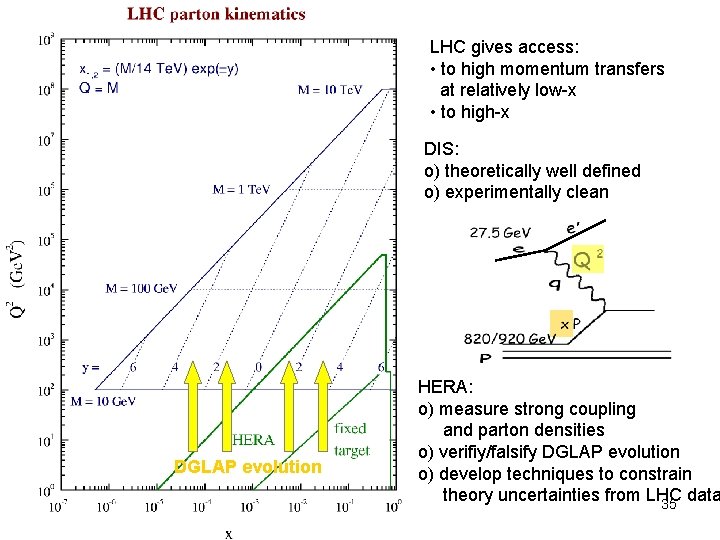
LHC gives access: • to high momentum transfers at relatively low-x • to high-x DIS: o) theoretically well defined o) experimentally clean DGLAP evolution HERA: o) measure strong coupling and parton densities o) verifiy/falsify DGLAP evolution o) develop techniques to constrain theory uncertainties from LHC data 35
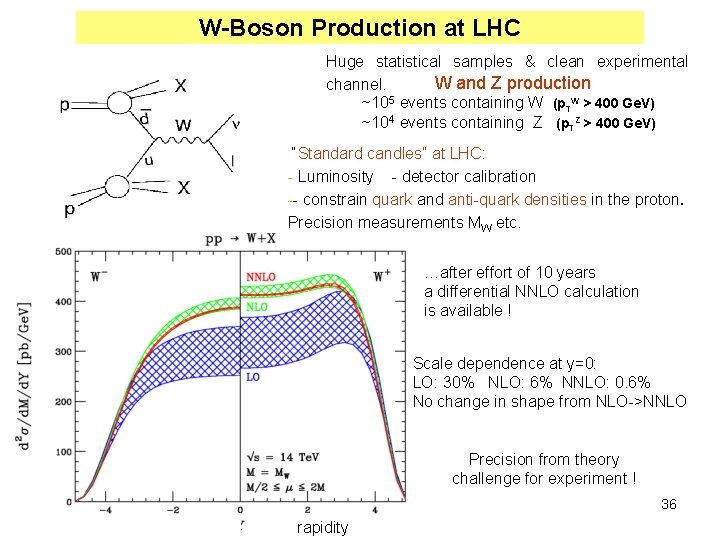
W-Boson Production at LHC Huge statistical samples & clean experimental W and Z production channel. 5 ~10 events containing W (p. TW > 400 Ge. V) ~104 events containing Z (p. TZ > 400 Ge. V) “Standard candles” at LHC: - Luminosity - detector calibration -- constrain quark and anti-quark densities in the proton. Precision measurements MW etc. …after effort of 10 years a differential NNLO calculation is available ! Scale dependence at y=0: LO: 30% NLO: 6% NNLO: 0. 6% No change in shape from NLO->NNLO Precision from theory challenge for experiment ! 36 rapidity
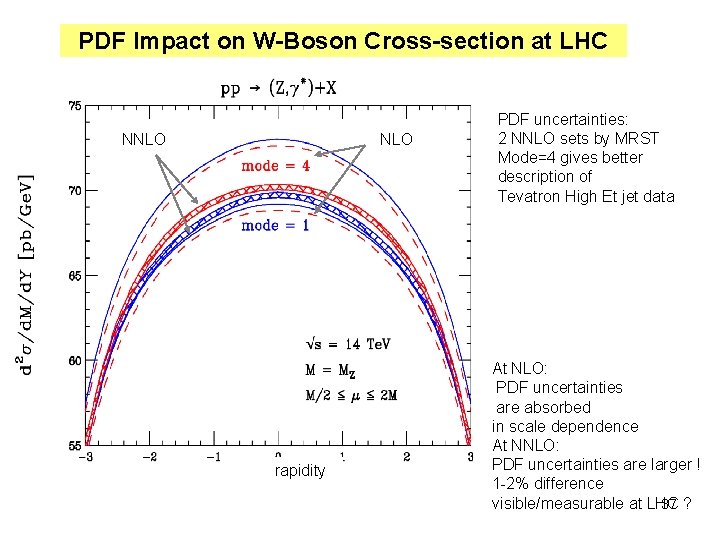
PDF Impact on W-Boson Cross-section at LHC NNLO rapidity PDF uncertainties: 2 NNLO sets by MRST Mode=4 gives better description of Tevatron High Et jet data At NLO: PDF uncertainties are absorbed in scale dependence At NNLO: PDF uncertainties are larger ! 1 -2% difference visible/measurable at LHC 37 ?