PHYSICS AND CHEMISTRY 4 ESO Physics and Chemistry
- Slides: 71
PHYSICS AND CHEMISTRY 4º ESO Physics and Chemistry Department UNIT 8. ATOMIC STRUCTURE AND PROPERTIES OF SUBSTANCES 1
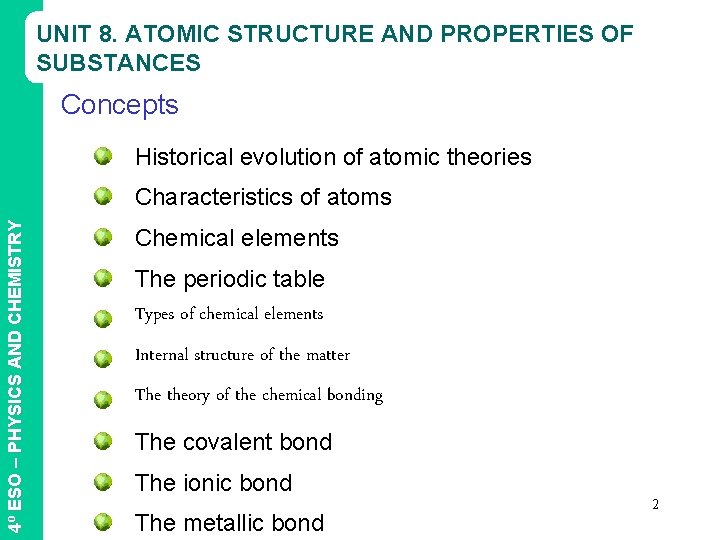
UNIT 8. ATOMIC STRUCTURE AND PROPERTIES OF SUBSTANCES Concepts Historical evolution of atomic theories 4º ESO – PHYSICS AND CHEMISTRY Characteristics of atoms Chemical elements The periodic table Types of chemical elements Internal structure of the matter The theory of the chemical bonding The covalent bond The ionic bond The metallic bond 2
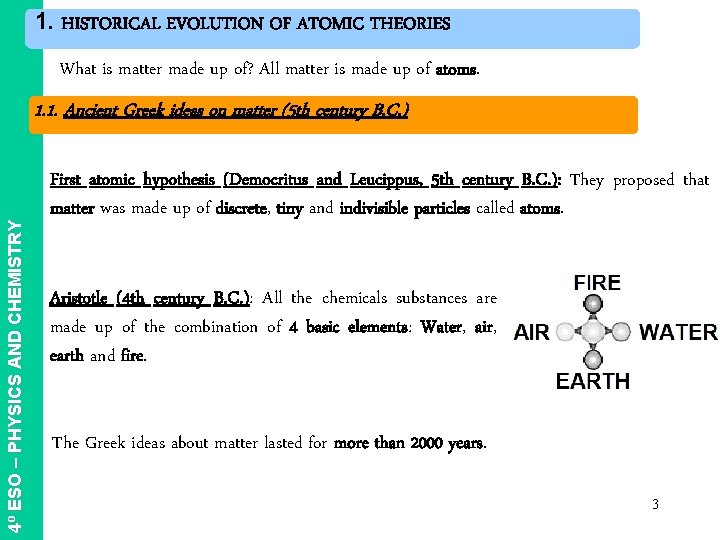
1. HISTORICAL EVOLUTION OF ATOMIC THEORIES What is matter made up of? All matter is made up of atoms. 4º ESO – PHYSICS AND CHEMISTRY 1. 1. Ancient Greek ideas on matter (5 th century B. C. ) First atomic hypothesis (Democritus and Leucippus, 5 th century B. C. ): They proposed that matter was made up of discrete, tiny and indivisible particles called atoms. Aristotle (4 th century B. C. ): All the chemicals substances are made up of the combination of 4 basic elements: Water, air, earth and fire. The Greek ideas about matter lasted for more than 2000 years. 3
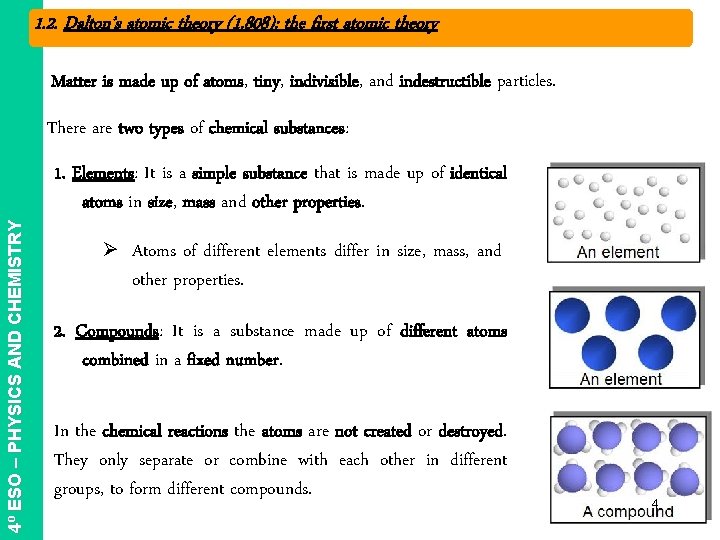
1. 2. Dalton’s atomic theory (1. 808): the first atomic theory Matter is made up of atoms, tiny, indivisible, and indestructible particles. 4º ESO – PHYSICS AND CHEMISTRY There are two types of chemical substances: 1. Elements: It is a simple substance that is made up of identical atoms in size, mass and other properties. Ø Atoms of different elements differ in size, mass, and other properties. 2. Compounds: It is a substance made up of different atoms combined in a fixed number. In the chemical reactions the atoms are not created or destroyed. They only separate or combine with each other in different groups, to form different compounds. 4
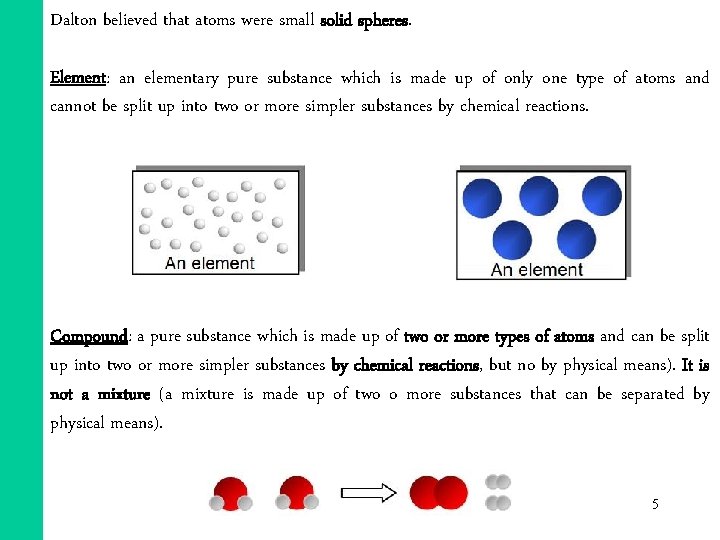
Dalton believed that atoms were small solid spheres. Element: an elementary pure substance which is made up of only one type of atoms and cannot be split up into two or more simpler substances by chemical reactions. Compound: a pure substance which is made up of two or more types of atoms and can be split up into two or more simpler substances by chemical reactions, but no by physical means). It is not a mixture (a mixture is made up of two o more substances that can be separated by physical means). 5
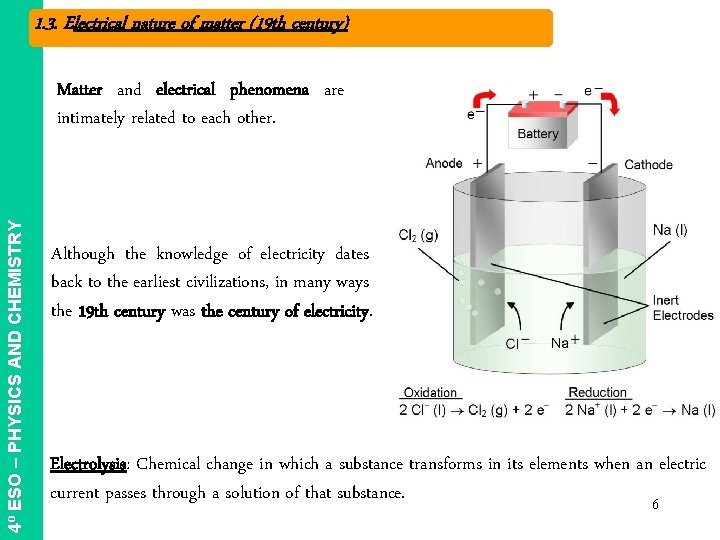
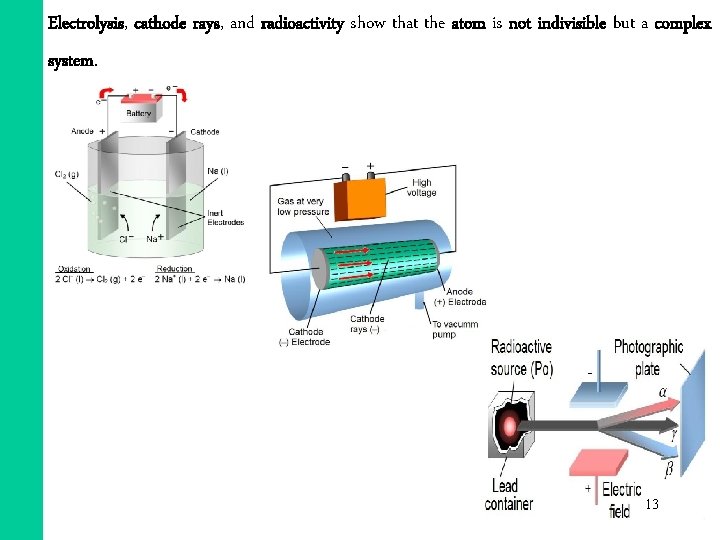
1. 3. Electrical nature of matter (19 th century) 4º ESO – PHYSICS AND CHEMISTRY Matter and electrical phenomena are intimately related to each other. Although the knowledge of electricity dates back to the earliest civilizations, in many ways the 19 th century was the century of electricity. Electrolysis: Chemical change in which a substance transforms in its elements when an electric current passes through a solution of that substance. 6
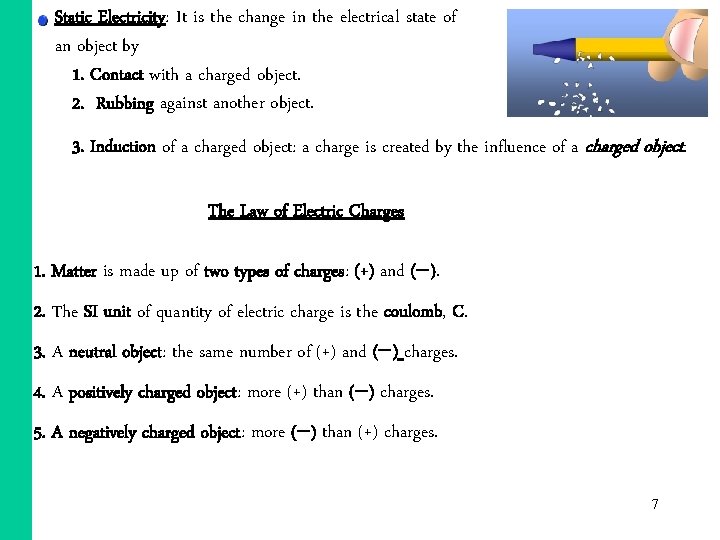
Static Electricity: It is the change in the electrical state of an object by 1. Contact with a charged object. 2. Rubbing against another object. 3. Induction of a charged object: a charge is created by the influence of a charged object. The Law of Electric Charges 1. Matter is made up of two types of charges: (+) and ( ). 2. The SI unit of quantity of electric charge is the coulomb, C. 3. A neutral object: the same number of (+) and ( ) charges. 4. A positively charged object: more (+) than ( ) charges. 5. A negatively charged object: more ( ) than (+) charges. 7
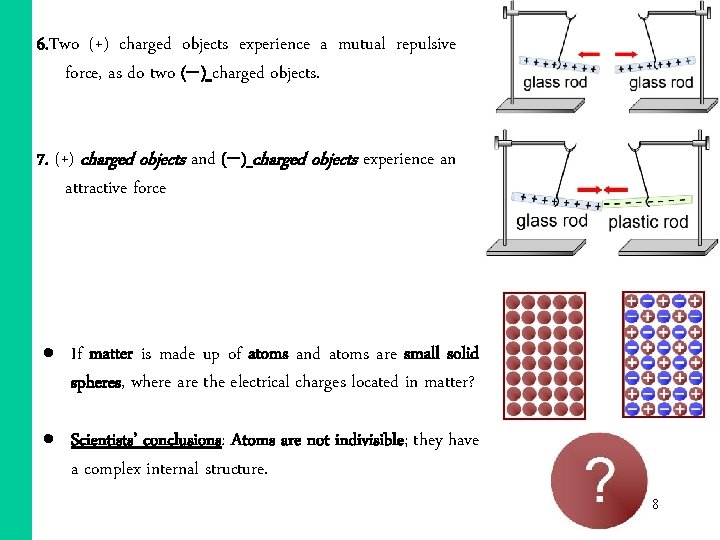
6. Two (+) charged objects experience a mutual repulsive force, as do two ( ) charged objects. 7. (+) charged objects and ( ) charged objects experience an attractive force If matter is made up of atoms and atoms are small solid spheres, where are the electrical charges located in matter? Scientists’ conclusions: Atoms are not indivisible; they have a complex internal structure. 8
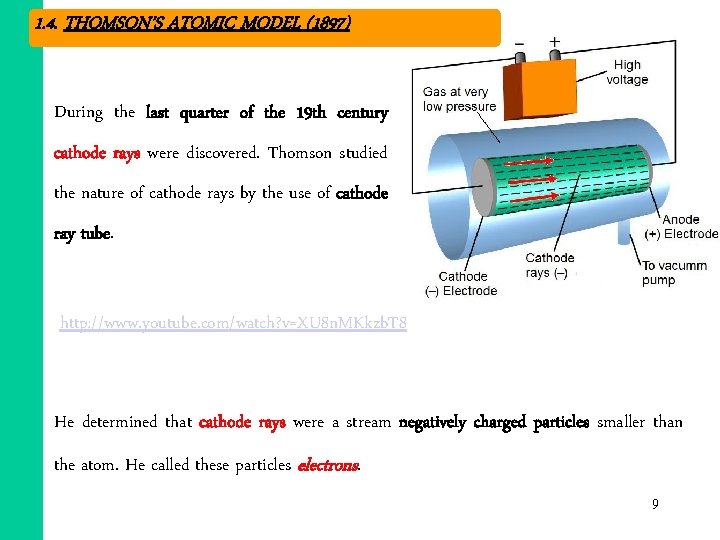
1. 4. THOMSON’S ATOMIC MODEL (1897) During the last quarter of the 19 th century cathode rays were discovered. Thomson studied the nature of cathode rays by the use of cathode ray tube. http: //www. youtube. com/watch? v=XU 8 n. MKkzb. T 8 He determined that cathode rays were a stream negatively charged particles smaller than the atom. He called these particles electrons. 9
Characteristics of the electron: It is a tiny particle which forms part of all atoms. Negatively electric charge: Smallest negatively electric charge in the Universe. Qe = 1, 6 10 19 C Qe = 1 Very small mass me = 0, 00000000000000091 kg me = 9, 1 10 31 kg 10
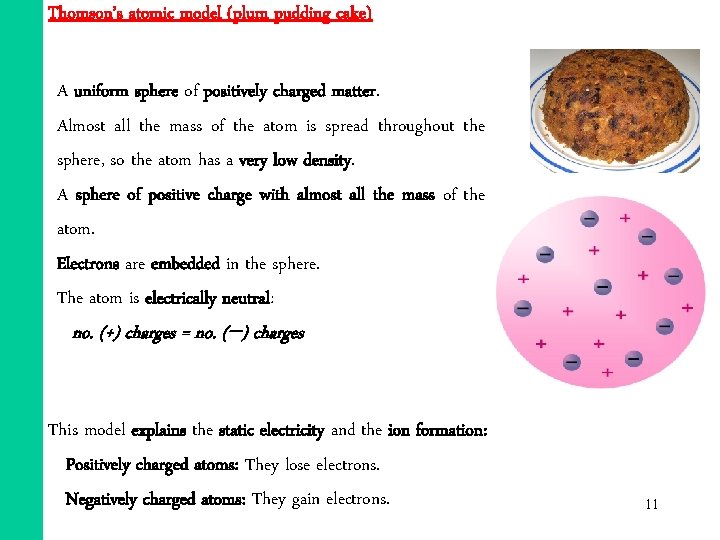
Thomson’s atomic model (plum pudding cake) A uniform sphere of positively charged matter. Almost all the mass of the atom is spread throughout the sphere, so the atom has a very low density. A sphere of positive charge with almost all the mass of the atom. Electrons are embedded in the sphere. The atom is electrically neutral: no. (+) charges = no. ( ) charges This model explains the static electricity and the ion formation: Positively charged atoms: They lose electrons. Negatively charged atoms: They gain electrons. 11
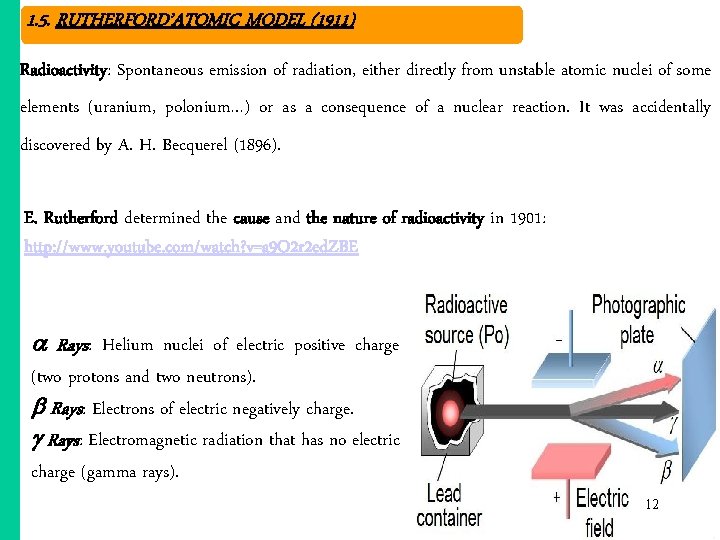
1. 5. RUTHERFORD’ATOMIC MODEL (1911) Radioactivity: Spontaneous emission of radiation, either directly from unstable atomic nuclei of some elements (uranium, polonium…) or as a consequence of a nuclear reaction. It was accidentally discovered by A. H. Becquerel (1896). E. Rutherford determined the cause and the nature of radioactivity in 1901: http: //www. youtube. com/watch? v=a 9 O 2 r 2 ed. ZBE Rays: Helium nuclei of electric positive charge (two protons and two neutrons). Rays: Electrons of electric negatively charge. g Rays: Electromagnetic radiation that has no electric charge (gamma rays). 12
Electrolysis, cathode rays, and radioactivity show that the atom is not indivisible but a complex system. 13
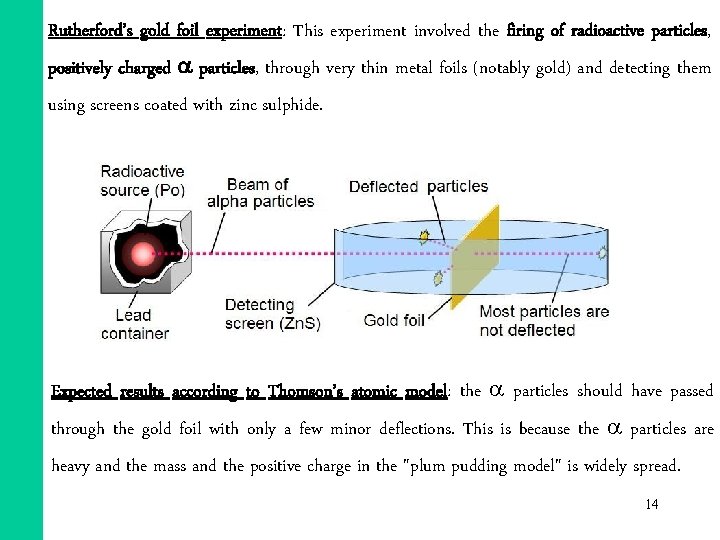
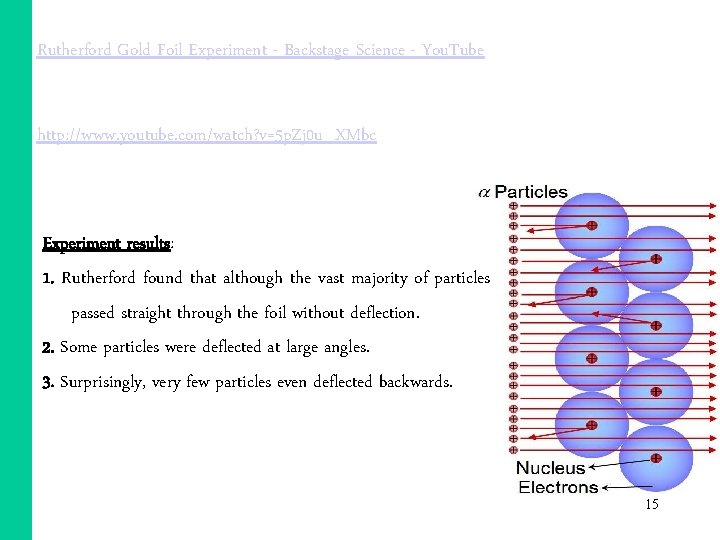
Rutherford’s gold foil experiment: This experiment involved the firing of radioactive particles, positively charged a particles, through very thin metal foils (notably gold) and detecting them using screens coated with zinc sulphide. Expected results according to Thomson’s atomic model: the a particles should have passed through the gold foil with only a few minor deflections. This is because the a particles are heavy and the mass and the positive charge in the "plum pudding model" is widely spread. 14
Rutherford Gold Foil Experiment - Backstage Science - You. Tube http: //www. youtube. com/watch? v=5 p. Zj 0 u_XMbc Experiment results: 1. Rutherford found that although the vast majority of particles passed straight through the foil without deflection. 2. Some particles were deflected at large angles. 3. Surprisingly, very few particles even deflected backwards. 15
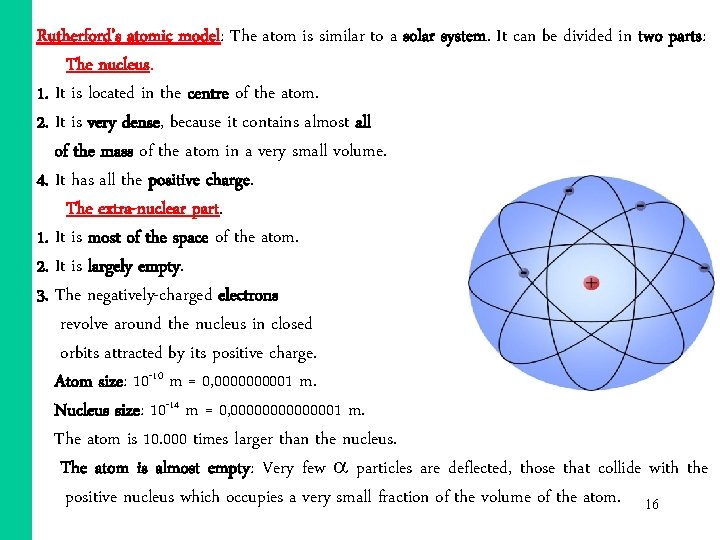
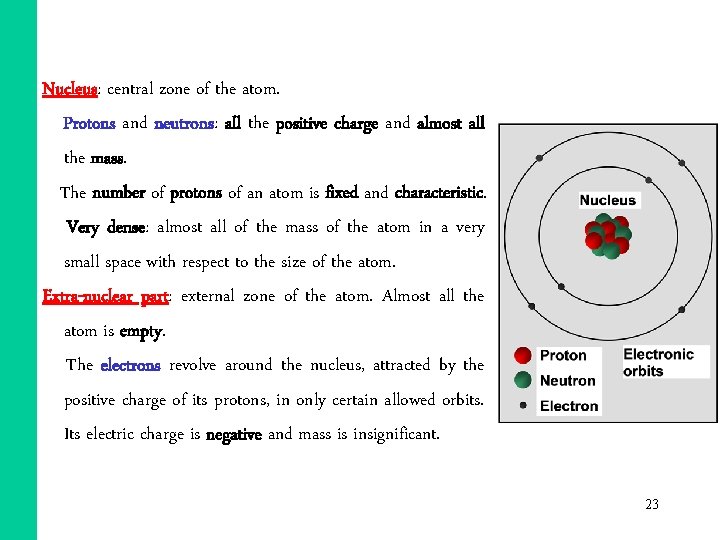
Rutherford’s atomic model: The atom is similar to a solar system. It can be divided in two parts: The nucleus. 1. It is located in the centre of the atom. 2. It is very dense, because it contains almost all of the mass of the atom in a very small volume. 4. It has all the positive charge. The extra-nuclear part. 1. It is most of the space of the atom. 2. It is largely empty. 3. The negatively-charged electrons revolve around the nucleus in closed orbits attracted by its positive charge. Atom size: 10 -10 m = 0, 000001 m. Nucleus size: 10 -14 m = 0, 00000001 m. The atom is 10. 000 times larger than the nucleus. The atom is almost empty: Very few a particles are deflected, those that collide with the positive nucleus which occupies a very small fraction of the volume of the atom. 16
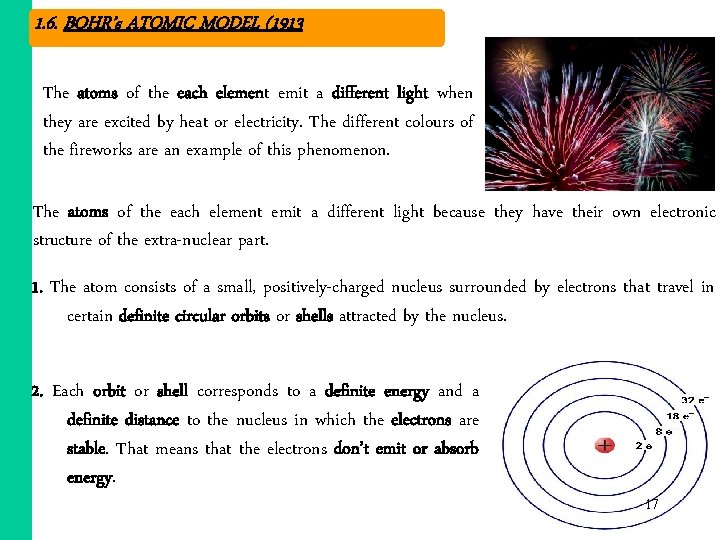
1. 6. BOHR’s ATOMIC MODEL (1913 The atoms of the each element emit a different light when they are excited by heat or electricity. The different colours of the fireworks are an example of this phenomenon. The atoms of the each element emit a different light because they have their own electronic structure of the extra-nuclear part. 1. The atom consists of a small, positively-charged nucleus surrounded by electrons that travel in certain definite circular orbits or shells attracted by the nucleus. 2. Each orbit or shell corresponds to a definite energy and a definite distance to the nucleus in which the electrons are stable. That means that the electrons don’t emit or absorb energy. 17
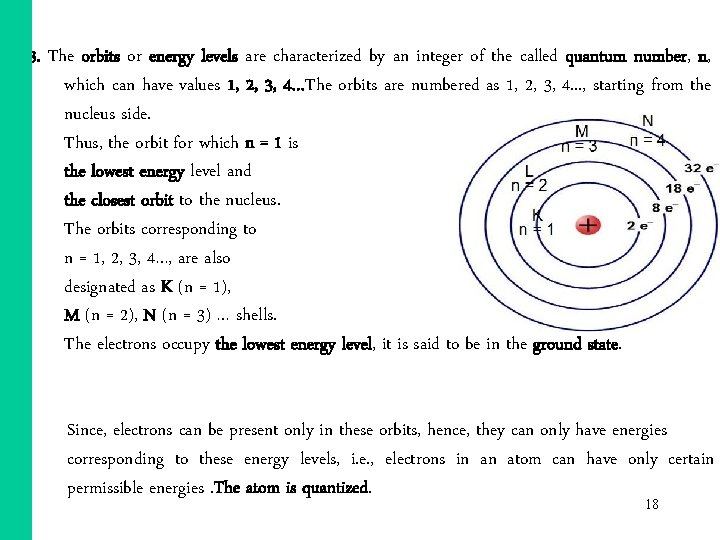
3. The orbits or energy levels are characterized by an integer of the called quantum number, n, which can have values 1, 2, 3, 4…The orbits are numbered as 1, 2, 3, 4. . . , starting from the nucleus side. Thus, the orbit for which n = 1 is the lowest energy level and the closest orbit to the nucleus. The orbits corresponding to n = 1, 2, 3, 4…, are also designated as K (n = 1), M (n = 2), N (n = 3) … shells. The electrons occupy the lowest energy level, it is said to be in the ground state. Since, electrons can be present only in these orbits, hence, they can only have energies corresponding to these energy levels, i. e. , electrons in an atom can have only certain permissible energies. The atom is quantized. 18
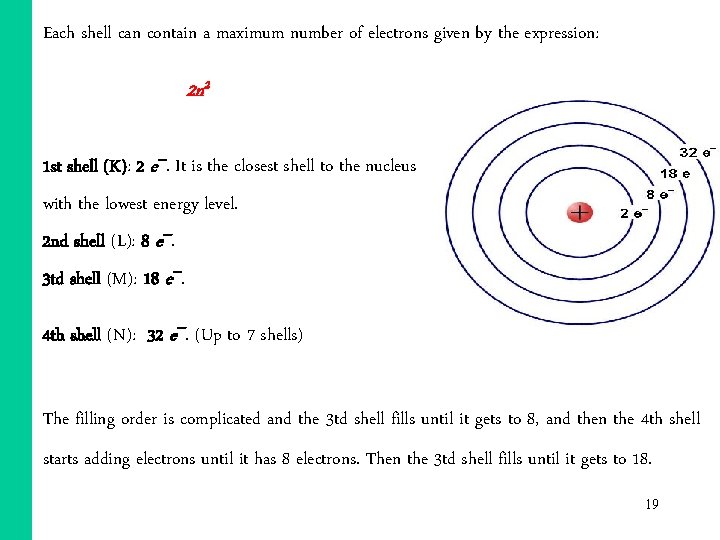
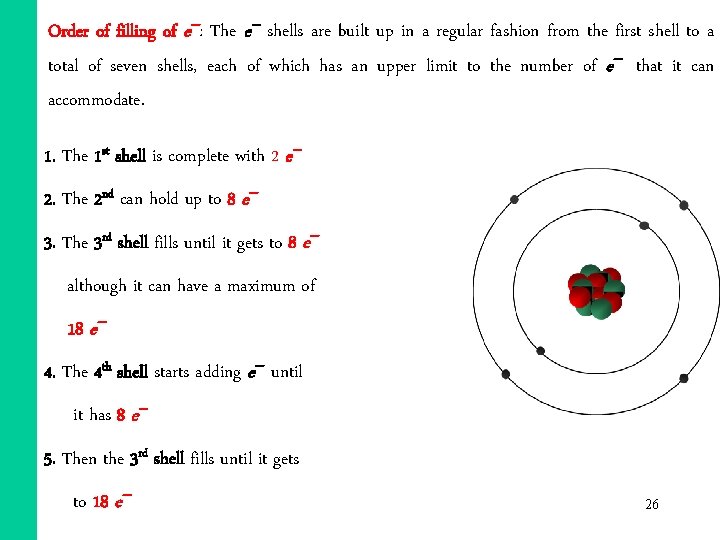
Each shell can contain a maximum number of electrons given by the expression: 2 n 2 1 st shell (K): 2 e. It is the closest shell to the nucleus with the lowest energy level. 2 nd shell (L): 8 e. 3 td shell (M): 18 e. 4 th shell (N): 32 e. (Up to 7 shells) The filling order is complicated and the 3 td shell fills until it gets to 8, and then the 4 th shell starts adding electrons until it has 8 electrons. Then the 3 td shell fills until it gets to 18. 19
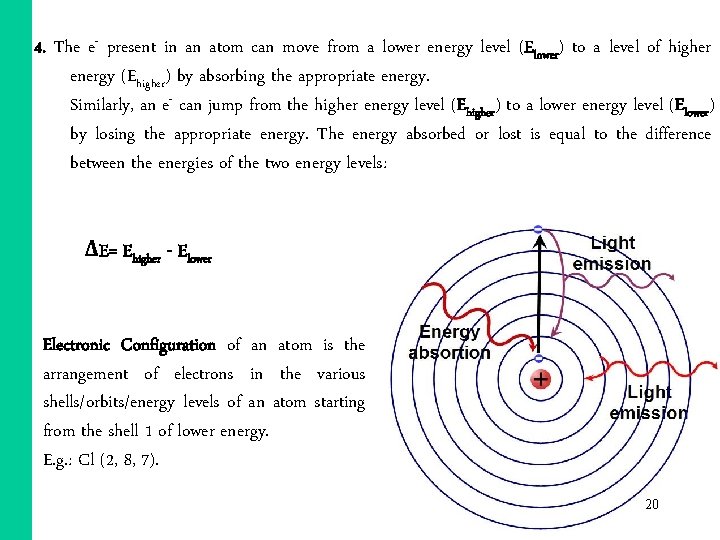
4. The e- present in an atom can move from a lower energy level (Elower) to a level of higher energy (Ehigher) by absorbing the appropriate energy. Similarly, an e- can jump from the higher energy level (Ehigher) to a lower energy level (Elower) by losing the appropriate energy. The energy absorbed or lost is equal to the difference between the energies of the two energy levels: ΔE= Ehigher - Elower Electronic Configuration of an atom is the arrangement of electrons in the various shells/orbits/energy levels of an atom starting from the shell 1 of lower energy. E. g. : Cl (2, 8, 7). 20
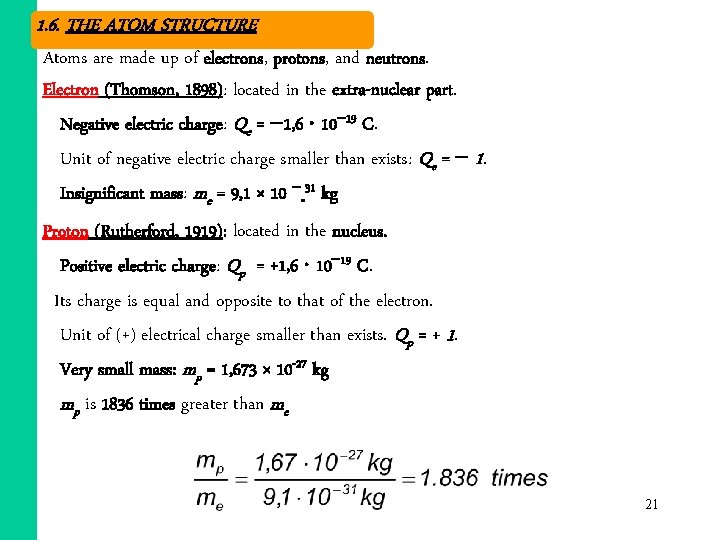
1. 6. THE ATOM STRUCTURE Atoms are made up of electrons, protons, and neutrons. Electron (Thomson, 1898): located in the extra-nuclear part. Negative electric charge: Qe = 1, 6 10 19 C. Unit of negative electric charge smaller than exists: Qe = 1. Insignificant mass: me = 9, 1 × 10 31 kg Proton (Rutherford, 1919): located in the nucleus. Positive electric charge: Qp = +1, 6 10 19 C. Its charge is equal and opposite to that of the electron. Unit of (+) electrical charge smaller than exists. Qp = + 1. Very small mass: mp = 1, 673 × 10 -27 kg mp is 1836 times greater than me 21
Neutron (Prediction of Rutherford: 1920; discovery of Chadwick: 1932): located in the nucleus. Without electrical charge. Very small mass: mn = mp = 1, 675 × 10 -27 kg 22
Nucleus: central zone of the atom. Protons and neutrons: all the positive charge and almost all the mass. The number of protons of an atom is fixed and characteristic. Very dense: almost all of the mass of the atom in a very small space with respect to the size of the atom. Extra-nuclear part: external zone of the atom. Almost all the atom is empty. The electrons revolve around the nucleus, attracted by the positive charge of its protons, in only certain allowed orbits. Its electric charge is negative and mass is insignificant. 23
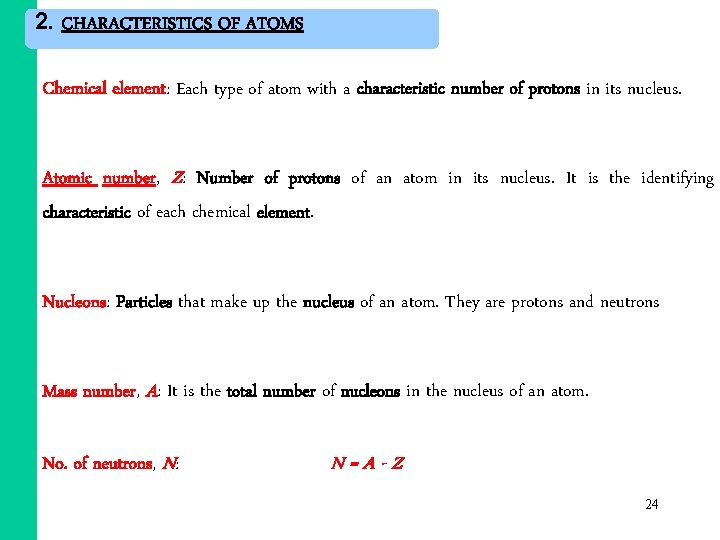
2. CHARACTERISTICS OF ATOMS Chemical element: Each type of atom with a characteristic number of protons in its nucleus. Atomic number, Z: Number of protons of an atom in its nucleus. It is the identifying characteristic of each chemical element. Nucleons: Particles that make up the nucleus of an atom. They are protons and neutrons Mass number, A: It is the total number of nucleons in the nucleus of an atom. No. of neutrons, N: N=A-Z 24
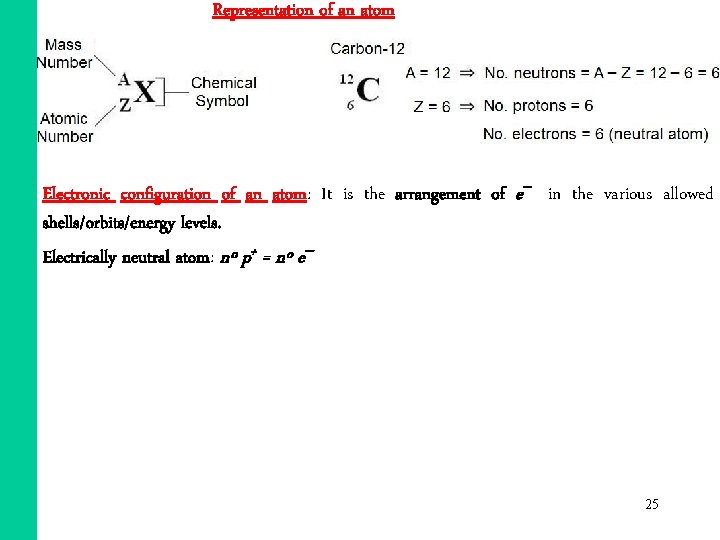
Representation of an atom Electronic configuration of an atom: It is the arrangement of e in the various allowed shells/orbits/energy levels. Electrically neutral atom: nº p+ = nº e 25
Order of filling of e : The e shells are built up in a regular fashion from the first shell to a total of seven shells, each of which has an upper limit to the number of e that it can accommodate. 1. The 1 st shell is complete with 2 e 2. The 2 nd can hold up to 8 e 3. The 3 rd shell fills until it gets to 8 e although it can have a maximum of 18 e 4. The 4 th shell starts adding e until it has 8 e 5. Then the 3 rd shell fills until it gets to 18 e 26
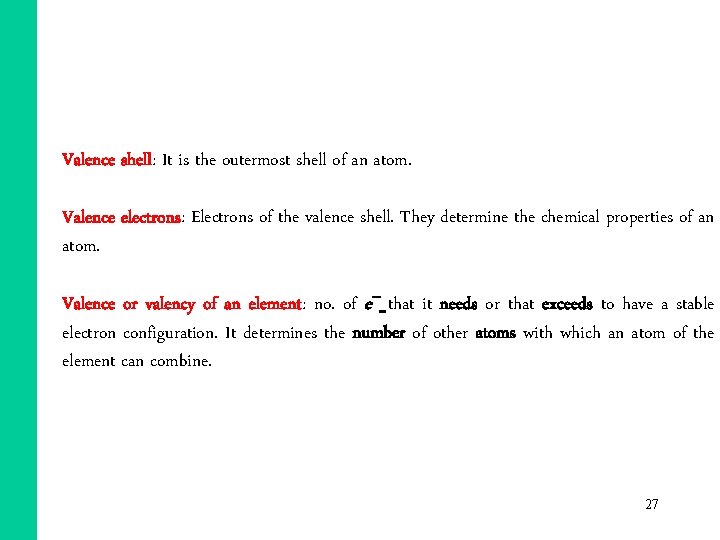
Valence shell: It is the outermost shell of an atom. Valence electrons: Electrons of the valence shell. They determine the chemical properties of an atom. Valence or valency of an element: no. of e that it needs or that exceeds to have a stable electron configuration. It determines the number of other atoms with which an atom of the element can combine. 27
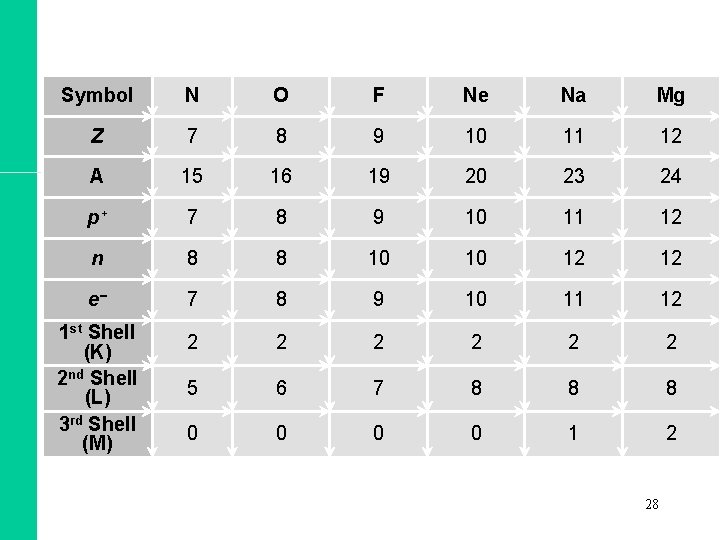
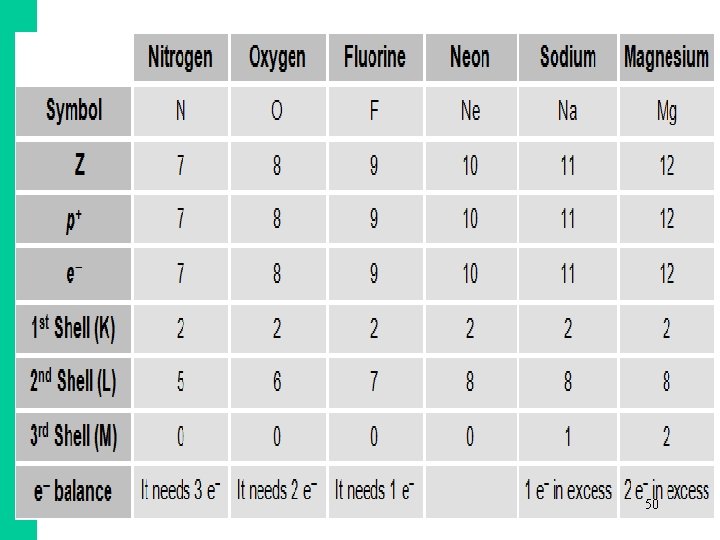
Symbol N O F Ne Na Mg Z 7 8 9 10 11 12 A 15 16 19 20 23 24 p+ 7 8 9 10 11 12 n 8 8 10 10 12 12 e 7 8 9 10 11 12 1 st Shell (K) 2 nd Shell (L) 3 rd Shell (M) 2 2 2 5 6 7 8 8 8 0 0 1 2 28
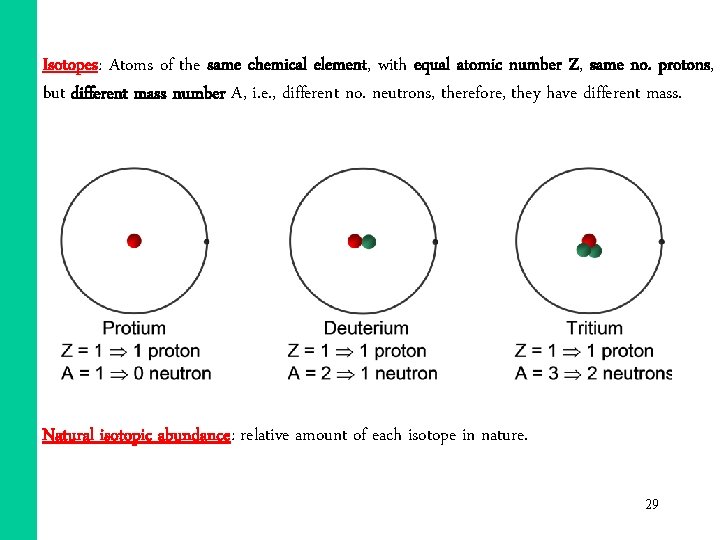
Isotopes: Atoms of the same chemical element, with equal atomic number Z, same no. protons, but different mass number A, i. e. , different no. neutrons, therefore, they have different mass. Natural isotopic abundance: relative amount of each isotope in nature. 29
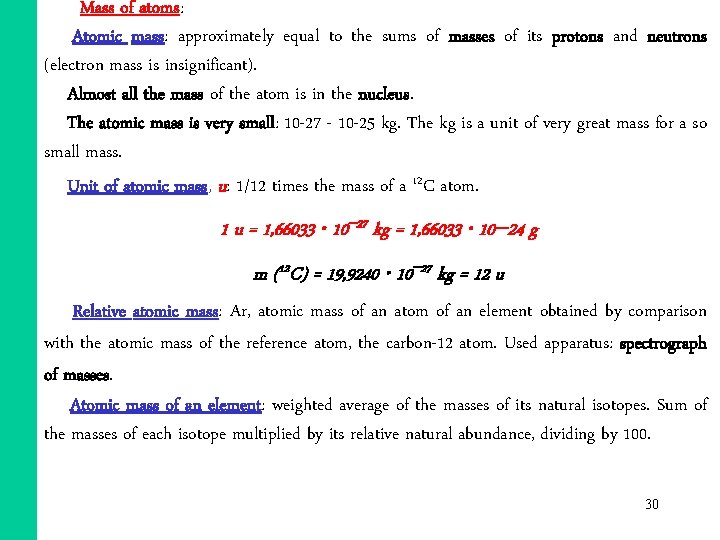
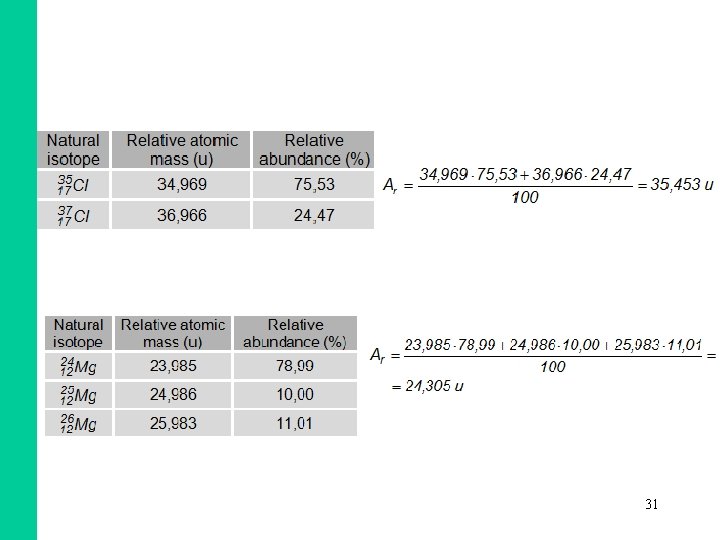
Mass of atoms: Atomic mass: approximately equal to the sums of masses of its protons and neutrons (electron mass is insignificant). Almost all the mass of the atom is in the nucleus. The atomic mass is very small: 10 -27 - 10 -25 kg. The kg is a unit of very great mass for a so small mass. Unit of atomic mass, u: 1/12 times the mass of a 12 C atom. 1 u = 1, 66033 10 27 kg = 1, 66033 10 24 g m (12 C) = 19, 9240 10 27 kg = 12 u Relative atomic mass: Ar, atomic mass of an atom of an element obtained by comparison with the atomic mass of the reference atom, the carbon-12 atom. Used apparatus: spectrograph of masses. Atomic mass of an element: weighted average of the masses of its natural isotopes. Sum of the masses of each isotope multiplied by its relative natural abundance, dividing by 100. 30
31
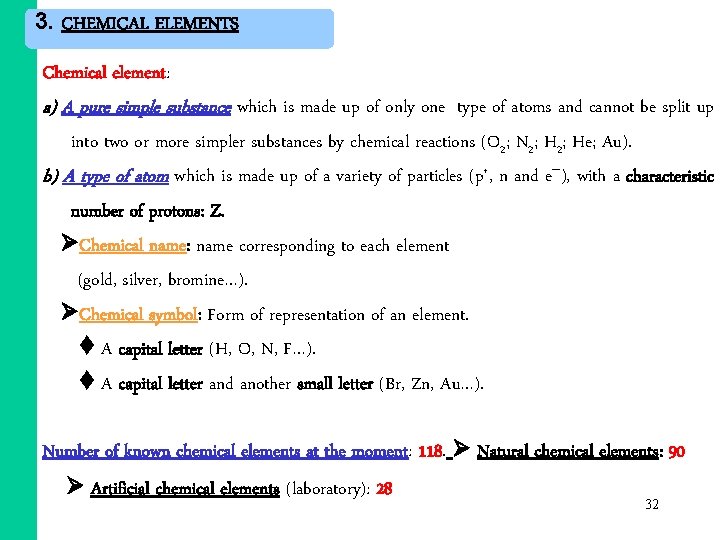
3. CHEMICAL ELEMENTS Chemical element: a) A pure simple substance which is made up of only one type of atoms and cannot be split up into two or more simpler substances by chemical reactions (O 2; N 2; He; Au). b) A type of atom which is made up of a variety of particles (p+, n and e ), with a characteristic number of protons: Z. Chemical name: name corresponding to each element (gold, silver, bromine…). Chemical symbol: Form of representation of an element. A capital letter (H, O, N, F…). A capital letter and another small letter (Br, Zn, Au…). Number of known chemical elements at the moment: 118. Natural chemical elements: 90 Artificial chemical elements (laboratory): 28 32
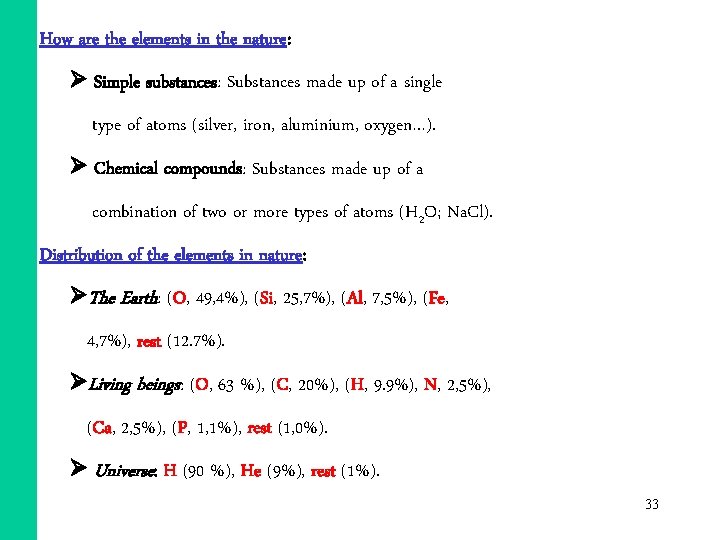
How are the elements in the nature: Simple substances: Substances made up of a single type of atoms (silver, iron, aluminium, oxygen…). Chemical compounds: Substances made up of a combination of two or more types of atoms (H 2 O; Na. Cl). Distribution of the elements in nature: The Earth: (O, 49, 4%), (Si, 25, 7%), (Al, 7, 5%), (Fe, 4, 7%), rest (12. 7%). Living beings: (O, 63 %), (C, 20%), (H, 9. 9%), N, 2, 5%), (Ca, 2, 5%), (P, 1, 1%), rest (1, 0%). Universe: H (90 %), He (9%), rest (1%). 33
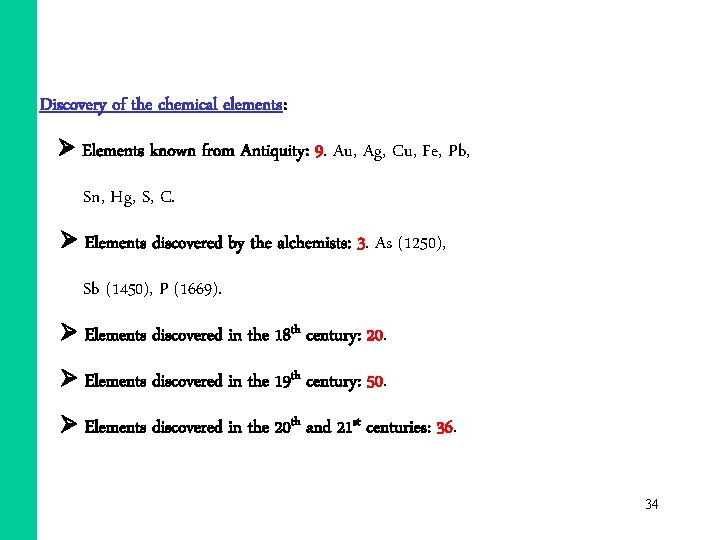
Discovery of the chemical elements: Elements known from Antiquity: 9. Au, Ag, Cu, Fe, Pb, Sn, Hg, S, C. Elements discovered by the alchemists: 3. As (1250), Sb (1450), P (1669). Elements discovered in the 18 th century: 20. Elements discovered in the 19 th century: 50. Elements discovered in the 20 th and 21 st centuries: 36. 34
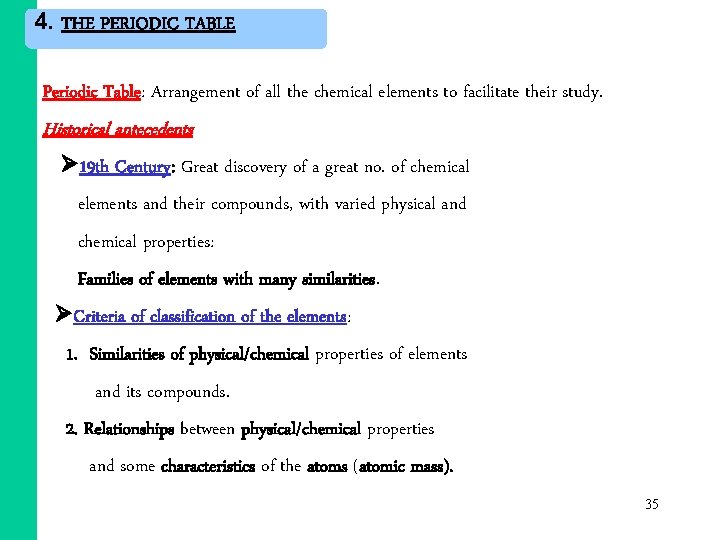
4. THE PERIODIC TABLE Periodic Table: Arrangement of all the chemical elements to facilitate their study. Historical antecedents 19 th Century: Great discovery of a great no. of chemical elements and their compounds, with varied physical and chemical properties: Families of elements with many similarities. Criteria of classification of the elements: 1. Similarities of physical/chemical properties of elements and its compounds. 2. Relationships between physical/chemical properties and some characteristics of the atoms (atomic mass). 35
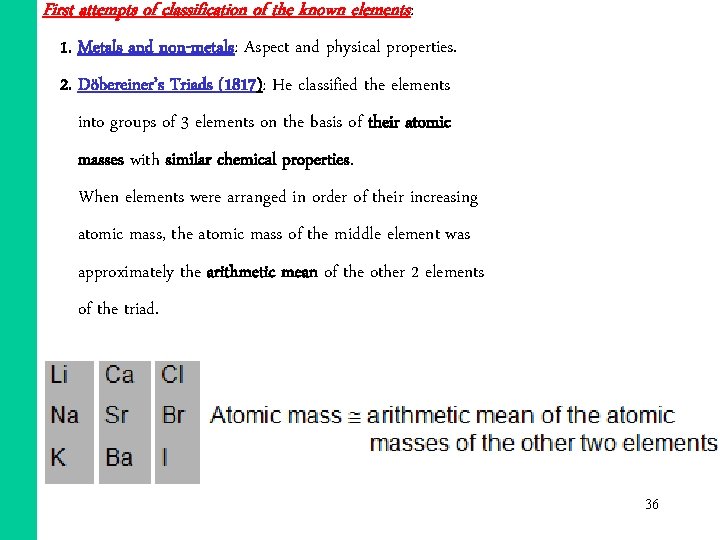
First attempts of classification of the known elements: 1. Metals and non-metals: Aspect and physical properties. 2. Döbereiner’s Triads (1817): He classified the elements into groups of 3 elements on the basis of their atomic masses with similar chemical properties. When elements were arranged in order of their increasing atomic mass, the atomic mass of the middle element was approximately the arithmetic mean of the other 2 elements of the triad. 36
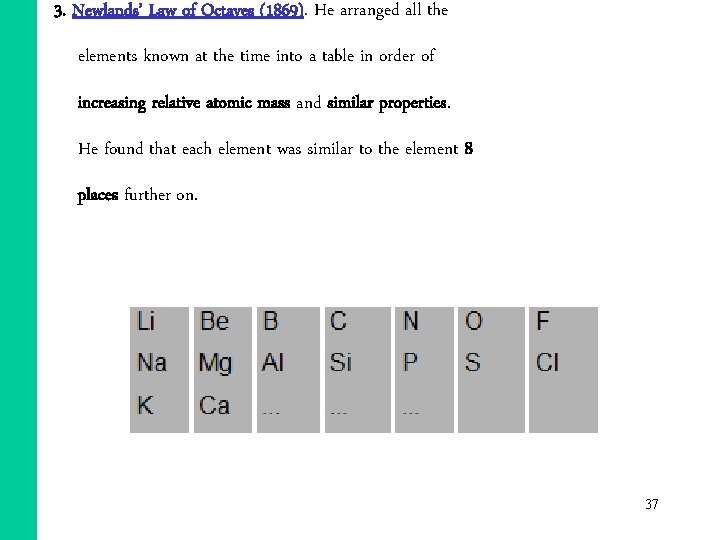
3. Newlands’ Law of Octaves (1869). He arranged all the elements known at the time into a table in order of increasing relative atomic mass and similar properties. He found that each element was similar to the element 8 places further on. 37
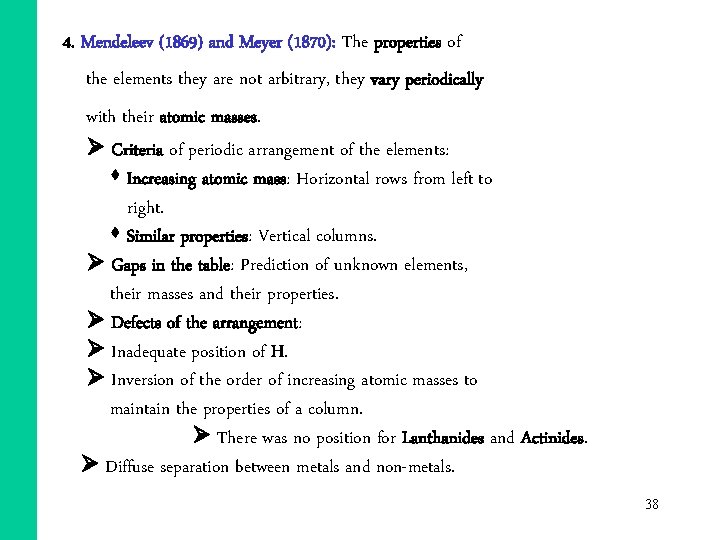
4. Mendeleev (1869) and Meyer (1870): The properties of the elements they are not arbitrary, they vary periodically with their atomic masses. Criteria of periodic arrangement of the elements: Increasing atomic mass: Horizontal rows from left to right. Similar properties: Vertical columns. Gaps in the table: Prediction of unknown elements, their masses and their properties. Defects of the arrangement: Inadequate position of H. Inversion of the order of increasing atomic masses to maintain the properties of a column. There was no position for Lanthanides and Actinides. Diffuse separation between metals and non-metals. 38
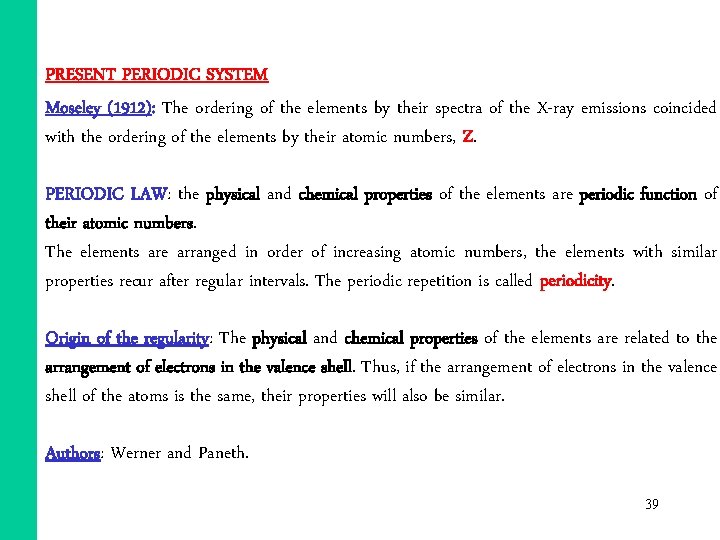
PRESENT PERIODIC SYSTEM Moseley (1912): The ordering of the elements by their spectra of the X-ray emissions coincided with the ordering of the elements by their atomic numbers, Z. PERIODIC LAW: the physical and chemical properties of the elements are periodic function of their atomic numbers. The elements are arranged in order of increasing atomic numbers, the elements with similar properties recur after regular intervals. The periodic repetition is called periodicity. Origin of the regularity: The physical and chemical properties of the elements are related to the arrangement of electrons in the valence shell. Thus, if the arrangement of electrons in the valence shell of the atoms is the same, their properties will also be similar. Authors: Werner and Paneth. 39
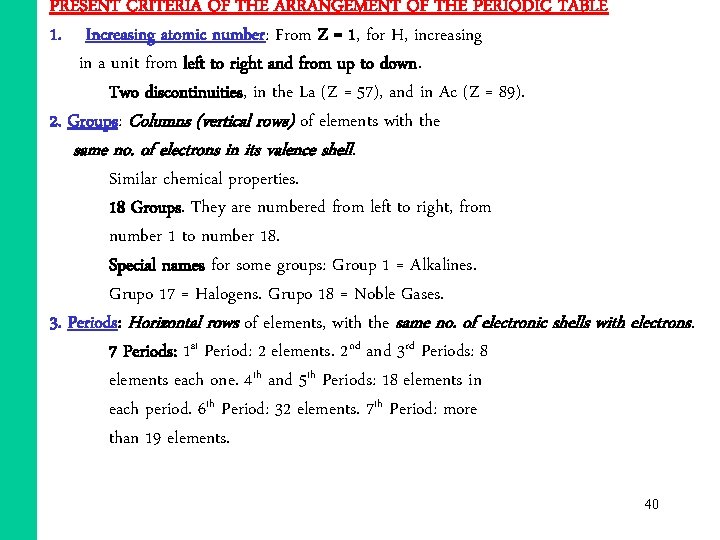
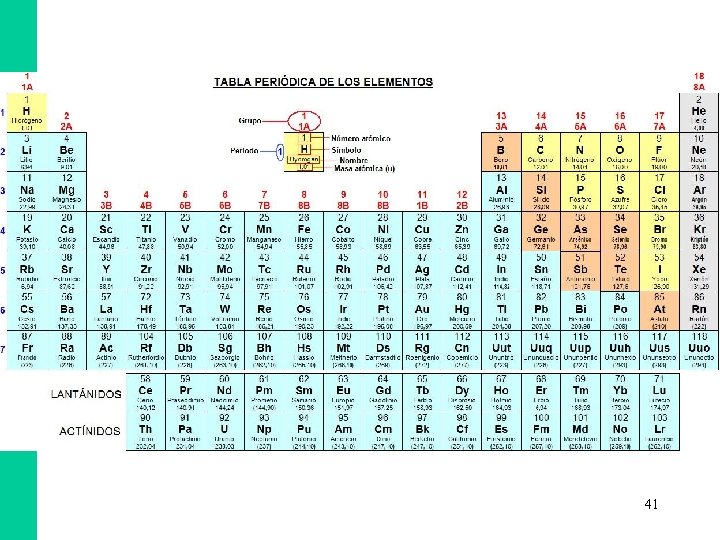
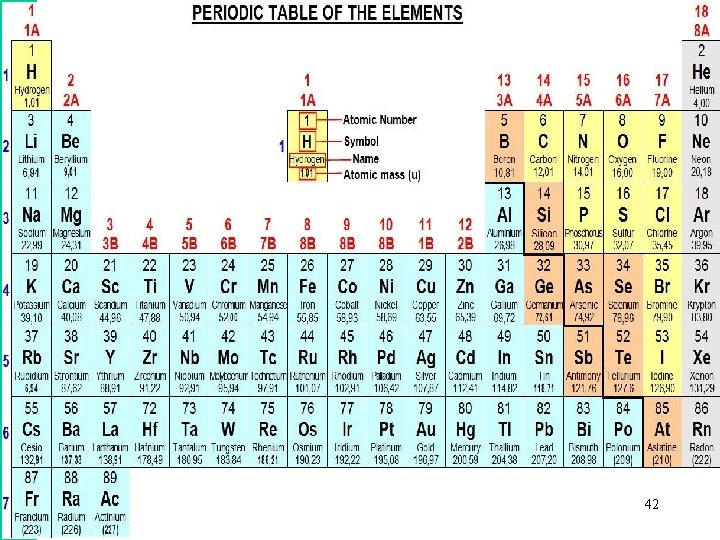
PRESENT CRITERIA OF THE ARRANGEMENT OF THE PERIODIC TABLE 1. Increasing atomic number: From Z = 1, for H, increasing in a unit from left to right and from up to down. Two discontinuities, in the La (Z = 57), and in Ac (Z = 89). 2. Groups: Columns (vertical rows) of elements with the same no. of electrons in its valence shell. Similar chemical properties. 18 Groups. They are numbered from left to right, from number 1 to number 18. Special names for some groups: Group 1 = Alkalines. Grupo 17 = Halogens. Grupo 18 = Noble Gases. 3. Periods: Horizontal rows of elements, with the same no. of electronic shells with electrons. 7 Periods: 1 st Period: 2 elements. 2 nd and 3 rd Periods: 8 elements each one. 4 th and 5 th Periods: 18 elements in each period. 6 th Period: 32 elements. 7 th Period: more than 19 elements. 40
41
42
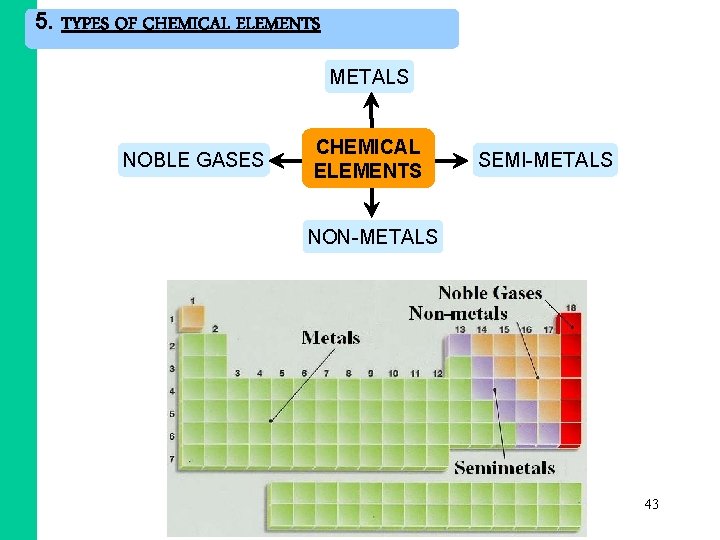
5. TYPES OF CHEMICAL ELEMENTS METALS NOBLE GASES CHEMICAL CIENCIA ELEMENTS SEMI-METALS NON-METALS 43
METALS 1. Solids (room temperature), high melting and boiling points. 2. A characteristic brightness. 3. Opaque (it doesn’t allow all light to pass through). 3. Metals feel cold to the touch. 4. Good thermal and electrical conductors. 5. Malleable (Malleability: property that enables a material to deform by compressive forces. It can be stamped, hammered, forged, pressed, or rolled into thin sheets. ) 6. Ductile (Ductility: property that enables a material to stretch, bend, or twist without cracking or breaking. This property makes it possible for a material to be drawn out into a thin wire). 7. Tough (Toughness: property that enables a material to withstand shock and to be deformed without rupturing). 8. Located on the left and the middle of the Periodic Table. 9. Most of the chemical elements of the Periodic Table. 44
NON-METALS 1. Solids, liquids or gases at room temperature. 2. Low melting and boiling points. 3. They do not have characteristic brightness. 4. Bad thermal and electrical conductors. 5. Located on the right of the Periodic Table. SEMI-METALS 1. Intermediate characteristics between metals and non-metals. 2. Located between metals and non-metals: B, Si, Ge, As, Sb, Te, Po, and At. NOBLE GASES 1. 18 th Group of the Periodic Table. 2. They are all gases at room temperature. 3. They are inert. 45
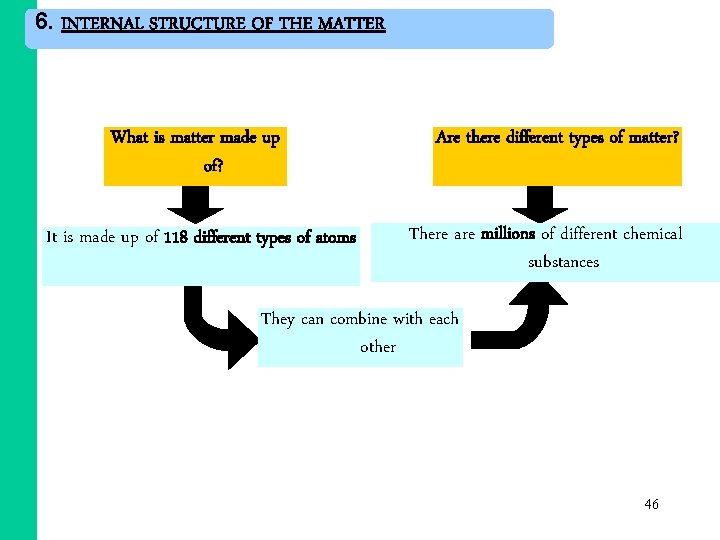
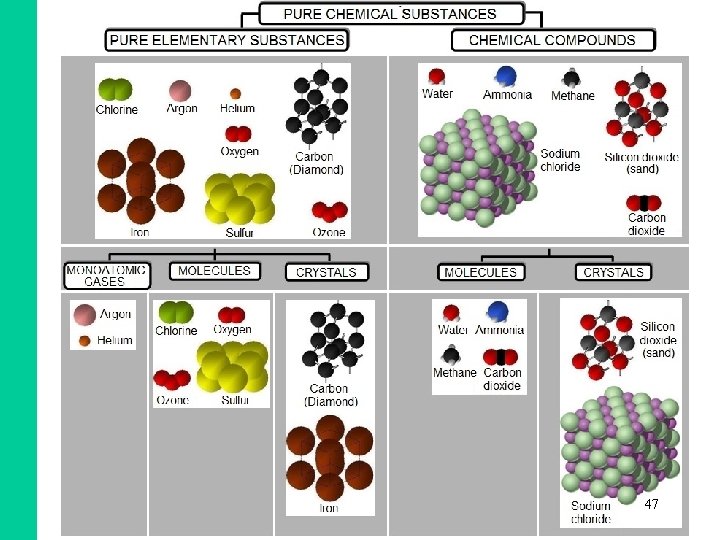
6. INTERNAL STRUCTURE OF THE MATTER What is matter made up of? It is made up of 118 different types of atoms Are there different types of matter? There are millions of different chemical substances They can combine with each other 46
47
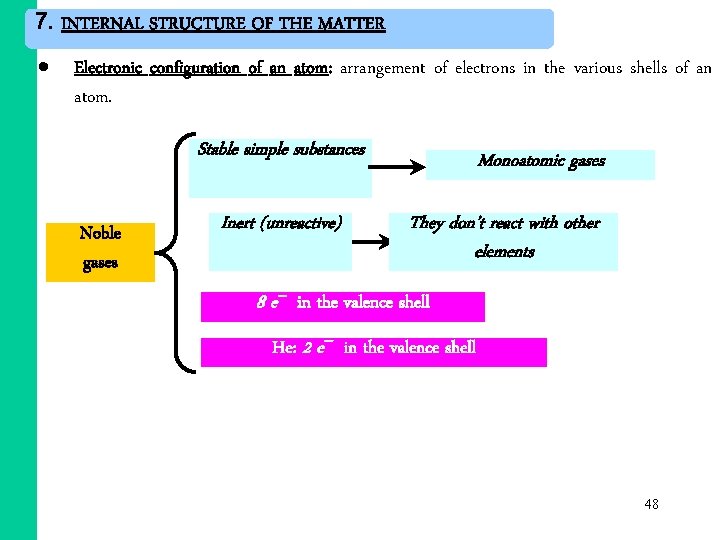
7. INTERNAL STRUCTURE OF THE MATTER Electronic configuration of an atom: arrangement of electrons in the various shells of an atom. Stable simple substances Noble gases Inert (unreactive) Monoatomic gases They don’t react with other elements 8 e in the valence shell He: 2 e in the valence shell 48
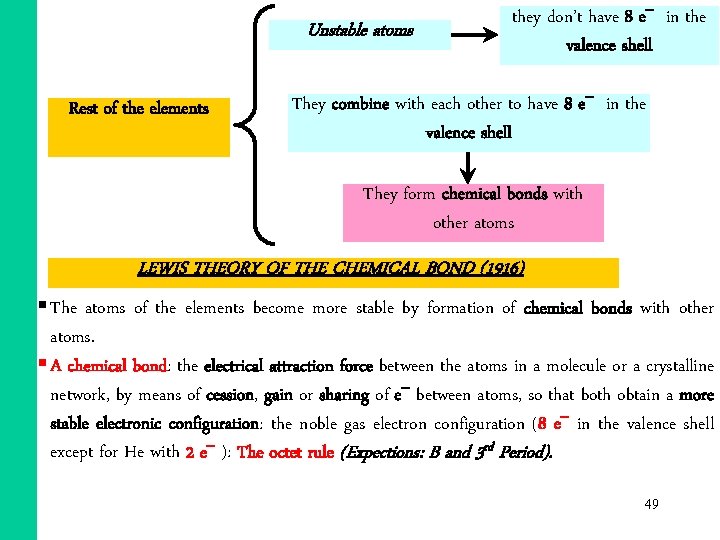
Unstable atoms Rest of the elements they don’t have 8 e in the valence shell They combine with each other to have 8 e in the valence shell They form chemical bonds with other atoms LEWIS THEORY OF THE CHEMICAL BOND (1916) § The atoms of the elements become more stable by formation of chemical bonds with other atoms. § A chemical bond: the electrical attraction force between the atoms in a molecule or a crystalline network, by means of cession, gain or sharing of e between atoms, so that both obtain a more stable electronic configuration: the noble gas electron configuration (8 e in the valence shell except for He with 2 e ): The octet rule (Expections: B and 3 rd Period). 49
50
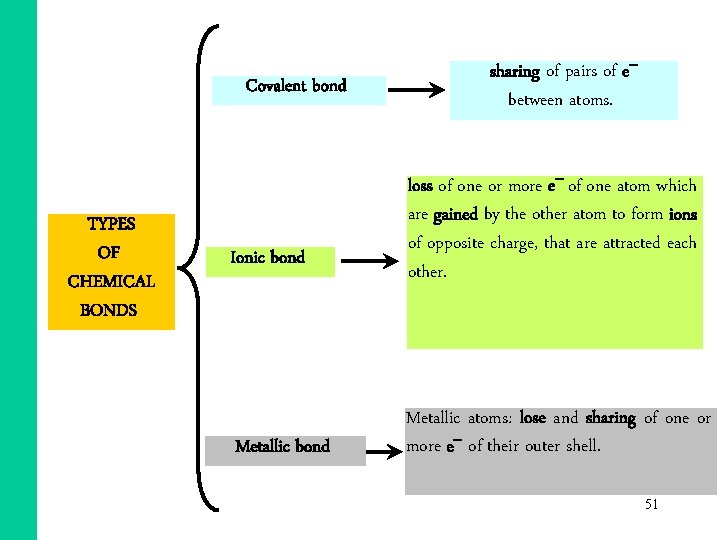
Covalent bond TYPES OF CHEMICAL BONDS Ionic bond Metallic bond sharing of pairs of e between atoms. loss of one or more e of one atom which are gained by the other atom to form ions of opposite charge, that are attracted each other. Metallic atoms: lose and sharing of one or more e of their outer shell. 51
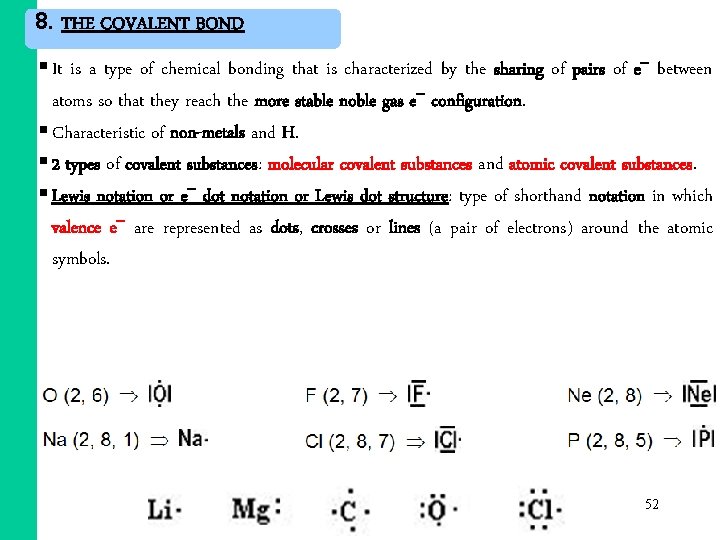
8. THE COVALENT BOND § It is a type of chemical bonding that is characterized by the sharing of pairs of e between atoms so that they reach the more stable noble gas e configuration. § Characteristic of non-metals and H. § 2 types of covalent substances: molecular covalent substances and atomic covalent substances. § Lewis notation or e dot notation or Lewis dot structure: type of shorthand notation in which valence e are represented as dots, crosses or lines (a pair of electrons) around the atomic symbols. 52
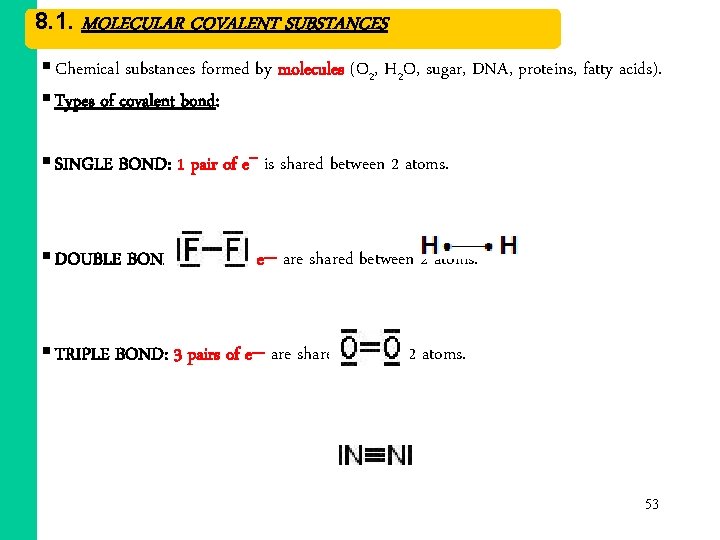
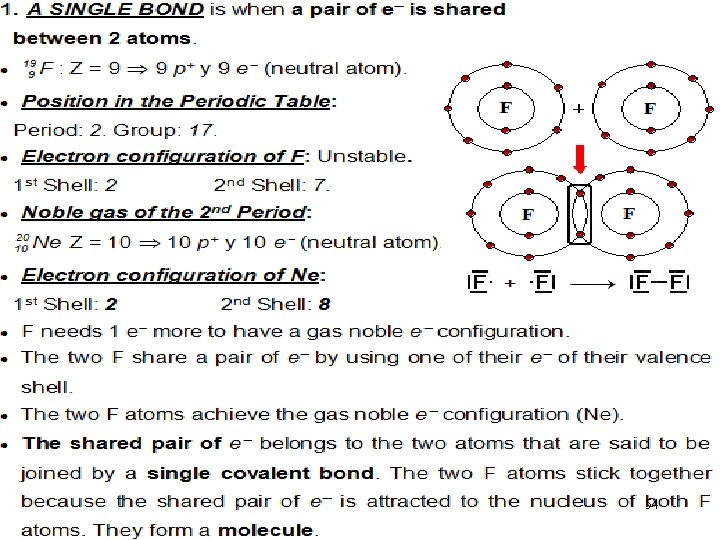
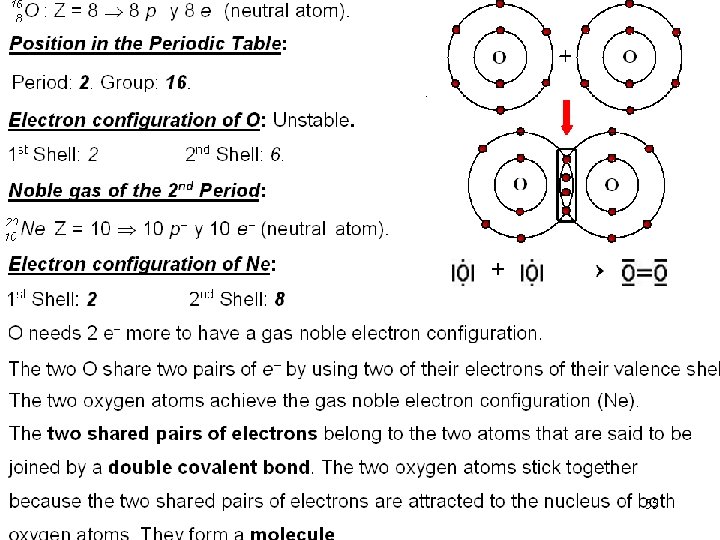
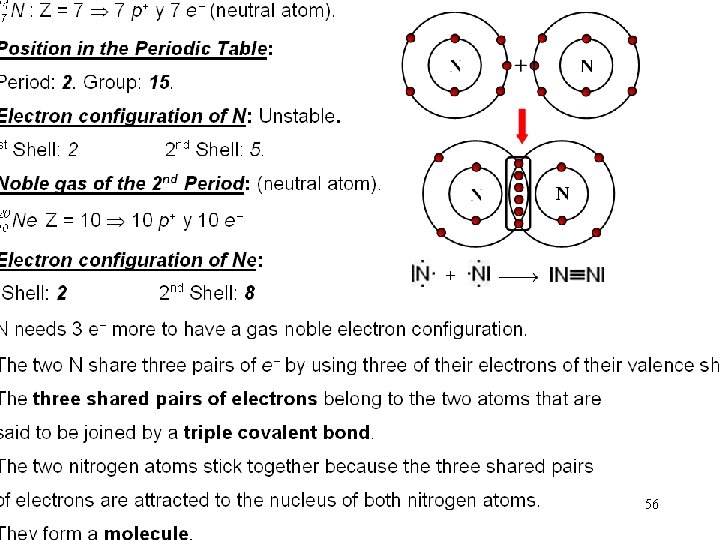
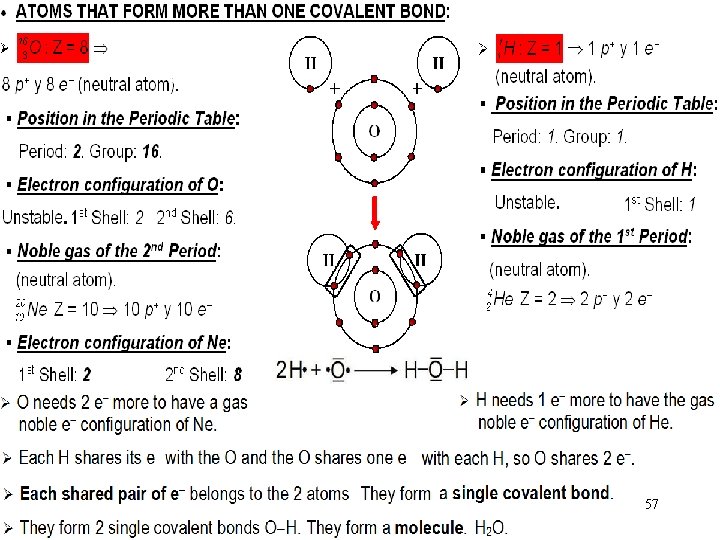
8. 1. MOLECULAR COVALENT SUBSTANCES § Chemical substances formed by molecules (O 2, H 2 O, sugar, DNA, proteins, fatty acids). § Types of covalent bond: § SINGLE BOND: 1 pair of e is shared between 2 atoms. § DOUBLE BOND: 2 pairs of e are shared between 2 atoms. § TRIPLE BOND: 3 pairs of e are shared between 2 atoms. 53
54
55
56
57
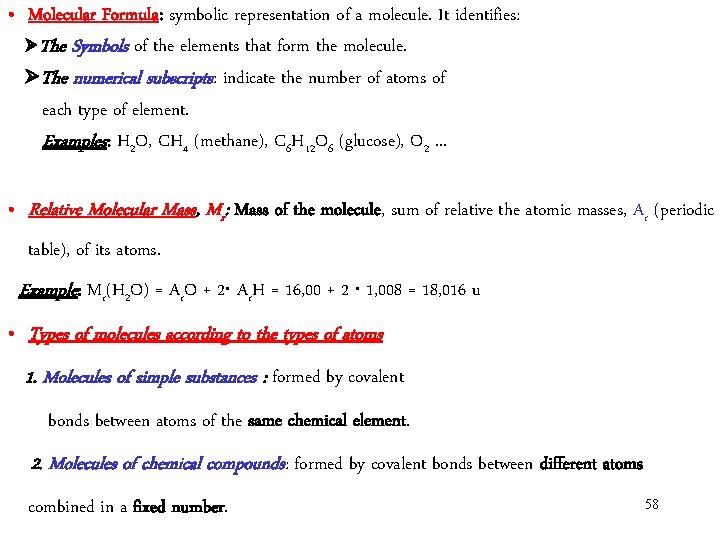
• Molecular Formula: symbolic representation of a molecule. It identifies: The Symbols of the elements that form the molecule. The numerical subscripts: indicate the number of atoms of each type of element. Examples: H 2 O, CH 4 (methane), C 6 H 12 O 6 (glucose), O 2. . . • Relative Molecular Mass, Mr: Mass of the molecule, sum of relative the atomic masses, Ar (periodic table), of its atoms. Example: Mr(H 2 O) = Ar. O + 2 Ar. H = 16, 00 + 2 1, 008 = 18, 016 u • Types of molecules according to the types of atoms 1. Molecules of simple substances : formed by covalent bonds between atoms of the same chemical element. 2. Molecules of chemical compounds: formed by covalent bonds between different atoms combined in a fixed number. 58
• Types of molecules according to their number of atoms: 1. Diatomic molecules composed of 2 atoms (O 2, H 2, N 2). 2. Triatomic molecules formed by 3 atoms (O 3 H 2 O). 3. Polyatomic molecules: more than 3 atoms (CH 4, C 4 H 10, NH 3) • The intermolecular forces: weak attraction forces that hold the molecules together of a molecular covalent substance. They are important in the interpretation of various physical properties of the molecular covalent substances: melting point, boiling point, evaporation, solubility, surface tension… 59
PROPERTIES OF THE MOLECULAR SUBSTANCES: 1. Low melting and boiling points: their intermolecular forces are weak. Many are gases (N 2, O 2, CO 2…) and liquids (H 2 O, ethanol, acetone…) at room temperature, although there also solids (sugar, hydrocarbons…). 2. Low density. 3. The solid molecular substances are usually fragile. 4. Non-conductors of electricity because they don’t have free electrical charges (e belong to the atoms (not free), no ions). 5. Solubility: They aren’t usually very soluble in water. Many molecular substances are soluble in organic solvents (ethanol). 60
8. 2. ATOMIC COVALENT SUBSTANCES • Substances composed of millions of atoms joint by covalent bonds that form an ordered threedimensional network called crystal or crystalline structure. (lattice: regular grid-like arrangement of atoms in a material). • They do not form molecules. • Empirical formula indicates the types of elements of the substance with the chemical symbols and its numerical proportion in the crystalline network, which is the simplest ratio of atoms of each element present in a compound. • Examples: C (diamond), C (graphite), Si. O 2 (silicon oxide or quartz, pure sand), . . . 61
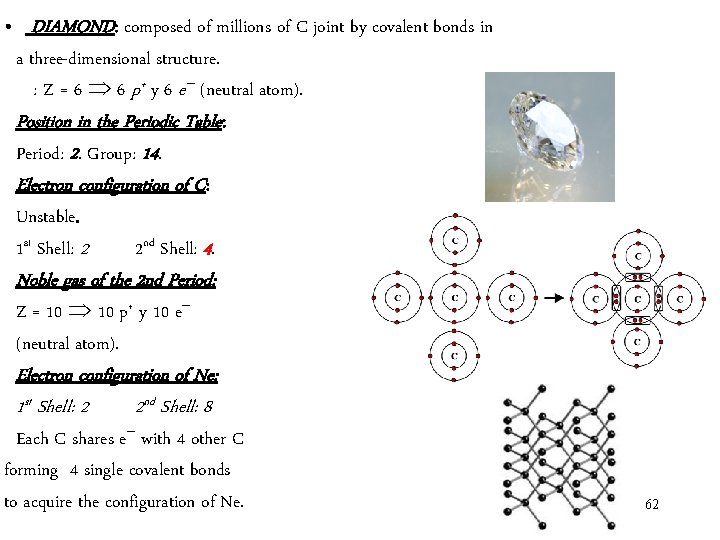
• DIAMOND: composed of millions of C joint by covalent bonds in a three-dimensional structure. : Z = 6 6 p+ y 6 e (neutral atom). Position in the Periodic Table: Period: 2. Group: 14. Electron configuration of C: Unstable. 1 st Shell: 2 2 nd Shell: 4. Noble gas of the 2 nd Period: Z = 10 p+ y 10 e (neutral atom). Electron configuration of Ne: 1 st Shell: 2 2 nd Shell: 8 Each C shares e with 4 other C forming 4 single covalent bonds to acquire the configuration of Ne. 62
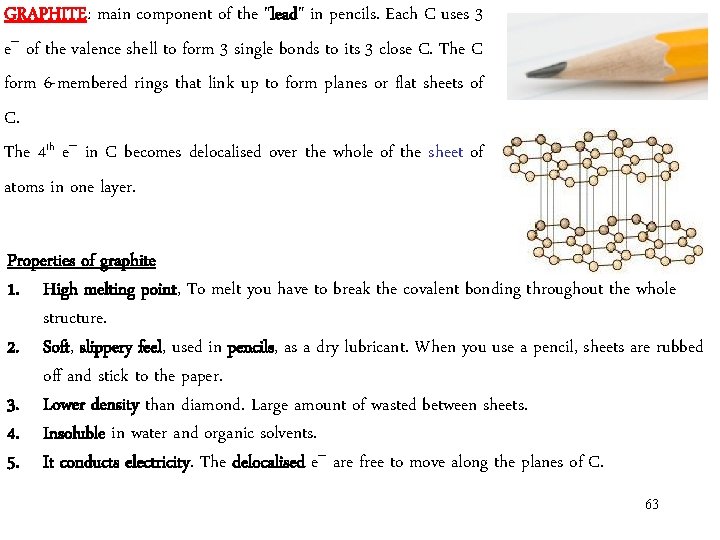
GRAPHITE: main component of the "lead" in pencils. Each C uses 3 e of the valence shell to form 3 single bonds to its 3 close C. The C form 6 -membered rings that link up to form planes or flat sheets of C. The 4 th e in C becomes delocalised over the whole of the sheet of atoms in one layer. Properties of graphite 1. High melting point, To melt you have to break the covalent bonding throughout the whole structure. 2. Soft, slippery feel, used in pencils, as a dry lubricant. When you use a pencil, sheets are rubbed off and stick to the paper. 3. Lower density than diamond. Large amount of wasted between sheets. 4. Insoluble in water and organic solvents. 5. It conducts electricity. The delocalised e are free to move along the planes of C. 63
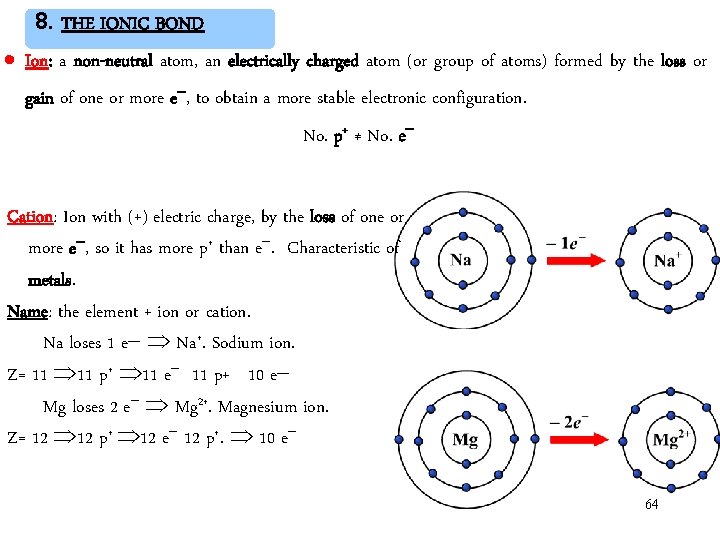
8. THE IONIC BOND Ion: a non-neutral atom, an electrically charged atom (or group of atoms) formed by the loss or gain of one or more e , to obtain a more stable electronic configuration. No. p+ ≠ No. e Cation: Ion with (+) electric charge, by the loss of one or more e , so it has more p+ than e. Characteristic of metals. Name: the element + ion or cation. Na loses 1 e Na+. Sodium ion. Z= 11 11 p+ 11 e 11 p+ 10 e Mg loses 2 e Mg 2+. Magnesium ion. Z= 12 12 p+ 12 e 12 p+. 10 e 64
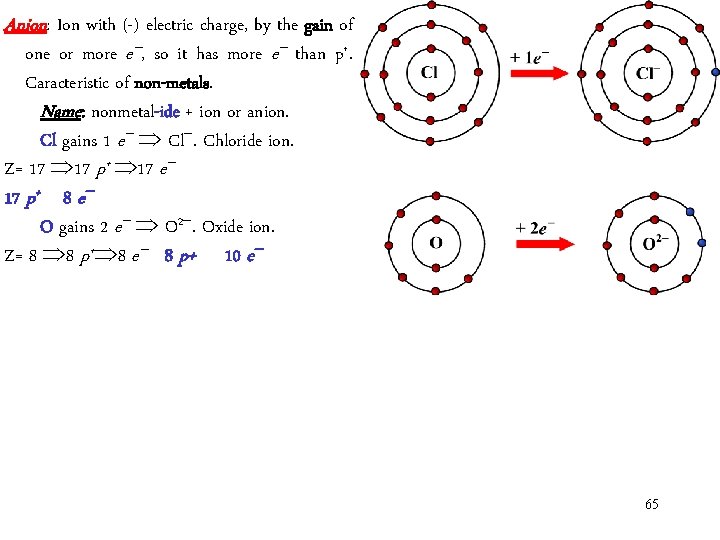
Anion: Ion with (-) electric charge, by the gain of one or more e , so it has more e than p+. Caracteristic of non-metals. Name: nonmetal-ide + ion or anion. Cl gains 1 e Cl. Chloride ion. Z= 17 17 p+ 17 e 17 p+ 8 e O gains 2 e O 2. Oxide ion. Z= 8 8 p+ 8 e 8 p+ 10 e 65
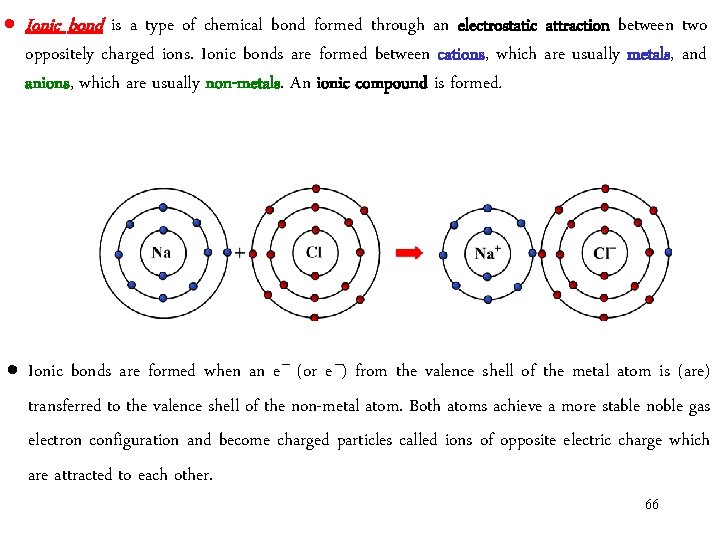
Ionic bond is a type of chemical bond formed through an electrostatic attraction between two oppositely charged ions. Ionic bonds are formed between cations, which are usually metals, and anions, which are usually non-metals. An ionic compound is formed. Ionic bonds are formed when an e (or e ) from the valence shell of the metal atom is (are) transferred to the valence shell of the non-metal atom. Both atoms achieve a more stable noble gas electron configuration and become charged particles called ions of opposite electric charge which are attracted to each other. 66
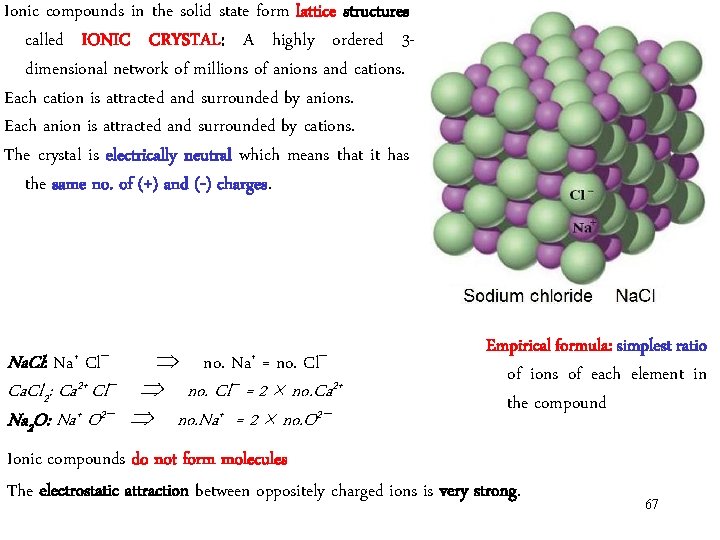
Ionic compounds in the solid state form lattice structures called IONIC CRYSTAL: A highly ordered 3 dimensional network of millions of anions and cations. Each cation is attracted and surrounded by anions. Each anion is attracted and surrounded by cations. The crystal is electrically neutral which means that it has the same no. of (+) and (-) charges. Na. Cl: no. = no. Ca. Cl 2: Ca 2+ Cl no. Cl = 2 no. Ca 2+ Na 2 O: Na+ O 2 no. Na+ = 2 no. O 2 Na+ Cl Empirical formula: simplest ratio of ions of each element in the compound Ionic compounds do not form molecules The electrostatic attraction between oppositely charged ions is very strong. 67
Properties of IONIC COMPOUNDS 1. Solids at room temperature, high melting and boiling points because of strong electrostatic forces between oppositely charged ions. (Tmp (Na. Cl) = 801 ºC). 2. Hardness. Very hard. Strong electrostatic forces between oppositely charged ions. 3. Solubility. Soluble in water and in many polar solvents (ethanol, acetone…). Insoluble in organic solvents (benzene, toluene…). 4. Electrical conductivity. They don’t conduct the electricity in solid state because there are no mobile ions or electrons present in the lattice. 5. Electrical conductivity. They conduct electricity when melted or dissolved in water because the mobile ions that allowed the electricity passed through it 6. They have low thermal conductivity. 68
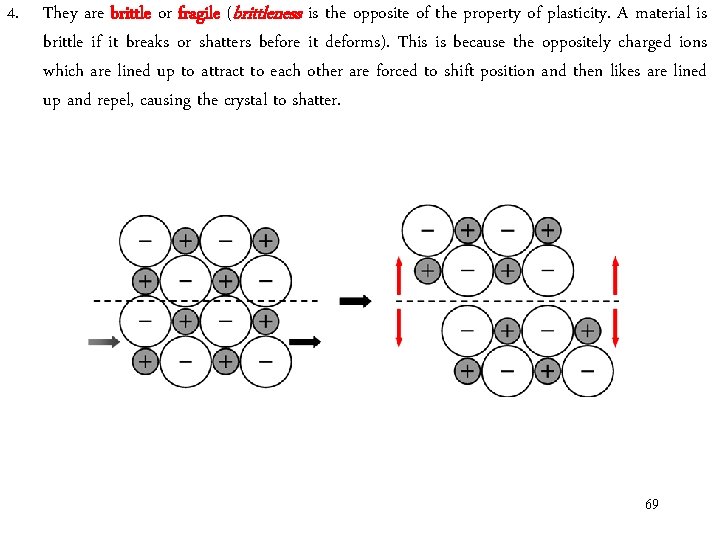
4. They are brittle or fragile (brittleness is the opposite of the property of plasticity. A material is brittle if it breaks or shatters before it deforms). This is because the oppositely charged ions which are lined up to attract to each other are forced to shift position and then likes are lined up and repel, causing the crystal to shatter. 69
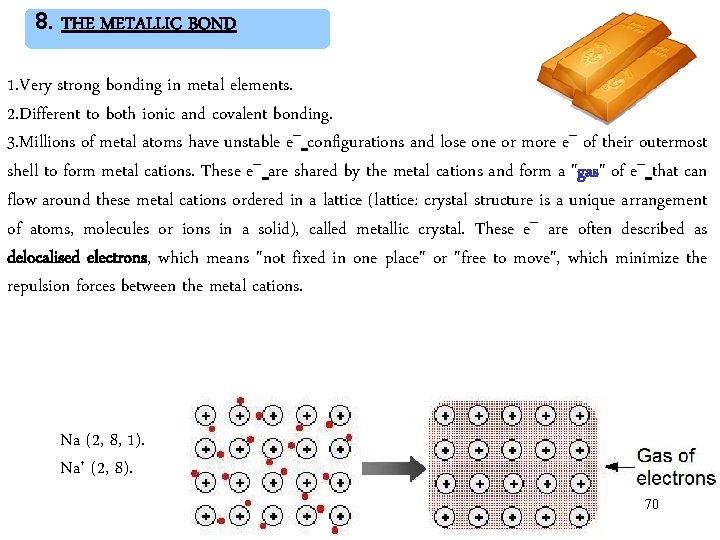
8. THE METALLIC BOND 1. Very strong bonding in metal elements. 2. Different to both ionic and covalent bonding. 3. Millions of metal atoms have unstable e configurations and lose one or more e of their outermost shell to form metal cations. These e are shared by the metal cations and form a "gas" of e that can flow around these metal cations ordered in a lattice (lattice: crystal structure is a unique arrangement of atoms, molecules or ions in a solid), called metallic crystal. These e are often described as delocalised electrons, which means "not fixed in one place" or "free to move", which minimize the repulsion forces between the metal cations. Na (2, 8, 1). Na+ (2, 8). 70
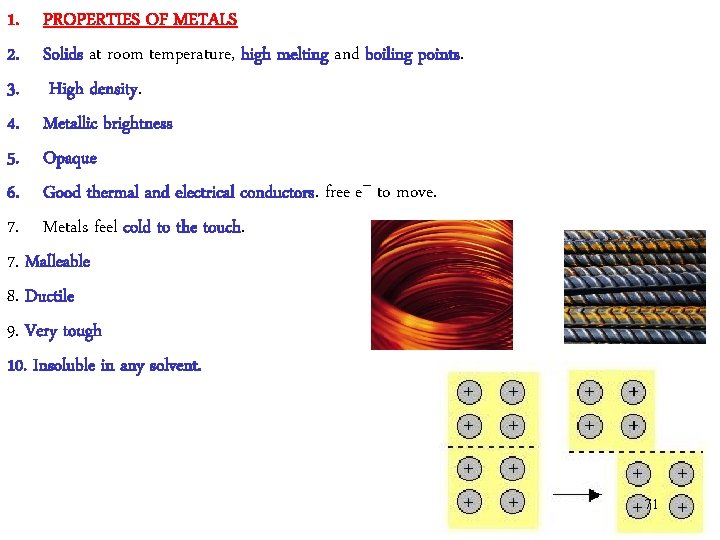
1. PROPERTIES OF METALS 2. Solids at room temperature, high melting and boiling points. 3. High density. 4. Metallic brightness 5. Opaque 6. Good thermal and electrical conductors. free e to move. 7. Metals feel cold to the touch. 7. Malleable 8. Ductile 9. Very tough 10. Insoluble in any solvent. 71