ORGANISATIONAL MANAGEMENT 8 MARKS Visit for more Learning




- Slides: 73
ORGANISATIONAL MANAGEMENT 8 -MARKS Visit for more Learning Resources
Course Outcome C 601. 3 -Describe the types of organizations.
Organization: �It is an organized group of people with a particular purpose, such as a business or government department. �It is also called as structure of management.
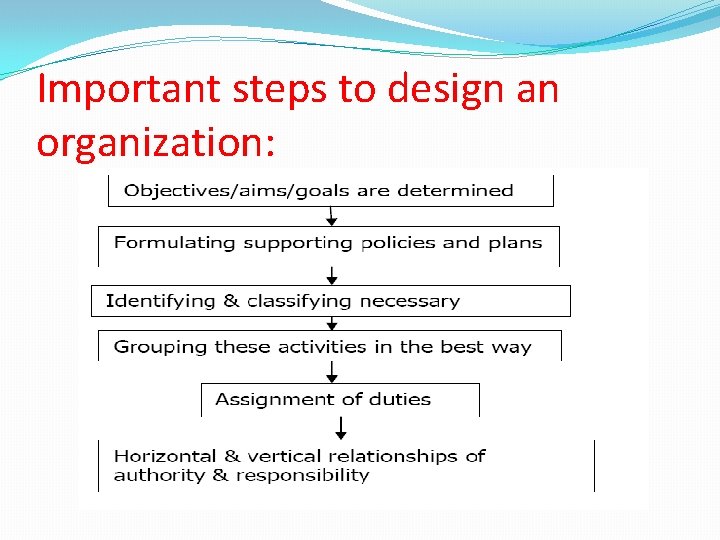
Important steps to design an organization:
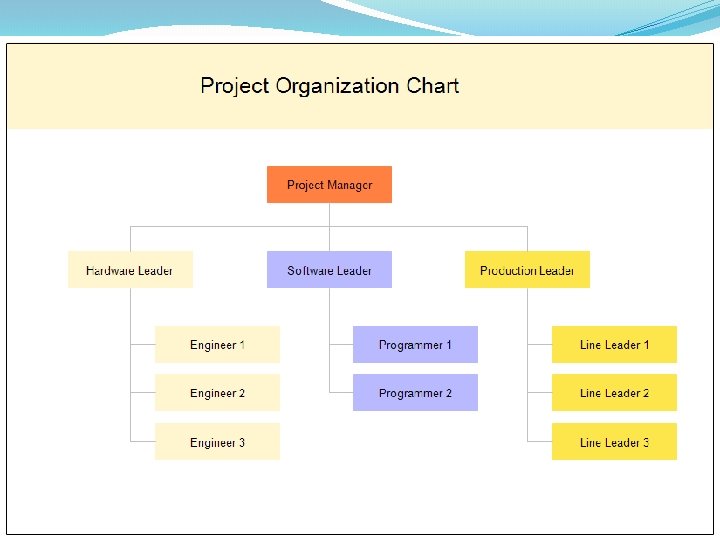
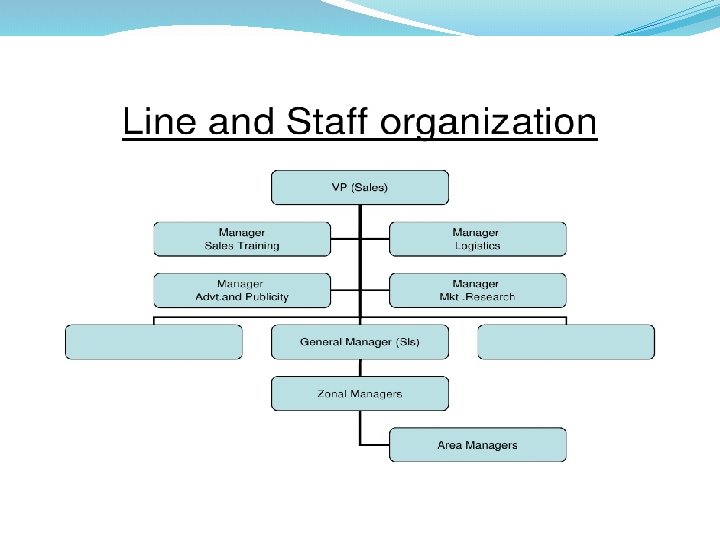
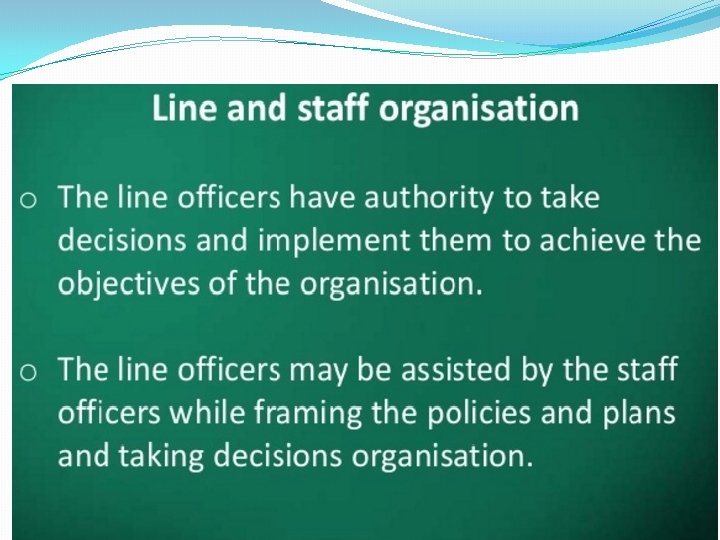
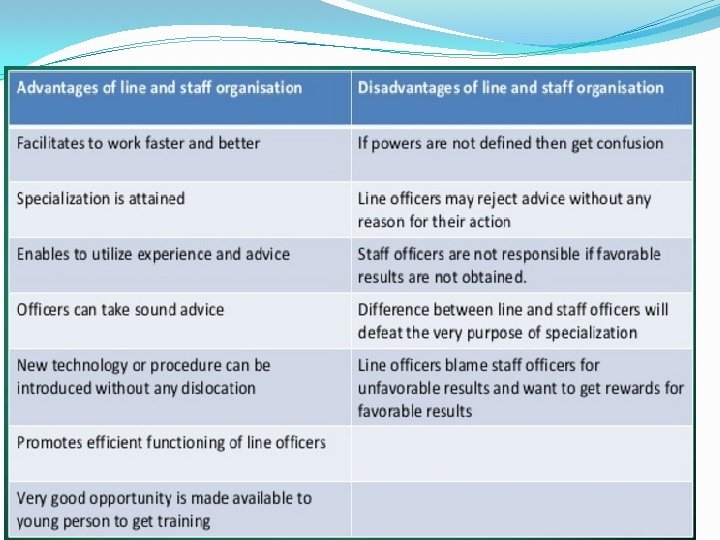
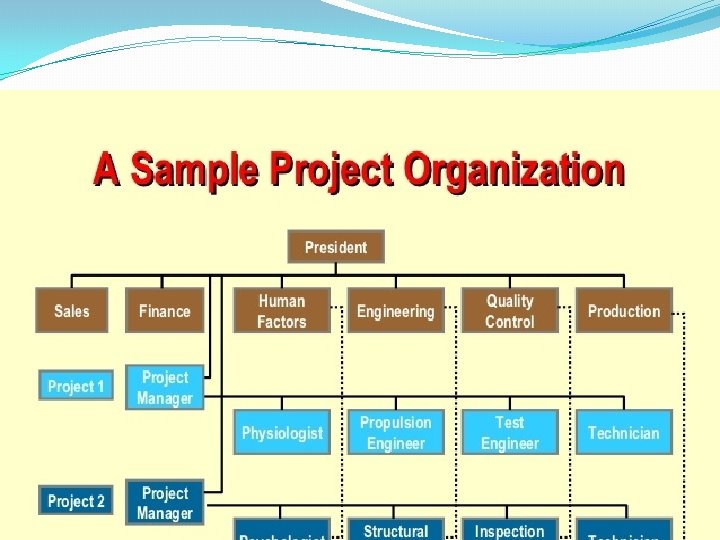
Types of organization: 1. Line 2. Line and Staff 3. Functional 4. Project
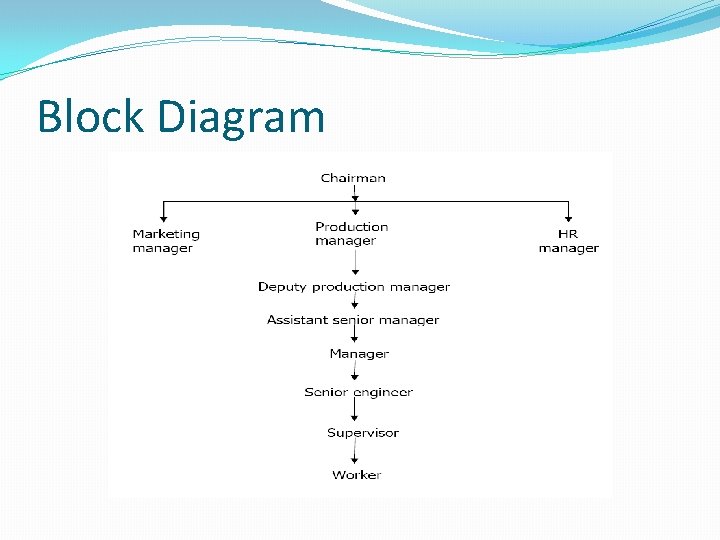
Line organization �It is also called as scalar organization. �It is the vertical type of organization structure. �Also called as military type because similar form of organization in the military. �Line organization is the oldest and simplest type of organization form. �It has a chain of authorities, one above the other.
Block Diagram
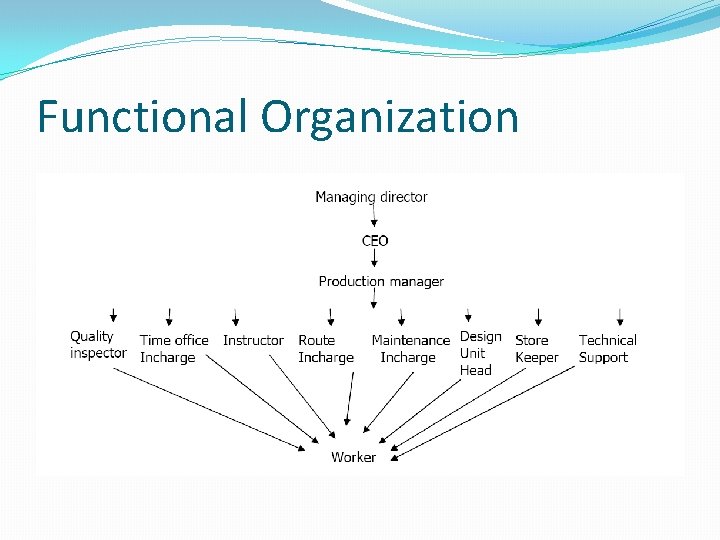
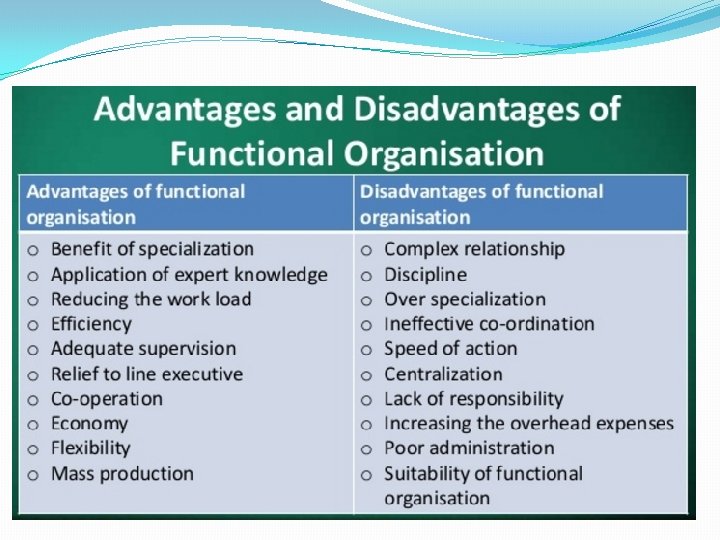
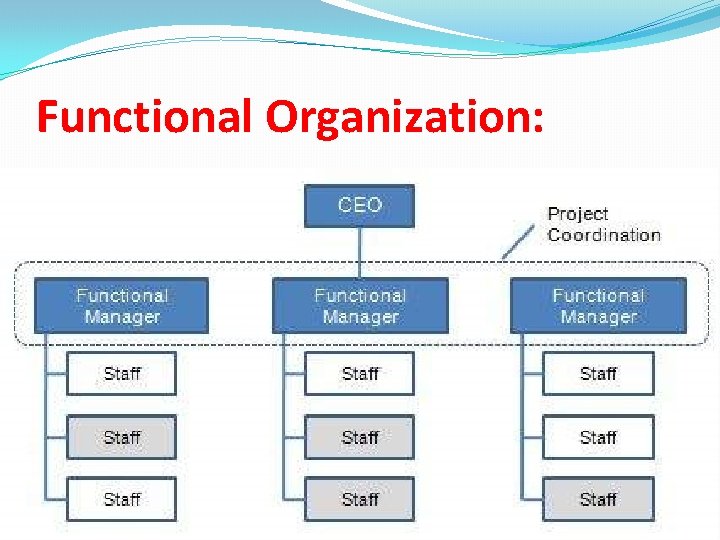
Functional organization (Staff organization �It is also called as horizontal organization. �There is grouping of activities as per functions. �Specialization of function is the characteristics of this type of organization. �Each group is performing a specific task. E. g. milling department is only performing milling operation, may be on different products. �Function is the same and so the people are specialized in that. Also called as functional organization.
Functional Organization
Functional Organization:
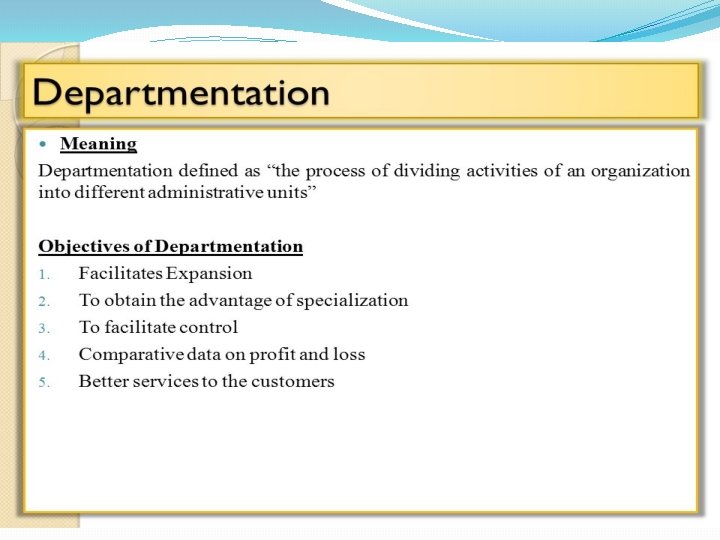
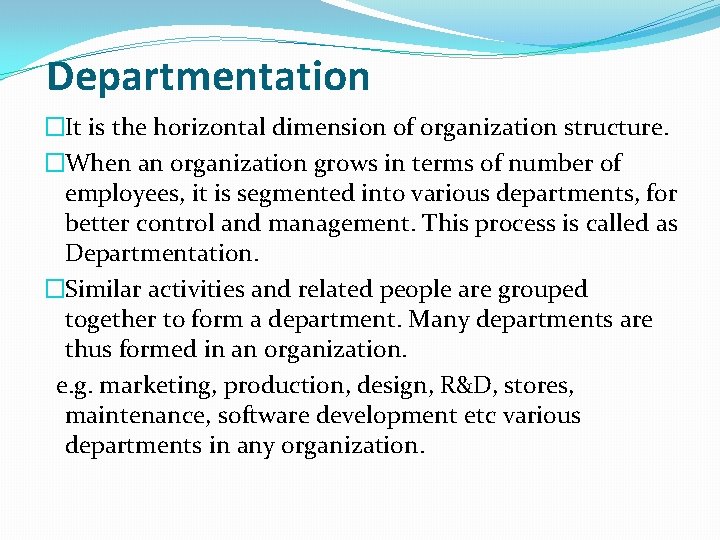
Departmentation �It is the horizontal dimension of organization structure. �When an organization grows in terms of number of employees, it is segmented into various departments, for better control and management. This process is called as Departmentation. �Similar activities and related people are grouped together to form a department. Many departments are thus formed in an organization. e. g. marketing, production, design, R&D, stores, maintenance, software development etc various departments in any organization.
Advantages of departmentation �Master work is divided into many tasks as per specialization. �More concentration is possible on the specific work. �Control in department is easier. �People become expert after working on similar functions for a long time. This expertise is an asset of any organization. �Confusion, overlapping of work is less.
Basis Of Departmentation 1. 2. 3. 4. 5. 6. Functional Departmentation. Product wise Departmentation. Territorial or Geographical Departmentation. Process wise Departmentation. Customer wise Departmentation. Time wise Departmentation.
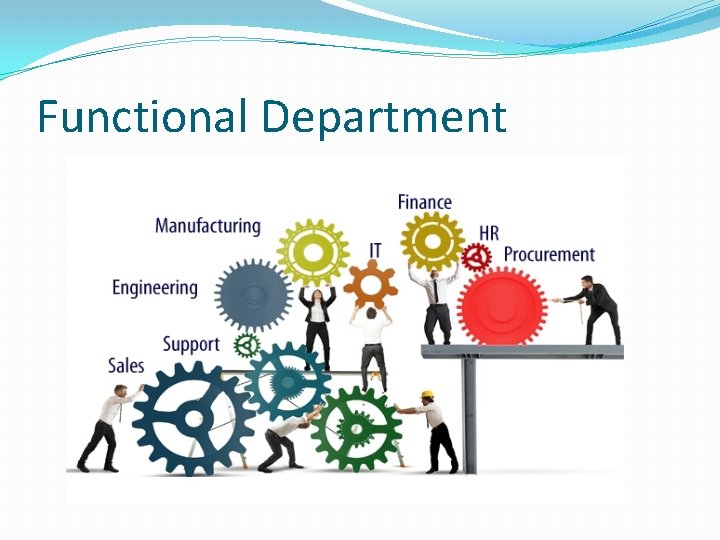
1. By Function �This is the simplest and most frequent basis for departmentation. �In departmentalization by function, the activities of the organization are divided into the primary functions to be performed manufacturing, marketing, engineering, research and development, employee relations and finance. �It is the most prevalent form of departmentalization and is seen not only in business enterprises but in hospitals, government agencies and many other kinds of organizations.
Functional Department
Advantades & Disadvantages Advantades Disadvantages �More productivity �Division of labour is easy �No duplication of work �More concentration on similar activites. �It is scientific and logical method. �Specialised employees are expert only on one type of work. �Facilities are over utilised. �Extra load of work on employes. �Less time available for training.
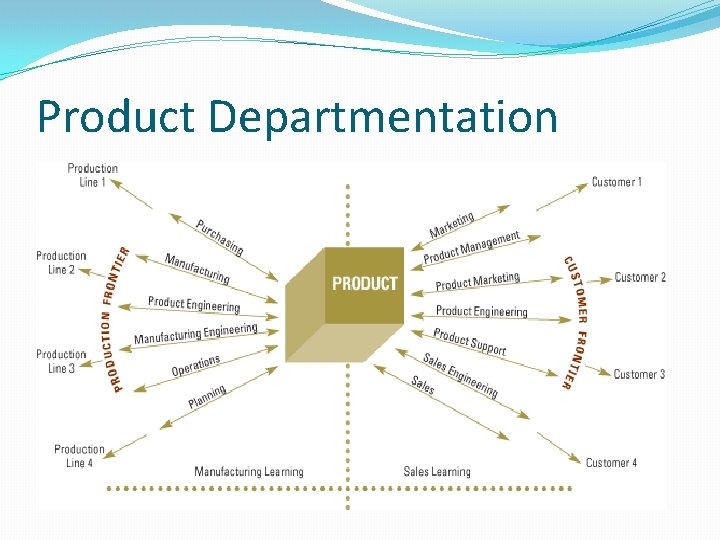
2. By Product �Product departmentation involves the grouping together of all the activities necessary to manufacture a product or product line. �In departmentalization by product, product lines are segregated and each product line has its own manager, its own manufacturing, selling etc. �It increases management cost, duplicate service functions are required both at the top and operating levels of management.
Product Departmentation
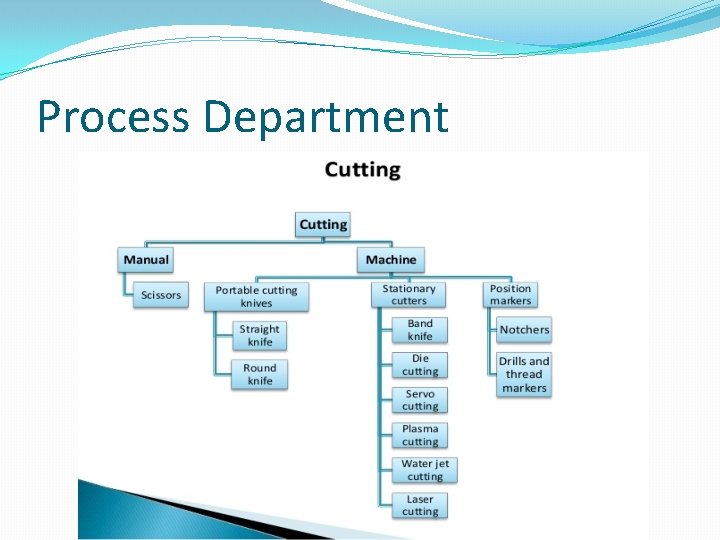
By Process �The manufacturing activities may be sub-divided on the basis of their process of production. Similar machines such all lathes, all drilling machines, all shapers etc. are grouped into separate sections, each kept at one place and used for a distinct operation on the job. �This arrangement works for job order work and is unsuitable for mass production.
Process Department
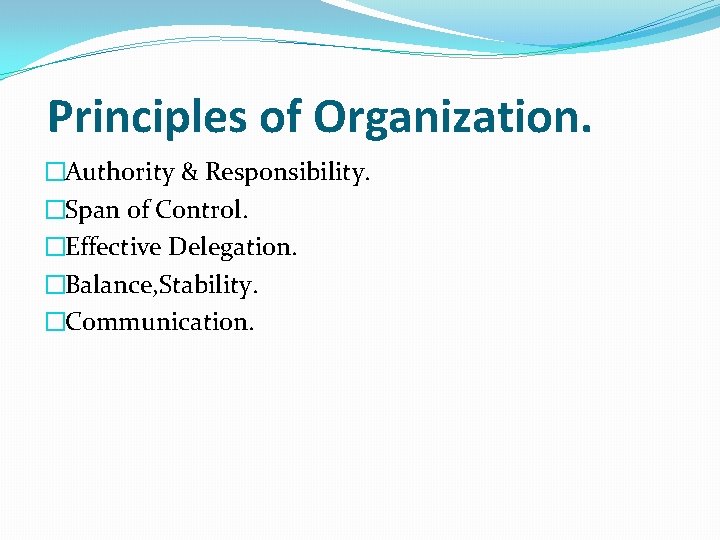
Principles of Organization. �Authority & Responsibility. �Span of Control. �Effective Delegation. �Balance, Stability. �Communication.
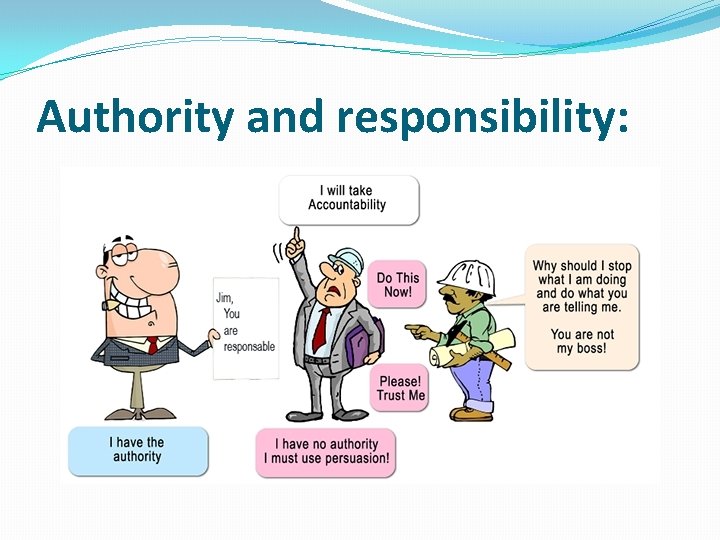
Authority and responsibility:
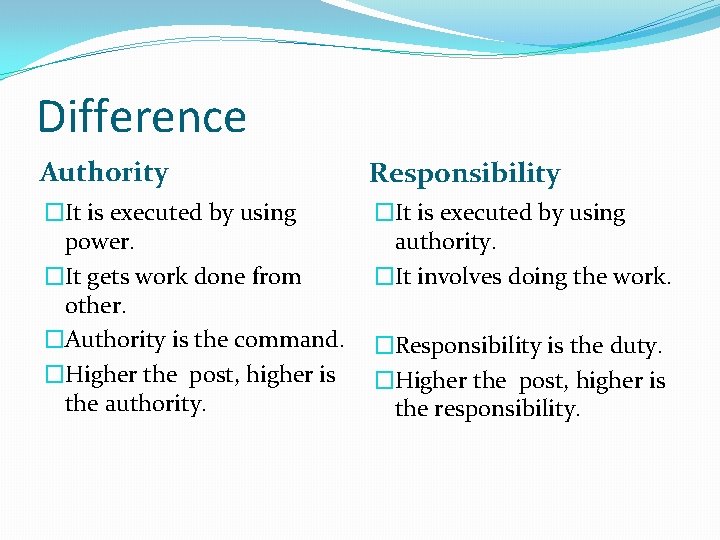
Difference Authority Responsibility �It is executed by using power. �It gets work done from other. �Authority is the command. �Higher the post, higher is the authority. �It is executed by using authority. �It involves doing the work. �Responsibility is the duty. �Higher the post, higher is the responsibility.
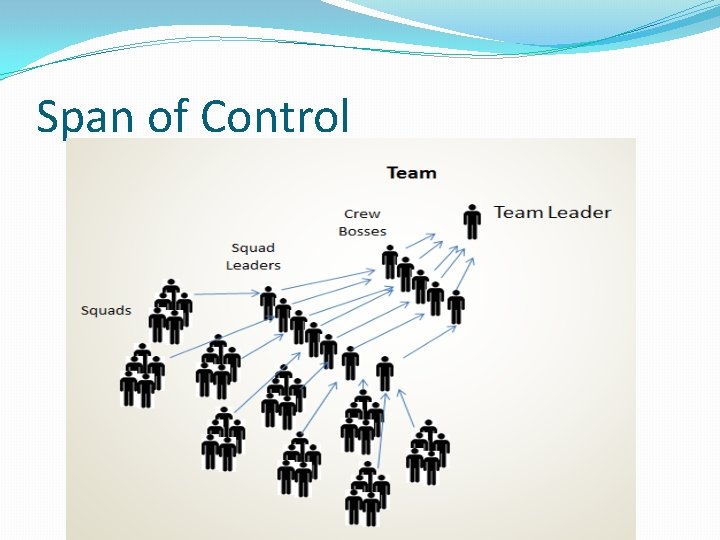
Span of Control
Span of control �It is the term related to the delegation only. Span of control means “number of subordinates can be handled by one manager effectively. ” �There is limitation to this number. i. e. span of control of any manager is limited number, to say maximum 20 subordinates at a time. It is not possible to directly control large number of subordinates. �Narrow span: It results into underutilization of manager’s capacity. �Wide span: It results into overloading of manager’s work.
Factors affecting the Span of Control : �Management methods �Policy of organisation �Discipline in organisation �The nature of organisation �Relationships among employees �Attitude of subordinates �Effectiveness of co-ordination
Limitations of Span of control �Extra and unnecessary level for control increases the cost of organization. �Interference increases. �Conflicts are possible due to overlapping of span. �Execution of plans becomes difficult. �Ego problems arise.
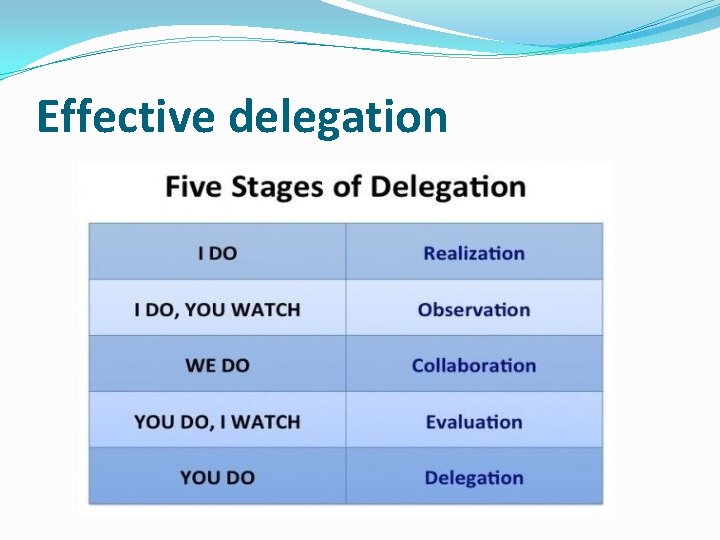
Effective delegation �when work is complicated, huge and difficult, it must be divided among the different teams. �Due to division of work, people get less variation in work. �Skilled people make effective concentration on their allotted work. Extra pressure of work on ‘very few’ is avoided. �This divided work gets completed in time with better quality. �So for effective management, division of work is very essential principle.
Steps in Effective Delegation: �Goals Establishment �Developing Personal Discipline �Establishing Responsibility �Motivation �Determine what to delegate �Training �Report �Control
Effective delegation
Balance & Stability
Communication
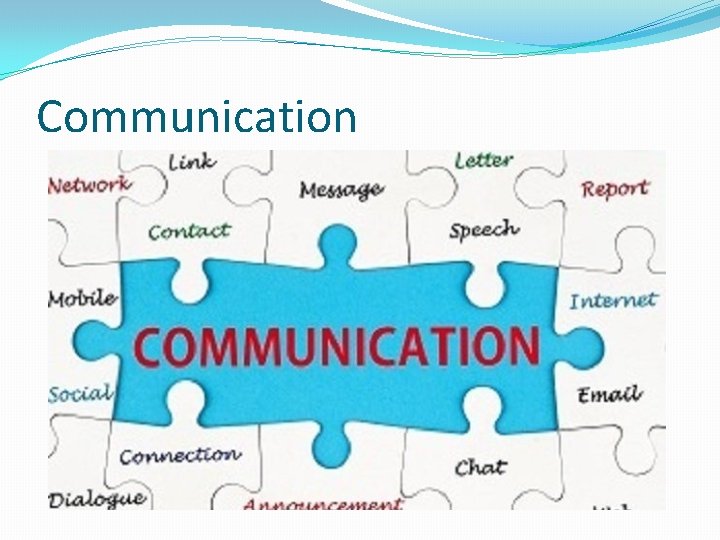
Purpose of Communication: �To forward instructions. �To inform notices. �To share information. �To understand unknown facts. �To get feedbacks. �To warn about situtaions.
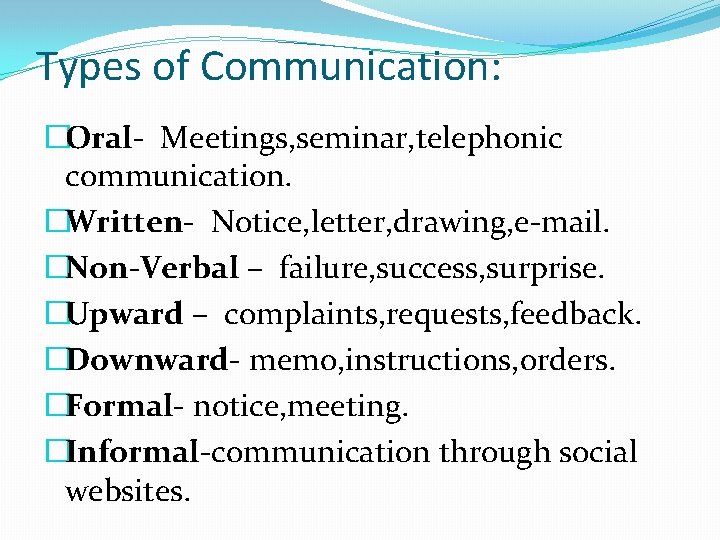
Types of Communication: �Oral- Meetings, seminar, telephonic communication. �Written- Notice, letter, drawing, e-mail. �Non-Verbal – failure, success, surprise. �Upward – complaints, requests, feedback. �Downward- memo, instructions, orders. �Formal- notice, meeting. �Informal-communication through social websites.
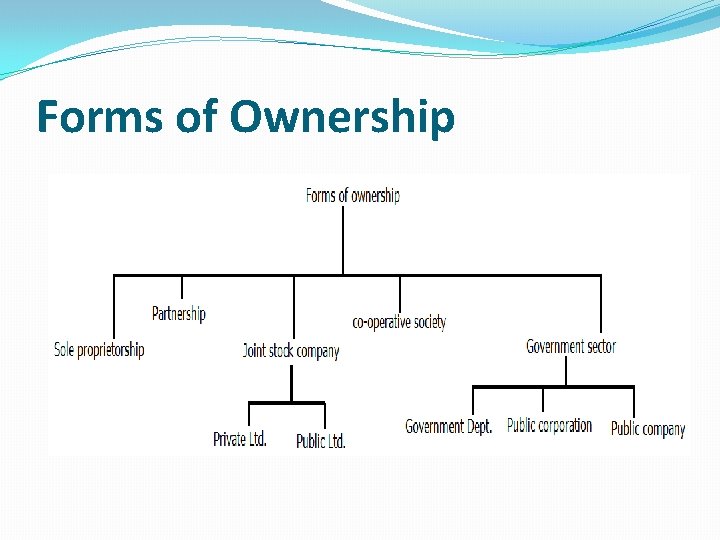
Forms of Ownership
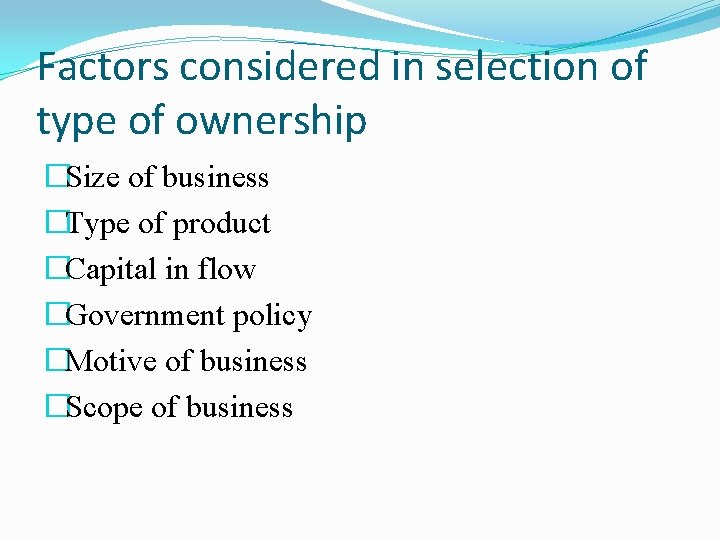
Factors considered in selection of type of ownership �Size of business �Type of product �Capital in flow �Government policy �Motive of business �Scope of business
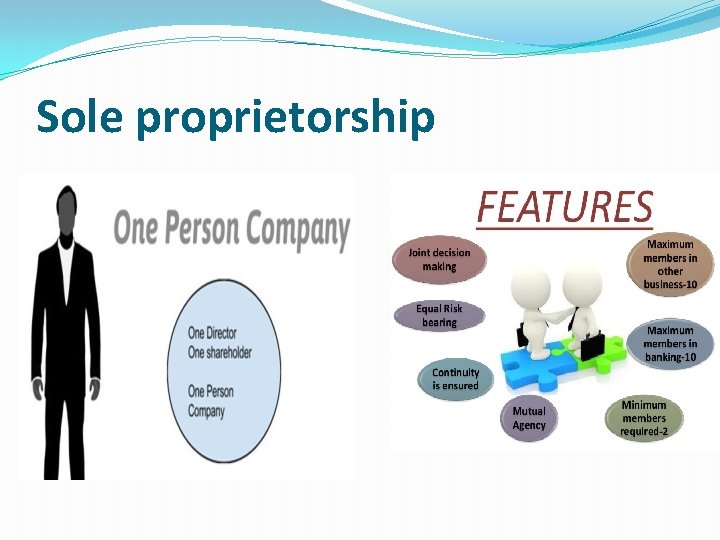
Sole proprietorship
Sole proprietorship �A business run by a single person is called as sole proprietorship. The single owner is whole and sole authority. He/she carries all the responsibility. Investment, market study, product finalization, procurement of all resources, land availability, legal documents etc. �The owner is responsible for profit or loss of the business. It is the oldest type of business.
Characteristics �Owner is a single person. �Owner is the supreme authority. �Oldest and simplest form of business. �For everything good or bad, owner is responsible. �Formation of business is quick and easy.
Advantages �Easy to form a business. �More flexibility in business. �Decisions are quick and not dependent on others. �Own ideas and innovations can be utilized. �Experimentation can be possible. �No sharing in profits.
Applications �Small manufacturing units �Press shop. �Maintenance shop. �Fabrication shop. �Service centre. �Auto repair shop.
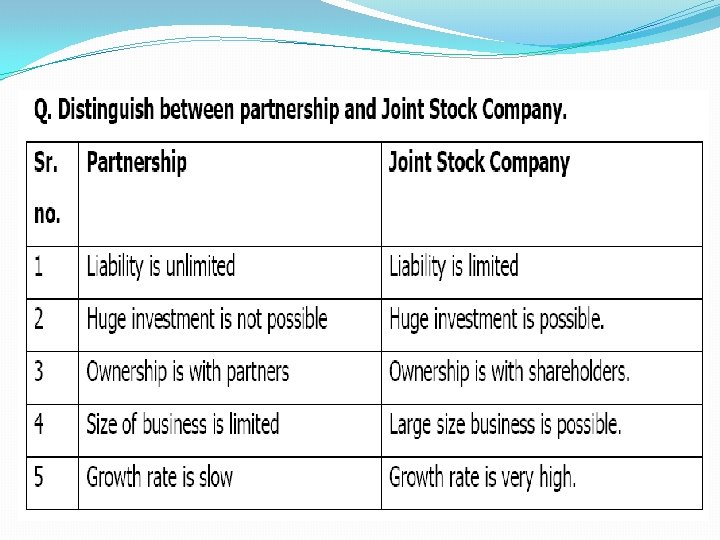
Partnership �It is the relationship between persons who have agreed to share the profits of a business carried on by all or any of them acting for all. �Types of partners: �Active partners �General partners �Sleeping partners �Nominal partners �Secret partners �Minor partners
Duties of Partners: �Everybody has to perform his/her own responsibility. �Must be co-operative and helpful. �Should care interests of others also should not be selfish. �Honesty and secrecy must be maintaied. �Must contribute maximum as mush they can. �Relationship must be friendly, cordial, professional. �Should not hide information from others.
Advantages & Disadvantages Advantages Disadvantages �No overloading of a single person. �Resources arrangement is easier than sole proprietorship. �Decision making is more perfect. �Decision making is more faster. �Unlimietd liability. �Difficult to maintain relations in partnerships. �Stability is less. �Not suitable for large scale business.
Joint Stock �Investment in terms of shares is one of the sources of finance for the business. This money is also called as stock. �When the ownership is jointly enjoyed by those who have their shares in the business, then that business is called as Joint Stock Company. � Thus Joint Stock Company is an association of individuals, called as shareholders
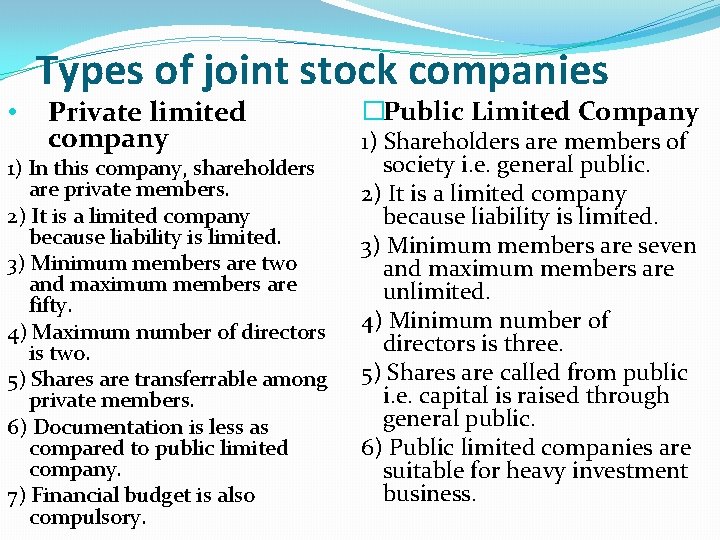
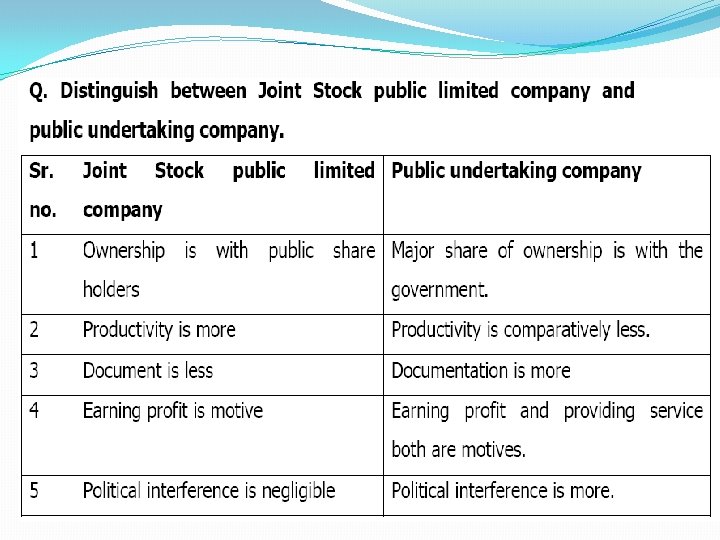
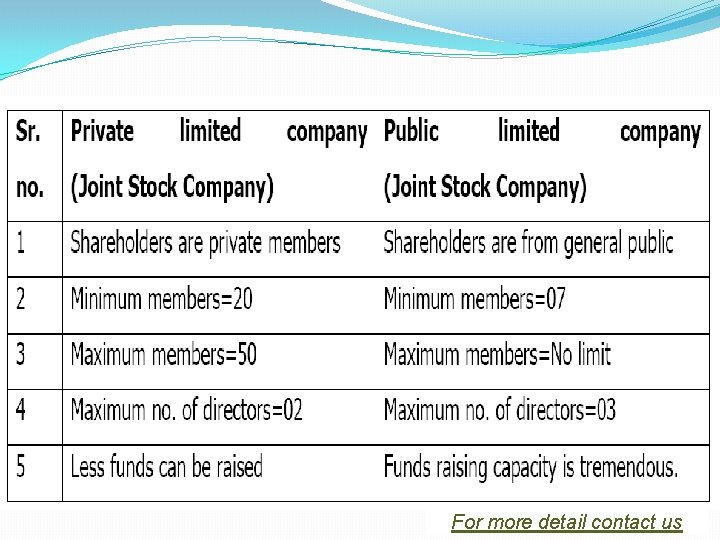
• Types of joint stock companies Private limited company 1) In this company, shareholders are private members. 2) It is a limited company because liability is limited. 3) Minimum members are two and maximum members are fifty. 4) Maximum number of directors is two. 5) Shares are transferrable among private members. 6) Documentation is less as compared to public limited company. 7) Financial budget is also compulsory. �Public Limited Company 1) Shareholders are members of society i. e. general public. 2) It is a limited company because liability is limited. 3) Minimum members are seven and maximum members are unlimited. 4) Minimum number of directors is three. 5) Shares are called from public i. e. capital is raised through general public. 6) Public limited companies are suitable for heavy investment business.
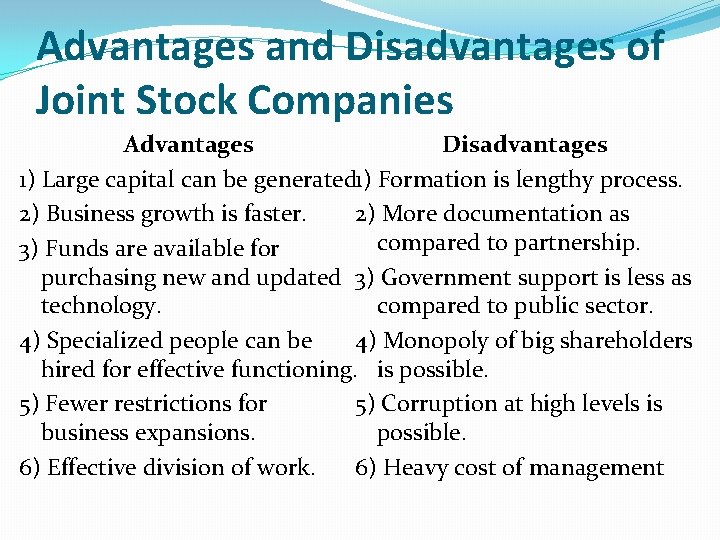
Advantages and Disadvantages of Joint Stock Companies Advantages Disadvantages 1) Large capital can be generated. 1) Formation is lengthy process. 2) Business growth is faster. 2) More documentation as compared to partnership. 3) Funds are available for purchasing new and updated 3) Government support is less as compared to public sector. technology. 4) Monopoly of big shareholders 4) Specialized people can be hired for effective functioning. is possible. 5) Corruption at high levels is 5) Fewer restrictions for possible. business expansions. 6) Heavy cost of management 6) Effective division of work.
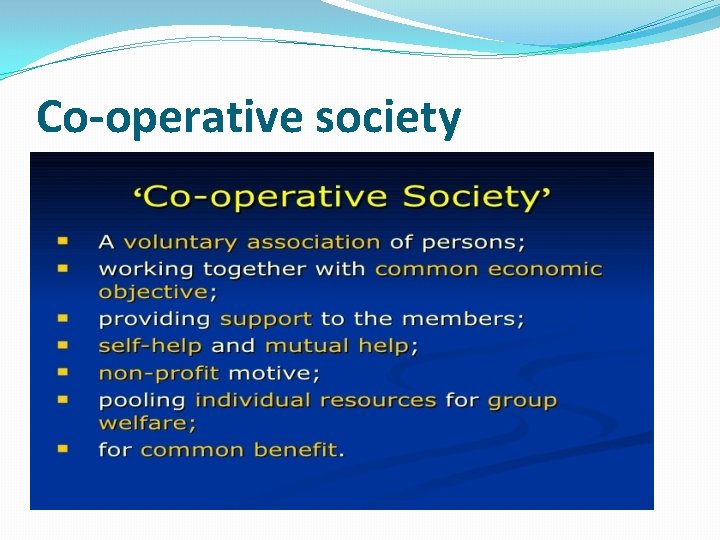
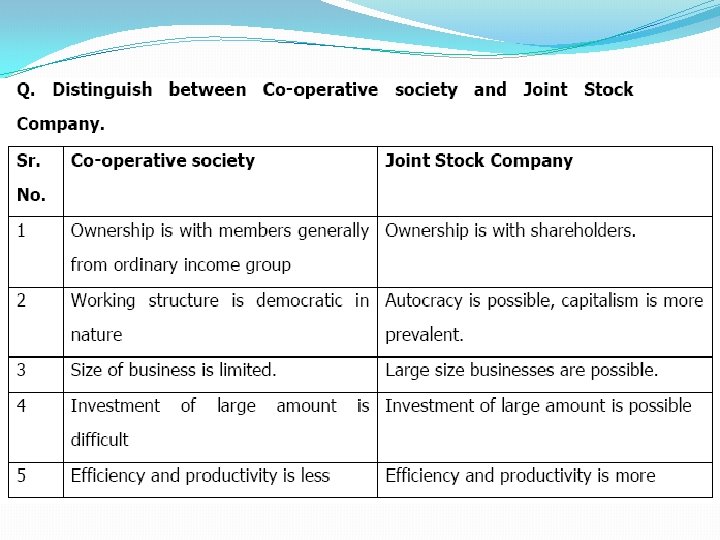
Co-operative society
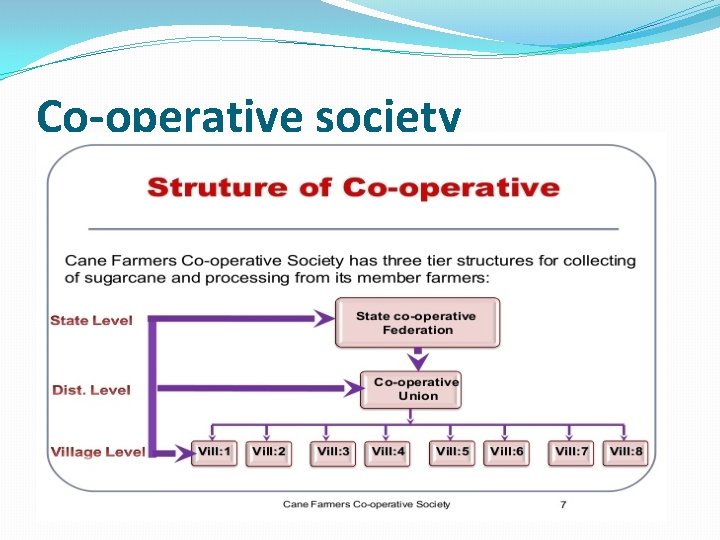
Co-operative society
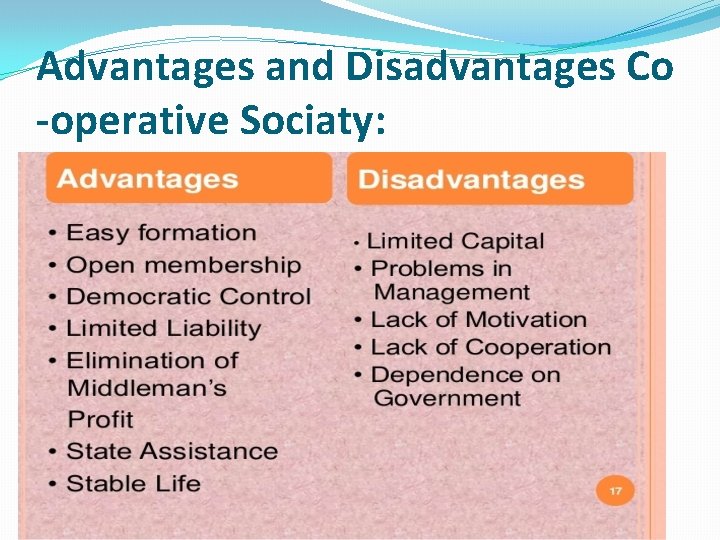
Advantages and Disadvantages Co -operative Sociaty:
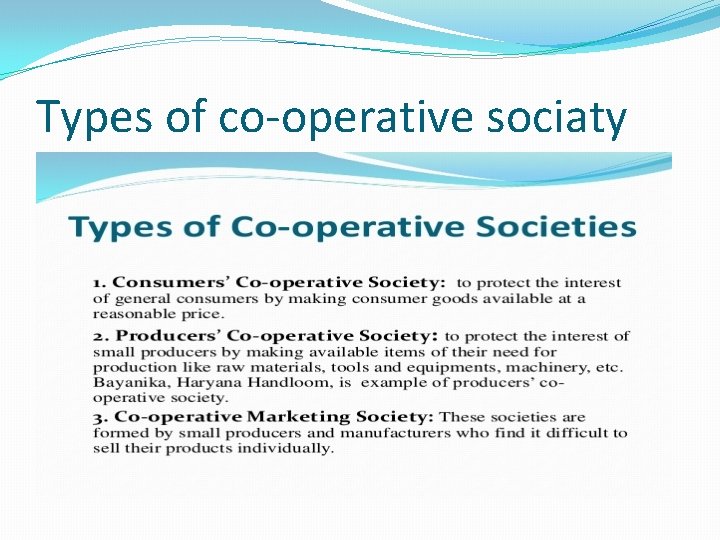
Types of co-operative sociaty
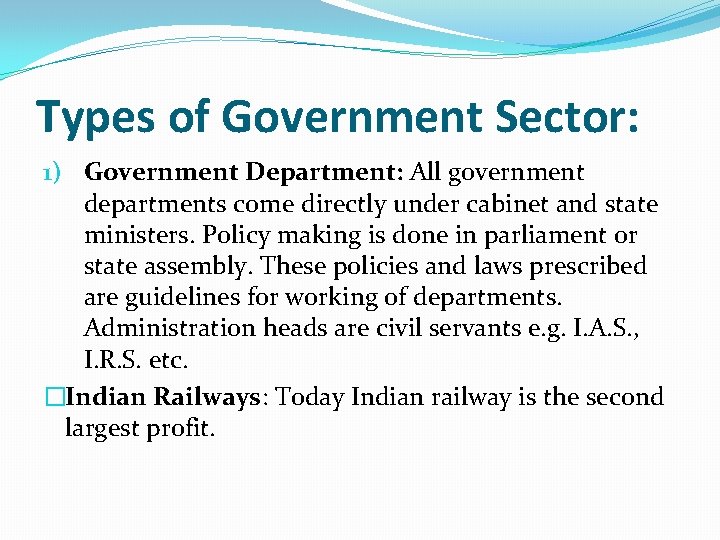
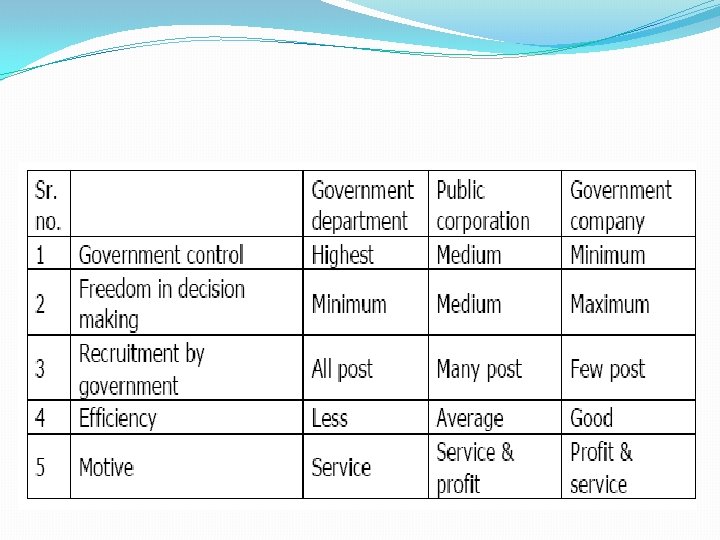
Types of Government Sector: 1) Government Department: All government departments come directly under cabinet and state ministers. Policy making is done in parliament or state assembly. These policies and laws prescribed are guidelines for working of departments. Administration heads are civil servants e. g. I. A. S. , I. R. S. etc. �Indian Railways: Today Indian railway is the second largest profit.
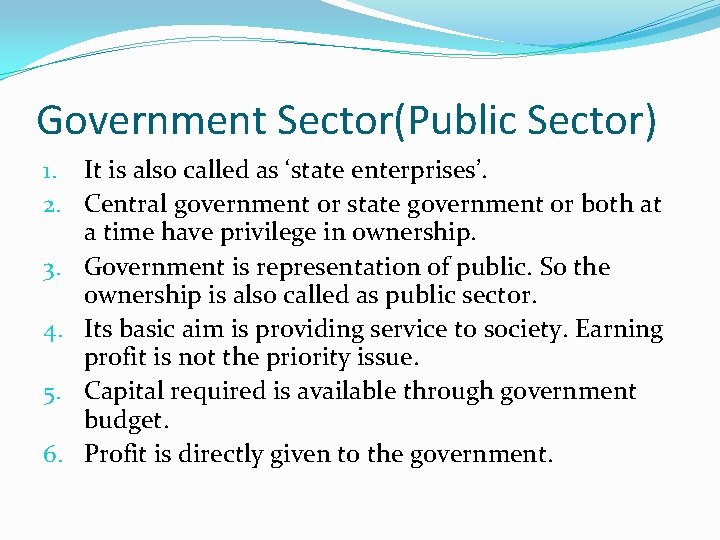
Government Sector(Public Sector) 1. It is also called as ‘state enterprises’. 2. Central government or state government or both at a time have privilege in ownership. 3. Government is representation of public. So the ownership is also called as public sector. 4. Its basic aim is providing service to society. Earning profit is not the priority issue. 5. Capital required is available through government budget. 6. Profit is directly given to the government.
(II) Public Corporation: �A company whose shares are publicly traded and are usually held by a large number (hundreds or thousands) of shareholders. The usual British term is public limited company. 2. A government owned company such as an airline or public transit company. A segment of government dedicated for particular function. 1. Less government control as compared to Government department. 2. Lower level recruitment is through private agencies. 3. Professional approach is more as compared to Government departments. 4. Long term policies, rules regulations, import decisions E. g. LIC, ONGC, Krishna valley corporation etc
�Public Corporation in India: • Delhi Metro Rail Corporation limited. • Stock holding corporation of India limited • Tehri hydro development corporation.
(III) Government Company: 1. Major shares are with government. 2. Only basic policies and vision-mission are decided by parliament/ state assembly. More freedom is given to executive authorities. 3. Except few higher posts, recruitment is done by private agencies. 4. Earning profit and providing service both are the motives. 5. High level of professionalism compared to government department and corporation. �e. g. HMT, BHEL, BSNL, Bharat petroleum, GAIL etc.
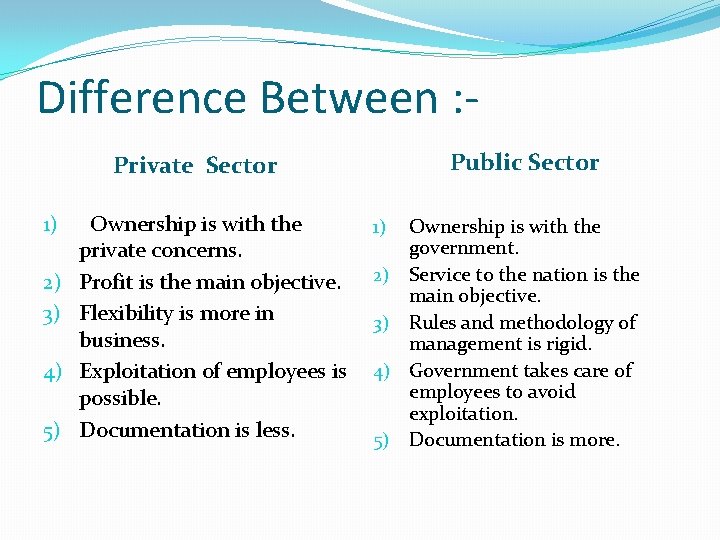
Difference Between : Public Sector Private Sector 1) 2) 3) 4) 5) Ownership is with the private concerns. Profit is the main objective. Flexibility is more in business. Exploitation of employees is possible. Documentation is less. 1) 2) 3) 4) 5) Ownership is with the government. Service to the nation is the main objective. Rules and methodology of management is rigid. Government takes care of employees to avoid exploitation. Documentation is more.
For more detail contact us