For Tomorrow Persuasive Topic Proposal given out on

- Slides: 66
For Tomorrow • Persuasive Topic Proposal (given out on Thurs, set as work on Fri) • If you did not receive one, let me know! • Must be a different topic from your N 5 piece
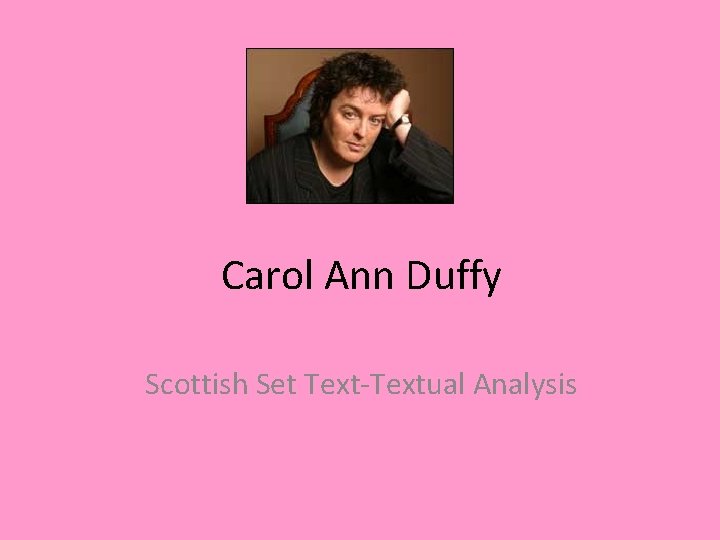
Carol Ann Duffy Scottish Set Text-Textual Analysis
What is the Scottish Text Study? In class • Part of your critical reading study • You will study a series of poems by a Scottish poet (six poems in total), analysing key language features and ensuring you have a good understanding of the common themes in their work In exam • Part of critical reading paper, alongside critical essay (1 hr 30 mins) • You are given one of the poems you have studied in class • You will answer questions based on that poem (textual analysis), looking at the language, themes, characters etc. • You will then compare the extract to another poem you have studied, in an 10 mark extended question • NO MARKS FOR QUOTING AT HIGHER!
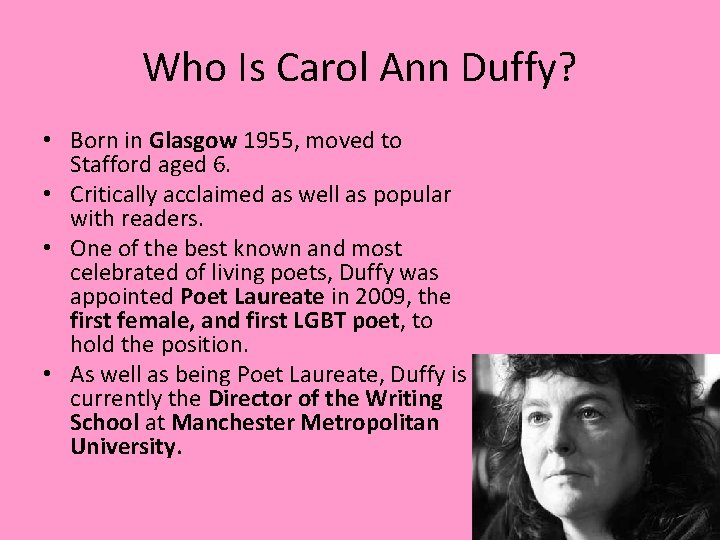
Who Is Carol Ann Duffy? • Born in Glasgow 1955, moved to Stafford aged 6. • Critically acclaimed as well as popular with readers. • One of the best known and most celebrated of living poets, Duffy was appointed Poet Laureate in 2009, the first female, and first LGBT poet, to hold the position. • As well as being Poet Laureate, Duffy is currently the Director of the Writing School at Manchester Metropolitan University.
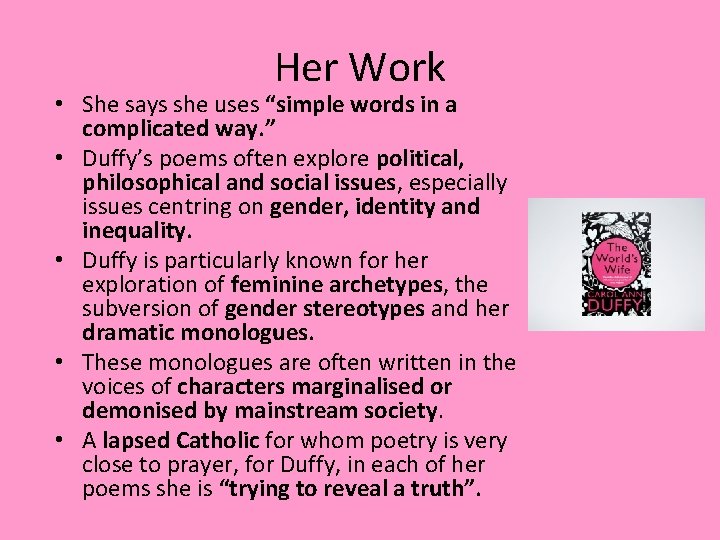
Her Work • She says she uses “simple words in a complicated way. ” • Duffy’s poems often explore political, philosophical and social issues, especially issues centring on gender, identity and inequality. • Duffy is particularly known for her exploration of feminine archetypes, the subversion of gender stereotypes and her dramatic monologues. • These monologues are often written in the voices of characters marginalised or demonised by mainstream society. • A lapsed Catholic for whom poetry is very close to prayer, for Duffy, in each of her poems she is “trying to reveal a truth”.
Major Themes in Duffy’s Writing Duffy’s poetry focuses on specific themes What do we mean when we talk about theme?
Major Themes in Duffy’s Writing A theme is…the big idea/message within a piece of writing. Writer may be making a grand statement/expressing their opinion on: • An aspect of human nature • A group of people • An aspect of society • A key topic
Major Themes in Duffy’s Writing • Memory-childhood, lost love, preserving memories • Nostalgia-a longing for the past; inability to return to past; losing time • Love and relationships-passion and desire; heartbreak; familial love • Isolation-socially, emotionally • Female voice-characters and female myths • Truth-honesty, bluntness
Poems • In Mrs Tilscher’s Class • Originally • The Way My Mother Speaks • Valentine • Mrs Midas • War Photographer
In Mrs Tilscher’s Class Scottish Set Text
Primary School Memories • What feelings do you associate with being in primary school, particularly the younger years (P 1 -3)? • What memories do you have of this time?
Your Favourite Teacher • Think back again to primary school. Can you remember your favourite teacher? • What age/stage were you when you had this teacher? • Why were they your favourite?
Primary Vs. Secondary • Do the relationships you have with your teachers change from primary to secondary? • How? Explain 3 ways in which they are different Primary Secondary
‘In Mrs Tilscher’s Class’ In this poem, Duffy looks back at her last year at primary school, reflecting on: • her memories of school and her favourite teacher • feelings at that time • Sense of growing older and maturing
Stanza Summary • This poem has 4 stanzas, each of which focus on a different idea of being at school. • Summarise in your groups what each stanza is about
Our Stanza Summary • Stanza 1 - what it feels like to be in a lesson taught by Mrs Tilscher • Stanza 2 -the classroom environment, the safety and love felt by the children • Stanza 3 -the children begin to grow and mature • Stanza 4 -leaving school, moving on, growing up
Due Today • Persuasive Topic Proposal (given out on Thurs, set as work on Fri)
Getting Organised For Higher-Tips • Use different folders or workbooks for different parts of the course-R 4 UAE, TA, Critical Essay, Folio. Label them clearly • Keep a copy of weekly schedule for English on phone to save having to bring everything everyday-take photo of next slide! • Set reminders in phone of deadlines e. g. “ 1 week until persuasive first draft due” to ensure you are on track • Get own copy of class novel (‘The Handmaid’s Tale. Margaret Atwood’) so you can label and highlight it to save rummaging for quotes every time • Regularly check GLOW site (https: //blogs. glowscotland. org. uk/gc/missinnes/) for missed notes if absent or to help with work at home
Structure of Week Monday P 2 -Scottish Set Text (Carol Ann Duffy Poetry) Tuesday P 1 -Scottish Set Text (Carol Ann Duffy Poetry) Wednesday P 3&4 -Critical Essay- ‘The Handmaid’s Tale’ Thursday P 5 -R 4 UAE Friday P 6 -R 4 UAE/Folio
Understanding The Poem Scottish Set Text
Our Stanza Summary • Stanza 1 - what it feels like to be in a lesson taught by Mrs Tilscher • Stanza 2 -the classroom environment, the safety and love felt by the children • Stanza 3 -the children begin to grow and mature • Stanza 4 -leaving school, moving on, growing up
Understanding The Poem • For each poem, you will initially answer some understanding question to ensure you grasp the basic PLOT and IDEAS of the poem • These questions will also provide some analysis work on the poem • You will answer in full sentences as far as possible
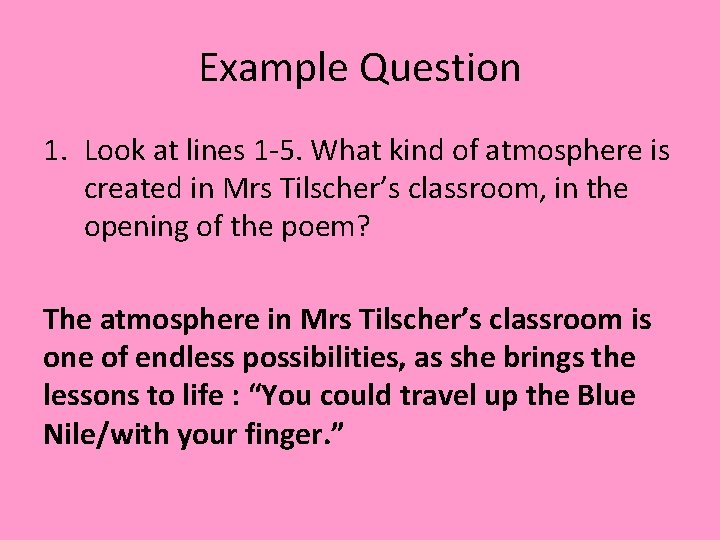
Example Question 1. Look at lines 1 -5. What kind of atmosphere is created in Mrs Tilscher’s classroom, in the opening of the poem? In the opening lines of ‘IMTC’, the poet uses imagery to create an atmosphere of wonder and authenticity: “You could travel up the Blue Nile/with your finger. ” This suggests the teacher brings the lessons to life for pupils, and creates vivid images in their minds of far-off places.
Example Question 1. Look at lines 1 -5. What kind of atmosphere is created in Mrs Tilscher’s classroom, in the opening of the poem? The atmosphere in Mrs Tilscher’s classroom is one of endless possibilities, as she brings the lessons to life : “You could travel up the Blue Nile/with your finger. ”
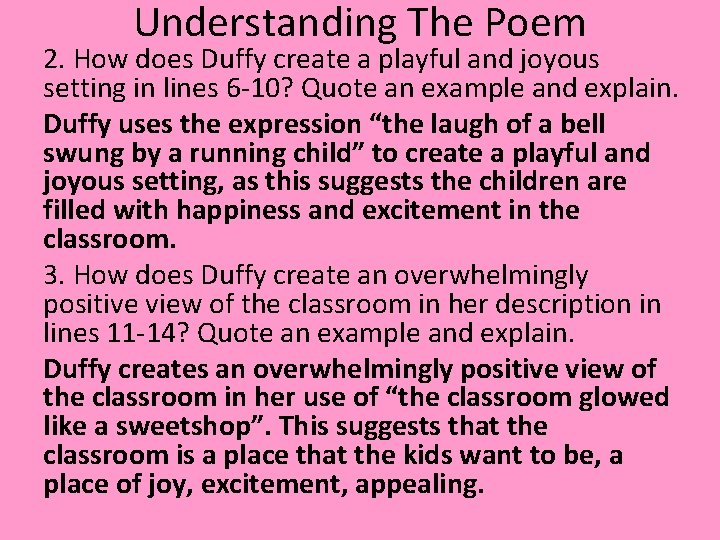
Understanding The Poem 2. How does Duffy create a playful and joyous setting in lines 6 -10? Quote an example and explain. Duffy uses the expression “the laugh of a bell swung by a running child” to create a playful and joyous setting, as this suggests the children are filled with happiness and excitement in the classroom. 3. How does Duffy create an overwhelmingly positive view of the classroom in her description in lines 11 -14? Quote an example and explain. Duffy creates an overwhelmingly positive view of the classroom in her use of “the classroom glowed like a sweetshop”. This suggests that the classroom is a place that the kids want to be, a place of joy, excitement, appealing.
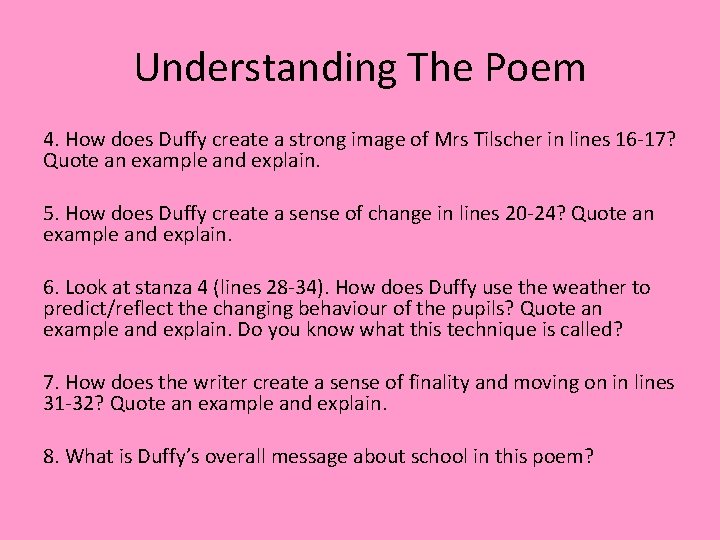
Understanding The Poem 4. How does Duffy create a strong image of Mrs Tilscher in lines 16 -17? Quote an example and explain. 5. How does Duffy create a sense of change in lines 20 -24? Quote an example and explain. 6. Look at stanza 4 (lines 28 -34). How does Duffy use the weather to predict/reflect the changing behaviour of the pupils? Quote an example and explain. Do you know what this technique is called? 7. How does the writer create a sense of finality and moving on in lines 31 -32? Quote an example and explain. 8. What is Duffy’s overall message about school in this poem?
Annotating The Poem Scottish Set Text
What is annotating? Annotating means…to add notes to a text or diagram, giving explanation or comment
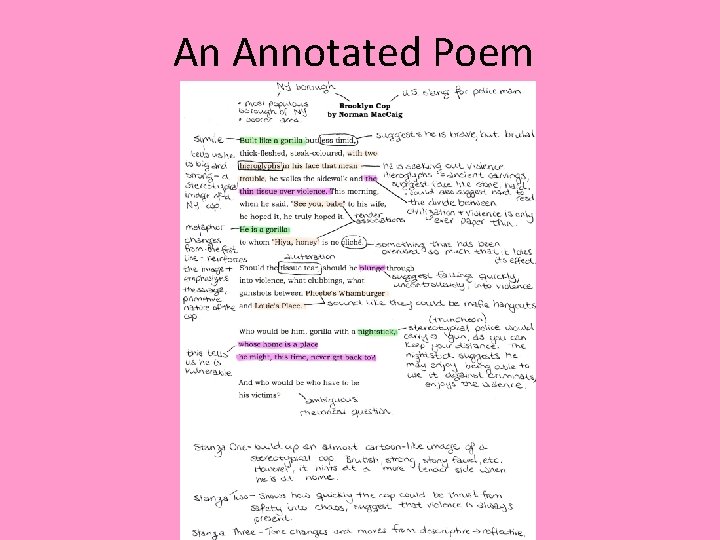
An Annotated Poem
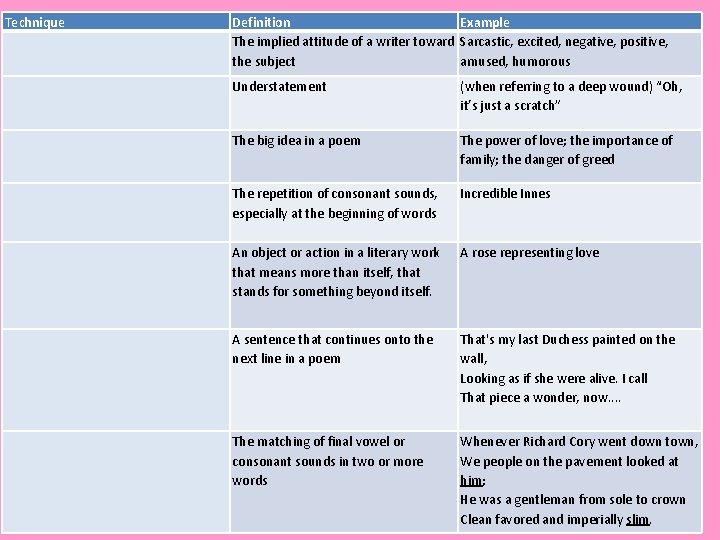
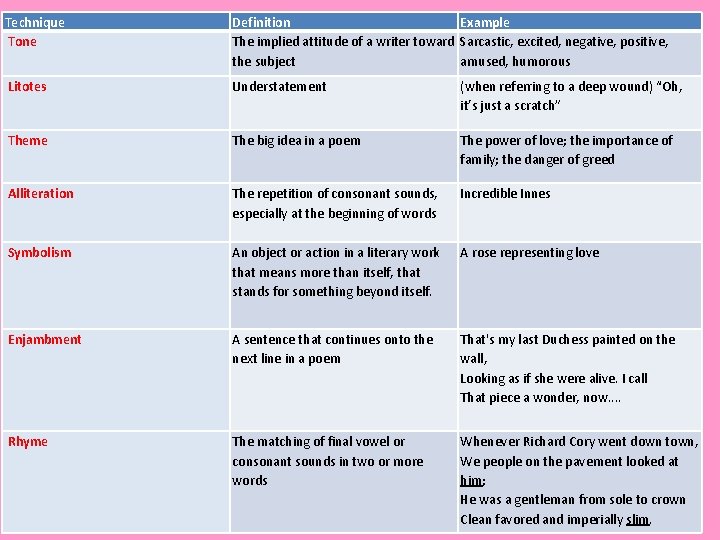
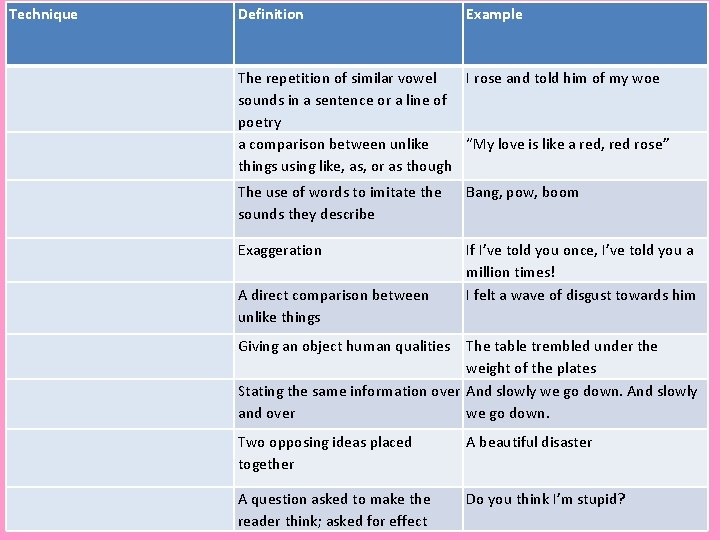
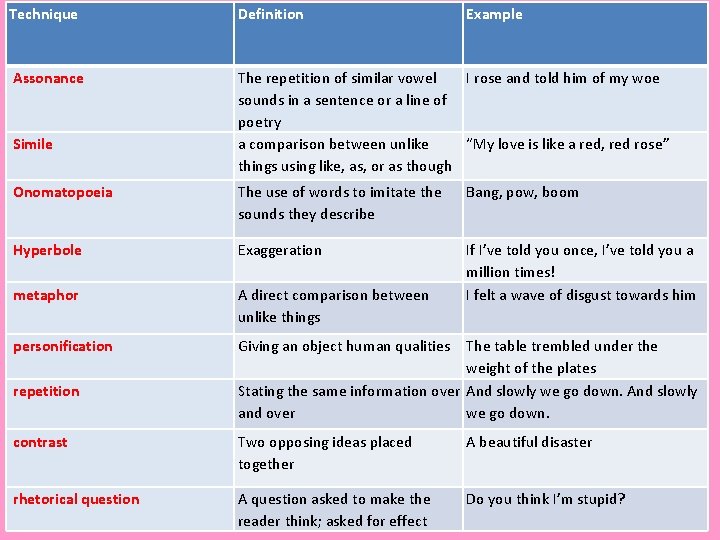
Poetic Techniques Cheat Sheet • Using your bingo card, match the name of the technique up to the definition and example • This will be your bible for textual analysis!
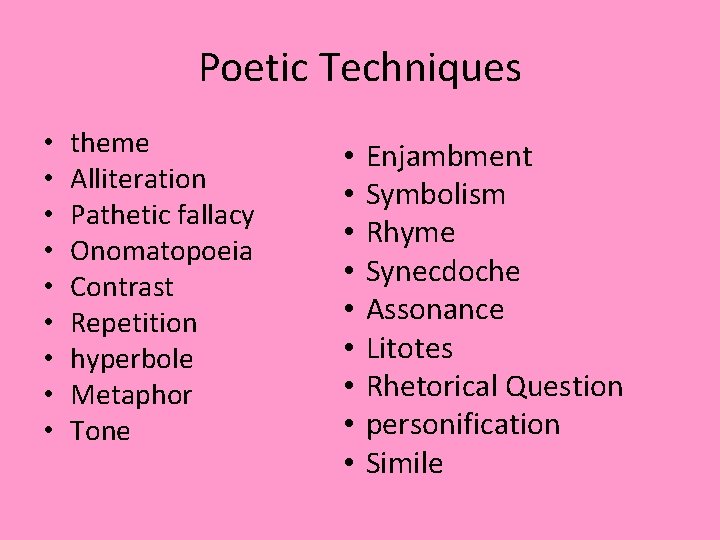
Poetic Techniques • • • theme Alliteration Pathetic fallacy Onomatopoeia Contrast Repetition hyperbole Metaphor Tone • • • Enjambment Symbolism Rhyme Synecdoche Assonance Litotes Rhetorical Question personification Simile
Technique Definition Example The implied attitude of a writer toward Sarcastic, excited, negative, positive, the subject amused, humorous Understatement (when referring to a deep wound) “Oh, it’s just a scratch” The big idea in a poem The power of love; the importance of family; the danger of greed The repetition of consonant sounds, especially at the beginning of words Incredible Innes An object or action in a literary work that means more than itself, that stands for something beyond itself. A rose representing love A sentence that continues onto the next line in a poem That's my last Duchess painted on the wall, Looking as if she were alive. I call That piece a wonder, now. . The matching of final vowel or consonant sounds in two or more words Whenever Richard Cory went down town, We people on the pavement looked at him; He was a gentleman from sole to crown Clean favored and imperially slim.
Technique Tone Definition Example The implied attitude of a writer toward Sarcastic, excited, negative, positive, the subject amused, humorous Litotes Understatement (when referring to a deep wound) “Oh, it’s just a scratch” Theme The big idea in a poem The power of love; the importance of family; the danger of greed Alliteration The repetition of consonant sounds, especially at the beginning of words Incredible Innes Symbolism An object or action in a literary work that means more than itself, that stands for something beyond itself. A rose representing love Enjambment A sentence that continues onto the next line in a poem That's my last Duchess painted on the wall, Looking as if she were alive. I call That piece a wonder, now. . Rhyme The matching of final vowel or consonant sounds in two or more words Whenever Richard Cory went down town, We people on the pavement looked at him; He was a gentleman from sole to crown Clean favored and imperially slim.
Technique Definition Example The repetition of similar vowel I rose and told him of my woe sounds in a sentence or a line of poetry a comparison between unlike “My love is like a red, red rose” things using like, as, or as though The use of words to imitate the sounds they describe Bang, pow, boom Exaggeration If I’ve told you once, I’ve told you a million times! I felt a wave of disgust towards him A direct comparison between unlike things Giving an object human qualities The table trembled under the weight of the plates Stating the same information over And slowly we go down. And slowly and over we go down. Two opposing ideas placed together A beautiful disaster A question asked to make the reader think; asked for effect Do you think I’m stupid?
Technique Definition Assonance The repetition of similar vowel I rose and told him of my woe sounds in a sentence or a line of poetry a comparison between unlike “My love is like a red, red rose” things using like, as, or as though Simile Example Onomatopoeia The use of words to imitate the sounds they describe Bang, pow, boom Hyperbole Exaggeration metaphor A direct comparison between unlike things If I’ve told you once, I’ve told you a million times! I felt a wave of disgust towards him personification Giving an object human qualities repetition The table trembled under the weight of the plates Stating the same information over And slowly we go down. And slowly and over we go down. contrast Two opposing ideas placed together A beautiful disaster rhetorical question A question asked to make the reader think; asked for effect Do you think I’m stupid?
Annotating Task In your group, you will annotate a section of the poem in DETAIL • Underline poetic techniques • Highlight interesting words used • Note down on the poem your thoughts and explanations
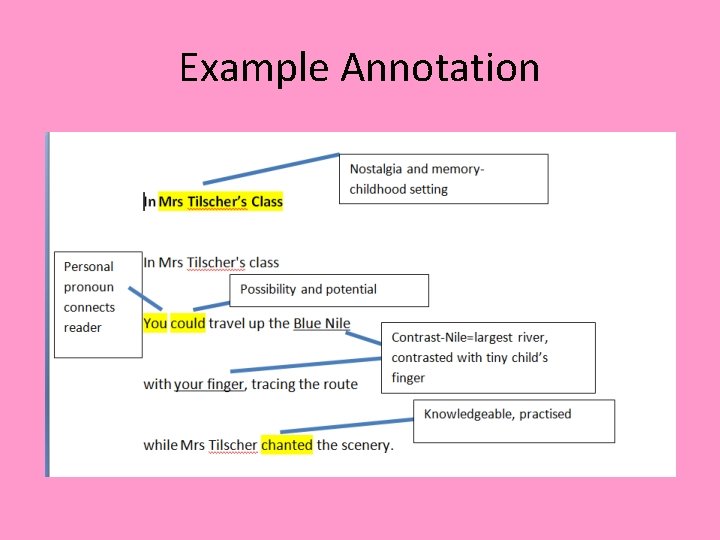
Annotation Example • Look closely at the annotation example • Look at the level of detail in the annotated notes-replicate this for your section! • You will present your example to the class, so make sure it is detailed and you understand it well
Example Annotation
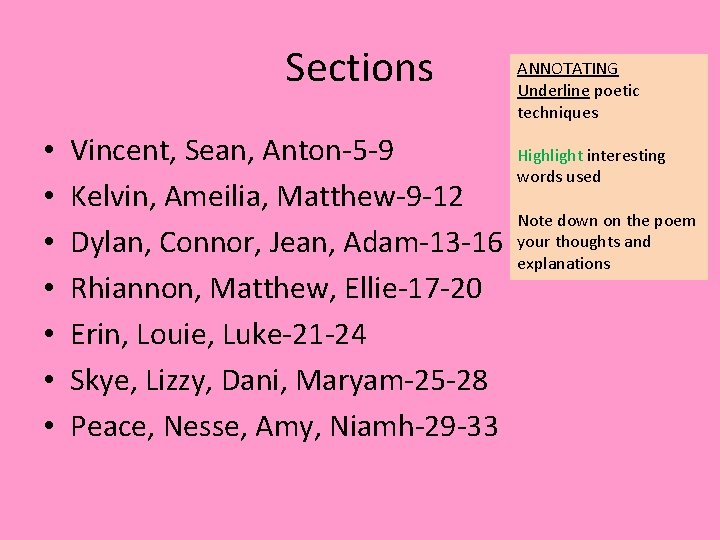
Sections • • Vincent, Sean, Anton-5 -9 Kelvin, Ameilia, Matthew-9 -12 Dylan, Connor, Jean, Adam-13 -16 Rhiannon, Matthew, Ellie-17 -20 Erin, Louie, Luke-21 -24 Skye, Lizzy, Dani, Maryam-25 -28 Peace, Nesse, Amy, Niamh-29 -33 ANNOTATING Underline poetic techniques Highlight interesting words used Note down on the poem your thoughts and explanations
Presenting Your Annotations • You are going to present your section of the poem and your annotated notes to the class You need to explain clearly: • Where to highlight/underline • What words mean/suggest • What techniques are being used • Explanations of key techniques
Homework Reminder For Weds 4 th Sept • Read chapters 7 -12 of ‘The Handmaid’s Tale’ • Setting paragraph for chapters 1 -6 (notes on GLOW) For Fri 13 th Sept. First draft of persuasive essaynotes on GLOW
Analysing Imagery Scottish Set Text
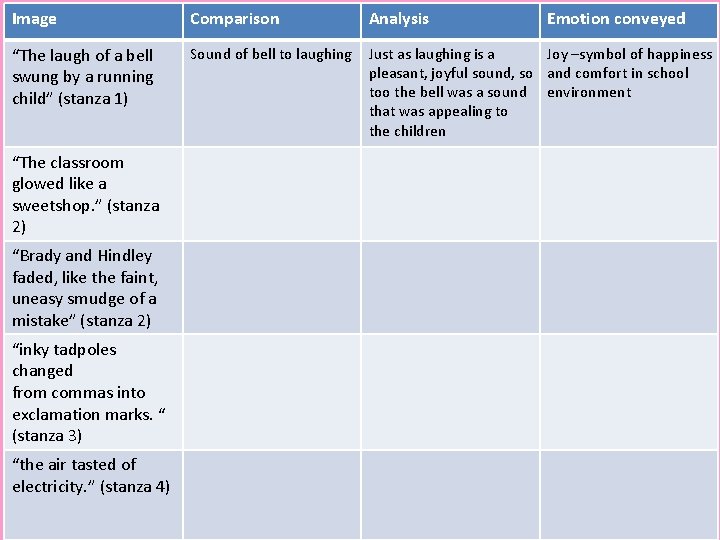
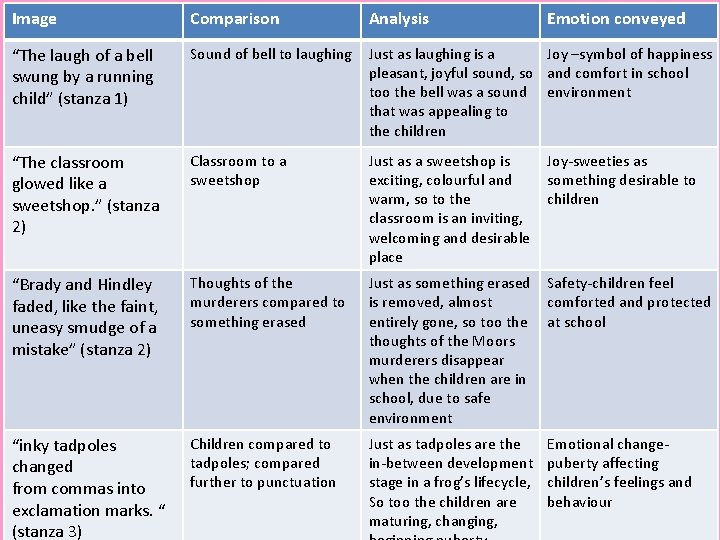
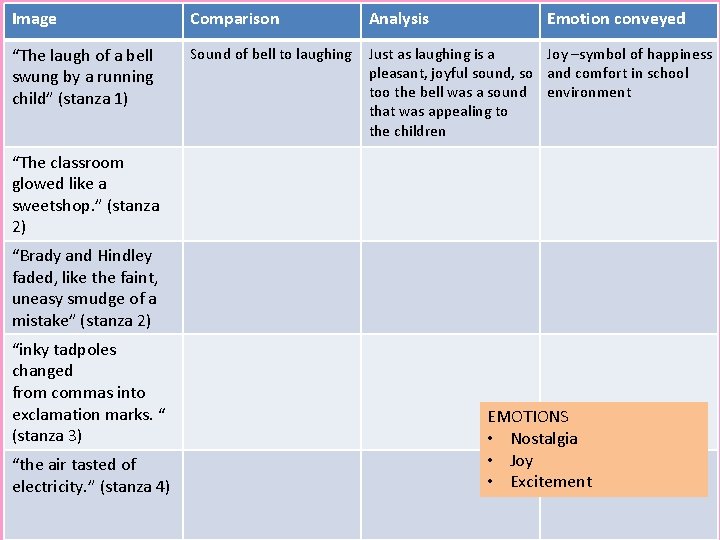
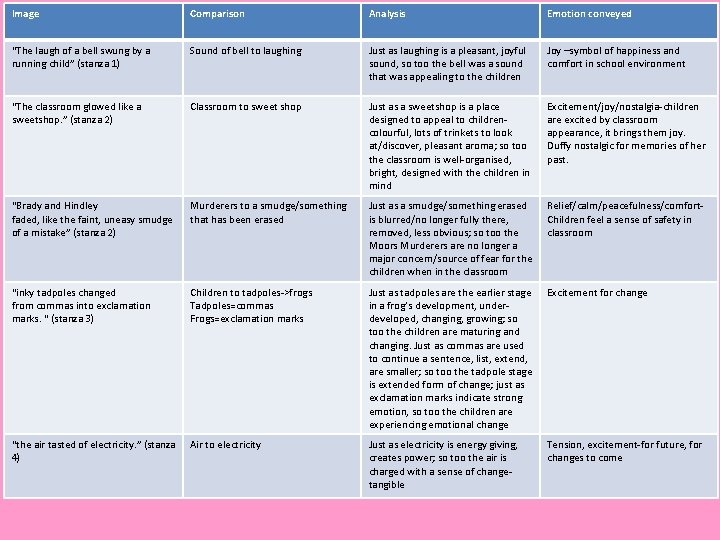
Analysing Imagery • Throughout the poem, Duffy uses imagery to express certain emotions, particularly: – Nostalgia – Joy – excitement • Look at the imagery used in the poem, and explain fully how these emotions are conveyed through comparison While you do this in groups…Attainment discussions!
Image Comparison Analysis “The laugh of a bell swung by a running child” (stanza 1) Sound of bell to laughing Just as laughing is a Joy –symbol of happiness pleasant, joyful sound, so and comfort in school too the bell was a sound environment that was appealing to the children “The classroom glowed like a sweetshop. ” (stanza 2) “Brady and Hindley faded, like the faint, uneasy smudge of a mistake” (stanza 2) “inky tadpoles changed from commas into exclamation marks. “ (stanza 3) “the air tasted of electricity. ” (stanza 4) Emotion conveyed
Image Comparison Analysis Emotion conveyed “The laugh of a bell swung by a running child” (stanza 1) Sound of bell to laughing Just as laughing is a Joy –symbol of happiness pleasant, joyful sound, so and comfort in school too the bell was a sound environment that was appealing to the children “The classroom glowed like a sweetshop. ” (stanza 2) Classroom to a sweetshop Just as a sweetshop is Joy-sweeties as exciting, colourful and something desirable to warm, so to the children classroom is an inviting, welcoming and desirable place “Brady and Hindley faded, like the faint, uneasy smudge of a mistake” (stanza 2) Thoughts of the murderers compared to something erased Just as something erased Safety-children feel is removed, almost comforted and protected entirely gone, so too the at school thoughts of the Moors murderers disappear when the children are in school, due to safe environment “inky tadpoles changed from commas into exclamation marks. “ (stanza 3) Children compared to tadpoles; compared further to punctuation Just as tadpoles are the in-between development stage in a frog’s lifecycle, So too the children are maturing, changing, Emotional changepuberty affecting children’s feelings and behaviour
Homework Reminder For Today Finish WC Edinburgh R 4 UAE task For Weds 11 th Sept • Complete character paragraph (begun in class last week, notes on GLOW • 5 bullet point summary of what we know so far (>chapter 12): • Plot • Setting • Offred For Fri 13 th Sept. First draft of persuasive essaynotes on GLOW
Image Comparison Analysis Emotion conveyed “The laugh of a bell swung by a running child” (stanza 1) Sound of bell to laughing Just as laughing is a Joy –symbol of happiness pleasant, joyful sound, so and comfort in school too the bell was a sound environment that was appealing to the children “The classroom glowed like a sweetshop. ” (stanza 2) “Brady and Hindley faded, like the faint, uneasy smudge of a mistake” (stanza 2) “inky tadpoles changed from commas into exclamation marks. “ (stanza 3) “the air tasted of electricity. ” (stanza 4) EMOTIONS • Nostalgia • Joy • Excitement
Image Comparison Analysis Emotion conveyed “The laugh of a bell swung by a running child” (stanza 1) Sound of bell to laughing Just as laughing is a pleasant, joyful sound, so too the bell was a sound that was appealing to the children Joy –symbol of happiness and comfort in school environment “The classroom glowed like a sweetshop. ” (stanza 2) Classroom to sweet shop Just as a sweetshop is a place designed to appeal to childrencolourful, lots of trinkets to look at/discover, pleasant aroma; so too the classroom is well-organised, bright, designed with the children in mind Excitement/joy/nostalgia-children are excited by classroom appearance, it brings them joy. Duffy nostalgic for memories of her past. “Brady and Hindley faded, like the faint, uneasy smudge of a mistake” (stanza 2) Murderers to a smudge/something that has been erased Just as a smudge/something erased is blurred/no longer fully there, removed, less obvious; so too the Moors Murderers are no longer a major concern/source of fear for the children when in the classroom Relief/calm/peacefulness/comfort. Children feel a sense of safety in classroom “inky tadpoles changed from commas into exclamation marks. “ (stanza 3) Children to tadpoles->frogs Tadpoles=commas Frogs=exclamation marks Just as tadpoles are the earlier stage in a frog’s development, underdeveloped, changing, growing; so too the children are maturing and changing. Just as commas are used to continue a sentence, list, extend, are smaller; so too the tadpole stage is extended form of change; just as exclamation marks indicate strong emotion, so too the children are experiencing emotional change Excitement for change “the air tasted of electricity. ” (stanza 4) Air to electricity Just as electricity is energy giving, creates power; so too the air is charged with a sense of changetangible Tension, excitement-for future, for changes to come
Themes Scottish Set Text
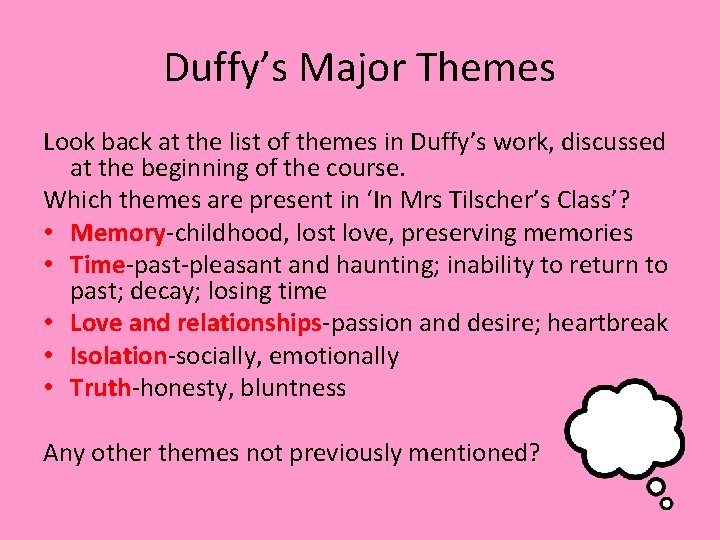
Duffy’s Major Themes Look back at the list of themes in Duffy’s work, discussed at the beginning of the course. Which themes are present in ‘In Mrs Tilscher’s Class’? • Memory-childhood, lost love, preserving memories • Time-past-pleasant and haunting; inability to return to past; decay; losing time • Love and relationships-passion and desire; heartbreak • Isolation-socially, emotionally • Truth-honesty, bluntness Any other themes not previously mentioned?
Homework Reminder For Weds 11 th Sept • Complete character paragraph (begun in class last week, notes on GLOW • 5 bullet point summary of what we know so far (>chapter 12): • Plot • Setting • Offred For Fri 13 th Sept. First draft of persuasive essaynotes on GLOW
Themes in ‘IMTC’ • Memory • Truth • Time • Nostalgia
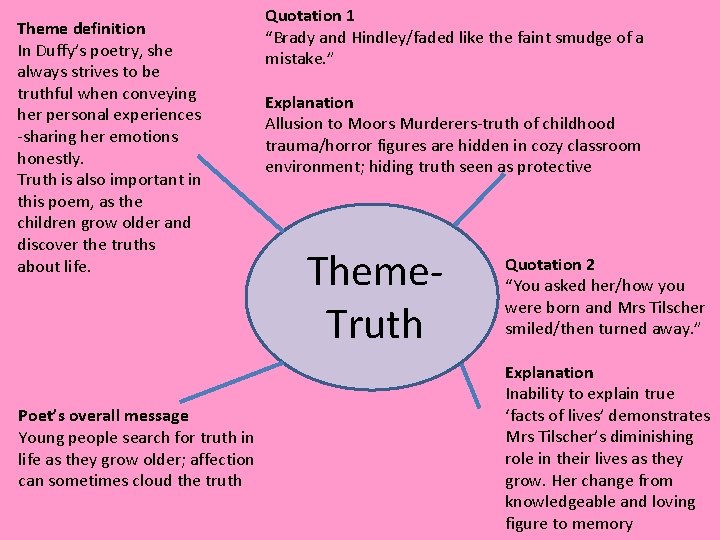
Group Mind Map Each group will create a mind map based on a particular theme. In your mind map, you will explain: • What your theme means in relation to the poem • In detail, analyse how 2 quotations demonstrate that theme, explaining key techniques used • What the poet’s overall message about that theme
Theme definition In Duffy’s poetry, she always strives to be truthful when conveying her personal experiences -sharing her emotions honestly. Truth is also important in this poem, as the children grow older and discover the truths about life. Poet’s overall message Young people search for truth in life as they grow older; affection can sometimes cloud the truth Quotation 1 “Brady and Hindley/faded like the faint smudge of a mistake. ” Explanation Allusion to Moors Murderers-truth of childhood trauma/horror figures are hidden in cozy classroom environment; hiding truth seen as protective Theme. Truth Quotation 2 “You asked her/how you were born and Mrs Tilscher smiled/then turned away. ” Explanation Inability to explain true ‘facts of lives’ demonstrates Mrs Tilscher’s diminishing role in their lives as they grow. Her change from knowledgeable and loving figure to memory
Peer Checking Rotate your mind maps Check the other group’s mind map. Ensure they have: • 2 relevant quotes for the specified theme • DETAILED analysis of these quotes (techniques!) and how they link to theme • A clear description of what theme means and how it relates to ‘IMTC’ • A clear idea of Duffy’s message/stance on this theme
Textual Analysis Practice Scottish Set Text
Textual Analysis-Tips! Treat it like a close reading! • Bullet point answers • Number of marks=number of points • Understanding Qs – Use own words where possible – Identify themes where asked – Summarise key events briefly • Analysis Qs – Quote/Identify key techniques (W. C. , S. S. , Imagery, Tone, poetic techniques) – Explain analysis – link to question
N 5 ->Higher • Like R 4 UAE, you do not get marks for quoting at Higher • You have to write more detailed analysis of the techniques you identify, and link your analysis more to the Q asked
Question 1 -Decoding the Q Make sure you are checking which lines you are being asked about Analysis-look for techniques, analyse in detail Look at lines 1 -5. Explain how the poet makes use of extended metaphor here to explore the idea of change. Specific technique I am (4 marks) looking for Link to Q-2 nd point of analysis-must mention ‘change’ in analysis 2 examples must be given
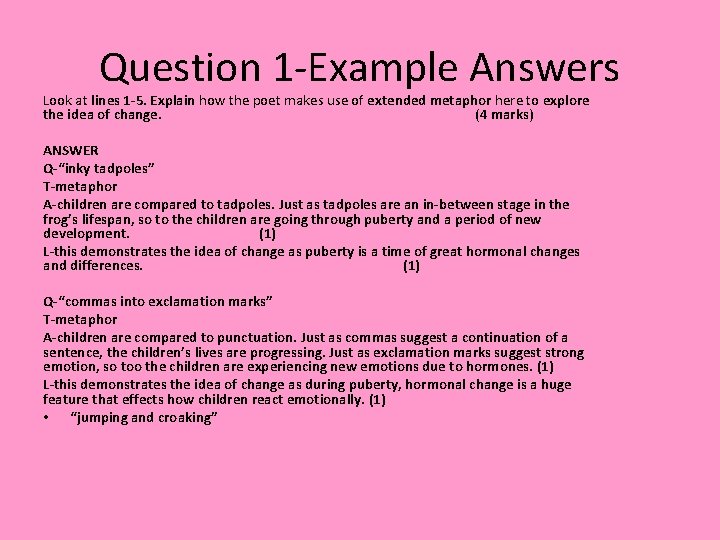
Question 1 -Example Answers Look at lines 1 -5. Explain how the poet makes use of extended metaphor here to explore the idea of change. (4 marks) ANSWER Q-“inky tadpoles” T-metaphor A-children are compared to tadpoles. Just as tadpoles are an in-between stage in the frog’s lifespan, so to the children are going through puberty and a period of new development. (1) L-this demonstrates the idea of change as puberty is a time of great hormonal changes and differences. (1) Q-“commas into exclamation marks” T-metaphor A-children are compared to punctuation. Just as commas suggest a continuation of a sentence, the children’s lives are progressing. Just as exclamation marks suggest strong emotion, so too the children are experiencing new emotions due to hormones. (1) L-this demonstrates the idea of change as during puberty, hormonal change is a huge feature that effects how children react emotionally. (1) • “jumping and croaking”
Homework Reminder For Weds 18 th Sept • Complete theme paragraph • Read chapters 13 -17
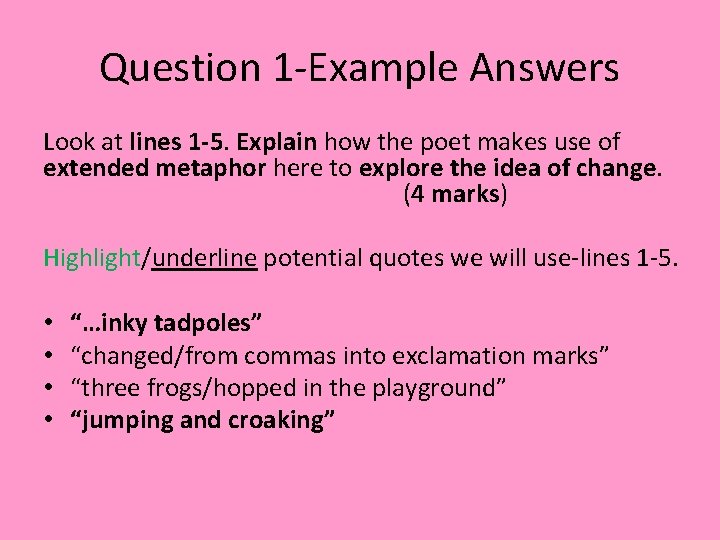
Question 1 -Example Answers Look at lines 1 -5. Explain how the poet makes use of extended metaphor here to explore the idea of change. (4 marks) Highlight/underline potential quotes we will use-lines 1 -5. • • “…inky tadpoles” “changed/from commas into exclamation marks” “three frogs/hopped in the playground” “jumping and croaking”
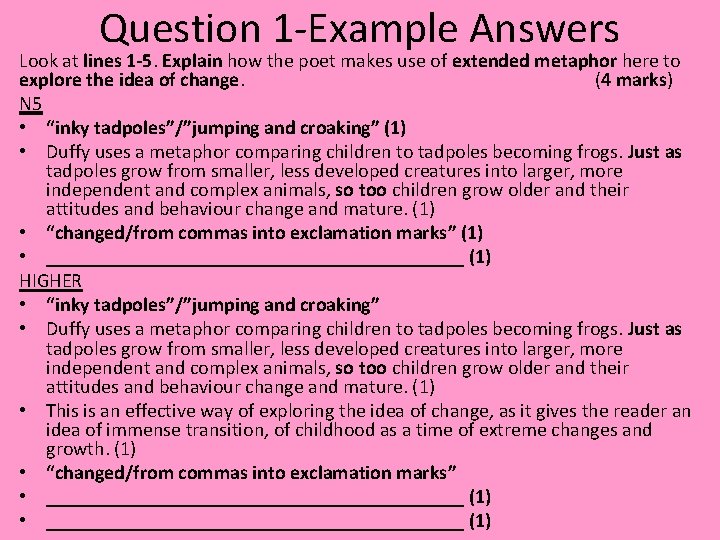
Question 1 -Example Answers Look at lines 1 -5. Explain how the poet makes use of extended metaphor here to explore the idea of change. (4 marks) N 5 • “inky tadpoles”/”jumping and croaking” (1) • Duffy uses a metaphor comparing children to tadpoles becoming frogs. Just as tadpoles grow from smaller, less developed creatures into larger, more independent and complex animals, so too children grow older and their attitudes and behaviour change and mature. (1) • “changed/from commas into exclamation marks” (1) • _____________________ (1) HIGHER • “inky tadpoles”/”jumping and croaking” • Duffy uses a metaphor comparing children to tadpoles becoming frogs. Just as tadpoles grow from smaller, less developed creatures into larger, more independent and complex animals, so too children grow older and their attitudes and behaviour change and mature. (1) • This is an effective way of exploring the idea of change, as it gives the reader an idea of immense transition, of childhood as a time of extreme changes and growth. (1) • “changed/from commas into exclamation marks” • __________________________________________ (1)
Notes on Q 2&3 • Q 2&3 -“use of language”=any poetic technique, S. S. , imagery, tone, W. C • Q 3 -“effective conclusion”-how does it summarise the main ideas in the poem well? How does it leave the reader feeling? Link to major themes, similar techniques used earlier • • 4 marks=2 examples • 2 marks=1 example • N 5 -marks for quoting • Higher=two points of analysis
Textual Analysis Review We will review and discuss our responses to the textual analysis, to help you identify: • Areas where you are having success • Areas where you need more support
10 Mark Q Practice Scottish Set Text