Figures of Speech The Language of Literature Philip


- Slides: 88
Figures of Speech The Language of Literature
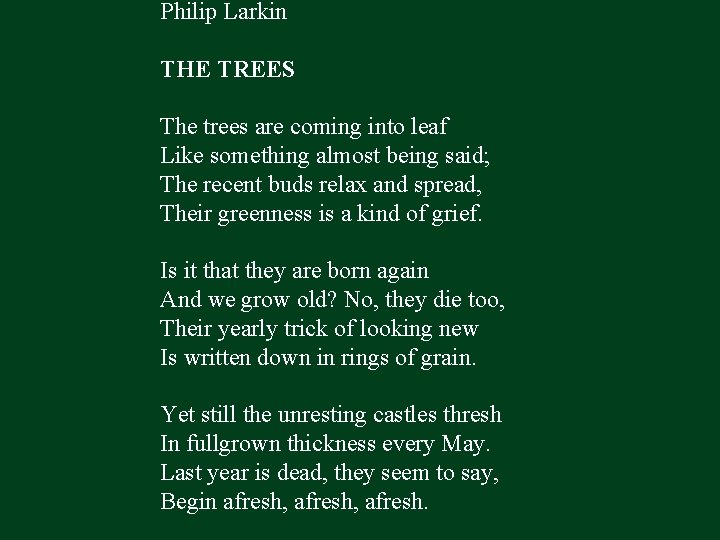
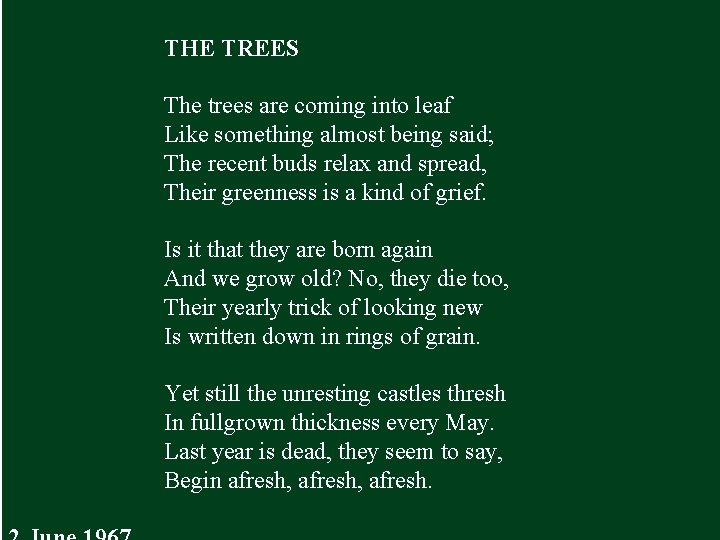
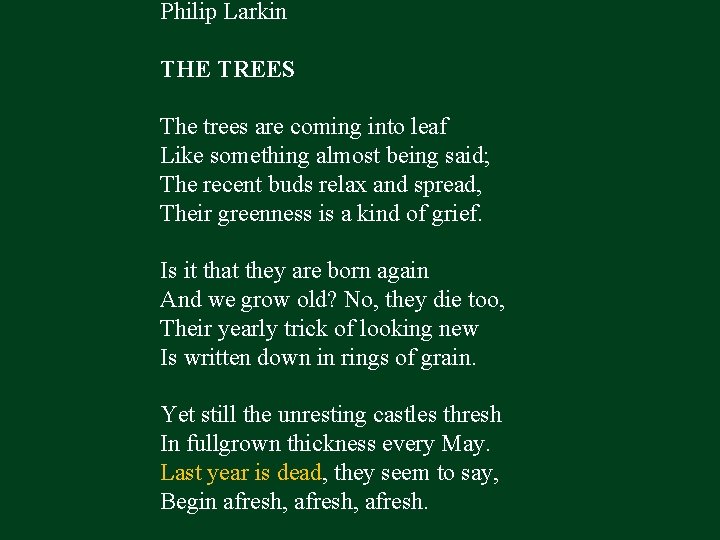
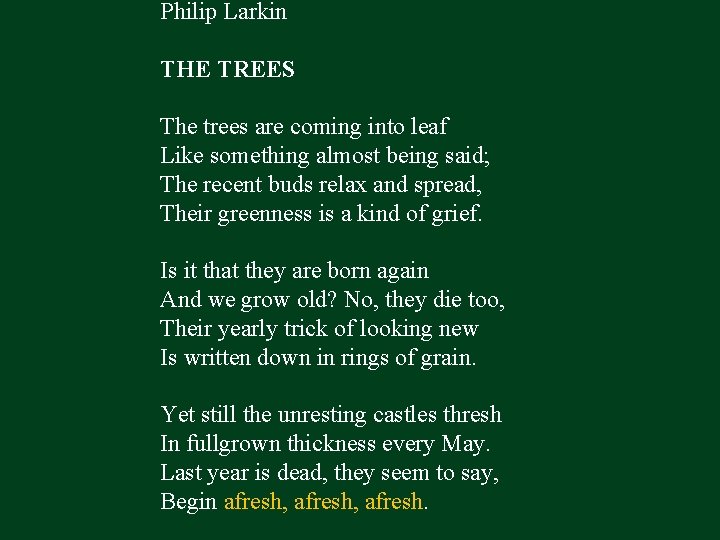
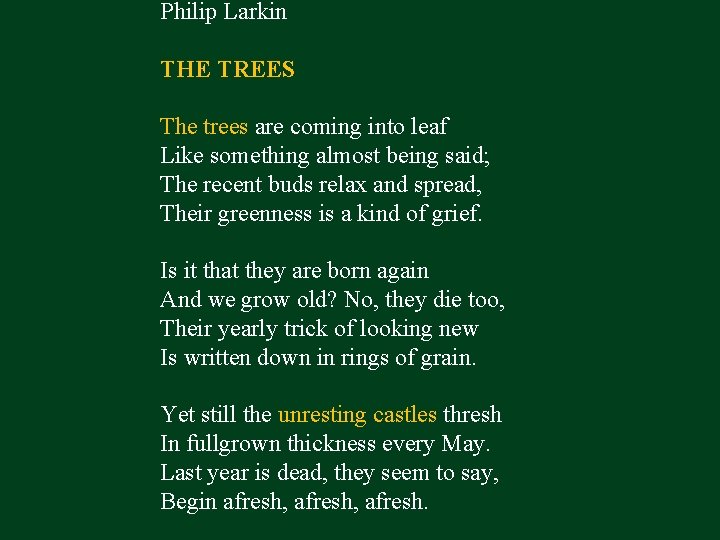
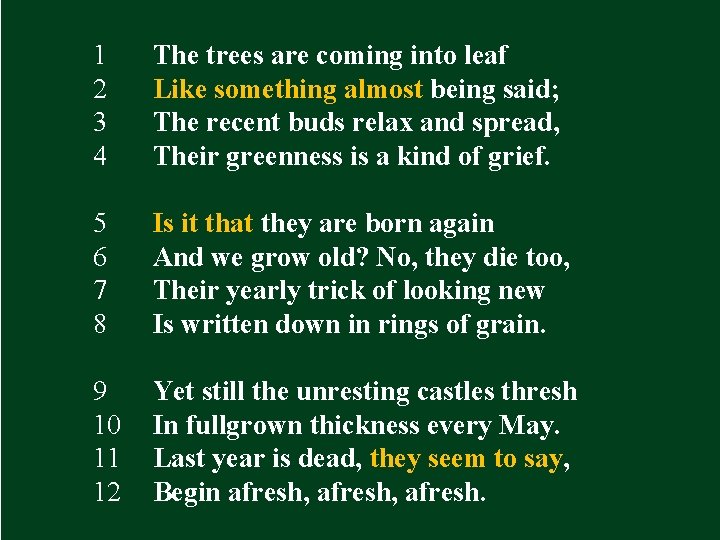
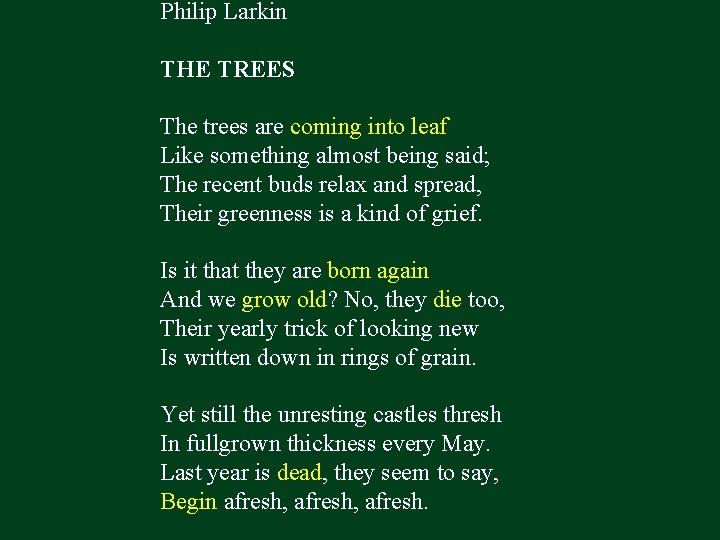
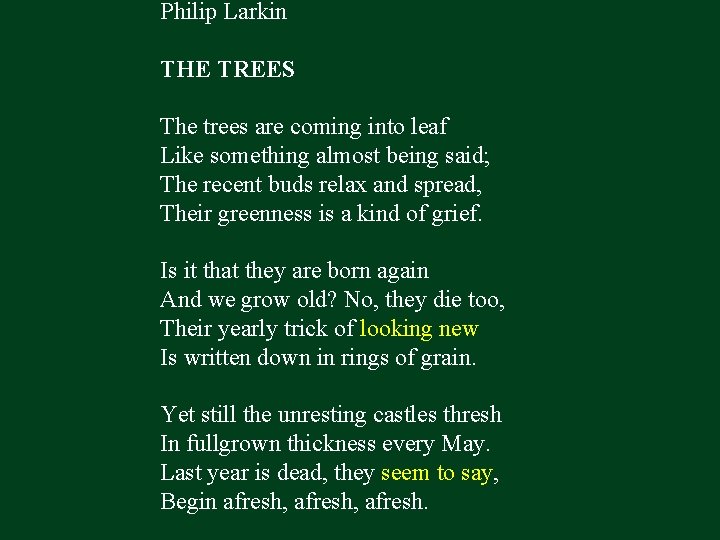
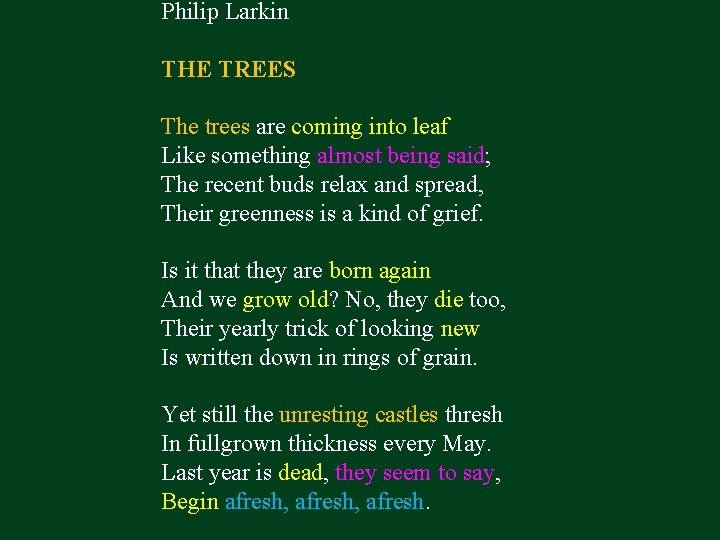
Philip Larkin THE TREES The trees are coming into leaf Like something almost being said; The recent buds relax and spread, Their greenness is a kind of grief. Is it that they are born again And we grow old? No, they die too, Their yearly trick of looking new Is written down in rings of grain. Yet still the unresting castles thresh In fullgrown thickness every May. Last year is dead, they seem to say, Begin afresh, afresh.
Literary texts A work of literature is always a coded text, in parts it may use figurative language (figures of speech or tropes), and as a whole it always communicates ideas different from its literal meaning. Therefore the student of literature must learn the various techniques of decoding literary texts.
Figurative language Language which uses figures of speech; for example, metaphor, metonymy, synecdoche, simile, alliteration, hyperbole, etc. Figurative language must be distinguished from literal language.
Literal language Language use that takes the meaning of words in their primary and non-figurative sense, as in literal interpretation.
literal language vs literary language
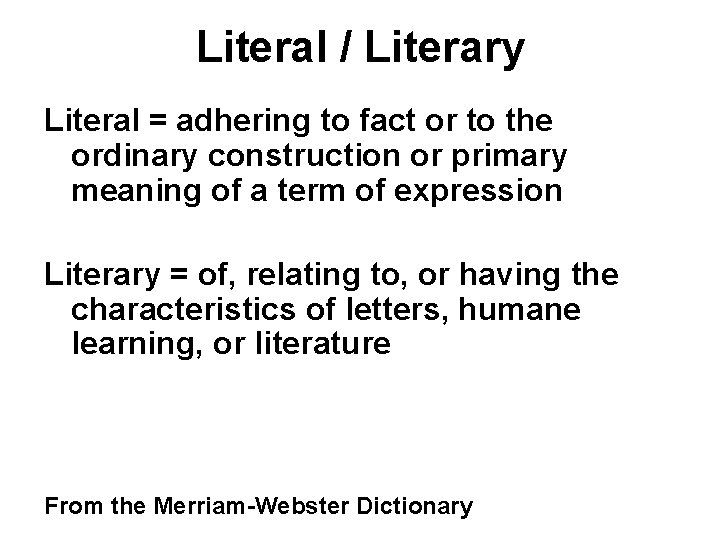
Literal / Literary Literal = adhering to fact or to the ordinary construction or primary meaning of a term of expression Literary = of, relating to, or having the characteristics of letters, humane learning, or literature From the Merriam-Webster Dictionary
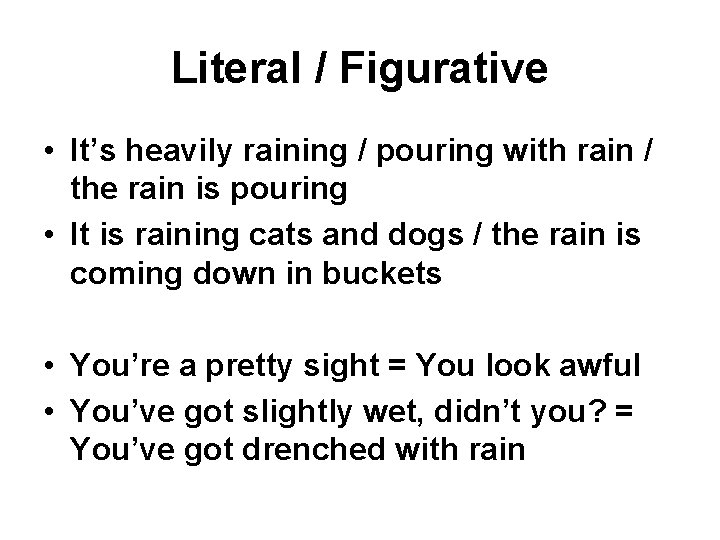
Literal / Figurative • It’s heavily raining / pouring with rain / the rain is pouring • It is raining cats and dogs / the rain is coming down in buckets • You’re a pretty sight = You look awful • You’ve got slightly wet, didn’t you? = You’ve got drenched with rain
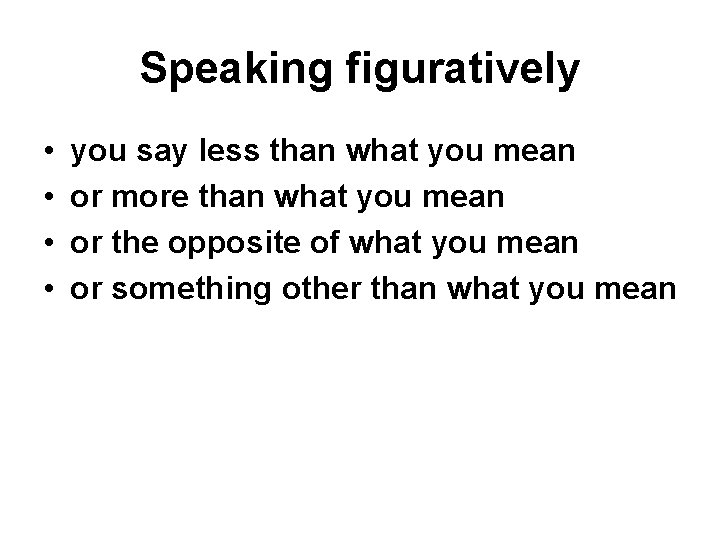
Speaking figuratively • • you say less than what you mean or more than what you mean or the opposite of what you mean or something other than what you mean
Figurative speech Broadly defined: Any way of saying something other than the ordinary (literal) way. (From the antiquity on rhetoricians have defined over 250 separate figures. ) Narrowly defined: A way of saying one thing and meaning another. Language that cannot be taken literally.
Figures of speech / Tropes Figures of speech = tropes Trope (Greek ‘turn’) denotes any rhetorical or figurative device
THE TREES The trees are coming into leaf Like something almost being said; The recent buds relax and spread, Their greenness is a kind of grief. Is it that they are born again And we grow old? No, they die too, Their yearly trick of looking new Is written down in rings of grain. Yet still the unresting castles thresh In fullgrown thickness every May. Last year is dead, they seem to say, Begin afresh, afresh.
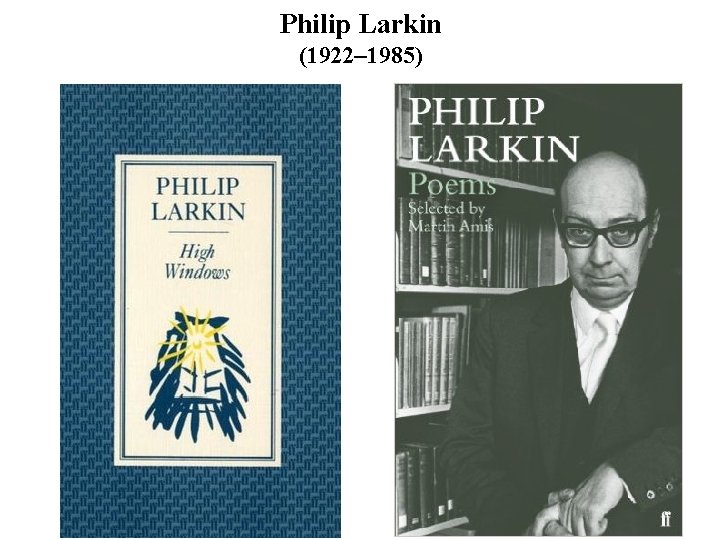
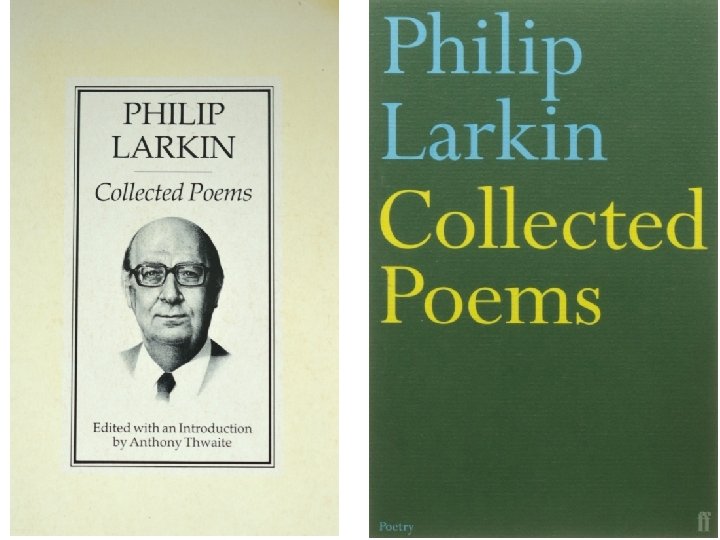
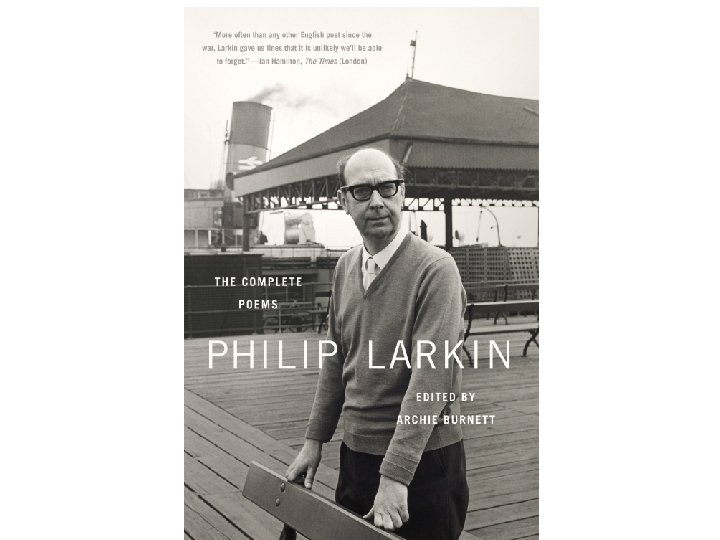
Philip Larkin (1922– 1985)
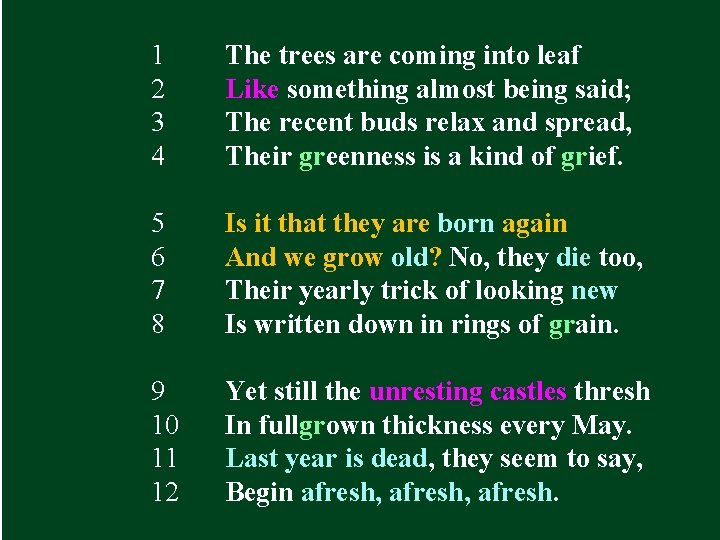
1 2 3 4 The trees are coming into leaf Like something almost being said; The recent buds relax and spread, Their greenness is a kind of grief. 5 6 7 8 9 10 11 12 Is it that they are born again And we grow old? No, they die too, Their yearly trick of looking new Is written down in rings of grain. Yet still the unresting castles thresh In fullgrown thickness every May. Last year is dead, they seem to say, Begin afresh, afresh.
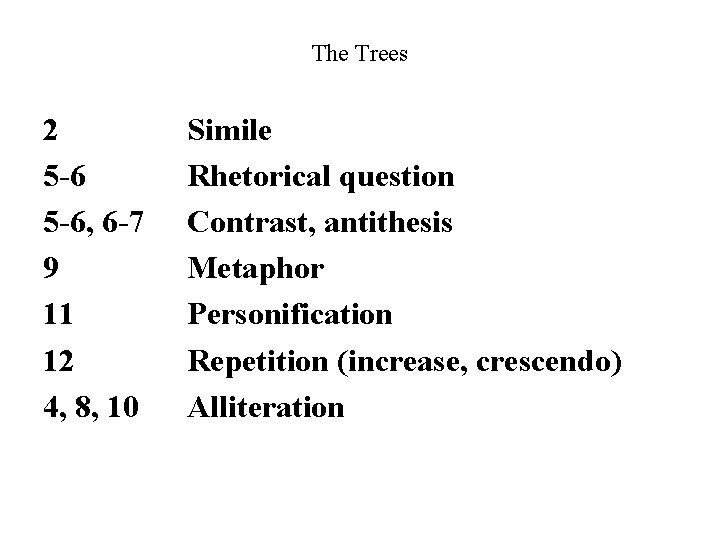
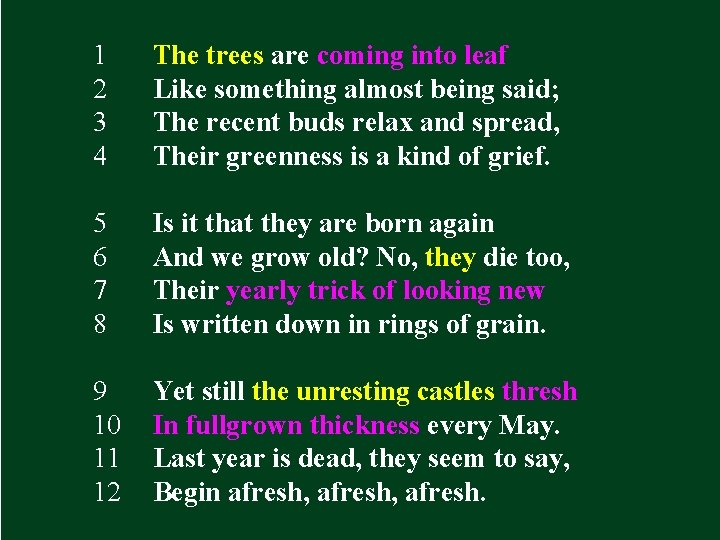
The Trees 2 5 -6, 6 -7 9 11 12 4, 8, 10 Simile Rhetorical question Contrast, antithesis Metaphor Personification Repetition (increase, crescendo) Alliteration
A figure of speech is an expression extending language beyond its literal meaning, either pictorially through metaphor, simile, allusion, personification, and the like, or rhetorically through repetition, balance, antithesis and the like. A figure of speech is also called a trope. The Harper Handbook to Literature, ed. Northrop Frye, Sheridan Baker, George Perkins. New York: Harper & Row, 1984
Metaphor All the world's a stage, And all the men and women merely players; They have their exits and their entrances William Shakespeare: As You Like It, Act Two, Scene 7 Interpretation The world is not literally a stage. But Shakespeare figuratively asserts that the world is a stage and thus reveals the mechanics of the world and the behaviour of the people within it.
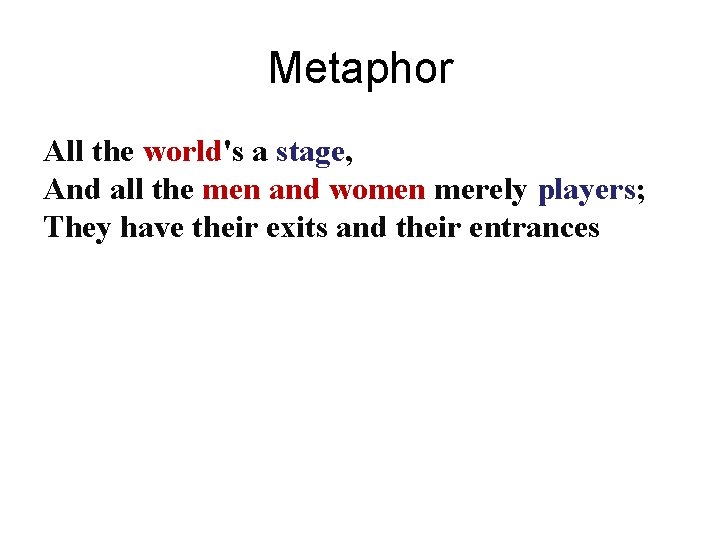
Metaphor I. A. Richards in The Philosophy of Rhetoric (1937) describes a metaphor as having two parts: the tenor the vehicle. The tenor is the subject to which attributes are ascribed. The vehicle is the object whose attributes are borrowed. In the above example "the world" is the tenor, and "a stage" is the vehicle; "men and women" forms part of the tenor and "players" of the vehicle.
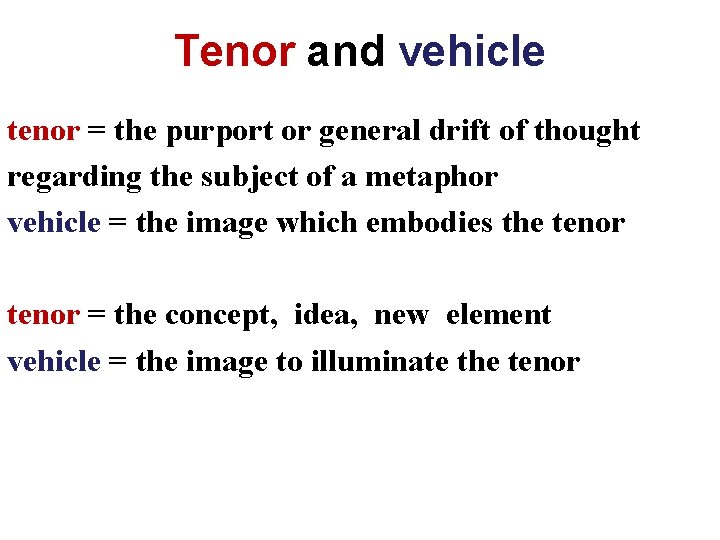
Tenor and vehicle tenor = the purport or general drift of thought regarding the subject of a metaphor vehicle = the image which embodies the tenor = the concept, idea, new element vehicle = the image to illuminate the tenor
Metaphor All the world's a stage, And all the men and women merely players; They have their exits and their entrances
Figurative language Metaphor (Greek 'to transfer‚ to carry over’) How to spot metaphor: textual and contextual signals Metaphor and simile in poetry: figurative language with a purpose The effects of metaphor: denotation / connotation denotation = what is referred to connotation = associations, connecting images, ideas, moods, etc.
Figures of speech: metaphor, simile Used as means of comparing things that are essentially unlike. Figures of speech in which one thing is described in terms of another. Metaphor – the comparison is implied, implicit, i. e. the figurative term is substituted for or identified with the literal term Simile – the comparison is expressed, explicit (like, as)
Metaphor and simile Metaphor: "O Rose, thou art sick. ” (William Blake) No sign of comparison: vehicle stands for tenor Simile: “O my luve's like a red, red rose” (Robert Burns) luve = tenor red, red rose = vehicle like = grammatical indicator of similarity
Philip Larkin THE TREES The trees are coming into leaf Like something almost being said; The recent buds relax and spread, Their greenness is a kind of grief. Is it that they are born again And we grow old? No, they die too, Their yearly trick of looking new Is written down in rings of grain. Yet still the unresting castles thresh In fullgrown thickness every May. Last year is dead, they seem to say, Begin afresh, afresh.
Conceit An extended metaphor (conceit, concetto) establishes a principal subject (comparison) and subsidiary subjects (comparisons). Used extensively by English metaphysical poets of the seventeenth century.
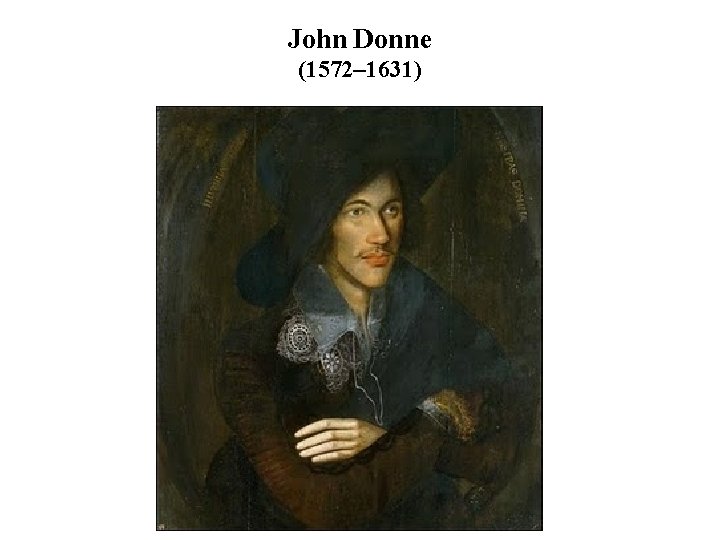
John Donne (1572– 1631)
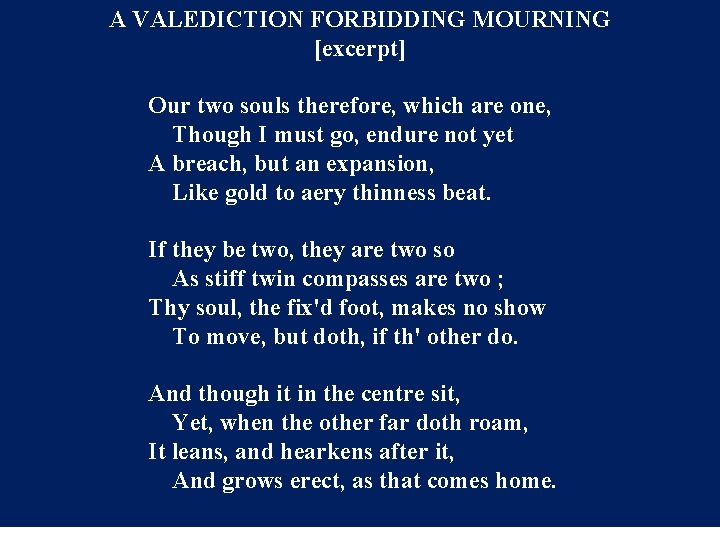
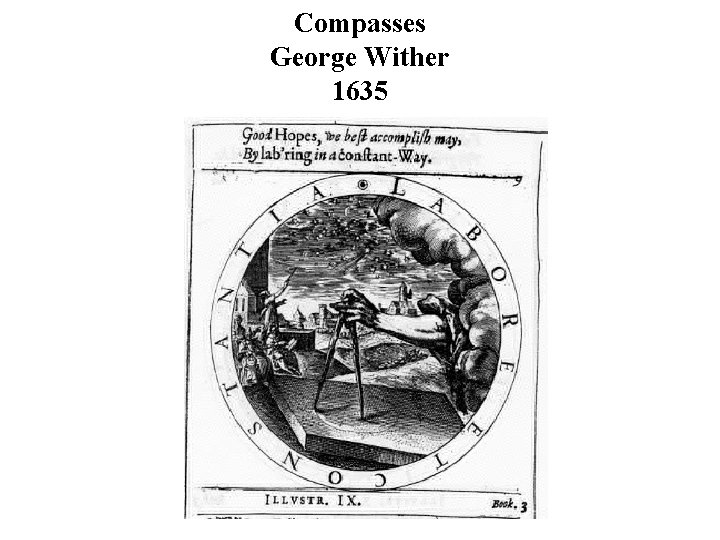
A VALEDICTION FORBIDDING MOURNING [excerpt] Our two souls therefore, which are one, Though I must go, endure not yet A breach, but an expansion, Like gold to aery thinness beat. If they be two, they are two so As stiff twin compasses are two ; Thy soul, the fix'd foot, makes no show To move, but doth, if th' other do. And though it in the centre sit, Yet, when the other far doth roam, It leans, and hearkens after it, And grows erect, as that comes home.
Compasses George Wither 1635
Catachresis A mixed metaphor (catachresis) is one that leaps from one identification to a second identification inconsistent with the first. It can be deliberate or unintentional. Example: To be, or not to be, that is the question: Whether 'tis nobler in the mind to suffer The slings and arrows of outrageous fortune, Or to take arms against a sea of troubles, And by opposing end them? (Shakespeare: Hamlet, Act III, Scene I)
Cliché A dead metaphor (cliché) is one in which the sense of a transferred image is absent. Example: "to grasp a concept" uses physical action as a metaphor for understanding. Dead metaphors normally go unnoticed.
Philip Larkin THE TREES The trees are coming into leaf Like something almost being said; The recent buds relax and spread, Their greenness is a kind of grief. Is it that they are born again And we grow old? No, they die too, Their yearly trick of looking new Is written down in rings of grain. Yet still the unresting castles thresh In fullgrown thickness every May. Last year is dead, they seem to say, Begin afresh, afresh.
Carol Ann Duffy (1955) SIT AT PEACE (from The Other Country, 1990)
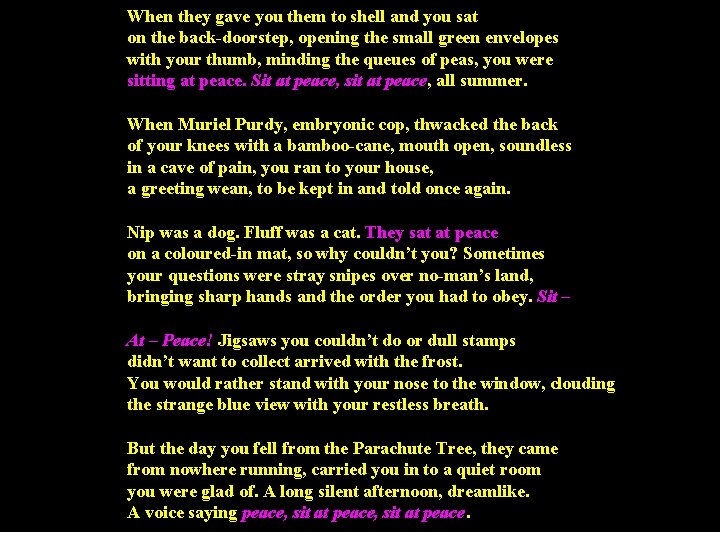
When they gave you them to shell and you sat on the back-doorstep, opening the small green envelopes with your thumb, minding the queues of peas, you were sitting at peace. Sit at peace, sit at peace, all summer. When Muriel Purdy, embryonic cop, thwacked the back of your knees with a bamboo-cane, mouth open, soundless in a cave of pain, you ran to your house, a greeting wean, to be kept in and told once again. Nip was a dog. Fluff was a cat. They sat at peace on a coloured-in mat, so why couldn’t you? Sometimes your questions were stray snipes over no-man’s land, bringing sharp hands and the order you had to obey. Sit – At – Peace! Jigsaws you couldn’t do or dull stamps didn’t want to collect arrived with the frost. You would rather stand with your nose to the window, clouding the strange blue view with your restless breath. But the day you fell from the Parachute Tree, they came from nowhere running, carried you in to a quiet room you were glad of. A long silent afternoon, dreamlike. A voice saying peace, sit at peace.
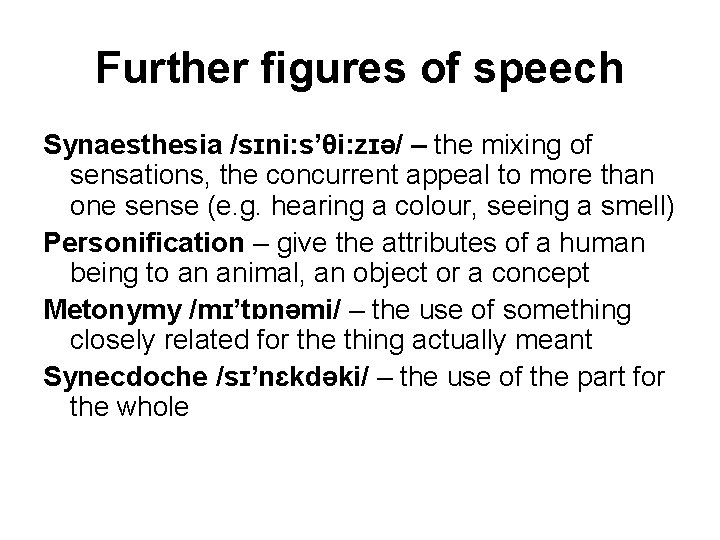
Further figures of speech Synaesthesia /sɪni: s’θi: zɪə/ – the mixing of sensations, the concurrent appeal to more than one sense (e. g. hearing a colour, seeing a smell) Personification – give the attributes of a human being to an animal, an object or a concept Metonymy /mɪ’tɒnəmi/ – the use of something closely related for the thing actually meant Synecdoche /sɪ’nɛkdəki/ – the use of the part for the whole
Philip Larkin THE TREES The trees are coming into leaf Like something almost being said; The recent buds relax and spread, Their greenness is a kind of grief. Is it that they are born again And we grow old? No, they die too, Their yearly trick of looking new Is written down in rings of grain. Yet still the unresting castles thresh In fullgrown thickness every May. Last year is dead, they seem to say, Begin afresh, afresh.
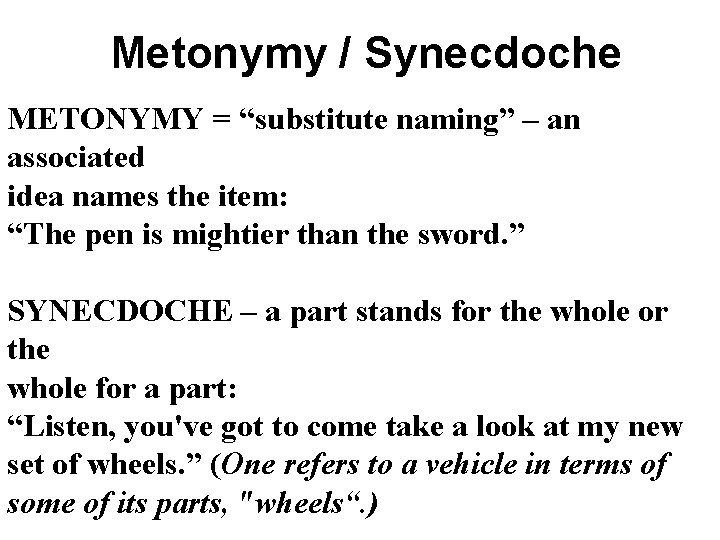
Metonymy / Synecdoche METONYMY = “substitute naming” – an associated idea names the item: “The pen is mightier than the sword. ” SYNECDOCHE – a part stands for the whole for a part: “Listen, you've got to come take a look at my new set of wheels. ” (One refers to a vehicle in terms of some of its parts, "wheels“. )
Even further figures of speech SYMBOl – something that means more than what it is. ALLEGORY – a narrative or description that has a second meaning, with more emphasis on the ulterior meaning than on the surface story. Unlike metaphors, it involves a system of related correspondences. Unlike symbols, it puts less emphasis on the images for their own sake
Allegory / Symbol A narrative that serves as an extended metaphor. Allegories are written in the form of fables, parables, poems, stories, and almost any other style or genre. The main purpose of an allegory is to tell a story that has characters, a setting, as well as other types of symbols, that have both literal and figurative meanings. The difference between an allegory and a symbol is that an allegory is a complete narrative that conveys abstract ideas to get a point across, while a symbol is a representation of an idea or concept that can have a different meaning throughout a literary work.
Examples of allegory Plato’s Cave allegory (The Republic, Book VII) Aesop’s Fables Dante Alighieri’s The Divine Comedy Edmund Spenser’s The Faerie Queene George Orwell’s Animal Farm
Allegorical figures in Thomas Gray’s (1716 -1771) Elegy Written in a Country Churchyard (excerpt) Let not Ambition mock their useful toil, Their homely joys, and destiny obscure; Nor Grandeur hear with a disdainful smile The short and simple annals of the Poor. The boast of heraldry, the pomp of power, And all that beauty, all that wealth e'er gave, Awaits alike th' inevitable hour: The paths of glory lead but to the grave.
Gray cont. Nor you, ye Proud, impute to these the fault If Memory o'er their tomb no trophies raise, Where through the long-drawn aisle and fretted vault The pealing anthem swells the note of praise. Can storied urn or animated bust Back to its mansion call the fleeting breath? Can Honour's voice provoke the silent dust, Or Flattery soothe dull cold ear of Death?
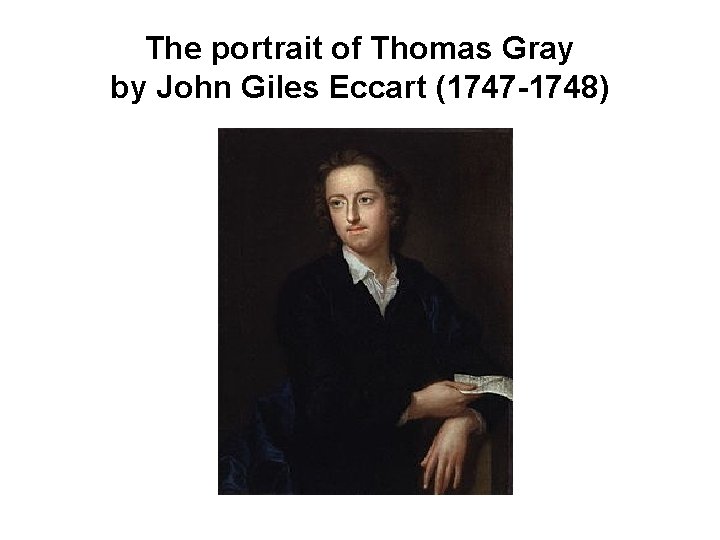
The portrait of Thomas Gray by John Giles Eccart (1747 -1748)
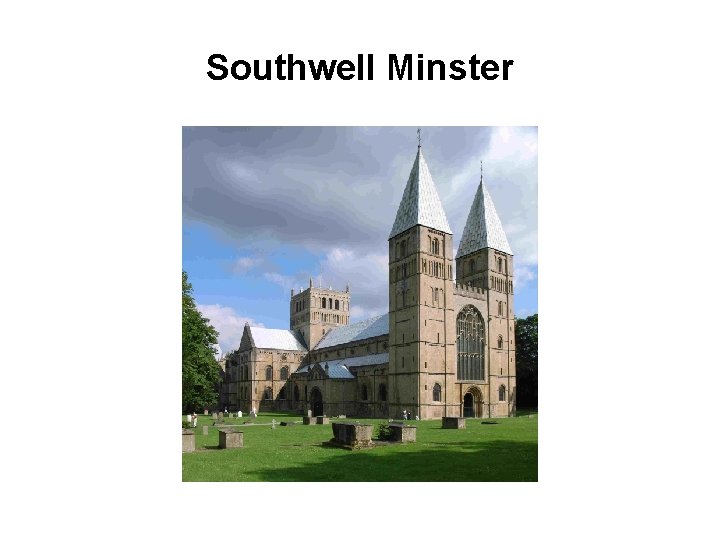
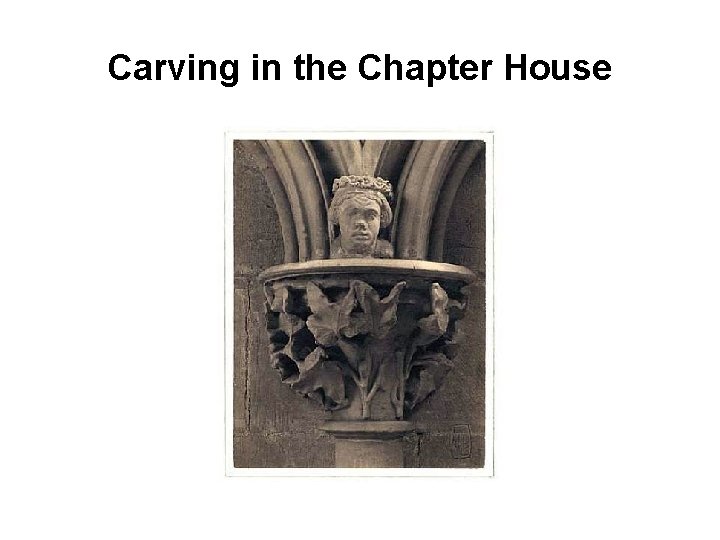
Southwell Minster
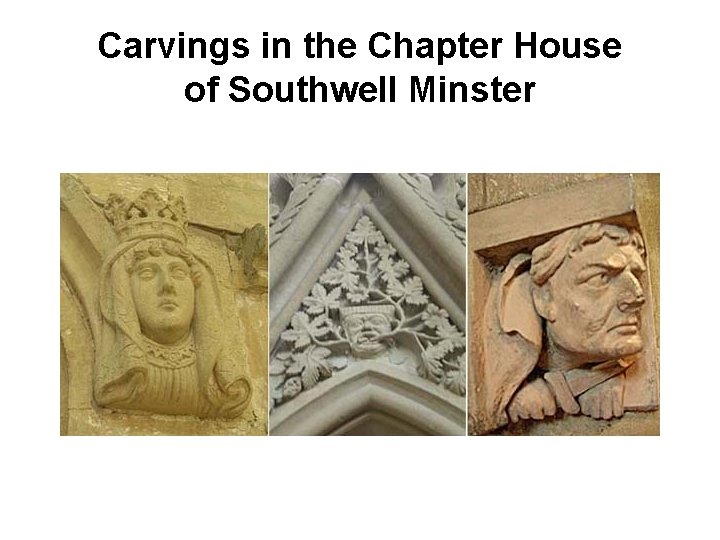
Carvings in the Chapter House of Southwell Minster
Carving in the Chapter House
Imagery Representation through language of sense experience Image - visual imagery (mental image) - auditory imagery (sound) - olfactory imagery (smell) - gustatory imagery (taste) - tactile imagery (touch) - organic imagery (internal sensation, hunger, fatigue) - kinesthetic imagery (movement, tension in the muscles)
Figures of speech easy to confuse Image, metaphor, and symbol are sometimes difficult to distinguish. An image means only what it is. A metaphor means something other than what it is. A symbol means what it is and something more, too. It functions literally and figuratively at the same time.
Rhetorical figures • • simple repetition /'rɛpɪ'tɪʃən/ parallelism /'pærəlɛˌlɪzəm, -lə'lɪz-/ antithesis /æn'tɪθəsɪs/ climax /'klaɪmæks/ hyperbole /haɪ'pɜ: rbəli/ apostrophe /ə'pɒstrəfi/ irony /'aɪrəni, 'aɪər-/ Find examples for each in the quotation from Alexander Pope’s An Essay on Man (1732 -1734):
Repetition
Philip Larkin THE TREES The trees are coming into leaf Like something almost being said; The recent buds relax and spread, Their greenness is a kind of grief. Is it that they are born again And we grow old? No, they die too, Their yearly trick of looking new Is written down in rings of grain. Yet still the unresting castles thresh In fullgrown thickness every May. Last year is dead, they seem to say, Begin afresh, afresh.
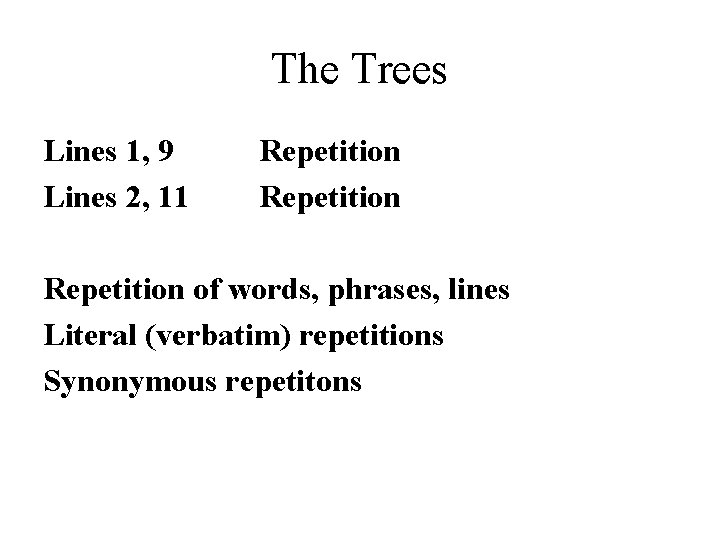
The Trees Lines 1, 9 Lines 2, 11 Repetition of words, phrases, lines Literal (verbatim) repetitions Synonymous repetitons
Philip Larkin THE TREES The trees are coming into leaf Like something almost being said; The recent buds relax and spread, Their greenness is a kind of grief. Is it that they are born again And we grow old? No, they die too, Their yearly trick of looking new Is written down in rings of grain. Yet still the unresting castles thresh In fullgrown thickness every May. Last year is dead, they seem to say, Begin afresh, afresh.
1 2 3 4 The trees are coming into leaf Like something almost being said; The recent buds relax and spread, Their greenness is a kind of grief. 5 6 7 8 9 10 11 12 Is it that they are born again And we grow old? No, they die too, Their yearly trick of looking new Is written down in rings of grain. Yet still the unresting castles thresh In fullgrown thickness every May. Last year is dead, they seem to say, Begin afresh, afresh.
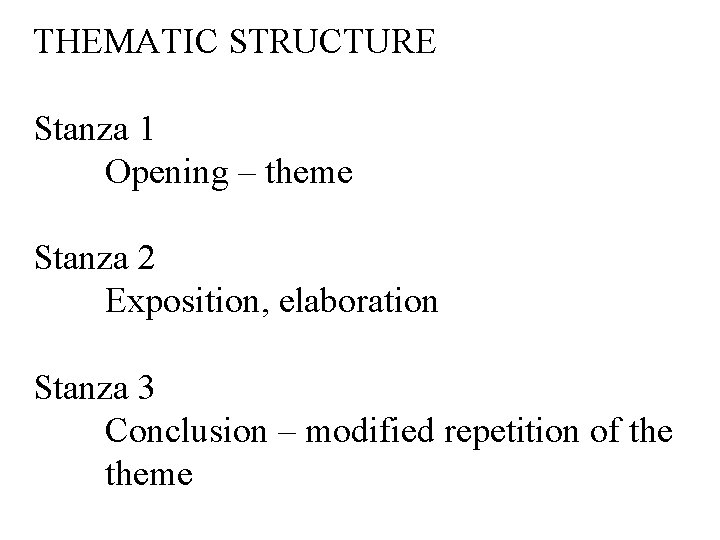
THEMATIC STRUCTURE Stanza 1 Opening – theme Stanza 2 Exposition, elaboration Stanza 3 Conclusion – modified repetition of theme
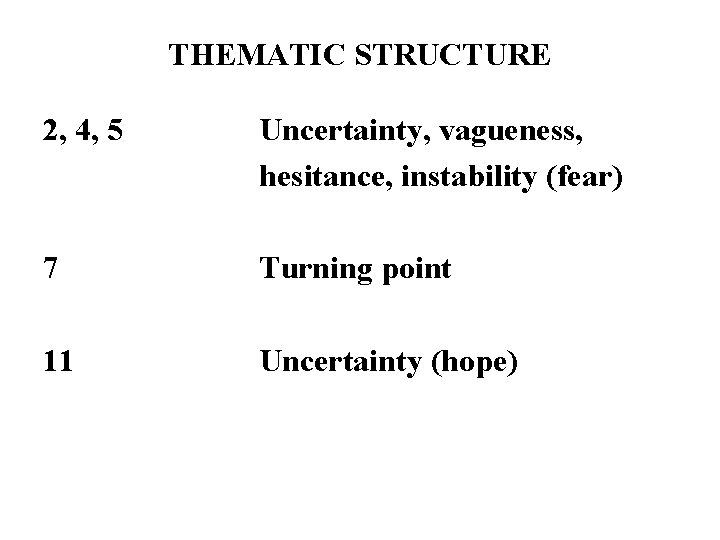
THEMATIC STRUCTURE 2, 4, 5 Uncertainty, vagueness, hesitance, instability (fear) 7 Turning point 11 Uncertainty (hope)
1 2 3 4 The trees are coming into leaf Like something almost being said; The recent buds relax and spread, Their greenness is a kind of grief. 5 6 7 8 9 10 11 12 Is it that they are born again And we grow old? No, they die too, Their yearly trick of looking new Is written down in rings of grain. Yet still the unresting castles thresh In fullgrown thickness every May. Last year is dead, they seem to say, Begin afresh, afresh.
Philip Larkin THE TREES The trees are coming into leaf Like something almost being said; The recent buds relax and spread, Their greenness is a kind of grief. Is it that they are born again And we grow old? No, they die too, Their yearly trick of looking new Is written down in rings of grain. Yet still the unresting castles thresh In fullgrown thickness every May. Last year is dead, they seem to say, Begin afresh, afresh.
Philip Larkin THE TREES The trees are coming into leaf Like something almost being said; The recent buds relax and spread, Their greenness is a kind of grief. Is it that they are born again And we grow old? No, they die too, Their yearly trick of looking new Is written down in rings of grain. Yet still the unresting castles thresh In fullgrown thickness every May. Last year is dead, they seem to say, Begin afresh, afresh.
Philip Larkin THE TREES The trees are coming into leaf Like something almost being said; The recent buds relax and spread, Their greenness is a kind of grief. Is it that they are born again And we grow old? No, they die too, Their yearly trick of looking new Is written down in rings of grain. Yet still the unresting castles thresh In fullgrown thickness every May. Last year is dead, they seem to say, Begin afresh, afresh.
Philip Larkin THE TREES The trees are coming into leaf Like something almost being said; The recent buds relax and spread, Their greenness is a kind of grief. Is it that they are born again And we grow old? No, they die too, Their yearly trick of looking new Is written down in rings of grain. Yet still the unresting castles thresh In fullgrown thickness every May. Last year is dead, they seem to say, Begin afresh, afresh.
Philip Larkin THE TREES The trees are coming into leaf Like something almost being said; The recent buds relax and spread, Their greenness is a kind of grief. Is it that they are born again And we grow old? No, they die too, Their yearly trick of looking new Is written down in rings of grain. Yet still the unresting castles thresh In fullgrown thickness every May. Last year is dead, they seem to say, Begin afresh, afresh.
Philip Larkin THE TREES The trees are coming into leaf Like something almost being said; The recent buds relax and spread, Their greenness is a kind of grief. Is it that they are born again And we grow old? No, they die too, Their yearly trick of looking new Is written down in rings of grain. Yet still the unresting castles thresh In fullgrown thickness every May. Last year is dead, they seem to say, Begin afresh, afresh.
Philip Larkin THE TREES The trees are coming into leaf Like something almost being said; The recent buds relax and spread, Their greenness is a kind of grief. Is it that they are born again And we grow old? No, they die too, Their yearly trick of looking new Is written down in rings of grain. Yet still the unresting castles thresh In fullgrown thickness every May. Last year is dead, they seem to say, Begin afresh, afresh.
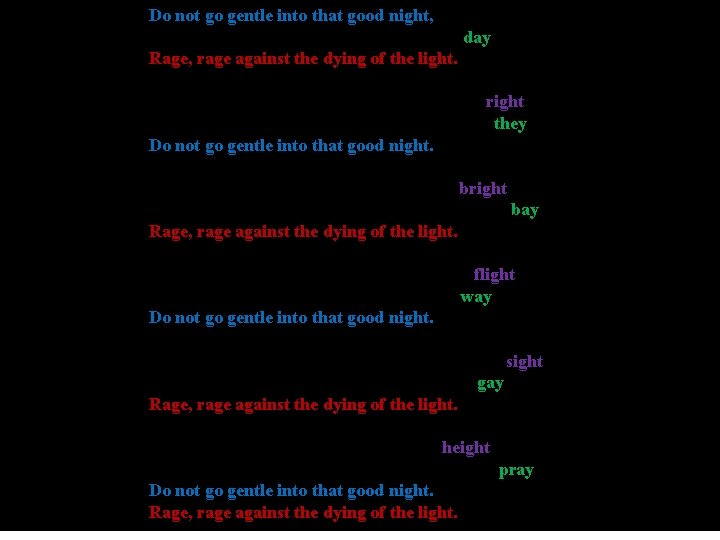
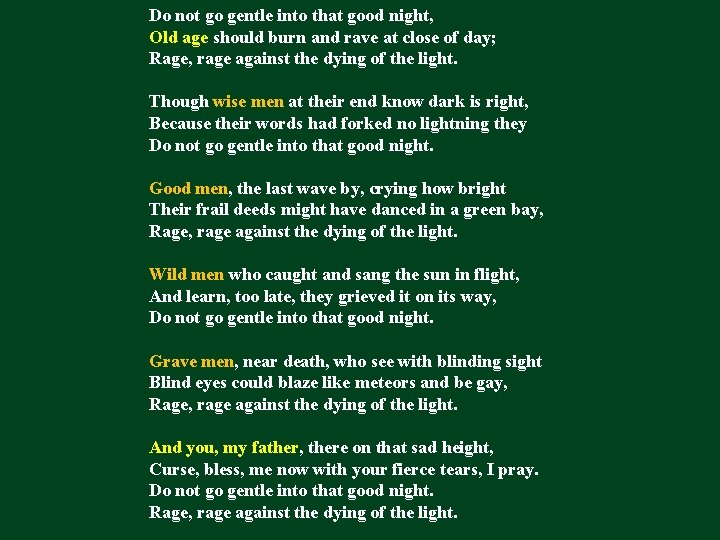
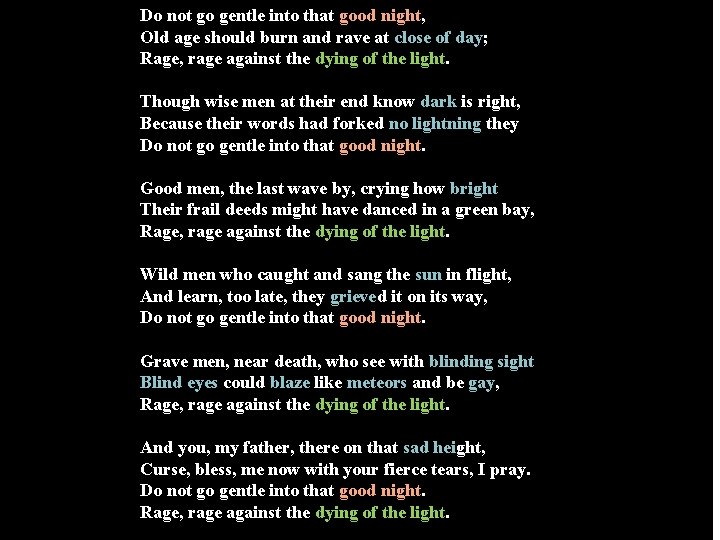
DO NOT GO GENTLE INTO THAT GOOD NIGHT Do not go gentle into that good night, Old age should burn and rave at close of day; Rage, rage against the dying of the light. Though wise men at their end know dark is right, Because their words had forked no lightning they Do not go gentle into that good night. Good men, the last wave by, crying how bright Their frail deeds might have danced in a green bay, Rage, rage against the dying of the light. Wild men who caught and sang the sun in flight, And learn, too late, they grieved it on its way, Do not go gentle into that good night. Grave men, near death, who see with blinding sight Blind eyes could blaze like meteors and be gay, Rage, rage against the dying of the light. And you, my father, there on that sad height, Curse, bless, me now with your fierce tears, I pray. Do not go gentle into that good night. Rage, rage against the dying of the light.
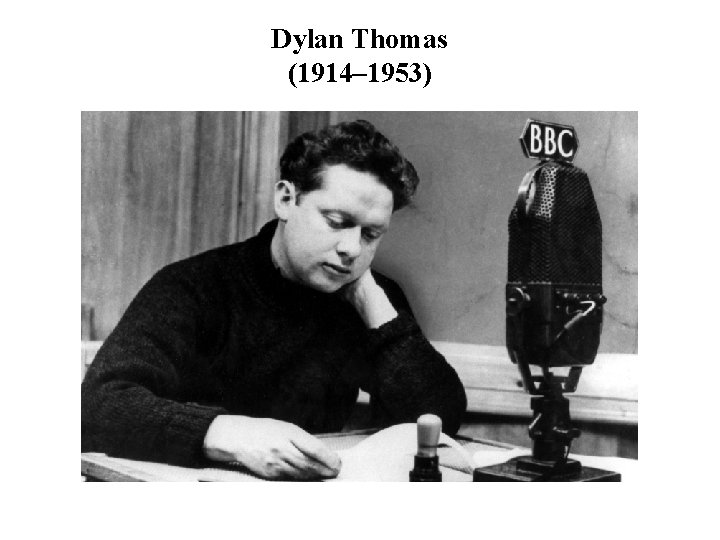
Dylan Thomas (1914– 1953)
Do not go gentle into that good night, Old age should burn and rave at close of day; Rage, rage against the dying of the light. Though wise men at their end know dark is right, Because their words had forked no lightning they Do not go gentle into that good night. Good men, the last wave by, crying how bright Their frail deeds might have danced in a green bay, Rage, rage against the dying of the light. Wild men who caught and sang the sun in flight, And learn, too late, they grieved it on its way, Do not go gentle into that good night. Grave men, near death, who see with blinding sight Blind eyes could blaze like meteors and be gay, Rage, rage against the dying of the light. And you, my father, there on that sad height, Curse, bless, me now with your fierce tears, I pray. Do not go gentle into that good night. Rage, rage against the dying of the light.
Do not go gentle into that good night, Old age should burn and rave at close of day; Rage, rage against the dying of the light. Though wise men at their end know dark is right, Because their words had forked no lightning they Do not go gentle into that good night. Good men, the last wave by, crying how bright Their frail deeds might have danced in a green bay, Rage, rage against the dying of the light. Wild men who caught and sang the sun in flight, And learn, too late, they grieved it on its way, Do not go gentle into that good night. Grave men, near death, who see with blinding sight Blind eyes could blaze like meteors and be gay, Rage, rage against the dying of the light. And you, my father, there on that sad height, Curse, bless, me now with your fierce tears, I pray. Do not go gentle into that good night. Rage, rage against the dying of the light.
Do not go gentle into that good night, Old age should burn and rave at close of day; Rage, rage against the dying of the light. Though wise men at their end know dark is right, Because their words had forked no lightning they Do not go gentle into that good night. Good men, the last wave by, crying how bright Their frail deeds might have danced in a green bay, Rage, rage against the dying of the light. Wild men who caught and sang the sun in flight, And learn, too late, they grieved it on its way, Do not go gentle into that good night. Grave men, near death, who see with blinding sight Blind eyes could blaze like meteors and be gay, Rage, rage against the dying of the light. And you, my father, there on that sad height, Curse, bless, me now with your fierce tears, I pray. Do not go gentle into that good night. Rage, rage against the dying of the light.
Further rhetorical figures Paradox – an apparent contradiction that is nevertheless somehow true Hyperbole (overstatement) – exaggeration, adding emphasis to what is really meant Understatement – saying less than what is meant
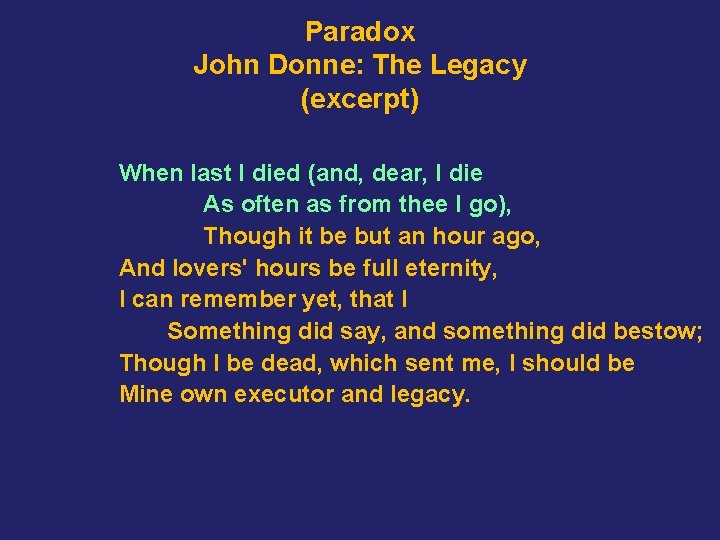
Paradox Emily Dickinson 1732 My life closed twice before its close – It yet remains to see If Immortality unveil A third event to me So huge, so hopeless to conceive As these that twice befell. Parting is all we know of heaven, And all we need of hell.
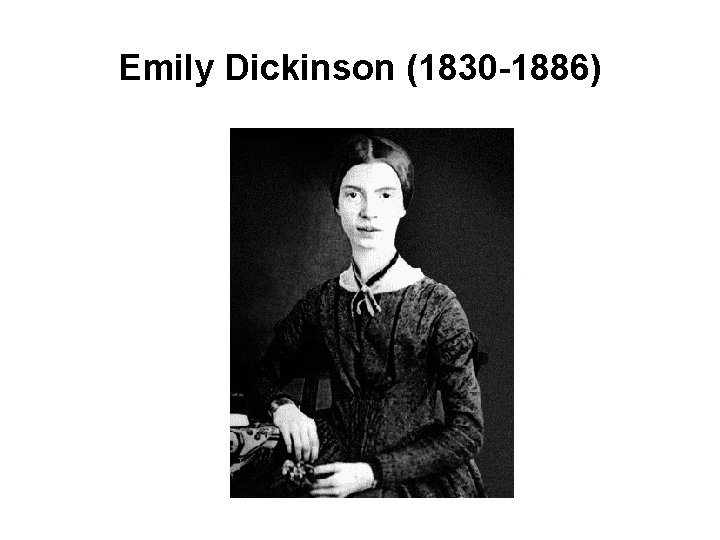
Emily Dickinson (1830 -1886)
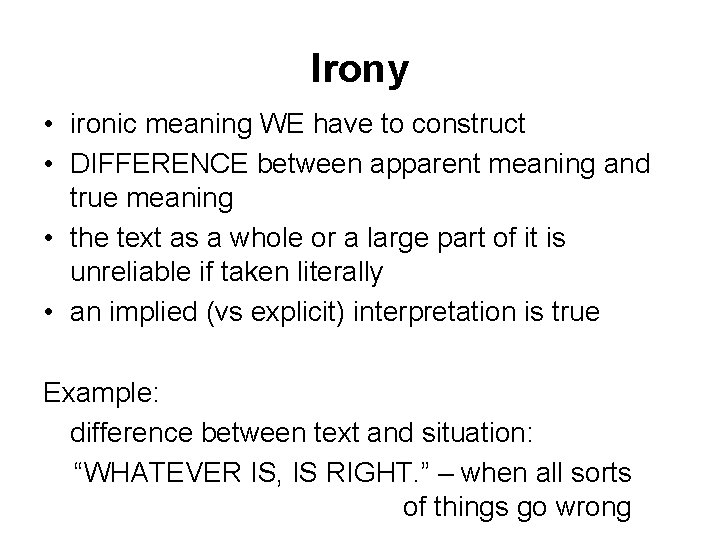
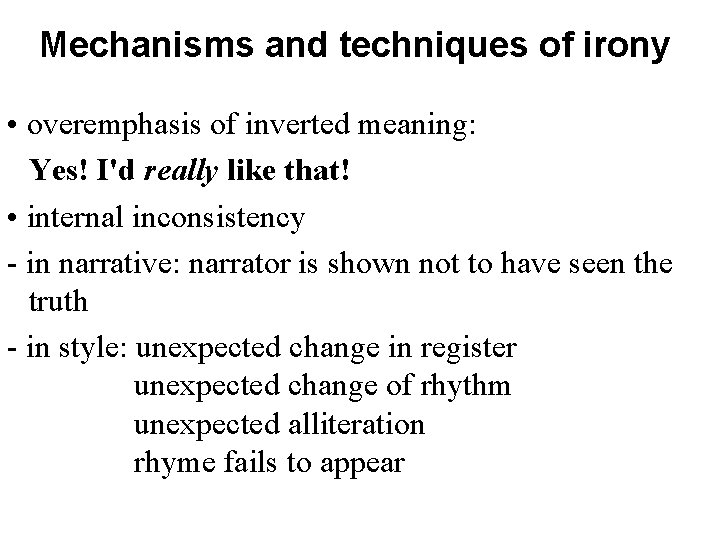
Irony a trope, a non-literal use of language like metaphor, metonymy, etc, also can be conceived as a rhetorical figure • a type of tone, a particular way of speaking/writing, a matter of style, • can be widespread in text (unlike metaphors which are usually discrete parts of text)
Paradox John Donne: The Legacy (excerpt) When last I died (and, dear, I die As often as from thee I go), Though it be but an hour ago, And lovers' hours be full eternity, I can remember yet, that I Something did say, and something did bestow; Though I be dead, which sent me, I should be Mine own executor and legacy.
Irony • ironic meaning WE have to construct • DIFFERENCE between apparent meaning and true meaning • the text as a whole or a large part of it is unreliable if taken literally • an implied (vs explicit) interpretation is true Example: difference between text and situation: “WHATEVER IS, IS RIGHT. ” – when all sorts of things go wrong
Mechanisms and techniques of irony • overemphasis of inverted meaning: Yes! I'd really like that! • internal inconsistency - in narrative: narrator is shown not to have seen the truth - in style: unexpected change in register unexpected change of rhythm unexpected alliteration rhyme fails to appear
Philip Larkin THE TREES The trees are coming into leaf Like something almost being said; The recent buds relax and spread, Their greenness is a kind of grief. Is it that they are born again And we grow old? No, they die too, Their yearly trick of looking new Is written down in rings of grain. Yet still the unresting castles thresh In fullgrown thickness every May. Last year is dead, they seem to say, Begin afresh, afresh.
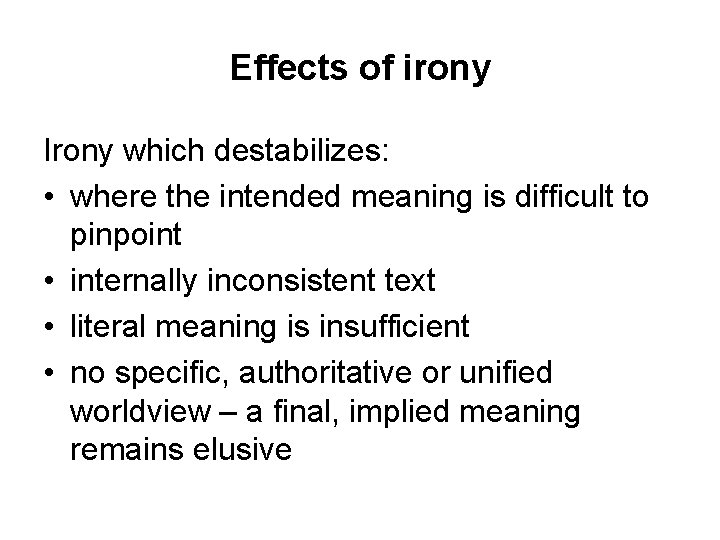
Effects of irony Irony which destabilizes: • where the intended meaning is difficult to pinpoint • internally inconsistent text • literal meaning is insufficient • no specific, authoritative or unified worldview – a final, implied meaning remains elusive
Types of irony Verbal irony – saying the opposite of what is meant Dramatic irony – discrepancy between what the speaker says and what the author means Irony of situation – discrepancy between the actual circumstances and those that would seem appropriate or discrepancy between what one anticipates and what actually comes to pass
Allusion A reference to something in history or previous literature. It is like a richly connotative word or a symbol, a means of suggesting more than it says.
T. S. Eliot (1888 – 1965) THE LOVE SONG OF J. ALFRED PRUFROCK Let us go then, you and I, When the evening is spread out against the sky Like a patient etherized upon a table; Let us go, through certain half-deserted streets, The muttering retreats Of restless nights in one-night cheap hotels And sawdust restaurants with oyster-shells: Streets that follow like a tedious argument Of insidious intent To lead you to an overwhelming question… Oh, do not ask, “What is it? ” Let us go and make our visit.
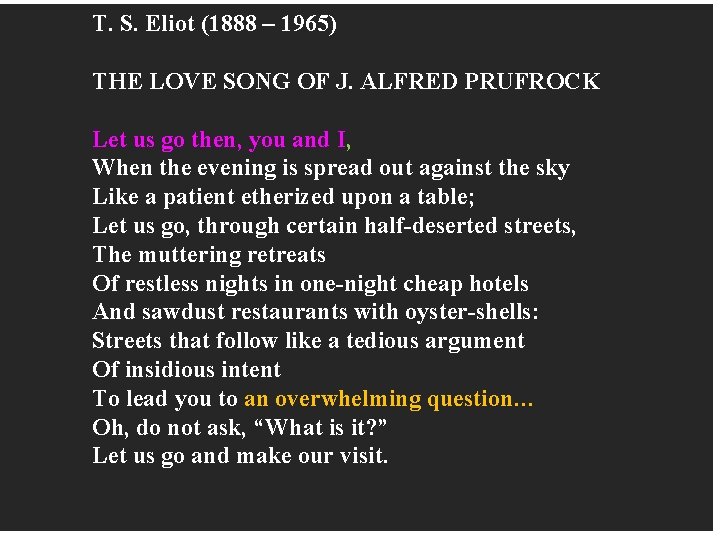
T. S. Eliot (1888 – 1965) THE LOVE SONG OF J. ALFRED PRUFROCK Let us go then, you and I, When the evening is spread out against the sky Like a patient etherized upon a table; Let us go, through certain half-deserted streets, The muttering retreats Of restless nights in one-night cheap hotels And sawdust restaurants with oyster-shells: Streets that follow like a tedious argument Of insidious intent To lead you to an overwhelming question… Oh, do not ask, “What is it? ” Let us go and make our visit.
Christopher Marlowe (1564– 1593) THE PASSIONATE SHEPHERD TO HIS LOVE Come live with me and be my love, And we will all the pleasures prove John Donne (1572– 1631) THE BAIT Come live with me, and be my love, And we will some new pleasures prove Robert Herrick (1591– 1674) TO PHYLLIS Live, live with me. and thou shalt see The pleasures I’ll prepare for thee
HAMLET To be, or not to be – that is the question: Whether 'tis nobler in the mind to suffer The slings and arrows of outrageous fortune Or to take arms against a sea of troubles And by opposing end them. To die, to sleep – No more – and by a sleep to say we end The heartache and the thousand natural shocks That flesh is heir to William Shakespeare: Hamlet, Act III, Scene 1
Literary allusion „if Poetry comes not as naturally as the leaves to a tree it had better not come at all. ” John Keats, Letter to John Taylor, February 27, 1818
Philip Larkin THE TREES The trees are coming into leaf Like something almost being said; The recent buds relax and spread, Their greenness is a kind of grief. Is it that they are born again And we grow old? No, they die too, Their yearly trick of looking new Is written down in rings of grain. Yet still the unresting castles thresh In fullgrown thickness every May. Last year is dead, they seem to say, Begin afresh, afresh.
Larkin alluding to Keats May his allusion imply that poetry does not come like leaves to a tree but only as a result of painful labour? Did Larkin indicate that he personally, unlike romantic poets, did not trust allegedly uncontrolled outbursts of inspirational energy? Was he uncertain about the role of the poet or his own role as a poet?