EXPLORING THE UNIVERSE Chapter 26 26 1 Energy





- Slides: 59
EXPLORING THE UNIVERSE Chapter 26
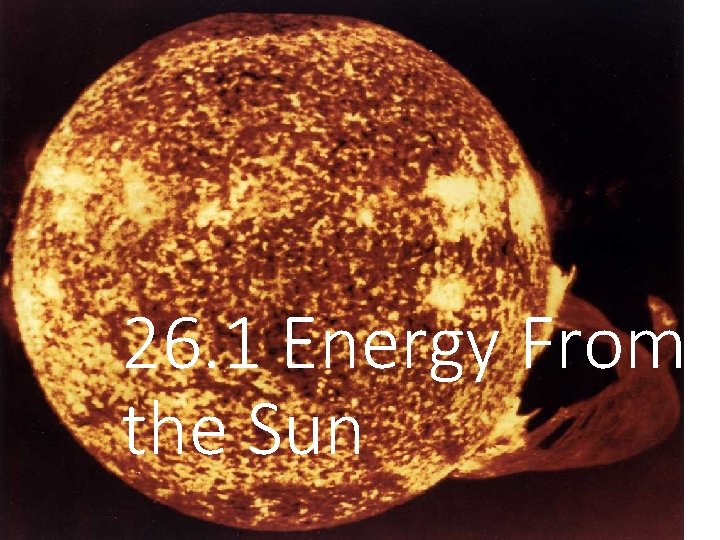
26. 1 Energy From the Sun
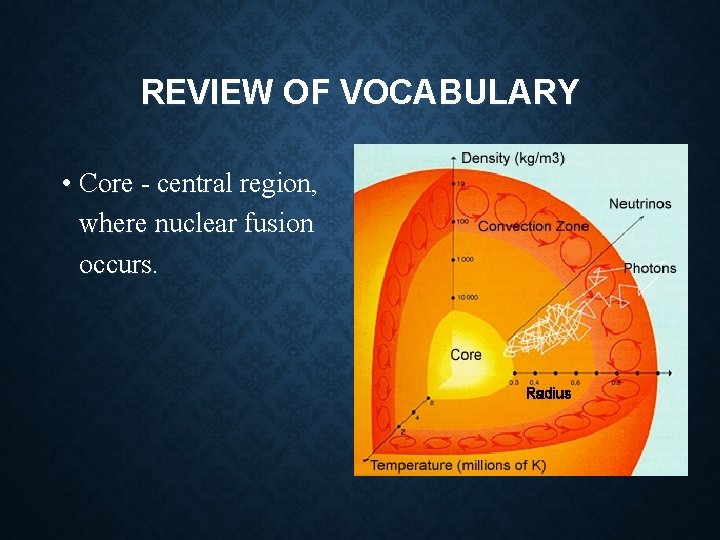
REVIEW OF VOCABULARY • Core - central region, where nuclear fusion occurs.
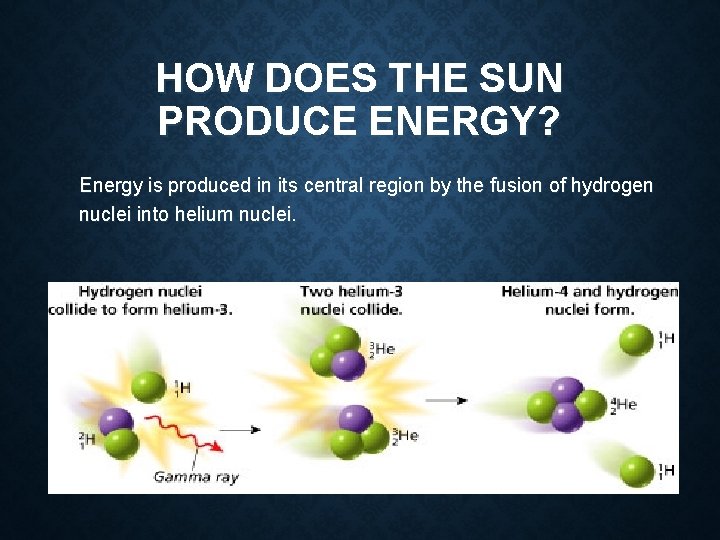
HOW DOES THE SUN PRODUCE ENERGY? Energy is produced in its central region by the fusion of hydrogen nuclei into helium nuclei.
QUESTION: WHAT NEW ISOTOPE IS PRODUCED BY THIS FUSION REACTION? 1. hydrogen-1 2. helium-4 3. oxygen-16 4. none
WHAT NEW ISOTOPE IS PRODUCED BY THIS FUSION REACTION? 1. hydrogen-1 2. helium-4 3. oxygen-16 4. none
26. 1 FORCES IN BALANCE May the force be with you!
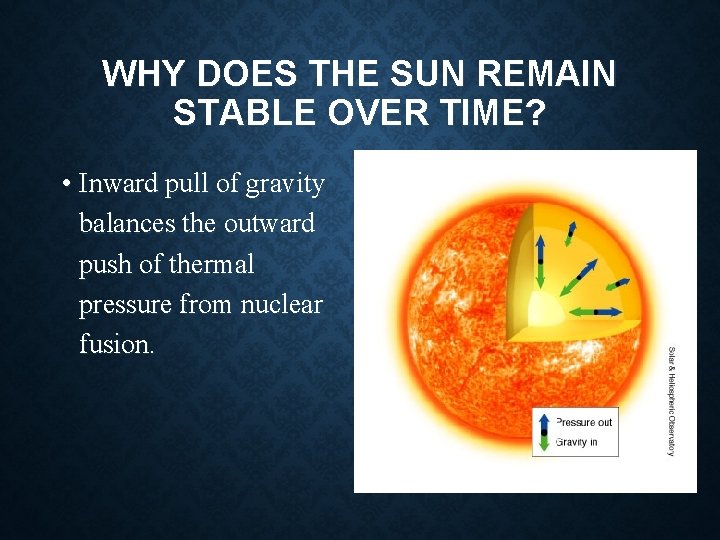
WHY DOES THE SUN REMAIN STABLE OVER TIME? • Inward pull of gravity balances the outward push of thermal pressure from nuclear fusion.
QUESTION: WHAT WOULD HAPPEN TO THE SUN IF IT BEGAN TO RUN OUT OF FUEL? 1. It would become cooler very quickly. 2. The force of gravity would decrease. 3. Its core would expand as thermal pressure increased. 4. Its core would shrink as thermal pressure decreased.
WHAT WOULD HAPPEN TO THE SUN IF IT BEGAN TO RUN OUT OF FUEL? 1. It would become cooler very quickly. 2. The force of gravity would decrease. 3. Its core would expand as thermal pressure increased. 4. Its core would shrink as thermal pressure decreased.
26. 1 THE SUN’S INTERIOR
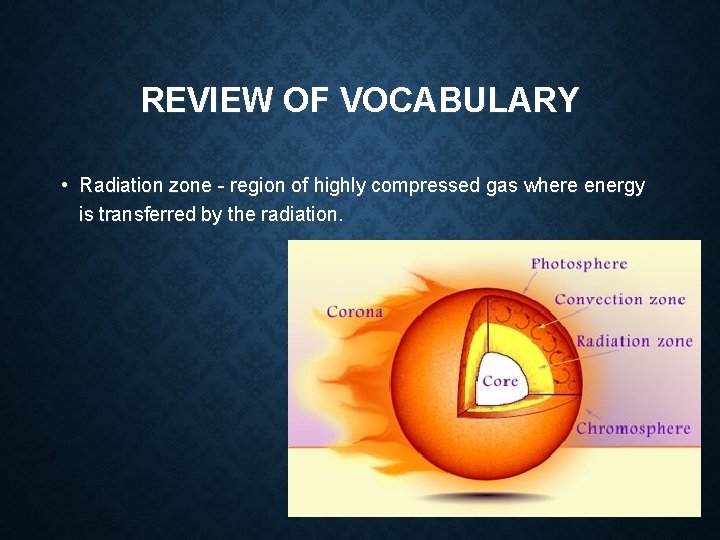
INTERIOR FACTS • The sun’s interior consists of 3 parts. • • • Core Radiation zone Convection zone • Energy moves through the sun in two main ways: • Radiation • Convection
REVIEW OF VOCABULARY • Radiation zone - region of highly compressed gas where energy is transferred by the radiation.
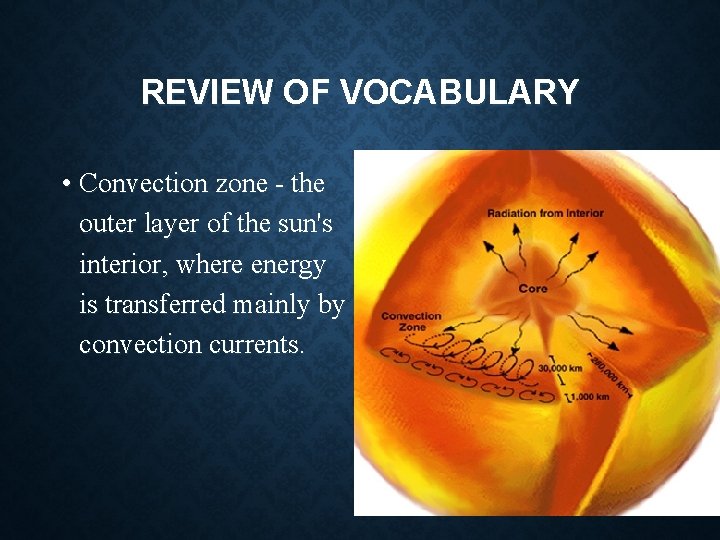
REVIEW OF VOCABULARY • Convection zone - the outer layer of the sun's interior, where energy is transferred mainly by convection currents.
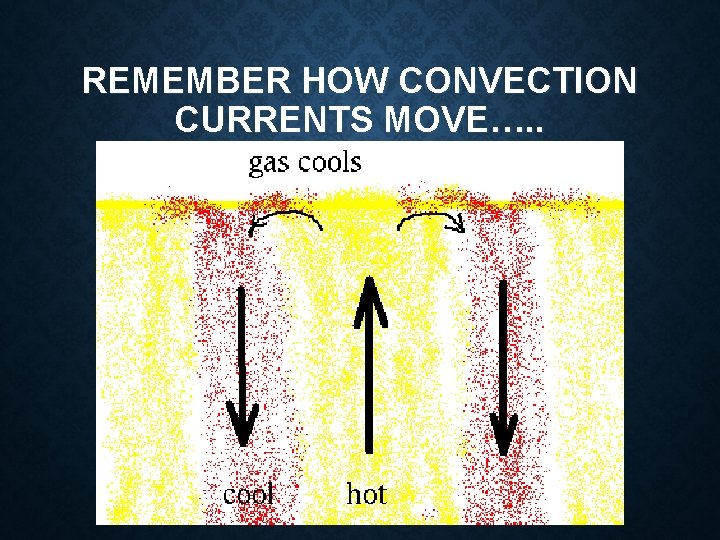
REMEMBER HOW CONVECTION CURRENTS MOVE…. .
26. 1 THE SUN’S ATMOSPHERE Very unlike Earths!
EXTERIOR FACTS • The sun's atmosphere consists of three layers. • Photosphere • Chromosphere • Corona These regions are outside the convection zone.
PHOTOSPHERE • Innermost layer • Visible surface of the sun • 500 kilometers thick • Temp: approximately 5800 K
CHROMOSPHERE • Middle layer • Temp: increases to nearly 10, 000 K • At high temperatures, hydrogen gas emits a reddish light. • This light gives it its name, which means “sphere of color. ” • Can see this during a total solar eclipse.
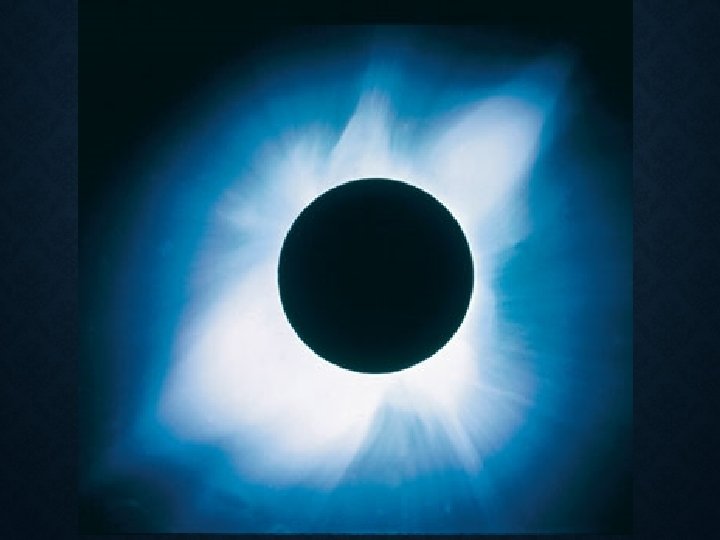
CORONA • Outermost layer • Gases in the corona are thin • Temp: Gases super hot (about 1 million K) • Thermal energy in it is relatively small. • Usually seen only during solar eclipses.
26. 1 FEATURES OF THE SUN’S ATMOSPHERE
SUN HAS GOT A MAGNETIC PERSONALITY! • The sun's magnetic field produces striking features on and above its surface • Such as: • Sunspots • Prominences • Solar flares.
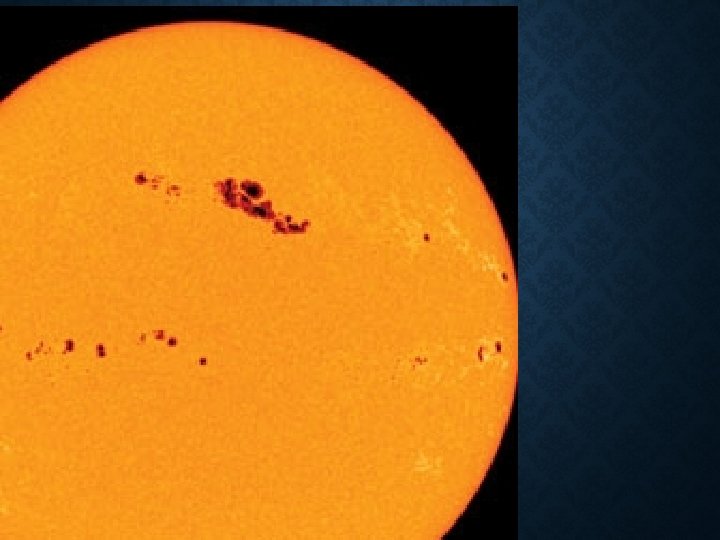
SUNSPOTS • Areas of gas in the photosphere that are cooler than the surrounding gases. • Spots can be larger than Earth • Associated with intense magnetic fields on the sun. • Last from a few hours to a few months. • Numbers varies in cycles, with about 11 years separating one sunspot peak from the next.
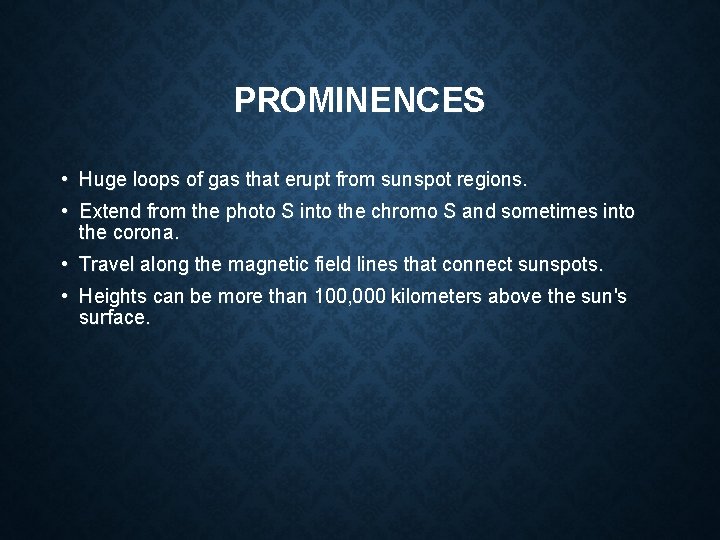
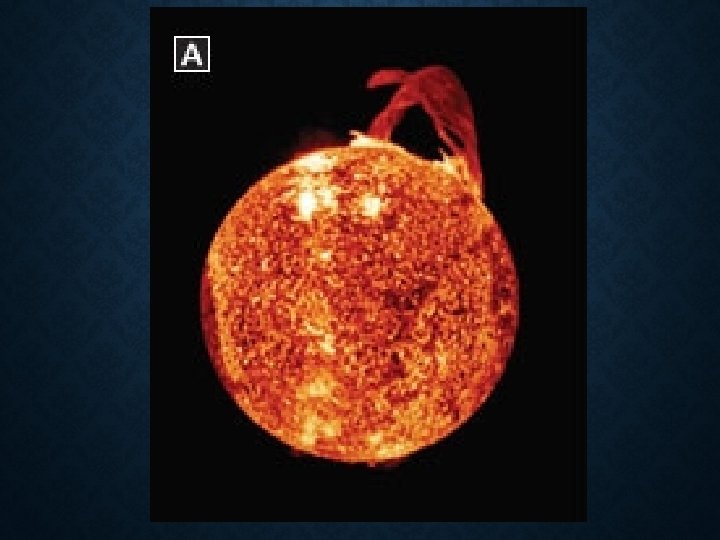
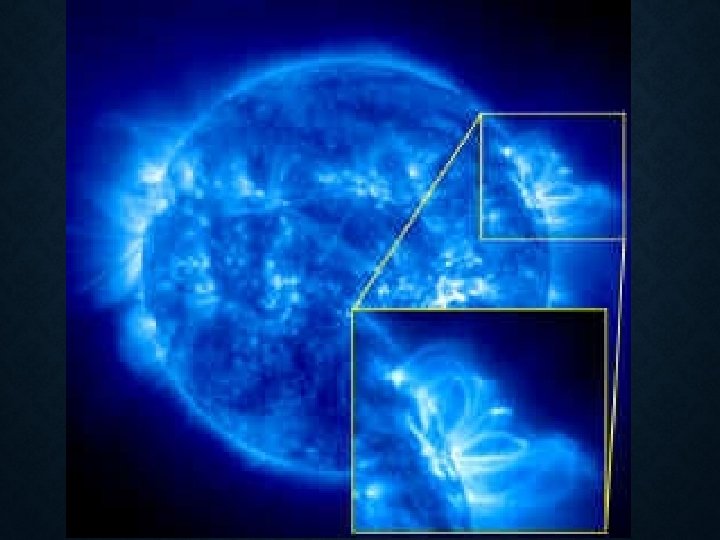
PROMINENCES • Huge loops of gas that erupt from sunspot regions. • Extend from the photo S into the chromo S and sometimes into the corona. • Travel along the magnetic field lines that connect sunspots. • Heights can be more than 100, 000 kilometers above the sun's surface.
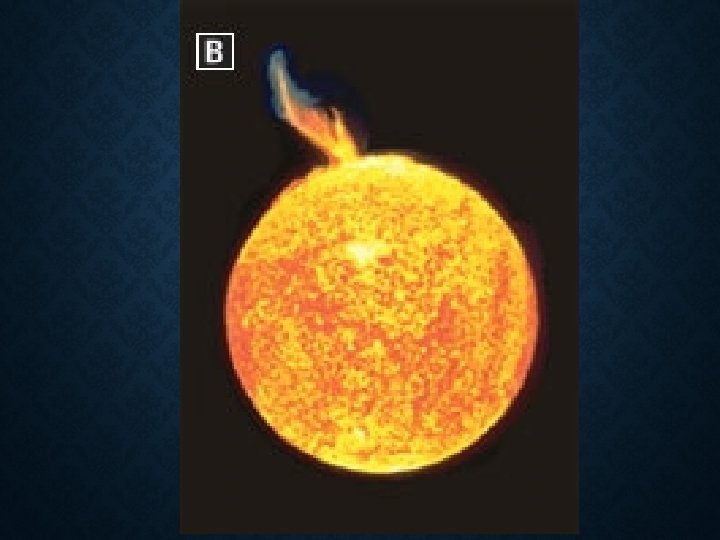
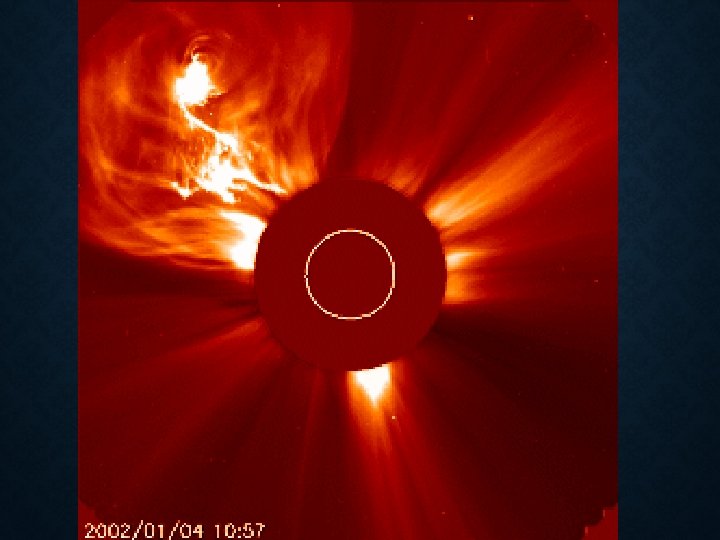
SOLAR FLARES • Sudden release of energy • Surface erupts dramatically, producing X-rays and hurling charged particles into space. • Heat the corona to a temps near 20 million K and produce solar wind. • High-energy particles and radiation can reach Earth • Cause magnetic storms in Earth's upper atmosphere. • Storms disrupt electric power transmission, radio, TV, and phone signals.
QUESTION: HOW CAN SUNSPOTS BE RECOGNIZED ON THE SUN'S SURFACE? 1. Sunspots appear darker than the surrounding photosphere. 2. Sunspots appear lighter than the surrounding photosphere. 3. It is hard to distinguish sunspots from the surrounding photosphere. 4. Sunspots always appear in definite groups.
HOW CAN SUNSPOTS BE RECOGNIZED ON THE SUN'S SURFACE? 1. Sunspots appear darker than the surrounding photosphere. 2. Sunspots appear lighter than the surrounding photosphere. 3. It is hard to distinguish sunspots from the surrounding photosphere. 4. Sunspots always appear in definite groups.
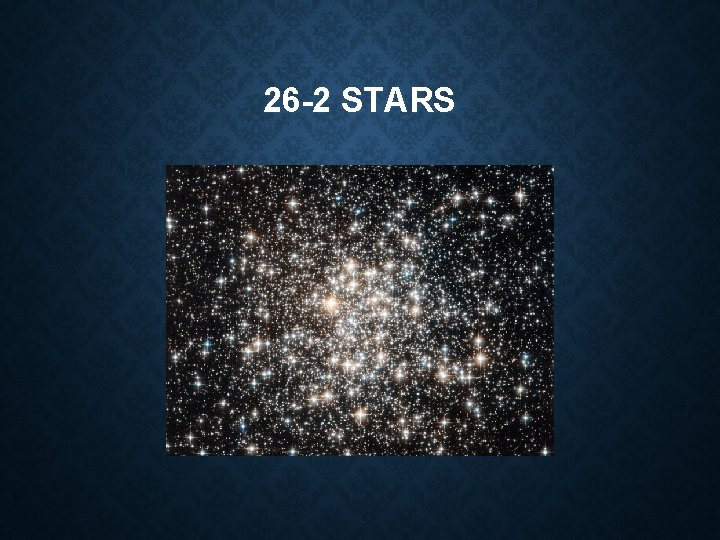
26 -2 STARS
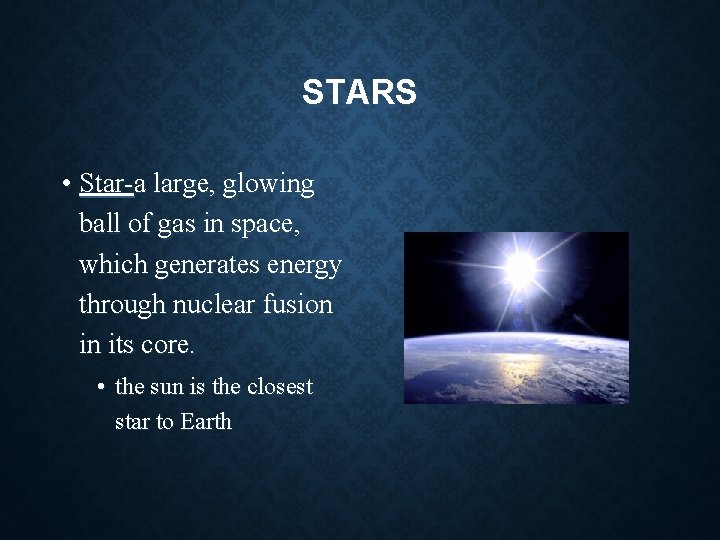
STARS • Star-a large, glowing ball of gas in space, which generates energy through nuclear fusion in its core. • the sun is the closest star to Earth
DISTANCES • Astronomical Unit • Light Year-distance light (AU) distance from Earth travels in 1 year. to the Sun~ • Approx. 9. 5 trillion Km (at 300, 000 Km/s) (150, 000 Km) • Most of Space is empty, so huge distances are required. • 1 light year=63 AU
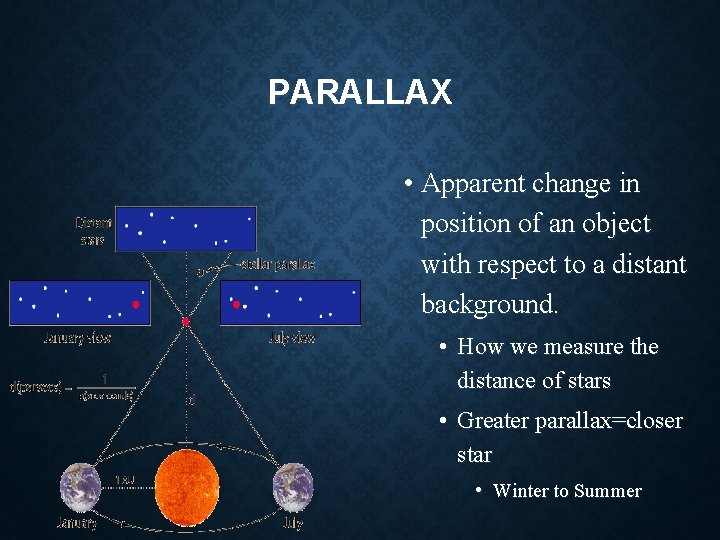
PARALLAX • Apparent change in position of an object with respect to a distant background. • How we measure the distance of stars • Greater parallax=closer star • Winter to Summer
PROPERTIES OF STARS • Color &Temperature • The color of a star indicates its surface temperature( think color spectrum) • Brightness • closer you are to a light the brighter it appears( not always) • Apparent brightness appears from Earth • Absolute brightness-how bright the star really is • Can be calculated using distance (if known)
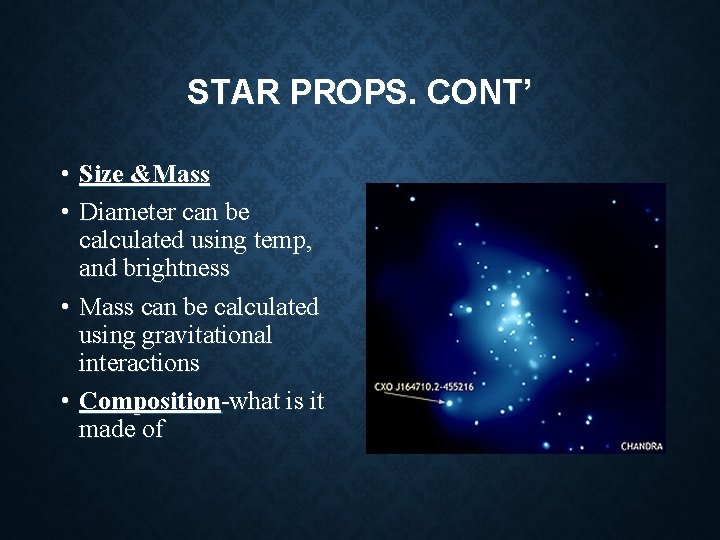
STAR PROPS. CONT’ • Size &Mass • Diameter can be calculated using temp, and brightness • Mass can be calculated using gravitational interactions • Composition-what is it made of
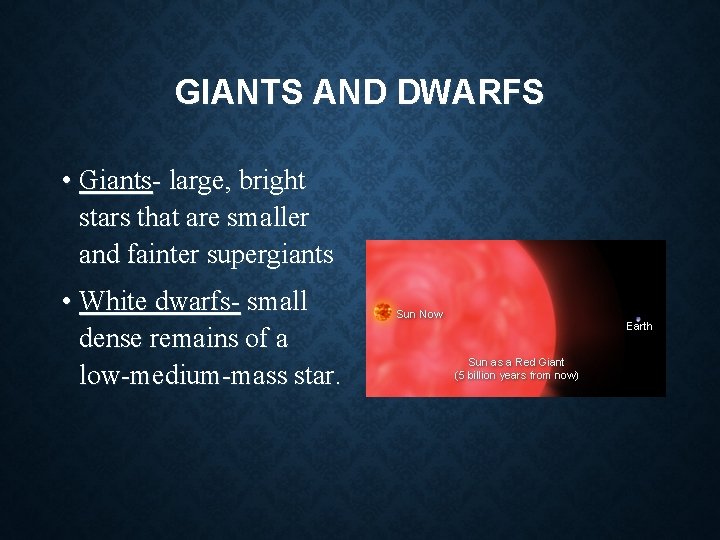
GIANTS AND DWARFS • Giants- large, bright stars that are smaller and fainter supergiants • White dwarfs- small dense remains of a low-medium-mass star.
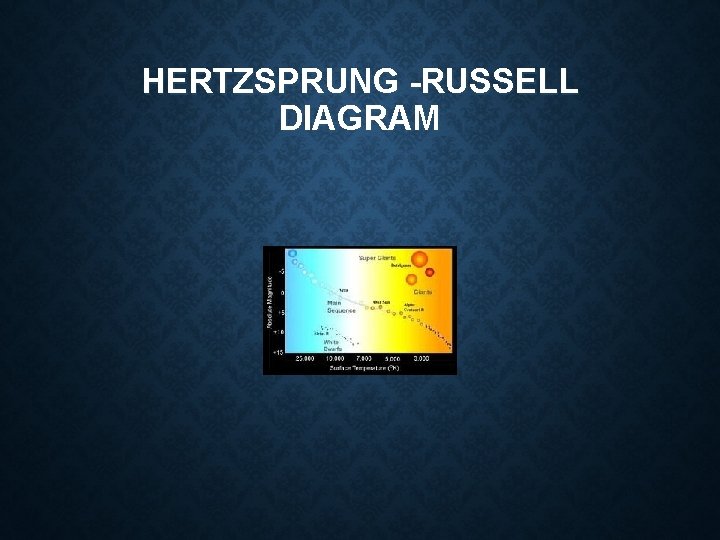
HERTZSPRUNG -RUSSELL DIAGRAM
26 -3 LIFE CYCLE OF STARS • Stars change over their lifespan just like animals change throughout their life. • Nebula-a large cloud of gas and dust spread out over a large volume of space. • They can have different appearances bright or dark
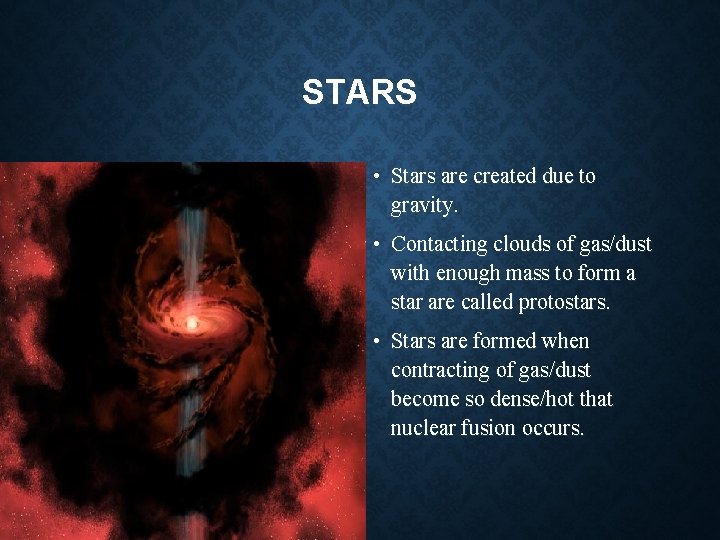
STARS • Stars are created due to gravity. • Contacting clouds of gas/dust with enough mass to form a star are called protostars. • Stars are formed when contracting of gas/dust become so dense/hot that nuclear fusion occurs.
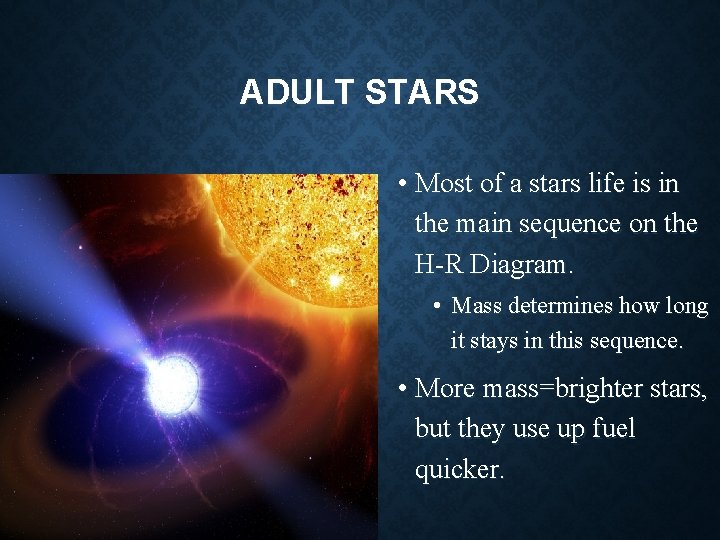
ADULT STARS • Most of a stars life is in the main sequence on the H-R Diagram. • Mass determines how long it stays in this sequence. • More mass=brighter stars, but they use up fuel quicker.
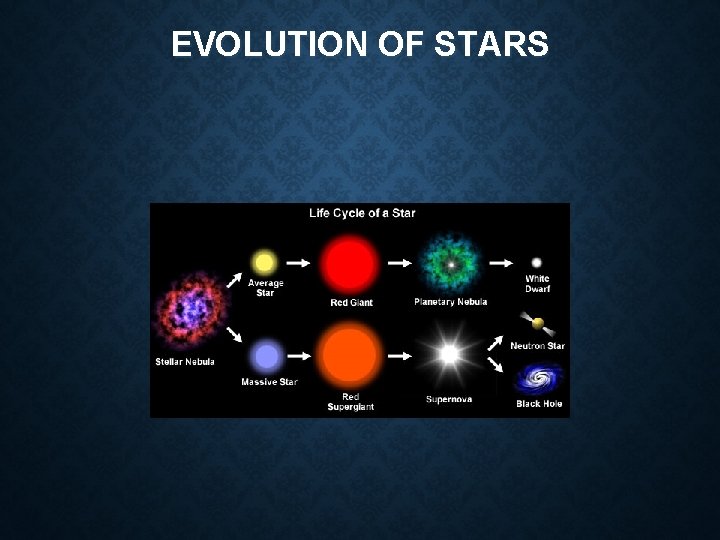
DEATH OF A STAR • When a star runs out of fuel (Hydrogen), gravity overtakes the star. • The core cools • Temperatures rise, causing swelling on exterior. • The dwindling supply of fuel in a star’s core ultimately leads to the star’s death as a white dwarf, neutron star, or black hole.
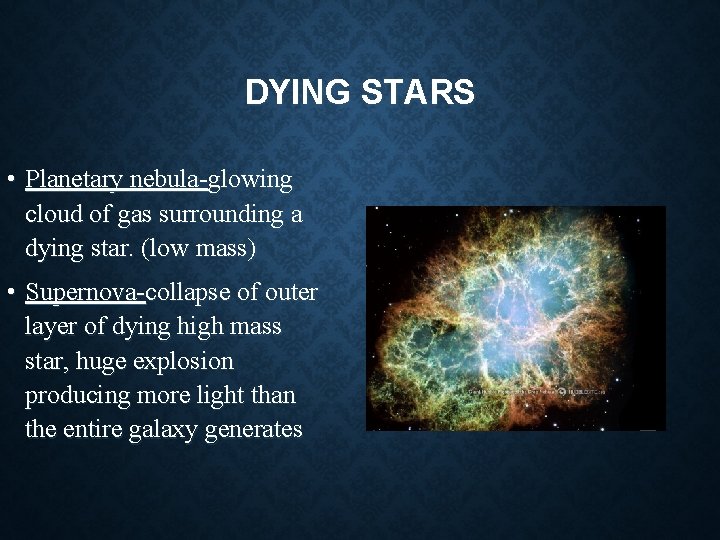
DYING STARS • Planetary nebula-glowing cloud of gas surrounding a dying star. (low mass) • Supernova-collapse of outer layer of dying high mass star, huge explosion producing more light than the entire galaxy generates
EVOLUTION OF STARS
DYING STARS • Neutron Star-remnants of high-mass star that has exploded supernova. • Spinning neutron stars that give off strong pulses of radio waves are called pulsars. • Black Hole-an object whose surface gravity is so great that even electromagnetic waves cannot escape it.
26 -4 GROUPS OF STARS
• Constellation-group of stars that appear to form a pattern. • Open-disorganized & loose appearance • Associations-temporary • Star System-group of 2 or clusters of young stars more stars held together (eventually move apart) by gravity. • Globular-large group of • Almost ½ stars are star systems. • Binary star(2) • Star Clusters • Open clusters • Associations • Globular clusters older stars, appear like a dense concentration
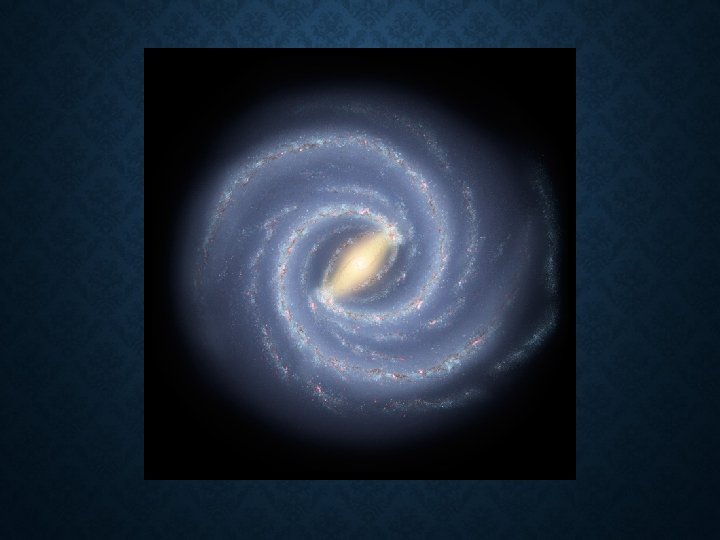
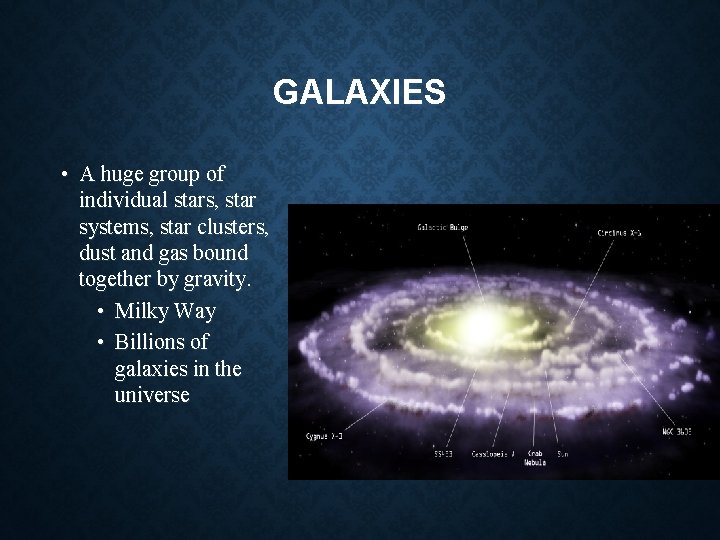
GALAXIES • A huge group of individual stars, star systems, star clusters, dust and gas bound together by gravity. • Milky Way • Billions of galaxies in the universe
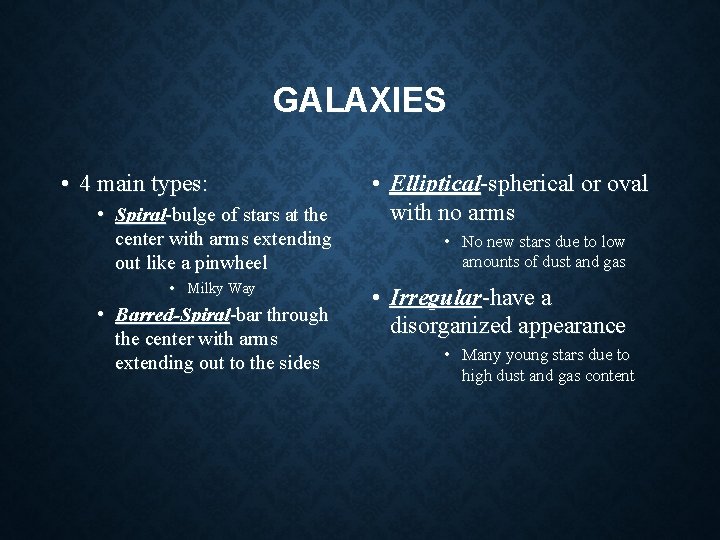
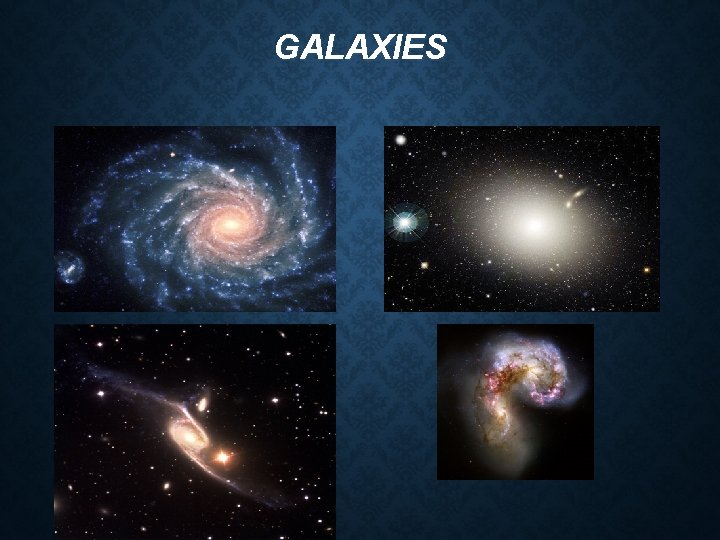
GALAXIES • 4 main types: • Spiral-bulge of stars at the center with arms extending out like a pinwheel • Milky Way • Barred-Spiral-bar through the center with arms extending out to the sides • Elliptical-spherical or oval with no arms • No new stars due to low amounts of dust and gas • Irregular-have a disorganized appearance • Many young stars due to high dust and gas content
GALAXIES
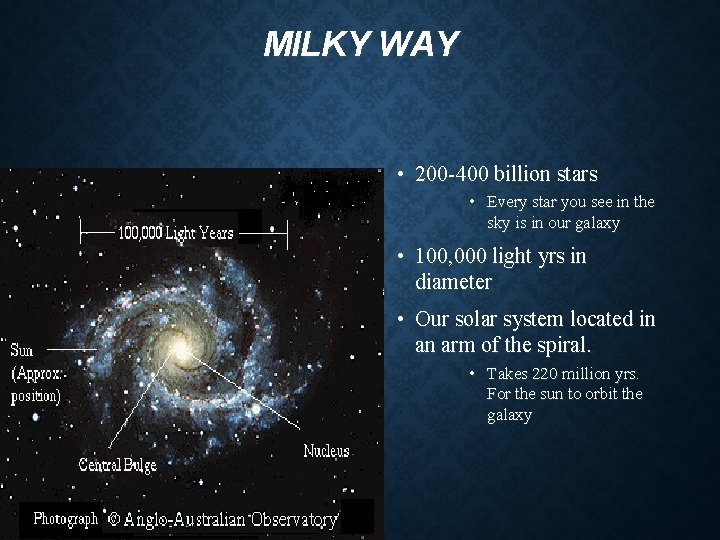
MILKY WAY • 200 -400 billion stars • Every star you see in the sky is in our galaxy • 100, 000 light yrs in diameter • Our solar system located in an arm of the spiral. • Takes 220 million yrs. For the sun to orbit the galaxy
EXPANDING UNIVERSE 26 -5
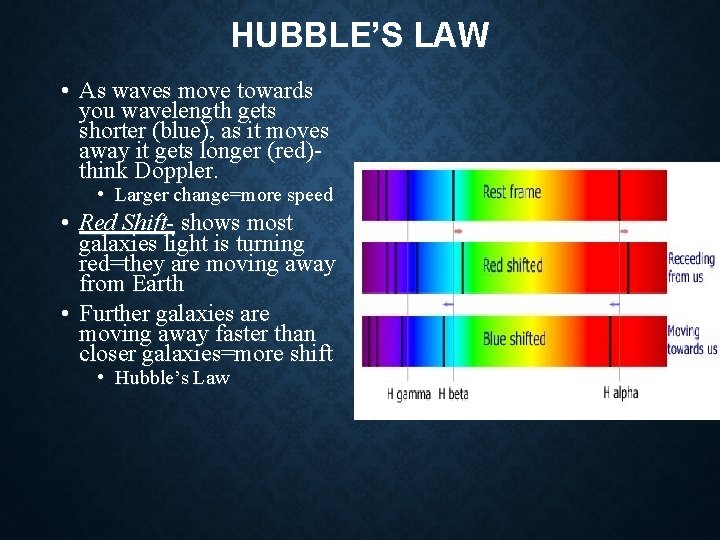
HUBBLE’S LAW • As waves move towards you wavelength gets shorter (blue), as it moves away it gets longer (red)think Doppler. • Larger change=more speed • Red Shift- shows most galaxies light is turning red=they are moving away from Earth • Further galaxies are moving away faster than closer galaxies=more shift • Hubble’s Law
THE BIG BANG THEORY • Astronomers theorize that the universe came into being at a single movement. • Once it was a hot dense small region • Began instant billions of years ago (explosion) • The universe expanded quickly, then quickly cooled down. • Gravity caused the formation of stars/galaxies. • The sun formed 4. 6 billion years ago when the universe was 2/3 rds the present size.
BIG BANG • Evidence • 1965 2 physicists noticed a radio signal from every direction • Cosmic microwave background radiation • Cosmic microwaves and the red shift strongly support the Big Bang Theory • Dark Matter-matter that doesn’t give off radiation • Cannot be seen but effects of gravity can be noticed. • Age of the Universe is approximately 13. 7 billion yrs. Old. • What NEXT? • • • Expansion? Contraction? Bounce?