CHAPTER 2 EXPLORING THE AMERICAS Section 1 A

- Slides: 49
CHAPTER 2 EXPLORING THE AMERICAS Section 1 A Changing World
VOCAB. n n n n Classical Technology Astrolabe Pilgrimage Mosque Quran Acquire Impose
NEW IDEAS AND NATIONS n Crusades 1095 Expedition by European Christians n Regain control of holy sites from Muslims n Brought Europeans into Contact with Middle East n Merchants sold goods from Asia to Europeans n n Spices, sugar, silk, and others
Growth of Trade n European traders interested in Asian goods Bought goods from Arab traders in Middle East n Sent back to major European cities n n Venice, Genoa, and Pisa Arab merchants charged high prices on goods Europeans began looking for route to the East to bypass the Arab merchants
Growth of Ideas n Age of Enlightenment In the 1300 s new wealth from trade n Europeans wanted to improve knowledge n n Began studying classical work n n Ancient Greek and Roman philosophies New experimental approach to science Rationalism n Scientific Revolution n Investigated nature of the world and universe n
Renaissance n Period of Intellectual and Artistic activity “rebirth” in French n Renewed interest in Greek and Roman learning n n Changed the way Europeans thought about themselves and the world
Nation States n Development of kingdoms in 1400 s Monarchs came to power n Formed national laws, courts, taxes, and militaries n n Enhanced trade and overseas exploration
Impact of Technology n Enhanced European exploration Better Maps and Instruments n Better Ships n n Printing press increased book production and communication
African Kingdoms n Flourished from 400 to 1600 Gold, copper, and iron ore mines n Trade with Islamic societies in North Africa n n Ghana – African Trade Center West Africa between salt and gold mines n Prospered from 400 to 1100 n
African Kingdoms (cont. ) n Mali – A Powerful Kingdom North Africa n Mansa Musa n 1324 Pilgrimage to Mecca n Returned to Mali with Arab architect to build great Mosques n n Songhai Built navy to control Niger River n Captured Timbuktu from Mali in 1468 n
Chapter 2 Section 2 Early Exploration
Vocab. n n n Saga Line of demarcation Strait Circumnavigate Devote Alter
Seeking New Trade Routes n Early explorers n n Unaware of Americas Assumed only one large land mass n n Europe, Africa, and Asia Maps used did not include the Americas
Early Portuguese Voyages n Henry the Navigator n n n Sailed up and down African Gold Coast n n n 1420 – promoted explorations Sarges – center for exploration Trading posts Bought slaves 1480 s – King John urges exploration further south
Bartholomeu Dias n Sent by King John to reach Asia n n Sailed south around the tip of Africa n n n Two caravels and a supply ship Forced off route by storm Returned back home Cape Of Good Hope n n Southern tip of Africa Named by King John of Portugal
Vasco da Gama n n First Portuguese to land in India July 1497 – set out with four ships n n n Sailed around the cape and up the east coast of Africa Made many stops on the eastern coast Landed in Calicut India in May 1498
Portuguese Trading Empire n 13 Ships sent East 6 months after Gama’s return to Portugal n n Returned with Asian goods Repeated the journey annually (yearly) Established permanent forts in India Trade success made the Portuguese capitol, Lisbon, the European trade center.
Columbus Crosses the Atlantic n Christopher Columbus Born in Italy n Sailed for Portugal n Planned to reach Asia by sailing West around the unexplored world n
The Viking Voyages n Vikings First Europeans to sail to North America n 800 s and 900 s visited Iceland Greenland n Made Settlements n Norse Sagas tell of exploration of land west of Greenland called the “Vinland” n Historians believe this to be North America n
Spain Backs Columbus n n Spain interested in trade success Queen Isabella decides to sponsor Columbus on his journeys west Columbus promises to spread Christianity n Open a trade route to Asia to make Spain rich n
Columbus’s First Voyage n August 3, 1492 Set out from Palos, Spain n Nina, Pinta, and Santa Maria n Headed West across the unknown Atlantic Ocean n n After a month at sea crew worried n Determined to make it to India
“Tierra!” n October 12, 1492 Columbus’s fleet meets land n Columbus claims San Salvador for Spain n n Thought it was East Indies Actually the Caribbean Islands n Found natives he called “Indians” n n Returns to Spain, and the king and queen agree to sponsor future voyages.
Dividing the World n Spain and Portugal lead world in Exploration Turned to Pope Alexander VI to protect claims n Line of Demarcation – n Divided the unexplored world between Spain and Portugal n Later moved further west to make the land control more equal n
Exploring America n Amerigo Vespucci 1502 – sailed along coast of South America n Determined that it was not part of Asia n n n Decided it was a continent by itself Geographers called it America
Sailing Around the World n Ferdinand Magellan Portuguese man that sailed for Spain n Sailed around the southern tip of South America n Named the ocean the Pacific n “Pacifico” – peaceful in Spanish n n Crew sailed all the way to Spain 1522 n First to circumnavigate the world
Chapter 2 Section 3 Spain in America
Vocab. n n n n Conquistador Pueblo Mission Encomienda Plantation Grant Found
Explorers and Conquest ● Conquistadors Received grants from Spanish rulers − Explored and established settlements in the Americas −
Cortes Conquers the Aztec ● Hernan Cortes Landed in Mexico in 1519 with 500 soldiers − Made alliances with Aztec enemies − ● Montezuma Aztec Emperor − Welcomed Cortes at first − Taken prisoner by Spanish − Aztec rebelled in 1520 and Montezuma was killed −
Pizarro Conquers the Inca ● Francisco Pizarro − − ● Atahualpa − − − ● Sailed Pacific (West) Coast of South America 1523: captured Inca ruler with 180 soldiers and destroyed most of the Inca military Inca leader Falsely accused of crimes and executed by Spanish Inca unable to fight without leader Pizarro gained control of the Empire
Why Spain Succeeded ● Weapons and Animals Guns and Cannons − Horses and dogs − ● Other Natives in the Areas Disliked Aztec and Inca − Assisted Spanish − ● Disease − Natives had no immunity to European illness
Spain in North America ● Juan Ponce De Leon First Spanish landing in North America − East coast of Florida in 1513 − Hoped to find “Fountain of Youth” − ● St. Augustine Settled 1565 in modern Florida − First Spanish settlement in North America −
The Seven Cities of Cibola ● Mythical empire of great riches Rumored to exist in the southern part of North America − Many European explorers searched but never found − Hernando de Soto − Francisco Vasquez de Coronado −
Spanish Rule ● 3 kinds of settlements Pueblos: towns − Missions: religious communities − Presidios: military fort −
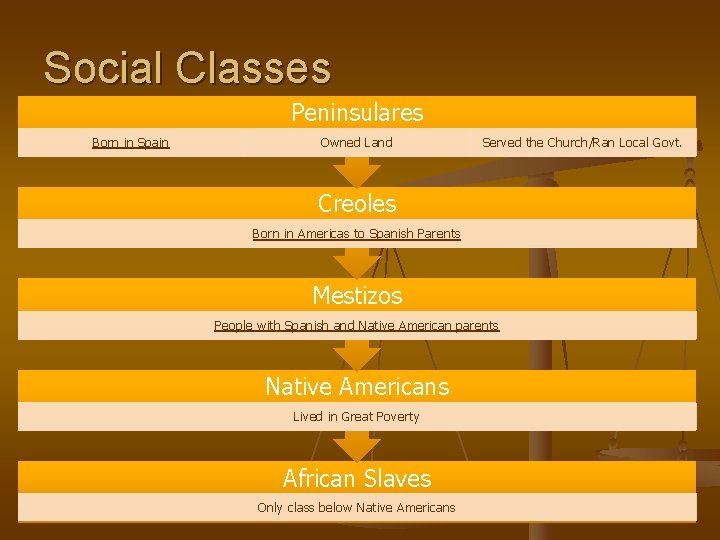
Social Classes Peninsulares Born in Spain Owned Land Served the Church/Ran Local Govt. Creoles Born in Americas to Spanish Parents Mestizos People with Spanish and Native American parents Native Americans Lived in Great Poverty African Slaves Only class below Native Americans
Social Classes (cont. ) ● Encomienda System Granted by Spanish government − Right to demand labor and taxes from natives − Led to formation of plantations −
Plantation System ● ● ● Large profits for Spanish from exporting crops Used natives to work the fields Bartolome de Las Casas Spanish priest − Suggested using African Slaves rather than Native Americans as slaves −
Chapter 2 Section 4 Exploring North America
Vocab n n n Mercantilism Columbian exchange Northwest passage Coureur de bois Globe Chart
A Divided Church ● Martin Luther German Priest − 1517: Nailed list of complaints about Catholic Church on church door − ● Protestant Reformation Religious movement − Followers broke away from Catholic Church − Rejected church practices −
Protestantism Spreads in Europe ● King Henry VIII Left catholic church − Denied authority of pope − ● Church of England Formed in 1534 − Headed by King Henry VIII −
Religious Rivalries in the Americas ● Religious divisions spread to America − Catholics: Spanish and French • − Worked to spread their faith to natives Protestants: Dutch and English • Established colonies to practice beliefs in peace
10/7/2011 v Make sure you have your study guide and an AR book with you. For the next 5 minutes, QUIETLY get out your study guide and review for the test.
Economic Rivalries ● Mercantilism Theory that a nation’s power is based on its wealth − Encouraged settlement of North America − • • – Resources Trade Increased rivalry between nations
The Columbian Exchange ● Two halves of the world brought together for the first time – – – • Plants Animals Diseases/Illness Both Hemispheres greatly affected
A Northwest Passage ● ● Europeans hoped to find a direct water route to Asia through the Americas John Cabot − − ● Sent by England in 1497 Landed in modern Newfoundland Jacques Cartier − − − French explorer who sailed up the St. Lawrence River in 1535 Finally reached what is now Montreal Never found sea passage to Asia
Hudson's Discoveries ● Henry Hudson English sailor − 1609: discovered and sailed the Hudson river to what is now Albany − 1610: found the Hudson Bay − • • • Thought he was in the Pacific Crew became unhappy and rebelled Hudson sent off in a small boat
French Trading Posts ● ● French uninterested in permanent settlement of North America Only wanted resources for trade Fishing − Animal Fur − ● Settled Quebec and spread to other areas of Canada
Dutch Settlements ● Settle the North East Fort Orange (now Albany) on the Hudson River − Fort Nassau (near Philadelphia) − ● Governor Peter Minuit 1626: traded with Manhates people for Manhattan Island − 60 Dutch guilders (about $24) − Today New York City −