
The Americas in the Age of Independence Chapter




- Slides: 16
The Americas in the Age of Independence Chapter 30
The Building of American States
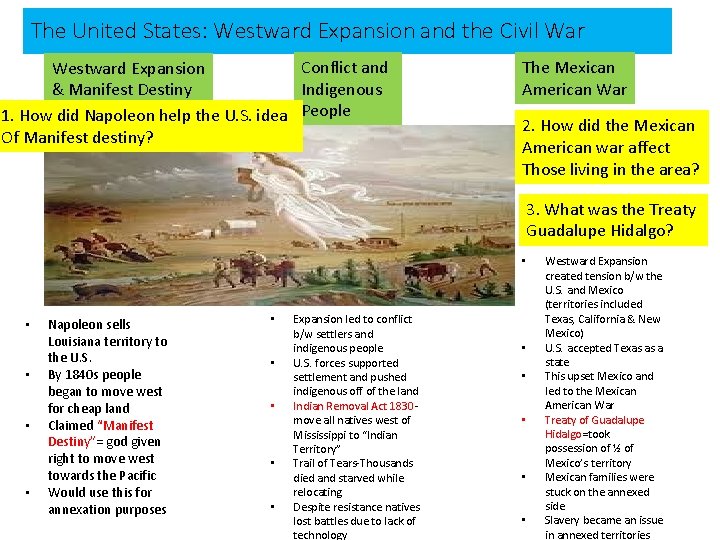
The United States: Westward Expansion and the Civil War Conflict and Westward Expansion Indigenous & Manifest Destiny 1. How did Napoleon help the U. S. idea People Of Manifest destiny? The Mexican American War 2. How did the Mexican American war affect Those living in the area? 3. What was the Treaty Guadalupe Hidalgo? • • • Napoleon sells Louisiana territory to the U. S. By 1840 s people began to move west for cheap land Claimed “Manifest Destiny”= god given right to move west towards the Pacific Would use this for annexation purposes • • • Expansion led to conflict b/w settlers and indigenous people U. S. forces supported settlement and pushed indigenous off of the land Indian Removal Act 1830 move all natives west of Mississippi to “Indian Territory” Trail of Tears-Thousands died and starved while relocating Despite resistance natives lost battles due to lack of technology • • • Westward Expansion created tension b/w the U. S. and Mexico (territories included Texas, California & New Mexico) U. S. accepted Texas as a state This upset Mexico and led to the Mexican American War Treaty of Guadalupe Hidalgo=took possession of ½ of Mexico’s territory Mexican families were stuck on the annexed side Slavery became an issue in annexed territories
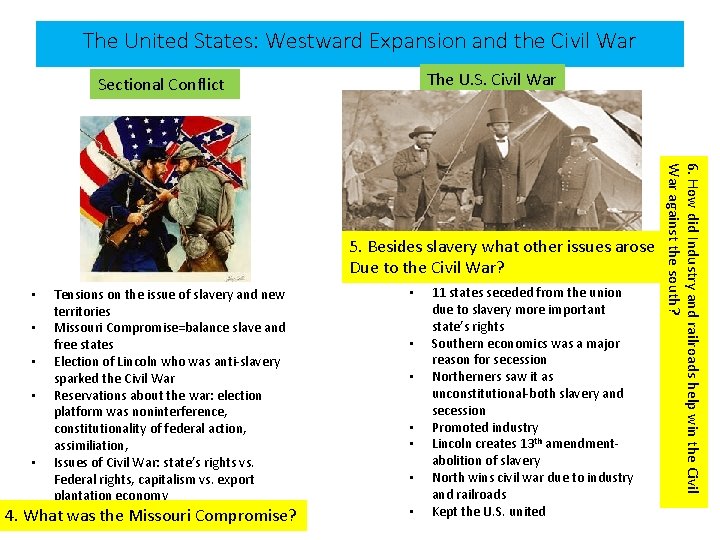
The United States: Westward Expansion and the Civil War The U. S. Civil War Sectional Conflict • • • Tensions on the issue of slavery and new territories Missouri Compromise=balance slave and free states Election of Lincoln who was anti-slavery sparked the Civil War Reservations about the war: election platform was noninterference, constitutionality of federal action, assimiliation, Issues of Civil War: state’s rights vs. Federal rights, capitalism vs. export plantation economy 4. What was the Missouri Compromise? • • 11 states seceded from the union due to slavery more important state’s rights Southern economics was a major reason for secession Northerners saw it as unconstitutional-both slavery and secession Promoted industry Lincoln creates 13 th amendmentabolition of slavery North wins civil war due to industry and railroads Kept the U. S. united 6. How did Industry and railroads help win the Civil War against the south? 5. Besides slavery what other issues arose Due to the Civil War?
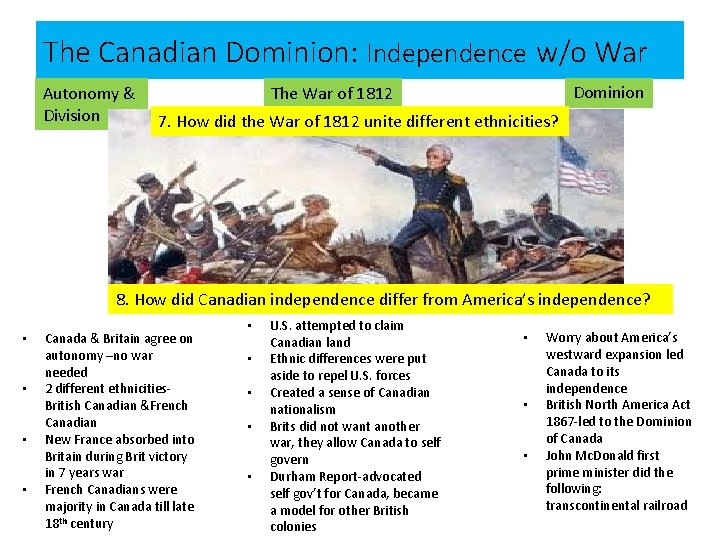
The Canadian Dominion: Independence w/o War Autonomy & Division Dominion The War of 1812 7. How did the War of 1812 unite different ethnicities? 8. How did Canadian independence differ from America’s independence? • • Canada & Britain agree on autonomy –no war needed 2 different ethnicities. British Canadian &French Canadian New France absorbed into Britain during Brit victory in 7 years war French Canadians were majority in Canada till late 18 th century • • • U. S. attempted to claim Canadian land Ethnic differences were put aside to repel U. S. forces Created a sense of Canadian nationalism Brits did not want another war, they allow Canada to self govern Durham Report-advocated self gov’t for Canada, became a model for other British colonies • • • Worry about America’s westward expansion led Canada to its independence British North America Act 1867 -led to the Dominion of Canada John Mc. Donald first prime minister did the following: transcontinental railroad
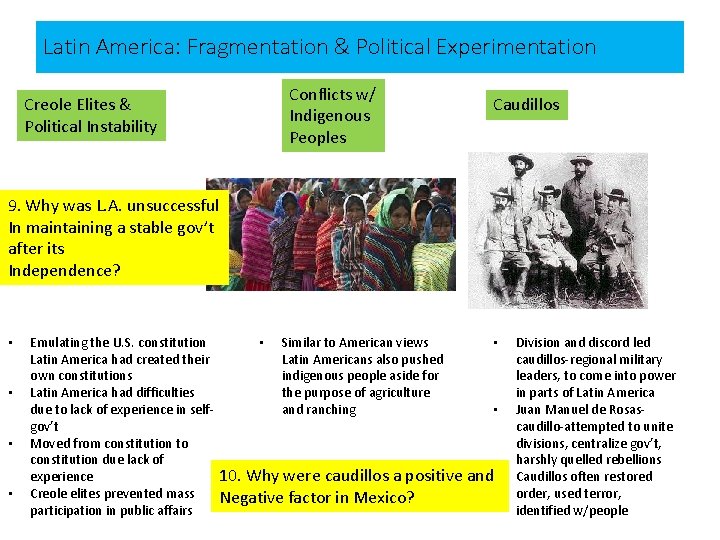
Latin America: Fragmentation & Political Experimentation Conflicts w/ Indigenous Peoples Creole Elites & Political Instability Caudillos 9. Why was L. A. unsuccessful In maintaining a stable gov’t after its Independence? • • Emulating the U. S. constitution Latin America had created their own constitutions Latin America had difficulties due to lack of experience in selfgov’t Moved from constitution to constitution due lack of experience Creole elites prevented mass participation in public affairs • Similar to American views Latin Americans also pushed indigenous people aside for the purpose of agriculture and ranching • • 10. Why were caudillos a positive and • Negative factor in Mexico? Division and discord led caudillos-regional military leaders, to come into power in parts of Latin America Juan Manuel de Rosascaudillo-attempted to unite divisions, centralize gov’t, harshly quelled rebellions Caudillos often restored order, used terror, identified w/people
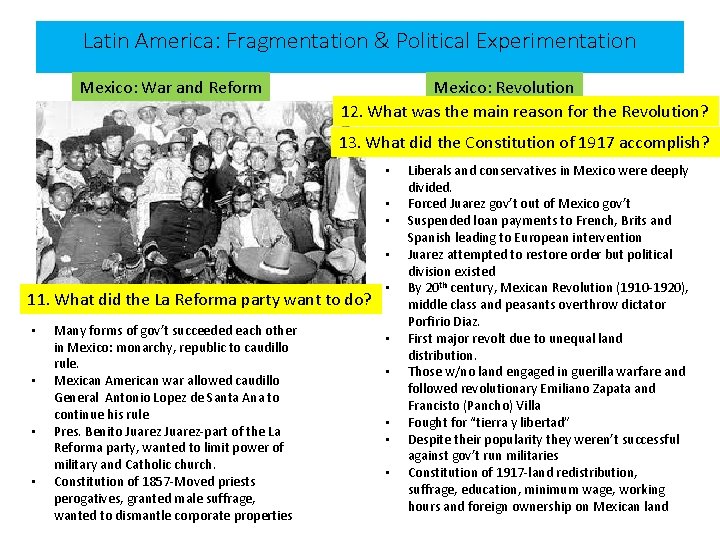
Latin America: Fragmentation & Political Experimentation Mexico: War and Reform Mexico: Revolution 12. What was the main reason for the Revolution? 13. What did the Constitution of 1917 accomplish? • • 11. What did the La Reforma party want to do? • • Many forms of gov’t succeeded each other in Mexico: monarchy, republic to caudillo rule. Mexican American war allowed caudillo General Antonio Lopez de Santa Ana to continue his rule Pres. Benito Juarez-part of the La Reforma party, wanted to limit power of military and Catholic church. Constitution of 1857 -Moved priests perogatives, granted male suffrage, wanted to dismantle corporate properties • • • Liberals and conservatives in Mexico were deeply divided. Forced Juarez gov’t out of Mexico gov’t Suspended loan payments to French, Brits and Spanish leading to European intervention Juarez attempted to restore order but political division existed By 20 th century, Mexican Revolution (1910 -1920), middle class and peasants overthrow dictator Porfirio Diaz. First major revolt due to unequal land distribution. Those w/no land engaged in guerilla warfare and followed revolutionary Emiliano Zapata and Francisto (Pancho) Villa Fought for “tierra y libertad” Despite their popularity they weren’t successful against gov’t run militaries Constitution of 1917 -land redistribution, suffrage, education, minimum wage, working hours and foreign ownership on Mexican land
American Economic Development
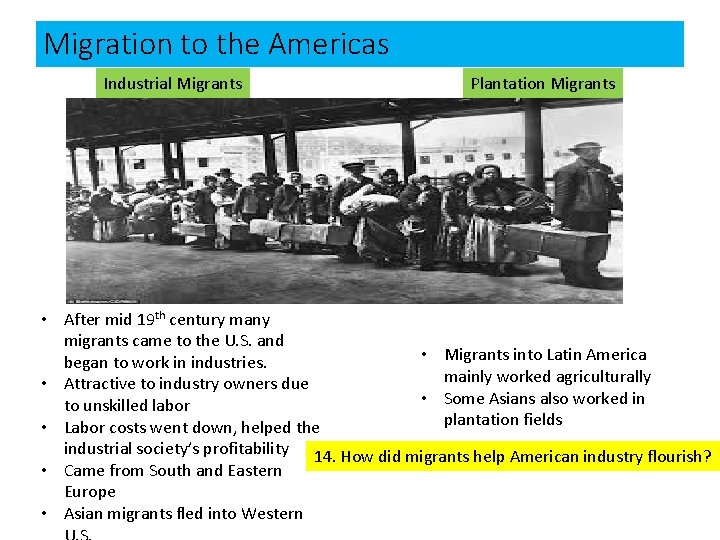
Migration to the Americas Industrial Migrants Plantation Migrants • After mid 19 th century many migrants came to the U. S. and • Migrants into Latin America began to work in industries. mainly worked agriculturally • Attractive to industry owners due • Some Asians also worked in to unskilled labor plantation fields • Labor costs went down, helped the industrial society’s profitability 14. How did migrants help American industry flourish? • Came from South and Eastern Europe • Asian migrants fled into Western
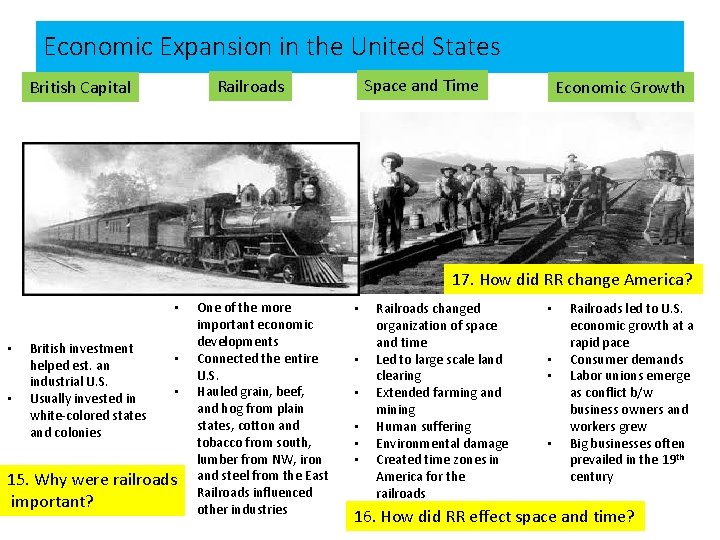
Economic Expansion in the United States Space and Time Railroads British Capital Economic Growth 17. How did RR change America? • • • British investment helped est. an industrial U. S. Usually invested in white-colored states and colonies • • 15. Why were railroads • important? One of the more important economic developments Connected the entire U. S. Hauled grain, beef, and hog from plain states, cotton and tobacco from south, lumber from NW, iron and steel from the East Railroads influenced other industries • • • Railroads changed organization of space and time Led to large scale land clearing Extended farming and mining Human suffering Environmental damage Created time zones in America for the railroads • • Railroads led to U. S. economic growth at a rapid pace Consumer demands Labor unions emerge as conflict b/w business owners and workers grew Big businesses often prevailed in the 19 th century 16. How did RR effect space and time?
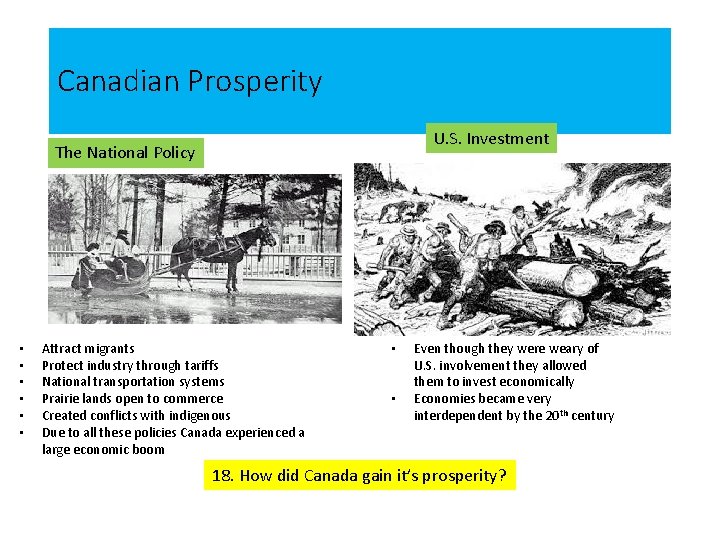
Canadian Prosperity U. S. Investment The National Policy • • • Attract migrants Protect industry through tariffs National transportation systems Prairie lands open to commerce Created conflicts with indigenous Due to all these policies Canada experienced a large economic boom • • Even though they were weary of U. S. involvement they allowed them to invest economically Economies became very interdependent by the 20 th century 18. How did Canada gain it’s prosperity?
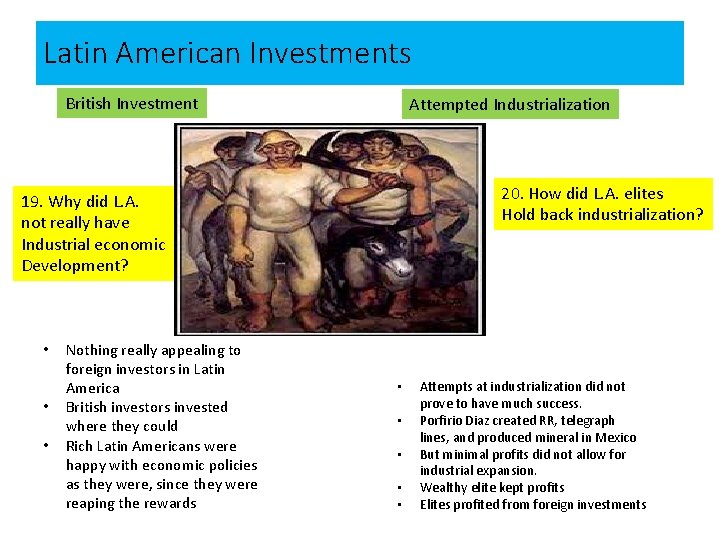
Latin American Investments British Investment Attempted Industrialization 20. How did L. A. elites Hold back industrialization? 19. Why did L. A. not really have Industrial economic Development? • • • Nothing really appealing to foreign investors in Latin America British investors invested where they could Rich Latin Americans were happy with economic policies as they were, since they were reaping the rewards • • • Attempts at industrialization did not prove to have much success. Porfirio Diaz created RR, telegraph lines, and produced mineral in Mexico But minimal profits did not allow for industrial expansion. Wealthy elite kept profits Elites profited from foreign investments
American Cultural and Social Diversity
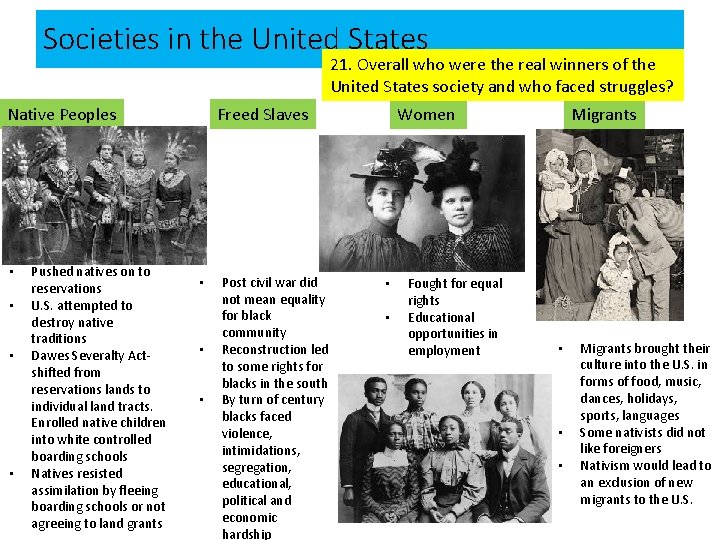
Societies in the United States 21. Overall who were the real winners of the United States society and who faced struggles? Native Peoples • • Pushed natives on to reservations U. S. attempted to destroy native traditions Dawes Severalty Actshifted from reservations lands to individual land tracts. Enrolled native children into white controlled boarding schools Natives resisted assimilation by fleeing boarding schools or not agreeing to land grants Freed Slaves • • • Post civil war did not mean equality for black community Reconstruction led to some rights for blacks in the south By turn of century blacks faced violence, intimidations, segregation, educational, political and economic hardship Women • • Fought for equal rights Educational opportunities in employment Migrants • • • Migrants brought their culture into the U. S. in forms of food, music, dances, holidays, sports, languages Some nativists did not like foreigners Nativism would lead to an exclusion of new migrants to the U. S.
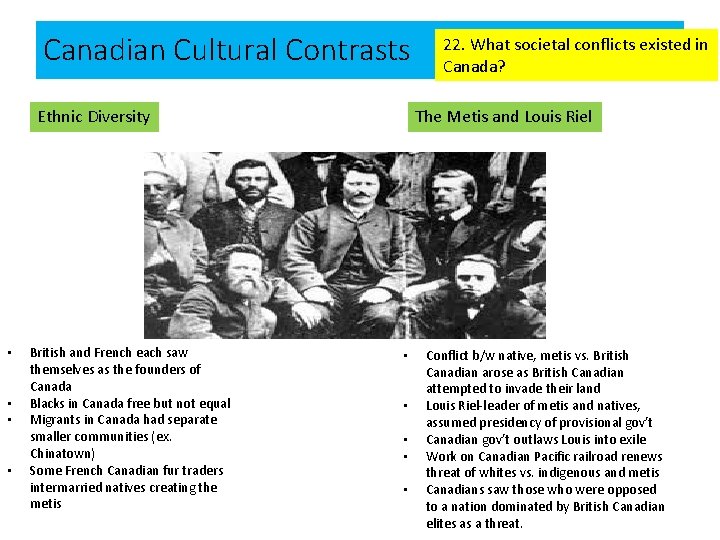
Canadian Cultural Contrasts Ethnic Diversity • • British and French each saw themselves as the founders of Canada Blacks in Canada free but not equal Migrants in Canada had separate smaller communities (ex. Chinatown) Some French Canadian fur traders intermarried natives creating the metis 22. What societal conflicts existed in Canada? The Metis and Louis Riel • • • Conflict b/w native, metis vs. British Canadian arose as British Canadian attempted to invade their land Louis Riel-leader of metis and natives, assumed presidency of provisional gov’t Canadian gov’t outlaws Louis into exile Work on Canadian Pacific railroad renews threat of whites vs. indigenous and metis Canadians saw those who were opposed to a nation dominated by British Canadian elites as a threat.
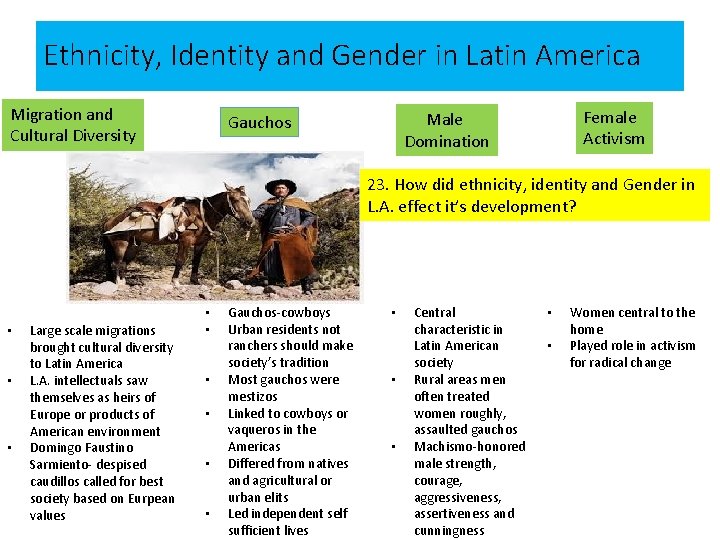
Ethnicity, Identity and Gender in Latin America Migration and Cultural Diversity Female Activism Male Domination Gauchos 23. How did ethnicity, identity and Gender in L. A. effect it’s development? • • • Large scale migrations brought cultural diversity to Latin America L. A. intellectuals saw themselves as heirs of Europe or products of American environment Domingo Faustino Sarmiento- despised caudillos called for best society based on Eurpean values • • • Gauchos-cowboys Urban residents not ranchers should make society’s tradition Most gauchos were mestizos Linked to cowboys or vaqueros in the Americas Differed from natives and agricultural or urban elits Led independent self sufficient lives • • • Central characteristic in Latin American society Rural areas men often treated women roughly, assaulted gauchos Machismo-honored male strength, courage, aggressiveness, assertiveness and cunningness • • Women central to the home Played role in activism for radical change