Dyscalculi UM a firstline Screening Devise for dyscalculia
- Slides: 65
Dyscalculi. UM a first-line Screening Devise for dyscalculia in Higher Education Clare Trott and Nigel Beacham DDIG conference Wednesday 13 th April 2005
Kerry • Sent to MLSC by her tutor who suggested she might be dyscalculic • Kerry interviewed in detail and looked at her work folder • Very basic difficulties with understanding simple %
• LHS of the formula did not co-exist with the RHS • Kerry was sent for dyslexia screening which produced a negative result • However, fundamental problems still remained • Much discussion • Kerry sent to Educational Psychologist who confirmed dyscalculia (no dyslexia)
Statistics According to current estimates (Butterworth (1999)) • about 10% of the population are dyslexic (4% severe, 6% mild/moderate) • of these 40% have some degree of difficulty with maths • additionally 4 to 6% is dyscalculic only.
• There is currently no accepted definition of dyscalculia • A number of different definitions exist • Numerically based • Cognitive based • Neuroscience based
• The DSM-IV document, used by educational psychologists, defines Mathematics disorder in term of test scores: "as measured by a standardised test that is given individually, the patient's mathematical ability is substantially less than would be expected from the patients age, intelligence and education. This deficiency materially impedes academic achievement or daily living"
Two Important Features 1. Mathematical level compared to expectation "most dyscalculic learners will have cognitive and language abilities in the normal range, and may excel in non-mathematical subjects". Butterworth (1999)
2. Impedance of academic achievement and daily living "Dyscalculia is a term referring to a wide range of life long learning disabilities involving math… the difficulties vary from person to person and affect people differently in school and throughout life". The National Center for Learning Disabilities, http: //www. ld. org/LDInfo. Zone/Info. Zone_Fact. Sheet_D yscacluia. cfm, Access: 22/10/03
More precise specification (Mahesh Sharma) “Dyscalculia is an inability to conceptualise numbers, number relationships (arithmetical facts) and the outcomes of numerical operations (estimating the answer to numerical problems before actually calculating). ” The emphasis here being on conceptualisation rather than on the numerical operations
The National Numeracy Strategy The Df. ES (2001) " Dyscalculia is a condition that affects the ability to acquire arithmetical skills. Dyscalculic learners may have difficulty understanding simple number concepts, lack an intuitive grasp of numbers, and have problems learning number facts and procedures. Even if they produce a correct answer or use a correct method, they may do so mechanically and without confidence. "
• Currently used by the BDA. • Perhaps more applicable to education in the early years • In H. E. emphasis is less on basic computation and more on the application and understanding of skills and techniques
Newman (1997) offers several subdivisons of dyscalculia, including: • Primary - dyscalculia being the main LD • Secondary - dyscalculia occurring with other LDs
Effective problem solving: "One of the things that distinguishes people who are good at maths, have effective 'mathematical brains', is an ability to see a problem in different ways. This is because they understand it. This, in turn, allows the use of a range of different procedures to solve it and to select the one that will be most effective in this particular task". Butterworth (2002)
Key Points • Mathematical ability substantially less than expectation • “Impedes academic achievement or daily living” • Inability to conceptualise • Failure to understanding number concepts and relationships
Our Working Definition “Dyscalculic students have a low level of numerical or mathematical competence compared to expectation. This expectation being based on unimpaired cognitive and language abilities and occurring within the normal range. The deficit will severely impede their academic progress or daily living.
Dyscalculia is therefore an inability to effectively connect with number and mathematics. It may include difficulties recognising, reading, writing or conceptualising numbers, understanding numerical or mathematical concepts and their inter-relationships.
It follows that dyscalculics may have difficulty with numerical operations, both in terms of understanding the process of the operation and in carrying out the procedure. Further difficulties may arise in understanding the systems that rely on this fundamental understanding, such as time, money, direction and more abstract mathematical, symbolic and graphical representations. ”
Neuroscience Research • “An elementary number system is present very early in life in both humans and animals, and constitutes the startup-tool for the development of symbolic numerical thinking that permeates our western technological societies“ (Dehaene 1997) • Different mathematical and arithmetical processes are associated with different areas of the brain.
Triple Code Theory (Dehaene (1997)) Numbers need to be § Read as words § Recognised in Arabic digital form § The corresponding concept of its quantity formed.
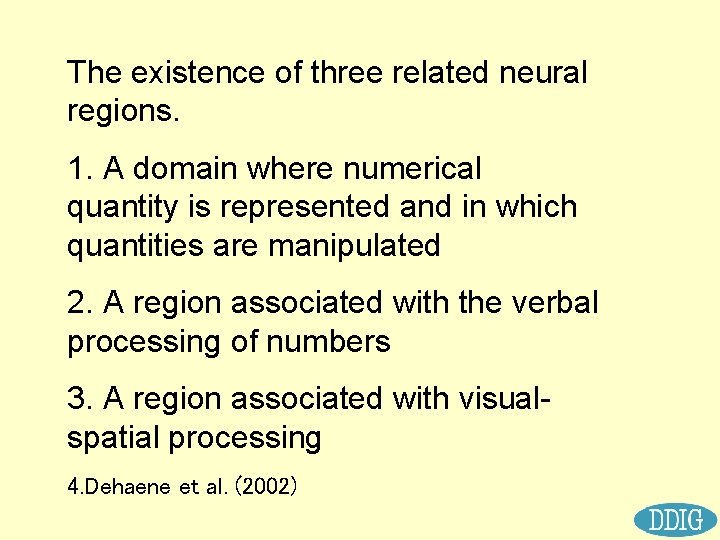
The existence of three related neural regions. 1. A domain where numerical quantity is represented and in which quantities are manipulated 2. A region associated with the verbal processing of numbers 3. A region associated with visualspatial processing 4. Dehaene et al. (2002)
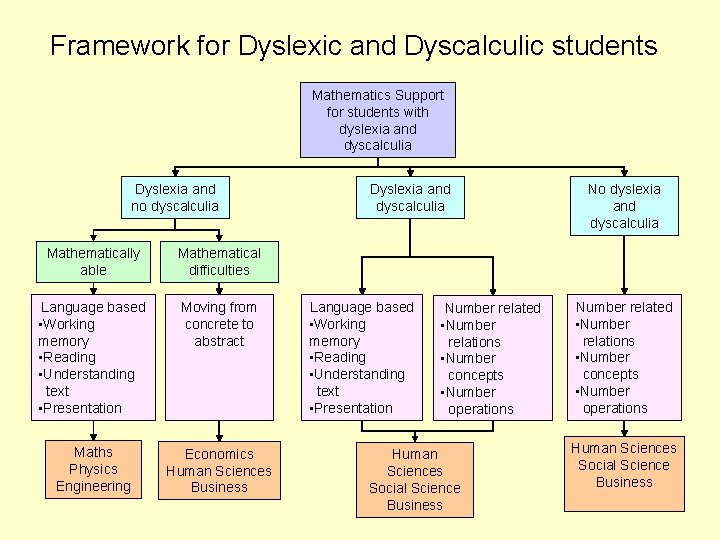
Framework for Dyslexic and Dyscalculic students Mathematics Support for students with dyslexia and dyscalculia Dyslexia and no dyscalculia Mathematically able No dyslexia and dyscalculia Mathematical difficulties Language based Moving from • Working concrete to memory abstract • Reading • Understanding text • Presentation Maths Physics Engineering Dyslexia and dyscalculia Economics Human Sciences Business Language based • Working memory • Reading • Understanding text • Presentation Number related • Number relations • Number concepts • Number operations Human Sciences Social Science Business
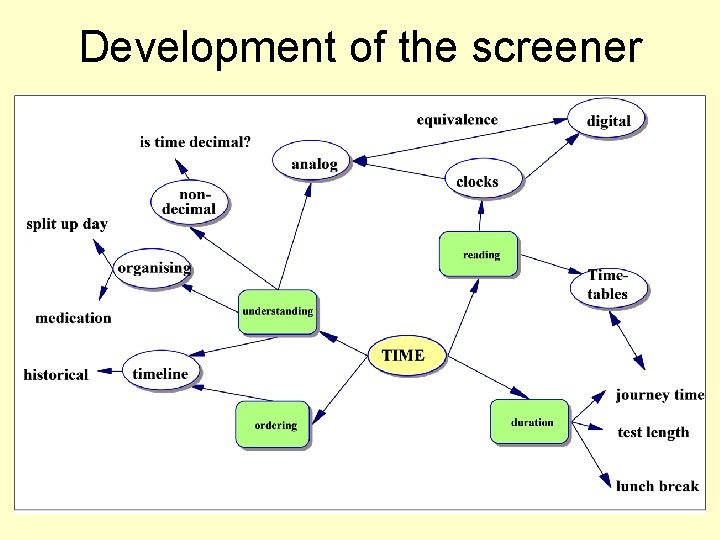
Development of the screener
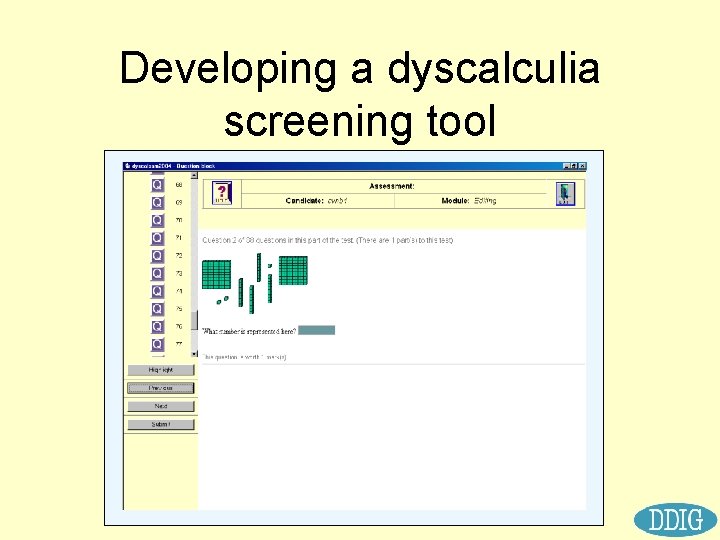
Developing a dyscalculia screening tool • Available in both paper and electronic versions • Electronic version produced on CD-ROM • Electronic version developed in Perception
Developing a dyscalculia screening tool
Issues in developing a dyscalculia screening tool • • • Background colour Previous button Time taken Scrolling and layout Submit button
Loughborough Initial Trials
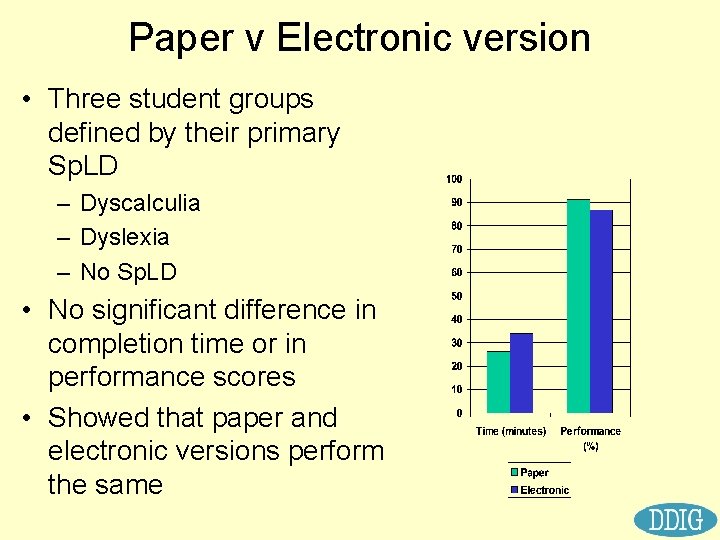
Paper v Electronic version • Three student groups defined by their primary Sp. LD – Dyscalculia – Dyslexia – No Sp. LD • No significant difference in completion time or in performance scores • Showed that paper and electronic versions perform the same
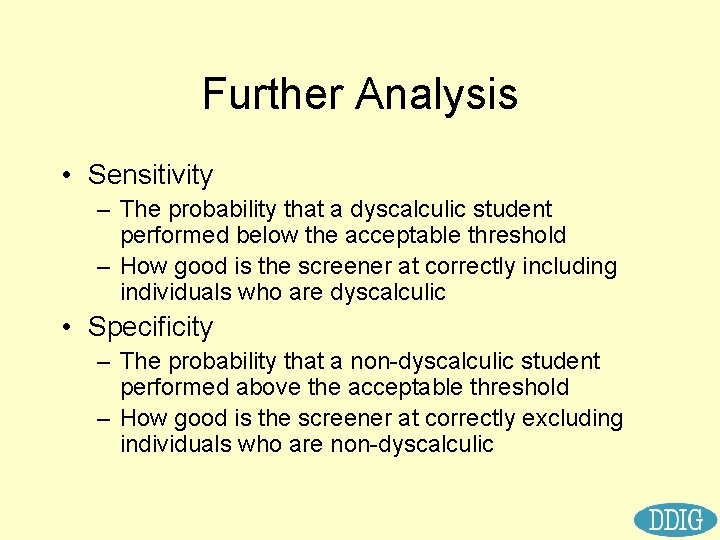
Further Analysis • Sensitivity – The probability that a dyscalculic student performed below the acceptable threshold – How good is the screener at correctly including individuals who are dyscalculic • Specificity – The probability that a non-dyscalculic student performed above the acceptable threshold – How good is the screener at correctly excluding individuals who are non-dyscalculic
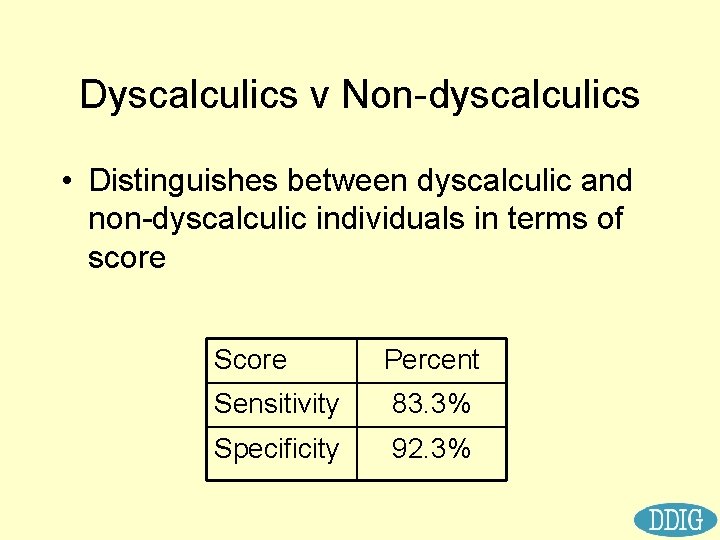
Dyscalculics v Non-dyscalculics • Distinguishes between dyscalculic and non-dyscalculic individuals in terms of score Score Percent Sensitivity 83. 3% Specificity 92. 3%
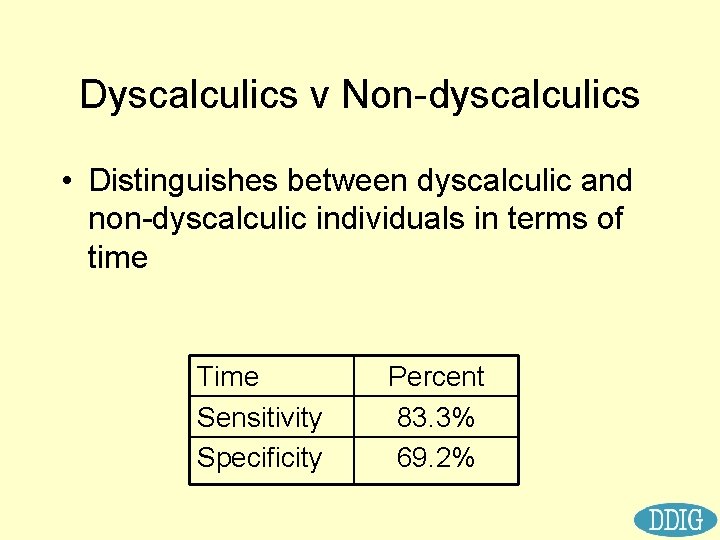
Dyscalculics v Non-dyscalculics • Distinguishes between dyscalculic and non-dyscalculic individuals in terms of time Time Sensitivity Specificity Percent 83. 3% 69. 2%
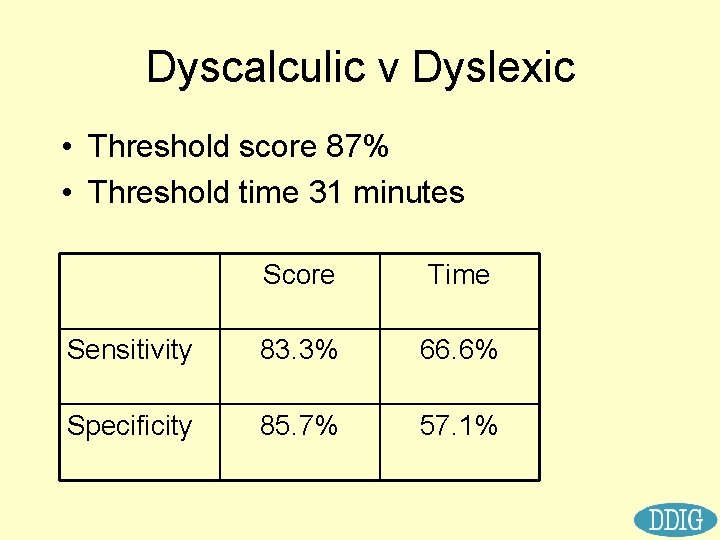
Dyscalculic v Dyslexic • Threshold score 87% • Threshold time 31 minutes Score Time Sensitivity 83. 3% 66. 6% Specificity 85. 7% 57. 1%
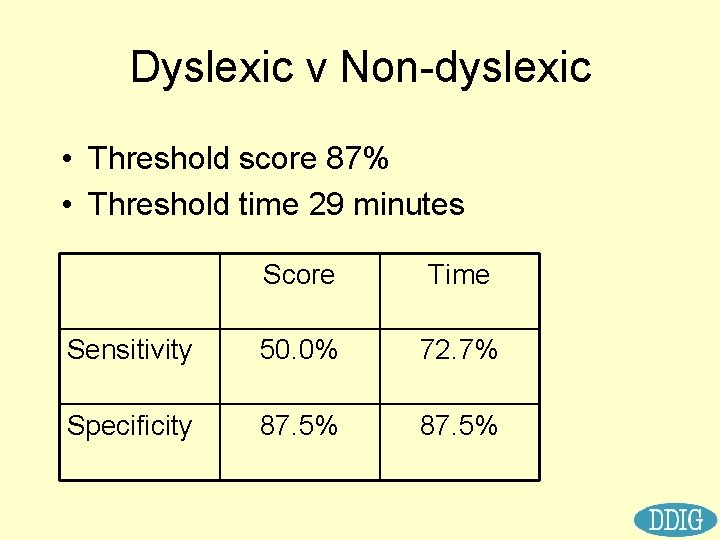
Dyslexic v Non-dyslexic • Threshold score 87% • Threshold time 29 minutes Score Time Sensitivity 50. 0% 72. 7% Specificity 87. 5%
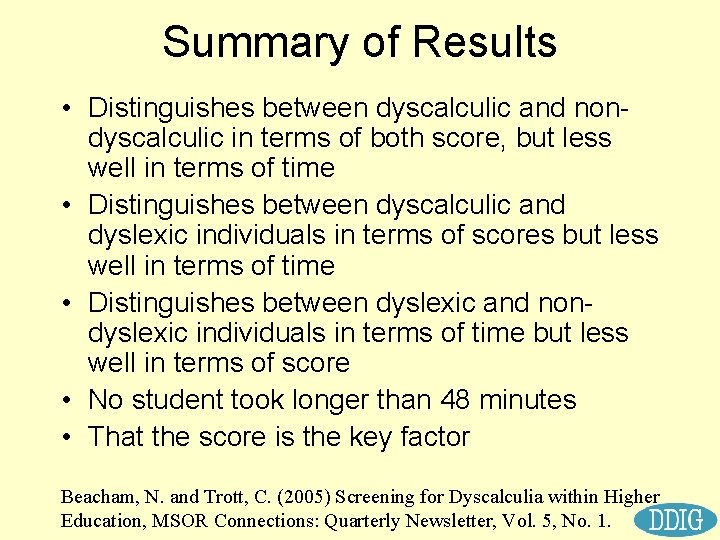
Summary of Results • Distinguishes between dyscalculic and nondyscalculic in terms of both score, but less well in terms of time • Distinguishes between dyscalculic and dyslexic individuals in terms of scores but less well in terms of time • Distinguishes between dyslexic and nondyslexic individuals in terms of time but less well in terms of score • No student took longer than 48 minutes • That the score is the key factor Beacham, N. and Trott, C. (2005) Screening for Dyscalculia within Higher Education, MSOR Connections: Quarterly Newsletter, Vol. 5, No. 1.
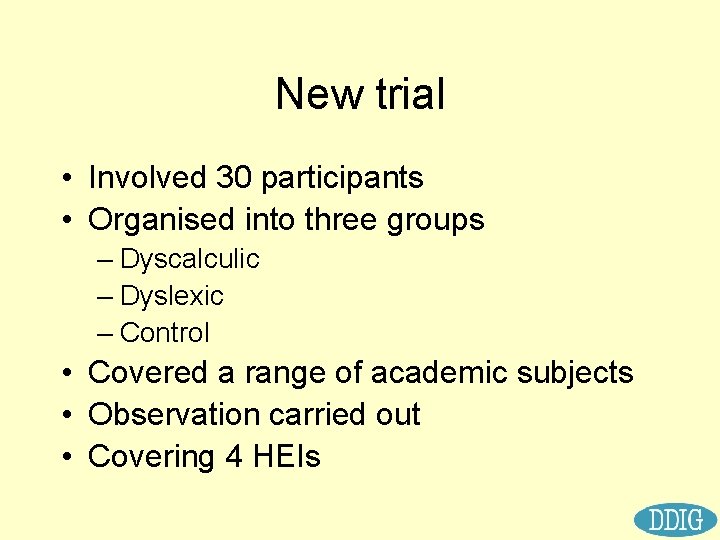
New trial • Involved 30 participants • Organised into three groups – Dyscalculic – Dyslexic – Control • Covered a range of academic subjects • Observation carried out • Covering 4 HEIs
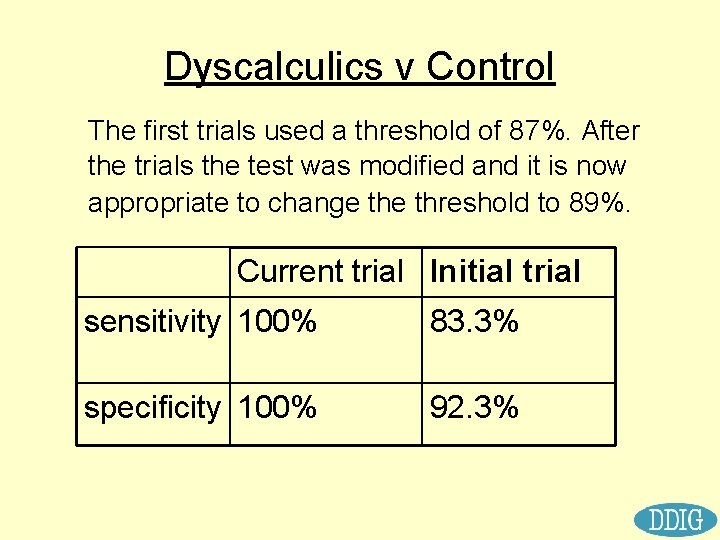
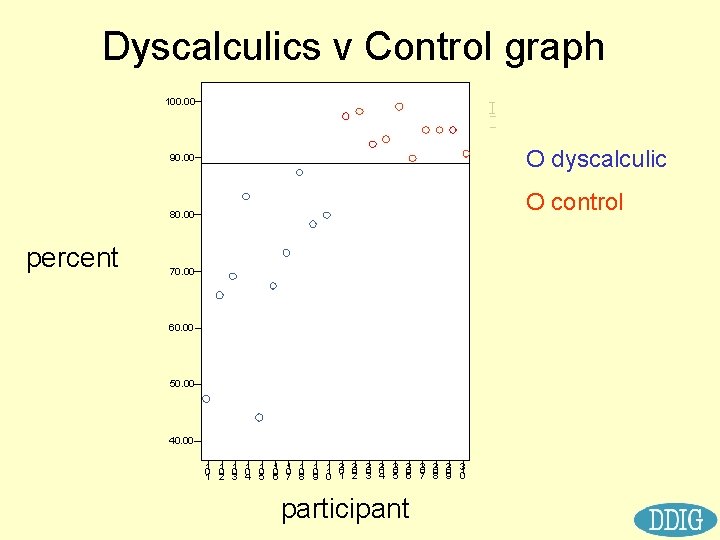
Dyscalculics v Control The first trials used a threshold of 87%. After the trials the test was modified and it is now appropriate to change threshold to 89%. Current trial Initial trial sensitivity 100% 83. 3% specificity 100% 92. 3%
Dyscalculics v Control graph 100. 00 O dyscalculic 90. 00 O control 80. 00 percent 70. 00 60. 00 50. 00 40. 00 1 1 1 1 1 3 3 0 3 0 3 1 0 0 0 0 0 1 2 3 4 5 6 7 8 9 0 participant
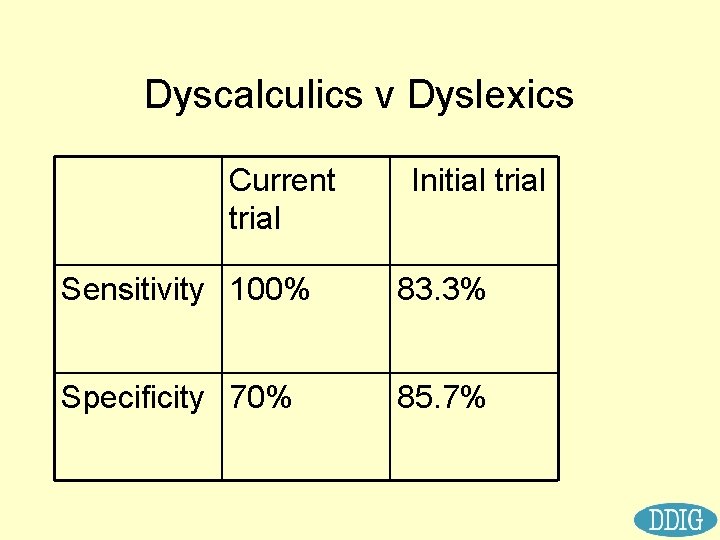
Dyscalculics v Dyslexics Current trial Initial trial Sensitivity 100% 83. 3% Specificity 70% 85. 7%
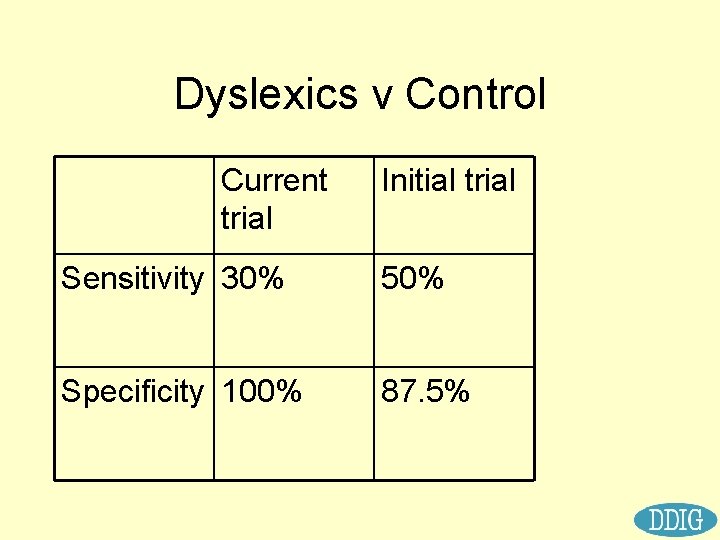
Dyslexics v Control Current trial Initial trial Sensitivity 30% 50% Specificity 100% 87. 5%
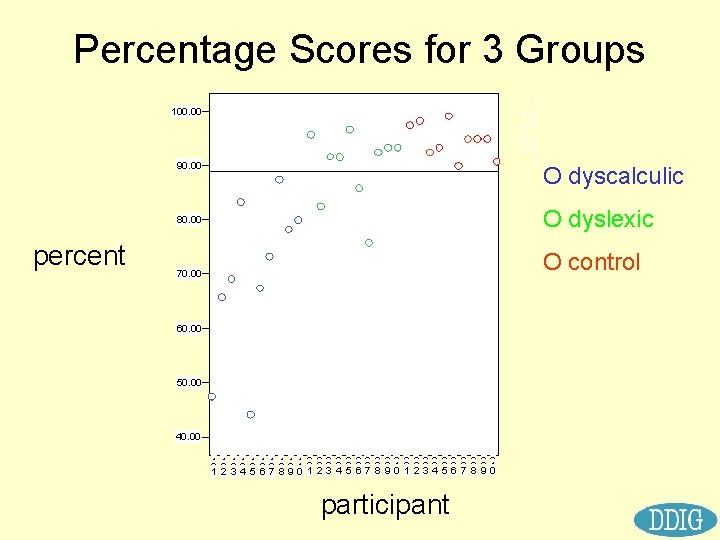
Percentage Scores for 3 Groups 100. 00 90. 00 O dyscalculic O dyslexic 80. 00 percent O control 70. 00 60. 00 50. 00 40. 00 22 2 22 3 33 3 3 33 1 1 11 2 00 0 01 0 00 0 0 01 0 0 00 0 01 0 1 2 34 5 67 8 90 1 23 4 56 7 8 90 participant
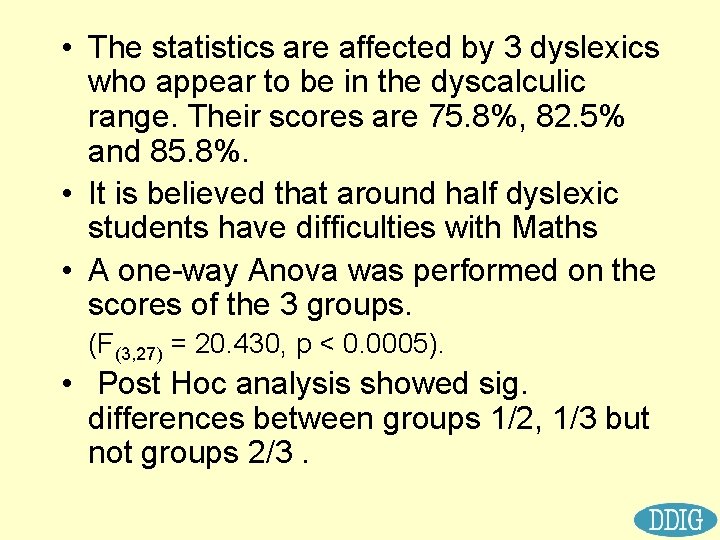
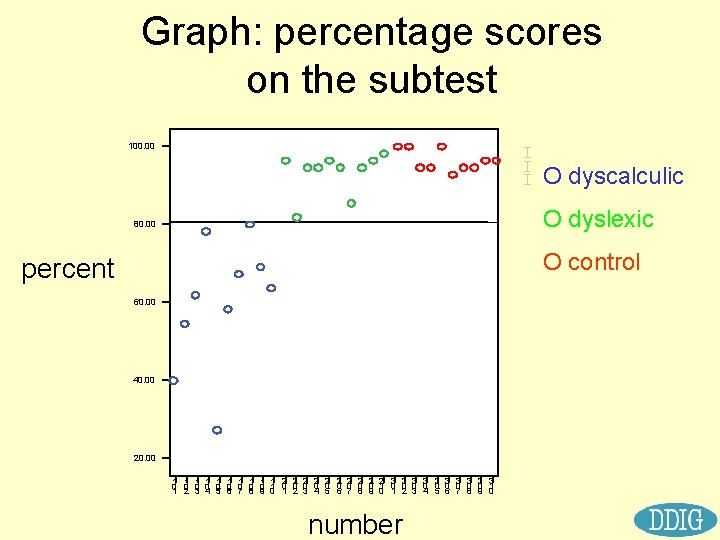
• The statistics are affected by 3 dyslexics who appear to be in the dyscalculic range. Their scores are 75. 8%, 82. 5% and 85. 8%. • It is believed that around half dyslexic students have difficulties with Maths • A one-way Anova was performed on the scores of the 3 groups. (F(3, 27) = 20. 430, p < 0. 0005). • Post Hoc analysis showed sig. differences between groups 1/2, 1/3 but not groups 2/3.
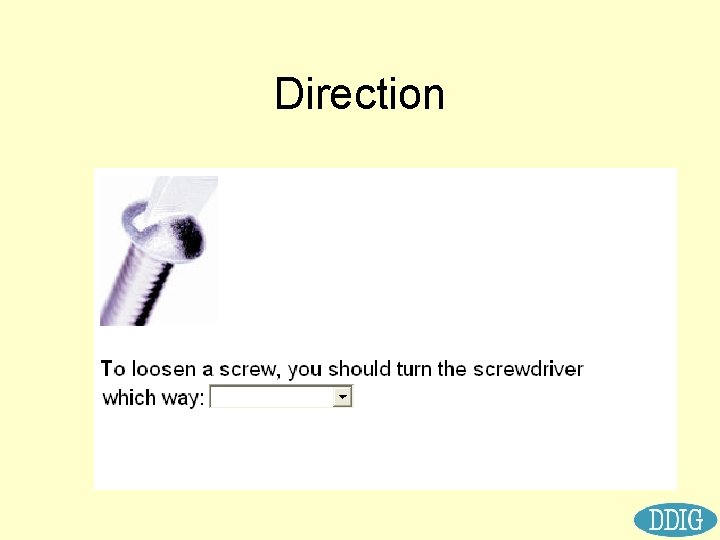
Examples from Dyscalculi. UM • • • Decimals Direction Bar graph Interval bisection Towards abstraction
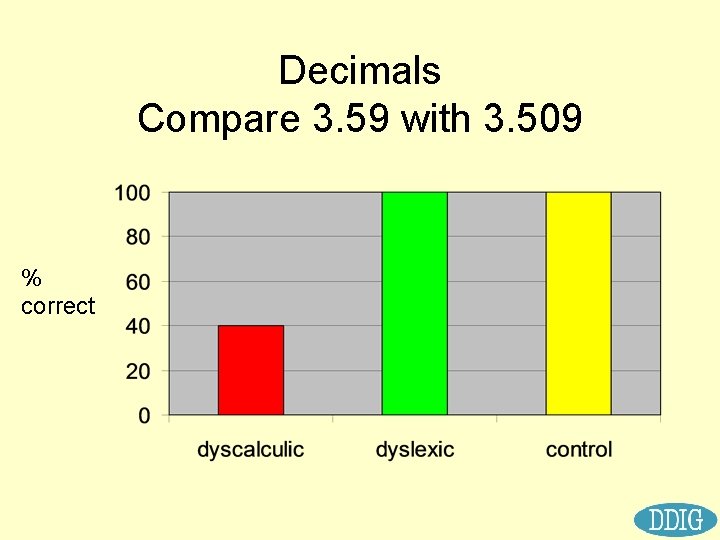
Decimals Compare 3. 59 with 3. 509 % correct
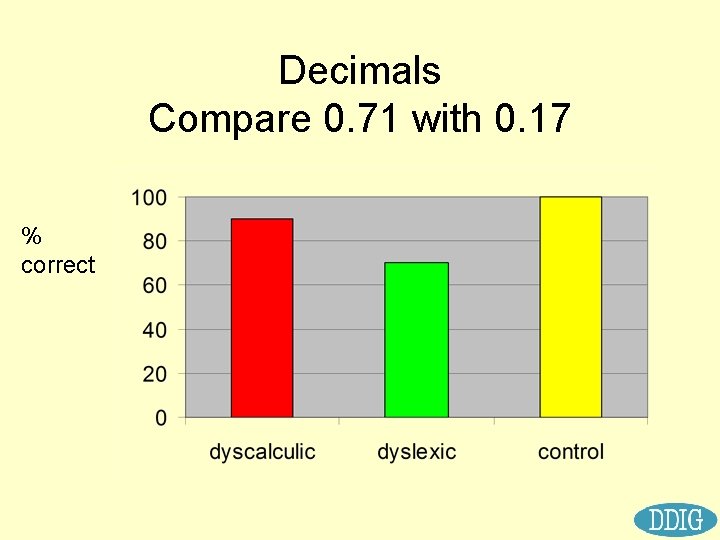
Decimals Compare 0. 71 with 0. 17 % correct
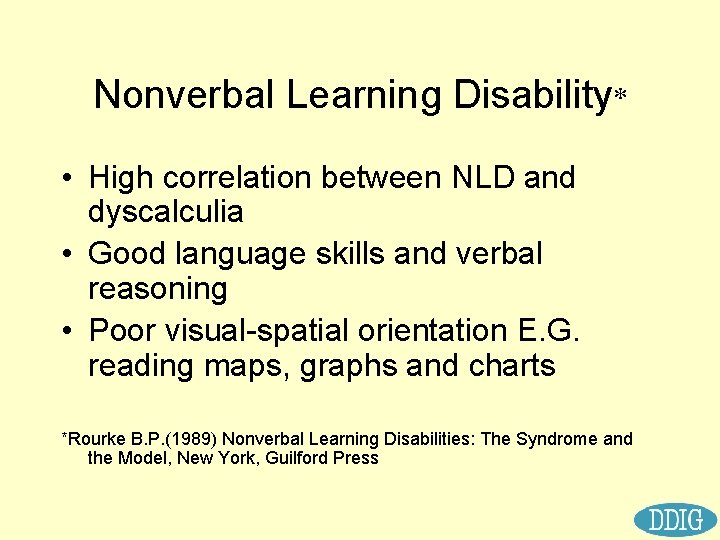
Nonverbal Learning Disability* • High correlation between NLD and dyscalculia • Good language skills and verbal reasoning • Poor visual-spatial orientation E. G. reading maps, graphs and charts *Rourke B. P. (1989) Nonverbal Learning Disabilities: The Syndrome and the Model, New York, Guilford Press
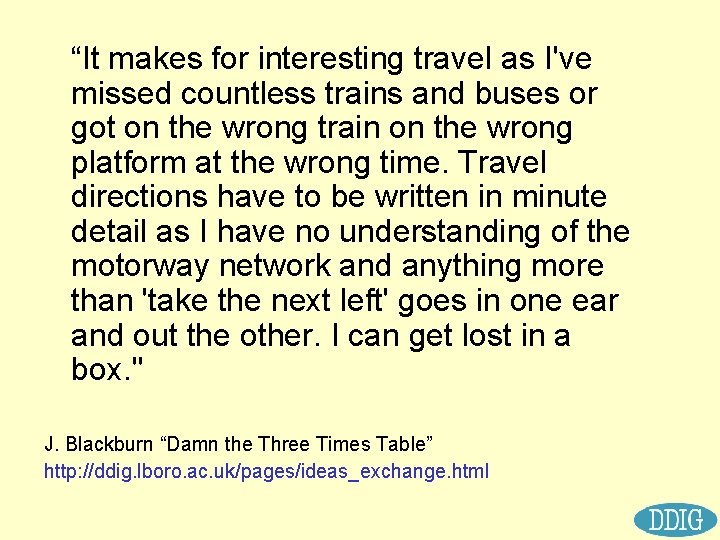
“It makes for interesting travel as I've missed countless trains and buses or got on the wrong train on the wrong platform at the wrong time. Travel directions have to be written in minute detail as I have no understanding of the motorway network and anything more than 'take the next left' goes in one ear and out the other. I can get lost in a box. " J. Blackburn “Damn the Three Times Table” http: //ddig. lboro. ac. uk/pages/ideas_exchange. html
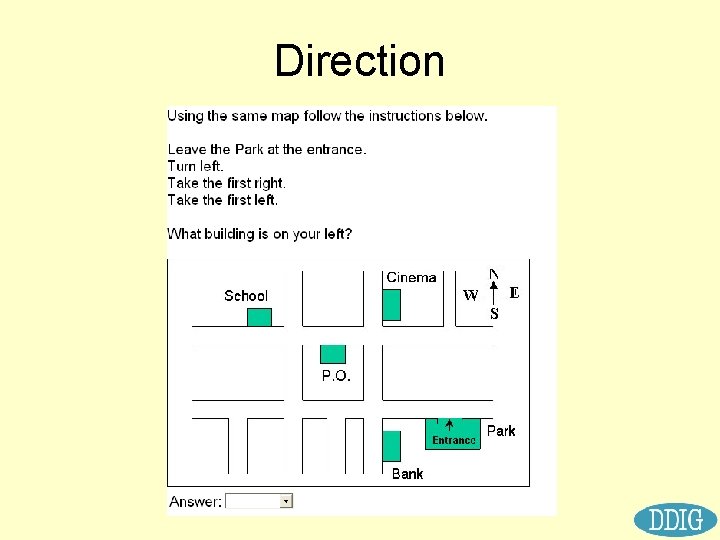
Direction
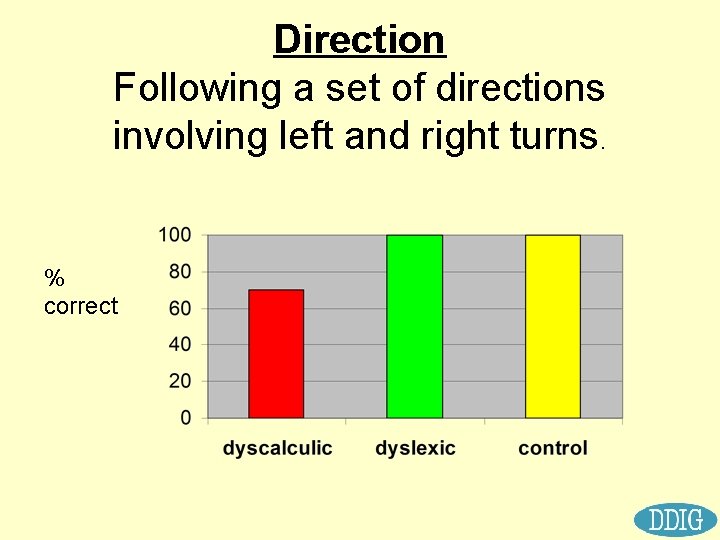
Direction Following a set of directions involving left and right turns. % correct
Direction
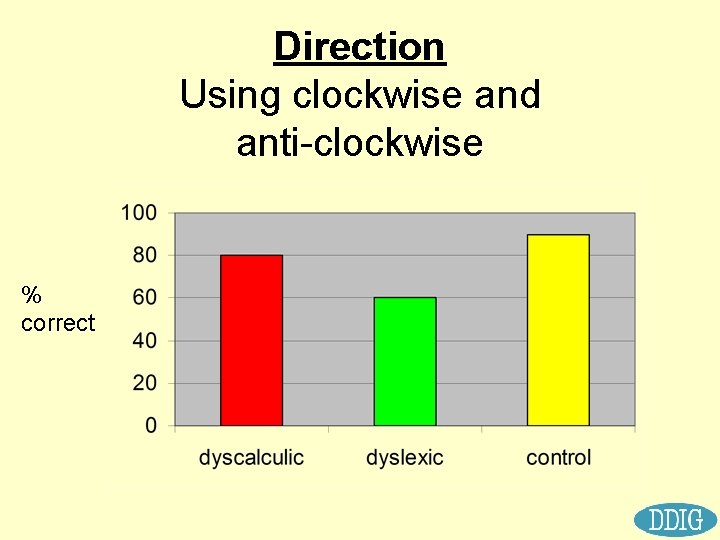
Direction Using clockwise and anti-clockwise % correct
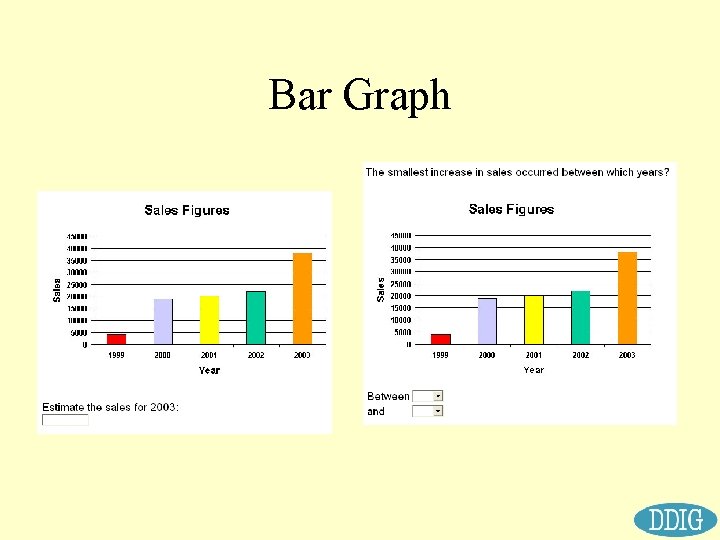
Bar Graph
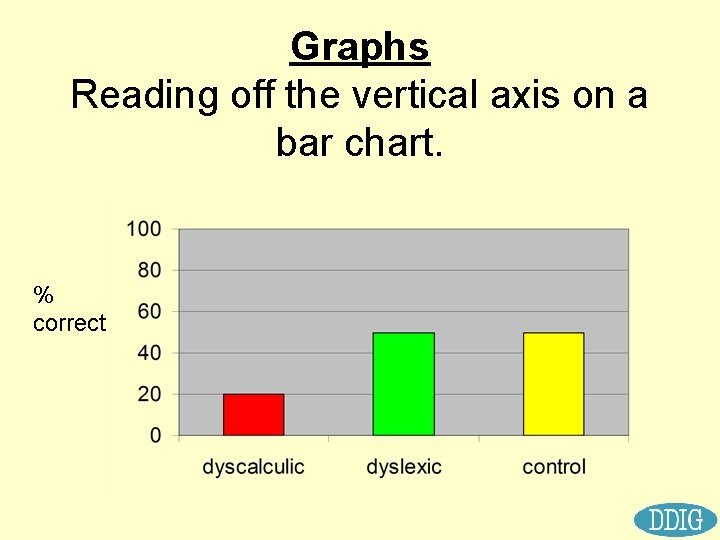
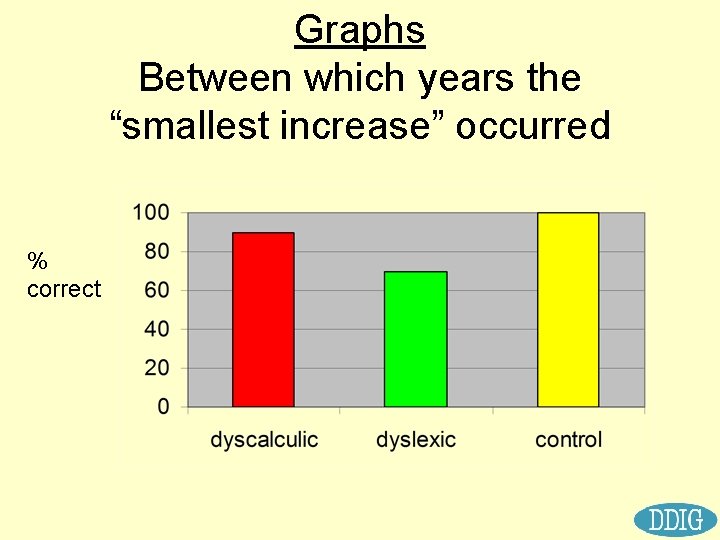
Graphs Reading off the vertical axis on a bar chart. % correct
Graphs Between which years the “smallest increase” occurred % correct
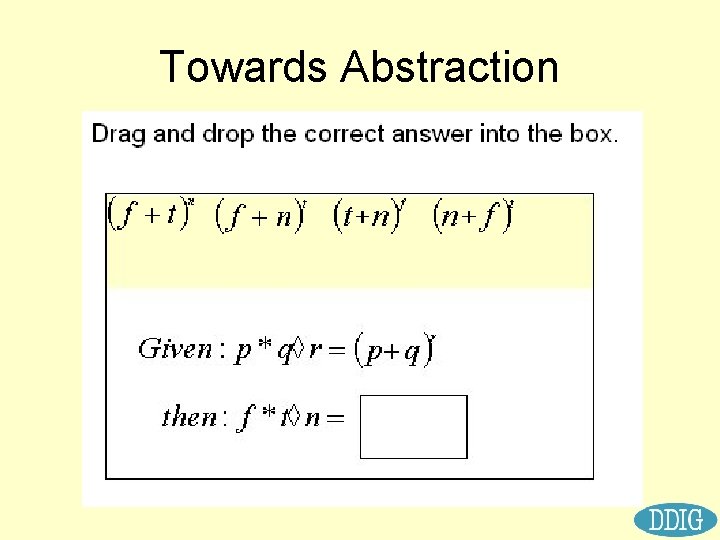
Towards Abstraction
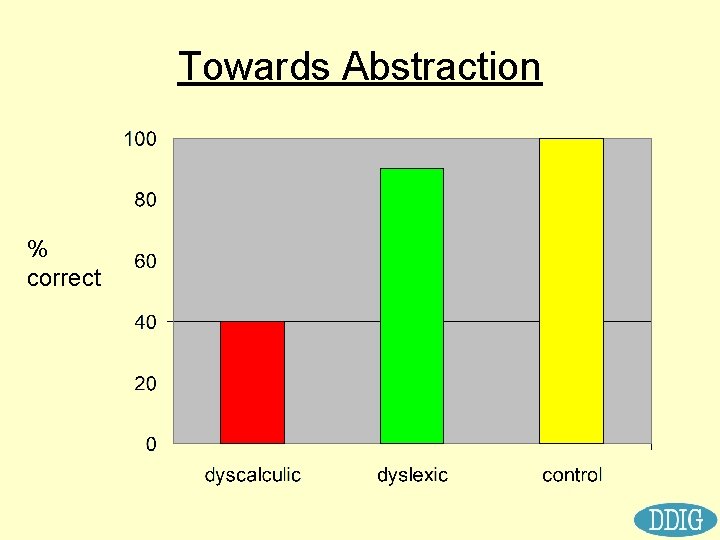
Towards Abstraction % correct
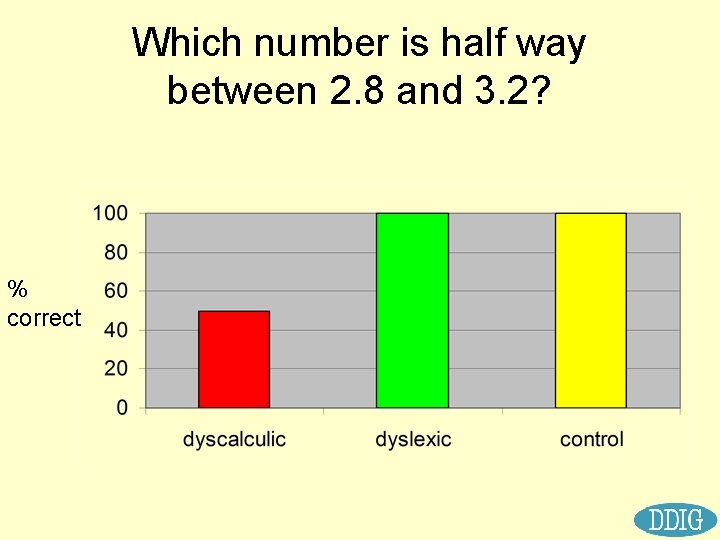
Interval Bisection • Research has shown that poor visualspatial skills result in difficulties with number bisection tasks* * Dehaene, S. , & Cohen, L. (1997). Cerebral pathways for calculation: Double dissociation between rote verbal and quantitative knowledge of arithmetic. Cortex, 33, 219– 250.
Which number is half way between 2. 8 and 3. 2? % correct
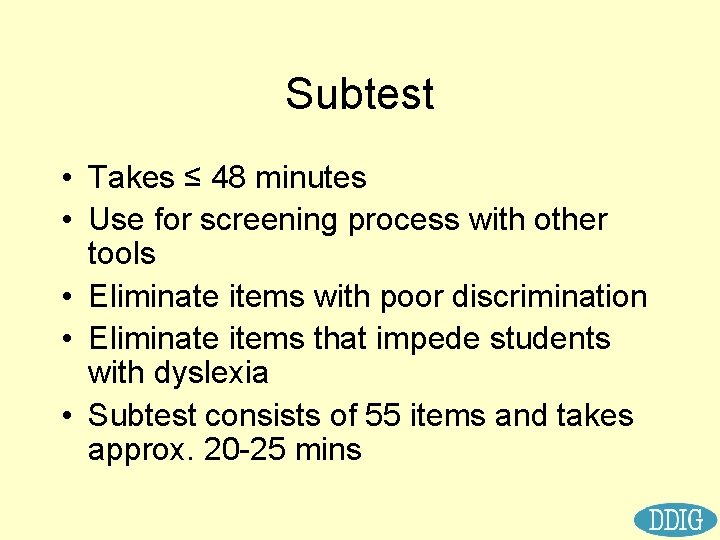
Subtest • Takes ≤ 48 minutes • Use for screening process with other tools • Eliminate items with poor discrimination • Eliminate items that impede students with dyslexia • Subtest consists of 55 items and takes approx. 20 -25 mins
Graph: percentage scores on the subtest 100. 00 O dyscalculic O dyslexic 80. 00 O control percent 60. 00 40. 00 2 2 2 2 2 3 3 3 3 3 1 1 1 1 1 2 0 0 0 0 1 0 0 0 0 0 1 0 1 2 3 4 5 6 7 8 9 0 number
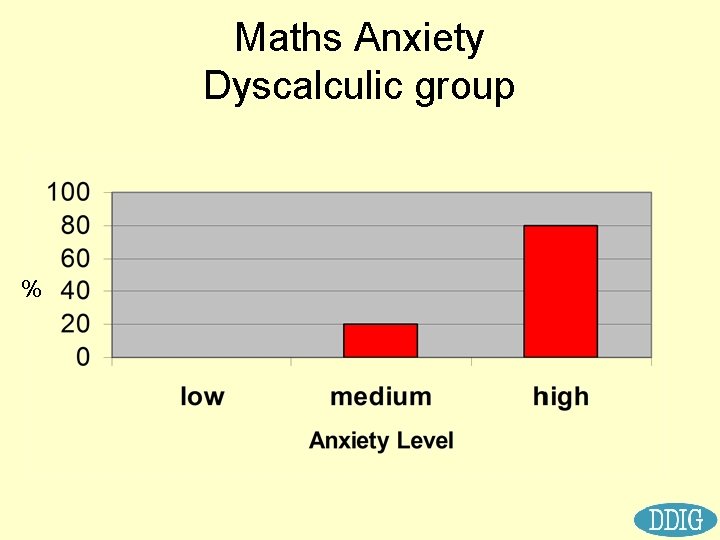
Maths Anxiety Dyscalculic group %
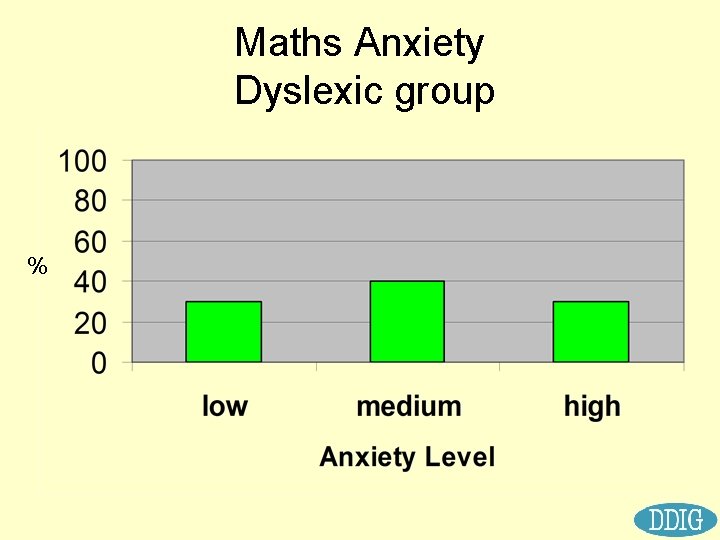
Maths Anxiety Dyslexic group %
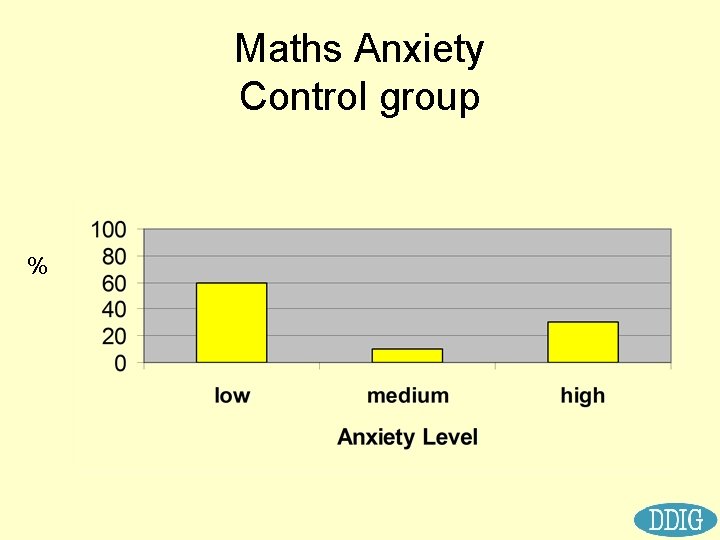
Maths Anxiety Control group %
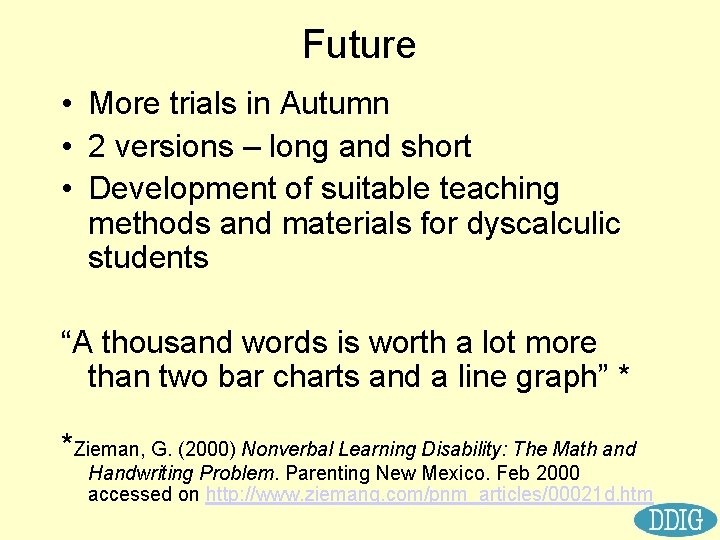
Future • More trials in Autumn • 2 versions – long and short • Development of suitable teaching methods and materials for dyscalculic students “A thousand words is worth a lot more than two bar charts and a line graph” * *Zieman, G. (2000) Nonverbal Learning Disability: The Math and Handwriting Problem. Parenting New Mexico. Feb 2000 accessed on http: //www. ziemang. com/pnm_articles/00021 d. htm
Acknowledgements • Tony Croft (Loughborough University) • Sarah Parsons (Harper Adams University College) • Fiona White (Leicester University) • Jane Jolliffe (Bournemouth University) • Jan Robertson (De Montfort University) • Higher Education Academy MSOR
References Beacham, N. and Trott, C. (2005) Screening for Dyscalculia within Higher Education, MSOR Connections: Quarterly Newsletter, Vol. 5, No. 1. Butterworth, B. (1999) The Mathematical Brain. London: Macmillan. Butterworth, B (2002) Ch. 10. From fear of fractions to the joy of maths http: //www. mathematicalbrain. com/test. html Dehaene, S. , & Cohen, L. (1997). Cerebral pathways for calculation: Double dissociation between rote verbal and quantitative knowledge of arithmetic. Cortex, 33, 219– 250. Dehaene, S. (1997) The number sense, New York Oxford University press. Dehaene, S. , Piazza, M. , Pinel, P. and Cohen, L. (2002) Three parietal circuits for number processing. Cognitive Neuropsychology, 2003, 20, pp. 487 -506 Df. ES (2001) The National Numeracy Strategy, Guidance to support pupils with dyslexia and dyscalculia Df. ES 0512/2001 Henderson, A. (2004) Working with Dyscalculia: Recognising Dyscalclulia overcoming barriers to learning in maths, Learning Works International Ltd. The National Center for Learning Disabilities, http: //www. ld. org/LDInfo. Zone/Info. Zone_Fact. Sheet_Dyscacluia. cfm, Access: 22/10/03 Newman, R. M. (1997) Dyscalculia Symptoms: dyscalculia. org (online), Available from http: //www. dyscalculia. org/calc. html, Accessed on 29/10/01. Rourke, B. P. (1998) Significance of Verbal-Performance Discrepancies for Subtypes of Children with Learning Disabilities. WISC-III Clinical Uses and Interpretation. Eds. Prifitera, A, and Saklofske, D. Academic Press. Sharma, M. (1997) Dyscalculia. http: //www. dyscalculia. org/Berkshire. Math. html, Accessed on 24/11/04. Trott, C. (2003), Mathematics Support for Dyslexic Students. In Lawson, D, Croft, T. and Halpin, M. Good Practice in the Provision of Mathematics Support Centres, pp 22 -28 LTSN MSOR, ISSN 1476 -1378. Reprinted in MSOR Connections Vol. 3 (3) November 2003 Pp 17 -20 ISSN 1473 -4869. Zieman, G. (2000) Nonverbal Learning Disability: The Math and Handwriting Problem. Parenting New Mexico. Feb 2000 accessed on http: //www. ziemang. com/pnm_articles/00021 d. htm
Contact details • Clare Trott – Email: C. Trott@lboro. ac. uk • Nigel Beacham – Email: N. Beacham@lboro. ac. uk • Also see Dyscalculia and Dyslexia Interest Group (DDIG) website – http: //ddig. lboro. ac. uk