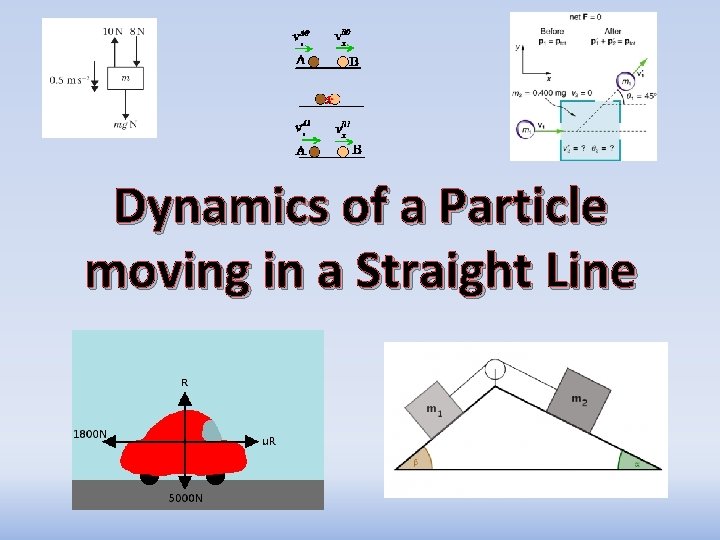
Dynamics of a Particle moving in a Straight








- Slides: 84
Dynamics of a Particle moving in a Straight Line
Introduction • This chapter teaches you how to deal with forces acting on an object • You will learn how to use several formulae (inspired by Isaac Newton) • You will learn how to model situations involving friction, particles moving on slopes and when joined over pulleys • You will also learn laws of momentum and impulse
Teachings for Exercise 3 A
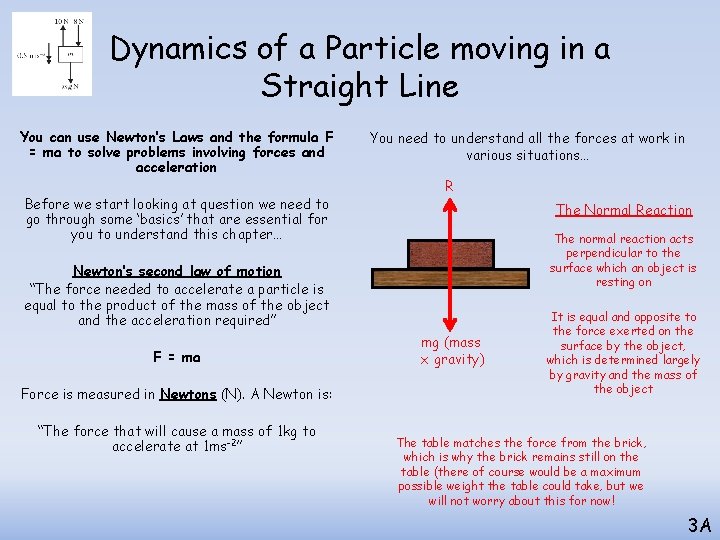
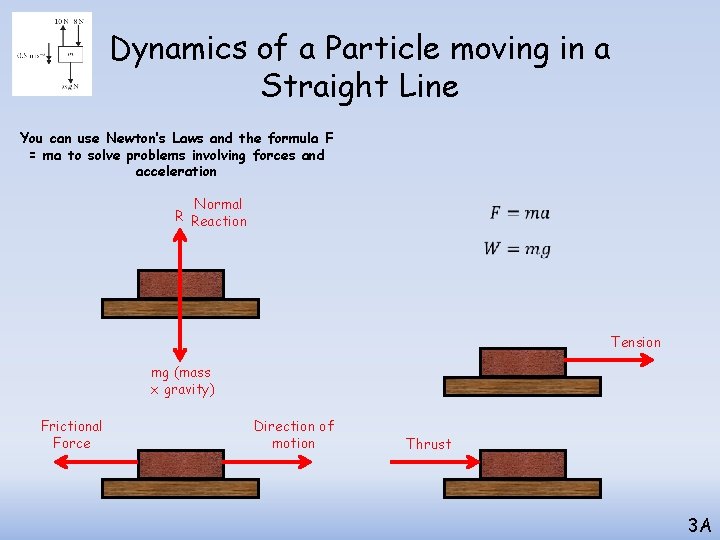
Dynamics of a Particle moving in a Straight Line You can use Newton’s Laws and the formula F = ma to solve problems involving forces and acceleration Before we start looking at question we need to go through some ‘basics’ that are essential for you to understand this chapter… You need to understand all the forces at work in various situations… R The Normal Reaction The normal reaction acts perpendicular to the surface which an object is resting on Newton’s second law of motion “The force needed to accelerate a particle is equal to the product of the mass of the object and the acceleration required” F = ma Force is measured in Newtons (N). A Newton is: “The force that will cause a mass of 1 kg to accelerate at 1 ms-2” mg (mass x gravity) It is equal and opposite to the force exerted on the surface by the object, which is determined largely by gravity and the mass of the object The table matches the force from the brick, which is why the brick remains still on the table (there of course would be a maximum possible weight the table could take, but we will not worry about this for now! 3 A
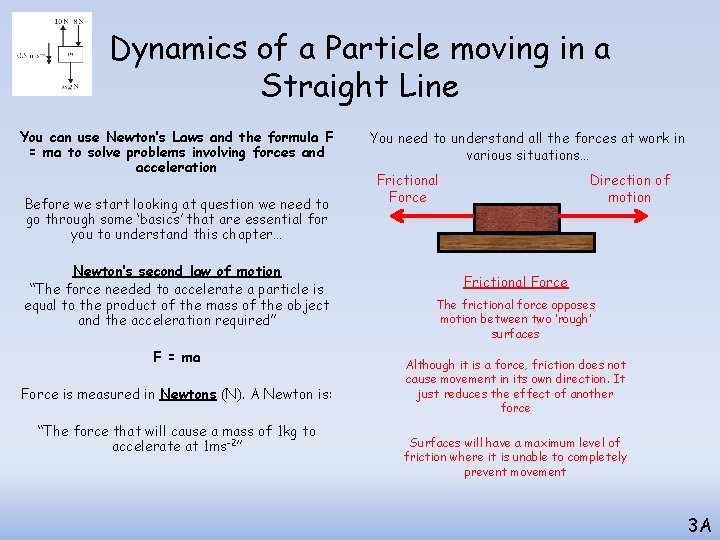
Dynamics of a Particle moving in a Straight Line You can use Newton’s Laws and the formula F = ma to solve problems involving forces and acceleration Before we start looking at question we need to go through some ‘basics’ that are essential for you to understand this chapter… Newton’s second law of motion “The force needed to accelerate a particle is equal to the product of the mass of the object and the acceleration required” F = ma Force is measured in Newtons (N). A Newton is: “The force that will cause a mass of 1 kg to accelerate at 1 ms-2” You need to understand all the forces at work in various situations… Frictional Force Direction of motion Frictional Force The frictional force opposes motion between two ‘rough’ surfaces Although it is a force, friction does not cause movement in its own direction. It just reduces the effect of another force Surfaces will have a maximum level of friction where it is unable to completely prevent movement 3 A
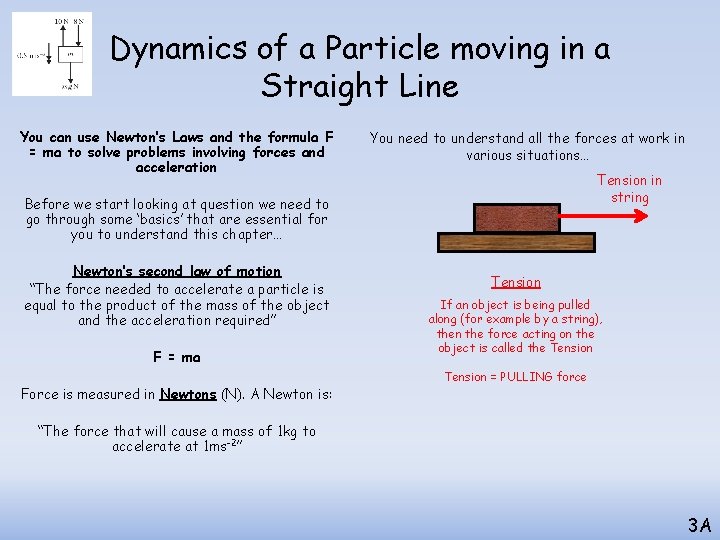
Dynamics of a Particle moving in a Straight Line You can use Newton’s Laws and the formula F = ma to solve problems involving forces and acceleration You need to understand all the forces at work in various situations… Tension in string Before we start looking at question we need to go through some ‘basics’ that are essential for you to understand this chapter… Newton’s second law of motion “The force needed to accelerate a particle is equal to the product of the mass of the object and the acceleration required” F = ma Force is measured in Newtons (N). A Newton is: Tension If an object is being pulled along (for example by a string), then the force acting on the object is called the Tension = PULLING force “The force that will cause a mass of 1 kg to accelerate at 1 ms-2” 3 A
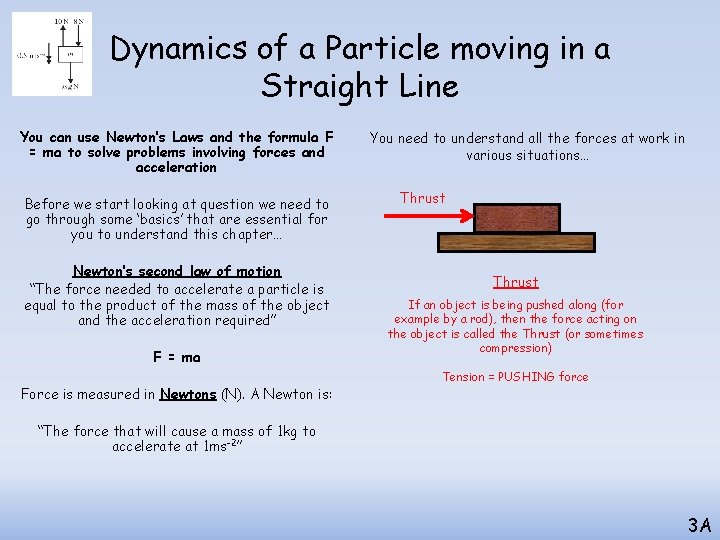
Dynamics of a Particle moving in a Straight Line You can use Newton’s Laws and the formula F = ma to solve problems involving forces and acceleration Before we start looking at question we need to go through some ‘basics’ that are essential for you to understand this chapter… Newton’s second law of motion “The force needed to accelerate a particle is equal to the product of the mass of the object and the acceleration required” F = ma Force is measured in Newtons (N). A Newton is: You need to understand all the forces at work in various situations… Thrust If an object is being pushed along (for example by a rod), then the force acting on the object is called the Thrust (or sometimes compression) Tension = PUSHING force “The force that will cause a mass of 1 kg to accelerate at 1 ms-2” 3 A
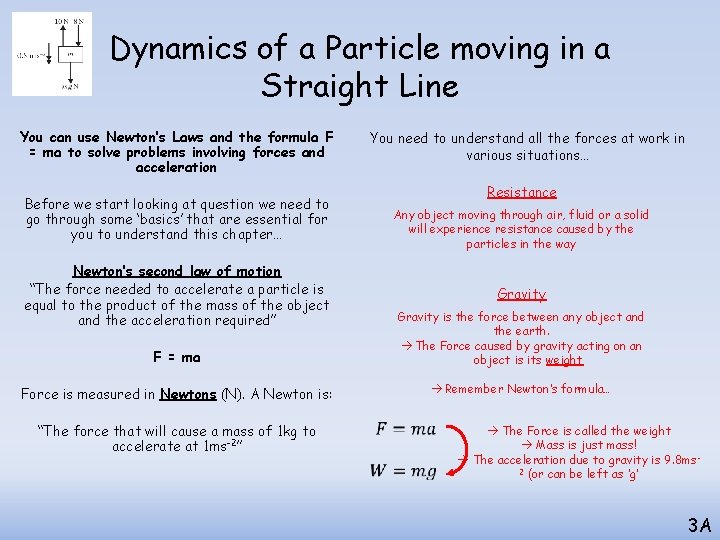
Dynamics of a Particle moving in a Straight Line You can use Newton’s Laws and the formula F = ma to solve problems involving forces and acceleration You need to understand all the forces at work in various situations… Resistance Before we start looking at question we need to go through some ‘basics’ that are essential for you to understand this chapter… Any object moving through air, fluid or a solid will experience resistance caused by the particles in the way Newton’s second law of motion “The force needed to accelerate a particle is equal to the product of the mass of the object and the acceleration required” Gravity is the force between any object and the earth. The Force caused by gravity acting on an object is its weight F = ma Remember Newton’s formula… Force is measured in Newtons (N). A Newton is: “The force that will cause a mass of 1 kg to accelerate at 1 ms-2” The Force is called the weight Mass is just mass! The acceleration due to gravity is 9. 8 ms 2 (or can be left as ‘g’ 3 A
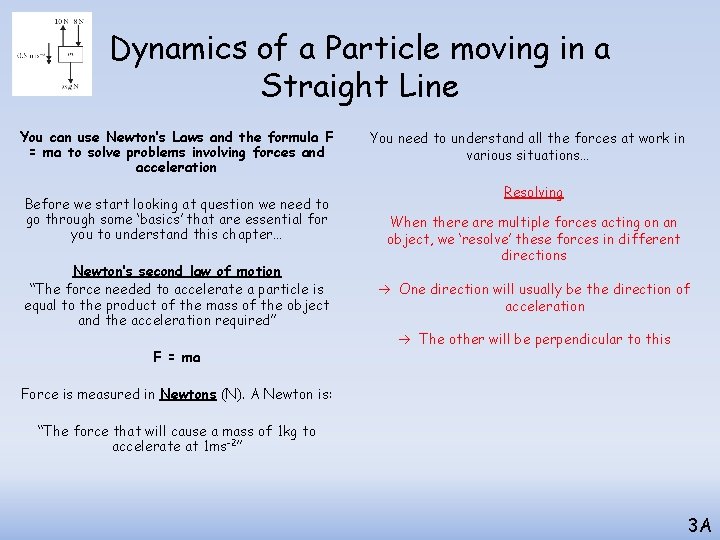
Dynamics of a Particle moving in a Straight Line You can use Newton’s Laws and the formula F = ma to solve problems involving forces and acceleration Before we start looking at question we need to go through some ‘basics’ that are essential for you to understand this chapter… Newton’s second law of motion “The force needed to accelerate a particle is equal to the product of the mass of the object and the acceleration required” F = ma You need to understand all the forces at work in various situations… Resolving When there are multiple forces acting on an object, we ‘resolve’ these forces in different directions One direction will usually be the direction of acceleration The other will be perpendicular to this Force is measured in Newtons (N). A Newton is: “The force that will cause a mass of 1 kg to accelerate at 1 ms-2” 3 A
Dynamics of a Particle moving in a Straight Line You can use Newton’s Laws and the formula F = ma to solve problems involving forces and acceleration Normal R Reaction Tension mg (mass x gravity) Frictional Force Direction of motion Thrust 3 A
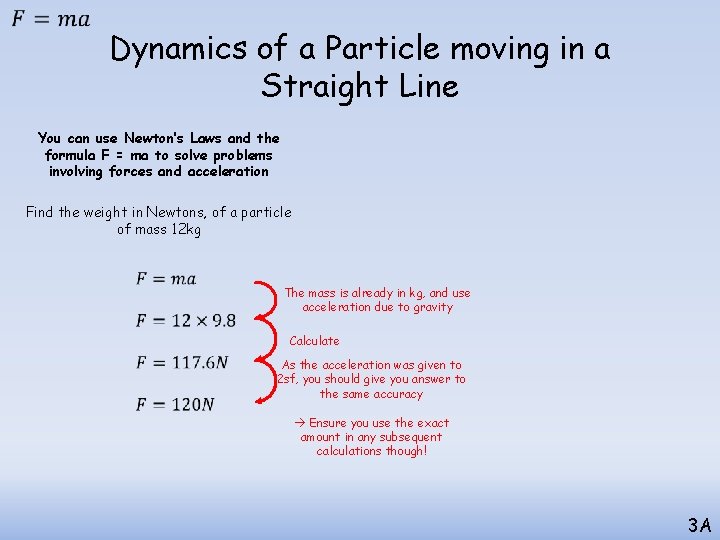
Dynamics of a Particle moving in a Straight Line You can use Newton’s Laws and the formula F = ma to solve problems involving forces and acceleration Find the weight in Newtons, of a particle of mass 12 kg The mass is already in kg, and use acceleration due to gravity Calculate As the acceleration was given to 2 sf, you should give you answer to the same accuracy Ensure you use the exact amount in any subsequent calculations though! 3 A
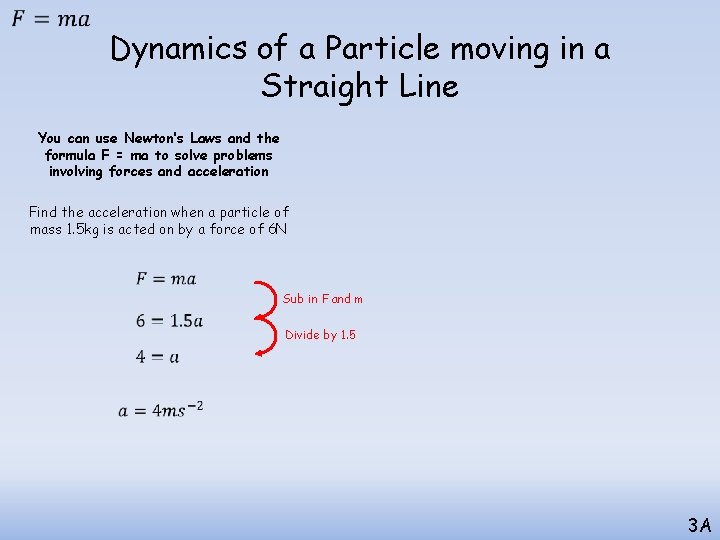
Dynamics of a Particle moving in a Straight Line You can use Newton’s Laws and the formula F = ma to solve problems involving forces and acceleration Find the acceleration when a particle of mass 1. 5 kg is acted on by a force of 6 N Sub in F and m Divide by 1. 5 3 A
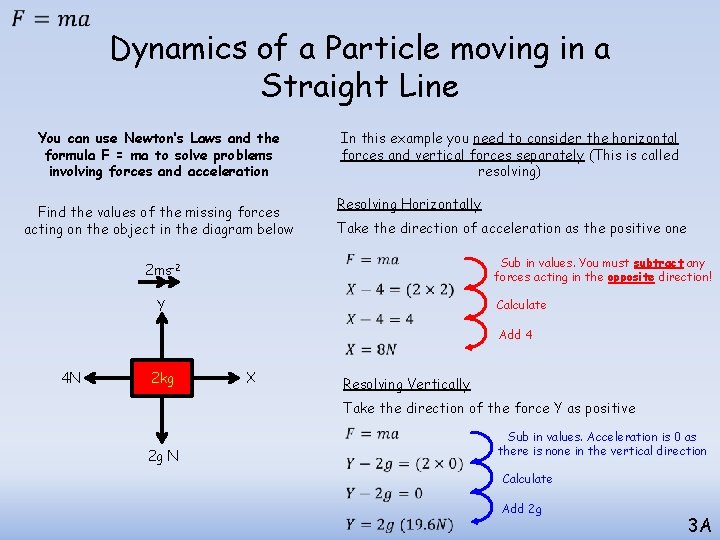
Dynamics of a Particle moving in a Straight Line You can use Newton’s Laws and the formula F = ma to solve problems involving forces and acceleration Find the values of the missing forces acting on the object in the diagram below In this example you need to consider the horizontal forces and vertical forces separately (This is called resolving) Resolving Horizontally Take the direction of acceleration as the positive one 2 ms-2 Y 4 N 2 kg X Sub in values. You must subtract any forces acting in the opposite direction! Calculate Add 4 Resolving Vertically Take the direction of the force Y as positive 2 g N Sub in values. Acceleration is 0 as there is none in the vertical direction Calculate Add 2 g 3 A
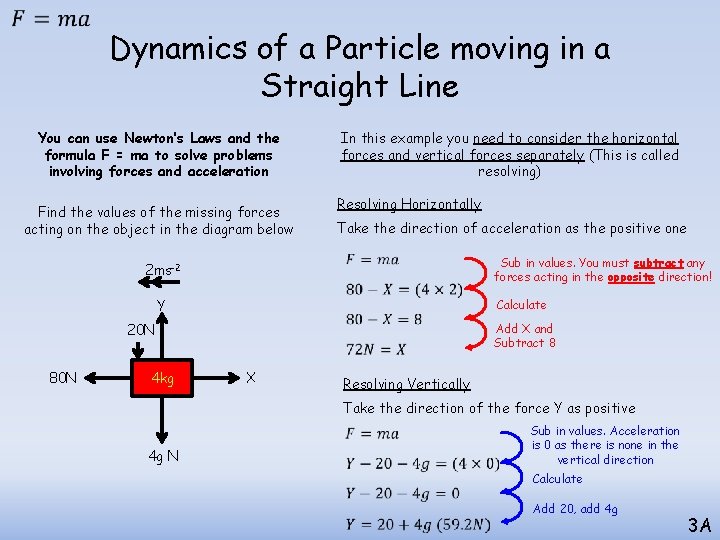
Dynamics of a Particle moving in a Straight Line You can use Newton’s Laws and the formula F = ma to solve problems involving forces and acceleration Find the values of the missing forces acting on the object in the diagram below In this example you need to consider the horizontal forces and vertical forces separately (This is called resolving) Resolving Horizontally Take the direction of acceleration as the positive one 2 ms-2 Y 20 N 80 N 4 kg X Sub in values. You must subtract any forces acting in the opposite direction! Calculate Add X and Subtract 8 Resolving Vertically Take the direction of the force Y as positive 4 g N Sub in values. Acceleration is 0 as there is none in the vertical direction Calculate Add 20, add 4 g 3 A
Teachings for Exercise 3 B
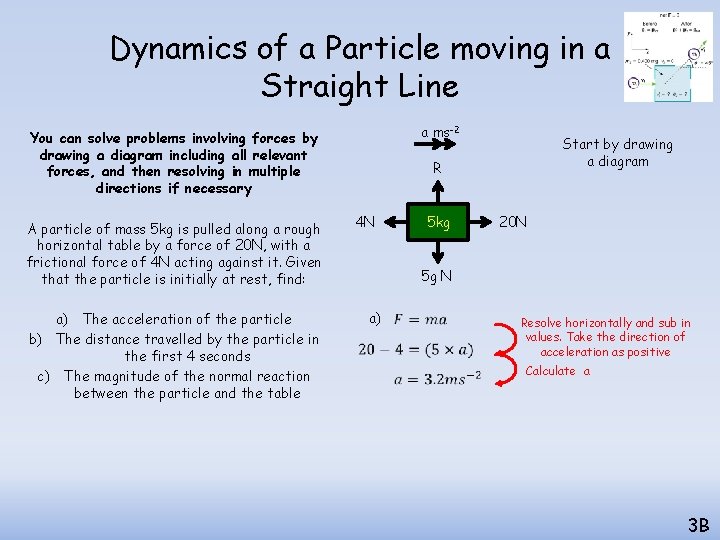
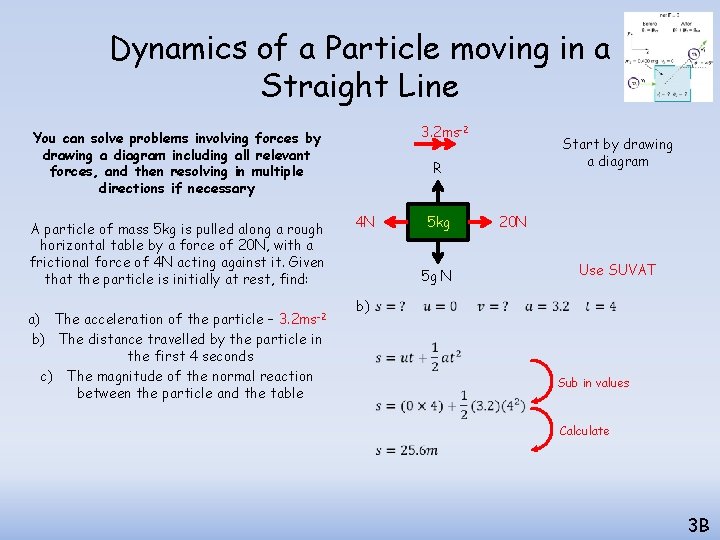
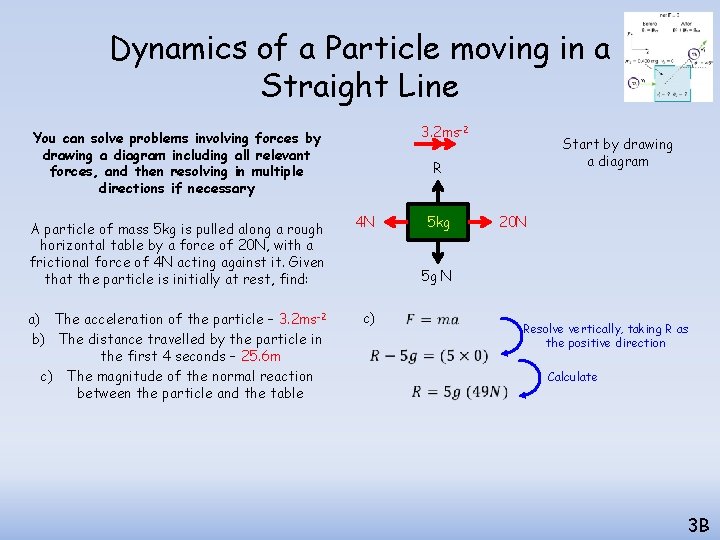
Dynamics of a Particle moving in a Straight Line a ms-2 You can solve problems involving forces by drawing a diagram including all relevant forces, and then resolving in multiple directions if necessary A particle of mass 5 kg is pulled along a rough horizontal table by a force of 20 N, with a frictional force of 4 N acting against it. Given that the particle is initially at rest, find: a) The acceleration of the particle b) The distance travelled by the particle in the first 4 seconds c) The magnitude of the normal reaction between the particle and the table Start by drawing a diagram R 4 N 5 kg 20 N 5 g N a) Resolve horizontally and sub in values. Take the direction of acceleration as positive Calculate a 3 B
Dynamics of a Particle moving in a Straight Line 3. 2 ms-2 You can solve problems involving forces by drawing a diagram including all relevant forces, and then resolving in multiple directions if necessary A particle of mass 5 kg is pulled along a rough horizontal table by a force of 20 N, with a frictional force of 4 N acting against it. Given that the particle is initially at rest, find: a) The acceleration of the particle – b) The distance travelled by the particle in the first 4 seconds c) The magnitude of the normal reaction between the particle and the table 3. 2 ms-2 Start by drawing a diagram R 4 N 5 kg 20 N Use SUVAT 5 g N b) Sub in values Calculate 3 B
Dynamics of a Particle moving in a Straight Line 3. 2 ms-2 You can solve problems involving forces by drawing a diagram including all relevant forces, and then resolving in multiple directions if necessary Start by drawing a diagram R A particle of mass 5 kg is pulled along a rough horizontal table by a force of 20 N, with a frictional force of 4 N acting against it. Given that the particle is initially at rest, find: 4 N a) The acceleration of the particle – 3. 2 ms-2 b) The distance travelled by the particle in the first 4 seconds – 25. 6 m c) The magnitude of the normal reaction between the particle and the table c) 5 kg 20 N 5 g N Resolve vertically, taking R as the positive direction Calculate 3 B
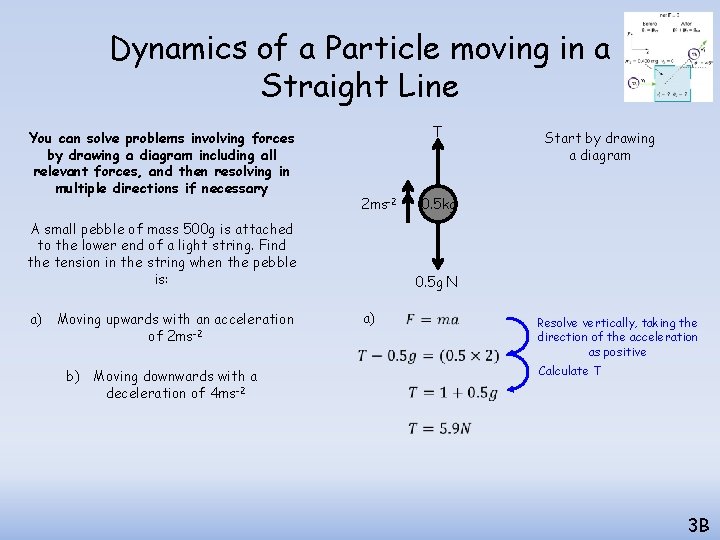
Dynamics of a Particle moving in a Straight Line T You can solve problems involving forces by drawing a diagram including all relevant forces, and then resolving in multiple directions if necessary 2 ms-2 0. 5 kg A small pebble of mass 500 g is attached to the lower end of a light string. Find the tension in the string when the pebble is: 0. 5 g N a) a) Moving upwards with an acceleration of 2 ms-2 b) Moving downwards with a deceleration of 4 ms-2 Start by drawing a diagram Resolve vertically, taking the direction of the acceleration as positive Calculate T 3 B
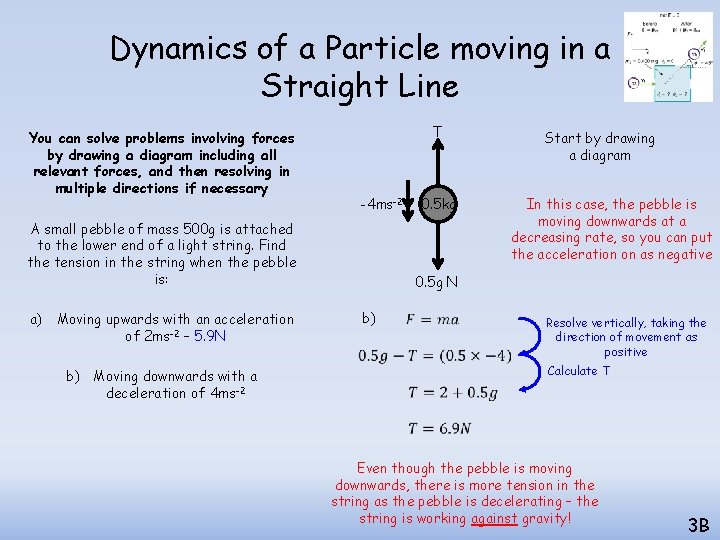
Dynamics of a Particle moving in a Straight Line T You can solve problems involving forces by drawing a diagram including all relevant forces, and then resolving in multiple directions if necessary -4 ms-2 0. 5 kg A small pebble of mass 500 g is attached to the lower end of a light string. Find the tension in the string when the pebble is: In this case, the pebble is moving downwards at a decreasing rate, so you can put the acceleration on as negative 0. 5 g N b) a) Moving upwards with an acceleration of 2 ms-2 – 5. 9 N b) Moving downwards with a deceleration of 4 ms-2 Start by drawing a diagram Resolve vertically, taking the direction of movement as positive Calculate T Even though the pebble is moving downwards, there is more tension in the string as the pebble is decelerating – the string is working against gravity! 3 B
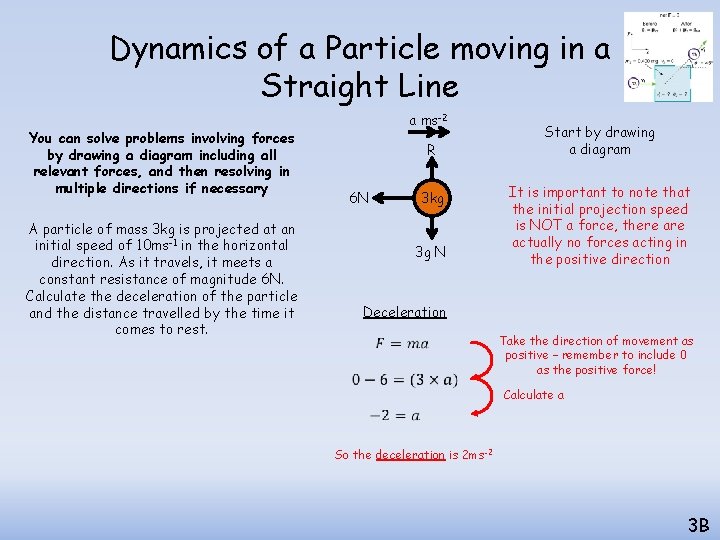
Dynamics of a Particle moving in a Straight Line You can solve problems involving forces by drawing a diagram including all relevant forces, and then resolving in multiple directions if necessary a ms-2 R 6 N A particle of mass 3 kg is projected at an initial speed of 10 ms-1 in the horizontal direction. As it travels, it meets a constant resistance of magnitude 6 N. Calculate the deceleration of the particle and the distance travelled by the time it comes to rest. 3 kg 3 g N Start by drawing a diagram It is important to note that the initial projection speed is NOT a force, there actually no forces acting in the positive direction Deceleration Take the direction of movement as positive – remember to include 0 as the positive force! Calculate a So the deceleration is 2 ms-2 3 B
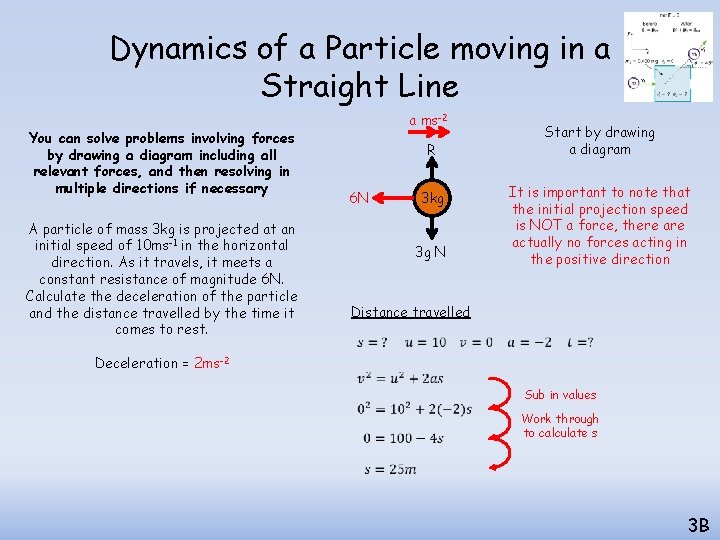
Dynamics of a Particle moving in a Straight Line You can solve problems involving forces by drawing a diagram including all relevant forces, and then resolving in multiple directions if necessary A particle of mass 3 kg is projected at an initial speed of 10 ms-1 in the horizontal direction. As it travels, it meets a constant resistance of magnitude 6 N. Calculate the deceleration of the particle and the distance travelled by the time it comes to rest. Deceleration = 2 ms-2 a ms-2 Start by drawing a diagram R 6 N It is important to note that the initial projection speed is NOT a force, there actually no forces acting in the positive direction 3 kg 3 g N Distance travelled Sub in values Work through to calculate s 3 B
Teachings for Exercise 3 C
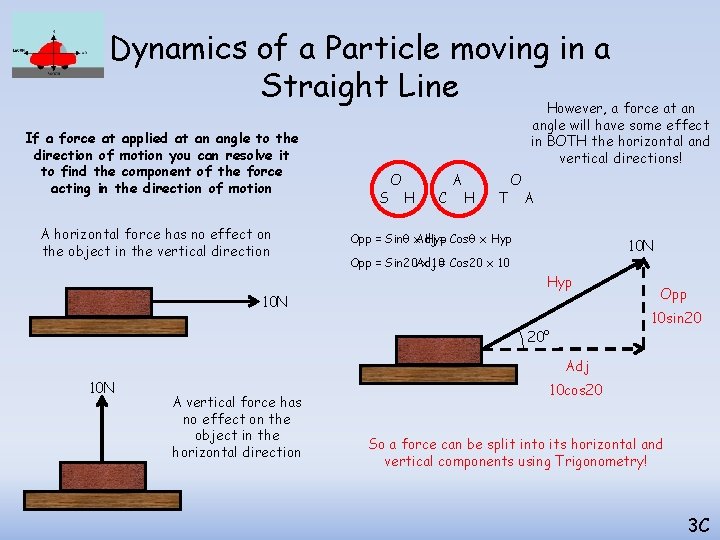
Dynamics of a Particle moving in a Straight Line However, a force at an If a force at applied at an angle to the direction of motion you can resolve it to find the component of the force acting in the direction of motion A horizontal force has no effect on the object in the vertical direction angle will have some effect in BOTH the horizontal and vertical directions! S O H C A H T O A Opp = Sinθ x. Adj Hyp = Cosθ x Hyp 10 N Opp = Sin 20 Adj x 10= Cos 20 x 10 Hyp 10 N Opp 10 sin 20 20° Adj 10 N A vertical force has no effect on the object in the horizontal direction 10 cos 20 So a force can be split into its horizontal and vertical components using Trigonometry! 3 C
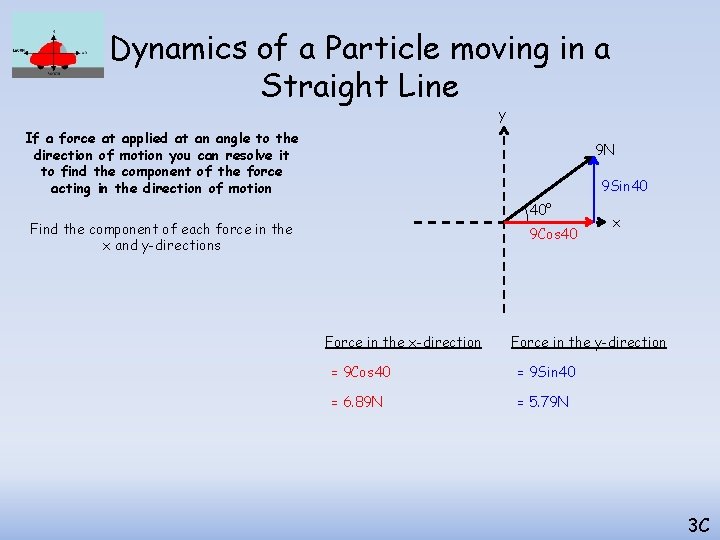
Dynamics of a Particle moving in a Straight Line y If a force at applied at an angle to the direction of motion you can resolve it to find the component of the force acting in the direction of motion 9 N 9 Sin 40 40° Find the component of each force in the x and y-directions 9 Cos 40 Force in the x-direction x Force in the y-direction = 9 Cos 40 = 9 Sin 40 = 6. 89 N = 5. 79 N 3 C
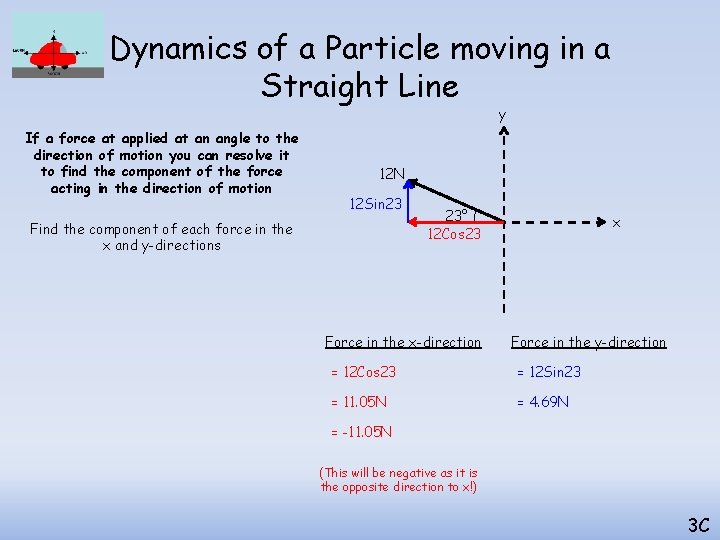
Dynamics of a Particle moving in a Straight Line y If a force at applied at an angle to the direction of motion you can resolve it to find the component of the force acting in the direction of motion 12 N 12 Sin 23 Find the component of each force in the x and y-directions 23° 12 Cos 23 Force in the x-direction x Force in the y-direction = 12 Cos 23 = 12 Sin 23 = 11. 05 N = 4. 69 N = -11. 05 N (This will be negative as it is the opposite direction to x!) 3 C
Teachings for Exercise 3 D
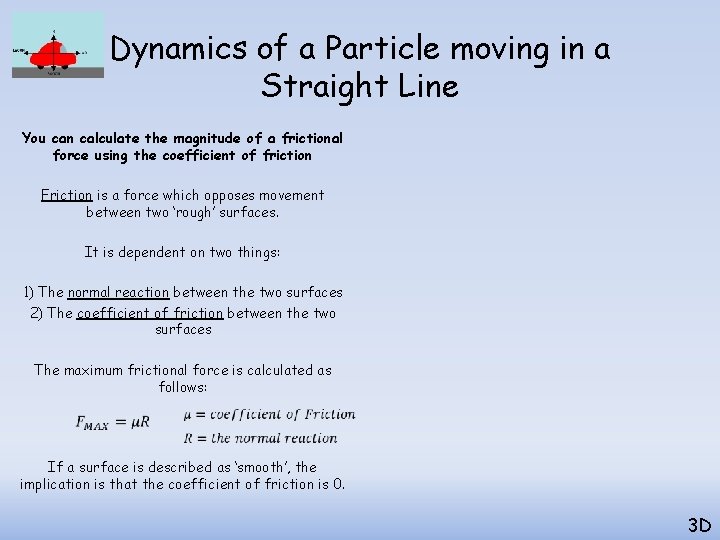
Dynamics of a Particle moving in a Straight Line You can calculate the magnitude of a frictional force using the coefficient of friction Friction is a force which opposes movement between two ‘rough’ surfaces. It is dependent on two things: 1) The normal reaction between the two surfaces 2) The coefficient of friction between the two surfaces The maximum frictional force is calculated as follows: If a surface is described as ‘smooth’, the implication is that the coefficient of friction is 0. 3 D
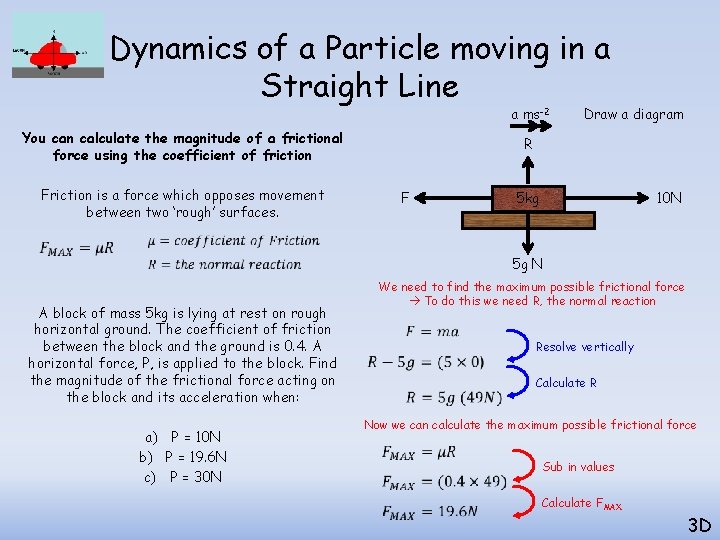
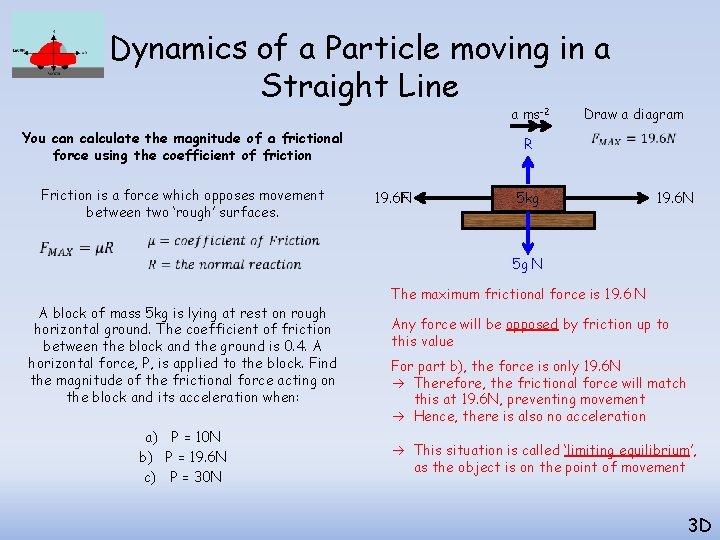
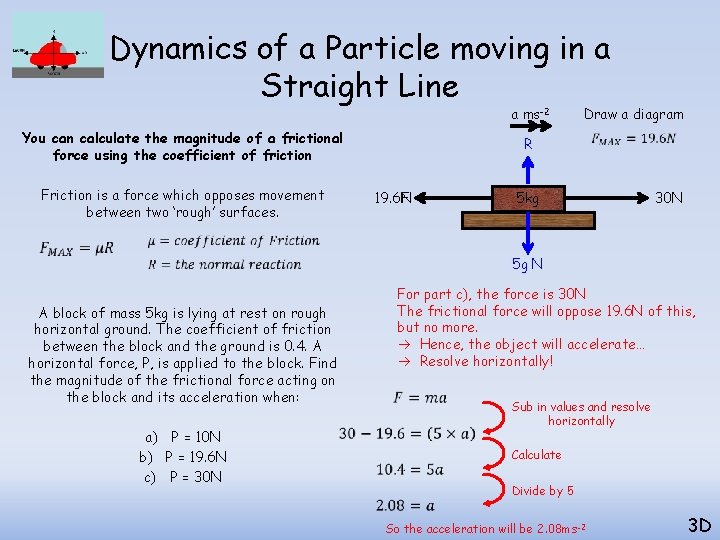
Dynamics of a Particle moving in a Straight Line a ms-2 You can calculate the magnitude of a frictional force using the coefficient of friction R Friction is a force which opposes movement between two ‘rough’ surfaces. F A block of mass 5 kg is lying at rest on rough horizontal ground. The coefficient of friction between the block and the ground is 0. 4. A horizontal force, P, is applied to the block. Find the magnitude of the frictional force acting on the block and its acceleration when: a) P = 10 N b) P = 19. 6 N c) P = 30 N Draw a diagram 5 kg 10 N 5 g N We need to find the maximum possible frictional force To do this we need R, the normal reaction Resolve vertically Calculate R Now we can calculate the maximum possible frictional force Sub in values Calculate FMAX 3 D
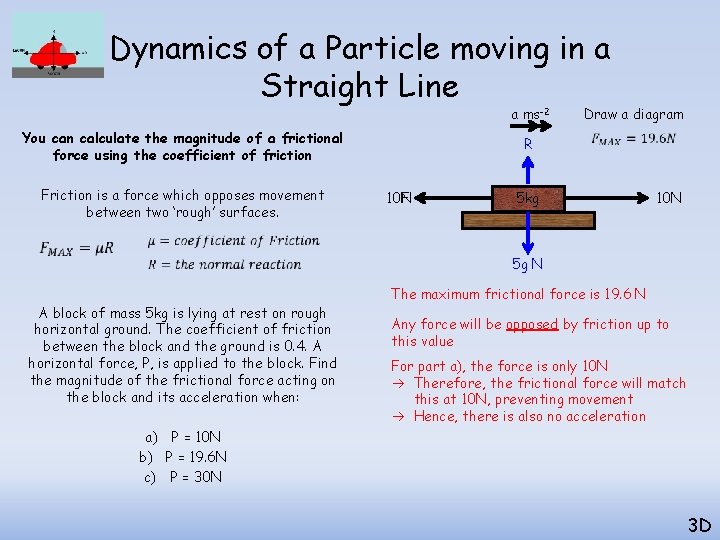
Dynamics of a Particle moving in a Straight Line a ms-2 You can calculate the magnitude of a frictional force using the coefficient of friction Friction is a force which opposes movement between two ‘rough’ surfaces. A block of mass 5 kg is lying at rest on rough horizontal ground. The coefficient of friction between the block and the ground is 0. 4. A horizontal force, P, is applied to the block. Find the magnitude of the frictional force acting on the block and its acceleration when: R 10 N F Draw a diagram 5 kg 10 N 5 g N The maximum frictional force is 19. 6 N Any force will be opposed by friction up to this value For part a), the force is only 10 N Therefore, the frictional force will match this at 10 N, preventing movement Hence, there is also no acceleration a) P = 10 N b) P = 19. 6 N c) P = 30 N 3 D
Dynamics of a Particle moving in a Straight Line a ms-2 You can calculate the magnitude of a frictional force using the coefficient of friction Friction is a force which opposes movement between two ‘rough’ surfaces. A block of mass 5 kg is lying at rest on rough horizontal ground. The coefficient of friction between the block and the ground is 0. 4. A horizontal force, P, is applied to the block. Find the magnitude of the frictional force acting on the block and its acceleration when: a) P = 10 N b) P = 19. 6 N c) P = 30 N R 19. 6 N F Draw a diagram 5 kg 19. 6 N 5 g N The maximum frictional force is 19. 6 N Any force will be opposed by friction up to this value For part b), the force is only 19. 6 N Therefore, the frictional force will match this at 19. 6 N, preventing movement Hence, there is also no acceleration This situation is called ‘limiting equilibrium’, as the object is on the point of movement 3 D
Dynamics of a Particle moving in a Straight Line a ms-2 You can calculate the magnitude of a frictional force using the coefficient of friction Friction is a force which opposes movement between two ‘rough’ surfaces. R 19. 6 N F 5 kg 30 N 5 g N For part c), the force is 30 N The frictional force will oppose 19. 6 N of this, but no more. Hence, the object will accelerate… Resolve horizontally! A block of mass 5 kg is lying at rest on rough horizontal ground. The coefficient of friction between the block and the ground is 0. 4. A horizontal force, P, is applied to the block. Find the magnitude of the frictional force acting on the block and its acceleration when: a) P = 10 N b) P = 19. 6 N c) P = 30 N Draw a diagram Sub in values and resolve horizontally Calculate Divide by 5 So the acceleration will be 2. 08 ms -2 3 D
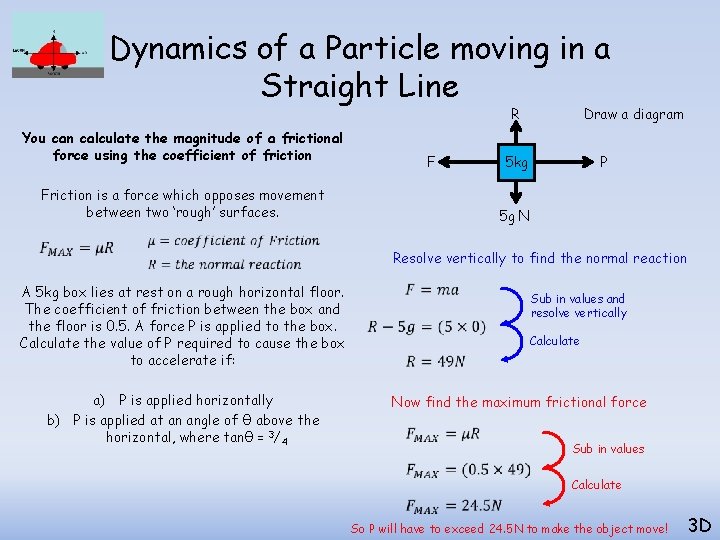
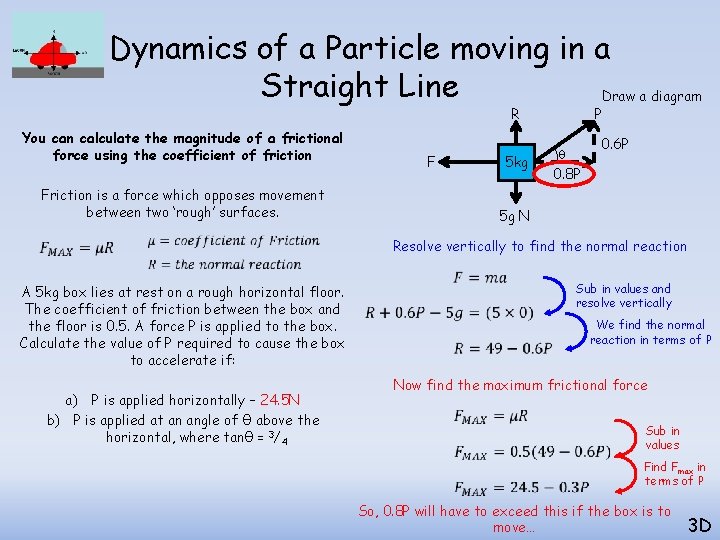
Dynamics of a Particle moving in a Straight Line R You can calculate the magnitude of a frictional force using the coefficient of friction F Friction is a force which opposes movement between two ‘rough’ surfaces. a) P is applied horizontally b) P is applied at an angle of θ above the horizontal, where tanθ = 3/4 5 kg P 5 g N A 5 kg box lies at rest on a rough horizontal floor. The coefficient of friction between the box and the floor is 0. 5. A force P is applied to the box. Calculate the value of P required to cause the box to accelerate if: Draw a diagram Resolve vertically to find the normal reaction Sub in values and resolve vertically Calculate Now find the maximum frictional force Sub in values Calculate So P will have to exceed 24. 5 N to make the object move! 3 D
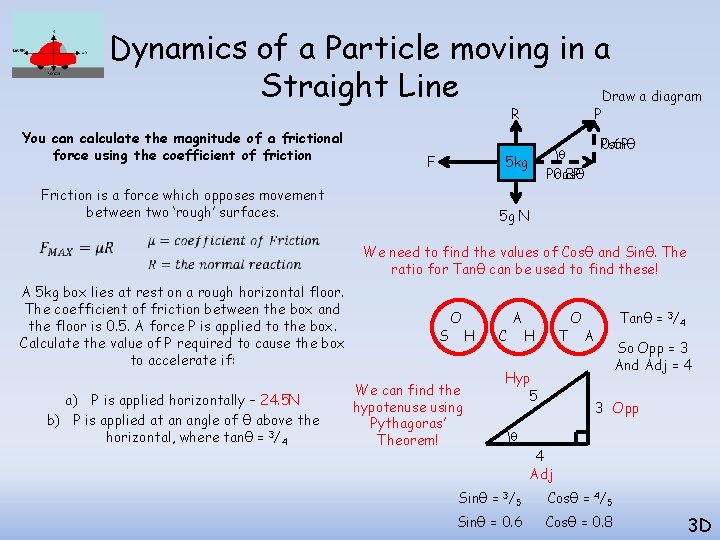
Dynamics of a Particle moving in a Straight Line Draw a diagram R You can calculate the magnitude of a frictional force using the coefficient of friction F A 5 kg box lies at rest on a rough horizontal floor. The coefficient of friction between the box and the floor is 0. 5. A force P is applied to the box. Calculate the value of P required to cause the box to accelerate if: a) P is applied horizontally – 24. 5 N b) P is applied at an angle of θ above the horizontal, where tanθ = 3/4 Psinθ 0. 6 P θ 5 kg Friction is a force which opposes movement between two ‘rough’ surfaces. P Pcosθ 0. 8 P 5 g N We need to find the values of Cosθ and Sinθ. The ratio for Tanθ can be used to find these! S O We can find the hypotenuse using Pythagoras’ Theorem! H C A H T Hyp 5 O Tanθ = 3/4 A So Opp = 3 And Adj = 4 3 Opp θ 4 Adj Sinθ = 3/5 Cosθ = 4/5 Sinθ = 0. 6 Cosθ = 0. 8 3 D
Dynamics of a Particle moving in a Straight Line Draw a diagram R You can calculate the magnitude of a frictional force using the coefficient of friction F 5 kg Friction is a force which opposes movement between two ‘rough’ surfaces. a) P is applied horizontally – 24. 5 N b) P is applied at an angle of θ above the horizontal, where tanθ = 3/4 0. 6 P θ 0. 8 P 5 g N A 5 kg box lies at rest on a rough horizontal floor. The coefficient of friction between the box and the floor is 0. 5. A force P is applied to the box. Calculate the value of P required to cause the box to accelerate if: P Resolve vertically to find the normal reaction Sub in values and resolve vertically We find the normal reaction in terms of P Now find the maximum frictional force Sub in values Find Fmax in terms of P So, 0. 8 P will have to exceed this if the box is to move… 3 D
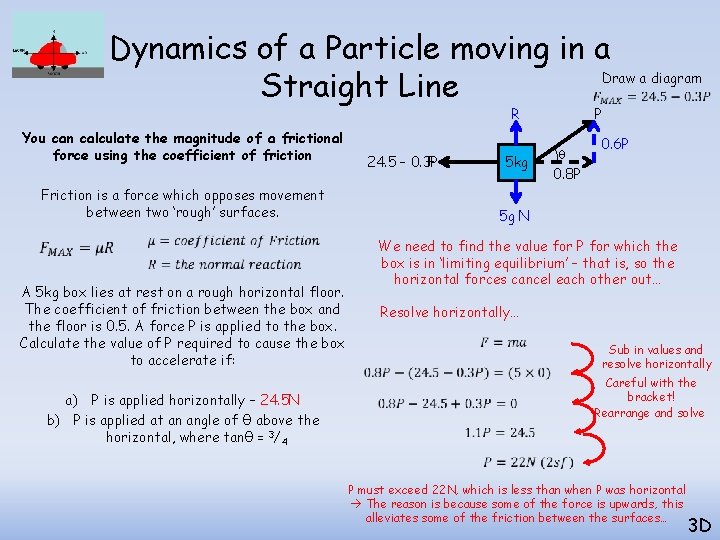
Dynamics of a Particle moving in a Draw a diagram Straight Line R You can calculate the magnitude of a frictional force using the coefficient of friction 24. 5 – 0. 3 P F 5 kg Friction is a force which opposes movement between two ‘rough’ surfaces. a) P is applied horizontally – 24. 5 N b) P is applied at an angle of θ above the horizontal, where tanθ = 3/4 θ 0. 6 P 0. 8 P 5 g N A 5 kg box lies at rest on a rough horizontal floor. The coefficient of friction between the box and the floor is 0. 5. A force P is applied to the box. Calculate the value of P required to cause the box to accelerate if: P We need to find the value for P for which the box is in ‘limiting equilibrium’ – that is, so the horizontal forces cancel each other out… Resolve horizontally… Sub in values and resolve horizontally Careful with the bracket! Rearrange and solve P must exceed 22 N, which is less than when P was horizontal The reason is because some of the force is upwards, this alleviates some of the friction between the surfaces… 3 D
Teachings for Exercise 3 E
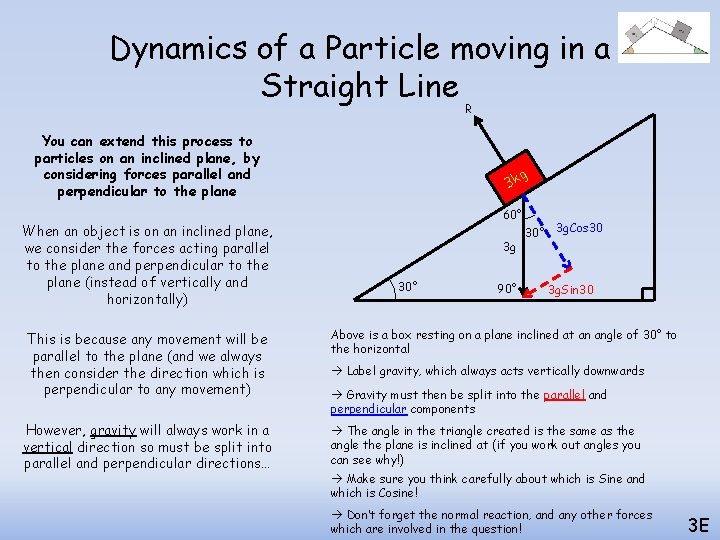
Dynamics of a Particle moving in a Straight Line R You can extend this process to particles on an inclined plane, by considering forces parallel and perpendicular to the plane When an object is on an inclined plane, we consider the forces acting parallel to the plane and perpendicular to the plane (instead of vertically and horizontally) This is because any movement will be parallel to the plane (and we always then consider the direction which is perpendicular to any movement) However, gravity will always work in a vertical direction so must be split into parallel and perpendicular directions… g 3 k 60° 3 g 30° 90° 3 g. Cos 30 3 g. Sin 30 Above is a box resting on a plane inclined at an angle of 30° to the horizontal Label gravity, which always acts vertically downwards Gravity must then be split into the parallel and perpendicular components The angle in the triangle created is the same as the angle the plane is inclined at (if you work out angles you can see why!) Make sure you think carefully about which is Sine and which is Cosine! Don’t forget the normal reaction, and any other forces which are involved in the question! 3 E
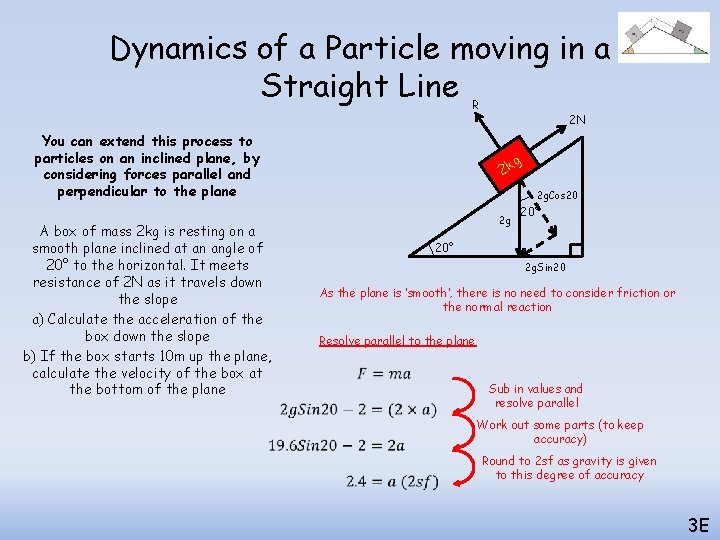
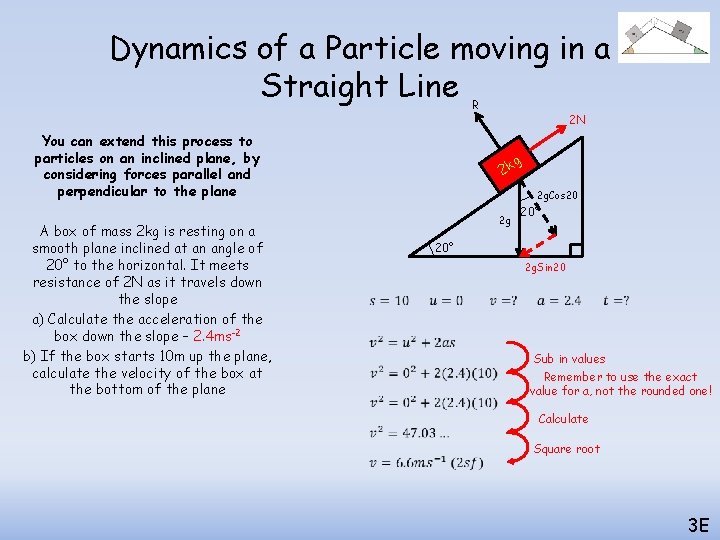
Dynamics of a Particle moving in a Straight Line R You can extend this process to particles on an inclined plane, by considering forces parallel and perpendicular to the plane 2 N g 2 k 2 g. Cos 20 2 g A box of mass 2 kg is resting on a smooth plane inclined at an angle of 20° to the horizontal. It meets resistance of 2 N as it travels down the slope a) Calculate the acceleration of the box down the slope b) If the box starts 10 m up the plane, calculate the velocity of the box at the bottom of the plane 20° 2 g. Sin 20 As the plane is ‘smooth’, there is no need to consider friction or the normal reaction Resolve parallel to the plane Sub in values and resolve parallel Work out some parts (to keep accuracy) Round to 2 sf as gravity is given to this degree of accuracy 3 E
Dynamics of a Particle moving in a Straight Line R 2 N You can extend this process to particles on an inclined plane, by considering forces parallel and perpendicular to the plane A box of mass 2 kg is resting on a smooth plane inclined at an angle of 20° to the horizontal. It meets resistance of 2 N as it travels down the slope a) Calculate the acceleration of the box down the slope – 2. 4 ms-2 b) If the box starts 10 m up the plane, calculate the velocity of the box at the bottom of the plane g 2 k 2 g. Cos 20 2 g 20° 2 g. Sin 20 Sub in values Remember to use the exact value for a, not the rounded one! Calculate Square root 3 E
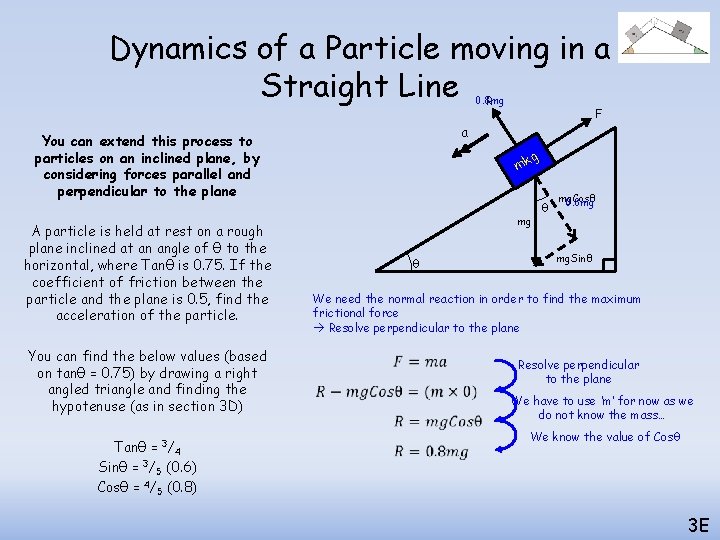
Dynamics of a Particle moving in a Straight Line 0. 8 mg R a You can extend this process to particles on an inclined plane, by considering forces parallel and perpendicular to the plane A particle is held at rest on a rough plane inclined at an angle of θ to the horizontal, where Tanθ is 0. 75. If the coefficient of friction between the particle and the plane is 0. 5, find the acceleration of the particle. You can find the below values (based on tanθ = 0. 75) by drawing a right angled triangle and finding the hypotenuse (as in section 3 D) Tanθ = 3/4 Sinθ = 3/5 (0. 6) Cosθ = 4/5 (0. 8) F g mk mg θ θ mg. Cosθ 0. 8 mg mg. Sinθ We need the normal reaction in order to find the maximum frictional force Resolve perpendicular to the plane We have to use ‘m’ for now as we do not know the mass… We know the value of Cosθ 3 E
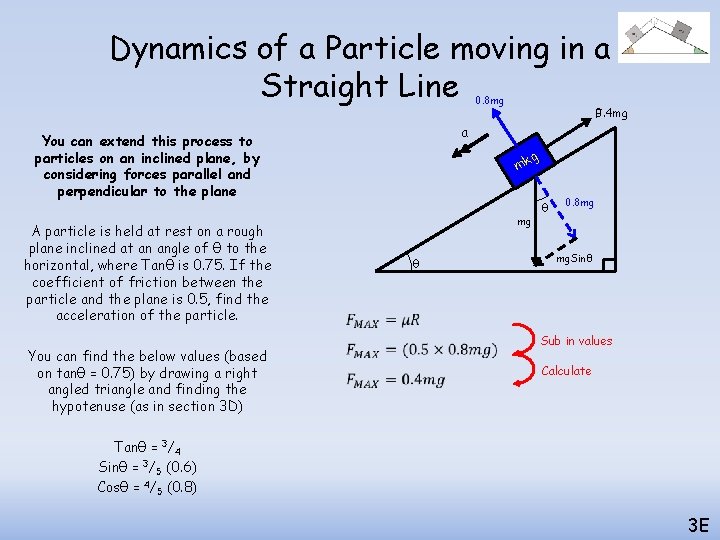
Dynamics of a Particle moving in a Straight Line 0. 8 mg a You can extend this process to particles on an inclined plane, by considering forces parallel and perpendicular to the plane A particle is held at rest on a rough plane inclined at an angle of θ to the horizontal, where Tanθ is 0. 75. If the coefficient of friction between the particle and the plane is 0. 5, find the acceleration of the particle. You can find the below values (based on tanθ = 0. 75) by drawing a right angled triangle and finding the hypotenuse (as in section 3 D) 0. 4 mg F g mk mg θ θ 0. 8 mg mg. Sinθ Sub in values Calculate Tanθ = 3/4 Sinθ = 3/5 (0. 6) Cosθ = 4/5 (0. 8) 3 E
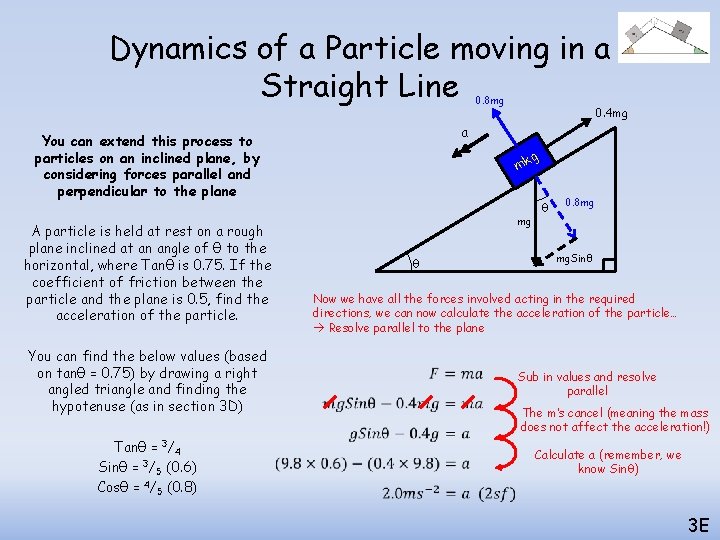
Dynamics of a Particle moving in a Straight Line 0. 8 mg a You can extend this process to particles on an inclined plane, by considering forces parallel and perpendicular to the plane g mk A particle is held at rest on a rough plane inclined at an angle of θ to the horizontal, where Tanθ is 0. 75. If the coefficient of friction between the particle and the plane is 0. 5, find the acceleration of the particle. You can find the below values (based on tanθ = 0. 75) by drawing a right angled triangle and finding the hypotenuse (as in section 3 D) Tanθ = 3/4 Sinθ = 3/5 (0. 6) Cosθ = 4/5 (0. 8) 0. 4 mg mg θ 0. 8 mg mg. Sinθ θ Now we have all the forces involved acting in the required directions, we can now calculate the acceleration of the particle… Resolve parallel to the plane Sub in values and resolve parallel The m’s cancel (meaning the mass does not affect the acceleration!) Calculate a (remember, we know Sinθ) 3 E
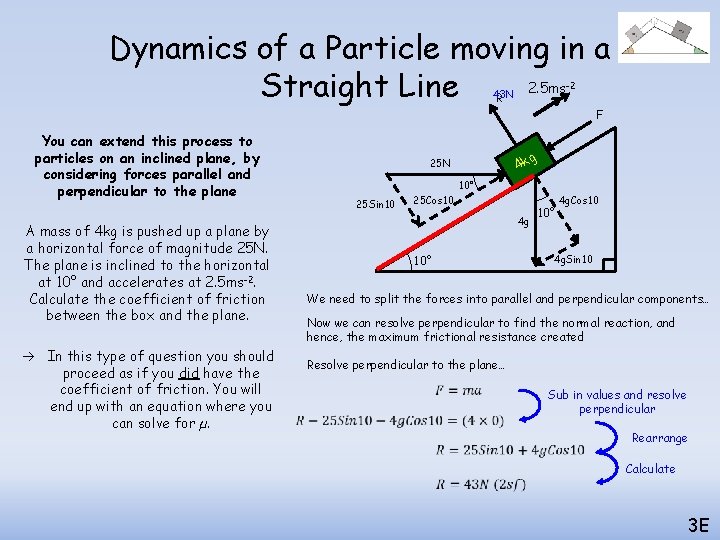
Dynamics of a Particle moving in a 2. 5 ms Straight Line -2 43 N R F You can extend this process to particles on an inclined plane, by considering forces parallel and perpendicular to the plane 10° 25 Sin 10 25 Cos 10 4 g A mass of 4 kg is pushed up a plane by a horizontal force of magnitude 25 N. The plane is inclined to the horizontal at 10° and accelerates at 2. 5 ms-2. Calculate the coefficient of friction between the box and the plane. In this type of question you should proceed as if you did have the coefficient of friction. You will end up with an equation where you can solve for µ. g 4 k 25 N 10° 4 g. Cos 10 4 g. Sin 10 10° We need to split the forces into parallel and perpendicular components… Now we can resolve perpendicular to find the normal reaction, and hence, the maximum frictional resistance created Resolve perpendicular to the plane… Sub in values and resolve perpendicular Rearrange Calculate 3 E
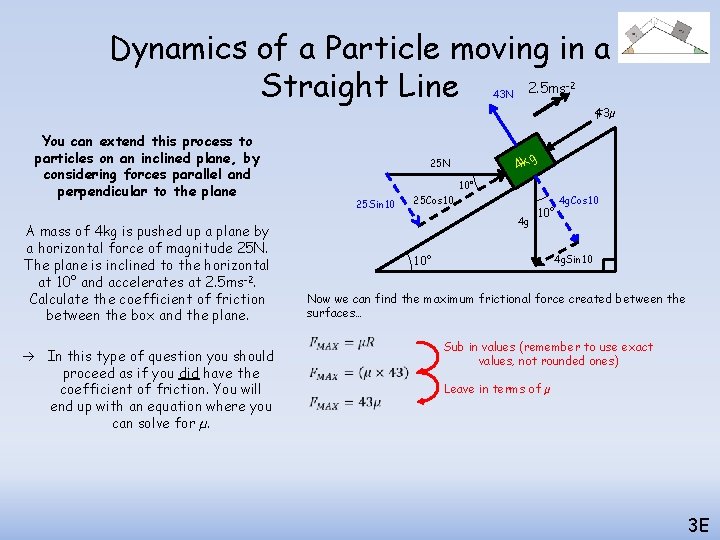
Dynamics of a Particle moving in a 2. 5 ms Straight Line -2 43 N 43µ F You can extend this process to particles on an inclined plane, by considering forces parallel and perpendicular to the plane A mass of 4 kg is pushed up a plane by a horizontal force of magnitude 25 N. The plane is inclined to the horizontal at 10° and accelerates at 2. 5 ms-2. Calculate the coefficient of friction between the box and the plane. In this type of question you should proceed as if you did have the coefficient of friction. You will end up with an equation where you can solve for µ. g 4 k 25 N 10° 25 Sin 10 25 Cos 10 4 g 10° 4 g. Cos 10 4 g. Sin 10 10° Now we can find the maximum frictional force created between the surfaces… Sub in values (remember to use exact values, not rounded ones) Leave in terms of µ 3 E
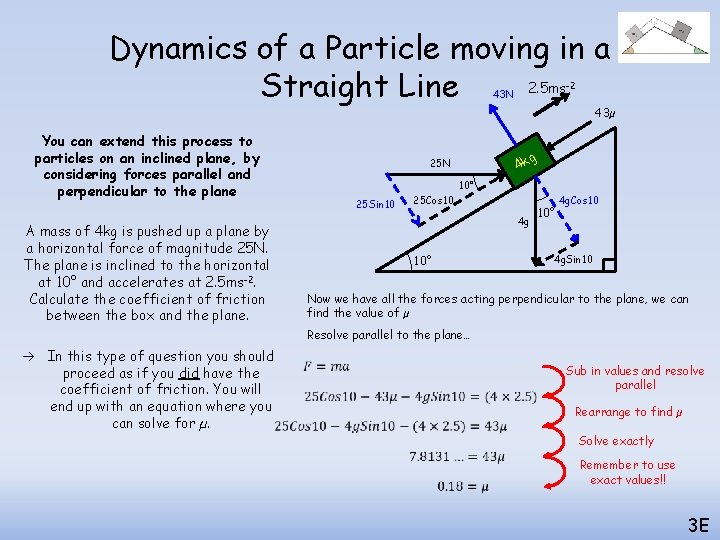
Dynamics of a Particle moving in a 2. 5 ms Straight Line -2 43 N 43µ You can extend this process to particles on an inclined plane, by considering forces parallel and perpendicular to the plane g 4 k 25 N 10° 25 Cos 10 25 Sin 10 4 g A mass of 4 kg is pushed up a plane by a horizontal force of magnitude 25 N. The plane is inclined to the horizontal at 10° and accelerates at 2. 5 ms-2. Calculate the coefficient of friction between the box and the plane. 10° 4 g. Cos 10 4 g. Sin 10 10° Now we have all the forces acting perpendicular to the plane, we can find the value of µ Resolve parallel to the plane… In this type of question you should proceed as if you did have the coefficient of friction. You will end up with an equation where you can solve for µ. Sub in values and resolve parallel Rearrange to find µ Solve exactly Remember to use exact values!! 3 E
Teachings for Exercise 3 F
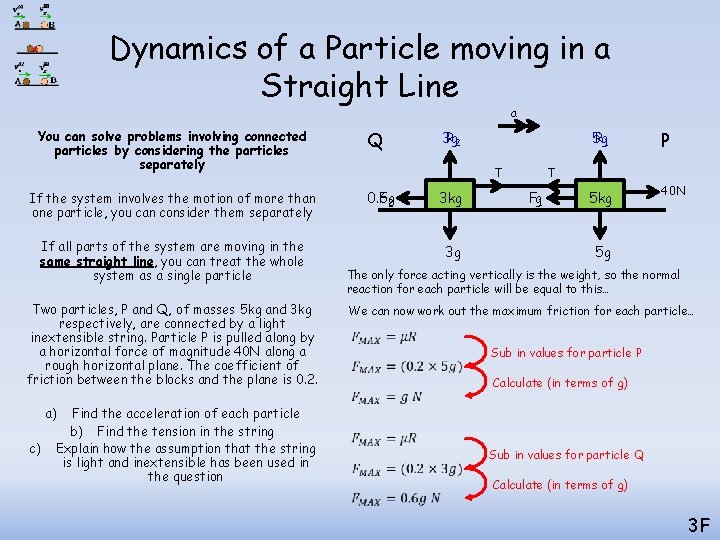
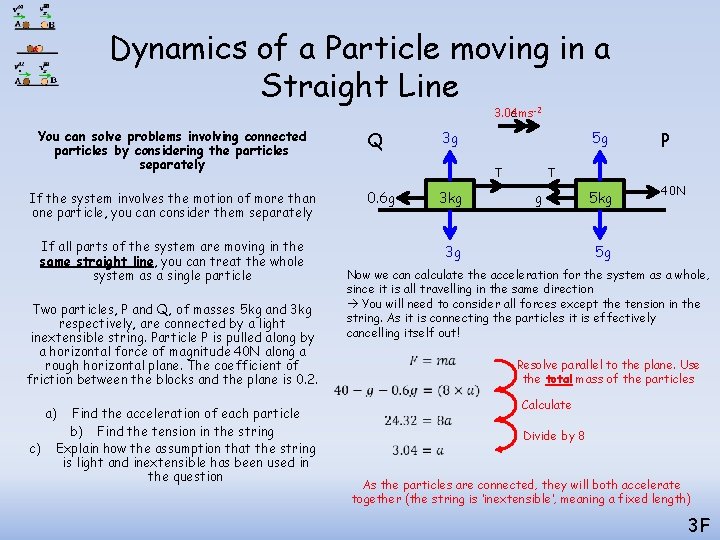
Dynamics of a Particle moving in a Straight Line a You can solve problems involving connected particles by considering the particles separately Q T 0. 6 g F 2 If the system involves the motion of more than one particle, you can consider them separately If all parts of the system are moving in the same straight line, you can treat the whole system as a single particle Two particles, P and Q, of masses 5 kg and 3 kg respectively, are connected by a light inextensible string. Particle P is pulled along by a horizontal force of magnitude 40 N along a rough horizontal plane. The coefficient of friction between the blocks and the plane is 0. 2. a) c) Find the acceleration of each particle b) Find the tension in the string Explain how the assumption that the string is light and inextensible has been used in the question 3 g R 2 3 kg 3 g 5 g R 1 P 5 kg 40 N T Fg 1 5 g The only force acting vertically is the weight, so the normal reaction for each particle will be equal to this… We can now work out the maximum friction for each particle… Sub in values for particle P Calculate (in terms of g) Sub in values for particle Q Calculate (in terms of g) 3 F
Dynamics of a Particle moving in a Straight Line 3. 04 ms a -2 You can solve problems involving connected particles by considering the particles separately Q T 0. 6 g If the system involves the motion of more than one particle, you can consider them separately If all parts of the system are moving in the same straight line, you can treat the whole system as a single particle Two particles, P and Q, of masses 5 kg and 3 kg respectively, are connected by a light inextensible string. Particle P is pulled along by a horizontal force of magnitude 40 N along a rough horizontal plane. The coefficient of friction between the blocks and the plane is 0. 2. a) c) Find the acceleration of each particle b) Find the tension in the string Explain how the assumption that the string is light and inextensible has been used in the question 3 g 3 kg 5 g P 5 kg 40 N T g 3 g 5 g Now we can calculate the acceleration for the system as a whole, since it is all travelling in the same direction You will need to consider all forces except the tension in the string. As it is connecting the particles it is effectively cancelling itself out! Resolve parallel to the plane. Use the total mass of the particles Calculate Divide by 8 As the particles are connected, they will both accelerate together (the string is ‘inextensible’, meaning a fixed length) 3 F
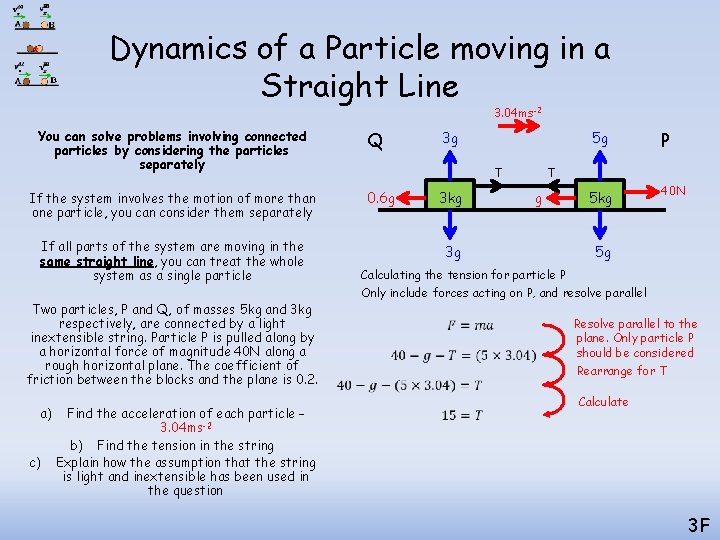
Dynamics of a Particle moving in a Straight Line 3. 04 ms-2 You can solve problems involving connected particles by considering the particles separately Q T 0. 6 g If the system involves the motion of more than one particle, you can consider them separately If all parts of the system are moving in the same straight line, you can treat the whole system as a single particle Two particles, P and Q, of masses 5 kg and 3 kg respectively, are connected by a light inextensible string. Particle P is pulled along by a horizontal force of magnitude 40 N along a rough horizontal plane. The coefficient of friction between the blocks and the plane is 0. 2. a) c) Find the acceleration of each particle – 3. 04 ms-2 b) Find the tension in the string Explain how the assumption that the string is light and inextensible has been used in the question 3 g 3 kg 3 g 5 g P 5 kg 40 N T g 5 g Calculating the tension for particle P Only include forces acting on P, and resolve parallel Resolve parallel to the plane. Only particle P should be considered Rearrange for T Calculate 3 F
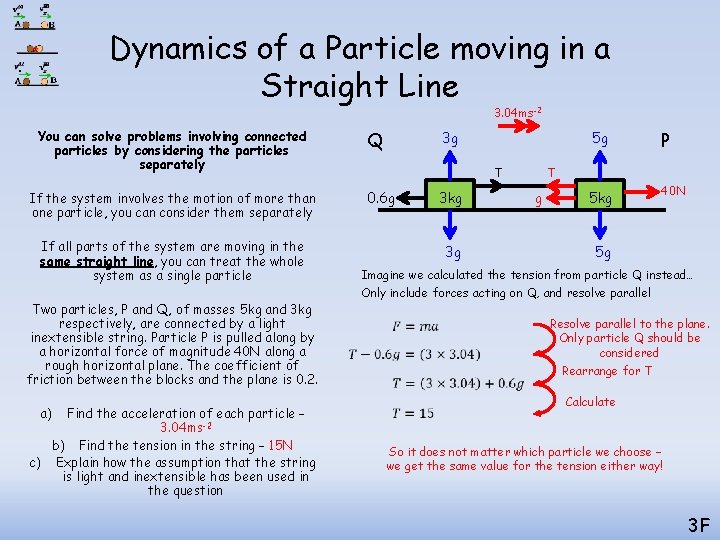
Dynamics of a Particle moving in a Straight Line 3. 04 ms-2 You can solve problems involving connected particles by considering the particles separately Q T 0. 6 g If the system involves the motion of more than one particle, you can consider them separately If all parts of the system are moving in the same straight line, you can treat the whole system as a single particle Two particles, P and Q, of masses 5 kg and 3 kg respectively, are connected by a light inextensible string. Particle P is pulled along by a horizontal force of magnitude 40 N along a rough horizontal plane. The coefficient of friction between the blocks and the plane is 0. 2. a) Find the acceleration of each particle – 3. 04 ms-2 b) Find the tension in the string – 15 N c) Explain how the assumption that the string is light and inextensible has been used in the question 3 g 3 kg 3 g 5 g P 5 kg 40 N T g 5 g Imagine we calculated the tension from particle Q instead… Only include forces acting on Q, and resolve parallel Resolve parallel to the plane. Only particle Q should be considered Rearrange for T Calculate So it does not matter which particle we choose – we get the same value for the tension either way! 3 F
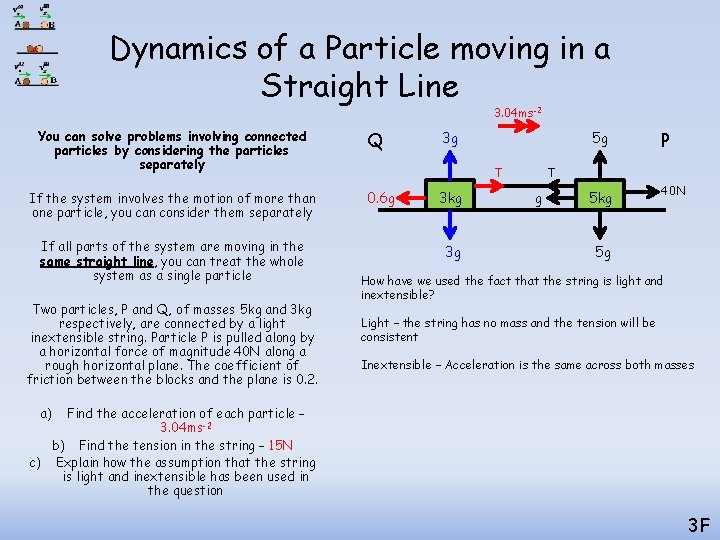
Dynamics of a Particle moving in a Straight Line 3. 04 ms-2 You can solve problems involving connected particles by considering the particles separately If the system involves the motion of more than one particle, you can consider them separately If all parts of the system are moving in the same straight line, you can treat the whole system as a single particle Two particles, P and Q, of masses 5 kg and 3 kg respectively, are connected by a light inextensible string. Particle P is pulled along by a horizontal force of magnitude 40 N along a rough horizontal plane. The coefficient of friction between the blocks and the plane is 0. 2. Q 3 g T 0. 6 g 3 kg 3 g 5 g P 5 kg 40 N T g 5 g How have we used the fact that the string is light and inextensible? Light – the string has no mass and the tension will be consistent Inextensible – Acceleration is the same across both masses a) Find the acceleration of each particle – 3. 04 ms-2 b) Find the tension in the string – 15 N c) Explain how the assumption that the string is light and inextensible has been used in the question 3 F
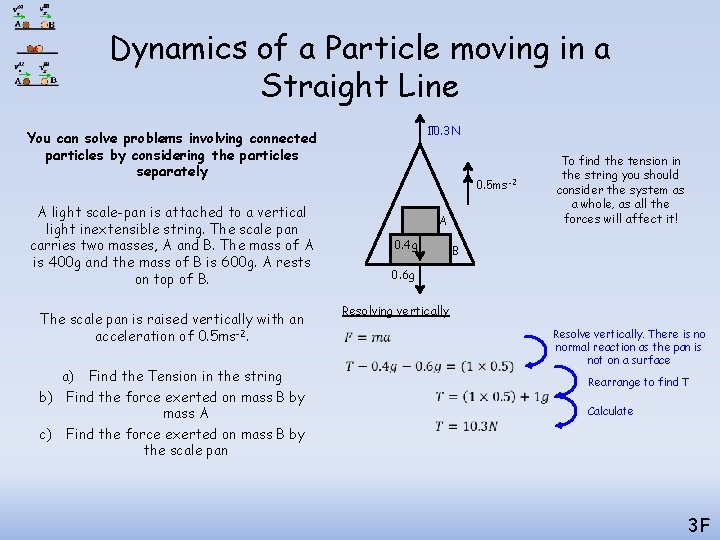
Dynamics of a Particle moving in a Straight Line 10. 3 N T You can solve problems involving connected particles by considering the particles separately 0. 5 ms-2 A light scale-pan is attached to a vertical light inextensible string. The scale pan carries two masses, A and B. The mass of A is 400 g and the mass of B is 600 g. A rests on top of B. The scale pan is raised vertically with an acceleration of 0. 5 ms-2. a) Find the Tension in the string b) Find the force exerted on mass B by mass A c) Find the force exerted on mass B by the scale pan A 0. 4 g To find the tension in the string you should consider the system as a whole, as all the forces will affect it! B 0. 6 g Resolving vertically Resolve vertically. There is no normal reaction as the pan is not on a surface Rearrange to find T Calculate 3 F
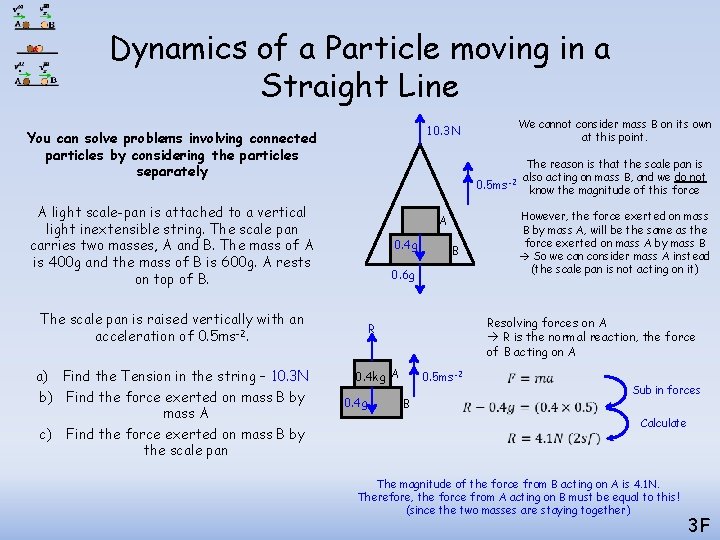
Dynamics of a Particle moving in a Straight Line 0. 5 ms-2 A light scale-pan is attached to a vertical light inextensible string. The scale pan carries two masses, A and B. The mass of A is 400 g and the mass of B is 600 g. A rests on top of B. 0. 4 g B 0. 6 g Resolving forces on A R is the normal reaction, the force of B acting on A R 0. 4 kg A 0. 4 g The reason is that the scale pan is also acting on mass B, and we do not know the magnitude of this force However, the force exerted on mass B by mass A, will be the same as the force exerted on mass A by mass B So we can consider mass A instead (the scale pan is not acting on it) A The scale pan is raised vertically with an acceleration of 0. 5 ms-2. a) Find the Tension in the string – 10. 3 N b) Find the force exerted on mass B by mass A c) Find the force exerted on mass B by the scale pan We cannot consider mass B on its own at this point. 10. 3 N You can solve problems involving connected particles by considering the particles separately 0. 5 ms-2 B Sub in forces Calculate The magnitude of the force from B acting on A is 4. 1 N. Therefore, the force from A acting on B must be equal to this! (since the two masses are staying together) 3 F
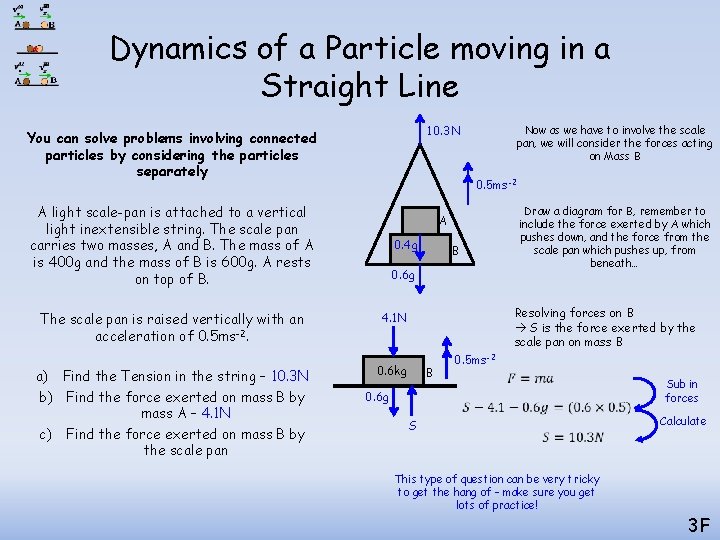
Dynamics of a Particle moving in a Straight Line Now as we have to involve the scale pan, we will consider the forces acting on Mass B 10. 3 N You can solve problems involving connected particles by considering the particles separately 0. 5 ms-2 A light scale-pan is attached to a vertical light inextensible string. The scale pan carries two masses, A and B. The mass of A is 400 g and the mass of B is 600 g. A rests on top of B. Draw a diagram for B, remember to include the force exerted by A which pushes down, and the force from the scale pan which pushes up, from beneath… A 0. 4 g B 0. 6 g The scale pan is raised vertically with an acceleration of 0. 5 ms-2. 4. 1 N a) Find the Tension in the string – 10. 3 N b) Find the force exerted on mass B by mass A – 4. 1 N c) Find the force exerted on mass B by the scale pan 0. 6 kg Resolving forces on B S is the force exerted by the scale pan on mass B B 0. 6 g S 0. 5 ms-2 Sub in forces Calculate This type of question can be very tricky to get the hang of – make sure you get lots of practice! 3 F
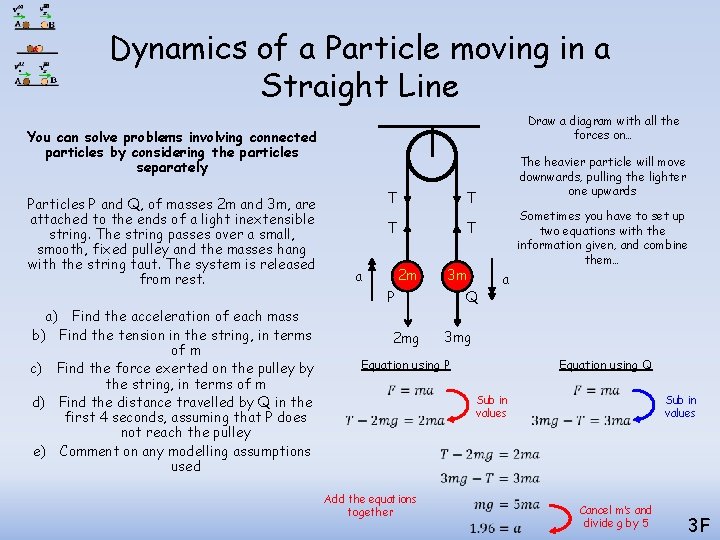
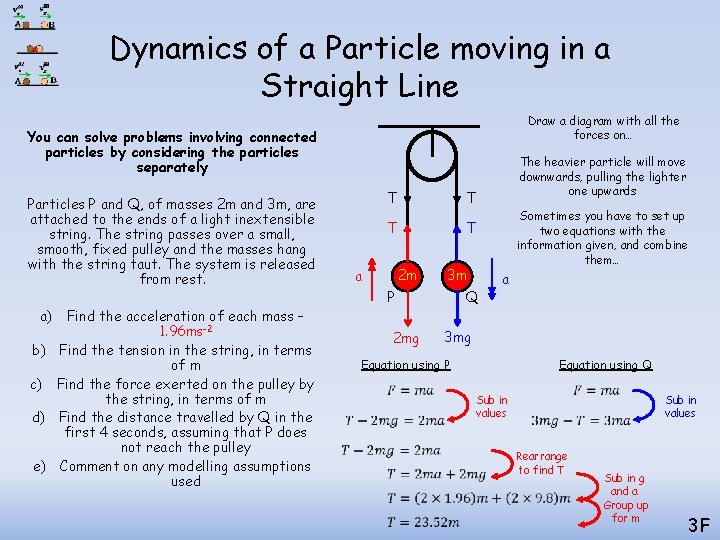
Dynamics of a Particle moving in a Straight Line Draw a diagram with all the forces on… You can solve problems involving connected particles by considering the particles separately Particles P and Q, of masses 2 m and 3 m, are attached to the ends of a light inextensible string. The string passes over a small, smooth, fixed pulley and the masses hang with the string taut. The system is released from rest. a) Find the acceleration of each mass b) Find the tension in the string, in terms of m c) Find the force exerted on the pulley by the string, in terms of m d) Find the distance travelled by Q in the first 4 seconds, assuming that P does not reach the pulley e) Comment on any modelling assumptions used T T 3 m 2 m a P Q The heavier particle will move downwards, pulling the lighter one upwards Sometimes you have to set up two equations with the information given, and combine them… a 3 mg 2 mg Equation using P Equation using Q Sub in values Add the equations together Sub in values Cancel m’s and divide g by 5 3 F
Dynamics of a Particle moving in a Straight Line Draw a diagram with all the forces on… You can solve problems involving connected particles by considering the particles separately Particles P and Q, of masses 2 m and 3 m, are attached to the ends of a light inextensible string. The string passes over a small, smooth, fixed pulley and the masses hang with the string taut. The system is released from rest. a) Find the acceleration of each mass – 1. 96 ms-2 b) Find the tension in the string, in terms of m c) Find the force exerted on the pulley by the string, in terms of m d) Find the distance travelled by Q in the first 4 seconds, assuming that P does not reach the pulley e) Comment on any modelling assumptions used T T 2 m a 3 m P 2 mg Q The heavier particle will move downwards, pulling the lighter one upwards Sometimes you have to set up two equations with the information given, and combine them… a 3 mg Equation using P Equation using Q Sub in values Rearrange to find T Sub in g and a Group up for m 3 F
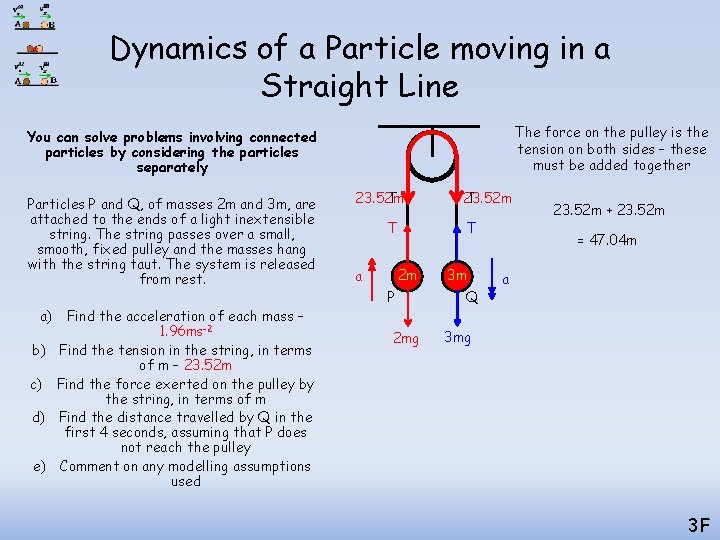
Dynamics of a Particle moving in a Straight Line The force on the pulley is the tension on both sides – these must be added together You can solve problems involving connected particles by considering the particles separately Particles P and Q, of masses 2 m and 3 m, are attached to the ends of a light inextensible string. The string passes over a small, smooth, fixed pulley and the masses hang with the string taut. The system is released from rest. a) Find the acceleration of each mass – 1. 96 ms-2 b) Find the tension in the string, in terms of m – 23. 52 m c) Find the force exerted on the pulley by the string, in terms of m d) Find the distance travelled by Q in the first 4 seconds, assuming that P does not reach the pulley e) Comment on any modelling assumptions used T 23. 52 m T T 2 m a P 2 mg T 3 m Q 23. 52 m + 23. 52 m = 47. 04 m a 3 mg 3 F
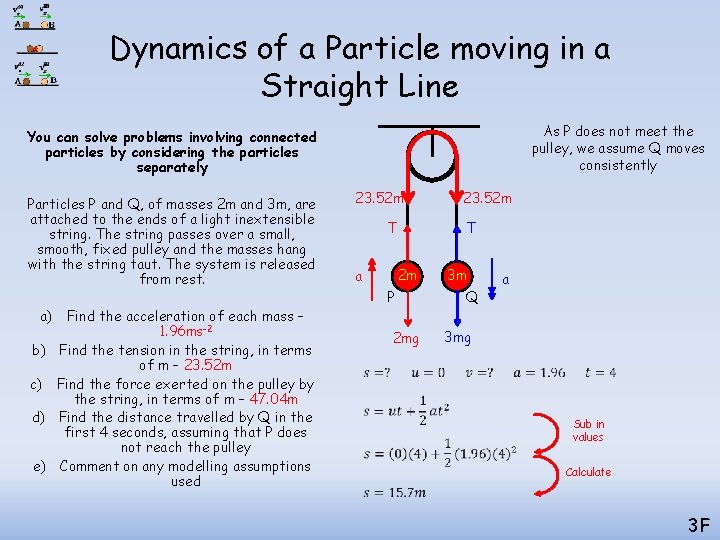
Dynamics of a Particle moving in a Straight Line As P does not meet the pulley, we assume Q moves consistently You can solve problems involving connected particles by considering the particles separately Particles P and Q, of masses 2 m and 3 m, are attached to the ends of a light inextensible string. The string passes over a small, smooth, fixed pulley and the masses hang with the string taut. The system is released from rest. a) Find the acceleration of each mass – 1. 96 ms-2 b) Find the tension in the string, in terms of m – 23. 52 m c) Find the force exerted on the pulley by the string, in terms of m – 47. 04 m d) Find the distance travelled by Q in the first 4 seconds, assuming that P does not reach the pulley e) Comment on any modelling assumptions used 23. 52 m T T 2 m a P Q 2 mg 3 m a 3 mg Sub in values Calculate 3 F
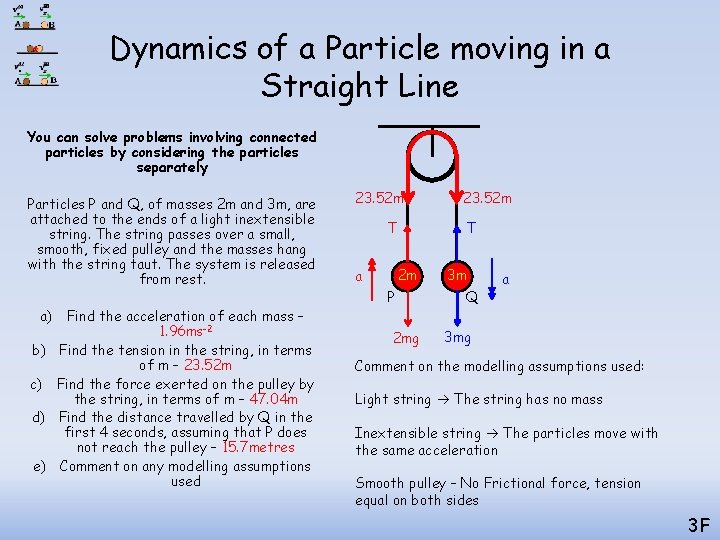
Dynamics of a Particle moving in a Straight Line You can solve problems involving connected particles by considering the particles separately Particles P and Q, of masses 2 m and 3 m, are attached to the ends of a light inextensible string. The string passes over a small, smooth, fixed pulley and the masses hang with the string taut. The system is released from rest. a) Find the acceleration of each mass – 1. 96 ms-2 b) Find the tension in the string, in terms of m – 23. 52 m c) Find the force exerted on the pulley by the string, in terms of m – 47. 04 m d) Find the distance travelled by Q in the first 4 seconds, assuming that P does not reach the pulley – 15. 7 metres e) Comment on any modelling assumptions used 23. 52 m T 2 m a P 2 mg T 3 m Q a 3 mg Comment on the modelling assumptions used: Light string The string has no mass Inextensible string The particles move with the same acceleration Smooth pulley – No Frictional force, tension equal on both sides 3 F
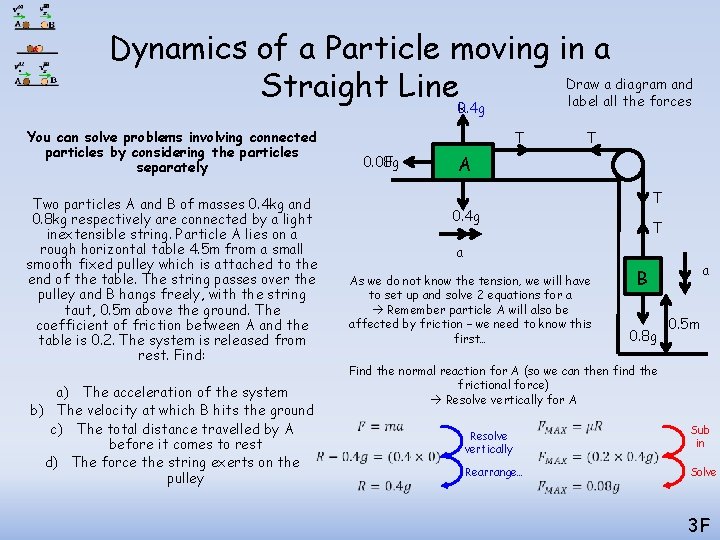
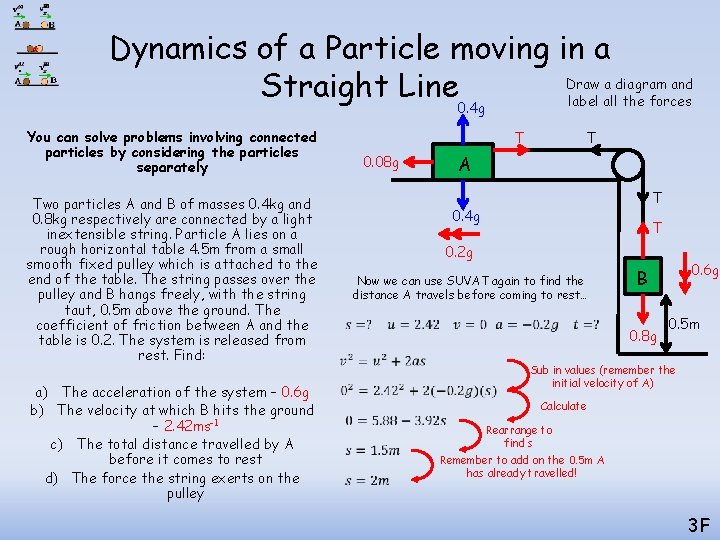
Dynamics of a Particle moving in a Draw a diagram and Straight Line 0. 4 g label all the forces R You can solve problems involving connected particles by considering the particles separately Two particles A and B of masses 0. 4 kg and 0. 8 kg respectively are connected by a light inextensible string. Particle A lies on a rough horizontal table 4. 5 m from a small smooth fixed pulley which is attached to the end of the table. The string passes over the pulley and B hangs freely, with the string taut, 0. 5 m above the ground. The coefficient of friction between A and the table is 0. 2. The system is released from rest. Find: a) The acceleration of the system b) The velocity at which B hits the ground c) The total distance travelled by A before it comes to rest d) The force the string exerts on the pulley T 0. 08 g F T A T 0. 4 g T a As we do not know the tension, we will have to set up and solve 2 equations for a Remember particle A will also be affected by friction – we need to know this first… a B 0. 8 g 0. 5 m Find the normal reaction for A (so we can then find the frictional force) Resolve vertically for A Resolve vertically Rearrange… Sub in Solve 3 F
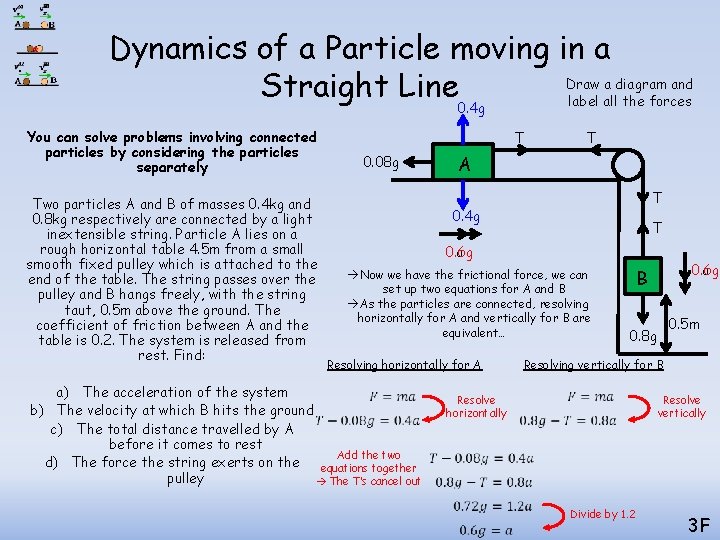
Dynamics of a Particle moving in a Draw a diagram and Straight Line 0. 4 g label all the forces You can solve problems involving connected particles by considering the particles separately Two particles A and B of masses 0. 4 kg and 0. 8 kg respectively are connected by a light inextensible string. Particle A lies on a rough horizontal table 4. 5 m from a small smooth fixed pulley which is attached to the end of the table. The string passes over the pulley and B hangs freely, with the string taut, 0. 5 m above the ground. The coefficient of friction between A and the table is 0. 2. The system is released from rest. Find: T T A 0. 08 g T 0. 4 g T 0. 6 g a Now we have the frictional force, we can set up two equations for A and B As the particles are connected, resolving horizontally for A and vertically for B are equivalent… Resolving horizontally for A a) The acceleration of the system b) The velocity at which B hits the ground c) The total distance travelled by A before it comes to rest Add the two d) The force the string exerts on the equations together pulley The T’s cancel out Resolve horizontally 0. 6 g a B 0. 5 m 0. 8 g Resolving vertically for B Resolve vertically Divide by 1. 2 3 F
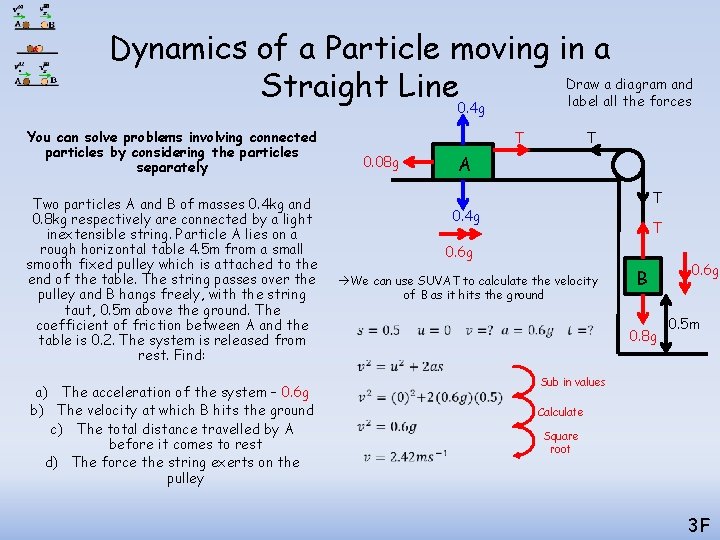
Dynamics of a Particle moving in a Draw a diagram and Straight Line 0. 4 g label all the forces You can solve problems involving connected particles by considering the particles separately Two particles A and B of masses 0. 4 kg and 0. 8 kg respectively are connected by a light inextensible string. Particle A lies on a rough horizontal table 4. 5 m from a small smooth fixed pulley which is attached to the end of the table. The string passes over the pulley and B hangs freely, with the string taut, 0. 5 m above the ground. The coefficient of friction between A and the table is 0. 2. The system is released from rest. Find: a) The acceleration of the system – 0. 6 g b) The velocity at which B hits the ground c) The total distance travelled by A before it comes to rest d) The force the string exerts on the pulley T T A 0. 08 g T 0. 4 g T 0. 6 g We can use SUVAT to calculate the velocity of B as it hits the ground B 0. 8 g 0. 6 g 0. 5 m Sub in values Calculate Square root 3 F
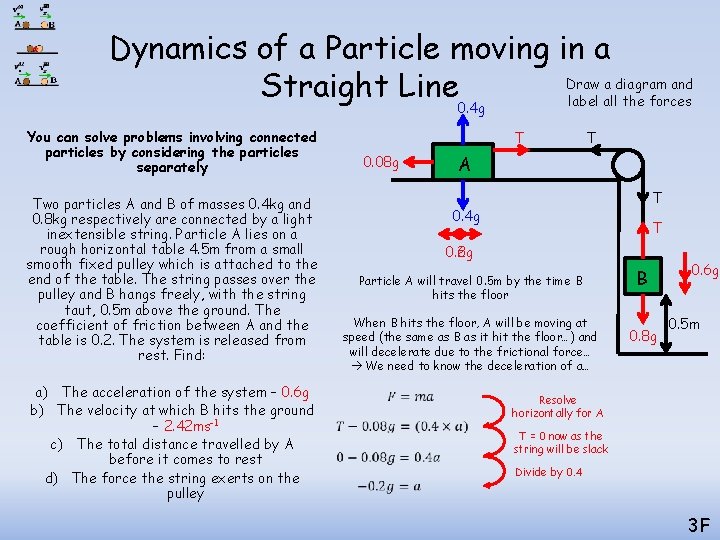
Dynamics of a Particle moving in a Draw a diagram and Straight Line 0. 4 g label all the forces You can solve problems involving connected particles by considering the particles separately T 0. 08 g Two particles A and B of masses 0. 4 kg and 0. 8 kg respectively are connected by a light inextensible string. Particle A lies on a rough horizontal table 4. 5 m from a small smooth fixed pulley which is attached to the end of the table. The string passes over the pulley and B hangs freely, with the string taut, 0. 5 m above the ground. The coefficient of friction between A and the table is 0. 2. The system is released from rest. Find: a) The acceleration of the system – 0. 6 g b) The velocity at which B hits the ground – 2. 42 ms-1 c) The total distance travelled by A before it comes to rest d) The force the string exerts on the pulley T A T 0. 4 g T 0. 6 g 0. 2 g Particle A will travel 0. 5 m by the time B hits the floor When B hits the floor, A will be moving at speed (the same as B as it hit the floor…) and will decelerate due to the frictional force… We need to know the deceleration of a… B 0. 8 g 0. 6 g 0. 5 m Resolve horizontally for A T = 0 now as the string will be slack Divide by 0. 4 3 F
Dynamics of a Particle moving in a Draw a diagram and Straight Line 0. 4 g label all the forces You can solve problems involving connected particles by considering the particles separately Two particles A and B of masses 0. 4 kg and 0. 8 kg respectively are connected by a light inextensible string. Particle A lies on a rough horizontal table 4. 5 m from a small smooth fixed pulley which is attached to the end of the table. The string passes over the pulley and B hangs freely, with the string taut, 0. 5 m above the ground. The coefficient of friction between A and the table is 0. 2. The system is released from rest. Find: a) The acceleration of the system – 0. 6 g b) The velocity at which B hits the ground – 2. 42 ms-1 c) The total distance travelled by A before it comes to rest d) The force the string exerts on the pulley T T A 0. 08 g T 0. 4 g T 0. 2 g Now we can use SUVAT again to find the distance A travels before coming to rest… 0. 6 g B 0. 8 g 0. 5 m Sub in values (remember the initial velocity of A) Calculate Rearrange to find s Remember to add on the 0. 5 m A has already travelled! 3 F
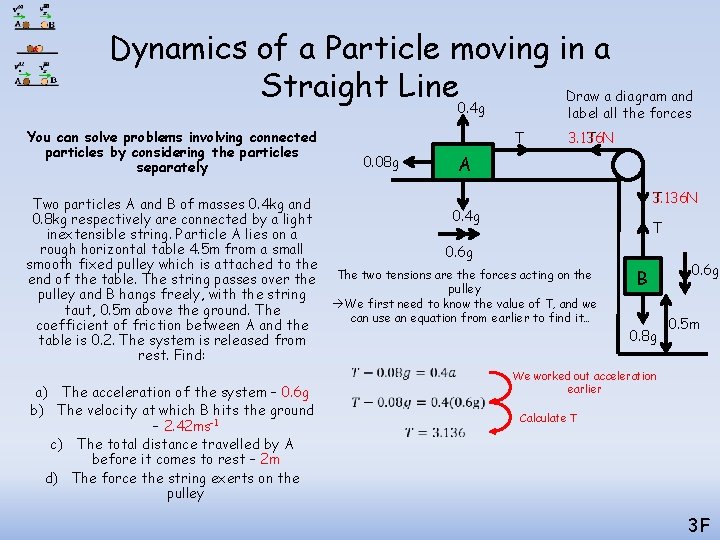
Dynamics of a Particle moving in a Straight Line 0. 4 g Draw a diagram and label all the forces You can solve problems involving connected particles by considering the particles separately T 3. 136 N T A 0. 08 g Two particles A and B of masses 0. 4 kg and 0. 4 g 0. 8 kg respectively are connected by a light inextensible string. Particle A lies on a rough horizontal table 4. 5 m from a small 0. 6 g smooth fixed pulley which is attached to the end of the table. The string passes over the The two tensions are the forces acting on the pulley and B hangs freely, with the string We first need to know the value of T, and we taut, 0. 5 m above the ground. The can use an equation from earlier to find it… coefficient of friction between A and the table is 0. 2. The system is released from rest. Find: a) The acceleration of the system – 0. 6 g b) The velocity at which B hits the ground – 2. 42 ms-1 c) The total distance travelled by A before it comes to rest – 2 m d) The force the string exerts on the pulley 3. 136 N T T B 0. 8 g 0. 6 g 0. 5 m We worked out acceleration earlier Calculate T 3 F
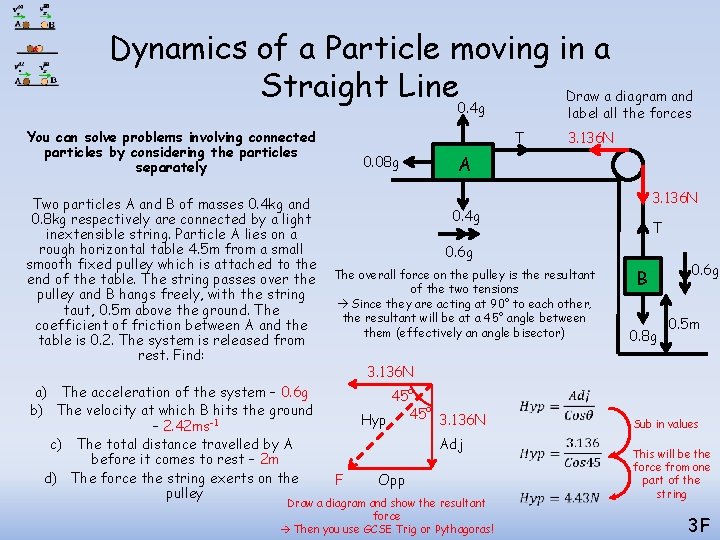
Dynamics of a Particle moving in a Straight Line 0. 4 g Draw a diagram and label all the forces You can solve problems involving connected particles by considering the particles separately Two particles A and B of masses 0. 4 kg and 0. 8 kg respectively are connected by a light inextensible string. Particle A lies on a rough horizontal table 4. 5 m from a small smooth fixed pulley which is attached to the end of the table. The string passes over the pulley and B hangs freely, with the string taut, 0. 5 m above the ground. The coefficient of friction between A and the table is 0. 2. The system is released from rest. Find: a) The acceleration of the system – 0. 6 g b) The velocity at which B hits the ground – 2. 42 ms-1 c) The total distance travelled by A before it comes to rest – 2 m d) The force the string exerts on the pulley T 0. 08 g 3. 136 N A 3. 136 N 0. 4 g T 0. 6 g The overall force on the pulley is the resultant of the two tensions Since they are acting at 90° to each other, the resultant will be at a 45° angle between them (effectively an angle bisector) B 0. 8 g 0. 6 g 0. 5 m 3. 136 N 45° 3. 136 N Hyp Adj F Sub in values Opp Draw a diagram and show the resultant force Then you use GCSE Trig or Pythagoras! This will be the force from one part of the string 3 F
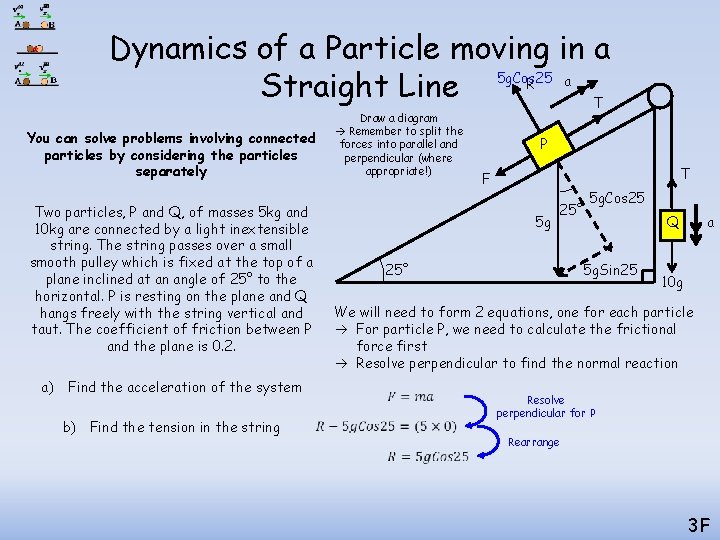
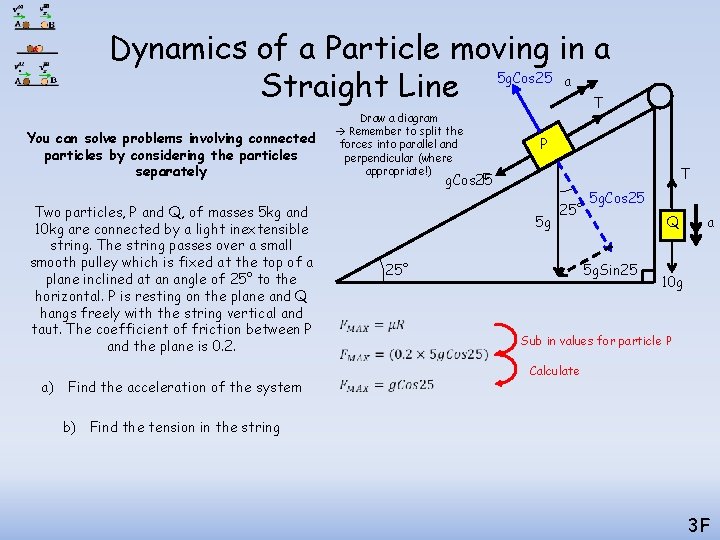
Dynamics of a Particle moving in a 5 g. Cos 25 a R Straight Line T You can solve problems involving connected particles by considering the particles separately Two particles, P and Q, of masses 5 kg and 10 kg are connected by a light inextensible string. The string passes over a small smooth pulley which is fixed at the top of a plane inclined at an angle of 25° to the horizontal. P is resting on the plane and Q hangs freely with the string vertical and taut. The coefficient of friction between P and the plane is 0. 2. a) Find the acceleration of the system b) Find the tension in the string Draw a diagram Remember to split the forces into parallel and perpendicular (where appropriate!) P T F 5 g 25˚ 5 g. Cos 25 5 g. Sin 25 Q a 10 g We will need to form 2 equations, one for each particle For particle P, we need to calculate the frictional force first Resolve perpendicular to find the normal reaction Resolve perpendicular for P Rearrange 3 F
Dynamics of a Particle moving in a 5 g. Cos 25 a Straight Line T You can solve problems involving connected particles by considering the particles separately Two particles, P and Q, of masses 5 kg and 10 kg are connected by a light inextensible string. The string passes over a small smooth pulley which is fixed at the top of a plane inclined at an angle of 25° to the horizontal. P is resting on the plane and Q hangs freely with the string vertical and taut. The coefficient of friction between P and the plane is 0. 2. a) Find the acceleration of the system Draw a diagram Remember to split the forces into parallel and perpendicular (where appropriate!) P T F g. Cos 25 5 g 25˚ 5 g. Cos 25 5 g. Sin 25 Q a 10 g Sub in values for particle P Calculate b) Find the tension in the string 3 F
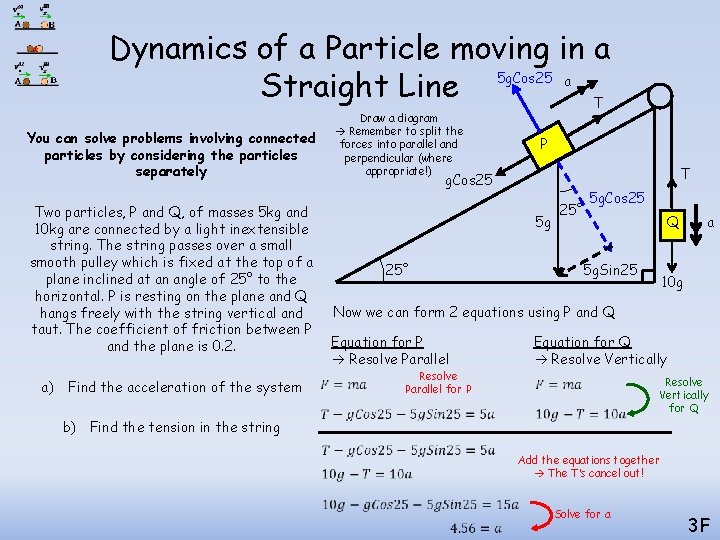
Dynamics of a Particle moving in a 5 g. Cos 25 a Straight Line T Draw a diagram Remember to split the forces into parallel and perpendicular (where appropriate!) You can solve problems involving connected particles by considering the particles separately b) Find the tension in the string T g. Cos 25 Two particles, P and Q, of masses 5 kg and 10 kg are connected by a light inextensible string. The string passes over a small smooth pulley which is fixed at the top of a plane inclined at an angle of 25° to the horizontal. P is resting on the plane and Q hangs freely with the string vertical and taut. The coefficient of friction between P and the plane is 0. 2. a) Find the acceleration of the system P 5 g 25˚ 5 g. Cos 25 Q 5 g. Sin 25 a 10 g Now we can form 2 equations using P and Q Equation for P Resolve Parallel for P Equation for Q Resolve Vertically for Q Add the equations together The T’s cancel out! Solve for a 3 F
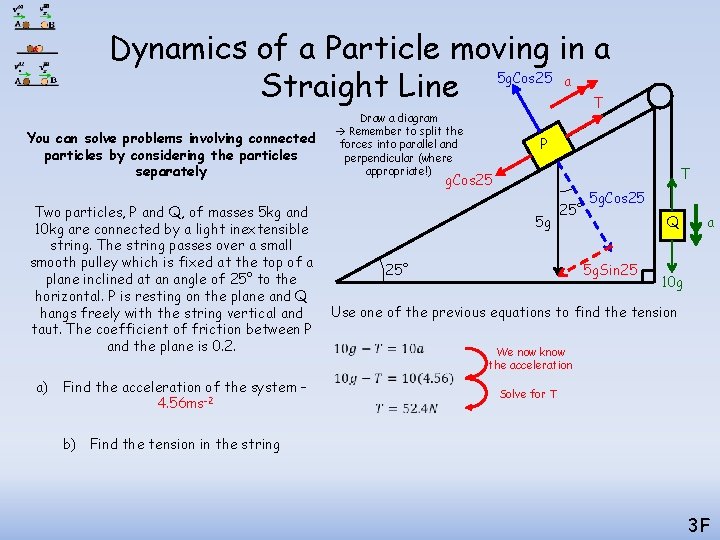
Dynamics of a Particle moving in a 5 g. Cos 25 a Straight Line T You can solve problems involving connected particles by considering the particles separately Two particles, P and Q, of masses 5 kg and 10 kg are connected by a light inextensible string. The string passes over a small smooth pulley which is fixed at the top of a plane inclined at an angle of 25° to the horizontal. P is resting on the plane and Q hangs freely with the string vertical and taut. The coefficient of friction between P and the plane is 0. 2. a) Find the acceleration of the system – 4. 56 ms-2 Draw a diagram Remember to split the forces into parallel and perpendicular (where appropriate!) P T g. Cos 25 5 g 25˚ 5 g. Cos 25 5 g. Sin 25 Q a 10 g Use one of the previous equations to find the tension We now know the acceleration Solve for T b) Find the tension in the string 3 F
Teachings for Exercise 3 G
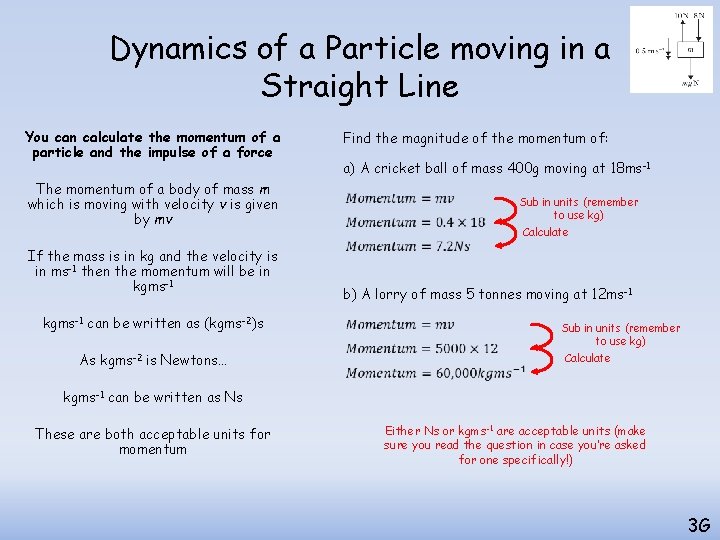
Dynamics of a Particle moving in a Straight Line You can calculate the momentum of a particle and the impulse of a force The momentum of a body of mass m which is moving with velocity v is given by mv If the mass is in kg and the velocity is in ms-1 then the momentum will be in kgms-1 can be written as (kgms-2)s As kgms-2 is Newtons… Find the magnitude of the momentum of: a) A cricket ball of mass 400 g moving at 18 ms-1 Sub in units (remember to use kg) Calculate b) A lorry of mass 5 tonnes moving at 12 ms-1 Sub in units (remember to use kg) Calculate kgms-1 can be written as Ns These are both acceptable units for momentum Either Ns or kgms-1 are acceptable units (make sure you read the question in case you’re asked for one specifically!) 3 G
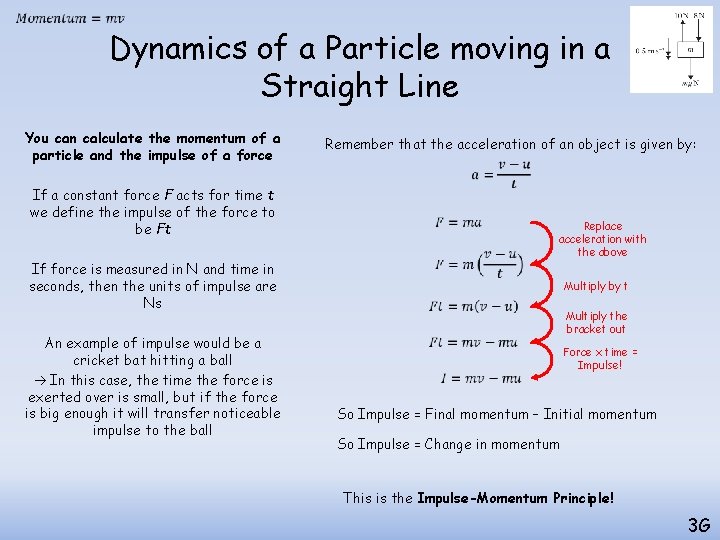
Dynamics of a Particle moving in a Straight Line You can calculate the momentum of a particle and the impulse of a force Remember that the acceleration of an object is given by: If a constant force F acts for time t we define the impulse of the force to be Ft If force is measured in N and time in seconds, then the units of impulse are Ns An example of impulse would be a cricket bat hitting a ball In this case, the time the force is exerted over is small, but if the force is big enough it will transfer noticeable impulse to the ball Replace acceleration with the above Multiply by t Multiply the bracket out Force x time = Impulse! So Impulse = Final momentum – Initial momentum So Impulse = Change in momentum This is the Impulse-Momentum Principle! 3 G
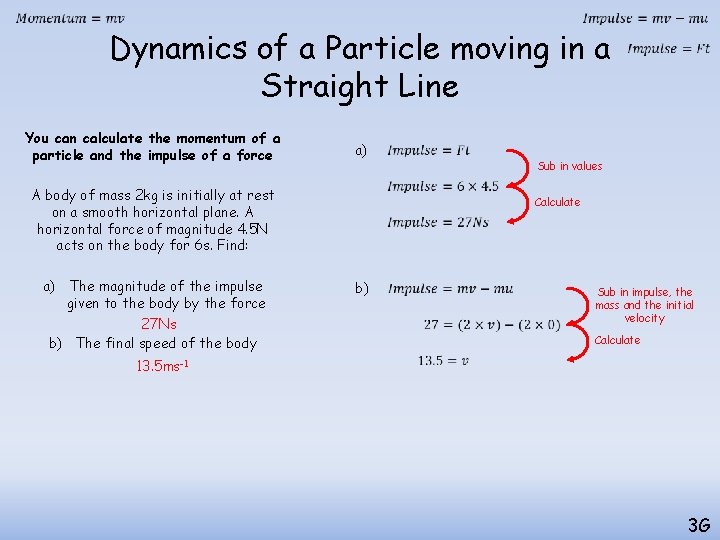
Dynamics of a Particle moving in a Straight Line You can calculate the momentum of a particle and the impulse of a force a) 13. 5 ms-1 Sub in values A body of mass 2 kg is initially at rest on a smooth horizontal plane. A horizontal force of magnitude 4. 5 N acts on the body for 6 s. Find: a) The magnitude of the impulse given to the body by the force 27 Ns b) The final speed of the body Calculate b) Sub in impulse, the mass and the initial velocity Calculate 3 G
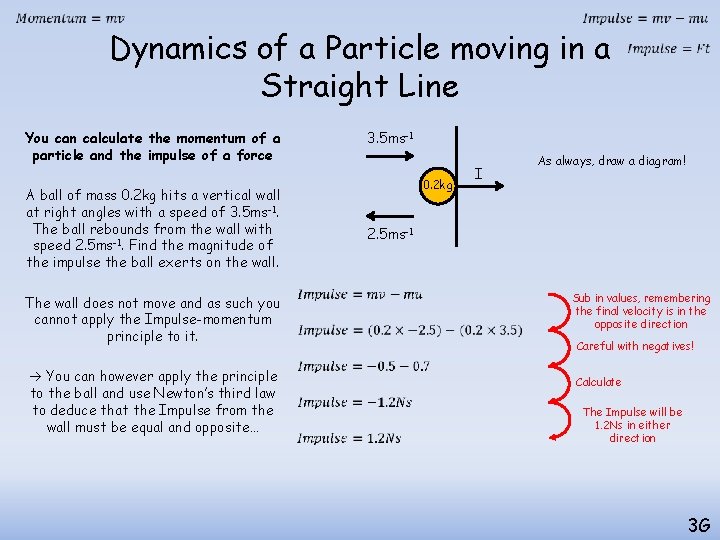
Dynamics of a Particle moving in a Straight Line You can calculate the momentum of a particle and the impulse of a force 3. 5 ms-1 0. 2 kg A ball of mass 0. 2 kg hits a vertical wall at right angles with a speed of 3. 5 ms-1. The ball rebounds from the wall with speed 2. 5 ms-1. Find the magnitude of the impulse the ball exerts on the wall. The wall does not move and as such you cannot apply the Impulse-momentum principle to it. You can however apply the principle to the ball and use Newton’s third law to deduce that the Impulse from the wall must be equal and opposite… I As always, draw a diagram! 2. 5 ms-1 Sub in values, remembering the final velocity is in the opposite direction Careful with negatives! Calculate The Impulse will be 1. 2 Ns in either direction 3 G
Teachings for Exercise 3 H
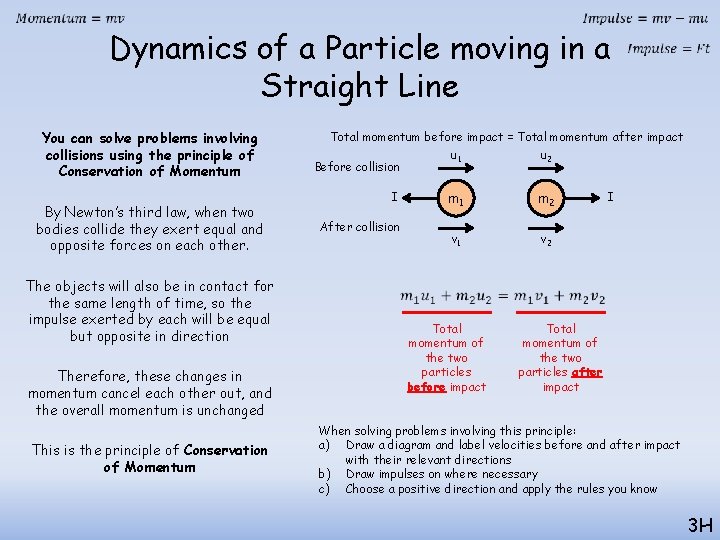
Dynamics of a Particle moving in a Straight Line You can solve problems involving collisions using the principle of Conservation of Momentum By Newton’s third law, when two bodies collide they exert equal and opposite forces on each other. The objects will also be in contact for the same length of time, so the impulse exerted by each will be equal but opposite in direction Therefore, these changes in momentum cancel each other out, and the overall momentum is unchanged This is the principle of Conservation of Momentum Total momentum before impact = Total momentum after impact u 1 u 2 Before collision I After collision m 1 m 2 v 1 v 2 I Total momentum of the two particles before impact Total momentum of the two particles after impact When solving problems involving this principle: a) Draw a diagram and label velocities before and after impact with their relevant directions b) Draw impulses on where necessary c) Choose a positive direction and apply the rules you know 3 H
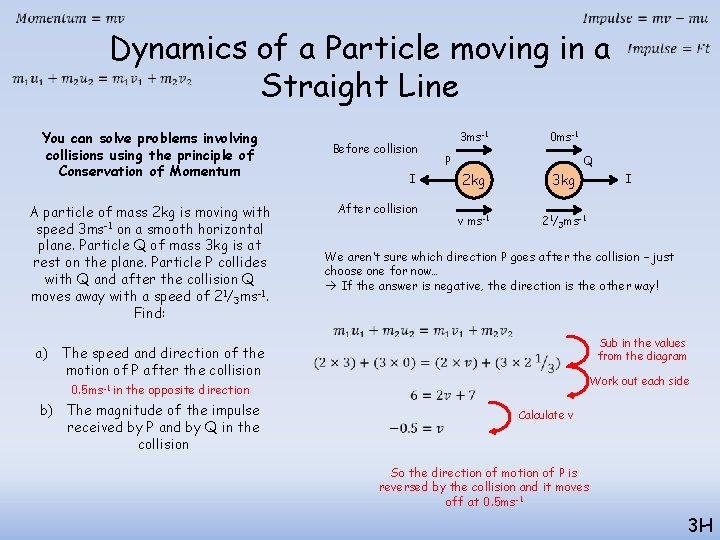
Dynamics of a Particle moving in a Straight Line You can solve problems involving collisions using the principle of Conservation of Momentum Before collision I After collision A particle of mass 2 kg is moving with speed 3 ms-1 on a smooth horizontal plane. Particle Q of mass 3 kg is at rest on the plane. Particle P collides with Q and after the collision Q moves away with a speed of 21/3 ms-1. Find: a) The speed and direction of the motion of P after the collision 0 ms-1 P Q 2 kg 3 kg v ms-1 21/3 ms-1 I We aren’t sure which direction P goes after the collision – just choose one for now… If the answer is negative, the direction is the other way! Sub in the values from the diagram 0. 5 ms-1 in the opposite direction b) The magnitude of the impulse received by P and by Q in the collision 3 ms-1 Work out each side Calculate v So the direction of motion of P is reversed by the collision and it moves off at 0. 5 ms-1 3 H
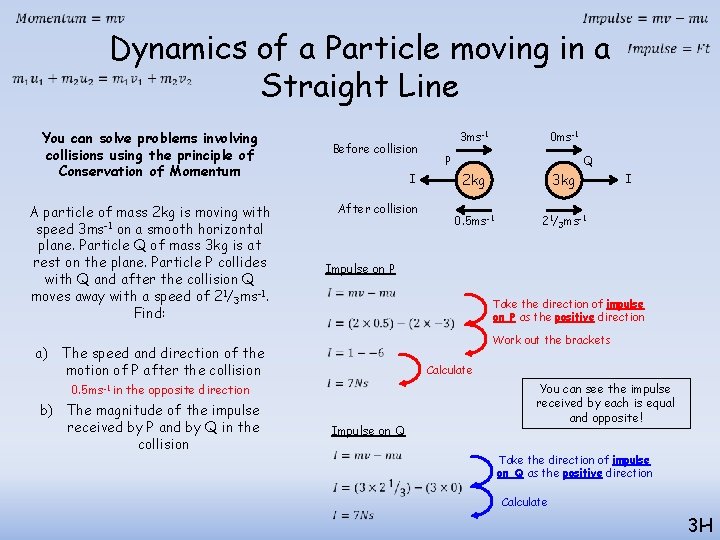
Dynamics of a Particle moving in a Straight Line You can solve problems involving collisions using the principle of Conservation of Momentum A particle of mass 2 kg is moving with speed 3 ms-1 on a smooth horizontal plane. Particle Q of mass 3 kg is at rest on the plane. Particle P collides with Q and after the collision Q moves away with a speed of 21/3 ms-1. Find: a) The speed and direction of the motion of P after the collision 0. 5 ms-1 in the opposite direction b) The magnitude of the impulse received by P and by Q in the collision Before collision I After collision 3 ms-1 0 ms-1 P Q 2 kg 3 kg 0. 5 ms-1 21/3 ms-1 I Impulse on P Take the direction of impulse on P as the positive direction Work out the brackets Calculate Impulse on Q You can see the impulse received by each is equal and opposite! Take the direction of impulse on Q as the positive direction Calculate 3 H
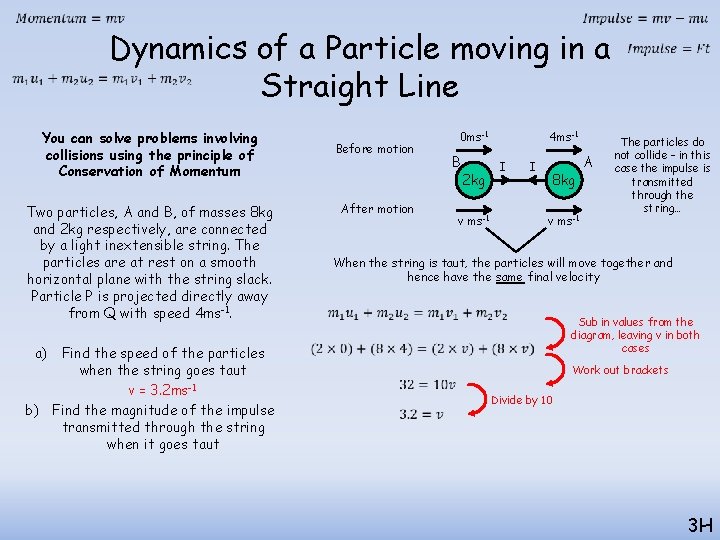
Dynamics of a Particle moving in a Straight Line You can solve problems involving collisions using the principle of Conservation of Momentum Before motion After motion Two particles, A and B, of masses 8 kg and 2 kg respectively, are connected by a light inextensible string. The particles are at rest on a smooth horizontal plane with the string slack. Particle P is projected directly away from Q with speed 4 ms-1. a) Find the speed of the particles when the string goes taut v = 3. 2 ms-1 b) Find the magnitude of the impulse transmitted through the string when it goes taut 0 ms-1 B 2 kg v ms-1 4 ms-1 I I 8 kg v ms-1 A The particles do not collide – in this case the impulse is transmitted through the string… When the string is taut, the particles will move together and hence have the same final velocity Sub in values from the diagram, leaving v in both cases Work out brackets Divide by 10 3 H
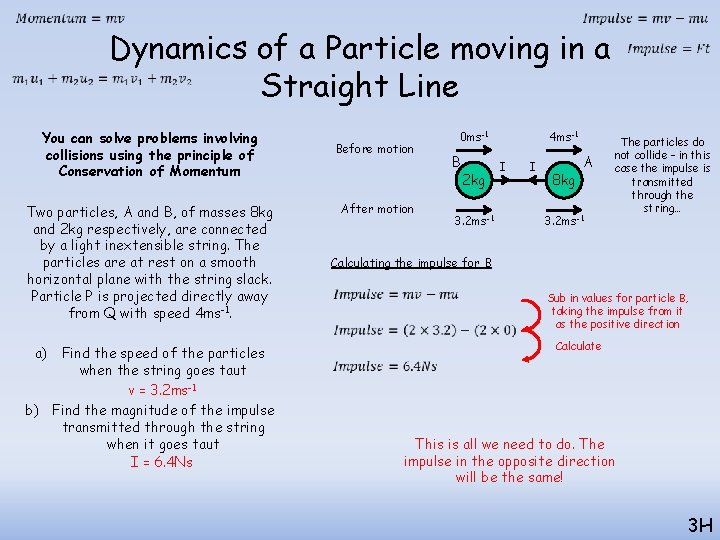
Dynamics of a Particle moving in a Straight Line You can solve problems involving collisions using the principle of Conservation of Momentum Two particles, A and B, of masses 8 kg and 2 kg respectively, are connected by a light inextensible string. The particles are at rest on a smooth horizontal plane with the string slack. Particle P is projected directly away from Q with speed 4 ms-1. a) Find the speed of the particles when the string goes taut v = 3. 2 ms-1 b) Find the magnitude of the impulse transmitted through the string when it goes taut I = 6. 4 Ns Before motion After motion 0 ms-1 B 2 kg 3. 2 ms-1 4 ms-1 I I 8 kg A 3. 2 ms-1 The particles do not collide – in this case the impulse is transmitted through the string… Calculating the impulse for B Sub in values for particle B, taking the impulse from it as the positive direction Calculate This is all we need to do. The impulse in the opposite direction will be the same! 3 H
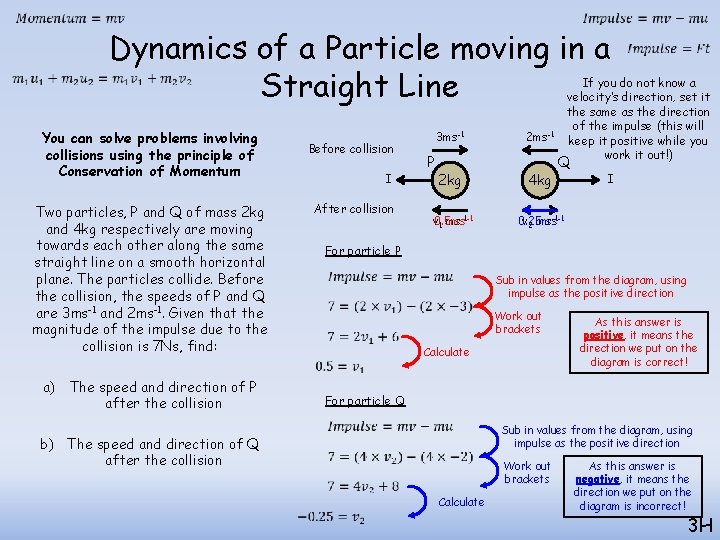
Dynamics of a Particle moving in a Straight Line You can solve problems involving collisions using the principle of Conservation of Momentum Before collision I After collision Two particles, P and Q of mass 2 kg and 4 kg respectively are moving towards each other along the same straight line on a smooth horizontal plane. The particles collide. Before the collision, the speeds of P and Q are 3 ms-1 and 2 ms-1. Given that the magnitude of the impulse due to the collision is 7 Ns, find: 3 ms-1 P 2 kg -1 -1 v 0. 5 ms 1 ms 2 ms-1 4 kg If you do not know a velocity’s direction, set it the same as the direction of the impulse (this will keep it positive while you work it out!) Q I 0. 25 ms v 2 ms-1 -1 For particle P Sub in values from the diagram, using impulse as the positive direction a) The speed and direction of P after the collision Work out brackets Calculate As this answer is positive, it means the direction we put on the diagram is correct! For particle Q b) The speed and direction of Q after the collision Sub in values from the diagram, using impulse as the positive direction Work out brackets Calculate As this answer is negative, it means the direction we put on the diagram is incorrect! 3 H
Summary • You have learnt a huge amount about forces in this chapter • It is very important that you practice questions like these – it is very easy to forget some of the forces involved in more complicated questions • Remember that the key to most questions is the correct use of F = ma!