New Particle Formation in Southern Great Plains during
- Slides: 11
New Particle Formation in Southern Great Plains during HISCALE 2016 with Model and Observed Measurements EAS 6792 (Spring 2019) Justin Min 2019 -04 -18
Outline • • Introduction Methods/Observations Results Conclusion
Introduction • Purpose was to investigate the similarities and differences of the multicomponent nucleation theories and compare them with observed nucleation rates during a field study. • Multicomponent Nucleation Theories (most common): • Binary • Ternary • Ion-Induced
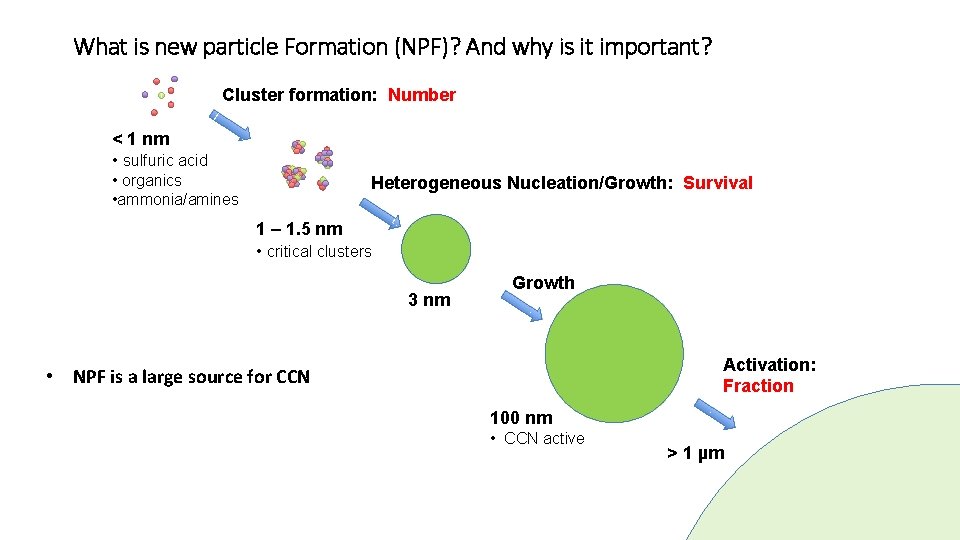
What is new particle Formation (NPF)? And why is it important? Cluster formation: Number < 1 nm • sulfuric acid • organics • ammonia/amines Heterogeneous Nucleation/Growth: Survival 1 – 1. 5 nm • critical clusters 3 nm Growth Activation: Fraction • NPF is a large source for CCN 100 nm • CCN active > 1 µm
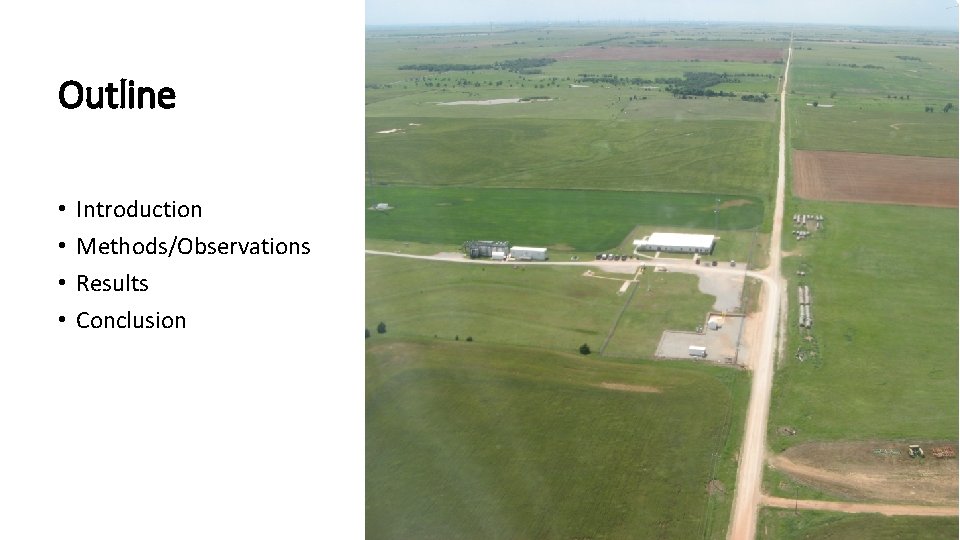
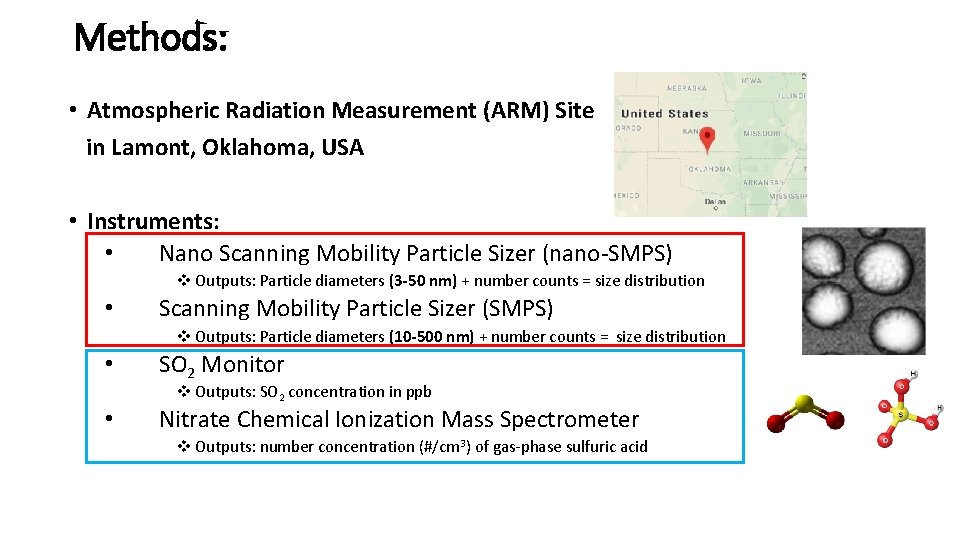
Methods: • Atmospheric Radiation Measurement (ARM) Site in Lamont, Oklahoma, USA v Outputs: Particle diameters (3 -50 nm) + number counts = size distribution • Scanning Mobility Particle Sizer (SMPS) v Outputs: Particle diameters (10 -500 nm) + number counts = size distribution • • SO 2 Monitor v Outputs: SO 2 concentration in ppb Nitrate Chemical Ionization Mass Spectrometer v Outputs: number concentration (#/cm 3) of gas-phase sulfuric acid Org Su lfu Ac ric id • Instruments: • Nano Scanning Mobility Particle Sizer (nano-SMPS) anic s onia Amm
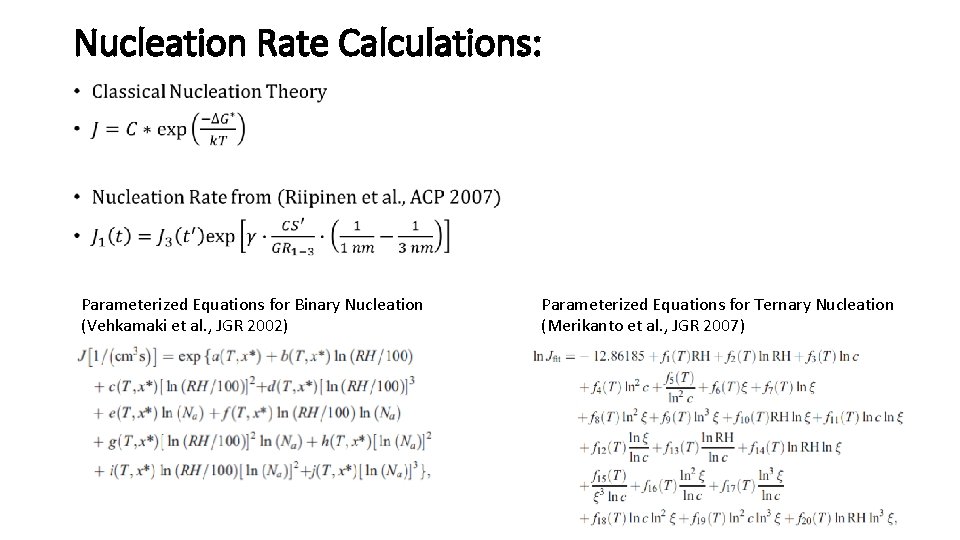
Nucleation Rate Calculations: • Parameterized Equations for Binary Nucleation (Vehkamaki et al. , JGR 2002) Parameterized Equations for Ternary Nucleation (Merikanto et al. , JGR 2007)
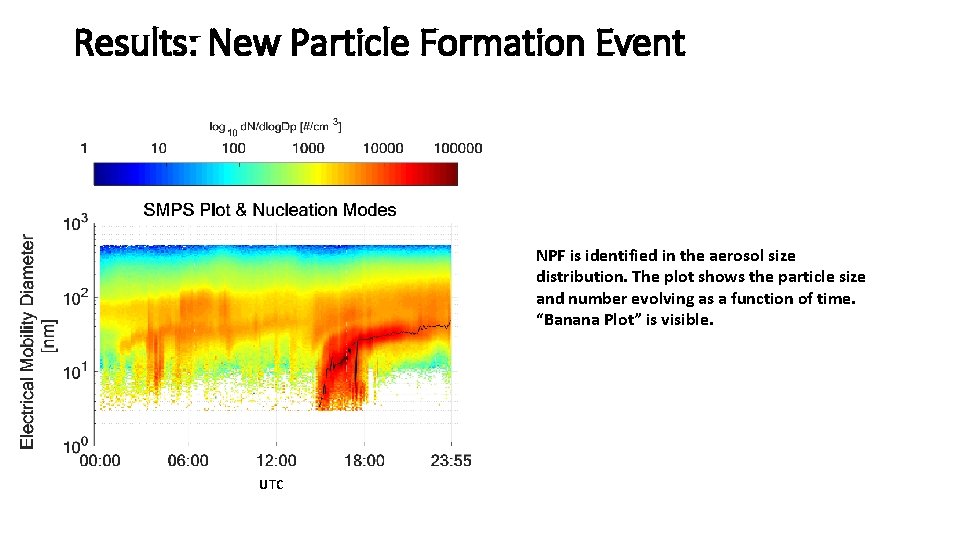
Results: New Particle Formation Event NPF is identified in the aerosol size distribution. The plot shows the particle size and number evolving as a function of time. “Banana Plot” is visible. UTC
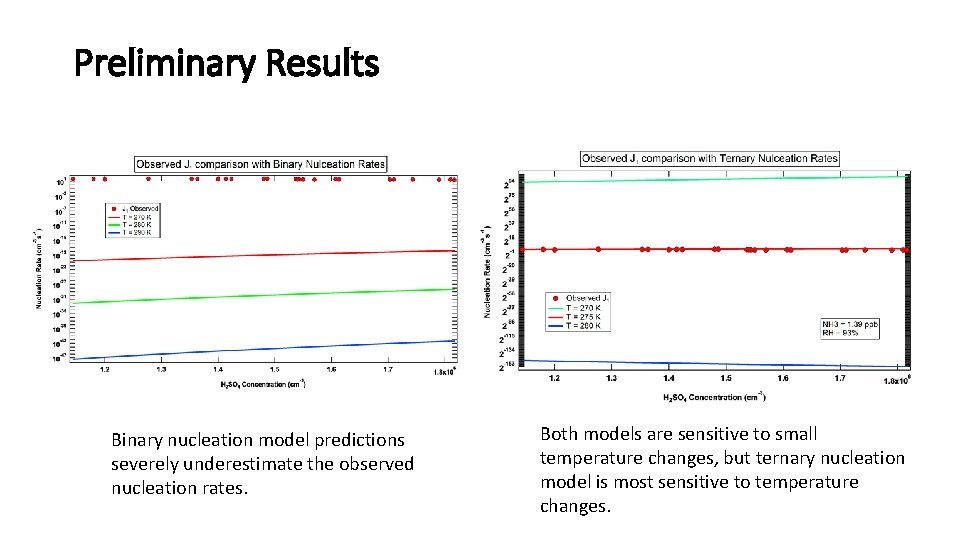
Preliminary Results Binary nucleation model predictions severely underestimate the observed nucleation rates. Both models are sensitive to small temperature changes, but ternary nucleation model is most sensitive to temperature changes.
Conclusion • Binary Nucleation does not capture what is happening at southern great plains site. • Ternary Nucleation appears to capture atmospherically relevant conditions of J 1 only at low temperatures. • There are still unaccounted species that may be contributing to the overall nucleation rate.
References • Merikanto, J. , Napari, I. , Vehkamäki, H. , Anttila, T. , Kulmala, M. , 2007. New parameterization of sulfuric acid-ammonia-water ternary nucleation rates at tropospheric conditions. Journal of Geophysical Research 112. • Riipinen, I. , 2007. Connections between atmospheric sulphuric acid and new particle formation during QUEST III–IV campaigns in Heidelberg and Hyytiala. Atmos. Chem. Phys. 16. • Vehkamäki, H. , 2002. An improved parameterization for sulfuric acid– water nucleation rates for tropospheric and stratospheric conditions. Journal of Geophysical Research 107.
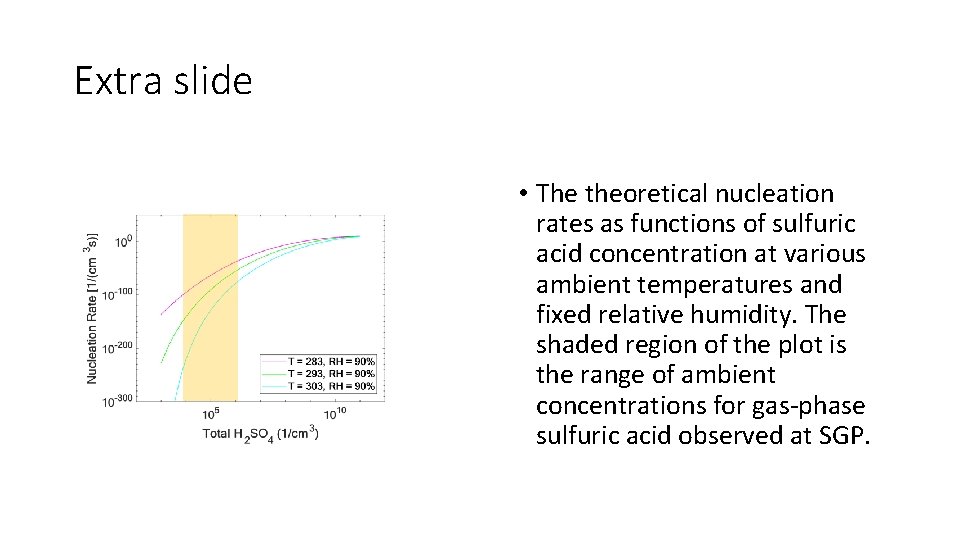
Extra slide • The theoretical nucleation rates as functions of sulfuric acid concentration at various ambient temperatures and fixed relative humidity. The shaded region of the plot is the range of ambient concentrations for gas-phase sulfuric acid observed at SGP.