
Alessandro Bettini Introduction to Elementary Particle Physics SECOND
Alessandro Bettini Introduction to Elementary Particle Physics SECOND EDITION Cambridge University Press 2014 CHAPTER 1: Preliminaries
Today’s plan • Review calculations of s, the energy available in the CM frame to produce new particles. • Reminder about q 2 (momentum transfer for a virtual photon) • Introduce hadrons, leptons, quarks and fundamental interactions. • Introduce cross-section, σ, used in particle and nuclear physics calculations of interaction probabilities (next time)
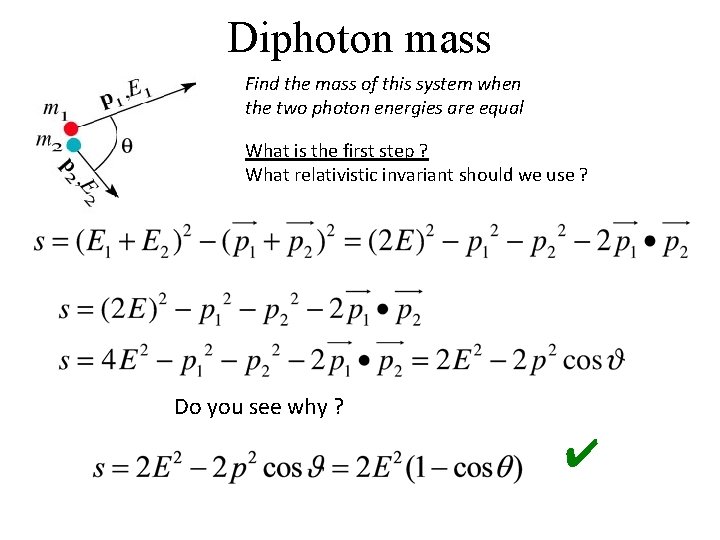
Diphoton mass Find the mass of this system when the two photon energies are equal What is the first step ? What relativistic invariant should we use ? Do you see why ? ✔
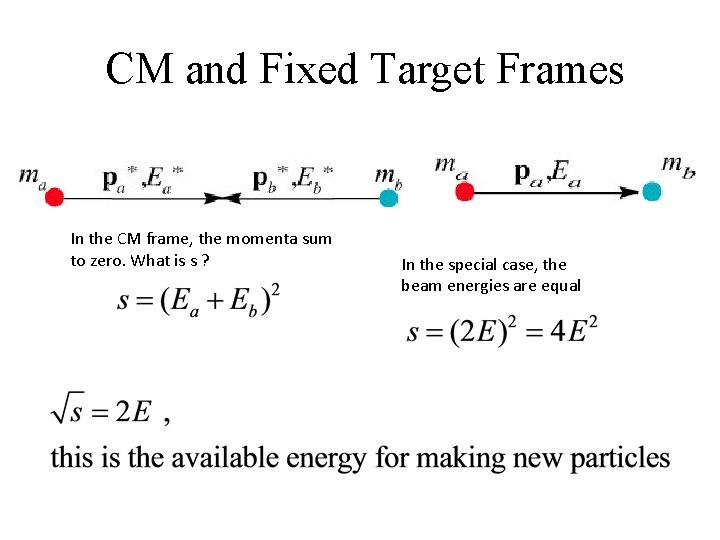
CM and Fixed Target Frames In the CM frame, the momenta sum to zero. What is s ? In the special case, the beam energies are equal
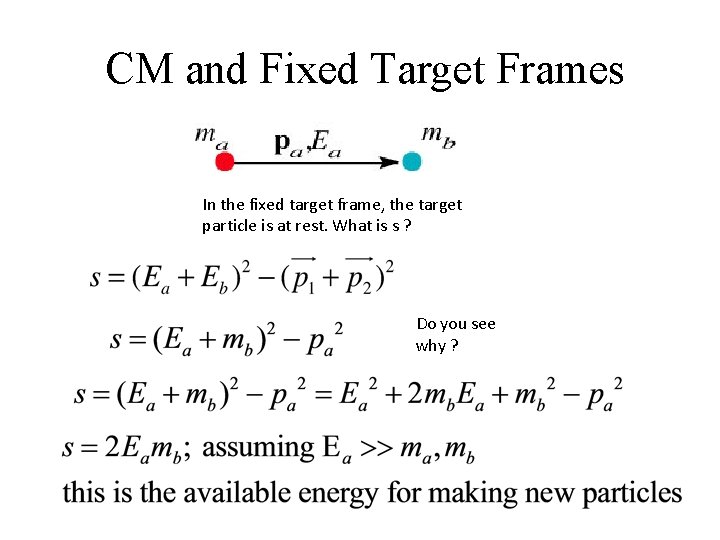
CM and Fixed Target Frames In the fixed target frame, the target particle is at rest. What is s ? Do you see why ?
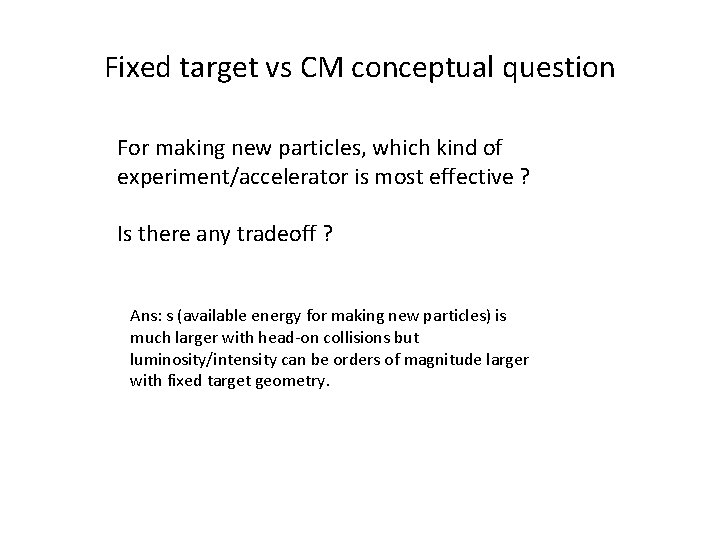
Fixed target vs CM conceptual question For making new particles, which kind of experiment/accelerator is most effective ? Is there any tradeoff ? Ans: s (available energy for making new particles) is much larger with head-on collisions but luminosity/intensity can be orders of magnitude larger with fixed target geometry.
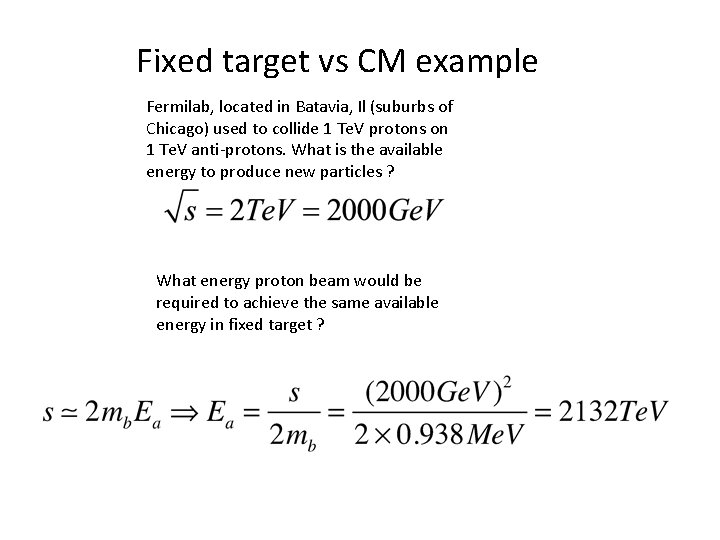
Fixed target vs CM example Fermilab, located in Batavia, Il (suburbs of Chicago) used to collide 1 Te. V protons on 1 Te. V anti-protons. What is the available energy to produce new particles ? What energy proton beam would be required to achieve the same available energy in fixed target ?
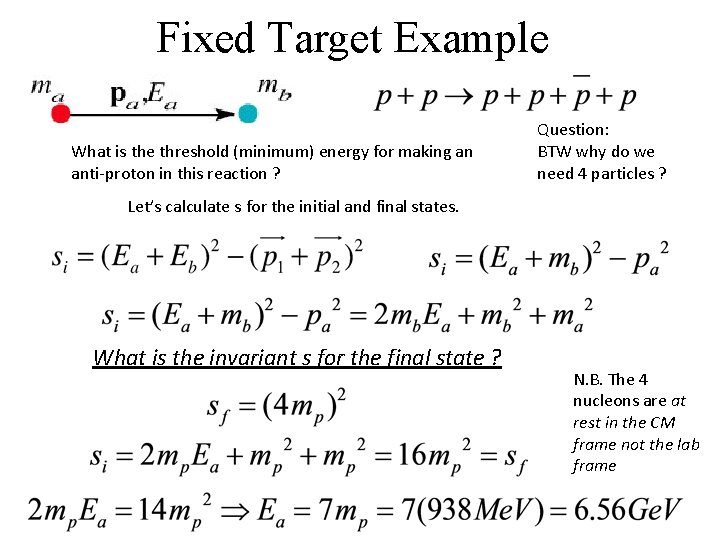
Fixed Target Example What is the threshold (minimum) energy for making an anti-proton in this reaction ? Question: BTW why do we need 4 particles ? Let’s calculate s for the initial and final states. What is the invariant s for the final state ? N. B. The 4 nucleons are at rest in the CM frame not the lab frame
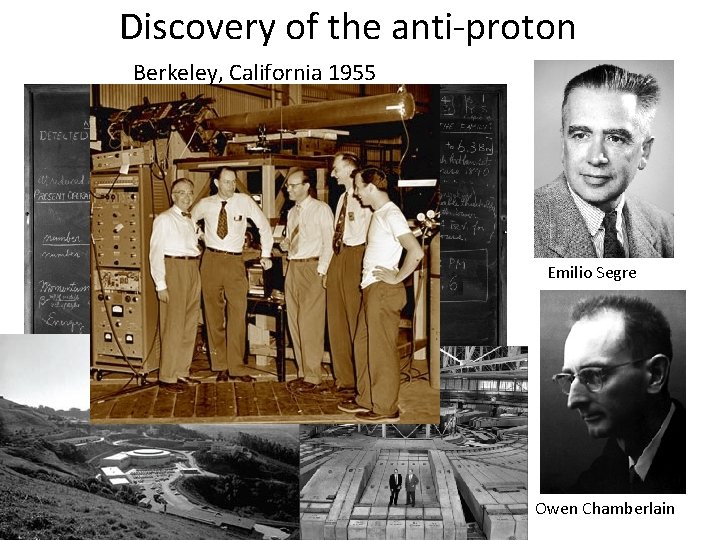
Discovery of the anti-proton Berkeley, California 1955 Emilio Segre Owen Chamberlain
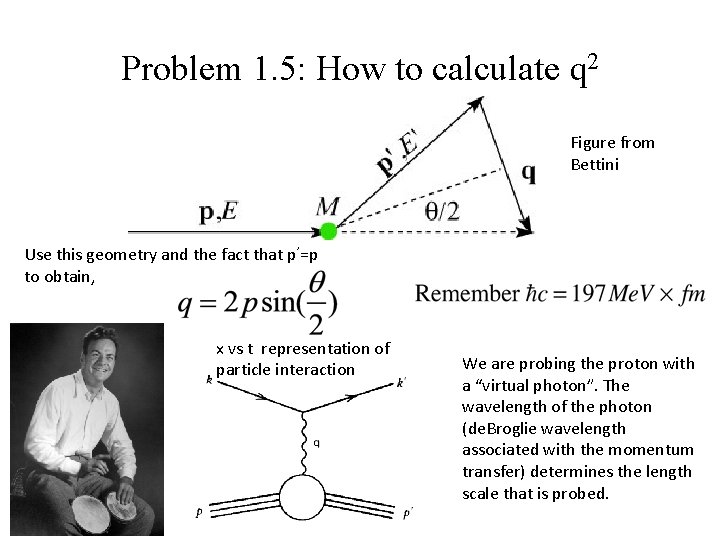
Problem 1. 5: How to calculate q 2 Figure from Bettini Use this geometry and the fact that p’=p to obtain, x vs t representation of particle interaction We are probing the proton with a “virtual photon”. The wavelength of the photon (de. Broglie wavelength associated with the momentum transfer) determines the length scale that is probed.
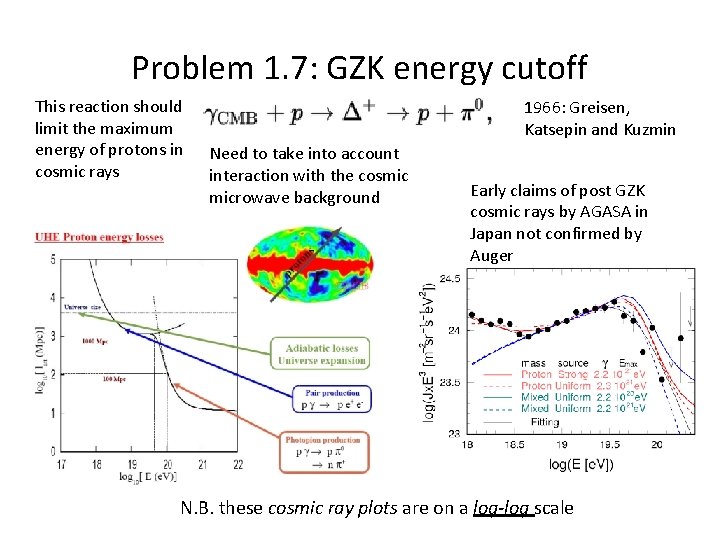
Problem 1. 7: GZK energy cutoff This reaction should limit the maximum energy of protons in cosmic rays 1966: Greisen, Katsepin and Kuzmin Need to take into account interaction with the cosmic microwave background Early claims of post GZK cosmic rays by AGASA in Japan not confirmed by Auger N. B. these cosmic ray plots are on a log-log scale
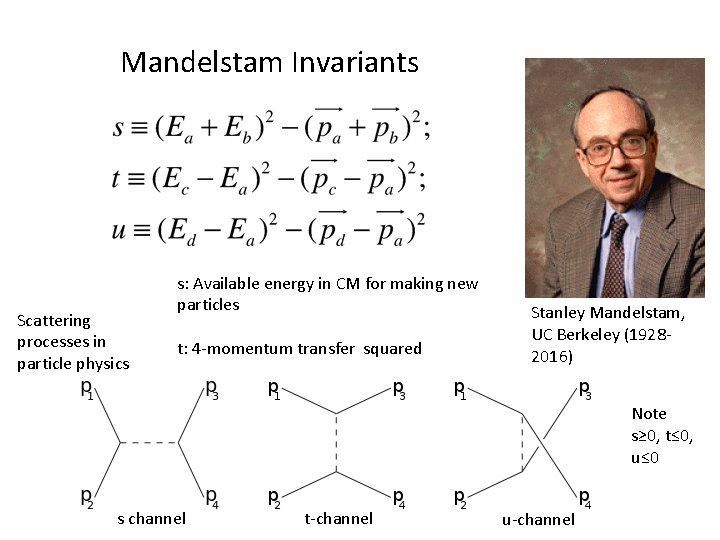
Mandelstam Invariants Scattering processes in particle physics s: Available energy in CM for making new particles t: 4 -momentum transfer squared Stanley Mandelstam, UC Berkeley (19282016) Note s≥ 0, t≤ 0, u≤ 0 s channel t-channel u-channel
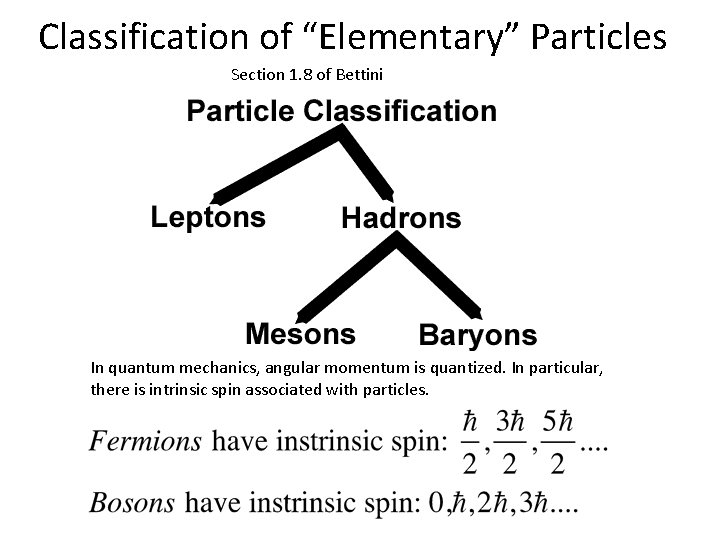
Classification of “Elementary” Particles Section 1. 8 of Bettini In quantum mechanics, angular momentum is quantized. In particular, there is intrinsic spin associated with particles.
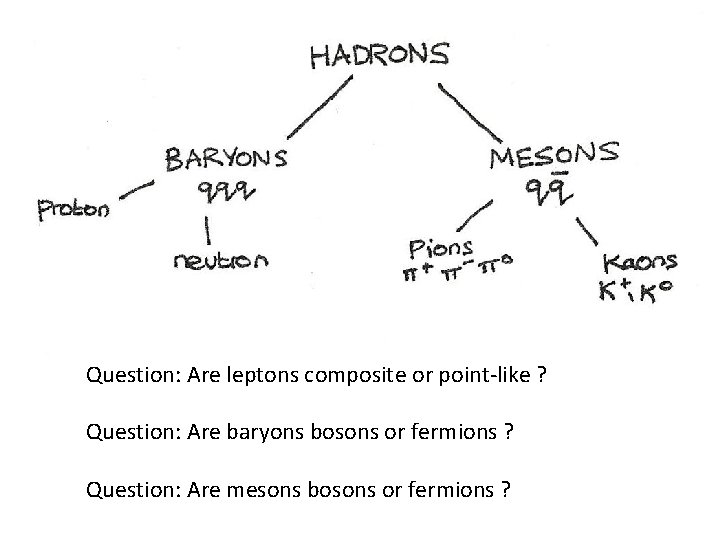
Question: Are leptons composite or point-like ? Question: Are baryons bosons or fermions ? Question: Are mesons bosons or fermions ?
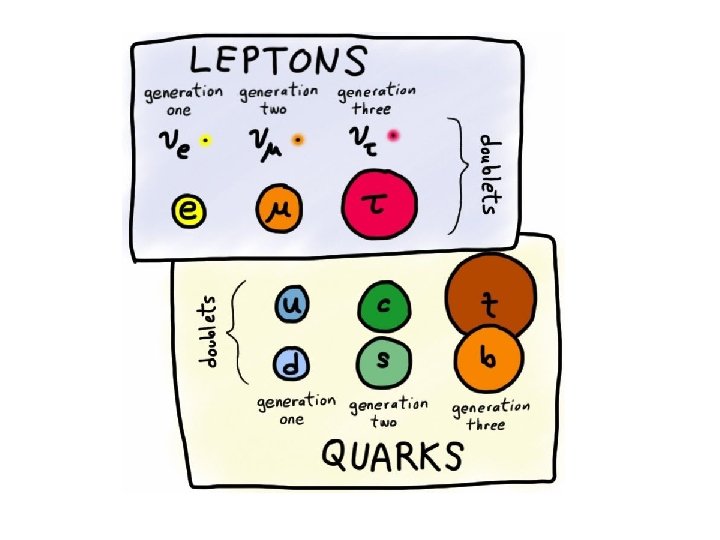
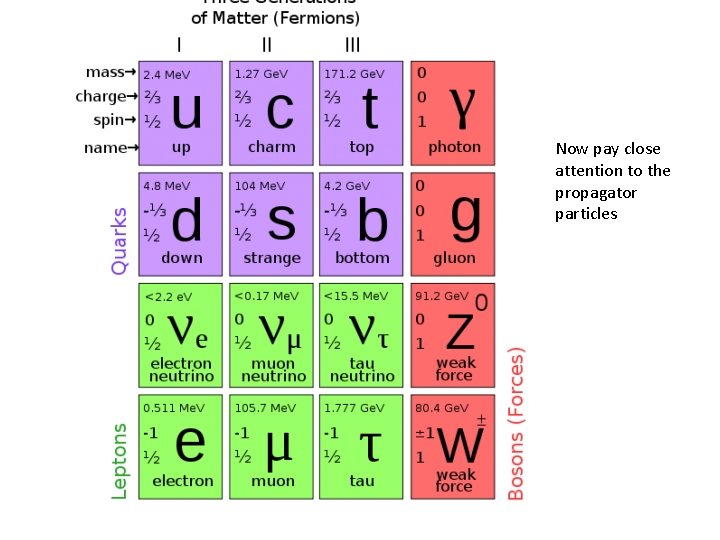
Now pay close attention to the propagator particles
- Slides: 17