
Physics 417517 Introduction to Particle Accelerator Physics G

- Slides: 9
Physics 417/517 Introduction to Particle Accelerator Physics G. A. Krafft Jefferson Lab Professor of Physics Old Dominion University Physics 417/517 Introduction to Particle Accelerator Physics 10/01/2009
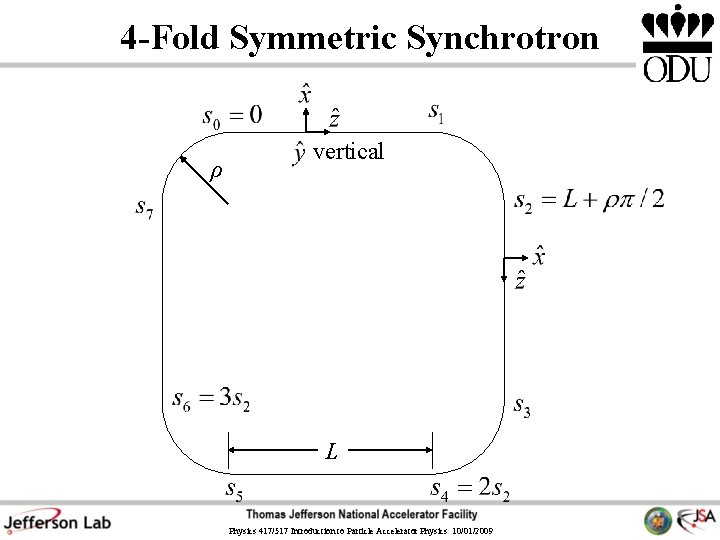
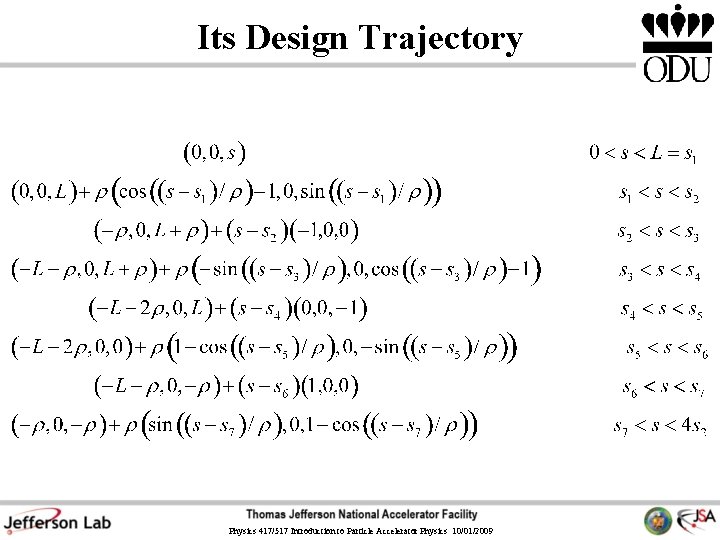
Comment on Design Trajectory The notion of specifying curves in terms of their path length is standard in courses on the vector analysis of curves. A good discussion in a Calculus book is Thomas, Calculus and Analytic Geometry, 4 th Edition, Articles 14. 3 -14. 5. Most vector analysis books have a similar, and more advanced discussion under the subject of “Frenet-Serret Equations”. Because all of our design trajectories involve only arcs of circles and straight lines (dipole magnets and the drift regions between them define the orbit), we can concentrate on a simplified set of equations that “only” involve the radius of curvature of the design orbit. It may be worthwhile giving a simple example. Physics 417/517 Introduction to Particle Accelerator Physics 10/01/2009
4 -Fold Symmetric Synchrotron ρ vertical L Physics 417/517 Introduction to Particle Accelerator Physics 10/01/2009
Its Design Trajectory Physics 417/517 Introduction to Particle Accelerator Physics 10/01/2009
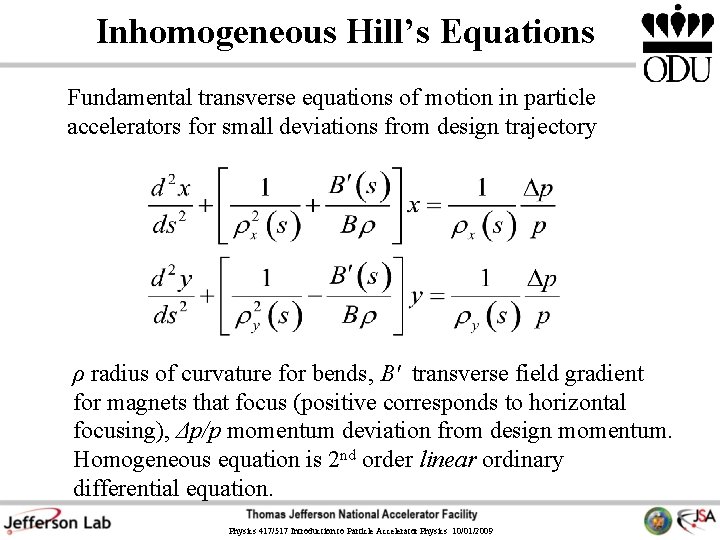
Inhomogeneous Hill’s Equations Fundamental transverse equations of motion in particle accelerators for small deviations from design trajectory ρ radius of curvature for bends, B' transverse field gradient for magnets that focus (positive corresponds to horizontal focusing), Δp/p momentum deviation from design momentum. Homogeneous equation is 2 nd order linear ordinary differential equation. Physics 417/517 Introduction to Particle Accelerator Physics 10/01/2009
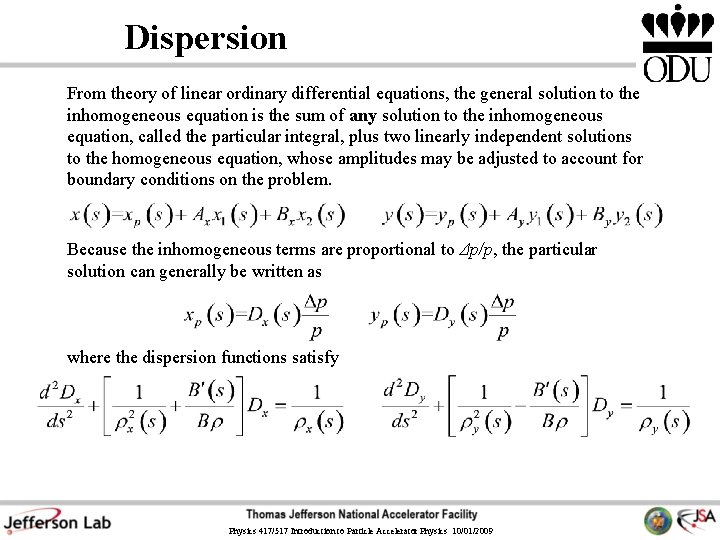
Dispersion From theory of linear ordinary differential equations, the general solution to the inhomogeneous equation is the sum of any solution to the inhomogeneous equation, called the particular integral, plus two linearly independent solutions to the homogeneous equation, whose amplitudes may be adjusted to account for boundary conditions on the problem. Because the inhomogeneous terms are proportional to Δp/p, the particular solution can generally be written as where the dispersion functions satisfy Physics 417/517 Introduction to Particle Accelerator Physics 10/01/2009
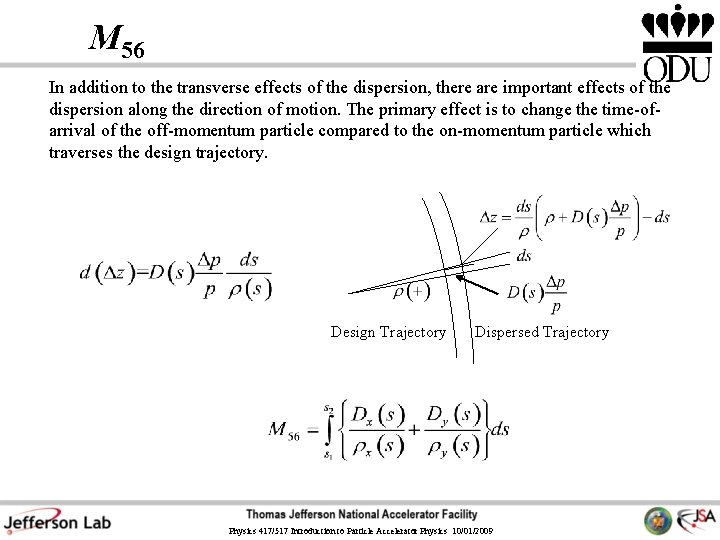
M 56 In addition to the transverse effects of the dispersion, there are important effects of the dispersion along the direction of motion. The primary effect is to change the time-ofarrival of the off-momentum particle compared to the on-momentum particle which traverses the design trajectory. Design Trajectory Dispersed Trajectory Physics 417/517 Introduction to Particle Accelerator Physics 10/01/2009
Solutions Homogeneous Eqn. Dipole Drift Physics 417/517 Introduction to Particle Accelerator Physics 10/01/2009
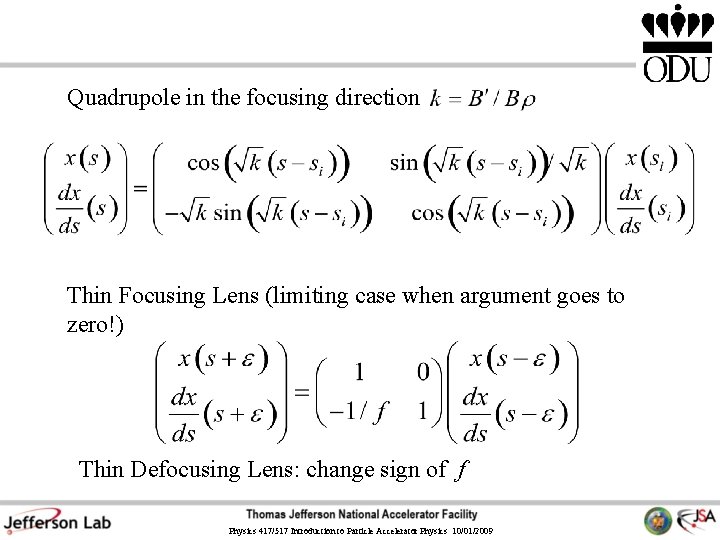
Quadrupole in the focusing direction Thin Focusing Lens (limiting case when argument goes to zero!) Thin Defocusing Lens: change sign of f Physics 417/517 Introduction to Particle Accelerator Physics 10/01/2009