
The MOLE Chemists need a convenient method for


- Slides: 27
The MOLE
• Chemists need a convenient method for counting accurately the number of atoms, molecules, or formula units in a sample of a substance. • As you know, atoms and molecules are extremely small. There are so many of them in even the smallest sample that it’s impossible to actually count them.
That’s why chemists created their own counting unit called the mole!!!!!
• The mole, commonly abbreviated mol, is the SI base unit used to measure the amount of a substance.
Measuring Moles • Through years of experimentation, it has been established that a mole of anything contains 6. 0221367 x 1023 representative particles. • A representative particle is any kind of particle such as atoms, molecules, formula units, electrons, or ions.
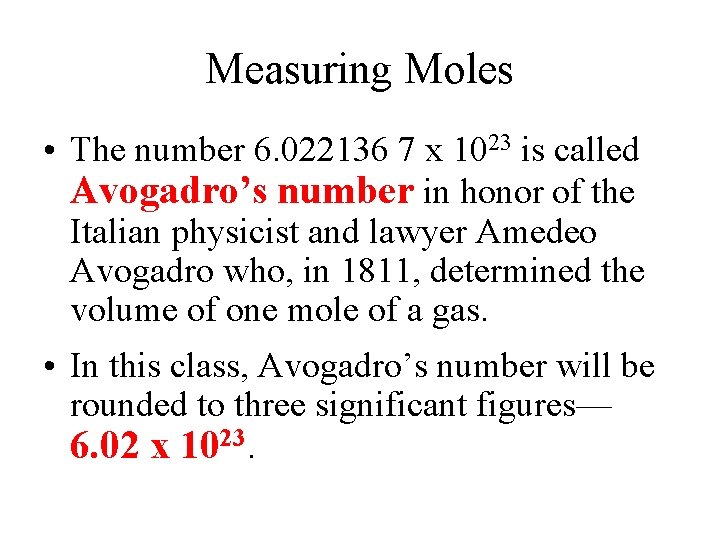
Measuring Moles • The number 6. 022136 7 x 10²³ is called Avogadro’s number in honor of the Italian physicist and lawyer Amedeo Avogadro who, in 1811, determined the volume of one mole of a gas. • In this class, Avogadro’s number will be rounded to three significant figures— 6. 02 x 1023.
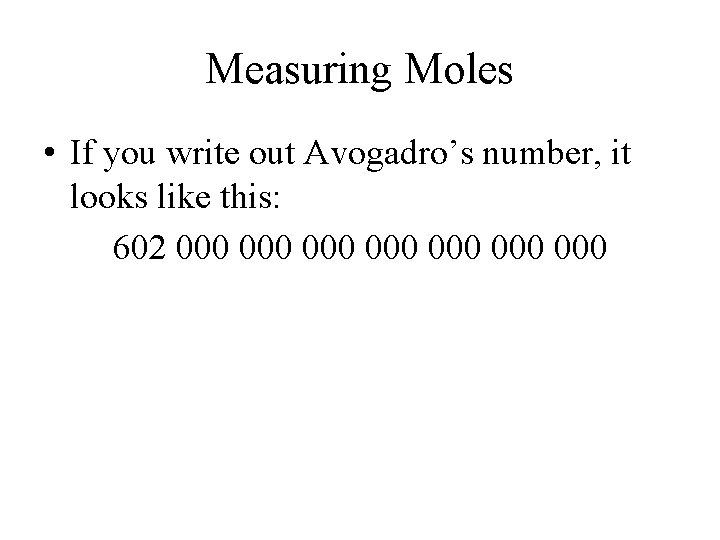
Measuring Moles • If you write out Avogadro’s number, it looks like this: 602 000 000
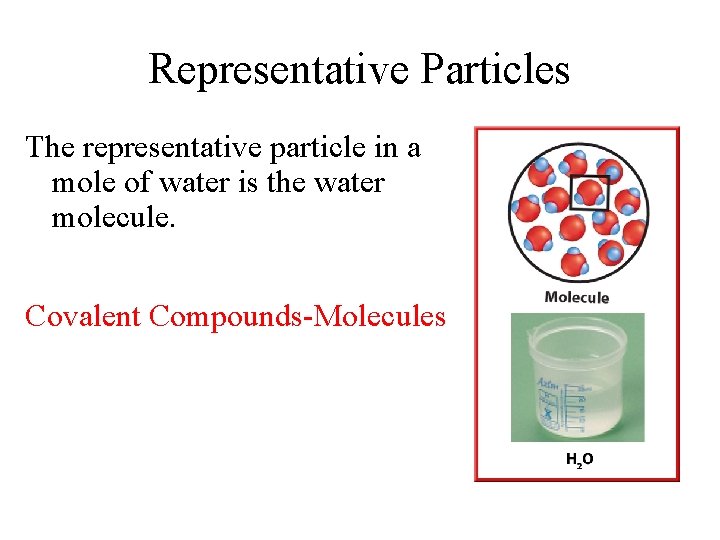
Representative Particles The representative particle in a mole of water is the water molecule. Covalent Compounds-Molecules
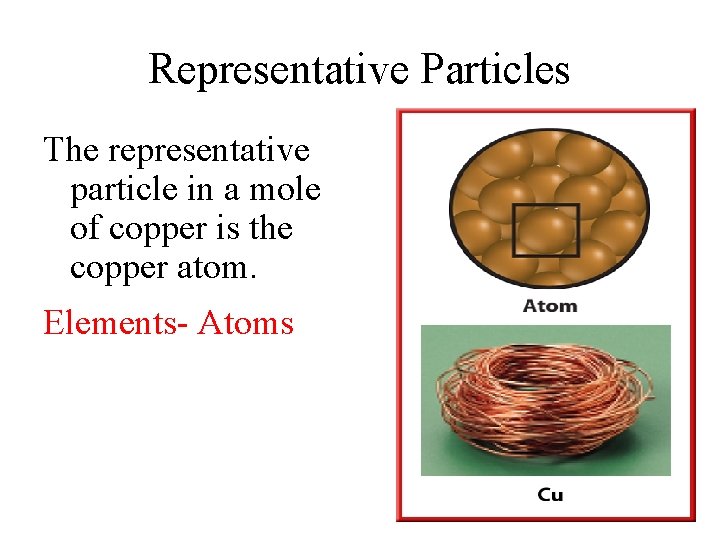
Representative Particles The representative particle in a mole of copper is the copper atom. Elements- Atoms
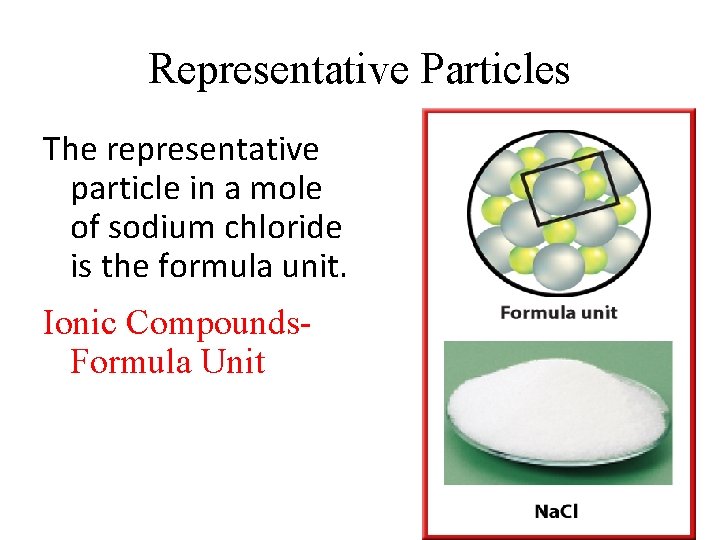
Representative Particles The representative particle in a mole of sodium chloride is the formula unit. Ionic Compounds. Formula Unit
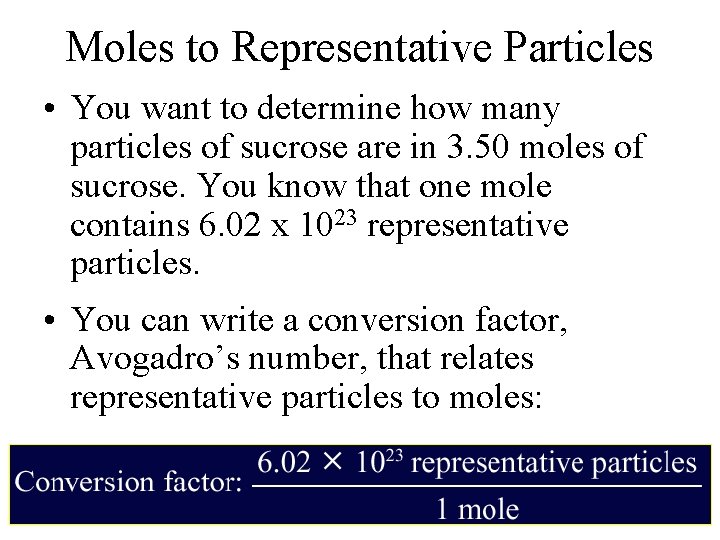
Moles to Representative Particles • You want to determine how many particles of sucrose are in 3. 50 moles of sucrose. You know that one mole contains 6. 02 x 1023 representative particles. • You can write a conversion factor, Avogadro’s number, that relates representative particles to moles:
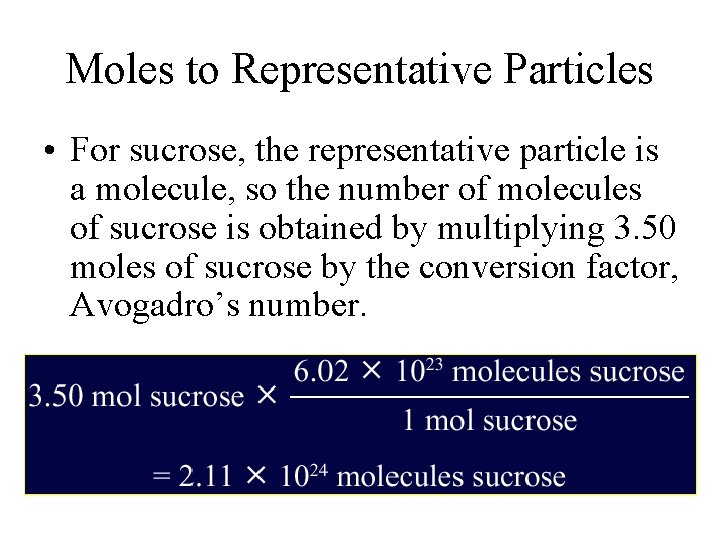
Moles to Representative Particles • For sucrose, the representative particle is a molecule, so the number of molecules of sucrose is obtained by multiplying 3. 50 moles of sucrose by the conversion factor, Avogadro’s number.
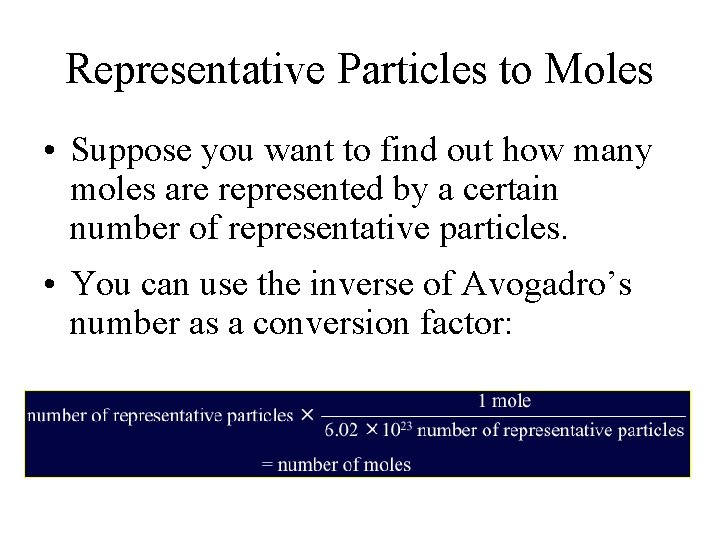
Representative Particles to Moles • Suppose you want to find out how many moles are represented by a certain number of representative particles. • You can use the inverse of Avogadro’s number as a conversion factor:
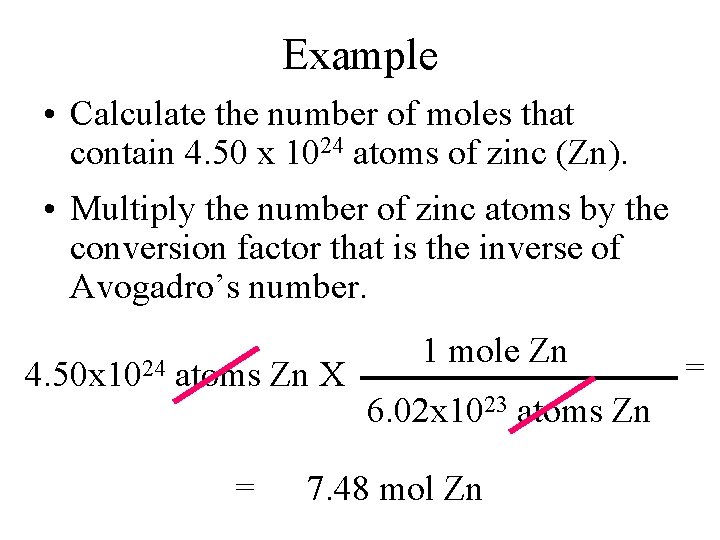
Example • Calculate the number of moles that contain 4. 50 x 1024 atoms of zinc (Zn). • Multiply the number of zinc atoms by the conversion factor that is the inverse of Avogadro’s number. 4. 50 x 1024 atoms Zn X = 1 mole Zn 6. 02 x 1023 atoms Zn 7. 48 mol Zn =
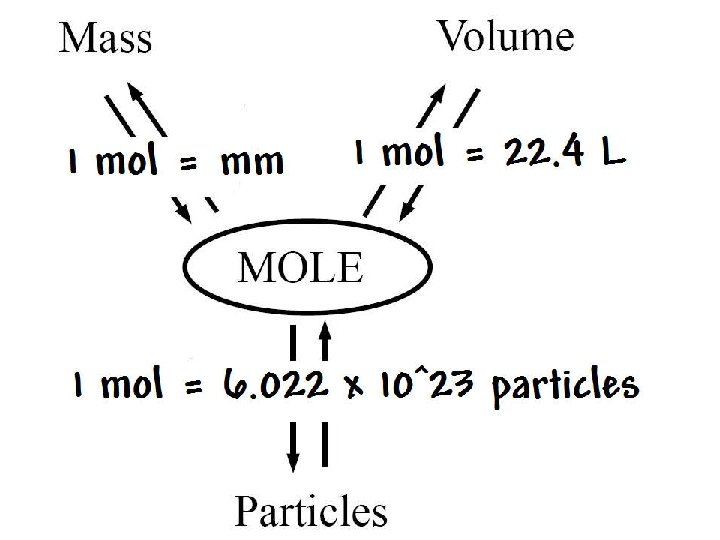
Mass and Moles • The mass in grams of one mole of any pure substance is called its molar mass. • The molar mass of any element is numerically equal to its atomic mass and has the units g/mol.
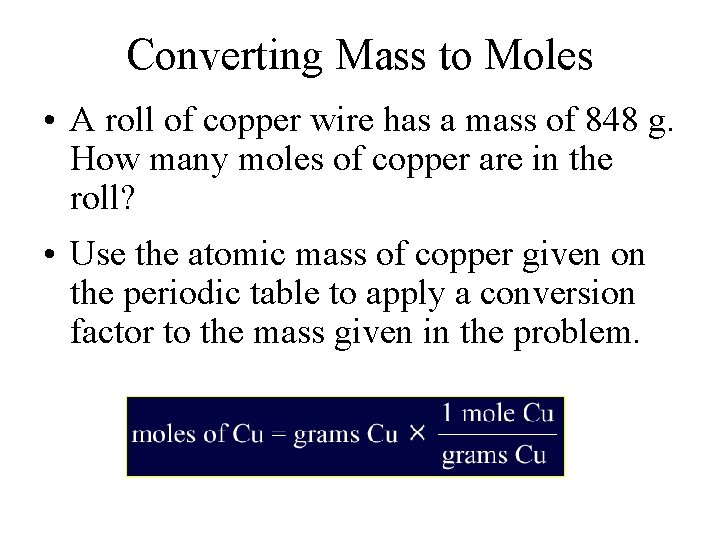
Converting Mass to Moles • A roll of copper wire has a mass of 848 g. How many moles of copper are in the roll? • Use the atomic mass of copper given on the periodic table to apply a conversion factor to the mass given in the problem.
848 g Cu X 1 mole Cu 63. 5 g Cu = 13. 4 mol Cu
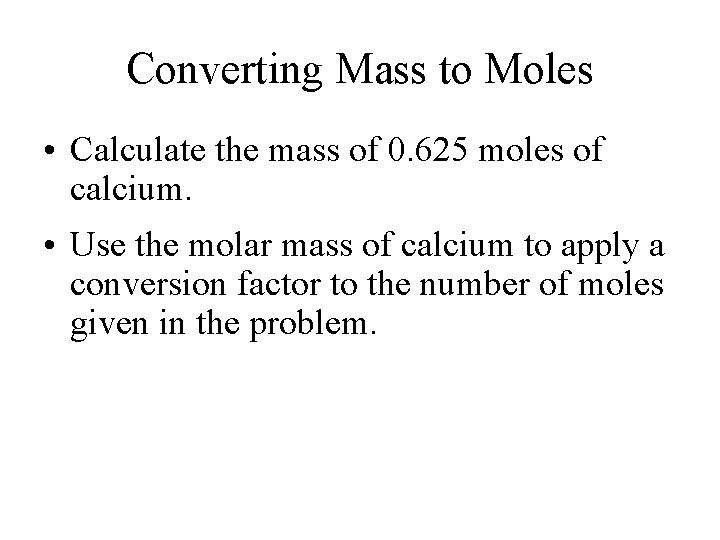
Converting Mass to Moles • Calculate the mass of 0. 625 moles of calcium. • Use the molar mass of calcium to apply a conversion factor to the number of moles given in the problem.
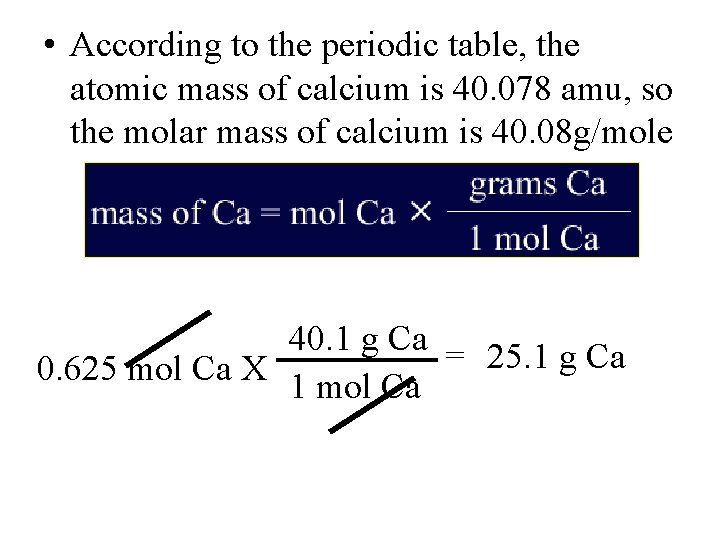
• According to the periodic table, the atomic mass of calcium is 40. 078 amu, so the molar mass of calcium is 40. 08 g/mole 40. 1 g Ca = 25. 1 g Ca 0. 625 mol Ca X 1 mol Ca
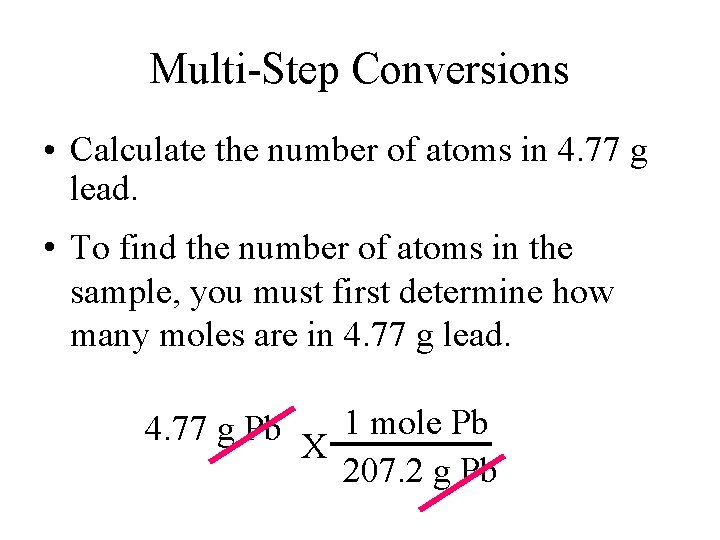
Multi-Step Conversions • Calculate the number of atoms in 4. 77 g lead. • To find the number of atoms in the sample, you must first determine how many moles are in 4. 77 g lead. 4. 77 g Pb X 1 mole Pb 207. 2 g Pb
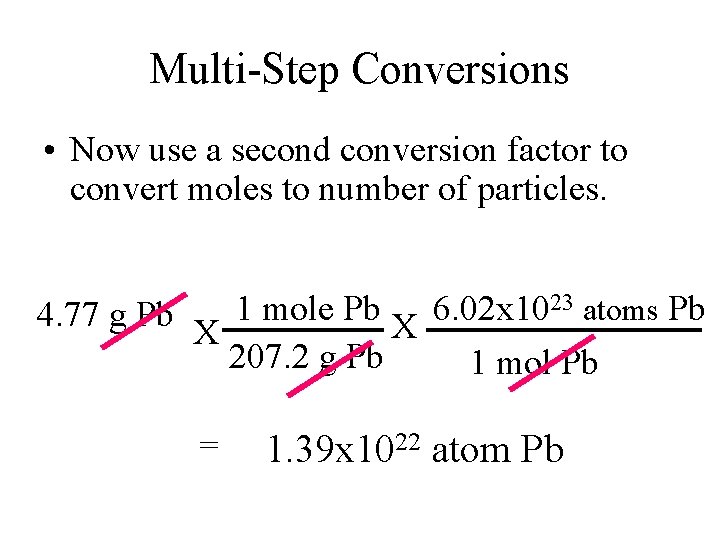
Multi-Step Conversions • Now use a second conversion factor to convert moles to number of particles. 23 atoms Pb 1 mole Pb 6. 02 x 10 4. 77 g Pb X X 207. 2 g Pb 1 mol Pb = 1. 39 x 1022 atom Pb
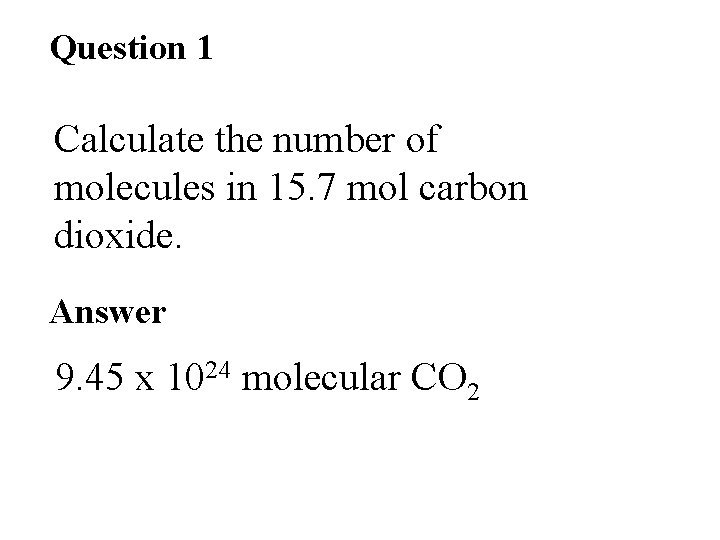
Question 1 Calculate the number of molecules in 15. 7 mol carbon dioxide. Answer 9. 45 x 1024 molecular CO 2
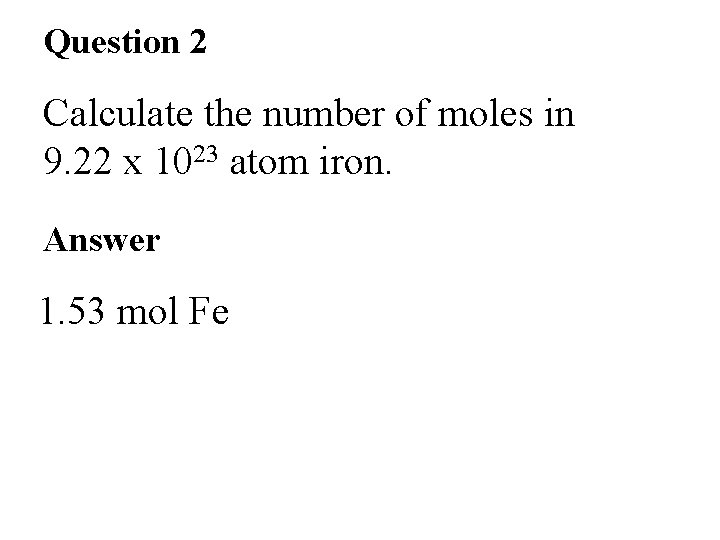
Question 2 Calculate the number of moles in 9. 22 x 1023 atom iron. Answer 1. 53 mol Fe
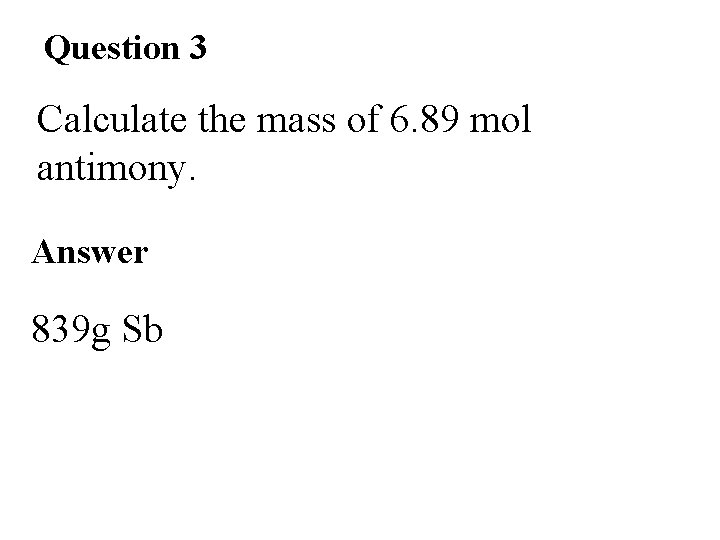
Question 3 Calculate the mass of 6. 89 mol antimony. Answer 839 g Sb
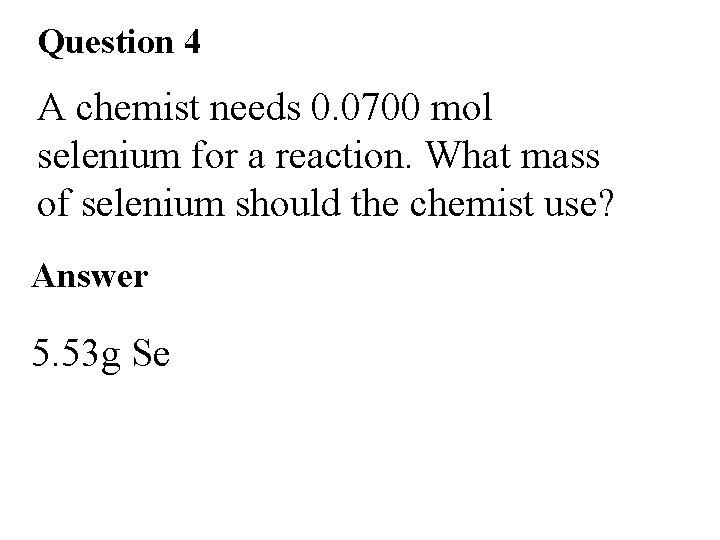
Question 4 A chemist needs 0. 0700 mol selenium for a reaction. What mass of selenium should the chemist use? Answer 5. 53 g Se
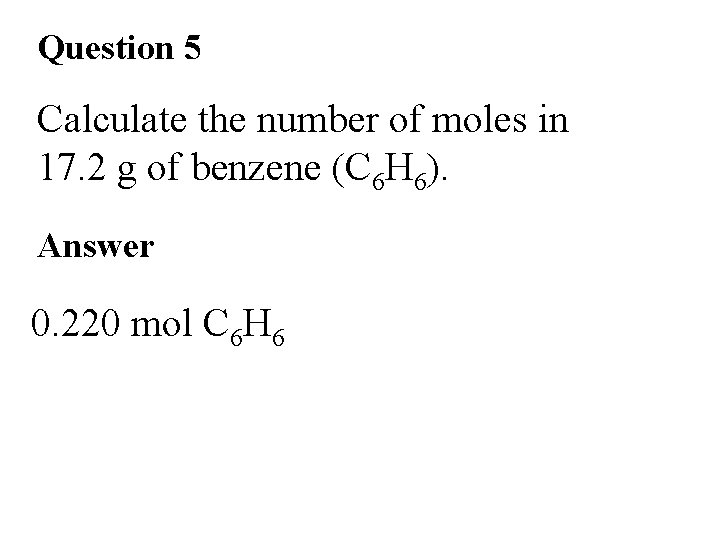
Question 5 Calculate the number of moles in 17. 2 g of benzene (C 6 H 6). Answer 0. 220 mol C 6 H 6