
PARTICLE PHYSICS AND COSMOLOGY Jonathan Feng UC Irvine
- Slides: 115
PARTICLE PHYSICS AND COSMOLOGY Jonathan Feng UC Irvine and CERN The 2014 European School of High Energy Physics Garderen, the Netherlands 19 -21 June 2014
OUTLINE LECTURE 1 Essential Cosmology: Contents and History of the Universe LECTURE 2 WIMP Dark Matter: Candidates and Methods of Detection LECTURE 3 Inflation, Gravitinos, and Hidden Sectors June 2014 Feng 2
INTRODUCTION • Why should HEP physicists care about cosmology? – We want to answer age-old questions about our Universe and our place in it – We are in a golden age of cosmology, and cosmology and particle physics have become inextricably intertwined – Many of the leading motivations for new particle physics come from cosmology: dark matter, dark energy, inflation, baryon asymmetry – Cosmology sets new interesting mass scales and can provide upper bounds on masses – Cosmology reaches the hard corners of parameter space (high masses, weak interactions) – HEP physicists and cosmologists have a lot to learn from each other – These topics capture the imagination of the public June 2014 Feng 3
ESSENTIAL COSMOLOGY • For the first time in history, we now have a complete picture of the Universe • How did this come about? • We will first review the standard model of cosmology and some of the key observational evidence leading to it • Little previous knowledge of cosmology is assumed; focus on heuristic derivations, order-of-magnitude estimates, intuitive arguments, and some aspects that (at present) seem to be most linked to particle physics, and particularly high-energy physics. This is a huge topic, many important topics will be neglected. June 2014 Feng 4
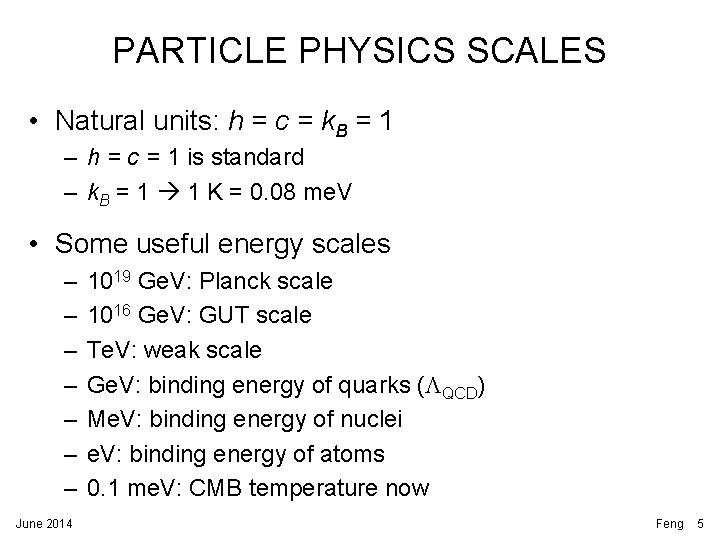
PARTICLE PHYSICS SCALES • Natural units: h = c = k. B = 1 – h = c = 1 is standard – k. B = 1 1 K = 0. 08 me. V • Some useful energy scales – – – – June 2014 1019 Ge. V: Planck scale 1016 Ge. V: GUT scale Te. V: weak scale Ge. V: binding energy of quarks (LQCD) Me. V: binding energy of nuclei e. V: binding energy of atoms 0. 1 me. V: CMB temperature now Feng 5
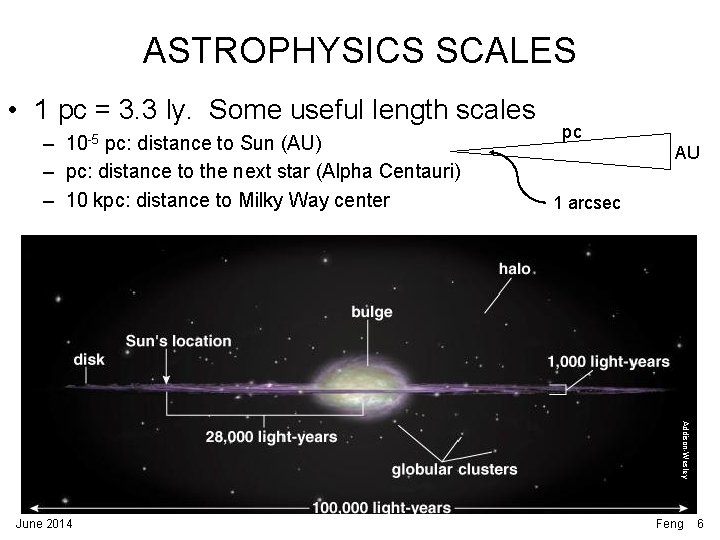
ASTROPHYSICS SCALES • 1 pc = 3. 3 ly. Some useful length scales – 10 -5 pc: distance to Sun (AU) – pc: distance to the next star (Alpha Centauri) – 10 kpc: distance to Milky Way center pc AU 1 arcsec Addison-Wesley June 2014 Feng 6
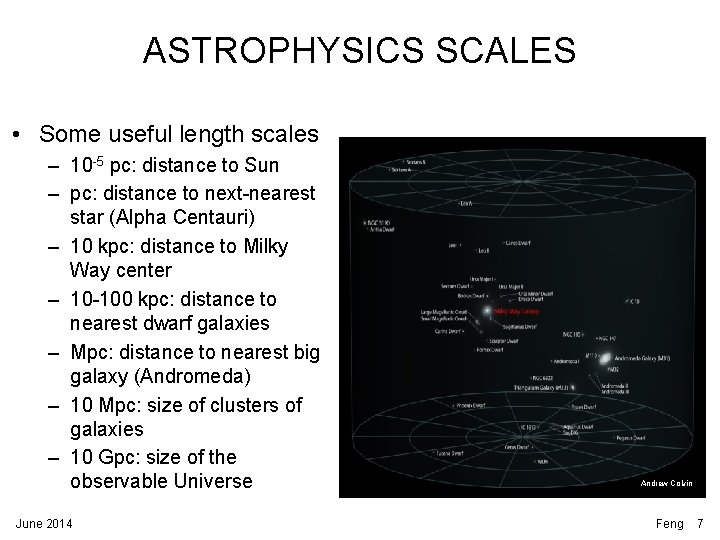
ASTROPHYSICS SCALES • Some useful length scales – 10 -5 pc: distance to Sun – pc: distance to next-nearest star (Alpha Centauri) – 10 kpc: distance to Milky Way center – 10 -100 kpc: distance to nearest dwarf galaxies – Mpc: distance to nearest big galaxy (Andromeda) – 10 Mpc: size of clusters of galaxies – 10 Gpc: size of the observable Universe June 2014 Andrew Colvin Feng 7
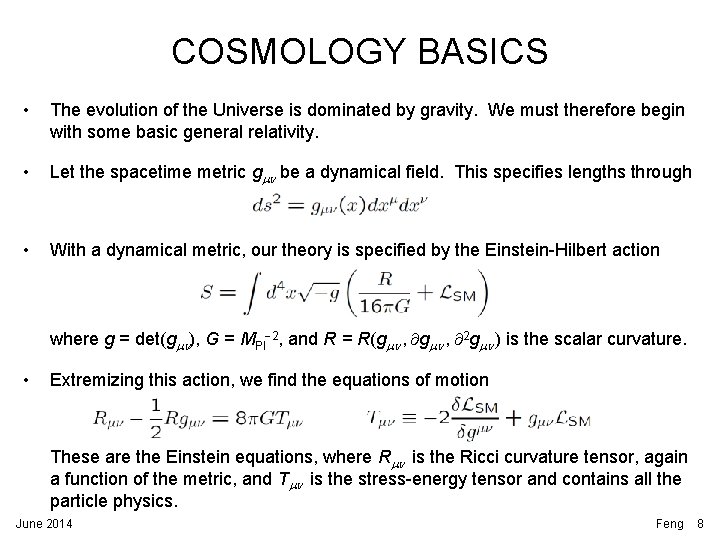
COSMOLOGY BASICS • The evolution of the Universe is dominated by gravity. We must therefore begin with some basic general relativity. • Let the spacetime metric gmn be a dynamical field. This specifies lengths through • With a dynamical metric, our theory is specified by the Einstein-Hilbert action where g = det(gmn), G = MPl-2, and R = R(gmn , 2 gmn ) is the scalar curvature. • Extremizing this action, we find the equations of motion These are the Einstein equations, where Rmn is the Ricci curvature tensor, again a function of the metric, and Tmn is the stress-energy tensor and contains all the particle physics. June 2014 Feng 8
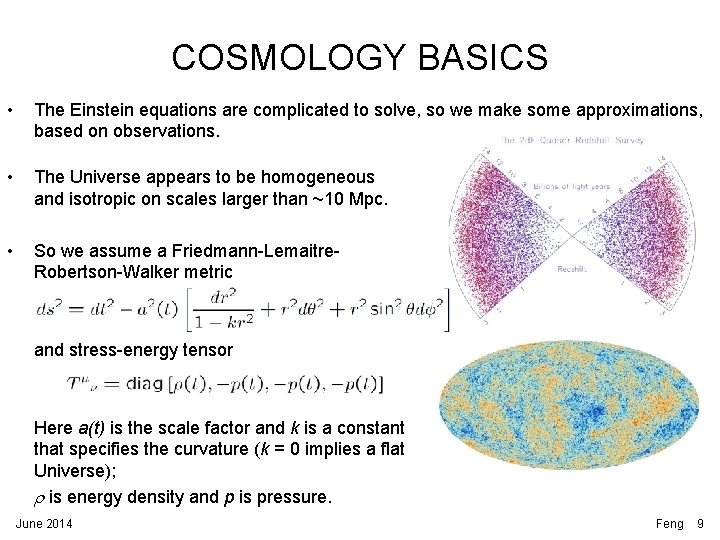
COSMOLOGY BASICS • The Einstein equations are complicated to solve, so we make some approximations, based on observations. • The Universe appears to be homogeneous and isotropic on scales larger than ~10 Mpc. • So we assume a Friedmann-Lemaitre. Robertson-Walker metric and stress-energy tensor Here a(t) is the scale factor and k is a constant that specifies the curvature (k = 0 implies a flat Universe); r is energy density and p is pressure. June 2014 Feng 9
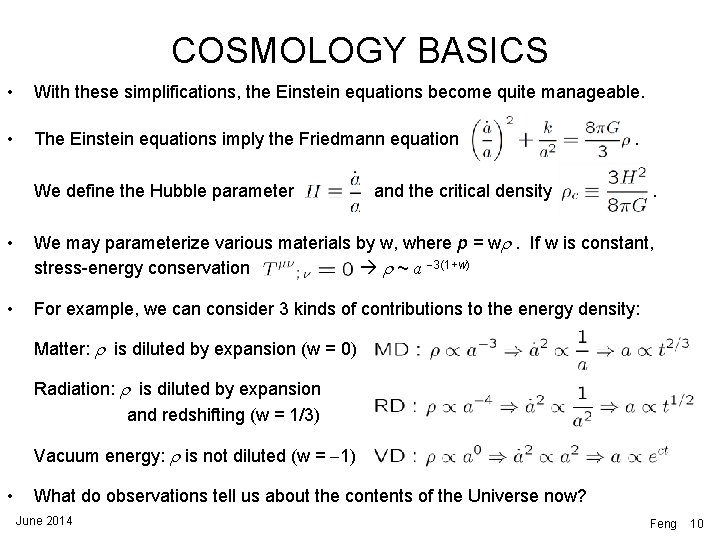
COSMOLOGY BASICS • With these simplifications, the Einstein equations become quite manageable. • The Einstein equations imply the Friedmann equation We define the Hubble parameter . and the critical density . • We may parameterize various materials by w, where p = wr. If w is constant, stress-energy conservation r ~ a -3(1+w) • For example, we can consider 3 kinds of contributions to the energy density: Matter: r is diluted by expansion (w = 0) Radiation: r is diluted by expansion and redshifting (w = 1/3) Vacuum energy: r is not diluted (w = -1) • What do observations tell us about the contents of the Universe now? June 2014 Feng 10
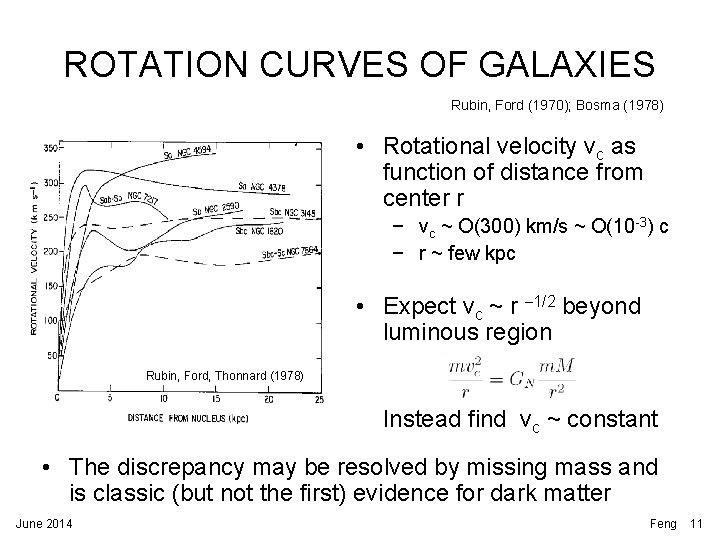
ROTATION CURVES OF GALAXIES Rubin, Ford (1970); Bosma (1978) • Rotational velocity vc as function of distance from center r − vc ~ O(300) km/s ~ O(10 -3) c − r ~ few kpc • Expect vc ~ r -1/2 beyond luminous region Rubin, Ford, Thonnard (1978) Instead find vc ~ constant • The discrepancy may be resolved by missing mass and is classic (but not the first) evidence for dark matter June 2014 Feng 11
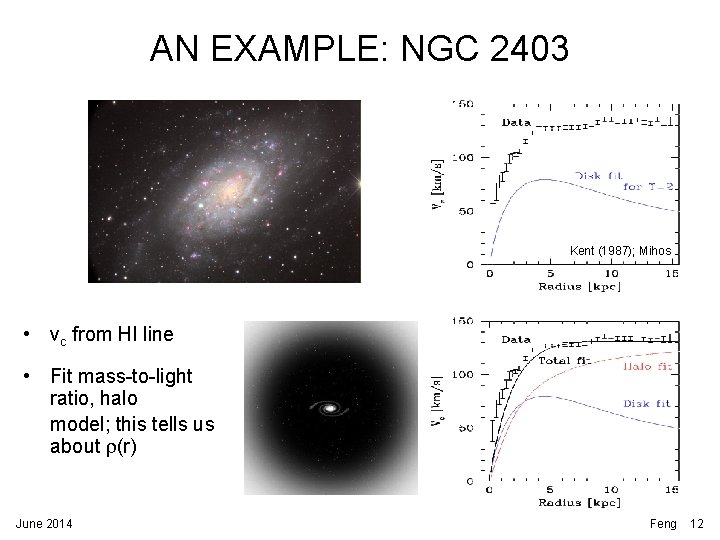
AN EXAMPLE: NGC 2403 Kent (1987); Mihos • vc from HI line • Fit mass-to-light ratio, halo model; this tells us about r(r) June 2014 Feng 12
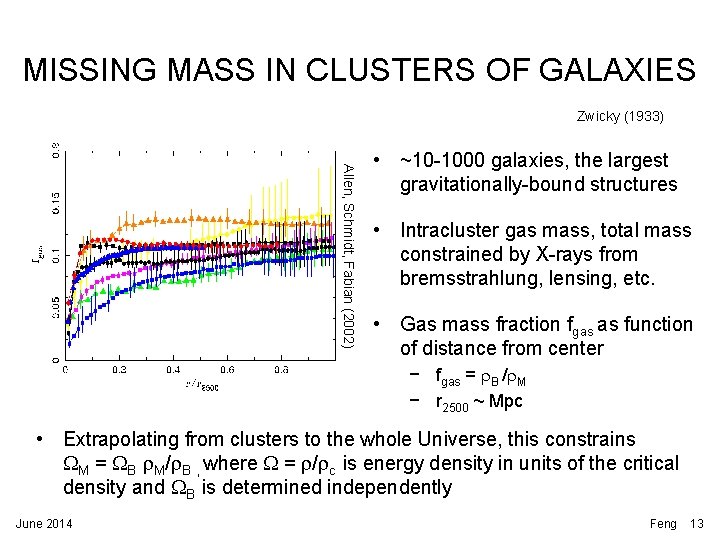
MISSING MASS IN CLUSTERS OF GALAXIES Zwicky (1933) Allen, Schmidt, Fabian (2002) • ~10 -1000 galaxies, the largest gravitationally-bound structures • Intracluster gas mass, total mass constrained by X-rays from bremsstrahlung, lensing, etc. • Gas mass fraction fgas as function of distance from center − fgas = r. B /r. M − r 2500 ~ Mpc • Extrapolating from clusters to the whole Universe, this constrains WM = WB r. M/r. B , where W = r/rc is energy density in units of the critical density and WB is determined independently June 2014 Feng 13
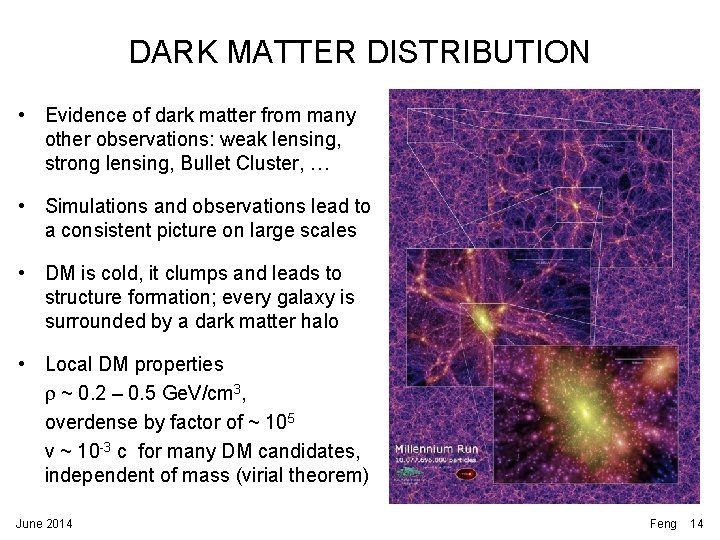
DARK MATTER DISTRIBUTION • Evidence of dark matter from many other observations: weak lensing, strong lensing, Bullet Cluster, … • Simulations and observations lead to a consistent picture on large scales • DM is cold, it clumps and leads to structure formation; every galaxy is surrounded by a dark matter halo • Local DM properties r ~ 0. 2 – 0. 5 Ge. V/cm 3, overdense by factor of ~ 105 v ~ 10 -3 c for many DM candidates, independent of mass (virial theorem) June 2014 Feng 14
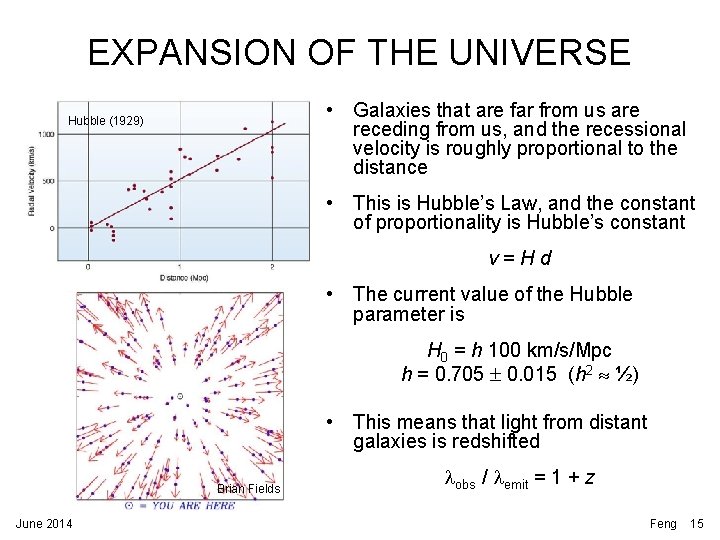
EXPANSION OF THE UNIVERSE • Galaxies that are far from us are receding from us, and the recessional velocity is roughly proportional to the distance Hubble (1929) • This is Hubble’s Law, and the constant of proportionality is Hubble’s constant v=Hd • The current value of the Hubble parameter is H 0 = h 100 km/s/Mpc h = 0. 705 0. 015 (h 2 ½) • This means that light from distant galaxies is redshifted Brian Fields June 2014 lobs / lemit = 1 + z Feng 15
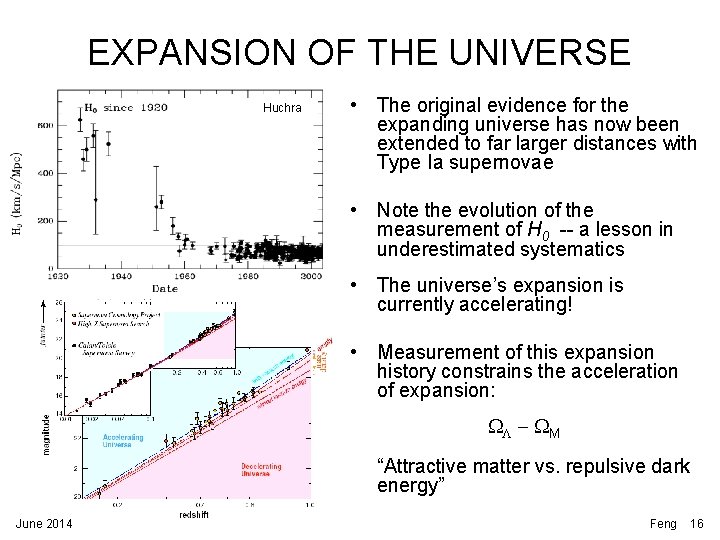
EXPANSION OF THE UNIVERSE Huchra • The original evidence for the expanding universe has now been extended to far larger distances with Type Ia supernovae • Note the evolution of the measurement of H 0 -- a lesson in underestimated systematics • The universe’s expansion is currently accelerating! • Measurement of this expansion history constrains the acceleration of expansion: WL - WM “Attractive matter vs. repulsive dark energy” June 2014 Feng 16
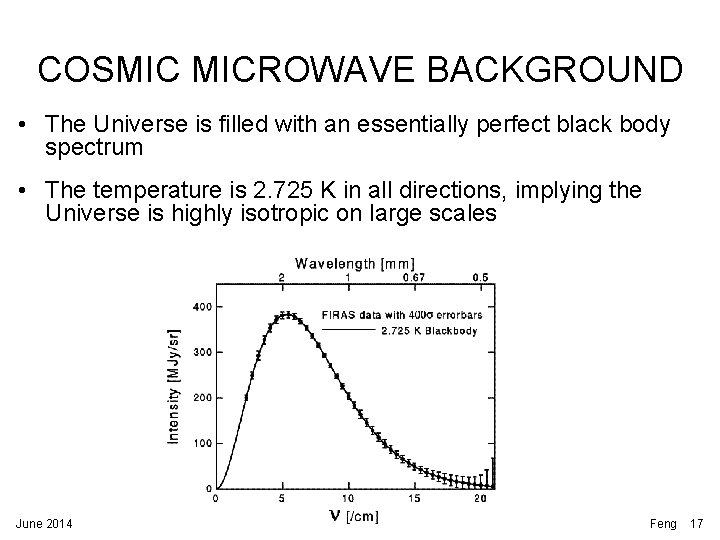
COSMIC MICROWAVE BACKGROUND • The Universe is filled with an essentially perfect black body spectrum • The temperature is 2. 725 K in all directions, implying the Universe is highly isotropic on large scales Planck June 2014 Feng 17
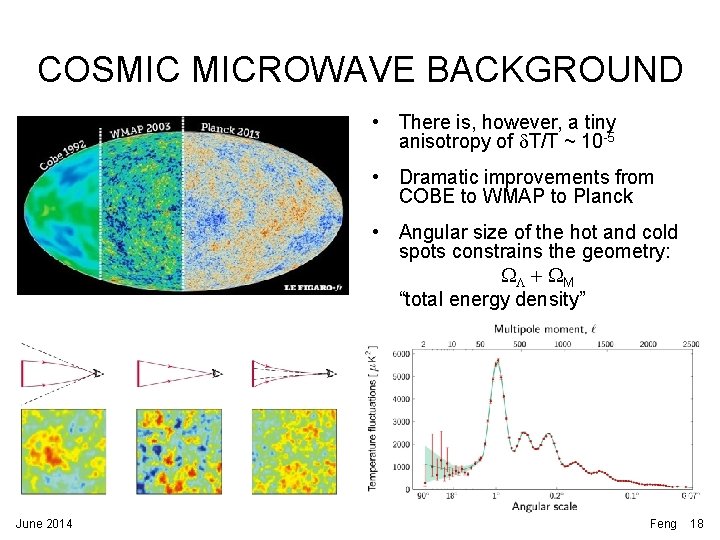
COSMIC MICROWAVE BACKGROUND • There is, however, a tiny anisotropy of d. T/T ~ 10 -5 • Dramatic improvements from COBE to WMAP to Planck • Angular size of the hot and cold spots constrains the geometry: WL + WM “total energy density” Planck June 2014 Feng 18
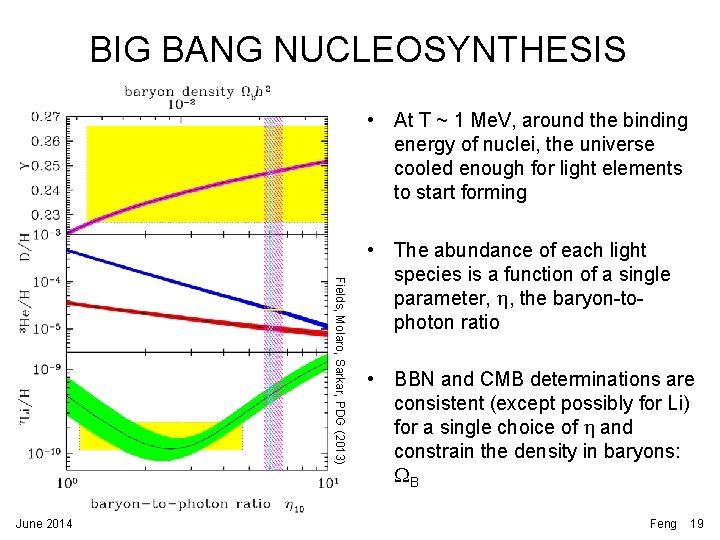
BIG BANG NUCLEOSYNTHESIS • At T ~ 1 Me. V, around the binding energy of nuclei, the universe cooled enough for light elements to start forming Fields, Molaro, Sarkar, PDG (2013) June 2014 • The abundance of each light species is a function of a single parameter, h, the baryon-tophoton ratio • BBN and CMB determinations are consistent (except possibly for Li) for a single choice of h and constrain the density in baryons: WB Feng 19
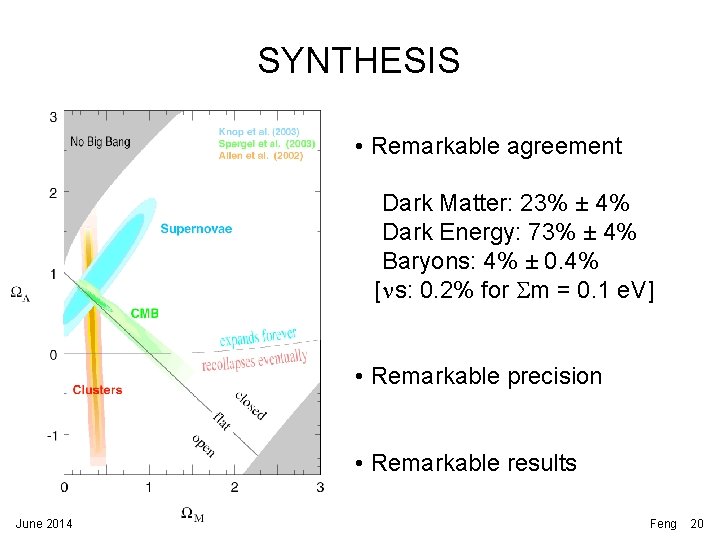
SYNTHESIS • Remarkable agreement Dark Matter: 23% ± 4% Dark Energy: 73% ± 4% Baryons: 4% ± 0. 4% [ns: 0. 2% for Sm = 0. 1 e. V] • Remarkable precision • Remarkable results June 2014 Feng 20
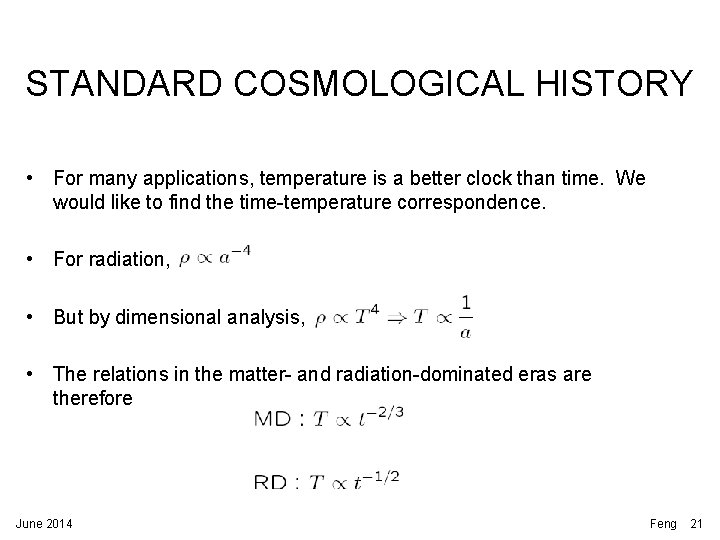
STANDARD COSMOLOGICAL HISTORY • For many applications, temperature is a better clock than time. We would like to find the time-temperature correspondence. • For radiation, • But by dimensional analysis, • The relations in the matter- and radiation-dominated eras are therefore June 2014 Feng 21
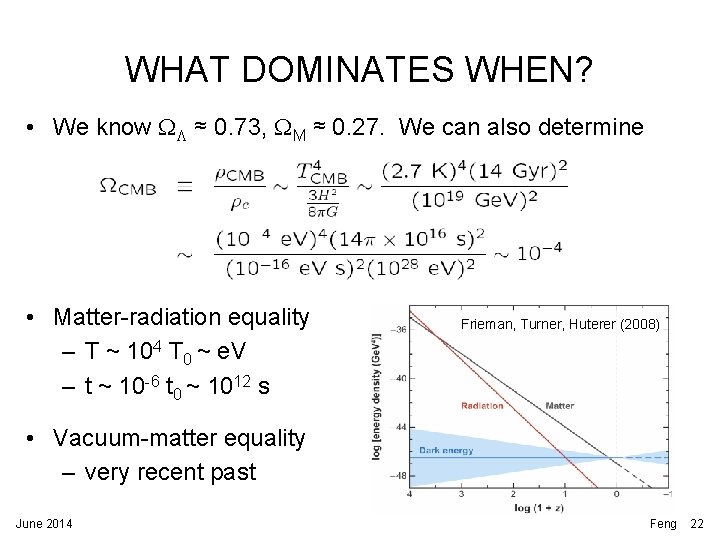
WHAT DOMINATES WHEN? • We know WL ≈ 0. 73, WM ≈ 0. 27. We can also determine • Matter-radiation equality – T ~ 104 T 0 ~ e. V – t ~ 10 -6 t 0 ~ 1012 s Frieman, Turner, Huterer (2008) • Vacuum-matter equality – very recent past June 2014 Feng 22
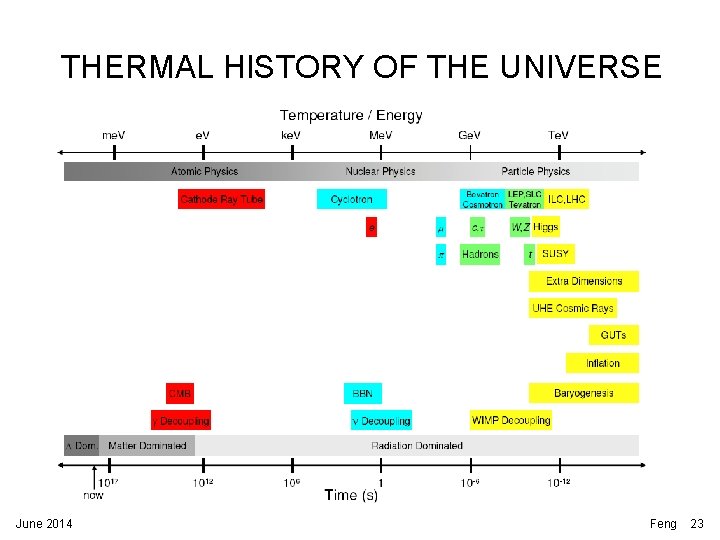
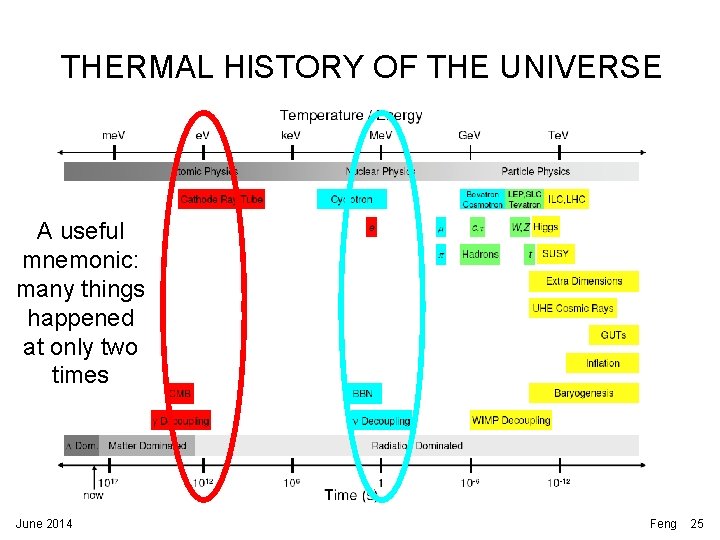
THERMAL HISTORY OF THE UNIVERSE June 2014 Feng 23
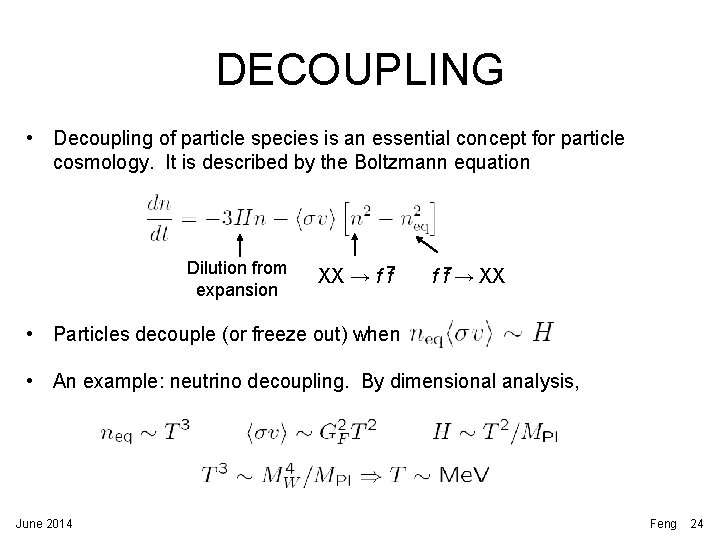
DECOUPLING • Decoupling of particle species is an essential concept for particle cosmology. It is described by the Boltzmann equation Dilution from expansion XX → f f‾ → XX • Particles decouple (or freeze out) when • An example: neutrino decoupling. By dimensional analysis, June 2014 Feng 24
THERMAL HISTORY OF THE UNIVERSE A useful mnemonic: many things happened at only two times June 2014 Feng 25
PROBLEMS The standard model of cosmology answers many questions, but also highlights many others: • • • What is dark matter? What is the (small-scale) distribution of dark matter? How did structure form? What is dark energy? Why is the cosmological constant so small? Why matter and no anti-matter? Why are all energy densities roughly comparable now? How did the universe begin? … Particle physics is required to answer all of these, not least because it is required to understand the hot early Universe June 2014 Feng 26
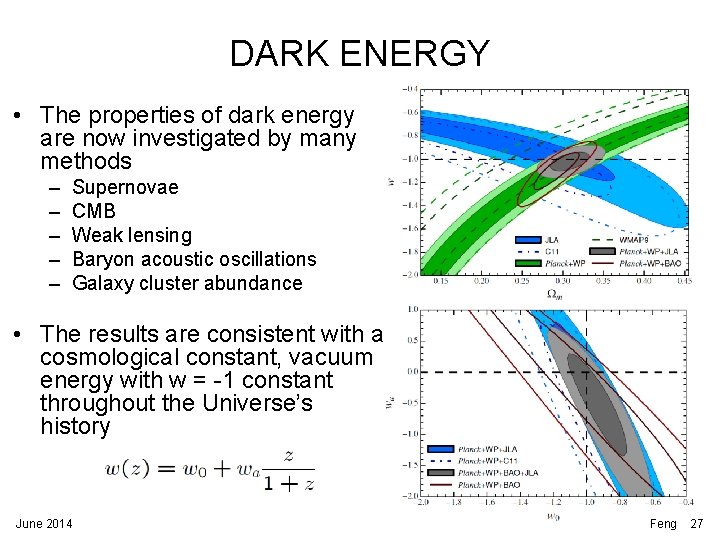
DARK ENERGY • The properties of dark energy are now investigated by many methods – – – Supernovae CMB Weak lensing Baryon acoustic oscillations Galaxy cluster abundance • The results are consistent with a cosmological constant, vacuum energy with w = -1 constant throughout the Universe’s history June 2014 Feng 27
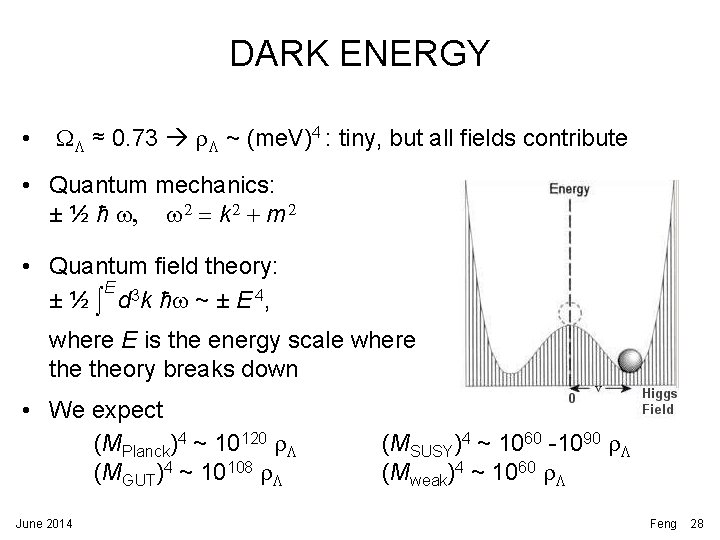
DARK ENERGY • WL ≈ 0. 73 r. L ~ (me. V)4 : tiny, but all fields contribute • Quantum mechanics: ± ½ ħ w, w 2 = k 2 + m 2 • Quantum field theory: E ± ½ ∫ d 3 k ħw ~ ± E 4, where E is the energy scale where theory breaks down • We expect (MPlanck)4 ~ 10120 r. L (MGUT)4 ~ 10108 r. L June 2014 (MSUSY)4 ~ 1060 -1090 r. L (Mweak)4 ~ 1060 r. L Feng 28
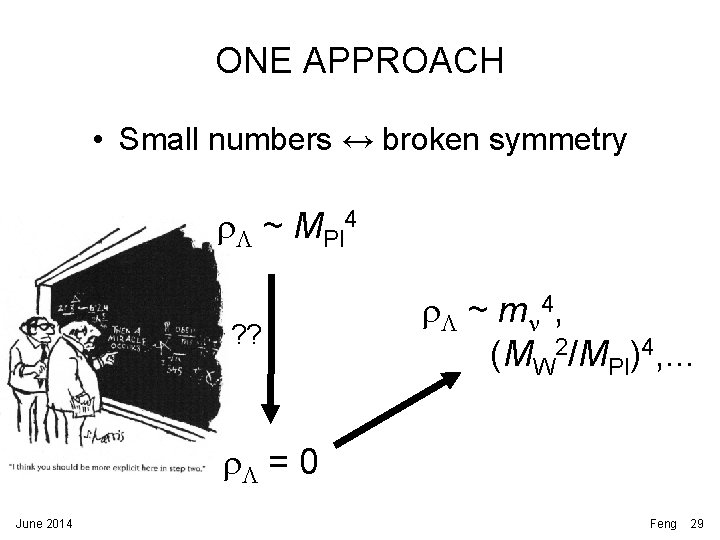
ONE APPROACH • Small numbers ↔ broken symmetry r. L ~ MPl 4 ? ? r L ~ mn 4 , (MW 2/MPl)4, . . . r. L = 0 June 2014 Feng 29
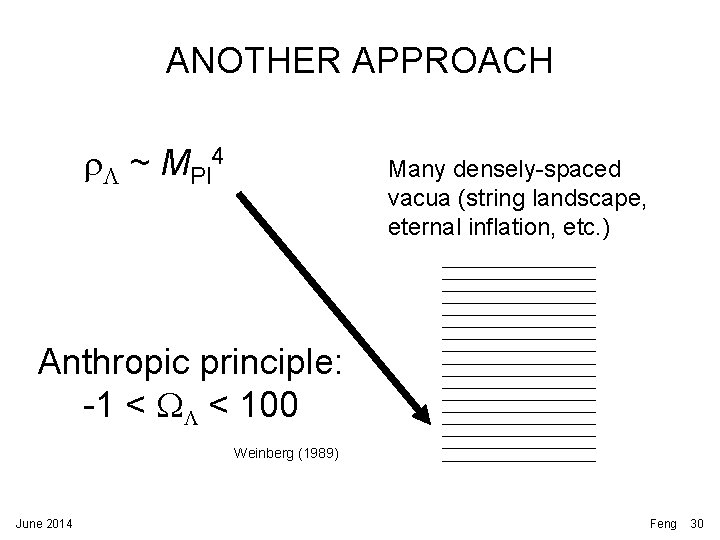
ANOTHER APPROACH r. L ~ MPl 4 Many densely-spaced vacua (string landscape, eternal inflation, etc. ) Anthropic principle: -1 < WL < 100 Weinberg (1989) June 2014 Feng 30
DARK ENERGY PROSPECTS • These approaches are very different. Their only similarity is that the more you think about either one, the more you think the other one must be more promising • The discrepancy between the expected and measured values of WL is the greatest hierarchy problem in particle physics, not just because it is numerically large, but because we think we understand me. V-scale physics • Ways forward Constrain DE properties, see if it deviates from a cosmological constant or indicates a deviation from GR Make a breakthrough in understanding quantum gravity Learn something unexpected about fundamental scalars June 2014 Feng 31
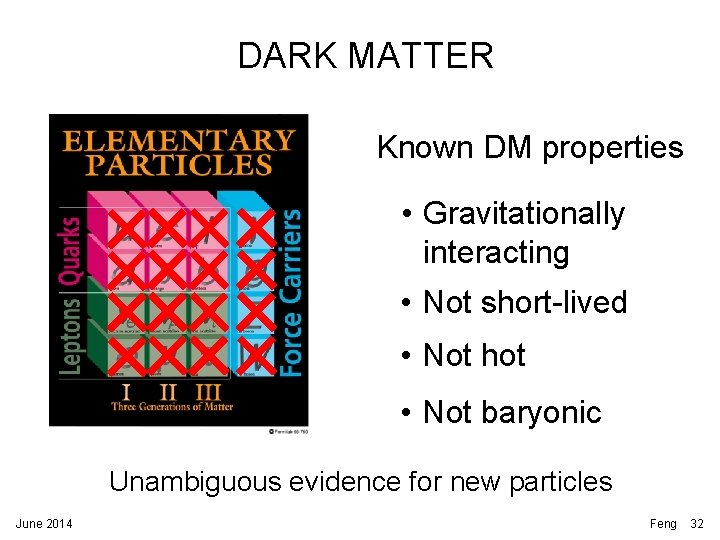
DARK MATTER Known DM properties • Gravitationally interacting • Not short-lived • Not hot • Not baryonic Unambiguous evidence for new particles June 2014 Feng 32
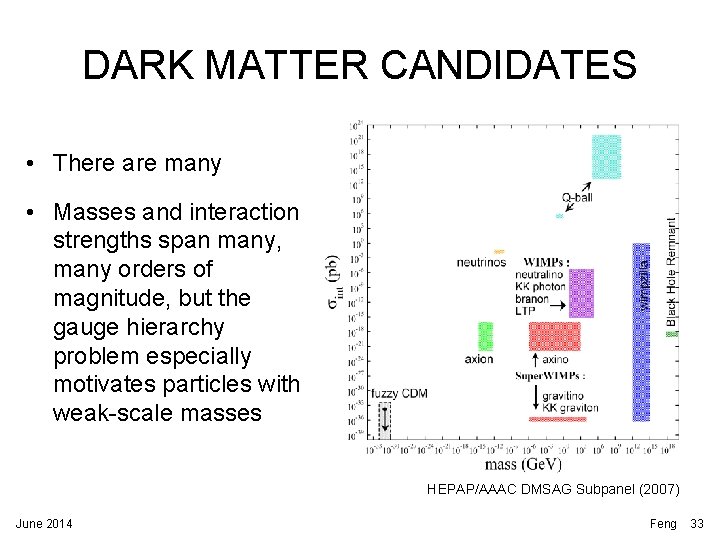
DARK MATTER CANDIDATES • There are many • Masses and interaction strengths span many, many orders of magnitude, but the gauge hierarchy problem especially motivates particles with weak-scale masses HEPAP/AAAC DMSAG Subpanel (2007) June 2014 Feng 33
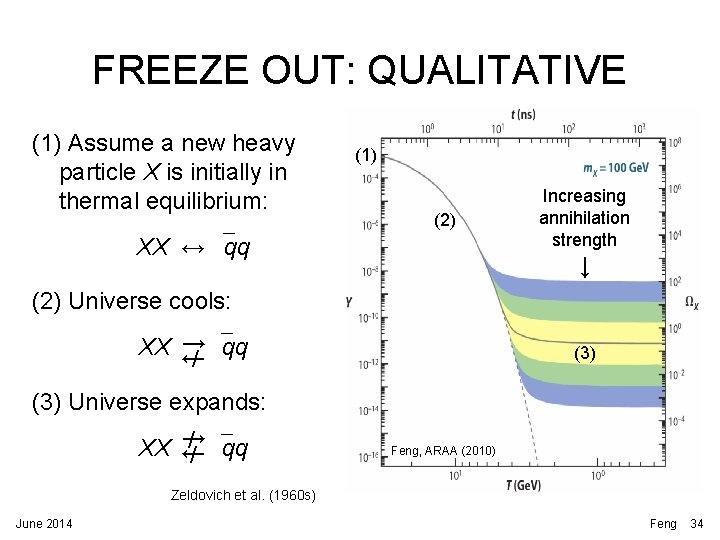
FREEZE OUT: QUALITATIVE (1) Assume a new heavy particle X is initially in thermal equilibrium: XX ↔ qq (1) (2) Increasing annihilation strength ↓ (2) Universe cools: qq → / ← XX (3) Universe expands: → / qq XX ← / (3) Feng, ARAA (2010) Zeldovich et al. (1960 s) June 2014 Feng 34
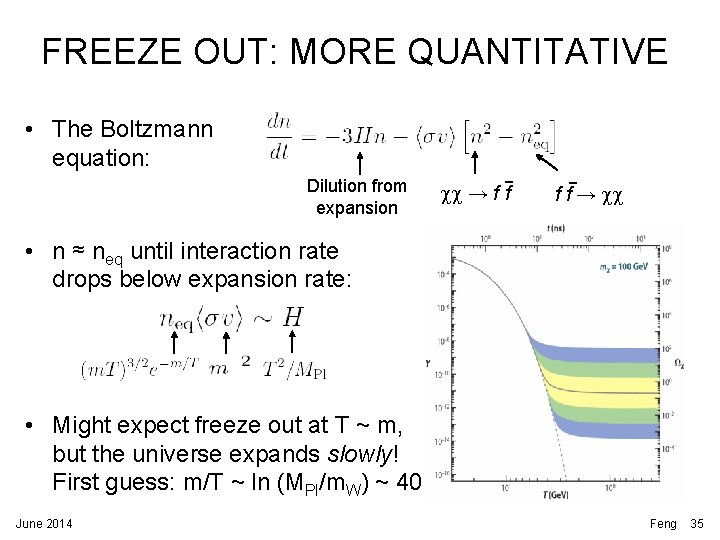
FREEZE OUT: MORE QUANTITATIVE • The Boltzmann equation: Dilution from expansion cc → f f‾→ cc • n ≈ neq until interaction rate drops below expansion rate: • Might expect freeze out at T ~ m, but the universe expands slowly! First guess: m/T ~ ln (MPl/m. W) ~ 40 June 2014 Feng 35
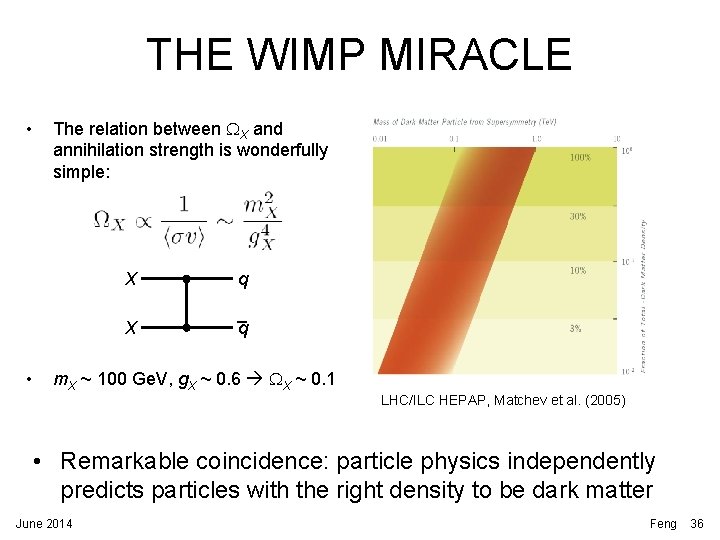
THE WIMP MIRACLE • • The relation between WX and annihilation strength is wonderfully simple: X q X _ q m. X ~ 100 Ge. V, g. X ~ 0. 6 WX ~ 0. 1 LHC/ILC HEPAP, Matchev et al. (2005) • Remarkable coincidence: particle physics independently predicts particles with the right density to be dark matter June 2014 Feng 36
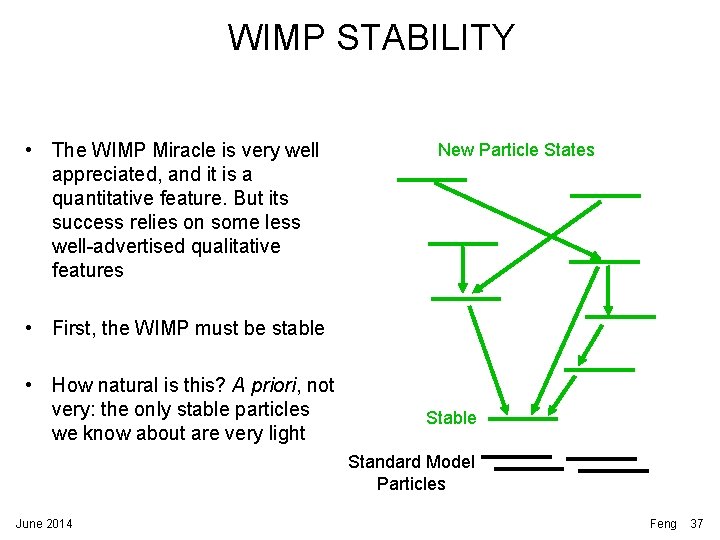
WIMP STABILITY • The WIMP Miracle is very well appreciated, and it is a quantitative feature. But its success relies on some less well-advertised qualitative features New Particle States • First, the WIMP must be stable • How natural is this? A priori, not very: the only stable particles we know about are very light Stable Standard Model Particles June 2014 Feng 37
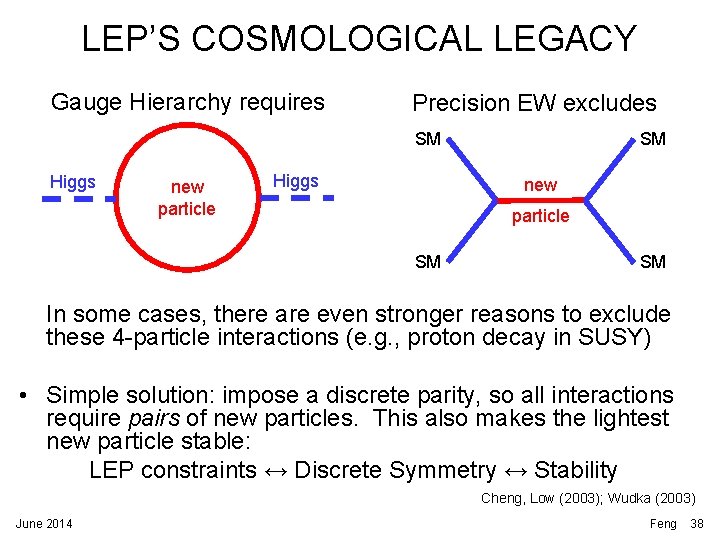
LEP’S COSMOLOGICAL LEGACY Gauge Hierarchy requires Precision EW excludes SM Higgs new particle Higgs SM new particle SM SM In some cases, there are even stronger reasons to exclude these 4 -particle interactions (e. g. , proton decay in SUSY) • Simple solution: impose a discrete parity, so all interactions require pairs of new particles. This also makes the lightest new particle stable: LEP constraints ↔ Discrete Symmetry ↔ Stability Cheng, Low (2003); Wudka (2003) June 2014 Feng 38
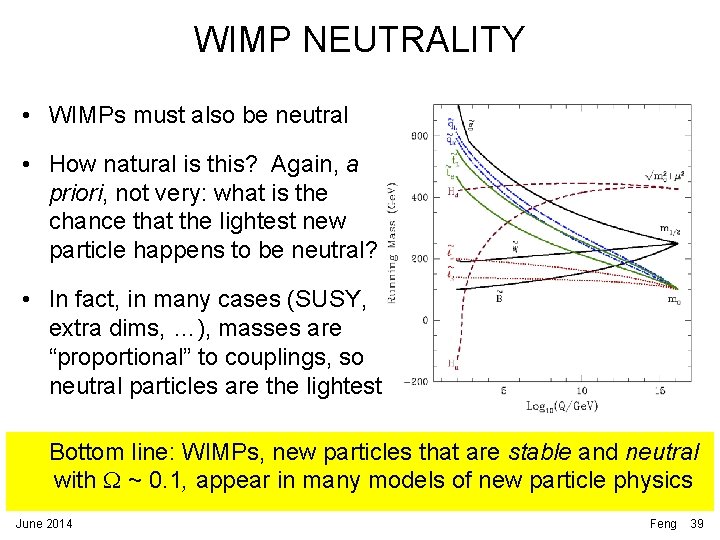
WIMP NEUTRALITY • WIMPs must also be neutral • How natural is this? Again, a priori, not very: what is the chance that the lightest new particle happens to be neutral? • In fact, in many cases (SUSY, extra dims, …), masses are “proportional” to couplings, so neutral particles are the lightest Bottom line: WIMPs, new particles that are stable and neutral with W ~ 0. 1, appear in many models of new particle physics June 2014 Feng 39
LECTURE 1 SUMMARY • The revolution in cosmology has produced remarkable progress • This progress also highlights puzzles that require particle physics answers • Cosmology and particle physics both point to the weak scale for new particles • Next time: what are the opportunities for probing the weak scale with dark matter searches? June 2014 Feng 40
OUTLINE LECTURE 1 Essential Cosmology: Contents and History of the Universe LECTURE 2 WIMP Dark Matter: Candidates and Methods of Detection LECTURE 3 Inflation, Gravitinos, and Hidden Sectors June 2014 Feng 41
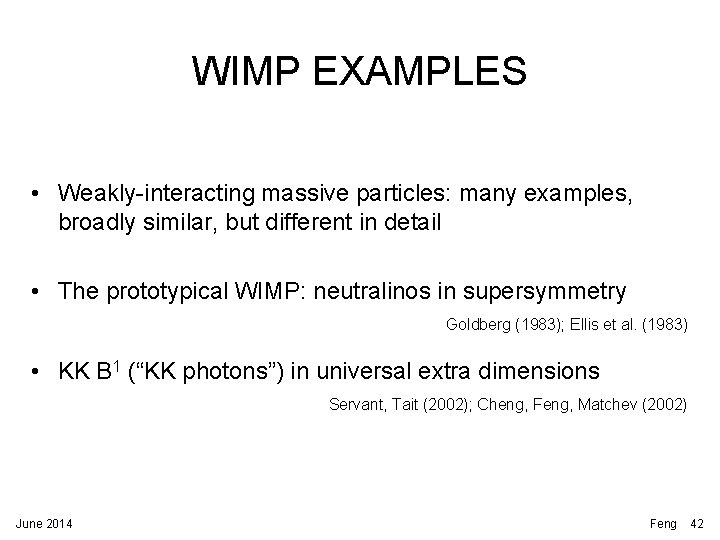
WIMP EXAMPLES • Weakly-interacting massive particles: many examples, broadly similar, but different in detail • The prototypical WIMP: neutralinos in supersymmetry Goldberg (1983); Ellis et al. (1983) • KK B 1 (“KK photons”) in universal extra dimensions Servant, Tait (2002); Cheng, Feng, Matchev (2002) June 2014 Feng 42
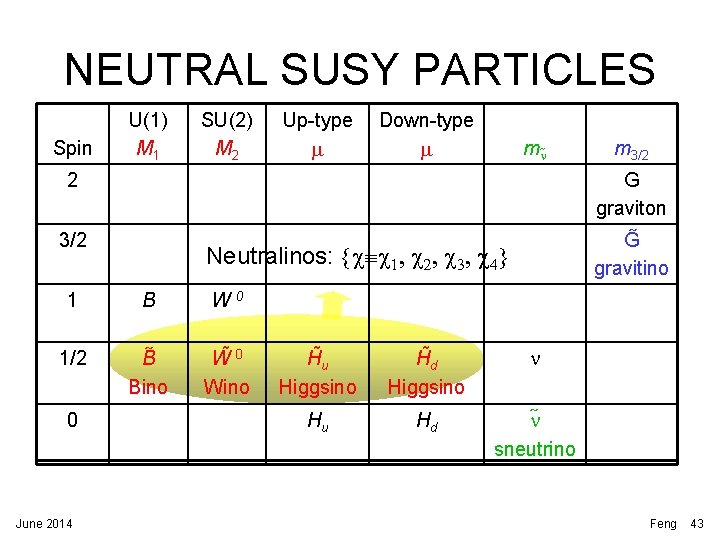
NEUTRAL SUSY PARTICLES Spin U(1) M 1 SU(2) M 2 Up-type m Down-type m mn m 3/2 2 G graviton 3/2 G gravitino Neutralinos: {c c 1, c 2, c 3, c 4} 1 B W 0 1/2 B Bino W 0 Wino 0 June 2014 H u Higgsino H d Higgsino n Hu Hd n sneutrino Feng 43
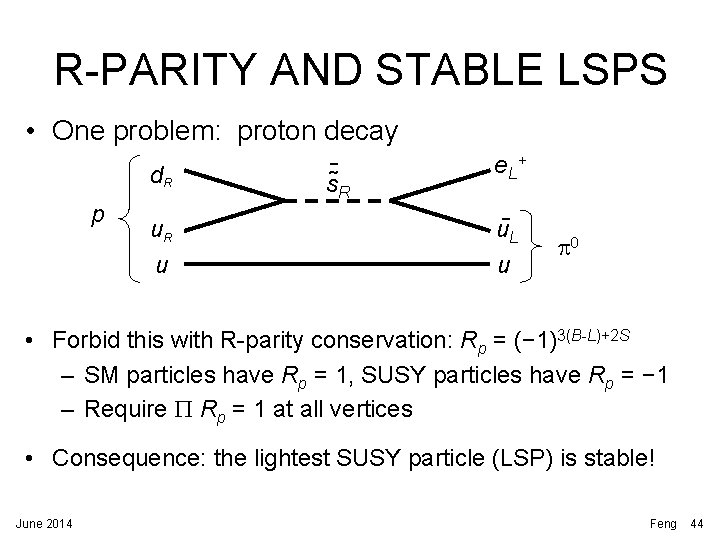
R-PARITY AND STABLE LSPS • One problem: proton decay d. R p ‾ s R e L+ u. R u‾L u u p 0 • Forbid this with R-parity conservation: Rp = (− 1)3(B-L)+2 S – SM particles have Rp = 1, SUSY particles have Rp = − 1 – Require P Rp = 1 at all vertices • Consequence: the lightest SUSY particle (LSP) is stable! June 2014 Feng 44
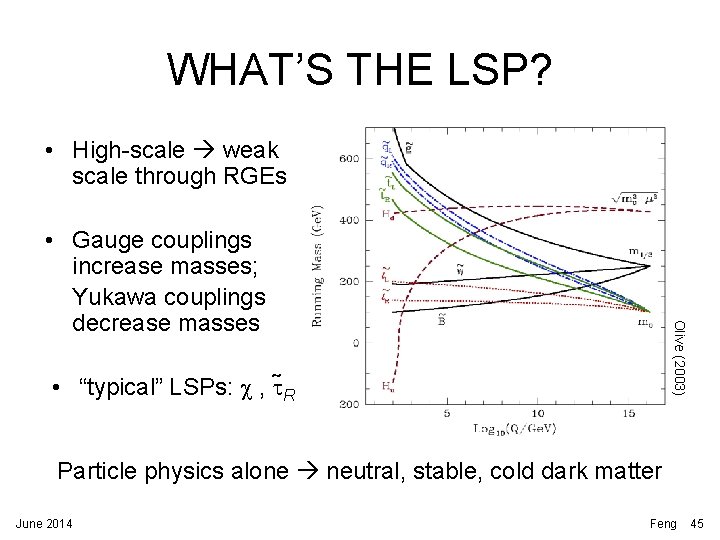
WHAT’S THE LSP? • High-scale weak scale through RGEs Olive (2003) • Gauge couplings increase masses; Yukawa couplings decrease masses • “typical” LSPs: c , t R Particle physics alone neutral, stable, cold dark matter June 2014 Feng 45
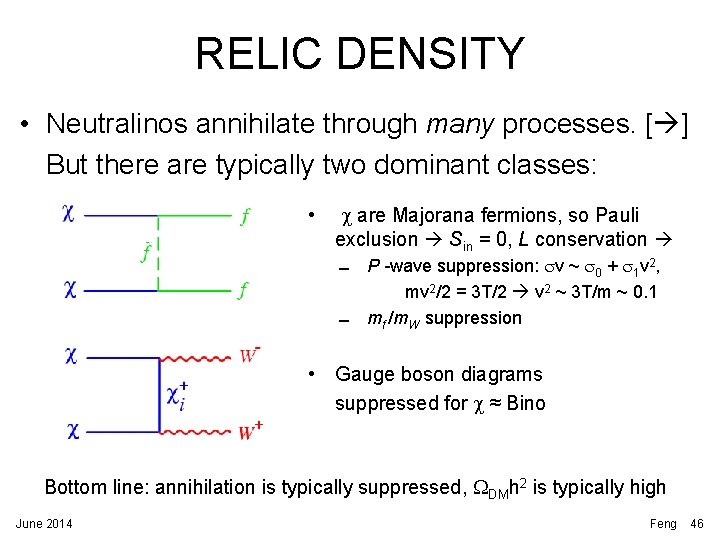
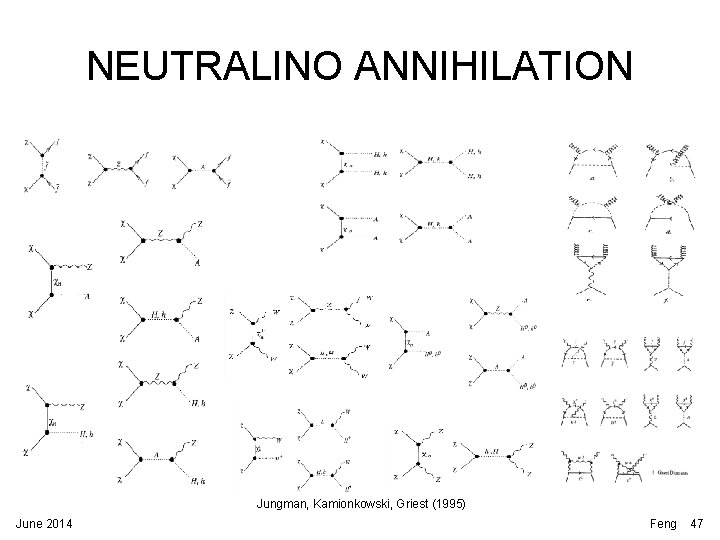
RELIC DENSITY • Neutralinos annihilate through many processes. [ ] But there are typically two dominant classes: • c are Majorana fermions, so Pauli exclusion Sin = 0, L conservation P -wave suppression: sv ~ s 0 + s 1 v 2, mv 2/2 = 3 T/2 v 2 ~ 3 T/m ~ 0. 1 mf /m. W suppression • Gauge boson diagrams suppressed for c ≈ Bino Bottom line: annihilation is typically suppressed, WDMh 2 is typically high June 2014 Feng 46
NEUTRALINO ANNIHILATION Jungman, Kamionkowski, Griest (1995) June 2014 Feng 47
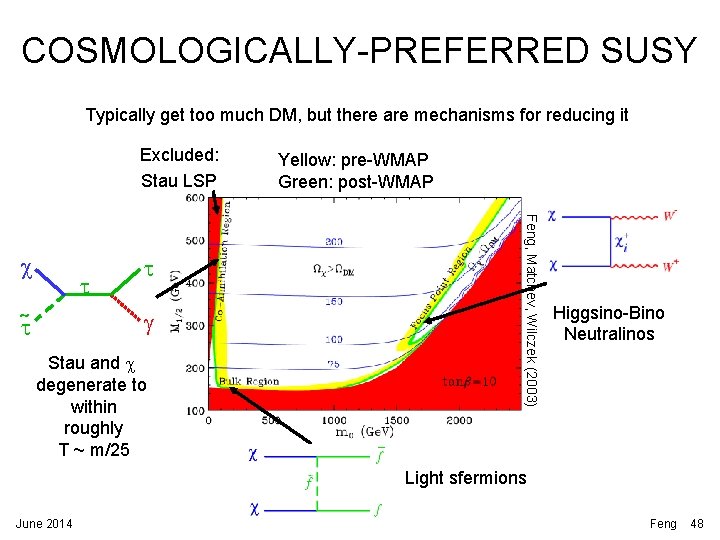
COSMOLOGICALLY-PREFERRED SUSY Typically get too much DM, but there are mechanisms for reducing it Excluded: Stau LSP t t g t Stau and c degenerate to within roughly T ~ m/25 Feng, Matchev, Wilczek (2003) c Yellow: pre-WMAP Green: post-WMAP Higgsino-Bino Neutralinos Light sfermions June 2014 Feng 48
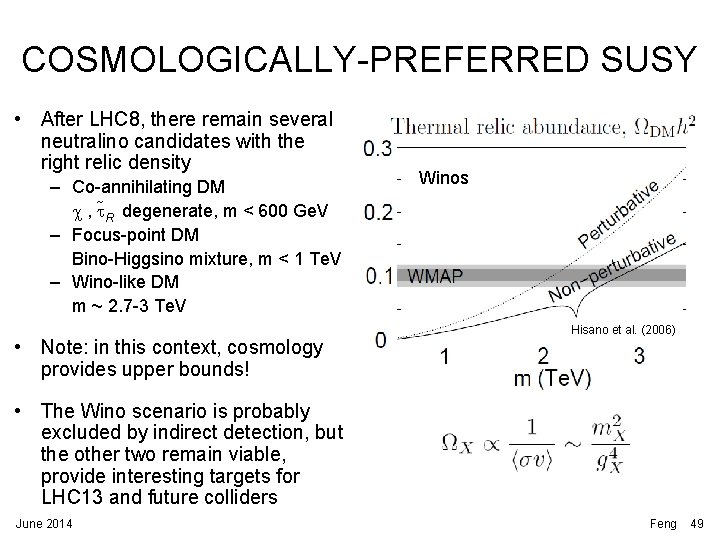
COSMOLOGICALLY-PREFERRED SUSY • After LHC 8, there remain several neutralino candidates with the right relic density – Co-annihilating DM c , t R degenerate, m < 600 Ge. V – Focus-point DM Bino-Higgsino mixture, m < 1 Te. V – Wino-like DM m ~ 2. 7 -3 Te. V • Note: in this context, cosmology provides upper bounds! Winos Hisano et al. (2006) • The Wino scenario is probably excluded by indirect detection, but the other two remain viable, provide interesting targets for LHC 13 and future colliders June 2014 Feng 49
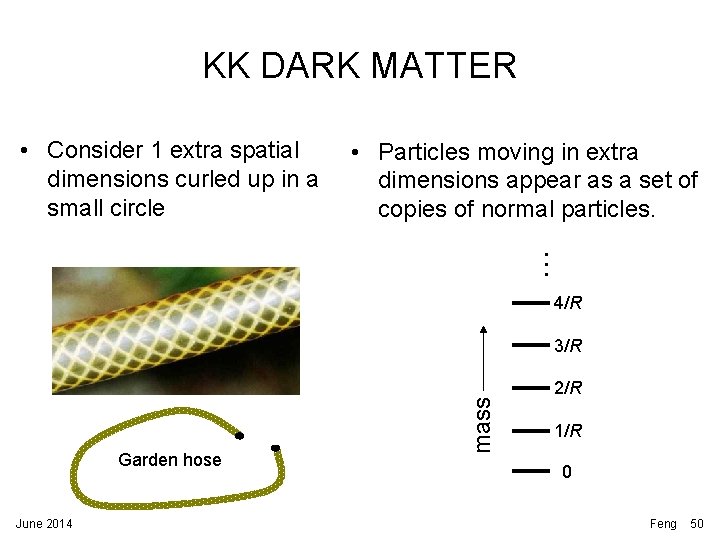
KK DARK MATTER • Particles moving in extra dimensions appear as a set of copies of normal particles. … • Consider 1 extra spatial dimensions curled up in a small circle 4/R Garden hose June 2014 mass 3/R 2/R 1/R 0 Feng 50
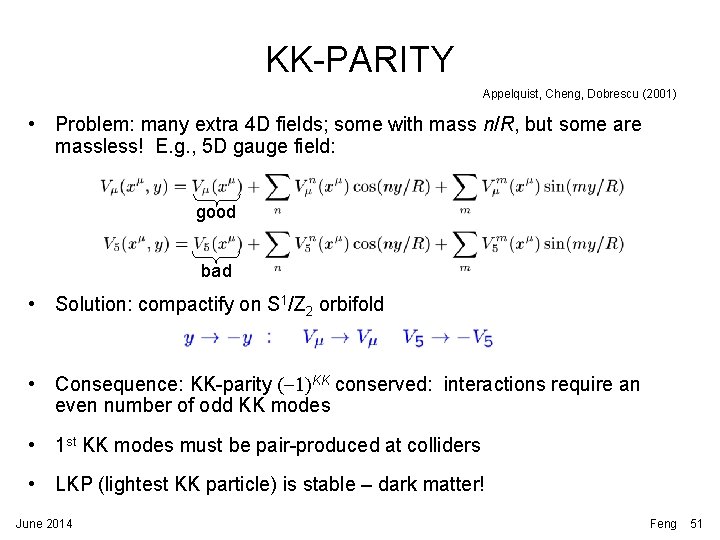
KK-PARITY Appelquist, Cheng, Dobrescu (2001) • Problem: many extra 4 D fields; some with mass n/R, but some are massless! E. g. , 5 D gauge field: good bad • Solution: compactify on S 1/Z 2 orbifold • Consequence: KK-parity (-1)KK conserved: interactions require an even number of odd KK modes • 1 st KK modes must be pair-produced at colliders • LKP (lightest KK particle) is stable – dark matter! June 2014 Feng 51
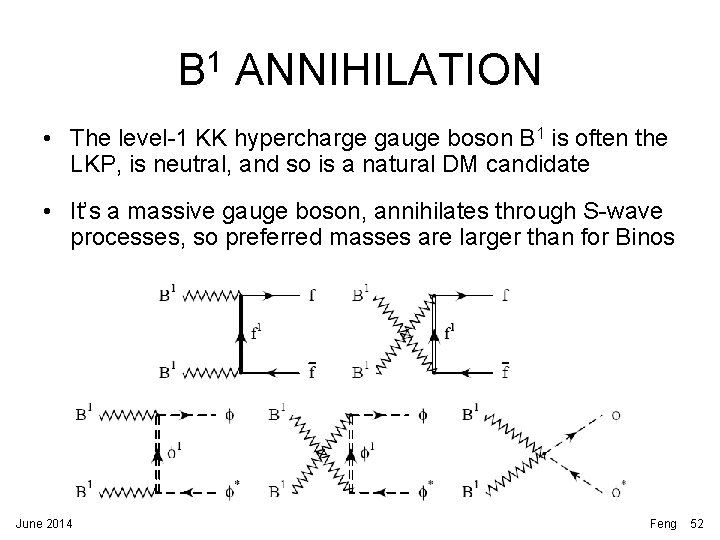
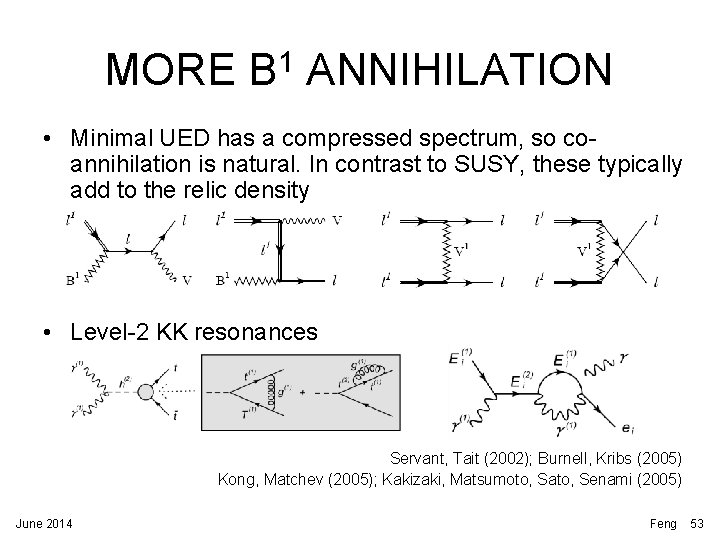
B 1 ANNIHILATION • The level-1 KK hypercharge gauge boson B 1 is often the LKP, is neutral, and so is a natural DM candidate • It’s a massive gauge boson, annihilates through S-wave processes, so preferred masses are larger than for Binos June 2014 Feng 52
MORE B 1 ANNIHILATION • Minimal UED has a compressed spectrum, so coannihilation is natural. In contrast to SUSY, these typically add to the relic density • Level-2 KK resonances Servant, Tait (2002); Burnell, Kribs (2005) Kong, Matchev (2005); Kakizaki, Matsumoto, Sato, Senami (2005) June 2014 Feng 53
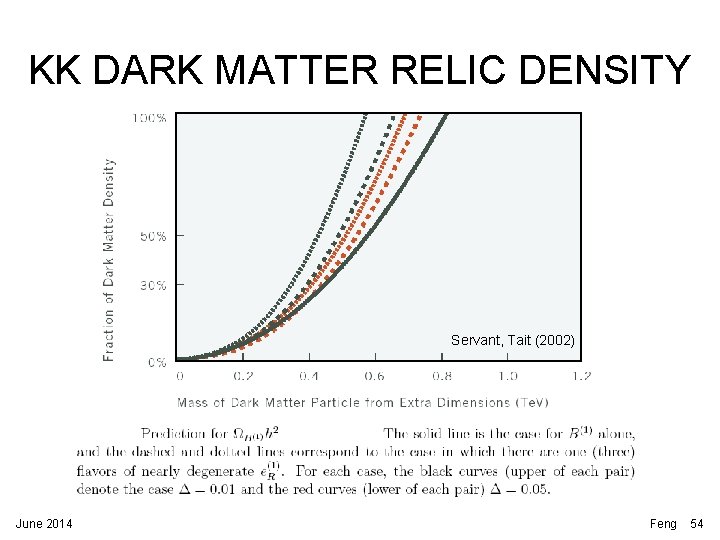
KK DARK MATTER RELIC DENSITY Servant, Tait (2002) June 2014 Feng 54
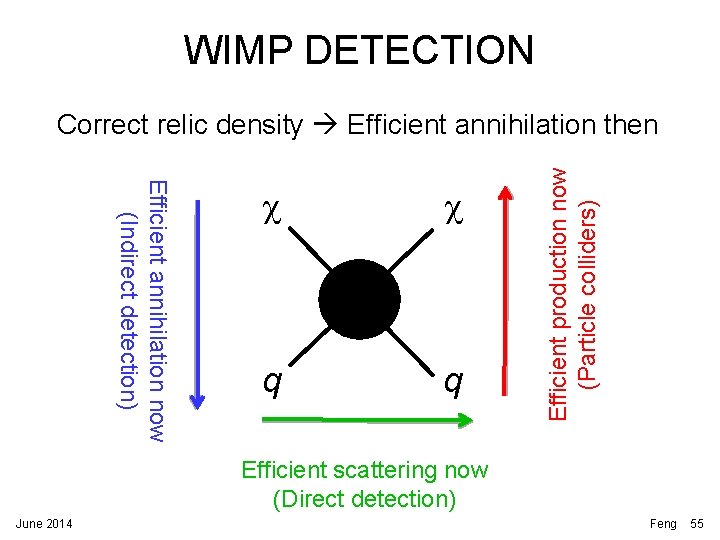
WIMP DETECTION Efficient annihilation now (Indirect detection) c c q q Efficient production now (Particle colliders) Correct relic density Efficient annihilation then Efficient scattering now (Direct detection) June 2014 Feng 55
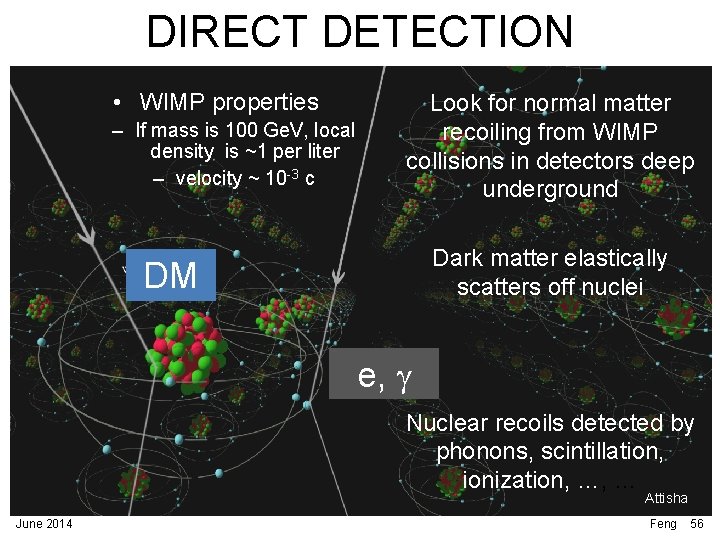
DIRECT DETECTION • WIMP properties – If mass is 100 Ge. V, local density is ~1 per liter – velocity ~ 10 -3 c Look for normal matter recoiling from WIMP collisions in detectors deep underground Dark matter elastically scatters off nuclei DM e, g Nuclear recoils detected by phonons, scintillation, ionization, …, … Attisha June 2014 Feng 56
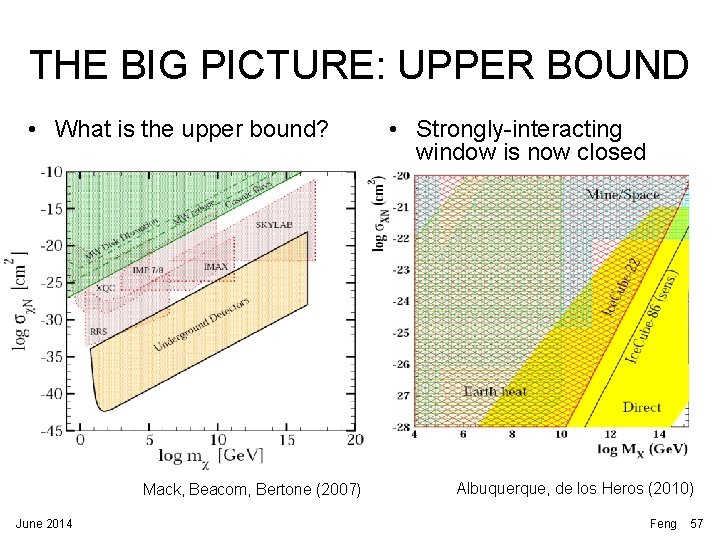
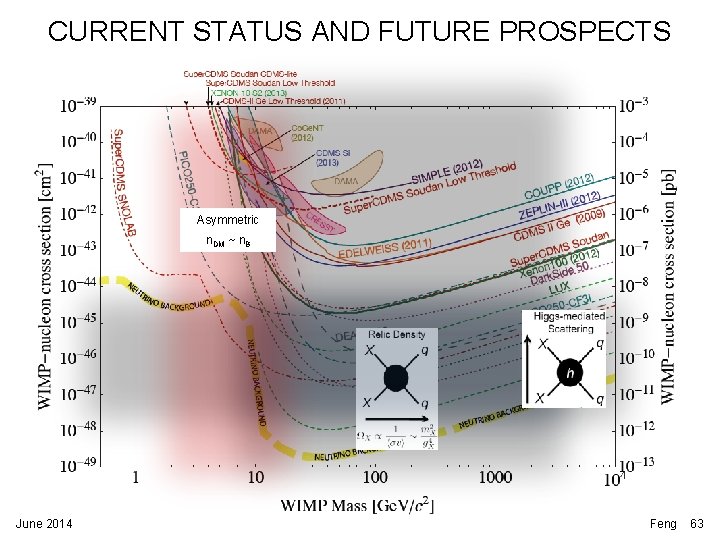
THE BIG PICTURE: UPPER BOUND • What is the upper bound? Mack, Beacom, Bertone (2007) June 2014 • Strongly-interacting window is now closed Albuquerque, de los Heros (2010) Feng 57
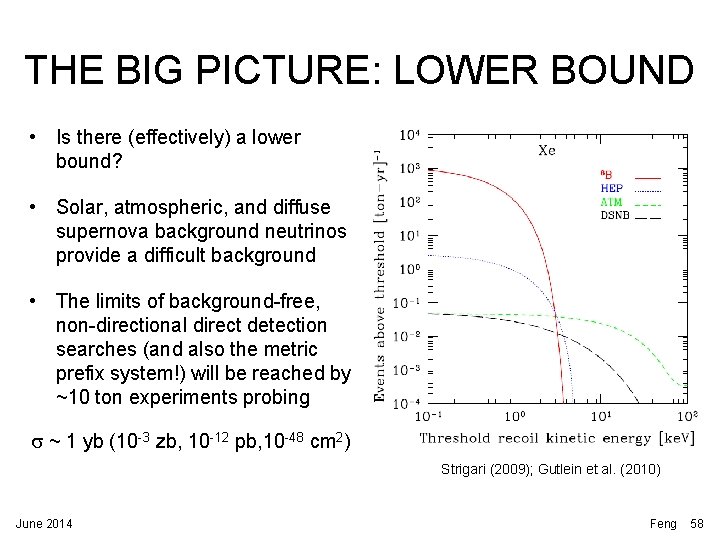
THE BIG PICTURE: LOWER BOUND • Is there (effectively) a lower bound? • Solar, atmospheric, and diffuse supernova background neutrinos provide a difficult background • The limits of background-free, non-directional direct detection searches (and also the metric prefix system!) will be reached by ~10 ton experiments probing s ~ 1 yb (10 -3 zb, 10 -12 pb, 10 -48 cm 2) Strigari (2009); Gutlein et al. (2010) June 2014 Feng 58
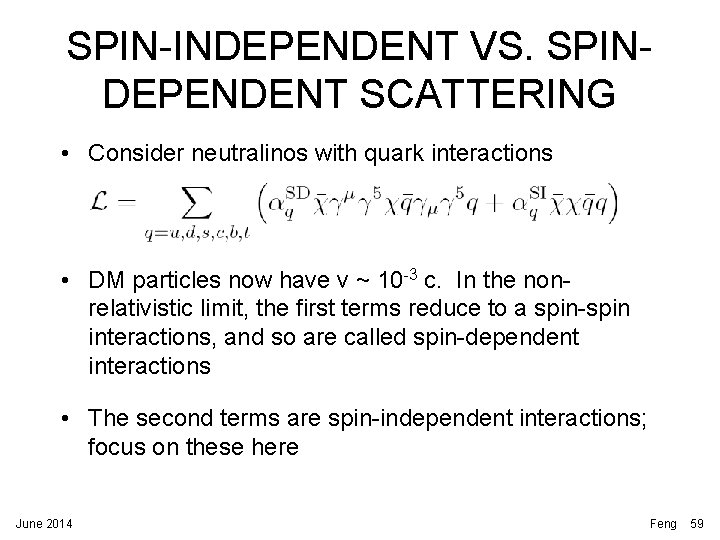
SPIN-INDEPENDENT VS. SPINDEPENDENT SCATTERING • Consider neutralinos with quark interactions • DM particles now have v ~ 10 -3 c. In the nonrelativistic limit, the first terms reduce to a spin-spin interactions, and so are called spin-dependent interactions • The second terms are spin-independent interactions; focus on these here June 2014 Feng 59
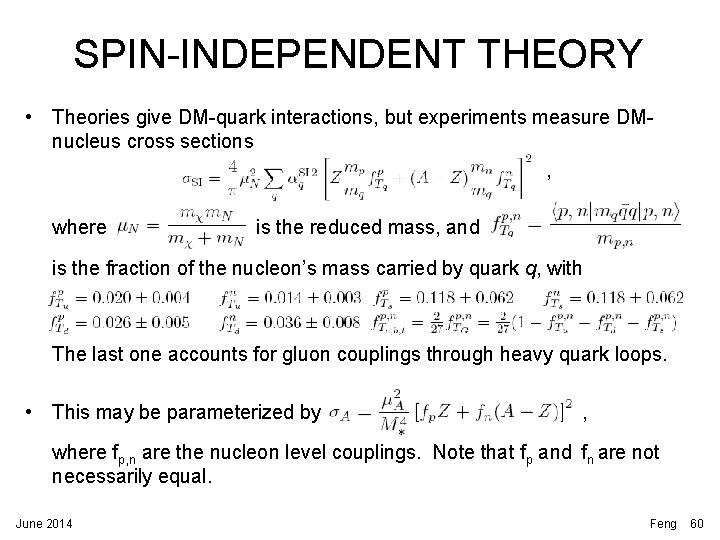
SPIN-INDEPENDENT THEORY • Theories give DM-quark interactions, but experiments measure DMnucleus cross sections , where is the reduced mass, and is the fraction of the nucleon’s mass carried by quark q, with The last one accounts for gluon couplings through heavy quark loops. • This may be parameterized by , where fp, n are the nucleon level couplings. Note that fp and fn are not necessarily equal. June 2014 Feng 60
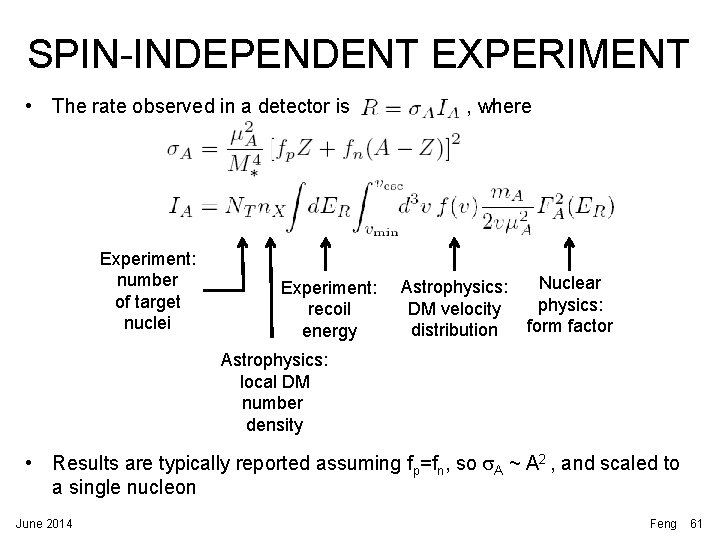
SPIN-INDEPENDENT EXPERIMENT • The rate observed in a detector is Experiment: number of target nuclei Experiment: recoil energy , where Astrophysics: DM velocity distribution Nuclear physics: form factor Astrophysics: local DM number density • Results are typically reported assuming fp=fn, so s. A ~ A 2 , and scaled to a single nucleon June 2014 Feng 61
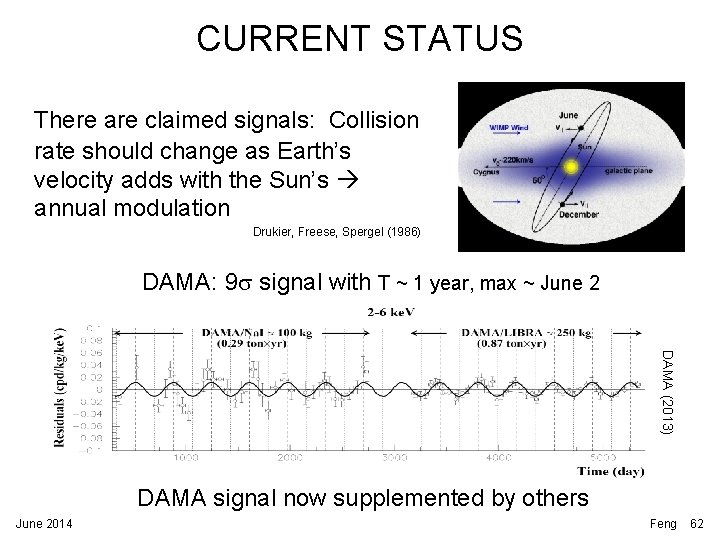
CURRENT STATUS There are claimed signals: Collision rate should change as Earth’s velocity adds with the Sun’s annual modulation Drukier, Freese, Spergel (1986) DAMA: 9 s signal with T ~ 1 year, max ~ June 2 DAMA (2013) DAMA signal now supplemented by others June 2014 Feng 62
CURRENT STATUS AND FUTURE PROSPECTS Asymmetric n. DM ~ n. B June 2014 Feng 63
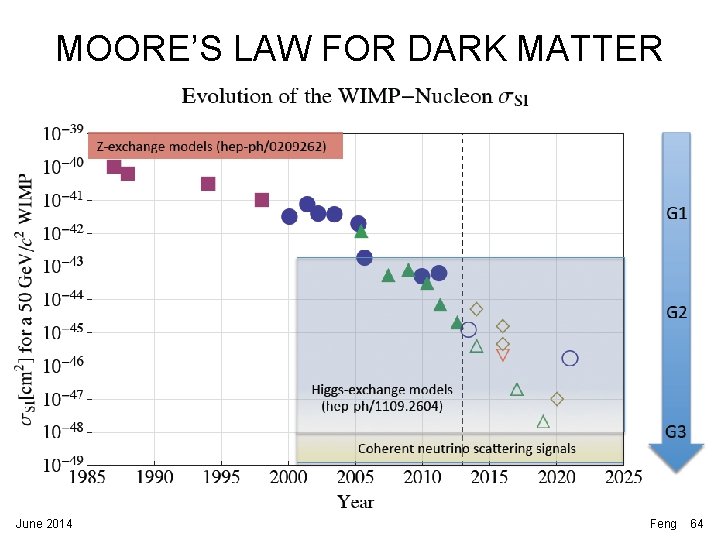
MOORE’S LAW FOR DARK MATTER June 2014 Feng 64
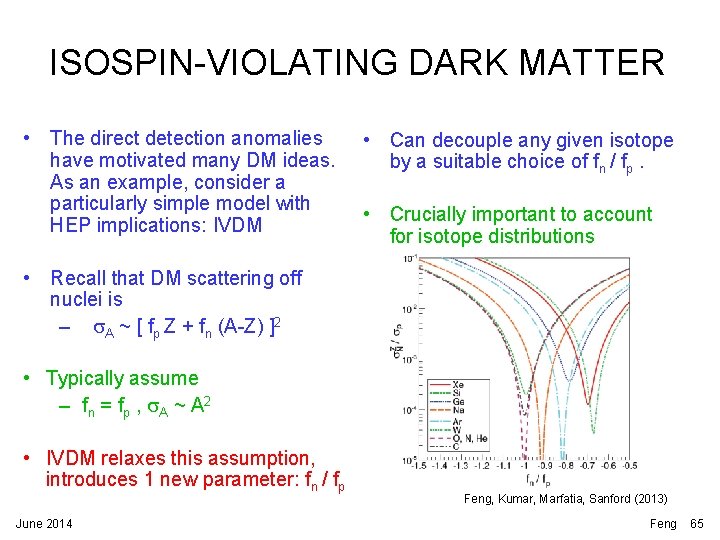
ISOSPIN-VIOLATING DARK MATTER • The direct detection anomalies have motivated many DM ideas. As an example, consider a particularly simple model with HEP implications: IVDM • Can decouple any given isotope by a suitable choice of fn / fp. • Crucially important to account for isotope distributions • Recall that DM scattering off nuclei is – s. A ~ [ fp Z + fn (A-Z) ]2 • Typically assume – f n = f p , s. A ~ A 2 • IVDM relaxes this assumption, introduces 1 new parameter: fn / fp June 2014 Feng, Kumar, Marfatia, Sanford (2013) Feng 65
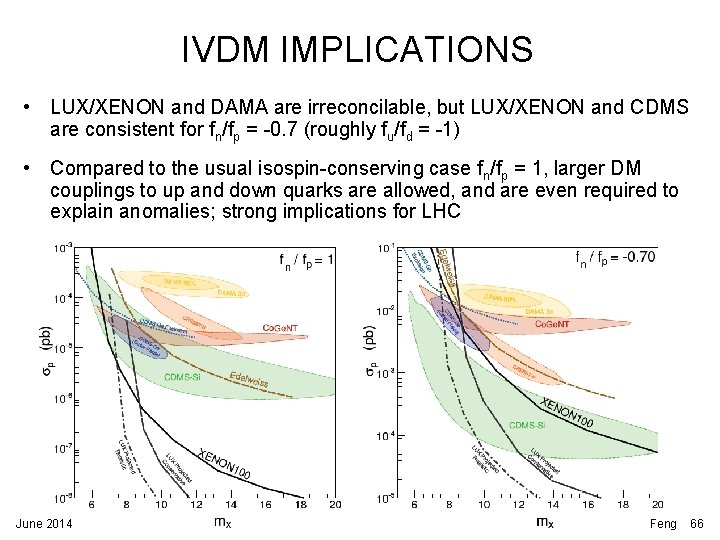
IVDM IMPLICATIONS • LUX/XENON and DAMA are irreconcilable, but LUX/XENON and CDMS are consistent for fn/fp = -0. 7 (roughly fu/fd = -1) • Compared to the usual isospin-conserving case fn/fp = 1, larger DM couplings to up and down quarks are allowed, and are even required to explain anomalies; strong implications for LHC June 2014 Feng 66
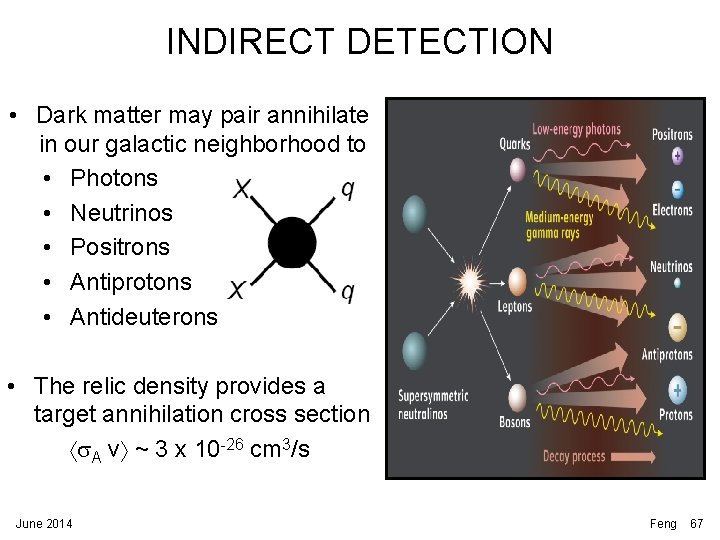
INDIRECT DETECTION • Dark matter may pair annihilate in our galactic neighborhood to • Photons • Neutrinos • Positrons • Antiprotons • Antideuterons • The relic density provides a target annihilation cross section s. A v ~ 3 x 10 -26 cm 3/s June 2014 Feng 67
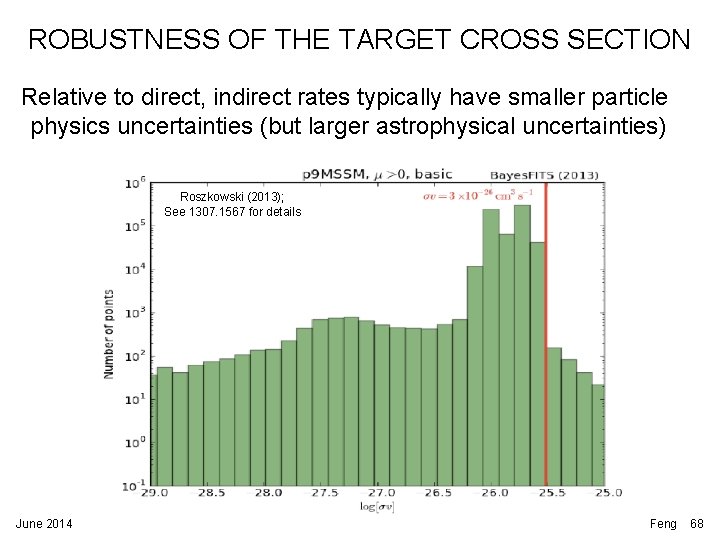
ROBUSTNESS OF THE TARGET CROSS SECTION Relative to direct, indirect rates typically have smaller particle physics uncertainties (but larger astrophysical uncertainties) Roszkowski (2013); See 1307. 1567 for details June 2014 Feng 68
INDIRECT DETECTION FILL IN THE BLANKS: Dark matter annihilates in ________ to a place _____ , which are detected by _______. particles June 2014 an experiment Feng 69
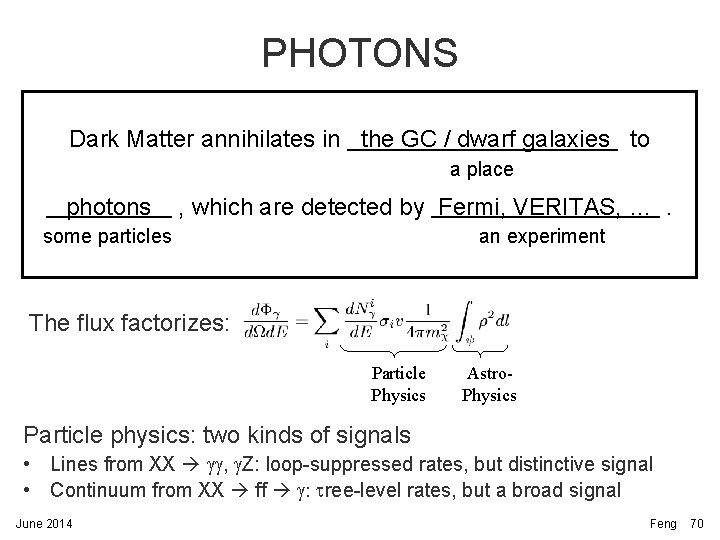
PHOTONS Dark Matter annihilates in the GC / dwarf galaxies to a place photons , which are detected by Fermi, VERITAS, …. some particles an experiment The flux factorizes: Particle Physics Astro. Physics Particle physics: two kinds of signals • Lines from XX gg, g. Z: loop-suppressed rates, but distinctive signal • Continuum from XX ff g: tree-level rates, but a broad signal June 2014 Feng 70
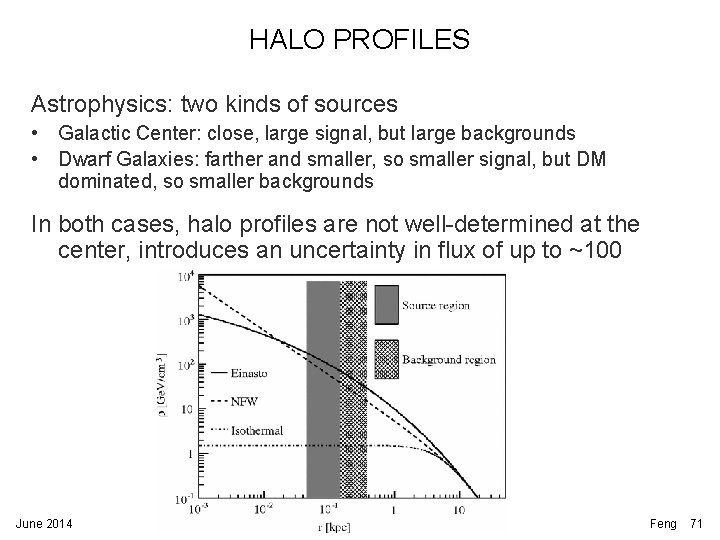
HALO PROFILES Astrophysics: two kinds of sources • Galactic Center: close, large signal, but large backgrounds • Dwarf Galaxies: farther and smaller, so smaller signal, but DM dominated, so smaller backgrounds In both cases, halo profiles are not well-determined at the center, introduces an uncertainty in flux of up to ~100 June 2014 Feng 71
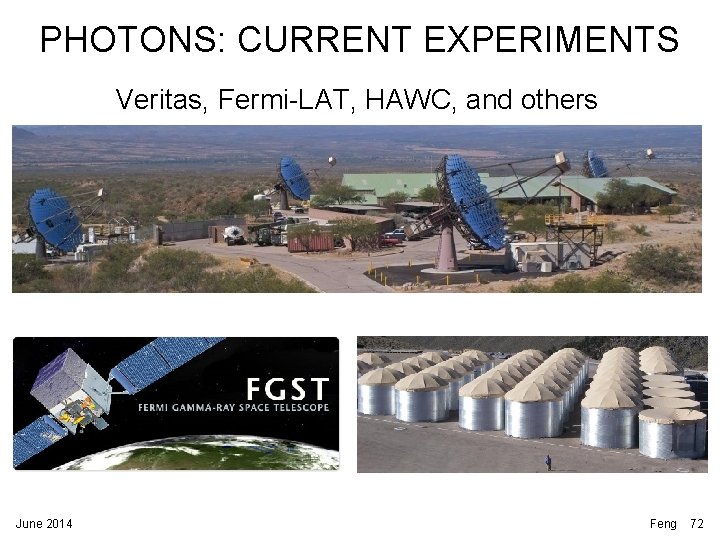
PHOTONS: CURRENT EXPERIMENTS Veritas, Fermi-LAT, HAWC, and others June 2014 Feng 72
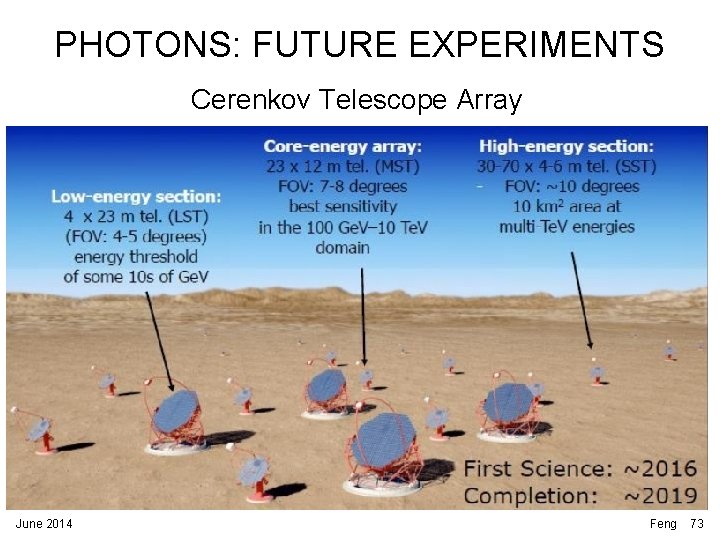
PHOTONS: FUTURE EXPERIMENTS Cerenkov Telescope Array June 2014 Feng 73
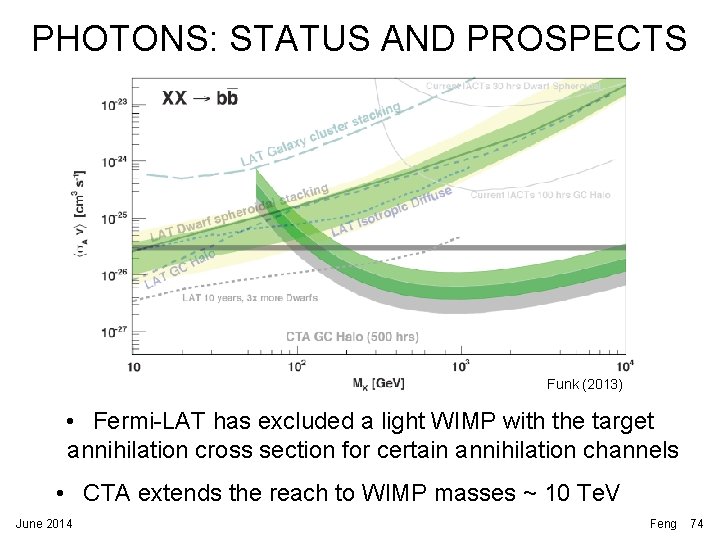
PHOTONS: STATUS AND PROSPECTS Funk (2013) • Fermi-LAT has excluded a light WIMP with the target annihilation cross section for certain annihilation channels • CTA extends the reach to WIMP masses ~ 10 Te. V June 2014 Feng 74
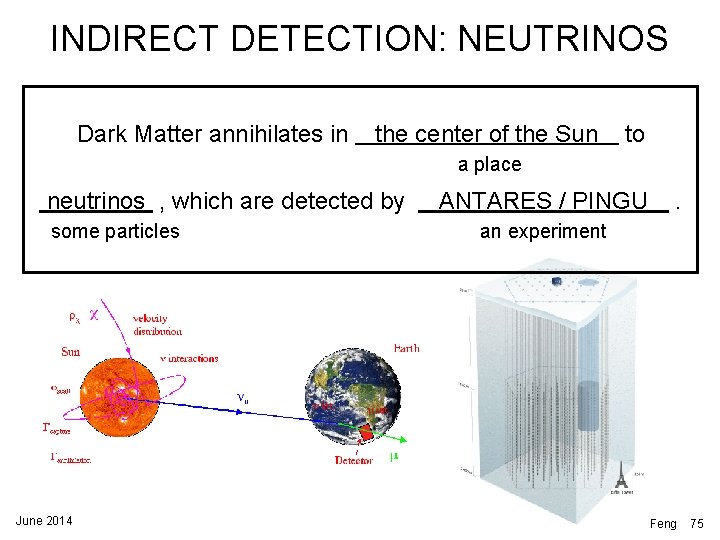
INDIRECT DETECTION: NEUTRINOS Dark Matter annihilates in the center of the Sun to a place neutrinos , which are detected by some particles June 2014 ANTARES / PINGU . an experiment Feng 75
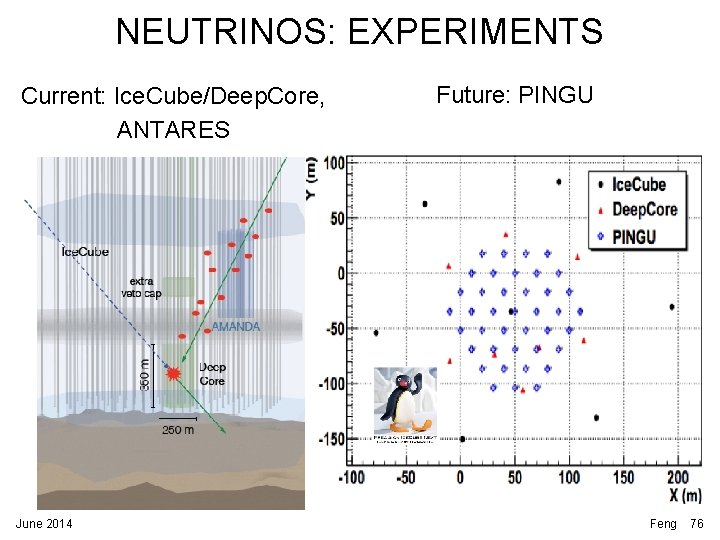
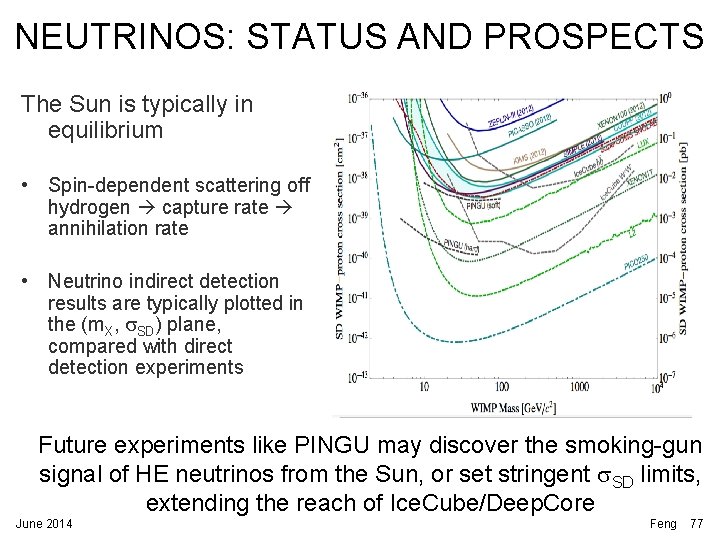
NEUTRINOS: EXPERIMENTS Current: Ice. Cube/Deep. Core, ANTARES June 2014 Future: PINGU Feng 76
NEUTRINOS: STATUS AND PROSPECTS The Sun is typically in equilibrium • Spin-dependent scattering off hydrogen capture rate annihilation rate • Neutrino indirect detection results are typically plotted in the (m. X, s. SD) plane, compared with direct detection experiments Future experiments like PINGU may discover the smoking-gun signal of HE neutrinos from the Sun, or set stringent s. SD limits, extending the reach of Ice. Cube/Deep. Core June 2014 Feng 77
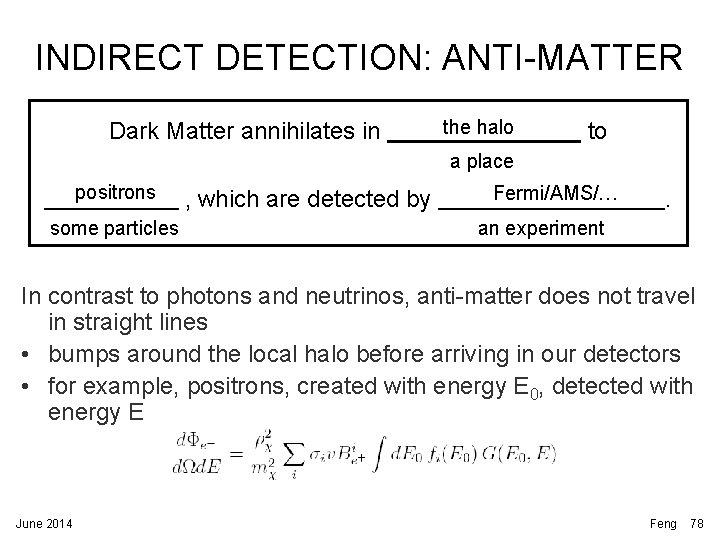
INDIRECT DETECTION: ANTI-MATTER Dark Matter annihilates in the halo to a place positrons some particles , which are detected by Fermi/AMS/… . an experiment In contrast to photons and neutrinos, anti-matter does not travel in straight lines • bumps around the local halo before arriving in our detectors • for example, positrons, created with energy E 0, detected with energy E June 2014 Feng 78
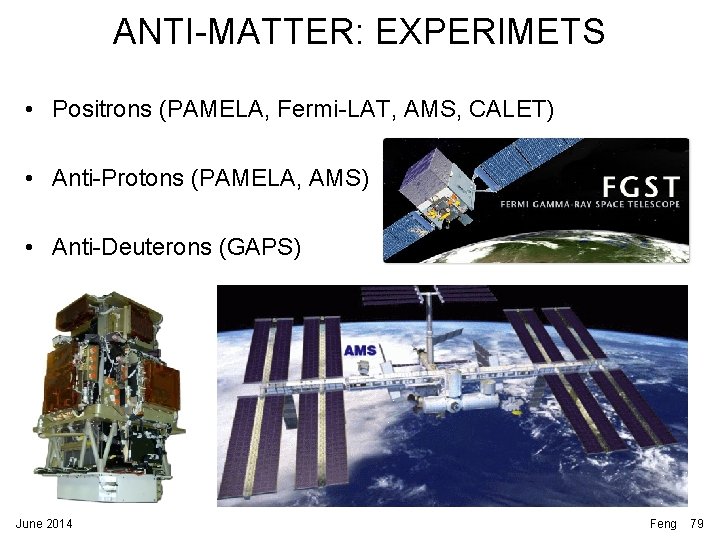
ANTI-MATTER: EXPERIMETS • Positrons (PAMELA, Fermi-LAT, AMS, CALET) • Anti-Protons (PAMELA, AMS) • Anti-Deuterons (GAPS) June 2014 Feng 79
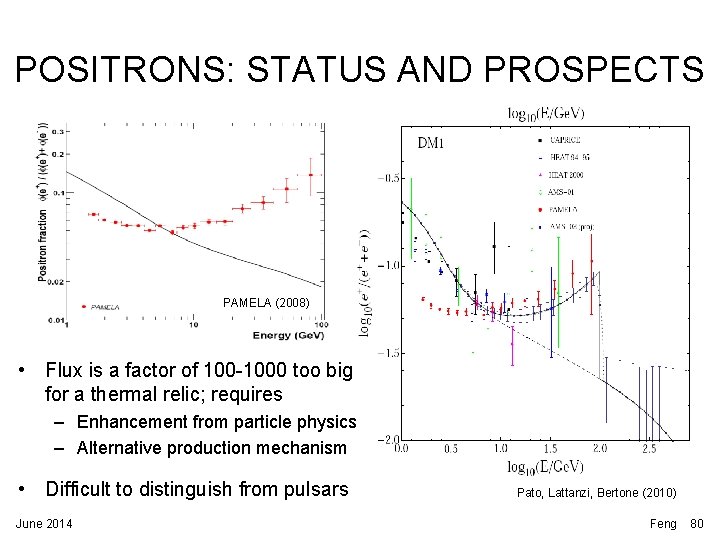
POSITRONS: STATUS AND PROSPECTS PAMELA (2008) • Flux is a factor of 100 -1000 too big for a thermal relic; requires – Enhancement from particle physics – Alternative production mechanism • Difficult to distinguish from pulsars June 2014 Pato, Lattanzi, Bertone (2010) Feng 80
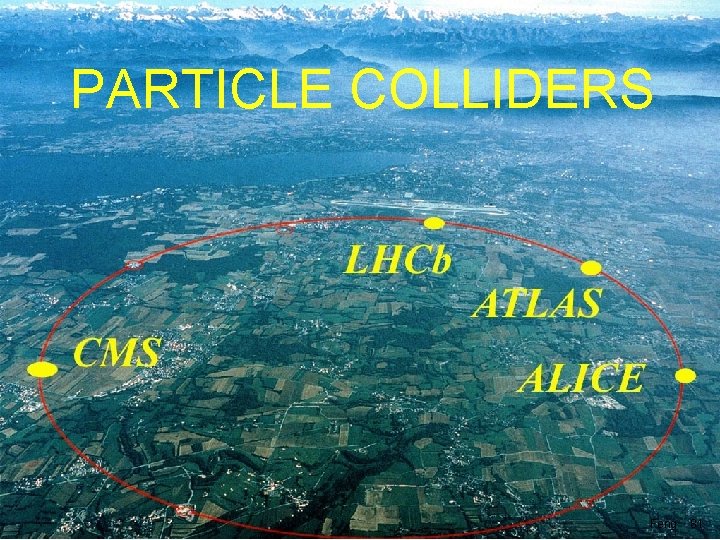
PARTICLE COLLIDERS June 2014 Feng 81
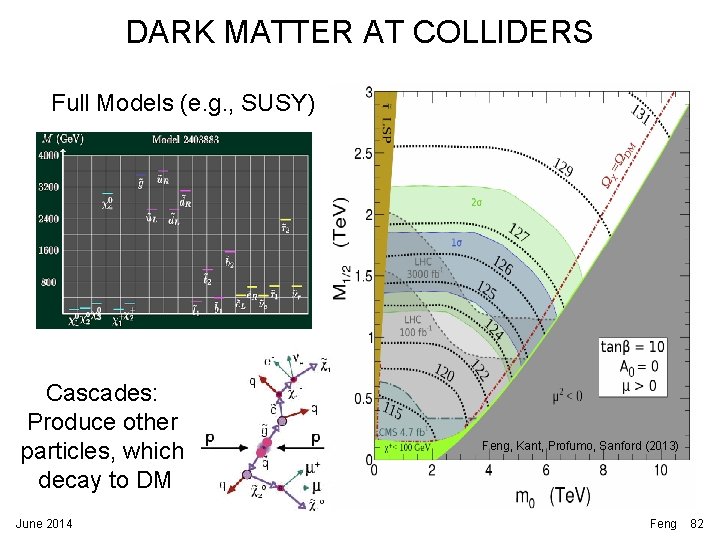
DARK MATTER AT COLLIDERS Full Models (e. g. , SUSY) Cascades: Produce other particles, which decay to DM June 2014 Feng, Kant, Profumo, Sanford (2013) Feng 82
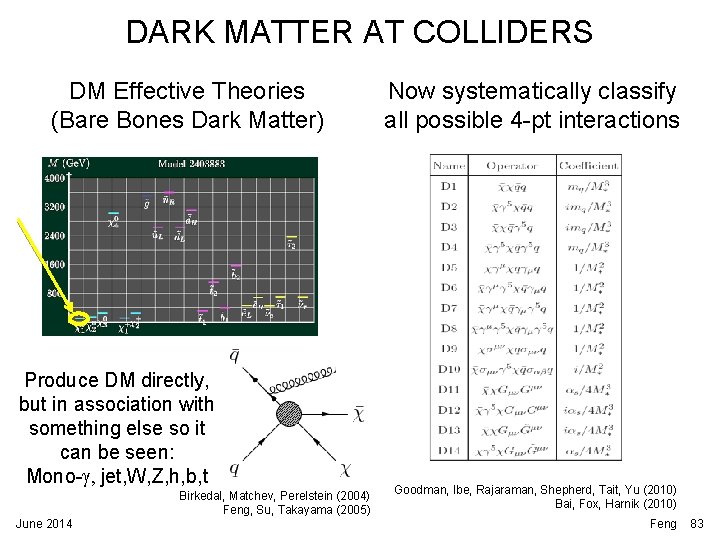
DARK MATTER AT COLLIDERS DM Effective Theories (Bare Bones Dark Matter) Produce DM directly, but in association with something else so it can be seen: Mono-g, jet, W, Z, h, b, t Birkedal, Matchev, Perelstein (2004) Feng, Su, Takayama (2005) June 2014 Now systematically classify all possible 4 -pt interactions Goodman, Ibe, Rajaraman, Shepherd, Tait, Yu (2010) Bai, Fox, Harnik (2010) Feng 83
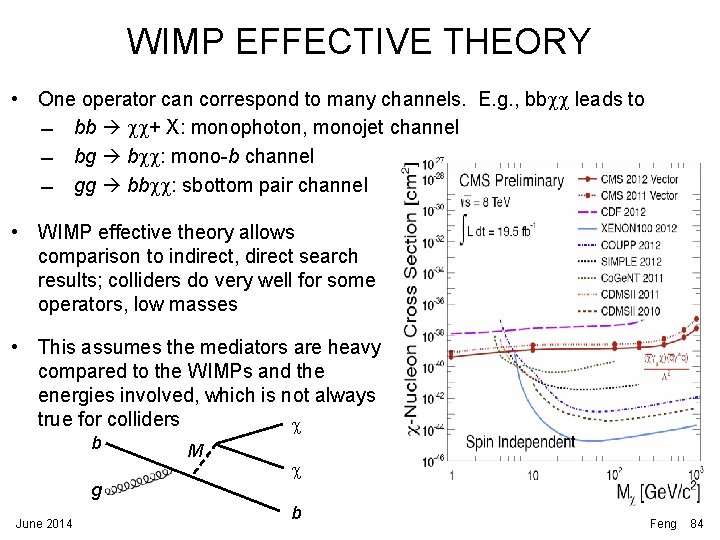
WIMP EFFECTIVE THEORY • One operator can correspond to many channels. E. g. , bbcc leads to bb cc+ X: monophoton, monojet channel bg bcc: mono-b channel gg bbcc: sbottom pair channel • WIMP effective theory allows comparison to indirect, direct search results; colliders do very well for some operators, low masses • This assumes the mediators are heavy compared to the WIMPs and the energies involved, which is not always true for colliders c b M c g June 2014 b Feng 84
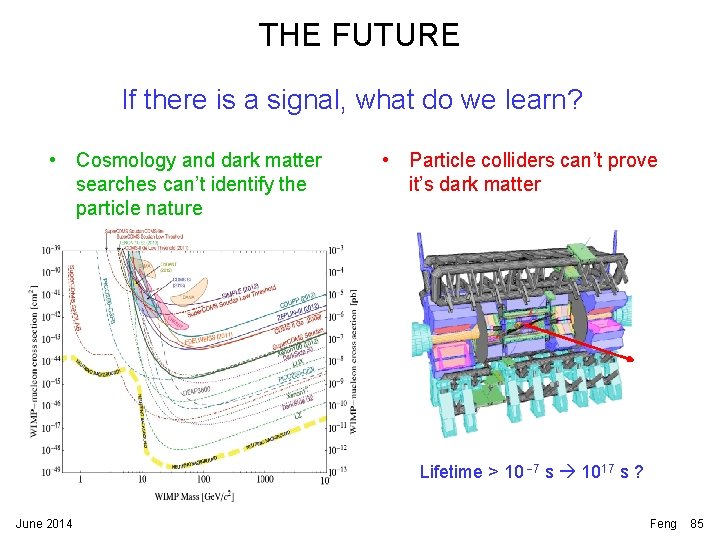
THE FUTURE If there is a signal, what do we learn? • Cosmology and dark matter searches can’t identify the particle nature • Particle colliders can’t prove it’s dark matter Lifetime > 10 -7 s 1017 s ? June 2014 Feng 85
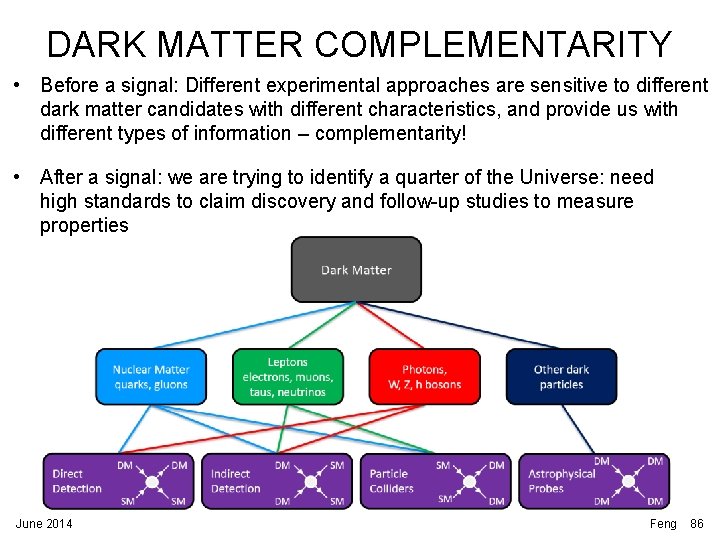
DARK MATTER COMPLEMENTARITY • Before a signal: Different experimental approaches are sensitive to different dark matter candidates with different characteristics, and provide us with different types of information – complementarity! • After a signal: we are trying to identify a quarter of the Universe: need high standards to claim discovery and follow-up studies to measure properties June 2014 Feng 86
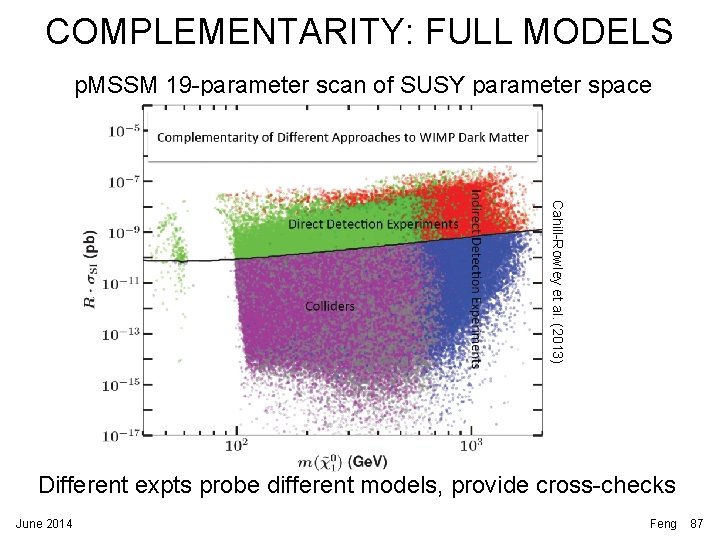
COMPLEMENTARITY: FULL MODELS p. MSSM 19 -parameter scan of SUSY parameter space Cahill-Rowley et al. (2013) Different expts probe different models, provide cross-checks June 2014 Feng 87
LECTURE 2 SUMMARY • WIMPs are natural dark matter candidates in many models of BSM physics • The relic density implies significant rates for direct detection, indirect detection, and colliders • A time of rapid experimental advances on all fronts • Definitive dark matter detection and understanding will require signals in several types of experiments June 2014 Feng 88
OUTLINE LECTURE 1 Essential Cosmology: Contents and History of the Universe LECTURE 2 WIMP Dark Matter: Candidates and Methods of Detection LECTURE 3 Inflation, Gravitinos, and Hidden Sectors June 2014 Feng 89
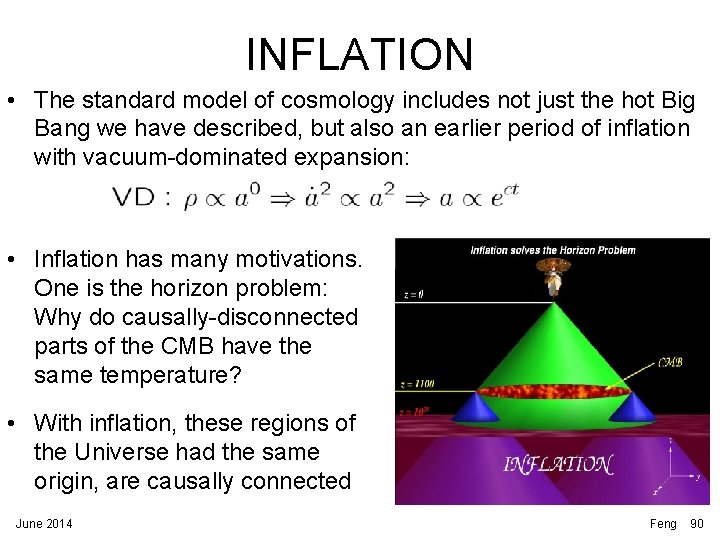
INFLATION • The standard model of cosmology includes not just the hot Big Bang we have described, but also an earlier period of inflation with vacuum-dominated expansion: • Inflation has many motivations. One is the horizon problem: Why do causally-disconnected parts of the CMB have the same temperature? • With inflation, these regions of the Universe had the same origin, are causally connected June 2014 Feng 90
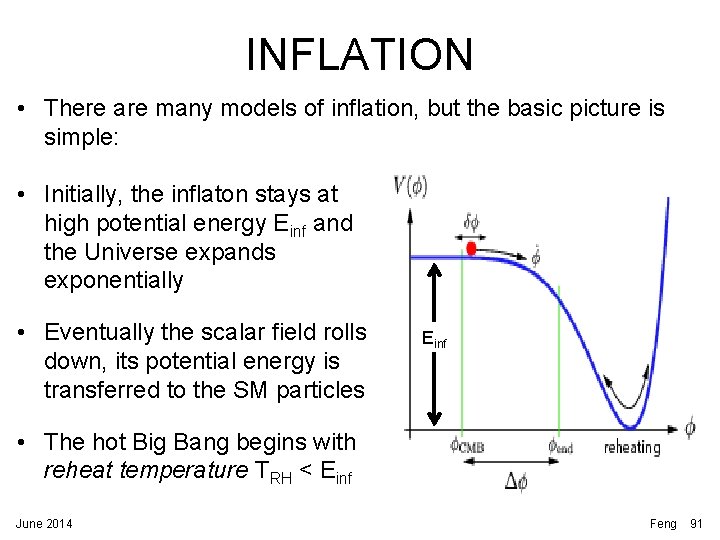
INFLATION • There are many models of inflation, but the basic picture is simple: • Initially, the inflaton stays at high potential energy Einf and the Universe expands exponentially • Eventually the scalar field rolls down, its potential energy is transferred to the SM particles Einf • The hot Big Bang begins with reheat temperature TRH < Einf June 2014 Feng 91
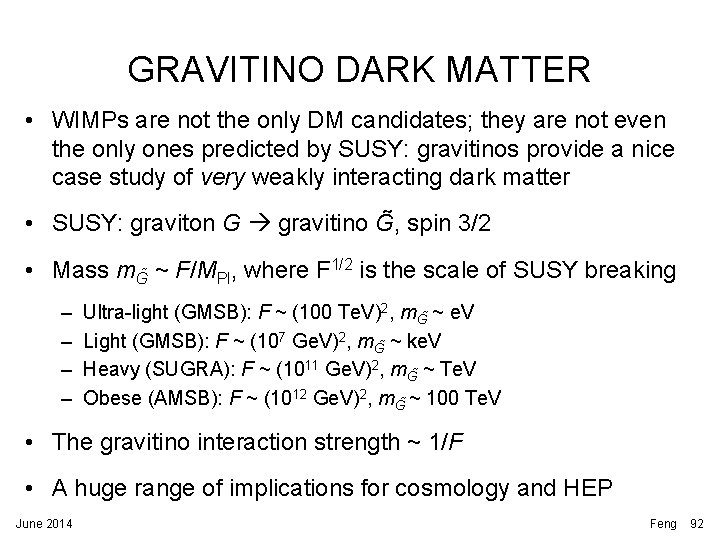
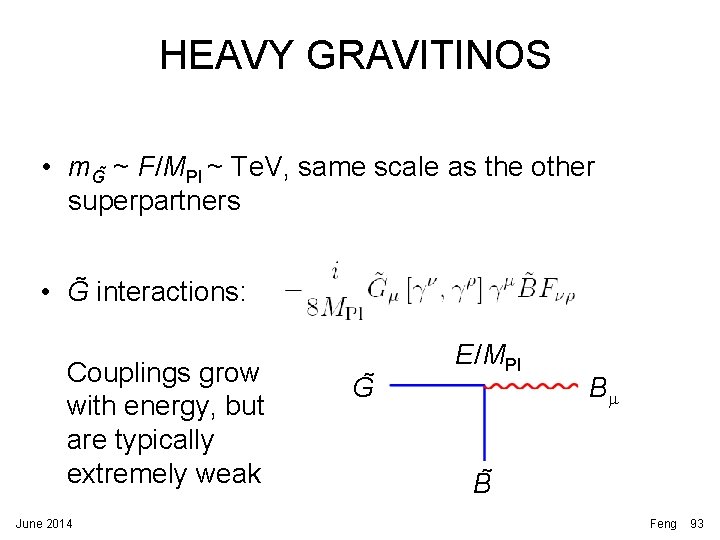
GRAVITINO DARK MATTER • WIMPs are not the only DM candidates; they are not even the only ones predicted by SUSY: gravitinos provide a nice case study of very weakly interacting dark matter • SUSY: graviton G gravitino G , spin 3/2 • Mass m. G ~ F/MPl, where F 1/2 is the scale of SUSY breaking – – Ultra-light (GMSB): F ~ (100 Te. V)2, m. G ~ e. V Light (GMSB): F ~ (107 Ge. V)2, m. G ~ ke. V Heavy (SUGRA): F ~ (1011 Ge. V)2, m. G ~ Te. V Obese (AMSB): F ~ (1012 Ge. V)2, m. G ~ 100 Te. V • The gravitino interaction strength ~ 1/F • A huge range of implications for cosmology and HEP June 2014 Feng 92
HEAVY GRAVITINOS • m. G ~ F/MPl ~ Te. V, same scale as the other superpartners • G interactions: Couplings grow with energy, but are typically extremely weak June 2014 G E/MPl Bm B Feng 93
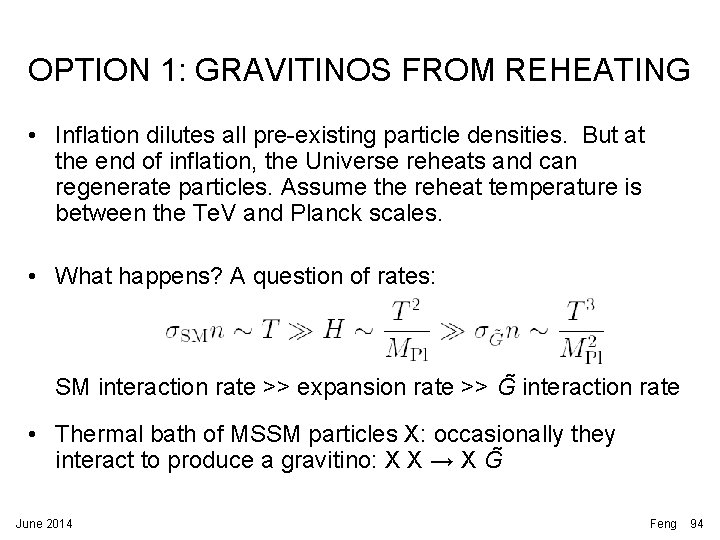
OPTION 1: GRAVITINOS FROM REHEATING • Inflation dilutes all pre-existing particle densities. But at the end of inflation, the Universe reheats and can regenerate particles. Assume the reheat temperature is between the Te. V and Planck scales. • What happens? A question of rates: SM interaction rate >> expansion rate >> G interaction rate • Thermal bath of MSSM particles X: occasionally they interact to produce a gravitino: X X → X G June 2014 Feng 94
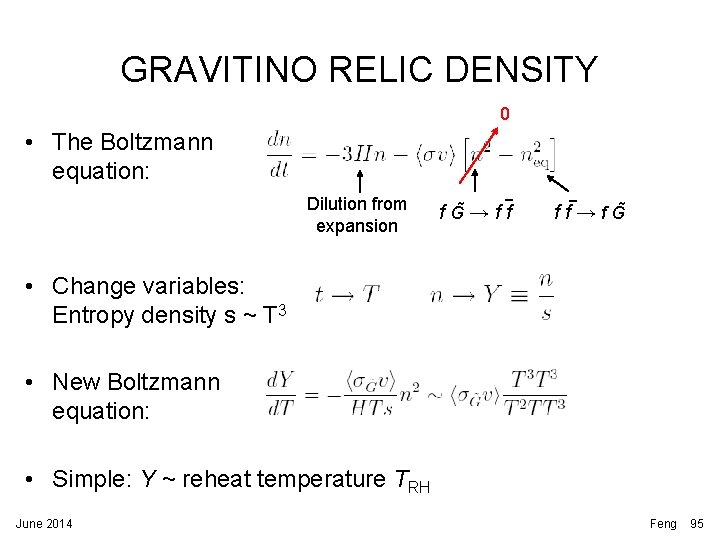
GRAVITINO RELIC DENSITY 0 • The Boltzmann equation: Dilution from expansion f G → f ‾f f f‾→ f G • Change variables: Entropy density s ~ T 3 • New Boltzmann equation: • Simple: Y ~ reheat temperature TRH June 2014 Feng 95
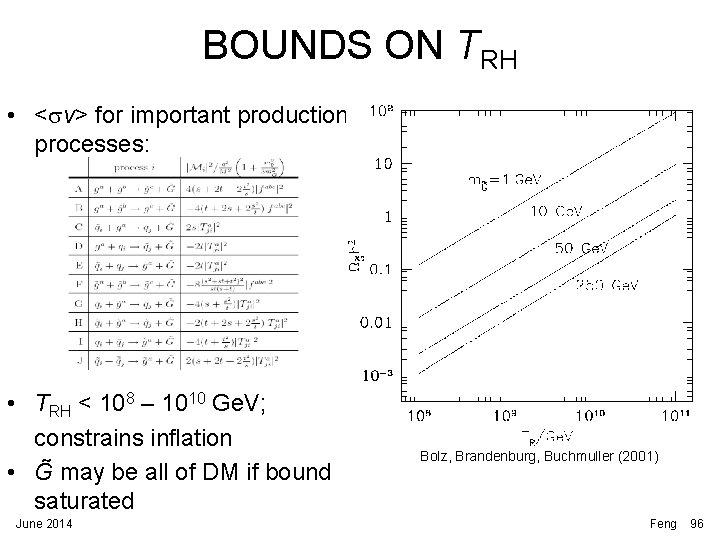
BOUNDS ON TRH • <sv> for important production processes: • TRH < 108 – 1010 Ge. V; constrains inflation • G may be all of DM if bound saturated June 2014 Bolz, Brandenburg, Buchmuller (2001) Feng 96
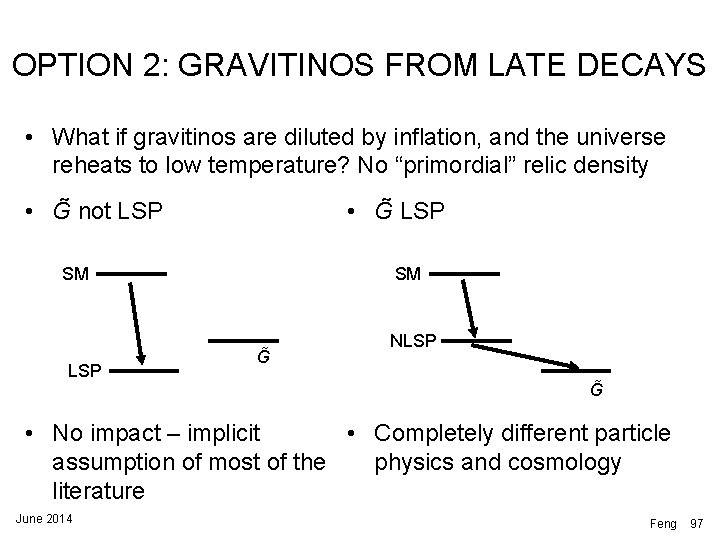
OPTION 2: GRAVITINOS FROM LATE DECAYS • What if gravitinos are diluted by inflation, and the universe reheats to low temperature? No “primordial” relic density • G not LSP • G LSP SM G NLSP G • No impact – implicit • Completely different particle assumption of most of the physics and cosmology literature June 2014 Feng 97
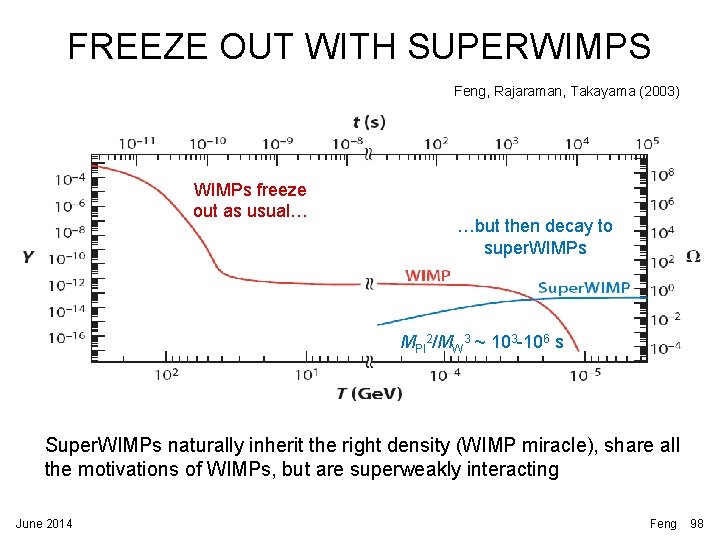
FREEZE OUT WITH SUPERWIMPS Feng, Rajaraman, Takayama (2003) WIMPs freeze out as usual… …but then decay to super. WIMPs MPl 2/MW 3 ~ 103 -106 s Super. WIMPs naturally inherit the right density (WIMP miracle), share all the motivations of WIMPs, but are superweakly interacting June 2014 Feng 98
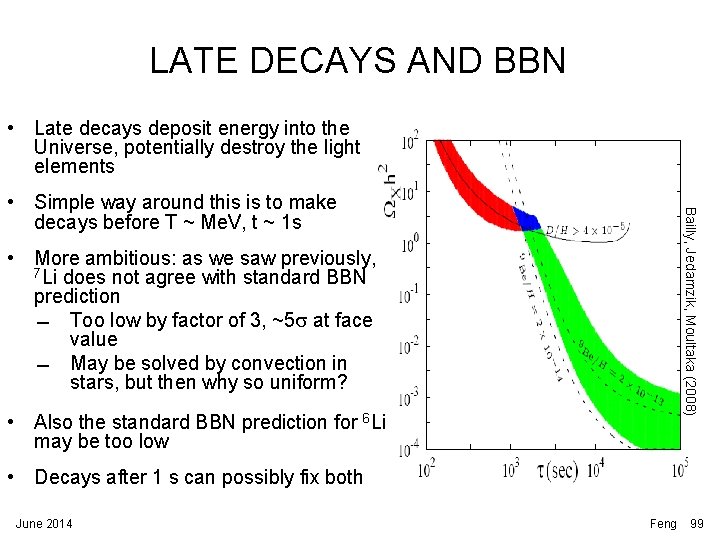
LATE DECAYS AND BBN • Late decays deposit energy into the Universe, potentially destroy the light elements Bailly, Jedamzik, Moultaka (2008) • Simple way around this is to make decays before T ~ Me. V, t ~ 1 s • More ambitious: as we saw previously, 7 Li does not agree with standard BBN prediction Too low by factor of 3, ~5 s at face value May be solved by convection in stars, but then why so uniform? • Also the standard BBN prediction for 6 Li may be too low • Decays after 1 s can possibly fix both June 2014 Feng 99
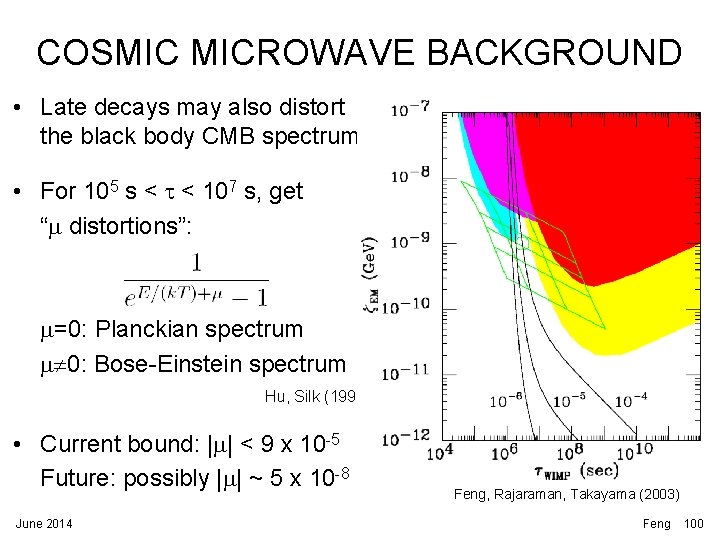
COSMIC MICROWAVE BACKGROUND • Late decays may also distort the black body CMB spectrum • For 105 s < t < 107 s, get “m distortions”: m=0: Planckian spectrum m 0: Bose-Einstein spectrum Hu, Silk (1993) • Current bound: |m| < 9 x 10 -5 Future: possibly |m| ~ 5 x 10 -8 June 2014 Feng, Rajaraman, Takayama (2003) Feng 100
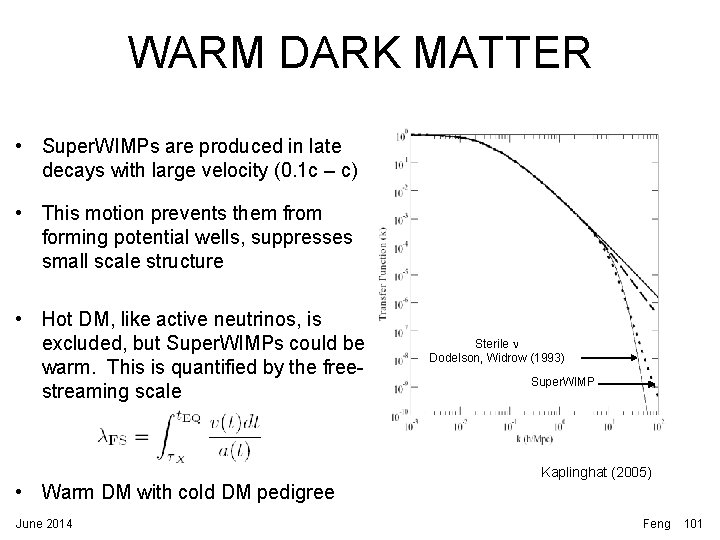
WARM DARK MATTER • Super. WIMPs are produced in late decays with large velocity (0. 1 c – c) • This motion prevents them from forming potential wells, suppresses small scale structure • Hot DM, like active neutrinos, is excluded, but Super. WIMPs could be warm. This is quantified by the freestreaming scale Sterile n Dodelson, Widrow (1993) Super. WIMP Kaplinghat (2005) • Warm DM with cold DM pedigree June 2014 Feng 101
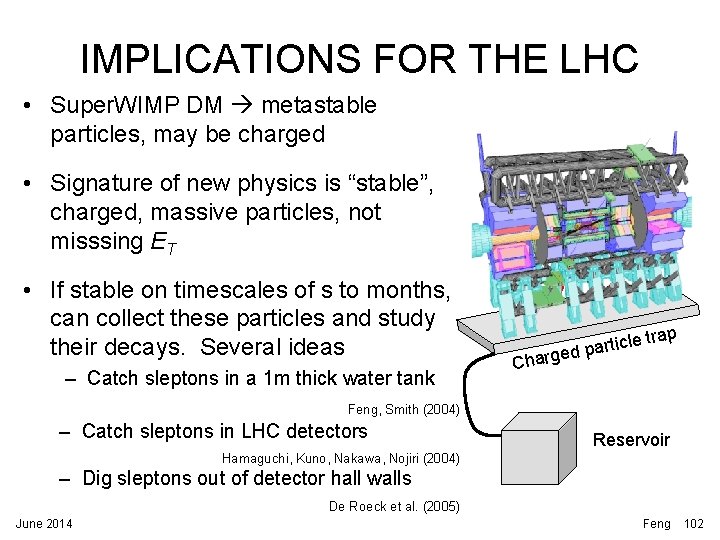
IMPLICATIONS FOR THE LHC • Super. WIMP DM metastable particles, may be charged • Signature of new physics is “stable”, charged, massive particles, not misssing ET • If stable on timescales of s to months, can collect these particles and study their decays. Several ideas ‒ Catch sleptons in a 1 m thick water tank rap Charg cle t i t r a p ed Feng, Smith (2004) ‒ Catch sleptons in LHC detectors Reservoir Hamaguchi, Kuno, Nakawa, Nojiri (2004) ‒ Dig sleptons out of detector hall walls De Roeck et al. (2005) June 2014 Feng 102
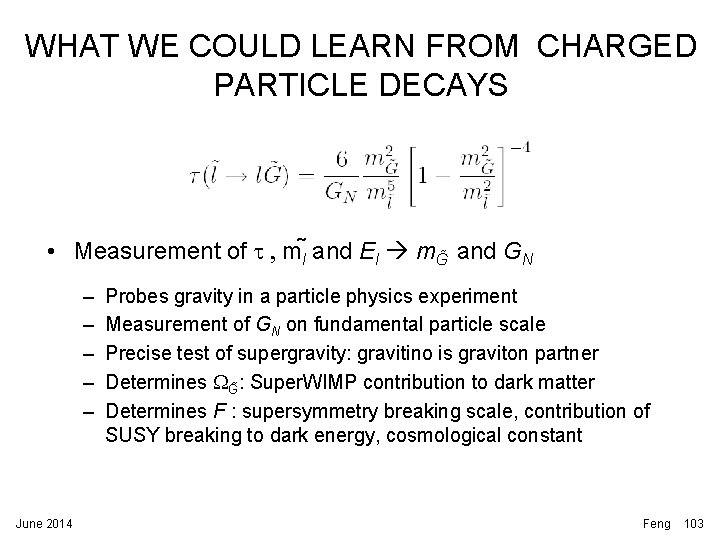
WHAT WE COULD LEARN FROM CHARGED PARTICLE DECAYS • Measurement of t , ml and El m. G and GN – – – June 2014 Probes gravity in a particle physics experiment Measurement of GN on fundamental particle scale Precise test of supergravity: gravitino is graviton partner Determines WG : Super. WIMP contribution to dark matter Determines F : supersymmetry breaking scale, contribution of SUSY breaking to dark energy, cosmological constant Feng 103
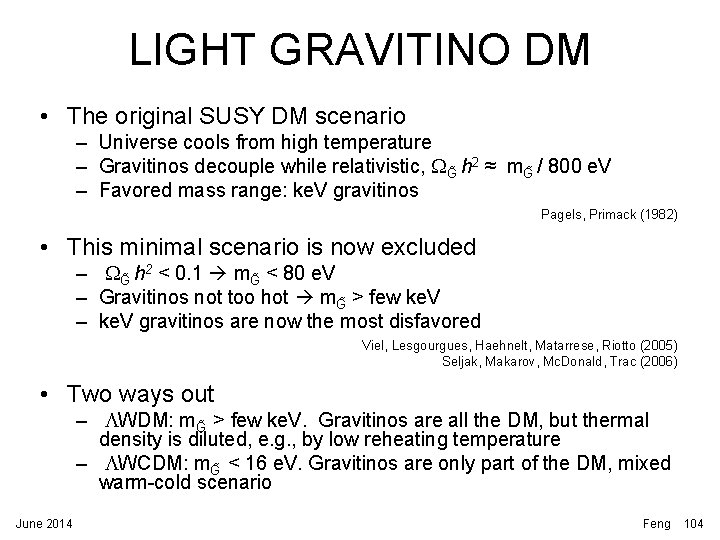
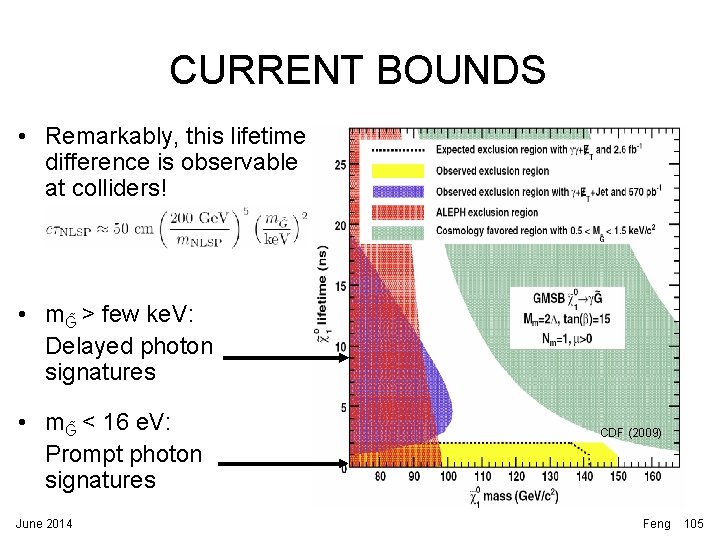
LIGHT GRAVITINO DM • The original SUSY DM scenario – Universe cools from high temperature – Gravitinos decouple while relativistic, WG h 2 ≈ m. G / 800 e. V – Favored mass range: ke. V gravitinos Pagels, Primack (1982) • This minimal scenario is now excluded – WG h 2 < 0. 1 m. G < 80 e. V – Gravitinos not too hot m. G > few ke. V – ke. V gravitinos are now the most disfavored Viel, Lesgourgues, Haehnelt, Matarrese, Riotto (2005) Seljak, Makarov, Mc. Donald, Trac (2006) • Two ways out – LWDM: m. G > few ke. V. Gravitinos are all the DM, but thermal density is diluted, e. g. , by low reheating temperature – LWCDM: m. G < 16 e. V. Gravitinos are only part of the DM, mixed warm-cold scenario June 2014 Feng 104
CURRENT BOUNDS • Remarkably, this lifetime difference is observable at colliders! • m. G > few ke. V: Delayed photon signatures • m. G < 16 e. V: Prompt photon signatures June 2014 CDF (2009) Feng 105
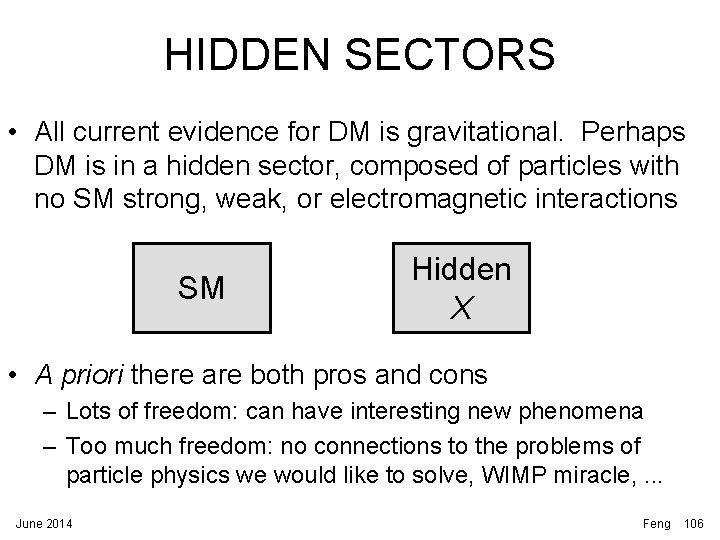
HIDDEN SECTORS • All current evidence for DM is gravitational. Perhaps DM is in a hidden sector, composed of particles with no SM strong, weak, or electromagnetic interactions SM Hidden X • A priori there are both pros and cons – Lots of freedom: can have interesting new phenomena – Too much freedom: no connections to the problems of particle physics we would like to solve, WIMP miracle, . . . June 2014 Feng 106
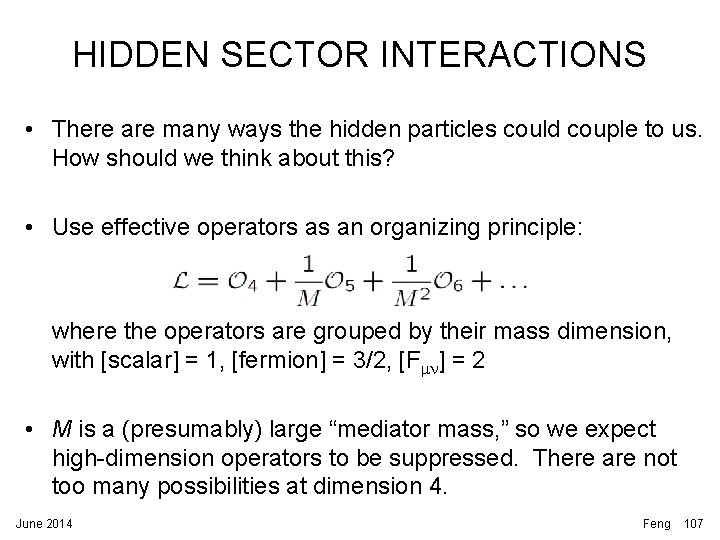
HIDDEN SECTOR INTERACTIONS • There are many ways the hidden particles could couple to us. How should we think about this? • Use effective operators as an organizing principle: where the operators are grouped by their mass dimension, with [scalar] = 1, [fermion] = 3/2, [Fmn] = 2 • M is a (presumably) large “mediator mass, ” so we expect high-dimension operators to be suppressed. There are not too many possibilities at dimension 4. June 2014 Feng 107
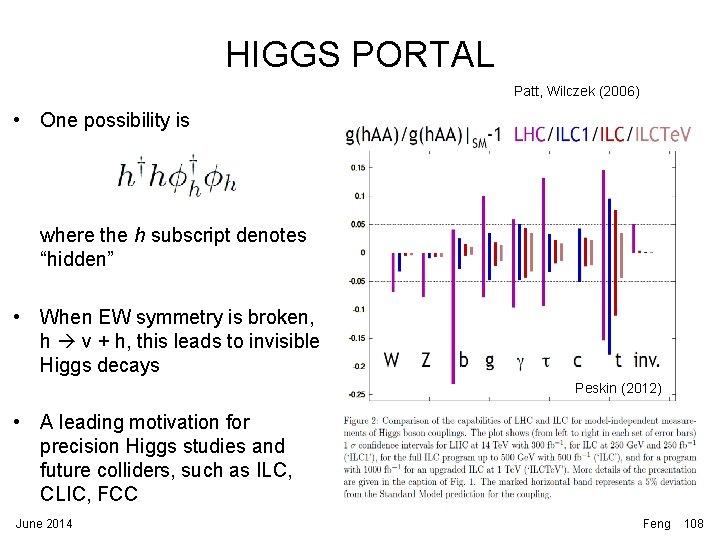
HIGGS PORTAL Patt, Wilczek (2006) • One possibility is where the h subscript denotes “hidden” • When EW symmetry is broken, h v + h, this leads to invisible Higgs decays Peskin (2012) • A leading motivation for precision Higgs studies and future colliders, such as ILC, CLIC, FCC June 2014 Feng 108
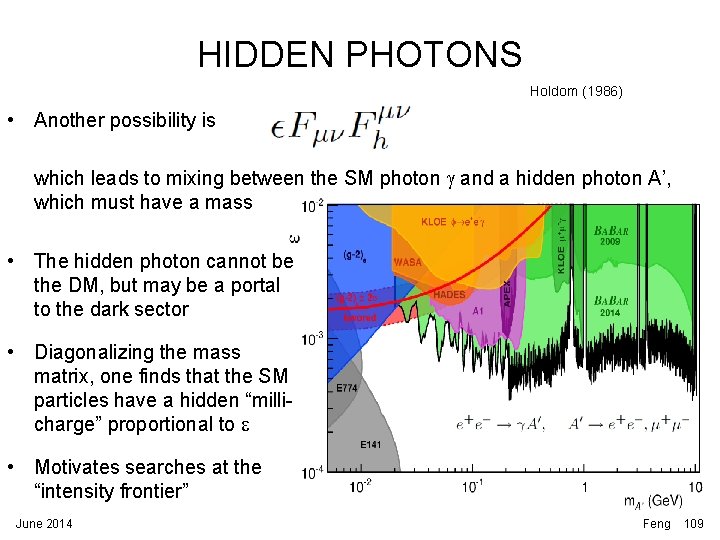
HIDDEN PHOTONS Holdom (1986) • Another possibility is which leads to mixing between the SM photon g and a hidden photon A’, which must have a mass • The hidden photon cannot be the DM, but may be a portal to the dark sector • Diagonalizing the mass matrix, one finds that the SM particles have a hidden “millicharge” proportional to e • Motivates searches at the “intensity frontier” June 2014 Feng 109
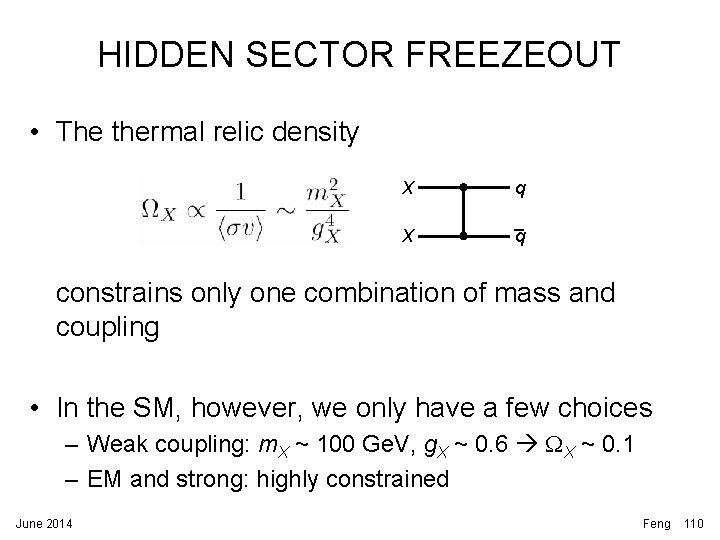
HIDDEN SECTOR FREEZEOUT • The thermal relic density X q X _ q constrains only one combination of mass and coupling • In the SM, however, we only have a few choices – Weak coupling: m. X ~ 100 Ge. V, g. X ~ 0. 6 WX ~ 0. 1 – EM and strong: highly constrained June 2014 Feng 110
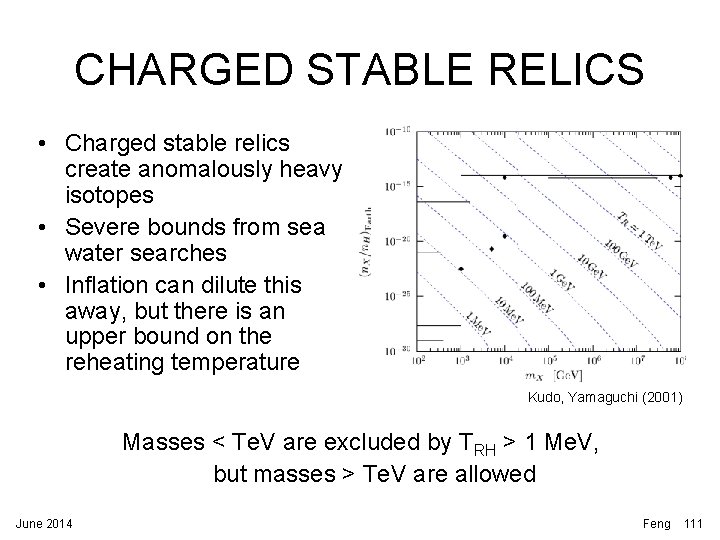
CHARGED STABLE RELICS • Charged stable relics create anomalously heavy isotopes • Severe bounds from sea water searches • Inflation can dilute this away, but there is an upper bound on the reheating temperature Kudo, Yamaguchi (2001) Masses < Te. V are excluded by TRH > 1 Me. V, but masses > Te. V are allowed June 2014 Feng 111
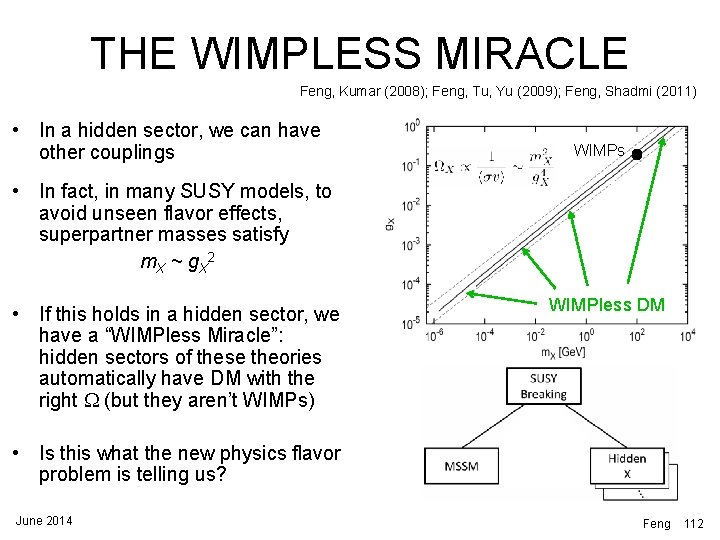
THE WIMPLESS MIRACLE Feng, Kumar (2008); Feng, Tu, Yu (2009); Feng, Shadmi (2011) • In a hidden sector, we can have other couplings WIMPs • In fact, in many SUSY models, to avoid unseen flavor effects, superpartner masses satisfy m. X ~ g. X 2 • If this holds in a hidden sector, we have a “WIMPless Miracle”: hidden sectors of these theories automatically have DM with the right W (but they aren’t WIMPs) WIMPless DM • Is this what the new physics flavor problem is telling us? June 2014 Feng 112
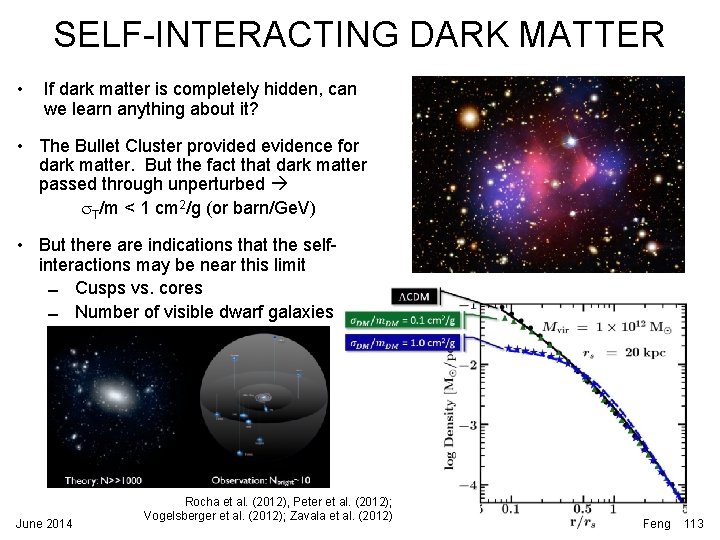
SELF-INTERACTING DARK MATTER • If dark matter is completely hidden, can we learn anything about it? • The Bullet Cluster provided evidence for dark matter. But the fact that dark matter passed through unperturbed s. T/m < 1 cm 2/g (or barn/Ge. V) • But there are indications that the selfinteractions may be near this limit Cusps vs. cores Number of visible dwarf galaxies June 2014 Rocha et al. (2012), Peter et al. (2012); Vogelsberger et al. (2012); Zavala et al. (2012) Feng 113
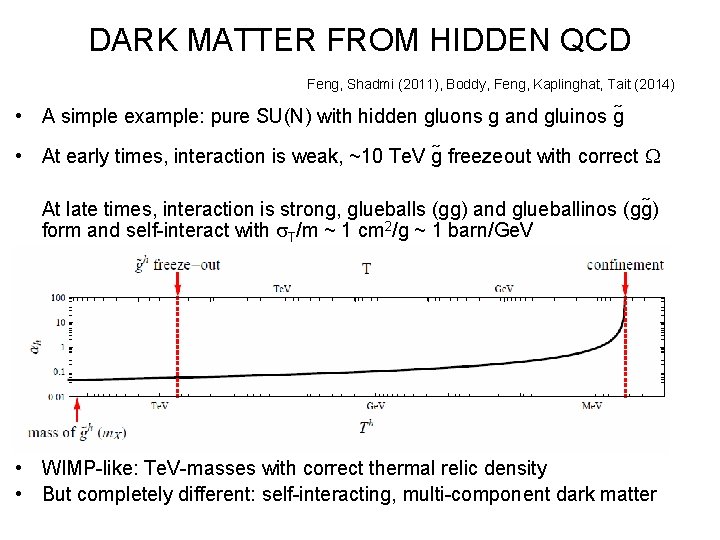
DARK MATTER FROM HIDDEN QCD Feng, Shadmi (2011), Boddy, Feng, Kaplinghat, Tait (2014) • A simple example: pure SU(N) with hidden gluons g and gluinos g • At early times, interaction is weak, ~10 Te. V g freezeout with correct W At late times, interaction is strong, glueballs (gg) and glueballinos (gg ) form and self-interact with s. T/m ~ 1 cm 2/g ~ 1 barn/Ge. V • WIMP-like: Te. V-masses with correct thermal relic density • But completely different: self-interacting, multi-component dark matter
LECTURE 3 SUMMARY • In addition to WIMPs, there are many other attractive DM candidates with similar motivations, but completely different implications for cosmology and HEP • Examples: long-lived charged particles, prompt photons, invisible Higgs decays, hidden photons, … • Is any of this right? LHC will be running soon, direct and indirect detection, astrophysical probes are improving rapidly – we will see soon June 2014 Feng 115