
GPU Acceleration of ParticleInCell Methods B M Cowan
GPU Acceleration of Particle-In-Cell Methods B. M. Cowan, J. R. Cary, S. W. Sides Tech-X Corporation
GPU characteristics • Graphics processing units (GPUs) offer tremendous computational performance • Much greater processing capability per monetary and power cost • Achieved through massive parallelism • Example: NVIDIA Tesla K 20 • 1. 17 Tflop/s (double), 3. 52 Tflop/s (single) • 13 streaming multiprocessors with 192 cores each = 2, 496 processor cores • 5 GB memory with 208 GB/s bandwidth • Cost: ~$3000 • Power consumption: 225 W
GPU restrictions • Multiprocessors are SIMD devices • Warps of 32 threads must execute the same instruction • Threads can be grouped into (larger) blocks for convenience • Branches can effectively stall threads (all threads go through all logical paths) • Full bandwidth of global memory only realized if memory accesses are coalesced • Blocks of 128 bytes accessed by consecutive groups of threads • Multiprocessor shared memory can be accessed without such restrictions by all threads in a block, but has limited size
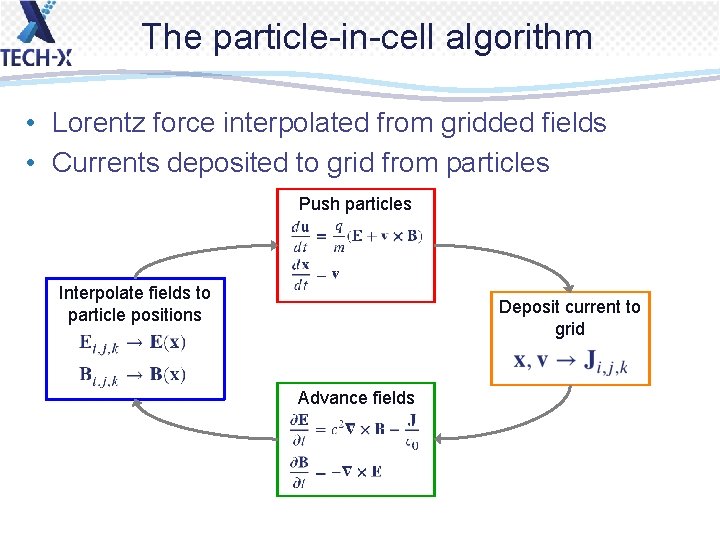
The particle-in-cell algorithm • Lorentz force interpolated from gridded fields • Currents deposited to grid from particles Push particles Interpolate fields to particle positions Deposit current to grid Advance fields
Difficulties of PIC on GPU • Both field update and particle phase space advance are straightforward • For field update, each thread updates a cell • For particle push, each thread updates a particle • Field interpolation and current deposition present problems • It’s not known a priori which cells particles occupy and hence which field values are needed • Naïve one-particle-per-thread memory accesses won’t be coalesced • Deposition may also experience race conditions: Multiple threads try to write the same current value
Some techniques • Optimize memory access • For interpolation, read fields into shared memory • Can then interpolate using one particle per thread • But need to be careful about available shared memory size • Tile the particles • Group the particles by small rectangular regions (tiles) of cells • Particles in a tile will generally be processed by the same thread block • Tile size trade-off: Smaller tiles increase occupancy, but each tile needs guard cells • Tile size must be set dynamically, based on problem specifications and hardware
General coding principles • Portability • Write main computational procedures (e. g. cell field update, particle push) in functions that can be executed on both host and device • And take advantage of MIC, vectorization • On CPU, function will be executed in a loop • On GPU, function will be executed by a thread • Generality • Design main management routines to work with multiple algorithm variants • Different types of field updates, e. g. absorbing boundaries, controlled dispersion • High-order particles: Complicates memory management • Other physics: Metallic boundaries, dielectric materials, collisions, cut cells…
Status of full GPU PIC in VSim • • Work in progress, part of ongoing DARPA project Completed main interpolate-push-deposit update Results correct in basic tests Coded consistently with general practices for good GPU performance, but not optimized yet • Still, we can start to get insight about performance trade-offs
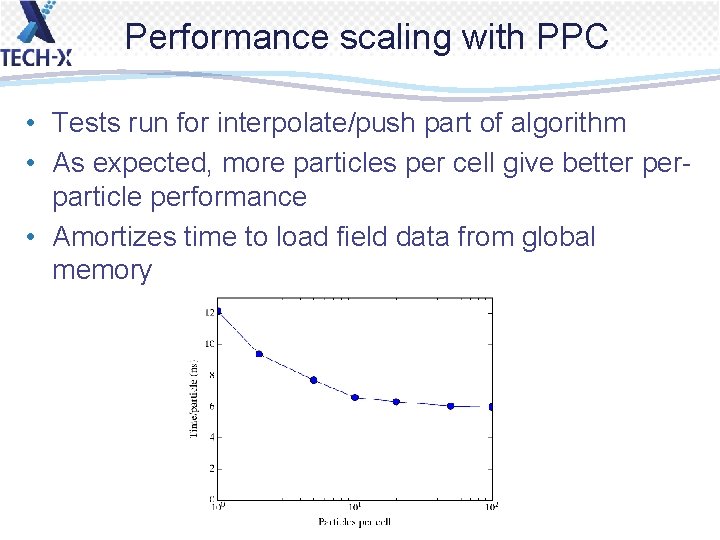
Performance scaling with PPC • Tests run for interpolate/push part of algorithm • As expected, more particles per cell give better perparticle performance • Amortizes time to load field data from global memory
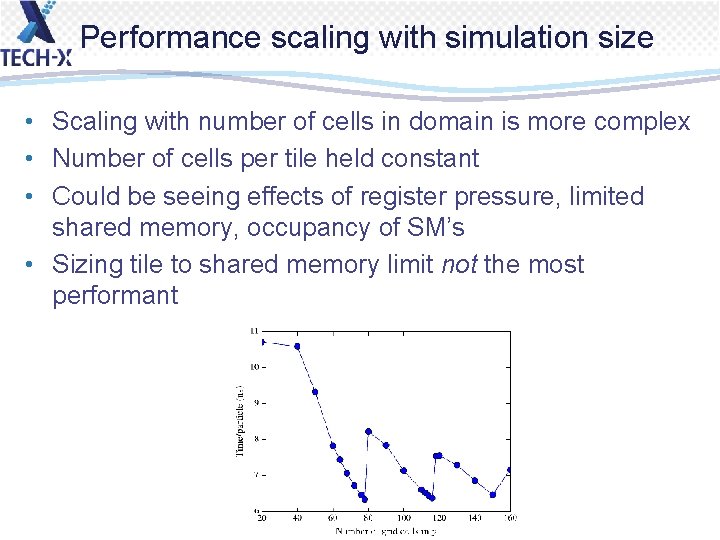
Performance scaling with simulation size • Scaling with number of cells in domain is more complex • Number of cells per tile held constant • Could be seeing effects of register pressure, limited shared memory, occupancy of SM’s • Sizing tile to shared memory limit not the most performant
Code considerations • VSim uses the Vorpal engine, which was written from the ground up in C++ • Different algorithms selected through run-time polymorphism with virtual functions • This was great in 2007 • Now this approach has limitations • Hardware considerations: want to avoid branching • CUDA restrictions: __global__ void kernel(Object my. Obj) { /*. . . */ } • Run-time polymorphism still OK for high-level logic, but use template policy classes for low-level logic This object must be “flat”: No virtual methods or bases
Moving toward code generality • VSim is a full multiphysics package • Plasmas, metals, dielectrics, collisions, … • We want to enable all these features on the GPU • Starting with grids • Cartesian and cylindrical coordinate systems; uniform and variable discretizations • All grid types except variable cylindrical implemented; uniform grids tested and working • Variable discretizations require runtime branching • Collisions in progress
Next steps • Refactoring basic classes to be GPU-friendly • Grids • Fields • Integrate with FDTD field update • Implement particle sinks • Performance testing and optimization • What drives the performance fluctuations as tile size, domain size are changed? • Are there savings to be had from data management? • Can we take advantage of the fact that particles move by at most one cell or tile per step? • Manual organization vs. global sort • Integrate with in-progress domain decomposition work • General for arbitrary number of CPU cores and GPUs on system
Acknowledgments • Work supported by DARPA contract W 31 P 4 Q-15 -C -0061 (SBIR) • Helpful discussions with D. N. Smithe
- Slides: 14