
Radioactivity Boardworks Ltd 2003 Background radiation is the
Radioactivity © Boardworks Ltd 2003
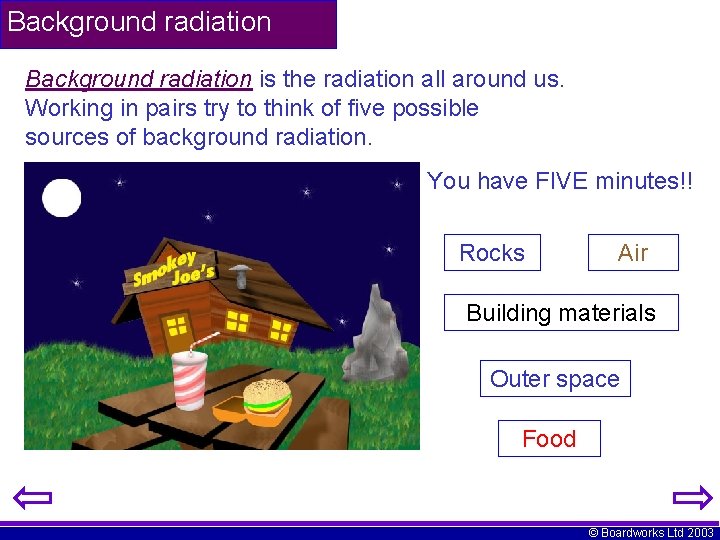
Background radiation is the radiation all around us. Working in pairs try to think of five possible sources of background radiation. You have FIVE minutes!! Rocks Air Building materials Outer space Food © Boardworks Ltd 2003

• http: //www. youtube. com/watch? v=Uv. N 5 4 Jo 7 Cs 8 • http: //www. youtube. com/watch? v=Vzdq Ztf-Sz 4 © Boardworks Ltd 2003
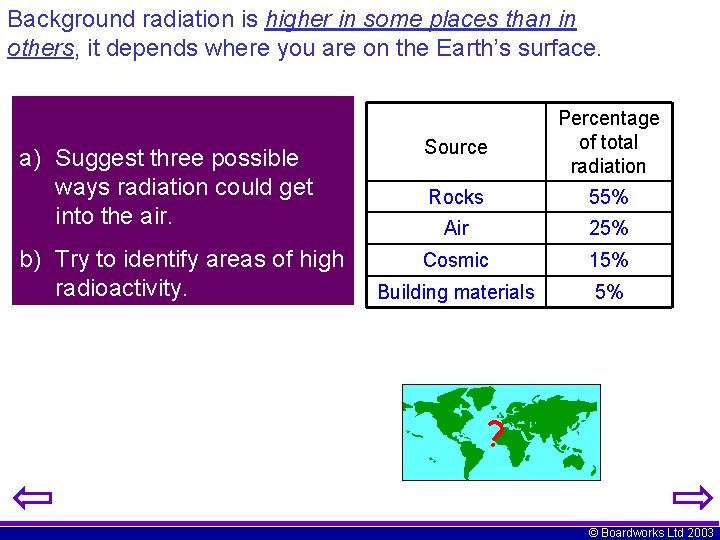
Background radiation is higher in some places than in others, it depends where you are on the Earth’s surface. a) Suggest three possible ways radiation could get into the air. Source Percentage of total radiation Rocks 55% Air 25% b) Try to identify areas of high radioactivity. Cosmic 15% Building materials 5% ? © Boardworks Ltd 2003
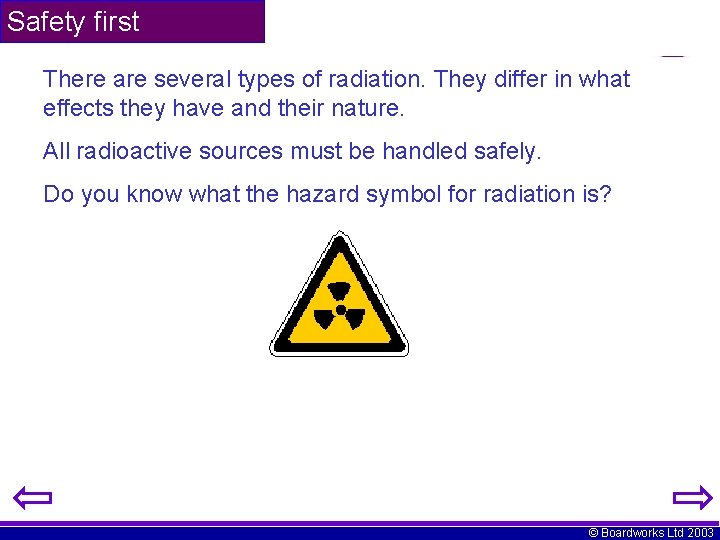
Safety first There are several types of radiation. They differ in what effects they have and their nature. All radioactive sources must be handled safely. Do you know what the hazard symbol for radiation is? © Boardworks Ltd 2003

Alpha radiation - Description: 2 neutrons, 2 protons (helium nuclei) Electric Charge: +2 Relative Atomic Mass: 4 Penetration power: Stopped by paper or a few cm of air Helium nuclei Ionisation effect: Strongly ionising Effects of Magnetic/Electric Field: Weakly deflected © Boardworks Ltd 2003
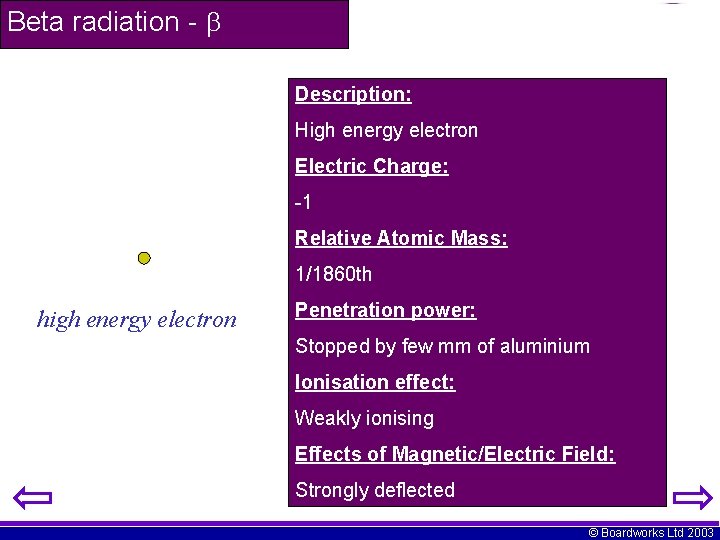
Beta radiation - Description: High energy electron Electric Charge: -1 Relative Atomic Mass: 1/1860 th high energy electron Penetration power: Stopped by few mm of aluminium Ionisation effect: Weakly ionising Effects of Magnetic/Electric Field: Strongly deflected © Boardworks Ltd 2003
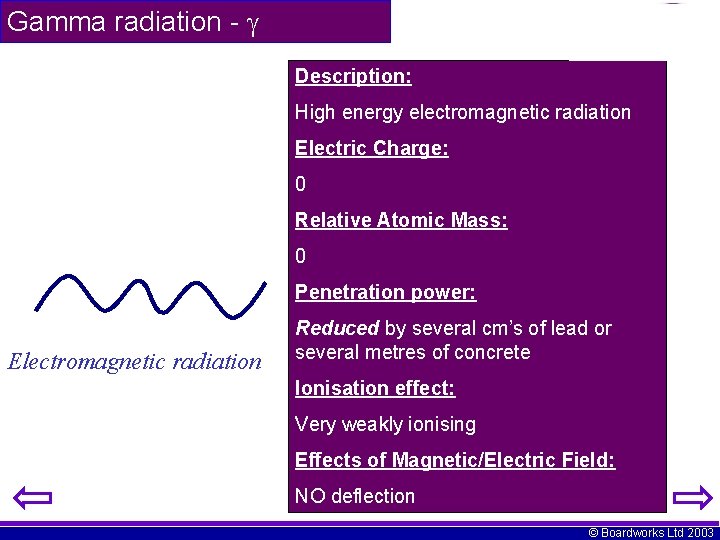
Gamma radiation - Description: High energy electromagnetic radiation Electric Charge: 0 Relative Atomic Mass: 0 Penetration power: Electromagnetic radiation Reduced by several cm’s of lead or several metres of concrete Ionisation effect: Very weakly ionising Effects of Magnetic/Electric Field: NO deflection © Boardworks Ltd 2003
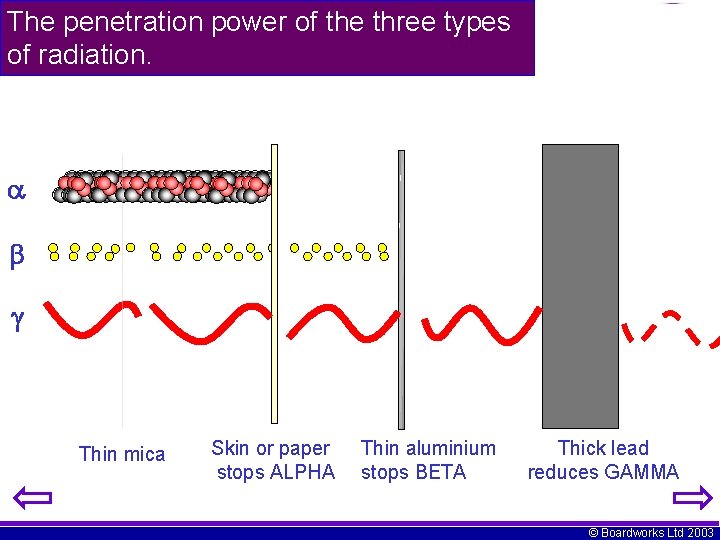
The penetration power of the three types of radiation. Thin mica Skin or paper stops ALPHA Thin aluminium stops BETA Thick lead reduces GAMMA © Boardworks Ltd 2003
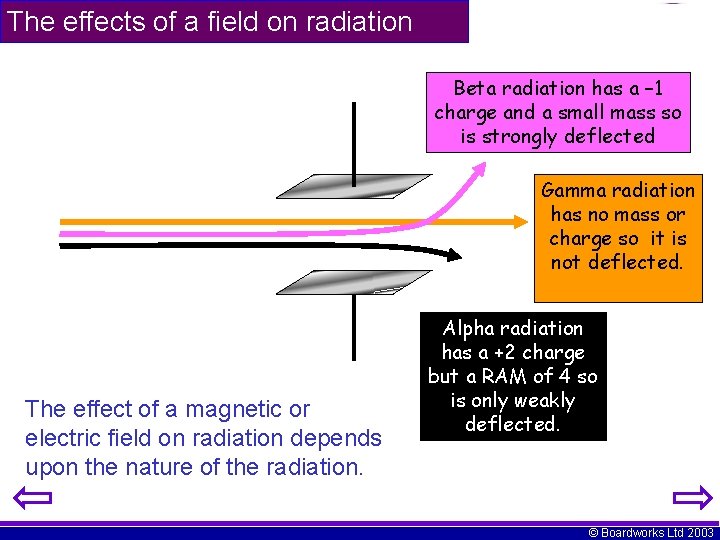
The effects of a field on radiation Beta radiation has a – 1 charge and a small mass so is strongly deflected Gamma radiation has no mass or charge so it is not deflected. The effect of a magnetic or electric field on radiation depends upon the nature of the radiation. Alpha radiation has a +2 charge but a RAM of 4 so is only weakly deflected. © Boardworks Ltd 2003
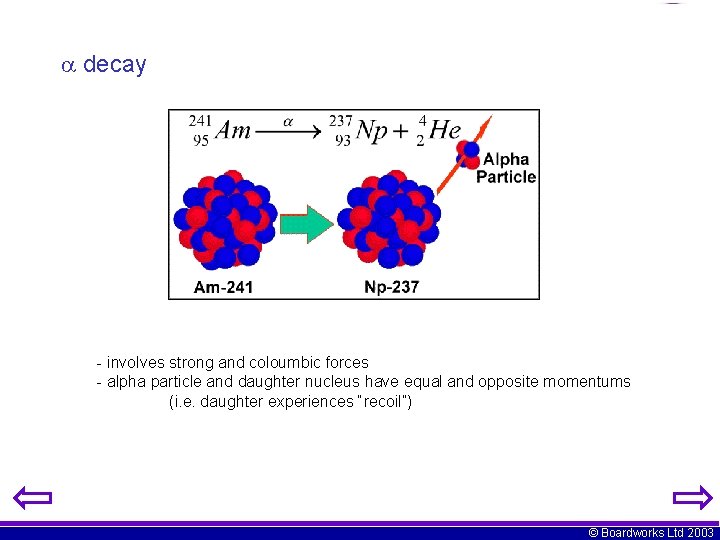
decay - involves strong and coloumbic forces - alpha particle and daughter nucleus have equal and opposite momentums (i. e. daughter experiences “recoil”) © Boardworks Ltd 2003
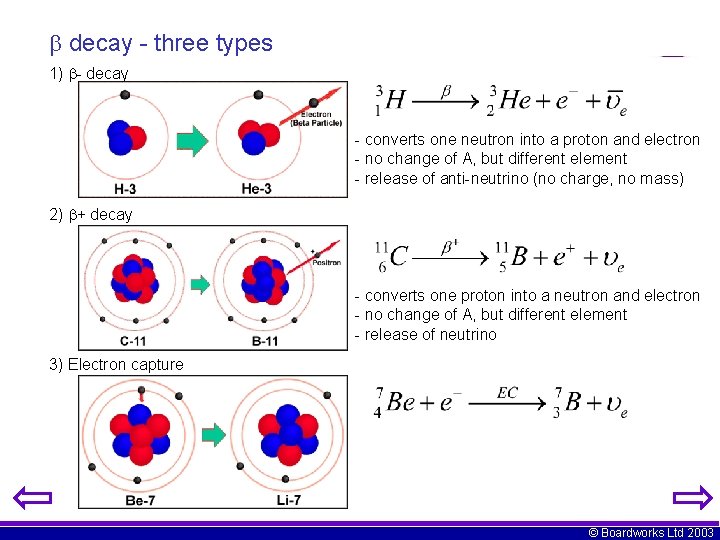
decay - three types 1) - decay - converts one neutron into a proton and electron - no change of A, but different element - release of anti-neutrino (no charge, no mass) 2) + decay - converts one proton into a neutron and electron - no change of A, but different element - release of neutrino 3) Electron capture © Boardworks Ltd 2003
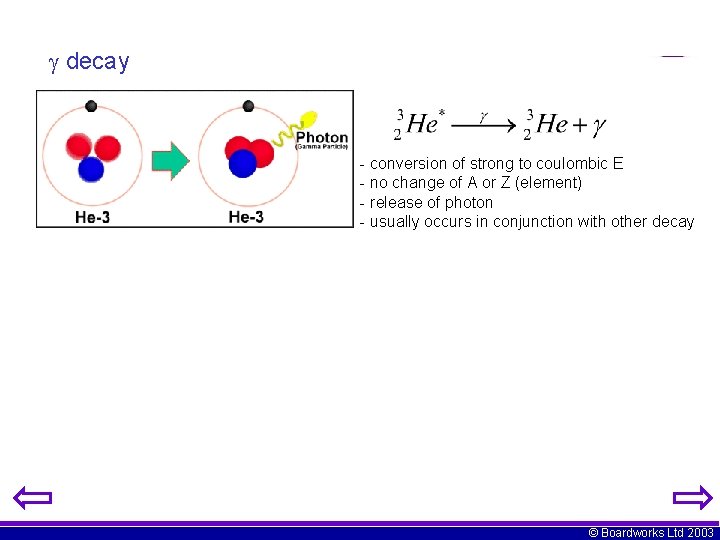
decay - conversion of strong to coulombic E - no change of A or Z (element) - release of photon - usually occurs in conjunction with other decay © Boardworks Ltd 2003
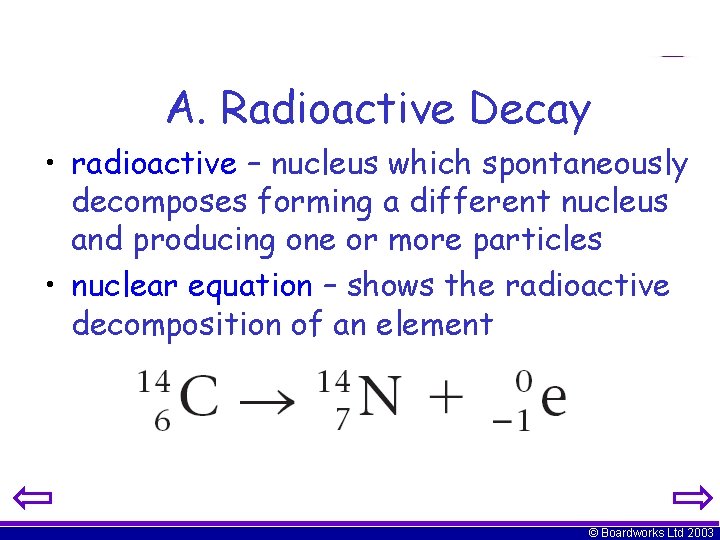
A. Radioactive Decay • radioactive – nucleus which spontaneously decomposes forming a different nucleus and producing one or more particles • nuclear equation – shows the radioactive decomposition of an element © Boardworks Ltd 2003
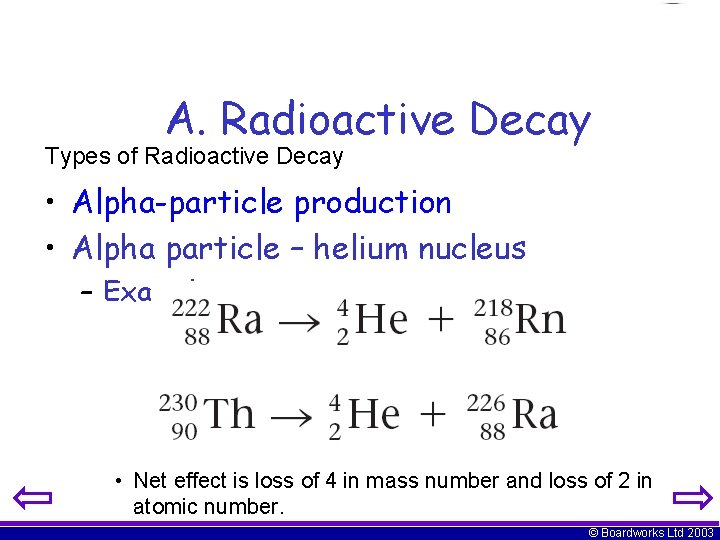
A. Radioactive Decay Types of Radioactive Decay • Alpha-particle production • Alpha particle – helium nucleus – Examples • Net effect is loss of 4 in mass number and loss of 2 in atomic number. © Boardworks Ltd 2003
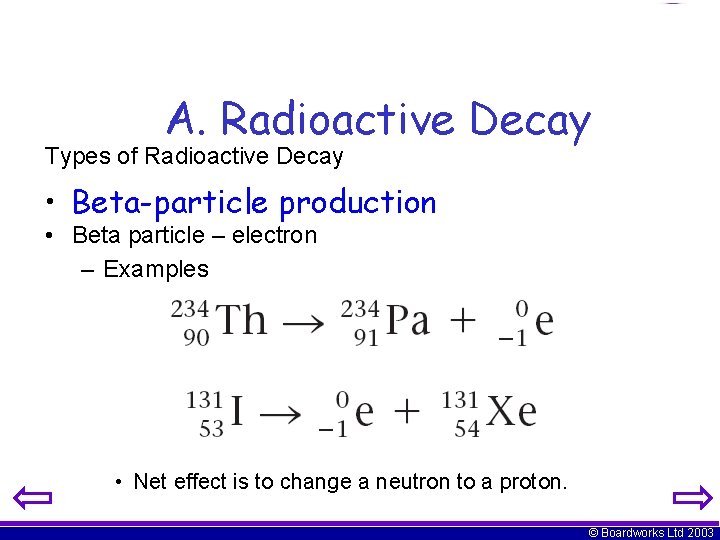
A. Radioactive Decay Types of Radioactive Decay • Beta-particle production • Beta particle – electron – Examples • Net effect is to change a neutron to a proton. © Boardworks Ltd 2003
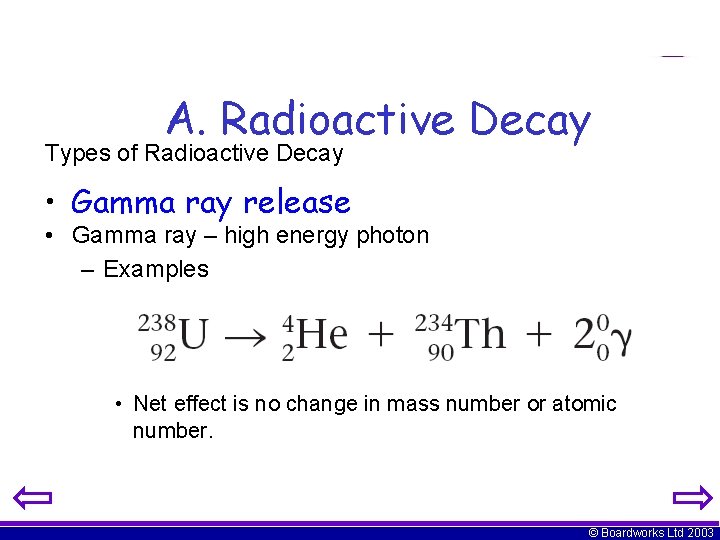
A. Radioactive Decay Types of Radioactive Decay • Gamma ray release • Gamma ray – high energy photon – Examples • Net effect is no change in mass number or atomic number. © Boardworks Ltd 2003
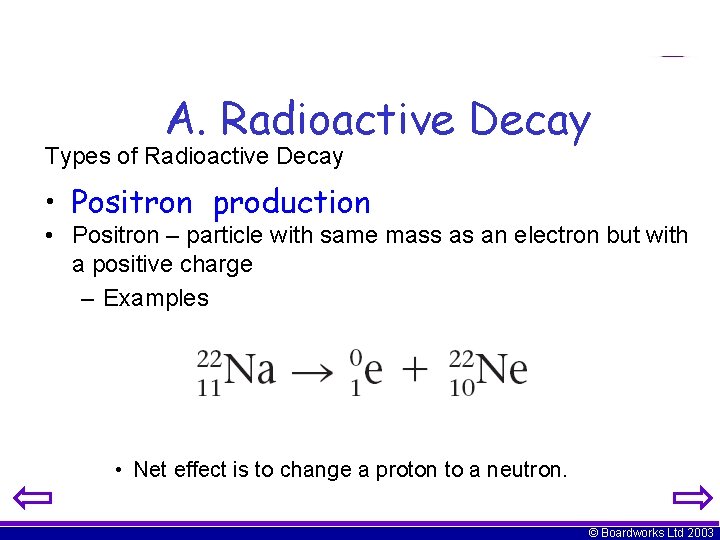
A. Radioactive Decay Types of Radioactive Decay • Positron production • Positron – particle with same mass as an electron but with a positive charge – Examples • Net effect is to change a proton to a neutron. © Boardworks Ltd 2003
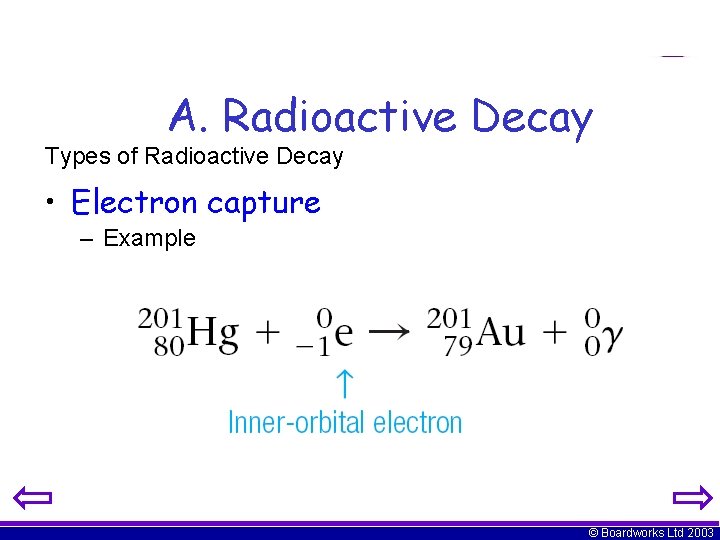
A. Radioactive Decay Types of Radioactive Decay • Electron capture – Example © Boardworks Ltd 2003
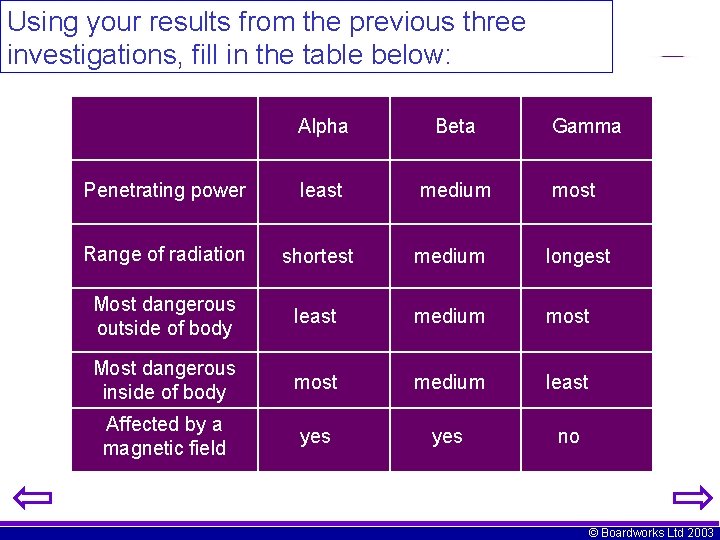
Using your results from the previous three investigations, fill in the table below: Alpha Beta Gamma Penetrating power least medium most Range of radiation shortest medium longest Most dangerous outside of body least medium most Most dangerous inside of body most medium least Affected by a magnetic field yes no © Boardworks Ltd 2003
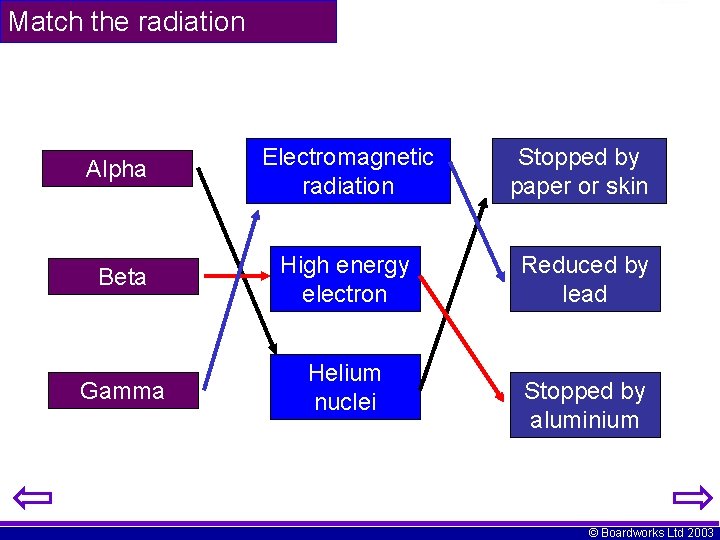
Match the radiation Alpha Electromagnetic radiation Stopped by paper or skin Beta High energy electron Reduced by lead Gamma Helium nuclei Stopped by aluminium © Boardworks Ltd 2003
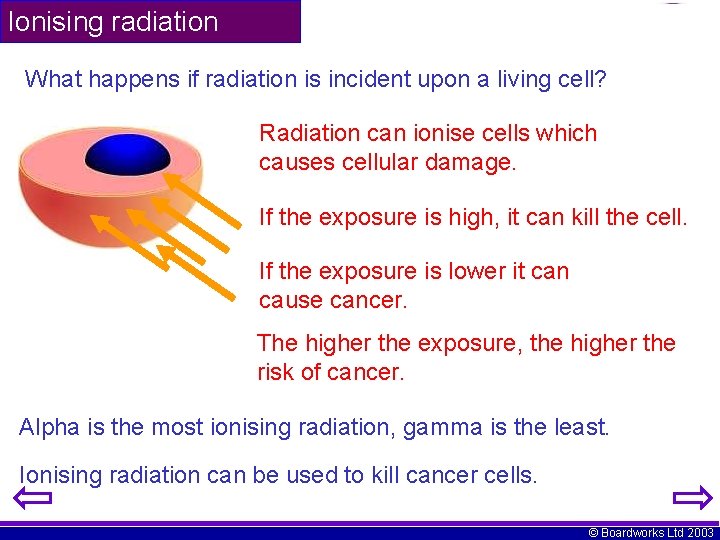
Ionising radiation What happens if radiation is incident upon a living cell? Radiation can ionise cells which causes cellular damage. If the exposure is high, it can kill the cell. If the exposure is lower it can cause cancer. The higher the exposure, the higher the risk of cancer. Alpha is the most ionising radiation, gamma is the least. Ionising radiation can be used to kill cancer cells. © Boardworks Ltd 2003
Ionisation questions 1. What is ionisation? When a neutral atom loses or gains electrons and hence charge. 2. How is a neutral atom positively ionised? By losing electrons. 3. How is a neutral atom negatively ionised? By gaining electrons. 4. What two effects on living cells can ionisation have? Kill cells or cause cancer. 5. Which type of radiation is the most ionising? Alpha radiation. 6. Which type of radiation is the least ionising? Gamma radiation. © Boardworks Ltd 2003
Which type of radiation is…. . 1. The most penetrating? Gamma 2. The least penetrating? Alpha 3. Least dangerous outside the body? Alpha 4. Most dangerous inside the body? Alpha 5. High energy electrons? Beta 6. Has a negative charge? Beta 7. Is weakly ionising? Beta 8. Has zero charge and zero mass? Gamma 9. Only reduced in intensity by lead and concrete? Gamma © Boardworks Ltd 2003
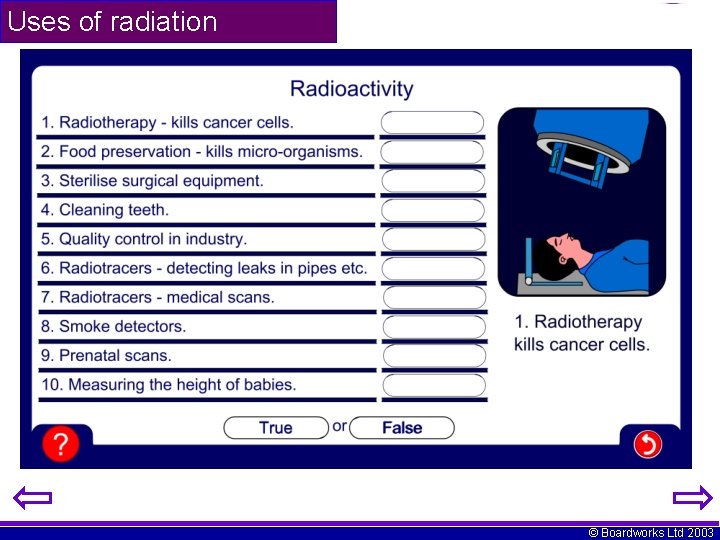
Uses of radiation © Boardworks Ltd 2003
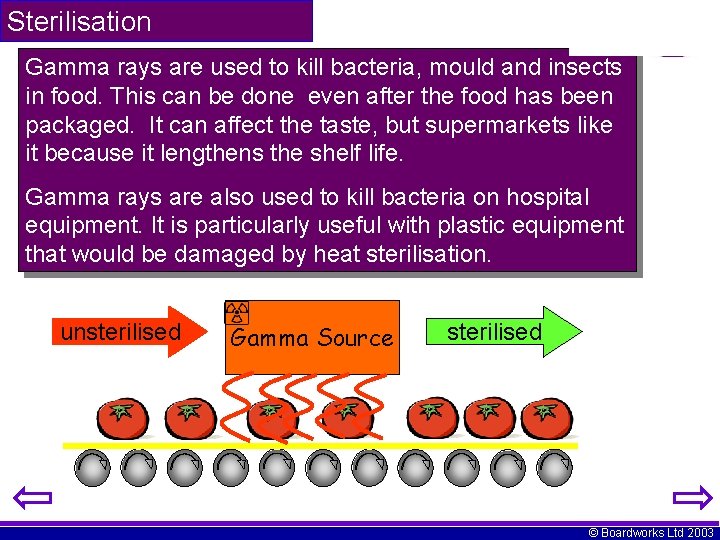
Sterilisation Gamma rays are used to kill bacteria, mould and insects in food. This can be done even after the food has been packaged. It can affect the taste, but supermarkets like it because it lengthens the shelf life. Gamma rays are also used to kill bacteria on hospital equipment. It is particularly useful with plastic equipment that would be damaged by heat sterilisation. unsterilised Gamma Source sterilised © Boardworks Ltd 2003
Radiotherapy A carefully controlled beam of gamma rays can be used to kill cancer cells. It must be directed carefully to minimise the damage to normal cells. However, some damage is unavoidable and this can make the patient ill. It is therefore a balancing act - getting the dose high enough to kill the cancerous cells, but as low as possible to minimise the harm to the patient. © Boardworks Ltd 2003
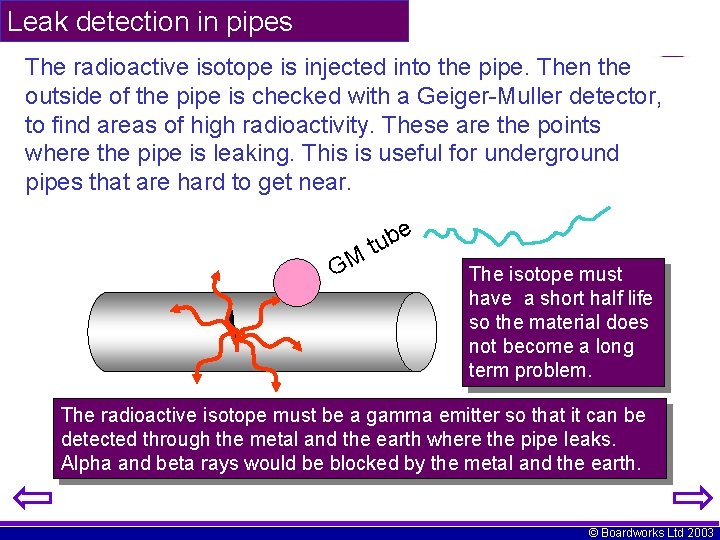
Leak detection in pipes The radioactive isotope is injected into the pipe. Then the outside of the pipe is checked with a Geiger-Muller detector, to find areas of high radioactivity. These are the points where the pipe is leaking. This is useful for underground pipes that are hard to get near. GM e b u t The isotope must have a short half life so the material does not become a long term problem. The radioactive isotope must be a gamma emitter so that it can be detected through the metal and the earth where the pipe leaks. Alpha and beta rays would be blocked by the metal and the earth. © Boardworks Ltd 2003
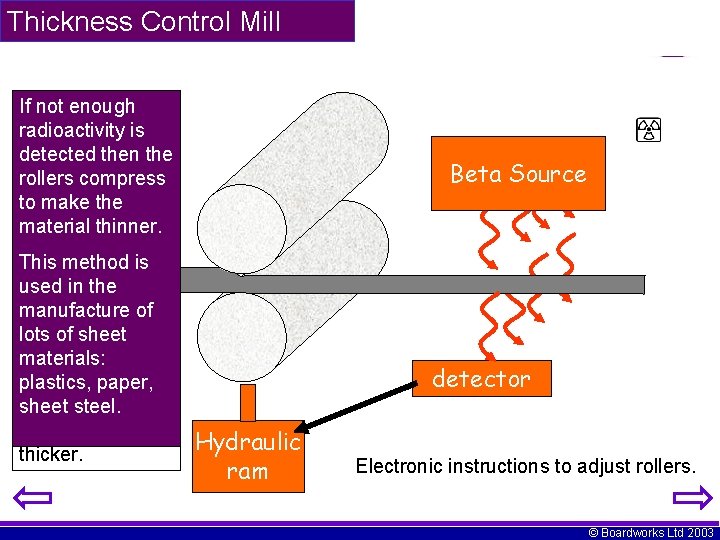
Thickness Control Mill If not A radioactive enough source is on is radioactivity one side of thethen the detected material rollers compress and a detector to make the on the other. thinner. material This If toomethod much is radioactivity used in the is getting through, manufacture of thenofthe lots sheet material is too thin and materials: the rollers plastics, paper, open up a bit sheet steel. to make the material thicker. Beta Source detector Hydraulic ram Electronic instructions to adjust rollers. © Boardworks Ltd 2003
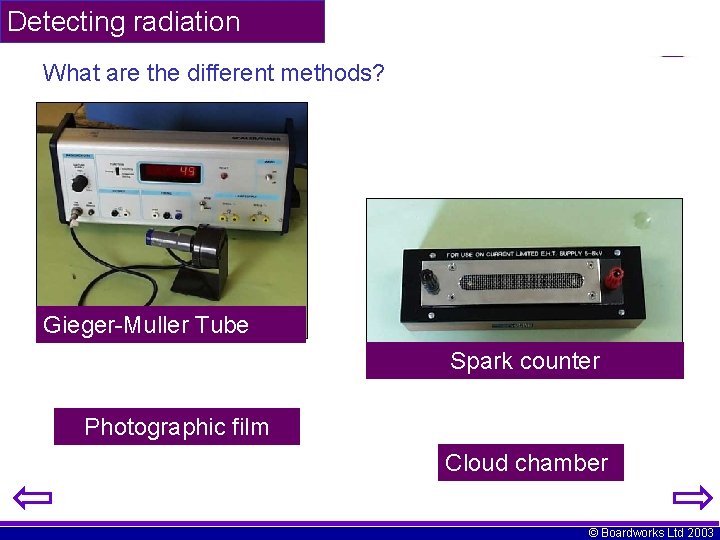
Detecting radiation What are the different methods? Gieger-Muller Tube Spark counter Photographic film Cloud chamber © Boardworks Ltd 2003
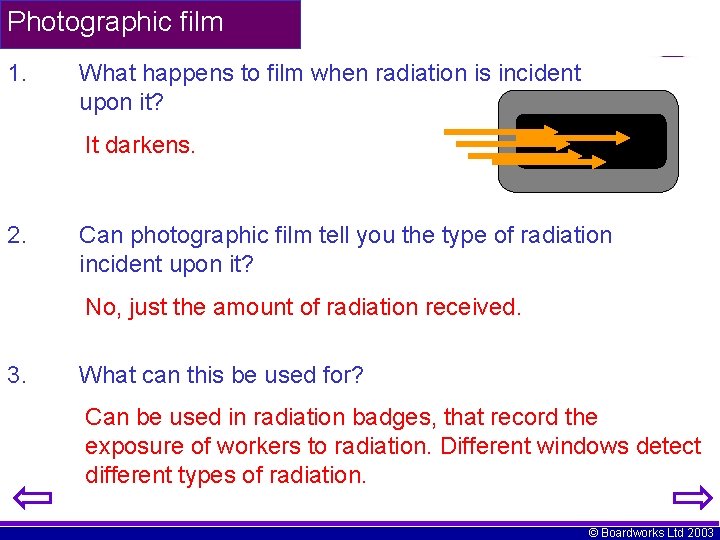
Photographic film 1. What happens to film when radiation is incident upon it? It darkens. 2. Can photographic film tell you the type of radiation incident upon it? No, just the amount of radiation received. 3. What can this be used for? Can be used in radiation badges, that record the exposure of workers to radiation. Different windows detect different types of radiation. © Boardworks Ltd 2003
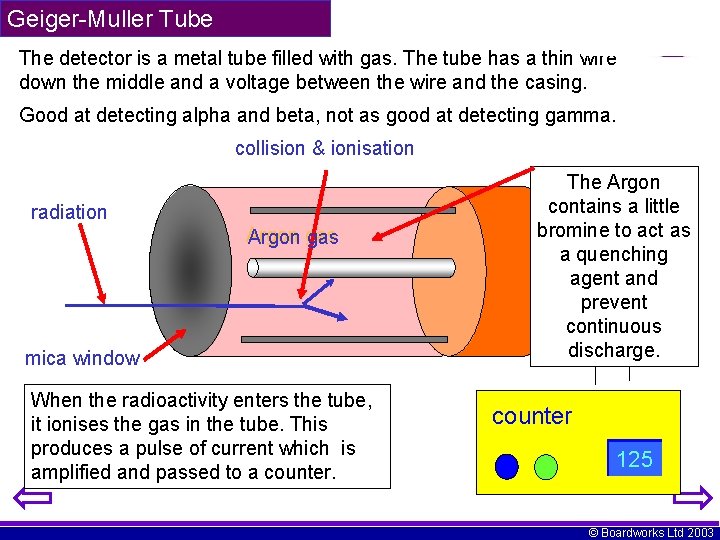
Geiger-Muller Tube The detector is a metal tube filled with gas. The tube has a thin wire down the middle and a voltage between the wire and the casing. Good at detecting alpha and beta, not as good at detecting gamma. collision & ionisation radiation Argon gas mica window When the radioactivity enters the tube, it ionises the gas in the tube. This produces a pulse of current which is amplified and passed to a counter. The Argon contains a little bromine to act as a quenching agent and prevent continuous discharge. counter 124 125 © Boardworks Ltd 2003
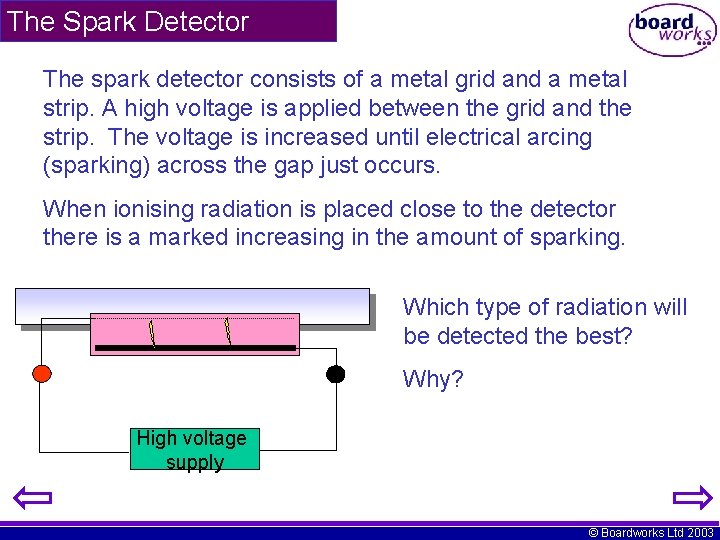
The Spark Detector The spark detector consists of a metal grid and a metal strip. A high voltage is applied between the grid and the strip. The voltage is increased until electrical arcing (sparking) across the gap just occurs. When ionising radiation is placed close to the detector there is a marked increasing in the amount of sparking. Which type of radiation will be detected the best? Why? High voltage supply © Boardworks Ltd 2003
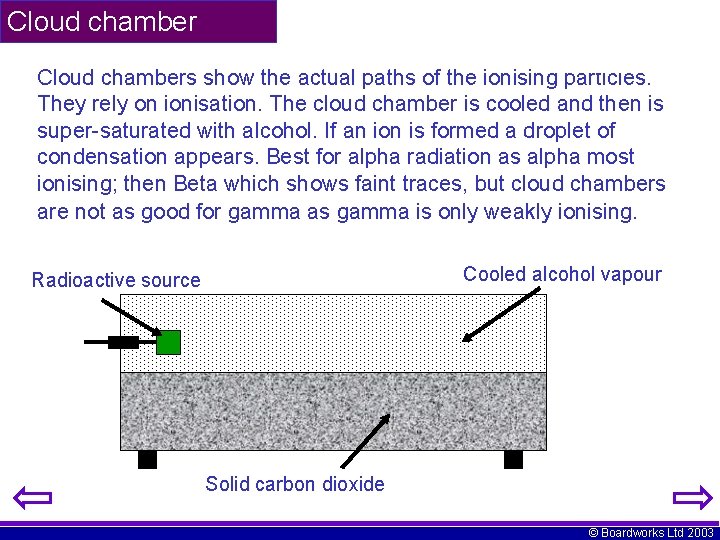
Cloud chambers show the actual paths of the ionising particles. They rely on ionisation. The cloud chamber is cooled and then is super-saturated with alcohol. If an ion is formed a droplet of condensation appears. Best for alpha radiation as alpha most ionising; then Beta which shows faint traces, but cloud chambers are not as good for gamma as gamma is only weakly ionising. Cooled alcohol vapour Radioactive source Solid carbon dioxide © Boardworks Ltd 2003
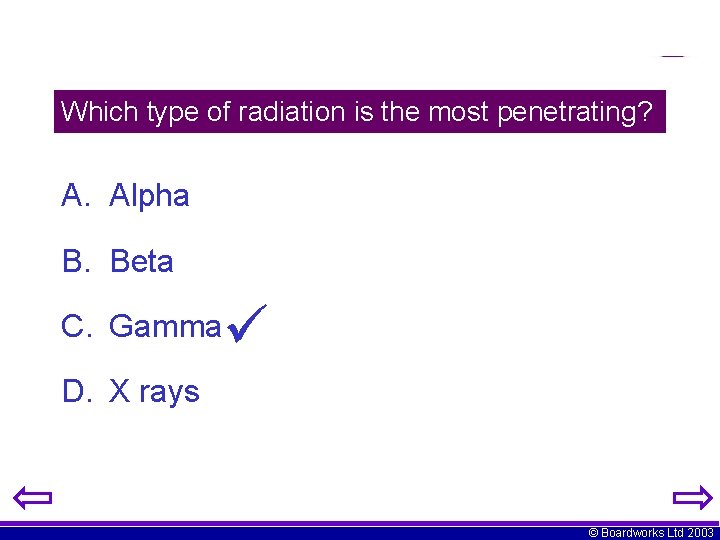
Which type of radiation is the most penetrating? A. Alpha B. Beta C. Gamma D. X rays © Boardworks Ltd 2003
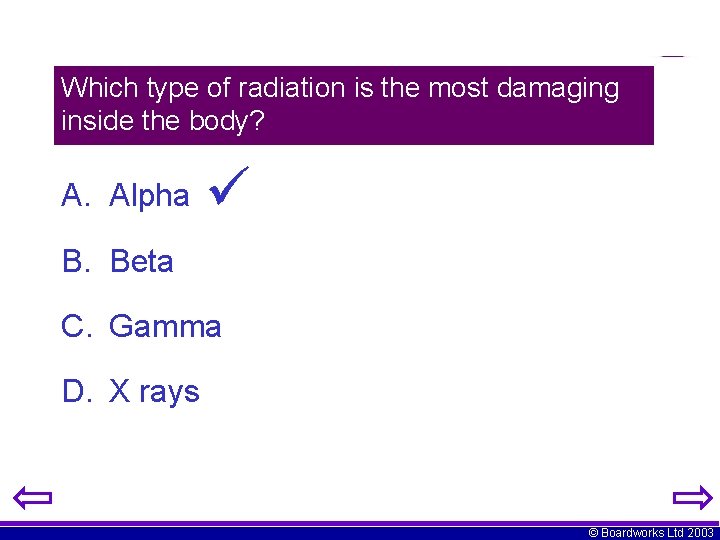
Which type of radiation is the most damaging inside the body? A. Alpha B. Beta C. Gamma D. X rays © Boardworks Ltd 2003

Which type of radiation is the most dangerous outside the body? A. Alpha B. Beta C. Gamma D. X rays © Boardworks Ltd 2003
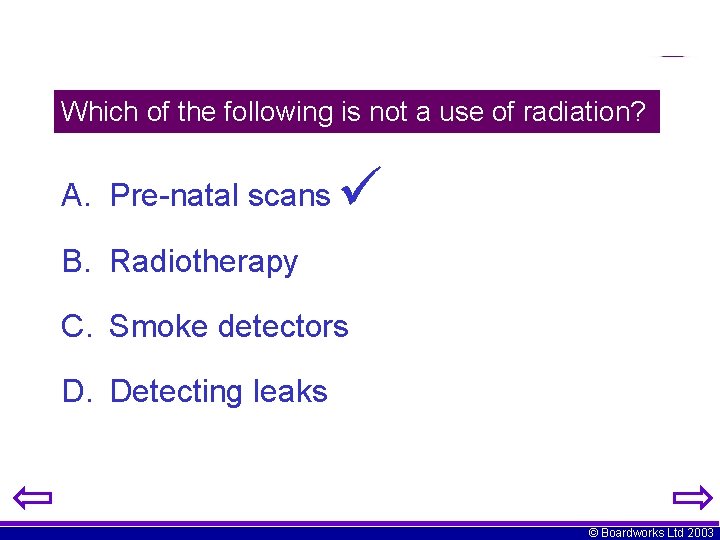
Which of the following is not a use of radiation? A. Pre-natal scans B. Radiotherapy C. Smoke detectors D. Detecting leaks © Boardworks Ltd 2003
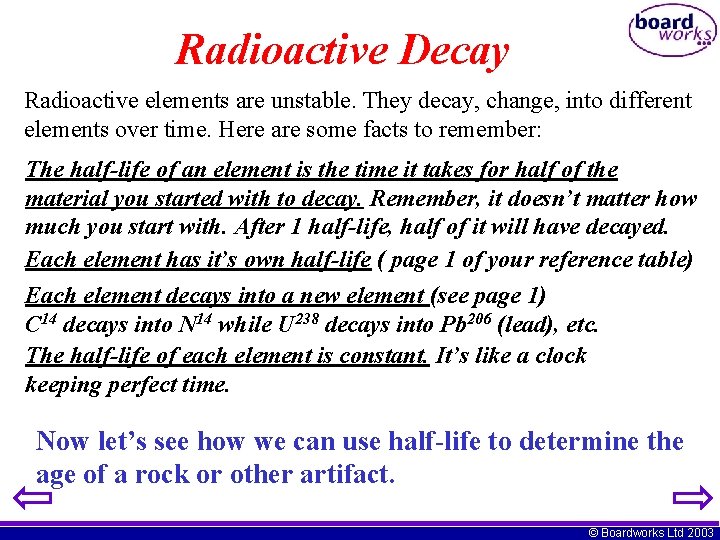
Radioactive Decay Radioactive elements are unstable. They decay, change, into different elements over time. Here are some facts to remember: The half-life of an element is the time it takes for half of the material you started with to decay. Remember, it doesn’t matter how much you start with. After 1 half-life, half of it will have decayed. Each element has it’s own half-life ( page 1 of your reference table) Each element decays into a new element (see page 1) C 14 decays into N 14 while U 238 decays into Pb 206 (lead), etc. The half-life of each element is constant. It’s like a clock keeping perfect time. Now let’s see how we can use half-life to determine the age of a rock or other artifact. © Boardworks Ltd 2003
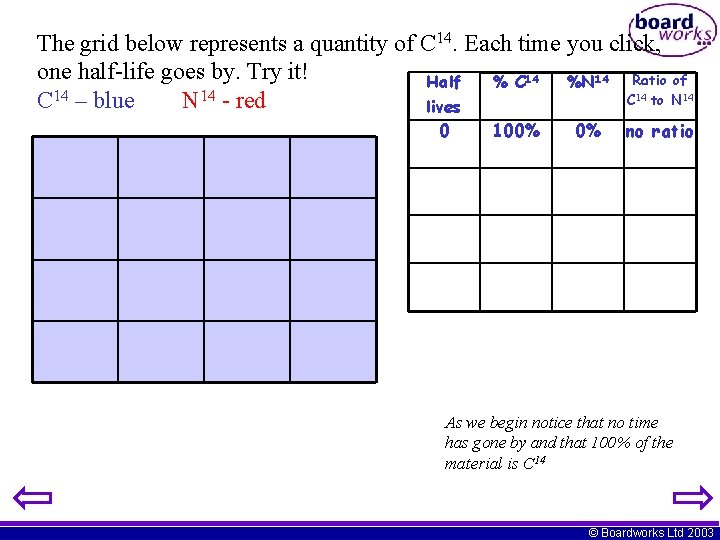
The grid below represents a quantity of C 14. Each time you click, one half-life goes by. Try it! Half % C 14 %N 14 Ratio of C to N C 14 – blue N 14 - red lives 14 0 100% 0% 14 no ratio As we begin notice that no time has gone by and that 100% of the material is C 14 © Boardworks Ltd 2003
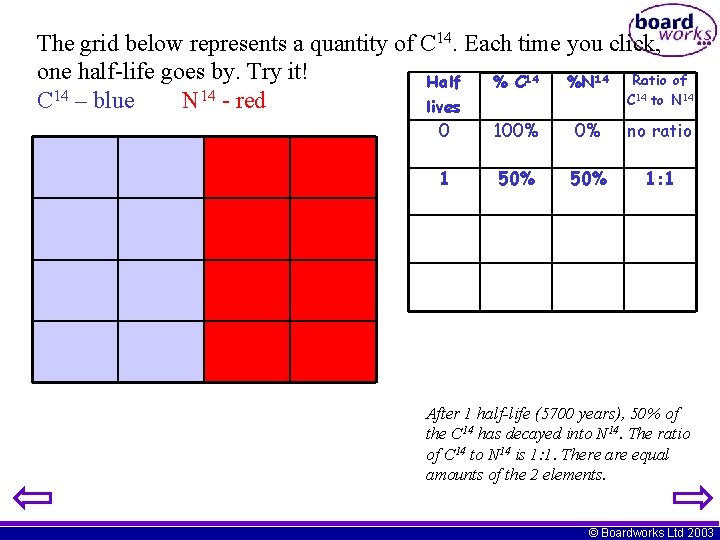
The grid below represents a quantity of C 14. Each time you click, one half-life goes by. Try it! Half % C 14 %N 14 Ratio of C to N C 14 – blue N 14 - red lives 14 14 0 100% 0% no ratio 1 50% 1: 1 After 1 half-life (5700 years), 50% of the C 14 has decayed into N 14. The ratio of C 14 to N 14 is 1: 1. There are equal amounts of the 2 elements. © Boardworks Ltd 2003
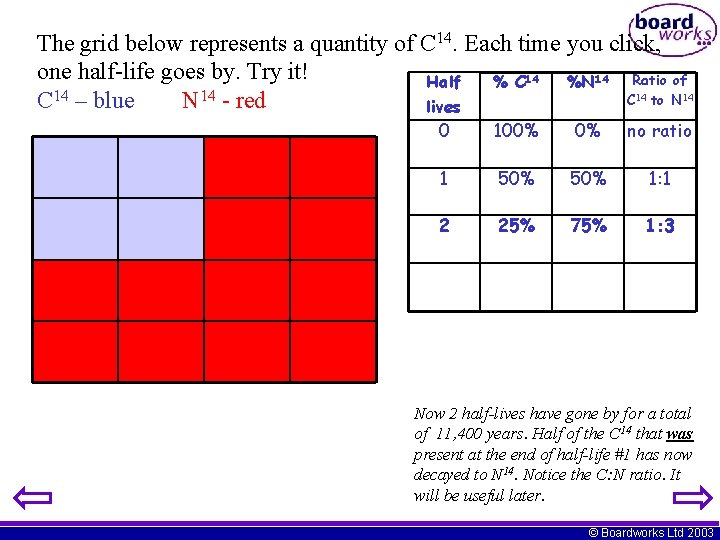
The grid below represents a quantity of C 14. Each time you click, one half-life goes by. Try it! Half % C 14 %N 14 Ratio of C to N C 14 – blue N 14 - red lives 14 14 0 100% 0% no ratio 1 50% 1: 1 2 25% 75% 1: 3 Now 2 half-lives have gone by for a total of 11, 400 years. Half of the C 14 that was present at the end of half-life #1 has now decayed to N 14. Notice the C: N ratio. It will be useful later. © Boardworks Ltd 2003
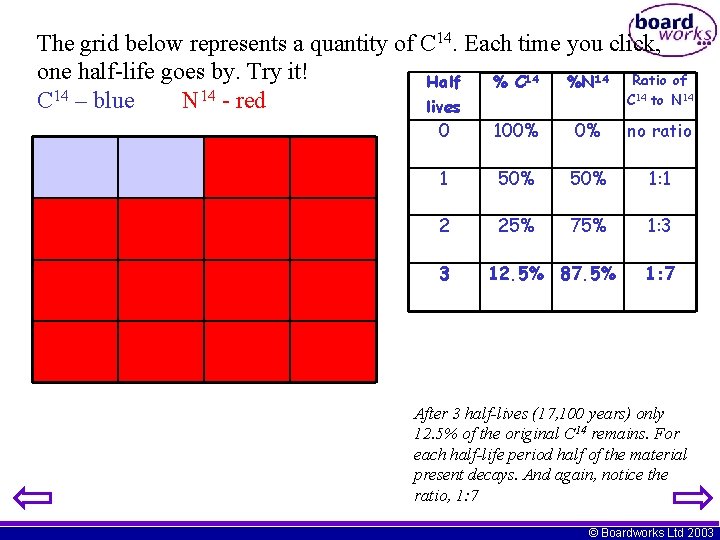
The grid below represents a quantity of C 14. Each time you click, one half-life goes by. Try it! Half % C 14 %N 14 Ratio of C to N C 14 – blue N 14 - red lives 14 14 0 100% 0% no ratio 1 50% 1: 1 2 25% 75% 1: 3 3 12. 5% 87. 5% 1: 7 After 3 half-lives (17, 100 years) only 12. 5% of the original C 14 remains. For each half-life period half of the material present decays. And again, notice the ratio, 1: 7 © Boardworks Ltd 2003
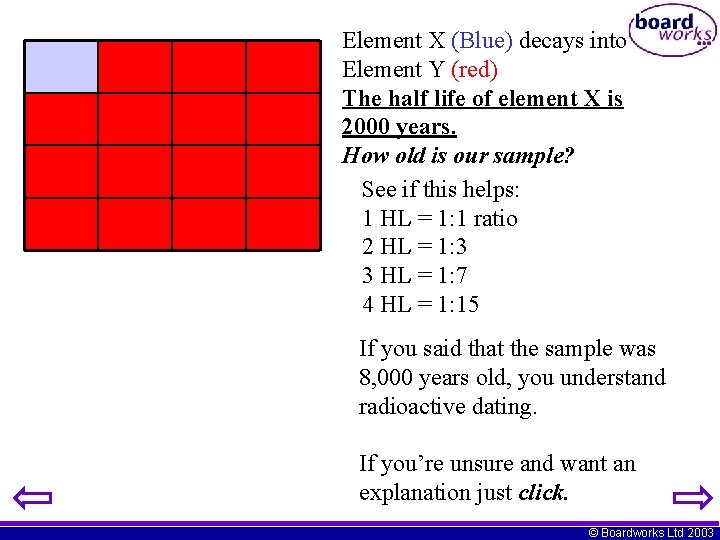
Element X (Blue) decays into Element Y (red) The half life of element X is 2000 years. How old is our sample? See if this helps: 1 HL = 1: 1 ratio 2 HL = 1: 3 3 HL = 1: 7 4 HL = 1: 15 If you said that the sample was 8, 000 years old, you understand radioactive dating. If you’re unsure and want an explanation just click. © Boardworks Ltd 2003
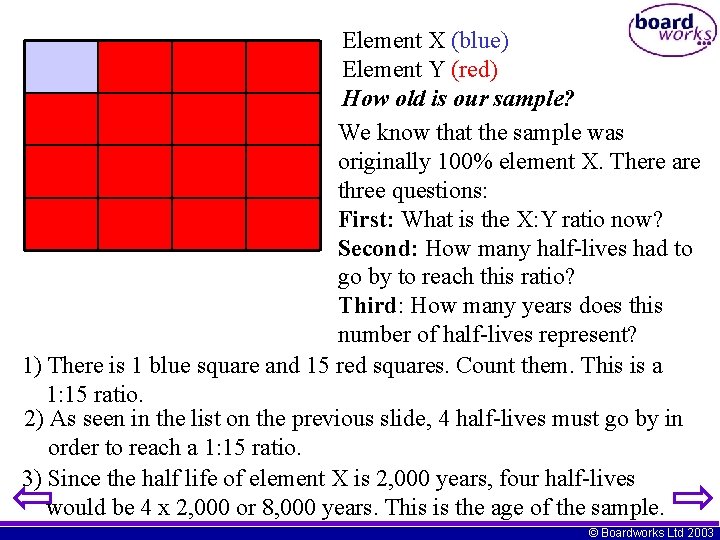
Element X (blue) Element Y (red) How old is our sample? We know that the sample was originally 100% element X. There are three questions: First: What is the X: Y ratio now? Second: How many half-lives had to go by to reach this ratio? Third: How many years does this number of half-lives represent? 1) There is 1 blue square and 15 red squares. Count them. This is a 1: 15 ratio. 2) As seen in the list on the previous slide, 4 half-lives must go by in order to reach a 1: 15 ratio. 3) Since the half life of element X is 2, 000 years, four half-lives would be 4 x 2, 000 or 8, 000 years. This is the age of the sample. © Boardworks Ltd 2003
- Slides: 45