
Introduction to particle accelerators Walter Scandale CERN AT





- Slides: 22
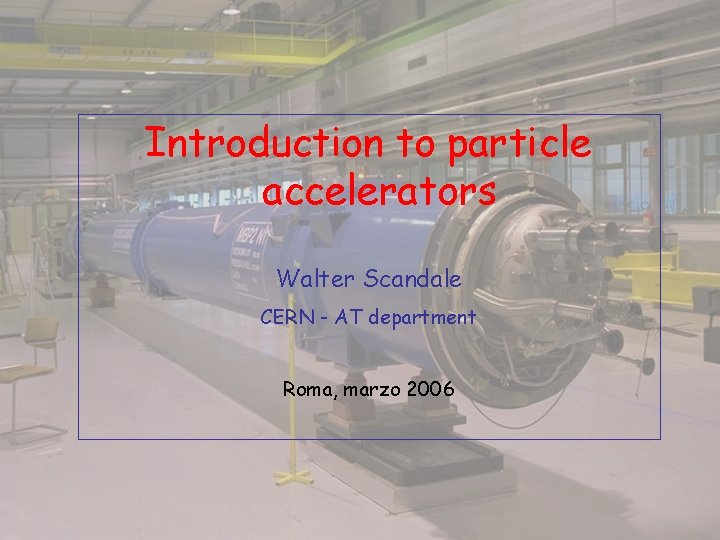
Introduction to particle accelerators Walter Scandale CERN - AT department Roma, marzo 2006
Lecture II - single particle dynamics topics Guiding fields and transverse motion Weak versus strong focusing Equation of motion n n Unperturbed case Orbit errors Quadrupole errors Chromaticity Resonances and dynamic aperture Low-ß insertion Longitudinal stability
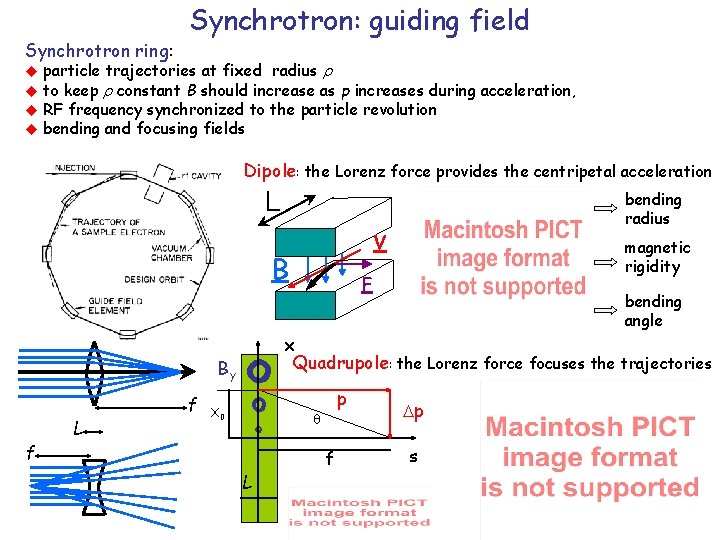
Synchrotron ring: Synchrotron: guiding field particle trajectories at fixed radius to keep constant B should increase as p increases during acceleration, RF frequency synchronized to the particle revolution bending and focusing fields Dipole: the Lorenz force provides the centripetal acceleration L v B By f L f X 0 ºº º L bending radius magnetic rigidity F bending angle x Quadrupole: the Lorenz force focuses the trajectories p f p s
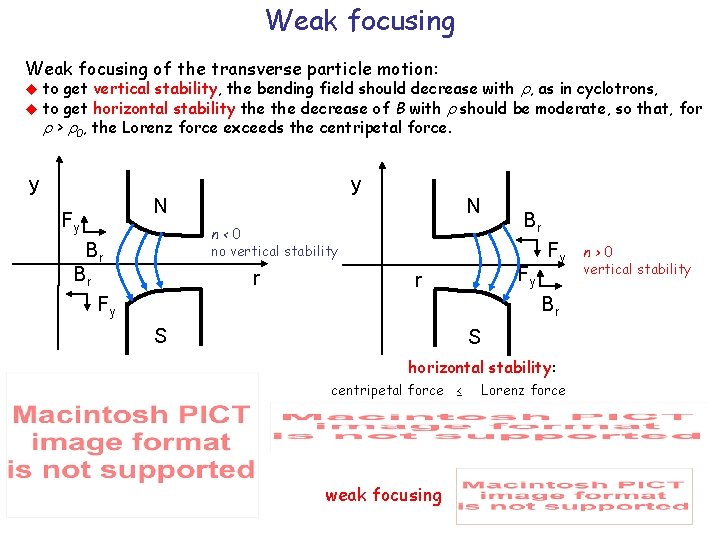
Weak focusing of the transverse particle motion: to get vertical stability, the bending field should decrease with , as in cyclotrons, to get horizontal stability the decrease of B with should be moderate, so that, for > 0, the Lorenz force exceeds the centripetal force. y Fy y N N n<0 no vertical stability Br Br Fy Br S S horizontal stability: centripetal force ≤ weak focusing Lorenz force n>0 vertical stability
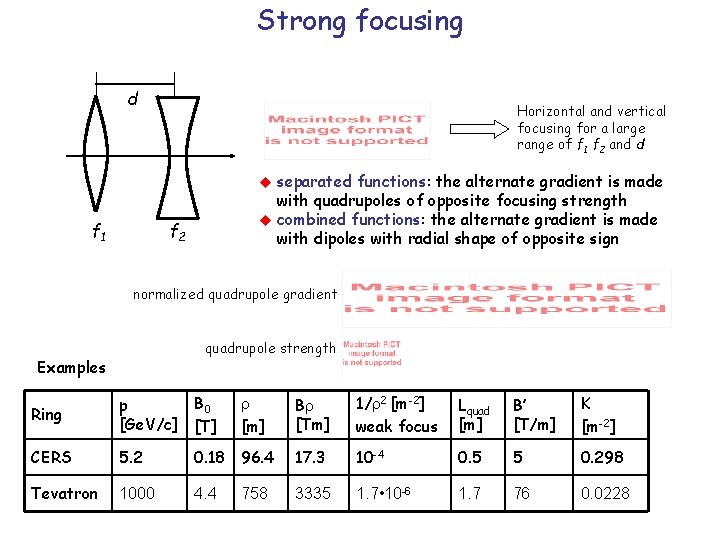
Strong focusing d Horizontal and vertical focusing for a large range of f 1 f 2 and d separated functions: the alternate gradient is made with quadrupoles of opposite focusing strength combined functions: the alternate gradient is made with dipoles with radial shape of opposite sign f 1 f 2 normalized quadrupole gradient quadrupole strength Examples Ring p [Ge. V/c] B 0 [T] Br [Tm] 1/r 2 [m-2] weak focus Lquad [m] B’ [T/m] K [m-2] CERS 5. 2 0. 18 96. 4 17. 3 10 -4 0. 5 5 0. 298 Tevatron 1000 4. 4 3335 1. 7 • 10 -6 1. 7 76 0. 0228 r [m] 758
Particle equation of motion B-field expansion Maxwell equations and quadrupolar gradients g gskew Equation of motion transport matrix approach
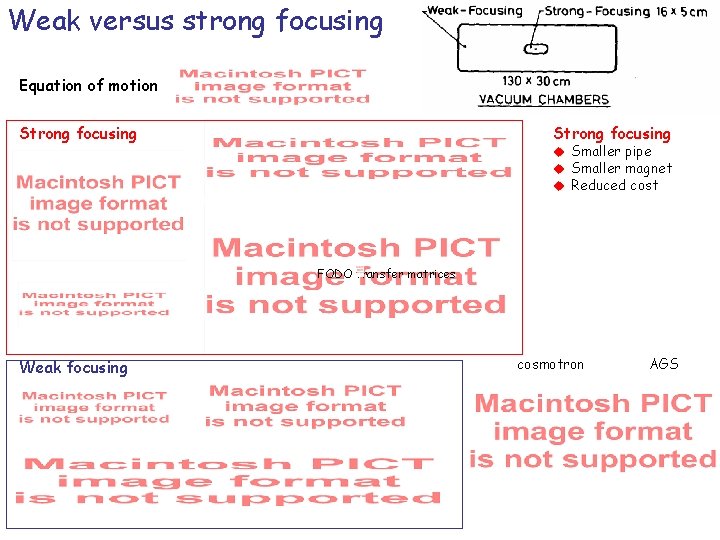
Weak versus strong focusing Equation of motion Strong focusing Smaller pipe Smaller magnet Reduced cost FODO transfer matrices Weak focusing cosmotron AGS
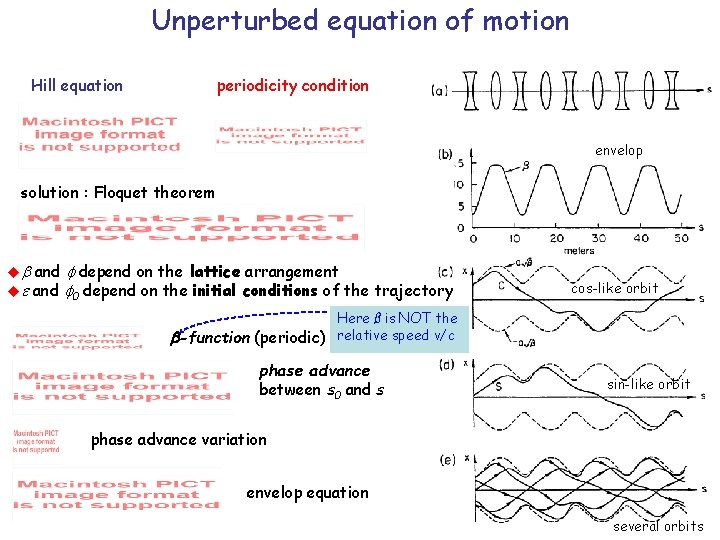
Unperturbed equation of motion Hill equation periodicity condition envelop solution : Floquet theorem b and f depend on the lattice arrangement e and f 0 depend on the initial conditions of the trajectory cos-like orbit Here ß is NOT the b-function (periodic) relative speed v/c phase advance between s 0 and s sin-like orbit phase advance variation envelop equation several orbits
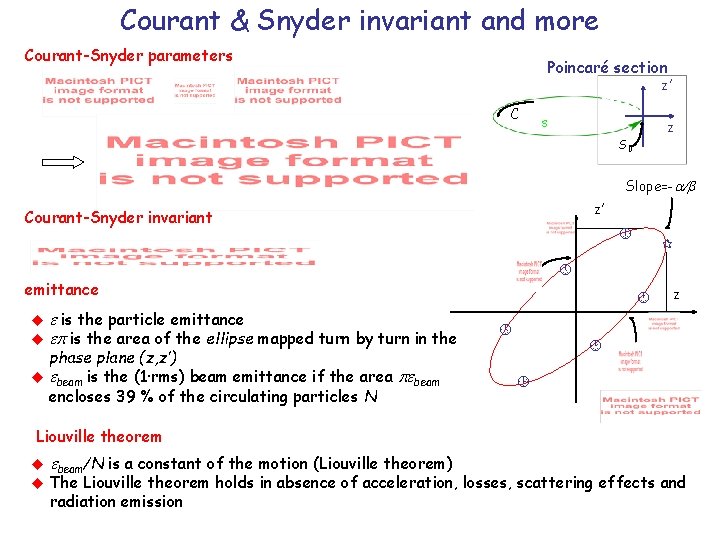
Courant & Snyder invariant and more Courant-Snyder parameters Poincaré section z’ C s z S 0 Slope=-a/b z’ Courant-Snyder invariant emittance e is the particle emittance ep is the area of the ellipse mapped turn by turn in the phase plane (z, z’) ebeam is the (1·rms) beam emittance if the area pebeam encloses 39 % of the circulating particles N z Liouville theorem ebeam/N is a constant of the motion (Liouville theorem) The Liouville theorem holds in absence of acceleration, losses, scattering effects and radiation emission
Adiabatic invariant The Courant-Snyder invariant emittance ε decreases if we the accelerate the particle. This is called “adiabatic damping” (a pure cinematic effect, since there is no damping process involved). The slope of the trajectory is z’ = pz/ps. Accelerate the particle: ps increases to ps+∆ps, but pz doesn’t change => slope changes. p ps pz z’ p+Dp p s +D p s pz z’+Dz’ b -> Courant Snyder parameter normalized emittance Invariant of the motion In a stationary Poincaré section -> e In an accelerating Poincaré section -> ebg b = the relative speed = the relativistic factor
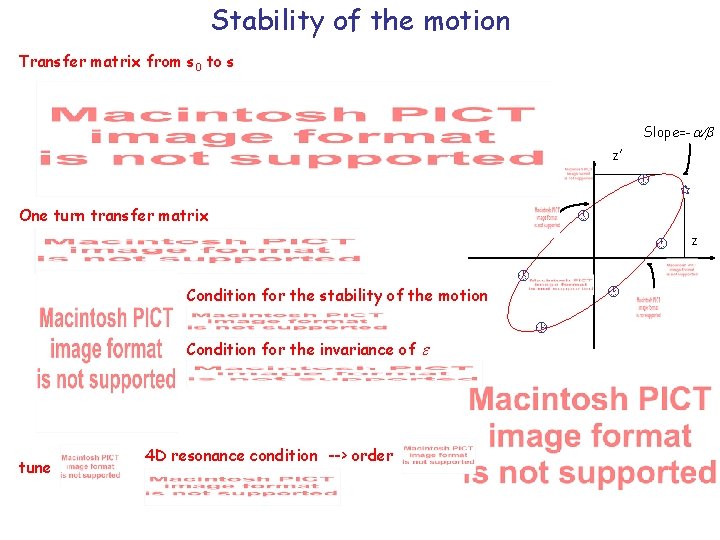
Stability of the motion Transfer matrix from s 0 to s Slope=-a/b z’ One turn transfer matrix Condition for the stability of the motion Condition for the invariance of e tune 4 D resonance condition --> order z
Exact & approximate solution Exact solution of the Hill equation Exact solution in compact form with This is a pseudo-harmonic oscillation modulated both in amplitude and in frequency Q is the total number of oscillation per turn The phase advances faster in the sections with a smaller b Approximate solution (smooth approximation) with Ten cell lattice n Cell length L = 1 m n Ring length C = 10 m n Focal length f = 0. 45 m
Perturbed equation of motion Solution with dipoles, quadrupoles sextupoles and octupoles dispersion chromaticity sextupole octupole dispersive orbit nonlinear terms betatron motion closed orbit Uncoupled motion (x-plane) orbit distortion with dispersive orbit with betatron oscillation natural chromaticity aberration chromaticity correction by sextupoles geometric aberration
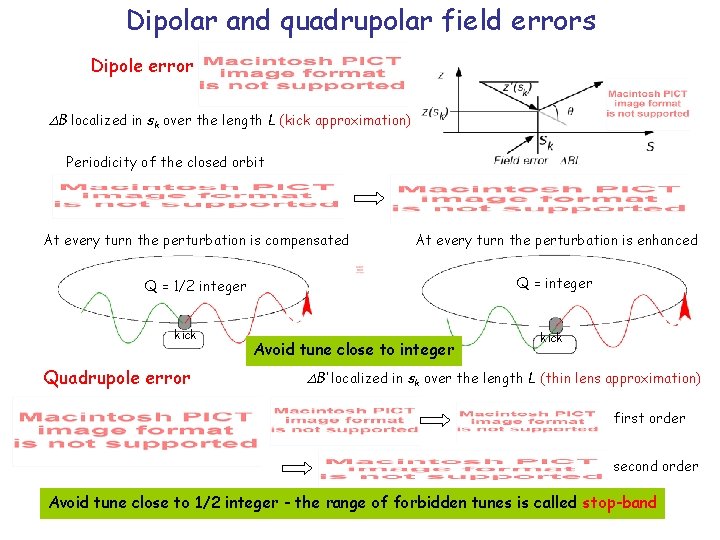
Dipolar and quadrupolar field errors Dipole error DB localized in sk over the length L (kick approximation) Periodicity of the closed orbit At every turn the perturbation is compensated At every turn the perturbation is enhanced Q = 1/2 integer Q = integer kick Quadrupole error Avoid tune close to integer kick DB’ localized in sk over the length L (thin lens approximation) first order second order Avoid tune close to 1/2 integer - the range of forbidden tunes is called stop-band
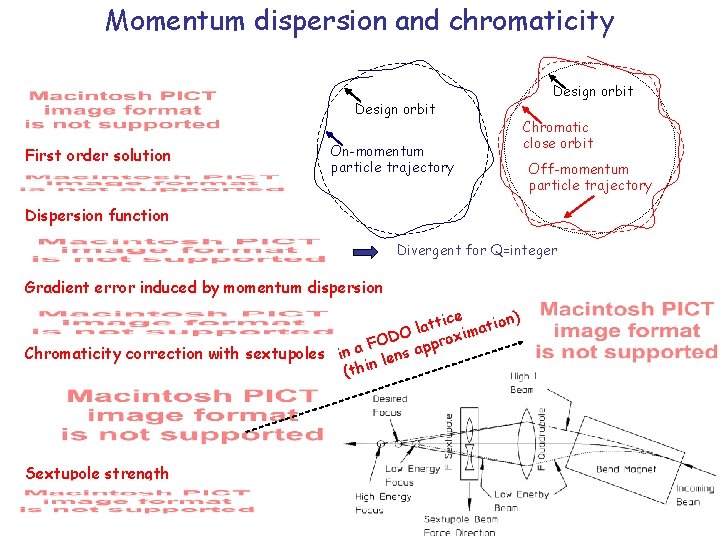
Momentum dispersion and chromaticity Design orbit First order solution On-momentum particle trajectory Design orbit Chromatic close orbit Off-momentum particle trajectory Dispersion function Divergent for Q=integer Gradient error induced by momentum dispersion e ttic mation) a l DO proxi O F Chromaticity correction with sextupoles in a lens ap n (thi Sextupole strength
Why chromaticity should be corrected The beam rigidity increases with p K decreases with p the tune decreases with p Q’ is negative Q’ non zero produces a tune shift with p In a beam Q’ produces a tune spread Be aware of resonance crossing Int(Qy)+1 Qy Low energy particles High energy particles Int(Qy) Int(Qx) Qx Int(Qx)+1
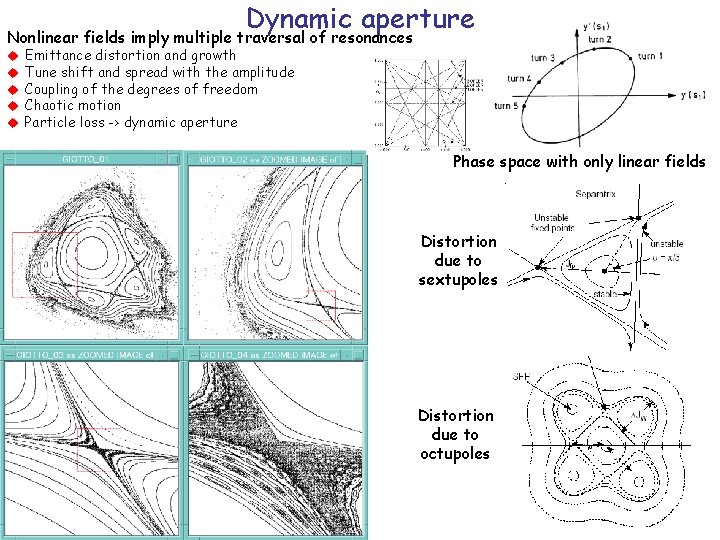
Dynamic aperture Nonlinear fields imply multiple traversal of resonances Emittance distortion and growth Tune shift and spread with the amplitude Coupling of the degrees of freedom Chaotic motion Particle loss -> dynamic aperture Phase space with only linear fields Distortion due to sextupoles Distortion due to octupoles
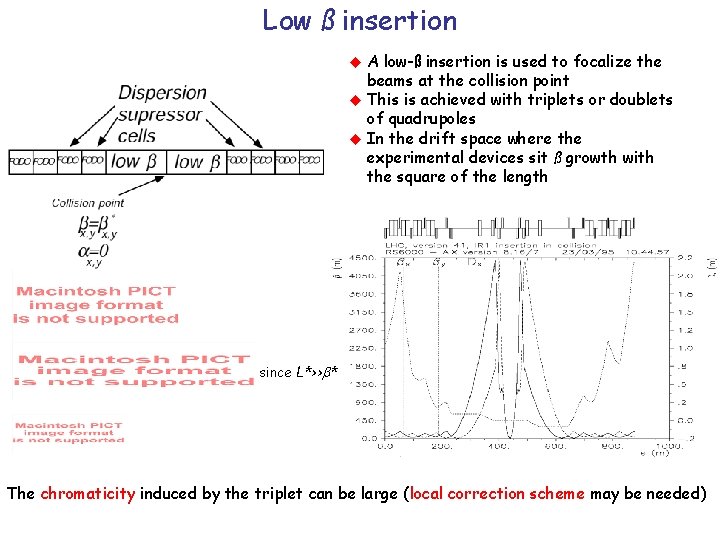
Low ß insertion A low-ß insertion is used to focalize the beams at the collision point This is achieved with triplets or doublets of quadrupoles In the drift space where the experimental devices sit ß growth with the square of the length since L*>>b* The chromaticity induced by the triplet can be large (local correction scheme may be needed)
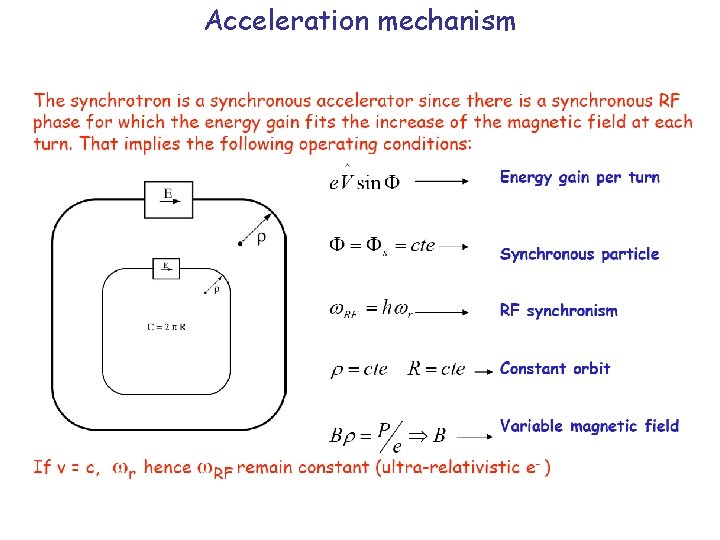
Acceleration mechanism
Longitudinal stability a measures how closely packed orbits with different momenta are Momentum compaction h measures how much offmomentum particles slip in time relative to on-momentum ones Slip factor Phase stability principle < tr B is late respect to A B will receive a larger voltage and will increase its speed B will be closer to A one turn later > tr B is late respect to A B will receive a smaller voltage and will see a shorter circumferential path one turn later B will be closer to A small oscillations
LHC luminosity
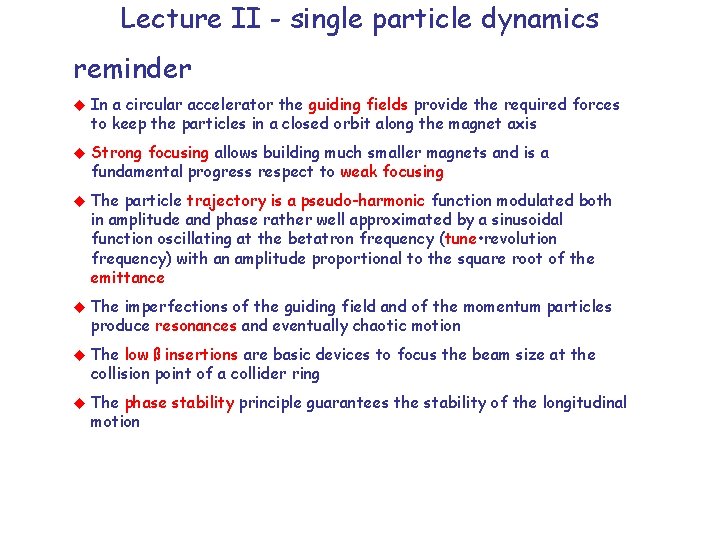
Lecture II - single particle dynamics reminder In a circular accelerator the guiding fields provide the required forces to keep the particles in a closed orbit along the magnet axis Strong focusing allows building much smaller magnets and is a fundamental progress respect to weak focusing The particle trajectory is a pseudo-harmonic function modulated both in amplitude and phase rather well approximated by a sinusoidal function oscillating at the betatron frequency (tune • revolution frequency) with an amplitude proportional to the square root of the emittance The imperfections of the guiding field and of the momentum particles produce resonances and eventually chaotic motion The low ß insertions are basic devices to focus the beam size at the collision point of a collider ring The phase stability principle guarantees the stability of the longitudinal motion