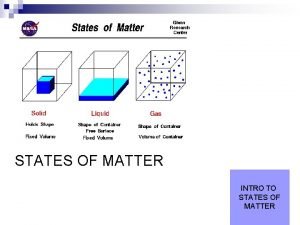
CHEMISTRY Matter and Change Chapter 12 States of






- Slides: 80
CHEMISTRY Matter and Change Chapter 12: States of Matter
CHAPTER 12 States of Matter Section 12. 1 Gases Section 12. 2 Forces of Attraction Section 12. 3 Liquids and Solids Section 12. 4 Phase Changes Click a hyperlink to view the corresponding slides. Exit
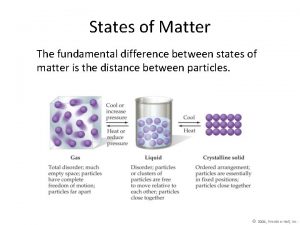
1 2. 1 SECTION Gases • Use the kinetic-molecular theory to explain the behavior of gases. • Describe how mass affects the rates of diffusion and effusion. • Explain how gas pressure is measured and calculate the partial pressure of a gas. kinetic energy: energy due to motion
Gases 1 2. 1 SECTION kinetic-molecular theory pressure elastic collision barometer temperature pascal diffusion atmosphere Graham’s law of effusion Dalton’s law of partial pressures Gases expand, diffuse, exert pressure, and can be compressed because they are in a low density state consisting of tiny, constantly-moving particles.
1 2. 1 SECTION Gases The Kinetic-Molecular Theory • Kinetic-molecular theory explains the different properties of solids, liquids, and gases. • Atomic composition affects chemical properties. • Atomic composition also affects physical properties. • The kinetic-molecular theory describes the behavior of matter in terms of particles in motion.
1 2. 1 SECTION Gases The Kinetic-Molecular Theory (cont. ) • Gases consist of small particles separated by empty space. • Gas particles are too far apart to experience significant attractive or repulsive forces.
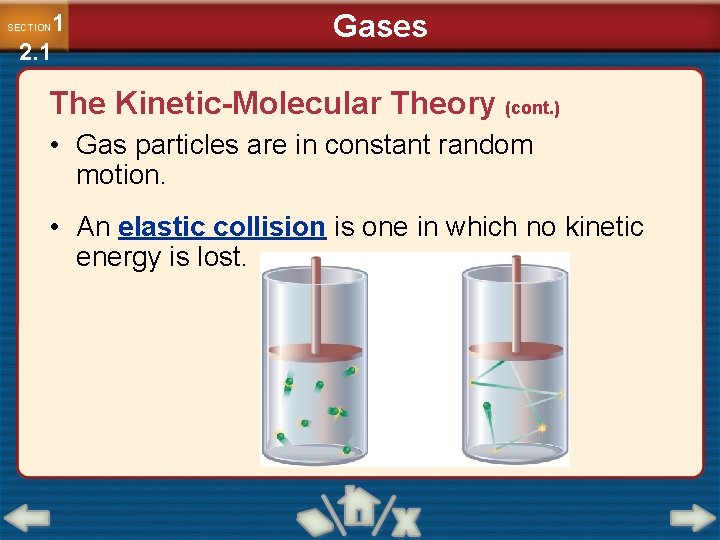
1 2. 1 SECTION Gases The Kinetic-Molecular Theory (cont. ) • Gas particles are in constant random motion. • An elastic collision is one in which no kinetic energy is lost.
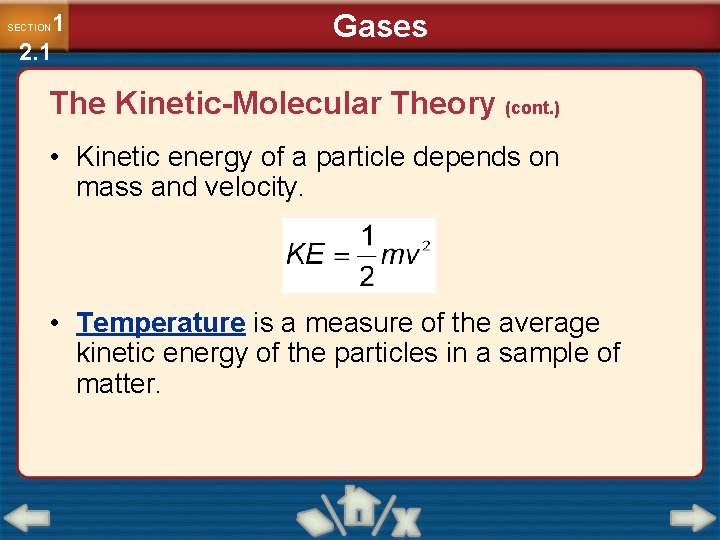
1 2. 1 SECTION Gases The Kinetic-Molecular Theory (cont. ) • Kinetic energy of a particle depends on mass and velocity. • Temperature is a measure of the average kinetic energy of the particles in a sample of matter.
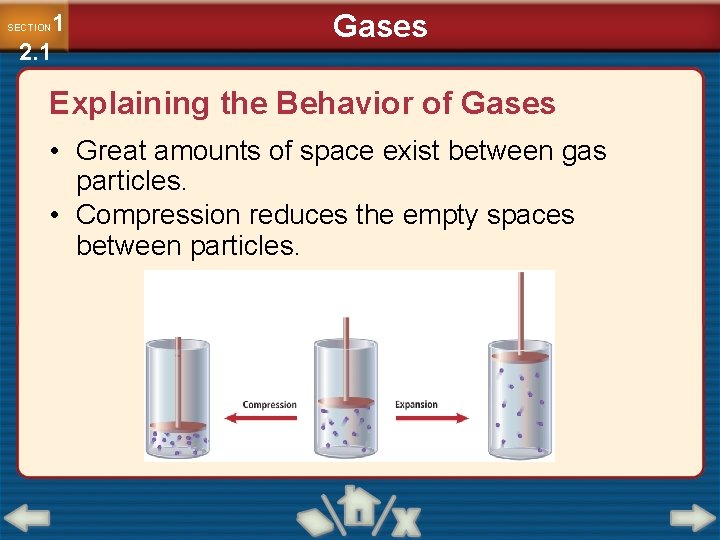
1 2. 1 SECTION Gases Explaining the Behavior of Gases • Great amounts of space exist between gas particles. • Compression reduces the empty spaces between particles.
1 2. 1 SECTION Gases Explaining the Behavior of Gases (cont. ) • Gases easily flow past each other because there are no significant forces of attraction. • Diffusion is the movement of one material through another. • Effusion is a gas escaping through a tiny opening.
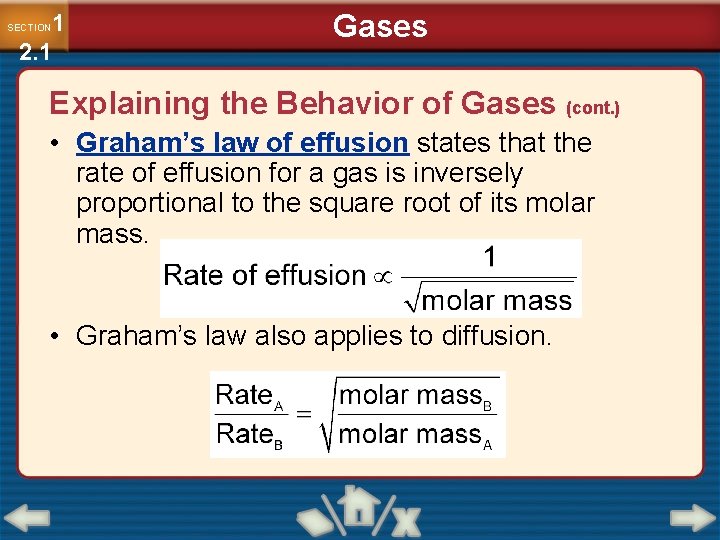
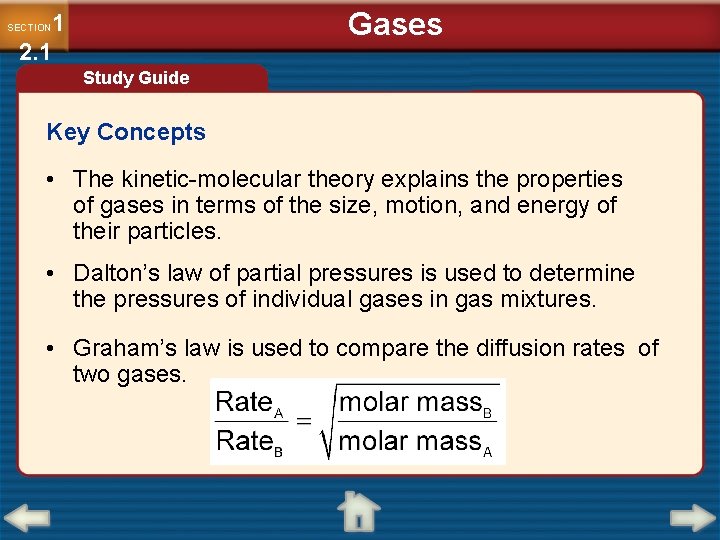
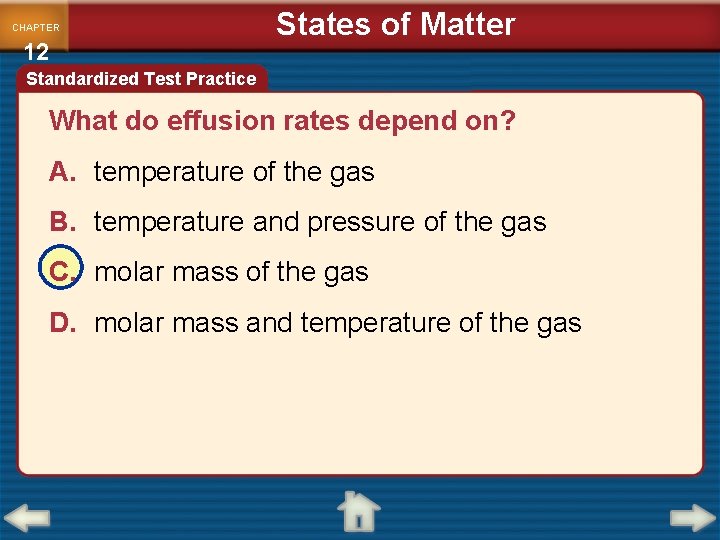
1 2. 1 SECTION Gases Explaining the Behavior of Gases (cont. ) • Graham’s law of effusion states that the rate of effusion for a gas is inversely proportional to the square root of its molar mass. • Graham’s law also applies to diffusion.
1 2. 1 SECTION Gases Gas Pressure • Pressure is defined as force per unit area. • Gas particles exert pressure when they collide with the walls of their container.
1 2. 1 SECTION Gases Gas Pressure (Cont. ) • The particles in the earth’s atmosphere exert pressure in all directions called air pressure. • There is less air pressure at high altitudes because there are fewer particles present, since the force of gravity is less.
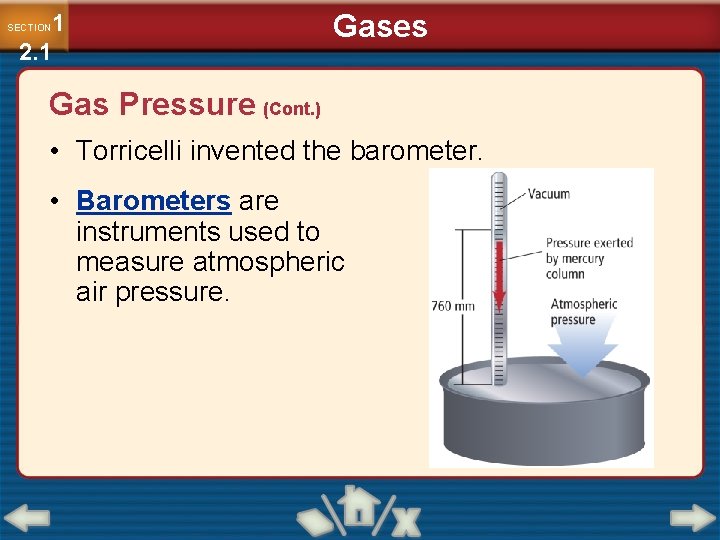
1 2. 1 SECTION Gases Gas Pressure (Cont. ) • Torricelli invented the barometer. • Barometers are instruments used to measure atmospheric air pressure.
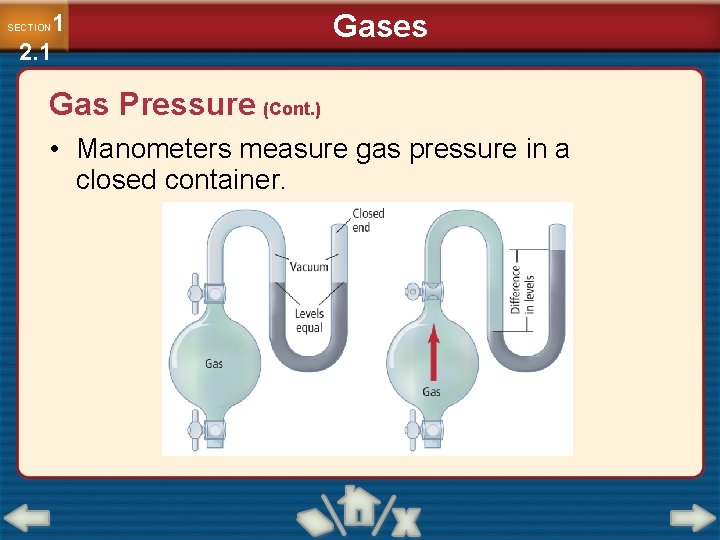
1 2. 1 SECTION Gases Gas Pressure (Cont. ) • Manometers measure gas pressure in a closed container.
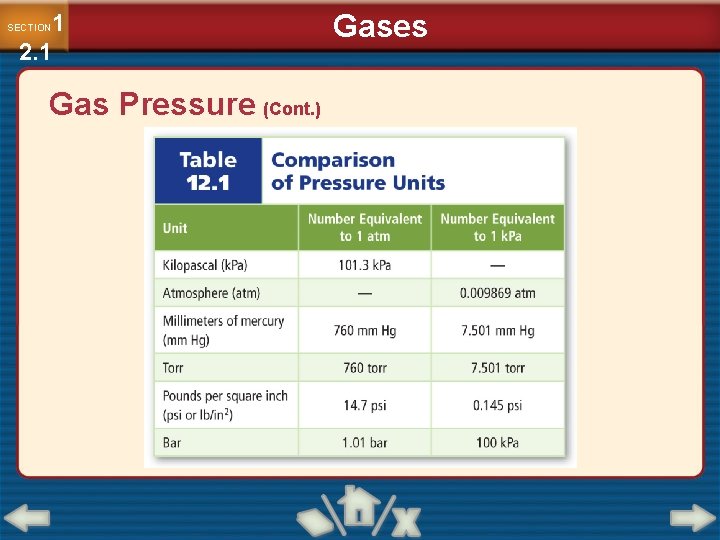
1 2. 1 SECTION Gases Gas Pressure (Cont. ) • The SI unit of force is the newton (N). • One pascal(Pa) is equal to a force of one Newton per square meter or N/m 2. • One atmosphere is equal to 760 mm Hg or 101. 3 kilopascals.
1 2. 1 SECTION Gas Pressure (Cont. ) Gases
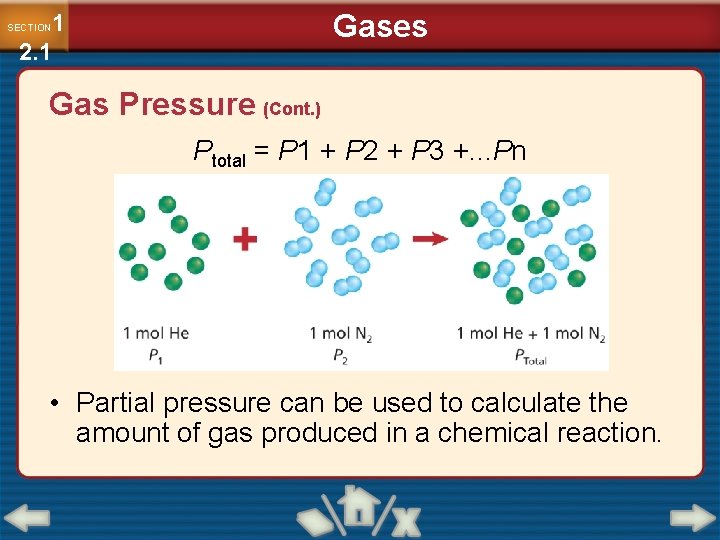
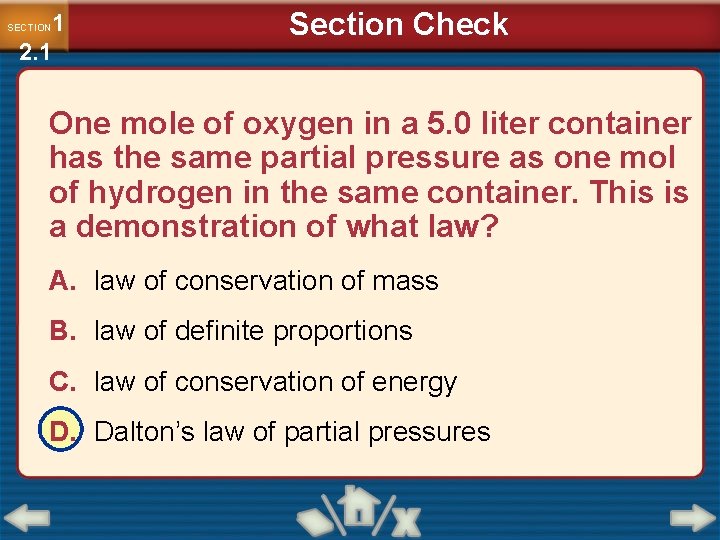
1 2. 1 SECTION Gases Gas Pressure (Cont. ) • Dalton’s law of partial pressures states that the total pressure of a mixture of gases is equal to the sum of the pressures of all the gases of the mixture. • The partial pressure of a gas depends on the number of moles, size of the container, and temperature and is independent of the type of gas. • At a given temperature and pressure, the partial pressure of 1 mol of any gas is the same.
Gases 1 2. 1 SECTION Gas Pressure (Cont. ) Ptotal = P 1 + P 2 + P 3 +. . . Pn • Partial pressure can be used to calculate the amount of gas produced in a chemical reaction.
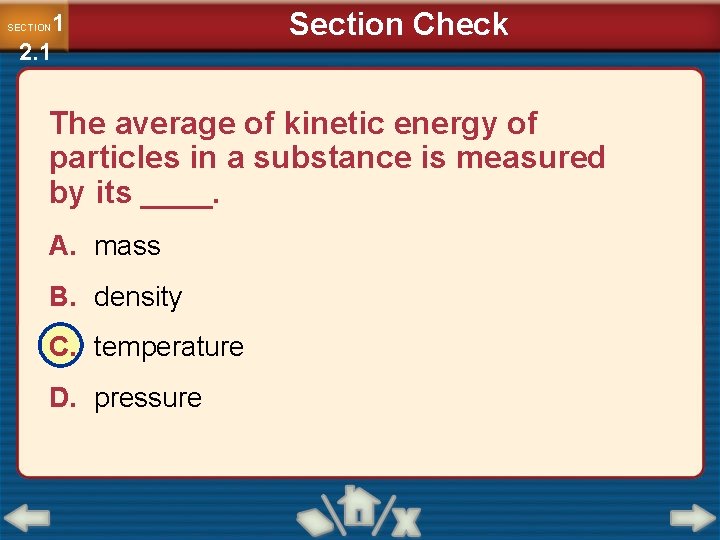
1 2. 1 SECTION Section Check The average of kinetic energy of particles in a substance is measured by its ____. A. mass B. density C. temperature D. pressure
1 2. 1 SECTION Section Check One mole of oxygen in a 5. 0 liter container has the same partial pressure as one mol of hydrogen in the same container. This is a demonstration of what law? A. law of conservation of mass B. law of definite proportions C. law of conservation of energy D. Dalton’s law of partial pressures
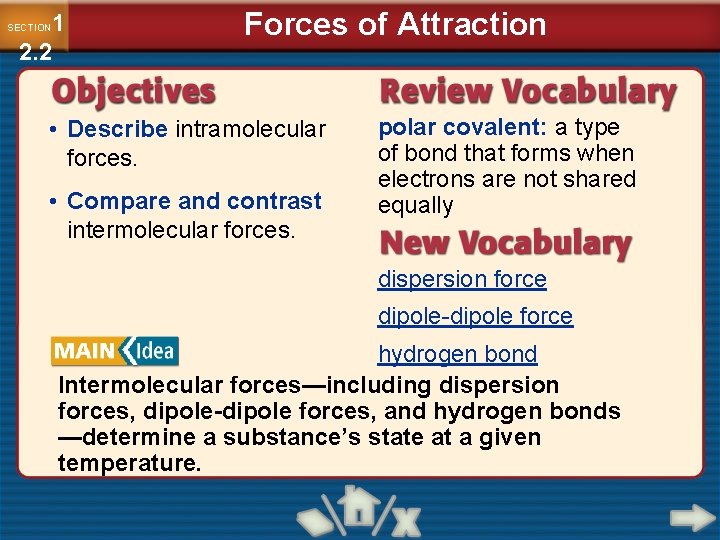
1 2. 2 SECTION Forces of Attraction • Describe intramolecular forces. • Compare and contrast intermolecular forces. polar covalent: a type of bond that forms when electrons are not shared equally dispersion force dipole-dipole force hydrogen bond Intermolecular forces—including dispersion forces, dipole-dipole forces, and hydrogen bonds —determine a substance’s state at a given temperature.
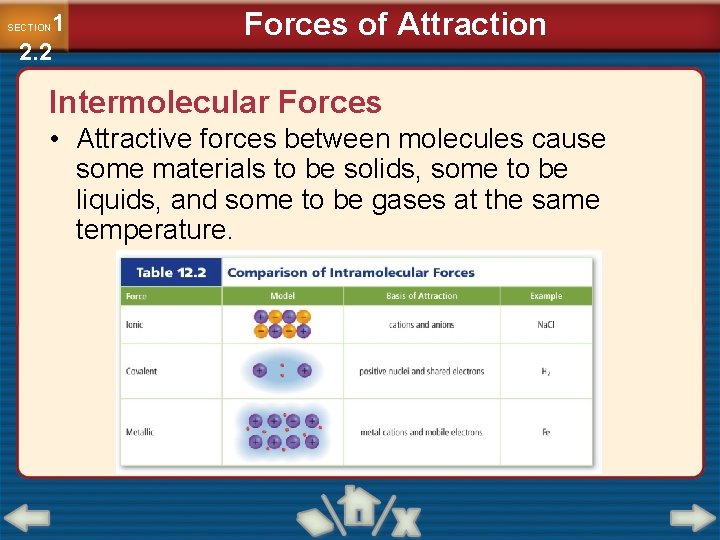
1 2. 2 SECTION Forces of Attraction Intermolecular Forces • Attractive forces between molecules cause some materials to be solids, some to be liquids, and some to be gases at the same temperature.
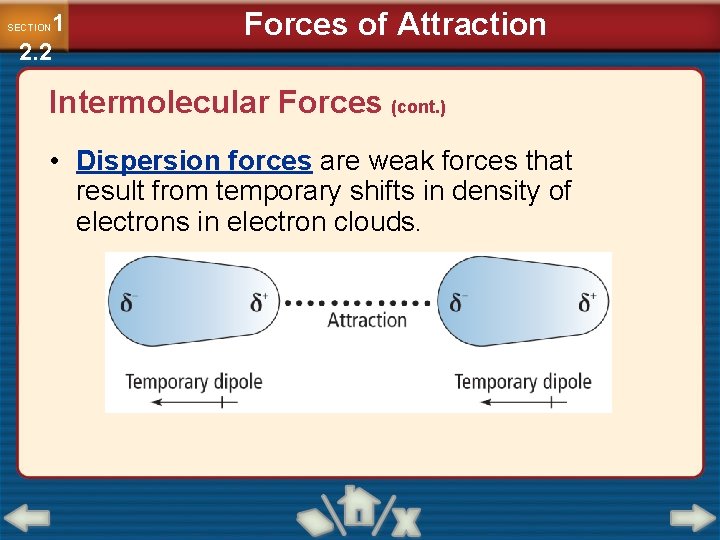
1 2. 2 SECTION Forces of Attraction Intermolecular Forces (cont. ) • Dispersion forces are weak forces that result from temporary shifts in density of electrons in electron clouds.
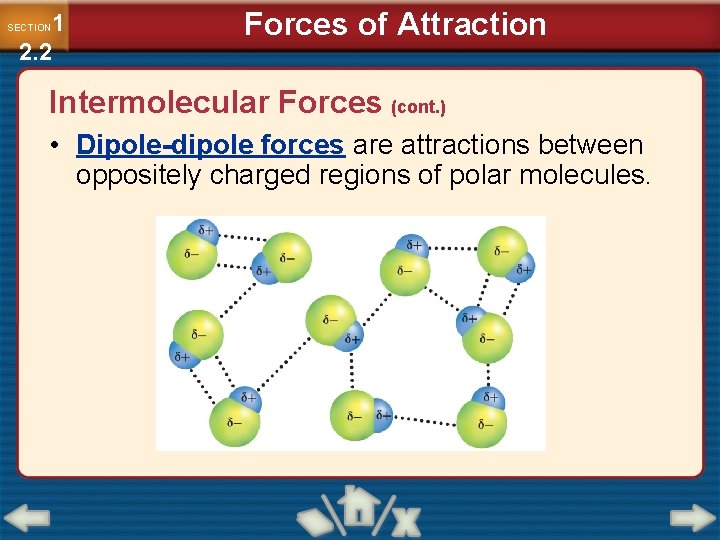
1 2. 2 SECTION Forces of Attraction Intermolecular Forces (cont. ) • Dipole-dipole forces are attractions between oppositely charged regions of polar molecules.
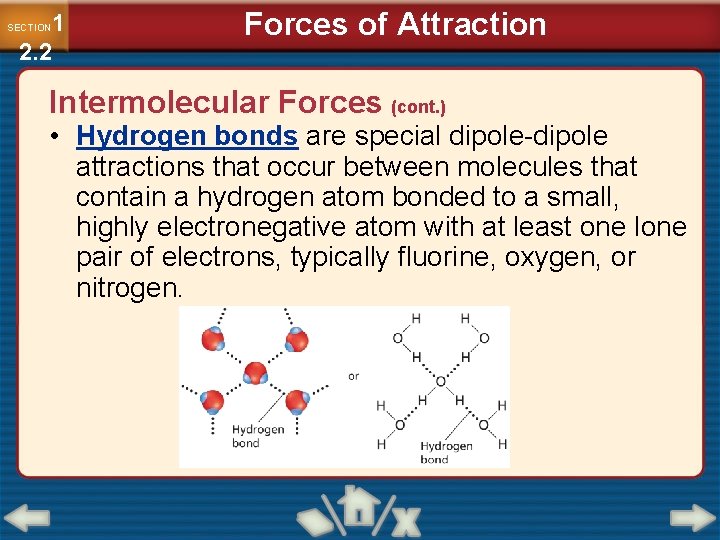
1 2. 2 SECTION Forces of Attraction Intermolecular Forces (cont. ) • Hydrogen bonds are special dipole-dipole attractions that occur between molecules that contain a hydrogen atom bonded to a small, highly electronegative atom with at least one lone pair of electrons, typically fluorine, oxygen, or nitrogen.
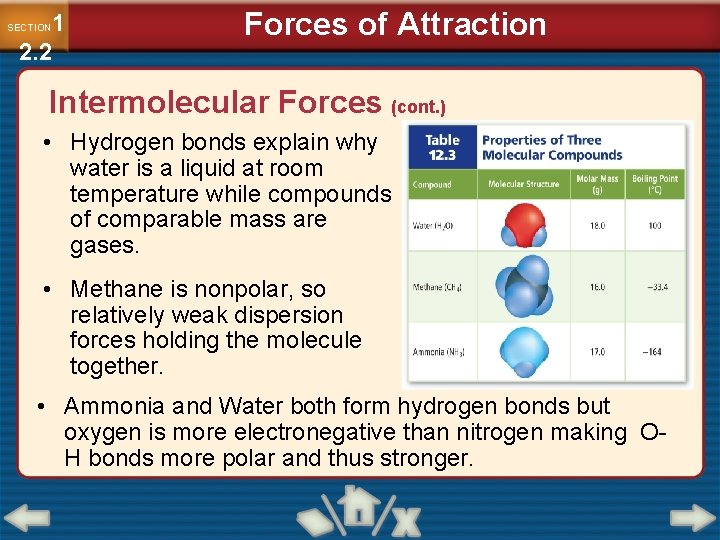
1 2. 2 SECTION Forces of Attraction Intermolecular Forces (cont. ) • Hydrogen bonds explain why water is a liquid at room temperature while compounds of comparable mass are gases. • Methane is nonpolar, so relatively weak dispersion forces holding the molecule together. • Ammonia and Water both form hydrogen bonds but oxygen is more electronegative than nitrogen making OH bonds more polar and thus stronger.
1 2. 2 SECTION Section Check A hydrogen bond is a type of ____. A. dispersion force B. ionic bond C. covalent bond D. dipole-dipole force
1 2. 2 SECTION Section Check Which of the following molecules can form hydrogen bonds? A. CO 2 B. C 2 H 6 C. NH 3 D. H 2
1 2. 3 SECTION Liquids and Solids • Contrast the arrangement of particles in liquids and solids. • Describe the factors that affect viscosity. • Explain how the unit cell and crystal lattice are related. meniscus: the curved surface of a column of liquid
Liquids and Solids 1 2. 3 SECTION viscosity unit cell surface tension allotrope surfactant amorphous solid crystalline solid The particles in solids and liquids have a limited range of motion and are not easily compressed.
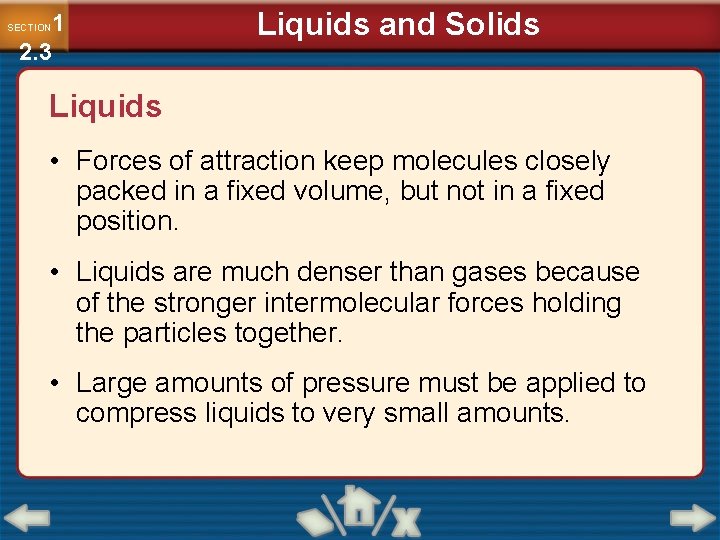
1 2. 3 SECTION Liquids and Solids Liquids • Forces of attraction keep molecules closely packed in a fixed volume, but not in a fixed position. • Liquids are much denser than gases because of the stronger intermolecular forces holding the particles together. • Large amounts of pressure must be applied to compress liquids to very small amounts.
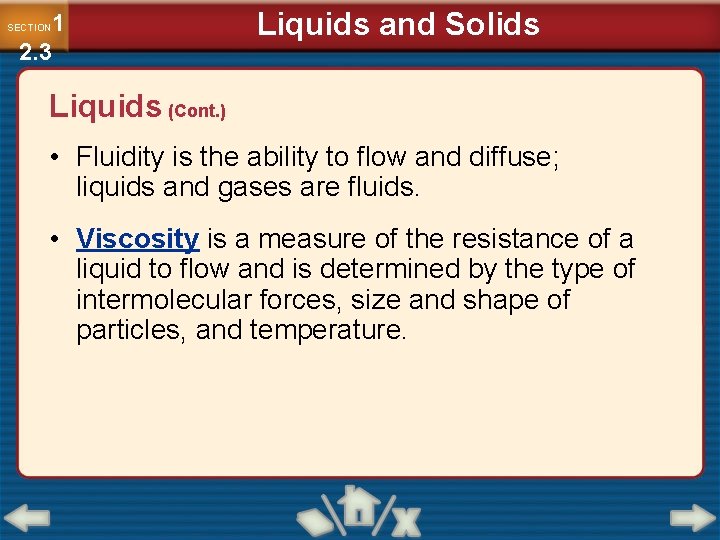
1 2. 3 SECTION Liquids and Solids Liquids (Cont. ) • Fluidity is the ability to flow and diffuse; liquids and gases are fluids. • Viscosity is a measure of the resistance of a liquid to flow and is determined by the type of intermolecular forces, size and shape of particles, and temperature.
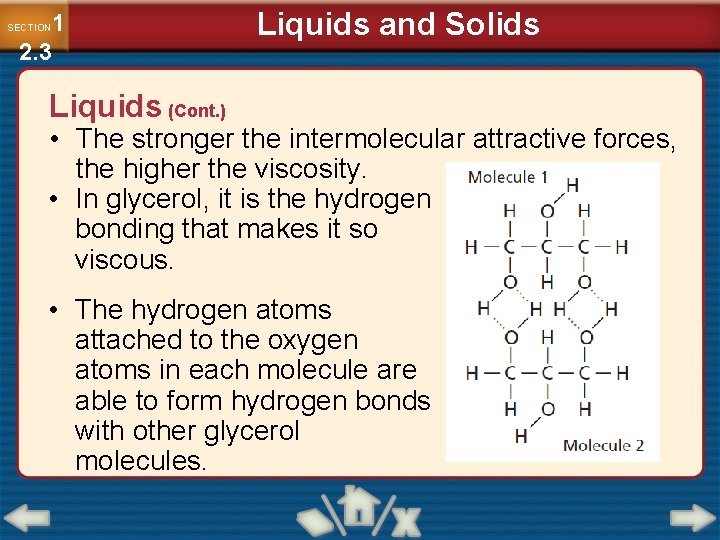
1 2. 3 SECTION Liquids and Solids Liquids (Cont. ) • The stronger the intermolecular attractive forces, the higher the viscosity. • In glycerol, it is the hydrogen bonding that makes it so viscous. • The hydrogen atoms attached to the oxygen atoms in each molecule are able to form hydrogen bonds with other glycerol molecules.
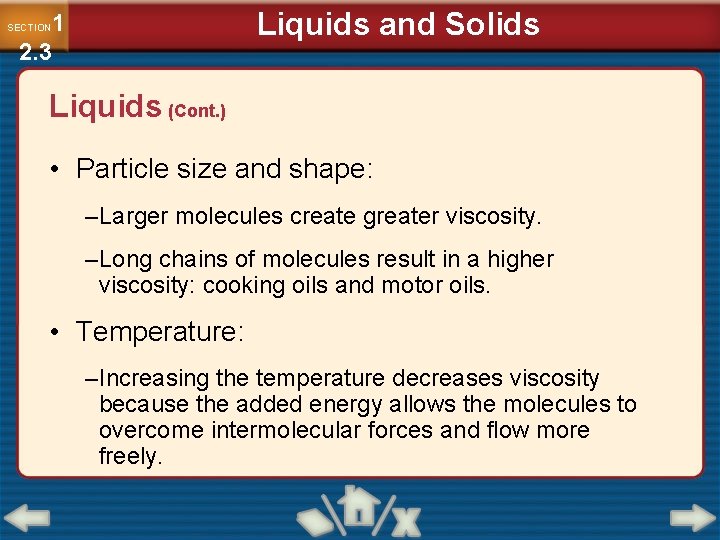
Liquids and Solids 1 2. 3 SECTION Liquids (Cont. ) • Particle size and shape: –Larger molecules create greater viscosity. –Long chains of molecules result in a higher viscosity: cooking oils and motor oils. • Temperature: –Increasing the temperature decreases viscosity because the added energy allows the molecules to overcome intermolecular forces and flow more freely.
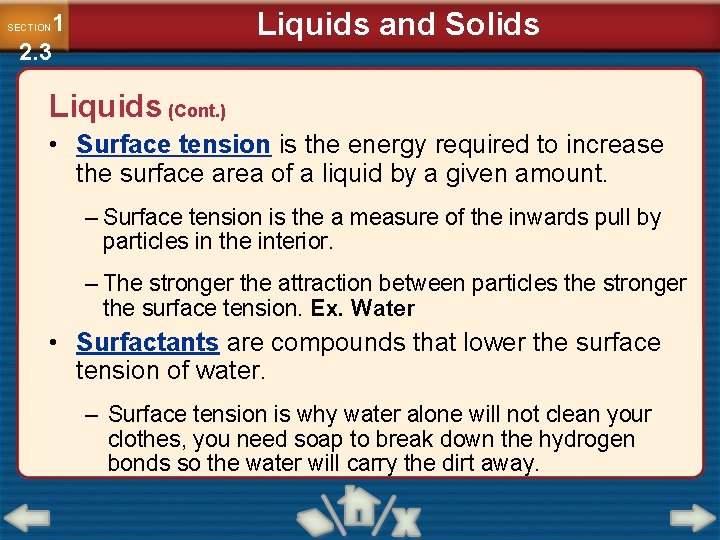
Liquids and Solids 1 2. 3 SECTION Liquids (Cont. ) • Surface tension is the energy required to increase the surface area of a liquid by a given amount. – Surface tension is the a measure of the inwards pull by particles in the interior. – The stronger the attraction between particles the stronger the surface tension. Ex. Water • Surfactants are compounds that lower the surface tension of water. – Surface tension is why water alone will not clean your clothes, you need soap to break down the hydrogen bonds so the water will carry the dirt away.
1 2. 3 SECTION Liquids and Solids Liquids (Cont. ) • Cohesion is the force of attraction between identical molecules. • Adhesion is the force of attraction between molecules that are different. • Capillary action is the upward movement of liquid into a narrow cylinder, or capillary tube.
Liquids and Solids 1 2. 3 SECTION Solids • Solids contain particles with strong attractive intermolecular forces. • Particles in a solid vibrate in a fixed position. • Most solids are more dense than liquids. – One exception to this is water. Ice is less dense than liquid water. The hydrogen bonding in ice results in an open symmetrical structure that keeps the water molecules in ice farther apart than in water in a liquid state.
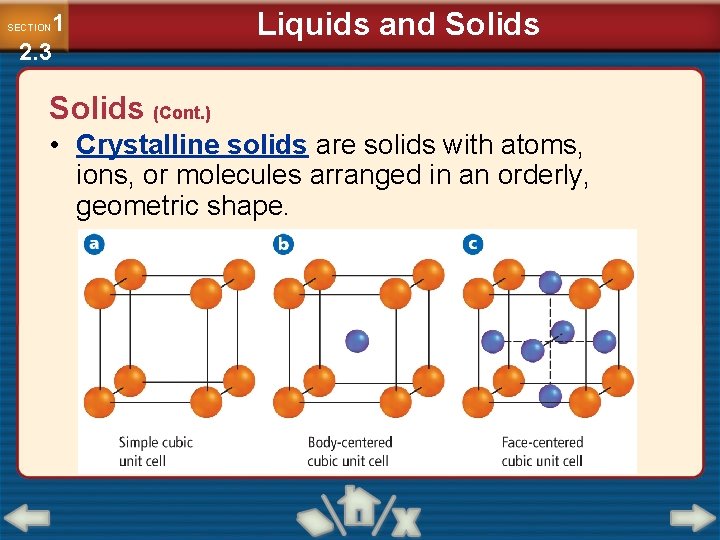
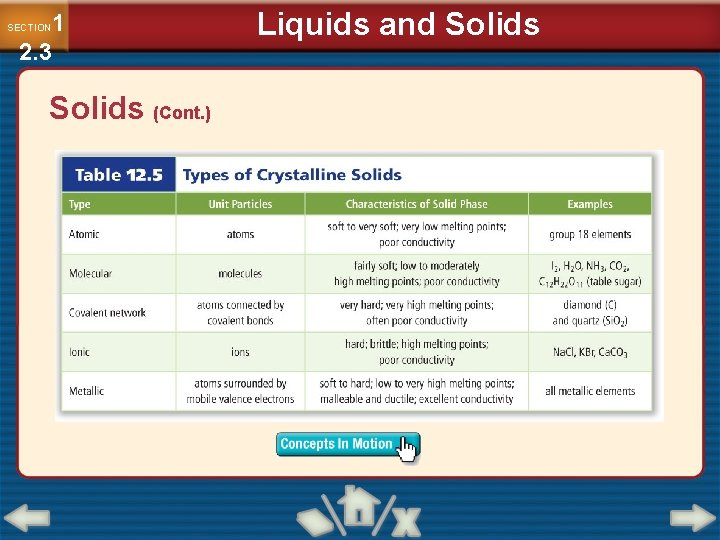
1 2. 3 SECTION Liquids and Solids (Cont. ) • Crystalline solids are solids with atoms, ions, or molecules arranged in an orderly, geometric shape.
1 2. 3 SECTION Liquids and Solids (Cont. ) • A unit cell is the smallest arrangement of atoms in a crystal lattice that has the same symmetry as the whole crystal.
1 2. 3 SECTION Solids (Cont. ) Liquids and Solids
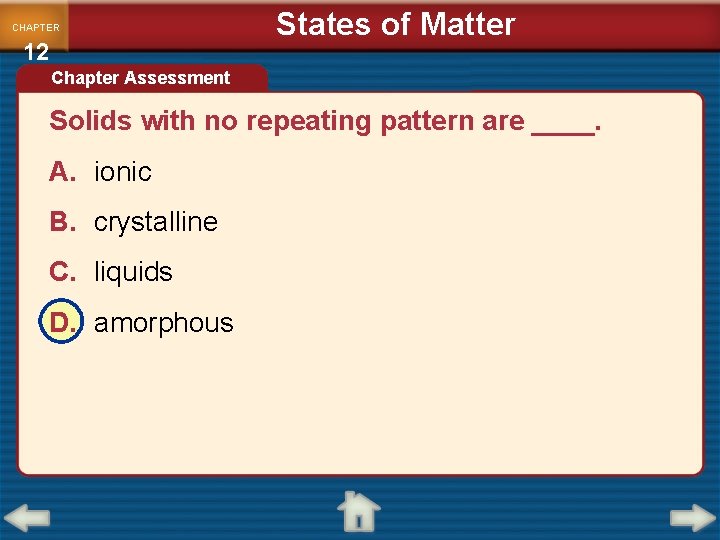
1 2. 3 SECTION Liquids and Solids (Cont. ) • Amorphous solids are solids in which the particles are not arranged in a regular, repeating pattern. • Amorphous solids form when molten material cools quickly.
1 2. 3 SECTION Section Check The smallest arrangement of atoms in a crystal that has the same pattern as the crystal is called ____. A. crystal lattice B. unit cell C. crystalline D. geometric cell
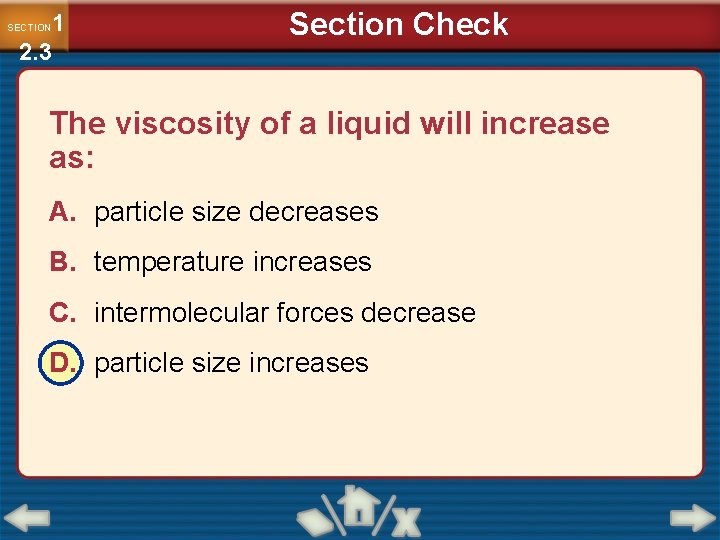
1 2. 3 SECTION Section Check The viscosity of a liquid will increase as: A. particle size decreases B. temperature increases C. intermolecular forces decrease D. particle size increases
1 2. 4 SECTION Phase Changes • Explain how the addition and removal of energy can cause a phase change. • Interpret a phase diagram. phase change: a change from one state of matter to another
Phase Changes 1 2. 4 SECTION melting point freezing point vaporization condensation evaporation deposition vapor pressure phase diagram boiling point triple point Matter changes phase when energy is added or removed.
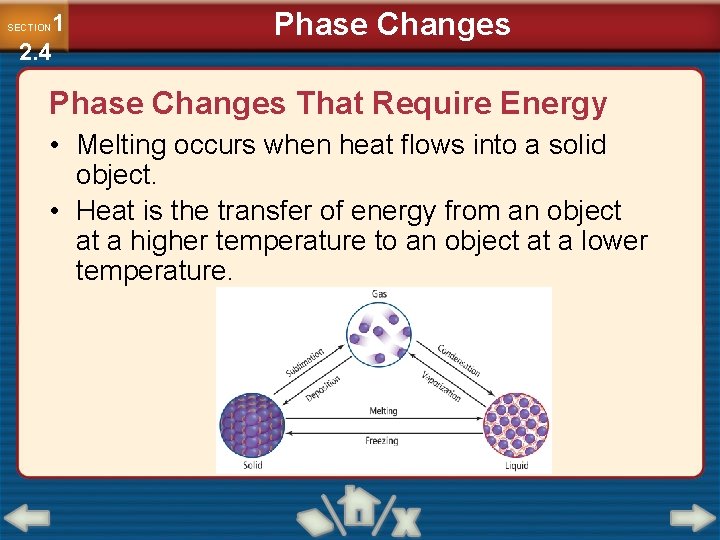
1 2. 4 SECTION Phase Changes That Require Energy • Melting occurs when heat flows into a solid object. • Heat is the transfer of energy from an object at a higher temperature to an object at a lower temperature.
1 2. 4 SECTION Phase Changes That Require Energy (cont. ) • When ice is heated, the ice eventually absorbs enough energy to break the hydrogen bonds that hold the water molecules together. • When the bonds break, the particles move apart and ice melts into water. • The melting point of a crystalline solid is the temperature at which the forces holding the crystal lattice together are broken and it becomes a liquid.
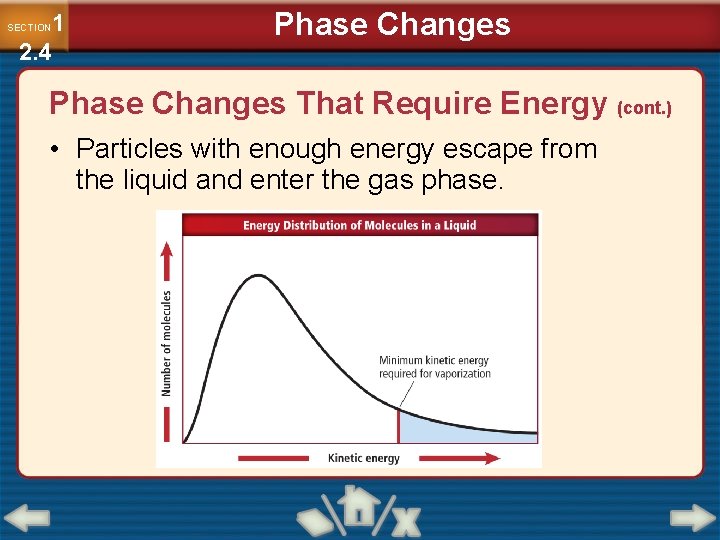
1 2. 4 SECTION Phase Changes That Require Energy (cont. ) • Particles with enough energy escape from the liquid and enter the gas phase.
1 2. 4 SECTION Phase Changes That Require Energy (cont. ) • Vaporization is the process by which a liquid changes to a gas or vapor. • Evaporation is vaporization only at the surface of a liquid.
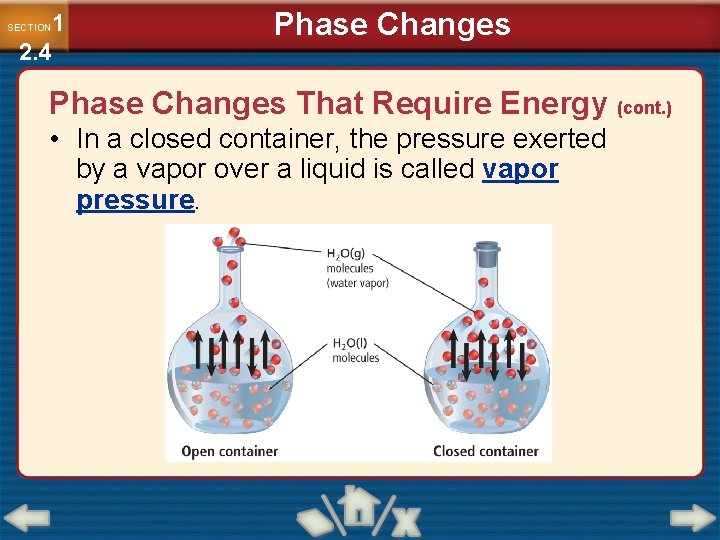
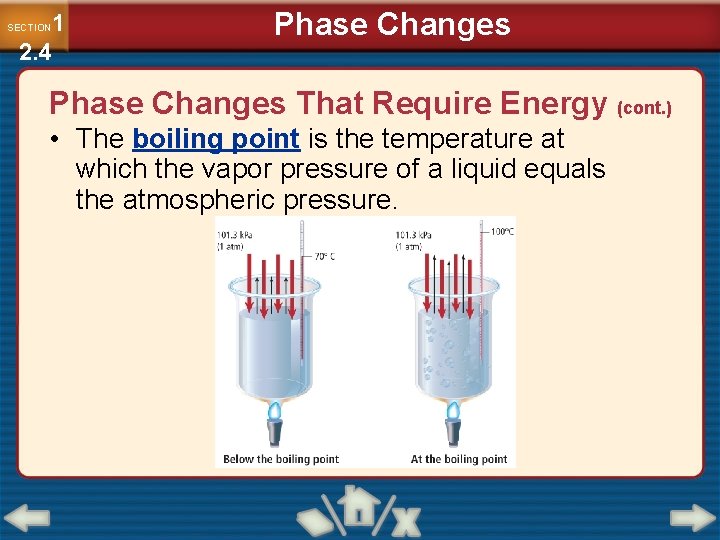
1 2. 4 SECTION Phase Changes That Require Energy (cont. ) • In a closed container, the pressure exerted by a vapor over a liquid is called vapor pressure.
1 2. 4 SECTION Phase Changes That Require Energy (cont. ) • The boiling point is the temperature at which the vapor pressure of a liquid equals the atmospheric pressure.
1 2. 4 SECTION Phase Changes That Require Energy (cont. ) • Sublimation is the process by which a solid changes into a gas without becoming a liquid.
1 2. 4 SECTION Phase Changes That Require Energy (cont. ) • As heat flows from water to the surroundings, the particles lose energy. • The freezing point is the temperature at which a liquid is converted into a crystalline solid.
1 2. 4 SECTION Phase Changes That Require Energy (cont. ) • As energy flows from water vapor, the velocity decreases. • The process by which a gas or vapor becomes a liquid is called condensation. • Deposition is the process by which a gas or vapor changes directly to a solid, and is the reverse of sublimation.
1 2. 4 SECTION Phase Changes Phase Diagrams • A phase diagram is a graph of pressure versus temperature that shows in which phase a substance will exist under different conditions of temperature and pressure.
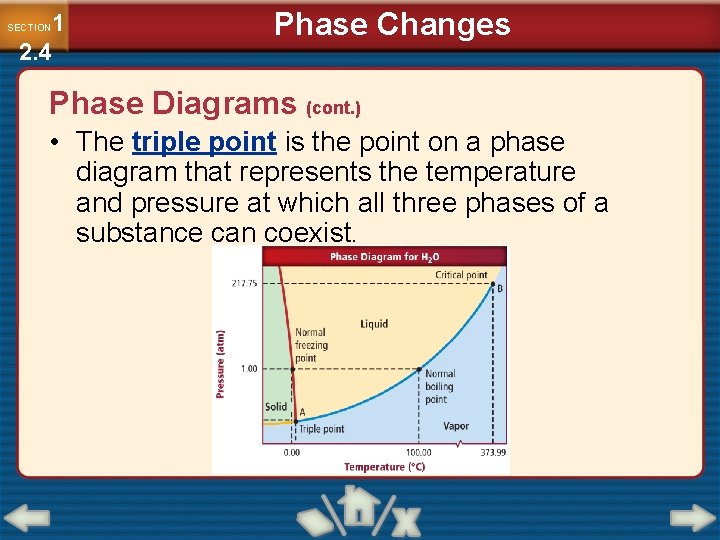
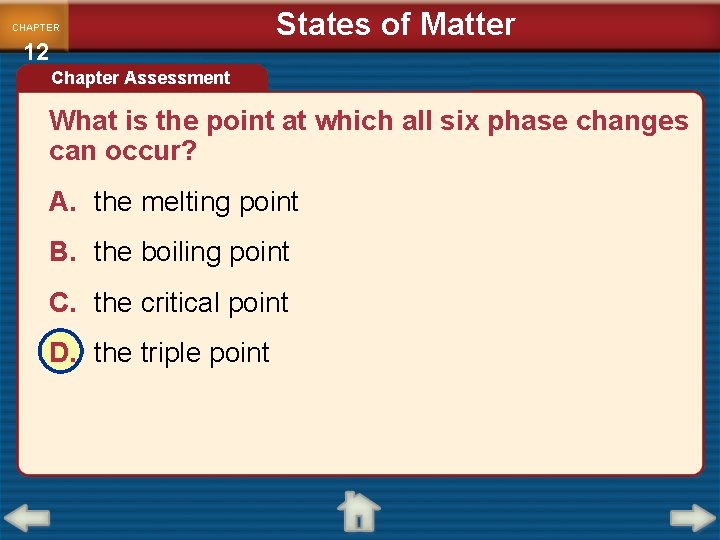
1 2. 4 SECTION Phase Changes Phase Diagrams (cont. ) • The triple point is the point on a phase diagram that represents the temperature and pressure at which all three phases of a substance can coexist.
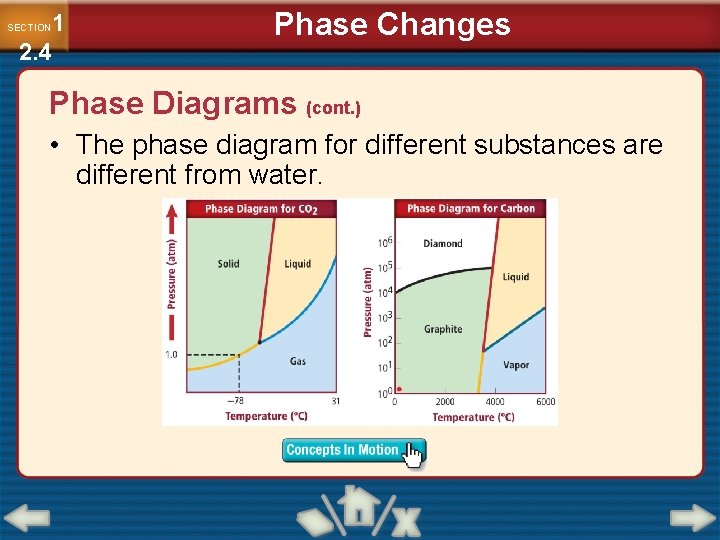
1 2. 4 SECTION Phase Changes Phase Diagrams (cont. ) • The phase diagram for different substances are different from water.
1 2. 4 SECTION Section Check The addition of energy to water molecules will cause them to ____. A. freeze B. change to water vapor C. form a crystal lattice D. move closer together
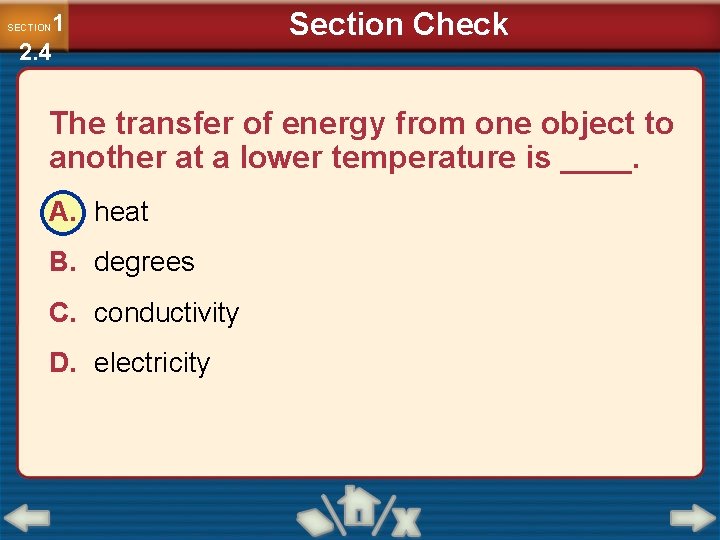
1 2. 4 SECTION Section Check The transfer of energy from one object to another at a lower temperature is ____. A. heat B. degrees C. conductivity D. electricity
States of Matter CHAPTER 12 Resources Chemistry Online Study Guide Chapter Assessment Standardized Test Practice
Gases 1 2. 1 SECTION Study Guide Key Concepts • The kinetic-molecular theory explains the properties of gases in terms of the size, motion, and energy of their particles. • Dalton’s law of partial pressures is used to determine the pressures of individual gases in gas mixtures. • Graham’s law is used to compare the diffusion rates of two gases.
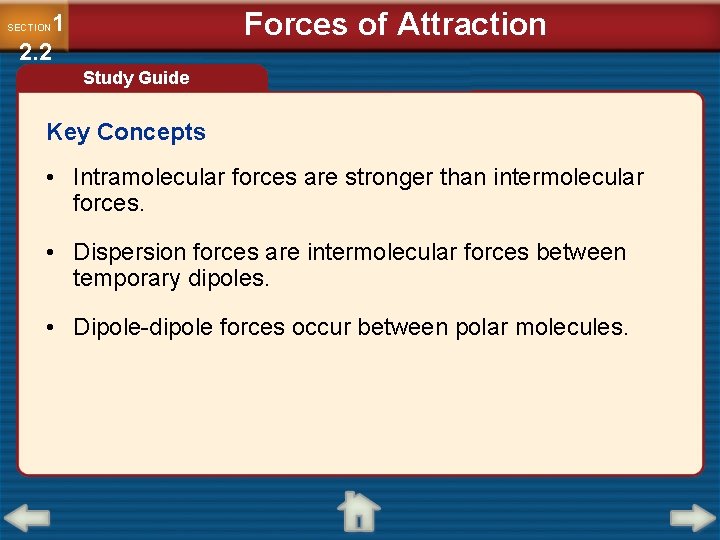
Forces of Attraction 1 2. 2 SECTION Study Guide Key Concepts • Intramolecular forces are stronger than intermolecular forces. • Dispersion forces are intermolecular forces between temporary dipoles. • Dipole-dipole forces occur between polar molecules.
Liquids and Solids 1 2. 3 SECTION Study Guide Key Concepts • The kinetic-molecular theory explains the behavior of solids and liquids. • Intermolecular forces in liquids affect viscosity, surface tension, cohesion, and adhesion. • Crystalline solids can be classified by their shape and composition.
Phase Changes 1 2. 4 SECTION Study Guide Key Concepts • States of a substance are referred to as phases when they coexist as physically distinct parts of a mixture. • Energy changes occur during phase changes. • Phase diagrams show different temperatures and pressures affect the phase of a substance.
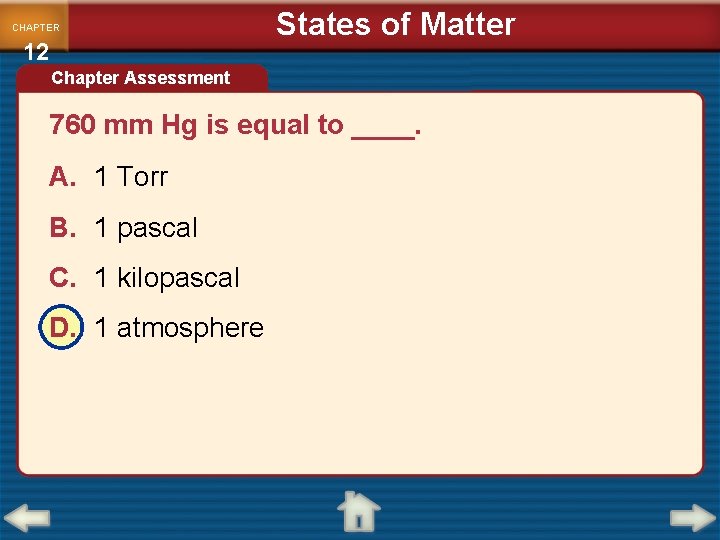
CHAPTER 12 States of Matter Chapter Assessment 760 mm Hg is equal to ____. A. 1 Torr B. 1 pascal C. 1 kilopascal D. 1 atmosphere
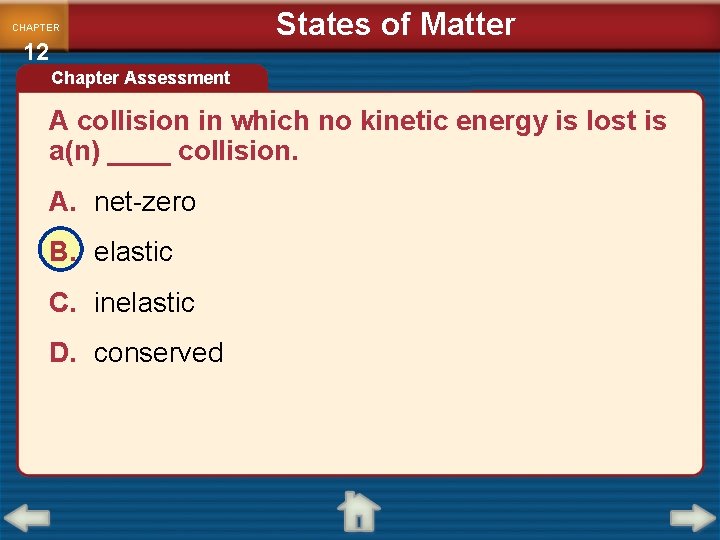
CHAPTER 12 States of Matter Chapter Assessment A collision in which no kinetic energy is lost is a(n) ____ collision. A. net-zero B. elastic C. inelastic D. conserved
CHAPTER 12 States of Matter Chapter Assessment Solids with no repeating pattern are ____. A. ionic B. crystalline C. liquids D. amorphous
CHAPTER 12 States of Matter Chapter Assessment What is the point at which all six phase changes can occur? A. the melting point B. the boiling point C. the critical point D. the triple point
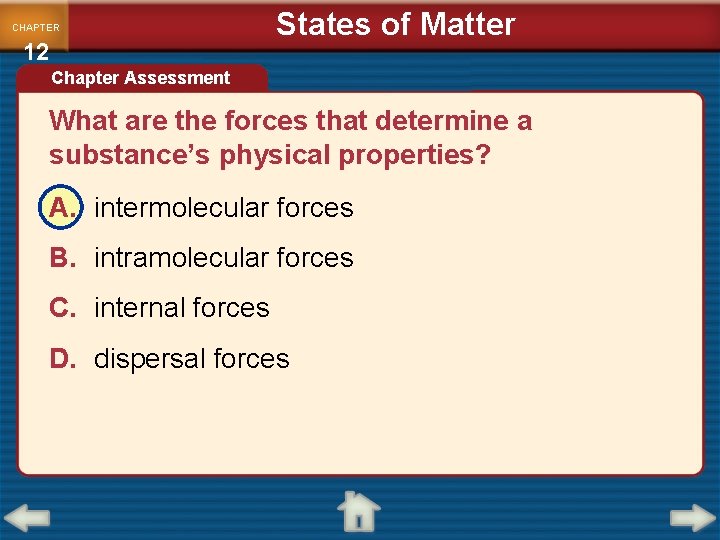
CHAPTER 12 States of Matter Chapter Assessment What are the forces that determine a substance’s physical properties? A. intermolecular forces B. intramolecular forces C. internal forces D. dispersal forces
CHAPTER 12 States of Matter Standardized Test Practice What do effusion rates depend on? A. temperature of the gas B. temperature and pressure of the gas C. molar mass of the gas D. molar mass and temperature of the gas
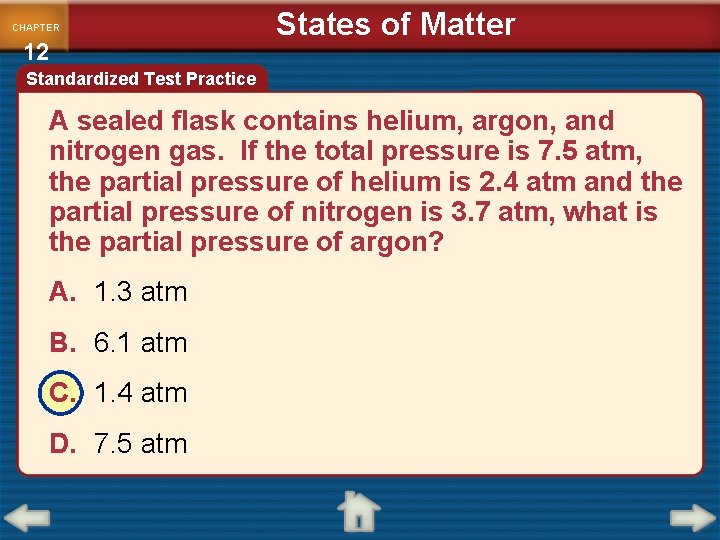
CHAPTER 12 States of Matter Standardized Test Practice A sealed flask contains helium, argon, and nitrogen gas. If the total pressure is 7. 5 atm, the partial pressure of helium is 2. 4 atm and the partial pressure of nitrogen is 3. 7 atm, what is the partial pressure of argon? A. 1. 3 atm B. 6. 1 atm C. 1. 4 atm D. 7. 5 atm
CHAPTER 12 States of Matter Standardized Test Practice Adding energy to a liquid will: A. cause it to form crystal lattice B. increase the viscosity C. compress the particles closer together D. increase the velocity of the particles
CHAPTER 12 States of Matter Standardized Test Practice Hydrogen bonds are a special type of ____. A. ionic bond B. covalent bond C. dipole-dipole force D. dispersion force
CHAPTER 12 States of Matter Standardized Test Practice How many atoms of oxygen are present in 3. 5 mol of water? A. 2. 1 x 1024 B. 3. 5 x 10²³ C. 6. 02 x 1023 D. 4. 2 x 1024
End of Custom Shows This slide is intentionally blank.