
Unit 2 Matter and the Changes They Undergo


- Slides: 24
Unit 2 Matter and the Changes They Undergo
Phases of Matter The type and arrangement of the particles in a sample of matter determine the properties of the matter Three 1. 2. 3. states of matter: Solid Liquid Gas
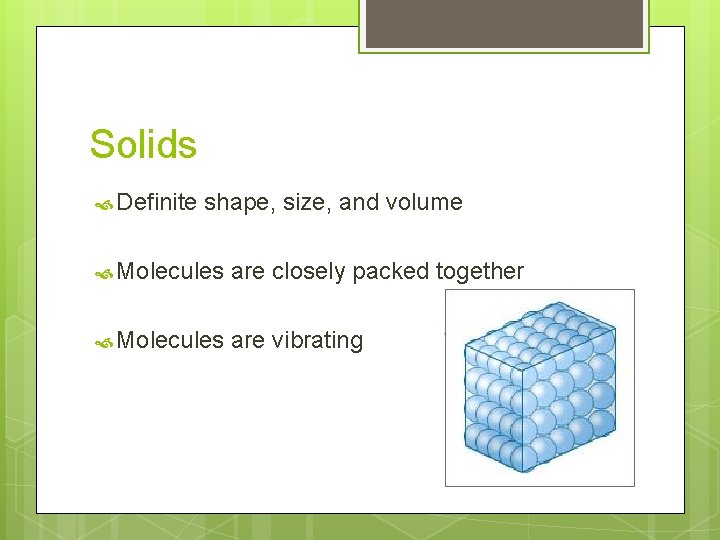
Solids Definite shape, size, and volume Molecules are closely packed together Molecules are vibrating
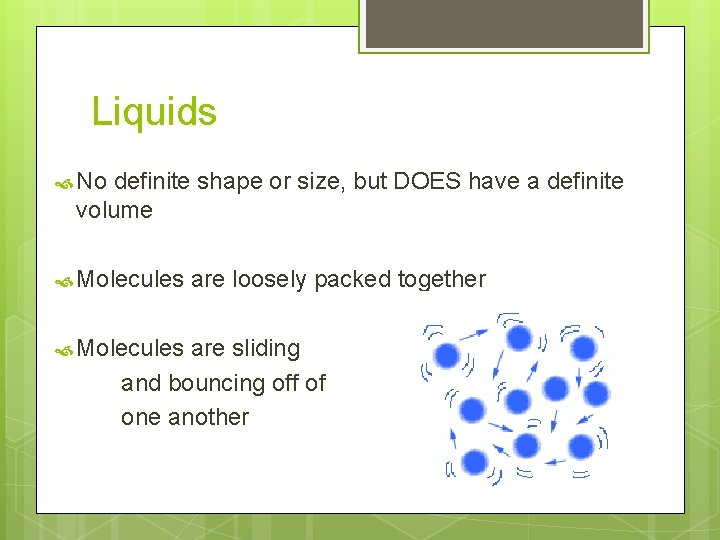
Liquids No definite shape or size, but DOES have a definite volume Molecules are loosely packed together are sliding and bouncing off of one another
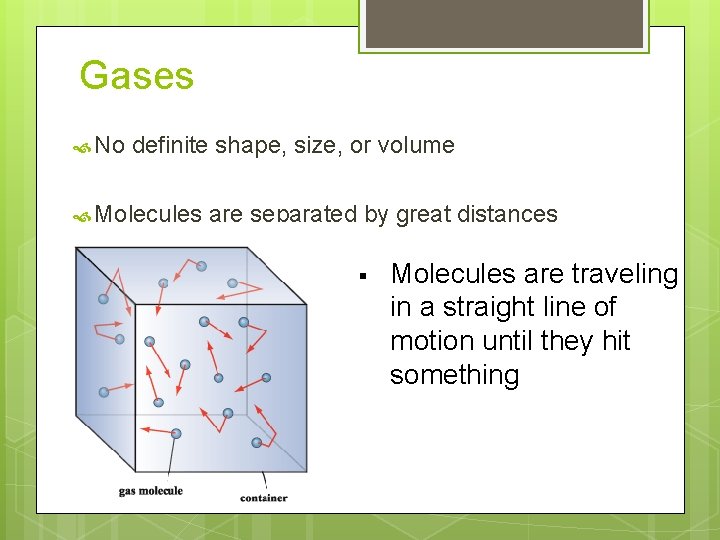
Gases No definite shape, size, or volume Molecules are separated by great distances § Molecules are traveling in a straight line of motion until they hit something
Matter – Anything that takes up spacethat you can think of? Matter has Physical and Chemical properties
Physical Properties are properties that describe the look or feel of a substance Example: color, hardness, density, texture, phase Every substance has its own unique physical properties that can be used to identify the substance.
Physical Properties These properties can change when conditions change However, are still unique (do not change into another substance) Water to ice is a physical change (same chemical composition)
Chemical Reactions �Propane Chemically Reacts with oxygen to yield water and carbon dioxide �Propane and oxygen gas are the REACTANTS and water and carbon dioxide are the PRODUCTS
Chemical Properties – The ability of a substance to react with other substances or to transform from one substance to another
Chemical Properties Altering a Chemical Property: Changes the way the atoms in the molecules are chemically bonded to one another. This is known as a Chemical Change means the materials are Reacting
Chemical Reactions In a Chemical Reaction, new materials are formed by a change in the way the atoms are bonded together Atoms actually rearrange within the molecules UNLIKE A PHYSICAL CHANGE WHICH KEEPS THE ORIGINAL CHEMICAL COMPOSITION
Evidence of a Chemical Change / Reaction Bubbles: Formation of a gas Solid/Precipitate Release is formed or absorption of energy (gets hot or cold) A color changed in the system
5 more dealing with energy Exchange of electrical energy Production of light energy Production of sound energy Production of chemical energy Production of heat energy
Physical or Chemical Change? SO… What is a Physical Change ? ? ? What is a Chemical Change ? ? ?
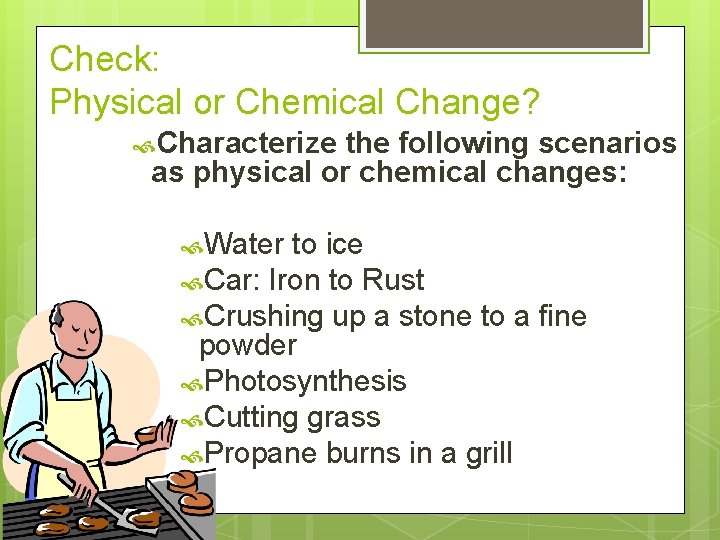
Check: Physical or Chemical Change? Characterize the following scenarios as physical or chemical changes: Water to ice Car: Iron to Rust Crushing up a stone to a fine powder Photosynthesis Cutting grass Propane burns in a grill
Matter (Review) What is Matter? Anything that has mass and volume (anything that takes up space) Mass? ? Volume? ?
Space an Object Occupies The Space an Object Occupies is the object’s volume Volume can be measure by Lx. Wx. H if a square or rectangle m. L, But, L, cm 3 how about an odd shaped solid? ? Even better, how about a gas or liquid? ?
Quantity of Matter The Quantity of Matter is the Mass A marble is smaller than a ping pong ball but has more mass It contains more MATTER Mass g, can be measured using a balance kg
Mass is NOT Weight Mass is a measure of the amount of matter an object contains Weight, on the other hand, is defined as the force produced by gravity acting on a mass Mass is the same on the moon, whereas weight will change
Units of Measurement Heavy, light, rough, smooth are qualitative measurements Mass and volume can be described in number values quantitative measurements Volume is the Quantity measured in milliliters (the Units)
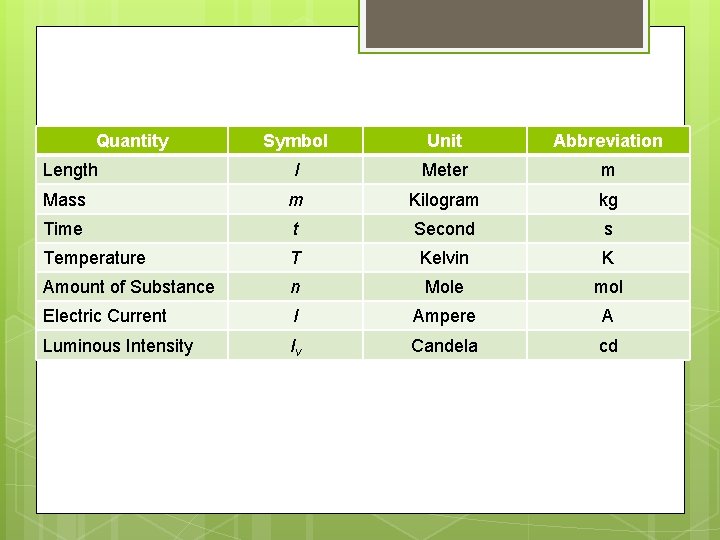
Système Internationale d’Unités (SI units) Scientists use the SI (Metric) system for ALL measurements English (American) System is not accepted The SI System is built on the seven base units listed below
Quantity Symbol Unit Abbreviation l Meter m Mass m Kilogram kg Time t Second s Temperature T Kelvin K Amount of Substance n Mole mol Electric Current I Ampere A Luminous Intensity Iv Candela cd Length