
Physical and Chemical Changes of Matter What is
- Slides: 29
Physical and Chemical Changes of Matter
What is “Change”? l It is the act of altering a substance. l An event, NOT a trait. Before condition After condition. l Can be PHYSICAL or CHEMICAL.
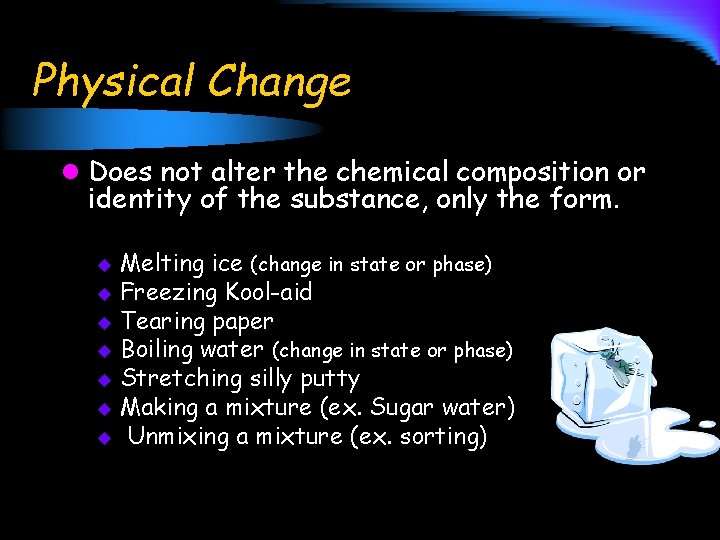
Physical Change l Does not alter the chemical composition or identity of the substance, only the form. Melting ice (change in state or phase) u Freezing Kool-aid u Tearing paper u Boiling water (change in state or phase) u Stretching silly putty u Making a mixture (ex. Sugar water) u Unmixing a mixture (ex. sorting) u
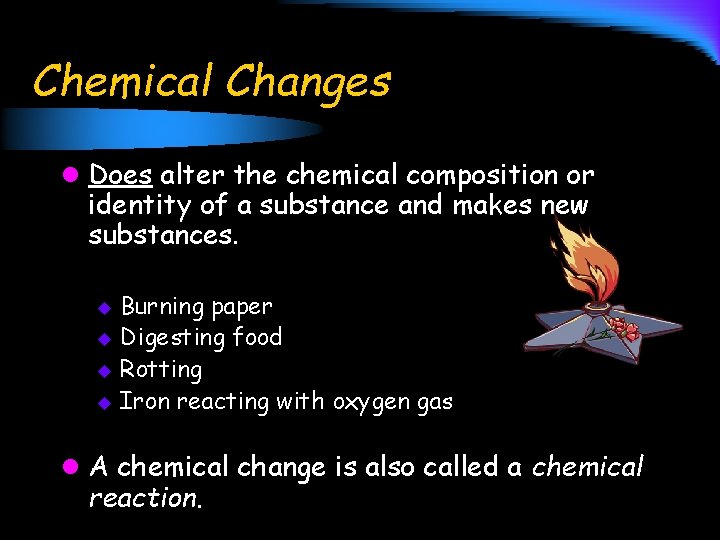
Chemical Changes l Does alter the chemical composition or identity of a substance and makes new substances. Burning paper u Digesting food u Rotting u Iron reacting with oxygen gas u l A chemical change is also called a chemical reaction.
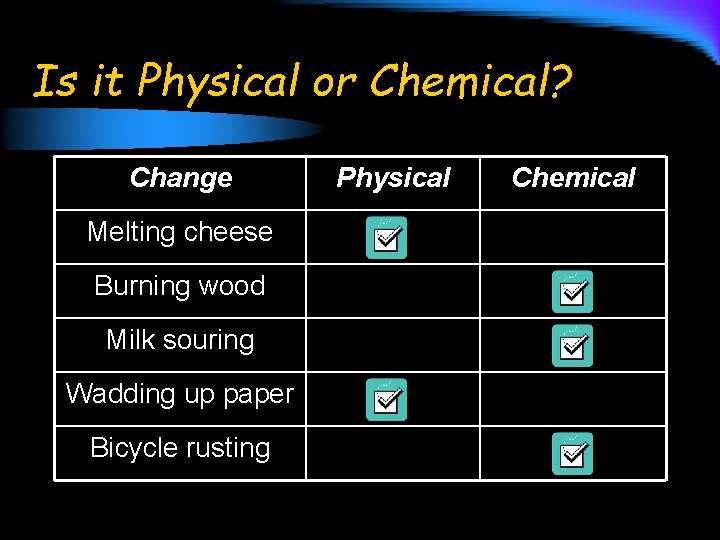
Is it Physical or Chemical? Change Melting cheese Burning wood Milk souring Wadding up paper Bicycle rusting Physical Chemical
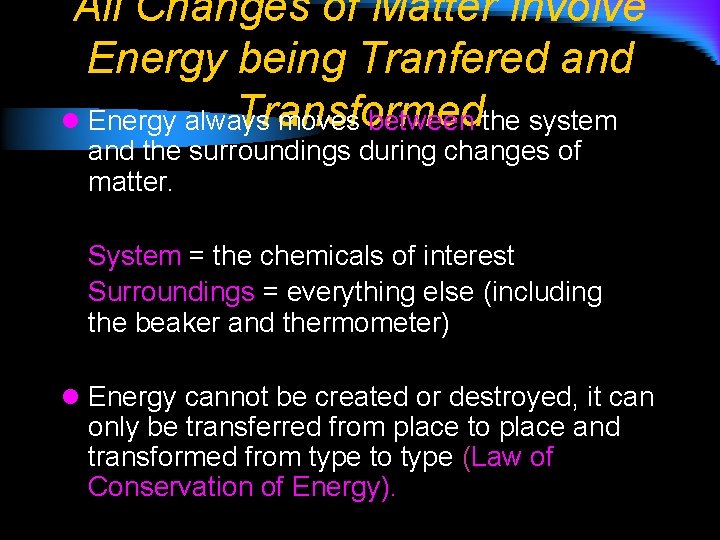
All Changes of Matter Involve Energy being Tranfered and Transformed l Energy always moves between the system and the surroundings during changes of matter. System = the chemicals of interest Surroundings = everything else (including the beaker and thermometer) l Energy cannot be created or destroyed, it can only be transferred from place to place and transformed from type to type (Law of Conservation of Energy).
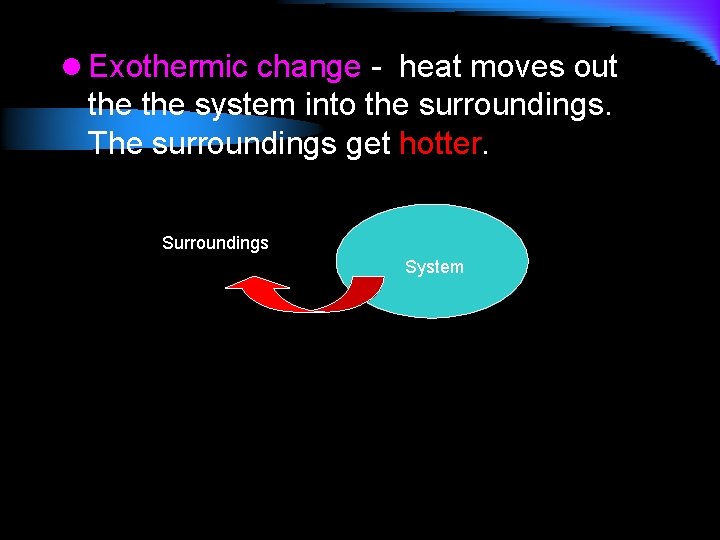
l Exothermic change - heat moves out the system into the surroundings. The surroundings get hotter. Surroundings System
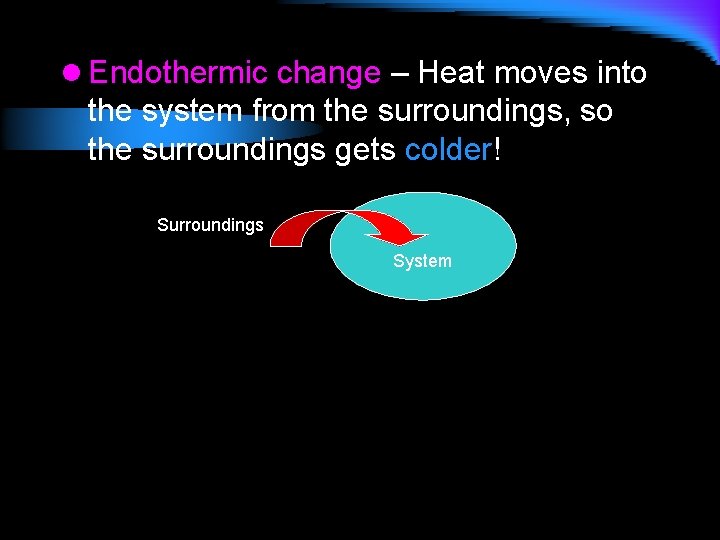
l Endothermic change – Heat moves into the system from the surroundings, so the surroundings gets colder! Surroundings System
Changes of Matter Demos u Magnesium + oxygen gas u Ammonium nitrate + water
Law of Conservation of Mass (1789) l Matter is never created or destroyed in chemical reactions. l Mass of reactants = Mass of products l Why? ? ? Because atoms are simply rearranged in new ways in chemical reactions. (LEGO analogy)
Parts of a Chemical Reaction Reactants Products l Reactants: Substances that are broken down by the chemical change. l Products: Substances created by the chemical change. l Means “Yields”
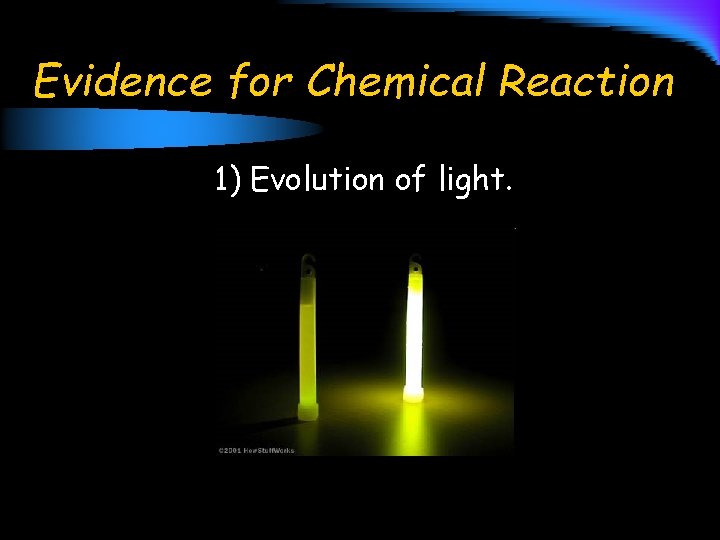
Evidence for Chemical Reaction 1) Evolution of light.
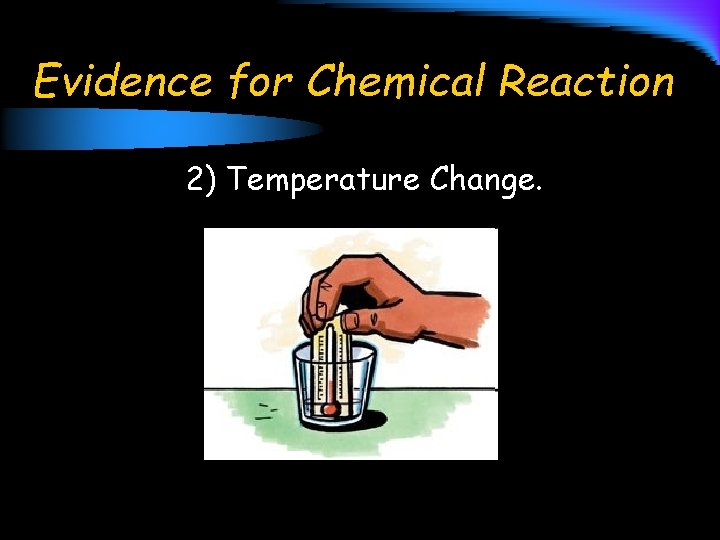
Evidence for Chemical Reaction 2) Temperature Change.
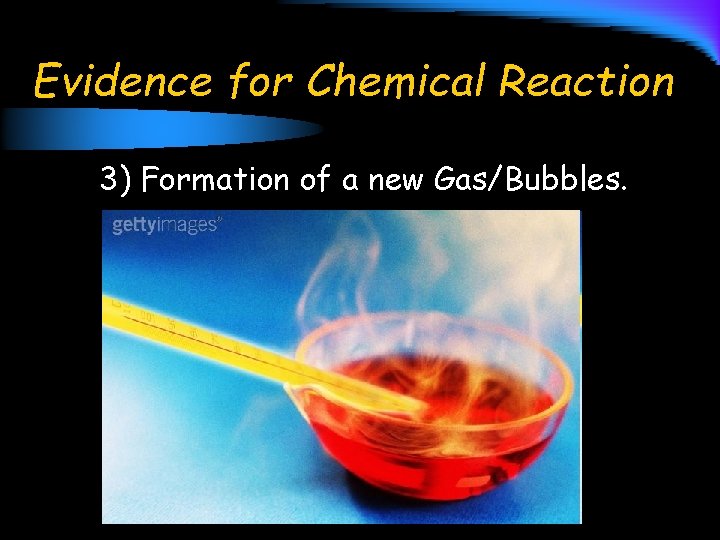
Evidence for Chemical Reaction 3) Formation of a new Gas/Bubbles.
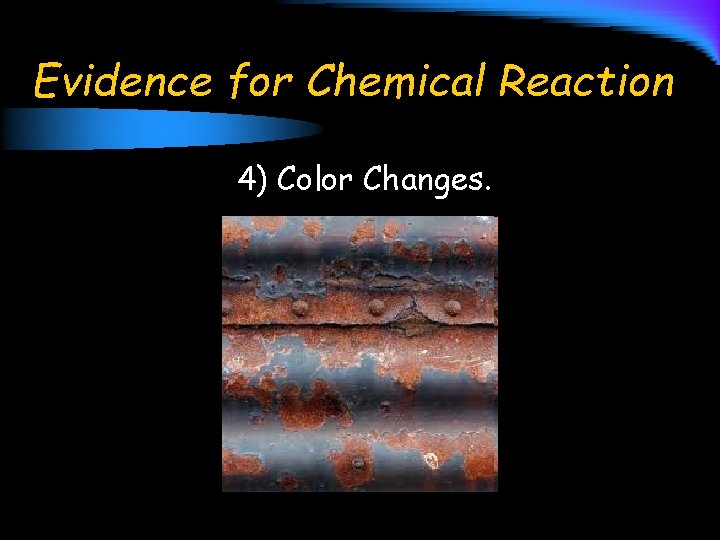
Evidence for Chemical Reaction 4) Color Changes.
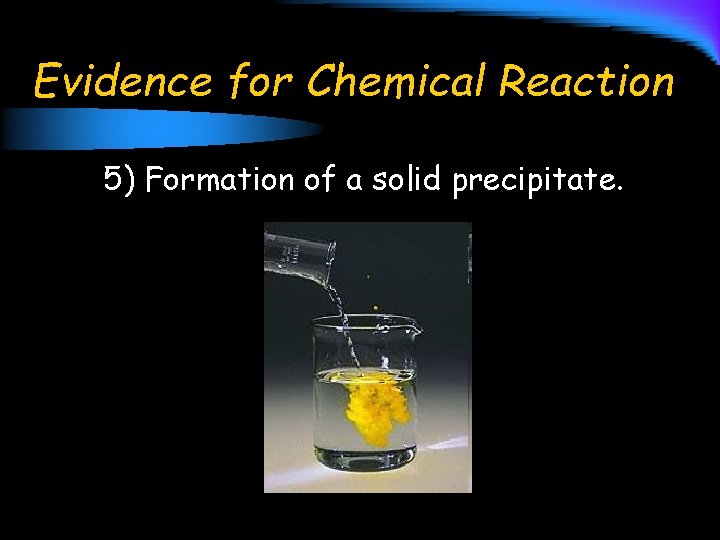
Evidence for Chemical Reaction 5) Formation of a solid precipitate.
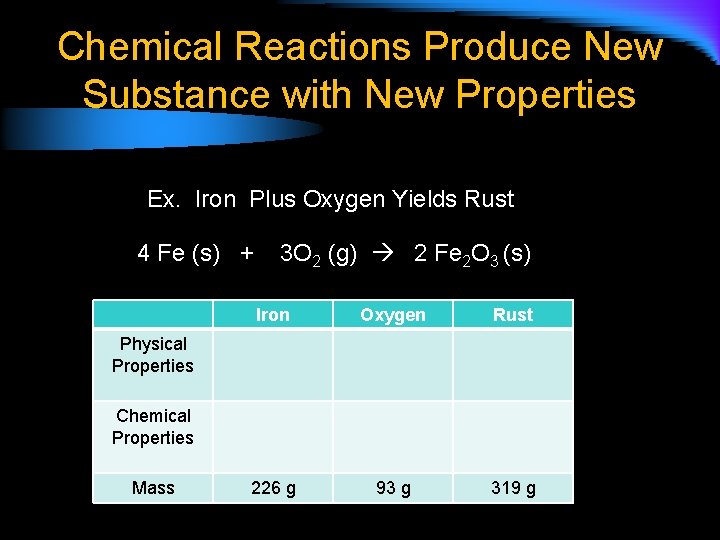
Chemical Reactions Produce New Substance with New Properties Ex. Iron Plus Oxygen Yields Rust 4 Fe (s) + 3 O 2 (g) 2 Fe 2 O 3 (s) Iron Oxygen Rust 226 g 93 g 319 g Physical Properties Chemical Properties Mass
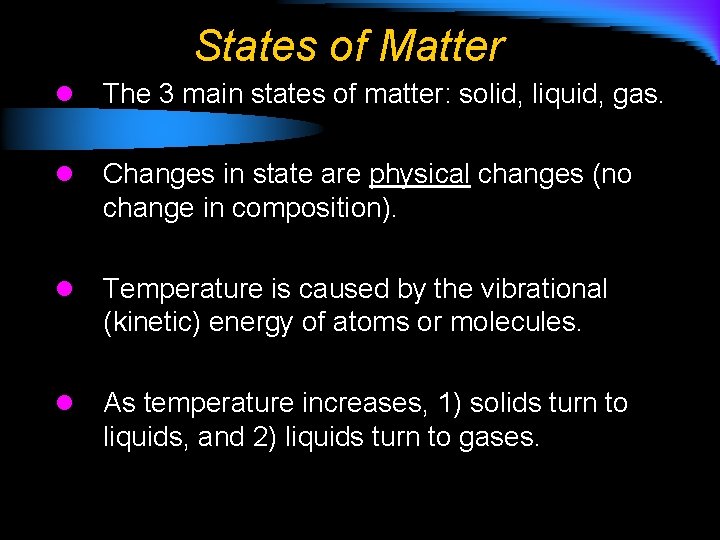
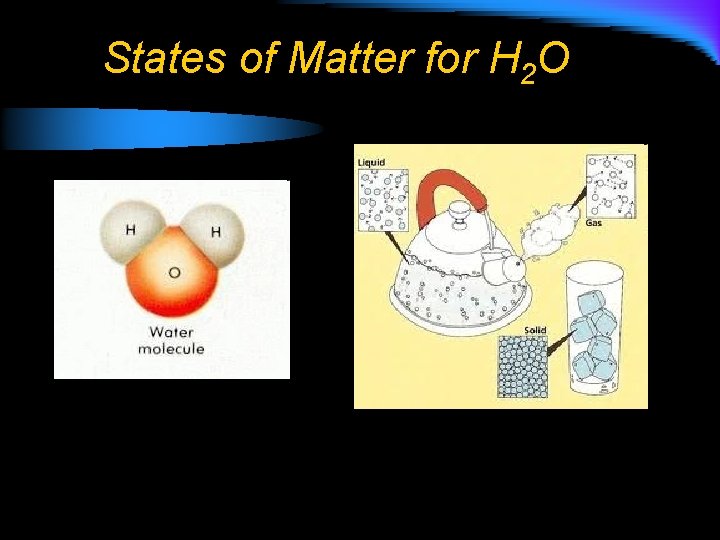
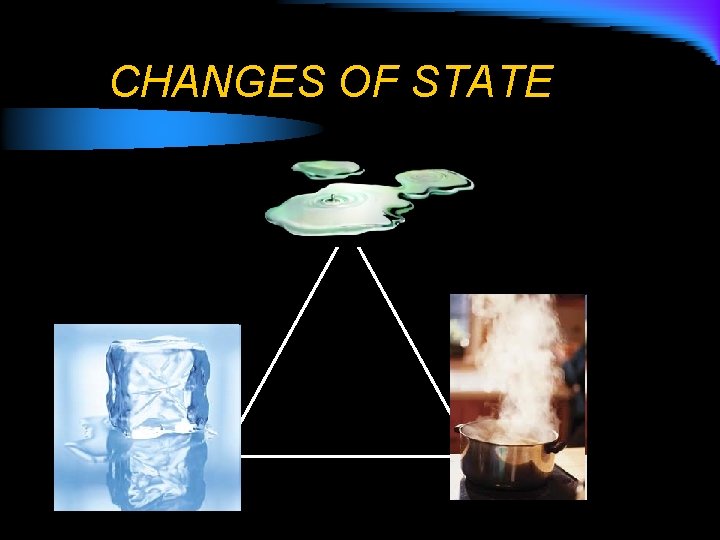
States of Matter l The 3 main states of matter: solid, liquid, gas. l Changes in state are physical changes (no change in composition). l Temperature is caused by the vibrational (kinetic) energy of atoms or molecules. l As temperature increases, 1) solids turn to liquids, and 2) liquids turn to gases.
States of Matter for H 2 O
Kinetic Molecular Theory of Matter l A theory that describes the differences between the states of matter in terms of particle behavior 1) all matter is made of tiny particles (atoms, molecules) 2) particles in matter are constantly moving (vibrating) , except at absolute zero 3) The volume that matter occupies is mainly due to the space between particles rather than the particles themselves; the particles are very small
Kinetic Molecular Theory Continued 4) In a solid, attractive forces hold the particles close together, although they still vibrate in positions. 5) In a liquid, the particles may move past one another, particles motions are slightly more random, and particles are spread out slightly more than in the solid. Attractions between particles are still important. 6) In a gas, particles are very spread out. They move in straight line, random paths until they collide elastically with each other or the walls of the container. Attractive forces between particles are negligible.
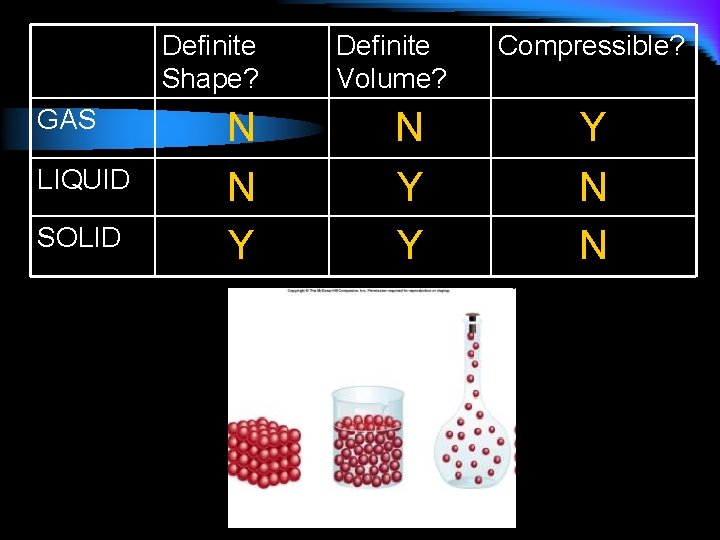
Definite Shape? GAS LIQUID SOLID N N Y Definite Volume? N Y Y Compressible? Y N N
CHANGES OF STATE
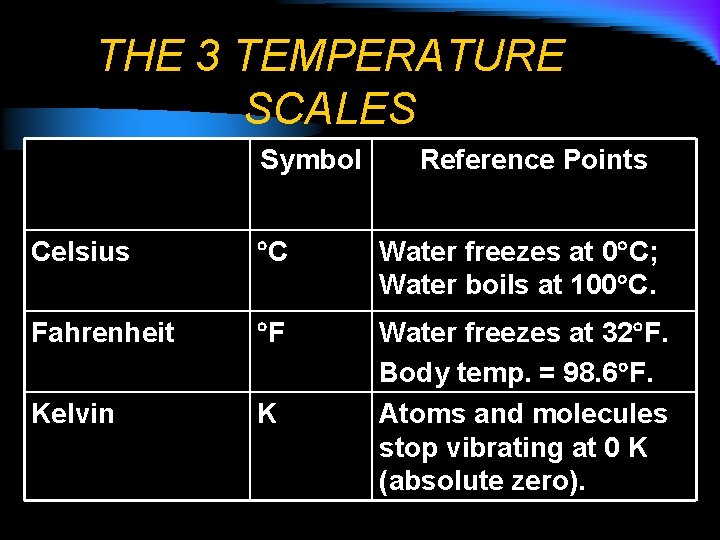
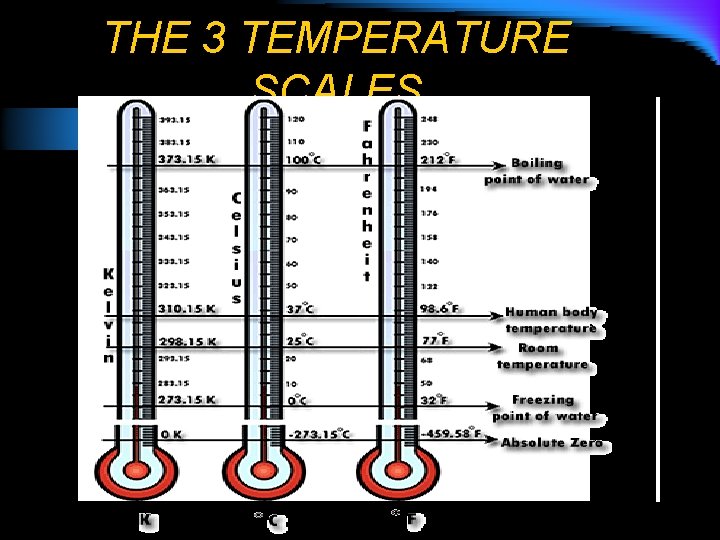
THE 3 TEMPERATURE SCALES Symbol Reference Points Celsius C Water freezes at 0 C; Water boils at 100 C. Fahrenheit F Kelvin K Water freezes at 32 F. Body temp. = 98. 6 F. Atoms and molecules stop vibrating at 0 K (absolute zero).
THE 3 TEMPERATURE SCALES
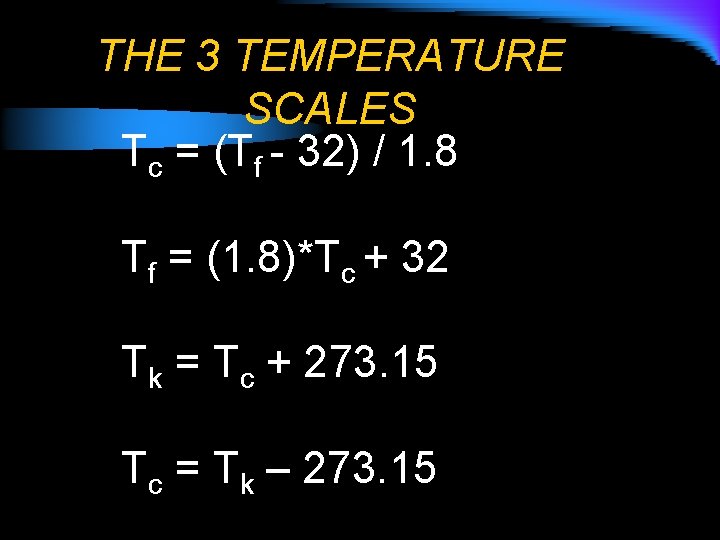
THE 3 TEMPERATURE SCALES Tc = (Tf - 32) / 1. 8 Tf = (1. 8)*Tc + 32 Tk = Tc + 273. 15 Tc = Tk – 273. 15