Characterization of Materials using the PDF Thomas Proffen
- Slides: 57
Characterization of Materials using the PDF Thomas Proffen Manuel Lujan Jr. Neutron Scattering Center Los Alamos National Laboratory tproffen@lanl. gov LA-UR 05 -0111 Characterizing materials using the PDF – Thomas Proffen 7 th Canadian Powder Diffraction Workshop, May 2007
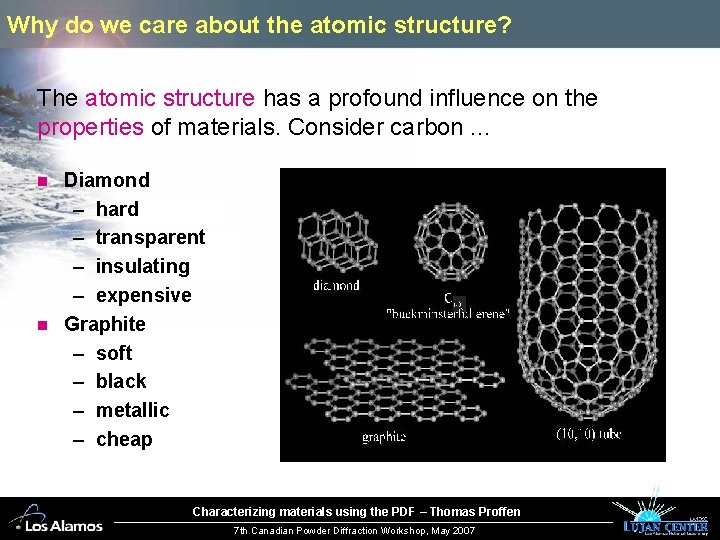
Why do we care about the atomic structure? The atomic structure has a profound influence on the properties of materials. Consider carbon. . . n n Diamond – hard – transparent – insulating – expensive Graphite – soft – black – metallic – cheap Characterizing materials using the PDF – Thomas Proffen 7 th Canadian Powder Diffraction Workshop, May 2007
Bragg’s world The average atomic structure Characterizing materials using the PDF – Thomas Proffen 7 th Canadian Powder Diffraction Workshop, May 2007
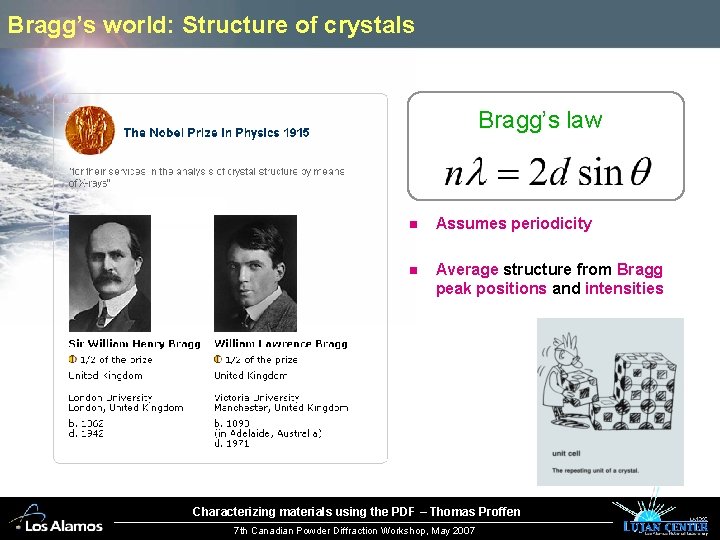
Bragg’s world: Structure of crystals Bragg’s law n Assumes periodicity n Average structure from Bragg peak positions and intensities Characterizing materials using the PDF – Thomas Proffen 7 th Canadian Powder Diffraction Workshop, May 2007
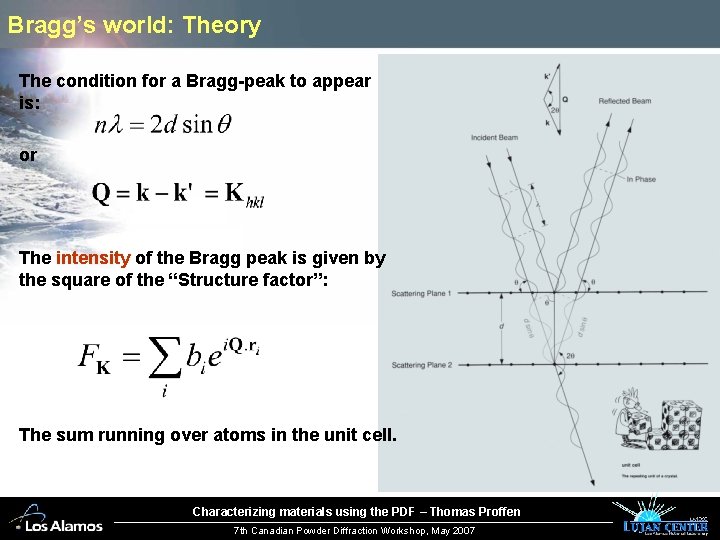
Bragg’s world: Theory The condition for a Bragg-peak to appear is: or The intensity of the Bragg peak is given by the square of the “Structure factor”: The sum running over atoms in the unit cell. Characterizing materials using the PDF – Thomas Proffen 7 th Canadian Powder Diffraction Workshop, May 2007
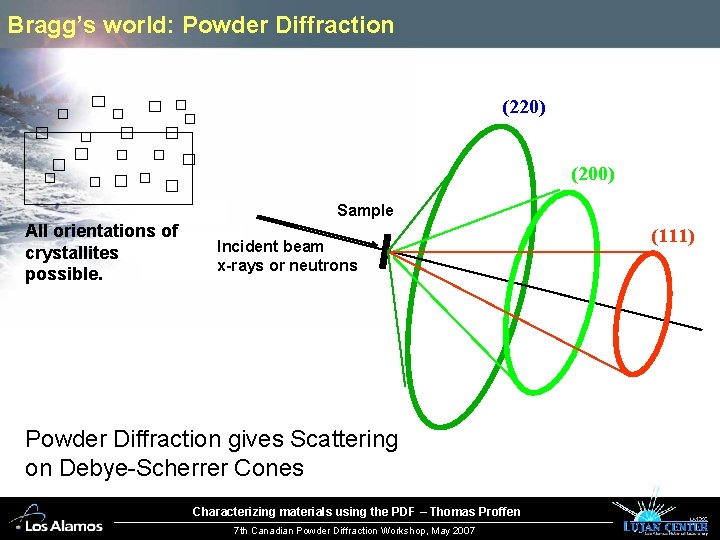
Bragg’s world: Powder Diffraction (220) (200) Sample All orientations of crystallites possible. Incident beam x-rays or neutrons Powder Diffraction gives Scattering on Debye-Scherrer Cones Characterizing materials using the PDF – Thomas Proffen 7 th Canadian Powder Diffraction Workshop, May 2007 (111)
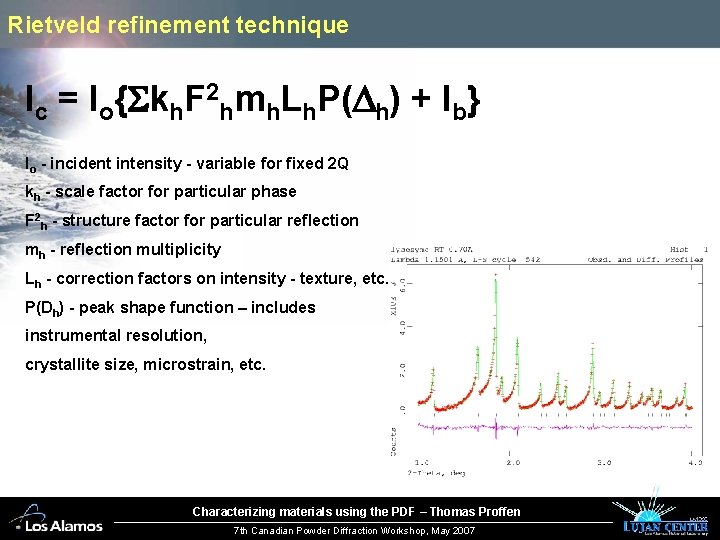
Rietveld refinement technique Ic = Io{Skh. F 2 hmh. Lh. P(Dh) + Ib} Io - incident intensity - variable for fixed 2 Q kh - scale factor for particular phase F 2 h - structure factor for particular reflection mh - reflection multiplicity Lh - correction factors on intensity - texture, etc. P(Dh) - peak shape function – includes instrumental resolution, crystallite size, microstrain, etc. Characterizing materials using the PDF – Thomas Proffen 7 th Canadian Powder Diffraction Workshop, May 2007
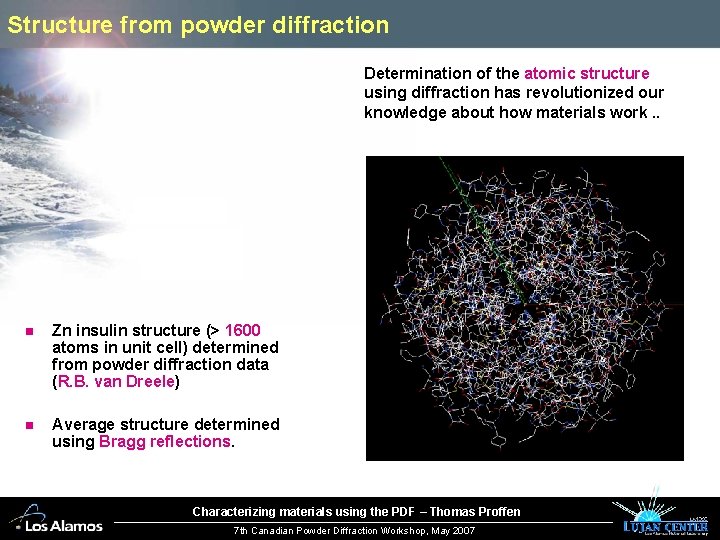
Structure from powder diffraction Determination of the atomic structure using diffraction has revolutionized our knowledge about how materials work. . n Zn insulin structure (> 1600 atoms in unit cell) determined from powder diffraction data (R. B. van Dreele) n Average structure determined using Bragg reflections. Characterizing materials using the PDF – Thomas Proffen 7 th Canadian Powder Diffraction Workshop, May 2007
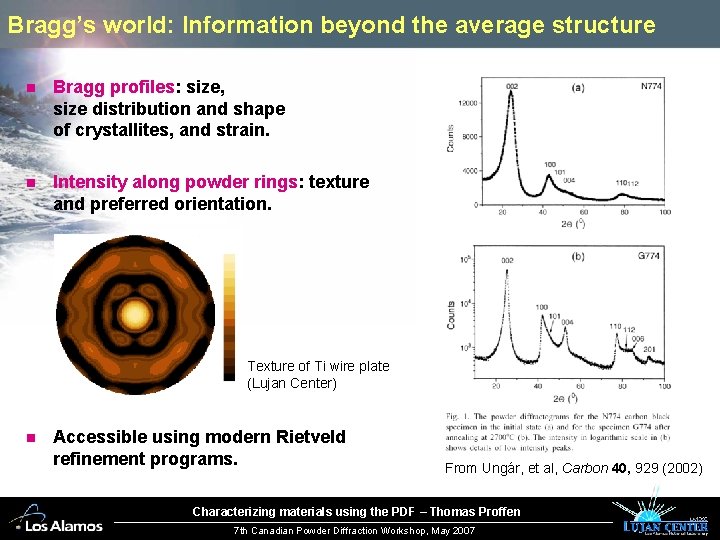
Bragg’s world: Information beyond the average structure n Bragg profiles: size, size distribution and shape of crystallites, and strain. n Intensity along powder rings: texture and preferred orientation. Texture of Ti wire plate (Lujan Center) n Accessible using modern Rietveld refinement programs. From Ungár, et al, Carbon 40, 929 (2002) Characterizing materials using the PDF – Thomas Proffen 7 th Canadian Powder Diffraction Workshop, May 2007
Diffuse scattering Local atomic structure Characterizing materials using the PDF – Thomas Proffen 7 th Canadian Powder Diffraction Workshop, May 2007
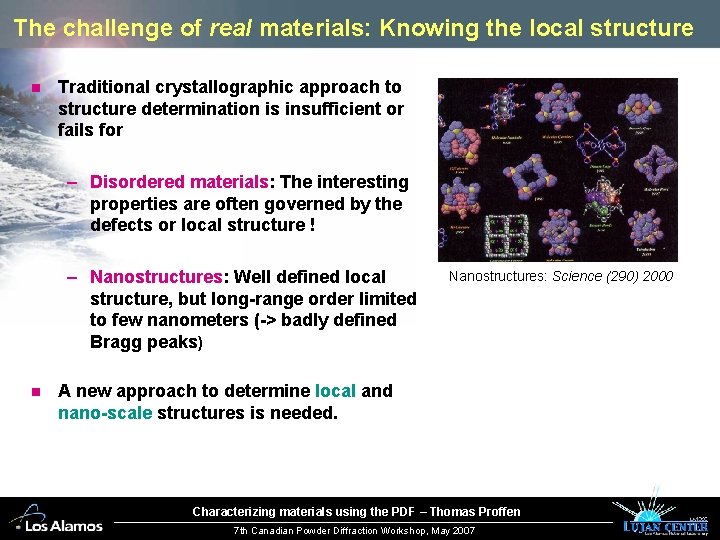
The challenge of real materials: Knowing the local structure n Traditional crystallographic approach to structure determination is insufficient or fails for – Disordered materials: The interesting properties are often governed by the defects or local structure ! – Nanostructures: Well defined local structure, but long-range order limited to few nanometers (-> badly defined Bragg peaks) n Nanostructures: Science (290) 2000 A new approach to determine local and nano-scale structures is needed. Characterizing materials using the PDF – Thomas Proffen 7 th Canadian Powder Diffraction Workshop, May 2007
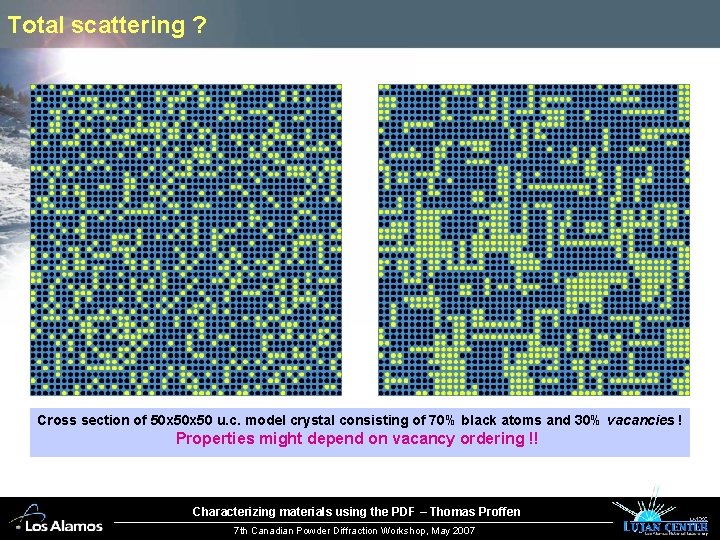
Total scattering ? Cross section of 50 x 50 u. c. model crystal consisting of 70% black atoms and 30% vacancies ! Properties might depend on vacancy ordering !! Characterizing materials using the PDF – Thomas Proffen 7 th Canadian Powder Diffraction Workshop, May 2007
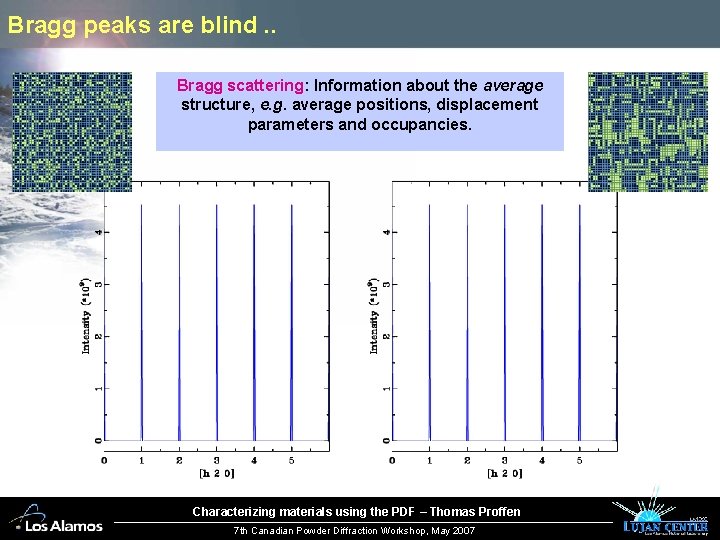
Bragg peaks are blind. . Bragg scattering: Information about the average structure, e. g. average positions, displacement parameters and occupancies. Characterizing materials using the PDF – Thomas Proffen 7 th Canadian Powder Diffraction Workshop, May 2007
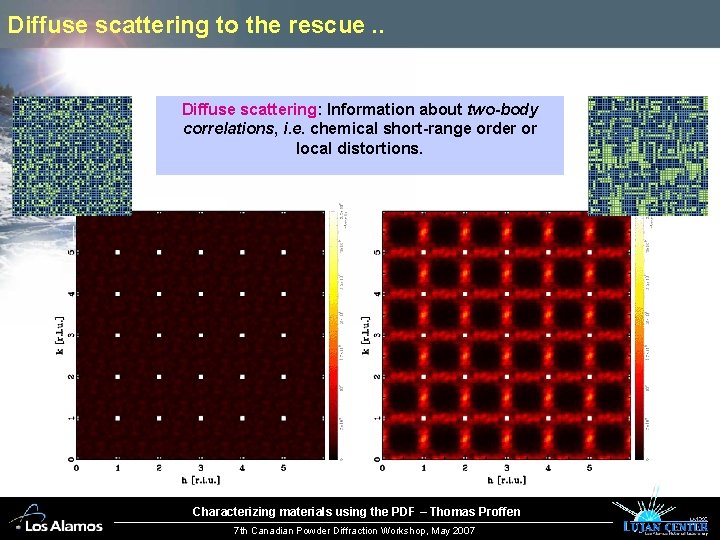
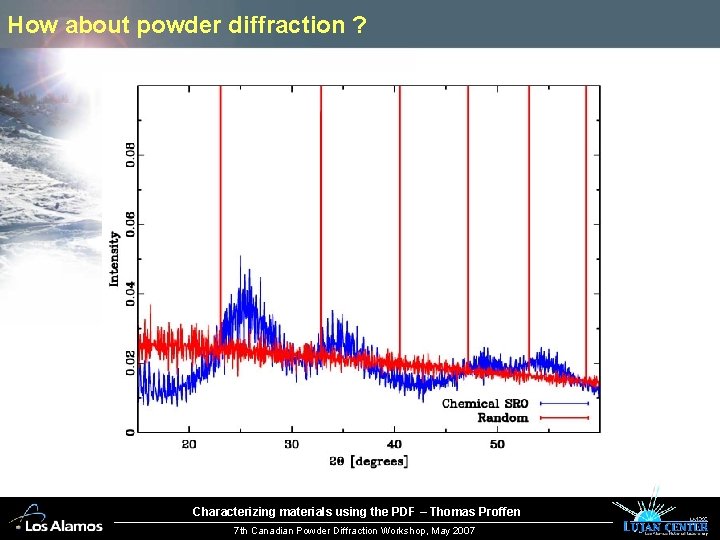
Diffuse scattering to the rescue. . Diffuse scattering: Information about two-body correlations, i. e. chemical short-range order or local distortions. Characterizing materials using the PDF – Thomas Proffen 7 th Canadian Powder Diffraction Workshop, May 2007
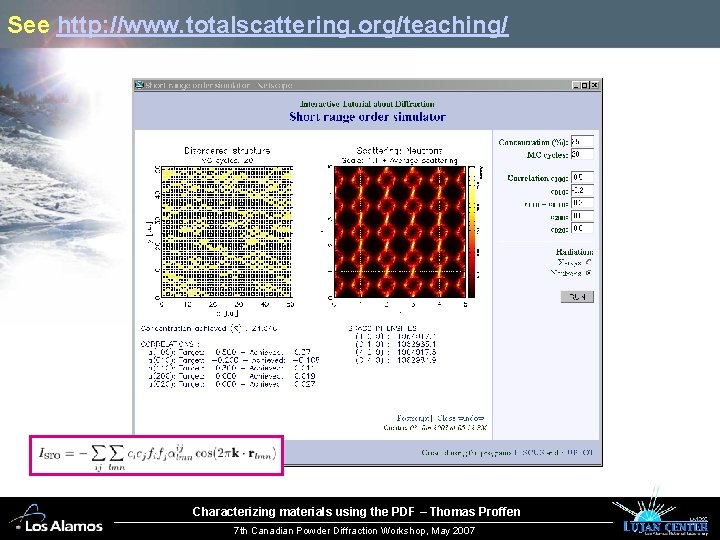
See http: //www. totalscattering. org/teaching/ Characterizing materials using the PDF – Thomas Proffen 7 th Canadian Powder Diffraction Workshop, May 2007
How about powder diffraction ? Characterizing materials using the PDF – Thomas Proffen 7 th Canadian Powder Diffraction Workshop, May 2007
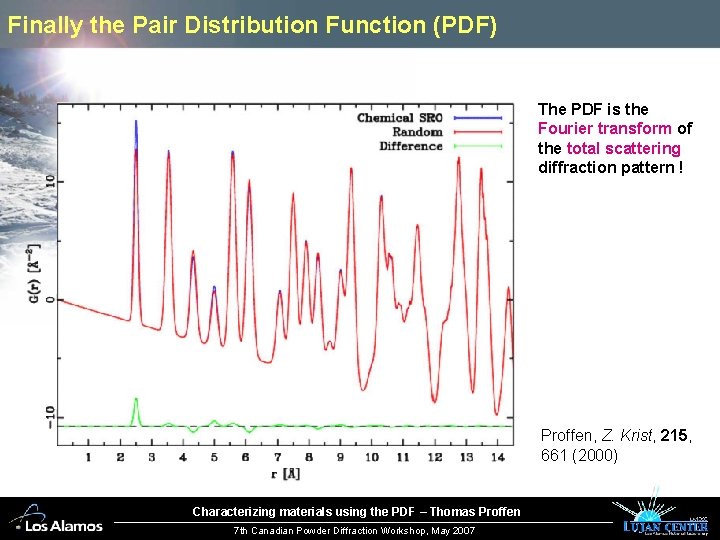
Finally the Pair Distribution Function (PDF) The PDF is the Fourier transform of the total scattering diffraction pattern ! Proffen, Z. Krist, 215, 661 (2000) Characterizing materials using the PDF – Thomas Proffen 7 th Canadian Powder Diffraction Workshop, May 2007
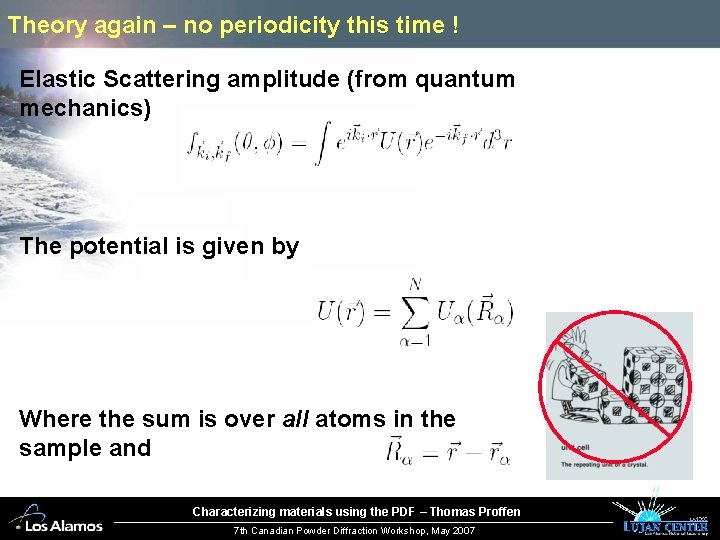
Theory again – no periodicity this time ! Elastic Scattering amplitude (from quantum mechanics) The potential is given by Where the sum is over all atoms in the sample and Characterizing materials using the PDF – Thomas Proffen 7 th Canadian Powder Diffraction Workshop, May 2007
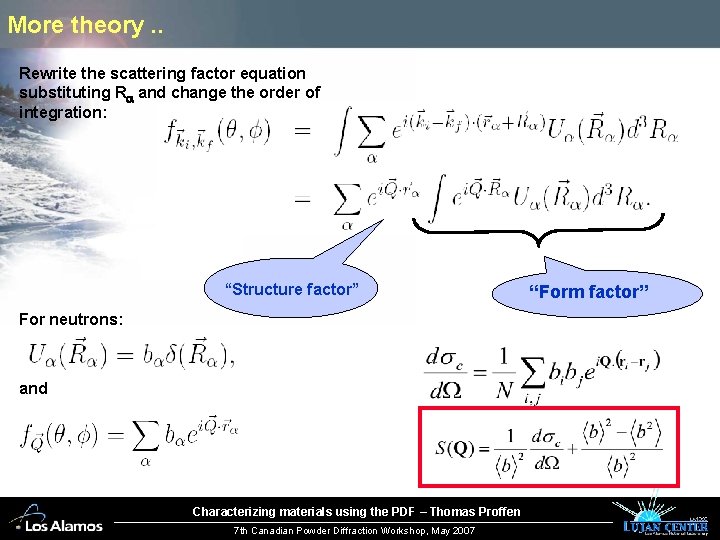
More theory. . Rewrite the scattering factor equation substituting Ra and change the order of integration: “Structure factor” For neutrons: and Characterizing materials using the PDF – Thomas Proffen 7 th Canadian Powder Diffraction Workshop, May 2007 “Form factor”
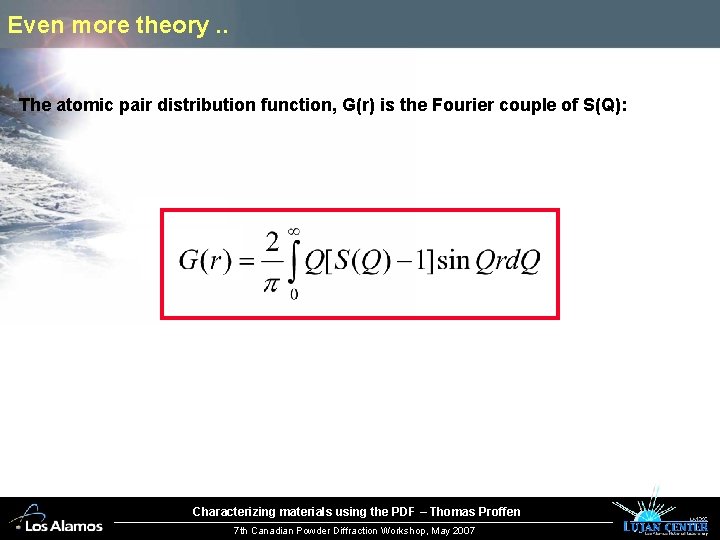
Even more theory. . The atomic pair distribution function, G(r) is the Fourier couple of S(Q): Characterizing materials using the PDF – Thomas Proffen 7 th Canadian Powder Diffraction Workshop, May 2007
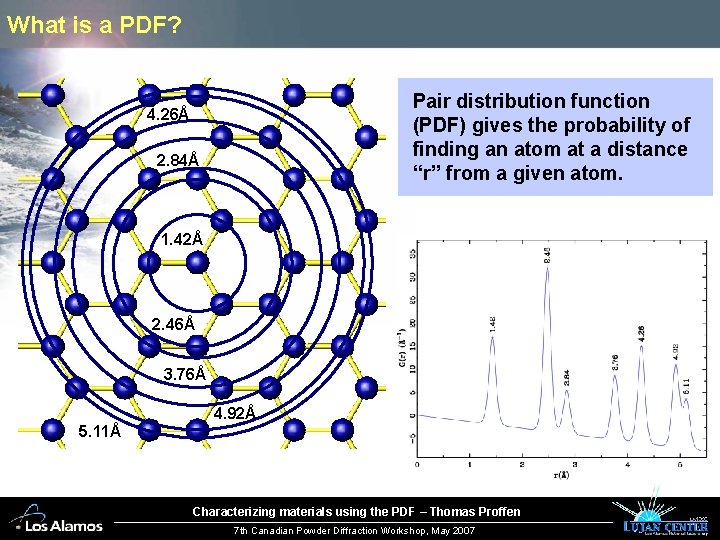
What is a PDF? Pair distribution function (PDF) gives the probability of finding an atom at a distance “r” from a given atom. 4. 26Å 2. 84Å 1. 42Å 2. 46Å 3. 76Å 4. 92Å 5. 11Å Characterizing materials using the PDF – Thomas Proffen 7 th Canadian Powder Diffraction Workshop, May 2007
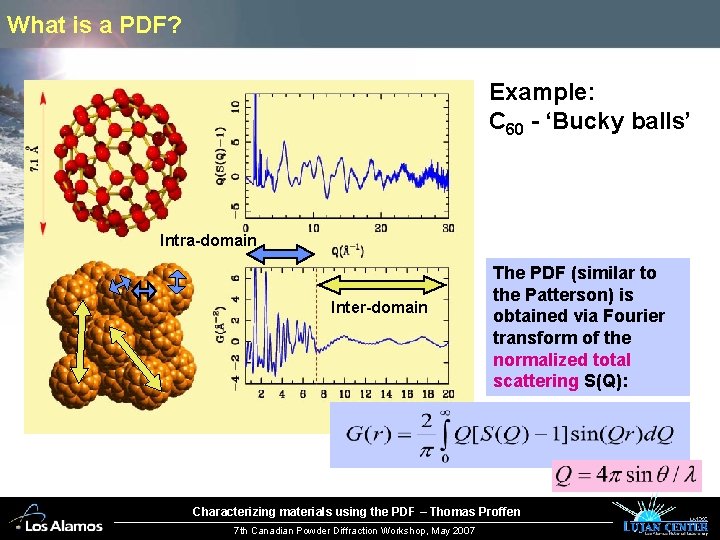
What is a PDF? Example: C 60 - ‘Bucky balls’ Intra-domain Inter-domain The PDF (similar to the Patterson) is obtained via Fourier transform of the normalized total scattering S(Q): Characterizing materials using the PDF – Thomas Proffen 7 th Canadian Powder Diffraction Workshop, May 2007
Examples Characterizing materials using the PDF – Thomas Proffen 7 th Canadian Powder Diffraction Workshop, May 2007
Local atomic strain in Zn. Se 1 -x. Tex Simon Billinge Thomas Proffen (LANL) Peterson (SNS) Facilities: IPNS, Lujan Funding: DOE, NSF Characterizing materials using the PDF – Thomas Proffen 7 th Canadian Powder Diffraction Workshop, May 2007
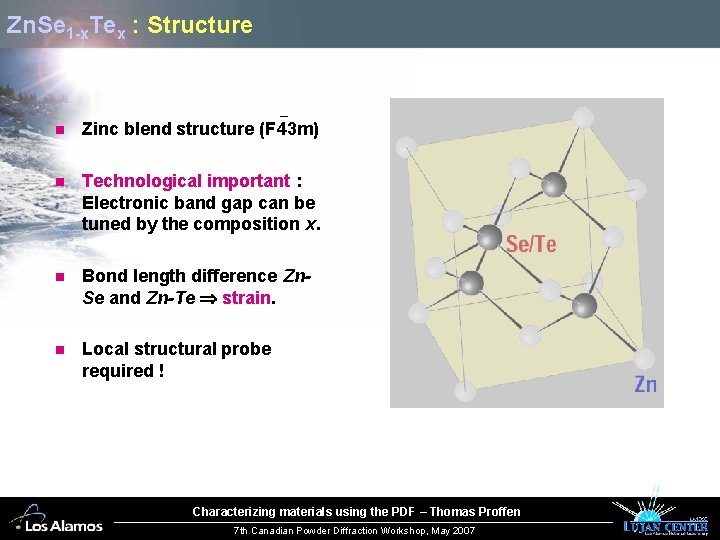
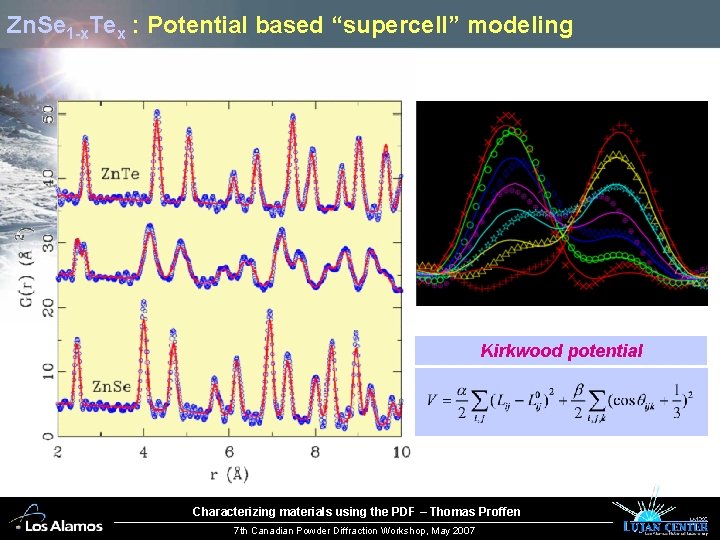
Zn. Se 1 -x. Tex : Structure n ¯ Zinc blend structure (F 43 m) n Technological important : Electronic band gap can be tuned by the composition x. n Bond length difference Zn. Se and Zn-Te strain. n Local structural probe required ! Characterizing materials using the PDF – Thomas Proffen 7 th Canadian Powder Diffraction Workshop, May 2007
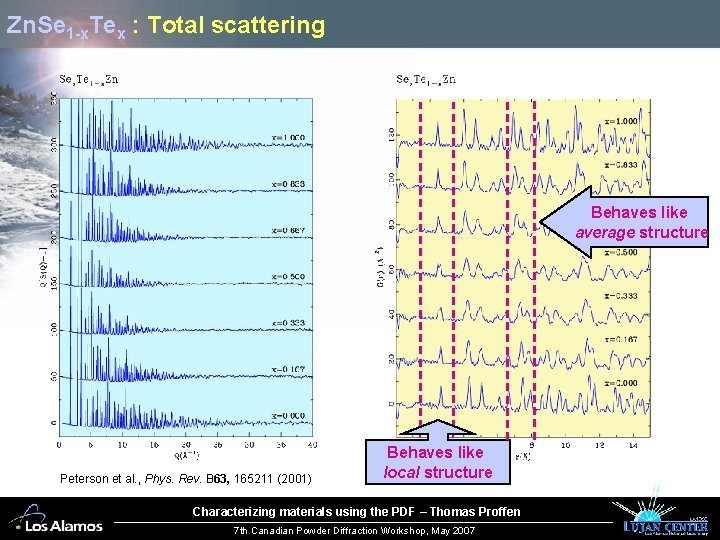
Zn. Se 1 -x. Tex : Total scattering Behaves like average structure Peterson et al. , Phys. Rev. B 63, 165211 (2001) Behaves like local structure Characterizing materials using the PDF – Thomas Proffen 7 th Canadian Powder Diffraction Workshop, May 2007
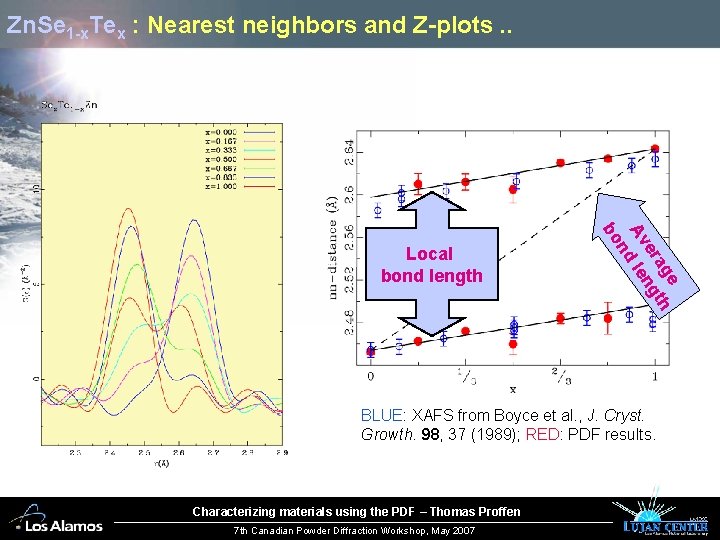
Zn. Se 1 -x. Tex : Nearest neighbors and Z-plots. . e ag th er ng Av le nd bo Local bond length BLUE: XAFS from Boyce et al. , J. Cryst. Growth. 98, 37 (1989); RED: PDF results. Characterizing materials using the PDF – Thomas Proffen 7 th Canadian Powder Diffraction Workshop, May 2007
Zn. Se 1 -x. Tex : Potential based “supercell” modeling Kirkwood potential Characterizing materials using the PDF – Thomas Proffen 7 th Canadian Powder Diffraction Workshop, May 2007
Local structure of WS 2 Simon Billinge Thomas Proffen (LANL) Peterson (SNS) Valeri Petkov (CMU) Facilities: Chess Funding: DOE, NSF Characterizing materials using the PDF – Thomas Proffen 7 th Canadian Powder Diffraction Workshop, May 2007
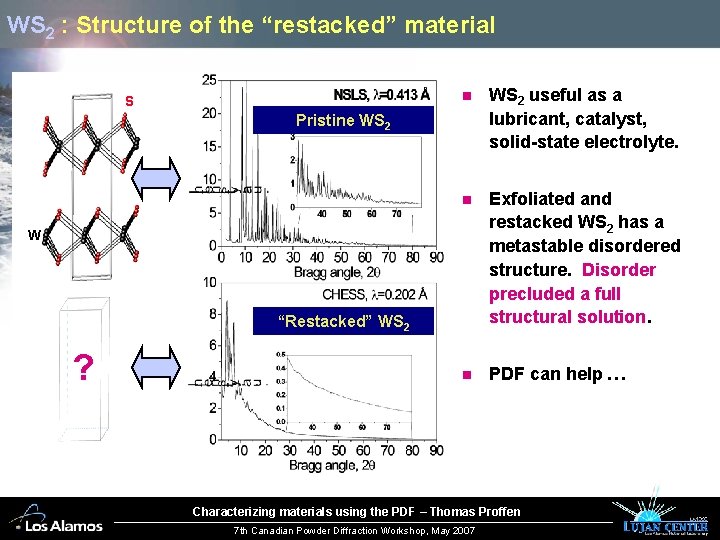
WS 2 : Structure of the “restacked” material S n WS 2 useful as a lubricant, catalyst, solid-state electrolyte. n Exfoliated and restacked WS 2 has a metastable disordered structure. Disorder precluded a full structural solution. n PDF can help … Pristine WS 2 W “Restacked” WS 2 ? Characterizing materials using the PDF – Thomas Proffen 7 th Canadian Powder Diffraction Workshop, May 2007
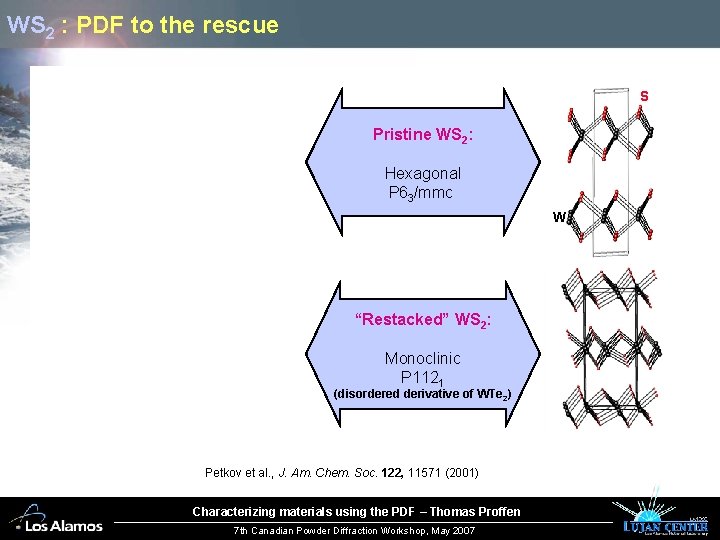
WS 2 : PDF to the rescue S Pristine WS 2: Hexagonal P 63/mmc W “Restacked” WS 2: Monoclinic P 1121 (disordered derivative of WTe 2) Petkov et al. , J. Am. Chem. Soc. 122, 11571 (2001) Characterizing materials using the PDF – Thomas Proffen 7 th Canadian Powder Diffraction Workshop, May 2007
Domain structures Katharine Page Thomas Proffen Facilities: Lujan Funding: DOE, NASA Characterizing materials using the PDF – Thomas Proffen 7 th Canadian Powder Diffraction Workshop, May 2007
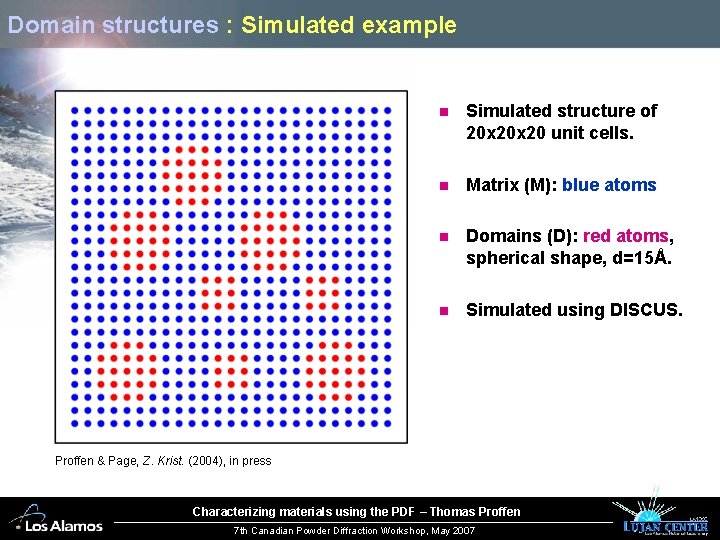
Domain structures : Simulated example n Simulated structure of 20 x 20 unit cells. n Matrix (M): blue atoms n Domains (D): red atoms, spherical shape, d=15Å. n Simulated using DISCUS. Proffen & Page, Z. Krist. (2004), in press Characterizing materials using the PDF – Thomas Proffen 7 th Canadian Powder Diffraction Workshop, May 2007
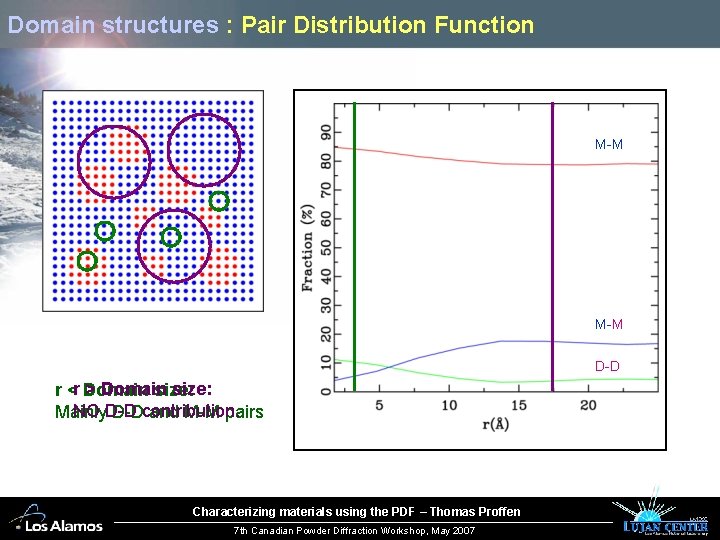
Domain structures : Pair Distribution Function M-M D-D > Domain size: r <r Domain size: NO D-D Mainly D-Dcontribution. and M-M pairs Characterizing materials using the PDF – Thomas Proffen 7 th Canadian Powder Diffraction Workshop, May 2007
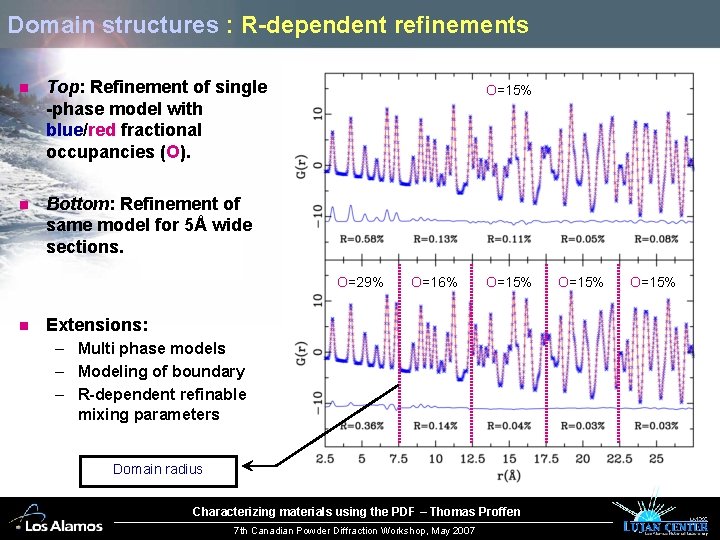
Domain structures : R-dependent refinements n Top: Refinement of single -phase model with blue/red fractional occupancies (O). n Bottom: Refinement of same model for 5Å wide sections. O=15% O=29% n O=16% O=15% Extensions: – Multi phase models – Modeling of boundary – R-dependent refinable mixing parameters Domain radius Characterizing materials using the PDF – Thomas Proffen 7 th Canadian Powder Diffraction Workshop, May 2007 O=15%
High temperature local structure of La. Mn. O 3 Xiangyun Qiu Simon Billinge Thomas Proffen Facilities: Lujan Funding: DOE-BES, NSF Characterizing materials using the PDF – Thomas Proffen 7 th Canadian Powder Diffraction Workshop, May 2007
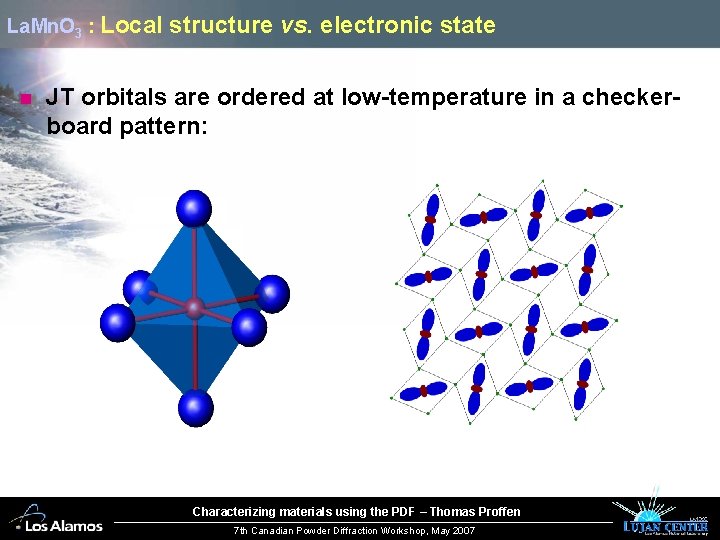
La. Mn. O 3 : Local n structure vs. electronic state JT orbitals are ordered at low-temperature in a checkerboard pattern: Characterizing materials using the PDF – Thomas Proffen 7 th Canadian Powder Diffraction Workshop, May 2007
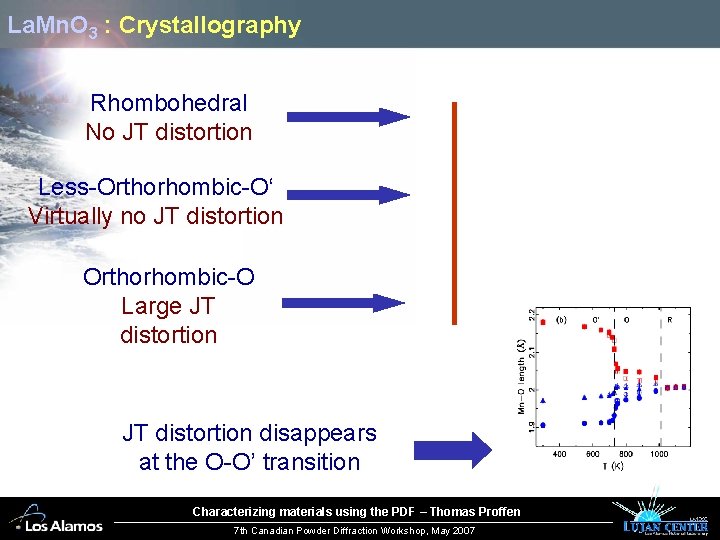
La. Mn. O 3 : Crystallography Rhombohedral No JT distortion Less-Orthorhombic-O‘ Virtually no JT distortion Orthorhombic-O Large JT distortion disappears at the O-O’ transition Characterizing materials using the PDF – Thomas Proffen 7 th Canadian Powder Diffraction Workshop, May 2007
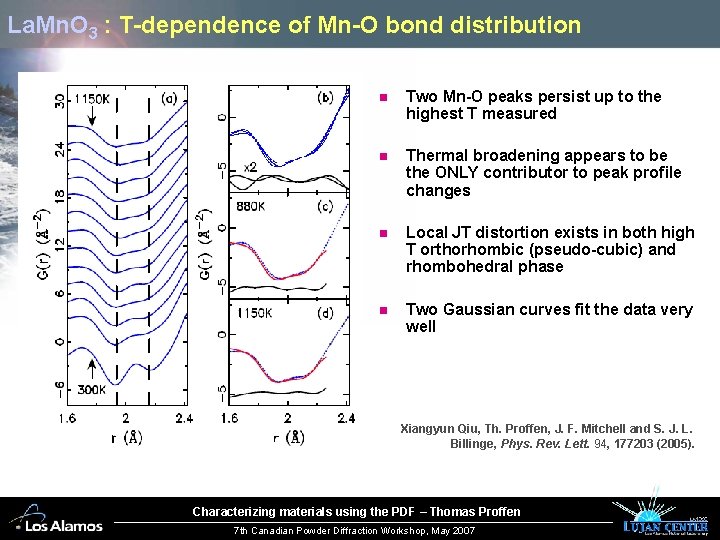
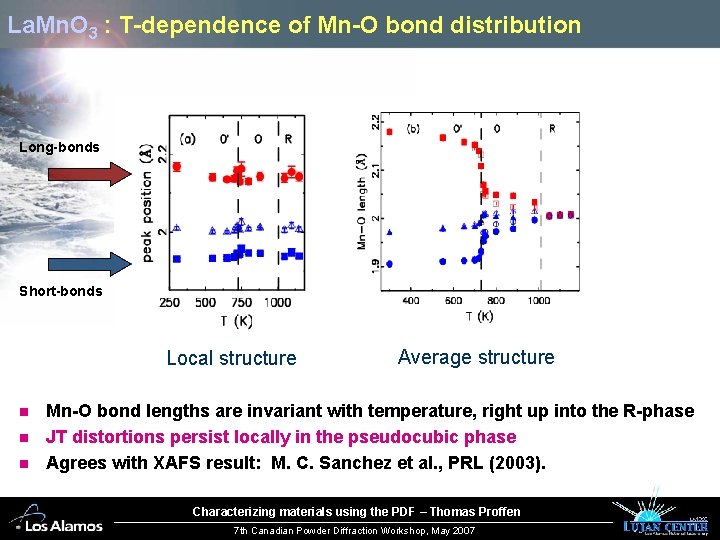
La. Mn. O 3 : T-dependence of Mn-O bond distribution n Two Mn-O peaks persist up to the highest T measured n Thermal broadening appears to be the ONLY contributor to peak profile changes n Local JT distortion exists in both high T orthorhombic (pseudo-cubic) and rhombohedral phase n Two Gaussian curves fit the data very well Xiangyun Qiu, Th. Proffen, J. F. Mitchell and S. J. L. Billinge, Phys. Rev. Lett. 94, 177203 (2005). Characterizing materials using the PDF – Thomas Proffen 7 th Canadian Powder Diffraction Workshop, May 2007
La. Mn. O 3 : T-dependence of Mn-O bond distribution Long-bonds Short-bonds Local structure n n n Average structure Mn-O bond lengths are invariant with temperature, right up into the R-phase JT distortions persist locally in the pseudocubic phase Agrees with XAFS result: M. C. Sanchez et al. , PRL (2003). Characterizing materials using the PDF – Thomas Proffen 7 th Canadian Powder Diffraction Workshop, May 2007
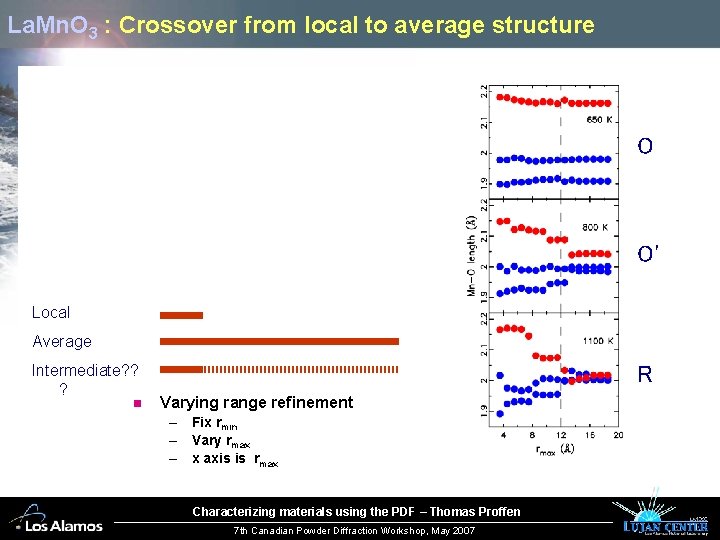
La. Mn. O 3 : Crossover from local to average structure O O' Local Average Intermediate? ? ? n R Varying range refinement – Fix rmin – Vary rmax – x axis is rmax Characterizing materials using the PDF – Thomas Proffen 7 th Canadian Powder Diffraction Workshop, May 2007
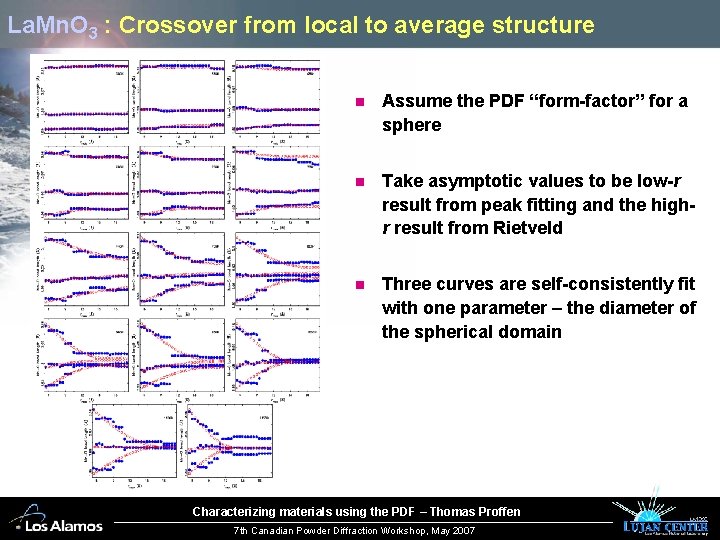
La. Mn. O 3 : Crossover from local to average structure n Assume the PDF “form-factor” for a sphere n Take asymptotic values to be low-r result from peak fitting and the highr result from Rietveld n Three curves are self-consistently fit with one parameter – the diameter of the spherical domain Characterizing materials using the PDF – Thomas Proffen 7 th Canadian Powder Diffraction Workshop, May 2007
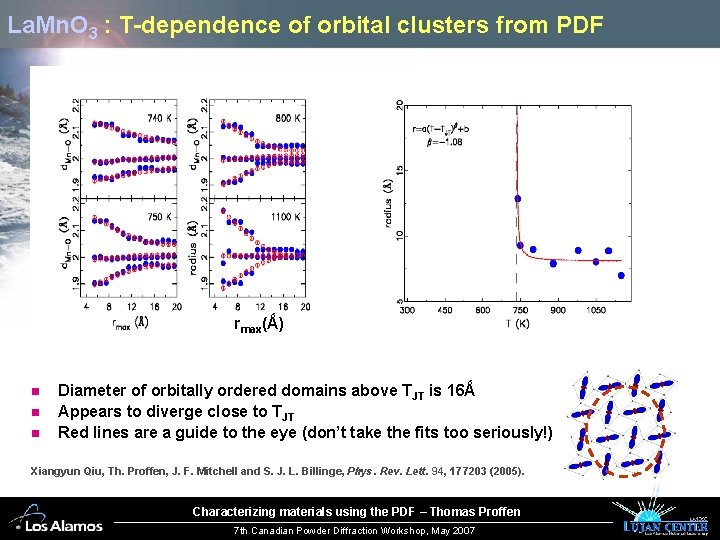
La. Mn. O 3 : T-dependence of orbital clusters from PDF rmax(Ǻ) n n n Diameter of orbitally ordered domains above TJT is 16Ǻ Appears to diverge close to TJT Red lines are a guide to the eye (don’t take the fits too seriously!) Xiangyun Qiu, Th. Proffen, J. F. Mitchell and S. J. L. Billinge, Phys. Rev. Lett. 94, 177203 (2005). Characterizing materials using the PDF – Thomas Proffen 7 th Canadian Powder Diffraction Workshop, May 2007
“Complete” Structure of Gold Nanoparticles Katharine Page Thomas Proffen Ram Seshadri Tony Cheetham Facilities: Lujan Funding: DOE, NASA Characterizing materials using the PDF – Thomas Proffen 7 th Canadian Powder Diffraction Workshop, May 2007
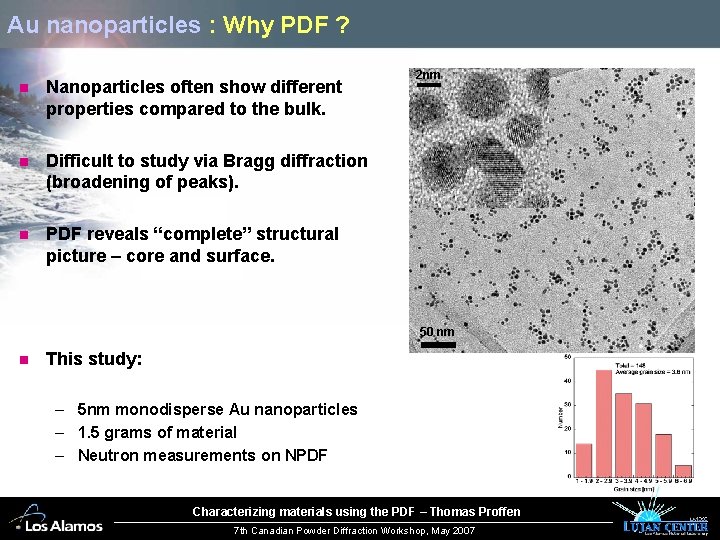
Au nanoparticles : Why PDF ? n Nanoparticles often show different properties compared to the bulk. n Difficult to study via Bragg diffraction (broadening of peaks). n PDF reveals “complete” structural picture – core and surface. 2 nm 50 nm n This study: – 5 nm monodisperse Au nanoparticles – 1. 5 grams of material – Neutron measurements on NPDF Characterizing materials using the PDF – Thomas Proffen 7 th Canadian Powder Diffraction Workshop, May 2007
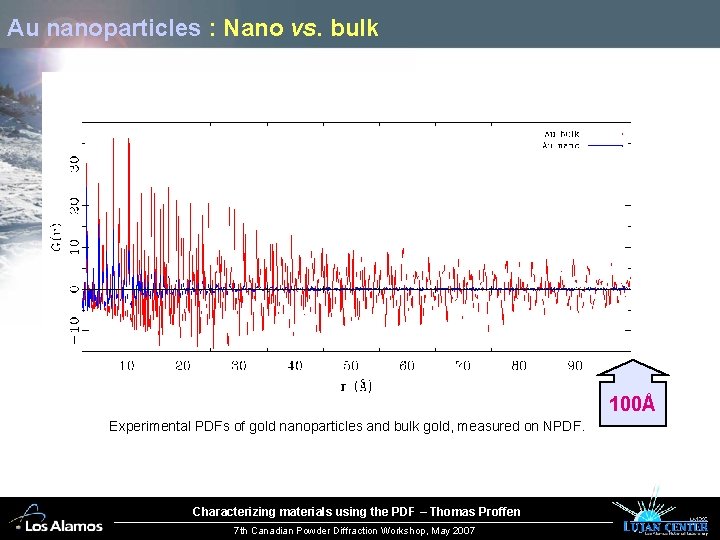
Au nanoparticles : Nano vs. bulk 100Å Experimental PDFs of gold nanoparticles and bulk gold, measured on NPDF. Characterizing materials using the PDF – Thomas Proffen 7 th Canadian Powder Diffraction Workshop, May 2007
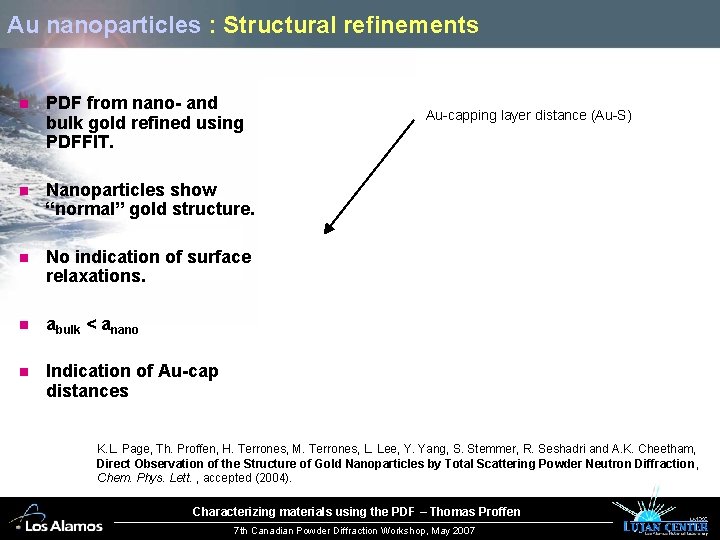
Au nanoparticles : Structural refinements n PDF from nano- and bulk gold refined using PDFFIT. n Nanoparticles show “normal” gold structure. n No indication of surface relaxations. n abulk < anano n Indication of Au-cap distances Au-capping layer distance (Au-S) K. L. Page, Th. Proffen, H. Terrones, M. Terrones, L. Lee, Y. Yang, S. Stemmer, R. Seshadri and A. K. Cheetham, Direct Observation of the Structure of Gold Nanoparticles by Total Scattering Powder Neutron Diffraction, Chem. Phys. Lett. , accepted (2004). Characterizing materials using the PDF – Thomas Proffen 7 th Canadian Powder Diffraction Workshop, May 2007
Local structure in sandstone Katharine Page Christina Herrera Thomas Proffen Sylvia Mc. Lain Tim Darling Jim Ten. Cate Facilities: Lujan Funding: DOE, NSF Characterizing materials using the PDF – Thomas Proffen 7 th Canadian Powder Diffraction Workshop, May 2007
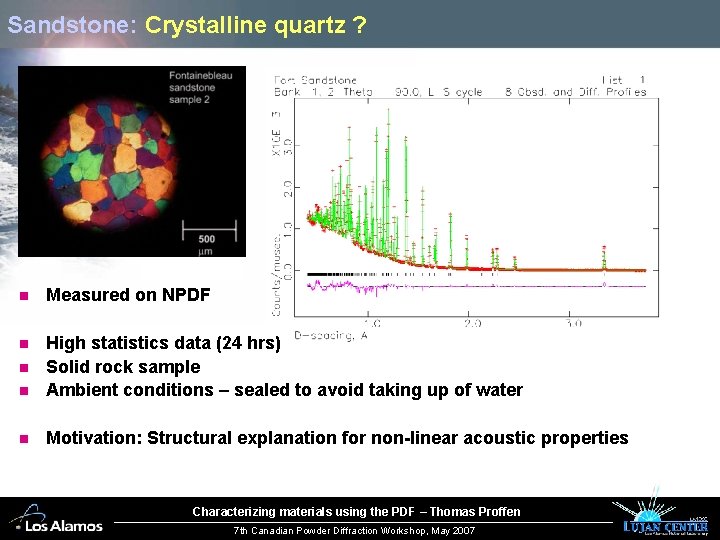
Sandstone: Crystalline quartz ? n Measured on NPDF n n High statistics data (24 hrs) Solid rock sample Ambient conditions – sealed to avoid taking up of water n Motivation: Structural explanation for non-linear acoustic properties n Characterizing materials using the PDF – Thomas Proffen 7 th Canadian Powder Diffraction Workshop, May 2007
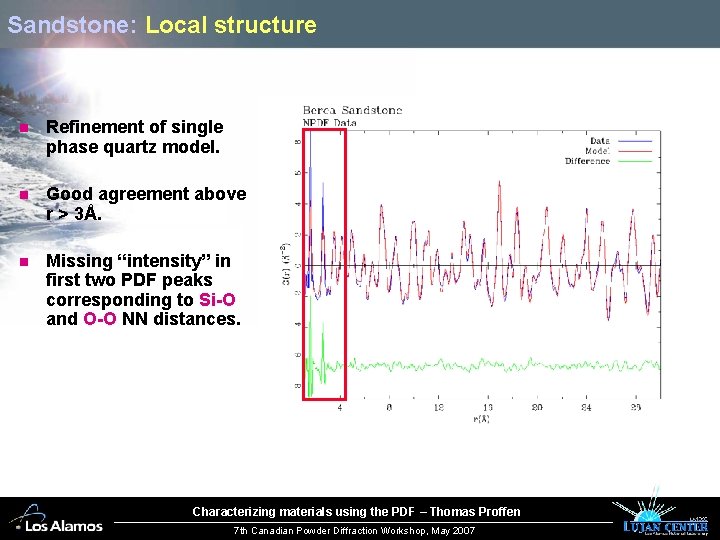
Sandstone: Local structure n Refinement of single phase quartz model. n Good agreement above r > 3Å. n Missing “intensity” in first two PDF peaks corresponding to Si-O and O-O NN distances. Characterizing materials using the PDF – Thomas Proffen 7 th Canadian Powder Diffraction Workshop, May 2007
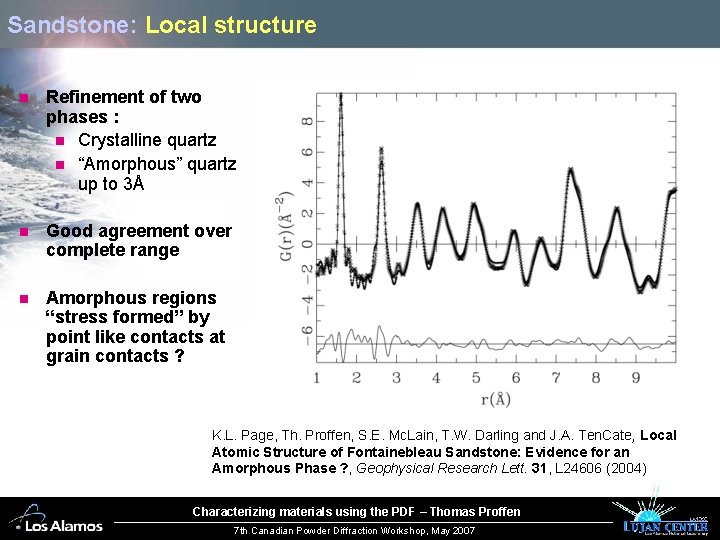
Sandstone: Local structure n Refinement of two phases : n Crystalline quartz n “Amorphous” quartz up to 3Å n Good agreement over complete range n Amorphous regions “stress formed” by point like contacts at grain contacts ? K. L. Page, Th. Proffen, S. E. Mc. Lain, T. W. Darling and J. A. Ten. Cate, Local Atomic Structure of Fontainebleau Sandstone: Evidence for an Amorphous Phase ? , Geophysical Research Lett. 31, L 24606 (2004) Characterizing materials using the PDF – Thomas Proffen 7 th Canadian Powder Diffraction Workshop, May 2007
Elastic properties of Bulk-Metallic-Glasses Katharine Page Thomas Proffen Bjorn Clausen Ersan Ustundag Seung-Yub Lee Facilities: Lujan Funding: DOE, NSF Characterizing materials using the PDF – Thomas Proffen 7 th Canadian Powder Diffraction Workshop, May 2007
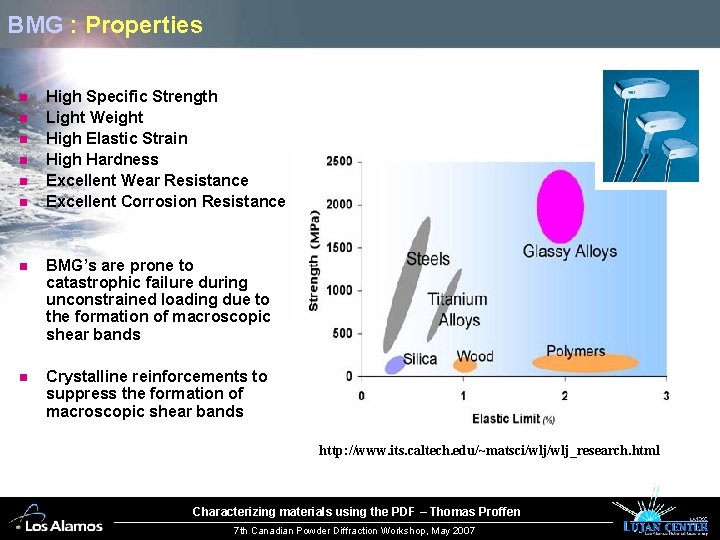
BMG : Properties n n n High Specific Strength Light Weight High Elastic Strain High Hardness Excellent Wear Resistance Excellent Corrosion Resistance n BMG’s are prone to catastrophic failure during unconstrained loading due to the formation of macroscopic shear bands n Crystalline reinforcements to suppress the formation of macroscopic shear bands http: //www. its. caltech. edu/~matsci/wlj_research. html Characterizing materials using the PDF – Thomas Proffen 7 th Canadian Powder Diffraction Workshop, May 2007
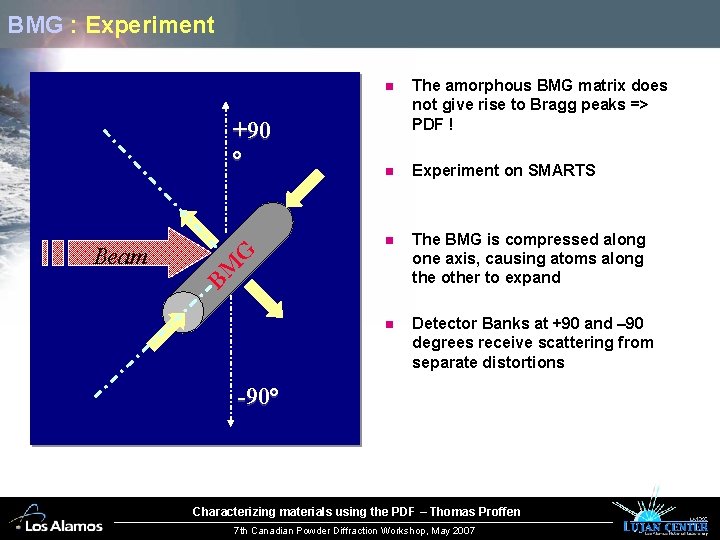
BMG : Experiment Beam The amorphous BMG matrix does not give rise to Bragg peaks => PDF ! n Experiment on SMARTS n The BMG is compressed along one axis, causing atoms along the other to expand n Detector Banks at +90 and – 90 degrees receive scattering from separate distortions BM G +90 ° n -90° Characterizing materials using the PDF – Thomas Proffen 7 th Canadian Powder Diffraction Workshop, May 2007
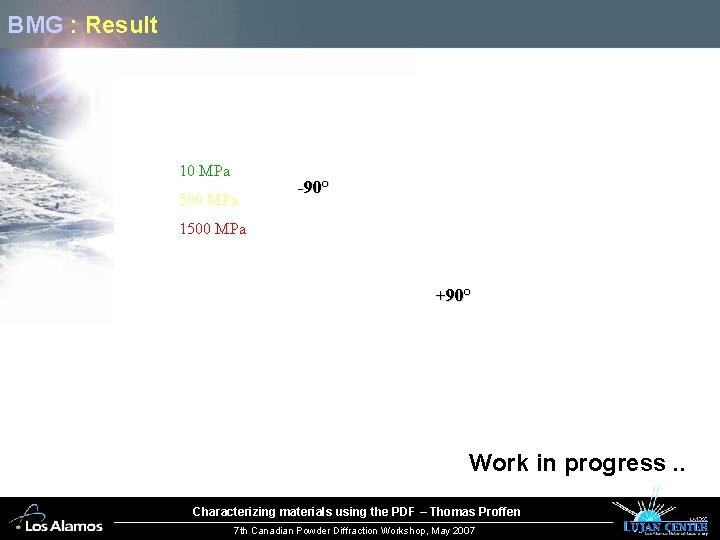
BMG : Result 10 MPa 500 MPa -90° 1500 MPa +90° Work in progress. . Characterizing materials using the PDF – Thomas Proffen 7 th Canadian Powder Diffraction Workshop, May 2007
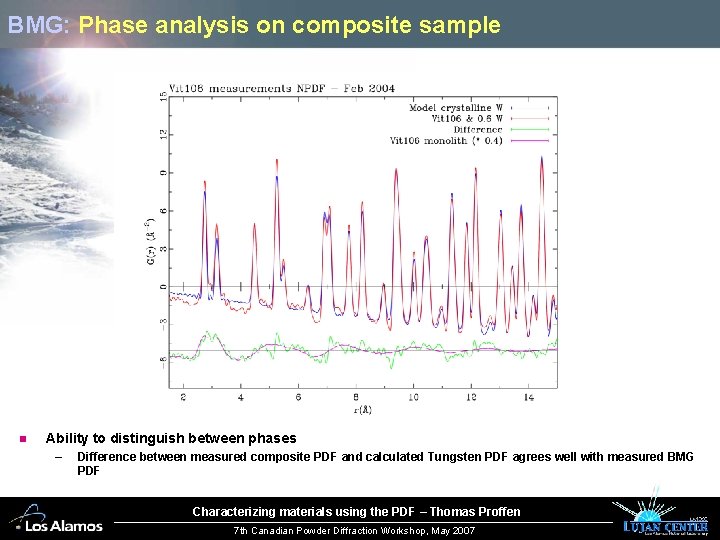
BMG: Phase analysis on composite sample n Ability to distinguish between phases – Difference between measured composite PDF and calculated Tungsten PDF agrees well with measured BMG PDF Characterizing materials using the PDF – Thomas Proffen 7 th Canadian Powder Diffraction Workshop, May 2007
Summary and more information n Analysis of total scattering gives valuable insight in structure properties relationship n High-resolution instruments open the door to medium-range order investigations n Obtain structural information from disordered crystalline, amorphous of composite materials n Fast powder measurements allow systematic exploration of local structure as function of T, x, P http: //www. totalscattering. org Characterizing materials using the PDF – Thomas Proffen 7 th Canadian Powder Diffraction Workshop, May 2007