CHAPTER 3 THE GROWTH OF A YOUNG NATION
- Slides: 54
CHAPTER 3: THE GROWTH OF A YOUNG NATION AMERICA EXPANDS IN THE FIRST HALF OF THE 19 TH CENTURY
I CAN… I can discuss the different reasons and methods for Americans moving west ●I can evaluate the impact of the belief of Manifest Destiny on Americans wanting to move west ●I can compare and contrast the accomplishments of several presidents ●I can connect how the technology of the time affected American lives ●
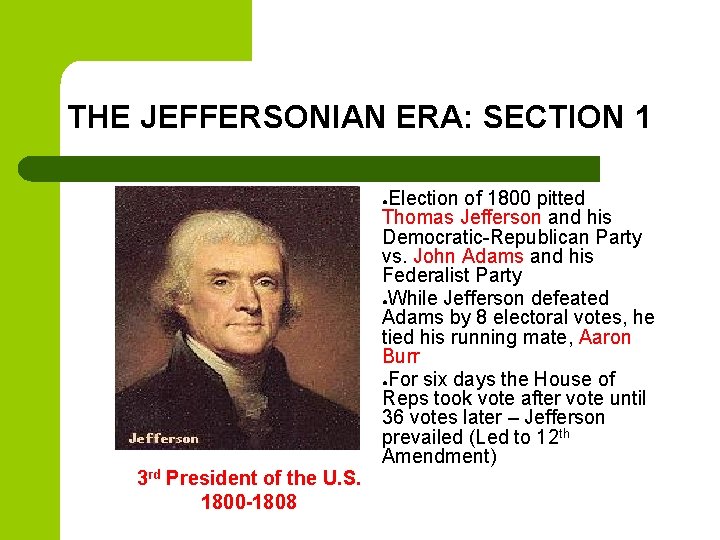
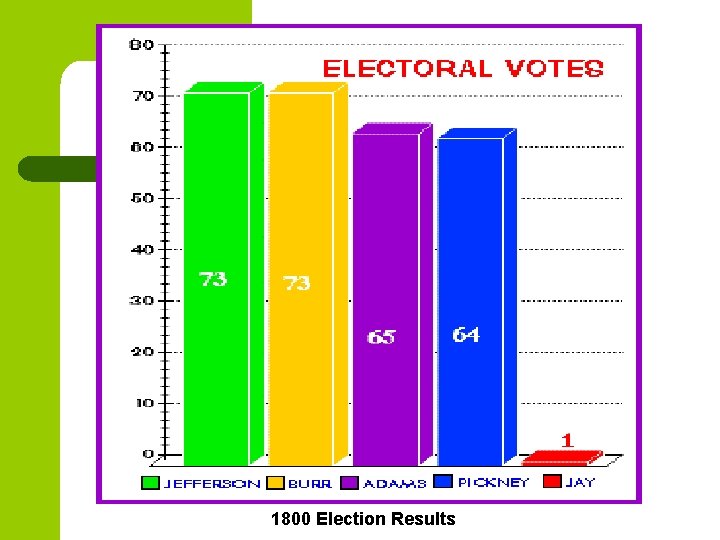
THE JEFFERSONIAN ERA: SECTION 1 Election of 1800 pitted Thomas Jefferson and his Democratic-Republican Party vs. John Adams and his Federalist Party ●While Jefferson defeated Adams by 8 electoral votes, he tied his running mate, Aaron Burr ●For six days the House of Reps took vote after vote until 36 votes later – Jefferson prevailed (Led to 12 th Amendment) ● 3 rd President of the U. S. 1800 -1808
1800 Election Results
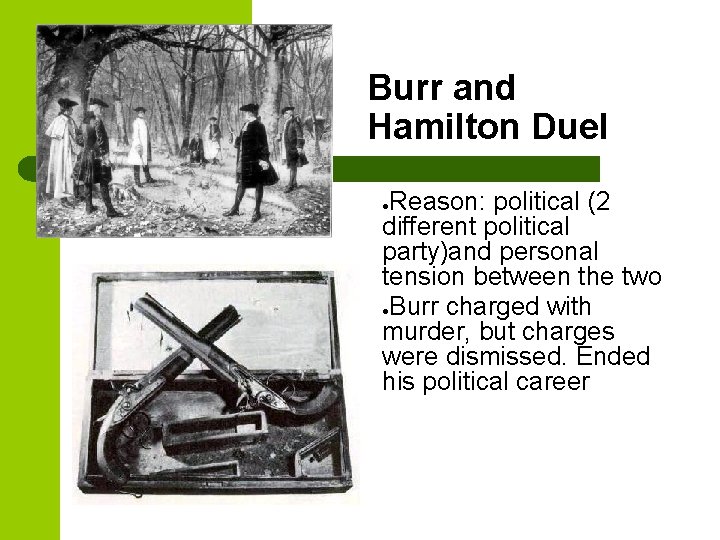
Burr and Hamilton Duel Reason: political (2 different political party)and personal tension between the two ●Burr charged with murder, but charges were dismissed. Ended his political career ●
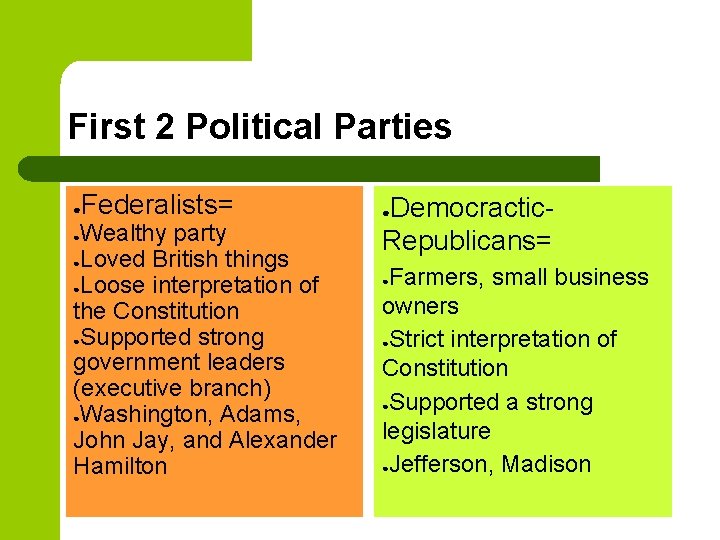
First 2 Political Parties ● Federalists= Wealthy party ●Loved British things ●Loose interpretation of the Constitution ●Supported strong government leaders (executive branch) ●Washington, Adams, John Jay, and Alexander Hamilton ● Democractic. Republicans= ● Farmers, small business owners ●Strict interpretation of Constitution ●Supported a strong legislature ●Jefferson, Madison ●
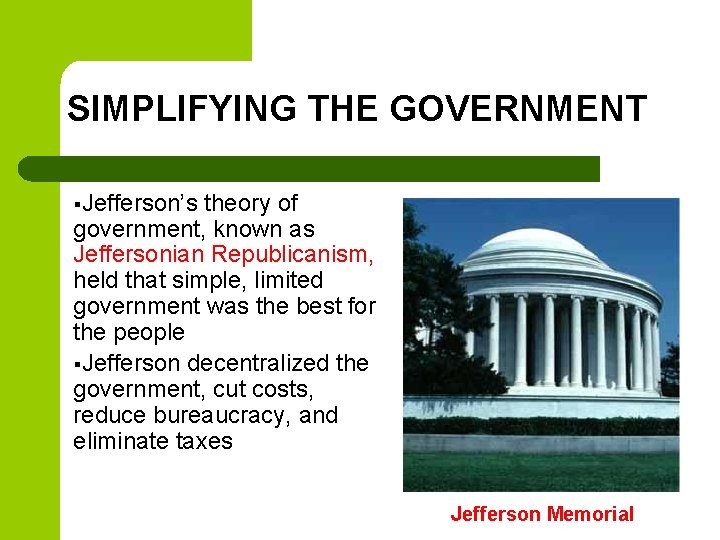
SIMPLIFYING THE GOVERNMENT §Jefferson’s theory of government, known as Jeffersonian Republicanism, held that simple, limited government was the best for the people §Jefferson decentralized the government, cut costs, reduce bureaucracy, and eliminate taxes Jefferson Memorial
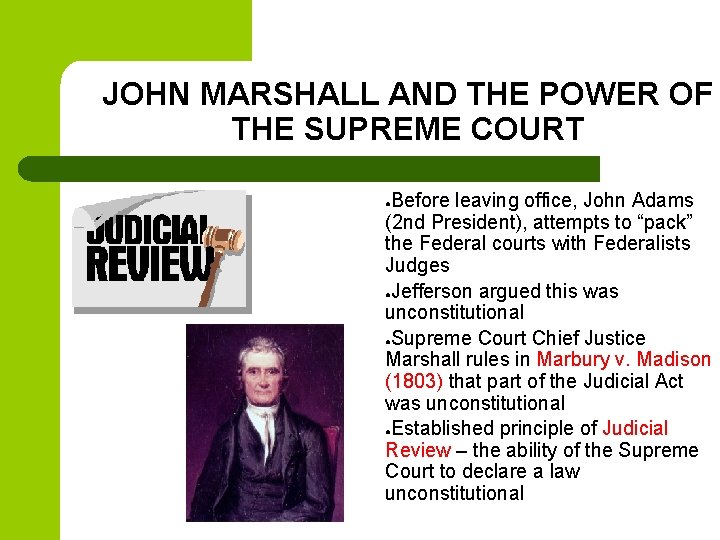
JOHN MARSHALL AND THE POWER OF THE SUPREME COURT Before leaving office, John Adams (2 nd President), attempts to “pack” the Federal courts with Federalists Judges ●Jefferson argued this was unconstitutional ●Supreme Court Chief Justice Marshall rules in Marbury v. Madison (1803) that part of the Judicial Act was unconstitutional ●Established principle of Judicial Review – the ability of the Supreme Court to declare a law unconstitutional ●
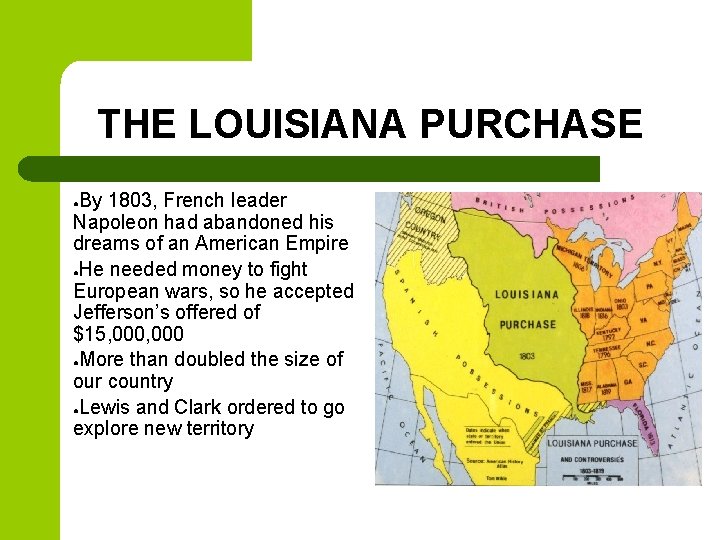
THE LOUISIANA PURCHASE By 1803, French leader Napoleon had abandoned his dreams of an American Empire ●He needed money to fight European wars, so he accepted Jefferson’s offered of $15, 000 ●More than doubled the size of our country ●Lewis and Clark ordered to go explore new territory ●
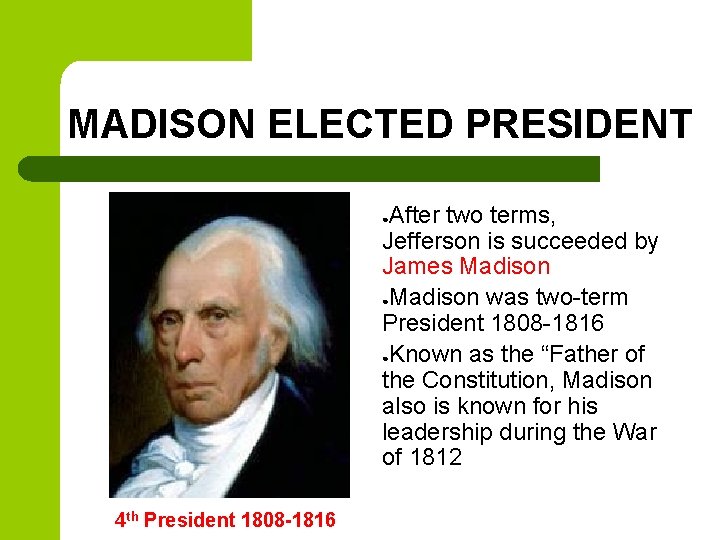
MADISON ELECTED PRESIDENT After two terms, Jefferson is succeeded by James Madison ●Madison was two-term President 1808 -1816 ●Known as the “Father of the Constitution, Madison also is known for his leadership during the War of 1812 ● 4 th President 1808 -1816
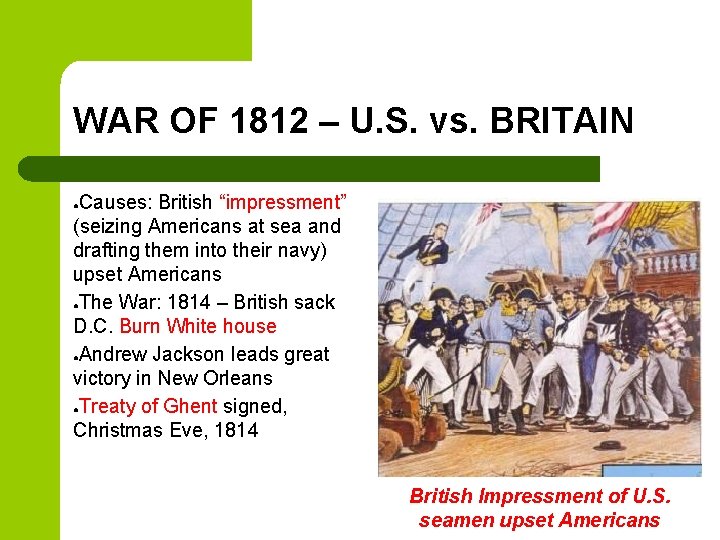
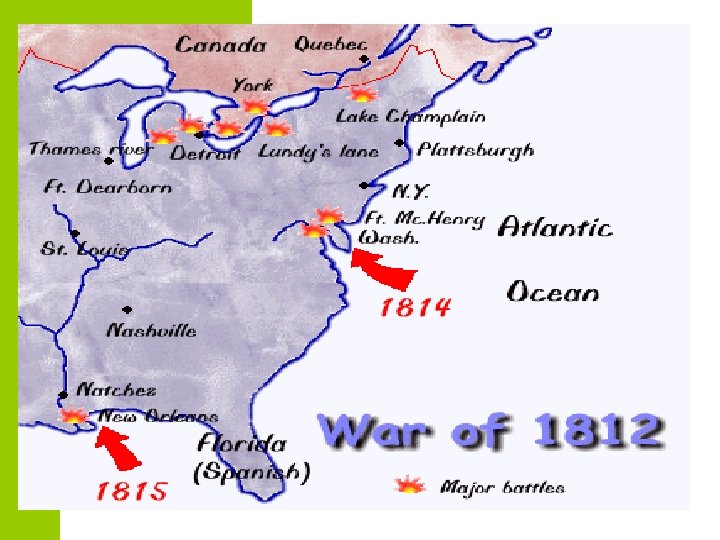
WAR OF 1812 – U. S. vs. BRITAIN Causes: British “impressment” (seizing Americans at sea and drafting them into their navy) upset Americans ●The War: 1814 – British sack D. C. Burn White house ●Andrew Jackson leads great victory in New Orleans ●Treaty of Ghent signed, Christmas Eve, 1814 ● British Impressment of U. S. seamen upset Americans
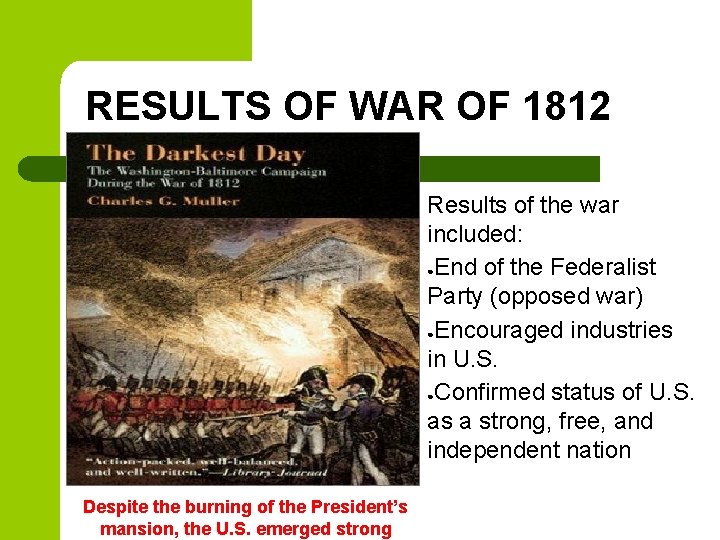
RESULTS OF WAR OF 1812 Results of the war included: ●End of the Federalist Party (opposed war) ●Encouraged industries in U. S. ●Confirmed status of U. S. as a strong, free, and independent nation Despite the burning of the President’s mansion, the U. S. emerged strong
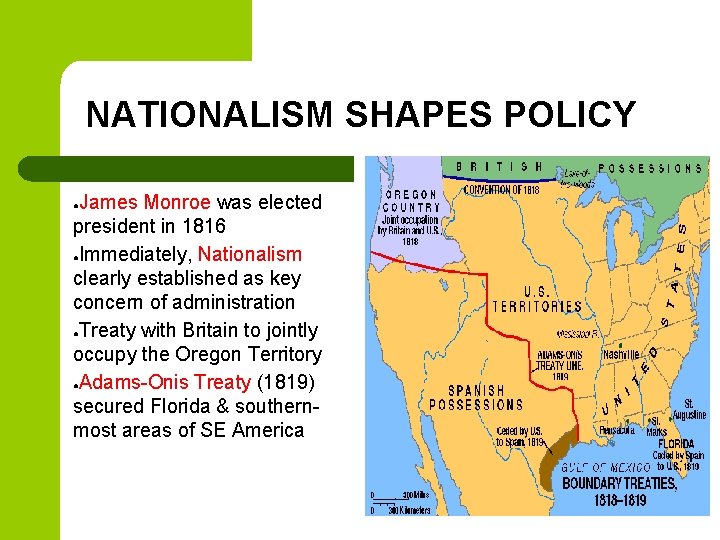
NATIONALISM SHAPES POLICY James Monroe was elected president in 1816 ●Immediately, Nationalism clearly established as key concern of administration ●Treaty with Britain to jointly occupy the Oregon Territory ●Adams-Onis Treaty (1819) secured Florida & southernmost areas of SE America ●
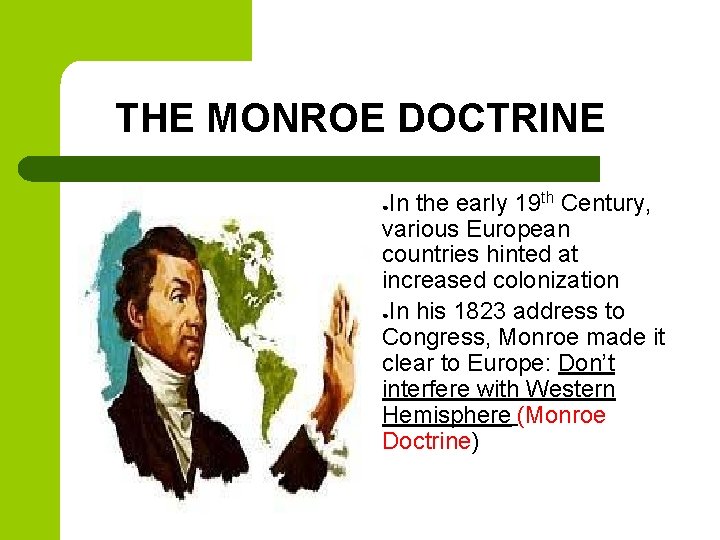
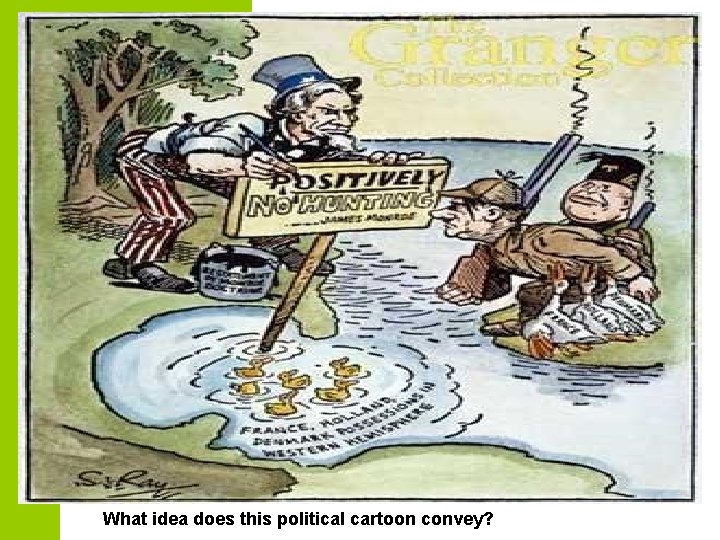
THE MONROE DOCTRINE In the early 19 th Century, various European countries hinted at increased colonization ●In his 1823 address to Congress, Monroe made it clear to Europe: Don’t interfere with Western Hemisphere (Monroe Doctrine) ●
What idea does this political cartoon convey?
Review Quiz: ●The War of 1812 began because of impressment. What is this? ●Do you believe in the Monroe Doctrine? Why or why not? ●Who are the first 5 Presidents (in order)? EC: Who wrote the National Anthem?
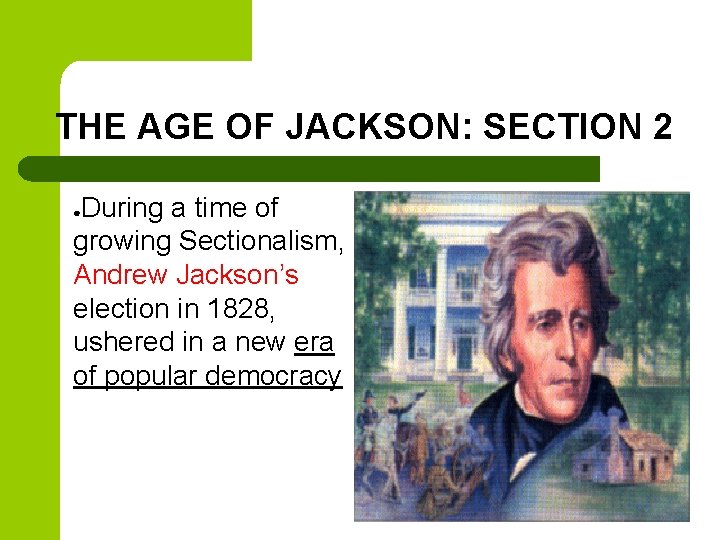
THE AGE OF JACKSON: SECTION 2 During a time of growing Sectionalism, Andrew Jackson’s election in 1828, ushered in a new era of popular democracy ●
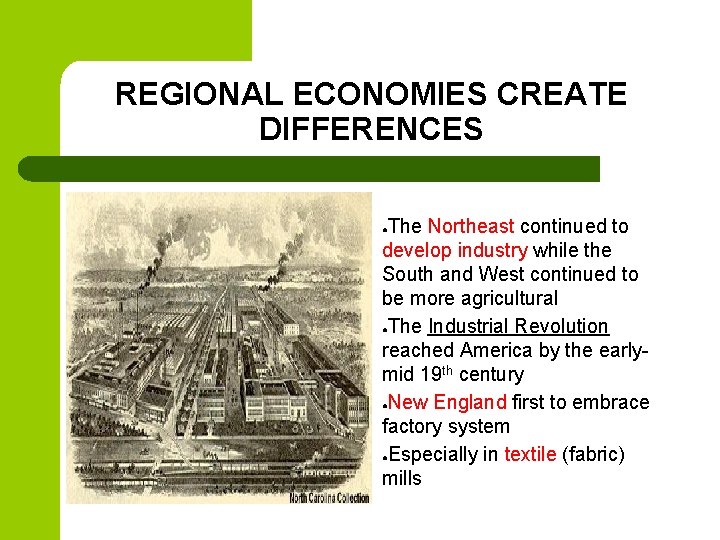
REGIONAL ECONOMIES CREATE DIFFERENCES The Northeast continued to develop industry while the South and West continued to be more agricultural ●The Industrial Revolution reached America by the earlymid 19 th century ●New England first to embrace factory system ●Especially in textile (fabric) mills ●
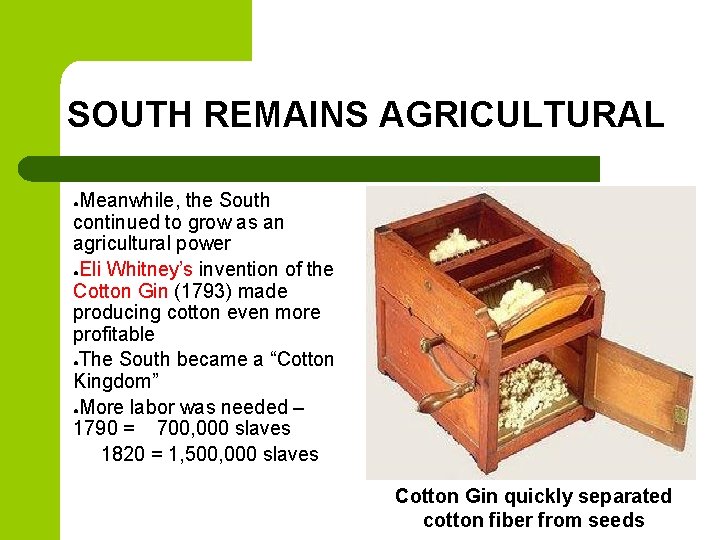
SOUTH REMAINS AGRICULTURAL Meanwhile, the South continued to grow as an agricultural power ●Eli Whitney’s invention of the Cotton Gin (1793) made producing cotton even more profitable ●The South became a “Cotton Kingdom” ●More labor was needed – 1790 = 700, 000 slaves 1820 = 1, 500, 000 slaves ● Cotton Gin quickly separated cotton fiber from seeds
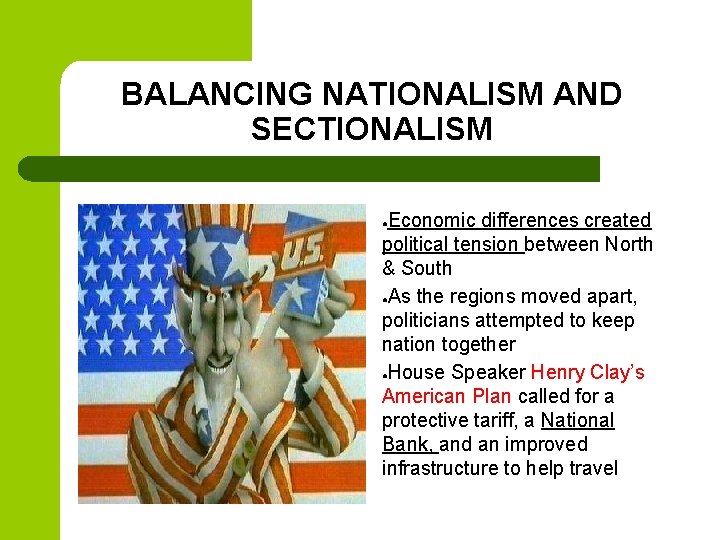
BALANCING NATIONALISM AND SECTIONALISM Economic differences created political tension between North & South ●As the regions moved apart, politicians attempted to keep nation together ●House Speaker Henry Clay’s American Plan called for a protective tariff, a National Bank, and an improved infrastructure to help travel ●
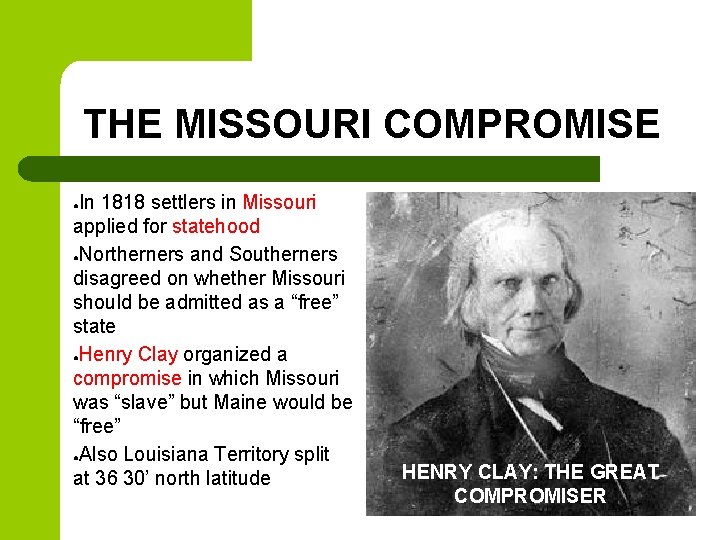
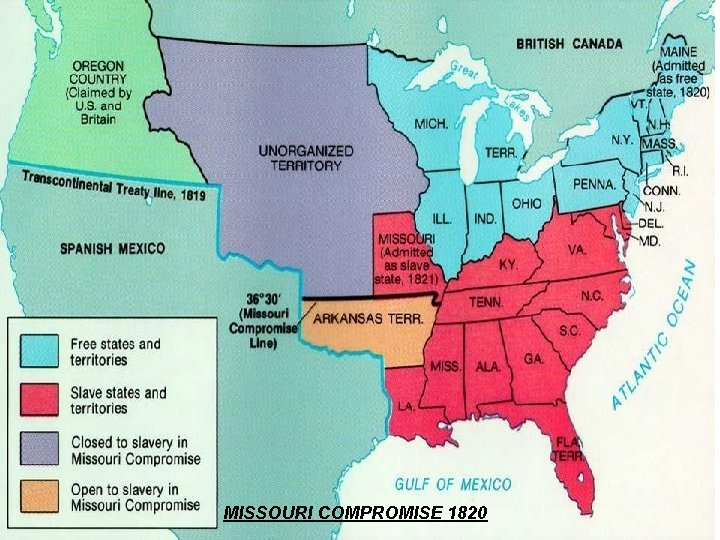
THE MISSOURI COMPROMISE In 1818 settlers in Missouri applied for statehood ●Northerners and Southerners disagreed on whether Missouri should be admitted as a “free” state ●Henry Clay organized a compromise in which Missouri was “slave” but Maine would be “free” ●Also Louisiana Territory split at 36 30’ north latitude ● HENRY CLAY: THE GREAT COMPROMISER
MISSOURI COMPROMISE 1820
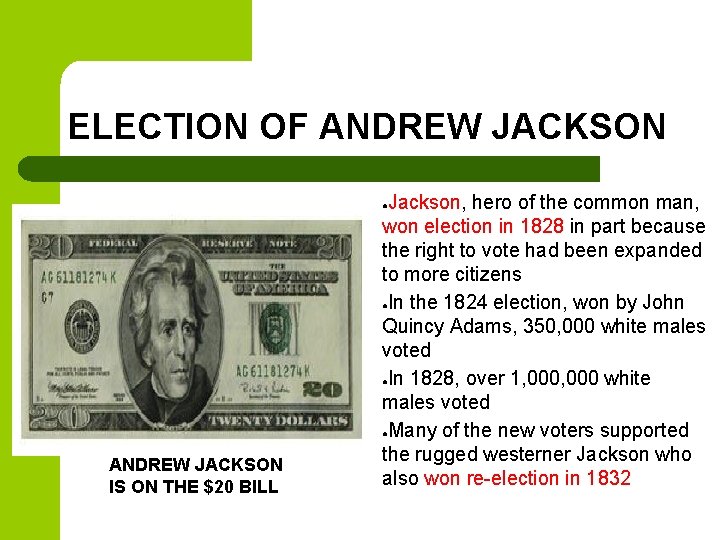
ELECTION OF ANDREW JACKSON Jackson, hero of the common man, won election in 1828 in part because the right to vote had been expanded to more citizens ●In the 1824 election, won by John Quincy Adams, 350, 000 white males voted ●In 1828, over 1, 000 white males voted ●Many of the new voters supported the rugged westerner Jackson who also won re-election in 1832 ● ANDREW JACKSON IS ON THE $20 BILL
JACKSONIAN DEMOCRACY As part of his political philosophy, Jackson sought to grant political power to the common people ●Called The Spoils System or Jacksonian Democracy, Jackson hired his own supporters to replace the previous administration’s staff ●Jackson gave away many jobs to his friends and political allies ●
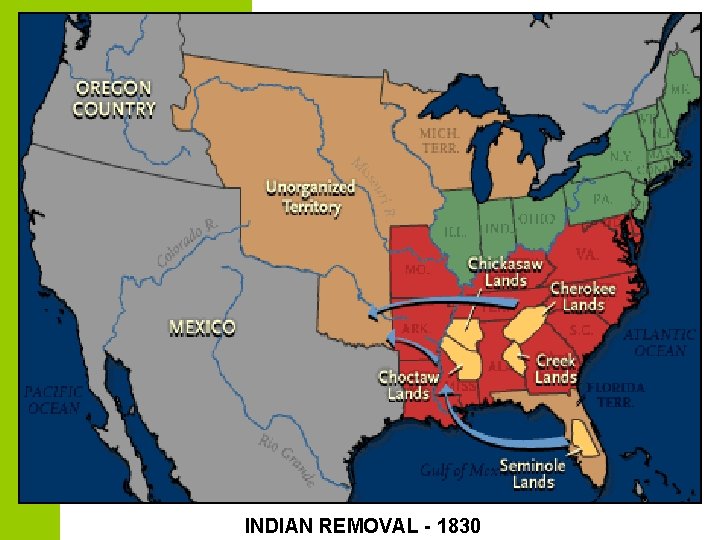
INDIAN REMOVAL ACT - 1830 Congress, with Jackson’s support, passed the Indian Removal Act in 1830 ●Under this law, the federal government funded treaties that forced tribes west ●The Cherokee Tribe in Georgia refused and were supported by the Supreme Court ●Jackson refused to abide by the Court decision ●Jackson said, “John Marshall (Supreme Court Chief Justice) has made his decision, now let him enforce it. ” ●Trail of Tears followed the Court ruling as U. S. troops rounded up the Cherokee and drove them west, mostly on foot. . . thousands died ●
INDIAN REMOVAL - 1830
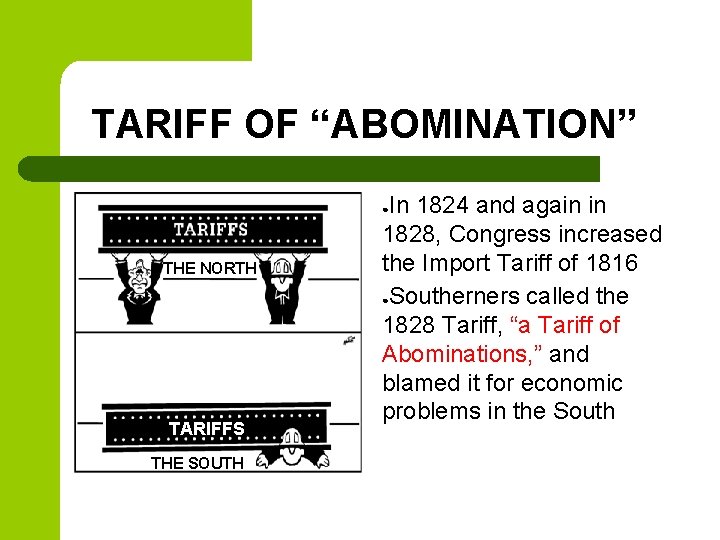
TARIFF OF “ABOMINATION” In 1824 and again in 1828, Congress increased the Import Tariff of 1816 ●Southerners called the 1828 Tariff, “a Tariff of Abominations, ” and blamed it for economic problems in the South ● THE NORTH TARIFFS THE SOUTH
NULLIFICATION THREAT In an attempt to free South Carolina from the tariff, John Calhoun (Jackson’s VP from S. C. ), developed the Theory of Nullification ●He believed if a state found an act of Congress to be unconstitutional, it could declare the law void within its borders ●Tensions only relieved by a Clay Compromise Tariff in 1833 ●
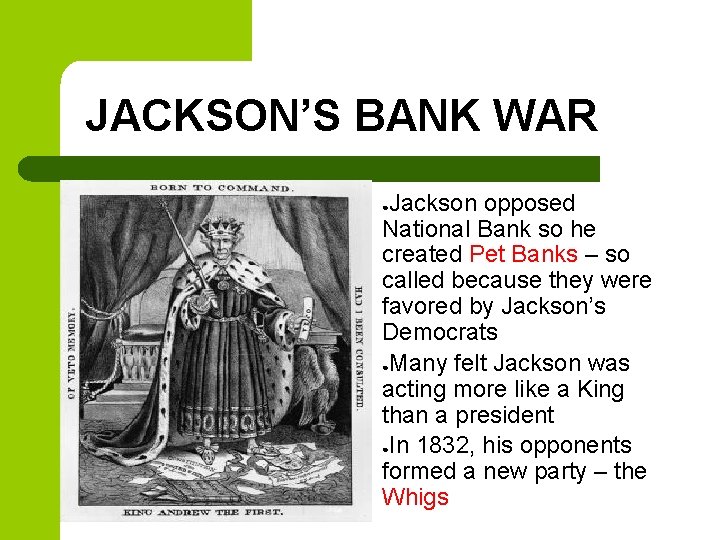
JACKSON’S BANK WAR Jackson opposed National Bank so he created Pet Banks – so called because they were favored by Jackson’s Democrats ●Many felt Jackson was acting more like a King than a president ●In 1832, his opponents formed a new party – the Whigs ●
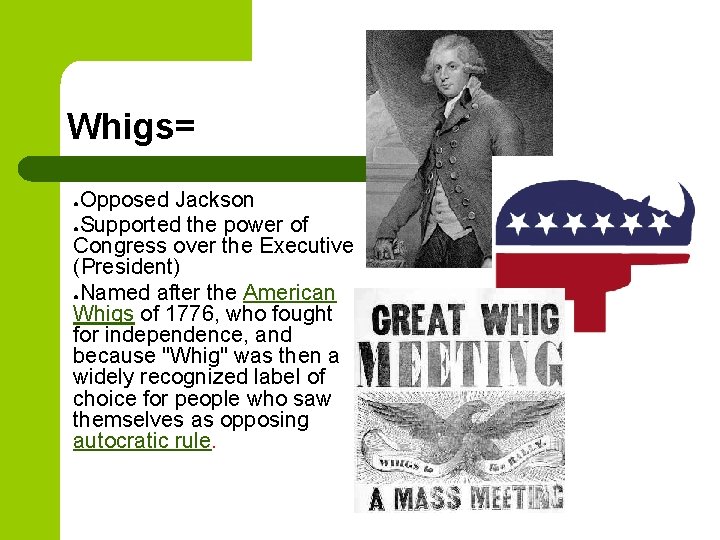
Whigs= Opposed Jackson ●Supported the power of Congress over the Executive (President) ●Named after the American Whigs of 1776, who fought for independence, and because "Whig" was then a widely recognized label of choice for people who saw themselves as opposing autocratic rule. ●
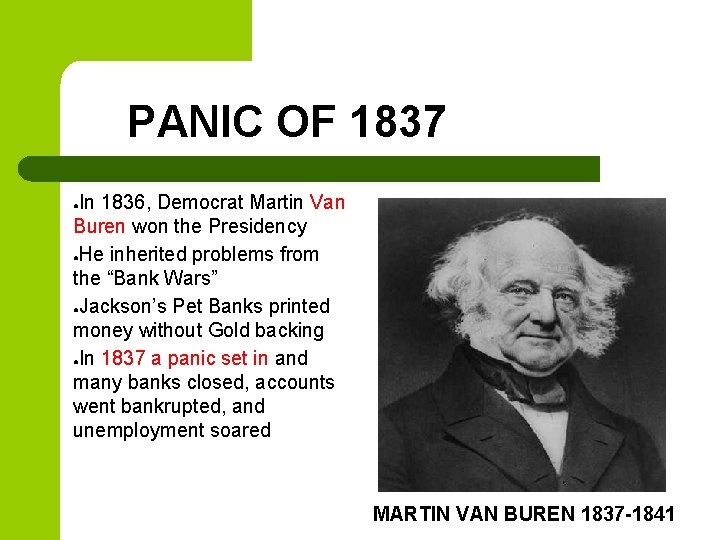
PANIC OF 1837 In 1836, Democrat Martin Van Buren won the Presidency ●He inherited problems from the “Bank Wars” ●Jackson’s Pet Banks printed money without Gold backing ●In 1837 a panic set in and many banks closed, accounts went bankrupted, and unemployment soared ● MARTIN VAN BUREN 1837 -1841
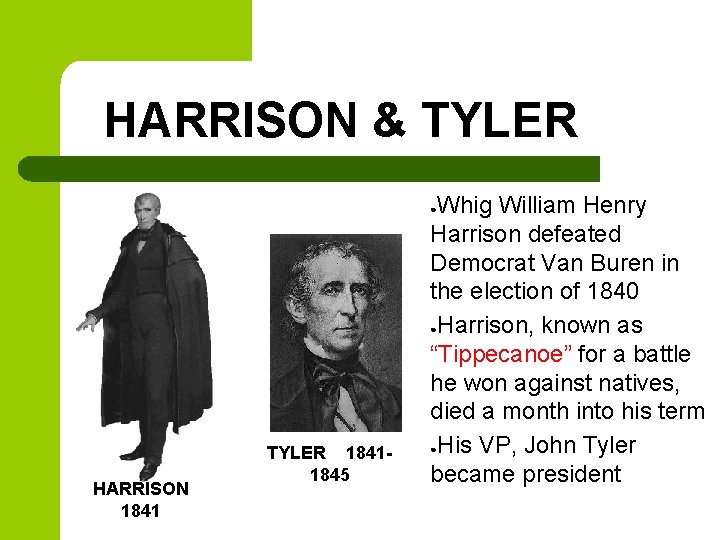
HARRISON & TYLER Whig William Henry Harrison defeated Democrat Van Buren in the election of 1840 ●Harrison, known as “Tippecanoe” for a battle he won against natives, died a month into his term ●His VP, John Tyler became president ● HARRISON 1841 TYLER 18411845
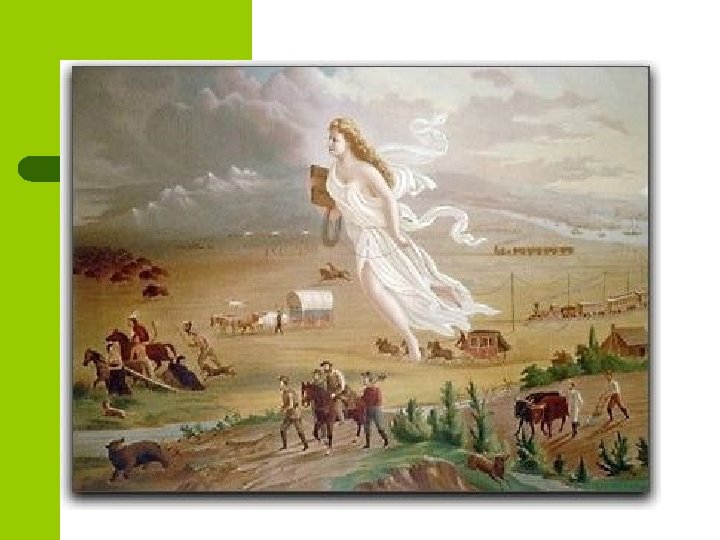
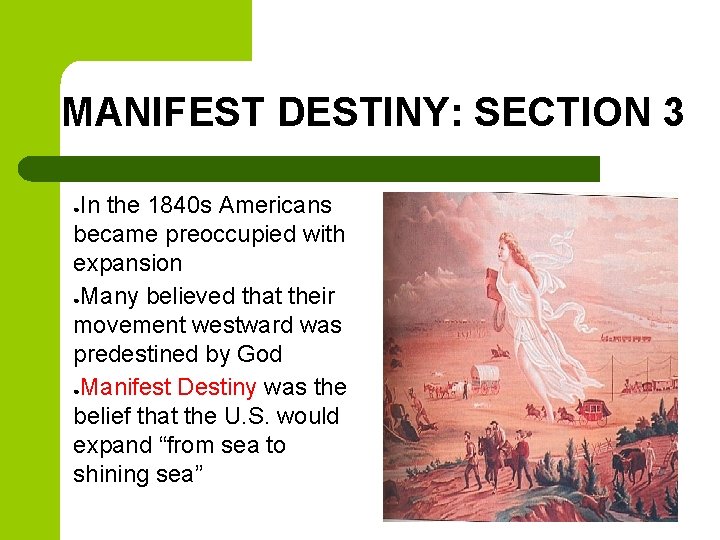
MANIFEST DESTINY: SECTION 3 In the 1840 s Americans became preoccupied with expansion ●Many believed that their movement westward was predestined by God ●Manifest Destiny was the belief that the U. S. would expand “from sea to shining sea” ●
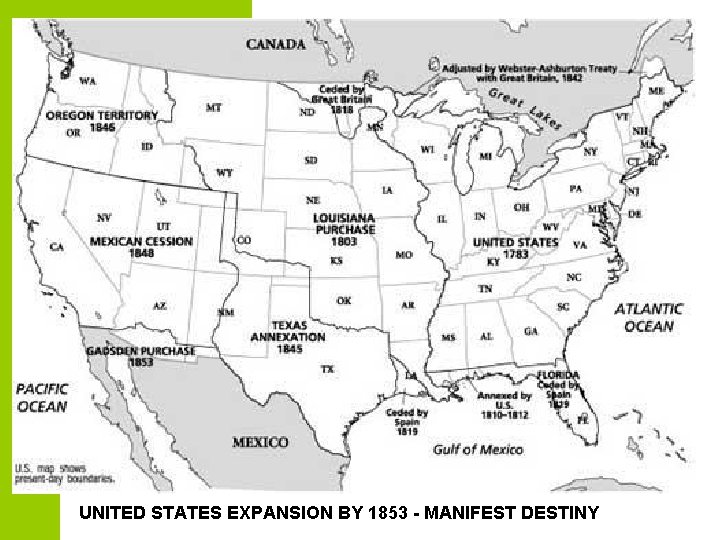
UNITED STATES EXPANSION BY 1853 - MANIFEST DESTINY
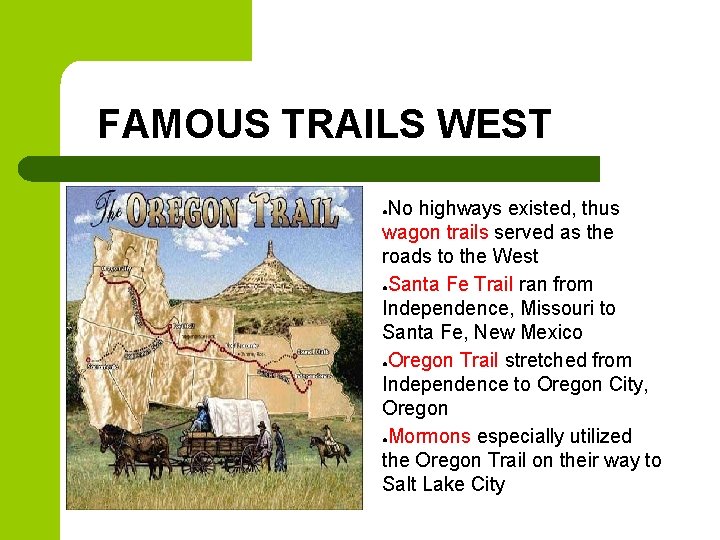
FAMOUS TRAILS WEST No highways existed, thus wagon trails served as the roads to the West ●Santa Fe Trail ran from Independence, Missouri to Santa Fe, New Mexico ●Oregon Trail stretched from Independence to Oregon City, Oregon ●Mormons especially utilized the Oregon Trail on their way to Salt Lake City ●
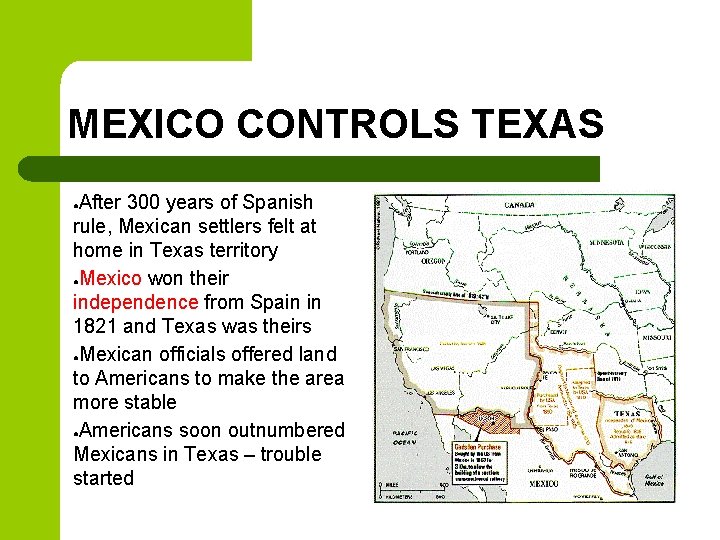
MEXICO CONTROLS TEXAS After 300 years of Spanish rule, Mexican settlers felt at home in Texas territory ●Mexico won their independence from Spain in 1821 and Texas was theirs ●Mexican officials offered land to Americans to make the area more stable ●Americans soon outnumbered Mexicans in Texas – trouble started ●
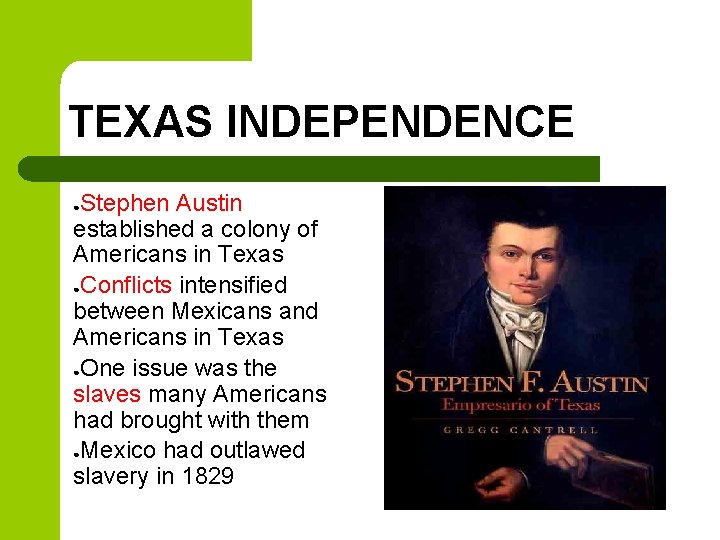
TEXAS INDEPENDENCE Stephen Austin established a colony of Americans in Texas ●Conflicts intensified between Mexicans and Americans in Texas ●One issue was the slaves many Americans had brought with them ●Mexico had outlawed slavery in 1829 ●
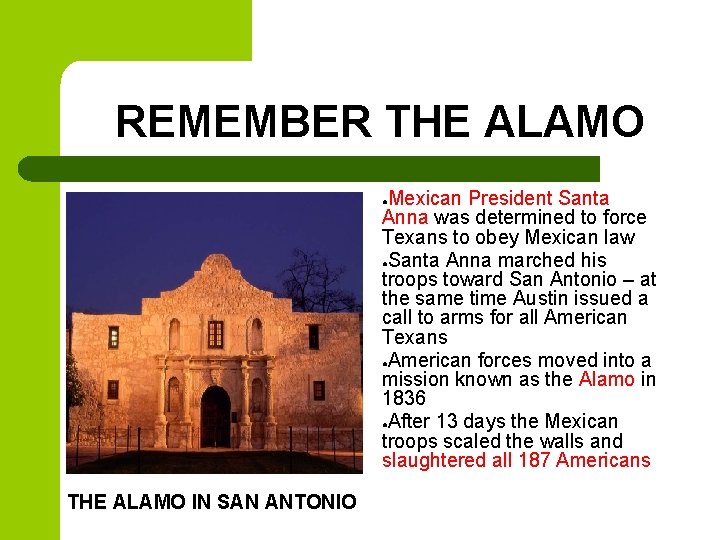
REMEMBER THE ALAMO Mexican President Santa Anna was determined to force Texans to obey Mexican law ●Santa Anna marched his troops toward San Antonio – at the same time Austin issued a call to arms for all American Texans ●American forces moved into a mission known as the Alamo in 1836 ●After 13 days the Mexican troops scaled the walls and slaughtered all 187 Americans ● THE ALAMO IN SAN ANTONIO
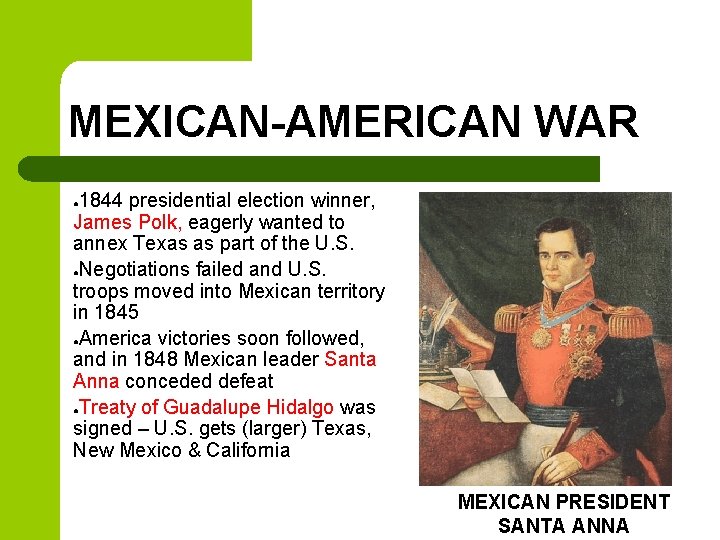
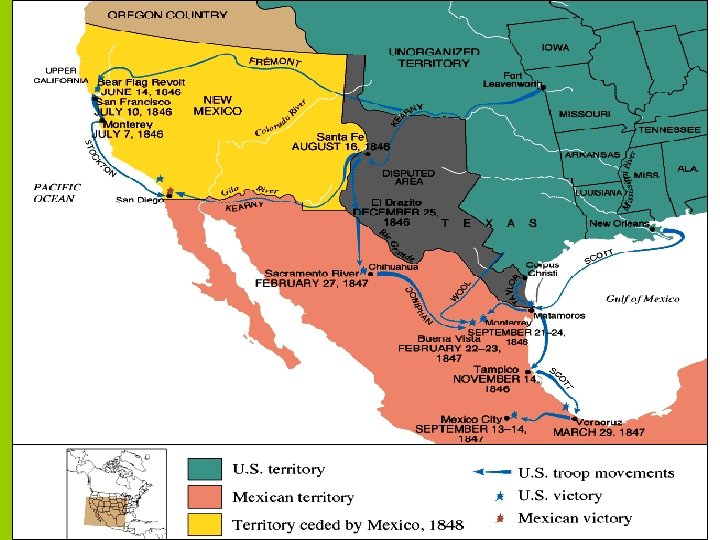
MEXICAN-AMERICAN WAR 1844 presidential election winner, James Polk, eagerly wanted to annex Texas as part of the U. S. ●Negotiations failed and U. S. troops moved into Mexican territory in 1845 ●America victories soon followed, and in 1848 Mexican leader Santa Anna conceded defeat ●Treaty of Guadalupe Hidalgo was signed – U. S. gets (larger) Texas, New Mexico & California ● MEXICAN PRESIDENT SANTA ANNA
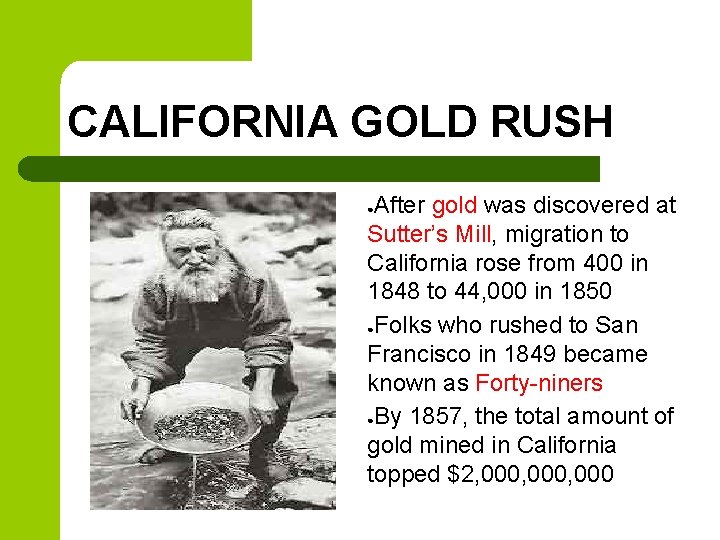
CALIFORNIA GOLD RUSH After gold was discovered at Sutter’s Mill, migration to California rose from 400 in 1848 to 44, 000 in 1850 ●Folks who rushed to San Francisco in 1849 became known as Forty-niners ●By 1857, the total amount of gold mined in California topped $2, 000, 000 ●
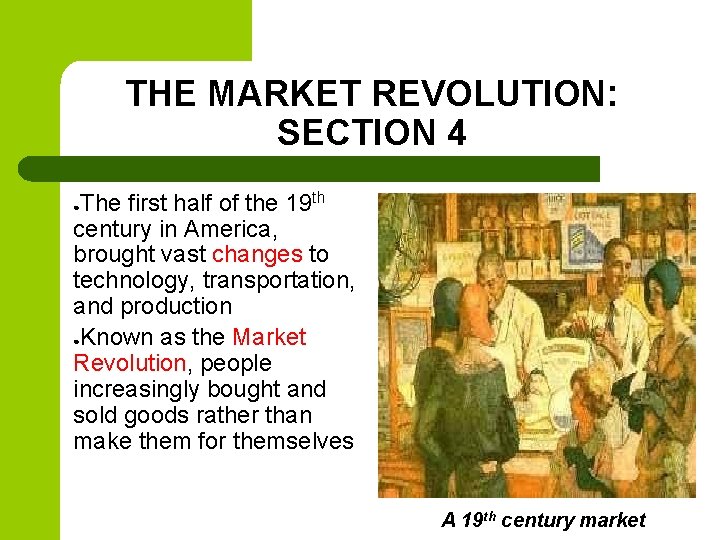
THE MARKET REVOLUTION: SECTION 4 The first half of the 19 th century in America, brought vast changes to technology, transportation, and production ●Known as the Market Revolution, people increasingly bought and sold goods rather than make them for themselves ● A 19 th century market
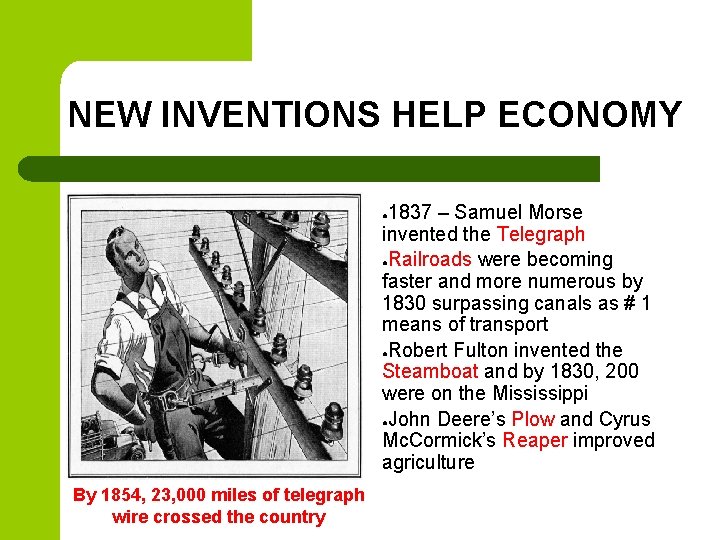
NEW INVENTIONS HELP ECONOMY 1837 – Samuel Morse invented the Telegraph ●Railroads were becoming faster and more numerous by 1830 surpassing canals as # 1 means of transport ●Robert Fulton invented the Steamboat and by 1830, 200 were on the Mississippi ●John Deere’s Plow and Cyrus Mc. Cormick’s Reaper improved agriculture ● By 1854, 23, 000 miles of telegraph wire crossed the country
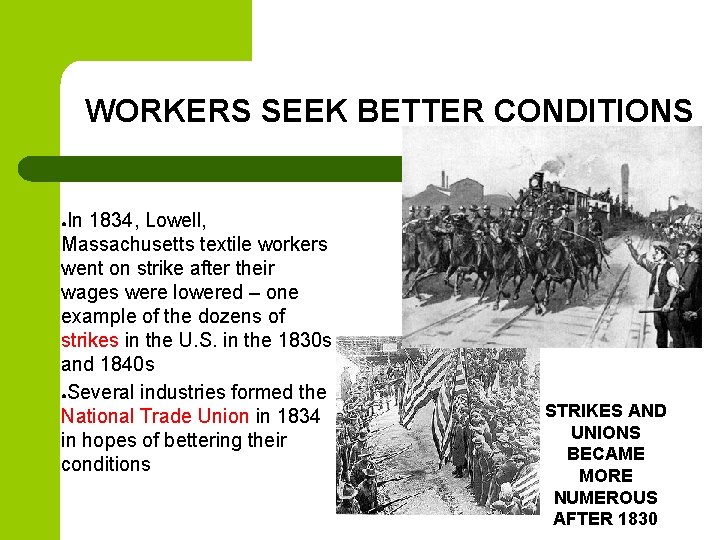
WORKERS SEEK BETTER CONDITIONS In 1834, Lowell, Massachusetts textile workers went on strike after their wages were lowered – one example of the dozens of strikes in the U. S. in the 1830 s and 1840 s ●Several industries formed the National Trade Union in 1834 in hopes of bettering their conditions ● STRIKES AND UNIONS BECAME MORE NUMEROUS AFTER 1830
Labor Strikes in the 1840’s Why were they ineffective? ● Workers were not well organized. ● Workers had little public support. ● Strikers could be easily replaced (especially by immigrants)
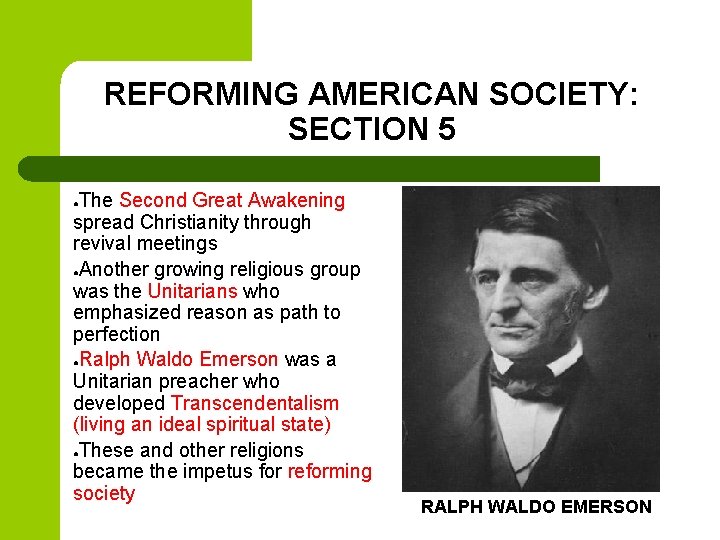
REFORMING AMERICAN SOCIETY: SECTION 5 The Second Great Awakening spread Christianity through revival meetings ●Another growing religious group was the Unitarians who emphasized reason as path to perfection ●Ralph Waldo Emerson was a Unitarian preacher who developed Transcendentalism (living an ideal spiritual state) ●These and other religions became the impetus for reforming society ● RALPH WALDO EMERSON
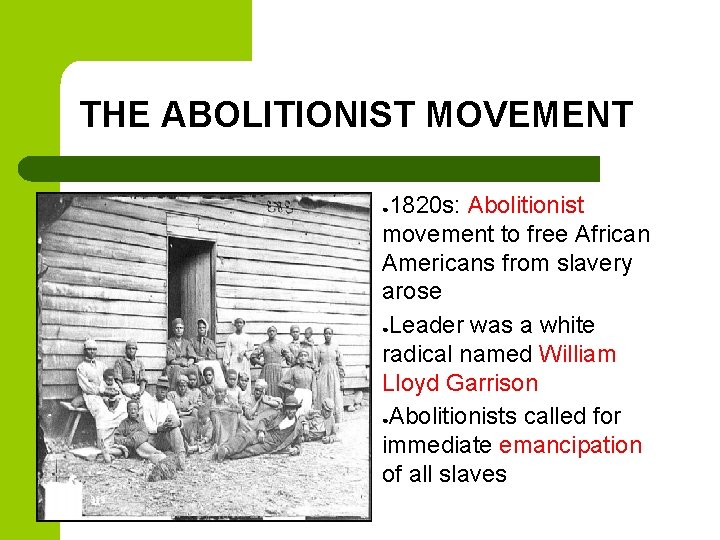
THE ABOLITIONIST MOVEMENT 1820 s: Abolitionist movement to free African Americans from slavery arose ●Leader was a white radical named William Lloyd Garrison ●Abolitionists called for immediate emancipation of all slaves ●
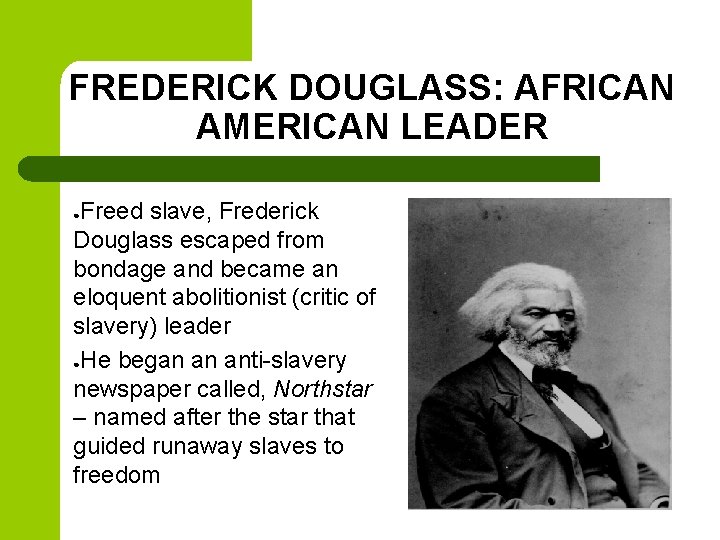
FREDERICK DOUGLASS: AFRICAN AMERICAN LEADER Freed slave, Frederick Douglass escaped from bondage and became an eloquent abolitionist (critic of slavery) leader ●He began an anti-slavery newspaper called, Northstar – named after the star that guided runaway slaves to freedom ●
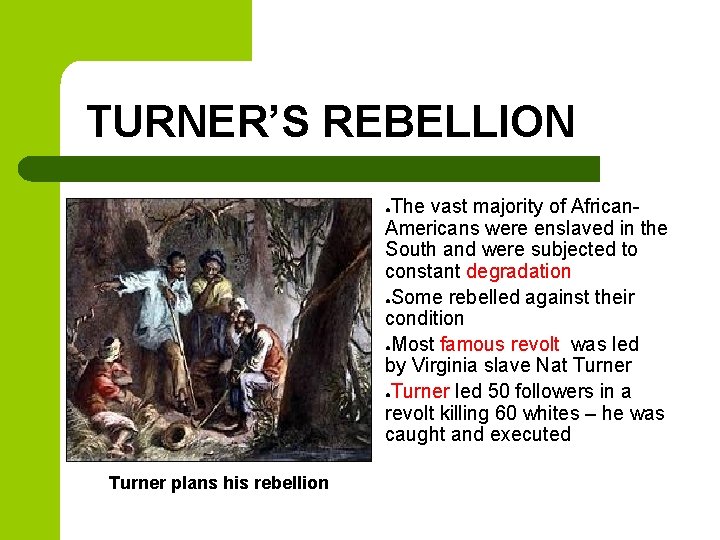
TURNER’S REBELLION The vast majority of African. Americans were enslaved in the South and were subjected to constant degradation ●Some rebelled against their condition ●Most famous revolt was led by Virginia slave Nat Turner ●Turner led 50 followers in a revolt killing 60 whites – he was caught and executed ● Turner plans his rebellion
WOMEN AND REFORM From abolition to education, women worked actively in all reform movements ●Throughout the 1800 s opportunity for women to become educated increased ● 1833: Oberlin College became first coed institution ●
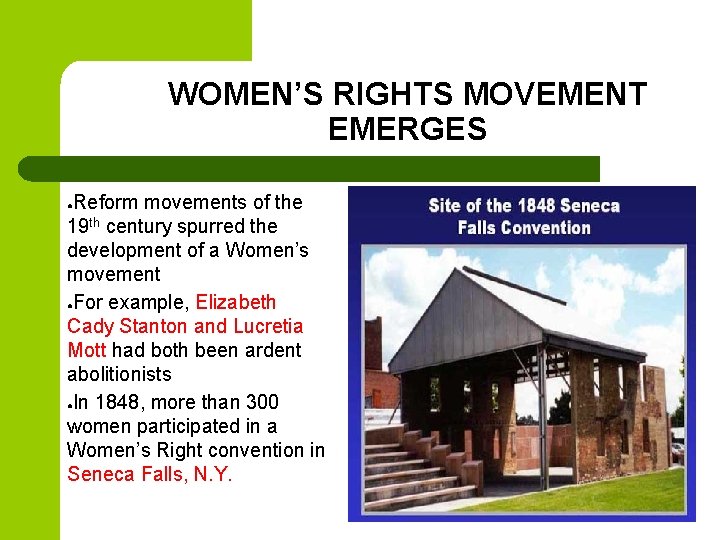
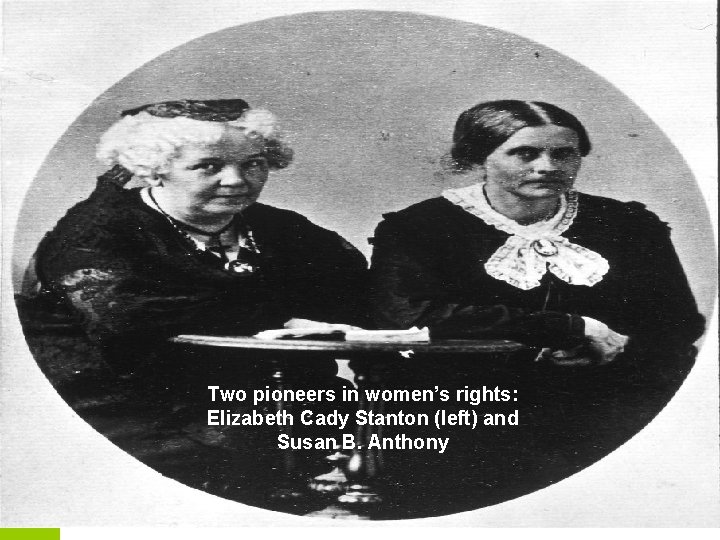
WOMEN’S RIGHTS MOVEMENT EMERGES Reform movements of the 19 th century spurred the development of a Women’s movement ●For example, Elizabeth Cady Stanton and Lucretia Mott had both been ardent abolitionists ●In 1848, more than 300 women participated in a Women’s Right convention in Seneca Falls, N. Y. ●
Two pioneers in women’s rights: Elizabeth Cady Stanton (left) and Susan B. Anthony