Chapter 17 Electrochemistry Contents Galvanic cells l Standard






- Slides: 97
Chapter 17 Electrochemistry
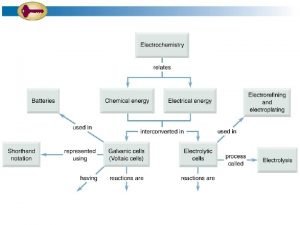
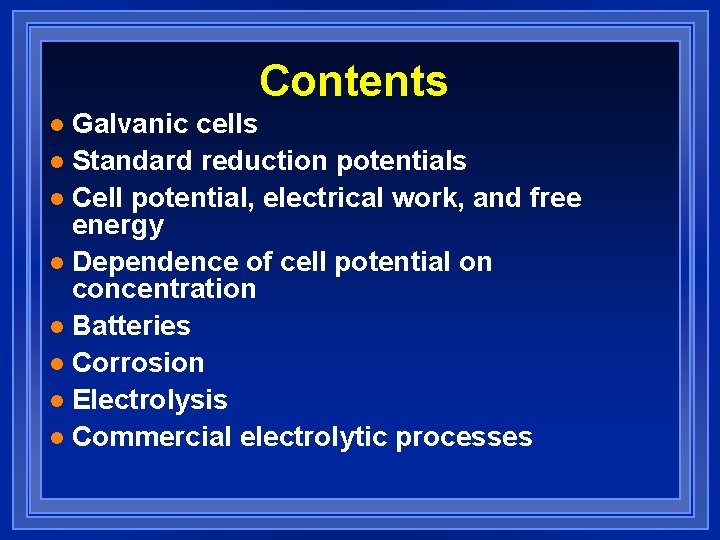
Contents Galvanic cells l Standard reduction potentials l Cell potential, electrical work, and free energy l Dependence of cell potential on concentration l Batteries l Corrosion l Electrolysis l Commercial electrolytic processes l
17. 1 Galvanic Cells Oxidation reduction reactions involve a transfer of electrons. l Oxidation Involves Loss of electrons – Increase in the oxidation number l Reduction Involves Gain electrons – Decrease in the oxidation number l
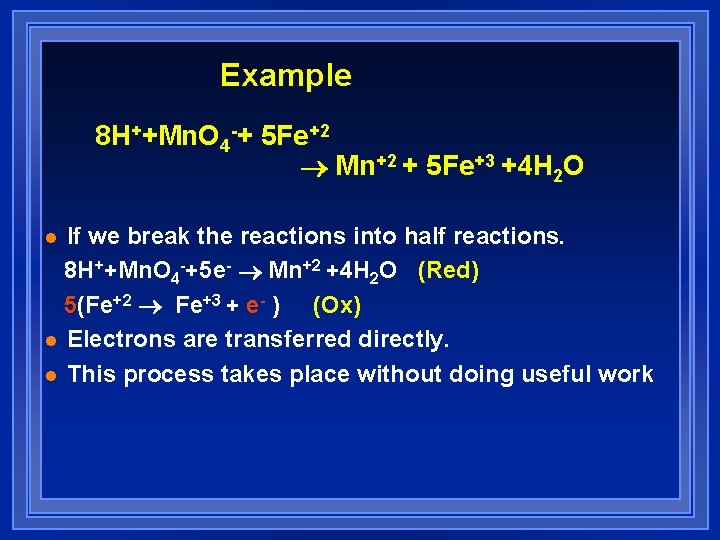
Example 8 H++Mn. O 4 -+ 5 Fe+2 Mn+2 + 5 Fe+3 +4 H 2 O If we break the reactions into half reactions. 8 H++Mn. O 4 -+5 e- Mn+2 +4 H 2 O (Red) 5(Fe 5 +2 Fe+3 + e- ) (Ox) l Electrons are transferred directly. l This process takes place without doing useful work l
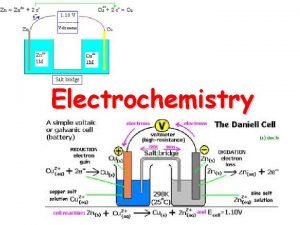
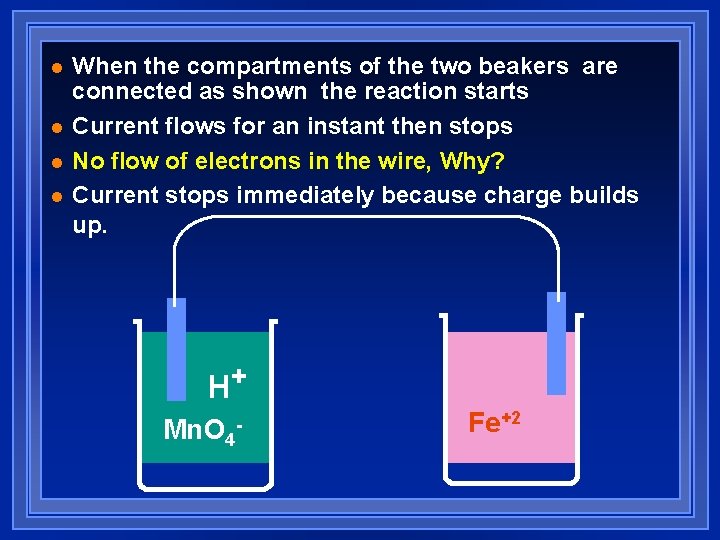
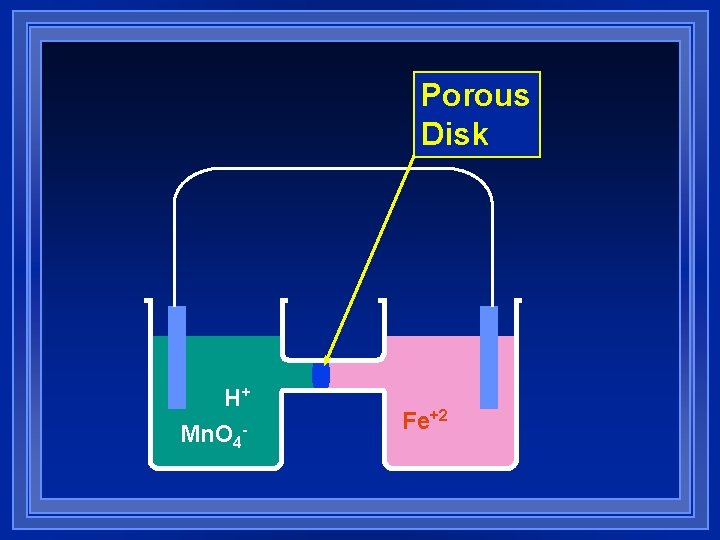
l l When the compartments of the two beakers are connected as shown the reaction starts Current flows for an instant then stops No flow of electrons in the wire, Why? Current stops immediately because charge builds up. H+ Mn. O 4 - Fe+2
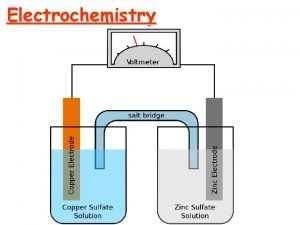
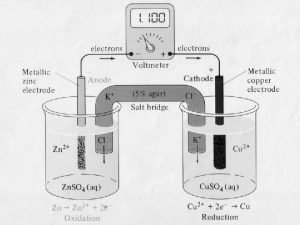
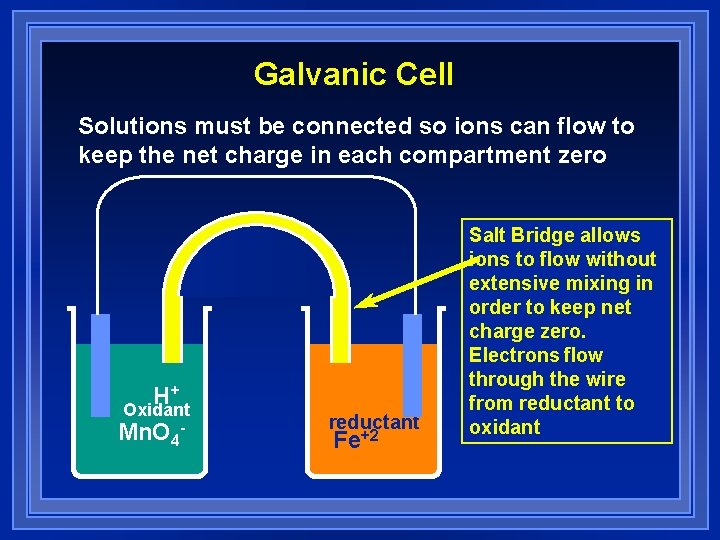
Galvanic Cell Solutions must be connected so ions can flow to keep the net charge in each compartment zero H+ Oxidant Mn. O 4 - reductant Fe+2 Salt Bridge allows ions to flow without extensive mixing in order to keep net charge zero. Electrons flow through the wire from reductant to oxidant
Porous Disk H+ Mn. O 4 - Fe+2
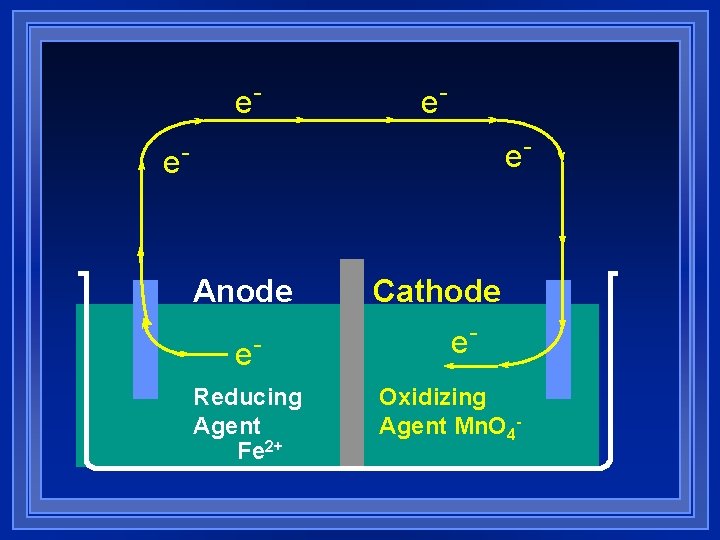
e- e- Anode e. Reducing Agent Fe 2+ Cathode e. Oxidizing Agent Mn. O 4 -
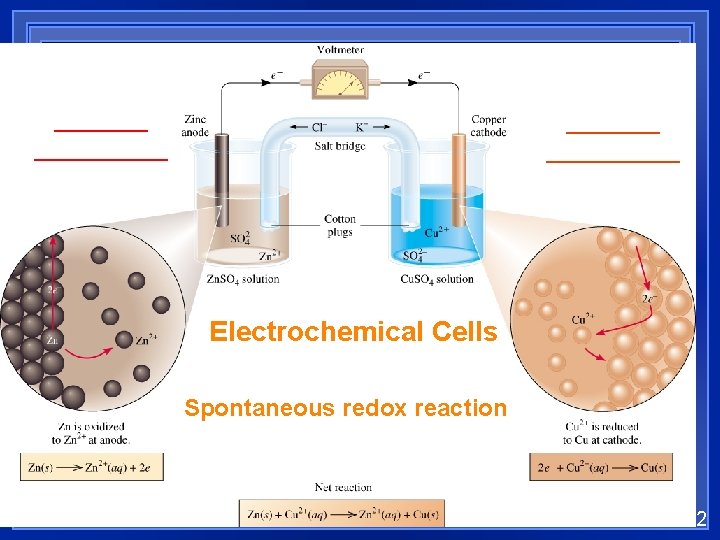
__________ Electrochemical Cells Spontaneous redox reaction 19. 2
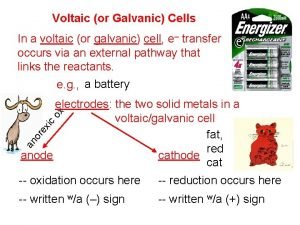
l Thus a Galvanic cell is a device in which a chemical energy is changed to electrical energy l The electrochemical reactions occur at the interface between electrode and solution where the electron transfer occurs l Anode: the electrode compartment at which oxidation occurs l Cathode: the electrode compartment at which reduction occurs
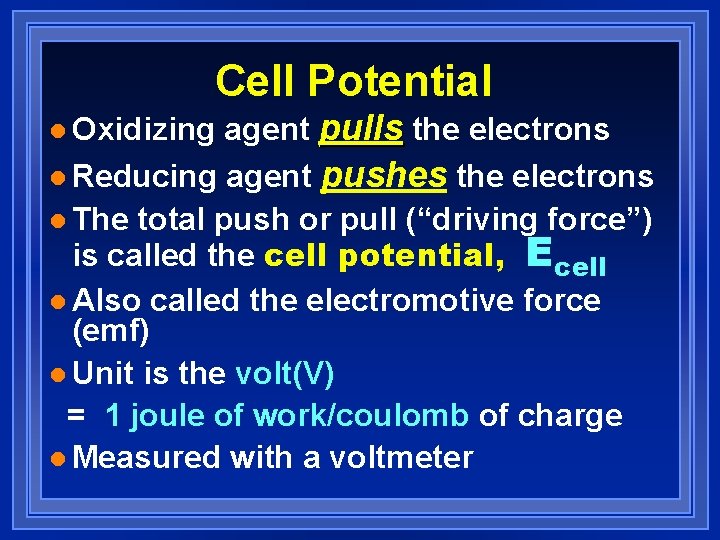
Cell Potential agent pulls the electrons l Reducing agent pushes the electrons l The total push or pull (“driving force”) is called the cell potential, Ecell l Also called the electromotive force (emf) l Unit is the volt(V) = 1 joule of work/coulomb of charge l Measured with a voltmeter l Oxidizing
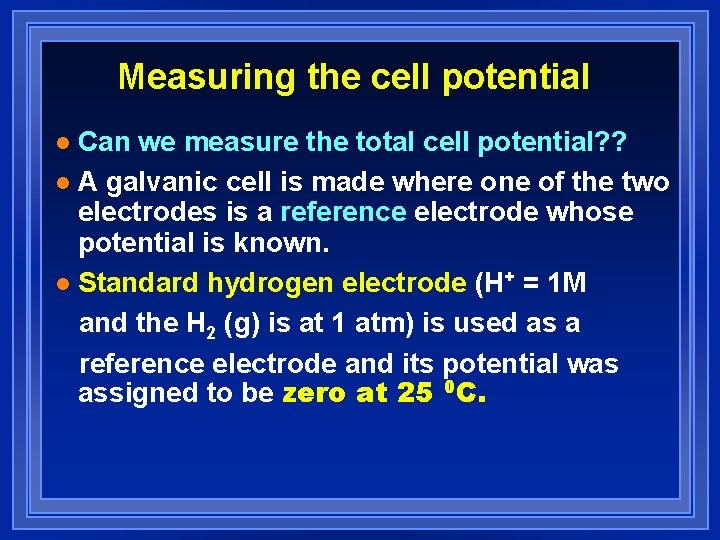
Measuring the cell potential Can we measure the total cell potential? ? l A galvanic cell is made where one of the two electrodes is a reference electrode whose potential is known. l Standard hydrogen electrode (H+ = 1 M and the H 2 (g) is at 1 atm) is used as a reference electrode and its potential was assigned to be zero at 25 0 C. l
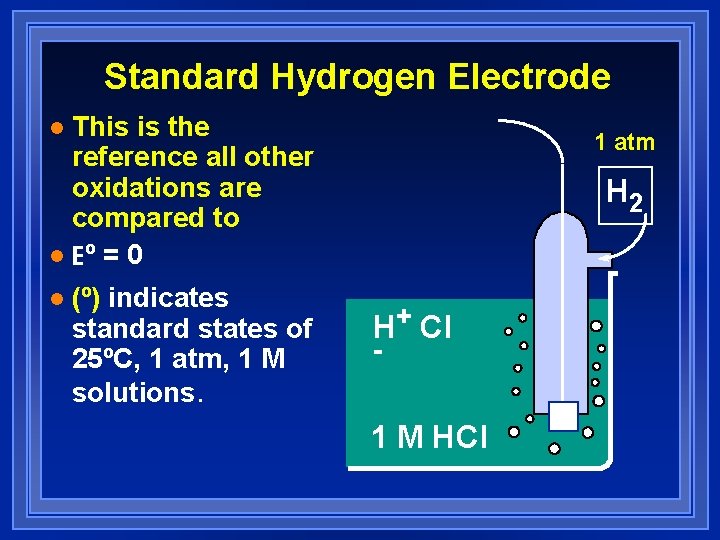
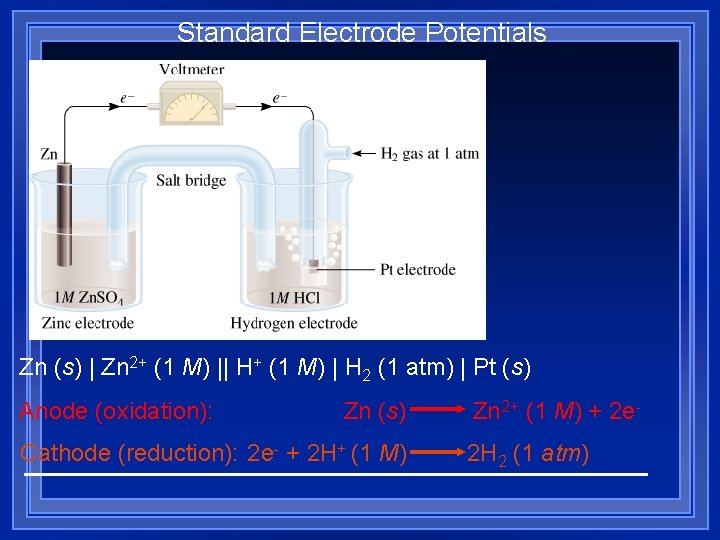
Standard Hydrogen Electrode This is the reference all other oxidations are compared to l Eº = 0 l l (º) indicates standard states of 25ºC, 1 atm, 1 M solutions. 1 atm H 2 H+ Cl - 1 M HCl
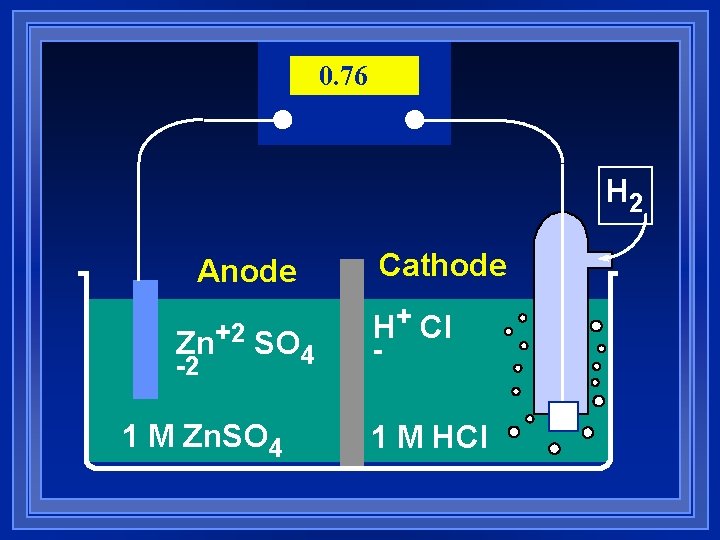
0. 76 H 2 Anode Zn+2 SO 4 -2 1 M Zn. SO 4 Cathode H+ Cl - 1 M HCl
Standard Electrode Potentials Zn (s) | Zn 2+ (1 M) || H+ (1 M) | H 2 (1 atm) | Pt (s) Anode (oxidation): Zn (s) Cathode (reduction): 2 e- + 2 H+ (1 M) Zn 2+ (1 M) + 2 e 2 H 2 (1 atm)
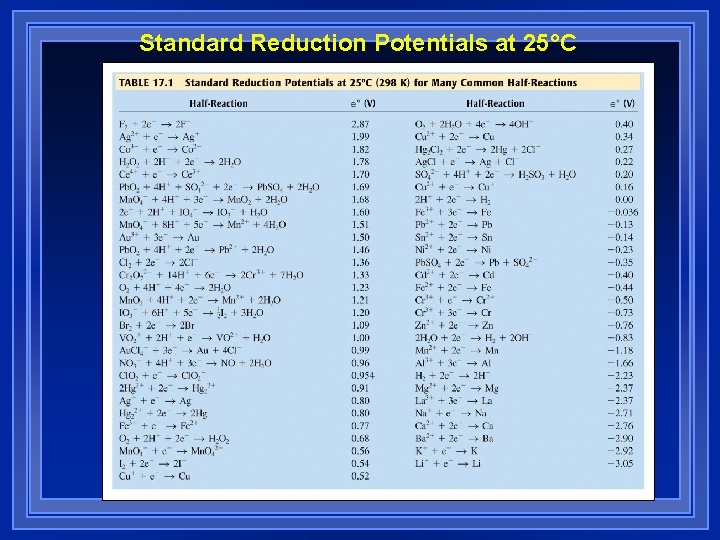
17. 2 Standard Reduction Potentials, E l l The E values corresponding to reduction halfreactions with all solutes at 1 M and all gases at 1 atm. E can be measured by making a galvanic cell in which one of the two electrodes is the Standard Hydrogen electrode, SHE, whose E = 0 V The total potential of this cell can be measured experimentally However, the individual electrode potential can not be measured experimentally. Why?
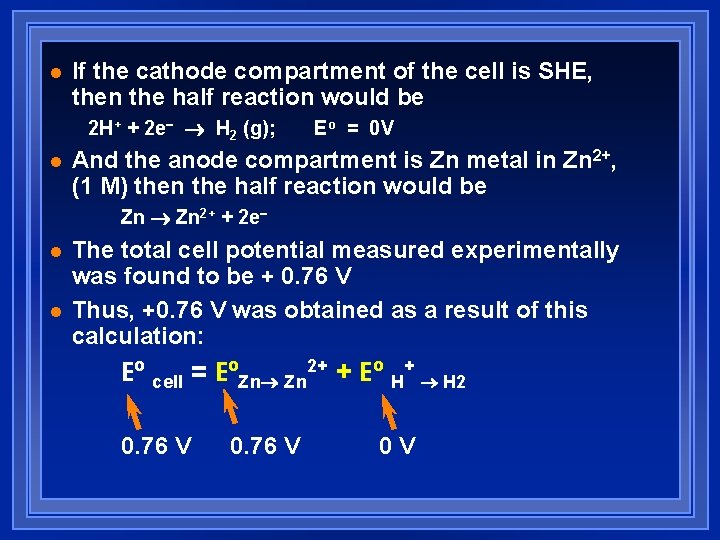
l If the cathode compartment of the cell is SHE, then the half reaction would be 2 H+ + 2 e H 2 (g); l Eo = 0 V And the anode compartment is Zn metal in Zn 2+, (1 M) then the half reaction would be Zn 2+ + 2 e l l The total cell potential measured experimentally was found to be + 0. 76 V Thus, +0. 76 V was obtained as a result of this calculation: Eº cell = EºZn Zn 2+ + Eº H+ H 2 0. 76 V 0 V
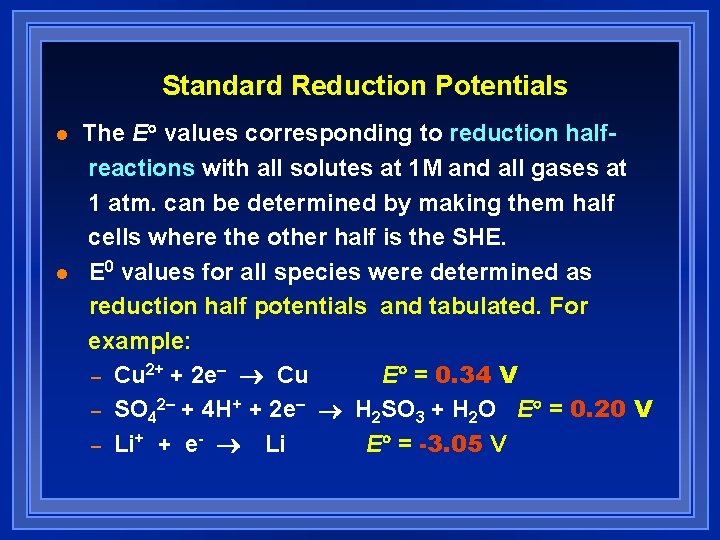
Standard Reduction Potentials l l The E values corresponding to reduction halfreactions with all solutes at 1 M and all gases at 1 atm. can be determined by making them half cells where the other half is the SHE. E 0 values for all species were determined as reduction half potentials and tabulated. For example: – Cu 2+ + 2 e Cu E = 0. 34 V – SO 42 + 4 H+ + 2 e H 2 SO 3 + H 2 O E = 0. 20 V – Li+ + e- Li E = -3. 05 V
Some Standard Reduction Potentials Li+ + e- ---> Li Zn+2 + 2 e- ---> Zn Fe+2 + 2 e- ---> Fe 2 H+(aq) + 2 e- ---> H 2(g) Cu+2 + 2 e- ---> Cu O 2(g) + 4 H+(aq) + 4 e- ---> 2 H 2 O(l) F 2 + 2 e- ---> 2 F- -3. 045 v -0. 763 v -0. 44 v 0. 00 v +0. 337 v +1. 229 v +2. 87 v
Standard Reduction Potentials at 25°C
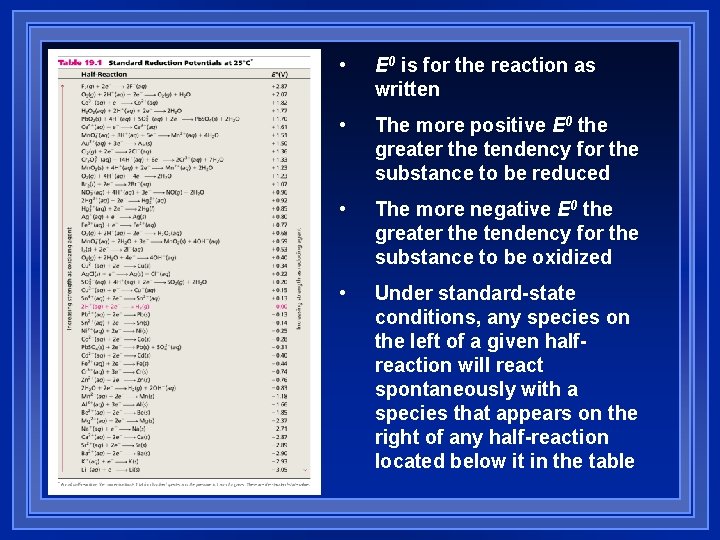
• E 0 is for the reaction as written • The more positive E 0 the greater the tendency for the substance to be reduced • The more negative E 0 the greater the tendency for the substance to be oxidized • Under standard-state conditions, any species on the left of a given halfreaction will react spontaneously with a species that appears on the right of any half-reaction located below it in the table
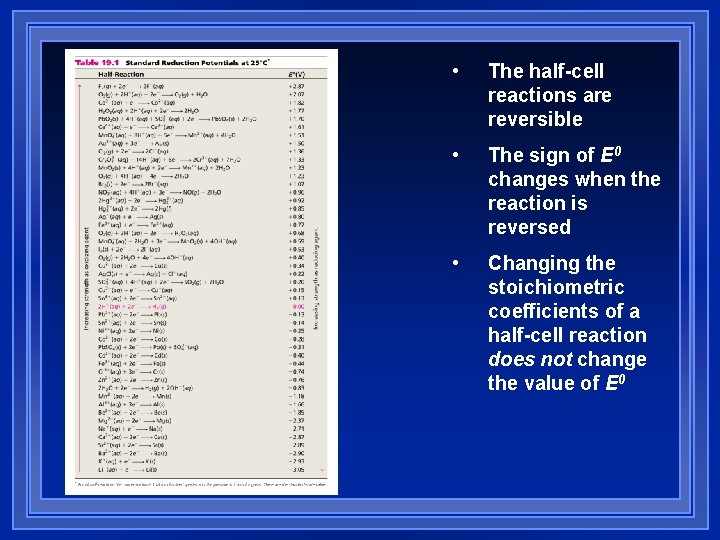
• The half-cell reactions are reversible • The sign of E 0 changes when the reaction is reversed • Changing the stoichiometric coefficients of a half-cell reaction does not change the value of E 0
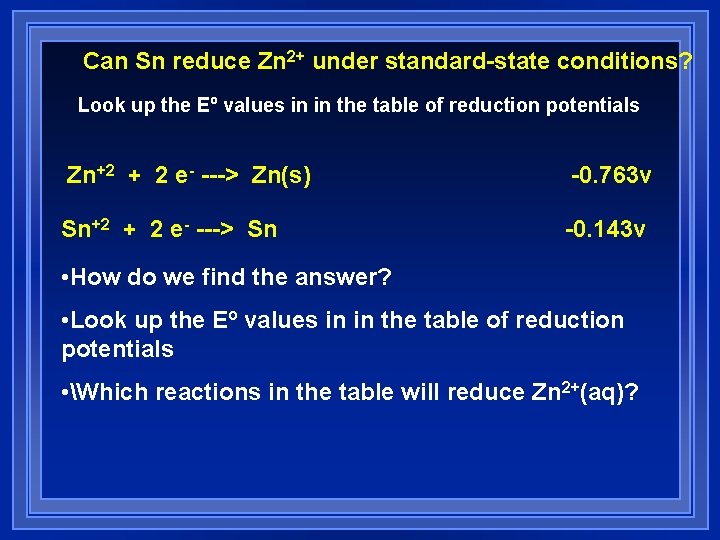
Can Sn reduce Zn 2+ under standard-state conditions? Look up the Eº values in in the table of reduction potentials Zn+2 + 2 e- ---> Zn(s) -0. 763 v Sn+2 + 2 e- ---> Sn -0. 143 v • How do we find the answer? • Look up the Eº values in in the table of reduction potentials • Which reactions in the table will reduce Zn 2+(aq)?
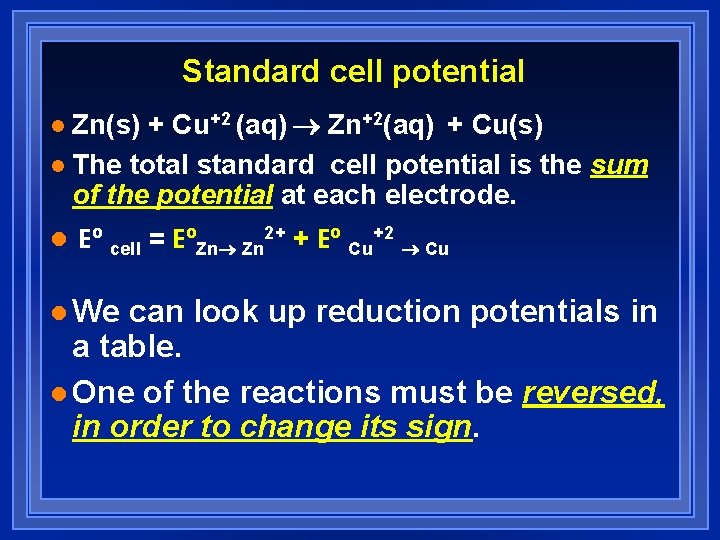
Standard cell potential Zn(s) + Cu+2 (aq) Zn+2(aq) + Cu(s) l The total standard cell potential is the sum of the potential at each electrode. l l Eº 2+ + Eº +2 = Eº cell Zn Zn Cu l We can look up reduction potentials in a table. l One of the reactions must be reversed, in order to change its sign.
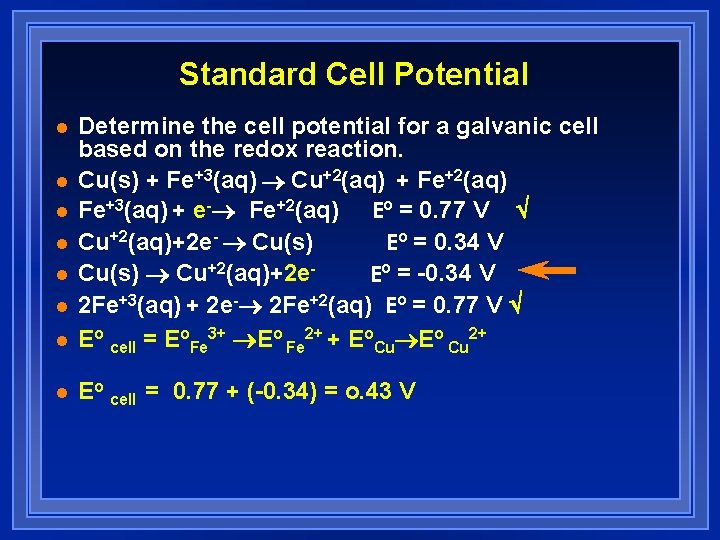
Standard Cell Potential l Determine the cell potential for a galvanic cell based on the redox reaction. Cu(s) + Fe+3(aq) Cu+2(aq) + Fe+2(aq) Fe+3(aq) + e- Fe+2(aq) Eº = 0. 77 V Cu+2(aq)+2 e- Cu(s) Eº = 0. 34 V Cu(s) Cu+2(aq)+2 e. Eº = -0. 34 V 2 Fe+3(aq) + 2 e- 2 Fe+2(aq) Eº = 0. 77 V Eo cell = Eo. Fe 3+ Eo Fe 2+ + Eo. Cu Eo Cu 2+ l Eo cell = 0. 77 + (-0. 34) = o. 43 V l l l
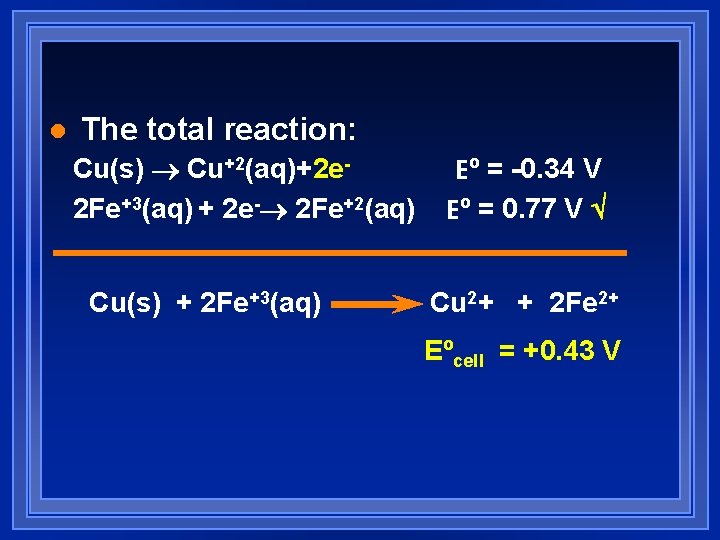
l The total reaction: Cu(s) Cu+2(aq)+2 e 2 Fe+3(aq) + 2 e- 2 Fe+2(aq) Cu(s) + 2 Fe+3(aq) Eº = -0. 34 V Eº = 0. 77 V Cu 2+ + 2 Fe 2+ Eºcell = +0. 43 V
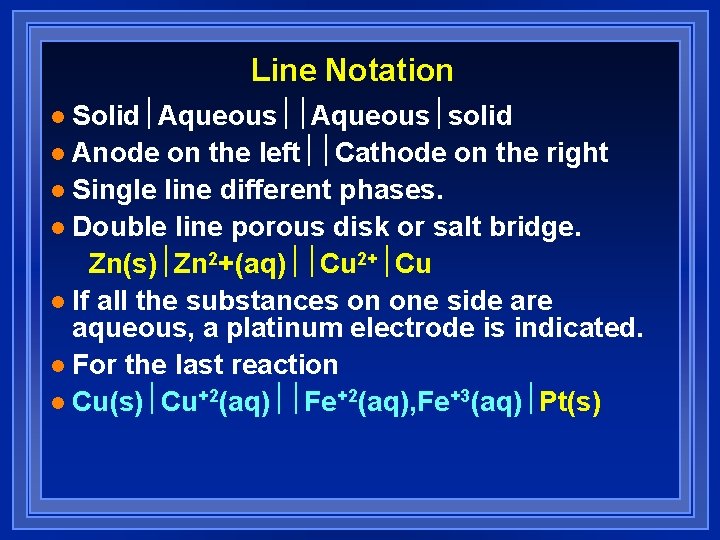
Line Notation Solid½Aqueous½solid l Anode on the left½½Cathode on the right l Single line different phases. l Double line porous disk or salt bridge. Zn(s)½Zn 2+(aq)½½Cu 2+½Cu l If all the substances on one side are aqueous, a platinum electrode is indicated. l For the last reaction l Cu(s)½Cu+2(aq)½½Fe+2(aq), Fe+3(aq)½Pt(s) l
Complete description of a Galvanic Cell l l 1. 2. 3. 4. The reaction always runs spontaneously in the direction that produces a positive cell potential Four parameters are needed for a complete description: Cell Potential Direction of flow Designation of anode and cathode Nature of all the componentselectrodes and ions
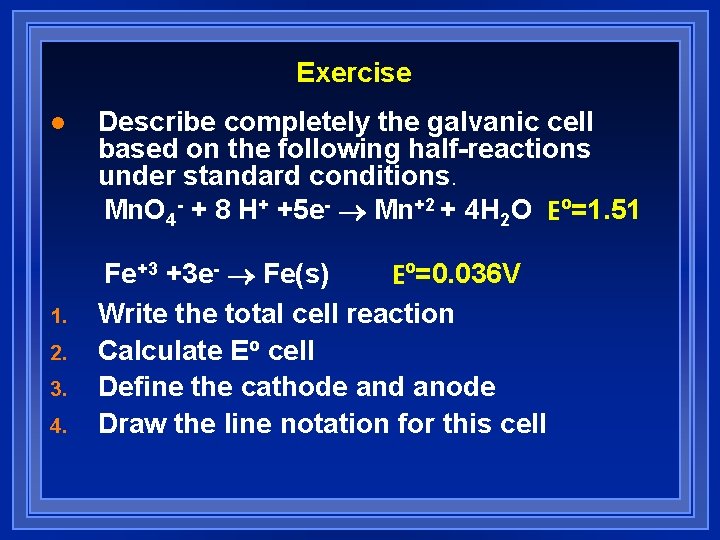
Exercise l 1. 2. 3. 4. Describe completely the galvanic cell based on the following half-reactions under standard conditions. Mn. O 4 - + 8 H+ +5 e- Mn+2 + 4 H 2 O Eº=1. 51 Fe+3 +3 e- Fe(s) Eº=0. 036 V Write the total cell reaction Calculate Eo cell Define the cathode and anode Draw the line notation for this cell
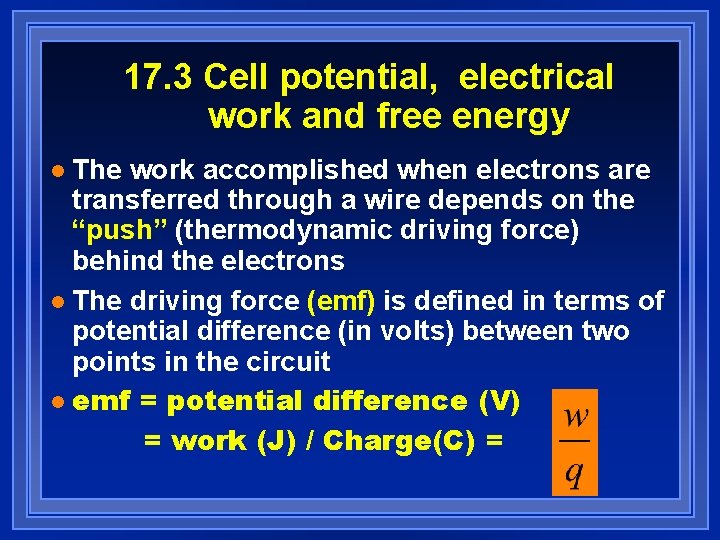
17. 3 Cell potential, electrical work and free energy The work accomplished when electrons are transferred through a wire depends on the “push” (thermodynamic driving force) behind the electrons l The driving force (emf) is defined in terms of potential difference (in volts) between two points in the circuit l emf = potential difference (V) = work (J) / Charge(C) = l
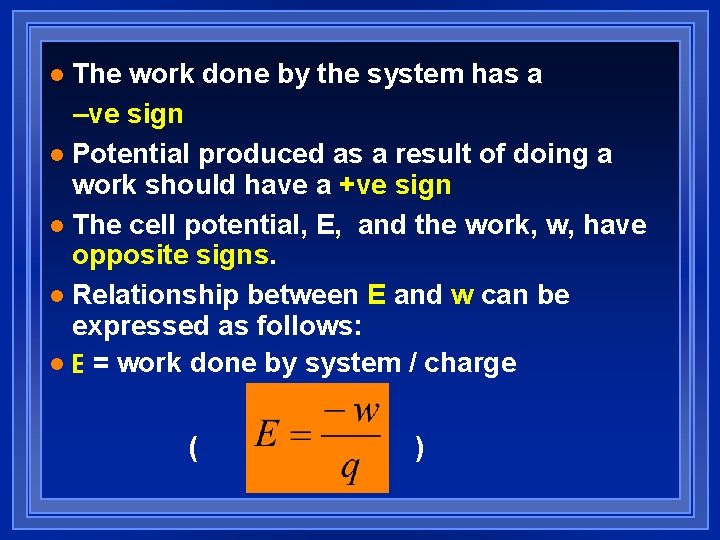
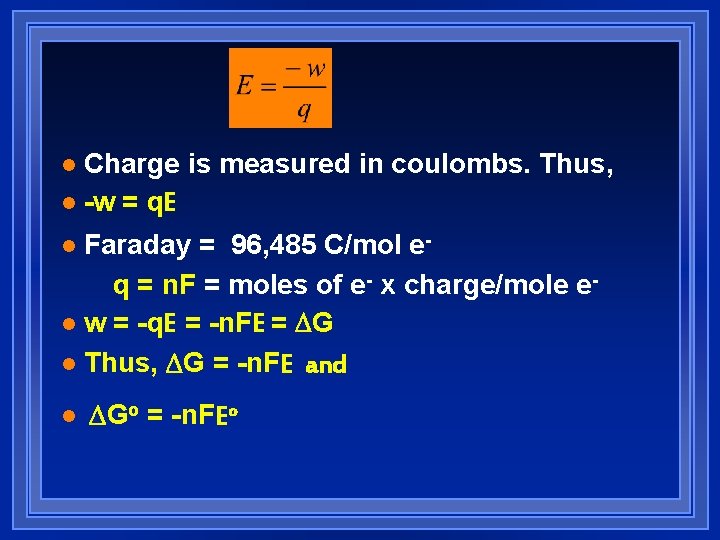
The work done by the system has a –ve sign l Potential produced as a result of doing a work should have a +ve sign l The cell potential, E, and the work, w, have opposite signs. l Relationship between E and w can be expressed as follows: l E = work done by system / charge l ( )
Charge is measured in coulombs. Thus, l -w = q. E l Faraday = 96, 485 C/mol eq = n. F = moles of e- x charge/mole el w = -q. E = -n. FE = G l Thus, G = -n. FE and l l Go = -n. FEo
Potential, Work, G and spontaneity Gº = -n. FE º l if E º > 0, then Gº < 0 spontaneous l if E º < 0, then Gº > 0 nonspontaneous l l In fact, the reverse process is spontaneous.
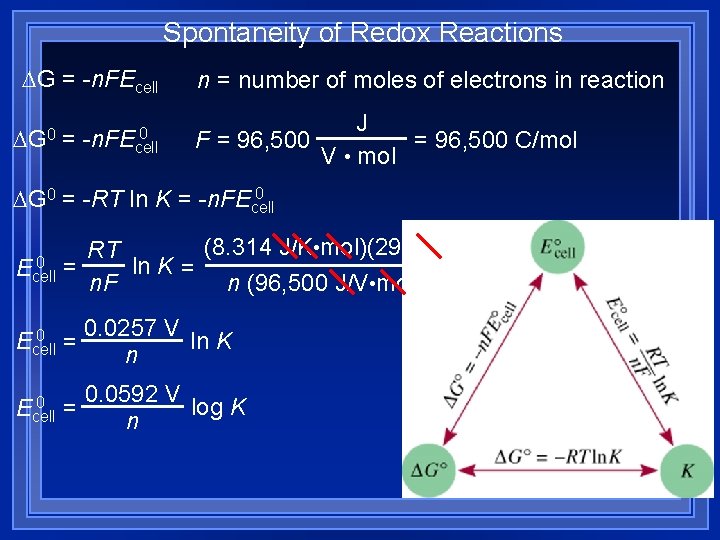
Spontaneity of Redox Reactions G = -n. FEcell G 0 = 0 -n. FEcell n = number of moles of electrons in reaction J F = 96, 500 C/mol V • mol 0 G 0 = -RT ln K = -n. FEcell (8. 314 J/K • mol)(298 K) RT 0 = ln K Ecell n. F n (96, 500 J/V • mol) 0 Ecell = 0 Ecell 0. 0257 V ln K n 0. 0592 V log K = n
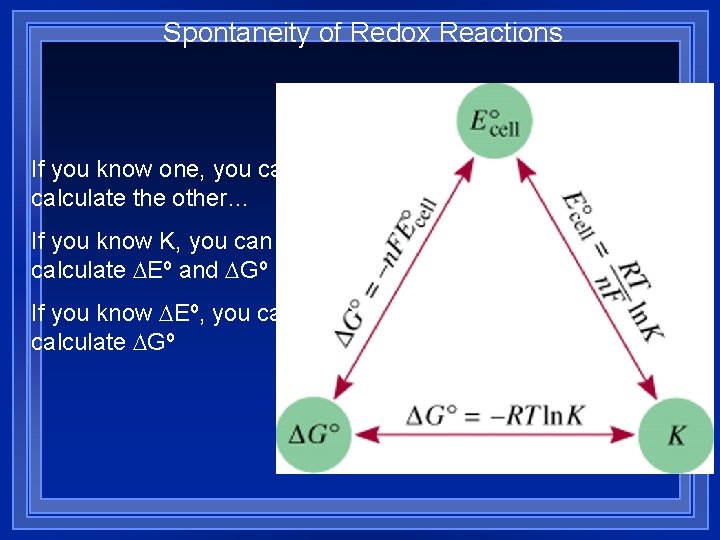
Spontaneity of Redox Reactions If you know one, you can calculate the other… If you know K, you can calculate Eº and Gº If you know Eº, you can calculate Gº
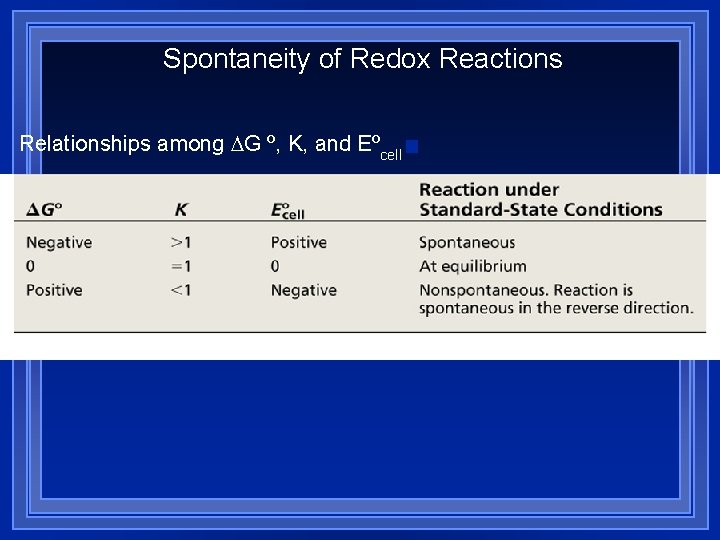
Spontaneity of Redox Reactions Relationships among G º, K, and Eºcell
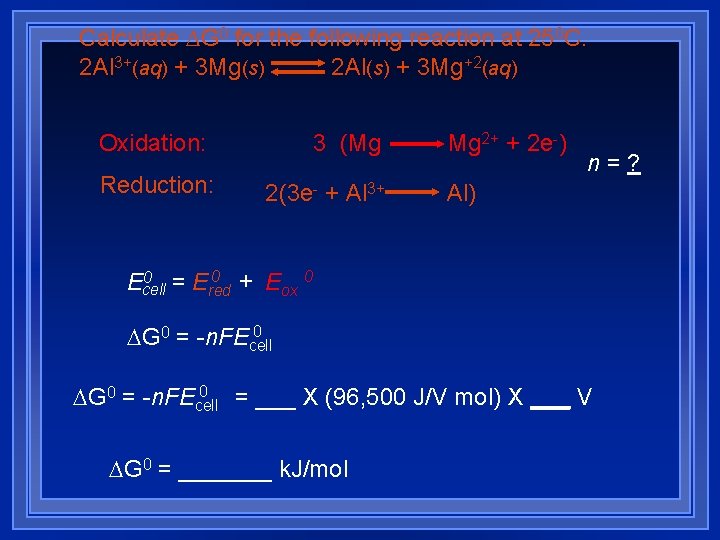
Calculate G 0 for the following reaction at 250 C. 2 Al 3+(aq) + 3 Mg(s) 2 Al(s) + 3 Mg+2(aq) Oxidation: Reduction: 3 (Mg 2(3 e- + Al 3+ Mg 2+ + 2 e-) n=? Al) 0 = E 0 + E 0 Ecell red ox 0 G 0 = -n. FEcell = ___ X (96, 500 J/V mol) X ___ V G 0 = _______ k. J/mol
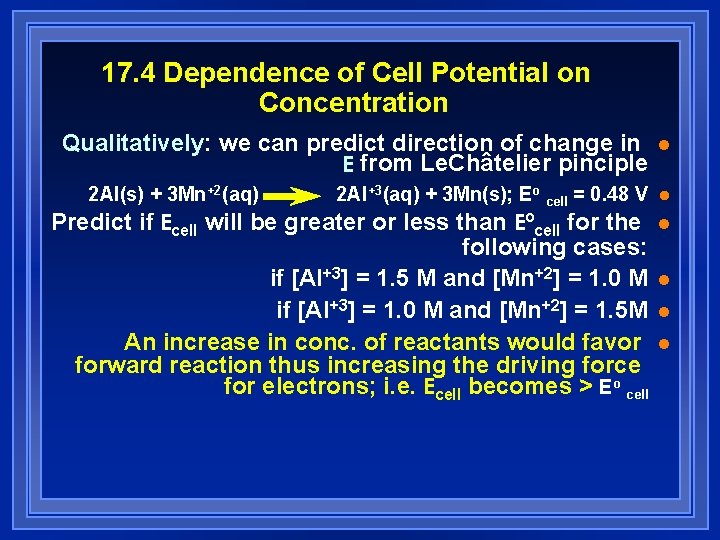
17. 4 Dependence of Cell Potential on Concentration Qualitatively: we can predict direction of change in E from Le. Châtelier pinciple 2 Al(s) + 3 Mn+2(aq) 2 Al+3(aq) + 3 Mn(s); Eo cell = 0. 48 V Predict if Ecell will be greater or less than Eºcell for the following cases: if [Al+3] = 1. 5 M and [Mn+2] = 1. 0 M if [Al+3] = 1. 0 M and [Mn+2] = 1. 5 M An increase in conc. of reactants would favor forward reaction thus increasing the driving force for electrons; i. e. Ecell becomes > Eo cell l l l
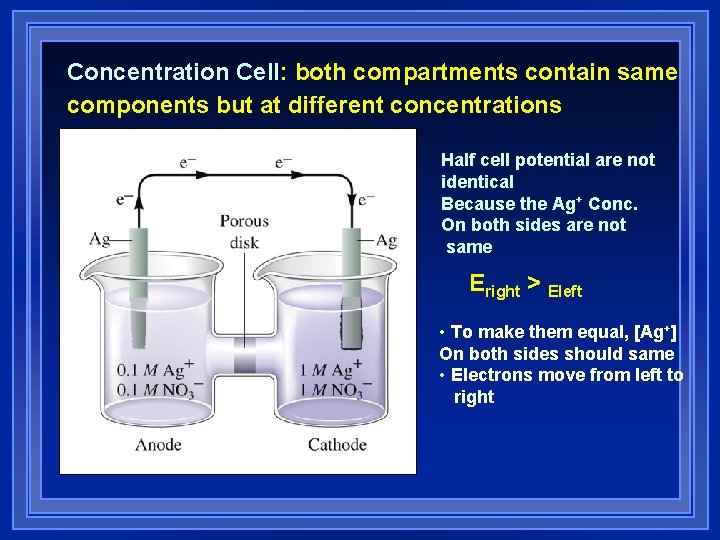
Concentration Cell: both compartments contain same components but at different concentrations Half cell potential are not identical Because the Ag+ Conc. On both sides are not same Eright > Eleft • To make them equal, [Ag+] On both sides should same • Electrons move from left to right
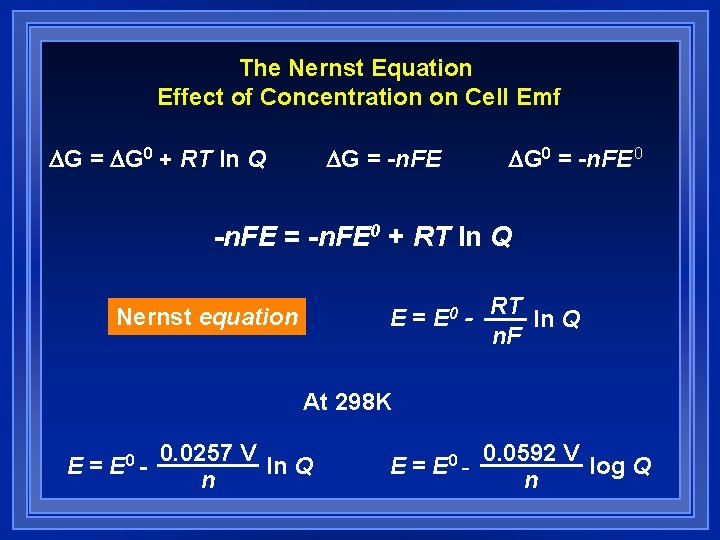
The Nernst Equation Effect of Concentration on Cell Emf G = G 0 + RT ln Q G = -n. FE G 0 = -n. FE 0 -n. FE = -n. FE 0 + RT ln Q Nernst equation E = E 0 - RT ln Q n. F At 298 K E = E 0 - 0. 0257 V ln Q n E = E 0 - 0. 0592 V log Q n
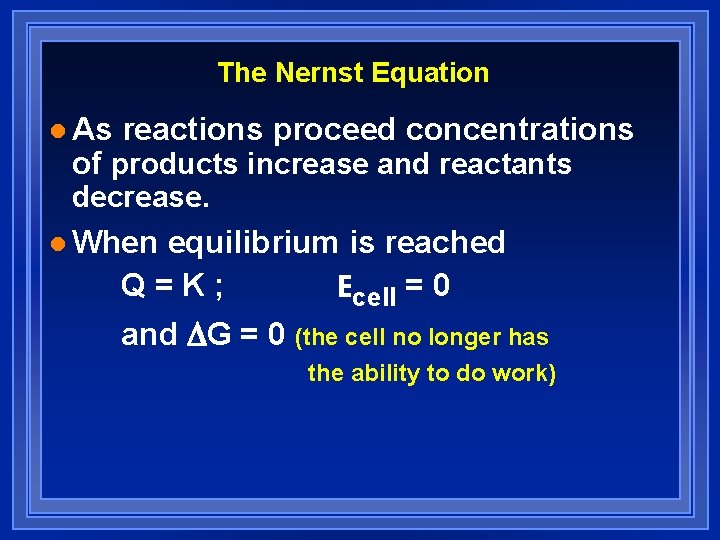
The Nernst Equation l As reactions proceed concentrations of products increase and reactants decrease. l When equilibrium is reached Q=K; Ecell = 0 and G = 0 (the cell no longer has the ability to do work)
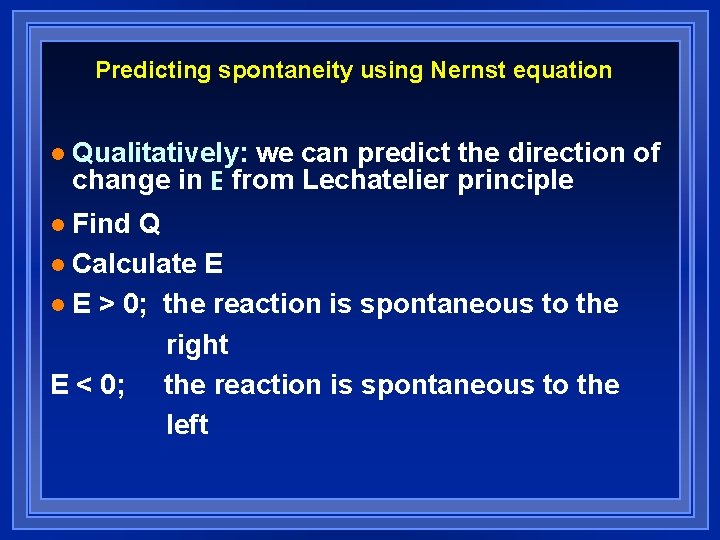
Predicting spontaneity using Nernst equation l Qualitatively: we can predict the direction of change in E from Lechatelier principle Find Q l Calculate E l E > 0; the reaction is spontaneous to the right E < 0; the reaction is spontaneous to the left l
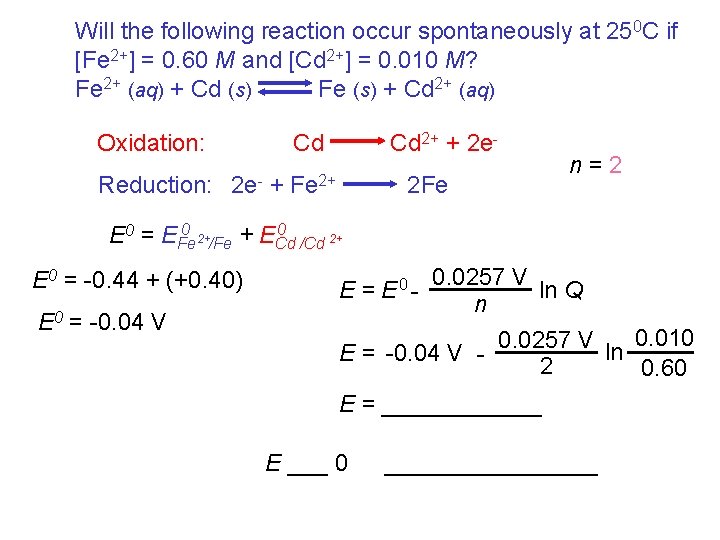
Will the following reaction occur spontaneously at 250 C if [Fe 2+] = 0. 60 M and [Cd 2+] = 0. 010 M? Fe 2+ (aq) + Cd (s) Fe (s) + Cd 2+ (aq) Oxidation: Reduction: Cd 2 e- + Cd 2+ + 2 e- Fe 2+ 2 Fe n=2 0 0 E 0 = EFe 2+/Fe + ECd /Cd 2+ E 0 = -0. 44 + (+0. 40) E 0 = -0. 04 V 0. 0257 V ln Q n 0. 010 0. 0257 V ln E = -0. 04 V 2 0. 60 E = ______ E = E 0 - E ___ 0 ________
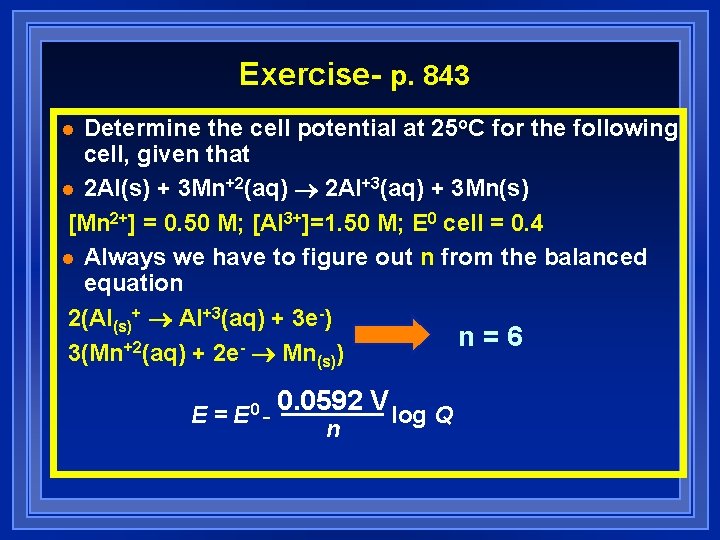
Exercise- p. 843 Determine the cell potential at 25 o. C for the following cell, given that l 2 Al(s) + 3 Mn+2(aq) 2 Al+3(aq) + 3 Mn(s) [Mn 2+] = 0. 50 M; [Al 3+]=1. 50 M; E 0 cell = 0. 4 l Always we have to figure out n from the balanced equation 2(Al(s)+ Al+3(aq) + 3 e-) n=6 +2 3(Mn (aq) + 2 e Mn(s)) l E = E 0 - 0. 0592 V log Q n
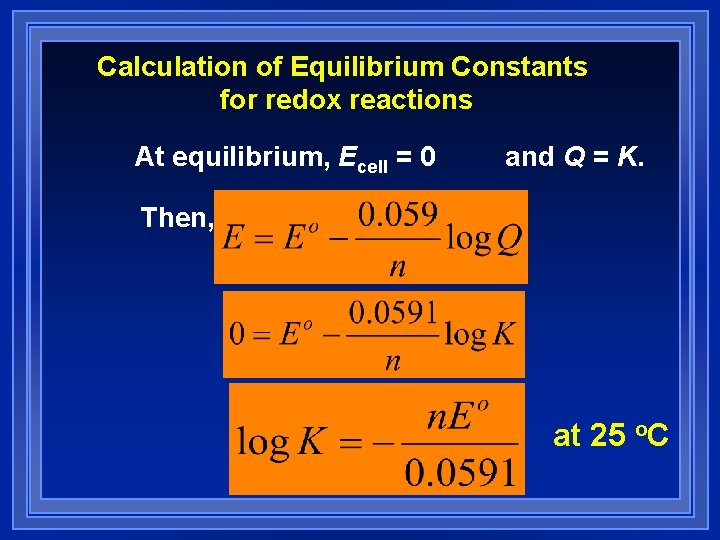
Calculation of Equilibrium Constants for redox reactions At equilibrium, Ecell = 0 and Q = K. Then, at 25 o. C
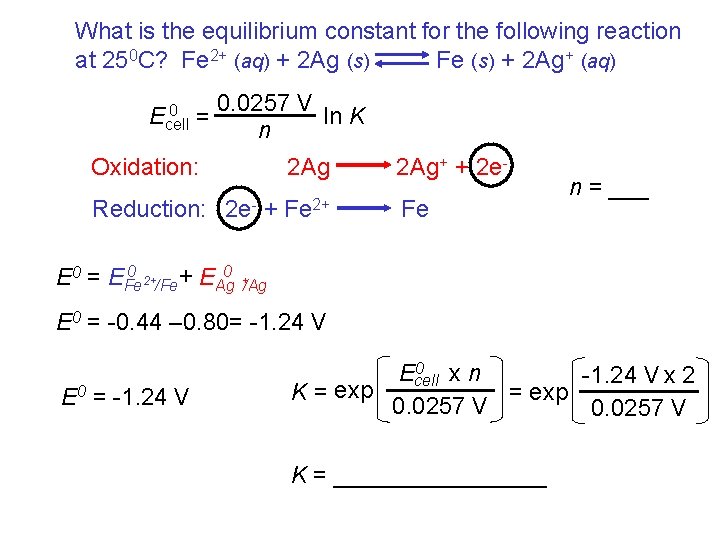
What is the equilibrium constant for the following reaction at 250 C? Fe 2+ (aq) + 2 Ag (s) Fe (s) + 2 Ag+ (aq) 0 Ecell = 0. 0257 V ln K n Oxidation: 2 Ag Reduction: 2 e- + Fe 2+ 0 0 E 0 = EFe 2+/Fe+ EAg 2 Ag+ + 2 e. Fe n = ___ +/Ag E 0 = -0. 44 – 0. 80= -1. 24 V E 0 = -1. 24 V 0 Ecell xn -1. 24 V x 2 = exp K = exp 0. 0257 V K = ________
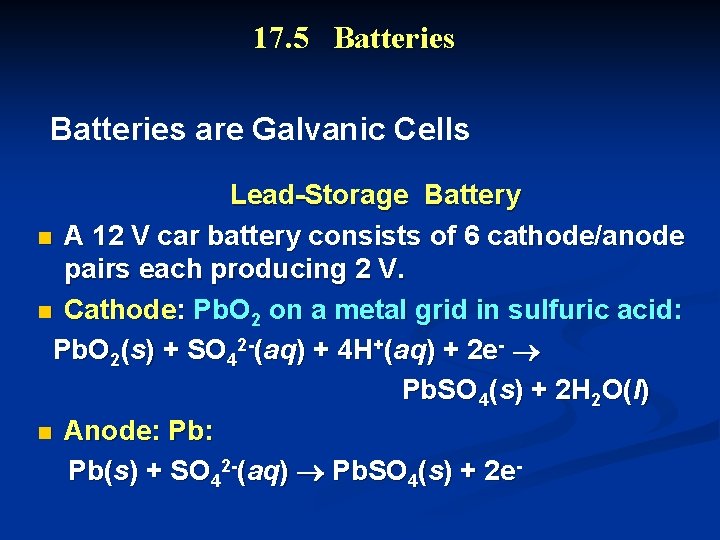
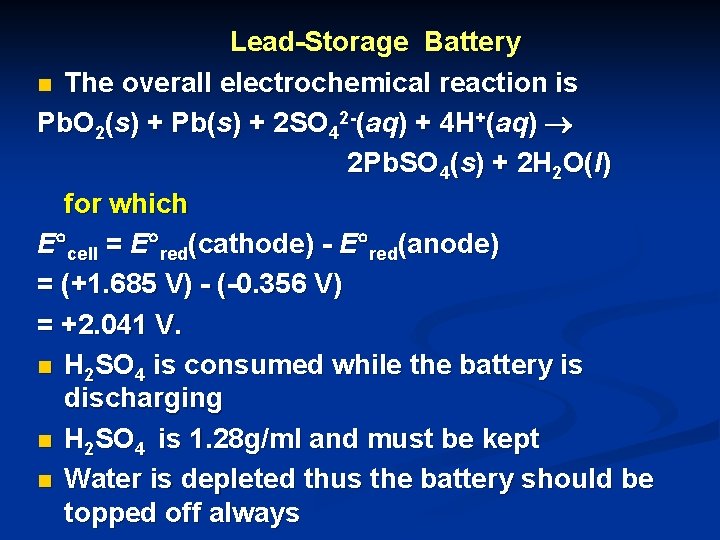
17. 5 Batteries are Galvanic Cells Lead-Storage Battery n A 12 V car battery consists of 6 cathode/anode pairs each producing 2 V. n Cathode: Pb. O 2 on a metal grid in sulfuric acid: Pb. O 2(s) + SO 42 -(aq) + 4 H+(aq) + 2 e- Pb. SO 4(s) + 2 H 2 O(l) n Anode: Pb(s) + SO 42 -(aq) Pb. SO 4(s) + 2 e-
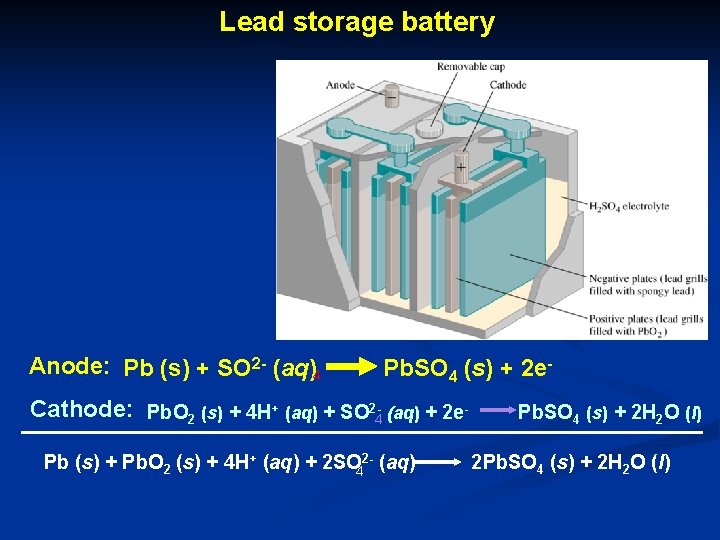
Lead storage battery Anode: Pb (s) + SO 2 - (aq)4 Pb. SO 4 (s) + 2 e- Cathode: Pb. O 2 (s) + 4 H+ (aq) + SO 2 -4 (aq) + 2 e. Pb (s) + Pb. O 2 (s) + 4 H+ (aq) + 2 SO 42 - (aq) Pb. SO 4 (s) + 2 H 2 O (l) 2 Pb. SO 4 (s) + 2 H 2 O (l)
Lead-Storage Battery n The overall electrochemical reaction is Pb. O 2(s) + Pb(s) + 2 SO 42 -(aq) + 4 H+(aq) 2 Pb. SO 4(s) + 2 H 2 O(l) for which E cell = E red(cathode) - E red(anode) = (+1. 685 V) - (-0. 356 V) = +2. 041 V. n H 2 SO 4 is consumed while the battery is discharging n H 2 SO 4 is 1. 28 g/ml and must be kept n Water is depleted thus the battery should be topped off always
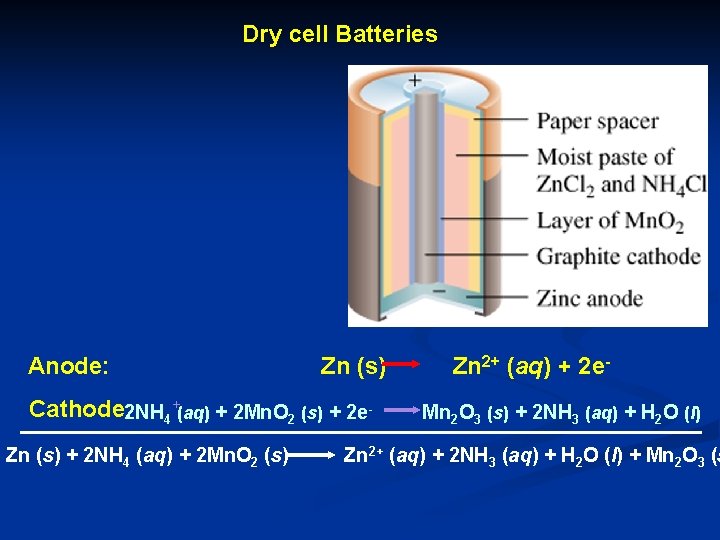
Dry cell Batteries Anode: Zn (s) Cathode: 2 NH 4+(aq) + 2 Mn. O 2 (s) + 2 e. Zn (s) + 2 NH 4 (aq) + 2 Mn. O 2 (s) Zn 2+ (aq) + 2 e. Mn 2 O 3 (s) + 2 NH 3 (aq) + H 2 O (l) Zn 2+ (aq) + 2 NH 3 (aq) + H 2 O (l) + Mn 2 O 3 (s
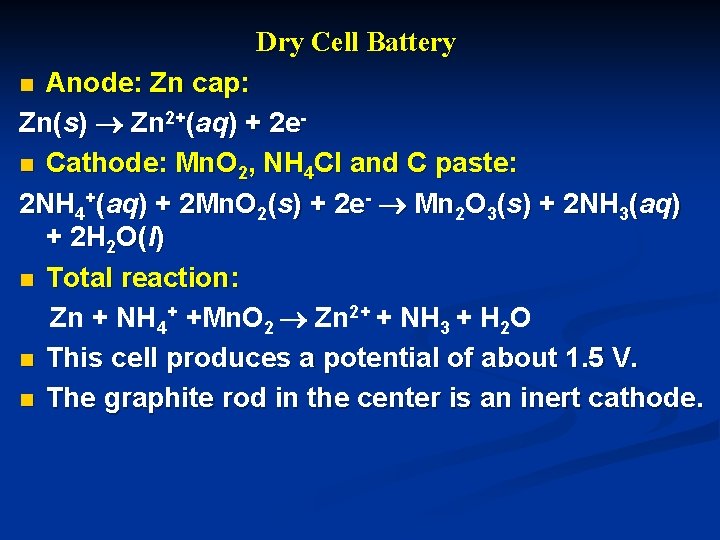
Dry Cell Battery Anode: Zn cap: Zn(s) Zn 2+(aq) + 2 en Cathode: Mn. O 2, NH 4 Cl and C paste: 2 NH 4+(aq) + 2 Mn. O 2(s) + 2 e- Mn 2 O 3(s) + 2 NH 3(aq) + 2 H 2 O(l) n Total reaction: Zn + NH 4+ +Mn. O 2 Zn 2+ + NH 3 + H 2 O n This cell produces a potential of about 1. 5 V. n The graphite rod in the center is an inert cathode. n
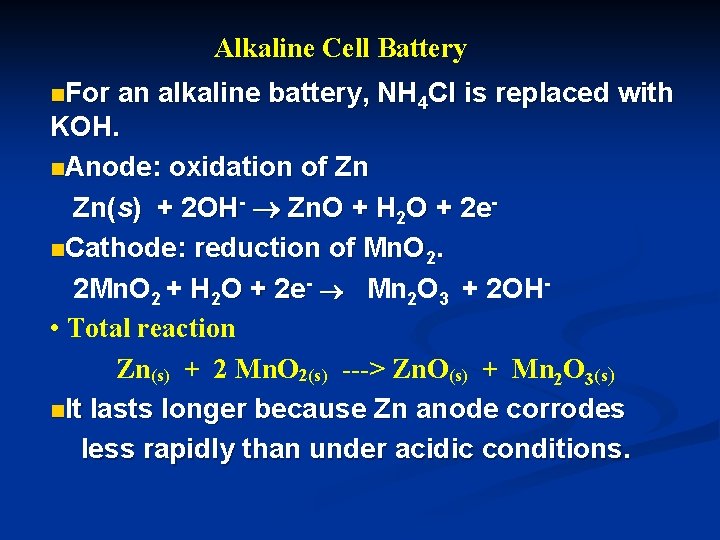
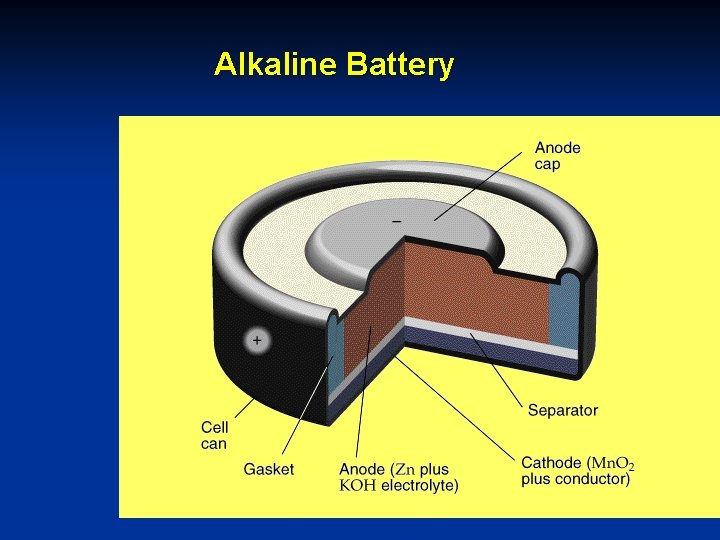
Alkaline Cell Battery n. For an alkaline battery, NH 4 Cl is replaced with KOH. n. Anode: oxidation of Zn Zn(s) + 2 OH- Zn. O + H 2 O + 2 en. Cathode: reduction of Mn. O 2. 2 Mn. O 2 + H 2 O + 2 e- Mn 2 O 3 + 2 OH • Total reaction Zn(s) + 2 Mn. O 2(s) ---> Zn. O(s) + Mn 2 O 3(s) n. It lasts longer because Zn anode corrodes less rapidly than under acidic conditions.
Alkaline Battery
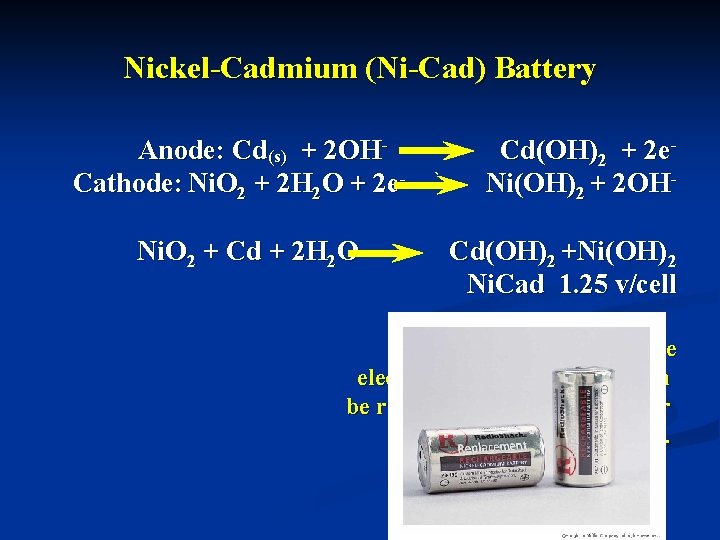
Nickel-Cadmium (Ni-Cad) Battery Anode: Cd(s) + 2 OHCathode: Ni. O 2 + 2 H 2 O + 2 e. Ni. O 2 + Cd + 2 H 2 O ` Cd(OH)2 + 2 e. Ni(OH)2 + 2 OHCd(OH)2 +Ni(OH)2 Ni. Cad 1. 25 v/cell The products adhere to the electrodes thus the battery can be recharged indefinite number of times.
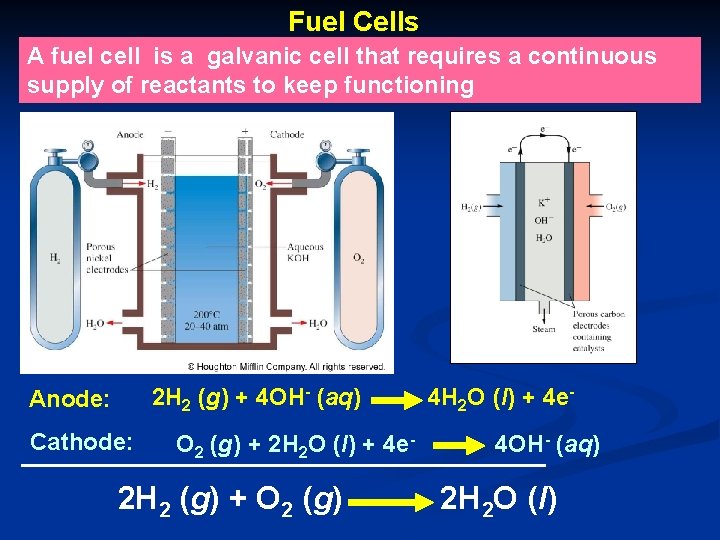
Fuel Cells A fuel cell is a galvanic cell that requires a continuous supply of reactants to keep functioning 2 H 2 (g) + 4 OH- (aq) Anode: Cathode: O 2 (g) + 2 H 2 O (l) + 4 e- 2 H 2 (g) + O 2 (g) 4 H 2 O (l) + 4 e 4 OH- (aq) 2 H 2 O (l)
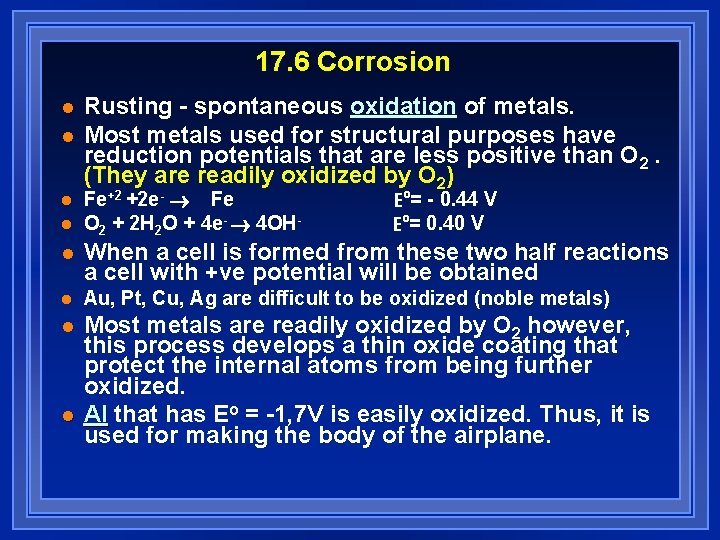
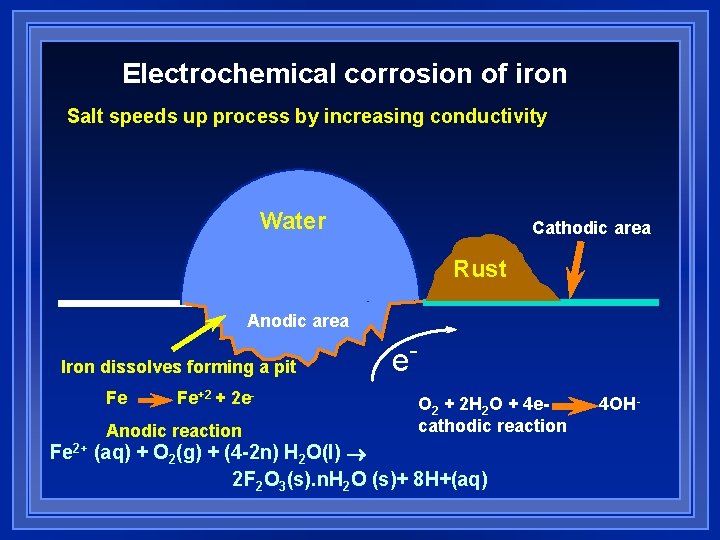
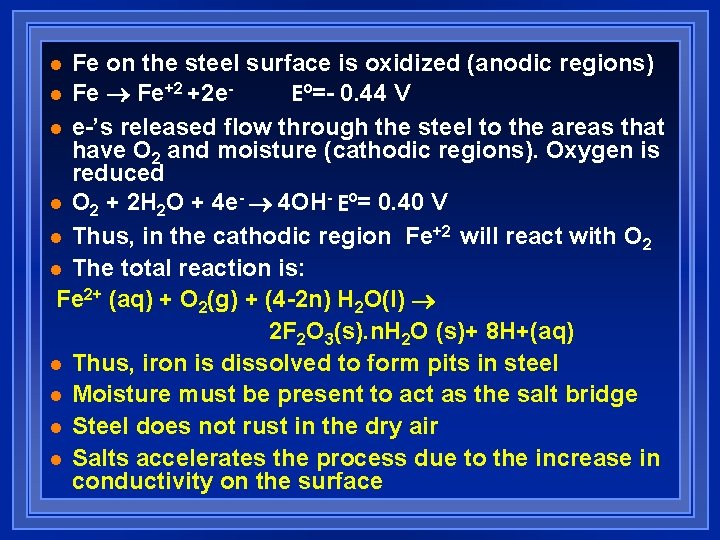
17. 6 Corrosion l l Rusting - spontaneous oxidation of metals. Most metals used for structural purposes have reduction potentials that are less positive than O 2. (They are readily oxidized by O 2) Fe+2 +2 e- Fe O 2 + 2 H 2 O + 4 e- 4 OH- Eº= - 0. 44 V Eº= 0. 40 V l When a cell is formed from these two half reactions a cell with +ve potential will be obtained l Au, Pt, Cu, Ag are difficult to be oxidized (noble metals) l Most metals are readily oxidized by O 2 however, this process develops a thin oxide coating that protect the internal atoms from being further oxidized. Al that has Eo = -1, 7 V is easily oxidized. Thus, it is used for making the body of the airplane. l
Electrochemical corrosion of iron Salt speeds up process by increasing conductivity Water Cathodic area Rust Anodic area Iron dissolves forming a pit Fe Fe+2 + 2 e- Anodic reaction e. O 2 + 2 H 2 O + 4 ecathodic reaction Fe 2+ (aq) + O 2(g) + (4 -2 n) H 2 O(l) 2 F 2 O 3(s). n. H 2 O (s)+ 8 H+(aq) 4 OH-
Fe on the steel surface is oxidized (anodic regions) l Fe Fe+2 +2 e. Eº=- 0. 44 V l e-’s released flow through the steel to the areas that have O 2 and moisture (cathodic regions). Oxygen is reduced l O 2 + 2 H 2 O + 4 e- 4 OH- Eº= 0. 40 V l Thus, in the cathodic region Fe+2 will react with O 2 l The total reaction is: Fe 2+ (aq) + O 2(g) + (4 -2 n) H 2 O(l) 2 F 2 O 3(s). n. H 2 O (s)+ 8 H+(aq) l Thus, iron is dissolved to form pits in steel l Moisture must be present to act as the salt bridge l Steel does not rust in the dry air l Salts accelerates the process due to the increase in conductivity on the surface l
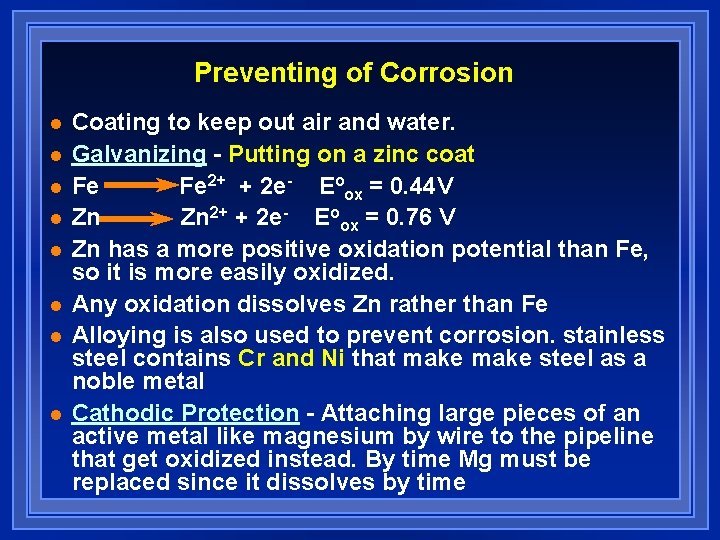
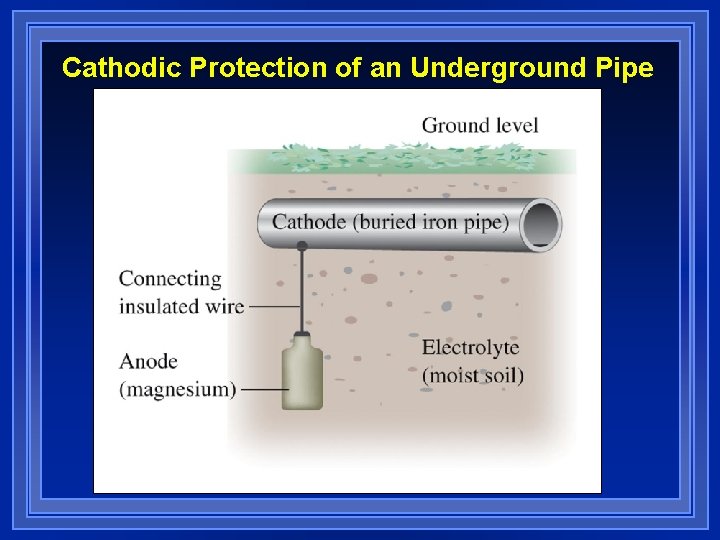
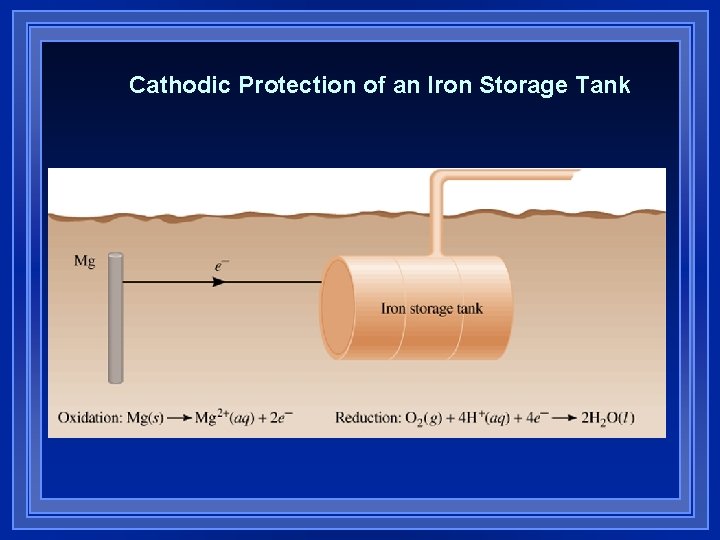
Preventing of Corrosion l l l l Coating to keep out air and water. Galvanizing - Putting on a zinc coat Fe Fe 2+ + 2 e- Eoox = 0. 44 V Zn Zn 2+ + 2 e- Eoox = 0. 76 V Zn has a more positive oxidation potential than Fe, so it is more easily oxidized. Any oxidation dissolves Zn rather than Fe Alloying is also used to prevent corrosion. stainless steel contains Cr and Ni that make steel as a noble metal Cathodic Protection - Attaching large pieces of an active metal like magnesium by wire to the pipeline that get oxidized instead. By time Mg must be replaced since it dissolves by time
Cathodic Protection of an Underground Pipe
Cathodic Protection of an Iron Storage Tank
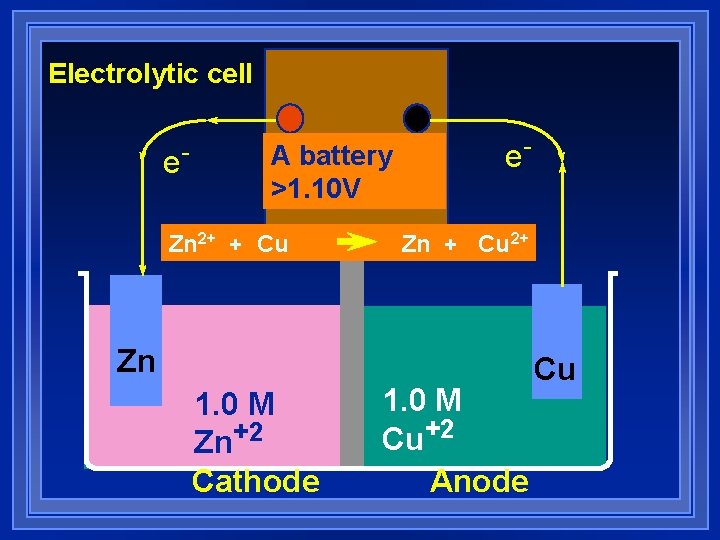
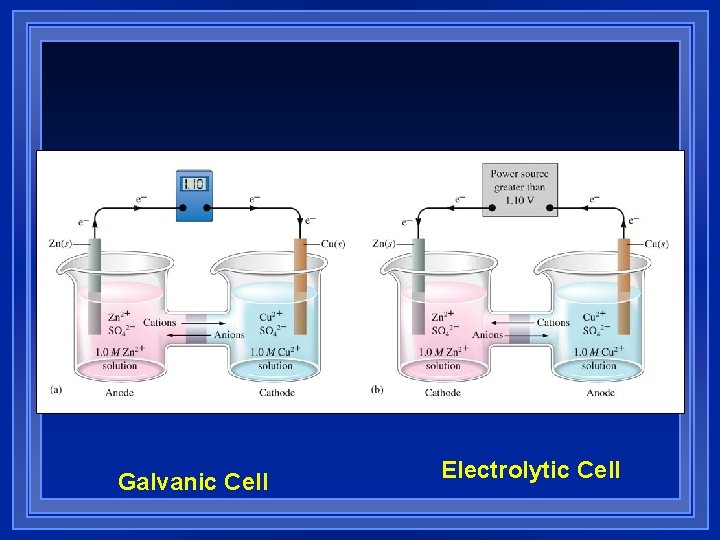
17. 7 Electrolysis Running a galvanic cell backwards. l Put a voltage bigger than the galvanic potential and reverse the direction of the redox reaction. l Electrolysis: Forcing a current through a cell to produce a chemical change for which the cell potential is negative. l That is causing a nonspontaneous reaction to occur l It is used for electroplating. l
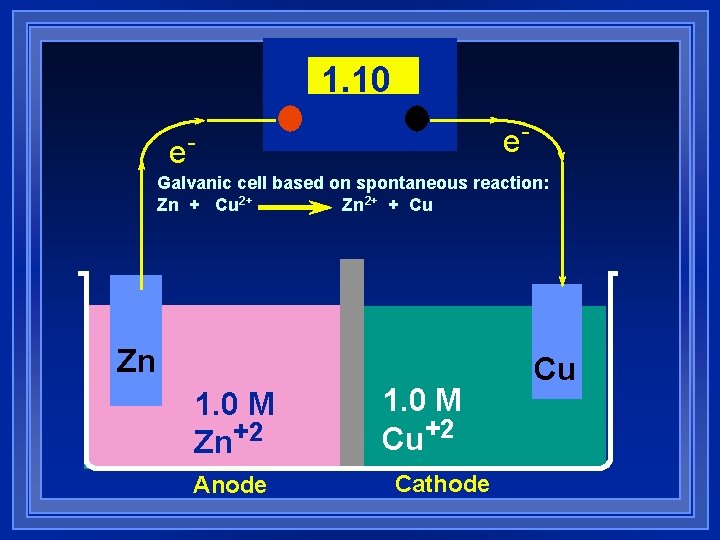
1. 10 e- e- Galvanic cell based on spontaneous reaction: Zn + Cu 2+ Zn 2+ + Cu Zn 1. 0 M Zn+2 Anode 1. 0 M Cu+2 Cathode Cu
Electrolytic cell e- A battery >1. 10 V Zn 2+ + Cu e. Zn + Cu 2+ Zn 1. 0 M Zn+2 Cathode 1. 0 M Cu+2 Anode Cu
Galvanic Cell Electrolytic Cell
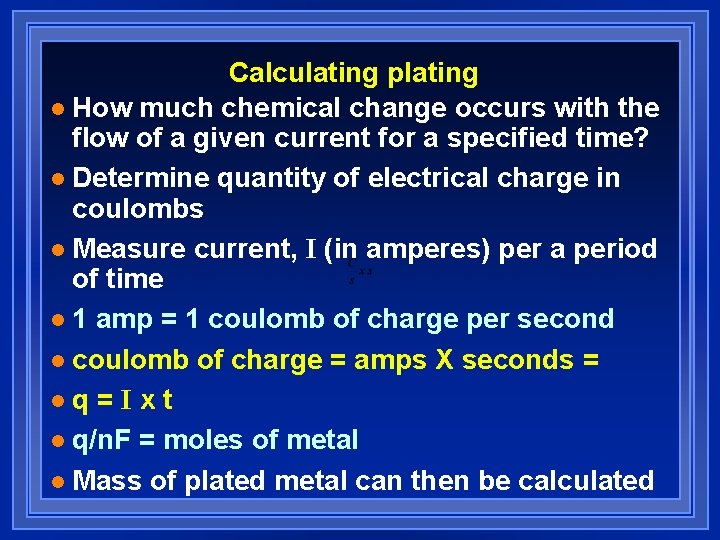
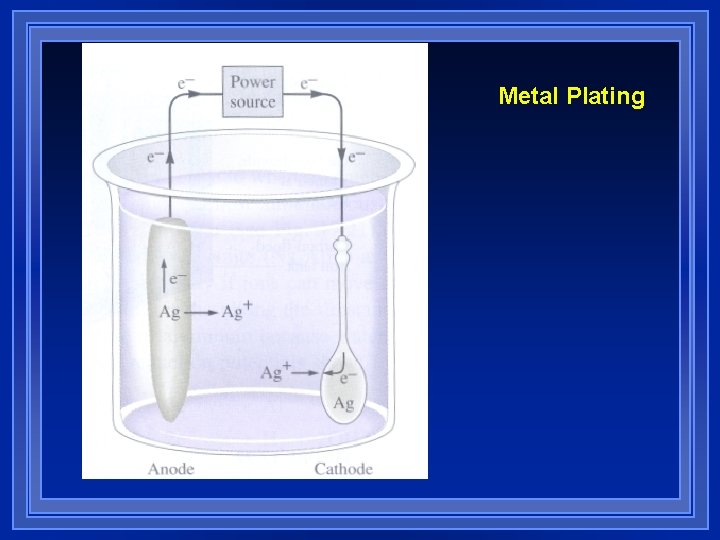
Calculating plating l How much chemical change occurs with the flow of a given current for a specified time? l Determine quantity of electrical charge in coulombs l Measure current, I (in amperes) per a period of time l 1 amp = 1 coulomb of charge per second l coulomb of charge = amps X seconds = lq=Ixt l q/n. F = moles of metal l Mass of plated metal can then be calculated
Exercise l Calculate mass of Cu that is plated out when a current of 10. 0 amps is passed for 30. 0 min through a solution of Cu 2+
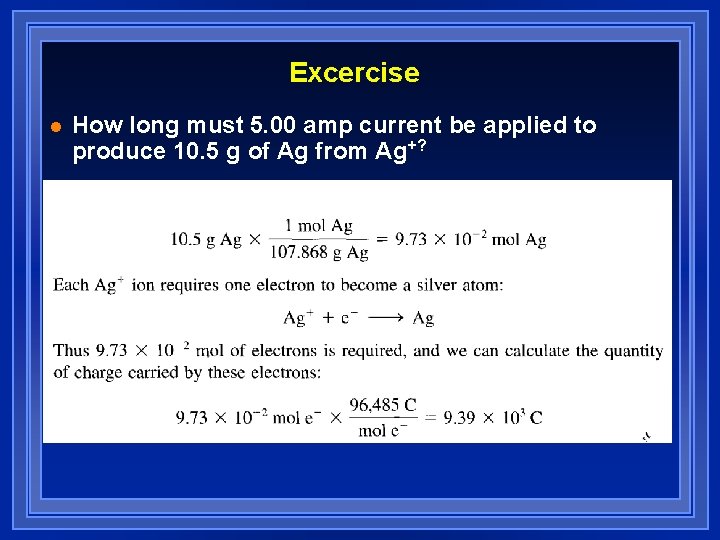
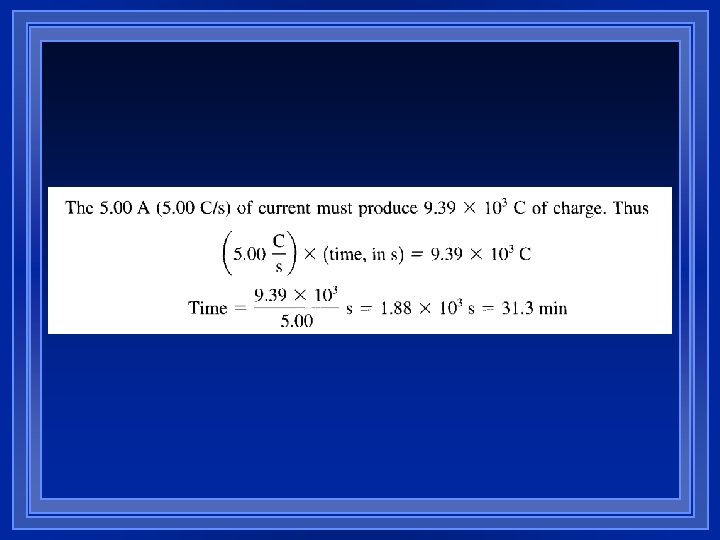
Excercise l How long must 5. 00 amp current be applied to produce 10. 5 g of Ag from Ag+?
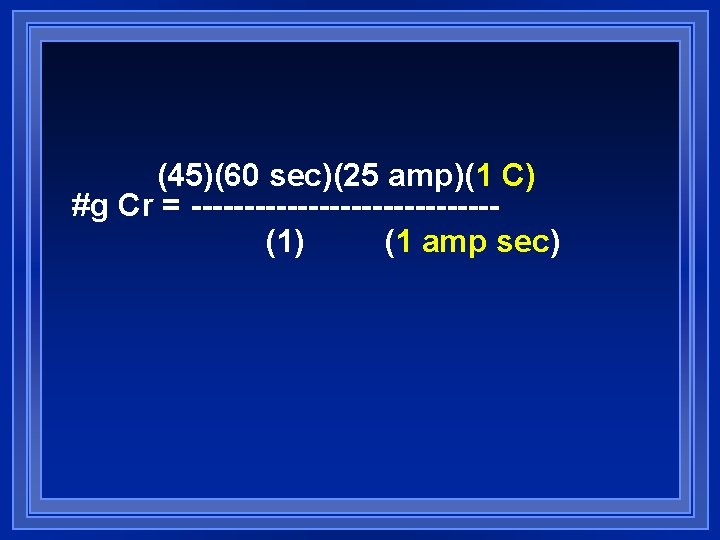
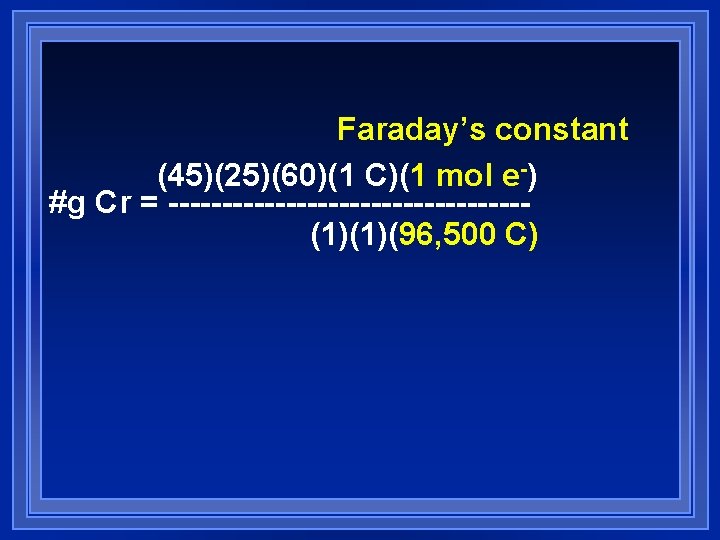
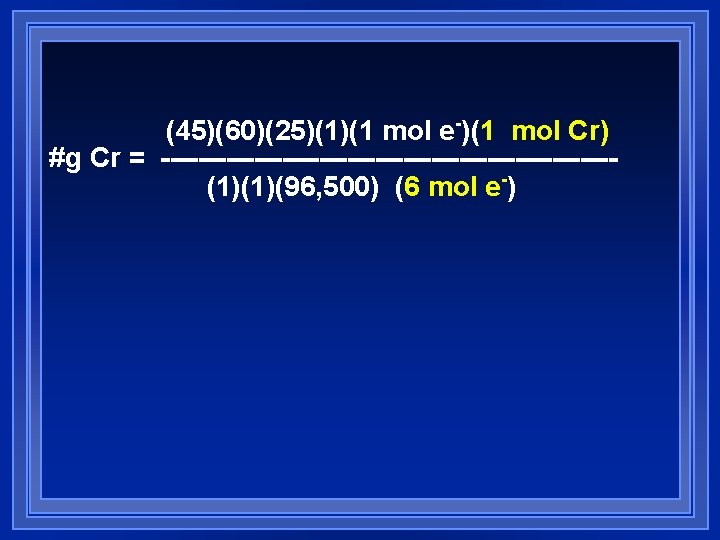
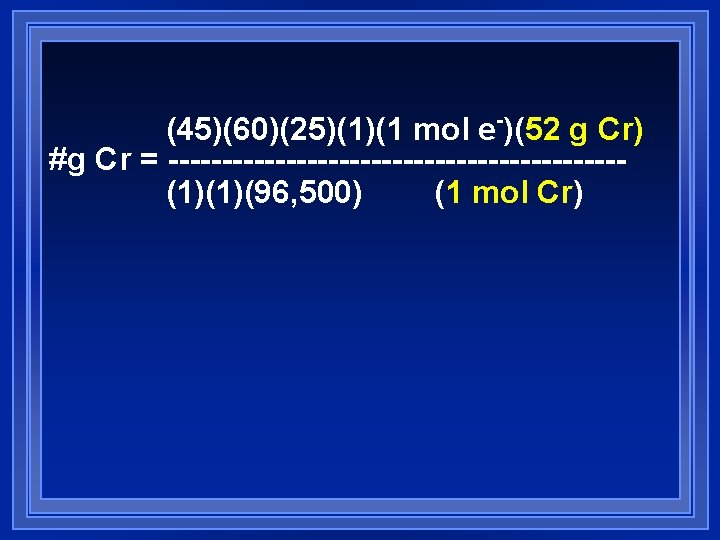
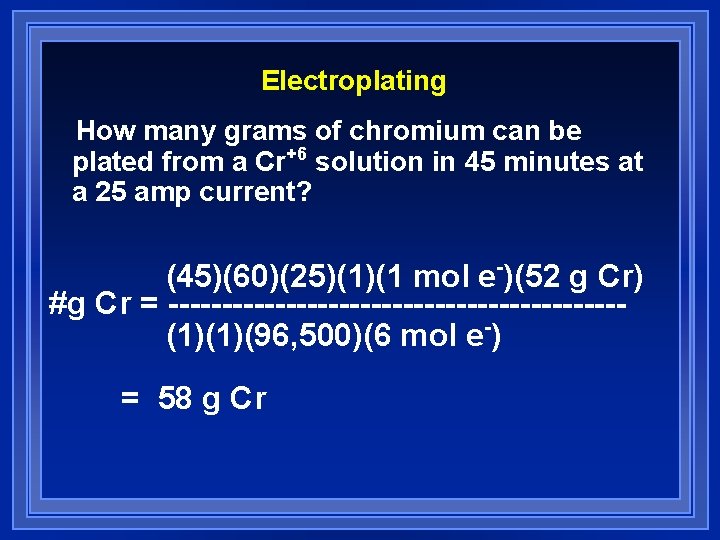
Electroplating How many grams of chromium can be plated from a Cr+6 solution in 45 minutes at a 25 amp current?
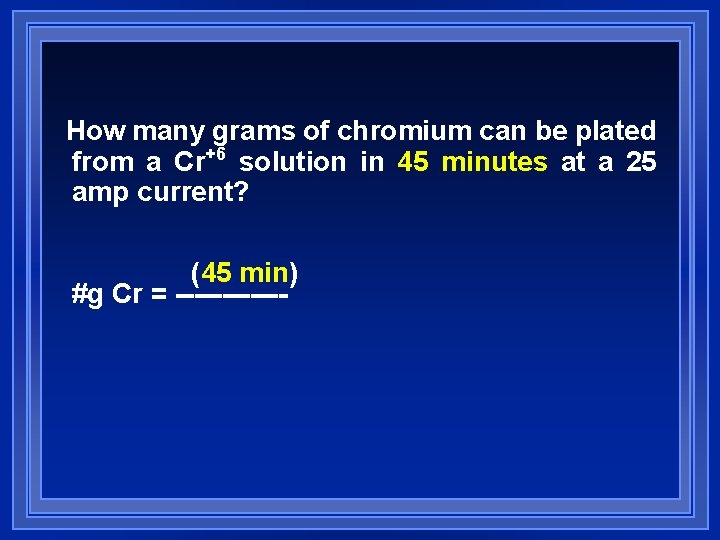
How many grams of chromium can be plated from a Cr+6 solution in 45 minutes at a 25 amp current? (45 min) #g Cr = ------
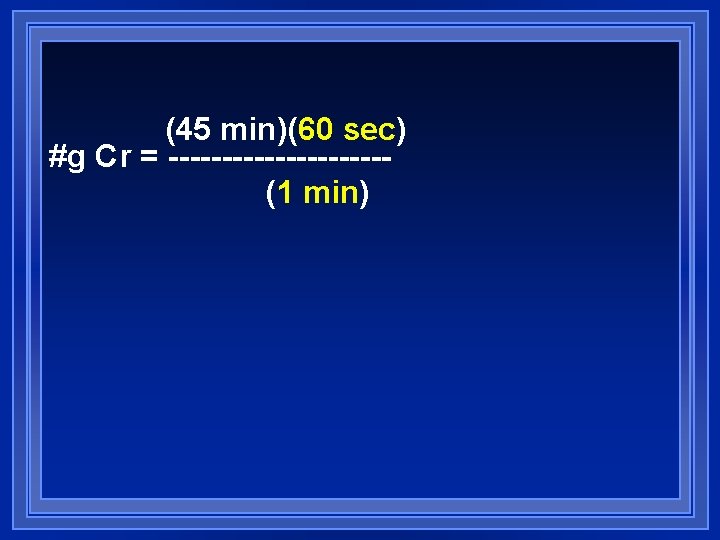
(45 min)(60 sec) #g Cr = ----------(1 min)
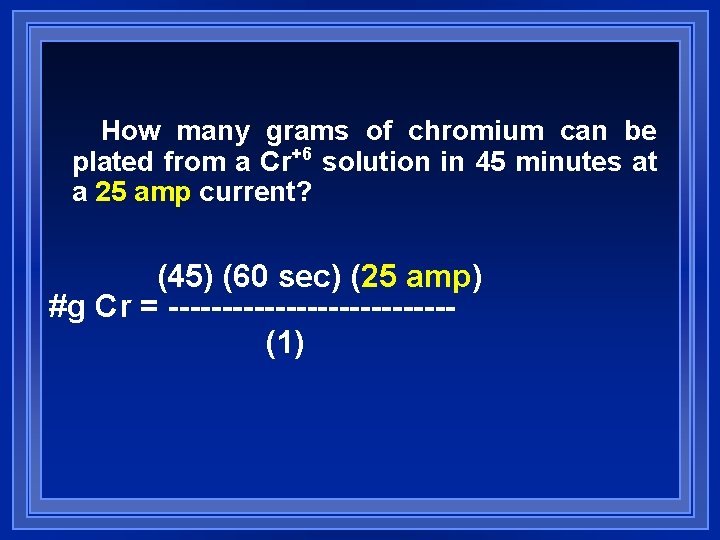
How many grams of chromium can be plated from a Cr+6 solution in 45 minutes at a 25 amp current? (45) (60 sec) (25 amp) #g Cr = -------------(1)
(45)(60 sec)(25 amp)(1 C) #g Cr = --------------(1) (1 amp sec)
Faraday’s constant (45)(25)(60)(1 C)(1 mol e-) #g Cr = -----------------(1)(1)(96, 500 C)
(45)(60)(25)(1)(1 mol e-)(1 mol Cr) #g Cr = ------------------------(1)(1)(96, 500) (6 mol e-)
(45)(60)(25)(1)(1 mol e-)(52 g Cr) #g Cr = ---------------------(1)(1)(96, 500) (1 mol Cr)
Electroplating How many grams of chromium can be plated from a Cr+6 solution in 45 minutes at a 25 amp current? (45)(60)(25)(1)(1 mol e-)(52 g Cr) #g Cr = ---------------------(1)(1)(96, 500)(6 mol e-) = 58 g Cr
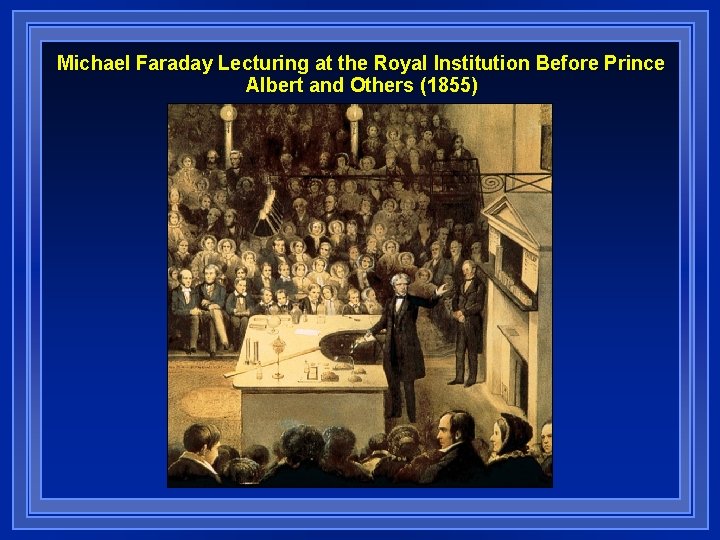
Michael Faraday Lecturing at the Royal Institution Before Prince Albert and Others (1855)
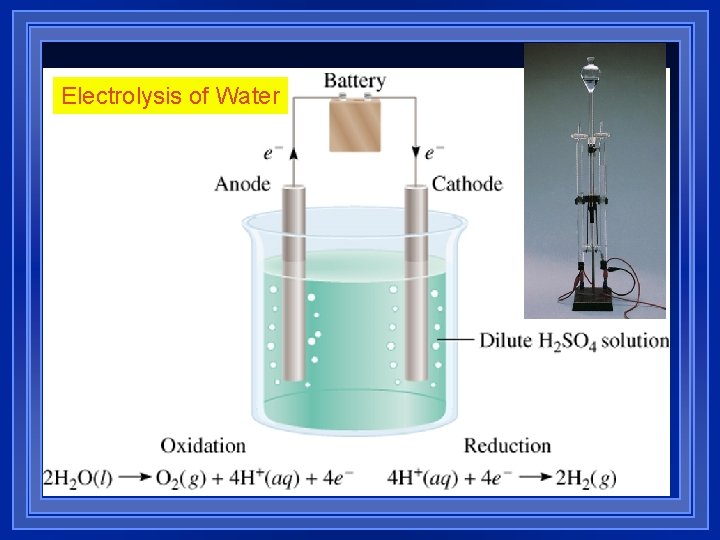
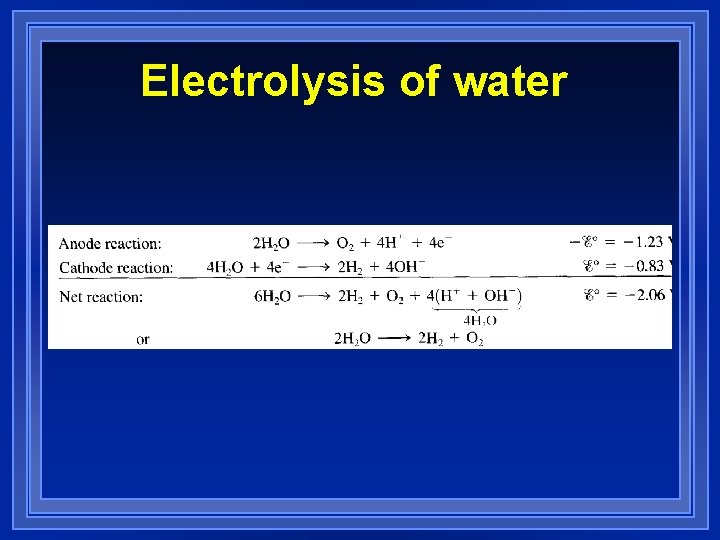
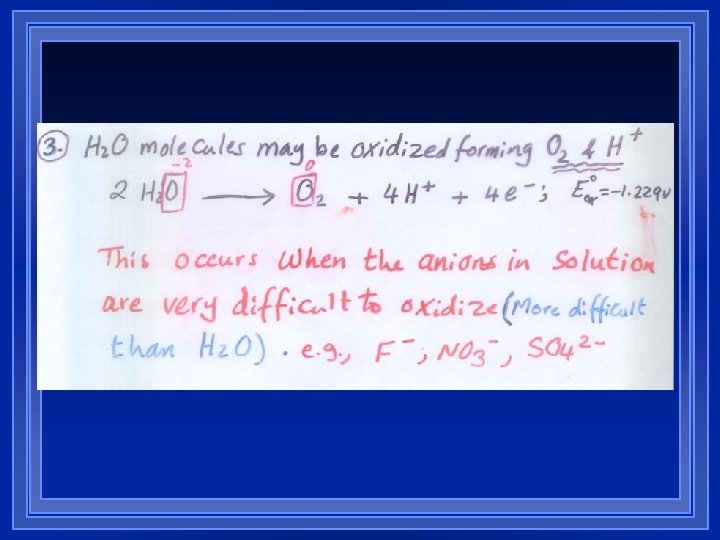
Electrolysis of Water
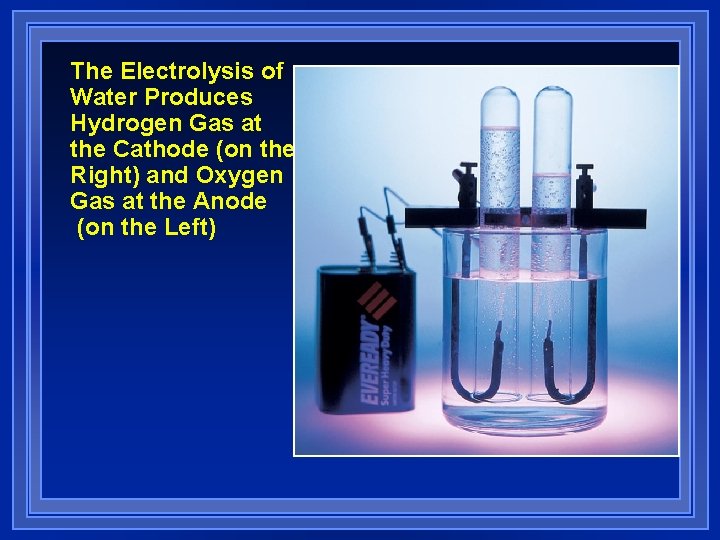
The Electrolysis of Water Produces Hydrogen Gas at the Cathode (on the Right) and Oxygen Gas at the Anode (on the Left)
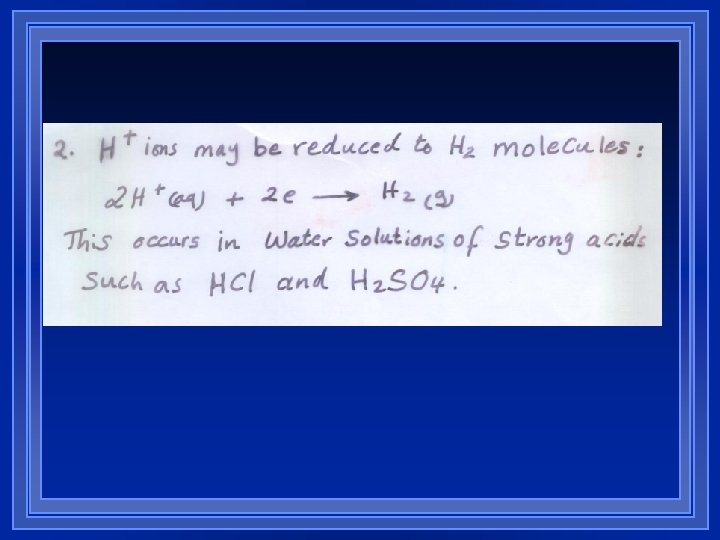
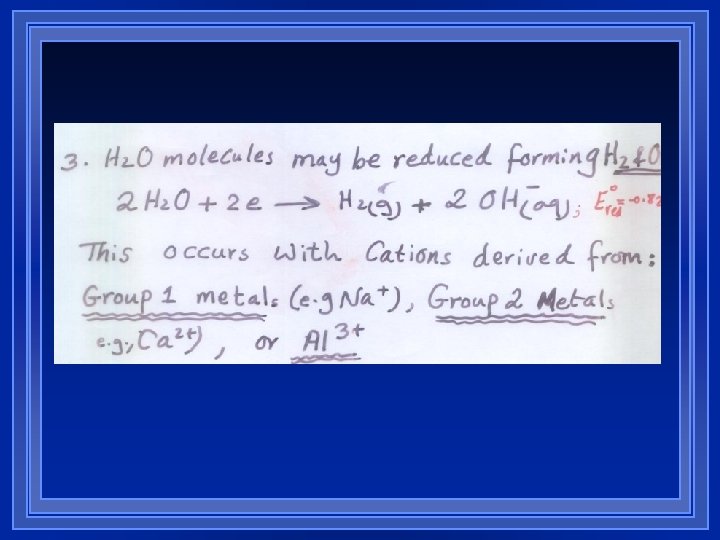
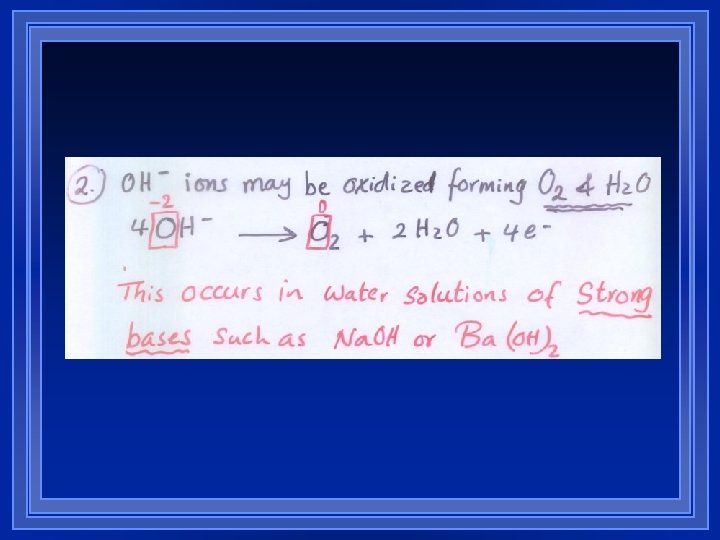
Electrolysis of water
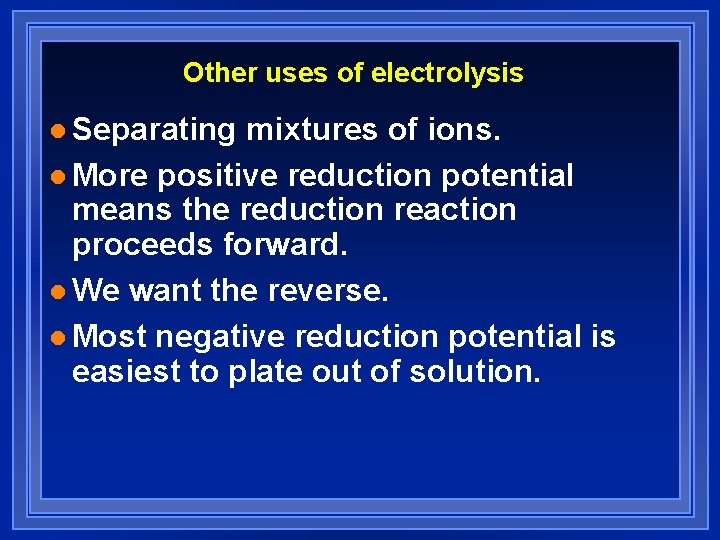
Other uses of electrolysis l Separating mixtures of ions. l More positive reduction potential means the reduction reaction proceeds forward. l We want the reverse. l Most negative reduction potential is easiest to plate out of solution.
17. 8 Commercial electrolytic processes
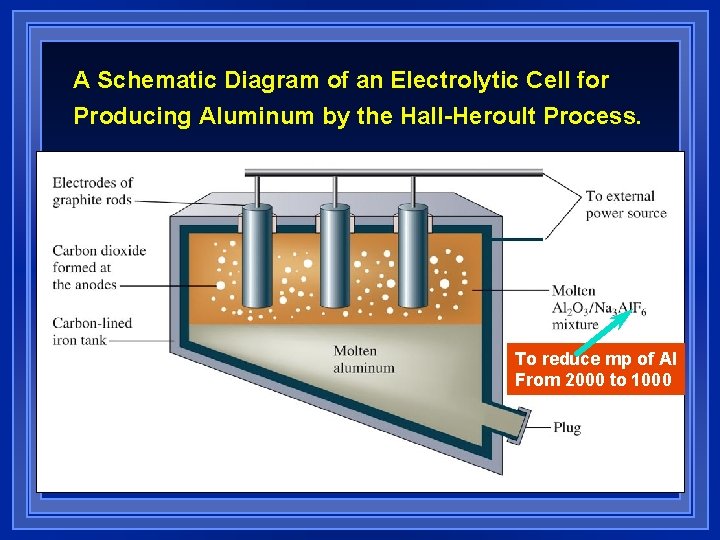
A Schematic Diagram of an Electrolytic Cell for Producing Aluminum by the Hall-Heroult Process. To reduce mp of Al From 2000 to 1000
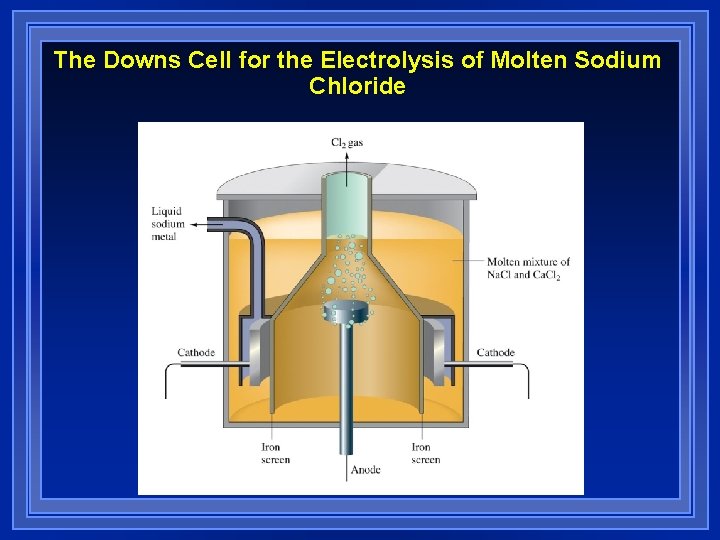
The Downs Cell for the Electrolysis of Molten Sodium Chloride
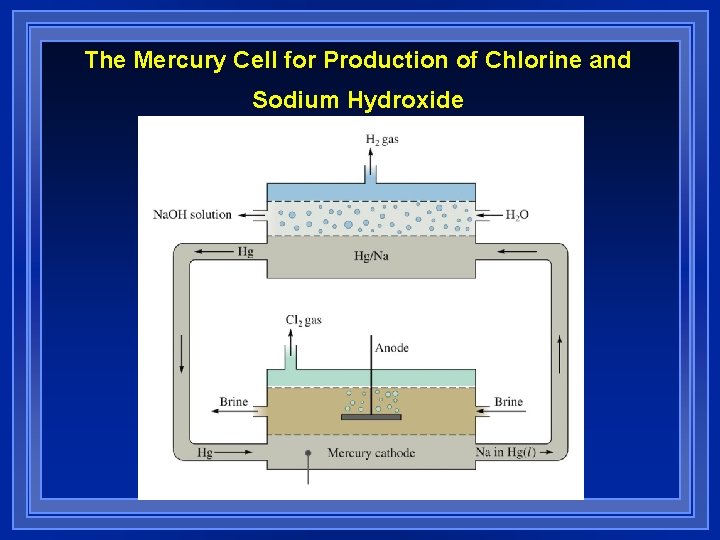
The Mercury Cell for Production of Chlorine and Sodium Hydroxide
Metal Plating