
CHM 103 Lesson Plan 612004 Electrochemistry Introduction Voltaic


- Slides: 36
CHM 103 Lesson Plan 6/1/2004
Electrochemistry • • Introduction Voltaic Cells Standard Voltage: E° Relations Between K, ΔG°, & E° Effect of Concentration on Voltage Electrolytic Cells Commercial Cells (for independent reading)
Introduction • Voltaic Cell • Spontaneous redox reaction • Generates useful electrical energy • Electrolytic Cell • Non-spontaneous Redox Reaction • Driven by application of electrical energy
Introduction (2) Cathode Reduction Consumes electrons Attracts cations • Anode • Oxidation • Produces electrons • Attracts anions
Introduction (3) • Voltage • A measure of spontaneity
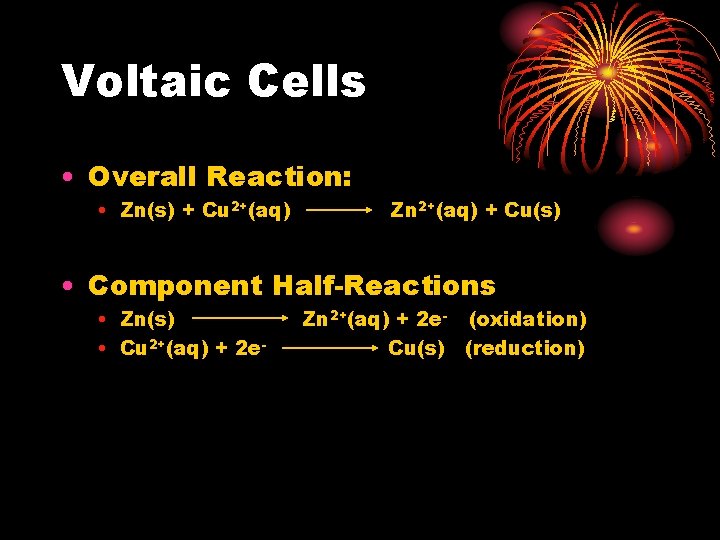
Voltaic Cells • Overall Reaction: • Zn(s) + Cu 2+(aq) Zn 2+(aq) + Cu(s) • Component Half-Reactions • Zn(s) • Cu 2+(aq) + 2 e- Zn 2+(aq) + 2 e- (oxidation) Cu(s) (reduction)
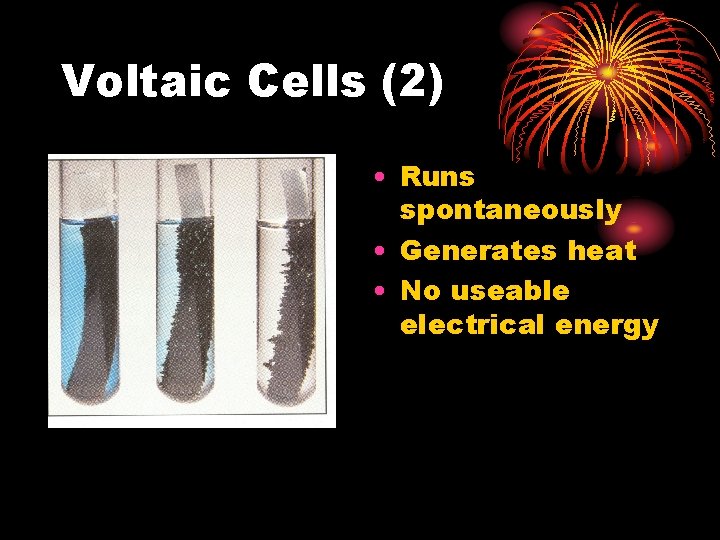
Voltaic Cells (2) • Runs spontaneously • Generates heat • No useable electrical energy
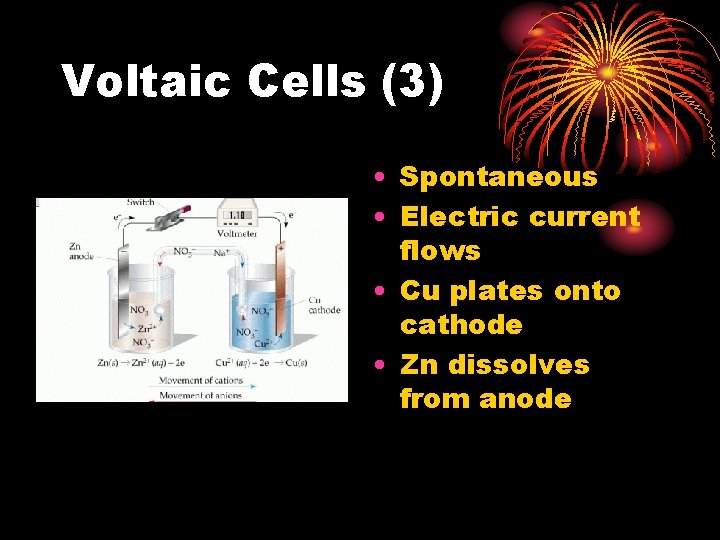
Voltaic Cells (3) • Spontaneous • Electric current flows • Cu plates onto cathode • Zn dissolves from anode
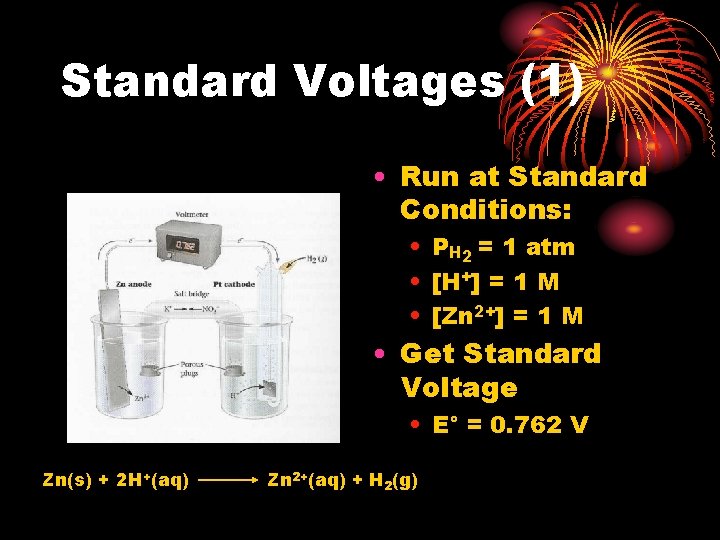
Standard Voltages (1) • Run at Standard Conditions: • PH 2 = 1 atm • [H+] = 1 M • [Zn 2+] = 1 M • Get Standard Voltage • E° = 0. 762 V Zn(s) + 2 H+(aq) Zn 2+(aq) + H 2(g)
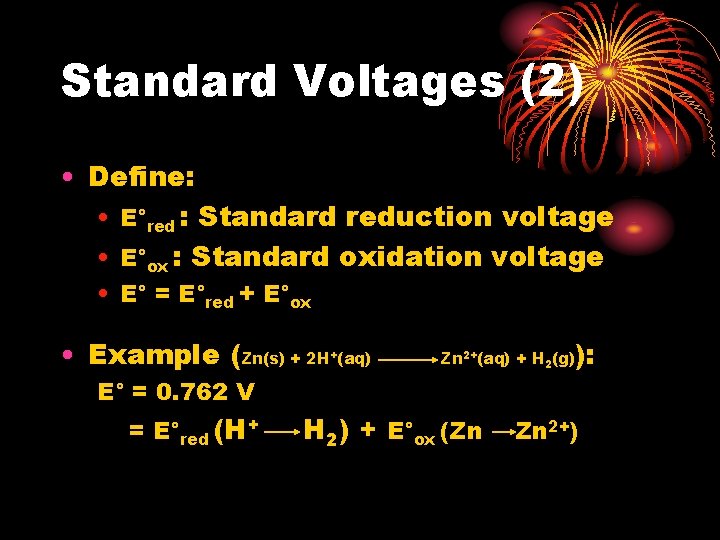
Standard Voltages (2) • Define: • E°red : Standard reduction voltage • E°ox : Standard oxidation voltage • E° = E°red + E°ox • Example (Zn(s) + 2 H (aq) + Zn 2+(aq) + H 2(g) ): E° = 0. 762 V = E°red (H+ H 2) + E°ox (Zn Zn 2+)
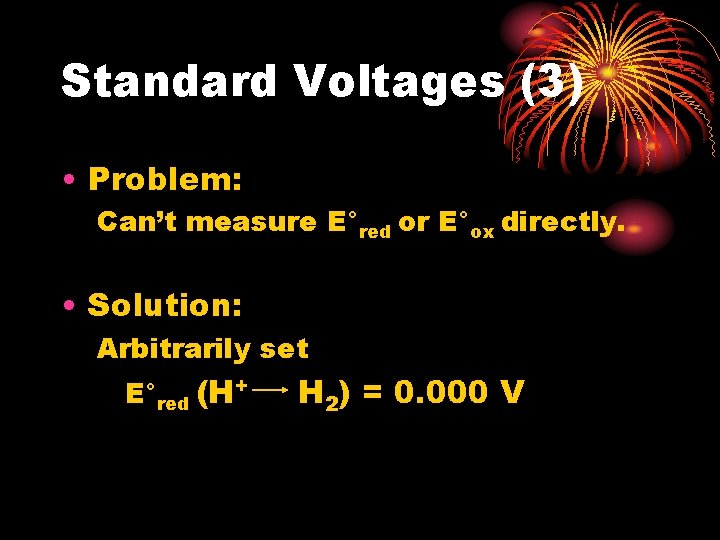
Standard Voltages (3) • Problem: Can’t measure E°red or E°ox directly. • Solution: Arbitrarily set E°red (H+ H 2) = 0. 000 V
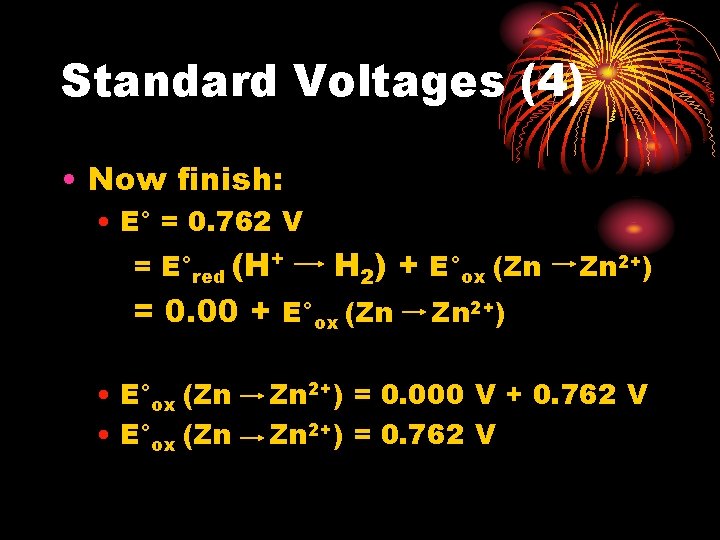
Standard Voltages (4) • Now finish: • E° = 0. 762 V = E°red (H+ H 2) + E°ox (Zn = 0. 00 + E°ox (Zn • E°ox (Zn Zn 2+) = 0. 000 V + 0. 762 V Zn 2+) = 0. 762 V
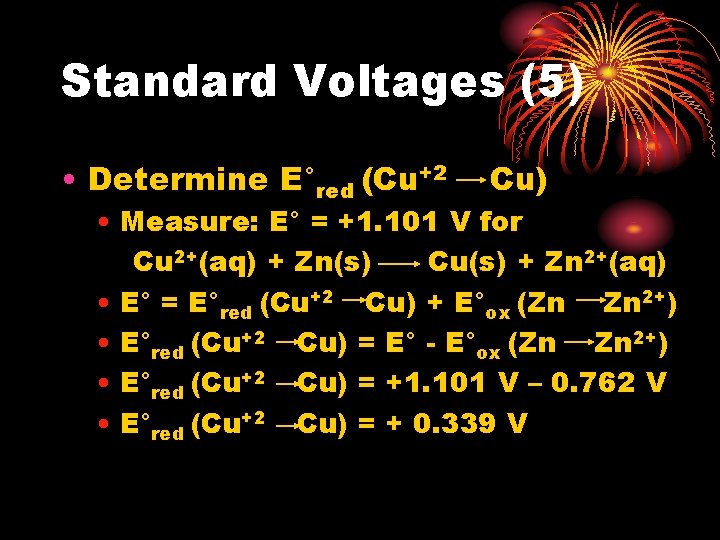
Standard Voltages (5) • Determine E°red (Cu+2 Cu) • Measure: E° = +1. 101 V for Cu 2+(aq) + Zn(s) Cu(s) + Zn 2+(aq) • E° = E°red (Cu+2 Cu) + E°ox (Zn Zn 2+) • E°red (Cu+2 Cu) = E° - E°ox (Zn Zn 2+) • E°red (Cu+2 Cu) = +1. 101 V – 0. 762 V • E°red (Cu+2 Cu) = + 0. 339 V
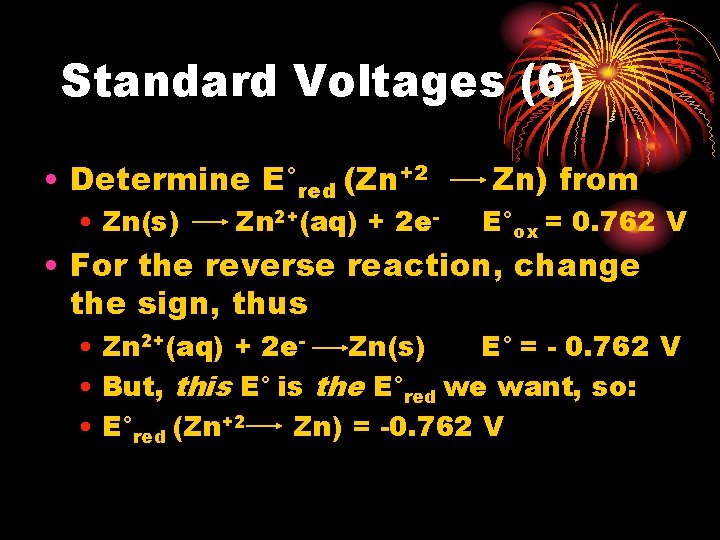
Standard Voltages (6) • Determine E°red (Zn+2 • Zn(s) Zn 2+(aq) + 2 e- Zn) from E°ox = 0. 762 V • For the reverse reaction, change the sign, thus • Zn 2+(aq) + 2 e. Zn(s) E° = - 0. 762 V • But, this E° is the E°red we want, so: • E°red (Zn+2 Zn) = -0. 762 V
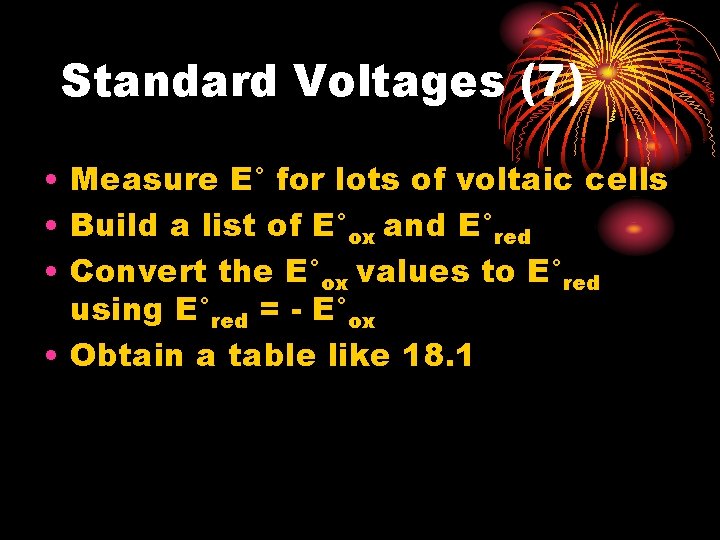
Standard Voltages (7) • Measure E° for lots of voltaic cells • Build a list of E°ox and E°red • Convert the E°ox values to E°red using E°red = - E°ox • Obtain a table like 18. 1
Standard Voltages (8)
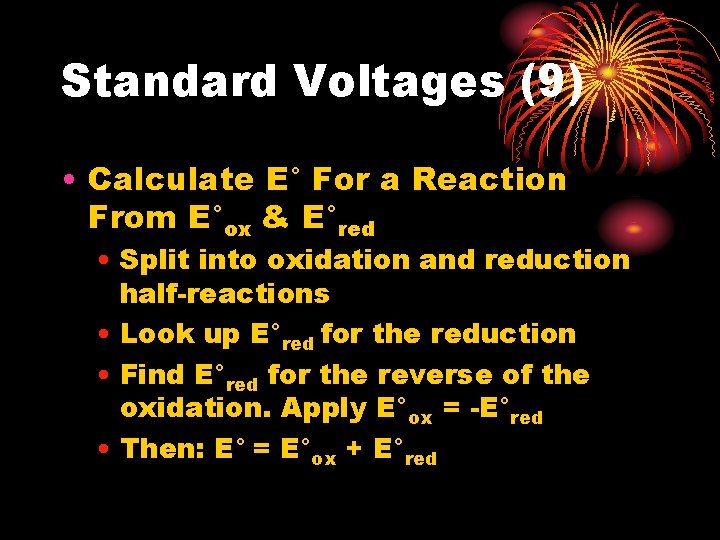
Standard Voltages (9) • Calculate E° For a Reaction From E°ox & E°red • Split into oxidation and reduction half-reactions • Look up E°red for the reduction • Find E°red for the reverse of the oxidation. Apply E°ox = -E°red • Then: E° = E°ox + E°red
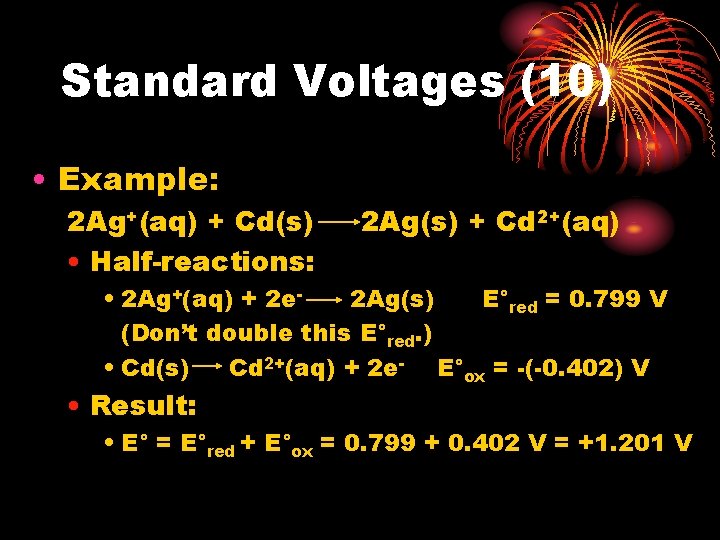
Standard Voltages (10) • Example: 2 Ag+(aq) + Cd(s) • Half-reactions: 2 Ag(s) + Cd 2+(aq) • 2 Ag+(aq) + 2 e 2 Ag(s) E°red = 0. 799 V (Don’t double this E°red. ) • Cd(s) Cd 2+(aq) + 2 e- E°ox = -(-0. 402) V • Result: • E° = E°red + E°ox = 0. 799 + 0. 402 V = +1. 201 V
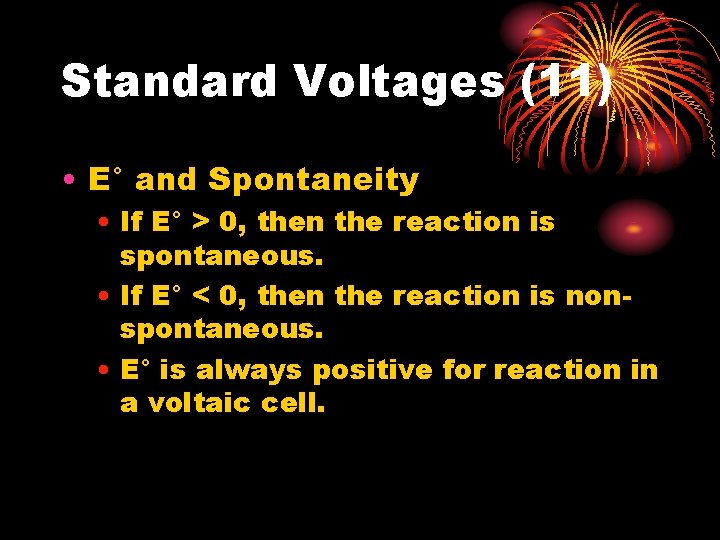
Standard Voltages (11) • E° and Spontaneity • If E° > 0, then the reaction is spontaneous. • If E° < 0, then the reaction is nonspontaneous. • E° is always positive for reaction in a voltaic cell.
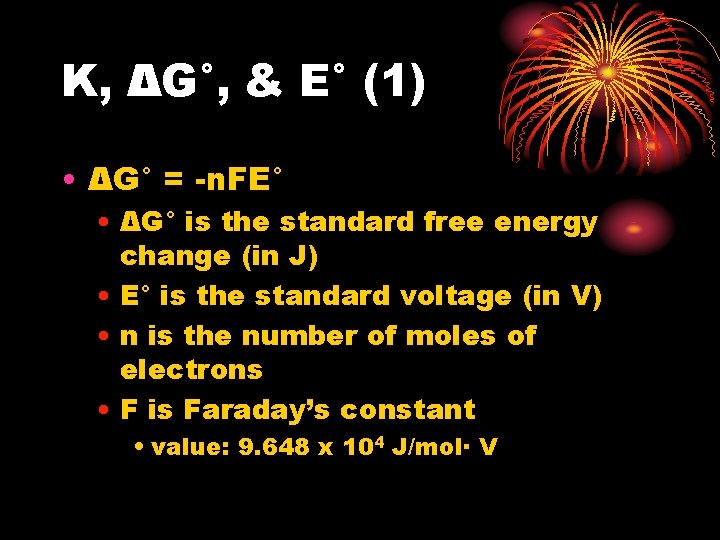
K, ΔG°, & E° (1) • ΔG° = -n. FE° • ΔG° is the standard free energy change (in J) • E° is the standard voltage (in V) • n is the number of moles of electrons • F is Faraday’s constant • value: 9. 648 x 104 J/mol· V
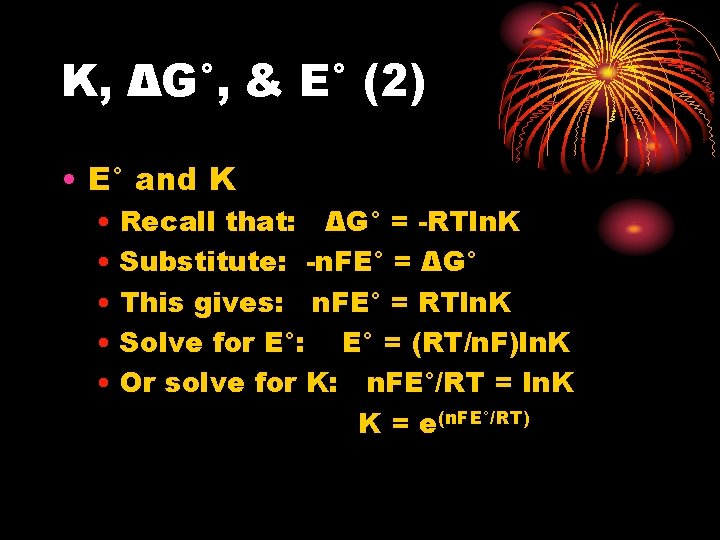
K, ΔG°, & E° (2) • E° and K • Recall that: ΔG° = -RTln. K • Substitute: -n. FE° = ΔG° • This gives: n. FE° = RTln. K • Solve for E°: E° = (RT/n. F)ln. K • Or solve for K: n. FE°/RT = ln. K K = e(n. FE°/RT)
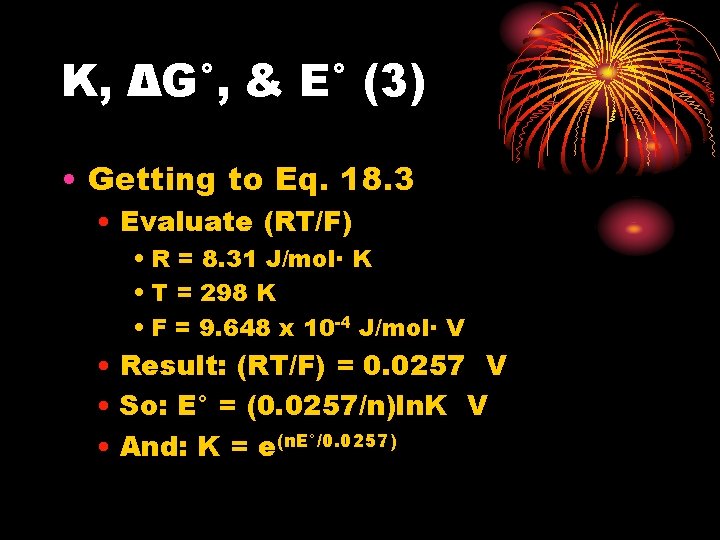
K, ΔG°, & E° (3) • Getting to Eq. 18. 3 • Evaluate (RT/F) • R = 8. 31 J/mol· K • T = 298 K • F = 9. 648 x 10 -4 J/mol· V • Result: (RT/F) = 0. 0257 V • So: E° = (0. 0257/n)ln. K V • And: K = e(n. E°/0. 0257)
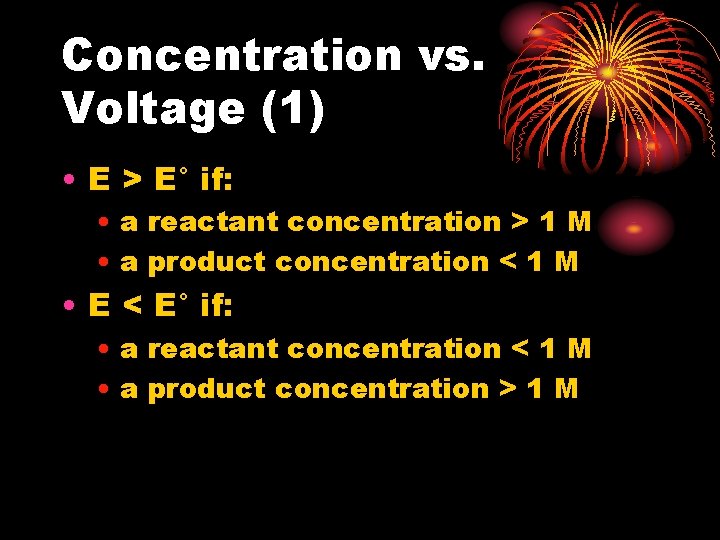
Concentration vs. Voltage (1) • E > E° if: • a reactant concentration > 1 M • a product concentration < 1 M • E < E° if: • a reactant concentration < 1 M • a product concentration > 1 M
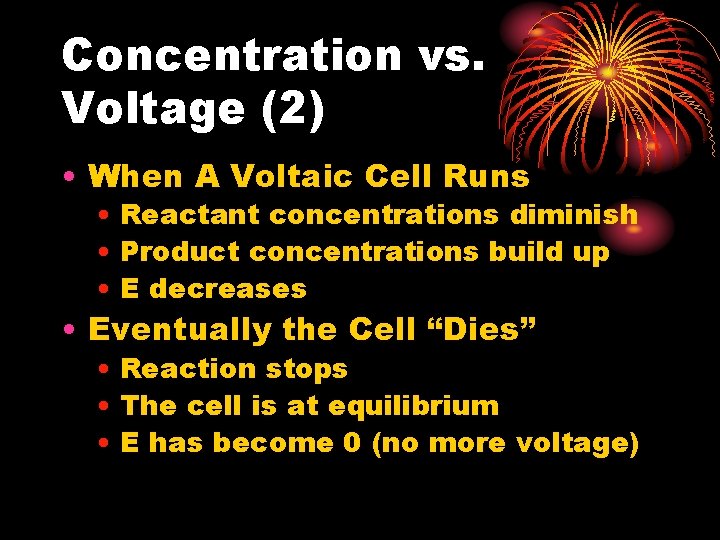
Concentration vs. Voltage (2) • When A Voltaic Cell Runs • Reactant concentrations diminish • Product concentrations build up • E decreases • Eventually the Cell “Dies” • Reaction stops • The cell is at equilibrium • E has become 0 (no more voltage)
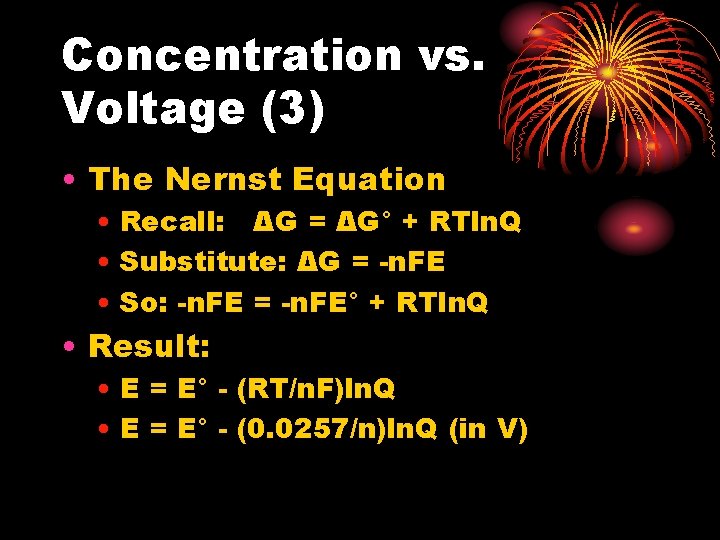
Concentration vs. Voltage (3) • The Nernst Equation • Recall: ΔG = ΔG° + RTln. Q • Substitute: ΔG = -n. FE • So: -n. FE = -n. FE° + RTln. Q • Result: • E = E° - (RT/n. F)ln. Q • E = E° - (0. 0257/n)ln. Q (in V)
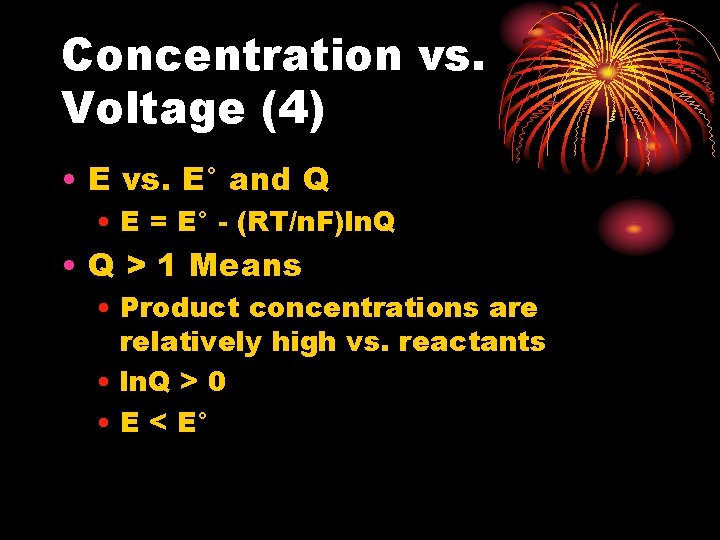
Concentration vs. Voltage (4) • E vs. E° and Q • E = E° - (RT/n. F)ln. Q • Q > 1 Means • Product concentrations are relatively high vs. reactants • ln. Q > 0 • E < E°
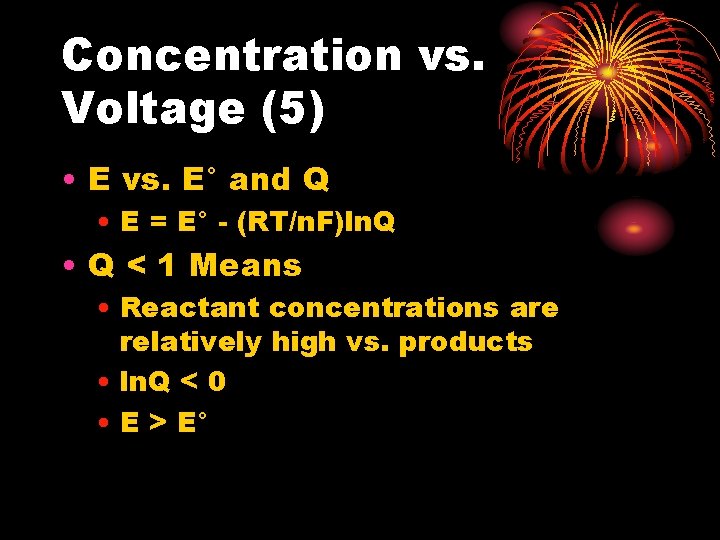
Concentration vs. Voltage (5) • E vs. E° and Q • E = E° - (RT/n. F)ln. Q • Q < 1 Means • Reactant concentrations are relatively high vs. products • ln. Q < 0 • E > E°
Concentration vs. Voltage (6) • Example (18. 6): Find E if: • O 2(g) + 4 H+(aq) – + 4 Br (aq) 2 H 2 O(l) + 2 Br 2(l) • PO 2 = 1. 0 atm • [H+] = [Br–] = 0. 10 M • Strategy: Use Nernst Equation 1. Determine Q 2. Determine E° 3. Solve for E (work at board)
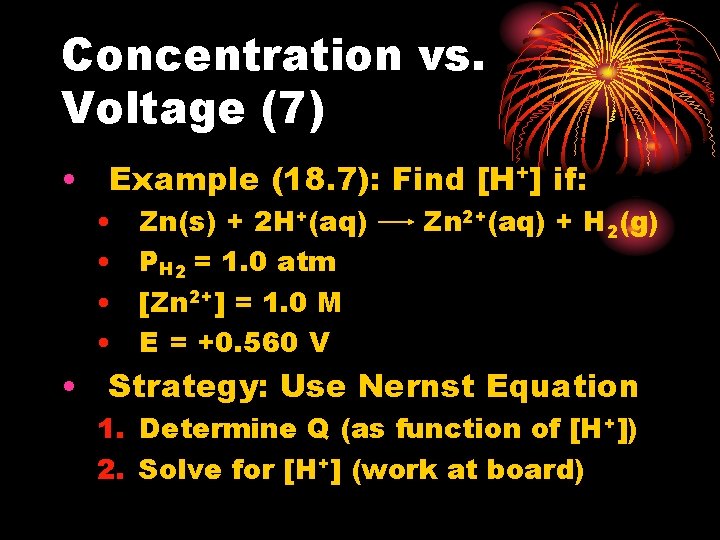
Concentration vs. Voltage (7) • Example (18. 7): Find [H+] if: • • Zn(s) + 2 H+(aq) PH 2 = 1. 0 atm [Zn 2+] = 1. 0 M E = +0. 560 V Zn 2+(aq) + H 2(g) • Strategy: Use Nernst Equation 1. Determine Q (as function of [H+]) 2. Solve for [H+] (work at board)
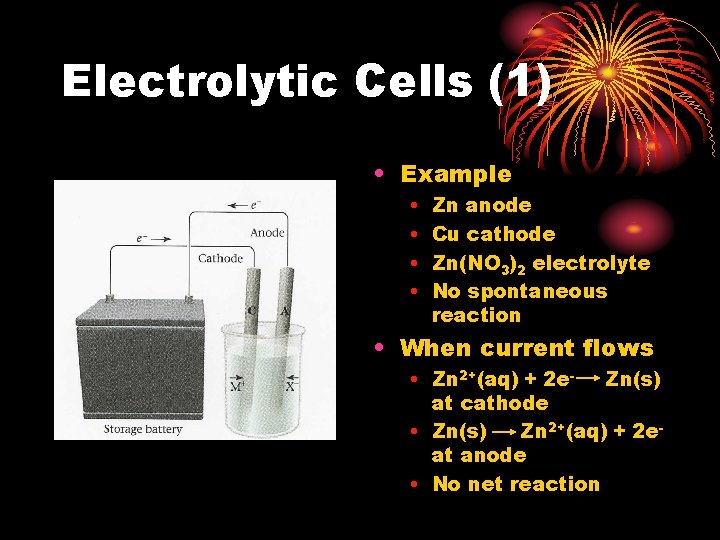
Electrolytic Cells (1) • Example • • Zn anode Cu cathode Zn(NO 3)2 electrolyte No spontaneous reaction • When current flows • Zn 2+(aq) + 2 e- Zn(s) at cathode • Zn(s) Zn 2+(aq) + 2 eat anode • No net reaction
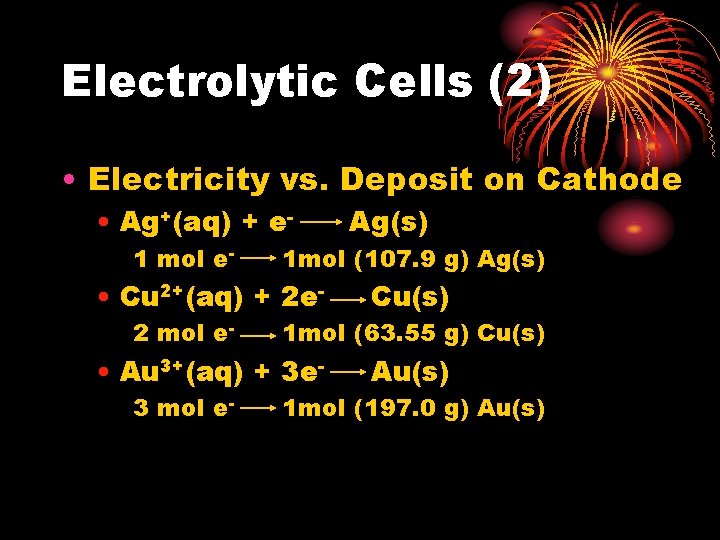
Electrolytic Cells (2) • Electricity vs. Deposit on Cathode • Ag+(aq) + e 1 mol e- 1 mol (107. 9 g) Ag(s) • Cu 2+(aq) + 2 e 2 mol e- Cu(s) 1 mol (63. 55 g) Cu(s) • Au 3+(aq) + 3 e 3 mol e- Ag(s) Au(s) 1 mol (197. 0 g) Au(s)
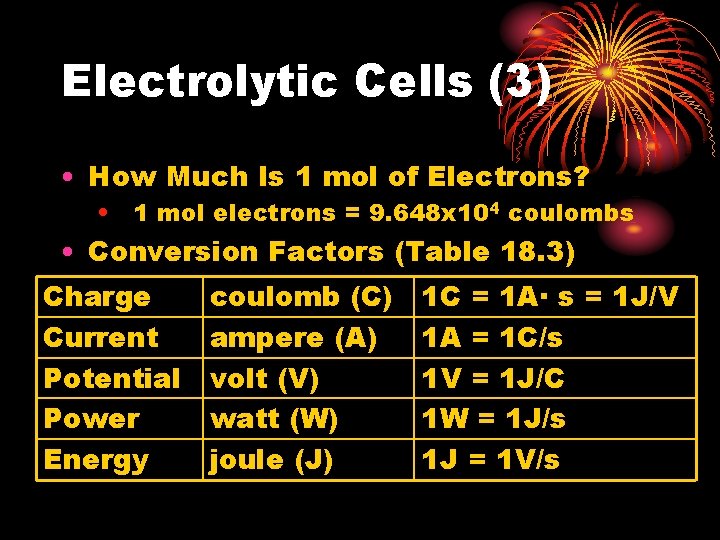
Electrolytic Cells (3) • How Much Is 1 mol of Electrons? • 1 mol electrons = 9. 648 x 104 coulombs • Conversion Factors (Table 18. 3) Charge Current Potential Power Energy coulomb (C) ampere (A) volt (V) watt (W) joule (J) 1 C = 1 A· s = 1 J/V 1 A = 1 C/s 1 V = 1 J/C 1 W = 1 J/s 1 J = 1 V/s
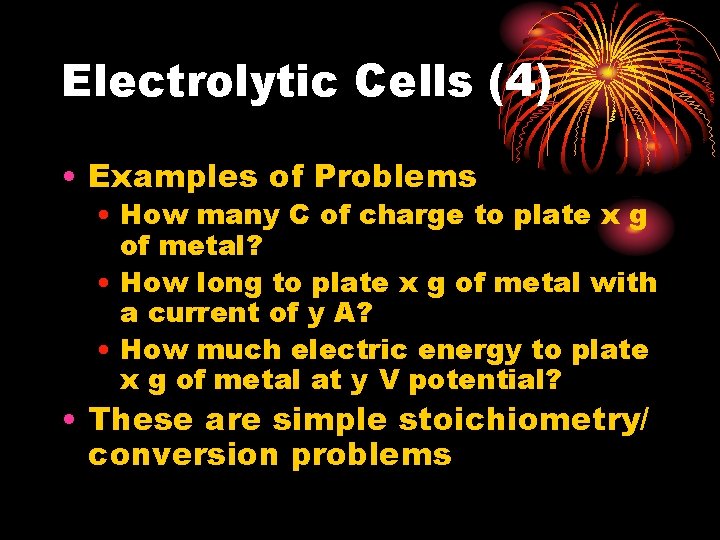
Electrolytic Cells (4) • Examples of Problems • How many C of charge to plate x g of metal? • How long to plate x g of metal with a current of y A? • How much electric energy to plate x g of metal at y V potential? • These are simple stoichiometry/ conversion problems
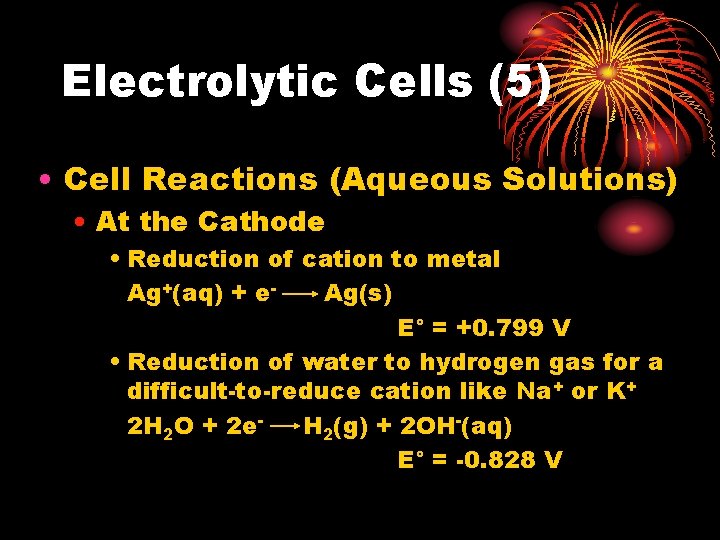
Electrolytic Cells (5) • Cell Reactions (Aqueous Solutions) • At the Cathode • Reduction of cation to metal Ag+(aq) + e. Ag(s) E° = +0. 799 V • Reduction of water to hydrogen gas for a difficult-to-reduce cation like Na+ or K+ 2 H 2 O + 2 e. H 2(g) + 2 OH-(aq) E° = -0. 828 V
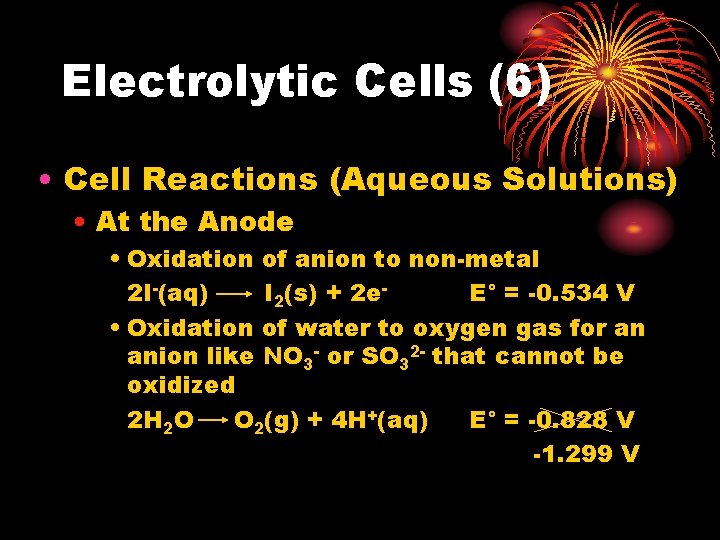
Electrolytic Cells (6) • Cell Reactions (Aqueous Solutions) • At the Anode • Oxidation of anion to non-metal 2 I-(aq) I 2(s) + 2 e. E° = -0. 534 V • Oxidation of water to oxygen gas for an anion like NO 3 - or SO 32 - that cannot be oxidized 2 H 2 O O 2(g) + 4 H+(aq) E° = -0. 828 V -1. 299 V
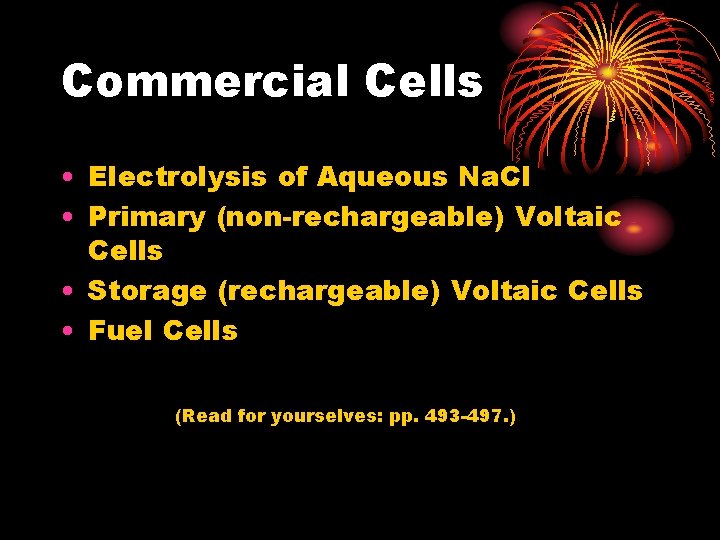
Commercial Cells • Electrolysis of Aqueous Na. Cl • Primary (non-rechargeable) Voltaic Cells • Storage (rechargeable) Voltaic Cells • Fuel Cells (Read for yourselves: pp. 493 -497. )