21 1 Electrochemical Cells Chapter 21 Electrochemistry 21


- Slides: 61
21. 1 Electrochemical Cells > Chapter 21 Electrochemistry 21. 1 Electrochemical Cells 21. 2 Half-Cells and Cell Potentials 21. 3 Electrolytic Cells 1 Copyright © Pearson Education, Inc. , or its affiliates. All Rights Reserved.
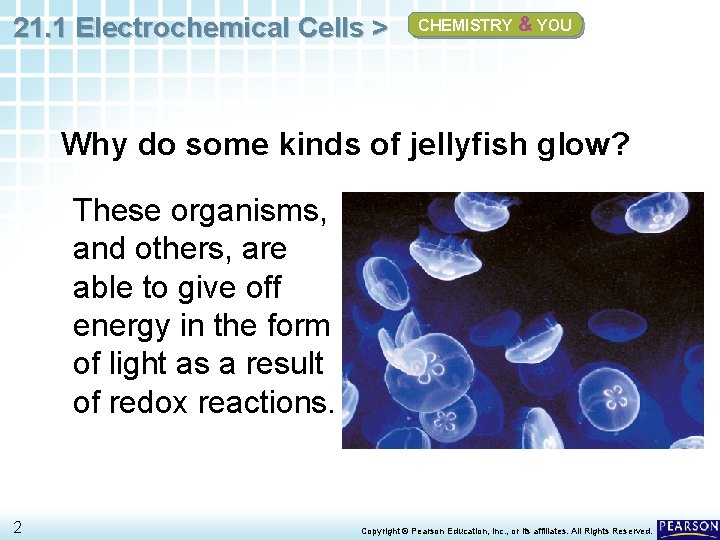
21. 1 Electrochemical Cells > CHEMISTRY & YOU Why do some kinds of jellyfish glow? These organisms, and others, are able to give off energy in the form of light as a result of redox reactions. 2 Copyright © Pearson Education, Inc. , or its affiliates. All Rights Reserved.
21. 1 Electrochemical Cells > Electrochemical Processes What type of chemical reaction is involved in all electrochemical processes? 3 Copyright © Pearson Education, Inc. , or its affiliates. All Rights Reserved.
21. 1 Electrochemical Cells > Electrochemical Processes Chemical processes can either release energy or absorb energy. The energy can sometimes be in the form of electricity. • An electrochemical process is any conversion between chemical energy and electrical energy. 4 Copyright © Pearson Education, Inc. , or its affiliates. All Rights Reserved.
21. 1 Electrochemical Cells > Electrochemical Processes All electrochemical processes involve redox reactions. • Electrochemical processes have many applications in the home as well as in industry: – Flashlight and automobile batteries – Silver-plating of tableware – Biological systems 5 Copyright © Pearson Education, Inc. , or its affiliates. All Rights Reserved.
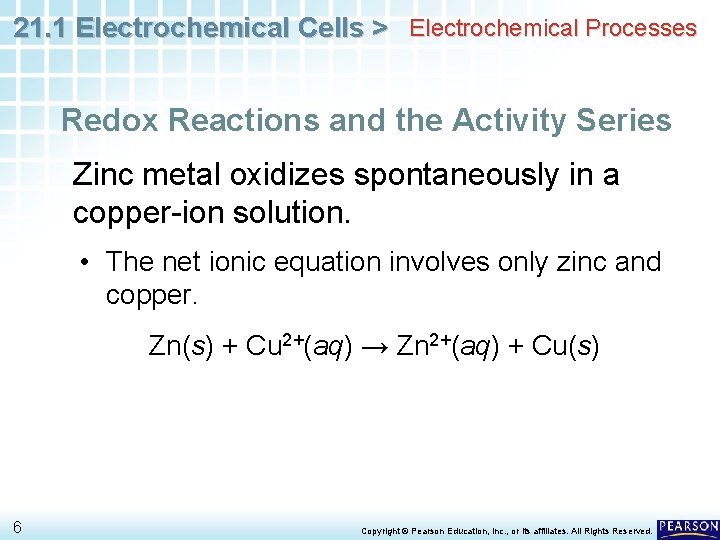
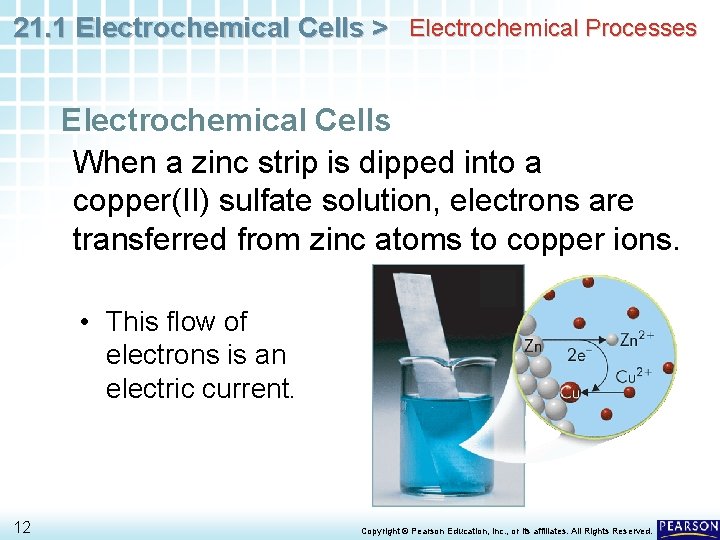
21. 1 Electrochemical Cells > Electrochemical Processes Redox Reactions and the Activity Series Zinc metal oxidizes spontaneously in a copper-ion solution. • The net ionic equation involves only zinc and copper. Zn(s) + Cu 2+(aq) → Zn 2+(aq) + Cu(s) 6 Copyright © Pearson Education, Inc. , or its affiliates. All Rights Reserved.
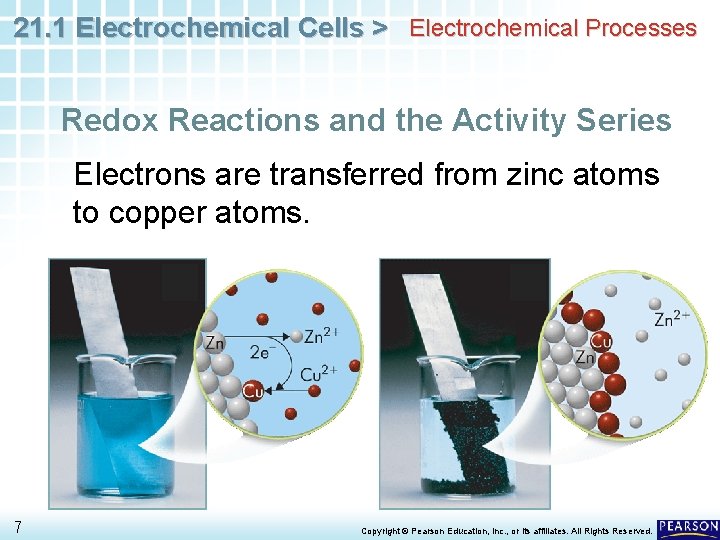
21. 1 Electrochemical Cells > Electrochemical Processes Redox Reactions and the Activity Series Electrons are transferred from zinc atoms to copper atoms. 7 Copyright © Pearson Education, Inc. , or its affiliates. All Rights Reserved.
21. 1 Electrochemical Cells > Electrochemical Processes Redox Reactions and the Activity Series Electrons are transferred from zinc atoms to copper atoms. • Zinc atoms lose electrons as they are oxidized to zinc ions. Oxidation: Zn(s) → Zn 2+(aq) + 2 e– • Copper ions in solution gain electrons lost by the zinc. Reduction: Cu 2+(aq) + 2 e– → Cu(s) 8 Copyright © Pearson Education, Inc. , or its affiliates. All Rights Reserved.
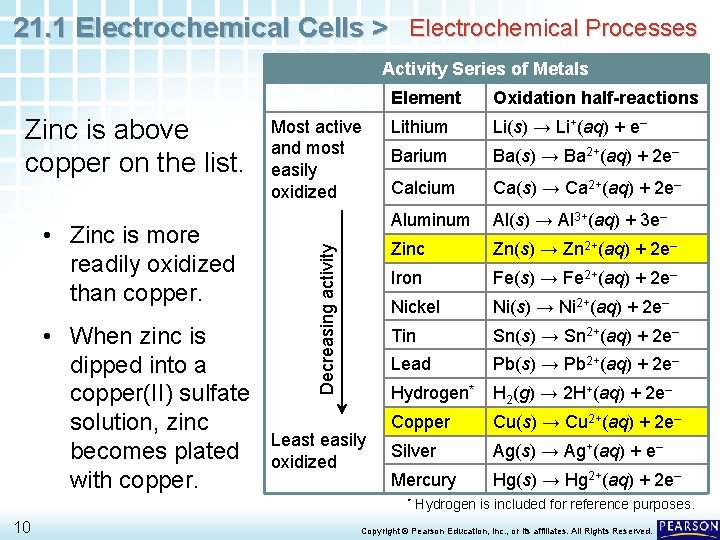
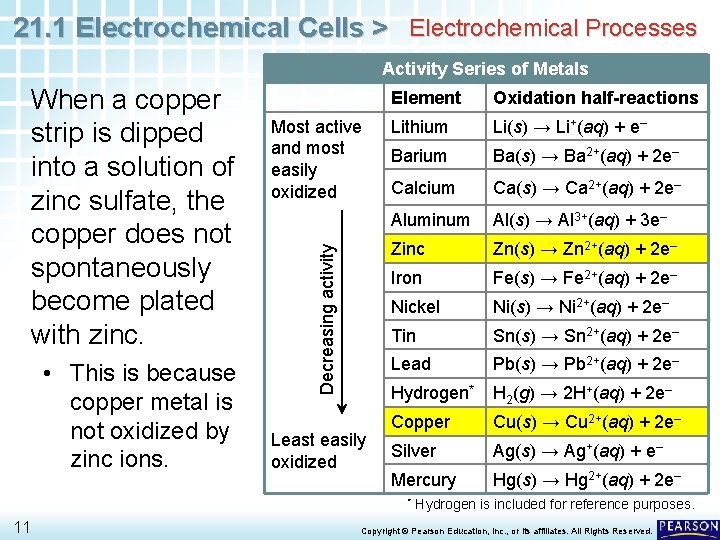
21. 1 Electrochemical Cells > Electrochemical Processes Activity Series of Metals Most active and most easily oxidized Decreasing activity For any two metals in an activity series, the more active metal is the more readily oxidized. Least easily oxidized Element Oxidation half-reactions Lithium Li(s) → Li+(aq) + e– Barium Ba(s) → Ba 2+(aq) + 2 e– Calcium Ca(s) → Ca 2+(aq) + 2 e– Aluminum Al(s) → Al 3+(aq) + 3 e– Zinc Zn(s) → Zn 2+(aq) + 2 e– Iron Fe(s) → Fe 2+(aq) + 2 e– Nickel Ni(s) → Ni 2+(aq) + 2 e– Tin Sn(s) → Sn 2+(aq) + 2 e– Lead Pb(s) → Pb 2+(aq) + 2 e– Hydrogen* H 2(g) → 2 H+(aq) + 2 e– Copper Cu(s) → Cu 2+(aq) + 2 e– Silver Ag(s) → Ag+(aq) + e– Mercury Hg(s) → Hg 2+(aq) + 2 e– * 9 Hydrogen is included for reference purposes. Copyright © Pearson Education, Inc. , or its affiliates. All Rights Reserved.
21. 1 Electrochemical Cells > Electrochemical Processes Activity Series of Metals • Zinc is more readily oxidized than copper. • When zinc is dipped into a copper(II) sulfate solution, zinc becomes plated with copper. Most active and most easily oxidized Decreasing activity Zinc is above copper on the list. Least easily oxidized Element Oxidation half-reactions Lithium Li(s) → Li+(aq) + e– Barium Ba(s) → Ba 2+(aq) + 2 e– Calcium Ca(s) → Ca 2+(aq) + 2 e– Aluminum Al(s) → Al 3+(aq) + 3 e– Zinc Zn(s) → Zn 2+(aq) + 2 e– Iron Fe(s) → Fe 2+(aq) + 2 e– Nickel Ni(s) → Ni 2+(aq) + 2 e– Tin Sn(s) → Sn 2+(aq) + 2 e– Lead Pb(s) → Pb 2+(aq) + 2 e– Hydrogen* H 2(g) → 2 H+(aq) + 2 e– Copper Cu(s) → Cu 2+(aq) + 2 e– Silver Ag(s) → Ag+(aq) + e– Mercury Hg(s) → Hg 2+(aq) + 2 e– * 10 Hydrogen is included for reference purposes. Copyright © Pearson Education, Inc. , or its affiliates. All Rights Reserved.
21. 1 Electrochemical Cells > Electrochemical Processes Activity Series of Metals • This is because copper metal is not oxidized by zinc ions. Most active and most easily oxidized Decreasing activity When a copper strip is dipped into a solution of zinc sulfate, the copper does not spontaneously become plated with zinc. Least easily oxidized Element Oxidation half-reactions Lithium Li(s) → Li+(aq) + e– Barium Ba(s) → Ba 2+(aq) + 2 e– Calcium Ca(s) → Ca 2+(aq) + 2 e– Aluminum Al(s) → Al 3+(aq) + 3 e– Zinc Zn(s) → Zn 2+(aq) + 2 e– Iron Fe(s) → Fe 2+(aq) + 2 e– Nickel Ni(s) → Ni 2+(aq) + 2 e– Tin Sn(s) → Sn 2+(aq) + 2 e– Lead Pb(s) → Pb 2+(aq) + 2 e– Hydrogen* H 2(g) → 2 H+(aq) + 2 e– Copper Cu(s) → Cu 2+(aq) + 2 e– Silver Ag(s) → Ag+(aq) + e– Mercury Hg(s) → Hg 2+(aq) + 2 e– * 11 Hydrogen is included for reference purposes. Copyright © Pearson Education, Inc. , or its affiliates. All Rights Reserved.
21. 1 Electrochemical Cells > Electrochemical Processes Electrochemical Cells When a zinc strip is dipped into a copper(II) sulfate solution, electrons are transferred from zinc atoms to copper ions. • This flow of electrons is an electric current. 12 Copyright © Pearson Education, Inc. , or its affiliates. All Rights Reserved.
21. 1 Electrochemical Cells > Electrochemical Processes Electrochemical Cells An electric current can be used to produce a chemical change. • Any device that converts chemical energy into electrical energy or electrical energy into chemical energy is an electrochemical cell. • Redox reactions occur in all electrochemical cells. 13 Copyright © Pearson Education, Inc. , or its affiliates. All Rights Reserved.
21. 1 Electrochemical Cells > CHEMISTRY & YOU Jellyfish and other creatures that glow contain compounds that undergo redox reactions. What do these reactions have in common with redox reactions that occur in electrochemical cells? 14 Copyright © Pearson Education, Inc. , or its affiliates. All Rights Reserved.
21. 1 Electrochemical Cells > CHEMISTRY & YOU Jellyfish and other creatures that glow contain compounds that undergo redox reactions. What do these reactions have in common with redox reactions that occur in electrochemical cells? The reactions taking place within the bodies of the jellyfish and those in electrochemical cells both involve the transfer of electrons from one reactant to another. 15 Copyright © Pearson Education, Inc. , or its affiliates. All Rights Reserved.
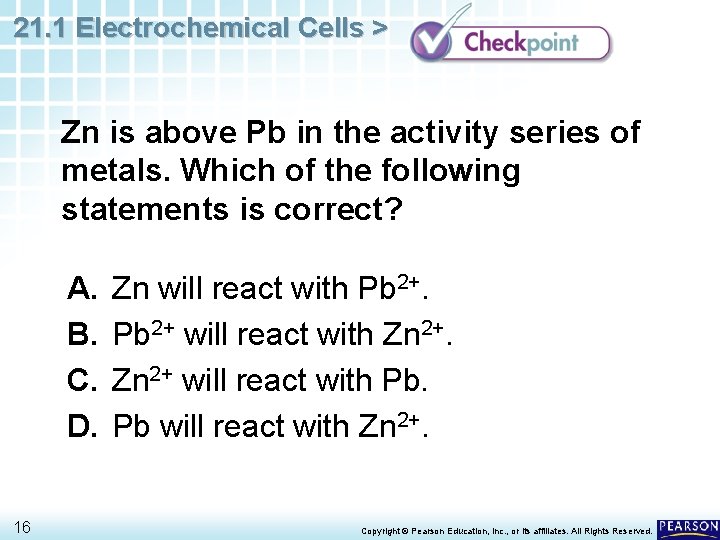
21. 1 Electrochemical Cells > Zn is above Pb in the activity series of metals. Which of the following statements is correct? A. B. C. D. 16 Zn will react with Pb 2+ will react with Zn 2+ will react with Pb. Pb will react with Zn 2+. Copyright © Pearson Education, Inc. , or its affiliates. All Rights Reserved.
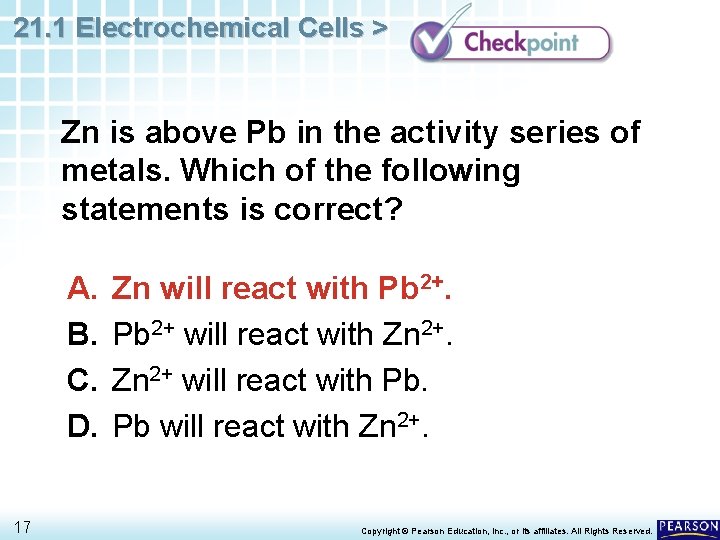
21. 1 Electrochemical Cells > Zn is above Pb in the activity series of metals. Which of the following statements is correct? A. B. C. D. 17 Zn will react with Pb 2+ will react with Zn 2+ will react with Pb. Pb will react with Zn 2+. Copyright © Pearson Education, Inc. , or its affiliates. All Rights Reserved.
21. 1 Electrochemical Cells > Voltaic Cells How does a voltaic cell produce electrical energy? • A voltaic cell is an electrochemical cell used to convert chemical energy into electrical energy. 18 Copyright © Pearson Education, Inc. , or its affiliates. All Rights Reserved.
21. 1 Electrochemical Cells > Voltaic Cells Electrical energy is produced in a voltaic cell by a spontaneous redox reaction within the cell. 19 Copyright © Pearson Education, Inc. , or its affiliates. All Rights Reserved.
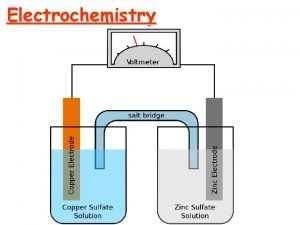
21. 1 Electrochemical Cells > Voltaic Cells Constructing a Voltaic Cell A voltaic cell consists of two half-cells. • A half-cell is one part of a voltaic cell in which either oxidation or reduction occurs. – A typical half-cell consists of a piece of metal immersed in a solution of its ions. 20 Copyright © Pearson Education, Inc. , or its affiliates. All Rights Reserved.
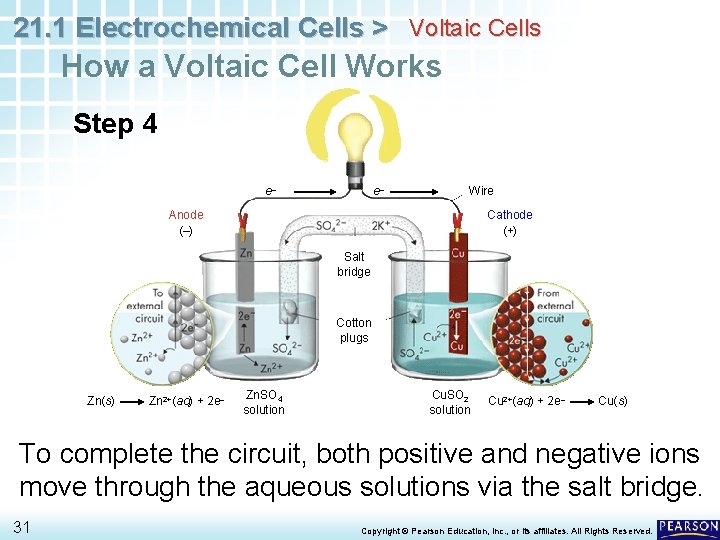
21. 1 Electrochemical Cells > Voltaic Cells Constructing a Voltaic Cell The half-cells are connected by a salt bridge, which is a tube containing a strong electrolyte, often potassium sulfate (K 2 SO 4). • A porous plate may be used instead of a salt bridge. • The salt bridge or porous plate allows ions to pass from one half-cell to the other but prevents the solutions from mixing completely. 21 Copyright © Pearson Education, Inc. , or its affiliates. All Rights Reserved.
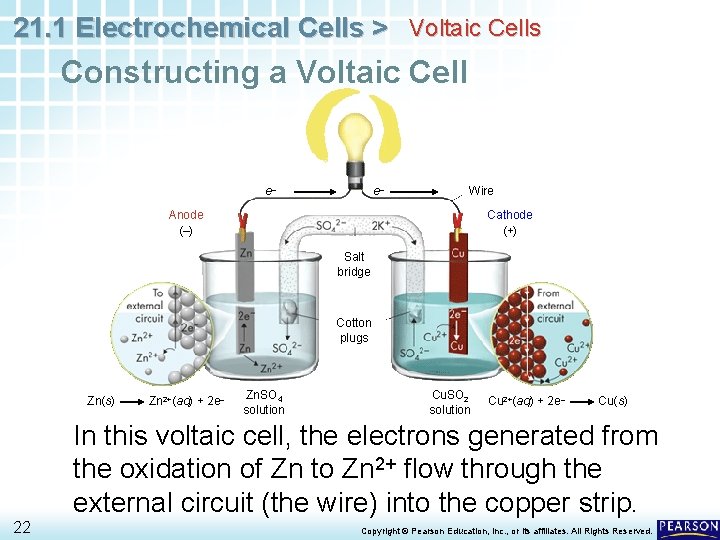
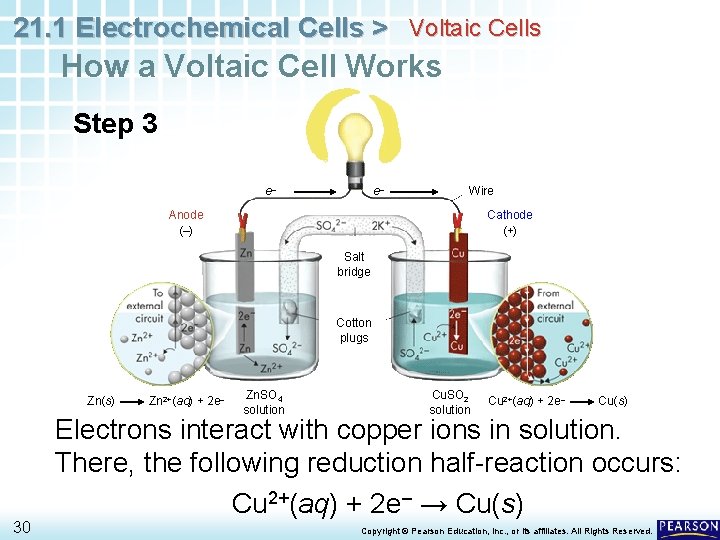
21. 1 Electrochemical Cells > Voltaic Cells Constructing a Voltaic Cell e– e– Wire Anode (–) Cathode (+) Salt bridge Cotton plugs Zn(s) Zn 2+(aq) + 2 e– Zn. SO 4 solution Cu. SO 2 solution Cu 2+(aq) + 2 e– Cu(s) In this voltaic cell, the electrons generated from the oxidation of Zn to Zn 2+ flow through the external circuit (the wire) into the copper strip. 22 Copyright © Pearson Education, Inc. , or its affiliates. All Rights Reserved.
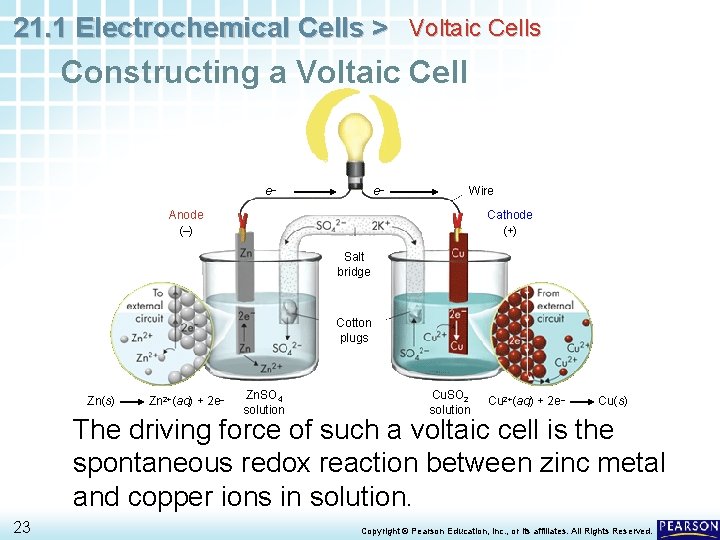
21. 1 Electrochemical Cells > Voltaic Cells Constructing a Voltaic Cell e– e– Wire Anode (–) Cathode (+) Salt bridge Cotton plugs Zn(s) Zn 2+(aq) + 2 e– Zn. SO 4 solution Cu. SO 2 solution Cu 2+(aq) + 2 e– Cu(s) The driving force of such a voltaic cell is the spontaneous redox reaction between zinc metal and copper ions in solution. 23 Copyright © Pearson Education, Inc. , or its affiliates. All Rights Reserved.
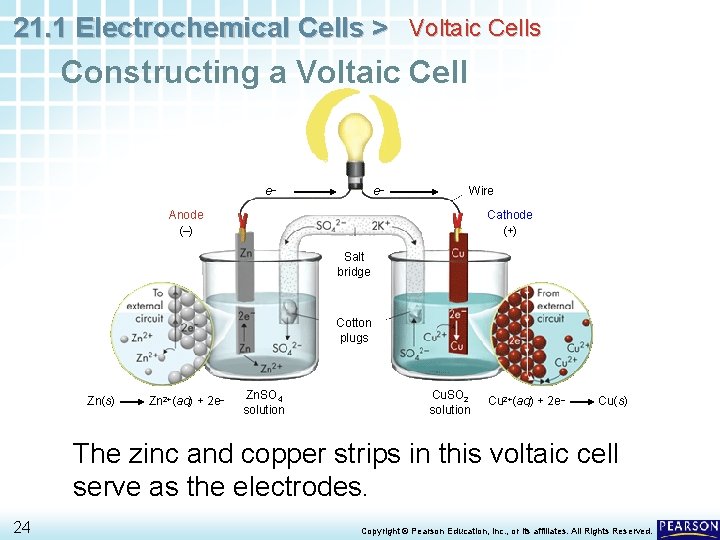
21. 1 Electrochemical Cells > Voltaic Cells Constructing a Voltaic Cell e– e– Wire Anode (–) Cathode (+) Salt bridge Cotton plugs Zn(s) Zn 2+(aq) + 2 e– Zn. SO 4 solution Cu. SO 2 solution Cu 2+(aq) + 2 e– Cu(s) The zinc and copper strips in this voltaic cell serve as the electrodes. 24 Copyright © Pearson Education, Inc. , or its affiliates. All Rights Reserved.
21. 1 Electrochemical Cells > Voltaic Cells Constructing a Voltaic Cell An electrode is a conductor in a circuit that carries electrons to or from a substance other than a metal. • The electrode at which oxidation occurs is called the anode. – Electrons are produced at the anode. – The anode is labeled the negative electrode in a voltaic cell. 25 Copyright © Pearson Education, Inc. , or its affiliates. All Rights Reserved.
21. 1 Electrochemical Cells > Voltaic Cells Constructing a Voltaic Cell An electrode is a conductor in a circuit that carries electrons to or from a substance other than a metal. • The electrode at which reduction occurs is called the cathode. – Electrons are consumed at the cathode in a voltaic cell. – The cathode is labeled the positive electrode. 26 Copyright © Pearson Education, Inc. , or its affiliates. All Rights Reserved.
21. 1 Electrochemical Cells > Voltaic Cells How a Voltaic Cell Works The electrochemical process that occurs in a zinc-copper voltaic cell can best be described in a number of steps. • These steps actually occur at the same time. 27 Copyright © Pearson Education, Inc. , or its affiliates. All Rights Reserved.
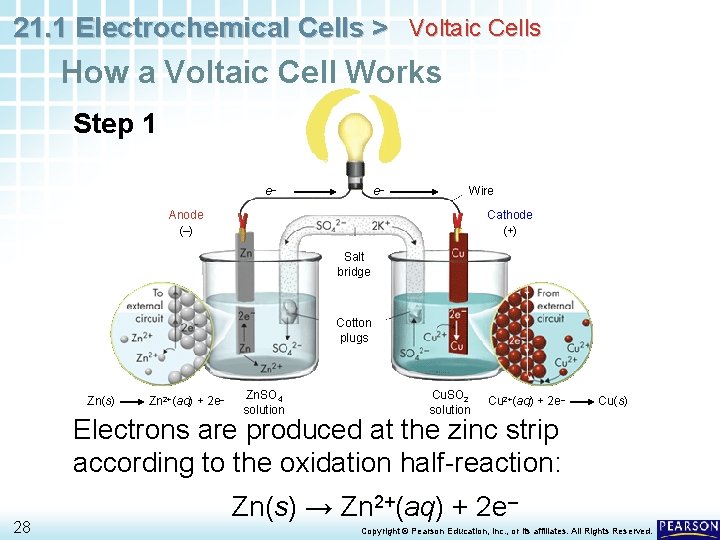
21. 1 Electrochemical Cells > Voltaic Cells How a Voltaic Cell Works Step 1 e– e– Wire Anode (–) Cathode (+) Salt bridge Cotton plugs Zn(s) Zn 2+(aq) + 2 e– Zn. SO 4 solution Cu. SO 2 solution Cu 2+(aq) + 2 e– Cu(s) Electrons are produced at the zinc strip according to the oxidation half-reaction: 28 Zn(s) → Zn 2+(aq) + 2 e– Copyright © Pearson Education, Inc. , or its affiliates. All Rights Reserved.
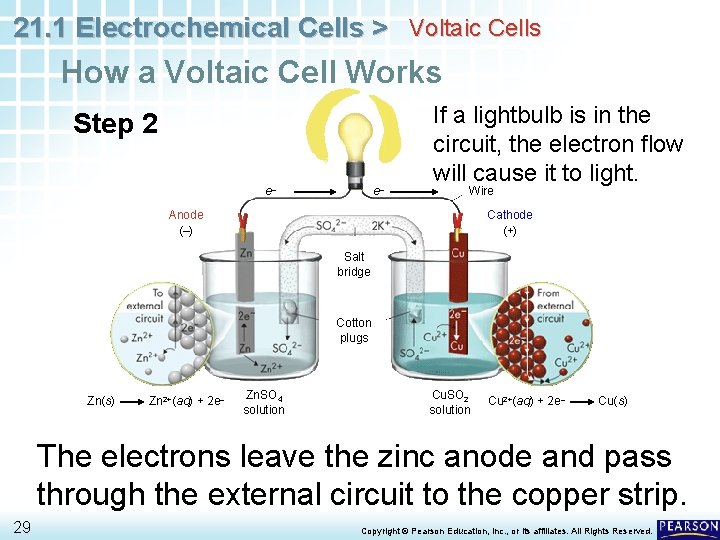
21. 1 Electrochemical Cells > Voltaic Cells How a Voltaic Cell Works Step 2 e– e– If a lightbulb is in the circuit, the electron flow will cause it to light. Wire Anode (–) Cathode (+) Salt bridge Cotton plugs Zn(s) Zn 2+(aq) + 2 e– Zn. SO 4 solution Cu. SO 2 solution Cu 2+(aq) + 2 e– Cu(s) The electrons leave the zinc anode and pass through the external circuit to the copper strip. 29 Copyright © Pearson Education, Inc. , or its affiliates. All Rights Reserved.
21. 1 Electrochemical Cells > Voltaic Cells How a Voltaic Cell Works Step 3 e– e– Wire Anode (–) Cathode (+) Salt bridge Cotton plugs Zn(s) 30 Zn 2+(aq) + 2 e– Zn. SO 4 solution Cu. SO 2 solution Cu 2+(aq) + 2 e– Cu(s) Electrons interact with copper ions in solution. There, the following reduction half-reaction occurs: Cu 2+(aq) + 2 e– → Cu(s) Copyright © Pearson Education, Inc. , or its affiliates. All Rights Reserved.
21. 1 Electrochemical Cells > Voltaic Cells How a Voltaic Cell Works Step 4 e– e– Wire Anode (–) Cathode (+) Salt bridge Cotton plugs Zn(s) Zn 2+(aq) + 2 e– Zn. SO 4 solution Cu. SO 2 solution Cu 2+(aq) + 2 e– Cu(s) To complete the circuit, both positive and negative ions move through the aqueous solutions via the salt bridge. 31 Copyright © Pearson Education, Inc. , or its affiliates. All Rights Reserved.
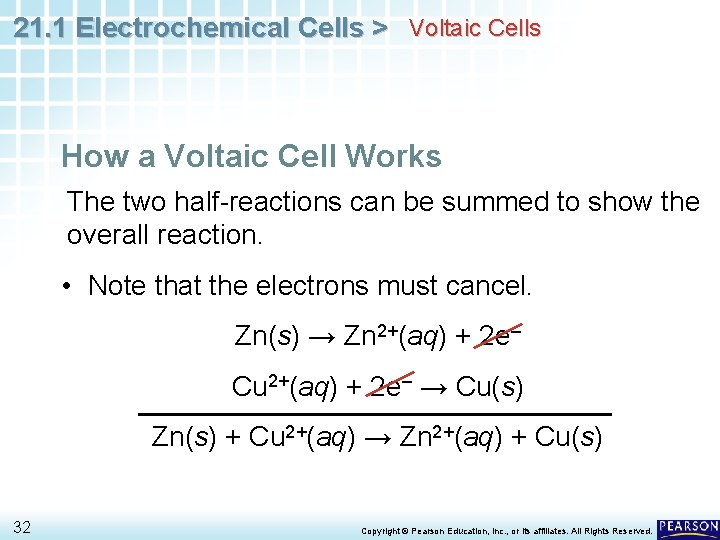
21. 1 Electrochemical Cells > Voltaic Cells How a Voltaic Cell Works The two half-reactions can be summed to show the overall reaction. • Note that the electrons must cancel. Zn(s) → Zn 2+(aq) + 2 e– Cu 2+(aq) + 2 e– → Cu(s) Zn(s) + Cu 2+(aq) → Zn 2+(aq) + Cu(s) 32 Copyright © Pearson Education, Inc. , or its affiliates. All Rights Reserved.
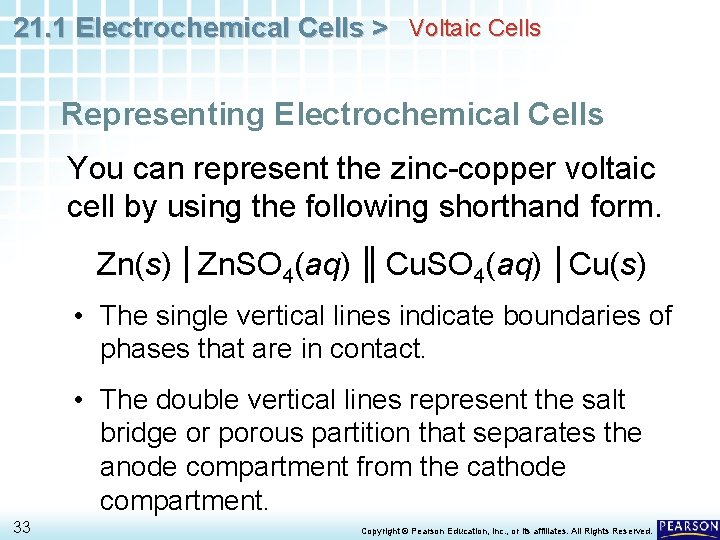
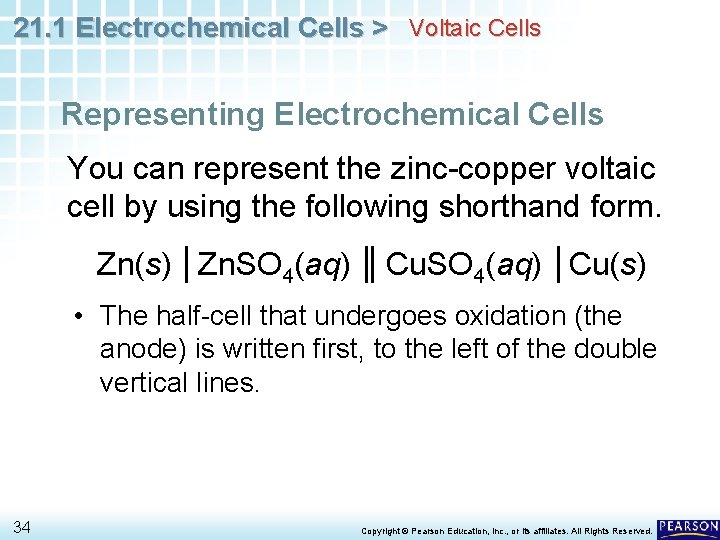
21. 1 Electrochemical Cells > Voltaic Cells Representing Electrochemical Cells You can represent the zinc-copper voltaic cell by using the following shorthand form. Zn(s) Zn. SO 4(aq) Cu(s) • The single vertical lines indicate boundaries of phases that are in contact. • The double vertical lines represent the salt bridge or porous partition that separates the anode compartment from the cathode compartment. 33 Copyright © Pearson Education, Inc. , or its affiliates. All Rights Reserved.
21. 1 Electrochemical Cells > Voltaic Cells Representing Electrochemical Cells You can represent the zinc-copper voltaic cell by using the following shorthand form. Zn(s) Zn. SO 4(aq) Cu(s) • The half-cell that undergoes oxidation (the anode) is written first, to the left of the double vertical lines. 34 Copyright © Pearson Education, Inc. , or its affiliates. All Rights Reserved.
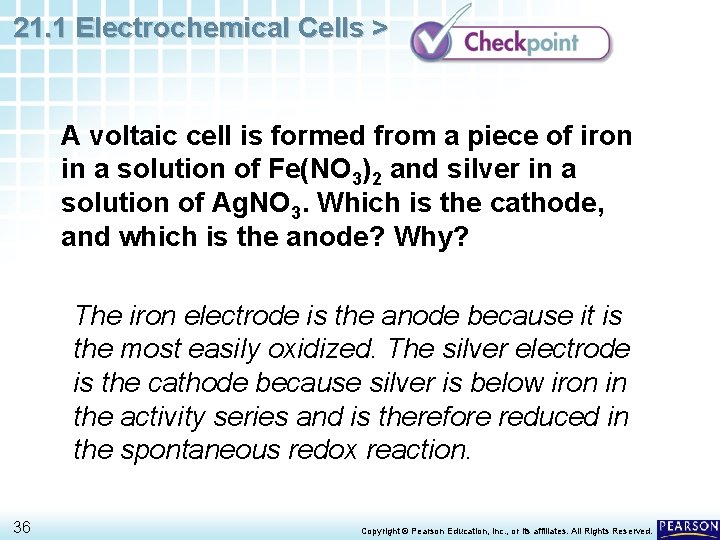
21. 1 Electrochemical Cells > A voltaic cell is formed from a piece of iron in a solution of Fe(NO 3)2 and silver in a solution of Ag. NO 3. Which is the cathode, and which is the anode? Why? 35 Copyright © Pearson Education, Inc. , or its affiliates. All Rights Reserved.
21. 1 Electrochemical Cells > A voltaic cell is formed from a piece of iron in a solution of Fe(NO 3)2 and silver in a solution of Ag. NO 3. Which is the cathode, and which is the anode? Why? The iron electrode is the anode because it is the most easily oxidized. The silver electrode is the cathode because silver is below iron in the activity series and is therefore reduced in the spontaneous redox reaction. 36 Copyright © Pearson Education, Inc. , or its affiliates. All Rights Reserved.
21. 1 Electrochemical Cells > Using Voltaic Cells as Energy Sources What current applications use electrochemical processes to produce electrical energy? 37 Copyright © Pearson Education, Inc. , or its affiliates. All Rights Reserved.
21. 1 Electrochemical Cells > Using Voltaic Cells as Energy Sources Current applications that use electrochemical processes to produce electrical energy include dry cells, lead storage batteries, and fuel cells. 38 Copyright © Pearson Education, Inc. , or its affiliates. All Rights Reserved.
21. 1 Electrochemical Cells > Using Voltaic Cells as Energy Sources Dry Cells A dry cell is a voltaic cell in which the electrolyte is a paste. 39 Copyright © Pearson Education, Inc. , or its affiliates. All Rights Reserved.
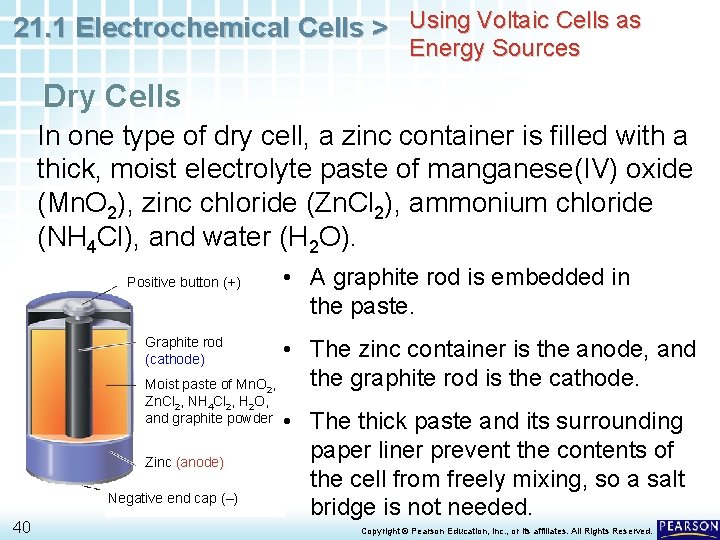
21. 1 Electrochemical Cells > Using Voltaic Cells as Energy Sources Dry Cells In one type of dry cell, a zinc container is filled with a thick, moist electrolyte paste of manganese(IV) oxide (Mn. O 2), zinc chloride (Zn. Cl 2), ammonium chloride (NH 4 Cl), and water (H 2 O). Positive button (+) Graphite rod (cathode) Moist paste of Mn. O 2, Zn. Cl 2, NH 4 Cl 2, H 2 O, and graphite powder Zinc (anode) Negative end cap (–) 40 • A graphite rod is embedded in the paste. • The zinc container is the anode, and the graphite rod is the cathode. • The thick paste and its surrounding paper liner prevent the contents of the cell from freely mixing, so a salt bridge is not needed. Copyright © Pearson Education, Inc. , or its affiliates. All Rights Reserved.
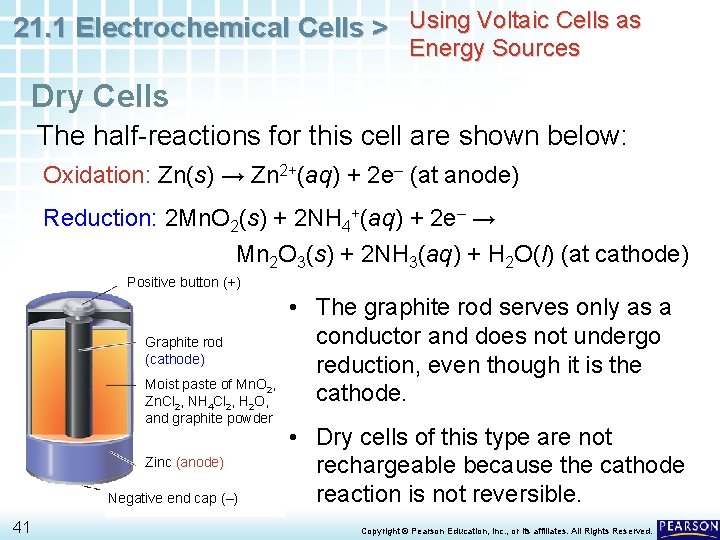
21. 1 Electrochemical Cells > Using Voltaic Cells as Energy Sources Dry Cells The half-reactions for this cell are shown below: Oxidation: Zn(s) → Zn 2+(aq) + 2 e– (at anode) Reduction: 2 Mn. O 2(s) + 2 NH 4+(aq) + 2 e– → Mn 2 O 3(s) + 2 NH 3(aq) + H 2 O(l) (at cathode) Positive button (+) Graphite rod (cathode) Moist paste of Mn. O 2, Zn. Cl 2, NH 4 Cl 2, H 2 O, and graphite powder Zinc (anode) Negative end cap (–) 41 • The graphite rod serves only as a conductor and does not undergo reduction, even though it is the cathode. • Dry cells of this type are not rechargeable because the cathode reaction is not reversible. Copyright © Pearson Education, Inc. , or its affiliates. All Rights Reserved.
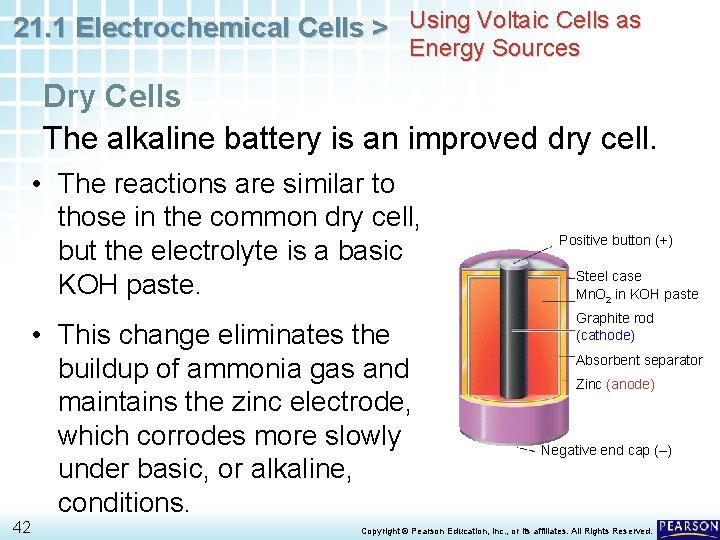
21. 1 Electrochemical Cells > Using Voltaic Cells as Energy Sources Dry Cells The alkaline battery is an improved dry cell. • The reactions are similar to those in the common dry cell, but the electrolyte is a basic KOH paste. • This change eliminates the buildup of ammonia gas and maintains the zinc electrode, which corrodes more slowly under basic, or alkaline, conditions. 42 Positive button (+) Steel case Mn. O 2 in KOH paste Graphite rod (cathode) Absorbent separator Zinc (anode) Negative end cap (–) Copyright © Pearson Education, Inc. , or its affiliates. All Rights Reserved.
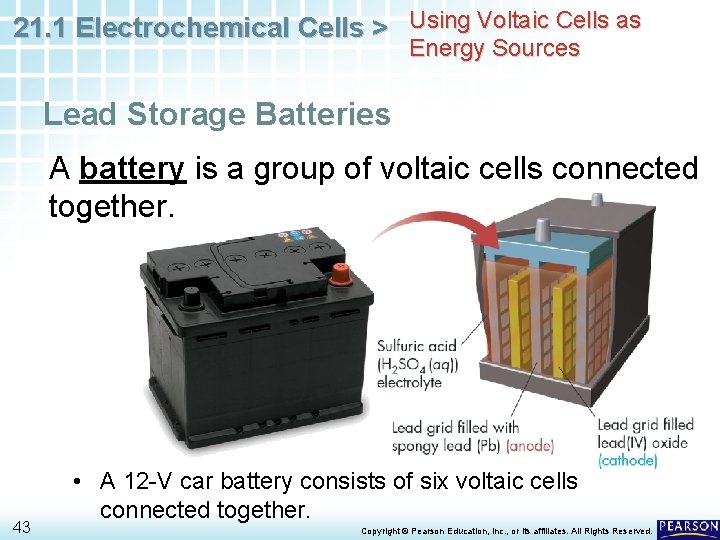
21. 1 Electrochemical Cells > Using Voltaic Cells as Energy Sources Lead Storage Batteries A battery is a group of voltaic cells connected together. 43 • A 12 -V car battery consists of six voltaic cells connected together. Copyright © Pearson Education, Inc. , or its affiliates. All Rights Reserved.
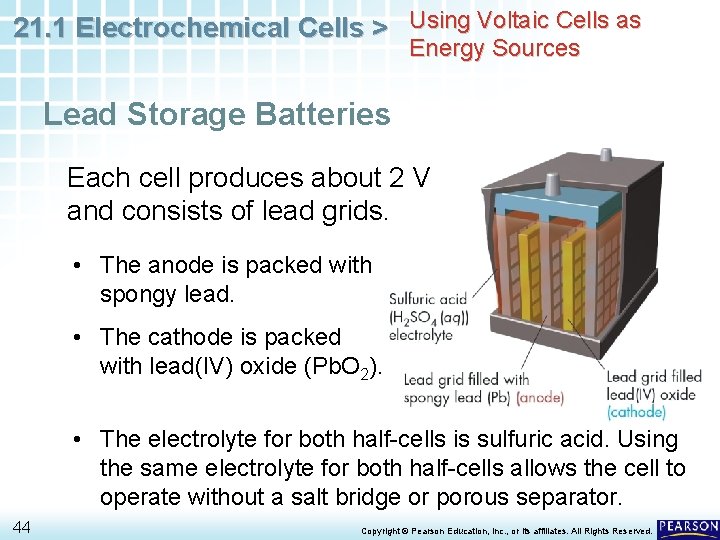
21. 1 Electrochemical Cells > Using Voltaic Cells as Energy Sources Lead Storage Batteries Each cell produces about 2 V and consists of lead grids. • The anode is packed with spongy lead. • The cathode is packed with lead(IV) oxide (Pb. O 2). • The electrolyte for both half-cells is sulfuric acid. Using the same electrolyte for both half-cells allows the cell to operate without a salt bridge or porous separator. 44 Copyright © Pearson Education, Inc. , or its affiliates. All Rights Reserved.
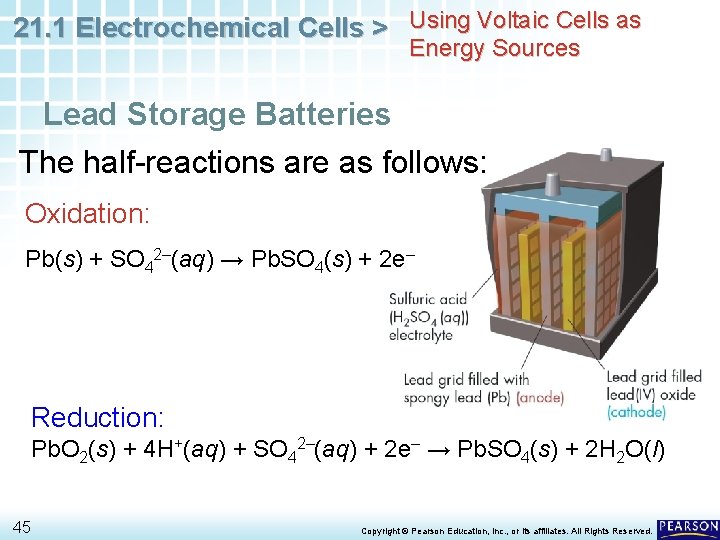
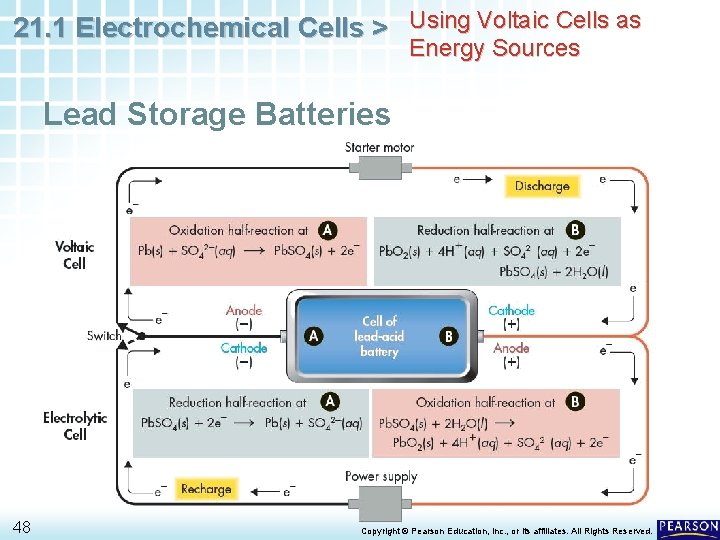
21. 1 Electrochemical Cells > Using Voltaic Cells as Energy Sources Lead Storage Batteries The half-reactions are as follows: Oxidation: Pb(s) + SO 42–(aq) → Pb. SO 4(s) + 2 e– Reduction: Pb. O 2(s) + 4 H+(aq) + SO 42–(aq) + 2 e– → Pb. SO 4(s) + 2 H 2 O(l) 45 Copyright © Pearson Education, Inc. , or its affiliates. All Rights Reserved.
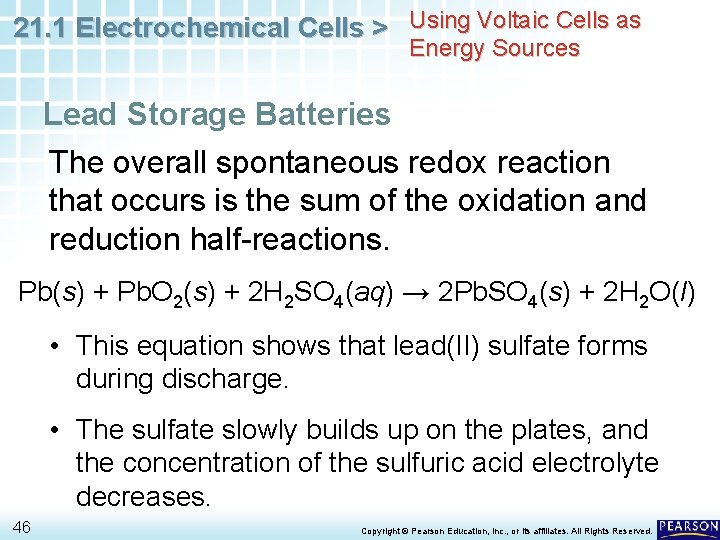
21. 1 Electrochemical Cells > Using Voltaic Cells as Energy Sources Lead Storage Batteries The overall spontaneous redox reaction that occurs is the sum of the oxidation and reduction half-reactions. Pb(s) + Pb. O 2(s) + 2 H 2 SO 4(aq) → 2 Pb. SO 4(s) + 2 H 2 O(l) • This equation shows that lead(II) sulfate forms during discharge. • The sulfate slowly builds up on the plates, and the concentration of the sulfuric acid electrolyte decreases. 46 Copyright © Pearson Education, Inc. , or its affiliates. All Rights Reserved.
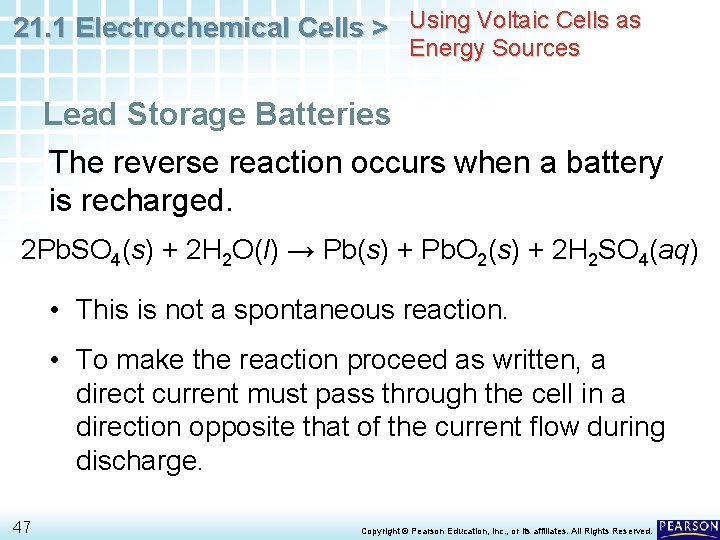
21. 1 Electrochemical Cells > Using Voltaic Cells as Energy Sources Lead Storage Batteries The reverse reaction occurs when a battery is recharged. 2 Pb. SO 4(s) + 2 H 2 O(l) → Pb(s) + Pb. O 2(s) + 2 H 2 SO 4(aq) • This is not a spontaneous reaction. • To make the reaction proceed as written, a direct current must pass through the cell in a direction opposite that of the current flow during discharge. 47 Copyright © Pearson Education, Inc. , or its affiliates. All Rights Reserved.
21. 1 Electrochemical Cells > Using Voltaic Cells as Energy Sources Lead Storage Batteries 48 Copyright © Pearson Education, Inc. , or its affiliates. All Rights Reserved.
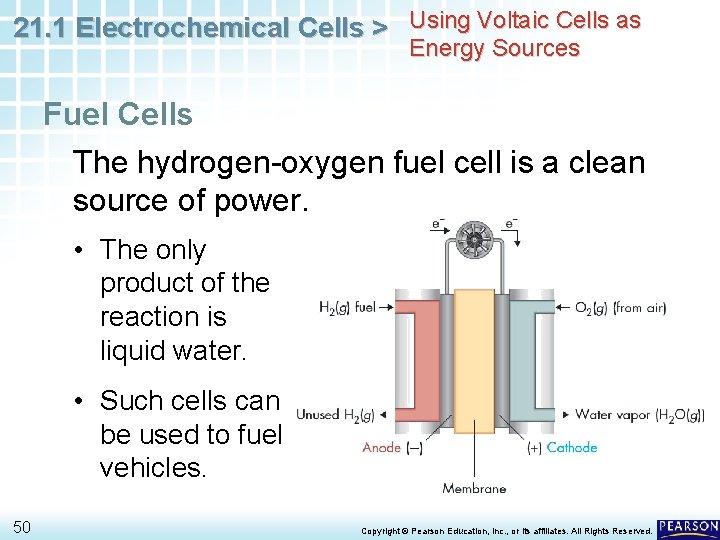
21. 1 Electrochemical Cells > Using Voltaic Cells as Energy Sources Fuel Cells Fuel cells are voltaic cells in which a fuel substance undergoes oxidation and from which electrical energy is continuously obtained. • Fuel cells do not have to be recharged. • They can be designed to emit no air pollutants and to operate more quietly and more costeffectively than a conventional electrical generator. 49 Copyright © Pearson Education, Inc. , or its affiliates. All Rights Reserved.
21. 1 Electrochemical Cells > Using Voltaic Cells as Energy Sources Fuel Cells The hydrogen-oxygen fuel cell is a clean source of power. • The only product of the reaction is liquid water. • Such cells can be used to fuel vehicles. 50 Copyright © Pearson Education, Inc. , or its affiliates. All Rights Reserved.
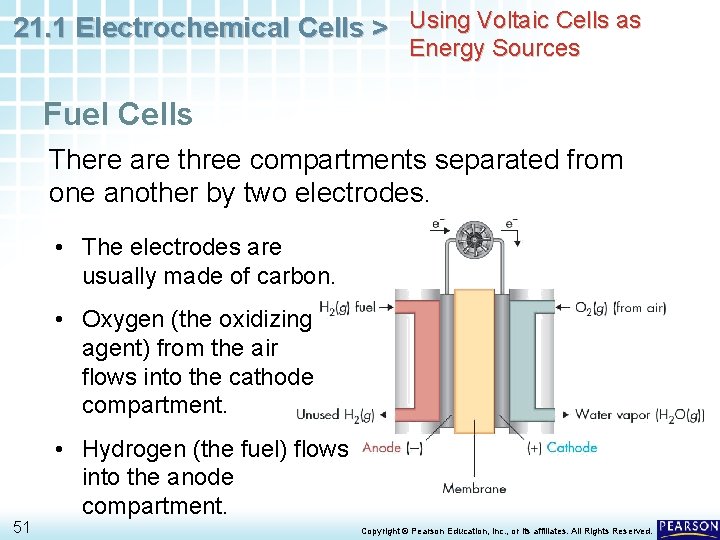
21. 1 Electrochemical Cells > Using Voltaic Cells as Energy Sources Fuel Cells There are three compartments separated from one another by two electrodes. • The electrodes are usually made of carbon. • Oxygen (the oxidizing agent) from the air flows into the cathode compartment. 51 • Hydrogen (the fuel) flows into the anode compartment. Copyright © Pearson Education, Inc. , or its affiliates. All Rights Reserved.
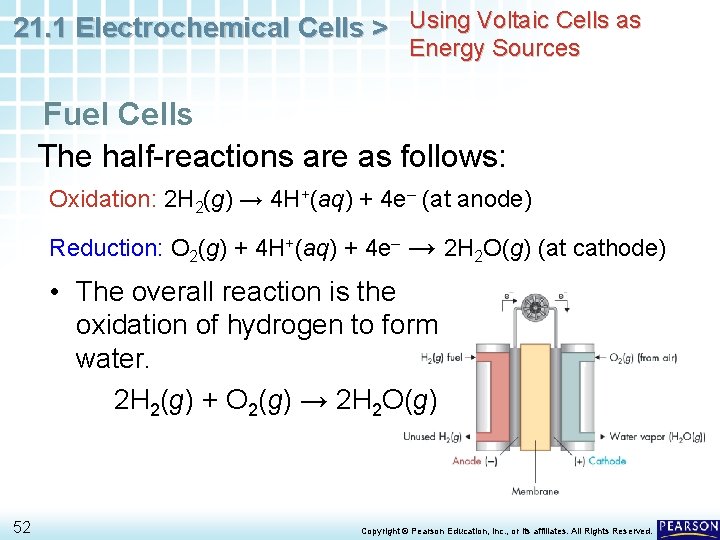
21. 1 Electrochemical Cells > Using Voltaic Cells as Energy Sources Fuel Cells The half-reactions are as follows: Oxidation: 2 H 2(g) → 4 H+(aq) + 4 e– (at anode) Reduction: O 2(g) + 4 H+(aq) + 4 e– → 2 H 2 O(g) (at cathode) • The overall reaction is the oxidation of hydrogen to form water. 2 H 2(g) + O 2(g) → 2 H 2 O(g) 52 Copyright © Pearson Education, Inc. , or its affiliates. All Rights Reserved.
21. 1 Electrochemical Cells > Which of the following are portable sources of electrical energy consisting of groups of voltaic cells connected together? A. B. C. D. 53 Alkaline cells Dry cells Fuel cells Batteries Copyright © Pearson Education, Inc. , or its affiliates. All Rights Reserved.
21. 1 Electrochemical Cells > Which of the following are portable sources of electrical energy consisting of groups of voltaic cells connected together? A. B. C. D. 54 Alkaline cells Dry cells Fuel cells Batteries Copyright © Pearson Education, Inc. , or its affiliates. All Rights Reserved.
21. 1 Electrochemical Cells > Key Concepts All electrochemical processes involve redox reactions. Electrical energy is produced in a voltaic cell by a spontaneous redox reaction within the cell. Current applications that use electrochemical processes to produce electrical energy include dry cells, lead storage batteries, and fuel cells. 55 Copyright © Pearson Education, Inc. , or its affiliates. All Rights Reserved.
21. 1 Electrochemical Cells > Glossary Terms • electrochemical process: the conversion of chemical energy into electrical energy or electrical energy into chemical energy; all electrochemical processes involve redox reactions • electrochemical cell: any device that converts chemical energy into electrical energy or electrical energy into chemical energy • voltaic cell: an electrochemical cell used to convert chemical energy into electrical energy; the energy is produced by a spontaneous redox reaction 56 Copyright © Pearson Education, Inc. , or its affiliates. All Rights Reserved.
21. 1 Electrochemical Cells > Glossary Terms • half-cell: the part of a voltaic cell in which either oxidation or reduction occurs; it consists of a single electrode immersed in a solution of its ions • salt bridge: a tube containing a strong electrolyte used to separate the half-cells in a voltaic cell; it allows the passage of ions from one half-cell to the other but prevents the solutions from mixing completely 57 Copyright © Pearson Education, Inc. , or its affiliates. All Rights Reserved.
21. 1 Electrochemical Cells > Glossary Terms • electrode: a conductor in a circuit that carries electrons to or from a substance other than a metal • anode: the electrode at which oxidation occurs • cathode: the electrode at which reduction occurs 58 Copyright © Pearson Education, Inc. , or its affiliates. All Rights Reserved.
21. 1 Electrochemical Cells > Glossary Terms • dry cell: a commercial voltaic cell in which the electrolyte is a moist paste; despite their name, the compact, portable batteries used in flashlights are dry cells • battery: a group of voltaic cells that are connected to one another • fuel cell: a voltaic cell that does not need to be recharged; the fuel is oxidized to produce a continuous supply of electrical energy 59 Copyright © Pearson Education, Inc. , or its affiliates. All Rights Reserved.
21. 1 Electrochemical Cells > BIG IDEA Matter and Energy • The two types of electrochemical cells are voltaic cells and electrolytic cells. • In a voltaic cell, electric current is produced by a spontaneous redox reaction. • Voltaic cells are used in batteries and fuel cells. 60 Copyright © Pearson Education, Inc. , or its affiliates. All Rights Reserved.
21. 1 Electrochemical Cells > END OF 21. 1 61 Copyright © Pearson Education, Inc. , or its affiliates. All Rights Reserved.