
19 Electrochemistry CHAPTER OBJECTIVES To distinguish between galvanic

19 Electrochemistry
CHAPTER OBJECTIVES • To distinguish between galvanic and electrolytic cells • To predict spontaneous reactions using redox potentials • To balance redox reactions using half-reactions • To understand the relationship between cell potential and the equilibrium constant • To be able to measure solution concentrations using cell potentials • To describe how commercial galvanic cells operate • To describe the process of corrosion • To understand electrolysis and to be able to describe it quantitatively Copyright © 2007 Pearson Education, Inc. , publishing as Pearson Benjamin Cummings
Electrochemistry • In oxidation-reduction (redox) reactions, electrons are transferred from one species (the reductant) to another (the oxidant). • Transfer of electrons provides a means for converting chemical energy to electrical energy, or vice versa. • The study of the relationship between electricity and chemical reactions is called electrochemistry. Copyright © 2007 Pearson Education, Inc. , publishing as Pearson Benjamin Cummings

Chemistry: Principles, Patterns, and Applications, 1 e 19. 1 Describing Electrochemical Cells Copyright © 2007 Pearson Education, Inc. , publishing as Pearson Benjamin Cummings
19. 1 Describing Electrochemical Cells • Electrochemical process—electrons flow from one chemical substance to another, driven by an oxidation-reduction (redox) reaction • Redox reaction – Occurs when electrons are transferred from a substance that is oxidized to one that is being reduced – Reductant is the substance that loses electrons and is oxidized in the process – Oxidant is the species that gains electrons and is reduced in the process Copyright © 2007 Pearson Education, Inc. , publishing as Pearson Benjamin Cummings
19. 1 Describing Electrochemical Cells – Described as two half-reactions, one representing the oxidation process and one the reduction process Reductive half-reaction: Br 2 (aq) + 2 e– 2 Br –(aq) Oxidative half-reaction: Zn (s) Zn 2+(aq) + 2 e– – Adding the two half-reactions gives the overall chemical reaction Zn (s) + Br 2 (aq) Zn. Br 2 (aq) – A redox reaction is balanced when the number of electrons lost by the reductant is equal to the number of electrons gained by the oxidant; overall process is electrically neutral – An electric current is produced from the flow of electrons from reductant to oxidant Copyright © 2007 Pearson Education, Inc. , publishing as Pearson Benjamin Cummings
19. 1 Describing Electrochemical Cells • Electrochemical cell – An apparatus that is used to generate electricity from a spontaneous redox or that uses electricity to drive a nonspontaneous redox reaction – There are two types of electrochemical cells 1. Galvanic cell (voltaic cell)—uses the energy released during a spontaneous redox reaction ( G < 0) to generate electricity 2. Electrolytic cell—consumes electrical energy from an external source, using it to cause a nonspontaneous redox reaction to occur ( G > 0) Copyright © 2007 Pearson Education, Inc. , publishing as Pearson Benjamin Cummings
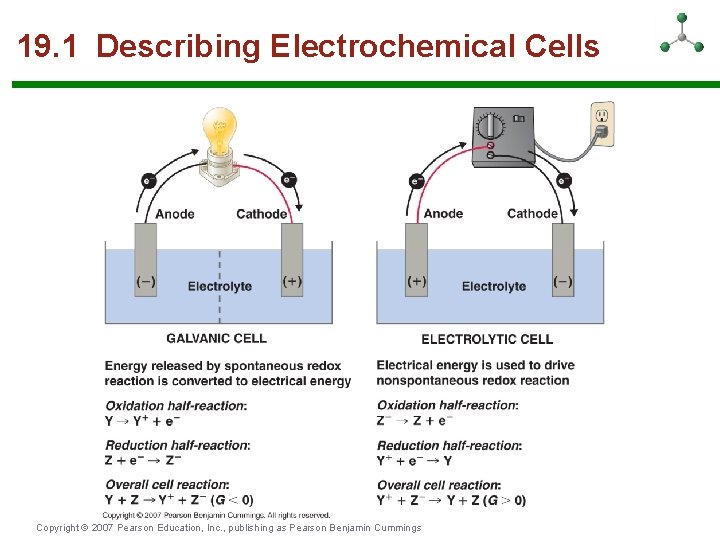
19. 1 Describing Electrochemical Cells Copyright © 2007 Pearson Education, Inc. , publishing as Pearson Benjamin Cummings
19. 1 Describing Electrochemical Cells – Both types of cells contain two electrodes, which are solid metals connected to an external circuit that provides an electrical connection between systems – Oxidation half-reaction occurs at one electrode, the anode, and the reduction half-reaction occurs at the other, the cathode – When circuit is closed, electrons flow from the anode to the cathode; electrodes are connected by an electrolyte, which is an ionic substance or solution that allows ions to transfer between the electrodes, thereby maintaining the system’s electrical neutrality Copyright © 2007 Pearson Education, Inc. , publishing as Pearson Benjamin Cummings
Galvanic (Voltaic) Cells • To illustrate the basic principles of a galvanic cell – look at the reaction of metallic zinc with cupric ion (Cu 2+) to give copper metal and Zn 2+ ion Zn(s) + Cu 2+(aq) Zn 2+(aq) + Cu(s) – a copper strip is inserted into a beaker that contains a 1 M solution of Cu 2+ ions, and a zinc strip is inserted into a different beaker that contains a 1 M solution of Zn 2+ ions – two metal strips serve as electrodes and are connected by a wire that allows electricity to flow; the compartments are connected by a salt bridge, a U-shaped tube inserted into both solutions and contains a concentrated liquid or gelled electrolyte to maintain electrical neutrality Copyright © 2007 Pearson Education, Inc. , publishing as Pearson Benjamin Cummings
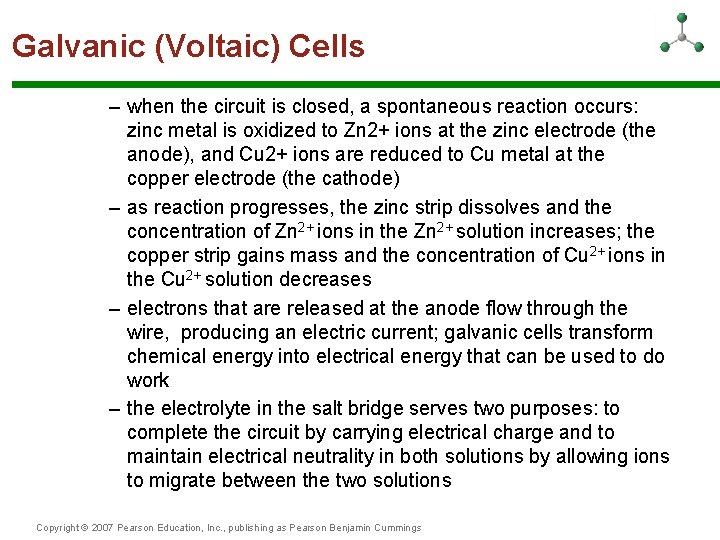
Galvanic (Voltaic) Cells – when the circuit is closed, a spontaneous reaction occurs: zinc metal is oxidized to Zn 2+ ions at the zinc electrode (the anode), and Cu 2+ ions are reduced to Cu metal at the copper electrode (the cathode) – as reaction progresses, the zinc strip dissolves and the concentration of Zn 2+ ions in the Zn 2+ solution increases; the copper strip gains mass and the concentration of Cu 2+ ions in the Cu 2+ solution decreases – electrons that are released at the anode flow through the wire, producing an electric current; galvanic cells transform chemical energy into electrical energy that can be used to do work – the electrolyte in the salt bridge serves two purposes: to complete the circuit by carrying electrical charge and to maintain electrical neutrality in both solutions by allowing ions to migrate between the two solutions Copyright © 2007 Pearson Education, Inc. , publishing as Pearson Benjamin Cummings
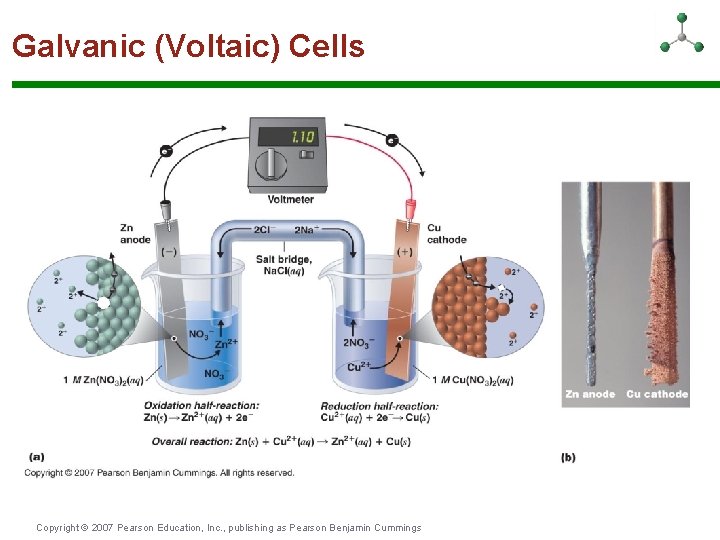
Galvanic (Voltaic) Cells Copyright © 2007 Pearson Education, Inc. , publishing as Pearson Benjamin Cummings
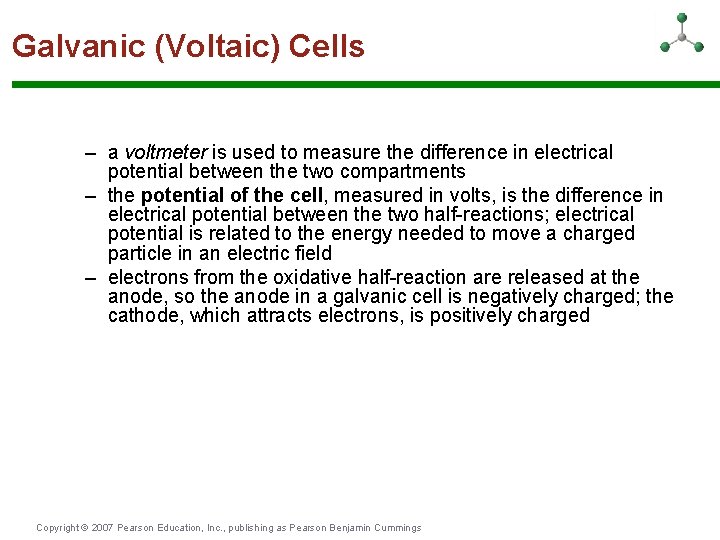
Galvanic (Voltaic) Cells – a voltmeter is used to measure the difference in electrical potential between the two compartments – the potential of the cell, measured in volts, is the difference in electrical potential between the two half-reactions; electrical potential is related to the energy needed to move a charged particle in an electric field – electrons from the oxidative half-reaction are released at the anode, so the anode in a galvanic cell is negatively charged; the cathode, which attracts electrons, is positively charged Copyright © 2007 Pearson Education, Inc. , publishing as Pearson Benjamin Cummings
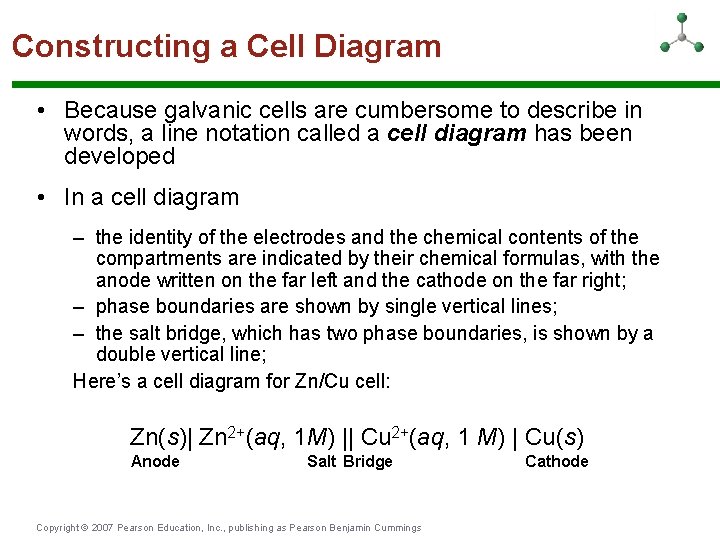
Constructing a Cell Diagram • Because galvanic cells are cumbersome to describe in words, a line notation called a cell diagram has been developed • In a cell diagram – the identity of the electrodes and the chemical contents of the compartments are indicated by their chemical formulas, with the anode written on the far left and the cathode on the far right; – phase boundaries are shown by single vertical lines; – the salt bridge, which has two phase boundaries, is shown by a double vertical line; Here’s a cell diagram for Zn/Cu cell: Zn(s)| Zn 2+(aq, 1 M) || Cu 2+(aq, 1 M) | Cu(s) Anode Salt Bridge Copyright © 2007 Pearson Education, Inc. , publishing as Pearson Benjamin Cummings Cathode
Constructing a Cell Diagram • In a single-compartment galvanic cell, the voltage produced by a redox reaction can be measured more accurately using two electrodes immersed in a single beaker containing an electrolyte that completes the circuit; arrangement reduces errors caused by resistance to the flow of charge at a boundary, called the junction potential – Cell diagram does not include a double vertical line for the salt bridge (no salt bridge) and does not include solution concentrations Pt(s) | H 2(g) | HCl(aq) | Ag. Cl(s) | Ag(s) Copyright © 2007 Pearson Education, Inc. , publishing as Pearson Benjamin Cummings

Chemistry: Principles, Patterns, and Applications, 1 e 19. 2 Standard Potentials Copyright © 2007 Pearson Education, Inc. , publishing as Pearson Benjamin Cummings
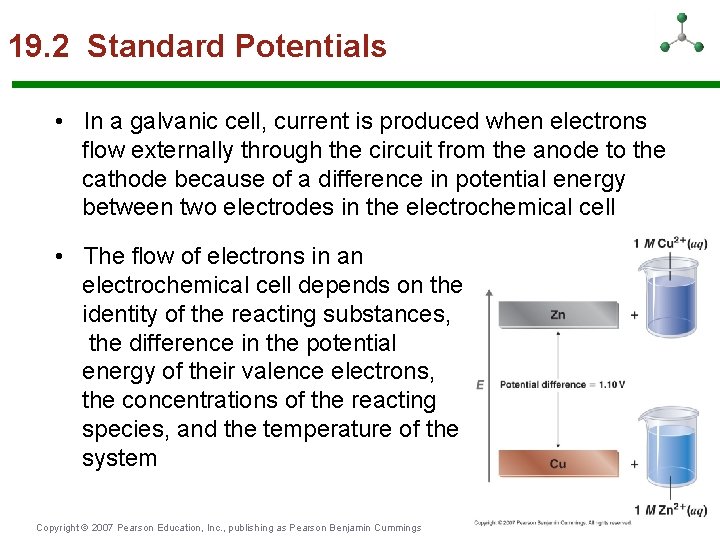
19. 2 Standard Potentials • In a galvanic cell, current is produced when electrons flow externally through the circuit from the anode to the cathode because of a difference in potential energy between two electrodes in the electrochemical cell • The flow of electrons in an electrochemical cell depends on the identity of the reacting substances, the difference in the potential energy of their valence electrons, the concentrations of the reacting species, and the temperature of the system Copyright © 2007 Pearson Education, Inc. , publishing as Pearson Benjamin Cummings
19. 2 Standard Potentials • The potential of the cell under standard conditions (1 M for solutions and 1 atm for gases, pure solids, or liquids for other substances) and at a fixed temperature (25ºC) is called the standard cell potential, Eºcell – Used in order to develop a scale of relative potentials that will allow the prediction of the direction of an electrochemical reaction and the magnitude of the driving force for the reaction – Used to measure the potentials for oxidations and reductions of different substances under comparable conditions Copyright © 2007 Pearson Education, Inc. , publishing as Pearson Benjamin Cummings
Measuring Standard Electrode Potentials • Impossible to measure the potential of a single electrode; only the difference between the potentials of two electrodes can be measured • Can compare the standard cell potentials for two different galvanic cells that have one kind of electrode in common—allows the measurement of the potential difference between two dissimilar electrodes • All tabulated values of standard electrode potentials by convention are listed as standard reduction potentials in order to compare standard potentials for different substances Copyright © 2007 Pearson Education, Inc. , publishing as Pearson Benjamin Cummings
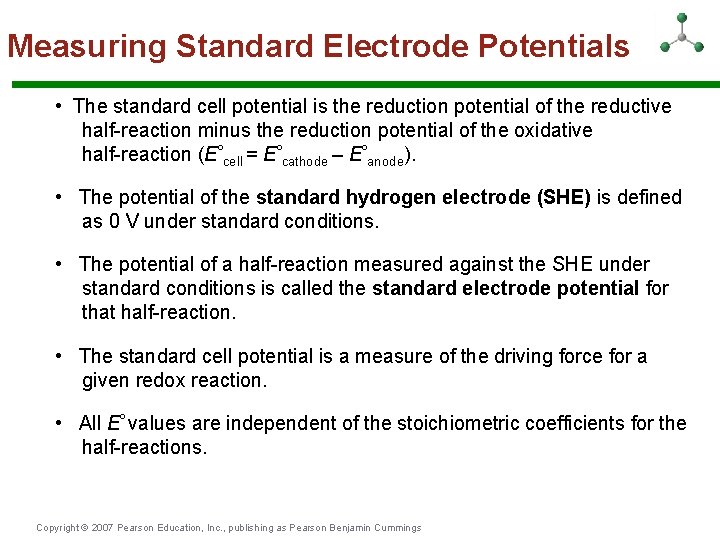
Measuring Standard Electrode Potentials • The standard cell potential is the reduction potential of the reductive half-reaction minus the reduction potential of the oxidative half-reaction (Eºcell = Eºcathode – Eºanode). • The potential of the standard hydrogen electrode (SHE) is defined as 0 V under standard conditions. • The potential of a half-reaction measured against the SHE under standard conditions is called the standard electrode potential for that half-reaction. • The standard cell potential is a measure of the driving force for a given redox reaction. • All Eº values are independent of the stoichiometric coefficients for the half-reactions. Copyright © 2007 Pearson Education, Inc. , publishing as Pearson Benjamin Cummings
Balancing Redox Reactions Using the Half-Reaction Method • Redox reactions can be balanced using the half-reaction method, where the overall redox reaction is divided into an oxidation half-reaction and a reduction half-reaction, each one balanced for mass and charge • The half-reactions selected from tabulated lists must exactly reflect reaction conditions Copyright © 2007 Pearson Education, Inc. , publishing as Pearson Benjamin Cummings
Balancing Redox Reactions Using the Half-Reaction Method • In an alternative method, the atoms in each half-reaction are balanced, and then the charges are balanced; one does not need to use the tabulated half-reactions; instead, focus on the atoms whose oxidation states change by using the following steps: 1. Write the reduction half-reaction and the oxidation half-reaction 2. Balance the atoms by balancing elements other than O and H; then balance O atoms by adding H 2 O, and balance H atoms by adding H+ 3. Balance the charges in each half-reaction by adding electrons Copyright © 2007 Pearson Education, Inc. , publishing as Pearson Benjamin Cummings
Balancing Redox Reactions Using the Half-Reaction Method 4. 5. 6. Multiply the reductive and oxidative half-reactions by appropriate integers to obtain the same number of electrons in both half-reactions Add the two half-reactions and cancel substances that appear on both sides of the equation Check to make sure that all atoms and charges are balanced Copyright © 2007 Pearson Education, Inc. , publishing as Pearson Benjamin Cummings
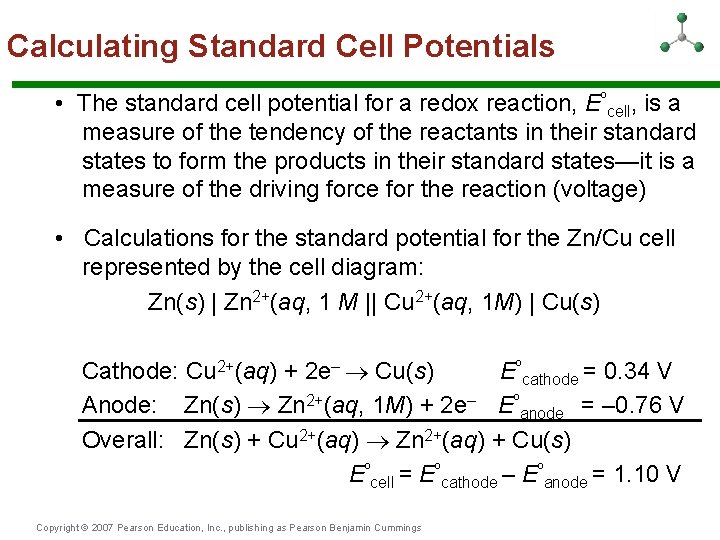
Calculating Standard Cell Potentials • The standard cell potential for a redox reaction, Eºcell, is a measure of the tendency of the reactants in their standard states to form the products in their standard states—it is a measure of the driving force for the reaction (voltage) • Calculations for the standard potential for the Zn/Cu cell represented by the cell diagram: Zn(s) | Zn 2+(aq, 1 M || Cu 2+(aq, 1 M) | Cu(s) Cathode: Cu 2+(aq) + 2 e– Cu(s) Eºcathode = 0. 34 V Anode: Zn(s) Zn 2+(aq, 1 M) + 2 e– Eºanode = – 0. 76 V Overall: Zn(s) + Cu 2+(aq) Zn 2+(aq) + Cu(s) Eºcell = Eºcathode – Eºanode = 1. 10 V Copyright © 2007 Pearson Education, Inc. , publishing as Pearson Benjamin Cummings
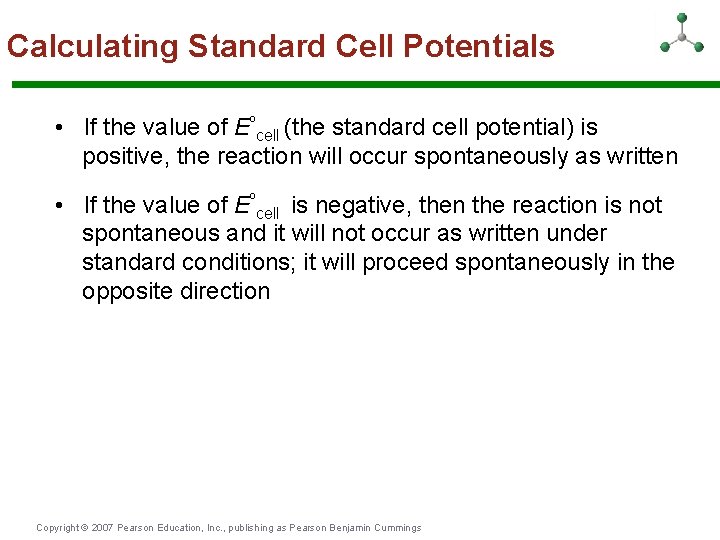
Calculating Standard Cell Potentials • If the value of Eºcell (the standard cell potential) is positive, the reaction will occur spontaneously as written • If the value of Eºcell is negative, then the reaction is not spontaneous and it will not occur as written under standard conditions; it will proceed spontaneously in the opposite direction Copyright © 2007 Pearson Education, Inc. , publishing as Pearson Benjamin Cummings
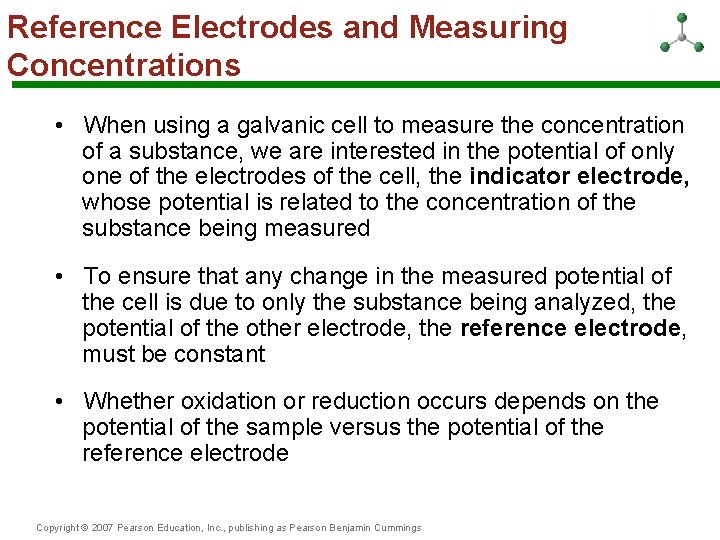
Reference Electrodes and Measuring Concentrations • When using a galvanic cell to measure the concentration of a substance, we are interested in the potential of only one of the electrodes of the cell, the indicator electrode, whose potential is related to the concentration of the substance being measured • To ensure that any change in the measured potential of the cell is due to only the substance being analyzed, the potential of the other electrode, the reference electrode, must be constant • Whether oxidation or reduction occurs depends on the potential of the sample versus the potential of the reference electrode Copyright © 2007 Pearson Education, Inc. , publishing as Pearson Benjamin Cummings
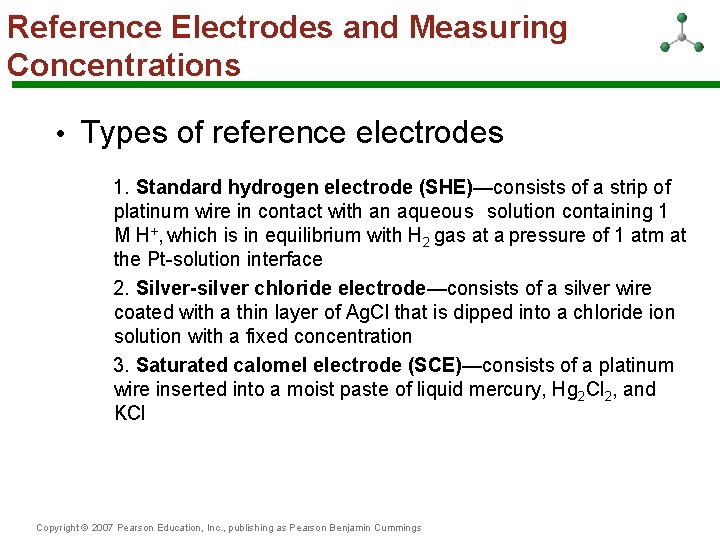
Reference Electrodes and Measuring Concentrations • Types of reference electrodes 1. Standard hydrogen electrode (SHE)—consists of a strip of platinum wire in contact with an aqueous solution containing 1 M H+, which is in equilibrium with H 2 gas at a pressure of 1 atm at the Pt-solution interface 2. Silver-silver chloride electrode—consists of a silver wire coated with a thin layer of Ag. Cl that is dipped into a chloride ion solution with a fixed concentration 3. Saturated calomel electrode (SCE)—consists of a platinum wire inserted into a moist paste of liquid mercury, Hg 2 Cl 2, and KCl Copyright © 2007 Pearson Education, Inc. , publishing as Pearson Benjamin Cummings
Reference Electrodes and Measuring Concentrations • One of the most common uses of electrochemistry is to measure the H+ ion concentration of a solution – A glass electrode is used for this purpose, in which an internal Ag/Ag. Cl electrode is immersed in a 0. 10 M HCl solution that is separated from the solution by a very thin glass membrane that absorbs protons – The extent of the adsorption on the inner side is fixed but the adsorption of protons on the outer surface depends on the p. H of the solution Copyright © 2007 Pearson Education, Inc. , publishing as Pearson Benjamin Cummings
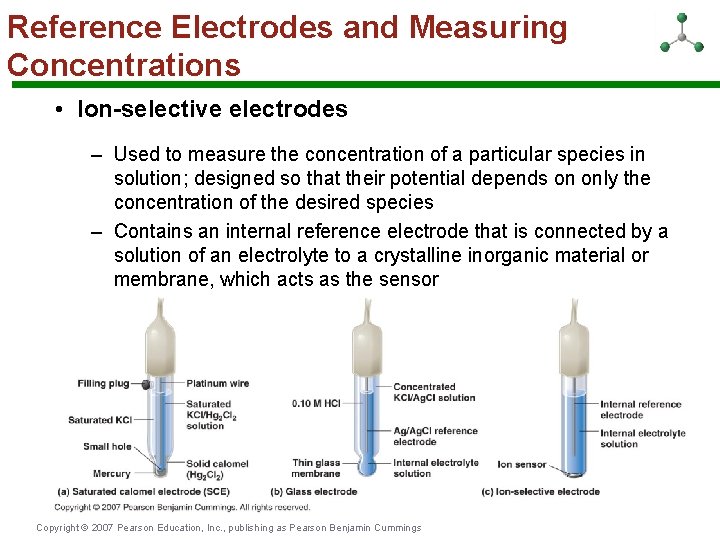
Reference Electrodes and Measuring Concentrations • Ion-selective electrodes – Used to measure the concentration of a particular species in solution; designed so that their potential depends on only the concentration of the desired species – Contains an internal reference electrode that is connected by a solution of an electrolyte to a crystalline inorganic material or membrane, which acts as the sensor Copyright © 2007 Pearson Education, Inc. , publishing as Pearson Benjamin Cummings

Chemistry: Principles, Patterns, and Applications, 1 e 19. 3 Comparing Strengths of Oxidants and Reductants Copyright © 2007 Pearson Education, Inc. , publishing as Pearson Benjamin Cummings
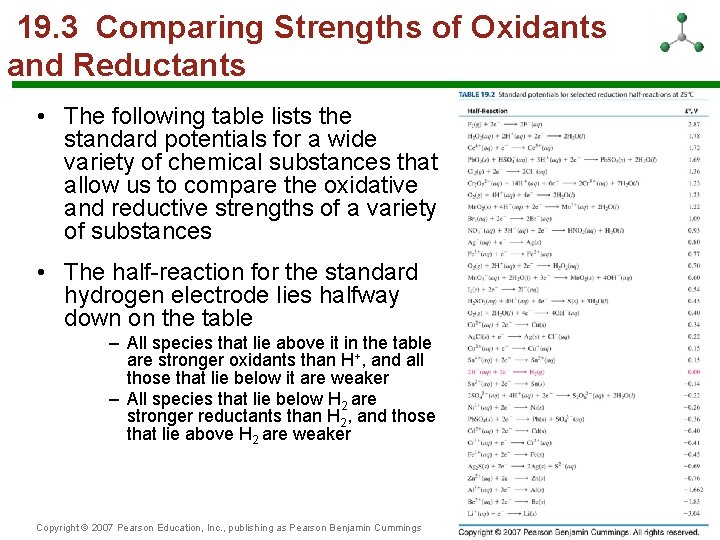
19. 3 Comparing Strengths of Oxidants and Reductants • The following table lists the standard potentials for a wide variety of chemical substances that allow us to compare the oxidative and reductive strengths of a variety of substances • The half-reaction for the standard hydrogen electrode lies halfway down on the table – All species that lie above it in the table are stronger oxidants than H+, and all those that lie below it are weaker – All species that lie below H 2 are stronger reductants than H 2, and those that lie above H 2 are weaker Copyright © 2007 Pearson Education, Inc. , publishing as Pearson Benjamin Cummings
19. 3 Comparing Strengths of Oxidants and Reductants • Because the half-reactions in the table arranged in order of their Eº values, the table can be used to predict the relative strengths of various oxidants and reductants – Any species on the left side of a half-reaction will spontaneously oxidize any species on the right side of another half-reaction that lies below it in the table – Any species on the right side of one half-reaction will spontaneously reduce any species on the left side of another half -reaction that lies above it in the table Copyright © 2007 Pearson Education, Inc. , publishing as Pearson Benjamin Cummings
Chemistry: Principles, Patterns, and Applications, 1 e 19. 4 Electrochemical Cells and Thermodynamics Copyright © 2007 Pearson Education, Inc. , publishing as Pearson Benjamin Cummings
The Relationship between Cell Potential and Free Energy • Electrochemical cells convert chemical to electrical energy, and vice versa • Total amount of energy produced by an electrochemical cell and the amount of energy available to do electrical work depends on both the cell potential and the total number of electrons that are transferred from the reductant to the oxidant during the course of the reaction • Resulting electric current measured in coulombs (C), an S unit that measures the number of electrons passing a given point in 1 s; coulomb defined as 6. 25 x 1018 e–/s and relates electrical potential (in volts) to energy (in joules) 1 J/1 V = 1 coulomb = 6. 25 x 1018 e–/s Copyright © 2007 Pearson Education, Inc. , publishing as Pearson Benjamin Cummings
The Relationship between Cell Potential and Free Energy • Electric current is measured in amperes (A); 1 ampere is defined as the flow of 1 coulomb per second past a given point (1 C = 1 A/s) • In chemical reactions one must relate the coulomb to the charge on a mole of electrons; multiplying the charge on the electron by Avogadro’s number gives the charge on 1 mol of electrons, the faraday (F) F = (1. 60218 x 10– 19 C) (6. 02214 x 1023/1 mol e–) = 9. 64855 x 104 C/mol e– = 96, 485. 5 J(V·mol e–) • Total charge transferred from the reductant to the oxidant is n. F, where n is the number of moles of electrons Copyright © 2007 Pearson Education, Inc. , publishing as Pearson Benjamin Cummings
The Relationship between Cell Potential and Free Energy • The maximum amount of work that can be produced by an electrochemical cell, wmax, is equal to the product of the cell potential, Ecell, and the total charge transferred during the reaction, n. F: wmax = –n. FEcell • Work is expressed as a negative number because work is being done by the system on the surroundings • G is also a measure of the maximum amount of work that can be performed during a chemical reaction ( G = wmax; there must be a relationship between the potential of an electrochemical cell and the change in free energy, G G = –n. FEcell • A spontaneous redox reaction is characterized by a negative value of G and a positive value of Ecell Copyright © 2007 Pearson Education, Inc. , publishing as Pearson Benjamin Cummings
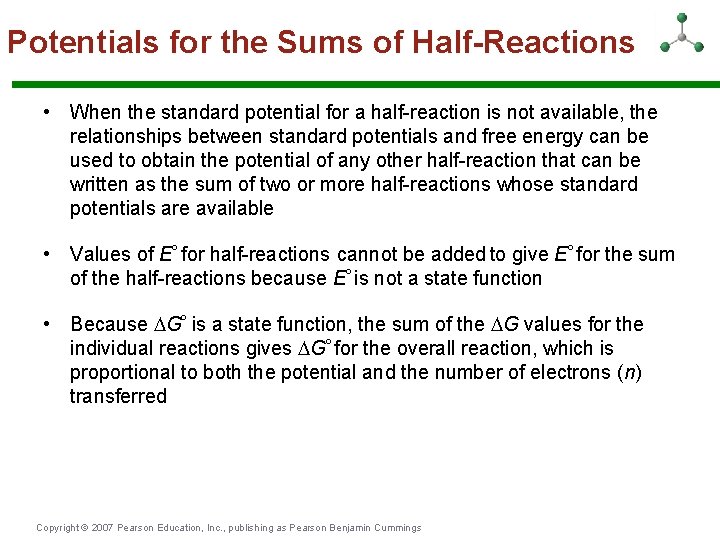
Potentials for the Sums of Half-Reactions • When the standard potential for a half-reaction is not available, the relationships between standard potentials and free energy can be used to obtain the potential of any other half-reaction that can be written as the sum of two or more half-reactions whose standard potentials are available • Values of Eº for half-reactions cannot be added to give Eº for the sum of the half-reactions because Eº is not a state function • Because Gº is a state function, the sum of the G values for the individual reactions gives Gº for the overall reaction, which is proportional to both the potential and the number of electrons (n) transferred Copyright © 2007 Pearson Education, Inc. , publishing as Pearson Benjamin Cummings
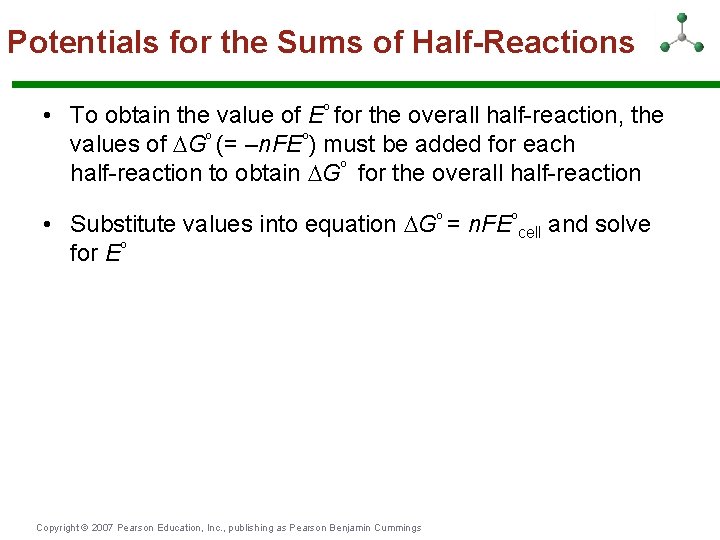
Potentials for the Sums of Half-Reactions • To obtain the value of Eº for the overall half-reaction, the values of Gº (= –n. FEº) must be added for each half-reaction to obtain Gº for the overall half-reaction • Substitute values into equation Gº = n. FEºcell and solve for Eº Copyright © 2007 Pearson Education, Inc. , publishing as Pearson Benjamin Cummings
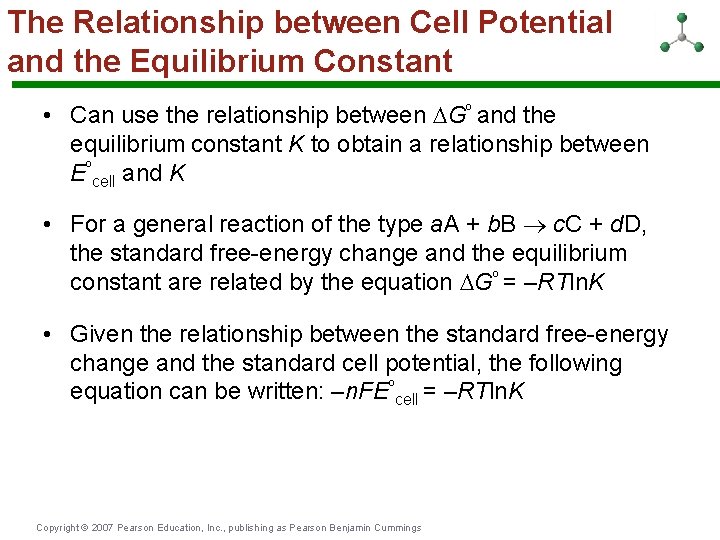
The Relationship between Cell Potential and the Equilibrium Constant • Can use the relationship between Gº and the equilibrium constant K to obtain a relationship between Eºcell and K • For a general reaction of the type a. A + b. B c. C + d. D, the standard free-energy change and the equilibrium constant are related by the equation Gº = –RTln. K • Given the relationship between the standard free-energy change and the standard cell potential, the following equation can be written: –n. FEºcell = –RTln. K Copyright © 2007 Pearson Education, Inc. , publishing as Pearson Benjamin Cummings
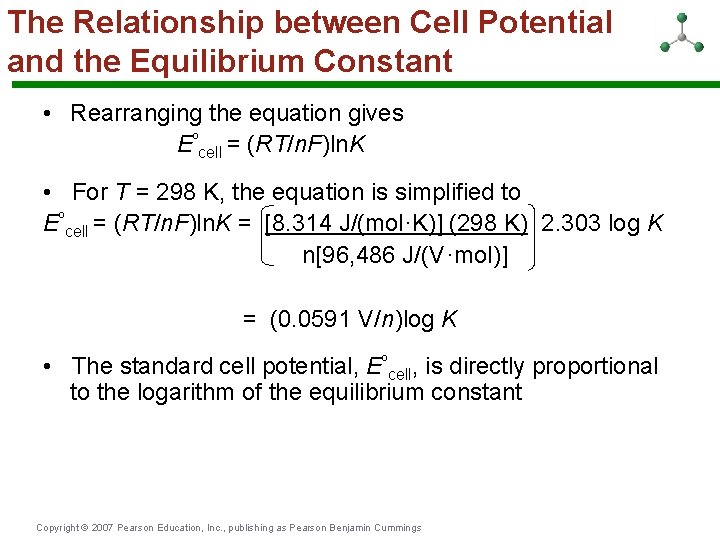
The Relationship between Cell Potential and the Equilibrium Constant • Rearranging the equation gives Eºcell = (RT/n. F)ln. K • For T = 298 K, the equation is simplified to Eºcell = (RT/n. F)ln. K = [8. 314 J/(mol·K)] (298 K) 2. 303 log K n[96, 486 J/(V·mol)] = (0. 0591 V/n)log K • The standard cell potential, Eºcell, is directly proportional to the logarithm of the equilibrium constant Copyright © 2007 Pearson Education, Inc. , publishing as Pearson Benjamin Cummings
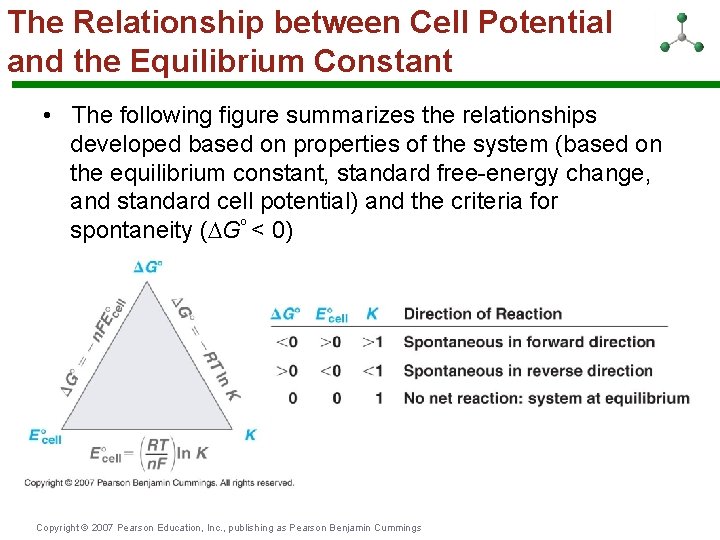
The Relationship between Cell Potential and the Equilibrium Constant • The following figure summarizes the relationships developed based on properties of the system (based on the equilibrium constant, standard free-energy change, and standard cell potential) and the criteria for spontaneity ( Gº < 0) Copyright © 2007 Pearson Education, Inc. , publishing as Pearson Benjamin Cummings
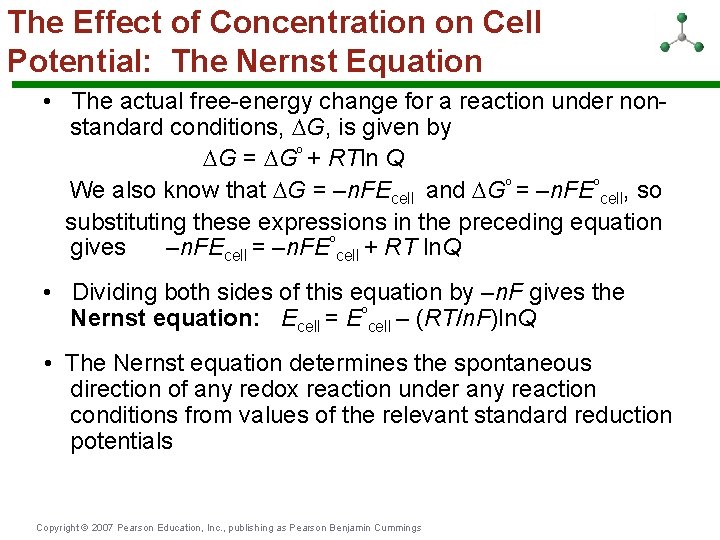
The Effect of Concentration on Cell Potential: The Nernst Equation • The actual free-energy change for a reaction under nonstandard conditions, G, is given by G = Gº + RTln Q We also know that G = –n. FEcell and Gº = –n. FEºcell, so substituting these expressions in the preceding equation gives –n. FEcell = –n. FEºcell + RT ln. Q • Dividing both sides of this equation by –n. F gives the Nernst equation: Ecell = Eºcell – (RT/n. F)ln. Q • The Nernst equation determines the spontaneous direction of any redox reaction under any reaction conditions from values of the relevant standard reduction potentials Copyright © 2007 Pearson Education, Inc. , publishing as Pearson Benjamin Cummings
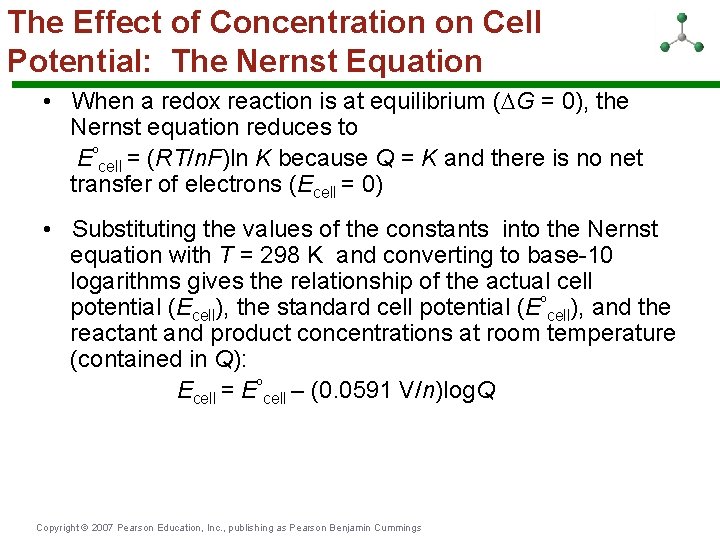
The Effect of Concentration on Cell Potential: The Nernst Equation • When a redox reaction is at equilibrium ( G = 0), the Nernst equation reduces to Eºcell = (RT/n. F)ln K because Q = K and there is no net transfer of electrons (Ecell = 0) • Substituting the values of the constants into the Nernst equation with T = 298 K and converting to base-10 logarithms gives the relationship of the actual cell potential (Ecell), the standard cell potential (Eºcell), and the reactant and product concentrations at room temperature (contained in Q): Ecell = Eºcell – (0. 0591 V/n)log. Q Copyright © 2007 Pearson Education, Inc. , publishing as Pearson Benjamin Cummings
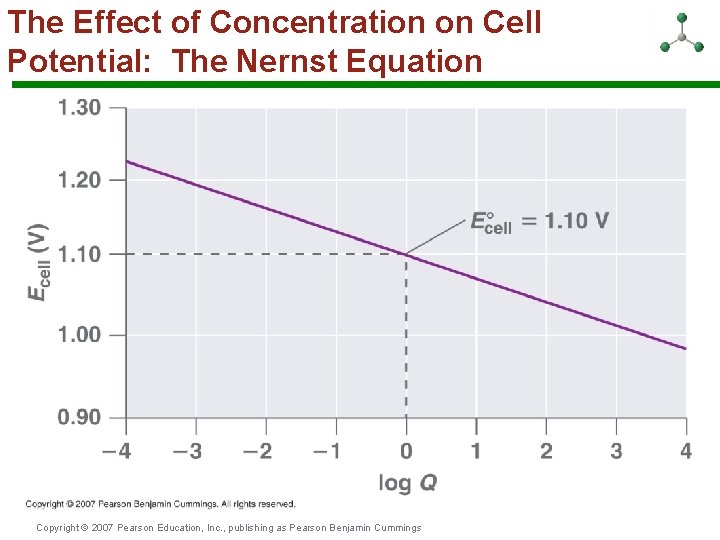
The Effect of Concentration on Cell Potential: The Nernst Equation Copyright © 2007 Pearson Education, Inc. , publishing as Pearson Benjamin Cummings
Concentration Cells • A voltage can be generated by constructing an electrochemical cell in which each compartment contains the same redox active solution but at different concentrations; voltage is produced as the concentrations equilibrate • An electrochemical cell in which the anode and cathode compartments are identical except for the concentration of a reactant is called a concentration cell • Because G = 0 at equilibrium, the measured potential of a concentration cell is zero at equilibrium Copyright © 2007 Pearson Education, Inc. , publishing as Pearson Benjamin Cummings
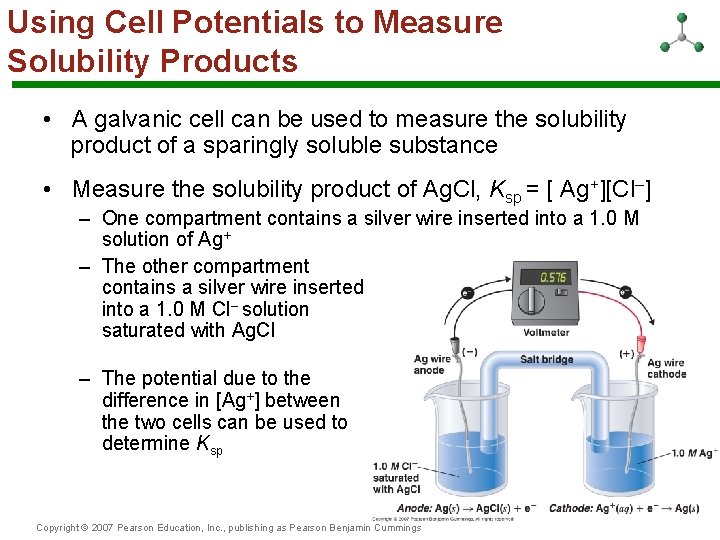
Using Cell Potentials to Measure Solubility Products • A galvanic cell can be used to measure the solubility product of a sparingly soluble substance • Measure the solubility product of Ag. Cl, Ksp = [ Ag+][Cl–] – One compartment contains a silver wire inserted into a 1. 0 M solution of Ag+ – The other compartment contains a silver wire inserted into a 1. 0 M Cl– solution saturated with Ag. Cl – The potential due to the difference in [Ag+] between the two cells can be used to determine Ksp Copyright © 2007 Pearson Education, Inc. , publishing as Pearson Benjamin Cummings
Using Cell Potentials to Measure Concentrations • A galvanic cell can be used to calculate the concentration of a species given a measured potential and the concentrations of all the other species by using the Nernst equation Copyright © 2007 Pearson Education, Inc. , publishing as Pearson Benjamin Cummings
Chemistry: Principles, Patterns, and Applications, 1 e 19. 5 Commercial Galvanic Cells Copyright © 2007 Pearson Education, Inc. , publishing as Pearson Benjamin Cummings
19. 5 Commercial Galvanic Cells • Galvanic cells can be self-contained and portable and can be used as batteries and fuel cells 1. A battery (storage cell) is a galvanic cell (or a series of galvanic cells) that contains all the reactants needed to produce electricity. 2. A fuel cell is a galvanic cell that requires a constant external supply of one or more reactants in order to generate electricity. Copyright © 2007 Pearson Education, Inc. , publishing as Pearson Benjamin Cummings
Batteries • Two basic kinds of batteries 1. Disposable, or primary, batteries in which the electrode reactions are effectively irreversible and which cannot be recharged 2. Rechargeable, or secondary, batteries, which form an insoluble product that adheres to the electrodes; can be recharged by applying an electrical potential in the reverse direction, which temporarily converts a rechargeable battery from a galvanic cell to an electrolytic cell • Major difference between batteries and galvanic cells is that commercial batteries use solids or pastes rather than solutions as reactants to maximize the electrical output per unit mass Copyright © 2007 Pearson Education, Inc. , publishing as Pearson Benjamin Cummings
Batteries • When a battery consists of more than one galvanic cell, the cells are connected in series—that is, with the positive (+) terminal of one cell connected to the negative (–) terminal of the next, and so on • The overall voltage of the battery is the sum of the voltages of the individual cells Copyright © 2007 Pearson Education, Inc. , publishing as Pearson Benjamin Cummings
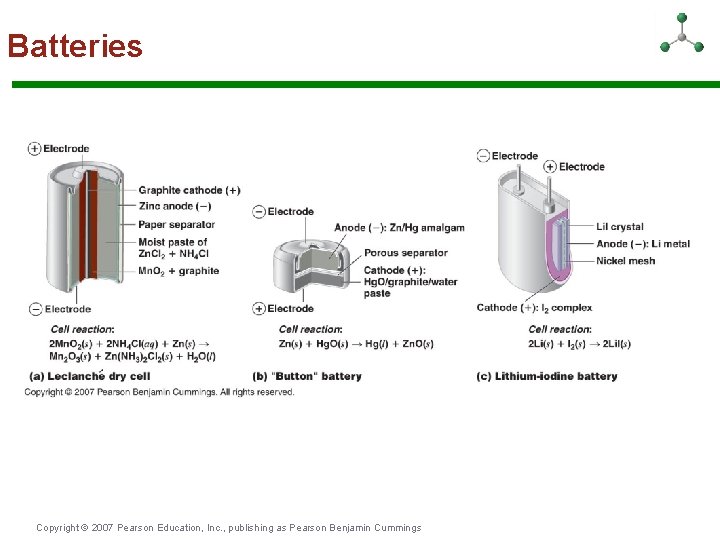
Batteries • Leclanché dry cell – A “wet cell” in which the electrolyte is an acidic water-based paste containing Mn. O 2, NH 4 Cl, Zn. Cl 2, graphite, and starch – Used in flashlights, Walkmen, and Game. Boys and is disposable – Cell not very efficient in producing electrical energy and has a limited shelf life – The alkaline battery is a Leclanché cell adapted to operate under alkaline, or basic, conditions; has a longer shelf life and more constant output voltage than the Leclanché dry cell Copyright © 2007 Pearson Education, Inc. , publishing as Pearson Benjamin Cummings
Batteries • “Button” batteries – The anode is a zinc-mercury amalgam, and the cathode can be either Hg. O or Ag 2 O as the oxidant – Are reliable and have a high output-to-mass ratio, which allows them to be used in calculators, cameras, hearing aids, and watches, where their small size is crucial – Disposable Copyright © 2007 Pearson Education, Inc. , publishing as Pearson Benjamin Cummings
Batteries • Lithium-iodine battery – Water-free battery – Consists of two cells separated by a metallic nickel mesh that collects charge from the anodes – The anode is lithium metal, and the cathode is a solid complex of 2 – Electrolyte is a layer of solid Li that allows Li+ ions to diffuse from the cathode to the anode – Highly reliable and long-lived – Used in cardiac pacemakers, medical implants, smoke alarms, and in computers – Disposable Copyright © 2007 Pearson Education, Inc. , publishing as Pearson Benjamin Cummings
Batteries Copyright © 2007 Pearson Education, Inc. , publishing as Pearson Benjamin Cummings
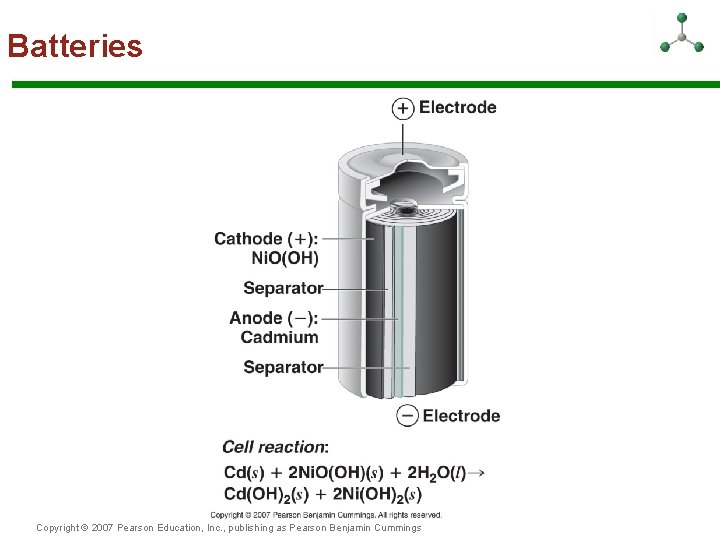
Batteries • Nickel-cadmium (nicad) battery – Used in small electrical appliances and in devices like drills and portable vacuum cleaners – A water-based cell with a cadmium anode and a highly oxidized nickel cathode – This design maximizes the surface area of the electrodes and minimizes the distance between them, which gives the battery both a high discharge current and a high capacity – Lightweight, rechargeable, and high capacity but tend to lose capacity quickly and do not store well; also presents disposal problems because of the toxicity of cadmium Copyright © 2007 Pearson Education, Inc. , publishing as Pearson Benjamin Cummings
Batteries Copyright © 2007 Pearson Education, Inc. , publishing as Pearson Benjamin Cummings
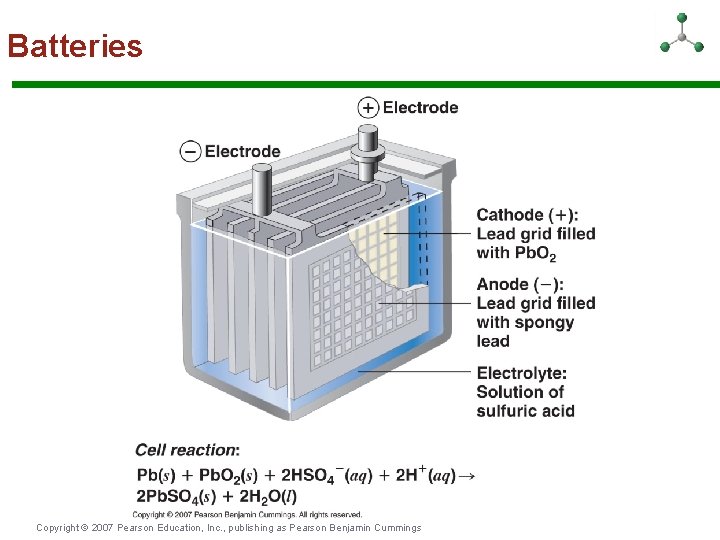
Batteries • Lead-acid (lead storage) battery – Provides the starting power in automobiles and boats; can be discharged and recharged many times – The anodes in each cell of this rechargeable battery are plates or grids of lead containing spongy lead metal, while the cathodes are similar grids containing powdered lead dioxide, Pb. O 2 – The electrolyte is an aqueous solution of sulfuric acid – The value of Eº for such a cell is 2 V; connecting three cells in series produces a 6 -V battery, and a typical 12 -V car battery contains six of these cells connected in series Copyright © 2007 Pearson Education, Inc. , publishing as Pearson Benjamin Cummings
Batteries Copyright © 2007 Pearson Education, Inc. , publishing as Pearson Benjamin Cummings
Fuel Cells • A galvanic cell that requires an external supply of reactants because the products of the reaction are continuously removed • Does not store electrical energy but allows electrical energy to be extracted directly from a chemical reaction • Have reliability problems and are costly • Used in space vehicles Copyright © 2007 Pearson Education, Inc. , publishing as Pearson Benjamin Cummings

Chemistry: Principles, Patterns, and Applications, 1 e 19. 6 Corrosion Copyright © 2007 Pearson Education, Inc. , publishing as Pearson Benjamin Cummings
19. 6 Corrosion • Corrosion is a galvanic process by which metals deteriorate through oxidation, usually but not always to their oxides • One of the most common techniques used to prevent corrosion is to apply a protective coating of another metal that is more difficult to oxidize • Alternatively, a more easily oxidized metal can be applied to a metal surface, thus providing cathodic protection of the surface; galvanized steel is protected by a thin layer of zinc • Sacrificial electrodes can also be attached to an object to protect it Copyright © 2007 Pearson Education, Inc. , publishing as Pearson Benjamin Cummings

Chemistry: Principles, Patterns, and Applications, 1 e 19. 7 Electrolysis Copyright © 2007 Pearson Education, Inc. , publishing as Pearson Benjamin Cummings
19. 7 Electrolysis • Galvanic cells—a spontaneous chemical reaction is used to generate electrical energy • In an electrolytic cell, the opposite process, called electrolysis, occurs: an external voltage is applied to drive a nonspontaneous reaction Copyright © 2007 Pearson Education, Inc. , publishing as Pearson Benjamin Cummings
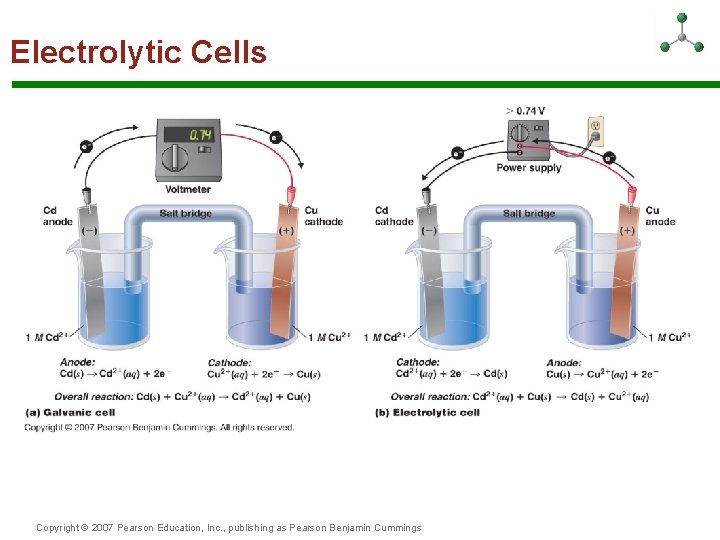
Electrolytic Cells • An electrochemical cell in which one electrode is copper metal immersed in a 1 M Cu 2+ solution and the other electrode is cadmium metal immersed in a 1 M Cd 2+ solution is set up, and then the circuit is closed – Cadmium electrode begins to dissolve (Cd is oxidized to Cd 2+) and thus is the anode, while metallic copper will be deposited on the copper electrode (Cu 2+ is reduced to Cu), which is the cathode – Overall reaction is thermodynamically spontaneous as written ( Gº < 0); in this direction, the system is acting as a galvanic cell – The reverse reaction, the reduction of Cd 2+ by Cu, is thermodynamically nonspontaneous and will only occur with an input of an applied voltage Copyright © 2007 Pearson Education, Inc. , publishing as Pearson Benjamin Cummings
Electrolytic Cells – Can force the reaction to proceed in the reverse direction by applying an electrical potential from an external power supply; applied voltage forces electrons through the circuit in the reverse direction, converting a galvanic cell to an electrolytic cell – The copper electrode is now the anode (Cu is oxidized) and the cadmium electrode is now the cathode (Cd 2+ is reduced) – Signs of the electrodes have changed to reflect the flow of electrons in the circuit Copyright © 2007 Pearson Education, Inc. , publishing as Pearson Benjamin Cummings
Electrolytic Cells Copyright © 2007 Pearson Education, Inc. , publishing as Pearson Benjamin Cummings
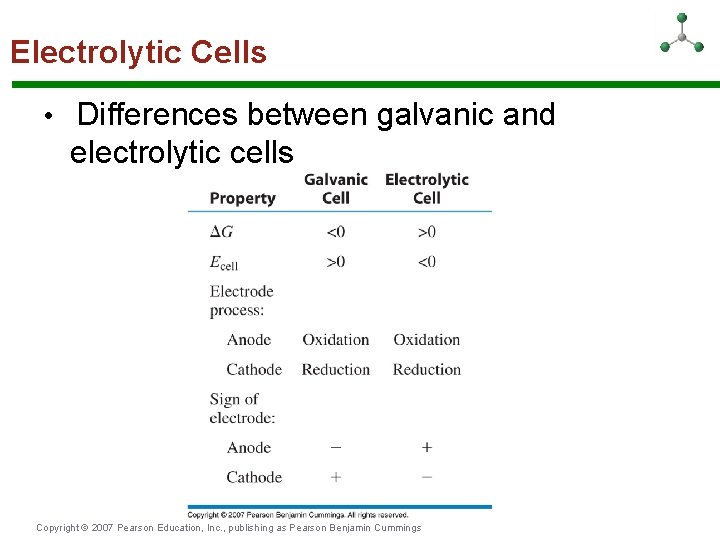
Electrolytic Cells • Differences between galvanic and electrolytic cells Copyright © 2007 Pearson Education, Inc. , publishing as Pearson Benjamin Cummings
Electrolytic Reactions • At sufficiently high temperatures, ionic solids melt to form liquids that conduct electricity extremely well due to the high concentrations of ions • Sodium metal is produced commercially by electrolysis of molten mixture of Na. Cl and Ca. Cl 2 in a Downs cell • The Hall-Heroult process is used to produce aluminum commercially by electrolysis of a molten mixture of aluminum oxide and cryolite • Electrolysis can also be used to drive thermodynamically nonspontaneous decomposition of water into its constituent elements, H 2 and O 2, by adding a small amount of an ionic solute to the water to make it electrically conductive Copyright © 2007 Pearson Education, Inc. , publishing as Pearson Benjamin Cummings
Electrolytic Reactions • Overvoltages are needed in all electrolytic processes • An overvoltage is an added voltage and represents the additional driving force required to overcome barriers such as a large activation energy and a junction potential Copyright © 2007 Pearson Education, Inc. , publishing as Pearson Benjamin Cummings
Electroplating • In a process called electroplating, a layer of a second metal is deposited on the metal electrode that acts as the cathode during electrolysis • Electroplating is used to enhance the appearance of metal objects and protect them from corrosion Copyright © 2007 Pearson Education, Inc. , publishing as Pearson Benjamin Cummings
Quantitative Considerations • The amount of material consumed or produced in a reaction can be calculated from the stoichiometry of an electrolysis reaction, the amount of current passed, and the duration of the electrolytic reaction Charge (C) = current (A) X times(s) moles e– = charge (C) 96, 486 C/mol (1 faraday) • The stoichiometry can be used to determine the combination of current and time needed to produce a given amount of material Copyright © 2007 Pearson Education, Inc. , publishing as Pearson Benjamin Cummings
- Slides: 72