Electrochemical Cells GALVANIC VOLTAIC ELECTROLYTIC Spontaneous chemical reaction


- Slides: 36
Electrochemical Cells GALVANIC / VOLTAIC ELECTROLYTIC • Spontaneous chemical reaction • Nonspontaneous chemical reaction • Often used as batteries • Driven by outside power source BOTH types above are considered electrochemical cells!
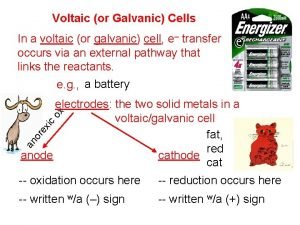
Electrochemistry Terminology #4 Ø Anode The electrode where oxidation occurs Ø Cathode The electrode where reduction occurs Memory device: Reduction at the Cathode
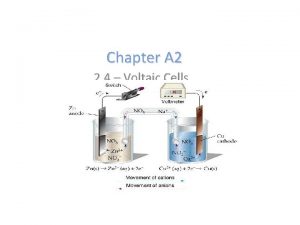
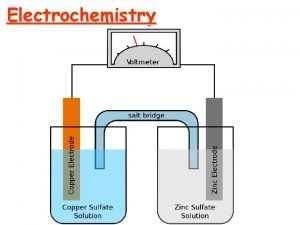
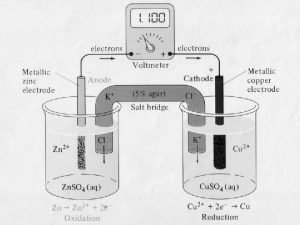
GALVANIC / VOLTAIC CELLS Galvanic / Voltaic cells have the following parts: • Anode: electrode where oxidation occurs; may appear to shrink with time • Cathode: electrode where reduction occurs; may appear to grow with time • Inert electrodes (optional): Usually platinum (Pt) or graphite; used when gases are involved or when species are oxidized or reduced but remain ions (i. e. Fe 2+ Fe 3+) • Salt Bridge: maintains electrical neutrality in a galvanic/voltaic cell by allowing non-reactive ions to migrate into and out of cells; may be replaced with a porous cup
GALVANIC / VOLTAIC CELLS Other Aspects: • Electrons ALWAYS flow FROM anode TO cathode in galvanic/voltaic cells! • Standard Cell Notation: anode | solution (conc) | cathode • Voltmeter: high input impedance device used to measure the potential difference between the cathode and anode in an electrochemical cell without allowing current to flow; this quantity is also known as cell emf or cell potential (E cell) and is often measured in volts (joule/coulomb, J/C)
No current flows here…circuit is not complete. There’s a massive resistance in the air between the cells. In this system, the salt bridge supplies ions to complete the circuit. They flow as needed to counteract the flow of electrons. Cations flow to the cathode cell and anions flow to the anode cell.
Standard Reduction Potential • Every half-reaction cell has a potential, which is measured against a standard cell • The standard of choice is often the Standard Hydrogen electrode (SHE), which is made of a piece of platinum that is in contact with H 2 gas at 1 atm and a 1 M solution of H+ ions • The SHE is assigned a value of 0. 0 V • Standard reduction Potentials are tabled at Standard Conditions (duh!) • Standard Conditions: 1 atm for gases, 1 M for solutions, and 298 K for all species • We again use the symbol “naught” ( ) to indicate standard conditions, much like in thermochemistry, i. e. potential at standard conditions is E • Values are always tabled as reductions, whether or not the species is undergoing reduction in the cell!
Standard Reduction Potential NOTE: REACTION OCCURING ABOVE HAS ZINC BEING OXIDIZED AND H+ BEING REDUCED WITH A POSITIVE POTENTIAL…THIS MEANS ZINC WILL HAVE A NEGATIVE REDUCTION POTENTIAL!!
Measuring Standard Electrode Potentials are measured against a hydrogen ion reduction reaction, which is arbitrarily assigned a potential of zero volts.
A Closer Look…
The oxidation-reduction reaction is spontaneous. A solution containing K 2 Cr 2 O 7 and H 2 SO 4 is poured into one beaker, and a solution of KI is poured into another. A salt bridge is used to join the beakers. A metallic conductor that will not react with either solution (such as platinum foil) is suspended in each solution, and the two conductors are connected with wires through a voltmeter or some other device to detect an electric current. The resultant voltaic cell generates an electric current. Indicate (1) the reaction occurring at the anode, (2) the reaction at the cathode, (3) the direction of electron migration, (4) the direction of ion migration, and (5) the signs of the electrodes.
Standard Reduction Potential There are some generalities that can be drawn from these values… • Elements with the most positive reduction potentials are easily reduced (generally nonmetals) • Elements with the least positive reduction potentials are easily oxidized (generally metals) • The standard potentials can also be used to determine the relative strength of oxidizing and reducing agents • Can be used as an activity series (This is why AP doesn’t give you the activity series as you are accustomed to seeing it) • If you are trying to produce a Galvanic/Voltaic cell…MORE POSITIVE REDUCTION POTENTIAL GETS REDUCED!
Calculating Standard Cell Potential for Voltaic Cells
Table of Reduction Potentials Measured against the Standard Hydrogen Electrode
EXAMPLE A voltaic cell is based on a Co 2+/Co half cell and a Ag. Cl/Ag half-cell. (a) Write the line notation for this cell; (b) What is the standard cell potential?
EXAMPLE A voltaic cell is based on a Co 2+/Co half cell and a Ag. Cl/Ag half-cell. (a) Write the line notation for this cell; (b) What is the standard cell potential?
Answer: -. 40 V
Potential, Electrical Work, and Free Energy
Potential, Electrical Work, and Free Energy
Potential, Electrical Work, and Free Energy
Potential, Electrical Work, and Free Energy
Potential, Electrical Work, and Free Energy
Cell Potential and Concentration When cells are not at standard conditions Le Chatlier’s Principle can be applied. Increasing a reactant species concentration relative to standard conditions will increase cell emf. Increasing temperature decreases voltage The moles of reactant or product do not effect voltage (only care about the moles of electrons)
Cell Potential and Concentration Important to note… Batteries consume reactants and make products as the reaction proceeds so eventually they will reach a state where Q = K. When Q = K a batter is “dead” and equilibrium is reached. When this happens E = 0 and G = 0 as well. As such, we can also use cells with different concentrations of the same reactants to generate a “concentration cell” that is useful in determining the concentration of an unknown solution relative to a known one.