
Aim What is entropy Do Now Review HW
- Slides: 12
Aim: What is entropy? Do Now: Review HW in pairs.
Spontaneous Reaction • A spontaneous reaction is one that is able to proceed without needing to add energy to it. • A nonspontaneous reaction needs energy added to it for the reaction to proceed. • Which type of reaction (exo or endo) could likely be a spontaneous reaction? • exo
Spontaneous reactions occur in the direction of: 1. Less energy (lower enthalpy): exothermic reactions are favored 2. Greater entropy (randomness, disorder)
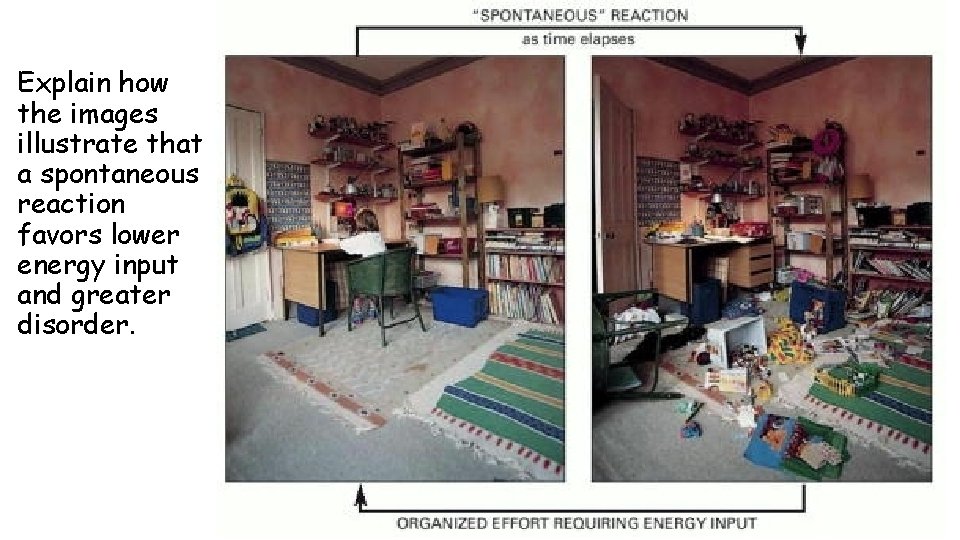
Explain how the images illustrate that a spontaneous reaction favors lower energy input and greater disorder.
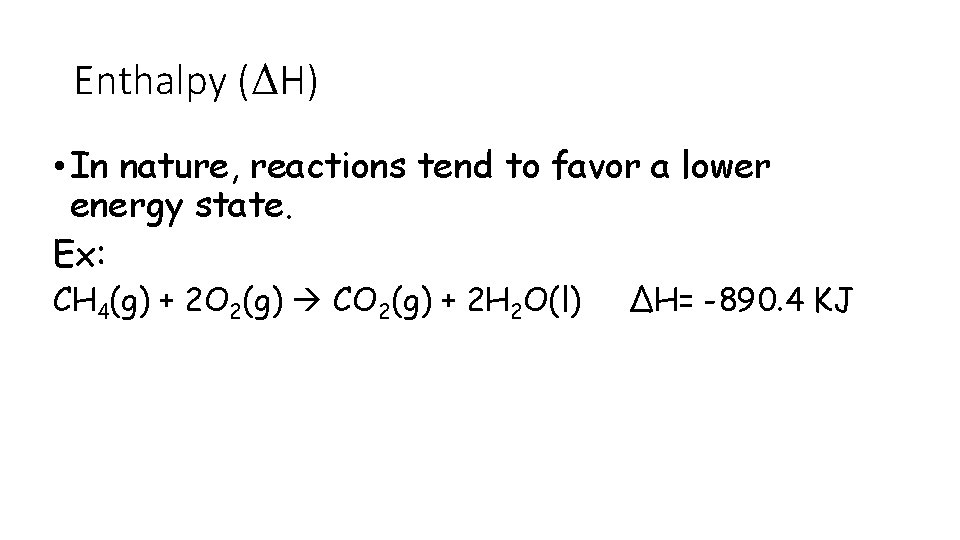
Enthalpy (ΔH) • In nature, reactions tend to favor a lower energy state. Ex: CH 4(g) + 2 O 2(g) CO 2(g) + 2 H 2 O(l) ΔH= -890. 4 KJ
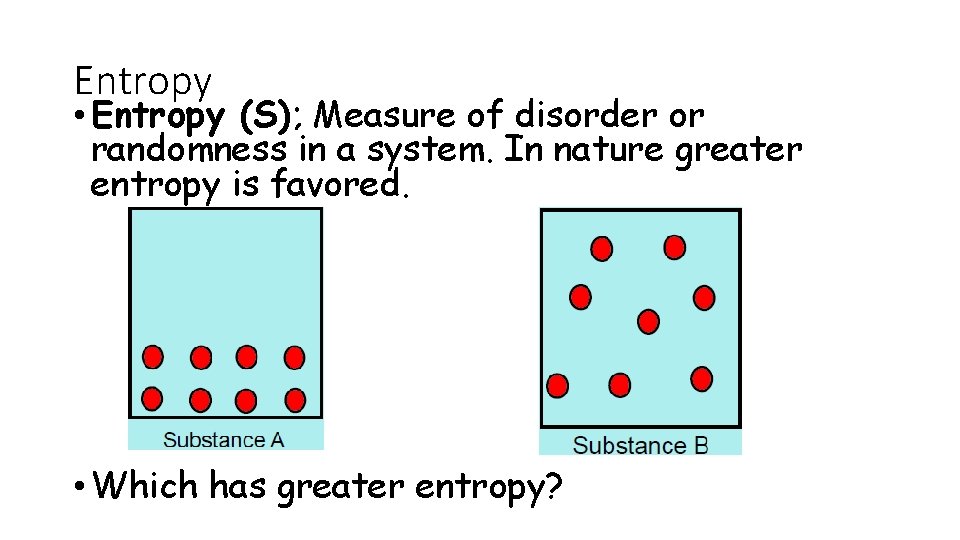
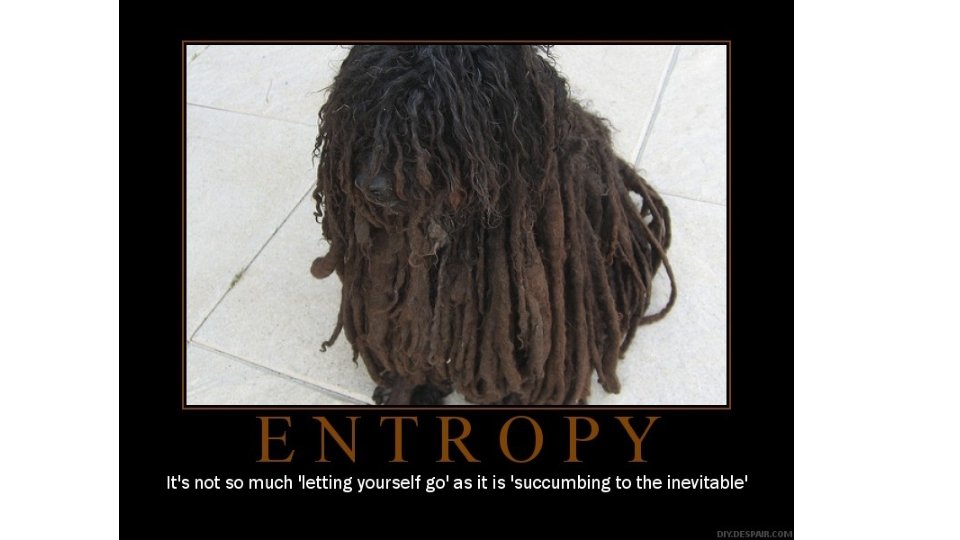
Entropy • Entropy (S); Measure of disorder or randomness in a system. In nature greater entropy is favored. • Which has greater entropy?
Entropy 1. Which phase (solid, liquid or gas) will have the greatest entropy? The least entropy? Explain your answer.
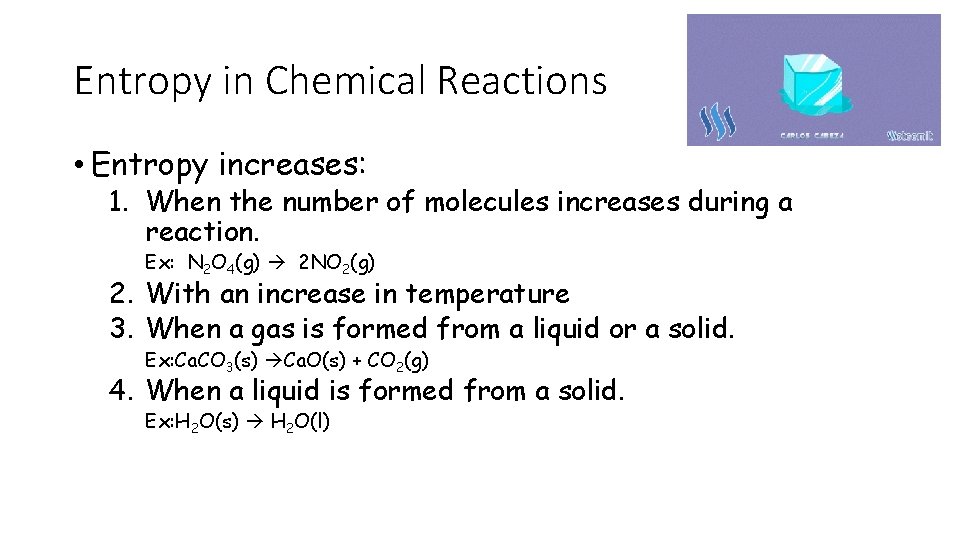
Entropy in Chemical Reactions • Entropy increases: 1. When the number of molecules increases during a reaction. Ex: N 2 O 4(g) 2 NO 2(g) 2. With an increase in temperature 3. When a gas is formed from a liquid or a solid. Ex: Ca. CO 3(s) Ca. O(s) + CO 2(g) 4. When a liquid is formed from a solid. Ex: H 2 O(s) H 2 O(l)
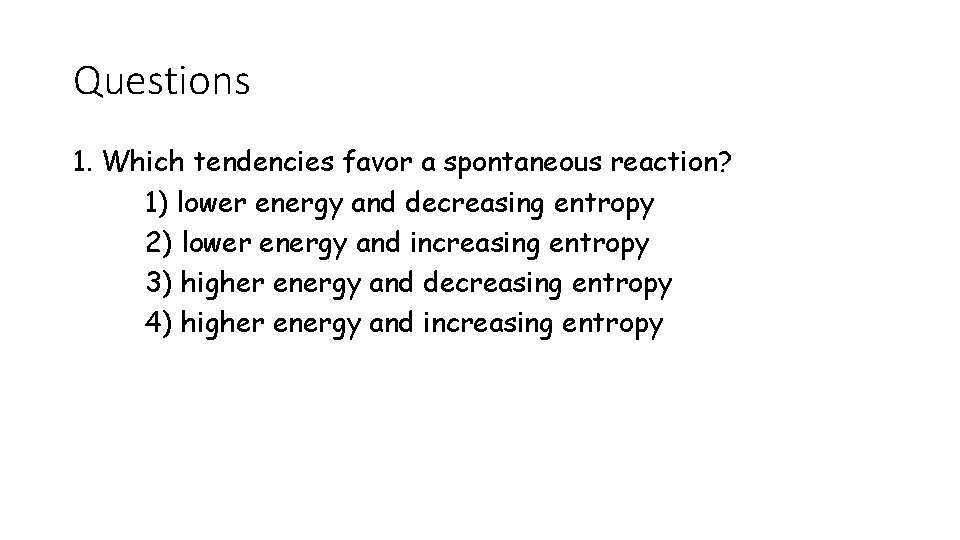
Questions 1. Which tendencies favor a spontaneous reaction? 1) lower energy and decreasing entropy 2) lower energy and increasing entropy 3) higher energy and decreasing entropy 4) higher energy and increasing entropy
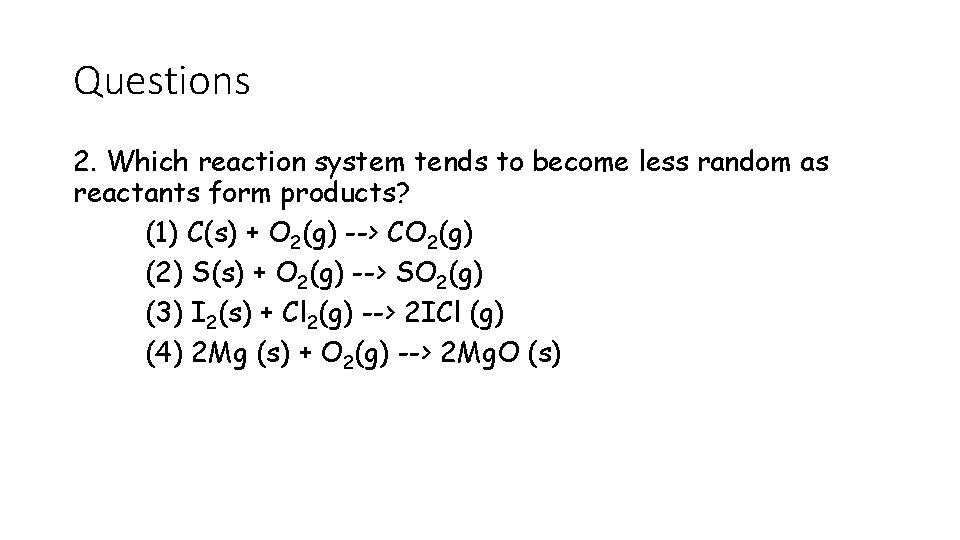
Questions 2. Which reaction system tends to become less random as reactants form products? (1) C(s) + O 2(g) --> CO 2(g) (2) S(s) + O 2(g) --> SO 2(g) (3) I 2(s) + Cl 2(g) --> 2 ICl (g) (4) 2 Mg (s) + O 2(g) --> 2 Mg. O (s)
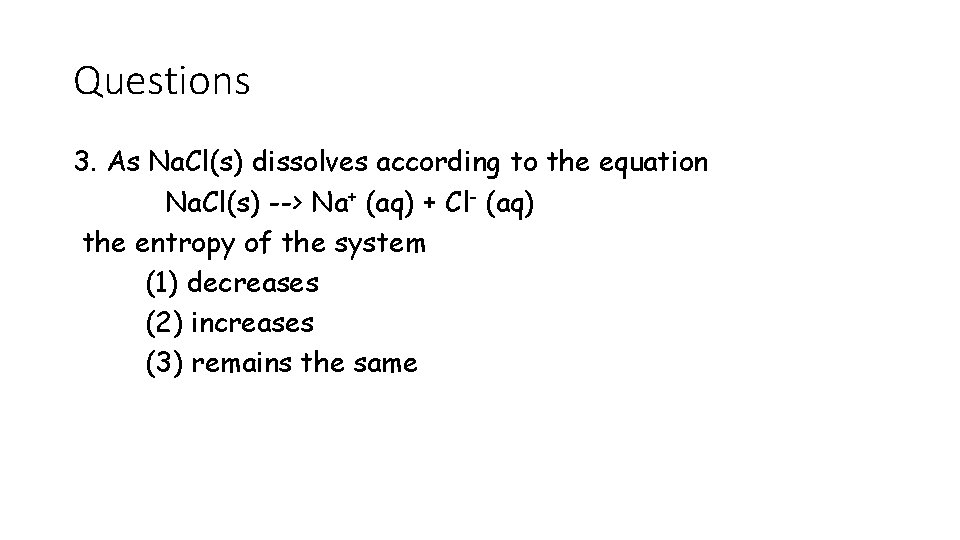
Questions 3. As Na. Cl(s) dissolves according to the equation Na. Cl(s) --> Na+ (aq) + Cl- (aq) the entropy of the system (1) decreases (2) increases (3) remains the same