
Spontaneity Entropy and Free Energy Laws Of Thermodynamics

- Slides: 20
Spontaneity, Entropy and Free Energy
Laws Of Thermodynamics • The first law of thermodynamics is a statement of the law of conservation of energy: – Energy can be neither created nor destroyed. In other words, the energy of the universe is constant.
Energy in Chemical Reactions A+B C + D + Energy • The potential energy is broken in chemical bonds in compounds A and B • The potential energy is the chemical bonds of C and D is lower – The excess has been given off (energy) as thermal energy, or heat, which is kinetic energy transferred to the surroundings
Spontaneity • Spontaneous Processes • Processes that occur without outside intervention • Spontaneous processes may be fast or slow –Many forms of combustion are fast –Conversion of graphite to diamond is slow –Kinetics is concerned with speed, thermodynamics with the initial and final state
Entropy (S) • A measure of the randomness or disorder • The driving force for a spontaneous process is an increase in the entropy of the universe (one of the laws of thermodynamics!) – The universe favors chaos!! • Entropy is a thermodynamic function describing the number of arrangements that are available to a system • Nature proceeds towards the states that have the highest probabilities of existing
Second Law of Thermodynamics § "In any spontaneous process there is always an increase in the entropy of the universe" § "The entropy of the universe is increasing"
Entropy and Exothermic Processes • Entropy and a process being exothermic are related, but a process doesn’t have to be both • Exothermic process – Ssurr = positive, exothermic = more disorder in surroundings • Endothermic process – Ssurr = negative, endothermic = less disorder in surroudings – ssystem must increease to obey 2 nd Law of Thermodynamics
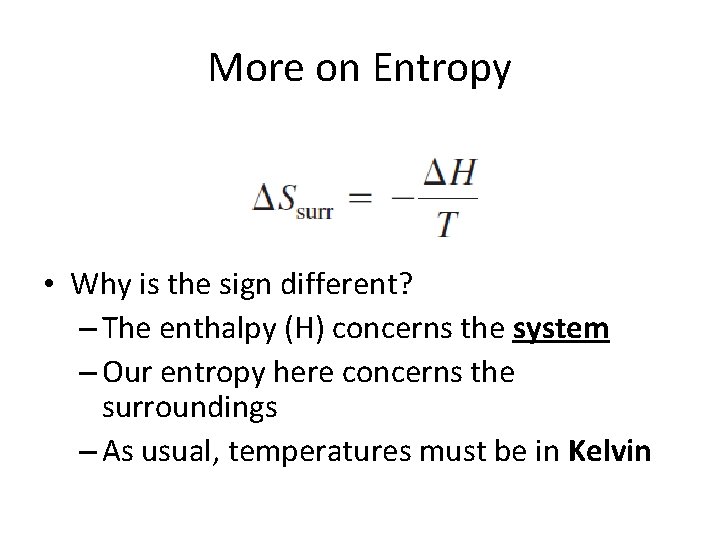
More on Entropy • Why is the sign different? – The enthalpy (H) concerns the system – Our entropy here concerns the surroundings – As usual, temperatures must be in Kelvin
Free Energy, G G = H - T S • Typically defined as the energy available to perform work • G determines whether a process is spontaneous or not ( G = negative = spontaneous) – Takes into account enthalpy, entropy, and temperature – Symbol honors Josiah Gibbs (sometimes called Gibbs Free Energy or Gibbs energy), a physics professor at Yale during the late 1800’s who was important in developing much of modern thermodynamics
Energy Diagrams • Left – A spontaneous reaction – The products have a lower free energy (G) than the reactants ( G < 0) • Right – A nonspontaneous reaction – The reactants have a higher free energy than the products ( G > 0)
What If? • G = 0? – The reaction is at equilibrium • As a result G < 0 The reaction is spontaneous. G > 0 The reaction is nonspontaneous. G = 0 The reaction mixture is at equilibrium. -It’s not moving forward or reverse overall – mult processes, same speed
Dependence on Temperature G = H - T S • Notice there are two terms in the equation – Spontaneity can change when the temperature changes. – Temperature and spontaneity are not necessarily correlated. • A reaction with a negative entropy (loss of randomness) would be LESS spontaneous at higher temperatures – it doesn’t want to happen, but is pushed by the extra heat.
Reaction Rates • Free energy (G) values tell us if reactions will occur • They do not tell us how fast reactions will occur. • During a reaction – Reactant particles must physically collide – They must collide with enough energy to break the bonds in the reactant • Some reactions require the addition of heat energy. This gives the reactants the extra energy needed (more collisions, harder collisions) for this process to occur.
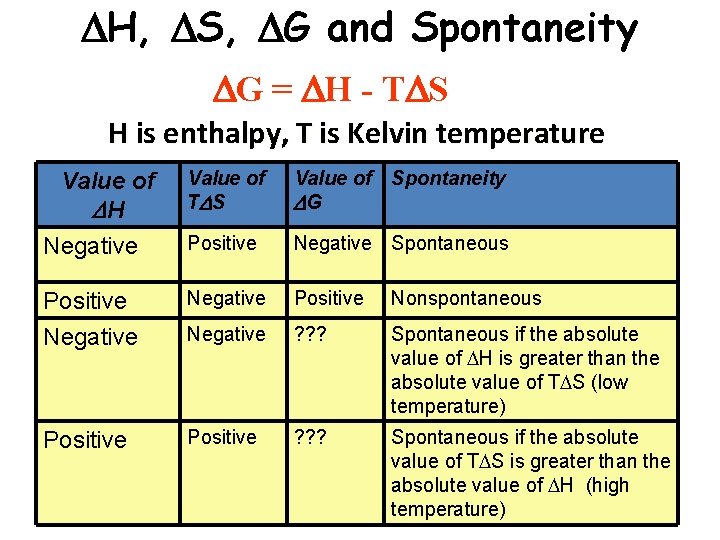
H, S, G and Spontaneity G = H - T S H is enthalpy, T is Kelvin temperature Value of H Negative Value of T S Value of Spontaneity G Positive Negative Spontaneous Positive Negative Positive Nonspontaneous Negative ? ? ? Spontaneous if the absolute value of H is greater than the absolute value of T S (low temperature) Positive ? ? ? Spontaneous if the absolute value of T S is greater than the absolute value of H (high temperature)
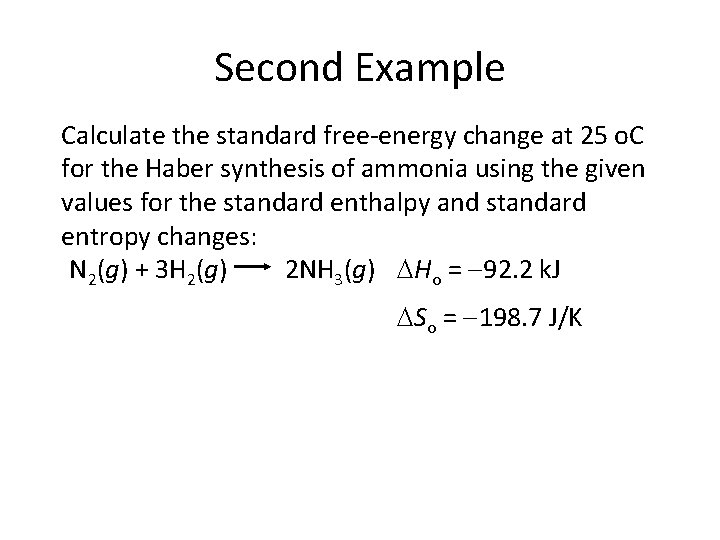
Second Example Calculate the standard free-energy change at 25 o. C for the Haber synthesis of ammonia using the given values for the standard enthalpy and standard entropy changes: N 2(g) + 3 H 2(g) 2 NH 3(g) Ho = 92. 2 k. J So = 198. 7 J/K
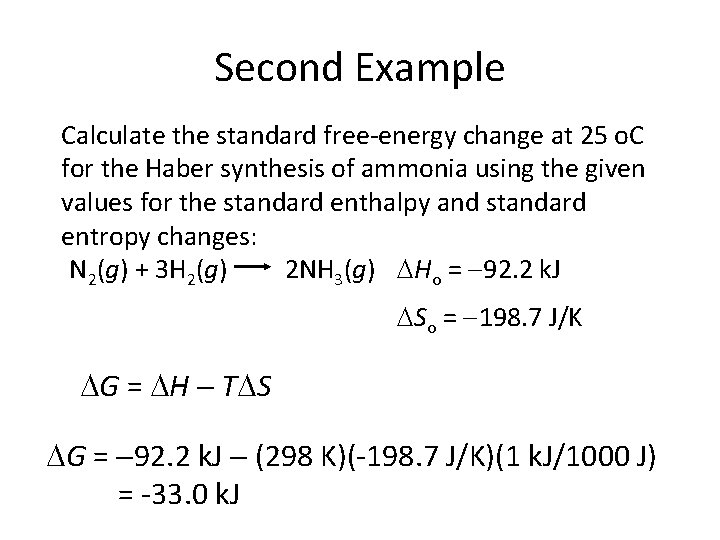
Second Example Calculate the standard free-energy change at 25 o. C for the Haber synthesis of ammonia using the given values for the standard enthalpy and standard entropy changes: N 2(g) + 3 H 2(g) 2 NH 3(g) Ho = 92. 2 k. J So = 198. 7 J/K G = H T S G = 92. 2 k. J (298 K)(-198. 7 J/K)(1 k. J/1000 J) = -33. 0 k. J
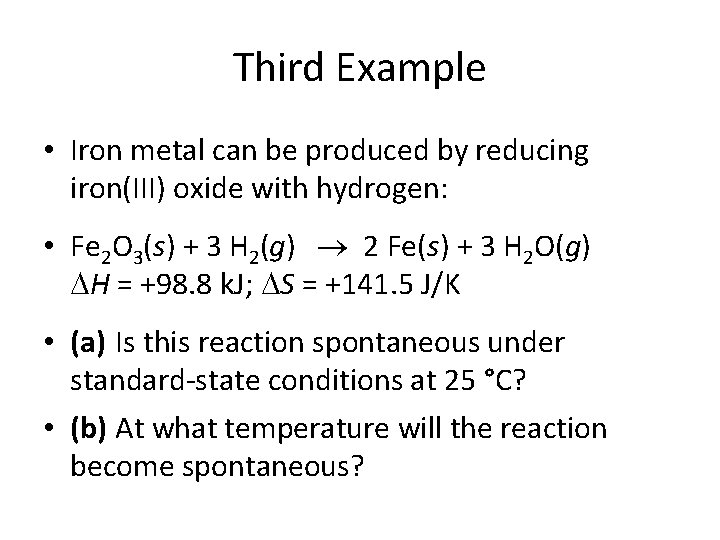
Third Example • Iron metal can be produced by reducing iron(III) oxide with hydrogen: • Fe 2 O 3(s) + 3 H 2(g) 2 Fe(s) + 3 H 2 O(g) H = +98. 8 k. J; S = +141. 5 J/K • (a) Is this reaction spontaneous under standard-state conditions at 25 °C? • (b) At what temperature will the reaction become spontaneous?
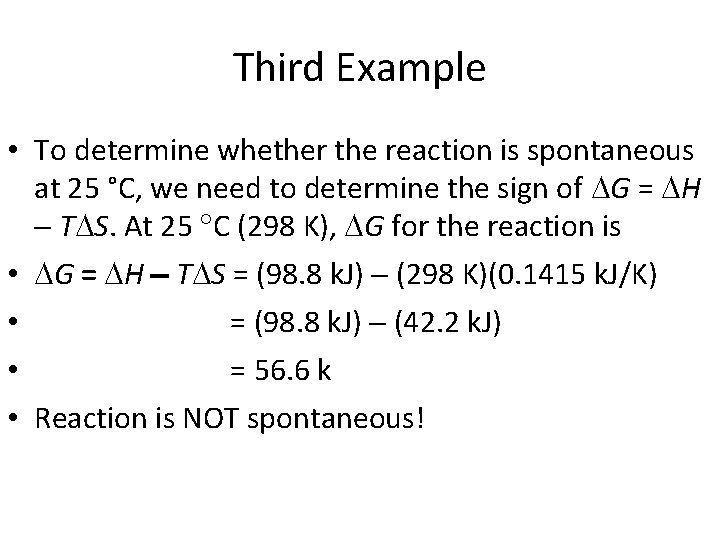
Third Example • To determine whether the reaction is spontaneous at 25 °C, we need to determine the sign of G = H T S. At 25 C (298 K), G for the reaction is • G = H T S = (98. 8 k. J) (298 K)(0. 1415 k. J/K) • = (98. 8 k. J) (42. 2 k. J) • = 56. 6 k • Reaction is NOT spontaneous!
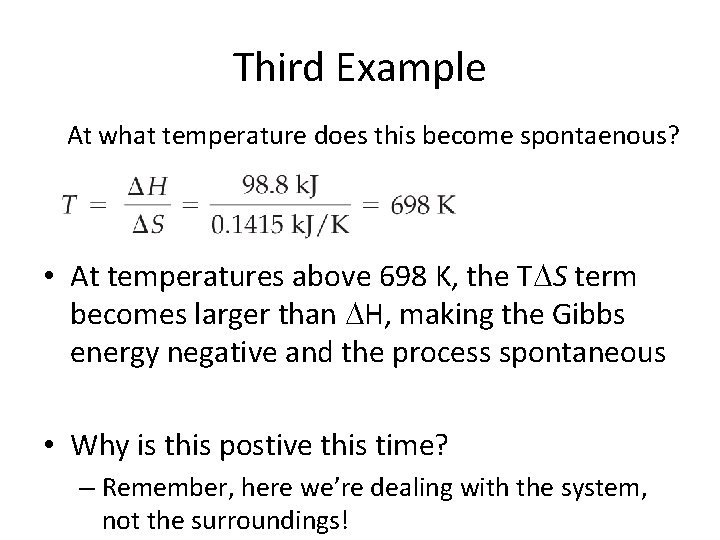
Third Example At what temperature does this become spontaenous? • At temperatures above 698 K, the T S term becomes larger than H, making the Gibbs energy negative and the process spontaneous • Why is this postive this time? – Remember, here we’re dealing with the system, not the surroundings!
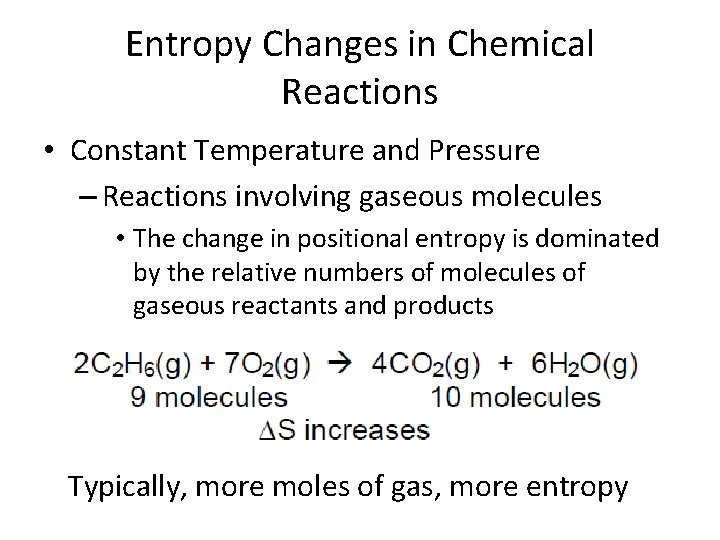
Entropy Changes in Chemical Reactions • Constant Temperature and Pressure – Reactions involving gaseous molecules • The change in positional entropy is dominated by the relative numbers of molecules of gaseous reactants and products Typically, more moles of gas, more entropy