
Voltaic or Galvanic Cells In a voltaic or
- Slides: 23
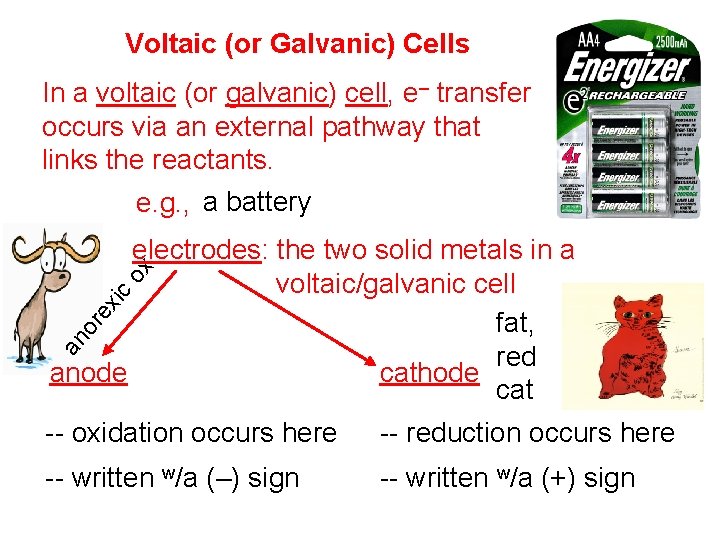
Voltaic (or Galvanic) Cells In a voltaic (or galvanic) cell, e– transfer occurs via an external pathway that links the reactants. e. g. , a battery an or ex ic ox electrodes: the two solid metals in a voltaic/galvanic cell fat, red anode cathode cat -- oxidation occurs here -- reduction occurs here -- written w/a (–) sign -- written w/a (+) sign
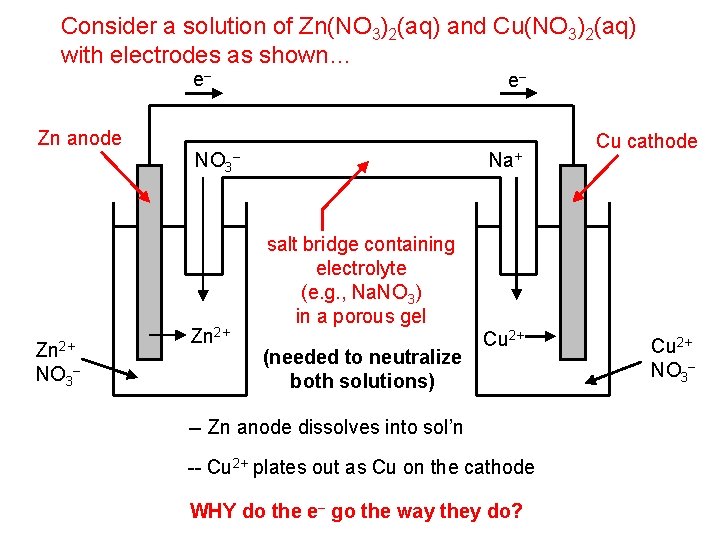
Consider a solution of Zn(NO 3)2(aq) and Cu(NO 3)2(aq) with electrodes as shown… e– Zn anode Zn 2+ NO 3 – NO 3 Zn 2+ e– Na+ – Cu cathode salt bridge containing electrolyte (e. g. , Na. NO 3) in a porous gel (needed to neutralize both solutions) Cu 2+ -- Zn anode dissolves into sol’n -- Cu 2+ plates out as Cu on the cathode WHY do the e– go the way they do? Cu 2+ NO 3–
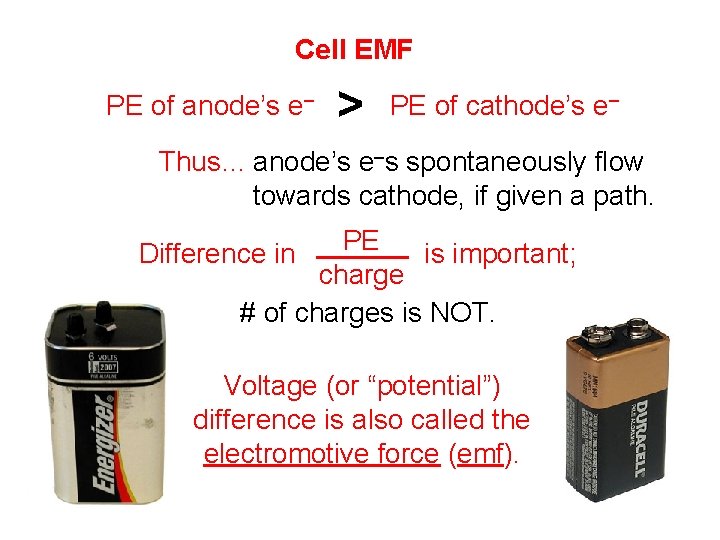
Cell EMF PE of anode’s e– > PE of cathode’s e– Thus… anode’s e–s spontaneously flow towards cathode, if given a path. PE is important; charge # of charges is NOT. Difference in Voltage (or “potential”) difference is also called the electromotive force (emf).
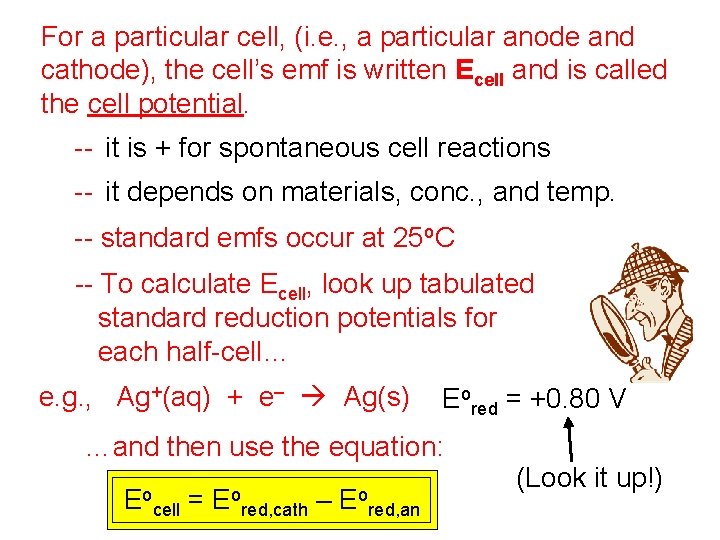
For a particular cell, (i. e. , a particular anode and cathode), the cell’s emf is written Ecell and is called the cell potential. -- it is + for spontaneous cell reactions -- it depends on materials, conc. , and temp. -- standard emfs occur at 25 o. C -- To calculate Ecell, look up tabulated standard reduction potentials for each half-cell… e. g. , Ag+(aq) + e– Ag(s) Eored = +0. 80 V …and then use the equation: Eocell = Eored, cath – Eored, an (Look it up!)
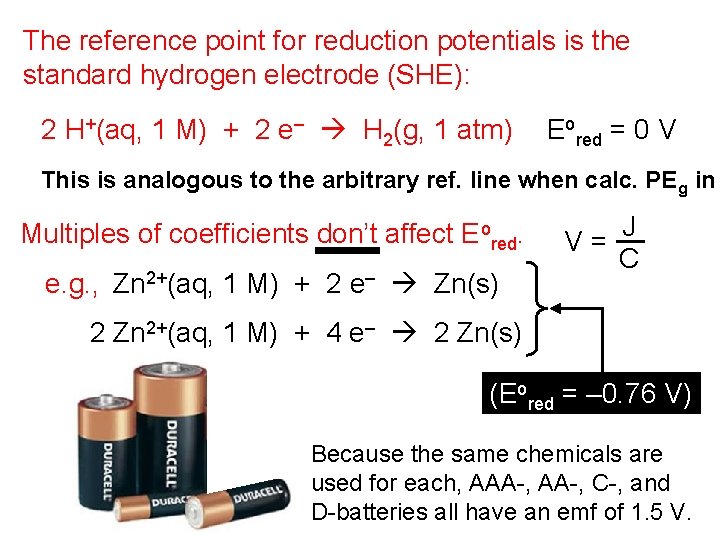
The reference point for reduction potentials is the standard hydrogen electrode (SHE): 2 H+(aq, 1 M) + 2 e– H 2(g, 1 atm) Eored = 0 V This is analogous to the arbitrary ref. line when calc. PE g in Multiples of coefficients don’t affect Eored. e. g. , Zn 2+(aq, 1 M) + 2 e– Zn(s) V= J C 2 Zn 2+(aq, 1 M) + 4 e– 2 Zn(s) (Eored = – 0. 76 V) Because the same chemicals are used for each, AAA-, C-, and D-batteries all have an emf of 1. 5 V.
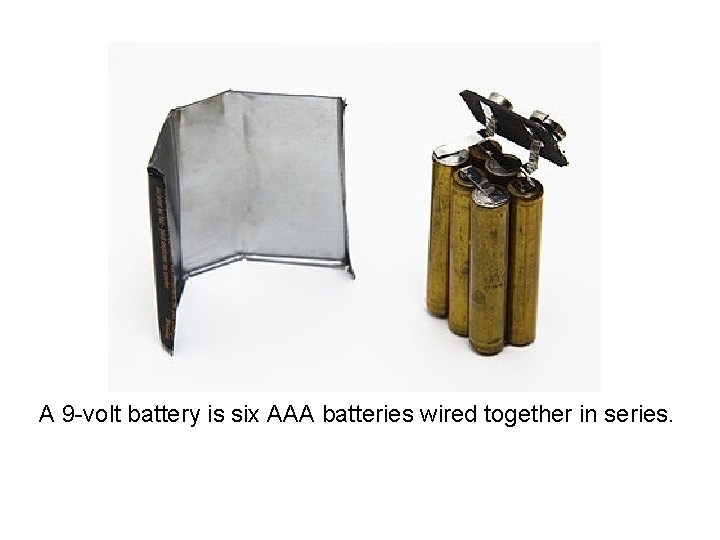
A 9 -volt battery is six AAA batteries wired together in series.
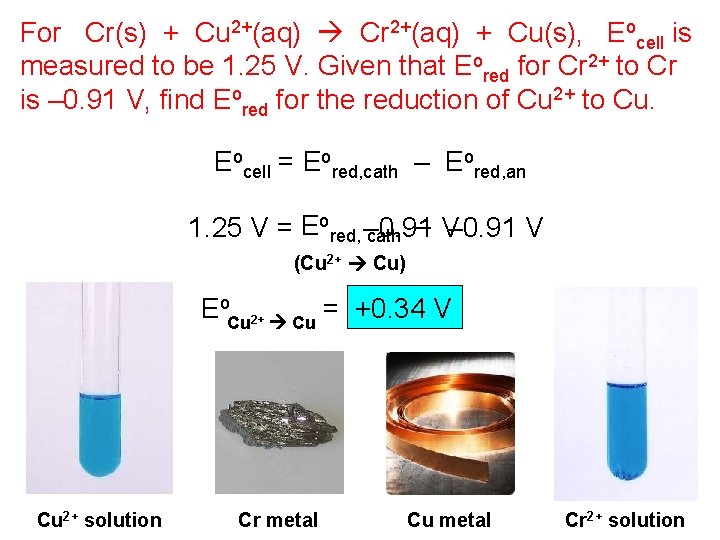
For Cr(s) + Cu 2+(aq) Cr 2+(aq) + Cu(s), Eocell is measured to be 1. 25 V. Given that Eored for Cr 2+ to Cr is – 0. 91 V, find Eored for the reduction of Cu 2+ to Cu. Eocell = Eored, cath – Eored, an 1. 25 V = Eored, – 0. 91 V cath – V (Cu 2+ Cu) Eo. Cu 2+ Cu = +0. 34 V Cu 2+ solution Cr metal Cu metal Cr 2+ solution
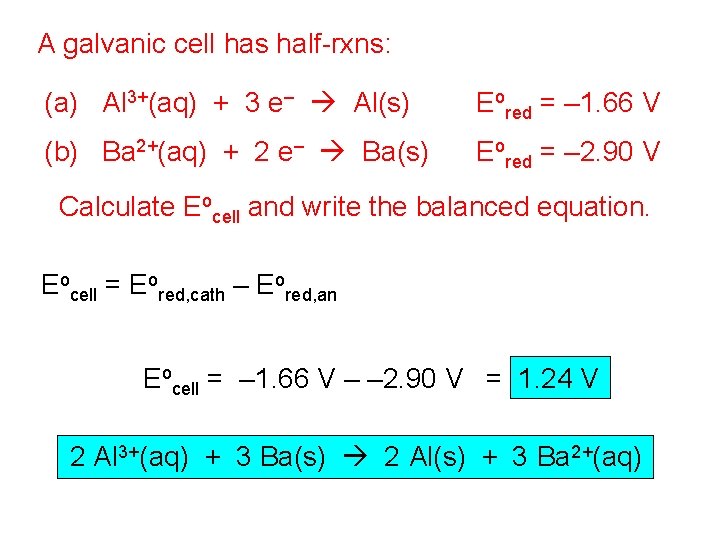
A galvanic cell has half-rxns: (a) Al 3+(aq) + 3 e– Al(s) Eored = – 1. 66 V (b) Ba 2+(aq) + 2 e– Ba(s) Eored = – 2. 90 V Calculate Eocell and write the balanced equation. Eocell = Eored, cath – Eored, an For a galvanic cell, Eo must be > 0. Thus, (a) represents the cathode and (b) represents the anode. Eocell = – 1. 66 V – – 2. 90 V = 1. 24 V 2 Al 3+(aq) + 3 Ba(s) 2 Al(s) + 3 Ba 2+(aq)
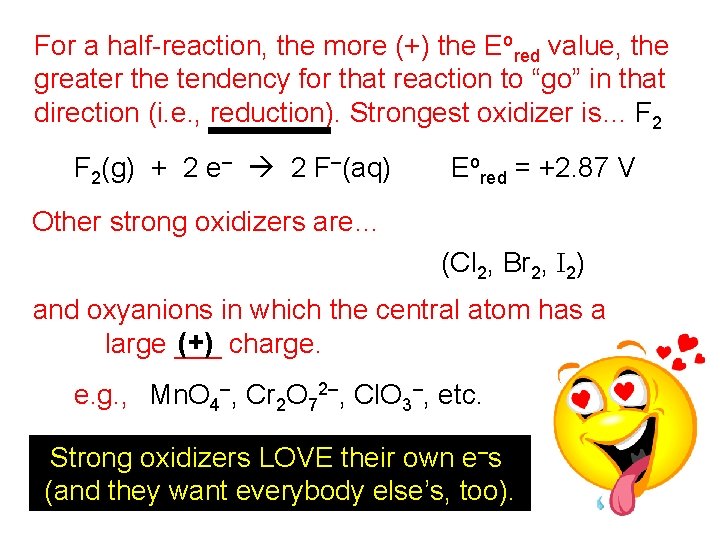
For a half-reaction, the more (+) the Eored value, the greater the tendency for that reaction to “go” in that direction (i. e. , reduction). Strongest oxidizer is… F 2(g) + 2 e– 2 F–(aq) Eored = +2. 87 V Other strong oxidizers are… the other halogens (Cl 2, Br 2, I 2) and oxyanions in which the central atom has a (+) charge. large ___ e. g. , Mn. O 4–, Cr 2 O 72–, Cl. O 3–, etc. Strong oxidizers LOVE their own e–s (and they want everybody else’s, too).
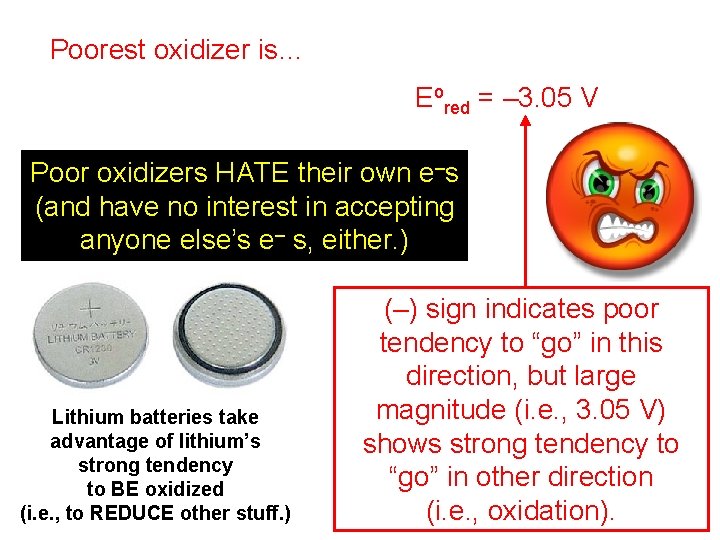
Poorest oxidizer is… Li. Li+(aq) + e– Li(s) Eored = – 3. 05 V Poor oxidizers HATE their own e–s (and have no interest in accepting anyone else’s e– s, either. ) Lithium batteries take advantage of lithium’s strong tendency to BE oxidized (i. e. , to REDUCE other stuff. ) (–) sign indicates poor tendency to “go” in this direction, but large magnitude (i. e. , 3. 05 V) shows strong tendency to “go” in other direction (i. e. , oxidation).
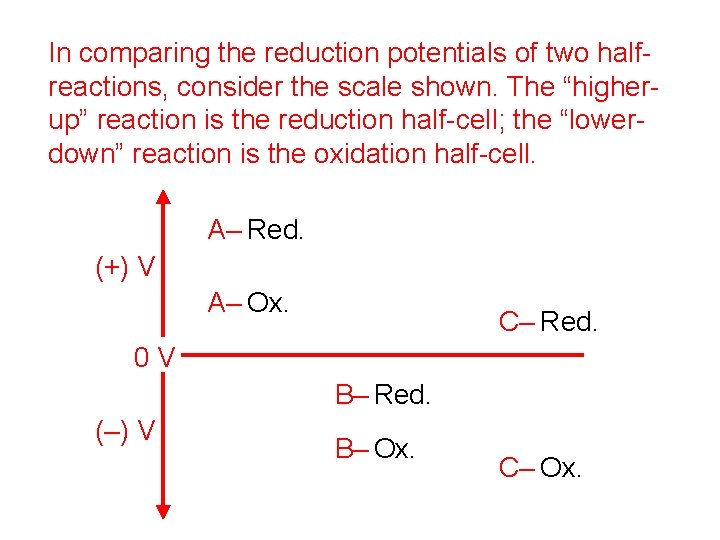
In comparing the reduction potentials of two halfreactions, consider the scale shown. The “higherup” reaction is the reduction half-cell; the “lowerdown” reaction is the oxidation half-cell. A– Red. (+) V A– Ox. C– Red. 0 V B– Red. (–) V B– Ox. C– Ox.
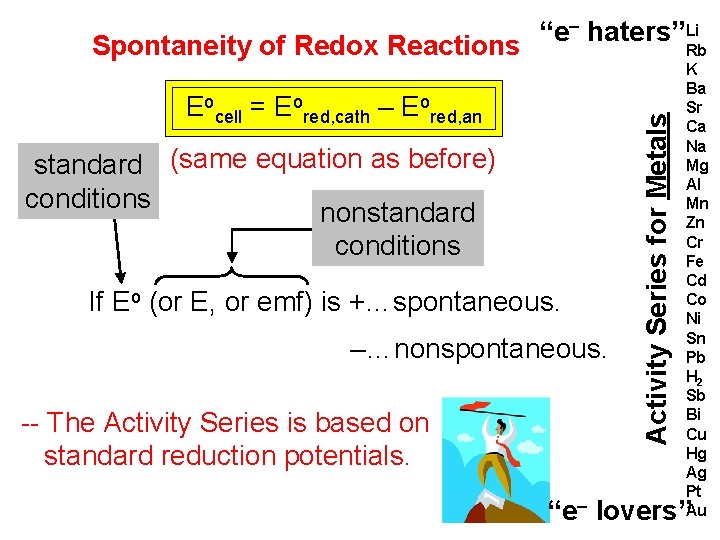
Eocell = Eored, cath – Eored, an standard (same equation as before) conditions nonstandard conditions If Eo (or E, or emf) is +…spontaneous. –…nonspontaneous. -- The Activity Series is based on standard reduction potentials. Activity Series for Metals Spontaneity of Redox Reactions “e– haters”Li Rb K Ba Sr Ca Na Mg Al Mn Zn Cr Fe Cd Co Ni Sn Pb H 2 Sb Bi Cu Hg Ag Pt Au “e– lovers”
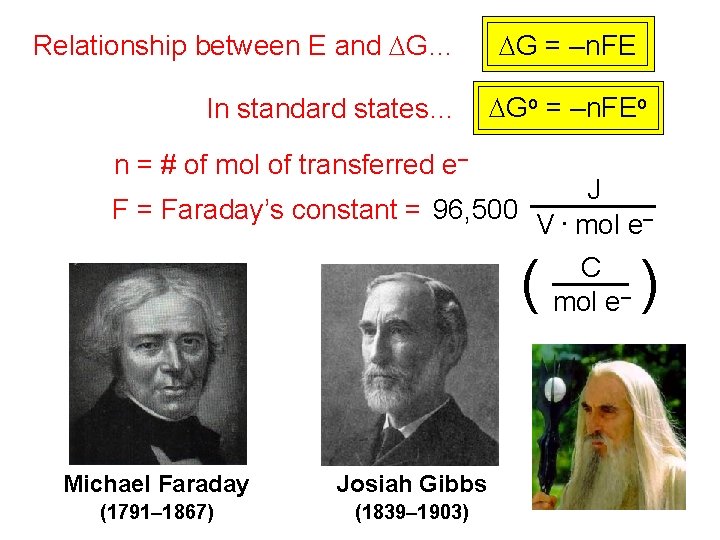
Relationship between E and DG… In standard states… DG = –n. FE DGo = –n. FEo n = # of mol of transferred e– J F = Faraday’s constant = 96, 500 V. mol e– ( Michael Faraday Josiah Gibbs (1791– 1867) (1839– 1903) C mol e– )
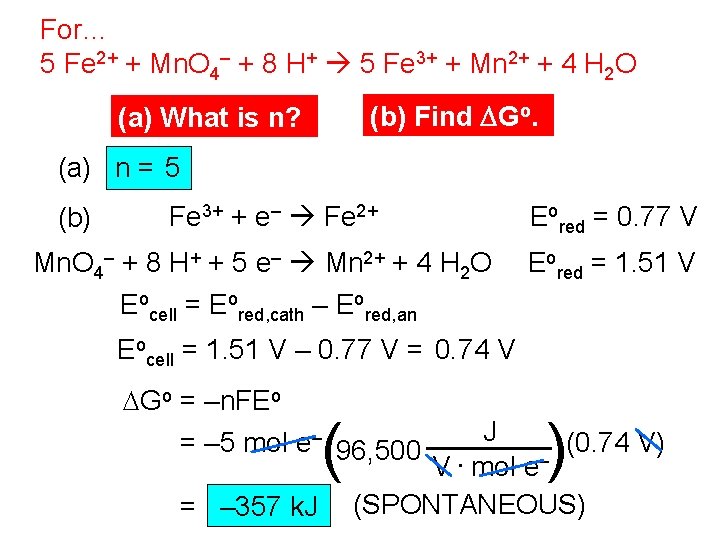
For… 5 Fe 2+ + Mn. O 4– + 8 H+ 5 Fe 3+ + Mn 2+ + 4 H 2 O (b) Find DGo. (a) What is n? (a) n = 5 (b) Fe 3+ + e– Fe 2+ Mn. O 4– + 8 H+ + 5 e– Mn 2+ + 4 H 2 O Eocell = Eored, cath – Eored, an Eored = 0. 77 V Eored = 1. 51 V Eocell = 1. 51 V – 0. 77 V = 0. 74 V DGo = –n. FEo ( = – 357 k. J ) J (0. 74 V). – V mol e (SPONTANEOUS) = – 5 mol e– 96, 500
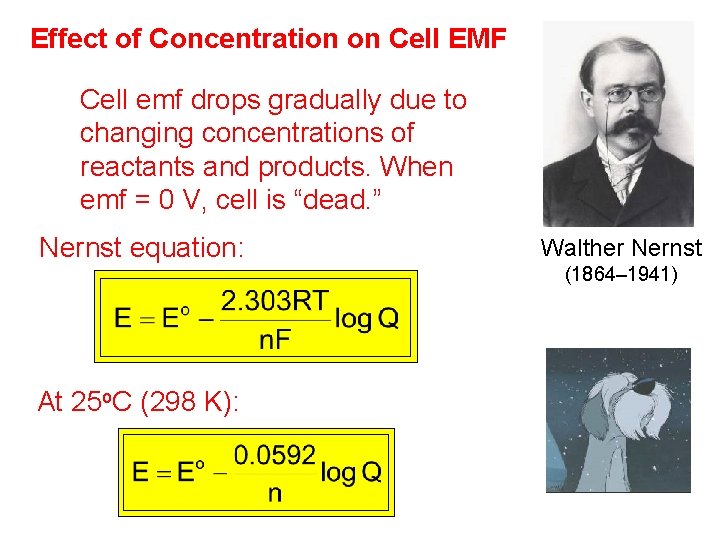
Effect of Concentration on Cell EMF Cell emf drops gradually due to changing concentrations of reactants and products. When emf = 0 V, cell is “dead. ” Nernst equation: Walther Nernst (1864– 1941) At 25 o. C (298 K):
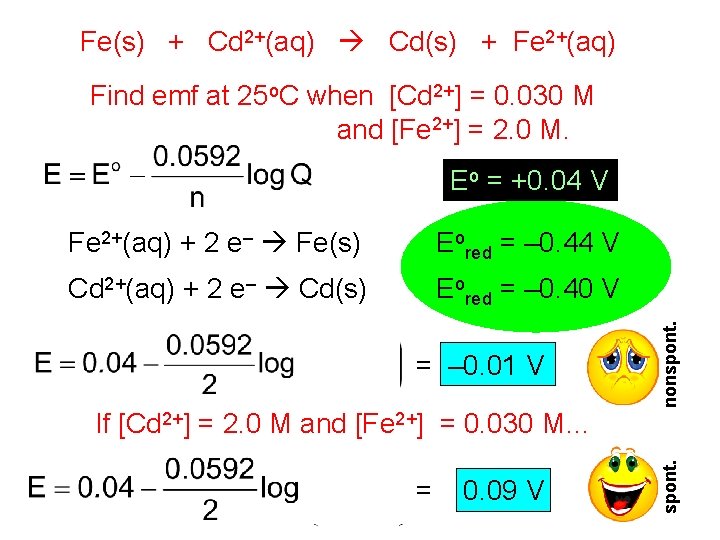
Fe(s) + Cd 2+(aq) Cd(s) + Fe 2+(aq) Find emf at 25 o. C when [Cd 2+] = 0. 030 M and [Fe 2+] = 2. 0 M. Eored = – 0. 44 V Cd 2+(aq) + 2 e– Cd(s) Eored = – 0. 40 V = – 0. 01 V If [Cd 2+] = 2. 0 M and [Fe 2+] = 0. 030 M… = 0. 09 V spont. Fe 2+(aq) + 2 e– Fe(s) nonspont. Eo = +0. 04 V
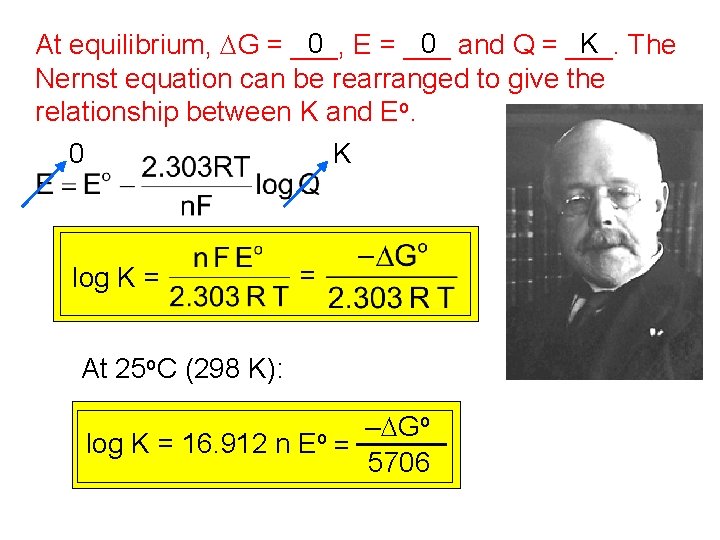
0 E = ___ 0 and Q = ___. K The At equilibrium, DG = ___, Nernst equation can be rearranged to give the relationship between K and Eo. 0 K log K = = – At 25 o. C (298 K): o –DG log K = 16. 912 n Eo = 5706
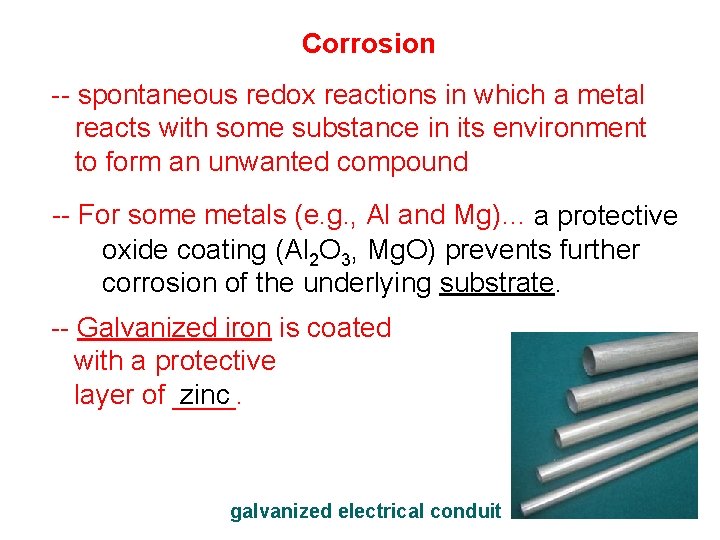
Corrosion -- spontaneous redox reactions in which a metal reacts with some substance in its environment to form an unwanted compound -- For some metals (e. g. , Al and Mg)… a protective oxide coating (Al 2 O 3, Mg. O) prevents further corrosion of the underlying substrate. -- Galvanized iron is coated with a protective layer of ____. zinc galvanized electrical conduit
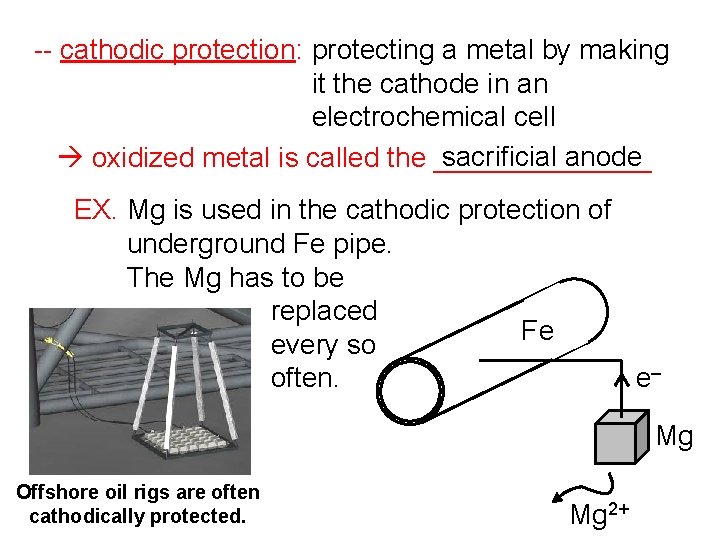
-- cathodic protection: protecting a metal by making it the cathode in an electrochemical cell sacrificial anode oxidized metal is called the _______ EX. Mg is used in the cathodic protection of underground Fe pipe. The Mg has to be replaced Fe every so e– often. Mg Offshore oil rigs are often cathodically protected. Mg 2+
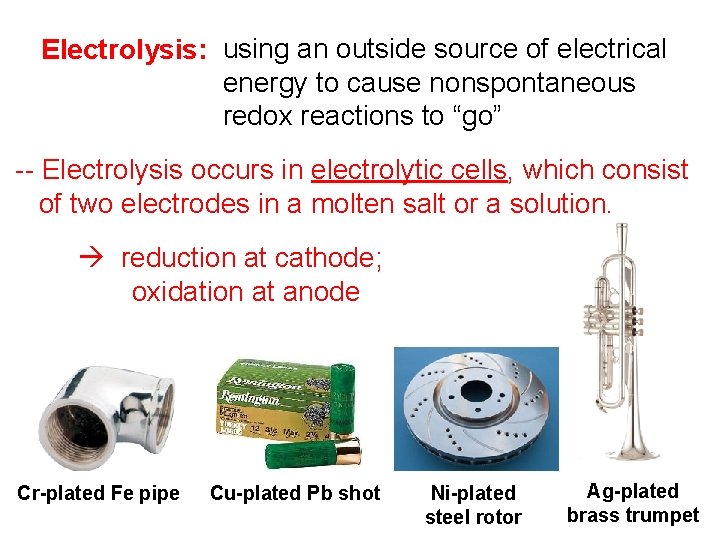
Electrolysis: using an outside source of electrical energy to cause nonspontaneous redox reactions to “go” -- Electrolysis occurs in electrolytic cells, which consist of two electrodes in a molten salt or a solution. reduction at cathode; oxidation at anode Cr-plated Fe pipe Cu-plated Pb shot Ni-plated steel rotor Ag-plated brass trumpet
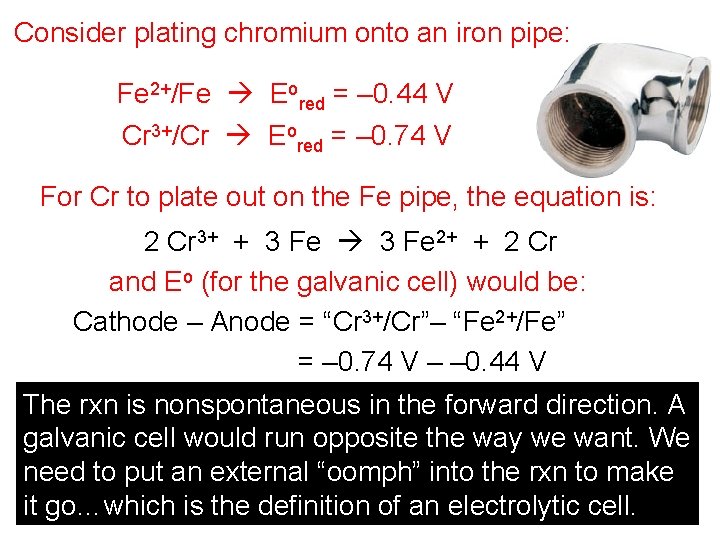
Consider plating chromium onto an iron pipe: Fe 2+/Fe Eored = – 0. 44 V Cr 3+/Cr Eored = – 0. 74 V For Cr to plate out on the Fe pipe, the equation is: 2 Cr 3+ + 3 Fe 2+ + 2 Cr and Eo (for the galvanic cell) would be: Cathode – Anode = “Cr 3+/Cr”– “Fe 2+/Fe” = – 0. 74 V – – 0. 44 V = – 0. 30 V The rxn is nonspontaneous in the forward direction. A galvanic cell would run opposite the way we want. We need to put an external “oomph” into the rxn to make it go…which is the definition of an electrolytic cell.
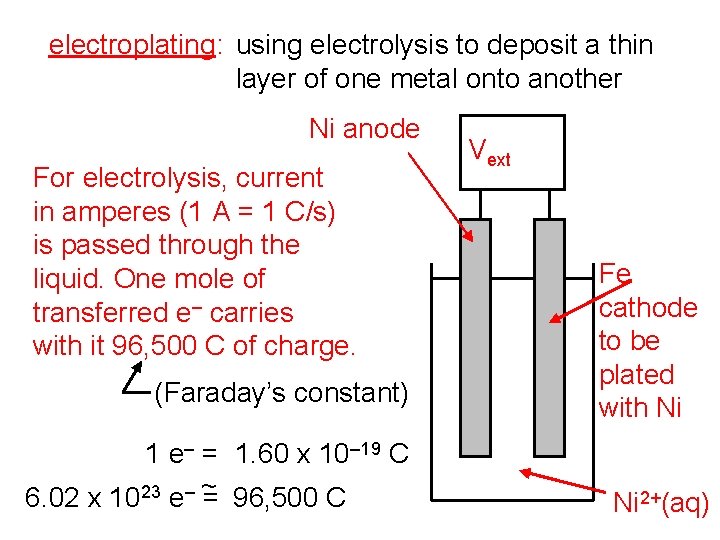
electroplating: using electrolysis to deposit a thin layer of one metal onto another Ni anode For electrolysis, current in amperes (1 A = 1 C/s) is passed through the liquid. One mole of transferred e– carries with it 96, 500 C of charge. (Faraday’s constant) 1 e– = 1. 60 x 10– 19 C 6. 02 x 1023 e– ~ = 96, 500 C Vext Fe cathode to be plated with Ni Ni 2+(aq)
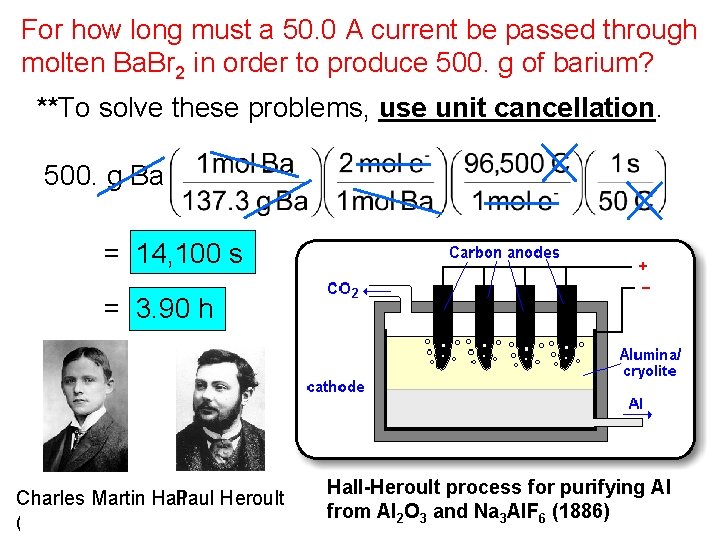
For how long must a 50. 0 A current be passed through molten Ba. Br 2 in order to produce 500. g of barium? **To solve these problems, use unit cancellation. 500. g Ba = 14, 100 s = 3. 90 h Charles Martin Hall Paul Heroult (1863– 1914) Hall-Heroult process for purifying Al from Al 2 O 3 and Na 3 Al. F 6 (1886)