Ch 9 Thermochemistry Dr Namphol Sinkaset Chem 200


- Slides: 71
Ch. 9: Thermochemistry Dr. Namphol Sinkaset Chem 200: General Chemistry I
I. Chapter Outline I. Introduction II. Energy III. 1 st Law of Thermodynamics IV. Quantifying Heat and Work V. Reactions at Constant V or P VI. Thermochemical Equations/Hess’s Law VII. Formation Reactions VIII. Using Bond Energies IX. Born-Haber Cycle
I. Chemistry and Energy • We have said before that chemistry is all about energy – energy lost, gained, and transferred. • Things always seek the lowest energy state which is equivalent to seeking highest stability. • We start to quantify energy in this chapter.
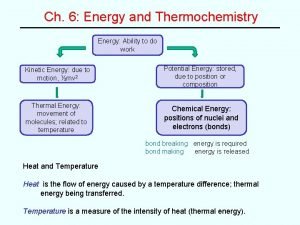
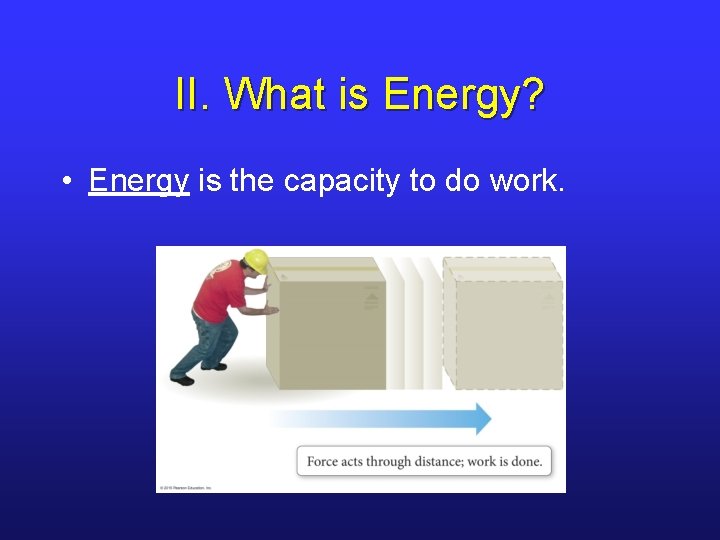
II. What is Energy? • Energy is the capacity to do work.
II. Kinetic Energy • Kinetic energy involves motion. § A moving car possesses kinetic energy. • Thermal energy is the energy associated w/ temp of an object. § A type of KE because it arises from motions of atoms/molecules in the substance.
II. Potential Energy • Potential energy is the energy associated with the position or composition of an object. § An object raised above the floor possess PE due to its position in a gravitational field. • Chemical energy is the energy associated with relative positions of e-’s and nuclei in atoms and molecules.
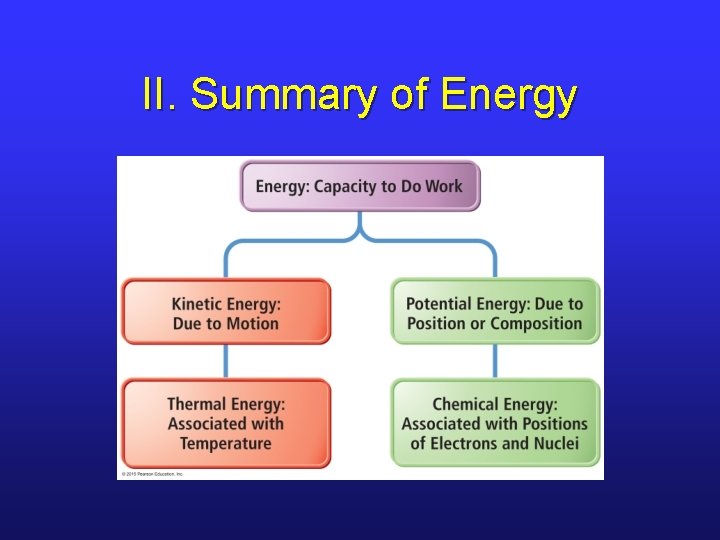
II. Summary of Energy
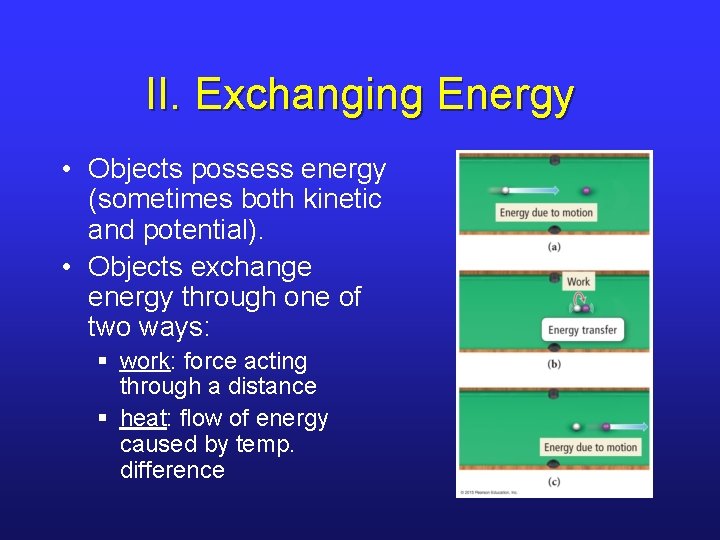
II. Exchanging Energy • Objects possess energy (sometimes both kinetic and potential). • Objects exchange energy through one of two ways: § work: force acting through a distance § heat: flow of energy caused by temp. difference
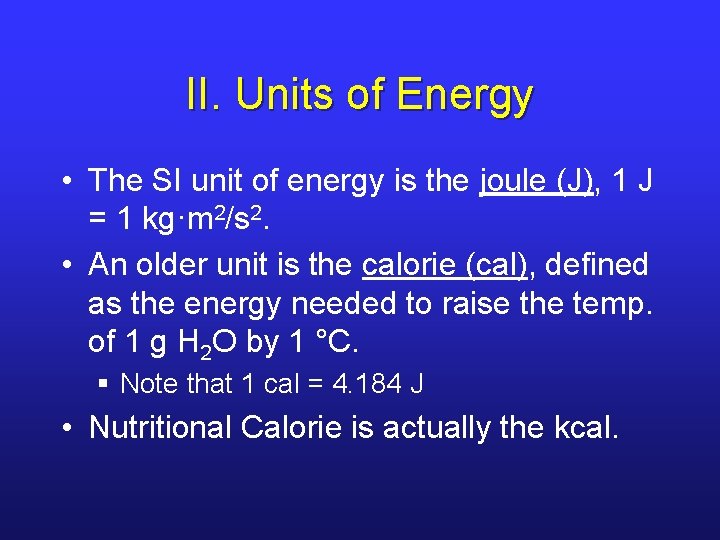
II. Units of Energy • The SI unit of energy is the joule (J), 1 J = 1 kg·m 2/s 2. • An older unit is the calorie (cal), defined as the energy needed to raise the temp. of 1 g H 2 O by 1 °C. § Note that 1 cal = 4. 184 J • Nutritional Calorie is actually the kcal.
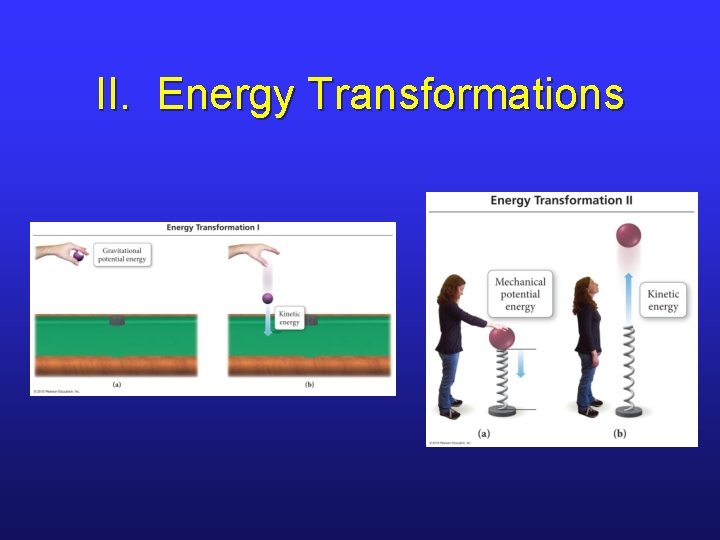
II. Energy Conservation • The law of conservation of energy states that energy cannot be created or destroyed. • But, we know it can be transferred via work or heat. • Energy can also change forms.
II. Energy Transformations
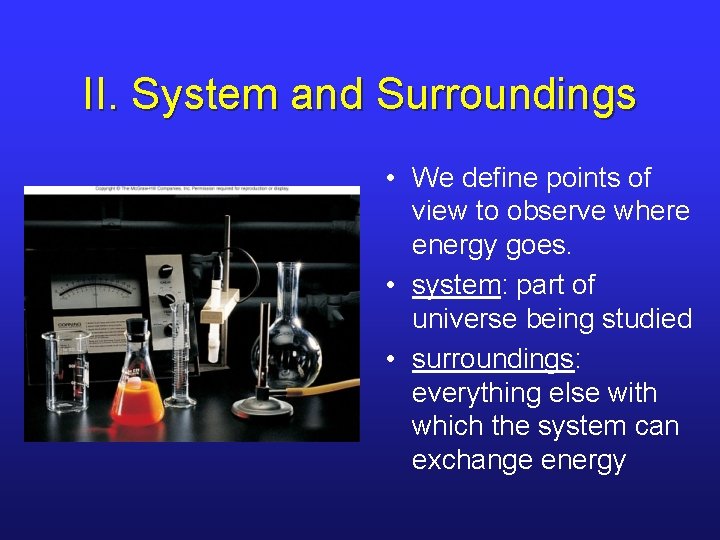
II. System and Surroundings • We define points of view to observe where energy goes. • system: part of universe being studied • surroundings: everything else with which the system can exchange energy
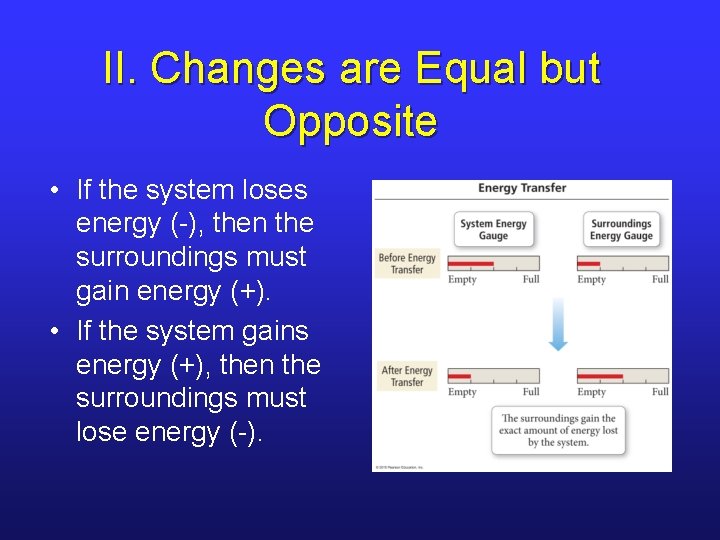
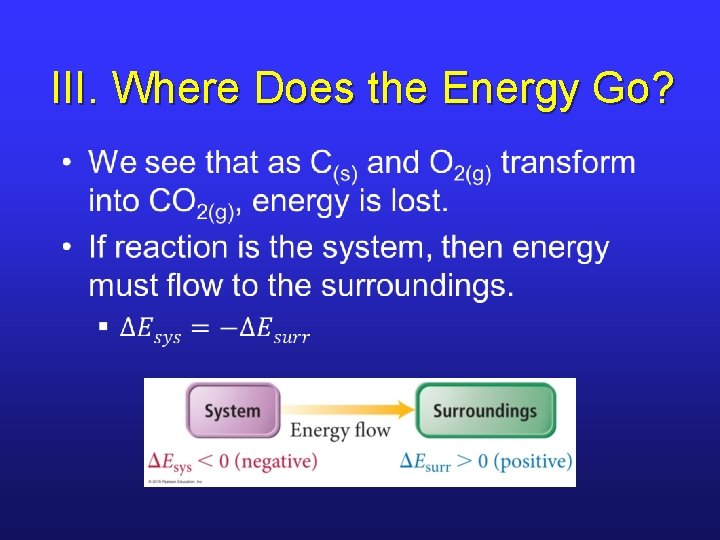
II. Changes are Equal but Opposite • If the system loses energy (-), then the surroundings must gain energy (+). • If the system gains energy (+), then the surroundings must lose energy (-).
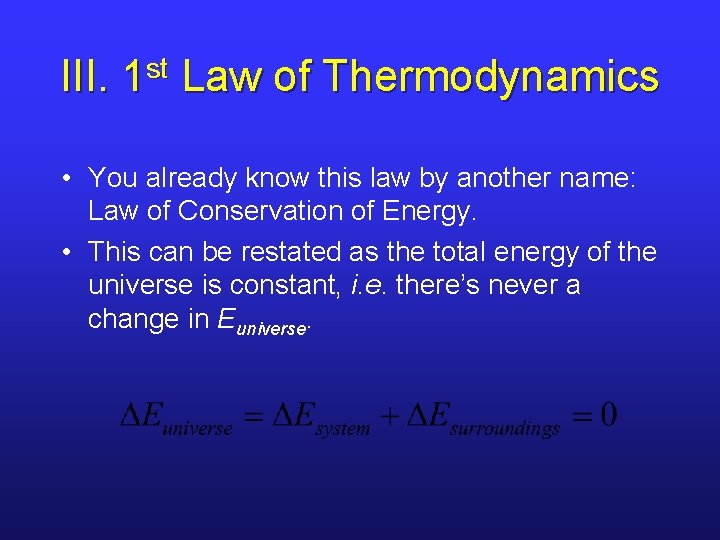
III. 1 st Law of Thermodynamics • You already know this law by another name: Law of Conservation of Energy. • This can be restated as the total energy of the universe is constant, i. e. there’s never a change in Euniverse.
III. The Internal Energy • Say we have a system comprised of reactants in solution. • Every particle moves constantly and feels different attractions/repulsions. § There is KE from movement and PE from position. • The sum of KE and PE for all particles in a system is called the internal energy (E).
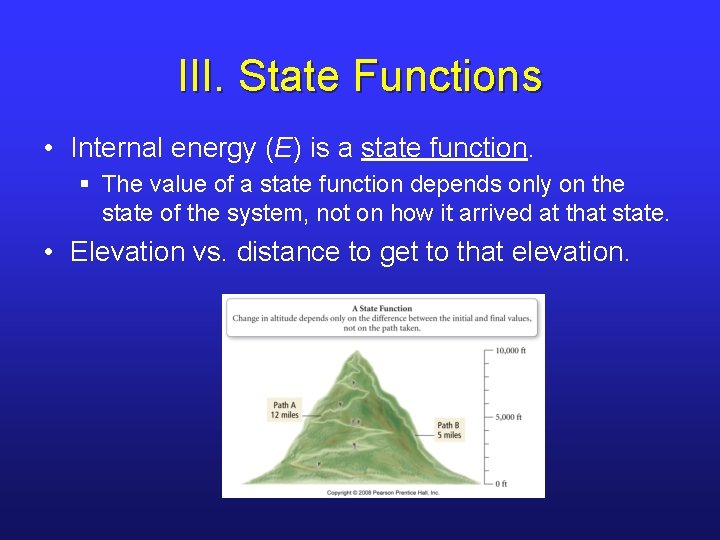
III. State Functions • Internal energy (E) is a state function. § The value of a state function depends only on the state of the system, not on how it arrived at that state. • Elevation vs. distance to get to that elevation.
III. State Functions • The E of a system does not depend on how it got there. Same goes for T, P, V. § “Independent of path. ” § “It is what it is. ” • State functions usually given uppercase variables. • Changes in state functions are easily calculated by subtracting initial value from final value (final – initial).
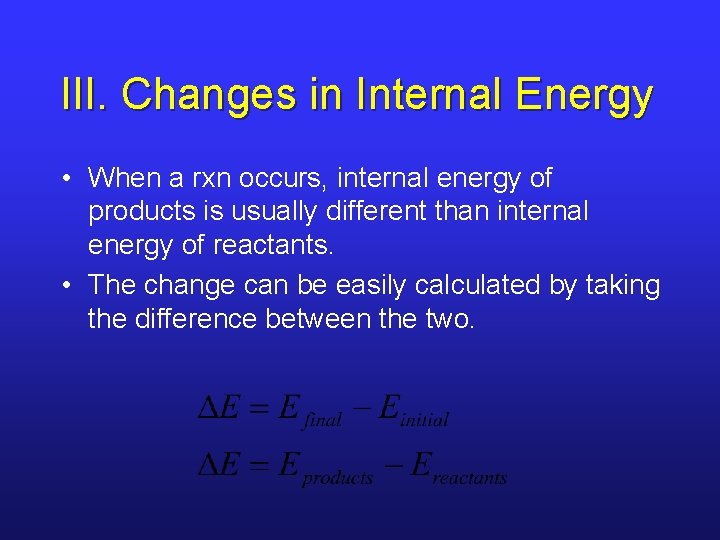
III. Changes in Internal Energy • When a rxn occurs, internal energy of products is usually different than internal energy of reactants. • The change can be easily calculated by taking the difference between the two.
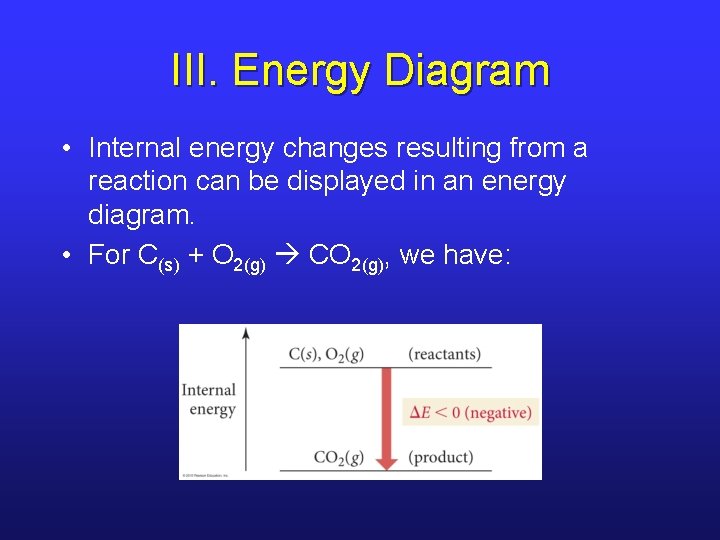
III. Energy Diagram • Internal energy changes resulting from a reaction can be displayed in an energy diagram. • For C(s) + O 2(g) CO 2(g), we have:
III. Where Does the Energy Go? •
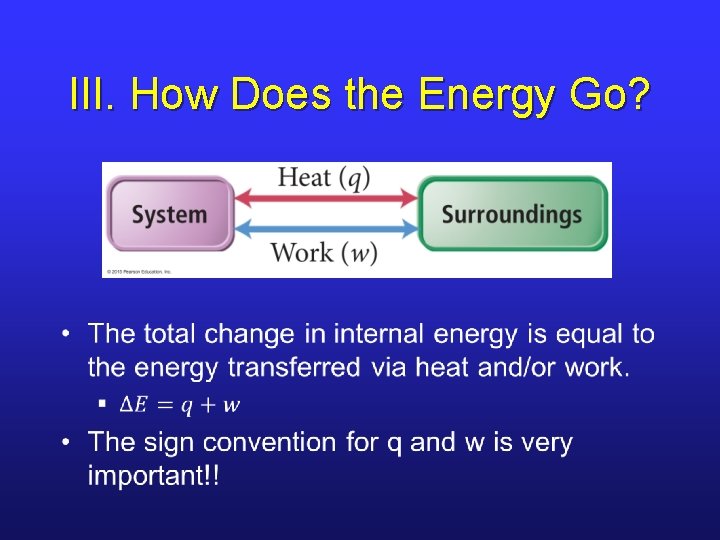
III. How Does the Energy Go? •
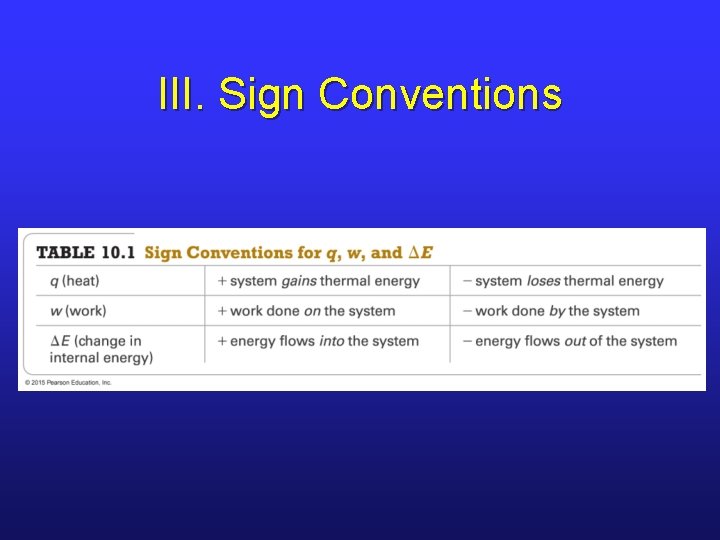
III. Sign Conventions
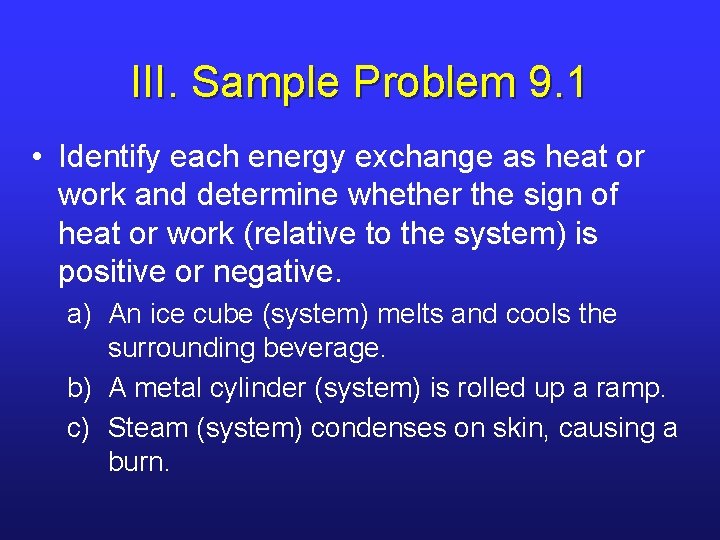
III. Sample Problem 9. 1 • Identify each energy exchange as heat or work and determine whether the sign of heat or work (relative to the system) is positive or negative. a) An ice cube (system) melts and cools the surrounding beverage. b) A metal cylinder (system) is rolled up a ramp. c) Steam (system) condenses on skin, causing a burn.
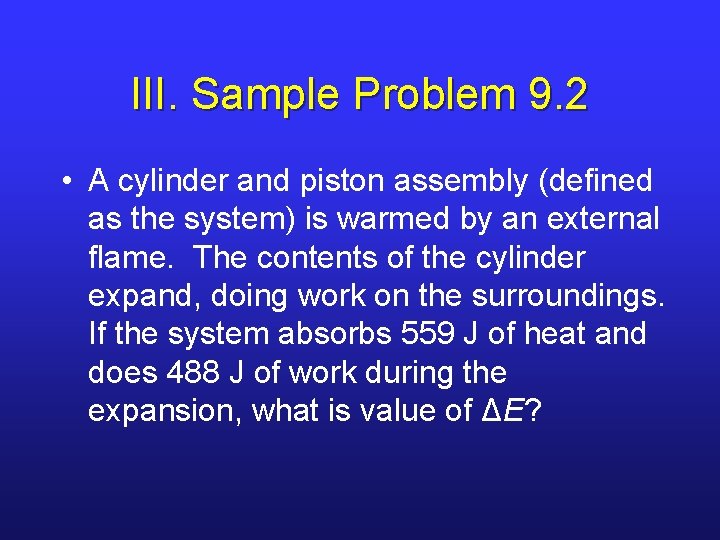
III. Sample Problem 9. 2 • A cylinder and piston assembly (defined as the system) is warmed by an external flame. The contents of the cylinder expand, doing work on the surroundings. If the system absorbs 559 J of heat and does 488 J of work during the expansion, what is value of ΔE?
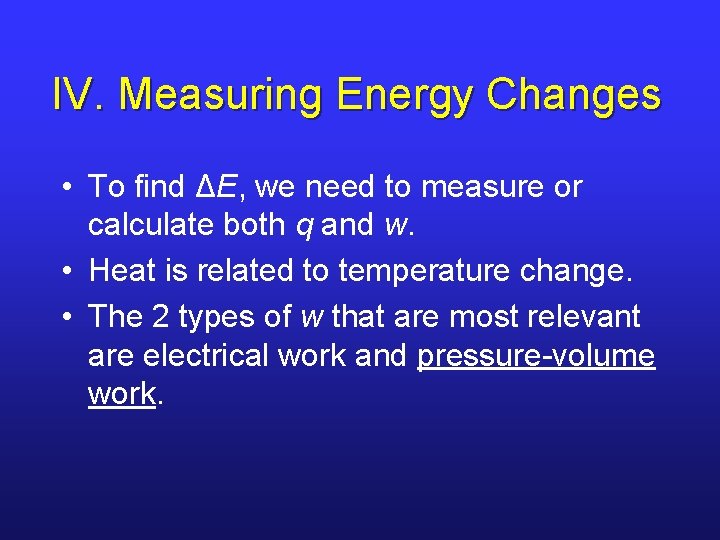
IV. Measuring Energy Changes • To find ΔE, we need to measure or calculate both q and w. • Heat is related to temperature change. • The 2 types of w that are most relevant are electrical work and pressure-volume work.
IV. Temperature vs. Heat • Temperature is the measure of thermal energy within a sample of matter. • Heat is the transfer of thermal energy. • Thermal energy always flows from hot to cold until thermal equilibrium is reached.
IV. Measuring Heat • Intuitively, we know temp. is related to heat, and different substances require different amounts of heat to change their temp. § q = C × ΔT • heat capacity (C): the amount of heat needed to change the temp of a substance by 1 °C § What’s wrong with this?
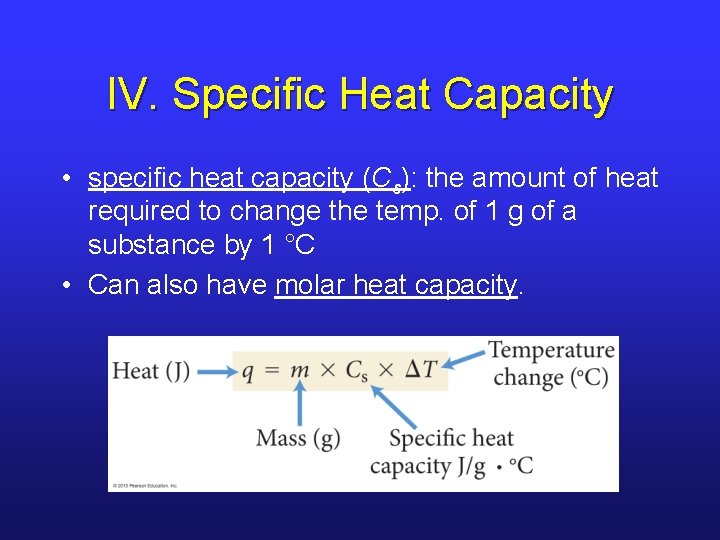
IV. Specific Heat Capacity • specific heat capacity (Cs): the amount of heat required to change the temp. of 1 g of a substance by 1 °C • Can also have molar heat capacity.
IV. Sample Problem 9. 3 • Find the heat transferred (in k. J) when 5. 50 L of ethylene glycol in a car radiator cools from 37. 0 °C to 25. 0 °C if the density of ethylene glycol is 1. 11 g/m. L, and its specific heat capacity is 2. 42 J/g·K.
IV. Sample Problem 9. 4 • A 55. 0 -g aluminum block (Cs= 0. 903 J/g·°C) initially at 27. 5 °C absorbs 725 J of heat. What is the final temperature of the aluminum?
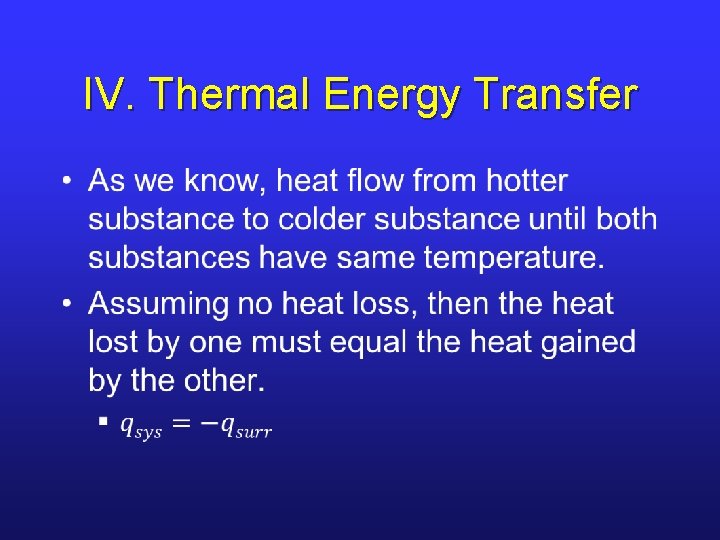
IV. Thermal Energy Transfer •
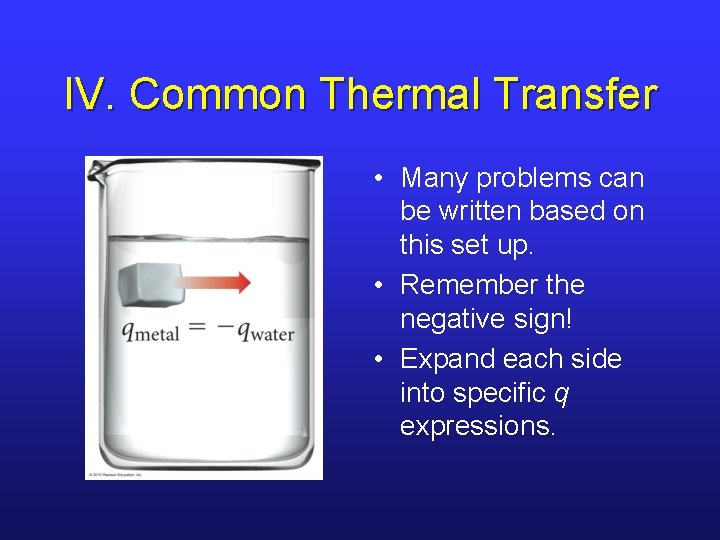
IV. Common Thermal Transfer • Many problems can be written based on this set up. • Remember the negative sign! • Expand each side into specific q expressions.
IV. Sample Problem 9. 5 • A 32. 5 -g cube of aluminum (Cs= 0. 903 J/g·°C) initially at 45. 8 °C is submerged into 105. 3 g of water (Cs= 4. 18 J/g·°C) at 15. 4 °C. What is the final temperature of both substances at thermal equilibrium, assuming no heat loss?
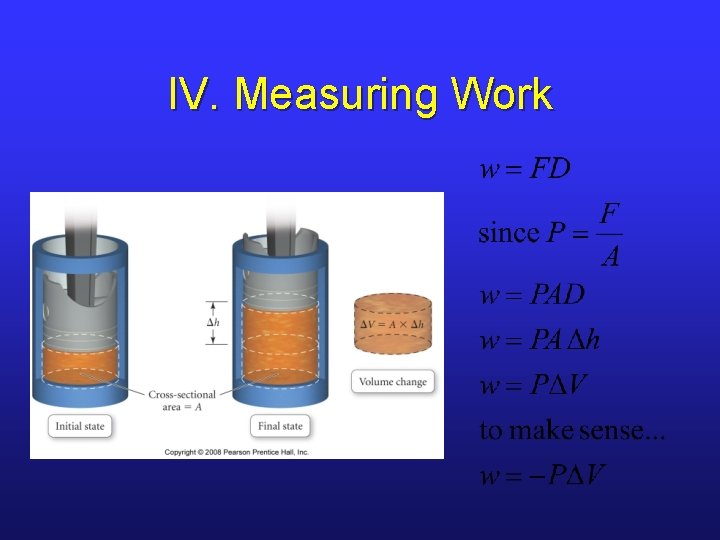
IV. Measuring Work
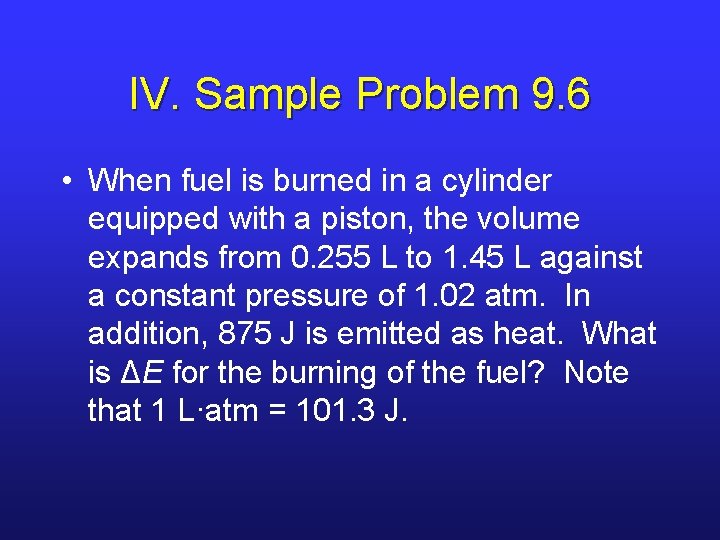
IV. Sample Problem 9. 6 • When fuel is burned in a cylinder equipped with a piston, the volume expands from 0. 255 L to 1. 45 L against a constant pressure of 1. 02 atm. In addition, 875 J is emitted as heat. What is ΔE for the burning of the fuel? Note that 1 L·atm = 101. 3 J.
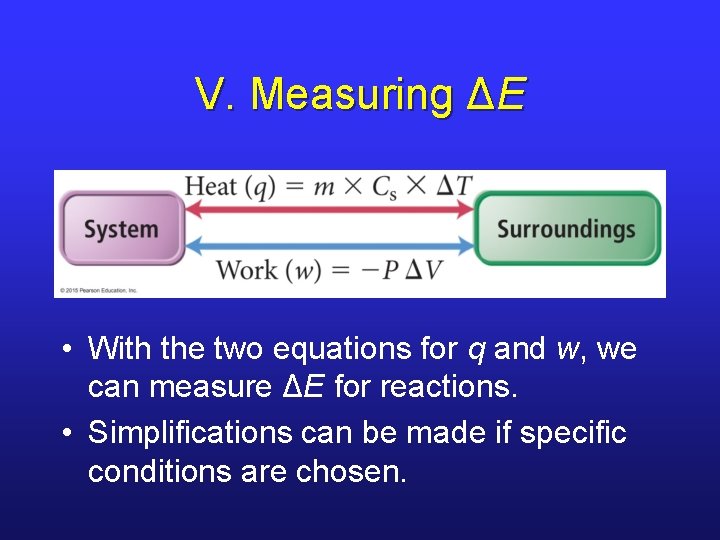
V. Measuring ΔE • With the two equations for q and w, we can measure ΔE for reactions. • Simplifications can be made if specific conditions are chosen.
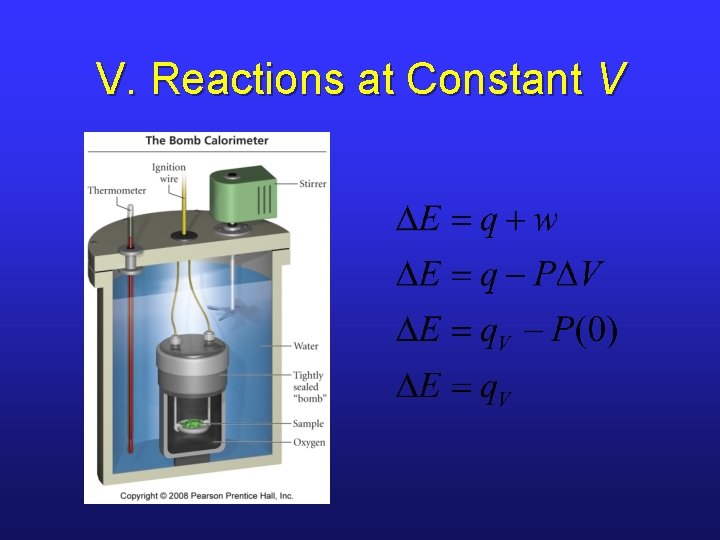
V. Reactions at Constant V
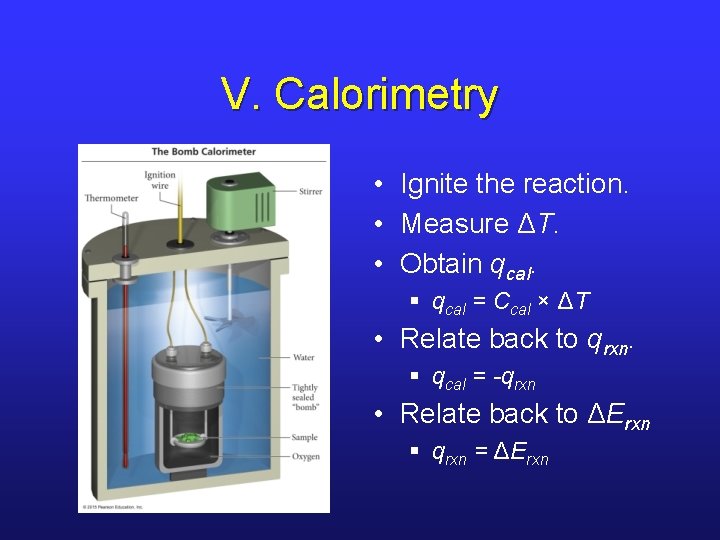
V. Calorimetry • Ignite the reaction. • Measure ΔT. • Obtain qcal. § qcal = Ccal × ΔT • Relate back to qrxn. § qcal = -qrxn • Relate back to ΔErxn § qrxn = ΔErxn
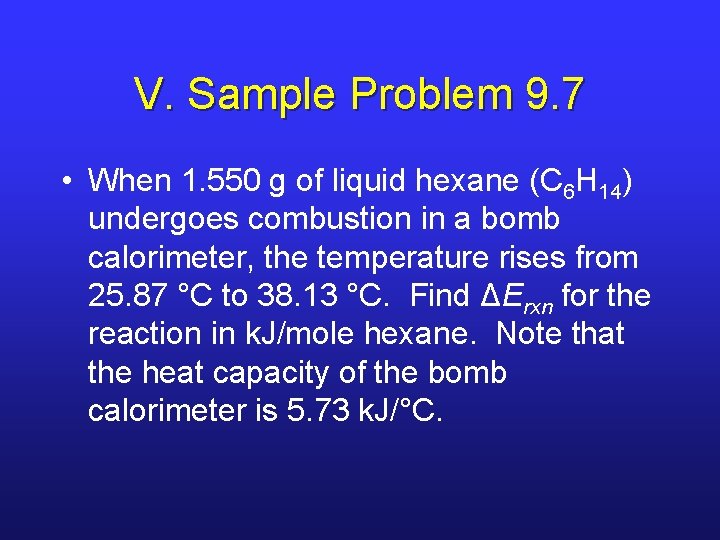
V. Sample Problem 9. 7 • When 1. 550 g of liquid hexane (C 6 H 14) undergoes combustion in a bomb calorimeter, the temperature rises from 25. 87 °C to 38. 13 °C. Find ΔErxn for the reaction in k. J/mole hexane. Note that the heat capacity of the bomb calorimeter is 5. 73 k. J/°C.
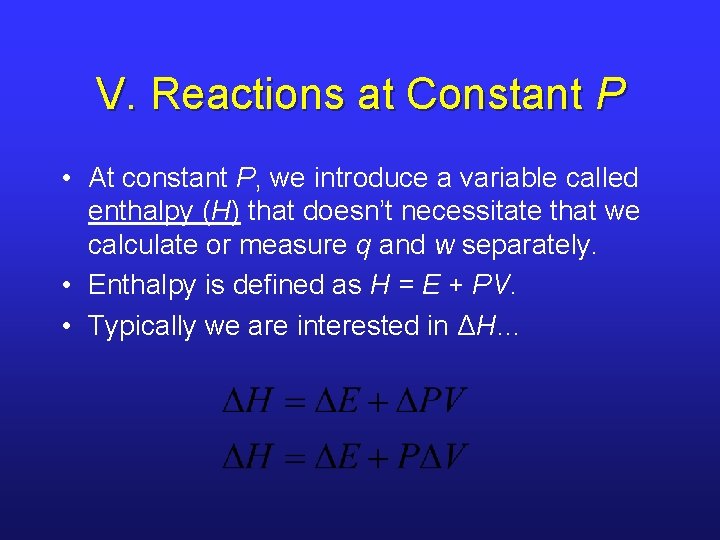
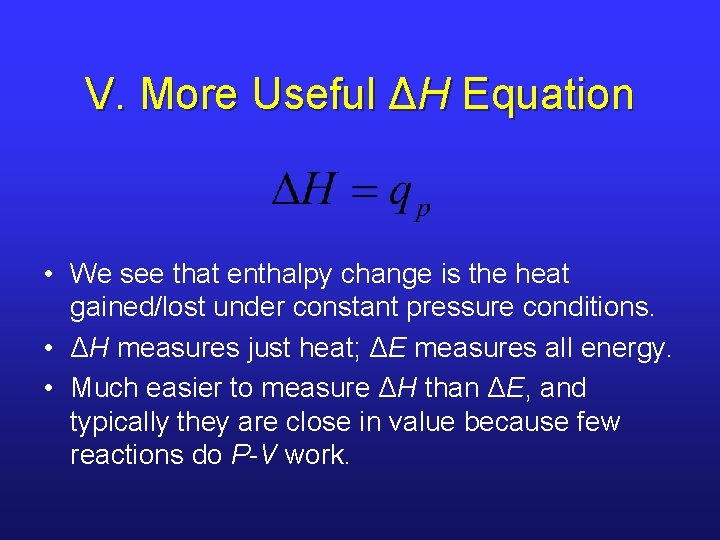
V. Reactions at Constant P • At constant P, we introduce a variable called enthalpy (H) that doesn’t necessitate that we calculate or measure q and w separately. • Enthalpy is defined as H = E + PV. • Typically we are interested in ΔH…
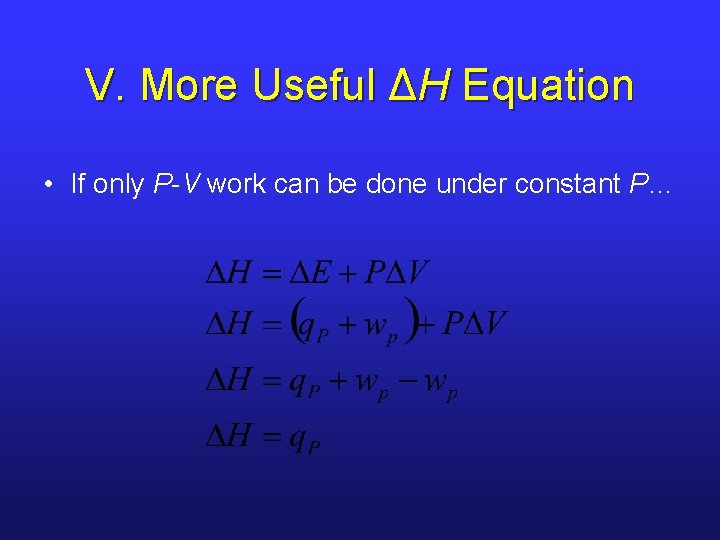
V. More Useful ΔH Equation • If only P-V work can be done under constant P…
V. More Useful ΔH Equation • We see that enthalpy change is the heat gained/lost under constant pressure conditions. • ΔH measures just heat; ΔE measures all energy. • Much easier to measure ΔH than ΔE, and typically they are close in value because few reactions do P-V work.
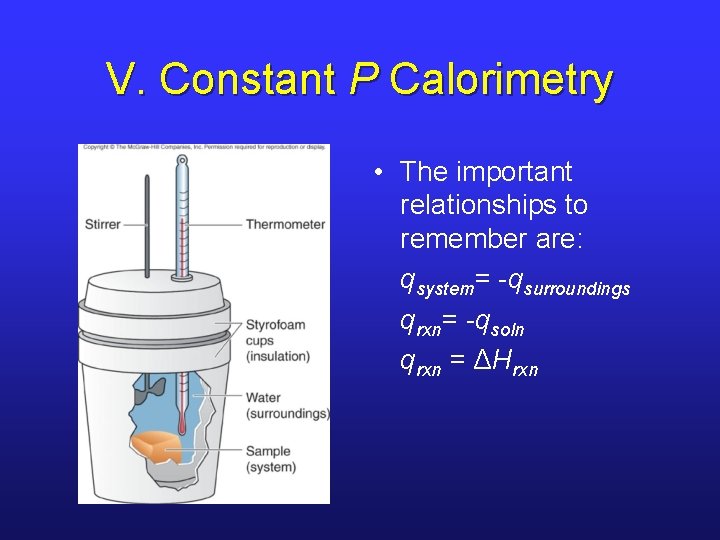
V. Constant P Calorimetry • The important relationships to remember are: qsystem= -qsurroundings qrxn= -qsoln qrxn = ΔHrxn
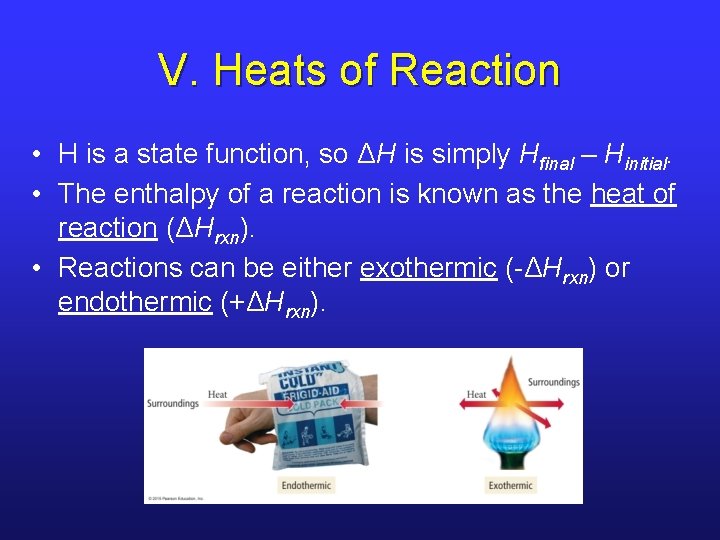
V. Heats of Reaction • H is a state function, so ΔH is simply Hfinal – Hinitial. • The enthalpy of a reaction is known as the heat of reaction (ΔHrxn). • Reactions can be either exothermic (-ΔHrxn) or endothermic (+ΔHrxn).
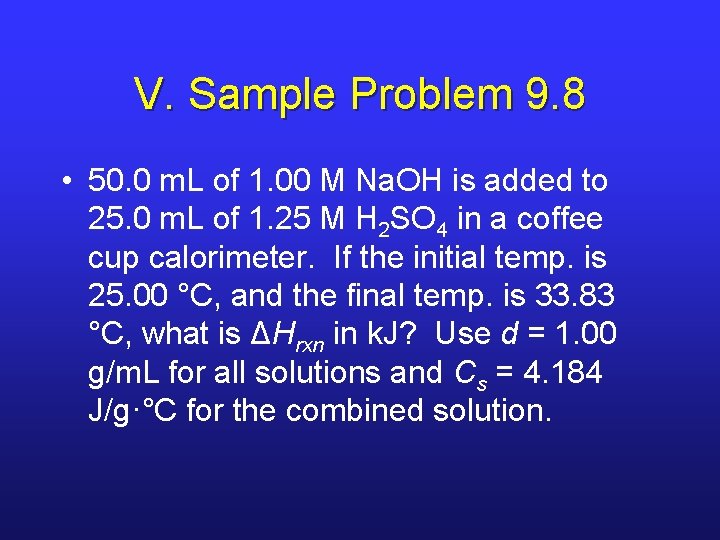
V. Sample Problem 9. 8 • 50. 0 m. L of 1. 00 M Na. OH is added to 25. 0 m. L of 1. 25 M H 2 SO 4 in a coffee cup calorimeter. If the initial temp. is 25. 00 °C, and the final temp. is 33. 83 °C, what is ΔHrxn in k. J? Use d = 1. 00 g/m. L for all solutions and Cs = 4. 184 J/g·°C for the combined solution.
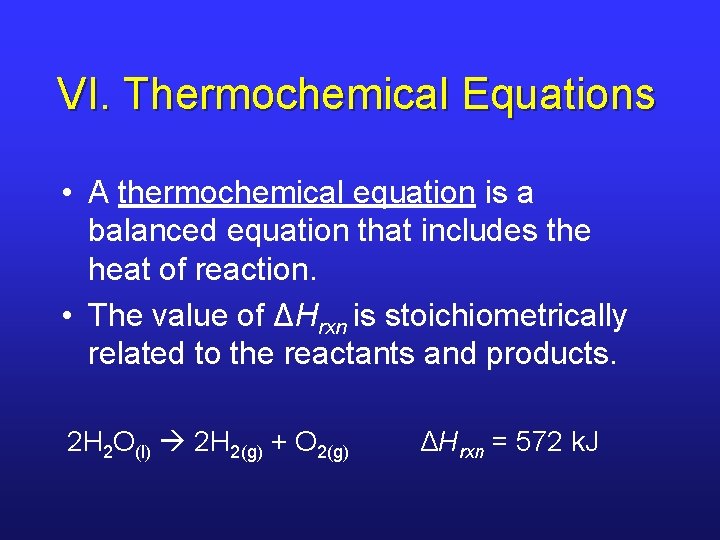
VI. Thermochemical Equations • A thermochemical equation is a balanced equation that includes the heat of reaction. • The value of ΔHrxn is stoichiometrically related to the reactants and products. 2 H 2 O(l) 2 H 2(g) + O 2(g) ΔHrxn = 572 k. J
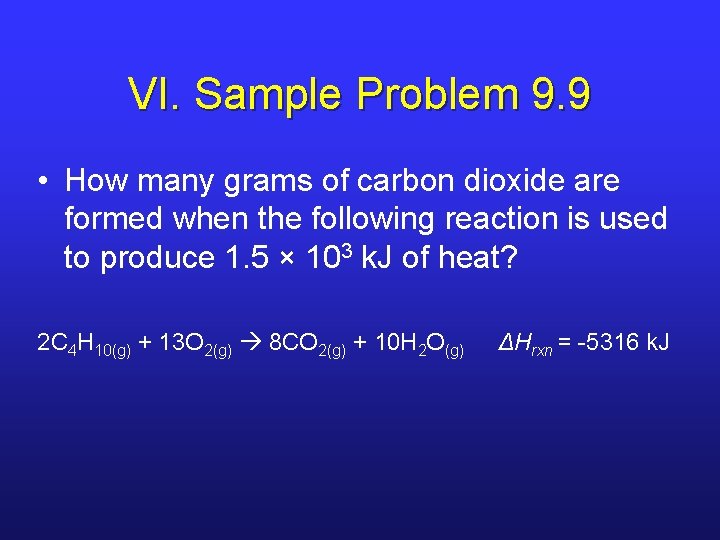
VI. Sample Problem 9. 9 • How many grams of carbon dioxide are formed when the following reaction is used to produce 1. 5 × 10³ k. J of heat? 2 C 4 H 10(g) + 13 O 2(g) 8 CO 2(g) + 10 H 2 O(g) ΔHrxn = -5316 k. J
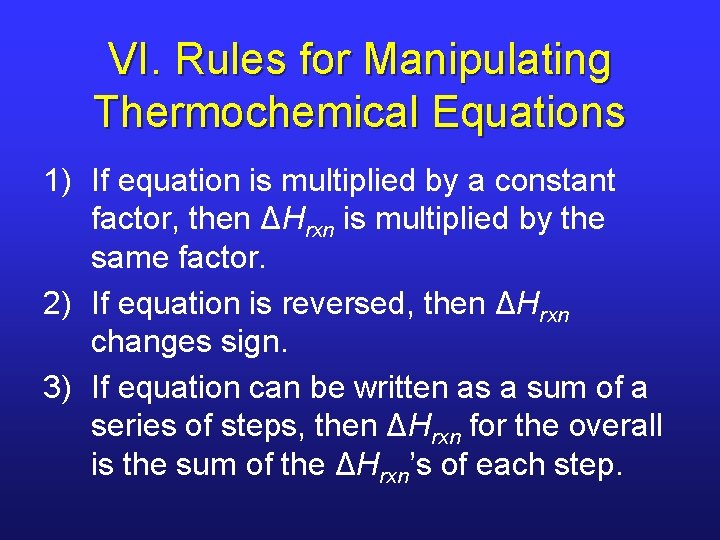
VI. Rules for Manipulating Thermochemical Equations 1) If equation is multiplied by a constant factor, then ΔHrxn is multiplied by the same factor. 2) If equation is reversed, then ΔHrxn changes sign. 3) If equation can be written as a sum of a series of steps, then ΔHrxn for the overall is the sum of the ΔHrxn’s of each step.
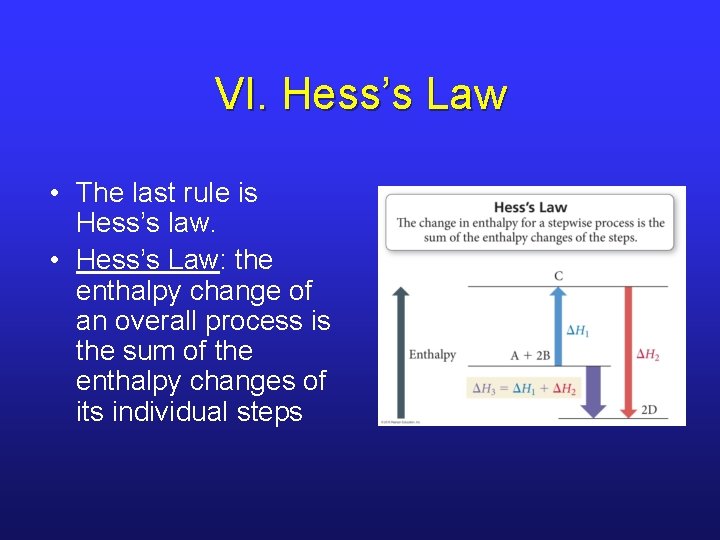
VI. Hess’s Law • The last rule is Hess’s law. • Hess’s Law: the enthalpy change of an overall process is the sum of the enthalpy changes of its individual steps
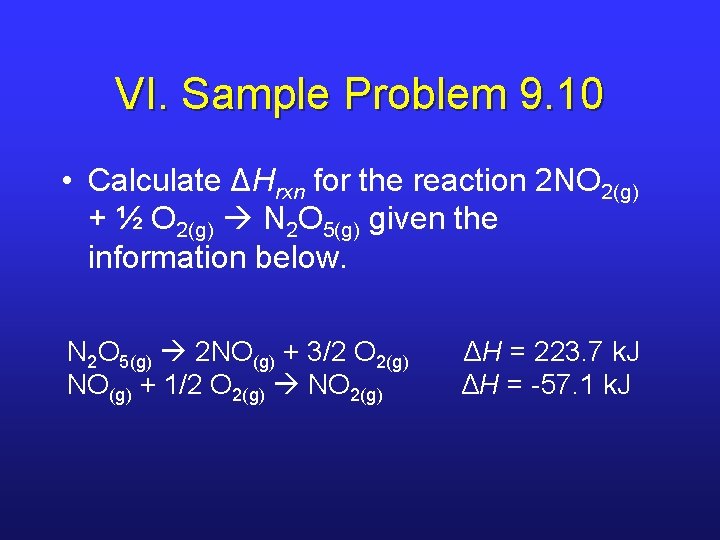
VI. Sample Problem 9. 10 • Calculate ΔHrxn for the reaction 2 NO 2(g) + ½ O 2(g) N 2 O 5(g) given the information below. N 2 O 5(g) 2 NO(g) + 3/2 O 2(g) ΔH = 223. 7 k. J NO(g) + 1/2 O 2(g) NO 2(g) ΔH = -57. 1 k. J
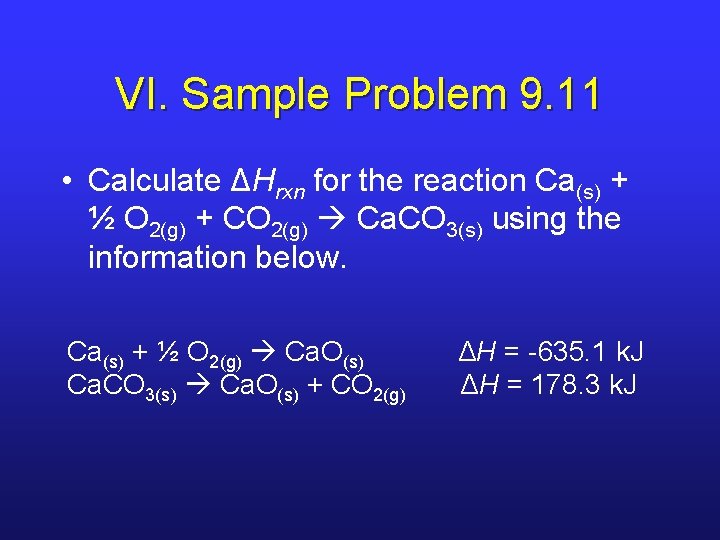
VI. Sample Problem 9. 11 • Calculate ΔHrxn for the reaction Ca(s) + ½ O 2(g) + CO 2(g) Ca. CO 3(s) using the information below. Ca(s) + ½ O 2(g) Ca. O(s) ΔH = -635. 1 k. J Ca. CO 3(s) Ca. O(s) + CO 2(g) ΔH = 178. 3 k. J
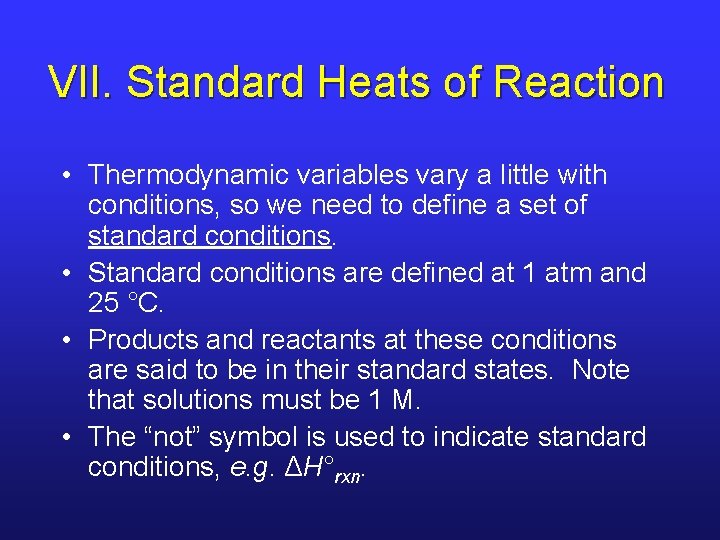
VII. Standard Heats of Reaction • Thermodynamic variables vary a little with conditions, so we need to define a set of standard conditions. • Standard conditions are defined at 1 atm and 25 °C. • Products and reactants at these conditions are said to be in their standard states. Note that solutions must be 1 M. • The “not” symbol is used to indicate standard conditions, e. g. ΔH°rxn.
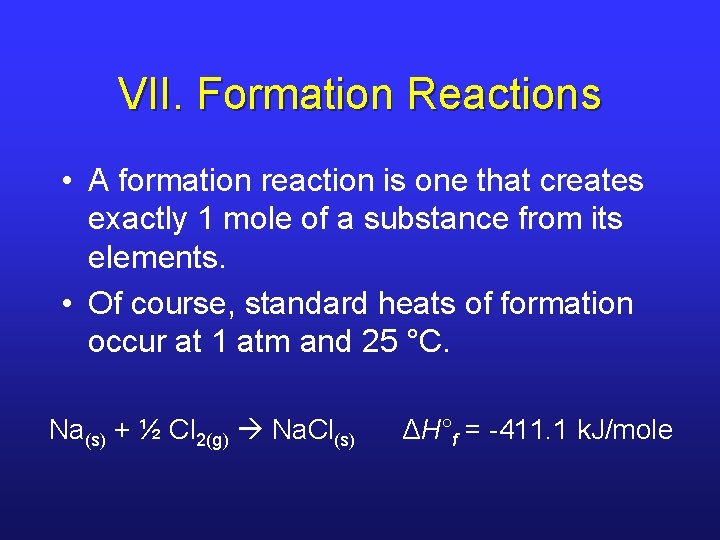
VII. Formation Reactions • A formation reaction is one that creates exactly 1 mole of a substance from its elements. • Of course, standard heats of formation occur at 1 atm and 25 °C. Na(s) + ½ Cl 2(g) Na. Cl(s) ΔH°f = -411. 1 k. J/mole
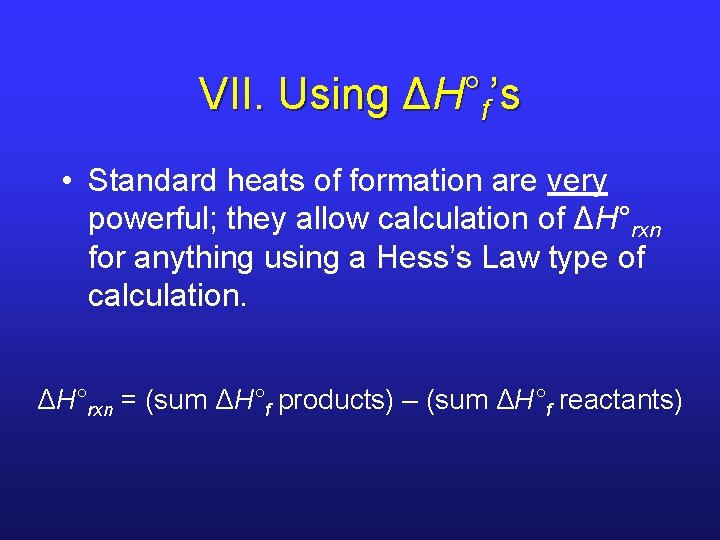
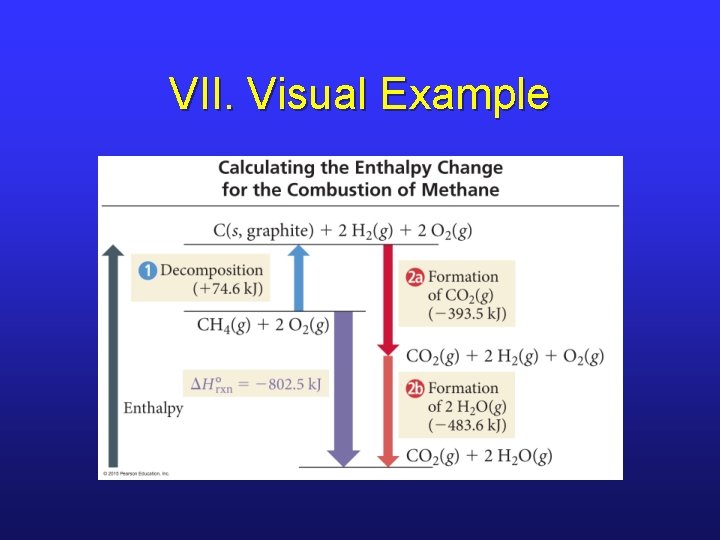
VII. Using ΔH°f’s • Standard heats of formation are very powerful; they allow calculation of ΔH°rxn for anything using a Hess’s Law type of calculation. ΔH°rxn = (sum ΔH°f products) – (sum ΔH°f reactants)
VII. Visual Example
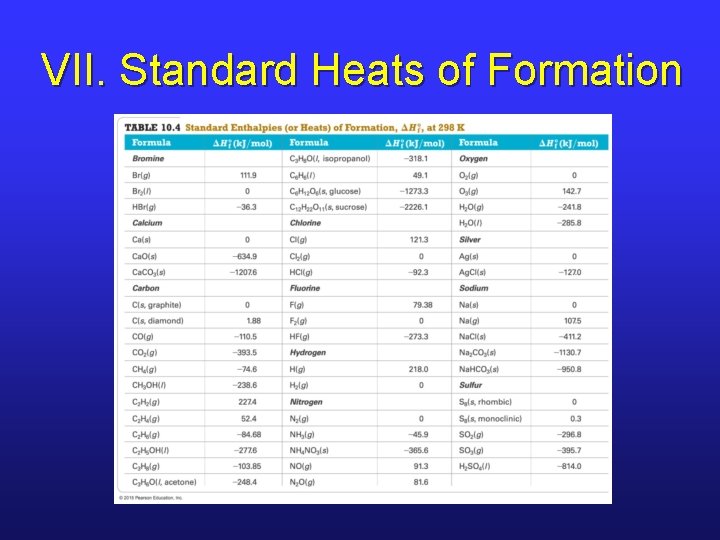
VII. Standard Heats of Formation
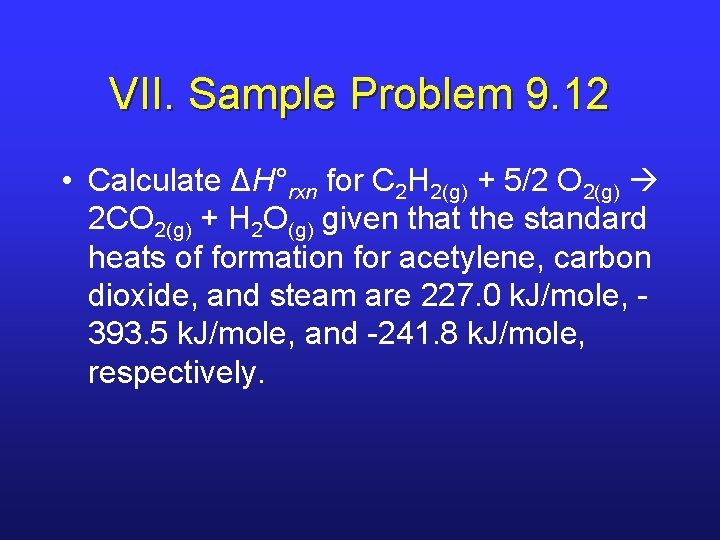
VII. Sample Problem 9. 12 • Calculate ΔH°rxn for C 2 H 2(g) + 5/2 O 2(g) 2 CO 2(g) + H 2 O(g) given that the standard heats of formation for acetylene, carbon dioxide, and steam are 227. 0 k. J/mole, 393. 5 k. J/mole, and -241. 8 k. J/mole, respectively.
VIII. BE’s and Chemical Change • In a reaction involving covalent compounds, bonds are broken and new bonds are formed. § Relative strengths of bonds determine whether rxn is exo or endo. • We can calculate heats of reaction based on the energy difference between bonds made and bonds broken.
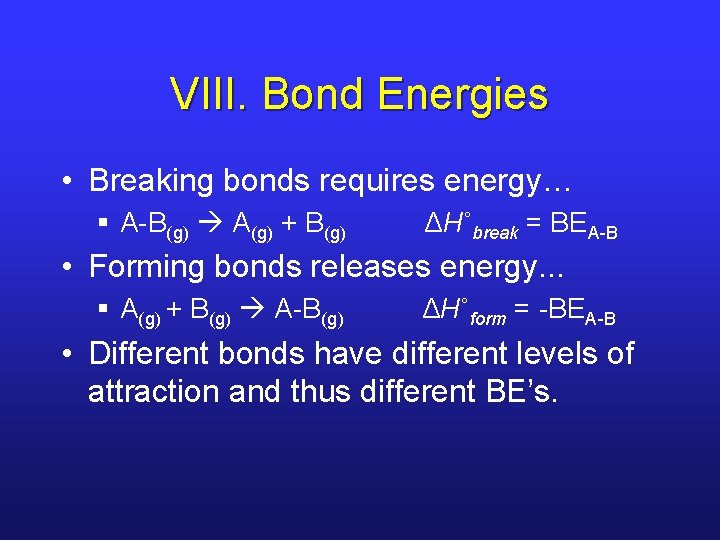
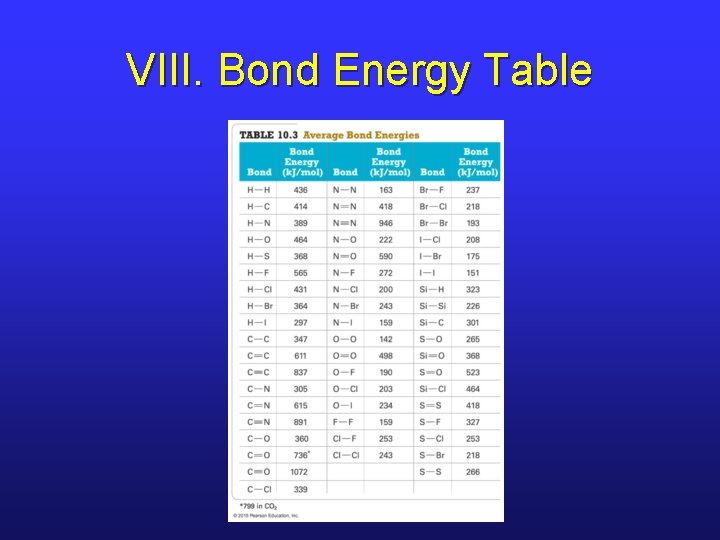
VIII. Bond Energies • Breaking bonds requires energy… § A-B(g) A(g) + B(g) ΔH˚break = BEA-B • Forming bonds releases energy. . . § A(g) + B(g) A-B(g) ΔH˚form = -BEA-B • Different bonds have different levels of attraction and thus different BE’s.
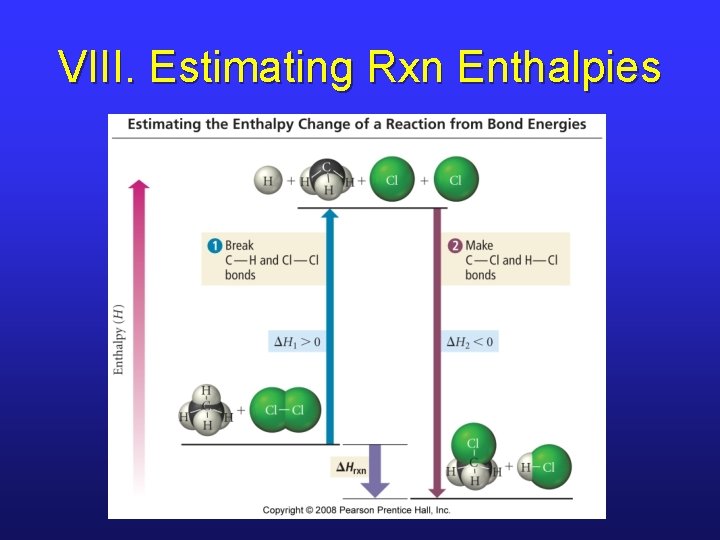
VIII. Estimating Rxn Enthalpies
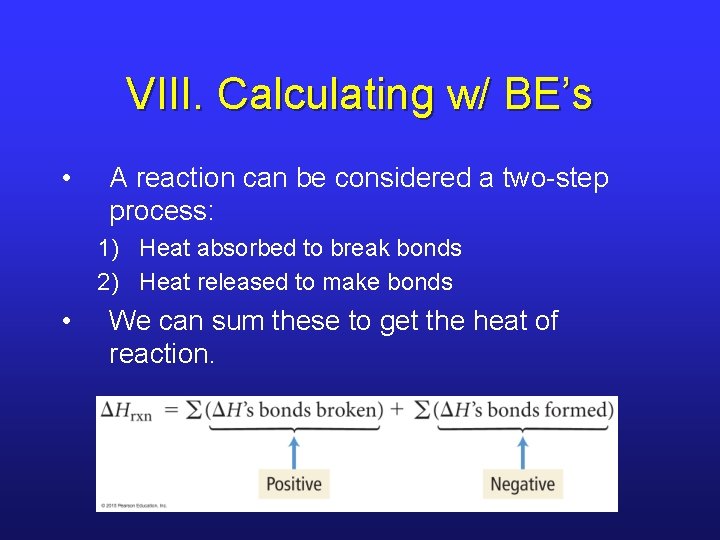
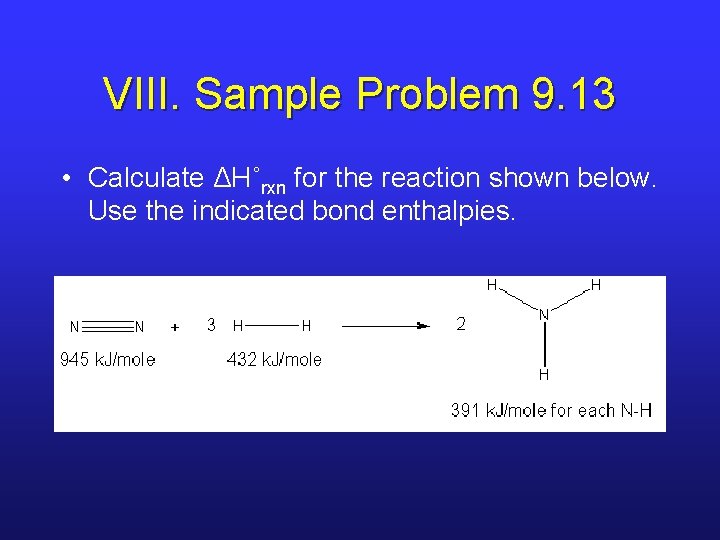
VIII. Calculating w/ BE’s • A reaction can be considered a two-step process: 1) Heat absorbed to break bonds 2) Heat released to make bonds • We can sum these to get the heat of reaction.
VIII. Bond Energy Table
VIII. Sample Problem 9. 13 • Calculate ΔH˚rxn for the reaction shown below. Use the indicated bond enthalpies.
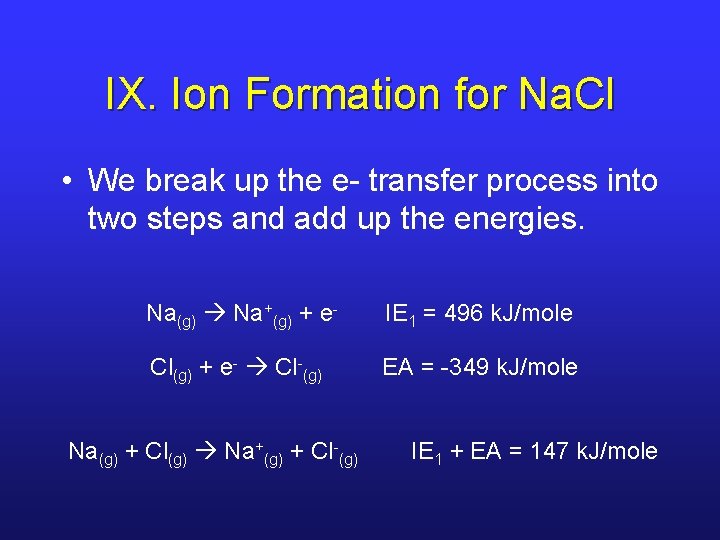
IX. Ionic Bond Formation • Recall that we envision the creation of ionic bond as an e- transfer from the metal to the nonmetal. • However, if we look at the energies involved in these two steps, we see something puzzling.
IX. Ion Formation for Na. Cl • We break up the e- transfer process into two steps and add up the energies. Na(g) Na+(g) + e- IE 1 = 496 k. J/mole Cl(g) + e- Cl-(g) EA = -349 k. J/mole Na(g) + Cl(g) Na+(g) + Cl-(g) IE 1 + EA = 147 k. J/mole
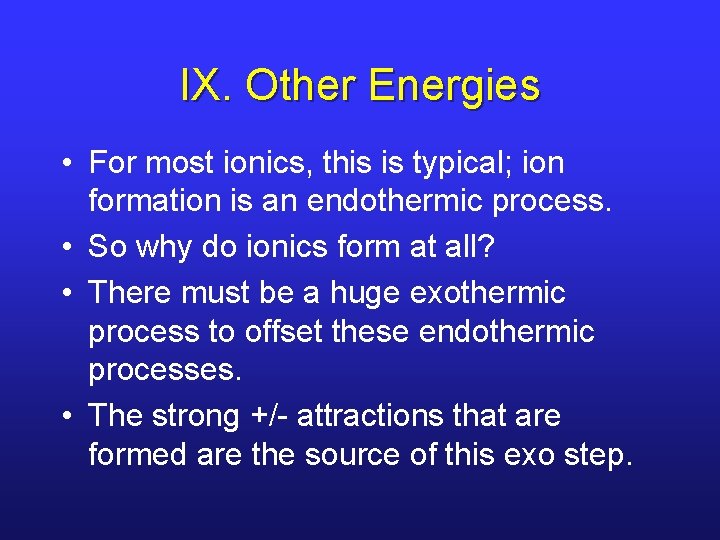
IX. Other Energies • For most ionics, this is typical; ion formation is an endothermic process. • So why do ionics form at all? • There must be a huge exothermic process to offset these endothermic processes. • The strong +/- attractions that are formed are the source of this exo step.
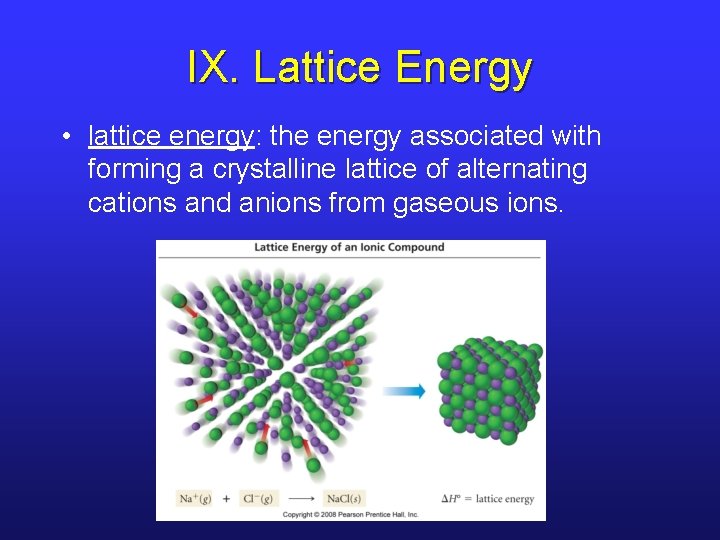
IX. Lattice Energy • lattice energy: the energy associated with forming a crystalline lattice of alternating cations and anions from gaseous ions.
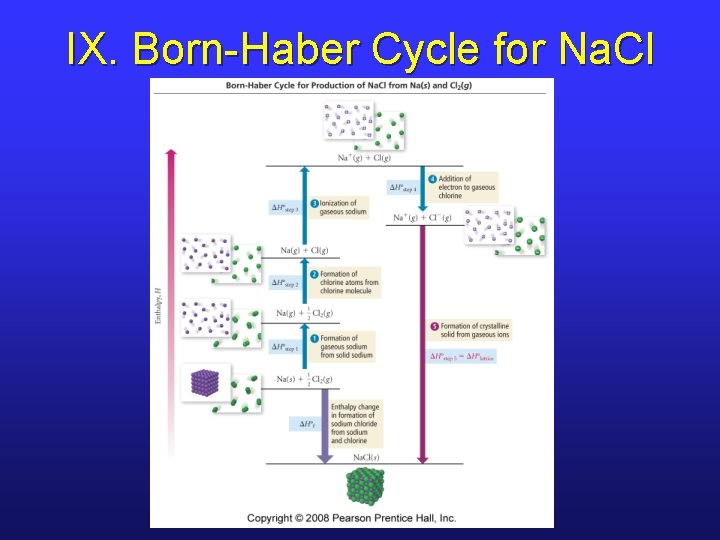
IX. Born-Haber Cycle • Although lattice energy is a critical component of ionic bond formation, it cannot be measured directly. • We use Hess’s Law in the Born-Haber Cycle.
IX. Born-Haber Cycle for Na. Cl
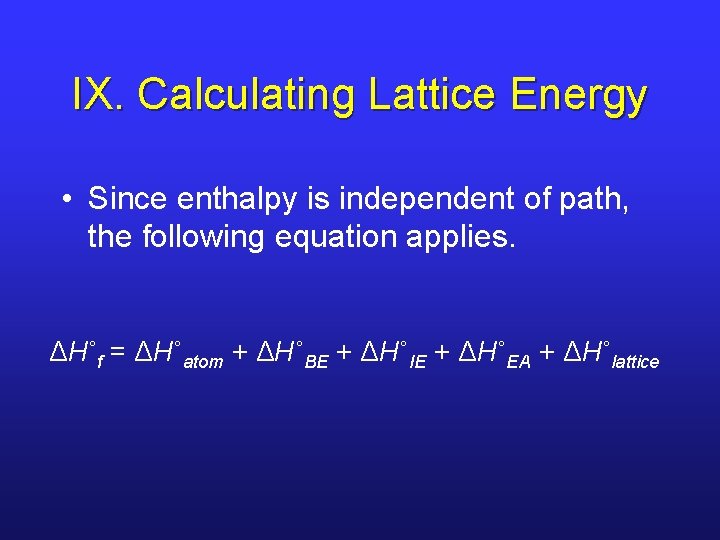
IX. Calculating Lattice Energy • Since enthalpy is independent of path, the following equation applies. ΔH˚f = ΔH˚atom + ΔH˚BE + ΔH˚IE + ΔH˚EA + ΔH˚lattice
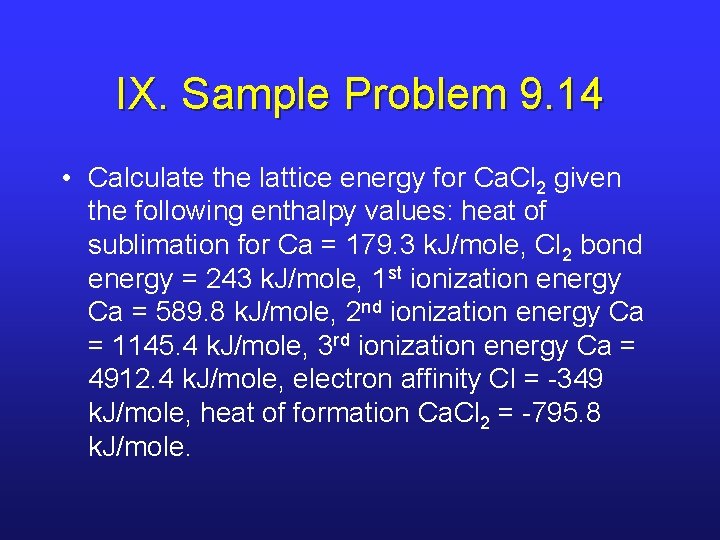
IX. Sample Problem 9. 14 • Calculate the lattice energy for Ca. Cl 2 given the following enthalpy values: heat of sublimation for Ca = 179. 3 k. J/mole, Cl 2 bond energy = 243 k. J/mole, 1 st ionization energy Ca = 589. 8 k. J/mole, 2 nd ionization energy Ca = 1145. 4 k. J/mole, 3 rd ionization energy Ca = 4912. 4 k. J/mole, electron affinity Cl = -349 k. J/mole, heat of formation Ca. Cl 2 = -795. 8 k. J/mole.