
Ch 20 Nuclear Chemistry Dr Namphol Sinkaset Chem
- Slides: 51
Ch. 20: Nuclear Chemistry Dr. Namphol Sinkaset Chem 201: General Chemistry II
I. Chapter Outline I. III. IV. V. VI. Introduction Nuclear Structure and Stability Radioactive Decay & Nuclear Equations Half Lives and Radiometric Dating Transmutation and Nuclear Energy Radiation and Life
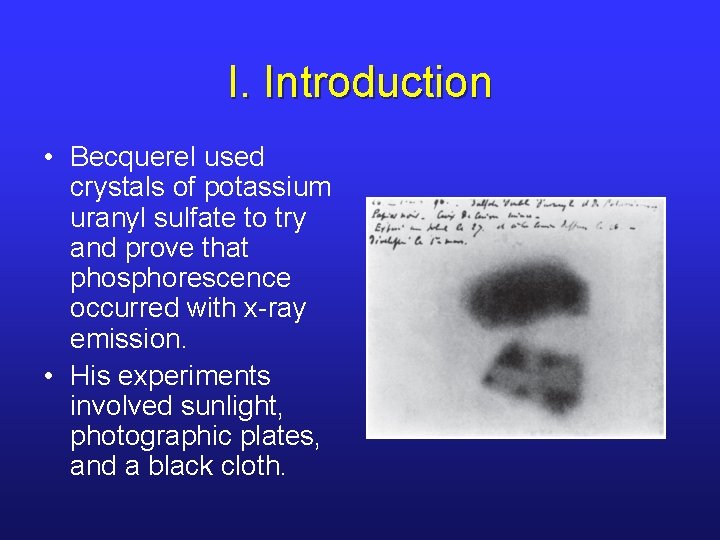
I. Introduction • Becquerel used crystals of potassium uranyl sulfate to try and prove that phosphorescence occurred with x-ray emission. • His experiments involved sunlight, photographic plates, and a black cloth.
I. Introduction • Becquerel concluded that the uranium caused the exposure and called the emissions uranic rays. • Marie Curie studied uranic rays for her doctoral thesis and discovered they weren’t unique to uranium. • She discovered 2 new elements that had the same emissions and renamed the phenomenon radioactivity.
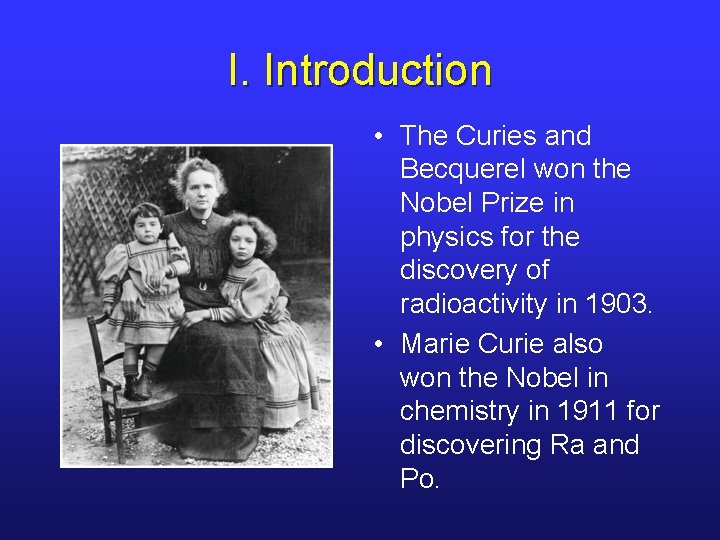
I. Introduction • The Curies and Becquerel won the Nobel Prize in physics for the discovery of radioactivity in 1903. • Marie Curie also won the Nobel in chemistry in 1911 for discovering Ra and Po.
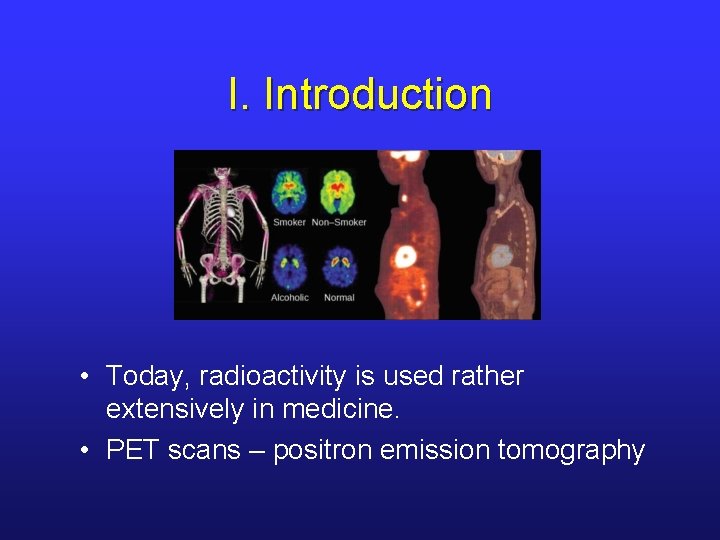
I. Introduction • Today, radioactivity is used rather extensively in medicine. • PET scans – positron emission tomography
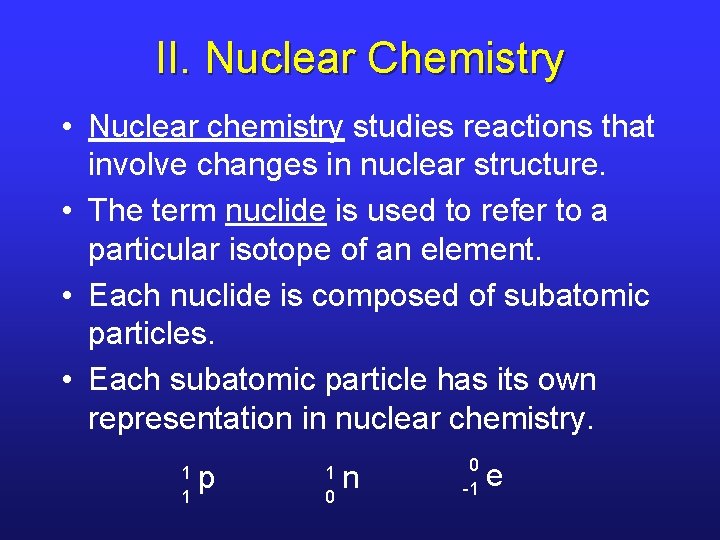
II. Nuclear Chemistry • Nuclear chemistry studies reactions that involve changes in nuclear structure. • The term nuclide is used to refer to a particular isotope of an element. • Each nuclide is composed of subatomic particles. • Each subatomic particle has its own representation in nuclear chemistry. 1 1 p 1 0 n 0 -1 e
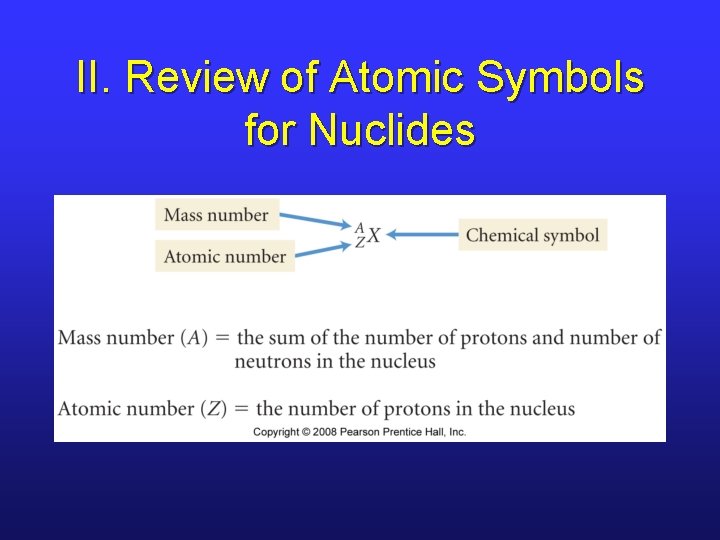
II. Review of Atomic Symbols for Nuclides
II. What Holds the Nucleus Together? • Something is needed to overcome the repulsive force between protons. • The strong nuclear force binds protons and neutrons together, but it only works at very short distances. • Stability of nucleus is a balance between +/+ repulsions and the strong nuclear force attraction.
II. Importance of Neutrons • Neutrons are key to nuclei stability because they increase strong force attractions, but lack charge repulsion. • However, since neutrons occupy energy levels like e-, cannot just stuff nucleus with neutrons.
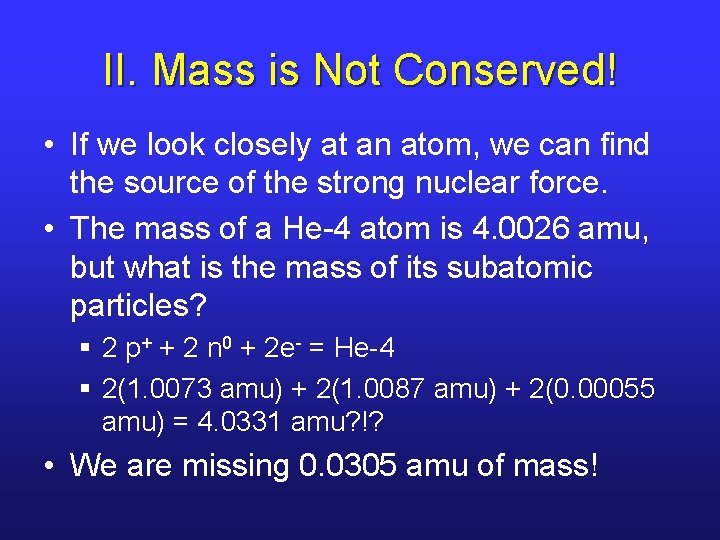
II. Mass is Not Conserved! • If we look closely at an atom, we can find the source of the strong nuclear force. • The mass of a He-4 atom is 4. 0026 amu, but what is the mass of its subatomic particles? § 2 p+ + 2 n 0 + 2 e- = He-4 § 2(1. 0073 amu) + 2(1. 0087 amu) + 2(0. 00055 amu) = 4. 0331 amu? !? • We are missing 0. 0305 amu of mass!
II. The Mass Defect • All stable nuclei have masses less than their components which is known as the mass defect. • When the mass defect is used in E = mc 2, the nuclear binding energy is calculated. • Mass is converted to energy to hold nucleus together! • The nuclear binding energy is the energy needed to break up a nucleus into its component nucleons.
II. Calculating Binding Energies • A useful conversion between mass and energy is 1 amu = 931. 5 Me. V. Note that 1 Me. V = 1. 602 x 10 -13 J. • The mass defect of a helium nucleus is 0. 0305 amu, so its binding energy is 28. 4 Me. V. • For one mole of He-4, the binding energy is 2. 74 × 109 k. J/mole!
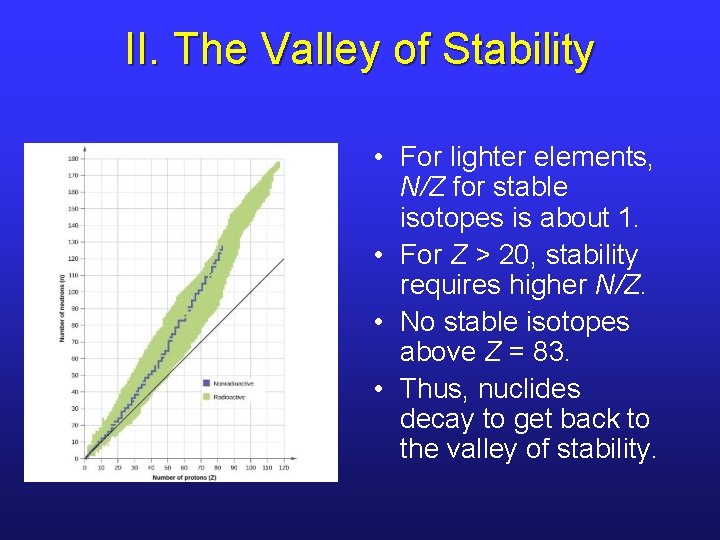
II. The Valley of Stability • For lighter elements, N/Z for stable isotopes is about 1. • For Z > 20, stability requires higher N/Z. • No stable isotopes above Z = 83. • Thus, nuclides decay to get back to the valley of stability.
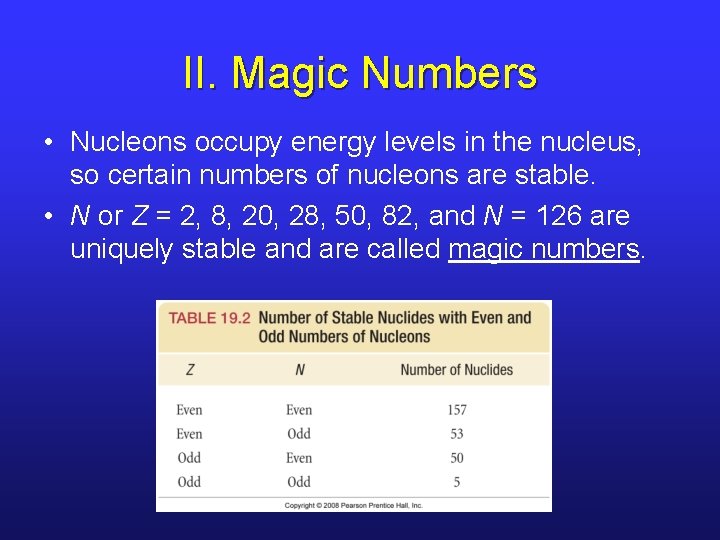
II. Magic Numbers • Nucleons occupy energy levels in the nucleus, so certain numbers of nucleons are stable. • N or Z = 2, 8, 20, 28, 50, 82, and N = 126 are uniquely stable and are called magic numbers.
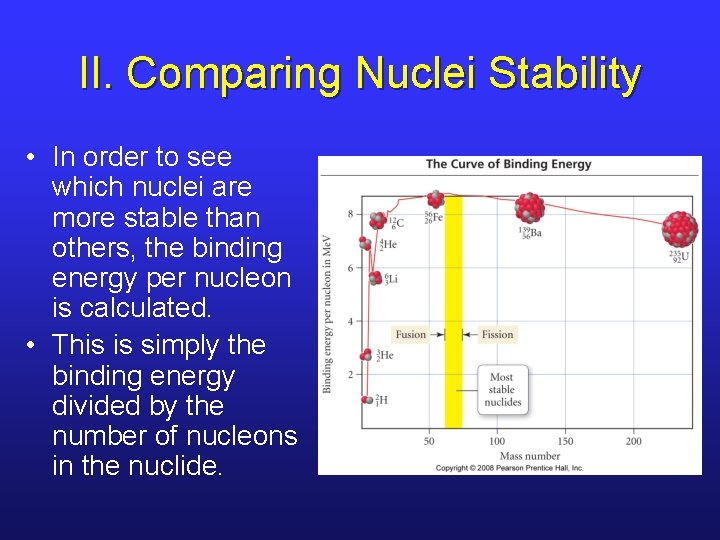
II. Comparing Nuclei Stability • In order to see which nuclei are more stable than others, the binding energy per nucleon is calculated. • This is simply the binding energy divided by the number of nucleons in the nuclide.
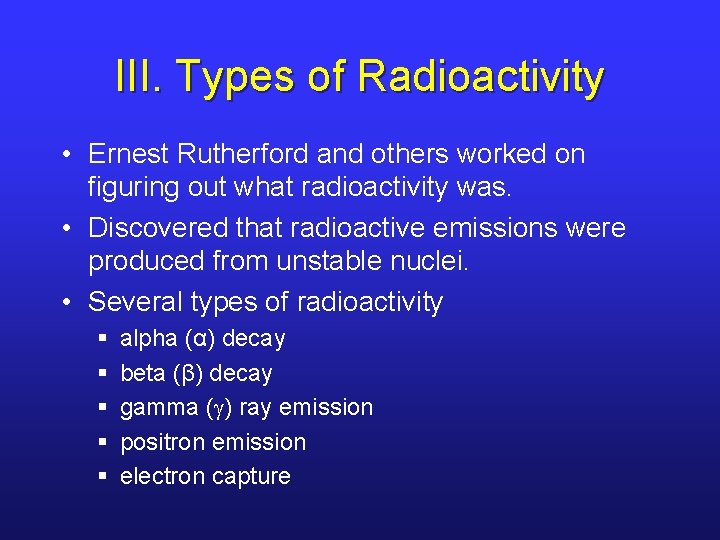
III. Types of Radioactivity • Ernest Rutherford and others worked on figuring out what radioactivity was. • Discovered that radioactive emissions were produced from unstable nuclei. • Several types of radioactivity § § § alpha (α) decay beta (β) decay gamma (g) ray emission positron emission electron capture
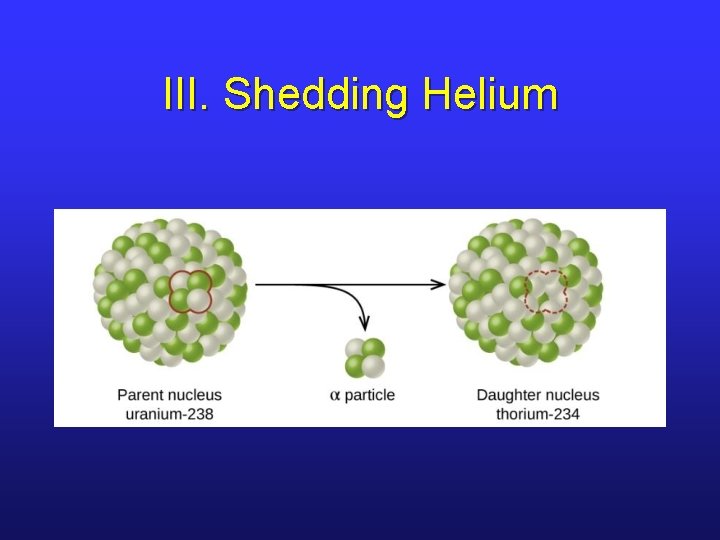
III. Shedding Helium
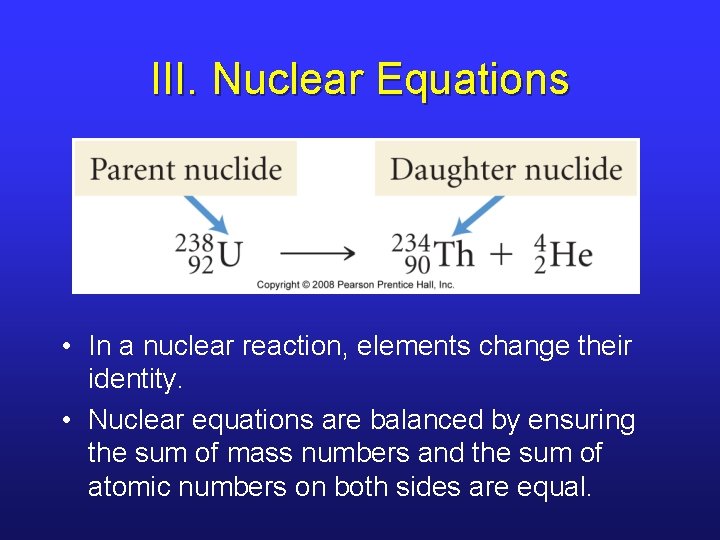
III. Nuclear Equations • In a nuclear reaction, elements change their identity. • Nuclear equations are balanced by ensuring the sum of mass numbers and the sum of atomic numbers on both sides are equal.
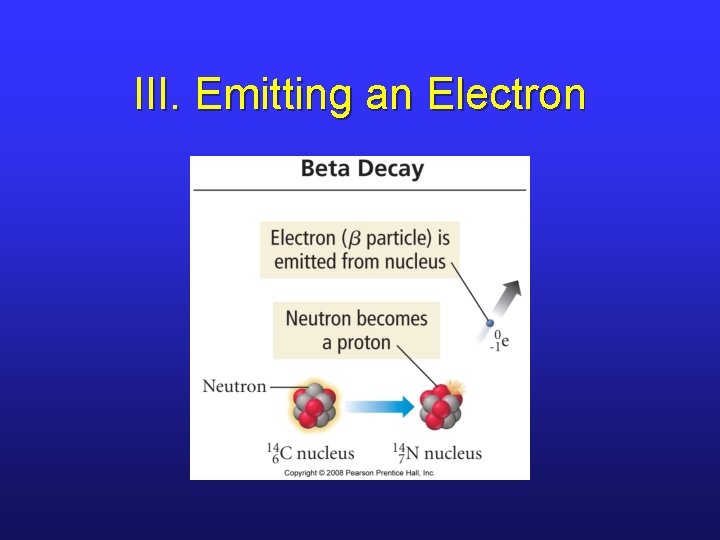
III. Emitting an Electron
III. Gamma Ray Emission • This type of radiation involves emission of high-energy photons, not particles. • Gamma rays have no mass and no charge as they are a type of EM radiation. • Gamma rays are emitted from a nucleus in an excited state, indicated w/ *. § e. g. 60 Co* § Excited state nuclei often associated w/ other radioactive processes.
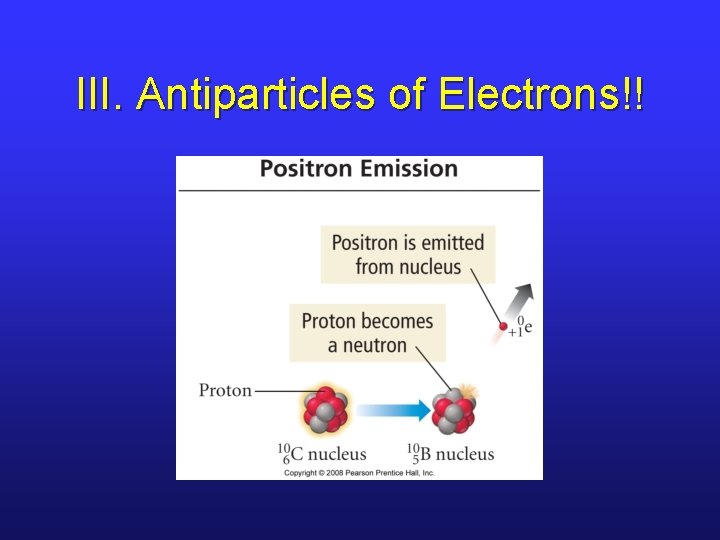
III. Antiparticles of Electrons!!
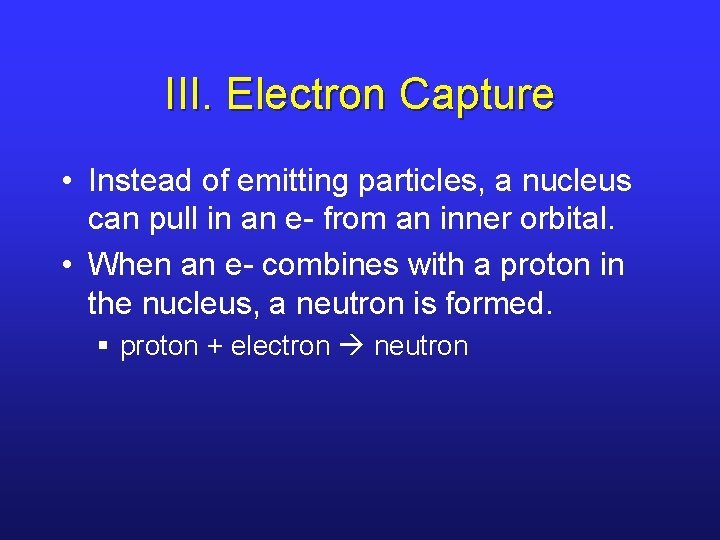
III. Electron Capture • Instead of emitting particles, a nucleus can pull in an e- from an inner orbital. • When an e- combines with a proton in the nucleus, a neutron is formed. § proton + electron neutron
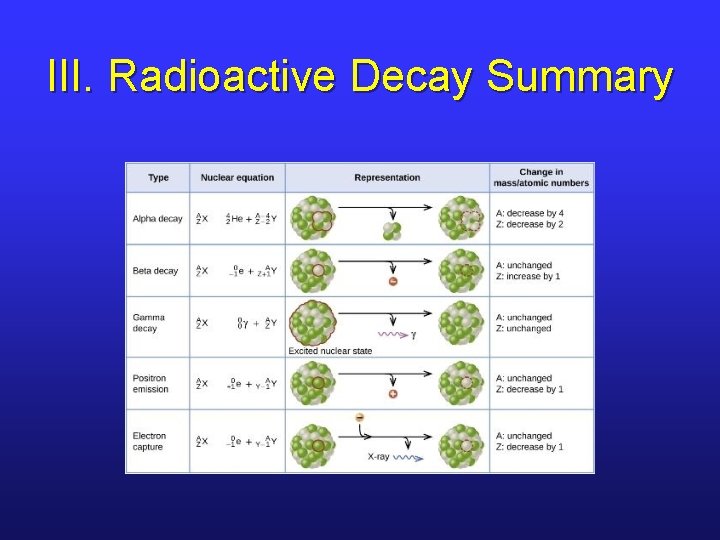
III. Radioactive Decay Summary
III. Sample Problems a) Write a nuclear equation for the positron emission of sodium-22. b) Write a nuclear equation for electron capture in krypton-76. c) Potassium-40 decays into argon-40. Identify the type of radioactive decay.
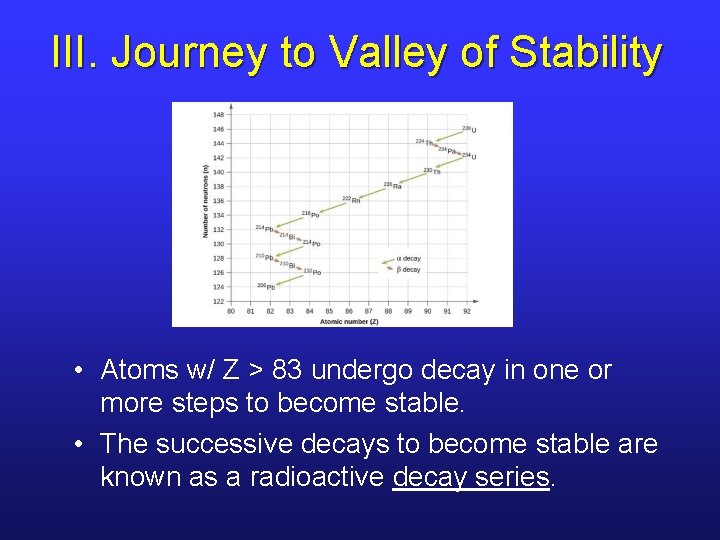
III. Journey to Valley of Stability • Atoms w/ Z > 83 undergo decay in one or more steps to become stable. • The successive decays to become stable are known as a radioactive decay series.
IV. Radioactivity is Everywhere • Everything around us contains at least some nuclides which are radioactive. • Radioactivity is found in the ground, in our food, in our air. • Radioactivity is in our environment because of some long decay times, and the constant production of radioactive nuclides through various decay series.
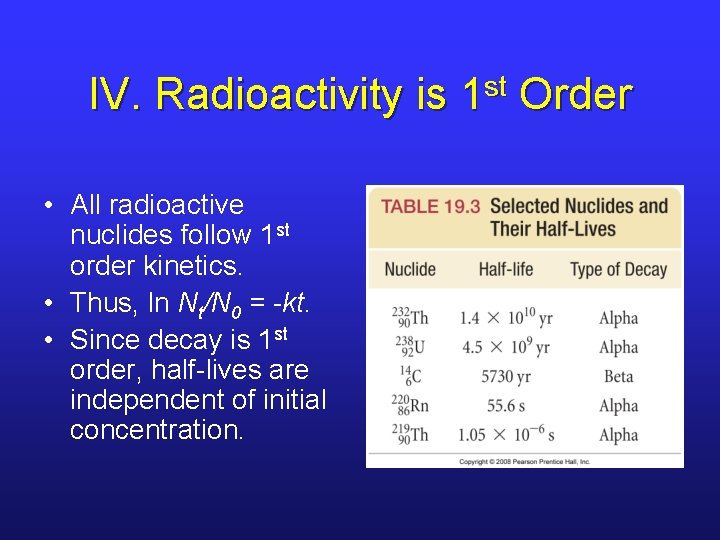
IV. Radioactivity is 1 st Order • All radioactive nuclides follow 1 st order kinetics. • Thus, ln Nt/N 0 = -kt. • Since decay is 1 st order, half-lives are independent of initial concentration.
IV. Sample Problem • How long would it take for a 1. 35 -mg sample of Pu-236 to decay to 0. 100 mg if it has a half-life of 2. 87 years?
IV. Radiocarbon Dating • Radioactive C-14 is continuously taken up by living organisms, so the amount is in equilibrium with the amount in the atmosphere (created by neutron bombardment of N-14). • When the organism dies, it no longer takes in C-14. The C-14 continuously decays in the remains. • Age can be determined by comparing C -14 in remains to C-14 in atmosphere.
IV. Radiocarbon Dating
IV. Rate of Decay and Amount are Interchangeable
IV. Sample Problem • An ancient scroll is claimed to have originated from Greek scholars in about 500 B. C. A measure of its C-14 decay rate gives a value that is 89% of that found in living organisms. How old is the scroll? Could it be authentic? Note that the half-life for C-14 is 5730 years.
IV. Uranium/Lead Dating • C-14 dating is only good for things that are less than 50, 000 years old. • Can use other known radioactive decays to date older things. • U-238 decays into Pb-206 with a halflife of 4. 5 × 10⁹ years.
IV. Sample Problem • A rock contains a Pb-206 to U-238 mass ratio of 0. 145: 1. 00. Assuming that the rock did not contain any Pb-206 at the time of its formation, determine its age. Note that the half-life of U-238 is 4. 5 × 10⁹ years.
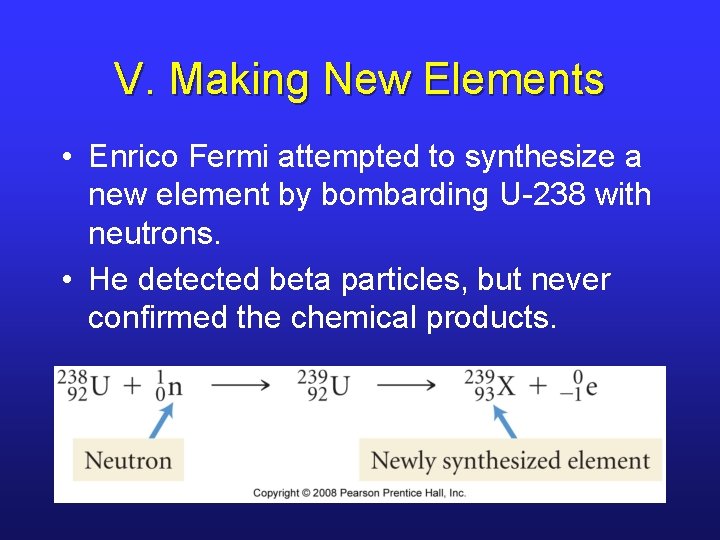
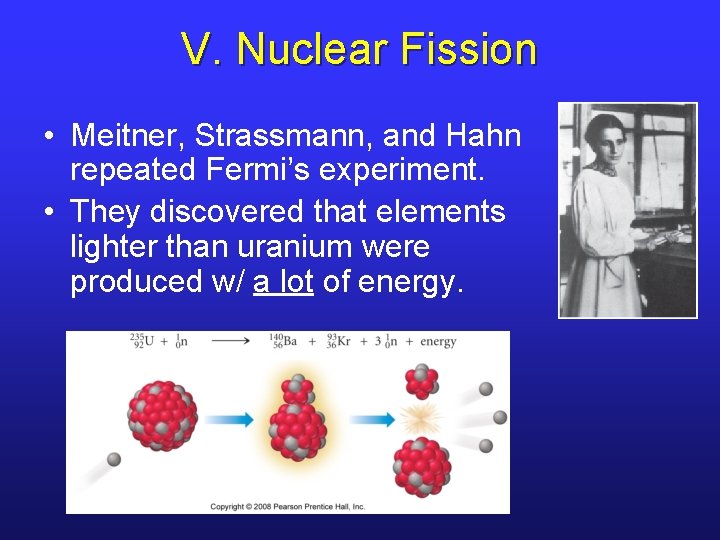
V. Making New Elements • Enrico Fermi attempted to synthesize a new element by bombarding U-238 with neutrons. • He detected beta particles, but never confirmed the chemical products.
V. Nuclear Fission • Meitner, Strassmann, and Hahn repeated Fermi’s experiment. • They discovered that elements lighter than uranium were produced w/ a lot of energy.
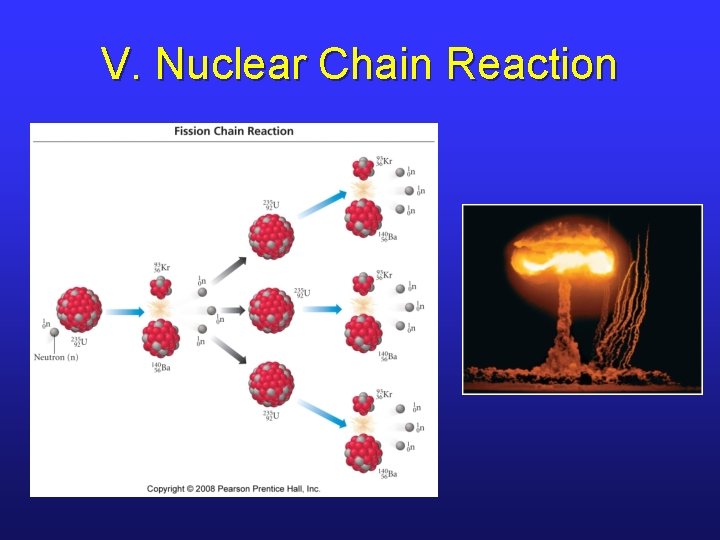
V. Nuclear Chain Reaction
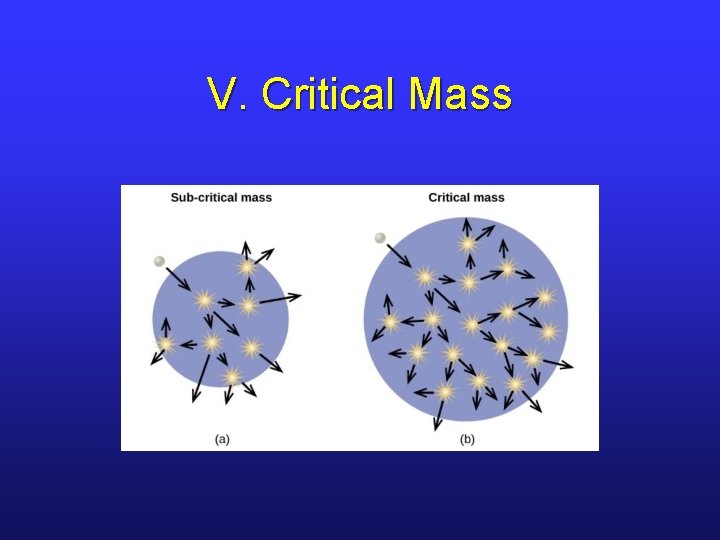
V. Critical Mass
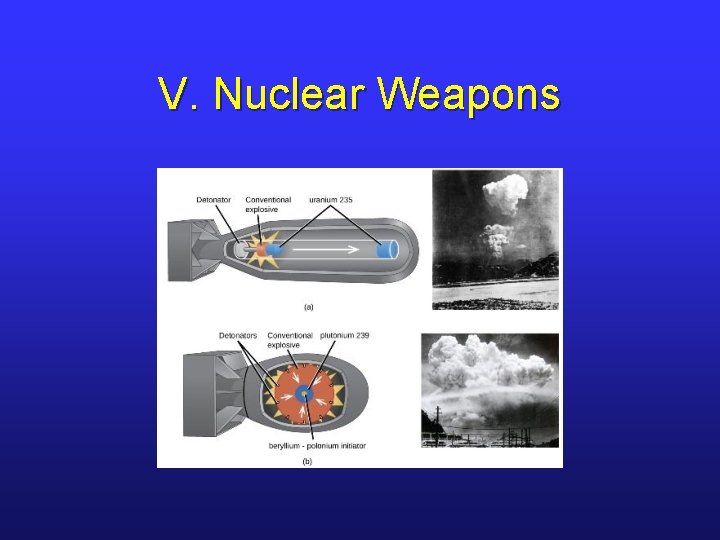
V. Source of Energy in Fission • U-235 + n Ba-140 + Kr-93 + 3 n • If we look at exact masses, we find that mass of products is 235. 86769 amu and mass of reactants is 236. 05258 amu. • Mass is not conserved!! • In nuclear reactions, mass can be converted into energy via E = mc 2.
V. Nuclear Weapons
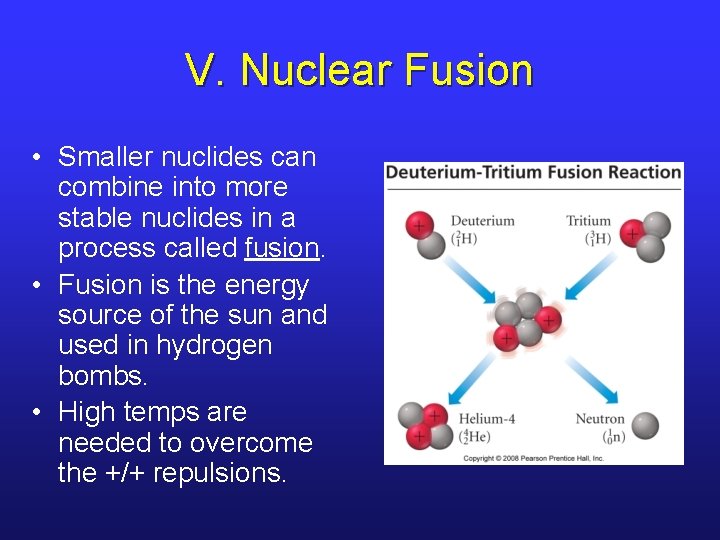
V. Nuclear Fusion • Smaller nuclides can combine into more stable nuclides in a process called fusion. • Fusion is the energy source of the sun and used in hydrogen bombs. • High temps are needed to overcome the +/+ repulsions.
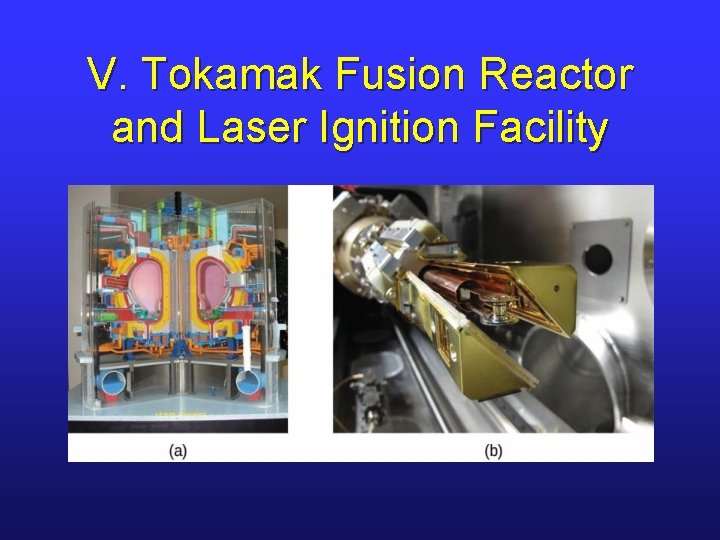
V. Tokamak Fusion Reactor and Laser Ignition Facility
VI. Applications of Radioactivity • Medicine § Use of radiotracers to track movement of compound or mixture in body. I-131 for thyroid, labeled antibodies to locate infection, P-32 for cancer. § Gamma rays to kill cancer cells. • Kill microorganisms § Sterilize medical devices. § Kill bacteria and parasites in food. • Sterilize harmful insects
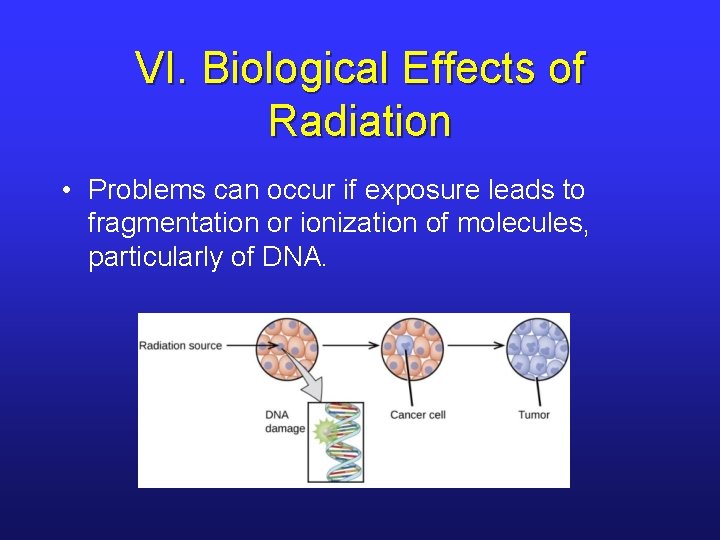
VI. Biological Effects of Radiation • Problems can occur if exposure leads to fragmentation or ionization of molecules, particularly of DNA.
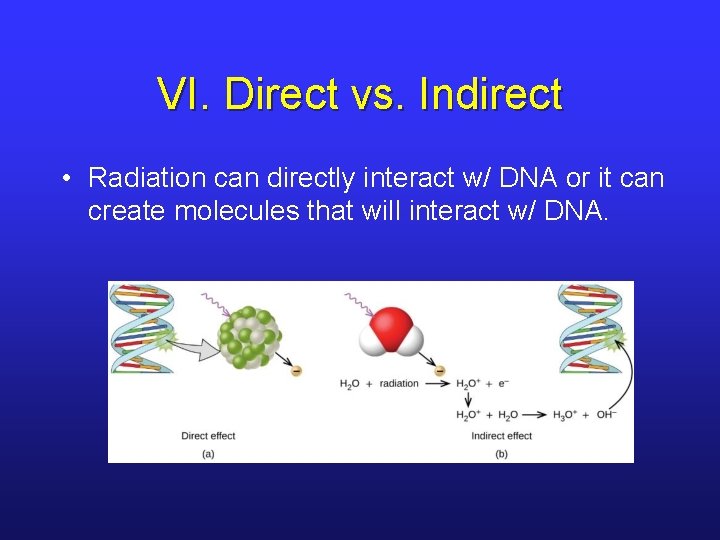
VI. Direct vs. Indirect • Radiation can directly interact w/ DNA or it can create molecules that will interact w/ DNA.
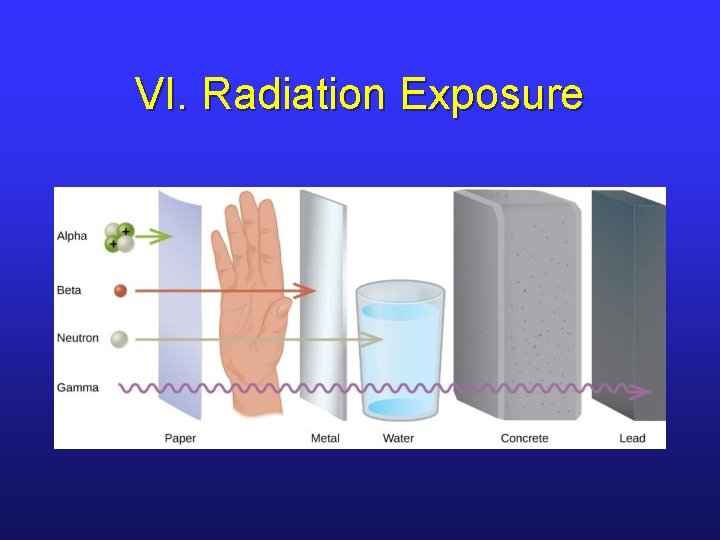
VI. Radiation Exposure
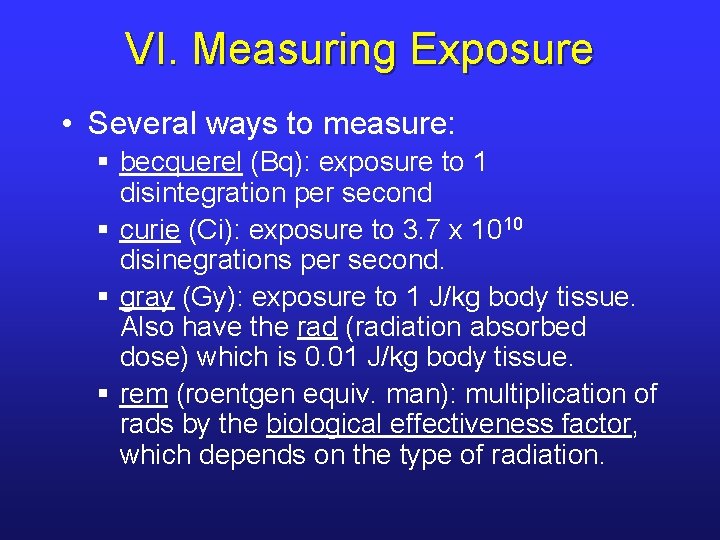
VI. Measuring Exposure • Several ways to measure: § becquerel (Bq): exposure to 1 disintegration per second § curie (Ci): exposure to 3. 7 x 10¹⁰ disinegrations per second. § gray (Gy): exposure to 1 J/kg body tissue. Also have the rad (radiation absorbed dose) which is 0. 01 J/kg body tissue. § rem (roentgen equiv. man): multiplication of rads by the biological effectiveness factor, which depends on the type of radiation.
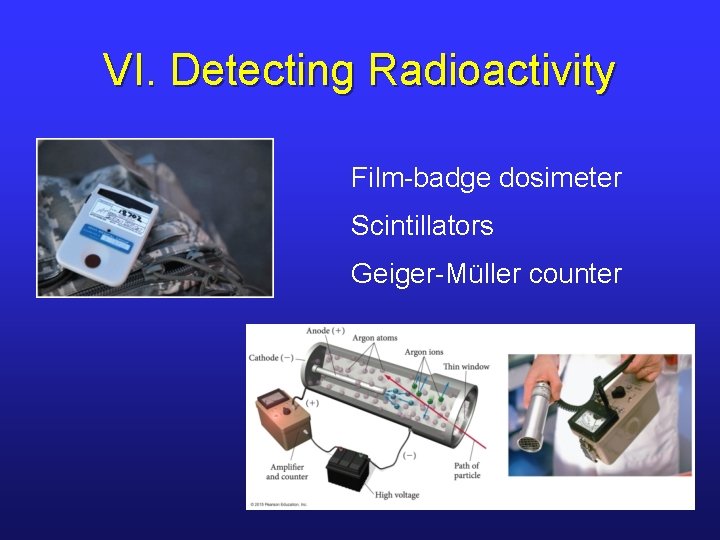
VI. Detecting Radioactivity Film-badge dosimeter Scintillators Geiger-Müller counter
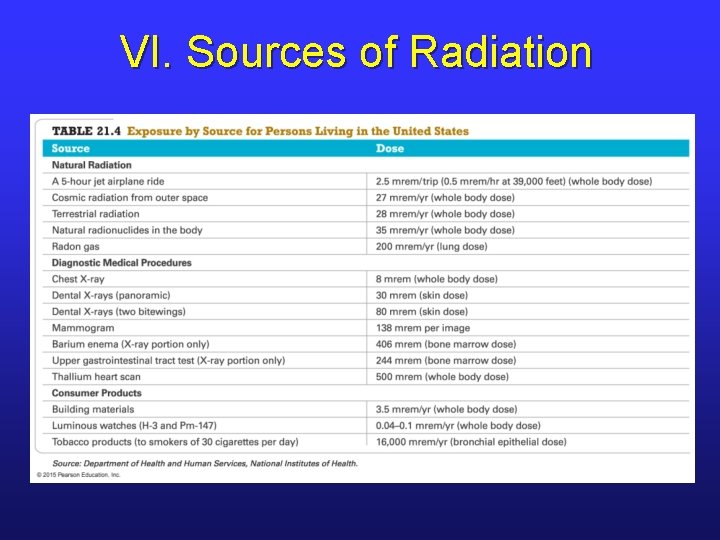
VI. Sources of Radiation
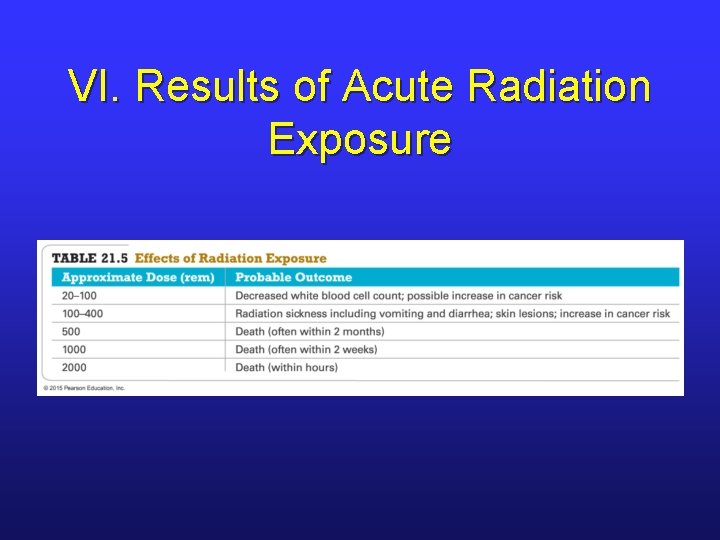
VI. Results of Acute Radiation Exposure