
Ch 3 Matter and Energy Dr Namphol Sinkaset







- Slides: 45
Ch. 3: Matter and Energy Dr. Namphol Sinkaset Chem 152: Introduction to General Chemistry
I. Chapter Outline I. III. IV. V. VII. Introduction Classifying Matter Physical/Chemical Properties/Changes Conservation of Matter Energy Temperature Heat Capacity
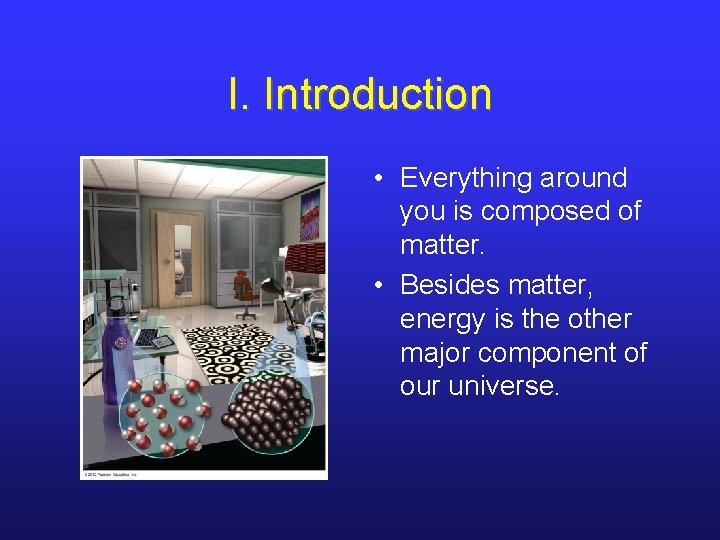
I. Introduction • Everything around you is composed of matter. • Besides matter, energy is the other major component of our universe.
II. Matter • Matter is anything that occupies space and has mass. • Some matter is easy to see (water, wood), others are difficult (air, dust). • The most basic building block of matter is the atom.
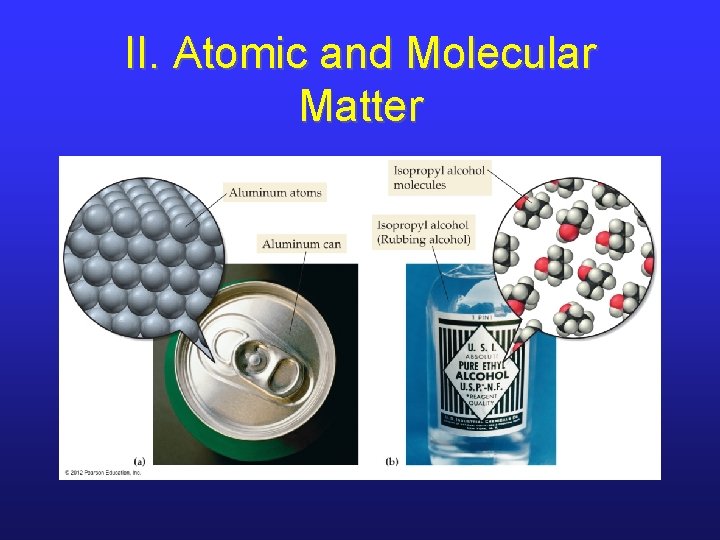
II. Atoms and Molecules • atoms: submicroscopic particles that are the fundamental building blocks of all matter. • Sometimes, atoms are bonded together to form molecules. • molecules: two or more atoms joined to one another in specific geometric arrangements.
II. Atomic and Molecular Matter
II. Actual Images of Atoms and Molecules
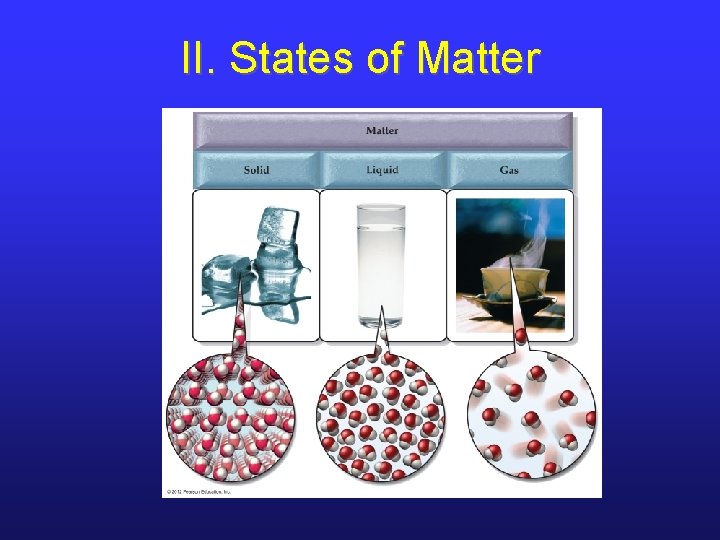
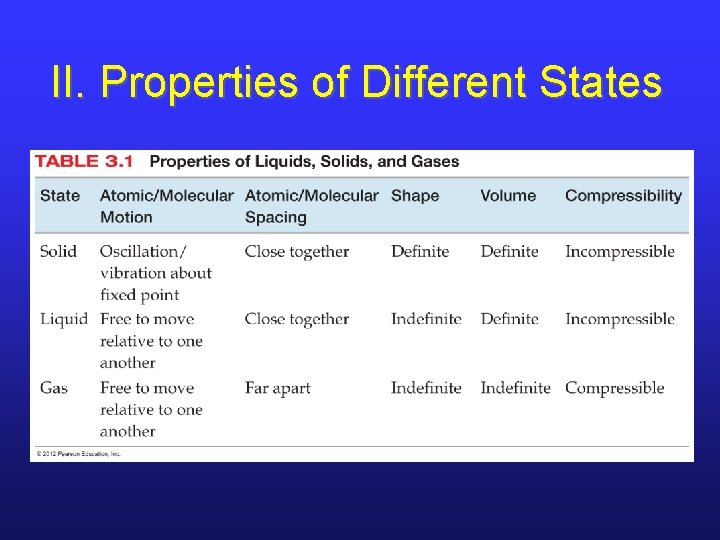
II. States of Matter • Matter can be classified by its state. • solid: closely-packed particles with fixed locations • liquid: closely-packed particles, but free to move around • gas: great distances between particles with free movement
II. States of Matter
II. The Solid State
II. Properties of Different States
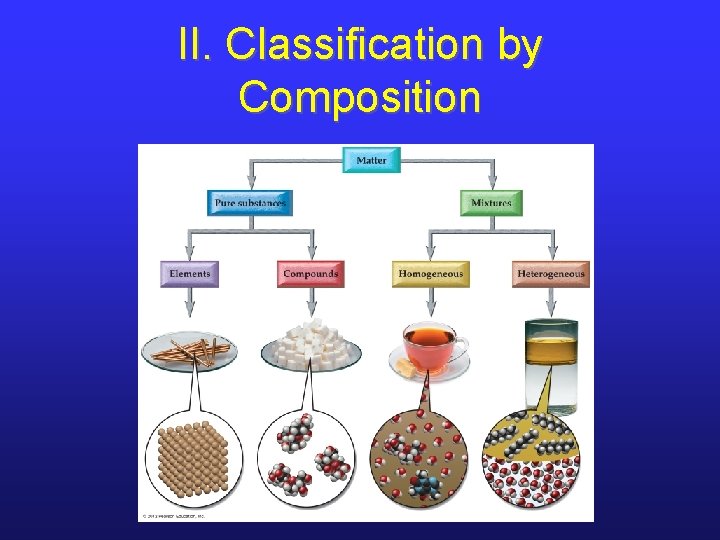
II. Pure Substances and Mixtures • Matter can be classified by its composition. • pure substance: matter composed of only one type of atom or molecule • mixture: matter composed of two or more different types of atoms or molecules which may vary in proportion
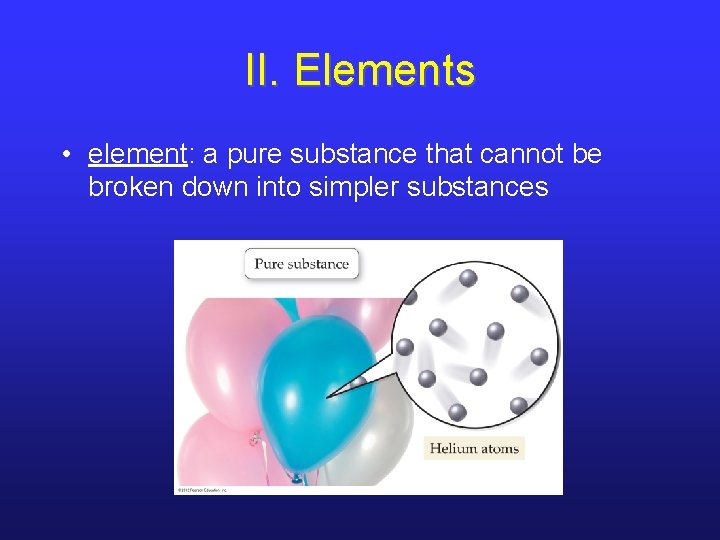
II. Elements • element: a pure substance that cannot be broken down into simpler substances
II. Compounds • compound: a pure substance composed of two or more elements in fixed definite proportions.
II. Mixtures • Most matter exists in this form. • heterogeneous: varied composition from one region to another • homogeneous: uniform composition throughout
II. Classification by Composition
II. Sample Problem • Classify the following as a pure substance or mixture. Further classify them as an element, compound, homogeneous, or heterogeneous. a) b) c) d) blood sugar mercury in a thermometer chicken noodle soup
III. Distinguishing Matter • We use physical and chemical properties to tell the difference between samples of matter. • physical property: a property a substance displays without changing its composition • chemical property: a property a substance displays only by changing its composition
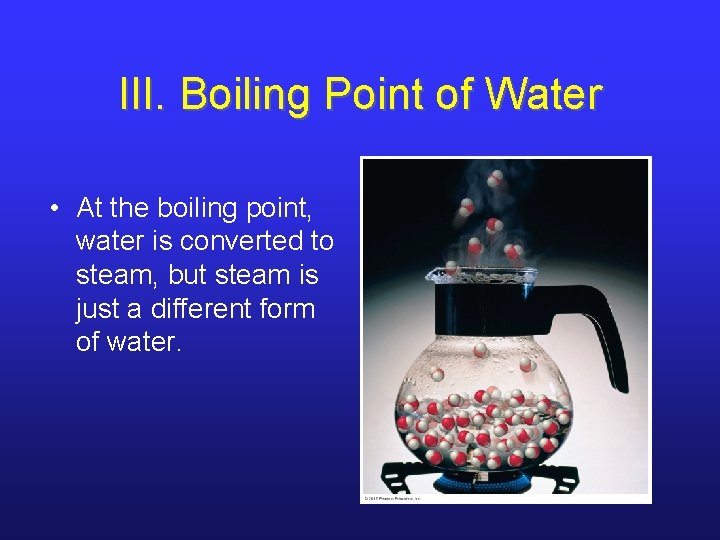
III. Boiling Point of Water • At the boiling point, water is converted to steam, but steam is just a different form of water.
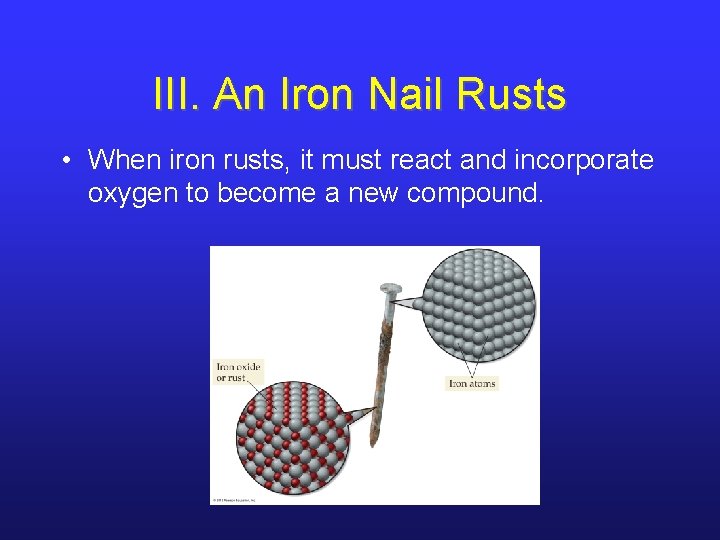
III. An Iron Nail Rusts • When iron rusts, it must react and incorporate oxygen to become a new compound.
III. Sample Problem • Identify the following as physical or chemical properties. a) Hydrogen gas is explosive. b) Silver has a shiny appearance. c) Dry ice sublimes (goes from solid directly to vapor). d) Copper turns green when exposed to air.
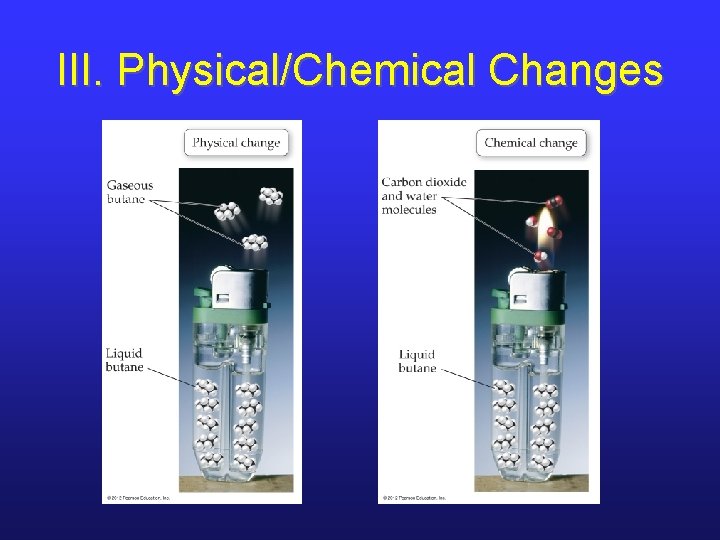
III. Physical/Chemical Changes • Physical/chemical changes are closely related to definitions of physical/chemical properties. • physical change: matter changes its appearance, but not its composition • chemical change: matter changes its composition • Chemical changes occur through chemical reactions in which reactants become products.
III. Physical/Chemical Changes
III. Sample Problem • Categorize the following as either a physical or chemical change. a) Copper metal forming a blue solution when dropped in concentrated nitric acid. b) A train flattening a penny. c) A match igniting a firework. d) Ice melting into liquid water.
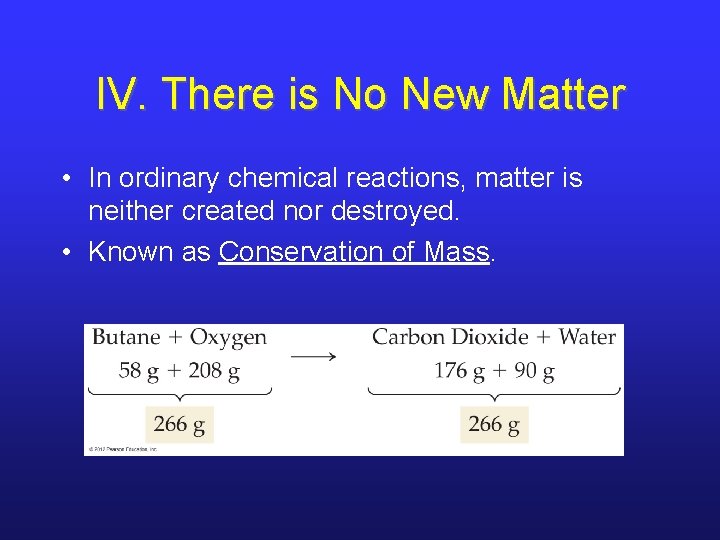
IV. There is No New Matter • In ordinary chemical reactions, matter is neither created nor destroyed. • Known as Conservation of Mass.
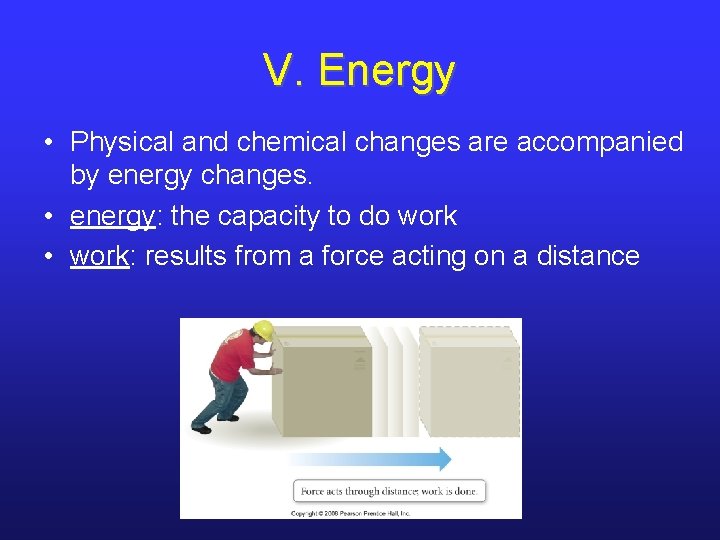
V. Energy • Physical and chemical changes are accompanied by energy changes. • energy: the capacity to do work • work: results from a force acting on a distance
V. Two Types of Energy • potential energy (PE): energy due to the position or composition of the object • kinetic energy (KE): energy due to motion of the object • An object’s total energy is the sum of its PE and KE
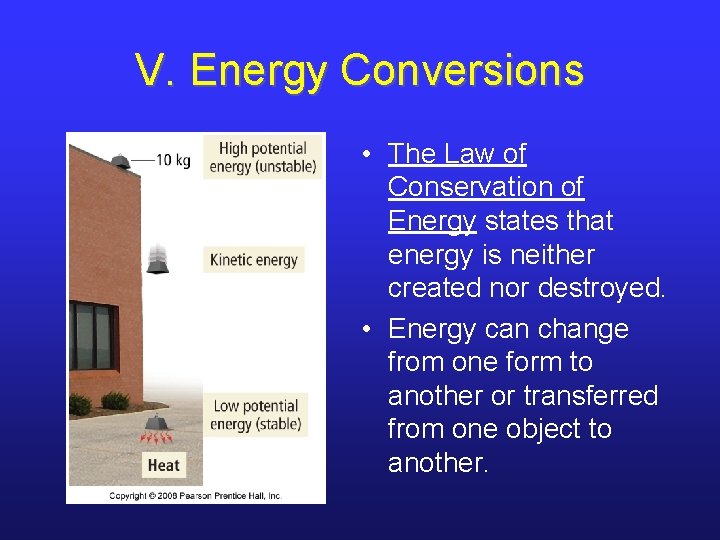
V. Energy Conversions • The Law of Conservation of Energy states that energy is neither created nor destroyed. • Energy can change from one form to another or transferred from one object to another.
V. Specific Types of Energy • Electrical energy is the energy associated with the flow of electrical charge. • Thermal energy is the energy associated with motions of particles of matter. • Chemical energy is a form of PE associated with positions of particles in a chemical system.
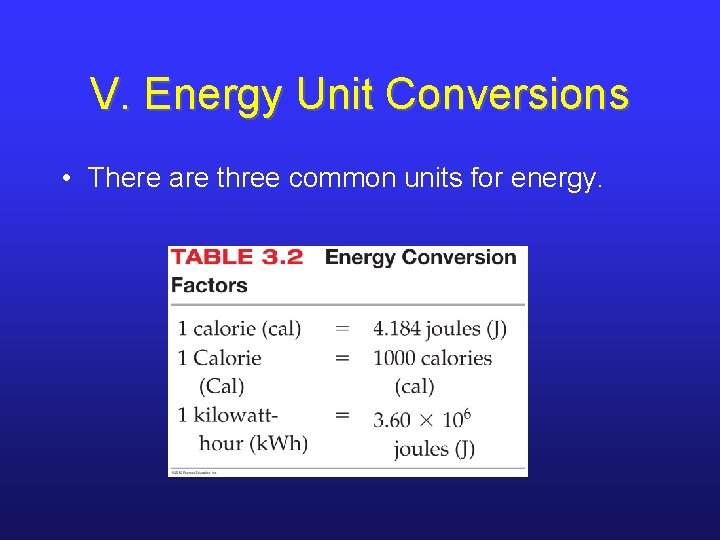
V. Energy Unit Conversions • There are three common units for energy.
V. Sample Problem • The complete combustion of a wooden match produces about 512 cal of heat. How many kilojoules are produced?
V. System and Surroundings • When describing energy changes, we need reference points. • system: object of study • surroundings: everything else • Systems with high PE tend to change such that their PE is lowered.
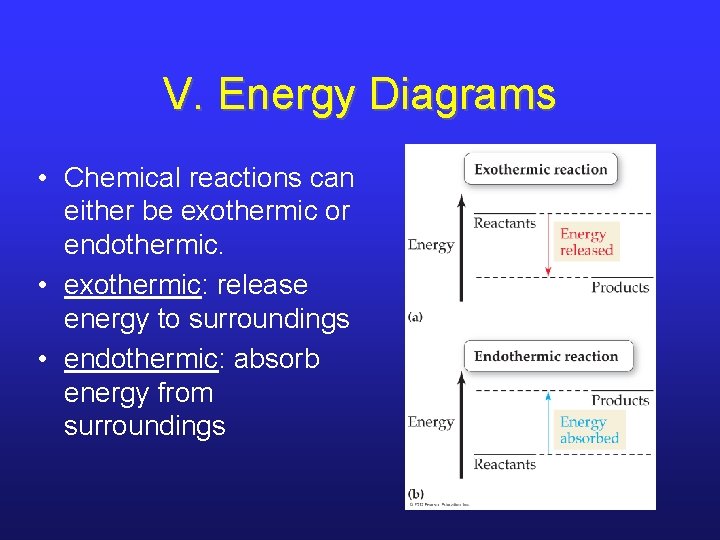
V. Energy Diagrams • Chemical reactions can either be exothermic or endothermic. • exothermic: release energy to surroundings • endothermic: absorb energy from surroundings
V. Sample Problem • Identify the following changes as exothermic or endothermic. a) Water freezing into ice. b) Propane burning. c) Isopropyl alcohol evaporating from skin.
VI. Thermal Energy • Atoms and molecules of matter are in constant, random motion, which is the source of thermal energy. • More motion = more thermal energy. • Is there a way to easily measure this motion?
VI. Temperature and Heat • Temperature is the measure of thermal energy of a substance. • The hotter an object, the greater the motion of its particles, and the greater thermal energy. • Heat is the transfer or exchange of thermal energy caused by a temperature difference.
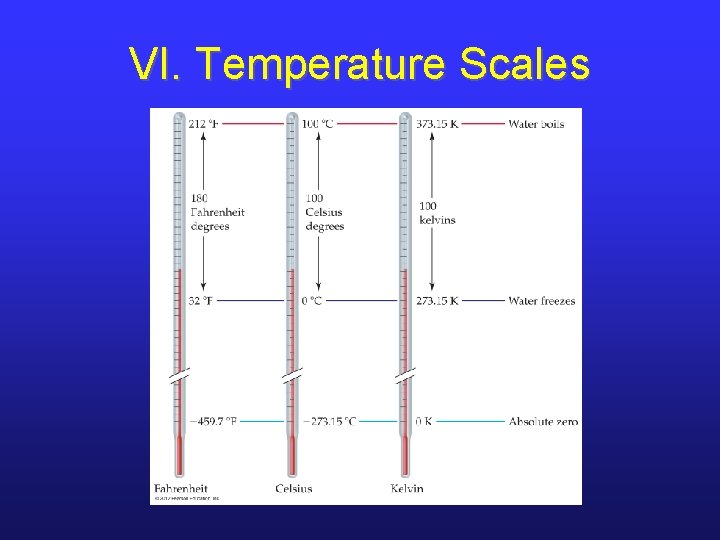
VI. Temperature Scales
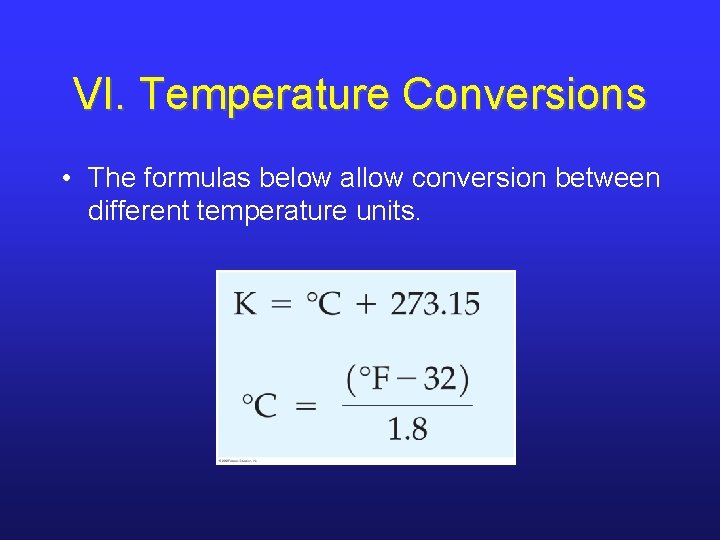
VI. Temperature Conversions • The formulas below allow conversion between different temperature units.
VI. Sample Problem • Convert 67 °F to kelvin and degrees Celsius.
VII. Heating a Substance • When you heat a substance, its temperature changes. • The amount of change depends on the substance. • heat capacity: quantity of heat needed to raise the temp of substance by 1 °C • specific heat capacity: quantity of heat needed to raise temp of 1 g of substance by 1 °C
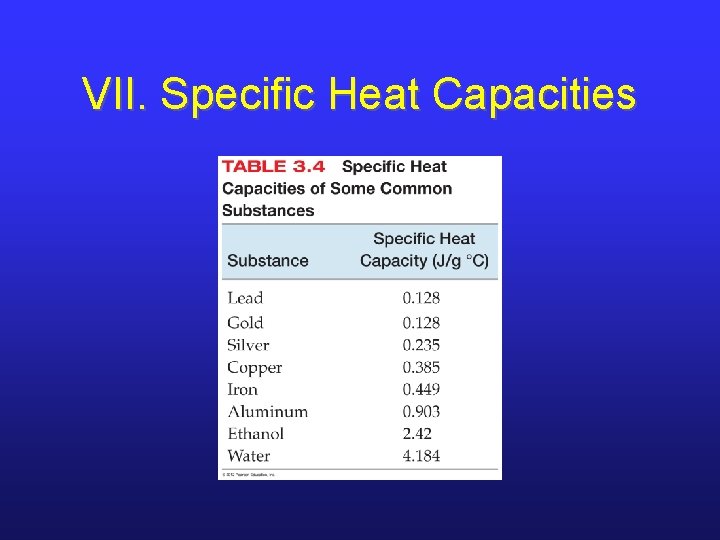
VII. Specific Heat Capacities
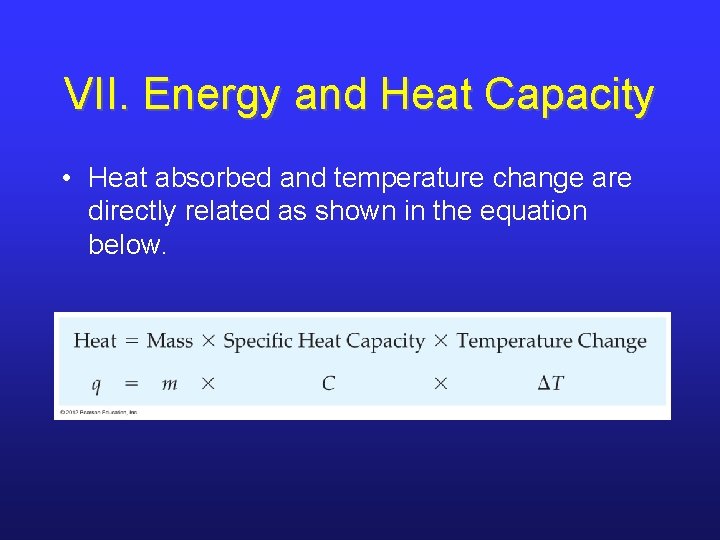
VII. Energy and Heat Capacity • Heat absorbed and temperature change are directly related as shown in the equation below.
VII. Sample Problem • Calculate the heat necessary to warm a 3. 10 g sample of copper from -5. 0 °C to 37. 0 °C if the specific heat capacity of copper is 0. 385 J/g °C.
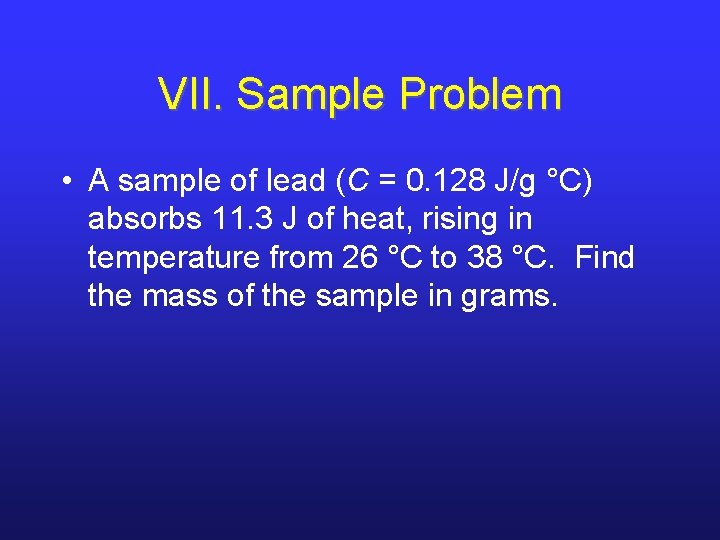
VII. Sample Problem • A sample of lead (C = 0. 128 J/g °C) absorbs 11. 3 J of heat, rising in temperature from 26 °C to 38 °C. Find the mass of the sample in grams.
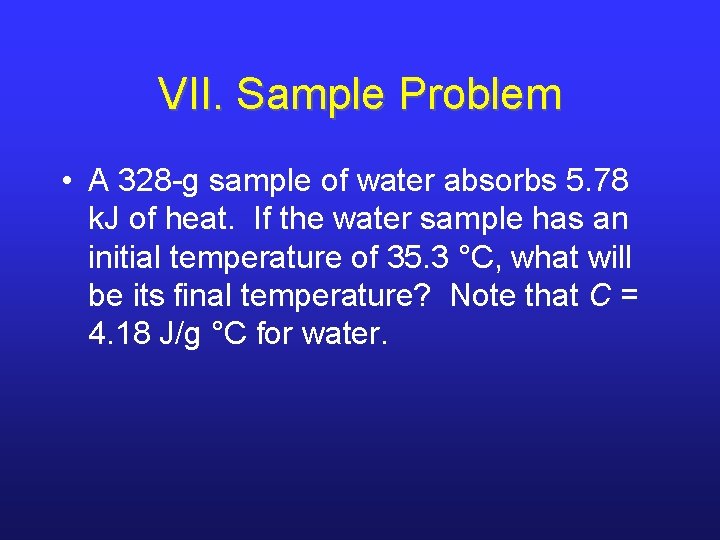
VII. Sample Problem • A 328 -g sample of water absorbs 5. 78 k. J of heat. If the water sample has an initial temperature of 35. 3 °C, what will be its final temperature? Note that C = 4. 18 J/g °C for water.